1 Chronicles 21:29

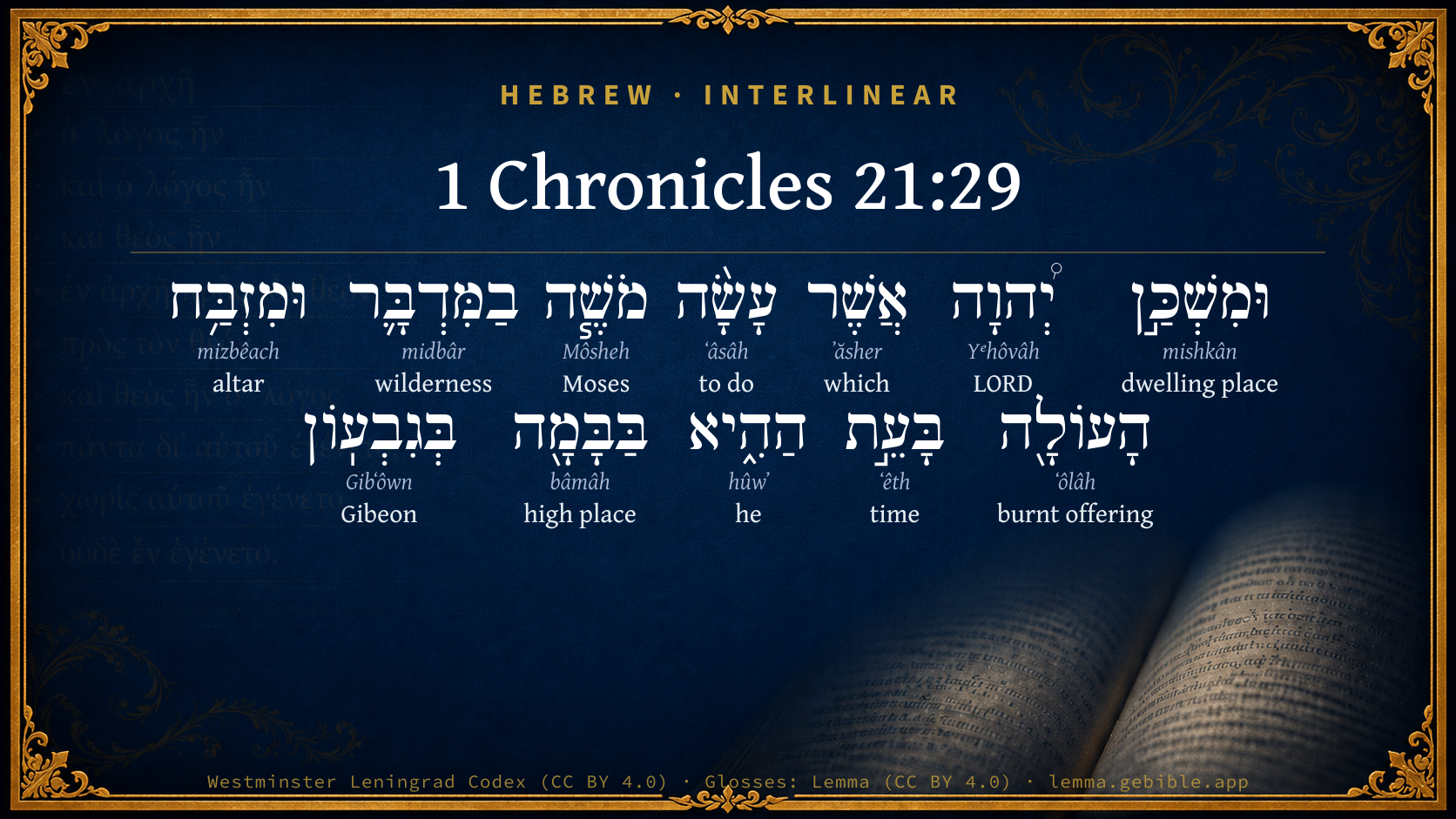
Hebrew (Westminster Leningrad Codex) 1 Chronicles 21:29 appears in the Hebrew Old Testament. The text above is from the Westminster Leningrad Codex. Each word links to its Strong’s number, a concise gloss, and parsing drawn from the Open Scriptures Hebrew Bible morphology. Click any word for its full Brown-Driver-Briggs (BDB) entry.
Download image
Cite this verse

1 Chronicles 21:29 (World English Bible). Public Domain. Lemma interlinear Bible study tool, https://lemma.gebible.app/v/1-chronicles/21/29.

Show BibTeX & RIS
BibTeX
RIS
English Translation
For the tent of Yahweh, which Moses made in the wilderness, and the altar of burnt offering, were at that time in the high place at Gibeon.
World English Bible · Public Domain
Download a study sheet

One document with this verse’s original text, its word-by-word gloss line, the meaning frame, cross-references with their text, attributed commentary, and full source and license credits — printable, and it pastes into notes with its structure intact.

This verse Autodidact and up

Study sheet (.html) Plain text (.txt)

A passage Seminary Student

Up to 50 verses in one chapter. A passage sheet keeps up to 6 commentary sources and 12 cross-references per verse, in the order this page ranks them, and says so on the sheet whenever that leaves anything out. Ask for a single verse and you get the Autodidact verse sheet above.

Everything on this page stays free to read, with no account — the sheet is a download of what is already on screen, not access to it.

Want to remove ads? Support Godless Engineer
Compare translations 3

The same verse in 3 English versions, stacked beneath the original-language interlinear above. Click any original word for its lexicon entry.

Each is an independent rendering of the whole verse — the interlinear is not word-aligned to these translations.

Highlighted words mark where these versions differ — a whole-verse word diff, not a word-by-word alignment.

  • World English Bible Public Domain
    For the tent of Yahweh, which Moses made in the wilderness, and the altar of burnt offering, were at that time in the high place at Gibeon.
  • King James Version Public Domain
    For the tabernacle of the LORD, which Moses made in the wilderness, and the altar of the burnt offering, were at that season in the high place at Gibeon.
  • unfoldingWord Literal Text CC BY-SA 4.0
    For the tabernacle of Yahweh that Moses made in the wilderness and the altar of burnt offering at the high place in Gibeon at that time.

unfoldingWord Literal Text — © unfoldingWord, licensed CC BY-SA 4.0. Word-aligned USFM3 via Door43 (git.door43.org/unfoldingWord/en_ult).

Versions to compare (up to 4)

3 of 4 selected

Show all 18 translations

Every available English version of this verse, each an independent rendering of the whole verse.

  • World English Bible Public Domain
    For the tent of Yahweh, which Moses made in the wilderness, and the altar of burnt offering, were at that time in the high place at Gibeon.
  • Berean Standard Bible Public Domain
    For the tabernacle of the LORD that Moses had made in the wilderness and the altar of burnt offering were presently at the high place in Gibeon,
  • Majority Standard Bible Public Domain
    For the tabernacle of the LORD that Moses had made in the wilderness and the altar of burnt offering were presently at the high place in Gibeon,
  • King James Version Public Domain
    For the tabernacle of the LORD, which Moses made in the wilderness, and the altar of the burnt offering, were at that season in the high place at Gibeon.
  • American Standard Version (1901) Public Domain
    For the tabernacle of Jehovah, which Moses made in the wilderness, and the altar of burnt-offering, were at that time in the high place at Gibeon.
  • Revised Version (1885) Public Domain
    For the tabernacle of the LORD, which Moses made in the wilderness, and the altar of burnt offering, were at that time in the high place at Gibeon.
  • Geneva Bible (1599) Public Domain
    (But the Tabernacle of the Lord which Moses had made in the wildernesse, and the altar of burnt offring were at that season in the hie place at Gibeon.
  • Douay-Rheims (1899) Public Domain
    And David seeing that the Lord had heard him in the thrashingfloor of Oman the Jebusite, forthwith offered victims there.
  • Young's Literal Translation Public Domain
    and the tabernacle of Jehovah that Moses made in the wilderness, and the altar of the burnt-offering, `are' at that time in a high place, in Gibeon;
  • Literal Standard Version CC BY-SA 4.0
    and the Dwelling Place of YHWH that Moses made in the wilderness, and the altar of the burnt-offering, [are] at that time at a high place in Gibeon;
  • Unlocked Literal Bible CC BY-SA 4.0
    Now at that time, Yahweh's tabernacle, which Moses had made in the wilderness, and the altar for burnt offerings, were at the high place at Gibeon.
  • unfoldingWord Literal Text CC BY-SA 4.0
    For the tabernacle of Yahweh that Moses made in the wilderness and the altar of burnt offering at the high place in Gibeon at that time.
  • Darby Bible Public Domain
    And the tabernacle of Jehovah, which Moses had made in the wilderness, and the altar of burnt-offering, were at that time in the high place at Gibeon.
  • World Messianic Bible Public Domain
    For the LORD’s tabernacle, which Moses made in the wilderness, and the altar of burnt offering, were at that time in the high place at Gibeon.
  • Webster's Bible Public Domain
    For the tabernacle of the LORD, which Moses made in the wilderness, and the altar of the burnt-offering, were at that season in the high place at Gibeon.
  • Free Bible Version CC BY-SA 4.0
    At that time the tent of the Lord that Moses had made in the wilderness, and the altar of burnt offering, were at the high place in Gibeon.
  • Bible in Basic English Public Domain
    For the House of the Lord, which Moses had made in the waste land, and the altar of burned offerings, were at that time in the high place at Gibeon.
  • JPS Tanakh (1917) Public Domain
    For the tabernacle of the LORD, which Moses made in the wilderness, and the altar of burnt-offering, were at that time in the high place at Gibeon.

Literal Standard Version (2020), Covenant Press — licensed CC BY-SA 4.0. Text via the HelloAO Bible API (eBible.org). Unlocked Literal Bible (unfoldingWord) — licensed CC BY-SA 4.0. Text via the HelloAO Bible API (eBible.org). unfoldingWord Literal Text — © unfoldingWord, licensed CC BY-SA 4.0. Word-aligned USFM3 via Door43 (git.door43.org/unfoldingWord/en_ult). Free Bible Version, Dr. Jonathan Gallagher — licensed CC BY-SA 4.0. Text via the HelloAO Bible API (eBible.org).

Word by word

More ways to search: Search by grammar → Find every occurrence → Compare this word →

Practice this passage: Drill this verse → Learn its vocabulary →

בְּגִבְעֽוֹן
Gibʻôwn
H1391
“in/at · Gibeon”
Preposition + Noun, Proper
Part of Speech
Preposition + Noun
Type
Proper
Full BDB Definition

Origin: from the same as H1387

TWOT: None

Gibeon = "hill city" - a Levitical city of Benjamin, modern 'el-Jib', which lies 5 miles or 8 kilometers from Jerusalem
  1. וּמִשְׁכַּ֣ן mishkân H4908 “and · dwelling place of” Conjunction + Noun, Common, Masculine, Singular, Construct
  2. יְ֠הוָה Yᵉhôvâh H3068 “LORD” Noun, Proper
  3. אֲשֶׁר ʼăsher H834 “which” Particle, Relative
  4. עָשָׂ֨ה ʻâsâh H6213 “to do” Verb, Qal, Perfect, 3rd Person, Masculine, Singular
  5. מֹשֶׁ֧ה Môsheh H4872 “Moses” Noun, Proper
  6. בַמִּדְבָּ֛ר midbâr H4057 “in/at the · wilderness” Preposition, Determined + Noun, Common, Masculine, Singular, Absolute
  7. וּמִזְבַּ֥ח mizbêach H4196 “and · altar of” Conjunction + Noun, Common, Masculine, Singular, Construct
  8. הָעוֹלָ֖ה ʻôlâh H5930 “the · burnt offering” Particle, Definite Article + Noun, Common, Feminine, Singular, Absolute
  9. בָּעֵ֣ת ʻêth H6256 “in/at the · time” Preposition, Determined + Noun, Common, Both, Singular, Absolute
  10. הַהִ֑יא hûwʼ H1931 “the · he” Particle, Definite Article + Pronoun, Personal, 3rd Person, Feminine, Singular
  11. בַּבָּמָ֖ה bâmâh H1116 “in/at the · high place” Preposition, Determined + Noun, Common, Feminine, Singular, Absolute

About this verse

These counts appear in no published source. They are computed here, from the morphology-tagged text and Lemma’s own curated glosses. What Lemma adds →

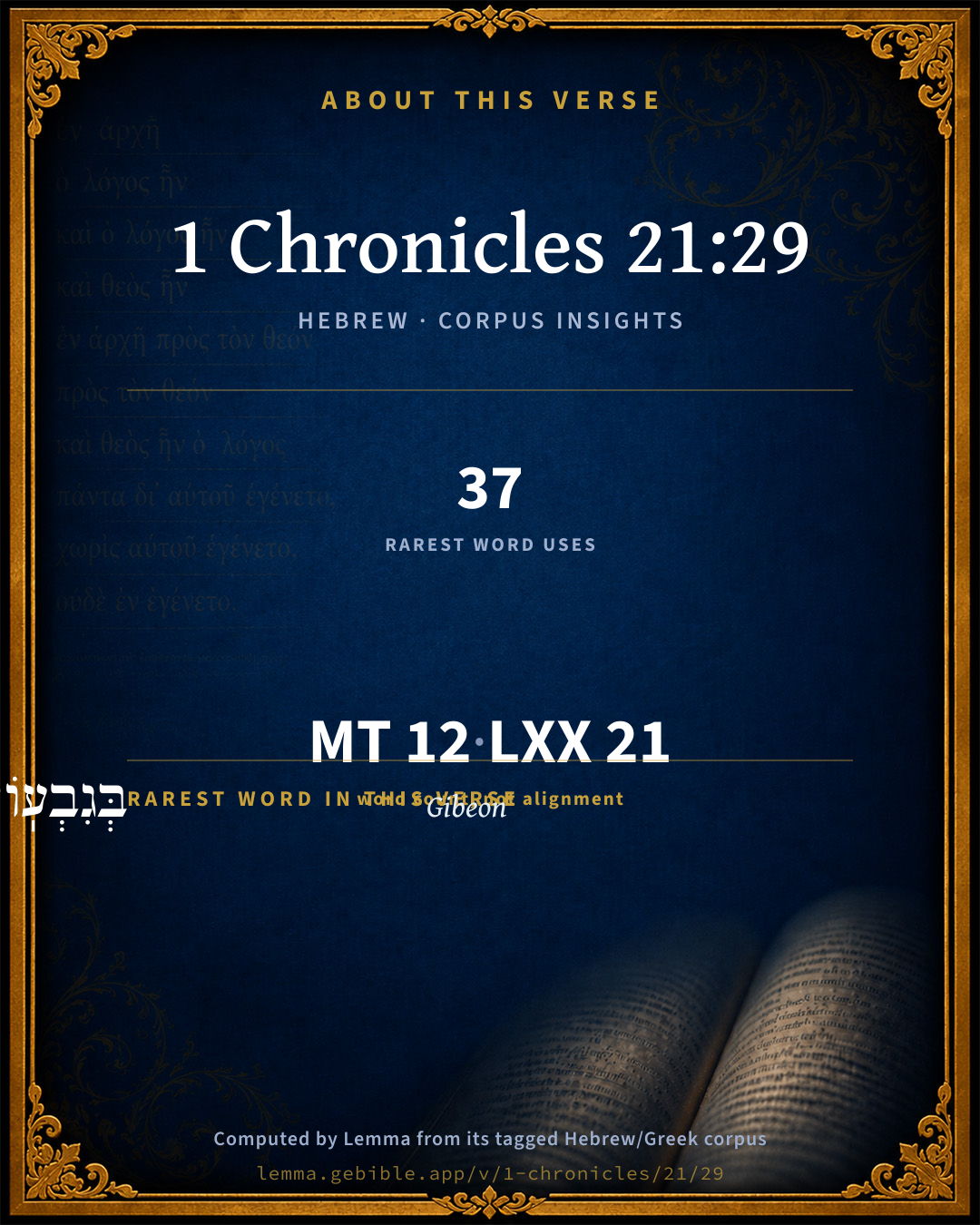
12
words
12
distinct lemmas
Historical
section

Shared distinctive vocabulary

בְּגִבְעֽוֹן Gibeon H1391 occurs in 35 verses of the Hebrew Bible. Also found in:

Grammatical profile

  • 1 verb
  • 9 nouns
  • 1 pronoun
  • 1 particle

Verb forms

  • עָשָׂ֨ה Qal · Perfect

Hebrew & Septuagint length

In English translation the verse runs 27 words from the Hebrew and 29 from the Septuagint (LXX English) — closely comparable.

A rough comparison of the two English renderings, which tokenize alike — not a word-level alignment.

Word counts can differ between the Hebrew and the Greek without any difference in meaning — e.g. the Hebrew direct-object marker אֵת has no separate Greek word, and Greek often adds the article ὁ.

In the original languages it is 12 Hebrew tokens and 21 Greek tokens — but the two are counted differently (Hebrew bundles its prefixes and suffixes into one token; the Greek is in lemma form), so that isn’t a like-for-like length.

Cross-references

5

Topical passages linked to 1 Chronicles 21:29 in the Treasury of Scripture Knowledge — connected by theme and wording, ordered by reader-vote popularity; previews shown in the World English Bible.

  • 1 Chronicles 16:39 and Zadok the priest, and his brothers the priests, before the tent of Yahweh in the high place that was at Gibeon,
  • 2 Chronicles 1:3 So Solomon, and all the assembly with him, went to the high place that was at Gibeon; for there was the tent of meeting of God, which Moses the servant of Yahweh had made in the wilderness.
  • 2 Chronicles 1:13 So Solomon came from the high place that was at Gibeon, from before the tent of meeting, to Jerusalem; and he reigned over Israel.
  • Exodus 40:1–38 Yahweh spoke to Moses, saying,
  • 1 Kings 3:4–15 The king went to Gibeon to sacrifice there; for that was the great high place: a thousand burnt offerings did Solomon offer on that altar.

Cross-references courtesy of OpenBible.info (CC BY 4.0).

Hebrew and Greek witnesses Masoretic Hebrew ↔ Greek Septuagint

The same verse in the two great witnesses to the Old Testament, shown verse-for-verse.

These are two independent witnesses, not word-aligned to each other, and the Septuagint is shown in lemma (dictionary) form.

Hebrew 1 Chronicles 21:29 Masoretic · Westminster Leningrad Codex

וּמִשְׁכַּ֣ן יְ֠הוָה אֲשֶׁר עָשָׂ֨ה מֹשֶׁ֧ה בַמִּדְבָּ֛ר וּמִזְבַּ֥ח הָעוֹלָ֖ה בָּעֵ֣ת הַהִ֑יא בַּבָּמָ֖ה בְּגִבְעֽוֹן

For the tent of Yahweh, which Moses made in the wilderness, and the altar of burnt offering, were at that time in the high place at Gibeon.

World English Bible · Public Domain

Greek LXX 1 Chronicles 21:29 Septuagint · lemma form

καί σκηνή κύριος ὅς ποιέω μωυσῆς ἐν ὁ ἔρημος καί θυσιαστήριον ὁ ὁλοκαύτωμα ἐν ὁ καιρός ἐκεῖνος ἐν βαμα ἐν γαβαων

And the tabernacle of the Lord which Moses made in the wilderness, and the altar of whole burnt offerings, were at that time in the high place at Gabaon.

LXX2012 (modern English Septuagint) · Public Domain

Hebrew: Westminster Leningrad Codex (CC BY 4.0). Greek: Septuagint (public domain); English from LXX2012 (modern English Septuagint) (Public Domain). How the Septuagint differs from the Hebrew →

Commentary

Notes on 1 Chronicles 21:29 from classic Christian and Jewish commentators (each source and its license shown beneath its notes). The classic Christian expositions comment on the surrounding passage and are grouped to its opening verse, so a note may address several verses; the Jewish commentaries on the Tanakh (Rashi and others) are per-verse, so they appear only where the commentator wrote on this verse.

Lemma curates 59 commentaries, every one of them public domain or Creative Commons licensed, each selected and text-cleaned for this edition rather than reprinted as found. About our sources →

Ellicott's Commentary for English Readers

(29) For the tabernacle.—Now the dwelling-place of Jehovah: in contrast with Oman’s threshingfloor, the new sanctuary.

(29, 30) A parenthesis, relating why it was that David did not rather resort to the ancient Tabernacle, which then stood at Gibeon. (Comp. 1Ch_16:39-40.)

A Bible Commentary for English Readers, edited by Charles John Ellicott (1878–1897) — public domain. Text from a community e-Sword module.

The Cambridge Bible for Schools and Colleges

gen. ed. J. J. S. Perowne

29. For] The beginning of a parenthesis.

the tabernacle of the Lord] See the prefatory note to ch. 23; also cp. 1Ch_16:1; 1Ch_16:39, and 2Ch_1:3.

The Cambridge Bible for Schools and Colleges (gen. ed. J. J. S. Perowne; Cambridge University Press, 1878–1918) — public domain. Text from a community e-Sword module.

John Gill's Exposition

But David could not go before it to inquire of God,.... Which yet was the proper place to seek the Lord in: the reason follows:

for he was afraid, because of the sword of the angel of the Lord; which had so terrified him, that he was so weak that he could not go; and he feared that, should he attempt to go, while he was going thither, at such a distance, the angel would make a terrible slaughter in Jerusalem, and therefore he durst not go and leave it; and besides, as the Lord had commanded him to build an altar there, he might fear it would displease him, should he depart from it; and the rather, as hereby he pointed out to him the place where the temple should be built, and sacrifices offered, as appears from what he says in the beginning of the next chapter.

Next: 1 Chronicles Chapter 22

John Gill's Exposition of the Whole Bible (1746–1763) — public domain (CC PDM 1.0). Text via the HelloAO Bible API.

Whedon's Commentary on the Bible

Daniel D. Whedon

29. The tabernacle… and the altar… at Gibeon — See note on chap.

1Ch_16:39.

Daniel D. Whedon (gen. ed.), Commentary on the Old and New Testaments (1874–1909) — public domain. Text from a community e-Sword module.

The Pulpit Commentary

Vers. 29, 30.

The relics left on feeling from the humbling scenes of life.

have supposed that the terror which David had felt at the sight of the destroying angel (ver. 16) produced a bodily infirmity which made it physically impossible for him to go to Gibeon; but probably no more than a moral impediment is meant. David, knowing that by sacrifice on this altar he had caused the angel to stay his band, was afraid to transfer his offerings elsewhere, lest the angel should resume his task, and pestilence again break out." David seemed ever after to see that sword before the tabernacle. It may be said that all Divine dealings have an immediate, and also a remote and permanent design. We are often dwelling on the immediate lessons that are impressed, but probably the best lessons are those which are learned by-and-by, after a while, when the excitement of the incidents has passed, and the whole is taken into quiet and serious review. Things seem so different when they are calmly looked back upon; aspects and relations come into view which we had not previously suspected. We know how true this is of our review of the lives of those whom we have known and loved; but it is equally true of the events and incidents of our own lives.

I A MAN"S SINS AND FAILINGS LEAVE THEIR TRACES ON CHARACTER AND FEELING. Even when they are forgiven, and a man is fully recovered from their influence, he cannot be rid of them altogether. There is a new reverence, or a fear of self, or a perilous openness to particular temptation, or a strange shyness left behind, of which the man will never be rid. Illustrative cases from Scripture and modem life may be given. A good Scripture instance, in which there was a humbling experience, but one free from the bitterness of personal sin, is that of King Hezekiah (see Isa_38:15, "I shall go softly all my (spared) years in the bitterness of my soul").

II SUCH CONTINUED FEELING INSENSIBLY GUIDES FUTURE CONDUCT. This is seen in the case of David. Perhaps he hardly admitted to himself what it really was that kept him from going to inquire of God at Gibeon. And so we find in our fellow-men and in ourselves singular hesitations; we feel difficulties and shrink back, when there seems no real occasion. We cannot tell others, we hardly like to admit to ourselves, that it is the relic of some great stumble, or even fall and sin and shame; the very real ghost of our former ill. Compare the man who, late in life, said, remembering his riotous youth-time, "I would give my right arm if I could be quit of the evils left in thought from my youthful sins.

III SUCH CONTINUED FEELING INDICATES A CONTINUED SANCTIFYING WORK, For God graciously uses, not merely things themselves, but their after-effects. No influence has its bare limits. The after-effects may differ greatly in different dispositions, but some of God"s best work in our hearts and lives is done by means of them. This may be illustrated by the after-influence exerted on the Apostle St. Peter by his sad and shameful fall. And David expresses this continuous sanctifying influence of remembered humblings when he says, "Before I was afflicted I went astray, but now will I keep thy Word.

Apply especially to that great work of sanctifying, the producing of the humility of the true dependence. Show that it is most perfectly wrought in the fallen and forgiven, who ever live in the solemn shadow of the great experience. R.T.

The Pulpit Commentary (1880–1919), ed. H.D.M. Spence-Jones & Joseph S. Exell — public domain. Text from a community e-Sword module.

Keil & Delitzsch

C. F. Keil & F. Delitzsch

But David could not go before it to inquire of God,.... Which yet was the proper place to seek the Lord in: the reason follows:

for he was afraid, because of the sword of the angel of the Lord; which had so terrified him, that he was so weak that he could not go; and he feared that, should he attempt to go, while he was going thither, at such a distance, the angel would make a terrible slaughter in Jerusalem, and therefore he durst not go and leave it; and besides, as the Lord had commanded him to build an altar there, he might fear it would displease him, should he depart from it; and the rather, as hereby he pointed out to him the place where the temple should be built, and sacrifices offered, as appears from what he says in the beginning of the next chapter.

Next: 1 Chronicles Chapter 22

Keil & Delitzsch — Biblical Commentary on the Old Testament (1861–1891) — public domain (CC PDM 1.0). Text via the HelloAO Bible API. (Old Testament only.)

Rashi

Rabbi Shlomo Yitzchaki (Rashi)

and the altar of the burnt offerings of Moses was still at that time in the high place, which was in Gibeon.

Rashi on the Tanakh — English translations: “The Judaica Press complete Tanach with Rashi, translated by A. J. Rosenberg” (CC BY 4.0); “Pentateuch with Rashi's commentary by M. Rosenbaum and A.M. Silbermann, 1929-1934” (public domain); “The Metsudah Tanach series, Lakewood, N.J” (CC BY 4.0); and “The Book of Joshua, Metsudah Publications, 1997” (CC BY 4.0). Text via Sefaria.

Lesson kit

Teaching starters — assembled from the data on this page, not authored interpretation. Every prompt links to the verse data it draws on. Edit before teaching.

1 Chronicles, in the Historical, opens this verse with 12 words (12 distinct Hebrew lemmas). Its most distinctive word is Gibʻôwn (“Gibeon”). A historical commentator’s framing appears above. Read the whole chapter for the surrounding context.

Discussion questions

  1. What does “Gibeon” (Gibʻôwn) contribute to the verse as a whole?
  2. How does Joshua 9:3, which shares the word «Gibeon», read alongside this verse?
  3. These translations render this verse differently; the difference is in the English rendering, not the original. What questions does that raise?
  4. «עָשָׂ֨ה» is a Qal Perfect verb. How does that grammatical form shape the action described?
  5. Compare how Ellicott's Commentary for English Readers and The Cambridge Bible for Schools and Colleges read this verse. Where do they agree or differ?

Things to notice

Reading settings

Reading text

Shown beneath each verse's original-language words.

Old Testament
Old Testament edition

Read the OT as the Masoretic Hebrew (MT) or the Greek Septuagint (LXX).

English shown for the Greek Septuagint (in the Hebrew ↔ Greek comparison).

Comparing translations? Open the Compare panel on any verse page to stack up to four side by side.