Jeremiah 20:16

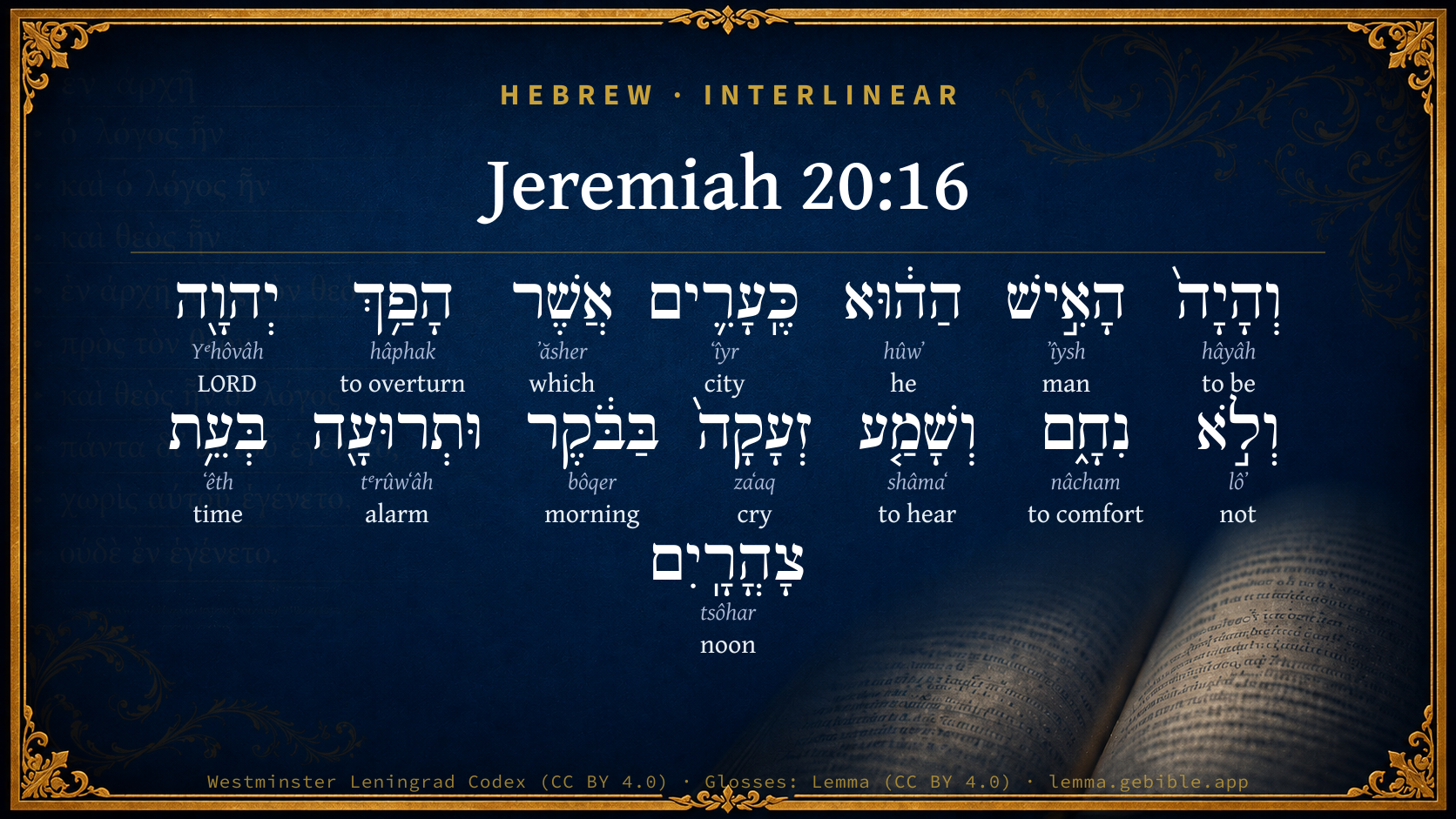
Hebrew (Westminster Leningrad Codex) Jeremiah 20:16 appears in the Hebrew Old Testament. The text above is from the Westminster Leningrad Codex. Each word links to its Strong’s number, a concise gloss, and parsing drawn from the Open Scriptures Hebrew Bible morphology. Click any word for its full Brown-Driver-Briggs (BDB) entry.
Download image
Cite this verse

Jeremiah 20:16 (World English Bible). Public Domain. Lemma interlinear Bible study tool, https://lemma.gebible.app/v/jeremiah/20/16.

Show BibTeX & RIS
BibTeX
RIS
English Translation
Let that man be as the cities which Yahweh overthrew, and didn't repent: and let him hear a cry in the morning, and shouting at noontime;
World English Bible · Public Domain
Download a study sheet

One document with this verse’s original text, its word-by-word gloss line, the meaning frame, cross-references with their text, attributed commentary, and full source and license credits — printable, and it pastes into notes with its structure intact.

This verse Autodidact and up

Study sheet (.html) Plain text (.txt)

A passage Seminary Student

Up to 50 verses in one chapter. A passage sheet keeps up to 6 commentary sources and 12 cross-references per verse, in the order this page ranks them, and says so on the sheet whenever that leaves anything out. Ask for a single verse and you get the Autodidact verse sheet above.

Everything on this page stays free to read, with no account — the sheet is a download of what is already on screen, not access to it.

Want to remove ads? Support Godless Engineer
Compare translations 3

The same verse in 3 English versions, stacked beneath the original-language interlinear above. Click any original word for its lexicon entry.

Each is an independent rendering of the whole verse — the interlinear is not word-aligned to these translations.

Highlighted words mark where these versions differ — a whole-verse word diff, not a word-by-word alignment.

  • World English Bible Public Domain
    Let that man be as the cities which Yahweh overthrew, and didn't repent: and let him hear a cry in the morning, and shouting at noontime;
  • King James Version Public Domain
    And let that man be as the cities which the LORD overthrew, and repented not: and let him hear the cry in the morning, and the shouting at noontide;
  • unfoldingWord Literal Text CC BY-SA 4.0
    And let that man be like the cities that Yahweh overthrew and did not relent. And let him hear an outcry in the morning and a shout at the time of noon,

unfoldingWord Literal Text — © unfoldingWord, licensed CC BY-SA 4.0. Word-aligned USFM3 via Door43 (git.door43.org/unfoldingWord/en_ult).

Versions to compare (up to 4)

3 of 4 selected

Show all 18 translations

Every available English version of this verse, each an independent rendering of the whole verse.

  • World English Bible Public Domain
    Let that man be as the cities which Yahweh overthrew, and didn't repent: and let him hear a cry in the morning, and shouting at noontime;
  • Berean Standard Bible Public Domain
    May that man be like the cities that the LORD overthrew without compassion. May he hear an outcry in the morning and a battle cry at noon,
  • Majority Standard Bible Public Domain
    May that man be like the cities that the LORD overthrew without compassion. May he hear an outcry in the morning and a battle cry at noon,
  • King James Version Public Domain
    And let that man be as the cities which the LORD overthrew, and repented not: and let him hear the cry in the morning, and the shouting at noontide;
  • American Standard Version (1901) Public Domain
    And let that man be as the cities which Jehovah overthrew, and repented not: and let him hear a cry in the morning, and shouting at noontime;
  • Revised Version (1885) Public Domain
    And let that man be as the cities which the LORD overthrew, and repented not: and let him hear a cry in the morning, and shouting at noontide;
  • Geneva Bible (1599) Public Domain
    And let that man be as the cities, which the Lord hath ouerturned and repented not: and let him heare the cry in the morning, and the showting at noone tide,
  • Douay-Rheims (1899) Public Domain
    Let that man be as the cities that the Lord hath overthrown, and hath not repented: let him hear a cry in the morning, and howling at noontide:
  • Young's Literal Translation Public Domain
    Then hath that man been as the cities, That Jehovah overthrew, and repented not, And he hath heard a cry at morning, And a shout at time of noon.
  • Literal Standard Version CC BY-SA 4.0
    Then that man has been as the cities, || That YHWH overthrew, and did not relent, || And he has heard a cry in the morning, || And a shout at noontime.
  • Unlocked Literal Bible CC BY-SA 4.0
    Let that man be like the cities that Yahweh overthrew and he did not have compassion on them. Let him hear a cry for help in the dawn, a battle cry at noontime,
  • unfoldingWord Literal Text CC BY-SA 4.0
    And let that man be like the cities that Yahweh overthrew and did not relent. And let him hear an outcry in the morning and a shout at the time of noon,
  • Darby Bible Public Domain
    And let that man be as the cities which Jehovah overthrew, and repented not; and let him hear a cry in the morning, and a shouting at noonday,
  • World Messianic Bible Public Domain
    Let that man be as the cities which the LORD overthrew, and didn’t repent. Let him hear a cry in the morning, and shouting at noontime,
  • Webster's Bible Public Domain
    And let that man be as the cities which the LORD overthrew, and repented not: and let him hear the cry in the morning, and the shouting at noon;
  • Free Bible Version CC BY-SA 4.0
    May that man be like the towns that the Lord destroyed without mercy. May he hear shouts of alarm in the morning and war cries at noon,
  • Bible in Basic English Public Domain
    May that man be like the towns overturned by the Lord without mercy: let a cry for help come to his ears in the morning, and the sound of war in the middle of the day;
  • JPS Tanakh (1917) Public Domain
    And let that man be as the cities which the LORD overthrew, and repented not; and let him hear a cry in the morning, and an alarm at noontide;

Literal Standard Version (2020), Covenant Press — licensed CC BY-SA 4.0. Text via the HelloAO Bible API (eBible.org). Unlocked Literal Bible (unfoldingWord) — licensed CC BY-SA 4.0. Text via the HelloAO Bible API (eBible.org). unfoldingWord Literal Text — © unfoldingWord, licensed CC BY-SA 4.0. Word-aligned USFM3 via Door43 (git.door43.org/unfoldingWord/en_ult). Free Bible Version, Dr. Jonathan Gallagher — licensed CC BY-SA 4.0. Text via the HelloAO Bible API (eBible.org).

Word by word

More ways to search: Search by grammar → Find every occurrence → Compare this word →

Practice this passage: Drill this verse → Learn its vocabulary →

זְעָקָה֙
zaʻaq
H2201
“cry”
Noun, Common, Feminine, Singular, Absolute
Part of Speech
Noun
Type
Common
Gender
Feminine
Number
Singular
State
Absolute
Full BDB Definition

Origin: from H2199

TWOT: 570a

cry, outcry - outcry - cry of distress - outcry, clamour
  1. וְהָיָה֙ hâyâh H1961 “and · to be” Conjunction + Verb, Qal, Sequential Perfect, 3rd Person, Masculine, Singular
  2. הָאִ֣ישׁ ʼîysh H376 “the · man” Particle, Definite Article + Noun, Common, Masculine, Singular, Absolute
  3. הַה֔וּא hûwʼ H1931 “the · he” Particle, Definite Article + Pronoun, Personal, 3rd Person, Masculine, Singular
  4. כֶּֽעָרִ֛ים ʻîyr H5892 “like/as the · cities” Preposition, Determined + Noun, Common, Feminine, Plural, Absolute
  5. אֲשֶׁר ʼăsher H834 “which” Particle, Relative
  6. הָפַ֥ךְ hâphak H2015 “to overturn” Verb, Qal, Perfect, 3rd Person, Masculine, Singular
  7. יְהוָ֖ה Yᵉhôvâh H3068 “LORD” Noun, Proper
  8. וְלֹ֣א lôʼ H3808 “and · not” Conjunction + Particle, Negative
  9. נִחָ֑ם nâcham H5162 “to comfort” Verb, Niphal, Perfect, 3rd Person, Masculine, Singular
  10. וְשָׁמַ֤ע shâmaʻ H8085 “and · to hear” Conjunction + Verb, Qal, Sequential Perfect, 3rd Person, Masculine, Singular
  11. בַּבֹּ֔קֶר bôqer H1242 “in/at the · morning” Preposition, Determined + Noun, Common, Masculine, Singular, Absolute
  12. וּתְרוּעָ֖ה tᵉrûwʻâh H8643 “and · alarm” Conjunction + Noun, Common, Feminine, Singular, Absolute
  13. בְּעֵ֥ת ʻêth H6256 “in/at · time of” Preposition + Noun, Common, Both, Singular, Construct
  14. צָהֳרָֽיִם tsôhar H6672 “noon” Noun, Common, Masculine, Plural, Absolute

About this verse

These counts appear in no published source. They are computed here, from the morphology-tagged text and Lemma’s own curated glosses. What Lemma adds →

15
words
15
distinct lemmas
Prophets
section

Notable vocabulary

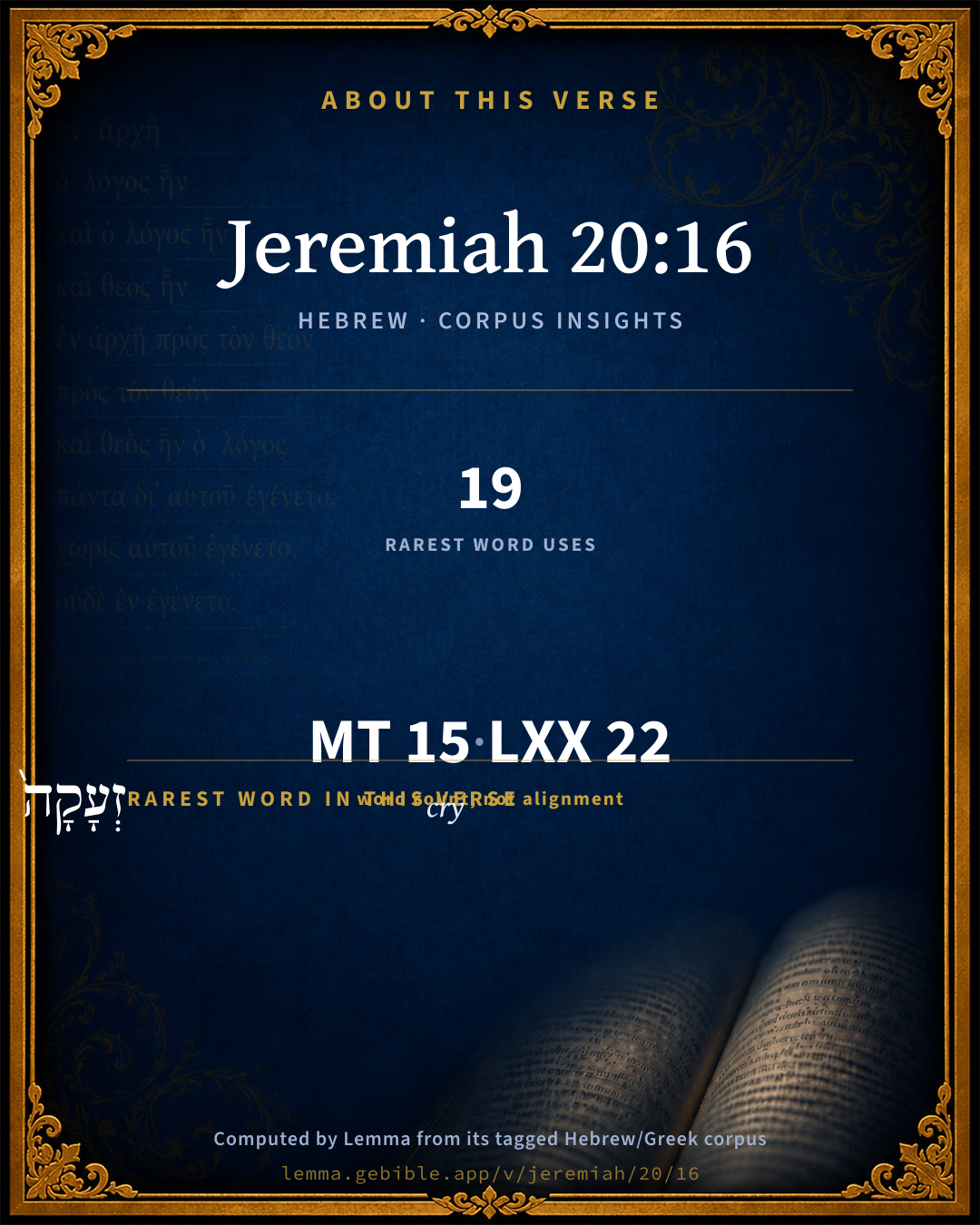
The rarest word here is זְעָקָה֙ cry H2201 — appearing just 19 times in the whole Hebrew Bible.

Shared distinctive vocabulary

זְעָקָה֙ cry H2201 occurs in 19 verses of the Hebrew Bible. Also found in:

Grammatical profile

  • 4 verbs
  • 8 nouns
  • 1 pronoun
  • 2 particles

Verb forms

  • וְהָיָה֙ Qal · Sequential Perfect
  • הָפַ֥ךְ Qal · Perfect
  • נִחָ֑ם Niphal · Perfect
  • וְשָׁמַ֤ע Qal · Sequential Perfect

Hebrew & Septuagint length

In the original languages it is 15 Hebrew tokens and 22 Greek tokens — but the two are counted differently (Hebrew bundles its prefixes and suffixes into one token; the Greek is in lemma form), so that isn’t a like-for-like length.

Cross-references

21

Topical passages linked to Jeremiah 20:16 in the Treasury of Scripture Knowledge — connected by theme and wording, ordered by reader-vote popularity; previews shown in the World English Bible.

  • Jeremiah 18:22 Let a cry be heard from their houses, when you shall bring a troop suddenly on them; for they have dug a pit to take me, and hid snares for my feet.
  • Deuteronomy 29:23 [and that] the whole land of it is sulfur, and salt, [and] a burning, [that] it is not sown, nor bears, nor any grass grows therein, like the overthrow of Sodom and Gomorrah, Admah and Zeboiim, which Yahweh overthrew in his anger, and in his wrath:
  • Jeremiah 48:3–4 The sound of a cry from Horonaim, desolation and great destruction!
  • Genesis 19:24–25 Then Yahweh rained on Sodom and on Gomorrah sulfur and fire from Yahweh out of the sky.
  • Jeremiah 4:19 My anguish, my anguish! I am pained at my very heart; my heart is disquieted in me; I can't hold my peace; because you have heard, O my soul, the sound of the trumpet, the alarm of war.
  • Jeremiah 18:8 if that nation, concerning which I have spoken, turn from their evil, I will repent of the evil that I thought to do to them.
  • Jeremiah 26:13 Now therefore amend your ways and your doings, and obey the voice of Yahweh your God; and Yahweh will repent him of the evil that he has pronounced against you.
  • Ezekiel 21:22 In his right hand was the divination [for] Jerusalem, to set battering rams, to open the mouth in the slaughter, to lift up the voice with shouting, to set battering rams against the gates, to cast up mounds, to build forts.
  • Hosea 10:14 Therefore a battle roar will arise among your people, And all your fortresses will be destroyed, As Shalman destroyed Beth Arbel in the day of battle. The mother was dashed in pieces with her children.
  • Hosea 11:8 "How can I give you up, Ephraim? How can I hand you over, Israel? How can I make you like Admah? How can I make you like Zeboiim? My heart is turned within me, My compassion is aroused.
  • Amos 1:14 But I will kindle a fire in the wall of Rabbah, And it will devour its palaces, With shouting in the day of battle, With a tempest in the day of the whirlwind;
  • Amos 2:2 But I will send a fire on Moab, And it will devour the palaces of Kerioth; And Moab will die with tumult, with shouting, and with the sound of the trumpet;
  • Amos 4:11 "I have overthrown some of you, As when God overthrew Sodom and Gomorrah, And you were like a burning stick plucked out of the fire; Yet you haven't returned to me," says Yahweh.
  • Jonah 3:4 Jonah began to enter into the city a day's journey, and he cried out, and said, "Yet forty days, and Nineveh shall be overthrown!"
  • Jonah 3:9–10 Who knows whether God will not turn and repent, and turn away from his fierce anger, so that we might not perish?"
  • Jonah 4:2 He prayed to Yahweh, and said, "Please, Yahweh, wasn't this what I said when I was still in my own country? Therefore I hurried to flee to Tarshish, for I knew that you are a gracious God, and merciful, slow to anger, and abundant in loving kindness, and you repent of the evil.
  • Zephaniah 1:16 a day of the trumpet and alarm, against the fortified cities, and against the high battlements.
  • Zephaniah 2:9 Therefore as I live, says Yahweh of Hosts, the God of Israel, surely Moab will be as Sodom, and the children of Ammon as Gomorrah, a possession of nettles, and salt pits, and a perpetual desolation. The remnant of my people will plunder them, and the survivors of my nation will inherit them.
  • Luke 17:29 but in the day that Lot went out from Sodom, it rained fire and sulfur from the sky, and destroyed them all.
  • 2 Peter 2:6 and turning the cities of Sodom and Gomorrah into ashes, condemned them to destruction, having made them an example to those who would live ungodly;
  • Jude 1:7 Even as Sodom and Gomorrah, and the cities around them, having, in the same way as these, given themselves over to sexual immorality and gone after strange flesh, are set forth as an example, suffering the punishment of eternal fire.

Cross-references courtesy of OpenBible.info (CC BY 4.0).

Hebrew and Greek witnesses Masoretic Hebrew ↔ Greek Septuagint

The same verse in the two great witnesses to the Old Testament, shown verse-for-verse.

These are two independent witnesses, not word-aligned to each other, and the Septuagint is shown in lemma (dictionary) form.

Hebrew Jeremiah 20:16 Masoretic · Westminster Leningrad Codex

וְהָיָה֙ הָאִ֣ישׁ הַה֔וּא כֶּֽעָרִ֛ים אֲשֶׁר הָפַ֥ךְ יְהוָ֖ה וְלֹ֣א נִחָ֑ם וְשָׁמַ֤ע זְעָקָה֙ בַּבֹּ֔קֶר וּתְרוּעָ֖ה בְּעֵ֥ת צָהֳרָֽיִם

Let that man be as the cities which Yahweh overthrew, and didn't repent: and let him hear a cry in the morning, and shouting at noontime;

World English Bible · Public Domain

Greek LXX Structure differs

In the Septuagint, Jeremiah is about an eighth shorter than the Hebrew and arranges its material differently — the Oracles Against the Nations (Hebrew chapters 46–51) appear in the middle of the Greek book, after 25:13. Because the chapter and verse boundaries do not line up, a verse-for-verse comparison with the Hebrew is not shown.

A verse-for-verse comparison isn’t shown here because the chapters and verses don’t line up. Switch to the LXX edition with the MT / LXX toggle above to read the Greek directly.

On this verse, John Gill's Exposition discusses the Septuagint’s reading. Read the note in Commentary ↓

Hebrew: Westminster Leningrad Codex (CC BY 4.0). Greek: Septuagint (public domain); English from a public-domain English Septuagint. How the Septuagint differs from the Hebrew →

Targum (Aramaic paraphrase)

1

The Targum is the ancient Jewish Aramaic paraphrase of the Hebrew Scriptures — an interpretive translation, not the Hebrew text itself. Onkelos (literal) and Pseudo-Jonathan (expansive) render the Torah, and Jonathan the Prophets. Coverage is partial: where no permissively-licensed English translation exists for a verse, only the Aramaic is shown. This is verse-level text, not a word-by-word alignment to the Hebrew.

  1. Targum Jonathan Prophets (Joshua–Malachi)
    וִיהֵי גַבְרָא הַהוּא כְּקִרְוַיָא דַהֲפָךְ יְיָ בְּרוּגְזֵיהּ וְלָא אִתּוֹתְבָא וְיִשְׁמַע צַוְחָתָא בְּצַפְרָא וְיַבָּבָא בְּעִדַן טִיהֲרָא:

    (no public-domain English translation for this verse)

    Targum Jonathan — Aramaic: “Mikraot Gedolot” (public domain). English: “Sefaria Community Translation” (CC0 1.0 (public-domain dedication)); “London "Chaldee Paraphrase," 1871” (public domain). Text via Sefaria.

Commentary

Notes on Jeremiah 20:16 from classic Christian and Jewish commentators (each source and its license shown beneath its notes). The classic Christian expositions comment on the surrounding passage and are grouped to its opening verse, so a note may address several verses; the Jewish commentaries on the Tanakh (Rashi and others) are per-verse, so they appear only where the commentator wrote on this verse.

Lemma curates 59 commentaries, every one of them public domain or Creative Commons licensed, each selected and text-cleaned for this edition rather than reprinted as found. About our sources →

Trapp's Complete Commentary

John Trapp

Jer 20:16 And let that man be as the cities which the LORD overthrew, and repented not: and let him hear the cry in the morning, and the shouting at noontide;

Ver. 16. And let that man be.] A most bitter curse, but causeless. The devil of discontent, where it prevaileth, maketh the heart to be for the time a little hell, {a} as we see in Moses, Job, David, Jeremiah, men otherwise made up of excellences. These sinned, but not with full consent. A godly man hath a flea in his ear, somewhat within, which saith, "Dost thou well to be angry, Jonah?" {Jon 4:4}

{a} ταραττειν, thence ταρταρος.

John Trapp, A Commentary or Exposition upon All the Books of the Old and New Testament (1647–1656) — public domain. Text from a community e-Sword module.

Tyndale Open Study Notes

Tyndale Open Resources

20:16 The cities of old were probably Sodom and Gomorrah (Gen 19:24-29).

Tyndale Open Study Notes — © Tyndale Open Resources, licensed CC BY-SA 4.0. Text via the HelloAO Bible API.

Geneva Bible (1599)

Geneva Bible translators

Alluding to the destruction of Sodom and Gomorrah, Gen. 19:25.

Geneva Bible (1599) marginal notes — public domain. Text via Bolls.life.

Jamieson, Fausset & Brown

Robert Jamieson, A. R. Fausset & David Brown

the cities--Sodom and Gomorrah.

cry . . . morning . . . noontide--that is, Let him be kept in alarm the whole day (not merely at night when terrors ordinarily prevail, but in daytime when it is something extraordinary) with terrifying war shouts, as those in a besieged city (Jer 18:22).

Jamieson, Fausset & Brown — Commentary Critical and Explanatory on the Whole Bible (1871) — public domain (CC PDM 1.0). Text via the HelloAO Bible API.

Adam Clarke's Commentary

Verse 16. And let him hear the cry] Let him be in continual alarms.

Adam Clarke's Commentary on the Bible (1810–1826) — public domain. Text from a community e-Sword/MySword module.

John Calvin's Commentaries

And he adds, Who with joy made him joyful We see, as it is commonly said, how he mingles heaven and earth; for had it been in his power, when this frenzy possessed his mind, he would have certainly disturbed all the elements. But more grievous and more inordinate is what follows, Let that man be like the cities which God destroyed without repentance Why did he imprecate on an innocent man the destruction of Sodom and Gomorrah? and then he speaks not of temporal punishment, but devotes the man to endless perdition, for that is the import of the words, and he repented not; as though he had said, “May God be angry with him, without shewing any mercy, but manifest himself as wholly implacable, as he dealt with Sodom, which he at once destroyed without leaving it any hope.” Had he spoken of an inveterate enemy, he ought to have kept within those bounds prescribed to all God’s children; but he had nothing against the man who brought the news to his father. We hence see how he was led away as it were by an insane impulse. But let us hence learn to restrain, in due time, our feelings, which will pass over all bounds if we indulge them; for they will break out then as it were into fury, as the case was with the Prophet.

He also adds, Let him hear a cry in the morning, and a tumult at noon-tide Here he devotes an innocent man to perpetual inquietude. And mention is made of the dawn, for we know that terrors occur during darkness in the night. If anything happens in the day-time, we inquire what it is, and we are not so frightened; but when there is any noise in the night, fear takes full possession of us. There is then something monstrous in what the Prophet expresses here. Hence, also, we more fully learn how very hot was his indignation, that he thus wished perpetual torments to an innocent man. In the morning, he says, let him hear a cry, and at noon a tumult Had he said, “Let him hear a cry perpetually,” it would not have been so grievous. It now follows, —

John Calvin's Commentaries (1540-1563) — public domain. Text from the Calvin Translation Society English edition (1840s-50s) via the Christian Classics Ethereal Library (ccel.org). Calvin's coverage is partial (roughly two-thirds of the Bible); uncommented books and verses are honest gaps, never fabricated. The 19th-century editor's footnotes and remarks are omitted so the notes are faithfully Calvin's own voice.

Ellicott's Commentary for English Readers

(16) The cities which the Lord overthrew.—The verb is the same as that used in Gen_19:29, and the reference is clearly to the “cities of the plain,” whose destruction is there described. The reference to them in Deu_32:32; Isa_1:9-10, shows that they had already become familiar to men as the great representative instances both of evil and its punishment.

The cry . . . the shouting.—The former word describes the wail of lamentation, the latter the shout of an invading army.

A Bible Commentary for English Readers, edited by Charles John Ellicott (1878–1897) — public domain. Text from a community e-Sword module.

The Cambridge Bible for Schools and Colleges

gen. ed. J. J. S. Perowne

16. let that man, etc.] Du. and Co. object to so much being made of the messenger, and therefore consider that for “man” we should substitute, or at any rate understand, “day” of the previous v. The meaning then would be, Let that day assuredly bring disaster. But the change is unnecessary. The text only expresses a counterpart of the Eastern custom of rewarding the messenger who brought good tidings.

the cities] Cp. Isa_13:19.

cry] Cp. Jer_18:22.

shouting] mg. an alarm, the same Hebrew word as that rendered “alarm” in Jer_4:19.

The Cambridge Bible for Schools and Colleges (gen. ed. J. J. S. Perowne; Cambridge University Press, 1878–1918) — public domain. Text from a community e-Sword module.

John Gill's Exposition

And let that man be as the cities which the Lord overthrew,.... In his fury, as the Targum and Septuagint add. Meaning the cities of Sodom and Gomorrah, who were utterly destroyed, and were never recovered:

and repented not; whose sentence God never repented of, nor revoked: this was very severe and uncharitable, to wish for so sore a destruction upon an innocent person;

and let him hear the cry in the morning, and the shouting at noontide; as soon as he is up in the morning, the first thing that salutes his ears, let it be the noise of an enemy invading the city he dwells in; and by noon let him hear the shouting of him, having broke in, and gotten the victory, seizing the plunder.

John Gill's Exposition of the Whole Bible (1746–1763) — public domain (CC PDM 1.0). Text via the HelloAO Bible API.

Haydock's Catholic Bible Commentary

Repented, is decree for the ruin of Sodom being fixed. --- Noon. This is more extraordinary than at midnight. Let him always be terrified with dismal sounds. (Calmet)

George Leo Haydock (1774–1849), Haydock's Catholic Family Bible and Commentary, 1859 edition — public domain. Excludes Psalms (Douay-Rheims chapter numbering differs from Protestant) and Deuterocanonical books (Catholic canon only).

Matthew Poole's English Annotations

By

the cities he means those cities mentioned Gen 19:25, Sodom and Gomorrah; by

the cry in the morning and shouting at noon, he means the shouts and noises that enemies make when they break in upon a place in a hostile manner.

Matthew Poole's English Annotations on the Holy Bible (1683–1685) — public domain. Text from a community e-Sword/MySword module.

The Pulpit Commentary

As the cities which the Lord overthrow. It is, so to speak, the "technical term" for the destruction of Sodom and Gomorrah which Jeremiah employs. So deeply imprinted was the tradition on the Hebrew mind, that a special word was appropriated to it, which at once called up thoughts of the awful justice of God. (see Gen_19:25 Isa_1:7 Isa_13:19 Amo_4:11 Deu_29:23 Jer_49:18 Jer_50:40) The cry... the shouting. The cry of the besieged for help; the shouting of the suddenly appearing assailants. (comp. Jer_15:8)

The Pulpit Commentary (1880–1919), ed. H.D.M. Spence-Jones & Joseph S. Exell — public domain. Text from a community e-Sword module.

John Wesley's Explanatory Notes

The cities - Sodom and Gomorrah; by the cry in the morning and shouting at noon, he means the shouts and noises that enemies make when they break in upon a place.

John Wesley, Explanatory Notes Upon the Whole Bible (1754–1765) — public domain. Text via the GEBible commentary corpus.

Scofield Reference Notes

C. I. Scofield

repented

(See Scofield "Zec 8:14").

The Scofield Reference Bible (1917 edition), notes by C. I. Scofield — public domain. Text from a community e-Sword module.

unfoldingWord translationNotes

Door43 World Missions Community

that man

This refers to the man who informed Jeremiah's father of Jeremiah's birth.

the cities that Yahweh overthrew

This refers to Sodom and Gomorrah.

he did not have compassion

Here the word "he" refers to Yahweh.

Let him hear a cry for help

Here the word "him" refers to "that man."

making my mother to be my tomb

Jeremiah speaks of his dying while his mother was still pregnant with him as if his mother's womb were his tomb. (See: Metaphor)

a womb that was pregnant forever

Jeremiah speaks of his pregnant mother never giving birth to the baby in her womb as if she had been pregnant forever. (See: Metaphor)

Why is it that I came out from the womb to see troubles and agony ... shame?

Jeremiah uses this rhetorical question to complain that there was no good reason for him to be born. It can be translated as a statement. AT: "There was no reason for me to be born only to see troubles and agony ... shame." (See: Rhetorical Question)

to see troubles and agony

The words "troubles" and "agony" mean basically the same thing and emphasize the amount and severity of suffering. AT: "to experience so much suffering" (See: Doublet)

my days are filled with shame

Here the word "days" represents all the days of Jeremiah's life. AT: "my life is filled with shame" (See: Synecdoche)

translationWords

mercy

call

womb

grave

eternity

trouble

shame

unfoldingWord translationNotes — © Distant Shores Media and the Door43 World Missions Community, licensed CC BY-SA 4.0. Source: git.door43.org/Door43/en_tn.

Rashi

Rabbi Shlomo Yitzchaki (Rashi)

like the cities that...overturned Namely Sodom and Gemorrah.

and did not repent Since He decreed destruction upon them, he did not think another thought to rescind His decree.

Rashi on the Tanakh — English translations: “The Judaica Press complete Tanach with Rashi, translated by A. J. Rosenberg” (CC BY 4.0); “Pentateuch with Rashi's commentary by M. Rosenbaum and A.M. Silbermann, 1929-1934” (public domain); “The Metsudah Tanach series, Lakewood, N.J” (CC BY 4.0); and “The Book of Joshua, Metsudah Publications, 1997” (CC BY 4.0). Text via Sefaria.

Lesson kit

Teaching starters — assembled from the data on this page, not authored interpretation. Every prompt links to the verse data it draws on. Edit before teaching.

Jeremiah, in the Prophets, opens this verse with 15 words (15 distinct Hebrew lemmas). Its most distinctive word is zaʻaq (“cry”). A historical commentator’s framing appears above. Read the whole chapter for the surrounding context.

Discussion questions

  1. The word zaʻaq carries the sense “cry.” How does it shape the verse?
  2. Genesis 18:20 shares the word «cry» with this verse. How do the two illuminate each other?
  3. These translations render this verse differently; the difference is in the English rendering, not the original. What questions does that raise?
  4. The verb «וְהָיָה֙» is Qal Sequential Perfect. How does its form color the action?
  5. Reading how Trapp's Complete Commentary and Tyndale Open Study Notes read this verse, where do the two commentators agree and where do they part?

Things to notice

Reading settings

Reading text

Shown beneath each verse's original-language words.

Old Testament
Old Testament edition

Read the OT as the Masoretic Hebrew (MT) or the Greek Septuagint (LXX).

English shown for the Greek Septuagint (in the Hebrew ↔ Greek comparison).

Comparing translations? Open the Compare panel on any verse page to stack up to four side by side.