Deuteronomy 11:14

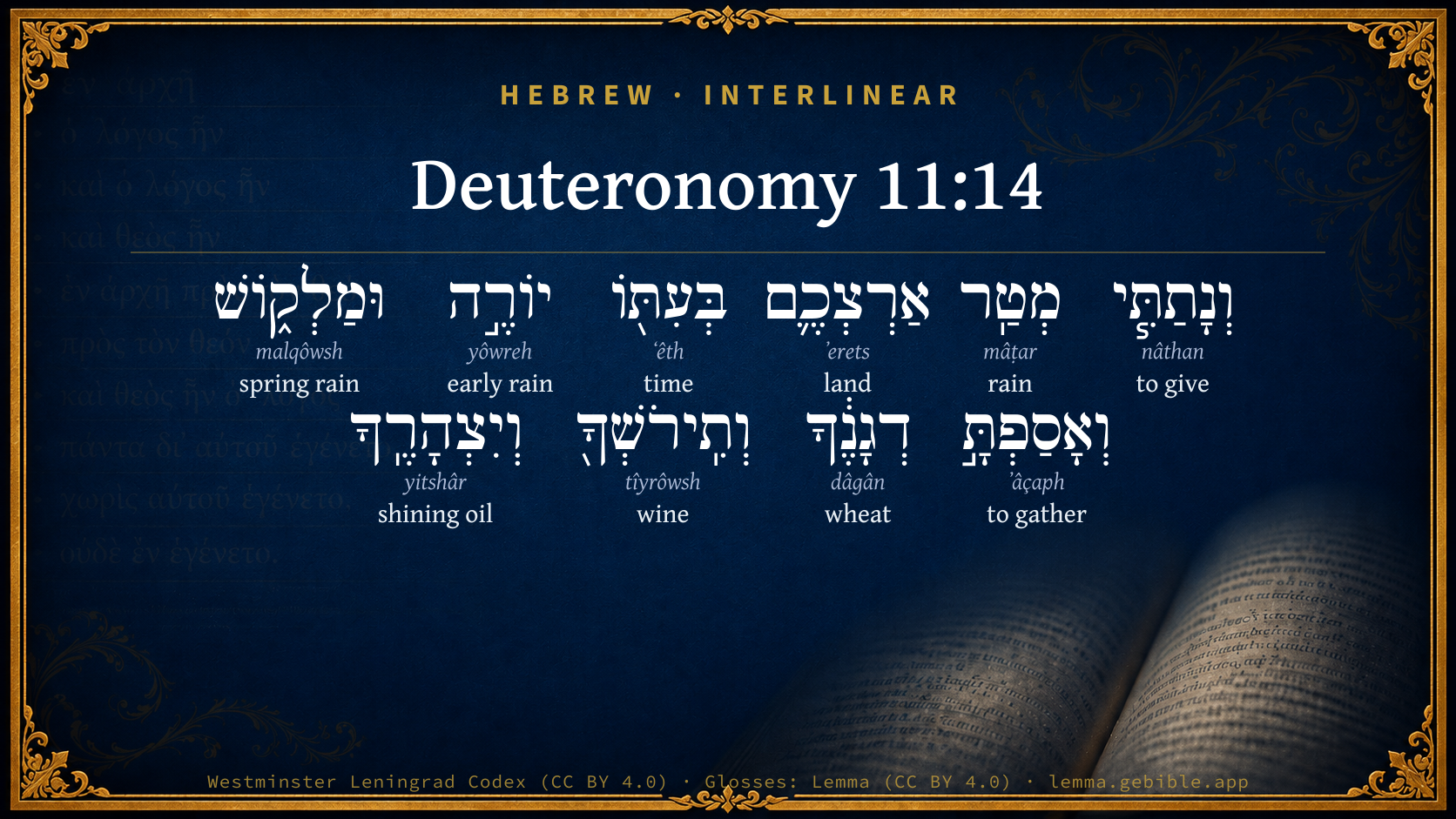
Hebrew (Westminster Leningrad Codex) Deuteronomy 11:14 appears in the Hebrew Old Testament. The text above is from the Westminster Leningrad Codex. Each word links to its Strong’s number, a concise gloss, and parsing drawn from the Open Scriptures Hebrew Bible morphology. Click any word for its full Brown-Driver-Briggs (BDB) entry.
Download image
Cite this verse

Deuteronomy 11:14 (World English Bible). Public Domain. Lemma interlinear Bible study tool, https://lemma.gebible.app/v/deuteronomy/11/14.

Show BibTeX & RIS
BibTeX
RIS
English Translation
that I will give the rain of your land in its season, the former rain and the latter rain, that you may gather in your grain, and your new wine, and your oil.
World English Bible · Public Domain
Highlights
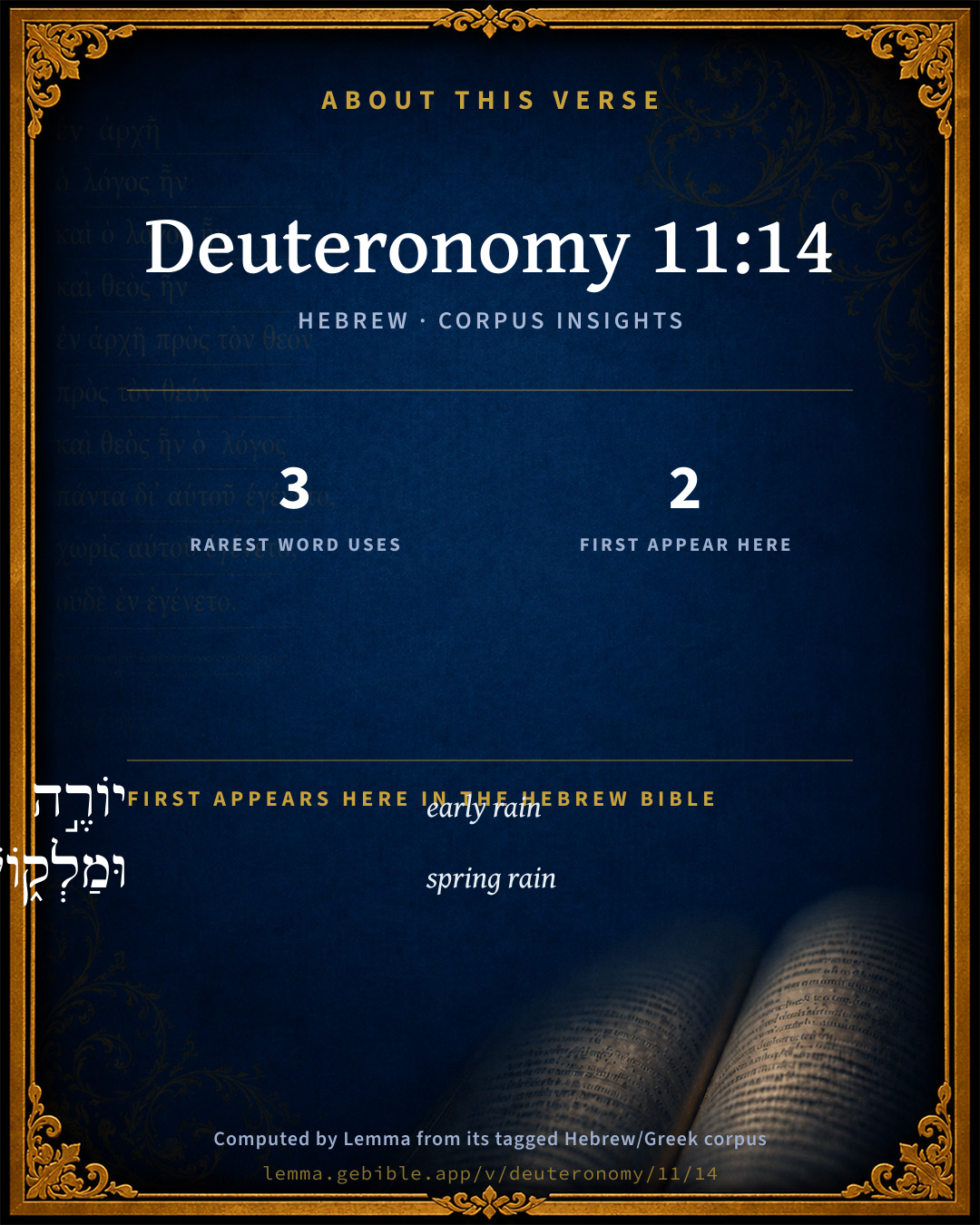
  • 2 first appearances in the Hebrew Bible
Full analysis ↓
Download a study sheet

One document with this verse’s original text, its word-by-word gloss line, the meaning frame, cross-references with their text, attributed commentary, and full source and license credits — printable, and it pastes into notes with its structure intact.

This verse Autodidact and up

Study sheet (.html) Plain text (.txt)

A passage Seminary Student

Up to 50 verses in one chapter. A passage sheet keeps up to 6 commentary sources and 12 cross-references per verse, in the order this page ranks them, and says so on the sheet whenever that leaves anything out. Ask for a single verse and you get the Autodidact verse sheet above.

Everything on this page stays free to read, with no account — the sheet is a download of what is already on screen, not access to it.

Want to remove ads? Support Godless Engineer
Compare translations 3

The same verse in 3 English versions, stacked beneath the original-language interlinear above. Click any original word for its lexicon entry.

Each is an independent rendering of the whole verse — the interlinear is not word-aligned to these translations.

Highlighted words mark where these versions differ — a whole-verse word diff, not a word-by-word alignment.

  • World English Bible Public Domain
    that I will give the rain of your land in its season, the former rain and the latter rain, that you may gather in your grain, and your new wine, and your oil.
  • King James Version Public Domain
    That I will give you the rain of your land in his due season, the first rain and the latter rain, that thou mayest gather in thy corn, and thy wine, and thine oil.
  • unfoldingWord Literal Text CC BY-SA 4.0
    then, ‘I will give the rain of your land in its season, the former rain and the latter rain, and you will gather your grain and your new wine and your oil.

unfoldingWord Literal Text — © unfoldingWord, licensed CC BY-SA 4.0. Word-aligned USFM3 via Door43 (git.door43.org/unfoldingWord/en_ult).

Versions to compare (up to 4)

3 of 4 selected

Show all 18 translations

Every available English version of this verse, each an independent rendering of the whole verse.

  • World English Bible Public Domain
    that I will give the rain of your land in its season, the former rain and the latter rain, that you may gather in your grain, and your new wine, and your oil.
  • Berean Standard Bible Public Domain
    then I will provide rain for your land in season, the autumn and spring rains, that you may gather your grain, new wine, and oil.
  • Majority Standard Bible Public Domain
    then I will provide rain for your land in season, the autumn and spring rains, that you may gather your grain, new wine, and oil.
  • King James Version Public Domain
    That I will give you the rain of your land in his due season, the first rain and the latter rain, that thou mayest gather in thy corn, and thy wine, and thine oil.
  • American Standard Version (1901) Public Domain
    that I will give the rain of your land in its season, the former rain and the latter rain, that thou mayest gather in thy grain, and thy new wine, and thine oil.
  • Revised Version (1885) Public Domain
    that I will give the rain of your land in its season, the former rain and the latter rain, that thou mayest gather in thy corn, and thy wine, and thine oil.
  • Geneva Bible (1599) Public Domain
    I also wil giue raine vnto your land in due time, the first raine and the latter, that thou maist gather in thy wheat, and thy wine, and thine oyle.
  • Douay-Rheims (1899) Public Domain
    If then you obey my commandments, which I command you this day, that you love the Lord your God, and serve him with all your heart, and with all your soul:
  • Young's Literal Translation Public Domain
    that I have given the rain of your land in its season -- sprinkling and gathered -- and thou hast gathered thy corn, and thy new wine, and thine oil,
  • Literal Standard Version CC BY-SA 4.0
    then I have given the rain of your land in its season—autumn rain and spring rain—and you have gathered your grain, and your new wine, and your oil,
  • Unlocked Literal Bible CC BY-SA 4.0
    that I will give the rain of your land in its season, the former rain and the latter rain, that you may gather in your grain, your new wine, and your oil.
  • unfoldingWord Literal Text CC BY-SA 4.0
    then, ‘I will give the rain of your land in its season, the former rain and the latter rain, and you will gather your grain and your new wine and your oil.
  • Darby Bible Public Domain
    that I will give rain to your land in its season, the early rain and the latter rain; and thou shalt gather in thy corn, and thy new wine, and thine oil;
  • World Messianic Bible Public Domain
    that I will give the rain for your land in its season, the early rain and the latter rain, that you may gather in your grain, your new wine, and your oil.
  • Webster's Bible Public Domain
    That I will give you the rain of your land in its due season, the former rain and the latter rain, that thou mayest gather in thy corn, and thy wine and thy oil.
  • Free Bible Version CC BY-SA 4.0
    then I will send rain for your land at the right time, rain in autumn and spring, so that you can harvest your grain, new wine, and olive oil.
  • Bible in Basic English Public Domain
    Then I will send rain on your land at the right time, the early rains and the late rains, so that you may get in your grain and your wine and your oil.
  • JPS Tanakh (1917) Public Domain
    that I will give the rain of your land in its season, the former rain and the latter rain, that thou mayest gather in thy corn, and thy wine, and thine oil.

Literal Standard Version (2020), Covenant Press — licensed CC BY-SA 4.0. Text via the HelloAO Bible API (eBible.org). Unlocked Literal Bible (unfoldingWord) — licensed CC BY-SA 4.0. Text via the HelloAO Bible API (eBible.org). unfoldingWord Literal Text — © unfoldingWord, licensed CC BY-SA 4.0. Word-aligned USFM3 via Door43 (git.door43.org/unfoldingWord/en_ult). Free Bible Version, Dr. Jonathan Gallagher — licensed CC BY-SA 4.0. Text via the HelloAO Bible API (eBible.org).

Word by word

More ways to search: Search by grammar → Find every occurrence → Compare this word →

Practice this passage: Drill this verse → Learn its vocabulary →

יוֹרֶ֣ה
yôwreh
H3138
“early rain”
Noun, Common, Masculine, Singular, Absolute
Part of Speech
Noun
Type
Common
Gender
Masculine
Number
Singular
State
Absolute
Full BDB Definition

Origin: active participle of H3384

TWOT: 910a

early rain, autumn shower - rain which falls in Palestine from late October until early December
  1. וְנָתַתִּ֧י nâthan H5414 “and · to give” Conjunction + Verb, Qal, Sequential Perfect, 1st Person, Common, Singular
  2. מְטַֽר mâṭar H4306 “rain of” Noun, Common, Masculine, Singular, Construct
  3. אַרְצְכֶ֛ם ʼerets H776 “land · your” Noun, Common, Both, Singular, Construct + Suffix, Personal, 2nd Person, Masculine, Plural
  4. בְּעִתּ֖וֹ ʻêth H6256 “in/at · time · his” Preposition + Noun, Common, Both, Singular, Construct + Suffix, Personal, 3rd Person, Masculine, Singular
  5. וּמַלְק֑וֹשׁ malqôwsh H4456 “and · spring rain” Conjunction + Noun, Common, Masculine, Singular, Absolute
  6. וְאָסַפְתָּ֣ ʼâçaph H622 “and · to gather” Conjunction + Verb, Qal, Sequential Perfect, 2nd Person, Masculine, Singular
  7. דְגָנֶ֔ךָ dâgân H1715 “wheat · your” Noun, Common, Masculine, Singular, Construct + Suffix, Personal, 2nd Person, Masculine, Singular
  8. וְתִֽירֹשְׁךָ֖ tîyrôwsh H8492 “and · wine · your” Conjunction + Noun, Common, Masculine, Singular, Construct + Suffix, Personal, 2nd Person, Masculine, Singular
  9. וְיִצְהָרֶֽךָ yitshâr H3323 “and · shining oil · your” Conjunction + Noun, Common, Masculine, Singular, Construct + Suffix, Personal, 2nd Person, Masculine, Singular

About this verse

These counts appear in no published source. They are computed here, from the morphology-tagged text and Lemma’s own curated glosses. What Lemma adds →

10
words
10
distinct lemmas
Pentateuch
section

Notable vocabulary

The rarest word here is יוֹרֶ֣ה early rain H3138 — appearing just 3 times in the whole Hebrew Bible.

First appearance in Scripture

These words make their first canonical appearance in the Hebrew Bible here:

  • יוֹרֶ֣ה early rain H3138
  • וּמַלְק֑וֹשׁ spring rain H4456

Shared distinctive vocabulary

יוֹרֶ֣ה early rain H3138 occurs in 2 verses of the Hebrew Bible. Also found in:

Grammatical profile

  • 2 verbs
  • 8 nouns

Verb forms

  • וְנָתַתִּ֧י Qal · Sequential Perfect
  • וְאָסַפְתָּ֣ Qal · Sequential Perfect

Hebrew & Septuagint length

In English translation the verse runs 33 words from the Hebrew and 28 from the Septuagint (LXX English) — closely comparable.

A rough comparison of the two English renderings, which tokenize alike — not a word-level alignment.

Word counts can differ between the Hebrew and the Greek without any difference in meaning — e.g. the Hebrew direct-object marker אֵת has no separate Greek word, and Greek often adds the article ὁ.

Cross-references

9

Topical passages linked to Deuteronomy 11:14 in the Treasury of Scripture Knowledge — connected by theme and wording, ordered by reader-vote popularity; previews shown in the World English Bible.

  • James 5:7 Be patient therefore, brothers, until the coming of the Lord. Behold, the farmer waits for the precious fruit of the earth, being patient over it, until it receives the early and late rain.
  • Leviticus 26:4 then I will give you your rains in their season, and the land shall yield its increase, and the trees of the field shall yield their fruit.
  • Deuteronomy 28:12 Yahweh will open to you his good treasure in the sky, to give the rain of your land in its season, and to bless all the work of your hand: and you shall lend to many nations, and you shall not borrow.
  • Ezekiel 34:26 I will make them and the places round about my hill a blessing; and I will cause the shower to come down in its season; there shall be showers of blessing.
  • Joel 2:22–23 Don't be afraid, you animals of the field; For the pastures of the wilderness spring up, For the tree bears its fruit. The fig tree and the vine yield their strength.
  • Jeremiah 14:22 Are there any among the vanities of the nations that can cause rain? or can the sky give showers? Aren't you he, Yahweh our God? therefore we will wait for you; for you have made all these things.
  • Job 5:10–11 Who gives rain on the earth, And sends waters on the fields;
  • Job 37:11–13 Yes, he loads the thick cloud with moisture. He spreads abroad the cloud of his lightning.
  • Psalms 65:9–13 You visit the earth, and water it. You greatly enrich it. The river of God is full of water. You provide them grain, for so you have ordained it.

Cross-references courtesy of OpenBible.info (CC BY 4.0).

Hebrew and Greek witnesses Masoretic Hebrew ↔ Greek Septuagint

The same verse in the two great witnesses to the Old Testament, shown verse-for-verse.

These are two independent witnesses, not word-aligned to each other, and the Septuagint is shown in lemma (dictionary) form.

Hebrew Deuteronomy 11:14 Masoretic · Westminster Leningrad Codex

וְנָתַתִּ֧י מְטַֽר אַרְצְכֶ֛ם בְּעִתּ֖וֹ יוֹרֶ֣ה וּמַלְק֑וֹשׁ וְאָסַפְתָּ֣ דְגָנֶ֔ךָ וְתִֽירֹשְׁךָ֖ וְיִצְהָרֶֽךָ

that I will give the rain of your land in its season, the former rain and the latter rain, that you may gather in your grain, and your new wine, and your oil.

World English Bible · Public Domain

Greek LXX Deuteronomy 11:14 Septuagint · lemma form

καί δίδωμι ὁ ὑετός ὁ γῆ σύ κατά ὥρα πρώιμος καί ὄψιμος καί εἰςφέρω ὁ σῖτος σύ καί ὁ οἶνος σύ καί ὁ ἔλαιον σύ

then he shall give to your land the early and latter rain in its season, and you shall bring in your corn, and your wine, and your oil.

LXX2012 (modern English Septuagint) · Public Domain

On this verse, The Cambridge Bible for Schools and Colleges discusses the Septuagint’s reading. Read the note in Commentary ↓

Hebrew: Westminster Leningrad Codex (CC BY 4.0). Greek: Septuagint (public domain); English from LXX2012 (modern English Septuagint) (Public Domain). How the Septuagint differs from the Hebrew →

Targum (Aramaic paraphrase)

2

The Targum is the ancient Jewish Aramaic paraphrase of the Hebrew Scriptures — an interpretive translation, not the Hebrew text itself. Onkelos (literal) and Pseudo-Jonathan (expansive) render the Torah, and Jonathan the Prophets. Coverage is partial: where no permissively-licensed English translation exists for a verse, only the Aramaic is shown. This is verse-level text, not a word-by-word alignment to the Hebrew.

  1. Targum Onkelos Torah (Genesis–Deuteronomy)
    וְאֶתֵּן מְטַר אַרְעֲכוֹן בְּעִדָנֵהּ בַּכִּיר וְלַקִישׁ וְתִכְנוֹשׁ עִבוּרָךְ וְחַמְרָךְ וּמִשְׁחָךְ

    And I will give the rain of your land in its time, early and late, and you will gather your grain, and your wine, and your oil.

    Targum Onkelos — Aramaic: “Onkelos Genesis” (public domain); “Onkelos Exodus” (public domain); “Onkelos Leviticus” (public domain); “Onkelos Numbers” (public domain); “Onkelos Deuteronomy” (public domain). English: “Sefaria Community Translation” (CC0 1.0 (public-domain dedication)); “J.W. Etheridge. The Targums of Onkelos and Jonathan Ben Uzziel on the Pentateuch. London: Longmans, Green, 1862” (public domain). Text via Sefaria.

  2. Targum Pseudo-Jonathan Torah (Genesis–Deuteronomy)
    וְאֶתֵּן מִטְרָא דְאַרְעֲכוֹן בְּעִידְנֵיהּ בַּכִּיר בְּמַרְחֶשְׁוָן וְלָקִישׁ בְּנִיסָן וְתִכְנְשׁוּן עִבּוּרֵיכוֹן חַמְרֵיכוֹן וּמִשְׁחֵיכוֹן

    then will I give you the rain of your land in its time, the early in Marchesvan, and the latter in Nisan, that you may gather in your corn, your wine., and your oil.

    Targum Pseudo-Jonathan — Aramaic: “Targum Jonathan on Genesis” (public domain); “Targum Jonathan on Exodus” (public domain); “Targum Jonathan on Leviticus” (public domain); “Targum Jonathan on Numbers” (public domain); “Targum Jonathan on Deuteronomy” (public domain). English: “The Targum of Jonathan ben Uzziel, trans. J. W. Etheridge, London, 1862” (public domain). Text via Sefaria.

Commentary

Notes on Deuteronomy 11:14 from classic Christian and Jewish commentators (each source and its license shown beneath its notes). The classic Christian expositions comment on the surrounding passage and are grouped to its opening verse, so a note may address several verses; the Jewish commentaries on the Tanakh (Rashi and others) are per-verse, so they appear only where the commentator wrote on this verse.

Lemma curates 59 commentaries, every one of them public domain or Creative Commons licensed, each selected and text-cleaned for this edition rather than reprinted as found. About our sources →

Trapp's Complete Commentary

John Trapp

Deu 11:14 That I will give [you] the rain of your land in his due season, the first rain and the latter rain, that thou mayest gather in thy corn, and thy wine, and thine oil.

Ver. 14. That I will give you the rain.] Rain God gives to all by a providence, {Act 14:17 Job 38:26} but to his Israel by virtue of a promise, whereby they might "live, not as by bread only, but as by every word that proceedeth out of the mouth of God."

John Trapp, A Commentary or Exposition upon All the Books of the Old and New Testament (1647–1656) — public domain. Text from a community e-Sword module.

Joseph Benson's Commentary

Deu 11:14-15. I will give you — Moses here personates God; or, rather, God speaks by him. The rain of your land — Which is proper to your land, and not common to Egypt, where there is little rain. The first rain and the latter rain — In Judea and the neighbouring countries there is seldom any rain, save at two seasons, about the autumnal and vernal equinox, called the former and latter rain. The first fell about the time of sowing their seed, and served to prepare the ground, and make the grain take root in the earth; and the other when the corn was well grown, toward earing-time, to make the ears full and plump for harvest. I will send grass in thy fields — So godliness has here the promise of the life which now is. But the favour of God puts gladness into the heart more than the increase of corn, wine, and oil.

Joseph Benson's Commentary on the Old and New Testaments (1811–1818) — public domain. Text from a community e-Sword module.

Geneva Bible (1599)

Geneva Bible translators

In the seed time, and toward harvest.

Geneva Bible (1599) marginal notes — public domain. Text via Bolls.life.

Jamieson, Fausset & Brown

Robert Jamieson, A. R. Fausset & David Brown

the first rain and the latter rain--The early rain commenced in autumn, that is, chiefly during the months of September and October, while the latter rain fell in the spring of the year, that is, during the months of March and April. It is true that occasional showers fell all the winter; but, at the autumnal and vernal seasons, they were more frequent, copious, and important; for the early rain was necessary, after a hot and protracted summer, to prepare the soil for receiving the seed; and the latter rain, which shortly preceded the harvest, was of the greatest use in invigorating the languishing powers of vegetation (Jer 5:24; Joe 2:23; Amo 4:7; Jam 5:7).

Jamieson, Fausset & Brown — Commentary Critical and Explanatory on the Whole Bible (1871) — public domain (CC PDM 1.0). Text via the HelloAO Bible API.

Adam Clarke's Commentary

Verse 14. The rain - in his due season, the first rain and the latter rain] By the first or former rain we are to understand that which fell in Judea about November, when they sowed their seed, and this served to moisten and prepare the ground for the vegetation of the seed. The latter rain fell about April, when the corn was well grown up, and served to fill the ears, and render them plump and perfect. Rain rarely fell in Judea at any other seasons than these. If the former rain were withheld, or not sent in due season, there could be no vegetation: if the latter rain were withheld, or not sent in its due season, there could be no full corn in the ear, and consequently no harvest. Of what consequence then was it that they should have their rain in due season! God, by promising this provided they were obedient, and threatening to withhold it should they be disobedient, shows that it is not a general providence that directs these things, but that the very rain of heaven falls by particular direction, and the showers are often regulated by an especial providence.

Adam Clarke's Commentary on the Bible (1810–1826) — public domain. Text from a community e-Sword/MySword module.

Ellicott's Commentary for English Readers

(14) The first rain (after sowing), the latter rain (just before harvest). In the ninth month and the first month respectively. (See Ezr_10:9; Ezr_10:13, and Joe_2:23.)

That thou mayest gather in.—Literally, and thou shalt gather in. Rashi reminds us that this may mean “thou, and not thine enemies.” “They that have gathered it shall eat it” (Isa_62:8-9).

A Bible Commentary for English Readers, edited by Charles John Ellicott (1878–1897) — public domain. Text from a community e-Sword module.

The Cambridge Bible for Schools and Colleges

gen. ed. J. J. S. Perowne

14. that I will give the rain of your land] The Heb. text is evidently due to the same hand which inserted Deu_11:13, for it immediately follows that verse, and as evidently the original reading is that of Sam., LXX and Vulg. that he will give the rain to thy land, which connects with Deu_11:12.

in its season, etc.] The agricultural year in Palestine consisted of two seasons, a rainy and a dry. ‘Towards the end of October heavy rains begin to fall, at intervals, for a day or several days at a time. These are what the English Bible calls the early or former rain, Heb. yôreh, the pourer. It opens the agricultural year; the soil, hardened and cracked by the long summer, rainless since May, is loosened, and the farmer begins ploughing. Till the end of November the average rainfall is not large, but it increases through December, January and February, begins to abate in March, and is practically over by the end of April. The latter rains, Heb. malḳosh, from a root meaning to be late, are the heavy showers of March and April. Coming as they do when the grain is ripening, and being the last before the long summer drought, they are of far more importance to the country than all the rains of the winter months, and that is why these are so frequently passed over in Scripture, and emphasis is laid only on the early and latter rains1[129]’ (HGHL, pp. 63, 64). The annual rainfall is considerable: at Jerusalem it averages over 25 inches, about the same as the annual rainfall in London. Whether it was more copious in ancient times is a question much debated. For this and other details see the present writer’s Jerusalem, i. 19, 77 f. The growth of the vine and olive depend, like the ripening of the corn, essentially on the latter rain; and the olive requires the rainless summer for the ripening of its berries (op. cit. 300).

[129] This has given people the idea that there are only two periods of rain in the Syrian year, at the vernal and the autumnal equinoxes; but the whole of the winter is the rainy season, as indeed we are told in the parallel lines of the Song of Songs: Lo the winter is past, the rain is over and gone (Deu_2:11).

The Cambridge Bible for Schools and Colleges (gen. ed. J. J. S. Perowne; Cambridge University Press, 1878–1918) — public domain. Text from a community e-Sword module.

John Gill's Exposition

And then the Lord's wrath be kindled against you,.... For their idolatry, nothing being more provoking to him than that, it being contrary to his nature and being, as well as to his will, and to his honour and glory:

and he shut up the heaven, that there be no rain; the treasures and storehouses of it there, or the windows of it, the clouds, which when opened let it down, but when shut withhold it; the key of rain is one of the keys which the Jews say (k) the Lord keeps in his own hand, and with it he opens and no man shuts, and shuts and no man opens; see Deu 28:12.

and that the land yield not her fruit; which is unavoidably the case when rain is withheld:

and lest ye perish quickly from off the good land which the Lord giveth you; for if the land does not yield its fruits sufficient to support the inhabitants of it, they must in course perish.

(k) Targum Jon. in Deut. xxviii. 12.

John Gill's Exposition of the Whole Bible (1746–1763) — public domain (CC PDM 1.0). Text via the HelloAO Bible API.

Albert Barnes' Notes on the Bible

The first rain and the latter rain - The former is the proper term for the autumn rain, falling about the time of sowing, and which may be named “the former,” as occurring in the early part of the Hebrew civil year, namely, in October and November. The other word is applied to the spring rain, which falls in March and April, because it fits the earth for the ingathering of harvest. Between these two wet periods, and except them, there was little or no rain in Canaan.

Albert Barnes' Notes on the Bible (1834–1885) — public domain. Text from a community e-Sword/MySword module.

Haydock's Catholic Bible Commentary

Rain, which falls in Judea, chiefly about the vernal and the autumnal equinoxes, in March and October. --- The latter rain (Hebrew malkosh,) is that which falls when the seed is just sown, though the Rabbins pretend that yore has this signification, in opposition to the Septuagint. It fell at the beginning of the Jewish year, which commenced in September, Joel ii. 23., and Zacharias x. 1. (Calmet) --- Rain contributed to make the seeds take root, and to bring the fruit to maturity, and God promises to give what may be requisite, provided his people serve him with fidelity. (Haydock) --- His grace helps us to begin and to perfect every good work. (Worthington)

George Leo Haydock (1774–1849), Haydock's Catholic Family Bible and Commentary, 1859 edition — public domain. Excludes Psalms (Douay-Rheims chapter numbering differs from Protestant) and Deuterocanonical books (Catholic canon only).

Matthew Poole's English Annotations

The rain of your land, i.e. which is needful and sufficient for your land; or which is proper to your land, not common to Egypt, where, as all authors agree, there is little or no rain.

The first rain and the latter rain; the first fell in seed time, to make the corn spring, the other a little before harvest, to ripen it. See Jer 5:24; Joe 2:23; Amo 4:7; Jam 5:7.

Matthew Poole's English Annotations on the Holy Bible (1683–1685) — public domain. Text from a community e-Sword/MySword module.

Whedon's Commentary on the Bible

Daniel D. Whedon

14. The first rain and the latter rain — In “the present time rain in an ordinarily good year falls first at the autumnal equinox. During November frequent thunderstorms occur, and about Christmas the weather is generally stormy. In January the heaviest rains fall, and in February sometimes none at all; but the weather is never settled till after the vernal equinox and the early April showers are past.” — Survey of Western Palestine, Special Papers, p. 196. In the Mishnah we find, “From what time shall they begin the form of praise that the Almighty power is manifested in giving rain? Rabbi Eliezer said from the first day of the feast of tabernacles. Others place it a few days later. Until what time shall rain be sought? Until the passover is finished. Comp. BARCLAY’S Talmud, p. 158.

Daniel D. Whedon (gen. ed.), Commentary on the Old and New Testaments (1874–1909) — public domain. Text from a community e-Sword module.

The Pulpit Commentary

The first rain; the rain which falls from the middle of October to the end of December, which prepares the soil for the seed, and keeps it moist after the seed is sown. The latter rain; that which falls in March and April, about the time when the grain is ripening for harvest; during the time of harvest no rain falls in Palestine. But if they allowed themselves to be deceived and misled, so as to apostatize from the Lord and serve other gods and worship them, the Divine displeasure would be shown in the withholding from them of the blessing, so that they should miserably perish.

The Pulpit Commentary (1880–1919), ed. H.D.M. Spence-Jones & Joseph S. Exell — public domain. Text from a community e-Sword module.

John Wesley's Explanatory Notes

The ruin of your land - Which is, proper to your land, not common to Egypt, where, as all authors agree, there is little rain. The first rain fell in seed time, to make the corn spring, the other a little before harvest, to ripen it.

John Wesley, Explanatory Notes Upon the Whole Bible (1754–1765) — public domain. Text via the GEBible commentary corpus.

Rashi

Rabbi Shlomo Yitzchaki (Rashi)

ונתתי מטר ארצכם I WILL GIVE THE RAIN OF YOUR LAND [IN ITS SEASON] — You will then have done what devolved upon you, I, too, shall do what devolves upon Me (Sifrei Devarim 41:29; cf. Rashi on Deuteronomy 26:15).

בעתו [RAIN …] IN ITS SEASON — i.e. at night time, so that it may not cause you any trouble. — Another explanation of בעתו IN ITS SEASON is: on Sabbath (Friday) nights when everyone is usually at home (cf. Sifrei Devarim 42:2; Taanit 23a; see Rashi on Leviticus 26:4).

יורה THE FIRST RAIN — This is the rain that falls after the sowing-time, which thoroughly drenches (מרוה) the soil and the seed (Sifrei Devarim 42:4; Taanit 6a).

מלקוש THE LATTER RAIN is the rain that descends just before the harvest time to make the grain full (ripe) on its stalk. The term מלקוש refers to something that is late, just as in the Targum we translate והיה העטפים ללבן (Genesis 30:42; see Rashi thereon) “those born late were Laban’s” by לקשיא. — Another explanation: The reason why it is called מלקוש is because it falls at the same period upon the ears (מלילות) and the stalks (קש) (i.e. just before the harvest) (Taanit 6a).

ואספת דגנך AND THOU SHALT GATHER IN THY CORN means: and thou shalt gather it into thy house, and not thy enemies, just as it is said, (Isaiah 62:8—9) “[The Lord hath sworn … ], surely I will no more give thy corn [to be food for thine enemies], but they that have gathered it shall eat it”; and not as it is said, (Judges 6:3) “And so it was when Israel had sown that the Midianites came up [and destroyed the produce of the land]” (Sifrei Devarim 42:10).

Rashi on the Tanakh — English translations: “The Judaica Press complete Tanach with Rashi, translated by A. J. Rosenberg” (CC BY 4.0); “Pentateuch with Rashi's commentary by M. Rosenbaum and A.M. Silbermann, 1929-1934” (public domain); “The Metsudah Tanach series, Lakewood, N.J” (CC BY 4.0); and “The Book of Joshua, Metsudah Publications, 1997” (CC BY 4.0). Text via Sefaria.

Lesson kit

Teaching starters — assembled from the data on this page, not authored interpretation. Every prompt links to the verse data it draws on. Edit before teaching.

Deuteronomy, in the Pentateuch, opens this verse with 10 words (10 distinct Hebrew lemmas). Its most distinctive word is yôwreh (“early rain”). A historical commentator’s framing appears above. Read the whole chapter for the surrounding context.

Discussion questions

  1. What does “early rain” (yôwreh) contribute to the verse as a whole?
  2. 2 words here appear for the first time in Scripture. What is being introduced at this debut?
  3. Jeremiah 5:24 shares the word «early rain» with this verse. How do the two illuminate each other?
  4. The translations on this page render this verse differently — a whole-verse word diff, not a word-by-word alignment. What might account for the different wordings?
  5. The verb «וְנָתַתִּ֧י» is Qal Sequential Perfect. How does its form color the action?
  6. Reading how Trapp's Complete Commentary and Joseph Benson's Commentary read this verse, where do the two commentators agree and where do they part?

Things to notice

Reading settings

Reading text

Shown beneath each verse's original-language words.

Old Testament
Old Testament edition

Read the OT as the Masoretic Hebrew (MT) or the Greek Septuagint (LXX).

English shown for the Greek Septuagint (in the Hebrew ↔ Greek comparison).

Comparing translations? Open the Compare panel on any verse page to stack up to four side by side.