Proverbs 5:19

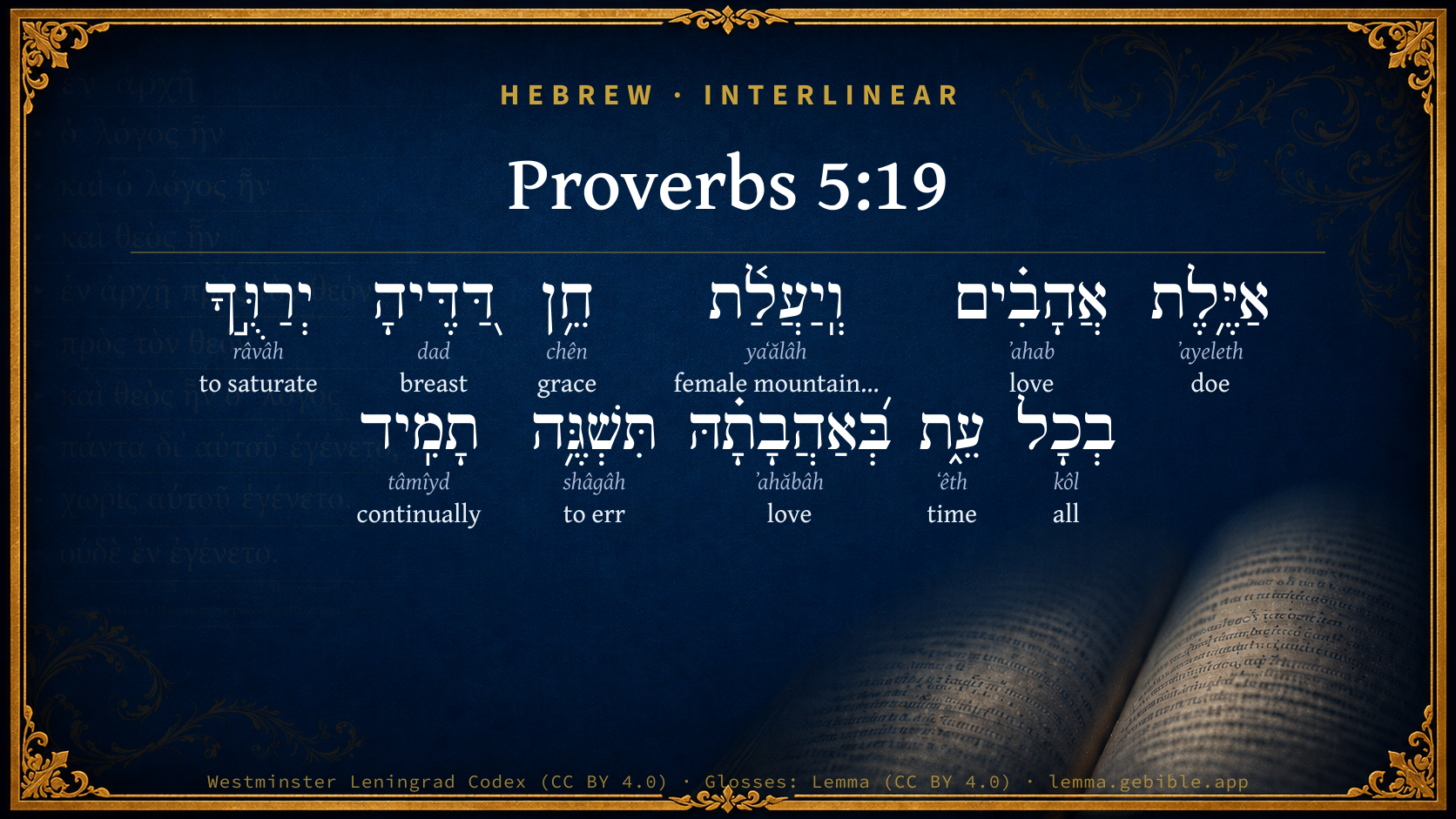
Hebrew (Westminster Leningrad Codex) Proverbs 5:19 appears in the Hebrew Old Testament. The text above is from the Westminster Leningrad Codex. Each word links to its Strong’s number, a concise gloss, and parsing drawn from the Open Scriptures Hebrew Bible morphology. Click any word for its full Brown-Driver-Briggs (BDB) entry.
Download image
Cite this verse

Proverbs 5:19 (World English Bible). Public Domain. Lemma interlinear Bible study tool, https://lemma.gebible.app/v/proverbs/5/19.

Show BibTeX & RIS
BibTeX
RIS
English Translation
A loving doe and a graceful deer-- Let her breasts satisfy you at all times. Be captivated always with her love.
World English Bible · Public Domain
Highlights Full analysis ↓
Download a study sheet

One document with this verse’s original text, its word-by-word gloss line, the meaning frame, cross-references with their text, attributed commentary, and full source and license credits — printable, and it pastes into notes with its structure intact.

This verse Autodidact and up

Study sheet (.html) Plain text (.txt)

A passage Seminary Student

Up to 50 verses in one chapter. A passage sheet keeps up to 6 commentary sources and 12 cross-references per verse, in the order this page ranks them, and says so on the sheet whenever that leaves anything out. Ask for a single verse and you get the Autodidact verse sheet above.

Everything on this page stays free to read, with no account — the sheet is a download of what is already on screen, not access to it.

Want to remove ads? Support Godless Engineer
Compare translations 3

The same verse in 3 English versions, stacked beneath the original-language interlinear above. Click any original word for its lexicon entry.

Each is an independent rendering of the whole verse — the interlinear is not word-aligned to these translations.

Highlighted words mark where these versions differ — a whole-verse word diff, not a word-by-word alignment.

  • World English Bible Public Domain
    A loving doe and a graceful deer-- Let her breasts satisfy you at all times. Be captivated always with her love.
  • King James Version Public Domain
    Let her be as the loving hind and pleasant roe; let her breasts satisfy thee at all times; and be thou ravished always with her love.
  • unfoldingWord Literal Text CC BY-SA 4.0
    A doe of loves and a mountain goat of grace, may her breasts drench you on every occasion; may you continually stagger in her love.

unfoldingWord Literal Text — © unfoldingWord, licensed CC BY-SA 4.0. Word-aligned USFM3 via Door43 (git.door43.org/unfoldingWord/en_ult).

Versions to compare (up to 4)

3 of 4 selected

Show all 18 translations

Every available English version of this verse, each an independent rendering of the whole verse.

  • World English Bible Public Domain
    A loving doe and a graceful deer-- Let her breasts satisfy you at all times. Be captivated always with her love.
  • Berean Standard Bible Public Domain
    A loving doe, a graceful fawn—may her breasts satisfy you always; may you be captivated by her love forever.
  • Majority Standard Bible Public Domain
    A loving doe, a graceful fawn—may her breasts satisfy you always; may you be captivated by her love forever.
  • King James Version Public Domain
    Let her be as the loving hind and pleasant roe; let her breasts satisfy thee at all times; and be thou ravished always with her love.
  • American Standard Version (1901) Public Domain
    `As' a loving hind and a pleasant doe, Let her breasts satisfy thee at all times; And be thou ravished always with her love.
  • Revised Version (1885) Public Domain
    As a loving hind and a pleasant doe, let her breasts satisfy thee at all times; and be thou ravished always with her love.
  • Geneva Bible (1599) Public Domain
    Let her be as the louing hinde and pleasant roe: let her brests satisfie thee at all times, and delite in her loue continually.
  • Douay-Rheims (1899) Public Domain
    Let her be thy dearest hind, and most agreeable fawn: let her breasts inebriate thee at all times; he thou delighted continually with her love.
  • Young's Literal Translation Public Domain
    A hind of loves, and a roe of grace! Let her loves satisfy thee at all times, In her love magnify thyself continually.
  • Literal Standard Version CC BY-SA 4.0
    A doe of loves, and a roe of grace! Let her loves satisfy you at all times, || Magnify yourself in her love continually.
  • Unlocked Literal Bible CC BY-SA 4.0
    for she is a loving deer and a graceful doe. Let her breasts satisfy you at all times; may you be continually intoxicated by her love.
  • unfoldingWord Literal Text CC BY-SA 4.0
    A doe of loves and a mountain goat of grace, may her breasts drench you on every occasion; may you continually stagger in her love.
  • Darby Bible Public Domain
    As a lovely hind and a graceful roe, let her breasts satisfy thee at all times: be thou ravished continually with her love.
  • World Messianic Bible Public Domain
    A loving doe and a graceful deer— let her breasts satisfy you at all times. Be captivated always with her love.
  • Webster's Bible Public Domain
    Let her be as the loving hind and pleasant roe; let her breasts satisfy thee at all times; and be thou ravished always with her love.
  • Free Bible Version CC BY-SA 4.0
    May she be to you a loving deer, a graceful doe. May her breasts always be intoxicating to you; may you be drunk on her love forever.
  • Bible in Basic English Public Domain
    As a loving hind and a gentle doe, let her breasts ever give you rapture; let your passion at all times be moved by her love.
  • JPS Tanakh (1917) Public Domain
    A lovely hind and a graceful doe, let her breasts satisfy thee at all times; with her love be thou ravished always.

Literal Standard Version (2020), Covenant Press — licensed CC BY-SA 4.0. Text via the HelloAO Bible API (eBible.org). Unlocked Literal Bible (unfoldingWord) — licensed CC BY-SA 4.0. Text via the HelloAO Bible API (eBible.org). unfoldingWord Literal Text — © unfoldingWord, licensed CC BY-SA 4.0. Word-aligned USFM3 via Door43 (git.door43.org/unfoldingWord/en_ult). Free Bible Version, Dr. Jonathan Gallagher — licensed CC BY-SA 4.0. Text via the HelloAO Bible API (eBible.org).

Word by word

More ways to search: Search by grammar → Find every occurrence → Compare this word →

Practice this passage: Drill this verse → Learn its vocabulary →

וְֽיַעֲלַ֫ת
yaʻălâh
H3280
“and · female mountain goat of”
Conjunction + Noun, Common, Feminine, Singular, Construct
Part of Speech
Conjunction + Noun
Type
Common
Gender
Feminine
Number
Singular
State
Construct
Full BDB Definition

Origin: from H3277

TWOT: 883b

female mountain goat
  1. אַיֶּ֥לֶת ʼayeleth H365 “doe of” Noun, Common, Feminine, Singular, Construct
  2. אֲהָבִ֗ים ʼahab H158 “loves” Noun, Common, Masculine, Plural, Absolute
  3. חֵ֥ן chên H2580 “grace” Noun, Common, Masculine, Singular, Absolute
  4. דַּ֭דֶּיהָ dad H1717 “breasts · her” Noun, Common, Masculine, Dual, Construct + Suffix, Personal, 3rd Person, Feminine, Singular
  5. יְרַוֻּ֣ךָ râvâh H7301 “to saturate · you” Verb, Piel, Jussive, 3rd Person, Masculine, Plural + Suffix, Personal, 2nd Person, Masculine, Singular
  6. בְכָל kôl H3605 “in/at · all of” Preposition + Noun, Common, Masculine, Singular, Construct
  7. עֵ֑ת ʻêth H6256 “time” Noun, Common, Both, Singular, Absolute
  8. בְּ֝אַהֲבָתָ֗הּ ʼahăbâh H160 “in/at · love · her” Preposition + Noun, Common, Feminine, Singular, Construct + Suffix, Personal, 3rd Person, Feminine, Singular
  9. תִּשְׁגֶּ֥ה shâgâh H7686 “to err” Verb, Qal, Imperfect, 2nd Person, Masculine, Singular
  10. תָמִֽיד tâmîyd H8548 “continually” Noun, Common, Masculine, Singular, Absolute

About this verse

These counts appear in no published source. They are computed here, from the morphology-tagged text and Lemma’s own curated glosses. What Lemma adds →

11
words
11
distinct lemmas
Wisdom
section

Notable vocabulary

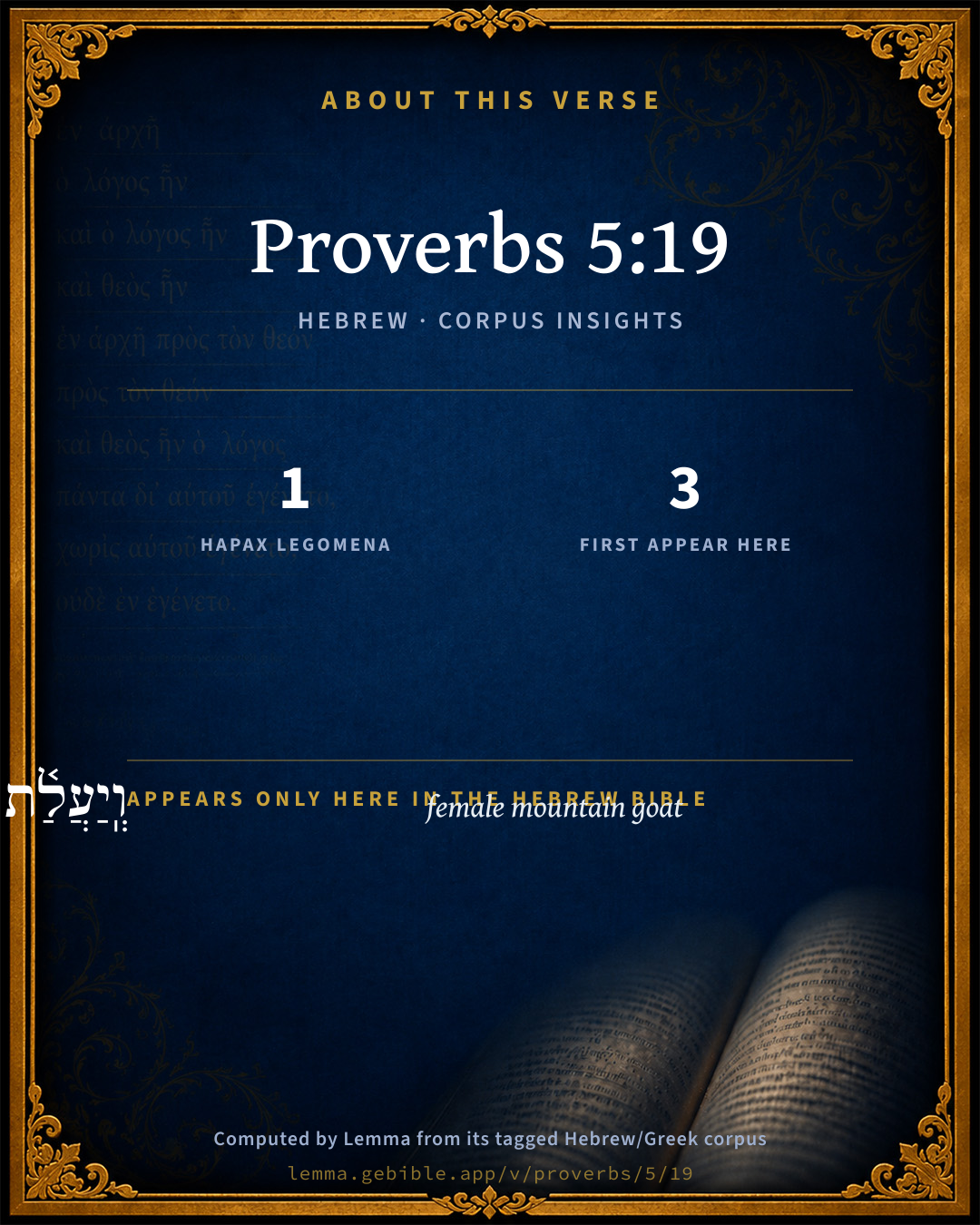
1 hapax legomenon — a word that appears only here in the entire Hebrew Bible:

  • וְֽיַעֲלַ֫ת female mountain goat H3280

First appearance in Scripture

These words make their first canonical appearance in the Hebrew Bible here:

  • אֲהָבִ֗ים love H158
  • וְֽיַעֲלַ֫ת female mountain goat H3280
  • דַּ֭דֶּיהָ breast H1717

Shared distinctive vocabulary

אֲהָבִ֗ים love H158 occurs in 2 verses of the Hebrew Bible. Also found in:

Grammatical profile

  • 2 verbs
  • 9 nouns

Verb forms

  • יְרַוֻּ֣ךָ Piel · Jussive
  • תִּשְׁגֶּ֥ה Qal · Imperfect

Hebrew & Septuagint length

In English translation the verse runs 21 words from the Hebrew and 35 from the Septuagint (LXX English) — the Septuagint runs noticeably longer here. See the side-by-side →

A rough comparison of the two English renderings, which tokenize alike — not a word-level alignment.

Word counts can differ between the Hebrew and the Greek without any difference in meaning — e.g. the Hebrew direct-object marker אֵת has no separate Greek word, and Greek often adds the article ὁ.

Cross-references

7

Topical passages linked to Proverbs 5:19 in the Treasury of Scripture Knowledge — connected by theme and wording, ordered by reader-vote popularity; previews shown in the World English Bible.

  • Song of Solomon 7:3 Your two breasts are like two fawns, That are twins of a roe.
  • Song of Solomon 2:9 My beloved is like a roe or a young hart. Behold, he stands behind our wall! He looks in at the windows. He glances through the lattice.
  • Song of Solomon 4:5 Your two breasts are like two fawns That are twins of a roe, Which feed among the lilies.
  • Song of Solomon 8:14 Come away, my beloved! Be like a gazelle or a young stag on the mountains of spices!
  • Proverbs 5:15 Drink water out of your own cistern, Running water out of your own well.
  • Song of Solomon 2:17 Until the day is cool, and the shadows flee away, Turn, my beloved, And be like a roe or a young hart on the mountains of Bether.
  • 2 Samuel 12:4 A traveler came to the rich man, and he spared to take of his own flock and of his own herd, to dress for the wayfaring man who had come to him, but took the poor man's lamb, and dressed it for the man who had come to him."

Cross-references courtesy of OpenBible.info (CC BY 4.0).

Hebrew and Greek witnesses Masoretic Hebrew ↔ Greek Septuagint

The same verse in the two great witnesses to the Old Testament, shown verse-for-verse.

Here the Septuagint runs noticeably longer than the Hebrew — LXX2012 (modern English Septuagint) 35 words vs World English Bible 21. A rough length comparison of the two English translations, not a word-level alignment — read both below.

These are two independent witnesses, not word-aligned to each other, and the Septuagint is shown in lemma (dictionary) form.

Hebrew Proverbs 5:19 Masoretic · Westminster Leningrad Codex

אַיֶּ֥לֶת אֲהָבִ֗ים וְֽיַעֲלַ֫ת חֵ֥ן דַּ֭דֶּיהָ יְרַוֻּ֣ךָ בְכָל עֵ֑ת בְּ֝אַהֲבָתָ֗הּ תִּשְׁגֶּ֥ה תָמִֽיד

A loving doe and a graceful deer-- Let her breasts satisfy you at all times. Be captivated always with her love.

World English Bible · Public Domain

Greek LXX Proverbs 5:19 Septuagint · lemma form

ἔλαφος φιλία καί πῶλος σός χάρις ὁμιλέω σύ ὁ δέ ἴδιος ἡγέομαι σύ καί συνεἰμί σύ ἐν πᾶς καιρός ἐν γάρ ὁ οὗτος φιλία συν περιφέρω πολλοστός εἰμί

Let your loving hart and your graceful colt company with you, and let her be considered your own, and be with you at all times; for ravished with her love you shall be greatly increased.

LXX2012 (modern English Septuagint) · Public Domain

On this verse, The Pulpit Commentary discusses the Septuagint’s reading. Read the note in Commentary ↓

Hebrew: Westminster Leningrad Codex (CC BY 4.0). Greek: Septuagint (public domain); English from LXX2012 (modern English Septuagint) (Public Domain). How the Septuagint differs from the Hebrew →

Commentary

Notes on Proverbs 5:19 from classic Christian and Jewish commentators (each source and its license shown beneath its notes). The classic Christian expositions comment on the surrounding passage and are grouped to its opening verse, so a note may address several verses; the Jewish commentaries on the Tanakh (Rashi and others) are per-verse, so they appear only where the commentator wrote on this verse.

Lemma curates 59 commentaries, every one of them public domain or Creative Commons licensed, each selected and text-cleaned for this edition rather than reprinted as found. About our sources →

Trapp's Complete Commentary

John Trapp

Pro 5:19 [Let her be as] the loving hind and pleasant roe; let her breasts satisfy thee at all times; and be thou ravished always with her love.

Ver. 19. Let her be as the loving hind, &c.] The hind and the roe are the females of the hart and roebuck, of which creatures it is noted that of all other beasts they are most enamoured, {a} as I may so speak, with their mates, and even mate again in their heat, and desire after them. This being taken in a good sense, may set forth the ardent affections that husbands should bear to the wives of their bosoms; so they are called, too, because they should be as dear to them as the hearts in their bosoms. A wife is the most proper object of love, {Col 3:18} above parent, friend, child, or any other, though never so dear to us.

And be thou ravished always.] Heb., Err thou always in her love: velut extra te sis et rerum aliarum obliviscare. {b} It implies, saith one, a lawful earnest affection, so as, first, to oversee some blemishes and defects. Love is blind. In facie naevus causa decoris erit. {c} Secondly, so highly to esteem her, and so lovingly to comport with her, that others may think him even to dote on her. Howbeit mulierosity must be carefully avoided, as a harmful error, and that saying of Jerome duly pondered and believed, Quisquis in uxorem ardentior est amator, adulter est. As a man may be drunk with his own drink, and a glutton by excessive devouring of his own meat, so likewise one may be unclean by the intemperate or intempestive abuse of the marriage bed, which ought by no means to be stained or dishonoured with sensual excesses.

{a} Inter utrumque ardor amoris summus, ut Oppianus de cervis agens scribit.

{b} Mercer.

{c} Ovid.

John Trapp, A Commentary or Exposition upon All the Books of the Old and New Testament (1647–1656) — public domain. Text from a community e-Sword module.

Joseph Benson's Commentary

Pro 5:19. Let her be as the loving hind — Hebrew, as the hind of loves; as amiable and delightful as the hinds are to princes and great men, who used to make them tame and familiar, and to take great delight in them, as has been observed by many writers. “The wise man,” says Bishop Patrick, “describes allegorically the felicities of the nuptial state, first under the comparison of a domestic fountain, where a man may quench his natural thirst, and from whence streams, that is, children, may be derived, to serve the public good; and, secondly, under the comparisons, of a young hind and pleasant roe, which naturalists have observed to be very fond creatures, which were usually kept by the greatest persons in their palaces, who diverted themselves with them, and adorned them with chains and garlands.” Let her breasts — Rather, her loves, as Houbigant renders דדוה, at all times, in all ages and conditions; not only love her when she is young and beautiful, but when she is old, or even deformed; and be thou always ravished with her love — Love her fervently. It is a hyperbolical expression.

Joseph Benson's Commentary on the Old and New Testaments (1811–1818) — public domain. Text from a community e-Sword module.

Tyndale Open Study Notes

Tyndale Open Resources

5:19 deer: cp. Song 4:5.

Tyndale Open Study Notes — © Tyndale Open Resources, licensed CC BY-SA 4.0. Text via the HelloAO Bible API.

Jamieson, Fausset & Brown

Robert Jamieson, A. R. Fausset & David Brown

loving . . . roe--other figures for a wife from the well-known beauty of these animals.

breasts--(Compare Sol 1:13; Eze 23:3, Eze 23:8).

ravished--literally, "intoxicated," that is, fully satisfied.

Jamieson, Fausset & Brown — Commentary Critical and Explanatory on the Whole Bible (1871) — public domain (CC PDM 1.0). Text via the HelloAO Bible API.

Adam Clarke's Commentary

Verse 19. The loving hind and pleasant roe] By אילת aiyeleth, the deer; by יעלה yaalah, the ibex or mountain goat, may be meant.

Let her breasts satisfy thee] As the infant is satisfied with the breasts of its mother; so shouldst thou be with the wife of thy youth.

Adam Clarke's Commentary on the Bible (1810–1826) — public domain. Text from a community e-Sword/MySword module.

Ellicott's Commentary for English Readers

(19) Loving hind and pleasant roe.—The deer and chamois, from their grace and speed and lustrous eyes, have always been chosen by the Oriental poets as figures of human strength and beauty. (Comp. Son_2:9; Son_2:17; Son_7:3; Son_8:14; Psa_18:33.) Both these animals are said to be remarkable for their affection to their young.

A Bible Commentary for English Readers, edited by Charles John Ellicott (1878–1897) — public domain. Text from a community e-Sword module.

The Cambridge Bible for Schools and Colleges

gen. ed. J. J. S. Perowne

19. Let her be as] These words, which are not in the Hebrew, are not wanted. Read “A loving hind &c.” The imagery again, which is thoroughly Oriental, reappears in the Song of Solomon (Pro_2:9; Pro_2:17, Pro_7:3, Pro_8:14).

The Cambridge Bible for Schools and Colleges (gen. ed. J. J. S. Perowne; Cambridge University Press, 1878–1918) — public domain. Text from a community e-Sword module.

John Gill's Exposition

Let her be as the loving hind and pleasant roe,.... That is, the wife of youth; let her always appear to thee as amiable and lovely as these creatures are; or let her be loved by thee as these are by princes and great men (w), who used to keep them tame, keep them clean, wash, comb them, and adorn them, and play with them; or rather, as these creatures are loving to their mates, let thy love be single, chaste, pure, and fervent, as theirs; see Sol 2:9. The pure church of Christ is very different from the apostate church of Rome; the one is compared to a loving and lovely creature, innocent and chaste; the other to a cruel and savage beast, Rev 13:1;

let her breasts satisfy thee at all times; even as it were to be inebriated therewith, and so as not to seek out elsewhere to strange women for satisfaction; see Sol 1:13. The church's breasts are the ordinances of the Gospel, which are said to be like young roes, and afford great pleasure, satisfaction, and refreshment to true believers, Sol 4:5;

and be thou ravished always with her love; greatly delighted with it, both in loving her and being loved by her; and let this always continue in old age as well as in youth; or now as well as formerly, and not for a short time, but for continuance: or, "err thou always in her love" (x); if any error is committed by thee, let it be on the side of love, in loving her too much; better err in loving her than in loving a strange woman.

(w) "Cervus erat forma praestanti", &c. Virgil. Aeneid l. 7. (x) "errabis", Montanus, Raynus, Cocceius; "hallucinaberis", Vatablus; "errato", Junius & Tremellius, Piscator.

John Gill's Exposition of the Whole Bible (1746–1763) — public domain (CC PDM 1.0). Text via the HelloAO Bible API.

Albert Barnes' Notes on the Bible

Better, “A loving hind (is she) and pleasant roe.” As in the whole circle of Arab and Persian poetry the antelope and the gazelle are the chosen images of beauty, so they served with equal fitness for the masculine and feminine types of it. (Compare the names Tabitha and Dorcas Act 9:36.

Albert Barnes' Notes on the Bible (1834–1885) — public domain. Text from a community e-Sword/MySword module.

Haydock's Catholic Bible Commentary

Love. This is spoken by way of permission, and to withdraw people from unlawful connections, Ecclesiastes ii. 1., and 1 Corinthians vii. 29. (Calmet)

George Leo Haydock (1774–1849), Haydock's Catholic Family Bible and Commentary, 1859 edition — public domain. Excludes Psalms (Douay-Rheims chapter numbering differs from Protestant) and Deuterocanonical books (Catholic canon only).

Matthew Poole's English Annotations

As the loving hind, or, as the beloved hind, Heb. the hind of loves; as amiable and delightful as the hinds are, either,

1. To their males, the harts; or,

2. To princes and great men, who used to make them tame and familiar, and to take great delight in them, as hath been noted by many writers; of which see my Latin Synopsis.

Her breasts, i.e. her loves and embraces, expressed by lying between the breasts, Son 1:13; Compare Eze 23:3,8,21.

At all times; at all convenient times; for that there may be excess in the use of the marriage bed is manifest, not only from many scriptures, but from the light of nature, and the consent of wise and sober heathens, who have laid restraints upon men in this particular. A man may be drunk with his own wine, and intemperate with his own wife. Or, in all ages and conditions. Do not only love her when she is young and beautiful, but also when she is old and deformed.

Be thou ravished; love her fervently. It is an hyperbolical expression.

Matthew Poole's English Annotations on the Holy Bible (1683–1685) — public domain. Text from a community e-Sword/MySword module.

Whedon's Commentary on the Bible

Daniel D. Whedon

19. The loving hind and pleasant roe — Animals which were much prized and petted on account of their beauty and affectionate dispositions. They were kept in palaces and courts, and adorned with chains and garlands, and highly esteemed for their graceful playfulness. This seems to indicate the characteristics of a good wife, and also the endearing fondness with which she should be treated. The latter part of the verse may express this sentiment, If thou art entranced with love, let it be with thine own wife. This is not to be understood as a license to excess, but as a prohibition of unlawful indulgence. Zockler translates: “The lovely hind, the graceful gazelle, let her bosom charm thee always. In her love delight thyself evermore. Fitly chosen images,” he remarks, “to illustrate the graceful, lively, facinating nature of a young wife.” Stuart: “A lovely hind and a graceful doe,” etc. There are numerous passages from Eastern poets which show the popularity of this figure in Oriental poetry. “These pretty animals,” says Thomson, “are amiable, affectionate, and loving by universal testimony, and no sweeter comparison can be found.”

Daniel D. Whedon (gen. ed.), Commentary on the Old and New Testaments (1874–1909) — public domain. Text from a community e-Sword module.

The Pulpit Commentary

Let her be as the loving hind and pleasant roe. The words in italics do not occur in the original. The expression, "the loving hind and pleasant roe," is, therefore, to be attached to the preceding verse, as carrying on the sense and as descriptive of the grace and fascinating charms of the young wife. As combining these attributes, she is to be the object of thy love and devotion, the one in whom thine affections are to find the fulfilment of their desires. Love and grace are her possessions. The loving hind (Hebrew, ayyeleth ahavim); literally, the hind of loves, which may be understood, as in the Authorized Version, as pointing to the fondness of this animal for its young, or as descriptive of its beauty and the extreme gracefulness of its form. In this sense the phrase may be rendered, "the lovely hind." The ayyeleth, or ayyalah, feminine of ayyal, "stag," or "hart," was in all probability the gazelle, Pleasant roe (Hebrew, yhaalath khen); literally, the ibex of grace. The particular expression only occurs here in the Bible. The yaalath is the feminine of yaal, "the ibex" or "mountain goat" according to Bochart, or the "chamois" according to Gesenius. It does not appear that it is so much "the pleasantness" or amiability of this animal which is here alluded to as its gracefulness of form. As terms of endearment, the words entered largely into the erotic poetry of the East. Thus in the Son_4:5 the bride likens her beloved to "a roe or young hart". (cf. also Son_4:1-7 and Son_8:14) while numerous examples might be quoted from the Arabian and Persian poets. They were also employed sometimes as names for women. Compare the superscription of Ps 22, Ayyeleth hash-shakar, "Upon the hind of the dawn." Let her breasts satisfy thee at all times. The love of the wife is to refresh and fully satisfy the husband. The word dadeyah, "her breasts," only occurs here and in Eze_23:3, Eze_23:8, Eze_23:21, and is equivalent to dodeyah, "her love." The marginal reading, "water thee," serves to bring out the literal meaning of the y"ravvuka, derived from ravah, in kal, "to drink largely," "to be satisfied with drink," but misses the emphatic force of the piel, "to be fully satisfied or satiated." This is expressed very forcibly in the Vulgate rendering, "Let her breasts inebriate thee (indebrient te)," which represents the strong influence which the attractions of the wife are to maintain. The LXX, on the other hand, avoiding the rather sensual colouring of the language, substitutes, "May she thine own lead thee, and be with thee always." And be thou ravished always with her love; i.e. let it intoxicate thee. The teacher, by a bold figure, describes the entire fascination which the husband is to allow the wife to exercise over him. The verb shagah is "to reel under the influence of wine," and is so used in the succeeding vers. 20 and 23, and Pro_20:1 and Isa_28:7. The primary meaning, "to err from the way," scarcely applies here, and does not express the idea of the teacher, which is to describe "an intensity of love connected with the feeling of superabundant happiness" (Delitzsch). The Vulgate, In amore ejus delectare jugiter, "In her love delight thyself continually," and the LXX, "For in her love thou shalt be daily engaged," are mere paraphrases.

The Pulpit Commentary (1880–1919), ed. H.D.M. Spence-Jones & Joseph S. Exell — public domain. Text from a community e-Sword module.

John Wesley's Explanatory Notes

Satisfy thee - At all convenient times: for that there may be excess in the marriage-bed is manifest. Ravished - Love her fervently. It is an hyperbolical expression.

John Wesley, Explanatory Notes Upon the Whole Bible (1754–1765) — public domain. Text via the GEBible commentary corpus.

Rashi

Rabbi Shlomo Yitzchaki (Rashi)

you shall always be intoxicated Heb. תשגה. I saw in the words of Rabbi Moshe Hadarshan that תשגה means “you shall always busy yourself,” and it is an Arabic expression. He cited as proof, “to seek shegiah,” meaning to seek business, but I do not know where it is stated. But our Sages explained it as an expression of intoxication (lit. inadvertence), as its apparent meaning. On account of her love, you shall be inadvertent in your other affairs, because she will guard your things. They said concerning Rabbi Eleazar the son of Pedath, that he was preaching in the lower market and his cloak was lying in the upper market. Once a man came and found a snake coiled on it.

Rashi on the Tanakh — English translations: “The Judaica Press complete Tanach with Rashi, translated by A. J. Rosenberg” (CC BY 4.0); “Pentateuch with Rashi's commentary by M. Rosenbaum and A.M. Silbermann, 1929-1934” (public domain); “The Metsudah Tanach series, Lakewood, N.J” (CC BY 4.0); and “The Book of Joshua, Metsudah Publications, 1997” (CC BY 4.0). Text via Sefaria.

Lesson kit

Teaching starters — assembled from the data on this page, not authored interpretation. Every prompt links to the verse data it draws on. Edit before teaching.

Proverbs, in the Wisdom, opens this verse with 11 words (11 distinct Hebrew lemmas). Its most distinctive word is yaʻălâh (“female mountain goat”). The Greek Septuagint runs longer here. A historical commentator’s framing appears above. Read the whole chapter for the surrounding context.

Discussion questions

  1. The word yaʻălâh carries the sense “female mountain goat.” How does it shape the verse?
  2. This verse holds 1 word here found nowhere else in the Hebrew Bible. What might the rare word draw attention to?
  3. 3 words here appear for the first time in Scripture. What is being introduced at this debut?
  4. Hosea 8:9 shares the word «love» with this verse. How do the two illuminate each other?
  5. Compared with the Hebrew, the Septuagint runs longer here. What questions does that raise?
  6. These translations render this verse differently. What is at stake in choosing one wording over another?
  7. The verb «יְרַוֻּ֣ךָ» is Piel Jussive. How does its form color the action?
  8. Reading how Trapp's Complete Commentary and Joseph Benson's Commentary read this verse, where do the two commentators agree and where do they part?

Things to notice

  • 1 word in this verse appears nowhere else in the Hebrew Bible.
  • 3 words make their first canonical appearance in Scripture here.
  • These translations choose different wording for 25 words in this verse.
  • 11 distinct Hebrew lemmas span 11 words in this verse.

Reading settings

Reading text

Shown beneath each verse's original-language words.

Old Testament
Old Testament edition

Read the OT as the Masoretic Hebrew (MT) or the Greek Septuagint (LXX).

English shown for the Greek Septuagint (in the Hebrew ↔ Greek comparison).

Comparing translations? Open the Compare panel on any verse page to stack up to four side by side.