
Psalms 104:27

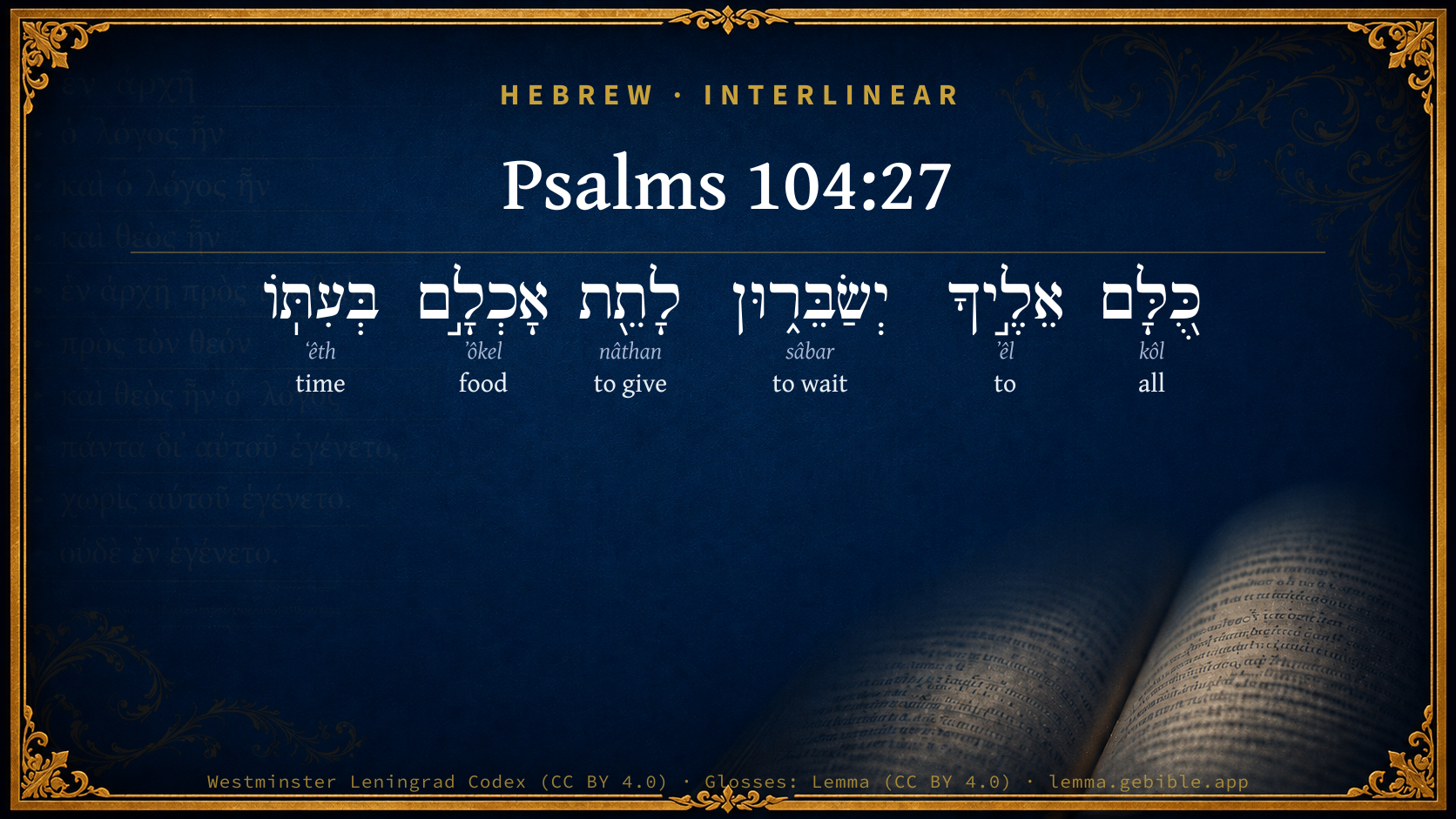
Hebrew (Westminster Leningrad Codex) Psalms 104:27 appears in the Hebrew Old Testament. The text above is from the Westminster Leningrad Codex. Each word links to its Strong’s number, a concise gloss, and parsing drawn from the Open Scriptures Hebrew Bible morphology. Click any word for its full Brown-Driver-Briggs (BDB) entry.
Download image
Cite this verse

Psalms 104:27 (World English Bible). Public Domain. Lemma interlinear Bible study tool, https://lemma.gebible.app/v/psalms/104/27.

Show BibTeX & RIS
BibTeX
RIS
English Translation
These all wait for you, That you may give them their food in due season.
World English Bible · Public Domain
Download a study sheet

One document with this verse’s original text, its word-by-word gloss line, the meaning frame, cross-references with their text, attributed commentary, and full source and license credits — printable, and it pastes into notes with its structure intact.

This verse Autodidact and up

Study sheet (.html) Plain text (.txt)

A passage Seminary Student

Up to 50 verses in one chapter. A passage sheet keeps up to 6 commentary sources and 12 cross-references per verse, in the order this page ranks them, and says so on the sheet whenever that leaves anything out. Ask for a single verse and you get the Autodidact verse sheet above.

Everything on this page stays free to read, with no account — the sheet is a download of what is already on screen, not access to it.

Want to remove ads? Support Godless Engineer
Compare translations 3

The same verse in 3 English versions, stacked beneath the original-language interlinear above. Click any original word for its lexicon entry.

Each is an independent rendering of the whole verse — the interlinear is not word-aligned to these translations.

Highlighted words mark where these versions differ — a whole-verse word diff, not a word-by-word alignment.

  • World English Bible Public Domain
    These all wait for you, That you may give them their food in due season.
  • King James Version Public Domain
    These wait all upon thee; that thou mayest give them their meat in due season.
  • unfoldingWord Literal Text CC BY-SA 4.0
    All of them look to you to give their food at its time.

unfoldingWord Literal Text — © unfoldingWord, licensed CC BY-SA 4.0. Word-aligned USFM3 via Door43 (git.door43.org/unfoldingWord/en_ult).

Versions to compare (up to 4)

3 of 4 selected

Show all 18 translations

Every available English version of this verse, each an independent rendering of the whole verse.

  • World English Bible Public Domain
    These all wait for you, That you may give them their food in due season.
  • Berean Standard Bible Public Domain
    All creatures look to You to give them their food in due season.
  • Majority Standard Bible Public Domain
    All creatures look to You to give them their food in due season.
  • King James Version Public Domain
    These wait all upon thee; that thou mayest give them their meat in due season.
  • American Standard Version (1901) Public Domain
    These wait all for thee, That thou mayest give them their food in due season.
  • Revised Version (1885) Public Domain
    These wait all upon thee, that thou mayest give them their meat in due season.
  • Geneva Bible (1599) Public Domain
    All these waite vpon thee, that thou maiest giue them foode in due season.
  • Douay-Rheims (1899) Public Domain
    All expect of thee that thou give them food in season.
  • Young's Literal Translation Public Domain
    All of them unto Thee do look, To give their food in its season.
  • Literal Standard Version CC BY-SA 4.0
    All of them look to You, || To give their food in its season.
  • Unlocked Literal Bible CC BY-SA 4.0
    All these look to you to give them their food on time.
  • unfoldingWord Literal Text CC BY-SA 4.0
    All of them look to you to give their food at its time.
  • Darby Bible Public Domain
    These all look unto thee, that thou mayest give their food in its season:
  • World Messianic Bible Public Domain
    These all wait for you, that you may give them their food in due season.
  • Webster's Bible Public Domain
    These wait all upon thee; that thou mayest give them their food in due season.
  • Free Bible Version CC BY-SA 4.0
    All creatures look to you to give them food at the right time.
  • Bible in Basic English Public Domain
    All of them are waiting for you, to give them their food in its time.
  • JPS Tanakh (1917) Public Domain
    All of them wait for Thee, that Thou mayest give them their food in due season.

Literal Standard Version (2020), Covenant Press — licensed CC BY-SA 4.0. Text via the HelloAO Bible API (eBible.org). Unlocked Literal Bible (unfoldingWord) — licensed CC BY-SA 4.0. Text via the HelloAO Bible API (eBible.org). unfoldingWord Literal Text — © unfoldingWord, licensed CC BY-SA 4.0. Word-aligned USFM3 via Door43 (git.door43.org/unfoldingWord/en_ult). Free Bible Version, Dr. Jonathan Gallagher — licensed CC BY-SA 4.0. Text via the HelloAO Bible API (eBible.org).

Word by word

More ways to search: Search by grammar → Find every occurrence → Compare this word →

Practice this passage: Drill this verse → Learn its vocabulary →

About this verse

These counts appear in no published source. They are computed here, from the morphology-tagged text and Lemma’s own curated glosses. What Lemma adds →

6
words
6
distinct lemmas
Wisdom
section

Notable vocabulary

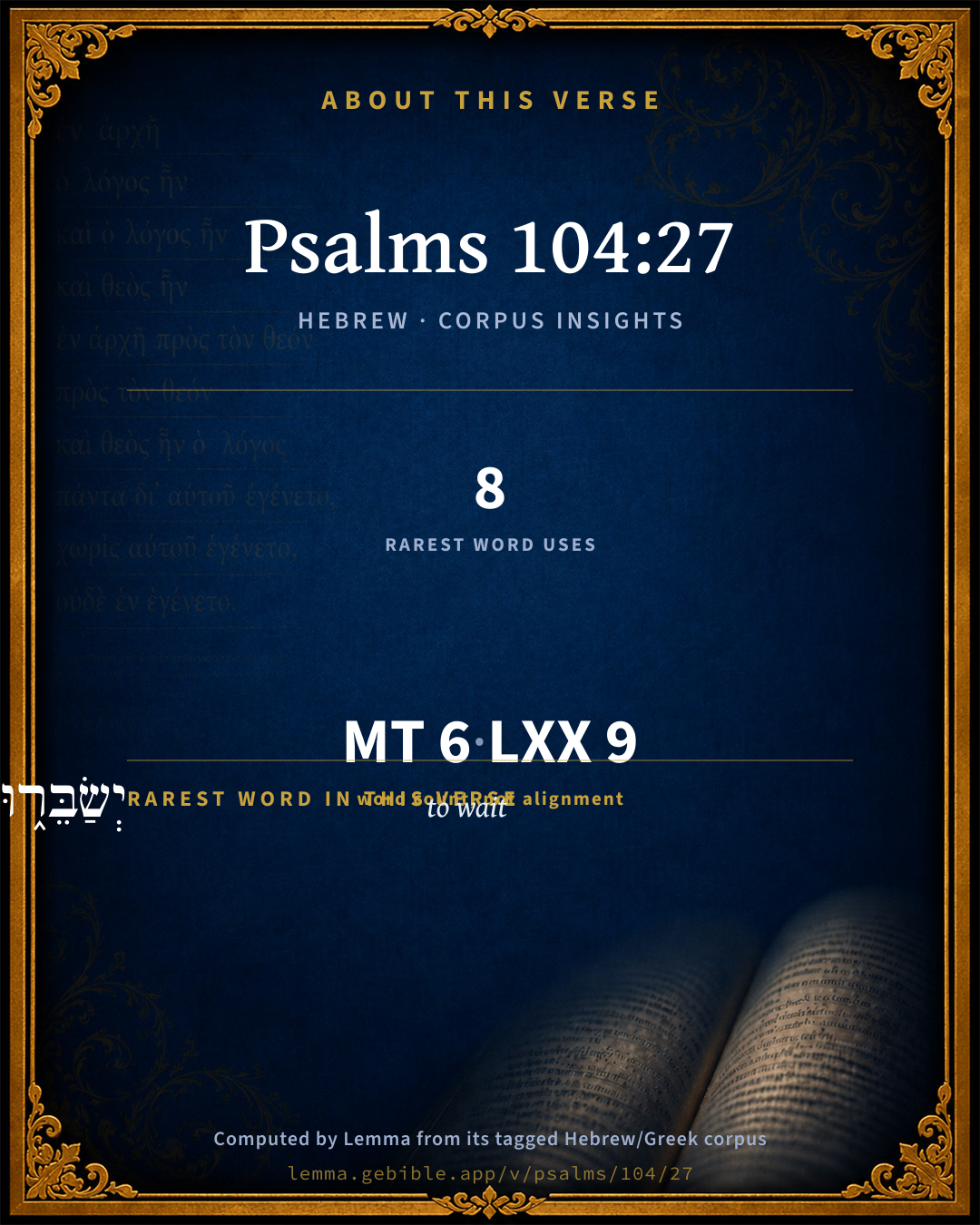
The rarest word here is יְשַׂבֵּר֑וּן to wait H7663 — appearing just 8 times in the whole Hebrew Bible.

Shared distinctive vocabulary

יְשַׂבֵּר֑וּן to wait H7663 occurs in 8 verses of the Hebrew Bible. Also found in:

Grammatical profile

  • 2 verbs
  • 3 nouns
  • 1 preposition

Verb forms

  • יְשַׂבֵּר֑וּן Piel · Imperfect
  • לָתֵ֖ת Qal · Infinitive Construct

Hebrew & Septuagint length

In English translation the verse runs 15 words from the Hebrew and 12 from the Septuagint (LXX English) — closely comparable.

A rough comparison of the two English renderings, which tokenize alike — not a word-level alignment.

Word counts can differ between the Hebrew and the Greek without any difference in meaning — e.g. the Hebrew direct-object marker אֵת has no separate Greek word, and Greek often adds the article ὁ.

In the original languages it is 6 Hebrew tokens and 9 Greek tokens — but the two are counted differently (Hebrew bundles its prefixes and suffixes into one token; the Greek is in lemma form), so that isn’t a like-for-like length.

Cross-references

7

Topical passages linked to Psalms 104:27 in the Treasury of Scripture Knowledge — connected by theme and wording, ordered by reader-vote popularity; previews shown in the World English Bible.

  • Psalms 136:25 Who gives food to every creature; For his loving kindness endures forever.
  • Psalms 147:9 He provides food for the cattle, And for the young ravens when they call.
  • Job 38:41 Who provides for the raven his prey, When his young ones cry to God, And wander for lack of food?
  • Luke 12:24–28 Consider the ravens: they don't sow, they don't reap, they have no warehouse or barn, and God feeds them. How much more valuable are you than birds!
  • Psalms 145:15–16 The eyes of all wait for you. You give them their food in due season.
  • Job 36:31 For by these he judges the people. He gives food in abundance.
  • Psalms 36:6 Your righteousness is like the mountains of God. Your judgments are like a great deep. Yahweh, you preserve man and animal.

Cross-references courtesy of OpenBible.info (CC BY 4.0).

Hebrew and Greek witnesses Masoretic Hebrew ↔ Greek Septuagint

The same verse in the two great witnesses to the Old Testament, shown verse-for-verse.

You’re reading Greek Psalm 103 (Hebrew Psalm 104). The Septuagint counts the superscription, so verse numbers can differ from the Hebrew — chapter-level alignment, not verse-by-verse. Numbering follows Rahlfs.

These are two independent witnesses, not word-aligned to each other, and the Septuagint is shown in lemma (dictionary) form.

Hebrew Psalms 104:27 Masoretic · Westminster Leningrad Codex

כֻּ֭לָּם אֵלֶ֣יךָ יְשַׂבֵּר֑וּן לָתֵ֖ת אָכְלָ֣ם בְּעִתּֽוֹ

These all wait for you, That you may give them their food in due season.

World English Bible · Public Domain

Greek LXX Greek Psalm 103:27 Septuagint · lemma form

πᾶς πρός σύ προςδοκάω δίδωμι ὁ τροφή αὐτός εὔκαιρος

All wait upon you, to give them their food in due season.

LXX2012 (modern English Septuagint) · Public Domain

On this verse, Albert Barnes' Notes on the Bible discusses the Septuagint’s reading. Read the note in Commentary ↓

Hebrew: Westminster Leningrad Codex (CC BY 4.0). Greek: Septuagint (public domain); English from LXX2012 (modern English Septuagint) (Public Domain). How the Septuagint differs from the Hebrew →

Commentary

Notes on Psalms 104:27 from classic Christian and Jewish commentators (each source and its license shown beneath its notes). The classic Christian expositions comment on the surrounding passage and are grouped to its opening verse, so a note may address several verses; the Jewish commentaries on the Tanakh (Rashi and others) are per-verse, so they appear only where the commentator wrote on this verse.

Lemma curates 59 commentaries, every one of them public domain or Creative Commons licensed, each selected and text-cleaned for this edition rather than reprinted as found. About our sources →

Trapp's Complete Commentary

John Trapp

Psa 104:27 These wait all upon thee; that thou mayest give [them] their meat in due season.

Ver. 27. These wait all upon thee] The great housekeeper of the world, who carvest them out their meet measures of meat, and at fit seasons. Of thee they have it, per causarum concatenationem.

John Trapp, A Commentary or Exposition upon All the Books of the Old and New Testament (1647–1656) — public domain. Text from a community e-Sword module.

The Biblical Illustrator

Joseph S. Exell

Psa_104:27-28

These wait all upon Thee; that Thou mayest give them their meat in due season.

The waiting world supplied

Often the poet, rather than the scientist, is the true interpreter of nature. Mystic links which the scientist kens not, bind the universe to God. The devout poet hears God in the thunder; sees His touch on the smoking volcano; beholds His glory in sun and stars; hears the trees clapping their hands before Him: and, listening to the sounds of want and woe rising from a travailing creation, catches the accents of a universal prayer; while, in the provision made for every living thing he sees the bountiful answer from the opened hand of Deity.

I. Universal dependence. These all wait upon Thee, etc. We are dependent for life and all the good of life upon circumstances beyond our control. Earth, air, water, warmth, light, all so necessary, may all become destructive. They are all under law; but God Himself made and enforces their laws. The universe is an embodied thought of Deity, the product of His will: it runs its course sustained by the power which called it into being. The Creator is the Sustainer; the Alpha is the Omega of existence.

II. Universal prayer. The eyes of all wait upon Thee, etc. Want looks up into the face of fulness. The sight of want and woe is a prayer to the bountiful. A drooping plant, a pining cat, or a crying babe, appeals to us all the more powerfully, because the appeal is inarticulate. Now, God is intimately connected with all forms of life, and perfectly understands the language of all His creatures. He sees the thirsty earth pining for rain; He hears the cry of the young ravens and roar of the lions (Jon_3:7-8; Jon_4:11). But it is reserved to man as the high priest of Nature, to understand both his own wants and those of the lower creation; and to voice those needs in the heaven-taught prayer, Our Father, give us this day our daily bread.

III. Universal supply. Thou openest Thy hand--the hand of infinite power, wisdom, benevolence, love--and the rain falls, the sun shines, the earth yields her fruit, the pastures are clothed with flocks; the valleys also are covered over with corn, and the desire of every living thing is satisfied. How pleasantly He prepares the table in our sight. He spreads His cloth of green: He decks it with the bloom of innumerable flowers: He permits us to watch, while His servants, the Laws of Nature, gather out of the dewdrop, the sunbeam, the atmosphere and the earth, the raw material which they compound into living food. Gradually earth is laden with the bounty of heaven. Food and decoration are here in rich profusion and golden glory. Man and beast alike are satisfied with the hospitality dispensed by the great Father of all. So also has He spread and richly furnished the Gospel table in our sight; so that we may in His Word trace the whole process of preparation: and now, for our souls needs it is our privilege to gather what He has given. (C. O. EIdridge, B.A.)

The bountifulness of God in His providence

I. His munificence to His creatures is general. Consider--

1. How large a family He provides for.

2. The variety of the provisions which He makes.

3. The regularity with which all is provided.

4. The abundance which He provides for all.

5. The ease with which tie distributes the provisions.

6. He does all this gratuitously.

II. His special generosity to man. This is seen--

1. In His preparing the earth to bring forth fruit to the service of man.

2. In His unremitting supervision of the earth.

3. In that all the gifts bestowed upon others are intended for mans benefit.

4. In that He makes provision for mans soul. (D. Roberts, D.D.)

How the lower creatures are fed

On the pampas, whenever grasshoppers, mice, frogs, or crickets become excessively abundant, we confidently look for the appearance of multitudes of the birds that prey on them . . . It is plain that these birds have been drawn from over an immense area to one spot; and the question is how have they been drawn? Many large birds possessing great powers of flight are, when not occupied with the business of propagation, incessantly wandering from place to place in search of food. They are not, as a rule, regular migrants, for their wanderings begin and end irrespective of seasons, and where they find abundance they remain the whole year. They fly at a very great height, and traverse immense distances. When the favourite food of any one of these species is plentiful in any particular region all the individuals that discover it remain, and attract to them all of their kind passing overhead. This happens on the pampas with the stork, the short-eared owl, the hooded gull, and the dominican or black-backed gull--the leading species among the feathered nomads: a few first appear like harbingers; these are presently joined by newcomers in considerable numbers, and before long they are in myriads. (Hudson.)

Divine sufficiency

After a world of hungry men have fed upon Christ, He remains inexhaustible as at the beginning; like the bread in His own miracles, of which the pieces that were broken and ready to be given to the eaters were more than the original stock as it appeared when the meal began. Or like the fabled meal in the Norse Walhalla, which the gods sat down to to-day, and to-morrow there it is, all on the board, as abundant and full as ever. (A. Maclaren, D.D.)

Sufficiency for all varieties of experience

So manifold are the aspects of Gods infinite sufficiency, that every soul, in every possible variety of circumstance, will find there just what will suit it. That deep fountain is like some of those fabled springs which gave forth whatsoever precious draught any thirsty lips asked. (A. Maclaren, D. D.)

The Biblical Illustrator, edited by Joseph S. Exell (c. 1880s–1900s) — public domain. Text from a community e-Sword module.

Joseph Benson's Commentary

Psa 104:27-30. These all — Both beasts and fishes, wait upon thee — Expect supplies from thy providence: which is spoken of them figuratively, and with an allusion to the manner of tame beasts and fowls, which commonly look after and wait upon those persons who bring their food to them. That thou mayest give them their meat, &c. — When it is necessary or convenient for them. That thou givest them they gather — Whatsoever they receive is from the bounty of thy gift, and they do their part for the obtaining of it: what thou placest within their reach they gather, and expect not that thy providence should put it into their mouths; and with what they gather they are satisfied. For when thou openest thy hand — To supply their wants, they are filled with good — And desire no more than what thou seest fit to give them. Thou hidest thy face — Withdrawest, or suspendest the favour and care of thy providence; they are troubled — Dejected and distressed through want and misery. Thou takest away their breath — Which is in thy hand, and then, and not till then, they die and return to their dust — To the earth, from whence they had their original. Thou sendest forth thy spirit — That spirit by which they live, which may be called God’s spirit, because given and preserved by him. Or rather, that quickening power of God, by which he produces and preserves life in the creatures from time to time. For he speaks not here of the first creation, but of the continued production and preservation of living creatures. They are created — That is, either, 1st, The same living creatures, which were languishing and dying, are strangely revived and restored. Or, 2d, Other living creatures are produced or generated; the word created being taken in its largest sense, for the production of things by second causes. And thou renewest the face of the earth — And thus, by thy wise and powerful providence, thou preservest the succession of living creatures upon the earth, which otherwise would be desolate and without inhabitants. It is justly observed here, by Dr. Dodd, that “the ideas in these verses can be excelled by nothing, but by the concise elegance of the expressions;” which convey to the human mind the most sublime and awful conceptions of that Almighty Being who does but open his hand, and the creatures are filled with good; does but hide his face, and they are troubled and die; does but send forth his Spirit, and they are created.

Joseph Benson's Commentary on the Old and New Testaments (1811–1818) — public domain. Text from a community e-Sword module.

J. A. Alexander on Psalms

Joseph Addison Alexander

27. (Psa 104:27) All of them on thee rely, to give their food in its season. The all of them obviously relates to all the living creatures previously mentioned, and not to any one or more exclusively, the proposition being no less true of men than brutes, or of brutes than men. On thee rely is not an exact translation of the Hebrew, which indeed does not admit of one, because it combines a verb and preposition which cannot be combined in English. The form of the original is, to thee wait, expect, or hope, the verb expressing confidence, the particle the act of looking towards the object thus confided in. The description of the animals as thus expecting their supplies from God, is merely the poetical costume in which the Psalmist clothes the fact that they are really, although unconsciously, dependent on him. In precisely the same manner, other poets represent the earth, in time of drought, as parched with thirst and longing for the rain, which expressions no sane man would either charge with falsehood, or consider as implying a belief in the conscious personality of Earth. Compare my note on Isa 42:4. In its season, i.e. when they need it.

Joseph Addison Alexander, The Psalms Translated and Explained (1850) — public domain. Text from a community e-Sword module.

Tyndale Open Study Notes

Tyndale Open Resources

104:27-30 All life depends on the gracious sustenance of the Lord of life and death (cp. Matt 6:11).

Tyndale Open Study Notes — © Tyndale Open Resources, licensed CC BY-SA 4.0. Text via the HelloAO Bible API.

Geneva Bible (1599)

Geneva Bible translators

God is a most nourishing Father, who provideth for all creatures their daily foods.

Geneva Bible (1599) marginal notes — public domain. Text via Bolls.life.

Adam Clarke's Commentary

Verse 27. These wait all upon thee] The innumerable fry of the smaller aquatic animals, as well as whales, dolphins, porpoises, and sharks, all have their meat from God. He has in his gracious providence furnished that sort of food which is suitable to all. And this provision is various; not only for every kind of fish does God provide food, but a different kind of aliment for each in its different periods of growth. Here are displayed the goodness and infinitely varied providence of God: "He giveth them their meat in due season."

Adam Clarke's Commentary on the Bible (1810–1826) — public domain. Text from a community e-Sword/MySword module.

John Calvin's Commentaries

27. All these wait upon thee The prophet here again describes God as acting the part of the master of a household, and a foster-father towards all sorts of living creatures, by providing liberally for them. He had said before, that God made food to grow on the mountains for the support of cattle, and that sustenance is ministered to the very lions by the hand of the same God, although they live upon prey. Now he amplifies this wonder of the divine beneficence by an additional circumstance. While the different species of living creatures are almost innumerable, and the number in each species is so great, there is yet not one of them which does not stand in need of daily food. The meaning then of the expression, All things wait upon thee, is, that they could not continue in existence even for a few days, unless God were to supply their daily need, and to nourish each of them in particular. We thus see why there is so great a diversity of fruits; for God assigns and appoints to each species of living creatures the food suitable and proper for them. The brute beasts are not indeed endued with reason and judgment to seek the supply of their wants from God, but stooping towards the earth, they seek to fill themselves with food; still the prophet speaks with propriety, when he represents them as waiting upon God; for their hunger must be relieved by his bounty, else they would soon die. Nor is the specification of the season when God furnishes them with food superfluous, since God lays up in store for them, that they may have the means of sustenance during the whole course of the year. As the earth in winter shuts up her bowels, what would become of them if he did not provide them with food for a long time? The miracle, then, is the greater from the circumstance, that God, by making the earth fruitful at stated seasons, extends in this way his blessing to the rest of the year which threatens us with hunger and famine. How wretched would we be when the earth in winter shuts up her riches, were not our hearts cheered with the hope of a new increase? In this sense, the Psalmist appropriately affirms, that God opens his hand If wheat should grow up daily, God’s providence would not be so manifest. But when the earth becomes barren, it is as if God shut his hand. Whence it follows, that when he makes it fruitful, he, so to speak, stretches out his hand from heaven to give us food. Now if he supply wild and brute beasts with sustenance in due season, by which they are fed to the full, his blessing will doubtless be to us as an inexhaustible source of plenty, provided we ourselves do not hinder it from flowing to us by our unbelief.

John Calvin's Commentaries (1540-1563) — public domain. Text from the Calvin Translation Society English edition (1840s-50s) via the Christian Classics Ethereal Library (ccel.org). Calvin's coverage is partial (roughly two-thirds of the Bible); uncommented books and verses are honest gaps, never fabricated. The 19th-century editor's footnotes and remarks are omitted so the notes are faithfully Calvin's own voice.

The Cambridge Bible for Schools and Colleges

gen. ed. J. J. S. Perowne

27. These wait all &c.] All of them wait upon thee. Not marine animals only, but all living creatures are meant, as in Gen_1:29-30. God is the great householder, dispensing to all His family their portions. Cp. Psa_145:15-16; Psa_147:9.

The Cambridge Bible for Schools and Colleges (gen. ed. J. J. S. Perowne; Cambridge University Press, 1878–1918) — public domain. Text from a community e-Sword module.

John Gill's Exposition

These wait all upon thee,.... Or "hope in thee" (s); not only the fishes of the sea, but the beasts of the field; for to them the psalmist returns, as Aben Ezra observes; to whom hope and expectation of their food and waiting for it at the hands of God, are ascribed; the allusion seems to be to tame creatures, who come at their certain times and wait on them that have been used to give them their food; and it may instruct us to wait on the Lord, as for our daily bread, so for our spiritual food, in prayer, and in public ordinances, where and from whom we may hope and expect to have it.

That thou mayest give them their meat in due season; or "in his time" (t); everyone in its own time, which is natural to them, and they have been used to; at which time the Lord gives it to them and they take it; it would be well if men would do so likewise, eat and drink in proper and due time, Ecc 10:17. Christ speaks a word in season to weary souls; his ministers give to everyone their portion of meat in due season; and a word spoken in due season, how good and sweet is it? Isa 1:4.

(s) "sperant", Pagninus, Cocceius, Michaelis; "sperabunt", Montanus. (t) "in tempore suo", Pagninus, Montanus, Tigurine version, Junius & Tremellius, Piscator, &c.

John Gill's Exposition of the Whole Bible (1746–1763) — public domain (CC PDM 1.0). Text via the HelloAO Bible API.

Albert Barnes' Notes on the Bible

These wait all upon thee - That is, These are all dependent on thee. It does not, of course, mean that they “wait” in the sense that they are conscious of their dependence on God, but that they are “actually” dependent. The original word implies the idea of “expecting” or “hoping,” and is so rendered in the Septuagint and Vulgate. They have no other ground of expectation or hope but in thee.

That thou mayest give them their meat in due season - Their food at the proper time. That is, They are constantly dependent on thee, that thou mayest give them food from day to day. Perhaps there is also the idea that they do not lay up or hoard anything; or that they cannot anticipate their own needs, but must receive from one day to another all that they want directly from God.

Albert Barnes' Notes on the Bible (1834–1885) — public domain. Text from a community e-Sword/MySword module.

Matthew Poole's English Annotations

These all, both beasts and fishes,

wait upon thee, expect supplies only from thy providence; which is said of them figuratively, and with an allusion to the manner of tame beasts and fowls, which commonly look after and wait upon those persons who bring their food to them.

In due season; when it is necessary or convenient for them; by which expression he intimates the moderation of the beasts in their desires of food, and tacitly reproves the intemperance of men who feed themselves in season and out of season.

Matthew Poole's English Annotations on the Holy Bible (1683–1685) — public domain. Text from a community e-Sword/MySword module.

The Treasury of David

Charles H. Spurgeon

Ver. 27. These wait all upon thee. They come around thee as fowls around the farmer's door at the time for feeding, and look up with expectation. Men or marmots, eagles or emmets, whales or minnows, they alike rely upon thy care.

That thou mayest give them meat in due season; that is to say, when they need it and when it is ready for them. God has a time for all things, and does not feed his creatures by fits and starts; he gives them daily bread, and a quantity proportioned to their needs. This is all that any of us should expect; if even the brute creatures are content with a sufficiency we ought not to be more greedy than they.

Ver. 27. There are five things to be observed in God's sustaining all animals. His power, which alone suffices for all: "These wait all upon thee." Wisdom, which selects a fitting time: "That thou mayest give them their meat in due season." His majesty rising above all: "That thou givest them they gather, "like the crumbs falling from the table of their supreme Lord. His liberality, which retains nothing in his open hand that it does not give: "Thou openest thine hand." His original goodness that flows down to all: "They are filled with good, "that is, with the good things that spring from thy goodness. Le Blanc.

Ver. 27. That thou mayest give them their meat in due season; or, in his time; every one in its own time which is natural to them, and they have been used to, at which time the Lord gives it to them, and they take it; it would be well if men would do so likewise, eat and drink in proper and due time, Ec 10:17. Christ speaks a word in season to weary souls; his ministers give to every one his portion of meat in due season; and a word spoken in due season, how good and sweet is it? Isa 7:4 Lu 7:12 Pr 15:23. John Gill.

Ver. 27.

These, Lord, all wait on thee, that thou their food may it give them;

Thou to their wants attendest;

They gather what thou sendest;

Thine hand thou openest, all their need supplying,

Over lookest not the least, the greatest satisfying.

When thou dost hide thy face a sudden change comes over them

Their breath in myriads taken,

They die no more to awaken;

But myriads more thy Spirit soon createth,

And the whole face of nature quickly renovateth.

The glory of the Lord, changeless, endures for ever;

In all his works delighting,

Nor even the smallest slighting;

Yet, if he frown, earth shrinks with fear before him,

And, at his touch, the hills with kindling flames adore him, John Burton.

Ver. 27. Trace the analogy in the spiritual world. The saints waiting, Ps 5:27; their sustenance from the opened hand, Ps 5:28; their trouble under the hidden face; their death if the Spirit were gone, Ps 5:29; their revival when the Spirit returns, Ps 5:30.

Psalms 104:28*

Charles H. Spurgeon's The Treasury of David (1869–1885) — public domain. Psalms only. Text from a community e-Sword/MySword module.

Whedon's Commentary on the Bible

Daniel D. Whedon

27. These wait all upon thee—Here is the moral of all these beautiful allusions to living creatures. God feeds them. They wait on God as if their eyes were fixed on him in expectation of being fed, as the Hebrew denotes. See Job_38:41; Psa_145:15; Psa_147:9.

In due season—Literally, In his time. The idea is that they, having no stores laid up, but seeking food only when impelled by hunger, are yet so supplied with means of sustentation, and endowed with instincts and prehensive appliances for discovering and securing their appropriate food, that to the eye of reason they discover and declare the wisdom and beneficence of the Creator, in thus providing for them. Compare Mat_6:26

Daniel D. Whedon (gen. ed.), Commentary on the Old and New Testaments (1874–1909) — public domain. Text from a community e-Sword module.

The Pulpit Commentary

These wait all upon thee; that thou mayest give them their meat in due season (see vers. 14, 23). As cattle have "grass," and lions "meat," from God, so every kind of animal receives from the same source its proper food.

Absolute dependence upon God.

"These wait all upon thee, that thou mayest give them their meat in due season." All vegetable and animal life depends on appropriate food; and though sometimes the food is at the creature"s hand, it usually has to be sought. God has arranged the economy of nature so that each creature is skilled to find its own food. The dependence of creation on the Creator may be made effective to an audience by an illustrative instance such as the following: The fox has sly and skilful movements; but it is not always noticed how God helps the fox apart from his cunning. The red colour of his coat is found to have a strangely paralyzing effect on his prey, so that they are quite unable to flee from him. The psalmist, in trying to raise high and adoring thoughts of the eternal King by examination of his kingdom, is especially impressed with the signs of the King"s presence, interest, care, and providing everywhere. It is not a creation set going, and left to go; it is sustained, provided for, continually.

I FOR LIFE WE ARE DEPENDENT ON GOD. God. wakens us from nightly sleep, and sets new time upon our store.

II FOR RENEWED POWERS WE ARE DEPENDENT ON GOD. Yet how seldom we thank God for our sound minds!

III FOR HEALTH WE ARE DEPENDENT ON GOD. Modern discoveries concerning the germs of disease that float around us and thrive within us, make us wonder that health is retained so well and so long.

IV FOR FOOD WE ARE DEPENDENT ON GOD. Since he gives us the means to get it, and provides it for us, year by year, as the harvest of his earth.

Visiting the Zoological Gardens, and noticing the variety of creatures, and the variety of food required to meet the needs and daily conditions of each one, we were set wondering over the Divine response to the dependence of all living things, he giveth "them," each one, "their meat that which is precisely suitable for each one in due season, or whenever the need of each one really rises into a cry. "Our sufficiency is of God." Dependence on him meets with response from him, which claims our thankfulness and our service. R.T.

The Pulpit Commentary (1880–1919), ed. H.D.M. Spence-Jones & Joseph S. Exell — public domain. Text from a community e-Sword module.

unfoldingWord translationNotes

Door43 World Missions Community

All these

"All these creatures"

give them their food on time

"give them their food when they need it"

When you give to them, they gather

It may be helpful to state that it is food that is given. AT: "When you give food to them, they gather it" (See: Assumed Knowledge and Implicit Information)

gather

collect

when you open your hand

This describes Yahweh as opening his hand to give food to the creatures. AT: "when you open your hand to feed them" (See: Assumed Knowledge and Implicit Information)

translationWords

hand

unfoldingWord translationNotes — © Distant Shores Media and the Door43 World Missions Community, licensed CC BY-SA 4.0. Source: git.door43.org/Door43/en_tn.

Lesson kit

Teaching starters — assembled from the data on this page, not authored interpretation. Every prompt links to the verse data it draws on. Edit before teaching.

Psalms, in the Wisdom, opens this verse with 6 words (6 distinct Hebrew lemmas). Its most distinctive word is sâbar (“to wait”). A historical commentator’s framing appears above. Read the whole chapter for the surrounding context.

Discussion questions

  1. The word sâbar carries the sense “to wait.” How does it shape the verse?
  2. Ruth 1:13 shares the word «to wait» with this verse. How do the two illuminate each other?
  3. These translations render this verse differently; the difference is in the English rendering, not the original. What questions does that raise?
  4. The verb «יְשַׂבֵּר֑וּן» is Piel Imperfect. How does its form color the action?
  5. Reading how Trapp's Complete Commentary and The Biblical Illustrator read this verse, where do the two commentators agree and where do they part?

Things to notice

Reading settings

Reading text

Shown beneath each verse's original-language words.

Old Testament
Old Testament edition

Read the OT as the Masoretic Hebrew (MT) or the Greek Septuagint (LXX).

English shown for the Greek Septuagint (in the Hebrew ↔ Greek comparison).

Comparing translations? Open the Compare panel on any verse page to stack up to four side by side.