Psalms 10:5

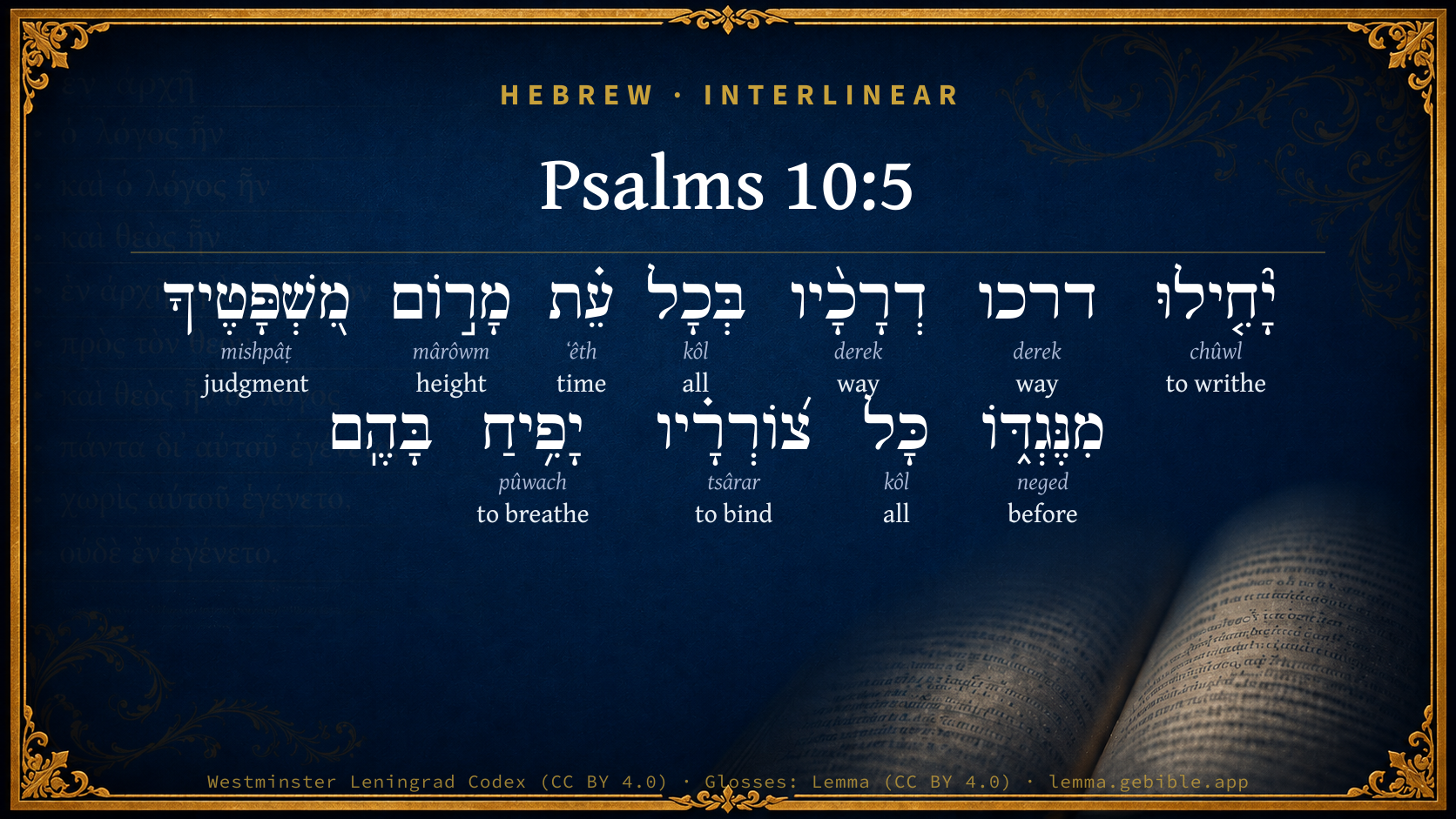
Hebrew (Westminster Leningrad Codex) Psalms 10:5 appears in the Hebrew Old Testament. The text above is from the Westminster Leningrad Codex. Each word links to its Strong’s number, a concise gloss, and parsing drawn from the Open Scriptures Hebrew Bible morphology. Click any word for its full Brown-Driver-Briggs (BDB) entry.
Download image
Cite this verse

Psalms 10:5 (World English Bible). Public Domain. Lemma interlinear Bible study tool, https://lemma.gebible.app/v/psalms/10/5.

Show BibTeX & RIS
BibTeX
RIS
English Translation
His ways are prosperous at all times; He is haughty, and your laws are far from his sight: As for all his adversaries, he sneers at them.
World English Bible · Public Domain
Highlights
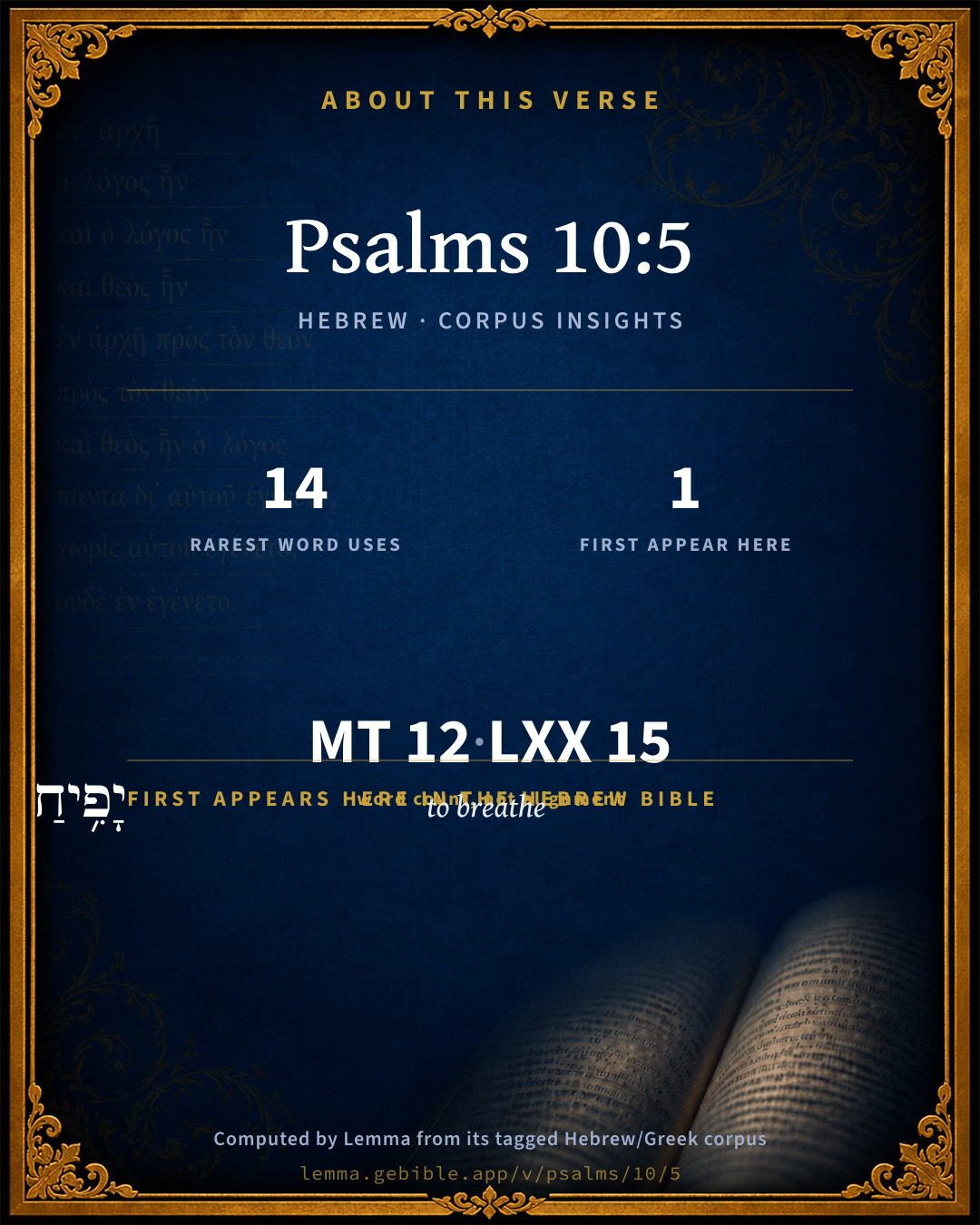
  • 1 first appearance in the Hebrew Bible
Full analysis ↓
Download a study sheet

One document with this verse’s original text, its word-by-word gloss line, the meaning frame, cross-references with their text, attributed commentary, and full source and license credits — printable, and it pastes into notes with its structure intact.

This verse Autodidact and up

Study sheet (.html) Plain text (.txt)

A passage Seminary Student

Up to 50 verses in one chapter. A passage sheet keeps up to 6 commentary sources and 12 cross-references per verse, in the order this page ranks them, and says so on the sheet whenever that leaves anything out. Ask for a single verse and you get the Autodidact verse sheet above.

Everything on this page stays free to read, with no account — the sheet is a download of what is already on screen, not access to it.

Want to remove ads? Support Godless Engineer
Compare translations 3

The same verse in 3 English versions, stacked beneath the original-language interlinear above. Click any original word for its lexicon entry.

Each is an independent rendering of the whole verse — the interlinear is not word-aligned to these translations.

Highlighted words mark where these versions differ — a whole-verse word diff, not a word-by-word alignment.

  • World English Bible Public Domain
    His ways are prosperous at all times; He is haughty, and your laws are far from his sight: As for all his adversaries, he sneers at them.
  • King James Version Public Domain
    His ways are always grievous; thy judgments are far above out of his sight: as for all his enemies, he puffeth at them.
  • unfoldingWord Literal Text CC BY-SA 4.0
    His ways endure at every time; your judgments are high from in front of him; all his enemies, he snorts at them.

unfoldingWord Literal Text — © unfoldingWord, licensed CC BY-SA 4.0. Word-aligned USFM3 via Door43 (git.door43.org/unfoldingWord/en_ult).

Versions to compare (up to 4)

3 of 4 selected

Show all 17 translations

Every available English version of this verse, each an independent rendering of the whole verse.

  • World English Bible Public Domain
    His ways are prosperous at all times; He is haughty, and your laws are far from his sight: As for all his adversaries, he sneers at them.
  • Berean Standard Bible Public Domain
    He is secure in his ways at all times; Your lofty judgments are far from him; he sneers at all his foes.
  • Majority Standard Bible Public Domain
    He is secure in his ways at all times; Your lofty judgments are far from him; he sneers at all his foes.
  • King James Version Public Domain
    His ways are always grievous; thy judgments are far above out of his sight: as for all his enemies, he puffeth at them.
  • American Standard Version (1901) Public Domain
    His ways are firm at all times; Thy judgments are far above out of his sight: As for all his adversaries, he puffeth at them.
  • Revised Version (1885) Public Domain
    His ways are firm at all times; thy judgments are far above out of his sight: as for all his adversaries, he puffeth at them.
  • Geneva Bible (1599) Public Domain
    His wayes alway prosper: thy iudgements are hie aboue his sight: therefore defieth he all his enemies.
  • Young's Literal Translation Public Domain
    Pain do his ways at all times, On high `are' Thy judgments before him, All his adversaries -- he puffeth at them.
  • Literal Standard Version CC BY-SA 4.0
    His ways writhe at all times, || Your judgments [are] on high before him, || All his adversaries—he puffs at them.
  • Unlocked Literal Bible CC BY-SA 4.0
    He is secure at all times, but your righteous decrees are too high for him; he snorts at all his enemies.
  • unfoldingWord Literal Text CC BY-SA 4.0
    His ways endure at every time; your judgments are high from in front of him; all his enemies, he snorts at them.
  • Darby Bible Public Domain
    His ways always succeed; thy judgments are far above out of his sight; [as for] all his adversaries, he puffeth at them.
  • World Messianic Bible Public Domain
    His ways are prosperous at all times. He is arrogant, and your laws are far from his sight. As for all his adversaries, he sneers at them.
  • Webster's Bible Public Domain
    His ways are always grievous; thy judgments are far above out of his sight: as for all his enemies, he puffeth at them.
  • Free Bible Version CC BY-SA 4.0
    What they do always seems to go well. They're unaware of God's judgments. They ridicule all their enemies.
  • Bible in Basic English Public Domain
    His ways are ever fixed; your decisions are higher than he may see: as for his haters, they are as nothing to him.
  • JPS Tanakh (1917) Public Domain
    His ways prosper at all times; Thy judgments are far above out of his sight; as for all his adversaries, he puffeth at them.

Literal Standard Version (2020), Covenant Press — licensed CC BY-SA 4.0. Text via the HelloAO Bible API (eBible.org). Unlocked Literal Bible (unfoldingWord) — licensed CC BY-SA 4.0. Text via the HelloAO Bible API (eBible.org). unfoldingWord Literal Text — © unfoldingWord, licensed CC BY-SA 4.0. Word-aligned USFM3 via Door43 (git.door43.org/unfoldingWord/en_ult). Free Bible Version, Dr. Jonathan Gallagher — licensed CC BY-SA 4.0. Text via the HelloAO Bible API (eBible.org).

Word by word

More ways to search: Search by grammar → Find every occurrence → Compare this word →

Practice this passage: Drill this verse → Learn its vocabulary →

יָפִ֥יחַ
pûwach
H6315
“to breathe”
Verb, Hiphil, Imperfect, 3rd Person, Masculine, Singular
Part of Speech
Verb
Stem
Hiphil
Form
Imperfect
Person
3rd Person
Gender
Masculine
Number
Singular
Full BDB Definition

Origin: a primitive root

TWOT: 1741

to breathe, blow - (Qal) to breathe - (Hiphil) - to cause to exhale or breathe - to puff, snort - to excite, inflame - to puff, pant for it - to breathe out, utter - to blow, blast
  1. יָ֘חִ֤ילוּ chûwl H2342 “to writhe” Verb, Qal, Imperfect, 3rd Person, Masculine, Plural
  2. דרכו derek H1870 “way · his” Noun, Common, Both, Singular, Construct + Suffix, Personal, 3rd Person, Masculine, Singular
  3. דְרָכָ֨יו derek H1870 “ways · his” Noun, Common, Both, Plural, Construct + Suffix, Personal, 3rd Person, Masculine, Singular
  4. בְּכָל kôl H3605 “in/at · all of” Preposition + Noun, Common, Masculine, Singular, Construct
  5. עֵ֗ת ʻêth H6256 “time” Noun, Common, Both, Singular, Absolute
  6. מָר֣וֹם mârôwm H4791 “height” Noun, Common, Masculine, Singular, Absolute
  7. מִ֭שְׁפָּטֶיךָ mishpâṭ H4941 “judgments · your” Noun, Common, Masculine, Plural, Construct + Suffix, Personal, 2nd Person, Masculine, Singular
  8. מִנֶּגְדּ֑וֹ neged H5048 “from · before · him” Preposition + Preposition + Suffix, Personal, 3rd Person, Masculine, Singular
  9. כָּל kôl H3605 “all of” Noun, Common, Masculine, Singular, Construct
  10. צ֝וֹרְרָ֗יו tsârar H6887 “binding · him” Verb, Qal, Participle Active, Masculine, Plural, Construct + Suffix, Personal, 3rd Person, Masculine, Singular

About this verse

These counts appear in no published source. They are computed here, from the morphology-tagged text and Lemma’s own curated glosses. What Lemma adds →

12
words
9
distinct lemmas
Wisdom
section

Notable vocabulary

The rarest word here is יָפִ֥יחַ to breathe H6315 — appearing just 14 times in the whole Hebrew Bible.

First appearance in Scripture

This word makes its first canonical appearance in the Hebrew Bible here:

  • יָפִ֥יחַ to breathe H6315

Shared distinctive vocabulary

יָפִ֥יחַ to breathe H6315 occurs in 14 verses of the Hebrew Bible. Also found in:

Grammatical profile

  • 3 verbs
  • 7 nouns
  • 2 prepositions

Verb forms

  • יָ֘חִ֤ילוּ Qal · Imperfect
  • צ֝וֹרְרָ֗יו Qal · Participle Active
  • יָפִ֥יחַ Hiphil · Imperfect

Repetition

Words recur within this verse — often emphatic in Hebrew:

  • דרכו way H1870 ×2
  • בְּכָל all H3605 ×2

Hebrew & Septuagint length

In English translation the verse runs 27 words from the Hebrew and 24 from the Septuagint (LXX English) — closely comparable.

A rough comparison of the two English renderings, which tokenize alike — not a word-level alignment.

Word counts can differ between the Hebrew and the Greek without any difference in meaning — e.g. the Hebrew direct-object marker אֵת has no separate Greek word, and Greek often adds the article ὁ.

In the original languages it is 12 Hebrew tokens and 15 Greek tokens — but the two are counted differently (Hebrew bundles its prefixes and suffixes into one token; the Greek is in lemma form), so that isn’t a like-for-like length.

Cross-references

21

Topical passages linked to Psalms 10:5 in the Treasury of Scripture Knowledge — connected by theme and wording, ordered by reader-vote popularity; previews shown in the World English Bible.

  • Isaiah 26:11 Yahweh, your hand is lifted up, yet they don't see: but they shall see [your] zeal for the people, and be disappointed; yes, fire shall devour your adversaries.
  • Psalms 12:5 "Because of the oppression of the weak and because of the groaning of the needy, I will now arise," says Yahweh; "I will set him in safety from those who malign him."
  • Psalms 92:5–6 How great are your works, Yahweh! Your thoughts are very deep.
  • Hosea 14:9 Who is wise, that he may understand these things? Who is prudent, that he may know them? For the ways of Yahweh are right, And the righteous walk in them; But the rebellious stumble in them.
  • Judges 9:27 They went out into the field, and gathered their vineyards, and trod [the grapes], and held festival, and went into the house of their god, and did eat and drink, and cursed Abimelech.
  • Judges 9:38 Then said Zebul to him, Where is now your mouth, that you said, Who is Abimelech, that we should serve him? is not this the people that you have despised? go out now, I pray, and fight with them.
  • 2 Samuel 5:6 The king and his men went to Jerusalem against the Jebusites, the inhabitants of the land, who spoke to David, saying, Except you take away the blind and the lame, you shall not come in here; thinking, David can't come in here.
  • 1 Kings 20:10–11 Ben Hadad sent to him, and said, The gods do so to me, and more also, if the dust of Samaria shall suffice for handfuls for all the people who follow me.
  • 1 Kings 20:13 Behold, a prophet came near to Ahab king of Israel, and said, Thus says Yahweh, Have you seen all this great multitude? behold, I will deliver it into your hand this day; and you shall know that I am Yahweh.
  • Proverbs 1:19 So are the ways of everyone who is greedy for gain. It takes away the life of its owners.
  • Proverbs 2:13 Who forsake the paths of uprightness, To walk in the ways of darkness;
  • Proverbs 2:15 Who are crooked in their ways, And wayward in their paths:
  • Proverbs 15:24 The path of life leads upward for the wise, To keep him from going downward to Sheol.
  • Proverbs 24:1 Don't be envious of evil men; Neither desire to be with them:
  • Isaiah 5:12 The harp, lyre, tambourine, and flute, with wine, are at their feasts; But they don't regard the work of Yahweh, Neither have they considered the operation of his hands.
  • Isaiah 10:1 Woe to those who decree unrighteous decrees, and to the writers who write perverseness;
  • Isaiah 28:15 Because you have said, We have made a covenant with death, and with Sheol are we at agreement; when the overflowing scourge shall pass through, it shall not come to us; for we have made lies our refuge, and under falsehood have we hid ourselves:
  • Isaiah 42:25 Therefore he poured on him the fierceness of his anger, and the strength of battle; and it set him on fire round about, yet he didn't know; and it burned him, yet he didn't lay it to heart.
  • Hosea 9:9 They have deeply corrupted themselves, As in the days of Gibeah. He will remember their iniquity. He will punish them for their sins.
  • Romans 3:16 Destruction and misery are in their ways.
  • Genesis 6:12 God saw the earth, and saw that it was corrupt, for all flesh had corrupted their way on the earth.

Cross-references courtesy of OpenBible.info (CC BY 4.0).

Hebrew and Greek witnesses Masoretic Hebrew ↔ Greek Septuagint

The same verse in the two great witnesses to the Old Testament, shown verse-for-verse.

You’re reading Greek Psalm 9 (Hebrew Psalm 10). The Septuagint counts the superscription, so verse numbers can differ from the Hebrew — chapter-level alignment, not verse-by-verse. Numbering follows Rahlfs.

These are two independent witnesses, not word-aligned to each other, and the Septuagint is shown in lemma (dictionary) form.

Hebrew Psalms 10:5 Masoretic · Westminster Leningrad Codex

יָ֘חִ֤ילוּ דרכו דְרָכָ֨יו בְּכָל עֵ֗ת מָר֣וֹם מִ֭שְׁפָּטֶיךָ מִנֶּגְדּ֑וֹ כָּל צ֝וֹרְרָ֗יו יָפִ֥יחַ בָּהֶֽם

His ways are prosperous at all times; He is haughty, and your laws are far from his sight: As for all his adversaries, he sneers at them.

World English Bible · Public Domain

Greek LXX Greek Psalm 9:5 Septuagint · lemma form

ὅτι ποιέω ὁ κρίσις ἐγώ καί ὁ δίκη ἐγώ καταἵζω ἐπί θρόνος ὁ κρίνω δικαιοσύνη

You have rebuked the nations, and the ungodly one has perished; you have blotted out their name for ever, even for ever and ever.

LXX2012 (modern English Septuagint) · Public Domain

On this verse, John Calvin's Commentaries discusses the Septuagint’s reading. Read the note in Commentary ↓

Hebrew: Westminster Leningrad Codex (CC BY 4.0). Greek: Septuagint (public domain); English from LXX2012 (modern English Septuagint) (Public Domain). How the Septuagint differs from the Hebrew →

Commentary

Notes on Psalms 10:5 from classic Christian and Jewish commentators (each source and its license shown beneath its notes). The classic Christian expositions comment on the surrounding passage and are grouped to its opening verse, so a note may address several verses; the Jewish commentaries on the Tanakh (Rashi and others) are per-verse, so they appear only where the commentator wrote on this verse.

Lemma curates 59 commentaries, every one of them public domain or Creative Commons licensed, each selected and text-cleaned for this edition rather than reprinted as found. About our sources →

Trapp's Complete Commentary

John Trapp

Psa 10:5 His ways are always grievous; thy judgments [are] far above out of his sight: [as for] all his enemies, he puffeth at them.

Ver. 5. His ways are always grievous] As he pleaseth not God, so he is contrary and vexatious to men, Viae eius semper terrent, so Aben Ezra. The psalmist here noteth him for such a one as the Cyclopes are set forth to have been by the poets.

Thy judgments are far above out of his sight] He looketh not so high, but reckoneth that quae supra nos nihil ad nos. If he read them at any time, he regardeth them as little as he doth the story of foreign wars, wherein he is not concerned.

As for all his enemies, he puffeth at them] He holdeth himself man good enough to make his party good with them, and that he can overthrow them all with a puff. He defieth them and domineereth over them, as the Greek renders it, κατακυριενει (Sept.), εκφυσα (Chrysost.).

John Trapp, A Commentary or Exposition upon All the Books of the Old and New Testament (1647–1656) — public domain. Text from a community e-Sword module.

The Biblical Illustrator

Joseph S. Exell

Psa_10:5

Thy judgments are far above, out of his sight.

Mans judgment at variance with Gods

There is an obtuseness and impenetrability that attach to the mind of man respecting the character of moral obligation that prove absolutely invincible to all his powers of meditation and research. This inability is of a moral, not of a natural kind, having its origin not in his natural constitution, but in his adventitious circumstances. The powers of the human mind receive a wrong direction. Reason turns renegade, and to escape a hated conclusion flings itself incontinently into the arms of delusion. It is thus that the stoutest intellect becomes the most impregnable. Numberless are the subterfuges, speculative as well as practical, that are continually held in play by the human mind in order to elude the embarrassment of its untoward circumstances; for there is no middle road to peace once the soul has begun to grapple with the momentous investigation. This obliquity of mind, that likes not to retain the knowledge of God, is the true and only source of all the difficulty that attaches to the reception of religious truth. Truth of this description lies no way more remote from our apprehension than any truth of natural science, till it begins to molest us with the sense of moral obligation, and to make its demands on our acquiescence in the form of duty. Men have not generally disputed much about what is virtue, their approbation of it being required only in the form of encomium. They willingly unite in applauding exemplary specimens of justice, disinterestedness, and generosity, and in the condemnation of their contraries . . . Our consciences ought not to sit so easy under the sins of our country, or even of mankind. That character in man which separates betwixt him and his Maker, and provokes the Divine judgment, also renders the Divine proceeding in judgment more obscure and unintelligible to him. Conclusion: See the indubitable equity, harmony, and consistency of the Divine administration in judgment. (H. Grey, M. A.)

The unseen avengers

On the whole and in the rough, unquestionably sin in this world does not remain unavenged. This is true when society is looked at in the mass; yet in the history of individuals it is constantly found that no such obvious sequence of crime and punishment can be traced. There are plenty of cases in which offenders against the moral law have seemed to get off scot-free. It even almost appears at times as if they were specially favoured in the struggle for existence. Is there some hidden explanation of cases of this kind? The text says, Thy judgments are far above. They are there, unerring in their action, unslumbering in their determination, but they are too great, too solemn and awful for the Psalmists sin-dulled eyes to behold. God has many ways of avenging sin. It may in reality be far worse for a man when he is left for a long while to delight in his sins, when they grow round him and in him, like some choking creeper, some deathly parasite that sucks out the vitality from that which it encircles, leaving at last only the mere semblance of life. Trace the action of these unseen avengers.

I. After the commission of downright, unmistakable sin. There are many sins of the flesh that ought to meet with open punishment from the Divine laws which they violate. Yet obviously ill deeds are often not so chastised. Take the case of secret drinking. There may be exposure. Or the habit grows more dominant. Even if its physical consequences are delayed, a degeneration of spiritual faculties sets in. It becomes increasingly difficult for such persons to see any goodness in their fellow creatures. Tell me not that sin is unavenged when the whole character becomes deteriorated, when the will becomes paralysed, when all impulses for good are rendered impotent and sterile, when blindness has come upon the eyes to all that is fair and glorious and uplifting in the world.

II. Take another instance, that of hypocrisy. The Chadbands and Pecksniffs of humanity, the religious and moral humbugs of the world, how do they fare? Are they always discovered? Hypocrisy is of various degrees. It commences in the bud by timid fear of speaking the truth, and it ends in the full-blown flower of brazen dishonesty and imposture. In this necessary development it is ever finding its dreadful reward. Here, again, the sinner may be unable to understand the doom which has fallen upon him. It is supposed that in past generations the blind fishes of subterranean lakes in America found their organs of sight not required, so nature dropped them out. They may be happy in their blindness, but who would exchange conditions with them? We cannot be untrue to what we know to be right without bringing upon ourselves a like Nemesis. The inevitable punishment of doing a false action is the increased difficulty of either doing or seeing what is true.

III. Worldliness. For the most part the consequences are obvious enough of devotion to the fancies and fashions of a luxurious, indolent society. Folk become weary and jaded. The upper-class world has, too, its seamy side. There are not often open exposures. The decorum of advancing age smooths over everything. In those cynical words, We are all respectable after seventy. The wrong is not done with when forgotten. What if the fires of passion and emulation are only banked in temporarily by the worn-out crust of mortality? They may be ready to flare up in another world. Anyway, their effects ever remain. All that might have been--all wasted, misused, handed over to the powers of evil! How terrible would these pitiable failures show if seen by eyes purged to discover things in their true reality! Worse thought still, may not this deplorable vision of lifes wasted opportunities be forced, branded upon the soul for ever hereafter? (G. Gardner, M. A.)

Judgments of life

In this Psalm David gives one of his emphatic descriptions of the wicked man, and the fate that awaits him. We in our day are apt to think of every bad man as partly good, and of every good man as partly bad; that character is always mingled. Hence good and bad characters do not stand out so clearly before us as they did before David and, I think I may say, as they stood out before Christ. But whilst our perception of the weakness in every mans character is very good, Davids thought is, no doubt, the true one--that there is, after all, in every character determination for right or wrong. The wicked man is he whose face is not away from righteousness and is content with unrighteousness. Now one thing about this man David affirms. Verse 5: Thy judgments are far above, out of his sight. It is so. There are regions of which men never think, in which they are being judged every day. A mans life depends much upon the judgments passed upon him. And if he be content with the lower judgments` relating to his earthly condition, be will pass by all the higher ones, and which are judging all his life. In the heavens there is a long series of thrones, growing whiter and whiter, until the great white throne stands above them all. And the richness and sacredness of a mans life depend on his consciousness of these judgments. The condemnation of the wicked is that he has no such consciousness that Gods judgments are out of his sight. How many of us live in the lower judgments--that of pleasure, or profit, or reputation. And all the time there tower above us these great judgment seats of God. Think of some of them.

I. The universe. As to whether we have found or are finding our own true place in it. There is such place. Are we filling it?

II. Absolute righteousness. That calm abstraction which we call the right, which makes itself known so really in all the operations of the world. It casts us aside for our perversity or it takes us into its embrace.

III. All the pure and noble men. They are forever judging us, not malignantly condemning us, but deciding as each one of us comes into their presence, whether there is any use in us. And above all there is--

IV. The judgment of God. He, knowing us altogether, is judging whether we are capable of receiving Him. He ever seeking us, and we ever either inviting or rejecting His love. That love which beats at the door of our nature is judging us, the judgment of the soul being in the refusal of the offer of God. How dreadful, then, to live with all these judgments out of our sight. Sometimes you see a man, once content, now full of discontent. The world satisfies him no more. He is seeking the higher judgments. Jesus ever sought the judgment of God--to please Him. (Phillips Brooks, D. D.)

The Biblical Illustrator, edited by Joseph S. Exell (c. 1880s–1900s) — public domain. Text from a community e-Sword module.

Joseph Benson's Commentary

Psa 10:5. His ways are always grievous — The whole course of his conduct is vexatious to all that are within his reach, but especially to the poor, who cannot defend themselves, and to just and good men, whom he hates and persecutes. Thy judgments — Either thy laws, which are often called judgments, or rather, thy threatenings denounced against, and punishments inflicted upon, sinners; are far above out of his sight — He neither discerns, nor regards, nor fears, nor thinks of them, but goes on securely and resolutely in his wicked courses. In other words, though all his actions tend to molest and injure his neighbours, and he is always bringing forth some mischief or other, yet that thou wilt judge him for it, is the furthest thing from his thoughts. As for all his enemies, he puffeth at them — He doth not regard or fear them; yea, he despises them, being confident that he can blow them away with a breath. This is an expression of contempt and disdain, both in Scripture and other authors.

Joseph Benson's Commentary on the Old and New Testaments (1811–1818) — public domain. Text from a community e-Sword module.

Keil & Delitzsch

C. F. Keil & F. Delitzsch

This strophe, consisting of only three lines, describes his happiness which he allows nothing to disturb. The signification: to be lasting (prop. stiff, strong) is secured to the verb חיל (whence חיל) by Job 20:21. He takes whatever ways he chooses, they always lead to the desired end; he stands fast, he neither stumbles nor goes astray, cf. Jer 12:1. The Chethמb דרכו (דּרכו) has no other meaning than that give to it by the Kerמ (cf. Psa 24:6; Psa 58:8). Whatever might cast a cloud over his happiness does not trouble him: neither the judgments of God, which are removed high as the heavens out of his sight, and consequently do not disturb his conscience (cf. Psa 28:5, Isa 5:12; and the opposite, Psa 18:23), nor his adversaries whom he bloweth upon contemptuously. מרום is the predicate: altissime remota. And הפיח בּ, to breathe upon, does not in any case signify: actually to blow away or down (to express which נשׁב or נשׁף would be used), but either to "snub," or, what is more appropriate to Psa 10:5, to blow upon them disdainfully, to puff at them, like הפּיח in Mal 1:13, and flare rosas (to despise the roses) in Prudentius. The meaning is not that he drives his enemies away without much difficulty, but that by his proud and haughty bearing he gives them to understand how little they interfere with him.

Keil & Delitzsch — Biblical Commentary on the Old Testament (1861–1891) — public domain (CC PDM 1.0). Text via the HelloAO Bible API. (Old Testament only.)

Geneva Bible (1599)

Geneva Bible translators

Or, snuffeth at.

Geneva Bible (1599) marginal notes — public domain. Text via Bolls.life.

Jamieson, Fausset & Brown

Robert Jamieson, A. R. Fausset & David Brown

Such is his confidence in the permanence of his way or course of life, that he disregards God's providential government (out of sight, because he will not look, Isa 26:11), sneers at his enemies, and boasts perpetual freedom from evil.

Jamieson, Fausset & Brown — Commentary Critical and Explanatory on the Whole Bible (1871) — public domain (CC PDM 1.0). Text via the HelloAO Bible API.

Adam Clarke's Commentary

Verse 5. His ways are always grievous] Or, He is travailing in pain to bring forth iniquity at all times. He is full of lust, or irregular and unholy desires; he conceives and brings forth sin; and sin being finished, time, place, and opportunity concurring, death is soon brought forth.

Thy judgments are far above out of his sight] He is so blinded with sin, that he cannot see the operations of God's hand.

He puffeth at them.] He whistles at them; insults God, and despises men. He overthrows them with his breath; he has only to give orders, and they are destroyed. "Bring me the head of Giaffer," said an Asiatic despot. The head was immediately brought! No trial, no judge, no jury; but the despot's will and caprice.

Adam Clarke's Commentary on the Bible (1810–1826) — public domain. Text from a community e-Sword/MySword module.

John Calvin's Commentaries

There is a great diversity of opinion among interpreters respecting the first clause of this verse. The translators of the Septuagint version, thinking the word יחילו, yachilu, which is in the future tense, derived from the root חלל, chalal, which it is not, have rendered it, his ways are defiled. But it is agreed among the Jewish expositors, that it is derived from the root חול, chol. Many among them, however, take it actively for to put one in fear, or to put one to trouble, as if it had been said, The ways of the ungodly are dreadful to the good, and torment them. The Greek word which they use is Βεβηλουνται,. Aben Ezra’s rendering is, “His ways always cause terror.”

“Apres qu’il ent pilld le temple de Proserpine.” — Fr.

Vale. lib. 1, chapter 2.

In the opinion of some, these words, On high are thy judgments before him, mean much the same thing as if the prophet had said, God treats them with too much clemency, and spares them; just as he elsewhere complains of their being exempted from the common afflictions of life. But this interpretation does not so well agree with the words; yea, it appears to be unnatural and forced. The judgments of God then are said to be on high to the ungodly, because, presuming upon the great distance of God from them, “Pource que se confians de la longue distance qui est entre Dieu et eux.” — Fr.

“Car nous voyons comme delayans le temps, il s’endureissent et obstinent au mal de plus en plus.” — Fr.

“En l’esperance de jamais ne venir le conte.” — Fr. “In the hope of never being called to account.”

“Font a croire qu’il est au ciel, on il se donne du bon temps sans se soucier de ce qu’il se fait yci bas.” — Fr.

John Calvin's Commentaries (1540-1563) — public domain. Text from the Calvin Translation Society English edition (1840s-50s) via the Christian Classics Ethereal Library (ccel.org). Calvin's coverage is partial (roughly two-thirds of the Bible); uncommented books and verses are honest gaps, never fabricated. The 19th-century editor's footnotes and remarks are omitted so the notes are faithfully Calvin's own voice.

Ellicott's Commentary for English Readers

(5) His ways are always grievous.—Better, his enterprises always succeed. This meaning is obtained from Job_20:21, “nothing escaped his covetousness, therefore his prospering shall not last,” and from the cognate of the verb “strength.” Perhaps, however, “his ways are always strong” implies only the bold and reckless course with which a tyrant pursues his end. (Comp. Psa_73:12.)

Thy judgments . . . .—Literally, a height thy judgments far above him. (Comp. Psa_36:6.)

Puffeth—i.e., in scorn. (Comp. Psa_12:5.) South uses the word in this sense, “It is really to defy heaven to puff at damnation, and bid omnipotence do its work.” It is especially forcible after the description of the haughty attitude of the wicked, with his nose high in the air, snorting out contempt against his foes, disdaining God and man alike.

A Bible Commentary for English Readers, edited by Charles John Ellicott (1878–1897) — public domain. Text from a community e-Sword module.

The Cambridge Bible for Schools and Colleges

gen. ed. J. J. S. Perowne

5. His ways &c.] Rather, as R.V., His ways are firm at all times. His plans succeed: he is never harassed by vicissitudes of fortune. Cp. Psa_55:19, Psa_73:3-5; Jer_12:1-2.

thy judgments &c.] God, he thinks, is too far away in heaven to interfere. The possibility of retribution does not enter into his calculations or disturb his equanimity. Cp. Job_22:12 ff.; and contrast the spirit of Psa_18:22.

enemies] R.V. adversaries. Cp. Psa_6:7, Psa_7:4; Psa_7:6, Psa_8:2.

puffeth at them] Openly by his gestures expressing his scorn and contempt for them. Cp. ‘snuff,’ Mal_1:13.

5, 6. The security of the wicked. He fears neither God nor man.

The Cambridge Bible for Schools and Colleges (gen. ed. J. J. S. Perowne; Cambridge University Press, 1878–1918) — public domain. Text from a community e-Sword module.

John Gill's Exposition

His ways are always grievous,.... To God and to his people; or, "his ways cause terror" (a), so Aben Ezra; make men fear; as antichrist has made the whole world tremble at him, Rev 13:4; or, "his ways are defiled", as the Septuagint and Vulgate Latin render it; for to him is nothing pure, his mind and conscience being defiled, Tit 1:15; or, "his ways always remain" (b); they are always the same, there is no change in them for the better: or they "prosper" (c) as Jarchi interprets it; and this is sometimes stumbling to the saints, Jer 12:1;

thy judgments are far above, out of his sight: meaning either the laws, statutes, and commandments of God, which are not taken notice of by him; but his own decrees or orders are set in the room of them; or the examples of punishment inflicted on wicked men, as on the old world, on Sodom and Gomorrah, the Egyptians, and other nations; these are not regarded, when they should be a terror to him;

as for all his enemies, he puffeth at them; who are the poor saints, and are looked upon by antichrist as feeble creatures, and all their efforts against him and his kingdom are treated with contempt: he blows upon them, and suggests that he can cause them to fall with the breath of his mouth, or strike them down with a straw or a feather; see Psa 12:6.

(a) "terrent", Cocceius. (b) "Permanent sive perdurant", Lutherus, Gejerus. (c) "Prosperantur", Musculus, Calvin, Ainsworth, Piscator.

John Gill's Exposition of the Whole Bible (1746–1763) — public domain (CC PDM 1.0). Text via the HelloAO Bible API.

Albert Barnes' Notes on the Bible

His ways are always grievous - His paths; his manner of life; his conduct toward God; his dealings with men. The word rendered “are grievious,” יחילוּ yāchiylû - has been variously rendered. The Latin Vulgate renders it, “His ways are defiled.” So the Septuagint. Coverdale renders it, “His ways are always filthy.” Prof. Alexander, “His ways are firm.” So DeWette, “Es gelingen seine Wege.” Horsley, “His ways are confident.” This variety in the interpretation arises from the ambiguity of the original word - חול chûl. The meaning of this word, as given by Genesius, is to turn round, to twist, to whirl; and hence:

(1) to dance;

(2) to be whirled, or twisted upon anything;

(3) to twist oneself with pain, or to be in pain;

(4) to bear or bring forth;

(5) to tremble, to quake;

(6) to be strong or stable, as things twisted are.

Hence, he translates this passage, “his ways are firm, or stable, that is, all his affairs prosper.” But it seems to me plain that this is not the idea in the mind of the psalmist. He is not dwelling on the prosperity of the wicked, or on the result of his conduct, but on his character. In the previous verses he had stated some of the traits in his character, and the subsequent verses continue the description; hence, it is natural that we should expect to find some special feature of his character referred to here, and not that there should be an allusion to the stability of his affairs. It seems to me, therefore, that the exact idea here is, that his ways, or his modes of feelling and conduct were always perverse and forced, and hard; that there was always something tortuous and unnatural about him; that he was not straightforward and honest; that he did not see things as they are, and did not act in a plain and upright manner.

Thy judgments - Thy laws; or, the principles of thy govermnent.

Are far above out of his sight - They are out of the range of his vision. He does not see them. His thoughts grovel on the earth, and he is never elevated in his views so as to see the great principles of truth.

As for all his enemies, he puffeth at them - He treats them with contempt and scorn, as if he had no fear of them, or as if he were entirely confident of his own ability to overcome them. This is an illustration of his pride and self-confidence, for it is the characteristic of the proud and self-confident to boast in this manner. The word rendered “puffeth” means to breathe, to blow; and the idea here is, that he acted as though he could sweep them away with a breath.

Albert Barnes' Notes on the Bible (1834–1885) — public domain. Text from a community e-Sword/MySword module.

Matthew Poole's English Annotations

His ways are always grievous; his whole course and carriage is vexatious to all that are within his reach, but especially to the poor, who cannot right themselves; and to just and good men, whom he hateth and persecuteth. Or, His ways, i.e. his designs and enterprises, at all times are prosperous, or successful, or do bring forth; for this verb signifies, as the pains and trouble, so also the success and comfort, of child-bearing, or the bringing forth children, as Psa 29:9; Isa 54:1; Jer 4:31. And the accomplishment or disappointment of designs is frequently expressed by this metaphor; of which see 2Ki 19:23; Psa 7:14; Isa 59:4, &c. And this sense seems best to suit with the context.

Thy judgments; either,

1. Thy laws, which are oft called judgments. Or rather,

2. Thy threatenings denounced against and punishments inflicted upon sinners.

Are far above out of his sight; either,

1. He doth not feel them; thou removest them far from him; which indulgence of thine is the cause of his insolency. Or rather,

2. He doth not discern, nor regard, nor fear them, nor think of them, but goes on securely and resolvedly in his wicked courses. He hath not so much faith nor reason as to apprehend or consider them, but, like a brute beast, looks only downward to the earth, and minds not things above him. And thus it seems best to agree with the foregoing and following clauses. His devices succeed, and therefore he neither fears God’s judgments, nor the power of his enemies, but fancies his happiness to be unchangeable, as it follows, Psa 10:6.

He puffeth at them, i.e. he despiseth them, being confident that he can blow them away with a breath. This is a gesture of contempt or disdain, both in Scripture, as Psa 12:5; Mal 1:13, and in other authors, as in Plautus; where one speaks thus to a proud and bragging captain, Thou hast blown away whole legions with thy breath, as leaves are blown away by a wind.

Matthew Poole's English Annotations on the Holy Bible (1683–1685) — public domain. Text from a community e-Sword/MySword module.

The Treasury of David

Charles H. Spurgeon

Ver. 5. His ways are always grievous. To himself they are hard. Men go a rough road when they go to hell. God has hedged up the way of sin: O what folly to leap these hedges and fall among the thorns! To others, also, his ways cause much sorrow and vexation; but what cares he? He sits like the idol god upon his monstrous car, utterly regardless of the crowds who are crushed as he rolls along.

Thy judgments are far above out of his sight: he looks high, but not high enough. As God is forgotten, so are his judgments. He is not able to comprehend the things of God; a swine may sooner look through a telescope at the stars than this man study the Word of God to understand the righteousness of the Lord.

As for all his enemies, he puffeth at them. He defies and domineers; and when men resist his injurious behaviour, he sneers at them, and threatens to annihilate them with a puff. In most languages there is a word of contempt borrowed from the action of puffing with the lips, and in English we should express the idea by saying, "He cries, Pooh! Pooh! at his enemies." Ah! there is one enemy who will not thus be puffed at. Death will puff at the candle of his life and blow it out, and the wicked boaster will find it grim work to brag in the tomb.

Ver. 5. Grievous, or troublesome; that is, all his endeavours and actions aim at nothing but at hurting others. Are far above, for he is altogether carnal, he hath not any disposition nor correspondence with the justice of thy law, which is altogether spiritual; and therefore cannot lively represent unto himself thy judgments, and the issue of the wicked according to the said law. Ro 7:14 1Co 2:14. He puffeth; he doth most arrogantly despise them, and is confident he can overthrow them with a puff. John Diodati.

Ver. 5. Thy judgments are far above out of his sight. Because God does not immediately visit every sin with punishment, ungodly men do not see that in due time he judges all the earth. Human tribunals must of necessity, by promptness and publicity, commend themselves to the common judgment, but the Lord's modes of dealing with sin are more sublime and apparently more tardy, hence the bat's eyes of godless men cannot see them, and the grovelling wits of men cannot comprehend them. If God sat in the gate of every village and held his court there, even fools might discern his righteousness, but they are not capable of perceiving that for a matter to be settled in the highest court, even in heaven itself, is a far more solemn matter. Let believers take heed lest they fall in a degree into the same error, and begin to criticise the actions of The Great Supreme, when they are too elevated for human reason to comprehend them. C.H.S.

Ver. 5. The judgments of God are far above out of his sight. Out of his sight, as an eagle at her highest towering so lessens herself to view, that he sees not the talons, nor fears the grip. Thus man presumes till he hath sinned, and then despairs as fast afterwards. At first, "Tush, doth God see it?" At last, "Alas! will God forgive it?" But if a man will not know his sins, his sins will know him; the eyes which presumption shuts, commonly despair opens. Thomas Adams.

Ver. 5. As for all his enemies, he puffeth at them. David describeth a proud man, puffing at his enemies: he is puffed up and swelled with high conceits of himself, as if he had some great matter in him, and he puffs at others as if he could do some great matter against them, forgetting that himself is but, as to his being in this world, a puff of wind which passeth away. Joseph Caryl.

Ver. 5. As for all his enemies, he puffeth at them; literally, He whistles at them. He is given over to the dominion of gloomy indifference, and he cares as little for others as for himself. Whosoever may be imagined by him to be an enemy he cares not. Contempt and ridicule are his only weapons; and he has forgotten how to use others of a more sacred character. His mental habits are marked by scorn; and he treats with contempt the judgments, opinions, and practices of the wisest of men. John Morison.

Ver. 5. Thy judgments are far above out of his sight. Moral inability of men to appreciate the character and acts of God.

Charles H. Spurgeon's The Treasury of David (1869–1885) — public domain. Psalms only. Text from a community e-Sword/MySword module.

Whedon's Commentary on the Bible

Daniel D. Whedon

5. Grievous—Rather, firm, sure, prosperous, as the true etymology would give it. See Hebrew of Job_20:21. This also agrees with what follows.

Thy judgments are far above out of his sight—Divine judgments are delayed. God suffers the plans of “the wicked,” for a time, to succeed, and as retribution is beyond the reach of his sensible vision, he seems to himself to be prosperous and safe.

His enemies, he puffeth at them—An expression of scorn. He treats all opposition with contempt and derision.

Daniel D. Whedon (gen. ed.), Commentary on the Old and New Testaments (1874–1909) — public domain. Text from a community e-Sword module.

The Pulpit Commentary

His ways are always grievous; lather, firm; i.e. steadfast and consistent, not wavering and uncertain. The thoroughly wicked person who "neither fears God nor regards man," pursues the course which he has set himself, without deviation, turning neither to the right hand nor to the left. There is nothing to hinder him no qualm of conscience, no distrust of himself, no fear of other men"s opposition. Thy judgments are far above out of his sight. They are held in reserve; he does not foresee them he does not believe in them. As for all his enemies, he puffeth at them. His human adversaries he wholly despises, believing that a breath from his month will bring them to nothing.

The Pulpit Commentary (1880–1919), ed. H.D.M. Spence-Jones & Joseph S. Exell — public domain. Text from a community e-Sword module.

John Wesley's Explanatory Notes

Judgments - Thy threatenings denounced against, and punishments inflicted upon sinners. Are far - He doth not regard or fear them: yea he despises them, being confident that he can blow them away with a breath. This is a gesture of contempt or disdain, both in scripture, and other authors.

John Wesley, Explanatory Notes Upon the Whole Bible (1754–1765) — public domain. Text via the GEBible commentary corpus.

J. A. Alexander on Psalms

Joseph Addison Alexander

5. His ways are firm, or will be firm, in all time, always. A height, or high thing, (are) thy judgments from before him, away from him, out of his sight. (As for) his enemies he will puff at them, as a natural expression of contempt, or he will blow upon them, i.e. blow them away, scatter them, with ease. This describes the prosperity and success of sinners, not only as a fact already familiar, but as something which is likely to continue. Hence the future forms, which indicate continuance hereafter, just as the preterites in Psa 10:3 indicate actual experience.—The only other sense which can be put upon the first clause is, his ways are twisted, i.e. his actions are perverse. But the Chaldee paraphrase, the cognate dialects, and the analogy of Job 20:21, are in favour of the rendering, his ways are strong, i.e. his fortunes are secure, his life is prosperous, which moreover agrees best with the remainder of the verse, as a description of the sinner's outward state. Thus understood, the second clause describes him as untouched or unaffected by God's providential judgments, and the third as easily ridding himself of all his human adversaries. Both together represent him as impregnable on all sides, in appearance equally beyond the reach of God and man. (Compare Luk 18:2; Luk 18:4.) As this immunity from danger, strictly understood, could exist only in appearance, the whole verse may be regarded as an expression of the sinner's own opinion rather than his true condition.

Joseph Addison Alexander, The Psalms Translated and Explained (1850) — public domain. Text from a community e-Sword module.

Rashi

Rabbi Shlomo Yitzchaki (Rashi)

prosper Heb. יחילו, prosper, and similar to this is (in Job 20:21): “therefore shall his goods not prosper (יחיל).” Others explain יחילו like (II Sam. 3:29): “May it rest (יחולו) upon the head of Joab.”

Your judgments are far removed from him Your judgments of pains and punishments are removed and distanced from him, for they do not come upon him.

All his adversaries he blows at them With a blowing of wind, he blows at them, and they fall before him.

Rashi on the Tanakh — English translations: “The Judaica Press complete Tanach with Rashi, translated by A. J. Rosenberg” (CC BY 4.0); “Pentateuch with Rashi's commentary by M. Rosenbaum and A.M. Silbermann, 1929-1934” (public domain); “The Metsudah Tanach series, Lakewood, N.J” (CC BY 4.0); and “The Book of Joshua, Metsudah Publications, 1997” (CC BY 4.0). Text via Sefaria.

Radak

Rabbi David Kimhi (Radak)

His ways are grievous – (יחילו may be explained) from the significance of חיל in “pain (חיל) as of a woman in travail” (Ps. 48:7). He says: that the evil ways of the wicked cause pangs to the poor.

always: – for all the while he is in the world they are afraid of him.

O Exalted One, Thy judgments are out of his sight: מרום (Exalted) is a vocative addressed to God – Blessed be He! He says: For Thou, O Lord, Exalted One, Thy judgments are out of his sight and do not touch him, therefore he is boastful.

All his adversaries: – i.e. the poor.

he puffeth at them: – They are as a puff of breath before him. Or it (יפיח) may be interpreted from the meaning (of פח) a trap and a snare: as if to say that he sets a trap among them to take them. And so “they bring a city into a snare (יפיחו)” (Prov. 29:8).

Radak on the Tanakh — English translations: “Sefaria Community Translation” (CC0 1.0 (public-domain dedication)); “Eliyahu Munk, HaChut Hameshulash” (CC BY 4.0); “Rabbi Mike Feuer, Jerusalem Anthology” (CC BY 4.0); and “R. David Kimhi on the first book of Psalms, Translated by R.G. Finch, London, 1919” (public domain). Text via Sefaria.

Lesson kit

Teaching starters — assembled from the data on this page, not authored interpretation. Every prompt links to the verse data it draws on. Edit before teaching.

Psalms, in the Wisdom, opens this verse with 12 words (9 distinct Hebrew lemmas). Its most distinctive word is pûwach (“to breathe”). A historical commentator’s framing appears above. Read the whole chapter for the surrounding context.

Discussion questions

  1. The word pûwach carries the sense “to breathe.” How does it shape the verse?
  2. The word “to breathe” first appears here in Scripture. What is being introduced at this debut?
  3. Psalms 12:5 shares the word «to breathe» with this verse. How do the two illuminate each other?
  4. “way” occurs 2× in this one verse. What is the effect of the repetition?
  5. The translations on this page render this verse differently — a whole-verse word diff, not a word-by-word alignment. What might account for the different wordings?
  6. The verb «יָ֘חִ֤ילוּ» is Qal Imperfect. How does its form color the action?
  7. Reading how Trapp's Complete Commentary and The Biblical Illustrator read this verse, where do the two commentators agree and where do they part?

Things to notice

Reading settings

Reading text

Shown beneath each verse's original-language words.

Old Testament
Old Testament edition

Read the OT as the Masoretic Hebrew (MT) or the Greek Septuagint (LXX).

English shown for the Greek Septuagint (in the Hebrew ↔ Greek comparison).

Comparing translations? Open the Compare panel on any verse page to stack up to four side by side.