
2 Kings 16:6

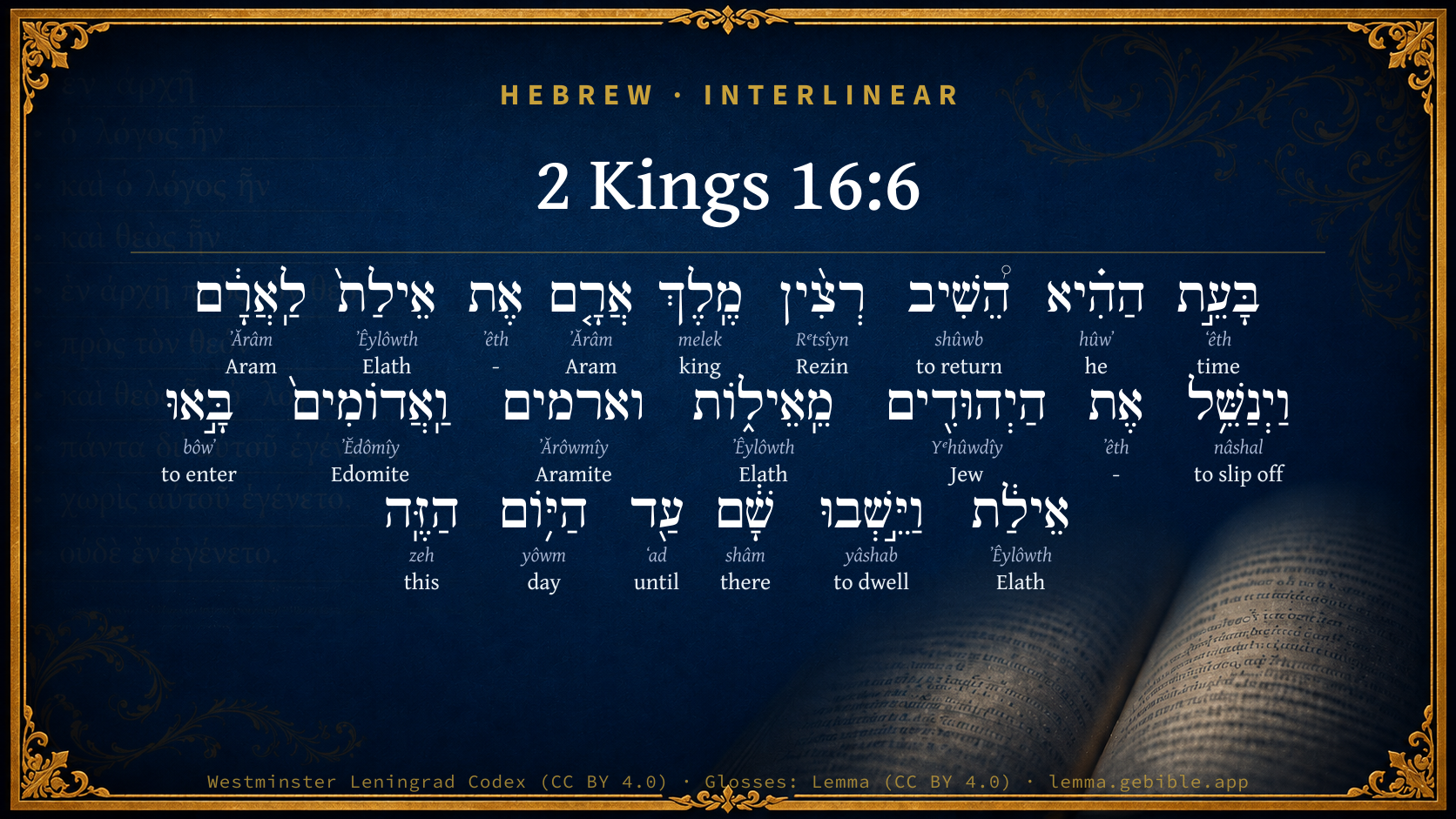
Hebrew (Westminster Leningrad Codex) 2 Kings 16:6 appears in the Hebrew Old Testament. The text above is from the Westminster Leningrad Codex. Each word links to its Strong’s number, a concise gloss, and parsing drawn from the Open Scriptures Hebrew Bible morphology. Click any word for its full Brown-Driver-Briggs (BDB) entry.
Download image
Cite this verse

2 Kings 16:6 (World English Bible). Public Domain. Lemma interlinear Bible study tool, https://lemma.gebible.app/v/2-kings/16/6.

Show BibTeX & RIS
BibTeX
RIS
English Translation
At that time Rezin king of Syria recovered Elath to Syria, and drove the Jews from Elath; and the Syrians came to Elath, and lived there, to this day.
World English Bible · Public Domain
Highlights
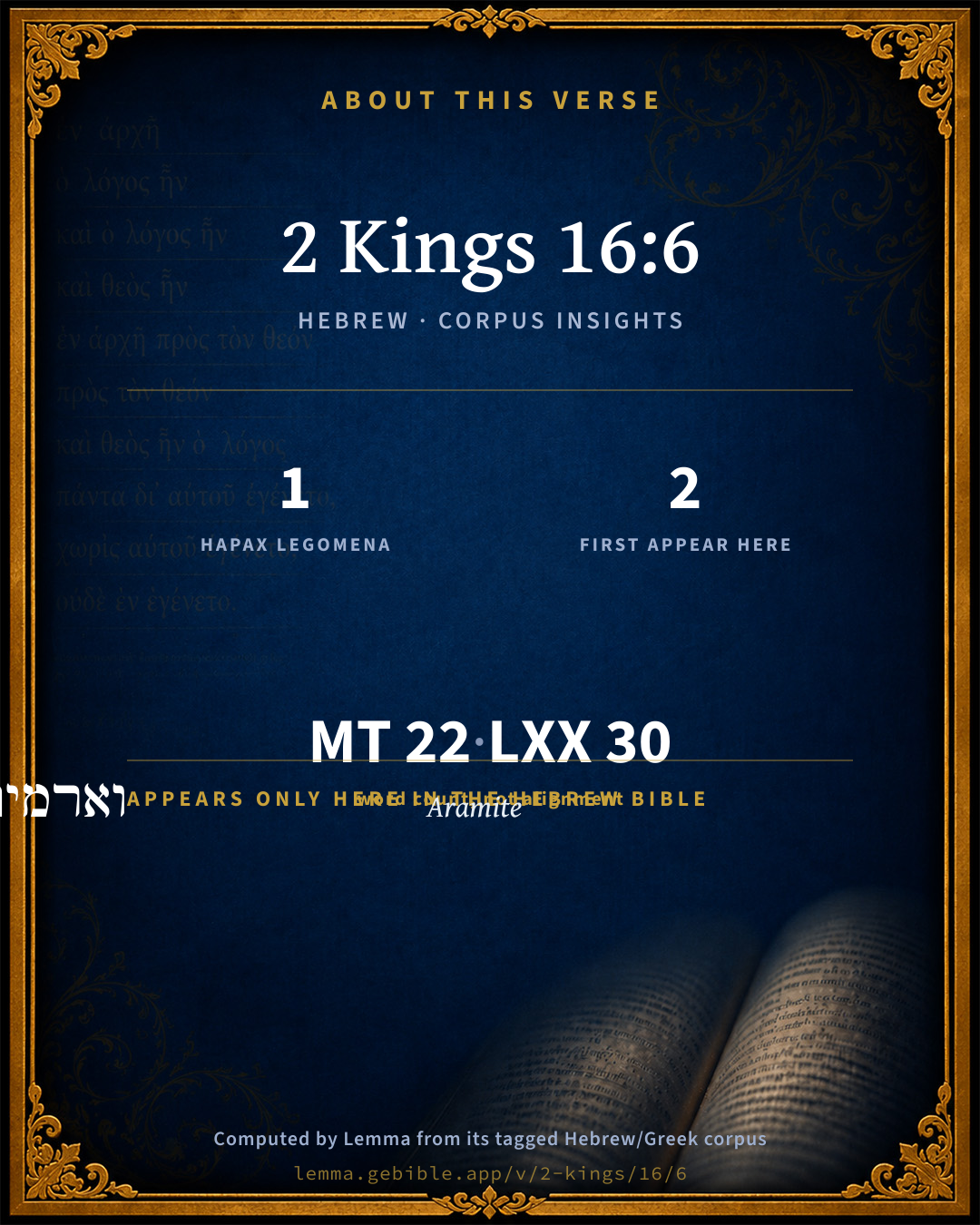
  • 1 hapax legomenon — only here in the Hebrew Bible
  • 2 first appearances in the Hebrew Bible
Full analysis ↓
Download a study sheet

One document with this verse’s original text, its word-by-word gloss line, the meaning frame, cross-references with their text, attributed commentary, and full source and license credits — printable, and it pastes into notes with its structure intact.

This verse Autodidact and up

Study sheet (.html) Plain text (.txt)

A passage Seminary Student

Up to 50 verses in one chapter. A passage sheet keeps up to 6 commentary sources and 12 cross-references per verse, in the order this page ranks them, and says so on the sheet whenever that leaves anything out. Ask for a single verse and you get the Autodidact verse sheet above.

Everything on this page stays free to read, with no account — the sheet is a download of what is already on screen, not access to it.

Want to remove ads? Support Godless Engineer
Compare translations 3

The same verse in 3 English versions, stacked beneath the original-language interlinear above. Click any original word for its lexicon entry.

Each is an independent rendering of the whole verse — the interlinear is not word-aligned to these translations.

Highlighted words mark where these versions differ — a whole-verse word diff, not a word-by-word alignment.

  • World English Bible Public Domain
    At that time Rezin king of Syria recovered Elath to Syria, and drove the Jews from Elath; and the Syrians came to Elath, and lived there, to this day.
  • King James Version Public Domain
    At that time Rezin king of Syria recovered Elath to Syria, and drave the Jews from Elath: and the Syrians came to Elath, and dwelt there unto this day.
  • unfoldingWord Literal Text CC BY-SA 4.0
    (At that time, Rezin, the king of Aram, restored Elath to Aram, and he drove the Judeans from Elath. And Arameans came to Elath, and they have lived there to this day.)

unfoldingWord Literal Text — © unfoldingWord, licensed CC BY-SA 4.0. Word-aligned USFM3 via Door43 (git.door43.org/unfoldingWord/en_ult).

Versions to compare (up to 4)

3 of 4 selected

Show all 18 translations

Every available English version of this verse, each an independent rendering of the whole verse.

  • World English Bible Public Domain
    At that time Rezin king of Syria recovered Elath to Syria, and drove the Jews from Elath; and the Syrians came to Elath, and lived there, to this day.
  • Berean Standard Bible Public Domain
    At that time Rezin king of Aram recovered Elath for Aram, drove out the men of Judah, and sent the Edomites into Elath, where they live to this day.
  • Majority Standard Bible Public Domain
    At that time Rezin king of Aram recovered Elath for Aram, drove out the men of Judah, and sent the Edomites into Elath, where they live to this day.
  • King James Version Public Domain
    At that time Rezin king of Syria recovered Elath to Syria, and drave the Jews from Elath: and the Syrians came to Elath, and dwelt there unto this day.
  • American Standard Version (1901) Public Domain
    At that time Rezin king of Syria recovered Elath to Syria, and drove the Jews from Elath; and the Syrians came to Elath, and dwelt there, unto this day.
  • Revised Version (1885) Public Domain
    At that time Rezin king of Syria recovered Elath to Syria, and drave the Jews from Elath: and the Syrians came to Elath, and dwelt there, unto this day.
  • Geneva Bible (1599) Public Domain
    At the same time Rezin king of Aram restored Elath to Aram, and droue the Iewes from Elath: so the Aramites came to Elath, and dwelt there vnto this day.
  • Douay-Rheims (1899) Public Domain
    At that time Rasin king of Syria restored Aila to Syria, and drove the men of Juda out of Aila: and the Edomites came into Aila, and dwelt there unto this day.
  • Young's Literal Translation Public Domain
    At that time hath Rezin king of Aram brought back Elath to Aram, and casteth out the Jews from Elath, and the Aramaeans have come in to Elath, and dwell there unto this day.
  • Literal Standard Version CC BY-SA 4.0
    At that time Rezin king of Aram has brought back Elath to Aram, and casts out the Jews from Elath, and the Arameans have come to Elath, and dwell there to this day.
  • Unlocked Literal Bible CC BY-SA 4.0
    At that time, Rezin king of Aram recovered Elath for Aram and drove the men of Judah out of Elath. Then the Arameans came to Elath where they have lived to this day.
  • unfoldingWord Literal Text CC BY-SA 4.0
    (At that time, Rezin, the king of Aram, restored Elath to Aram, and he drove the Judeans from Elath. And Arameans came to Elath, and they have lived there to this day.)
  • Darby Bible Public Domain
    At that time Rezin king of Syria recovered Elath to Syria, and drove the Jews from Elath; and the Syrians came to Elath, and dwelt there to this day.
  • World Messianic Bible Public Domain
    At that time Rezin king of Syria recovered Elath to Syria, and drove the Jews from Elath; and the Syrians came to Elath, and lived there to this day.
  • Webster's Bible Public Domain
    At that time Rezin king of Syria recovered Elath to Syria, and drove the Jews from Elath: and the Syrians came to Elath, and have dwelt there to this day.
  • Free Bible Version CC BY-SA 4.0
    This was when Rezin, king of Aram, recovered Elath for Edom. He expelled the people of Judah, and sent Edomites to Elath, where they still live to this day.
  • Bible in Basic English Public Domain
    At that time the king of Edom got Elath back for Edom, and sent the Jews out of Elath; and the Edomites came back to Elath where they are living to this day.
  • JPS Tanakh (1917) Public Domain
    At that time Rezin king of Aram recovered Elath to Aram, and drove the Jews from Elath; and the Edomites came to Elath, and dwelt there, unto this day.

Literal Standard Version (2020), Covenant Press — licensed CC BY-SA 4.0. Text via the HelloAO Bible API (eBible.org). Unlocked Literal Bible (unfoldingWord) — licensed CC BY-SA 4.0. Text via the HelloAO Bible API (eBible.org). unfoldingWord Literal Text — © unfoldingWord, licensed CC BY-SA 4.0. Word-aligned USFM3 via Door43 (git.door43.org/unfoldingWord/en_ult). Free Bible Version, Dr. Jonathan Gallagher — licensed CC BY-SA 4.0. Text via the HelloAO Bible API (eBible.org).

Word by word

More ways to search: Search by grammar → Find every occurrence → Compare this word →

Practice this passage: Drill this verse → Learn its vocabulary →

וארמים
ʼĂrôwmîy
H726
“and · Aramites”
Conjunction + Noun, Gentilic, Masculine, Plural, Absolute
Part of Speech
Conjunction + Noun
Type
Gentilic
Gender
Masculine
Number
Plural
State
Absolute
Full BDB Definition

Origin: a clerical error for H130

TWOT: None

Aramite, Syrian (Kethib), Edomite
  1. בָּעֵ֣ת ʻêth H6256 “in/at the · time” Preposition, Determined + Noun, Common, Both, Singular, Absolute
  2. הַהִ֗יא hûwʼ H1931 “the · he” Particle, Definite Article + Pronoun, Personal, 3rd Person, Feminine, Singular
  3. הֵ֠שִׁיב shûwb H7725 “to return” Verb, Hiphil, Perfect, 3rd Person, Masculine, Singular
  4. רְצִ֨ין Rᵉtsîyn H7526 “Rezin” Noun, Proper
  5. מֶֽלֶךְ melek H4428 “king of” Noun, Common, Masculine, Singular, Construct
  6. אֲרָ֤ם ʼĂrâm H758 “Aram” Noun, Proper
  7. אֶת ʼêth H853 “-” Particle, Direct Object
  8. אֵילַת֙ ʼÊylôwth H359 “Elath” Noun, Proper
  9. לַֽאֲרָ֔ם ʼĂrâm H758 “to/for · Aram” Preposition + Noun, Proper
  10. וַיְנַשֵּׁ֥ל nâshal H5394 “and · to slip off” Conjunction + Verb, Piel, Sequential Imperfect, 3rd Person, Masculine, Singular
  11. אֶת ʼêth H853 “-” Particle, Direct Object
  12. הַיְהוּדִ֖ים Yᵉhûwdîy H3064 “the · Jews” Particle, Definite Article + Noun, Gentilic, Masculine, Plural, Absolute
  13. מֵֽאֵיל֑וֹת ʼÊylôwth H359 “from · Elath” Preposition + Noun, Proper
  14. וַֽאֲדוֹמִים֙ ʼĔdômîy H130 “and · Edomites” Conjunction + Noun, Gentilic, Masculine, Plural, Absolute
  15. בָּ֣אוּ bôwʼ H935 “to enter” Verb, Qal, Perfect, 3rd Person, Common, Plural
  16. אֵילַ֔ת ʼÊylôwth H359 “Elath” Noun, Proper
  17. וַיֵּ֣שְׁבוּ yâshab H3427 “and · to dwell” Conjunction + Verb, Qal, Sequential Imperfect, 3rd Person, Masculine, Plural
  18. שָׁ֔ם shâm H8033 “there” Adverb
  19. עַ֖ד ʻad H5704 “until” Preposition
  20. הַיּ֥וֹם yôwm H3117 “the · day” Particle, Definite Article + Noun, Common, Masculine, Singular, Absolute
  21. הַזֶּֽה zeh H2088 “the · this” Particle, Definite Article + Pronoun, Demonstrative, Masculine, Singular

About this verse

These counts appear in no published source. They are computed here, from the morphology-tagged text and Lemma’s own curated glosses. What Lemma adds →

22
words
18
distinct lemmas
Historical
section

Notable vocabulary

1 hapax legomenon — a word that appears only here in the entire Hebrew Bible:

  • וארמים Aramite H726

First appearance in Scripture

These words make their first canonical appearance in the Hebrew Bible here:

  • הַיְהוּדִ֖ים Jew H3064
  • וארמים Aramite H726

Shared distinctive vocabulary

וַיְנַשֵּׁ֥ל to slip off H5394 occurs in 7 verses of the Hebrew Bible. Also found in:

Grammatical profile

  • 4 verbs
  • 12 nouns
  • 2 pronouns
  • 1 preposition
  • 1 adverb
  • 2 particles

Verb forms

  • הֵ֠שִׁיב Hiphil · Perfect
  • וַיְנַשֵּׁ֥ל Piel · Sequential Imperfect
  • בָּ֣אוּ Qal · Perfect
  • וַיֵּ֣שְׁבוּ Qal · Sequential Imperfect

Repetition

Words recur within this verse — often emphatic in Hebrew:

  • אֵילַת֙ Elath H359 ×3
  • אֲרָ֤ם Aram H758 ×2

Hebrew & Septuagint length

In English translation the verse runs 29 words from the Hebrew and 30 from the Septuagint (LXX English) — closely comparable.

A rough comparison of the two English renderings, which tokenize alike — not a word-level alignment.

Word counts can differ between the Hebrew and the Greek without any difference in meaning — e.g. the Hebrew direct-object marker אֵת has no separate Greek word, and Greek often adds the article ὁ.

In the original languages it is 22 Hebrew tokens and 30 Greek tokens — but the two are counted differently (Hebrew bundles its prefixes and suffixes into one token; the Greek is in lemma form), so that isn’t a like-for-like length.

Cross-references

4

Topical passages linked to 2 Kings 16:6 in the Treasury of Scripture Knowledge — connected by theme and wording, ordered by reader-vote popularity; previews shown in the World English Bible.

  • 2 Kings 14:22 He built Elath, and restored it to Judah, after that the king slept with his fathers.
  • Deuteronomy 2:8 So we passed by from our brothers the children of Esau, who dwell in Seir, from the way of the Arabah from Elath and from Ezion Geber. We turned and passed by the way of the wilderness of Moab.
  • 1 Kings 9:26 King Solomon made a navy of ships in Ezion Geber, which is beside Eloth, on the shore of the Red Sea, in the land of Edom.
  • 2 Chronicles 26:2 He built Eloth, and restored it to Judah, after that the king slept with his fathers.

Cross-references courtesy of OpenBible.info (CC BY 4.0).

Hebrew and Greek witnesses Masoretic Hebrew ↔ Greek Septuagint

The same verse in the two great witnesses to the Old Testament, shown verse-for-verse.

These are two independent witnesses, not word-aligned to each other, and the Septuagint is shown in lemma (dictionary) form.

Hebrew 2 Kings 16:6 Masoretic · Westminster Leningrad Codex

בָּעֵ֣ת הַהִ֗יא הֵ֠שִׁיב רְצִ֨ין מֶֽלֶךְ אֲרָ֤ם אֶת אֵילַת֙ לַֽאֲרָ֔ם וַיְנַשֵּׁ֥ל אֶת הַיְהוּדִ֖ים מֵֽאֵיל֑וֹת וארמים וַֽאֲדוֹמִים֙ בָּ֣אוּ אֵילַ֔ת וַיֵּ֣שְׁבוּ שָׁ֔ם עַ֖ד הַיּ֥וֹם הַזֶּֽה

At that time Rezin king of Syria recovered Elath to Syria, and drove the Jews from Elath; and the Syrians came to Elath, and lived there, to this day.

World English Bible · Public Domain

Greek LXX 2 Kings 16:6 Septuagint · lemma form

ἐν ὁ καιρός ἐκεῖνος ἐπιστρέφω ραασσων βασιλεύς συρία ὁ αιλαθ ὁ συρία καί ἐκβάλλω ὁ ἰουδαῖος ἐκ αιλαθ καί ιδουμαίος ἔρχομαι εἰς αιλαθ καί καταοἰκέω ἐκεῖ ἕως ὁ ἡμέρα οὗτος

At that time Raasson king of Syria recovered Aelath to Syria, and drove out the Jews from Aelath, and the Idumeans came to Aelath, and lived there until this day.

LXX2012 (modern English Septuagint) · Public Domain

On this verse, Jamieson, Fausset & Brown discusses the Septuagint’s reading. Read the note in Commentary ↓

Hebrew: Westminster Leningrad Codex (CC BY 4.0). Greek: Septuagint (public domain); English from LXX2012 (modern English Septuagint) (Public Domain). How the Septuagint differs from the Hebrew →

Targum (Aramaic paraphrase)

1

The Targum is the ancient Jewish Aramaic paraphrase of the Hebrew Scriptures — an interpretive translation, not the Hebrew text itself. Onkelos (literal) and Pseudo-Jonathan (expansive) render the Torah, and Jonathan the Prophets. Coverage is partial: where no permissively-licensed English translation exists for a verse, only the Aramaic is shown. This is verse-level text, not a word-by-word alignment to the Hebrew.

  1. Targum Jonathan Prophets (Joshua–Malachi)
    בְּעִדָנָא הַהִיא אָתֵיב רְצִין מַלְכָּא דַאֲרָם יַת אֵילַת לַאֲרָם וְתָרֵיךְ יַת יְהוּדָאֵי מֵאֵילַת וַאֲרָמָאֵי אֲתוֹ לְאֵילַת וִיתִיבוּ תַמָן עַד יוֹמָא הָדֵין:

    (no public-domain English translation for this verse)

    Targum Jonathan — Aramaic: “Mikraot Gedolot” (public domain). English: “Sefaria Community Translation” (CC0 1.0 (public-domain dedication)); “London "Chaldee Paraphrase," 1871” (public domain). Text via Sefaria.

Commentary

Notes on 2 Kings 16:6 from classic Christian and Jewish commentators (each source and its license shown beneath its notes). The classic Christian expositions comment on the surrounding passage and are grouped to its opening verse, so a note may address several verses; the Jewish commentaries on the Tanakh (Rashi and others) are per-verse, so they appear only where the commentator wrote on this verse.

Lemma curates 59 commentaries, every one of them public domain or Creative Commons licensed, each selected and text-cleaned for this edition rather than reprinted as found. About our sources →

Trapp's Complete Commentary

John Trapp

2Ki 16:6 At that time Rezin king of Syria recovered Elath to Syria, and drave the Jews from Elath: and the Syrians came to Elath, and dwelt there unto this day.

Ver. 6. At that time.] When he came against Jerusalem.

Recovered Elath.] Josephus calleth it Aria by the Red Sea.

John Trapp, A Commentary or Exposition upon All the Books of the Old and New Testament (1647–1656) — public domain. Text from a community e-Sword module.

Tyndale Open Study Notes

Tyndale Open Resources

16:6 The NLT translators have chosen to follow the text of several ancient translations, since the town of Elath is far to the south, nearer to Edom than to Aram.

Tyndale Open Study Notes — © Tyndale Open Resources, licensed CC BY-SA 4.0. Text via the HelloAO Bible API.

Geneva Bible (1599)

Geneva Bible translators

Which city Azariah had taken from the Aramites and fortified it, 2 Kings 14:22.

Geneva Bible (1599) marginal notes — public domain. Text via Bolls.life.

Jamieson, Fausset & Brown

Robert Jamieson, A. R. Fausset & David Brown

Rezin . . . recovered Elath--which Azariah had got into his possession (Kg2 14:22).

the Syrians came to Elath, and dwelt there unto this day--The Septuagint version has "the Edomites," which the most judicious commentators and travellers [ROBINSON] prefer.

Jamieson, Fausset & Brown — Commentary Critical and Explanatory on the Whole Bible (1871) — public domain (CC PDM 1.0). Text via the HelloAO Bible API.

Adam Clarke's Commentary

Verse 6. Recovered Elath to Syria] 2Kg 14:22.

Adam Clarke's Commentary on the Bible (1810–1826) — public domain. Text from a community e-Sword/MySword module.

Ellicott's Commentary for English Readers

(6) At that time.—Bähr regards this verse as a parenthesis, so that 2Ki_16:7 is the strict continuation of 2Ki_16:5, and “At that time” simply assigns this war as the epoch when Judah lost its only harbour and chief emporium—a grave blow to the national prosperity. It is perhaps impossible to weave the various data of Isaiah, Kings, and Chronicles into a single narrative which shall be free from all objection. But it seems probable that, after the successes recorded in 2Ch_28:5, seq., the confederates advanced upon Jerusalem, and that Ahaz despatched his envoys to Tiglath Pileser. The allies soon despaired of a siege, and Pekah fell to ravaging the country, while Rezin pushed on to Elath, determined not to return home without having achieved some permanent success. The approach of Tiglath Pileser compelled the two kings to give up their enterprise, and hasten to defend their own frontiers.

Recovered Elath to Syria . . . the Syrians.—The words for Syria and Edom, Syrians and Edomties, are very much alike in Hebrew writing, and the Hebrew margin, many MSS., the LXX. and Vulg. read Edomites for Syrians here. If this be correct, we must also restore Edom for Syria, as many critics propose. The meaning then becomes this: Rezin emancipated the Edomites from the yoke of Judah imposed on them by Uzziah (2Ki_14:22) in order to win their active co-operation against Judah. Bähr, however, prefers the readings of the ordinary text, and supposes that Rezin simply expelled the Jews from Elath, and established there a commercial colony of Syrians.

A Bible Commentary for English Readers, edited by Charles John Ellicott (1878–1897) — public domain. Text from a community e-Sword module.

The Cambridge Bible for Schools and Colleges

gen. ed. J. J. S. Perowne

6. Rezin … recovered Elath to Syria] Elath was a place of much importance to the Jews. It was situate at the top of the gulf of Akabah (sinus Ælaniticus), and was part of the land of Edom. But when the Edomites were in subjection to Judah, the port was to all intents and purposes a harbour of Judah. Now the Jews were driven from it, and the Syrians came and occupied it, having overrun Edom in their progress towards Elath.

the Syrians came to Elath] The LXX. says the ‘Idumæans’, i.e. the Edomites came to Elath, and this is supported by the marginal reading (Keri) of the Hebrew Bible. But it is a reading which cannot be accepted. The Edomites were at Elath already. It was part of their own land. Therefore they could not be said to come to it. There is very little difference in Hebrew between ‘Idumæans’ i.e. Edomites, and Aramæans, i.e. Syrians. The latter is ארומים, the former ארומים, a difference only in one letter and that of the slightest kind. Hence the confusion.

and dwelt there unto this day] On this expression as a mark of faithful reproduction by the compiler of what he found in the document he was using, see note on chap. 2Ki_2:22.

The Chronicler, before mentioning the appeal of Ahaz to Tiglath-Pileser, which is here related in the next verse, gives an account how the two hundred thousand captives taken by the Israelites (see above on verse 5) were brought to Samaria, and how Oded, a prophet of the Lord, forbad in God’s name that the children of Judah and Jerusalem should be kept by Israel for bondmen and bondwomen. Some also among the chief men of Israel declared that the captives should not be brought into Samaria. They were in consequence set free, and, after being fed and clothed, were conducted homeward as far as Jericho. The Chronicler also records the names of the men who thus withstood the bringing in of the Jewish prisoners as if he were taking them from some contemporary record.

The Cambridge Bible for Schools and Colleges (gen. ed. J. J. S. Perowne; Cambridge University Press, 1878–1918) — public domain. Text from a community e-Sword module.

John Gill's Exposition

So Ahaz sent messengers to Tiglathpileser king of Assyria,.... Of whom see Kg2 15:29.

saying, I am thy servant, and thy son; signifying, that he would be his vassal, and become tributary to him, and serve him as a servant to his master, or a son his father, on condition he would come to his assistance, and so he became his servant; hence his son Hezekiah is said to rebel against the king of Assyria, Kg2 18:1.

come up and save me out of the hand of the king of Syria, and out of the hand of the king off Israel, which rise up against me; which assistance he had no reason to call in, since the Lord had promised him deliverance from both those kings, and gave him a sign of it, Isa 7:4.

John Gill's Exposition of the Whole Bible (1746–1763) — public domain (CC PDM 1.0). Text via the HelloAO Bible API.

Albert Barnes' Notes on the Bible

Either during the siege, or on breaking up from before Jeruasalem, Rezin made an expedition to the lied Sea coast, and became master of the city which had belonged to Judaea about 70 years (marginal reference). Most moderns render this verse, “Rezin recovered (or restored) Elath to Edom ... and the Edomites came to Elath.” On the resemblance of the words Aram and Edom in the original, see 2Sa 8:12 note.

Albert Barnes' Notes on the Bible (1834–1885) — public domain. Text from a community e-Sword/MySword module.

Haydock's Catholic Bible Commentary

Juda. Literally, "Jews," Judæos, (Haydock) which is the first time we find this appellation. (Du Hamel) --- Aila, or Elath, which had been taken by Ozias, chap. xiv. 22. (Menochius) --- It seems never to have belonged to Syria, as it was too far from Damascus. Instead of Aram, we should therefore probably read Edom, which words in Hebrew are extremely similar, and have been often mistaken, (Judges xi. 17.; Calmet) particularly as we find that the Edomites took possession of the city. This latter word is indeed Syrians in Hebrew, &c. (Haydock) --- Josephus and others maintain that the Syrians seized and kept the place. But they were most likely only invited by the Idumeans to come to their assistance. (Calmet)

George Leo Haydock (1774–1849), Haydock's Catholic Family Bible and Commentary, 1859 edition — public domain. Excludes Psalms (Douay-Rheims chapter numbering differs from Protestant) and Deuterocanonical books (Catholic canon only).

Matthew Poole's English Annotations

Recovered Elath, i.e. took it from the Jews, who had not long since taken it, 2Ki 14:22. It lay in the land of Edom, upon the Red Sea, very conveniently for navigation; of which See Poole "1Ki 9:26".

Matthew Poole's English Annotations on the Holy Bible (1683–1685) — public domain. Text from a community e-Sword/MySword module.

Whedon's Commentary on the Bible

Daniel D. Whedon

6. At that time — During the course of this Syro-Israelitish war.

Rezin… recovered Elath to Syria — Rezin appears throughout all this war against Judah as more powerful than his Israelitish ally. Elath, on the Red Sea, had been taken from the Edomites and attached to the kingdom of Judah in the reign of Uzziah. See on 2Ki_14:22. The word recovered [השׁיב] does not necessarily imply that Elath had formerly belonged to Syria, but here it simply means that it now changed hands, turned from one possessor to another.

The Syrians came to Elath — The Hebrew is without the article, Syrians came — that is, a colony of Syrians. Rezin, having captured this ancient commercial town, at once settled a Syrian colony there, probably for purposes of commerce, and to open for himself a new source of revenue, and though Syria was soon afterwards conquered, and Rezin slain, this colony dwelt there unto this day, that is, at the time when our author wrote. For it is by no means improbable that a Syrian colony remained at Elath long after the home Government had been annihilated. The Keri, Septuagint, Vulgate, and many interpreters, read Edomites instead of Syrians, but that reading would seem to be unsuitable, for it would be strange to say that Edomites dwelt there unto this day, when the Edomites had always dwelt in that vicinity. Besides the losses which Ahaz sustained from the combined armies of Rezin and Pekah, Chronicles informs us that the Edomites and Philistines also invaded Judah on the south and west, occupied many cities, and carried off captives. 2Ch_28:17-18.

Daniel D. Whedon (gen. ed.), Commentary on the Old and New Testaments (1874–1909) — public domain. Text from a community e-Sword module.

The Pulpit Commentary

At that time Rezin, King of Syria recovered Elath to Syria. The Syrians had certainly never previously been masters of Elath, which had always hitherto been either Jewish or Edomite (see 1Ki_9:26; 2Ki_14:22) Hence it seems to be necessary that we should either translate the Hebrew verb byvije by "gained," "conquered," instead of "recovered;" or else change "Syria," into "Edom." The Syrians could "recover" Elath for Edom; they could only "gain" it for themselves. And drave the Jews from Elathi.e. expelled the Jewish garrison which had been maintained in Elath from the time of its conquest by Uzziah (2Ki_14:22) and the Syrians came to Elath; rather, the Edomites for Rezin could not have thought of holding a place so remote from Damascus as Elath; and, had he done so, the danger of his kingdom in the next year would have necessitated the relinquishment of so distant a possession. And dwelt there unto this day. It is quite certain that Elath belonged to Edom, and not to Syria, at the time when the Books of Kings were written.

The Pulpit Commentary (1880–1919), ed. H.D.M. Spence-Jones & Joseph S. Exell — public domain. Text from a community e-Sword module.

Lesson kit

Teaching starters — assembled from the data on this page, not authored interpretation. Every prompt links to the verse data it draws on. Edit before teaching.

2 Kings, in the Historical, opens this verse with 22 words (18 distinct Hebrew lemmas). Its most distinctive word is ʼĂrôwmîy (“Aramite”). A historical commentator’s framing appears above. Read the whole chapter for the surrounding context.

Discussion questions

  1. What does “Aramite” (ʼĂrôwmîy) contribute to the verse as a whole?
  2. 1 word here appears nowhere else in the Hebrew Bible. Why might the author reach for such rare wording?
  3. 2 words make their first appearance in Scripture here. What does this debut establish?
  4. How does Exodus 3:5, which shares the word «to slip off», read alongside this verse?
  5. What does the repetition of “Elath” (3× in this one verse) do in this verse?
  6. The translations on this page render this verse differently — a whole-verse word diff, not a word-by-word alignment. What might account for the different wordings?
  7. «הֵ֠שִׁיב» is a Hiphil Perfect verb. How does that grammatical form shape the action described?
  8. Compare how Trapp's Complete Commentary and Tyndale Open Study Notes read this verse. Where do they agree or differ?

Things to notice

  • 1 word in this verse appears nowhere else in the Hebrew Bible.
  • 2 words make their first canonical appearance in Scripture here.
  • This verse counts 22 Hebrew ↔ 30 Greek words.
  • These translations choose different wording for 13 words in this verse.
  • “Elath” occurs 3× in this single verse.

Reading settings

Reading text

Shown beneath each verse's original-language words.

Old Testament
Old Testament edition

Read the OT as the Masoretic Hebrew (MT) or the Greek Septuagint (LXX).

English shown for the Greek Septuagint (in the Hebrew ↔ Greek comparison).

Comparing translations? Open the Compare panel on any verse page to stack up to four side by side.