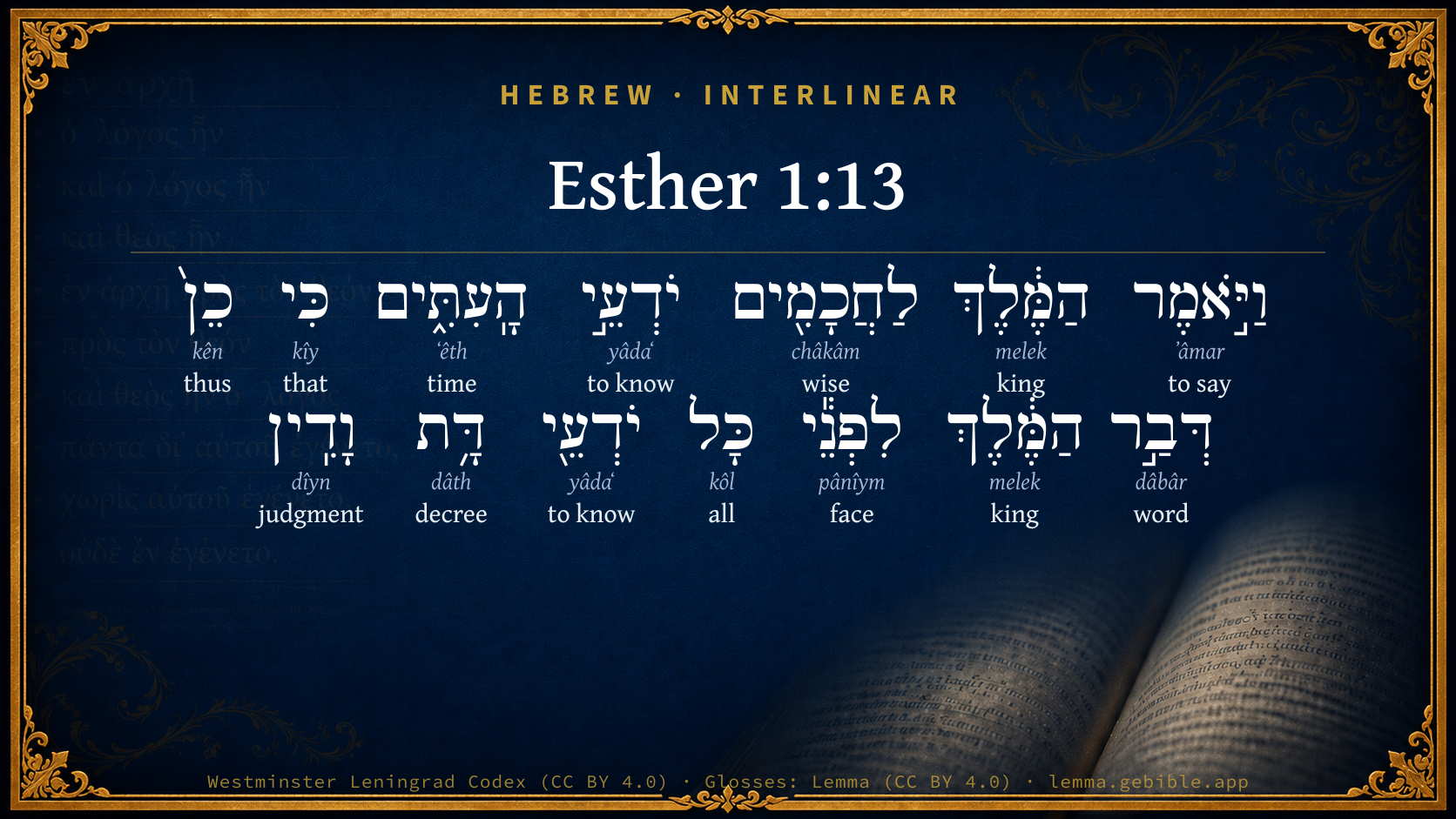
Esther 1:13

Hebrew (Westminster Leningrad Codex) Esther 1:13 appears in the Hebrew Old Testament. The text above is from the Westminster Leningrad Codex. Each word links to its Strong’s number, a concise gloss, and parsing drawn from the Open Scriptures Hebrew Bible morphology. Click any word for its full Brown-Driver-Briggs (BDB) entry.
Download image
Cite this verse

Esther 1:13 (World English Bible). Public Domain. Lemma interlinear Bible study tool, https://lemma.gebible.app/v/esther/1/13.

Show BibTeX & RIS
BibTeX
RIS
English Translation
Then the king said to the wise men, who knew the times, (for so was the king's manner toward all who knew law and judgment;
World English Bible · Public Domain
Download a study sheet

One document with this verse’s original text, its word-by-word gloss line, the meaning frame, cross-references with their text, attributed commentary, and full source and license credits — printable, and it pastes into notes with its structure intact.

This verse Autodidact and up

Study sheet (.html) Plain text (.txt)

A passage Seminary Student

Up to 50 verses in one chapter. A passage sheet keeps up to 6 commentary sources and 12 cross-references per verse, in the order this page ranks them, and says so on the sheet whenever that leaves anything out. Ask for a single verse and you get the Autodidact verse sheet above.

Everything on this page stays free to read, with no account — the sheet is a download of what is already on screen, not access to it.

Want to remove ads? Support Godless Engineer
Compare translations 3

The same verse in 3 English versions, stacked beneath the original-language interlinear above. Click any original word for its lexicon entry.

Each is an independent rendering of the whole verse — the interlinear is not word-aligned to these translations.

Highlighted words mark where these versions differ — a whole-verse word diff, not a word-by-word alignment.

  • World English Bible Public Domain
    Then the king said to the wise men, who knew the times, (for so was the king's manner toward all who knew law and judgment;
  • King James Version Public Domain
    Then the king said to the wise men, which knew the times, (for so was the king's manner toward all that knew law and judgment:
  • unfoldingWord Literal Text CC BY-SA 4.0
    Then the king said to the wise men, who were knowers of the times (for thus was the manner of the king before the face of all those who were knowers of law and judgment,

unfoldingWord Literal Text — © unfoldingWord, licensed CC BY-SA 4.0. Word-aligned USFM3 via Door43 (git.door43.org/unfoldingWord/en_ult).

Versions to compare (up to 4)

3 of 4 selected

Show all 18 translations

Every available English version of this verse, each an independent rendering of the whole verse.

  • World English Bible Public Domain
    Then the king said to the wise men, who knew the times, (for so was the king's manner toward all who knew law and judgment;
  • Berean Standard Bible Public Domain
    Then the king consulted the wise men who knew the times, for it was customary for him to confer with the experts in law and justice.
  • Majority Standard Bible Public Domain
    Then the king consulted the wise men who knew the times, for it was customary for him to confer with the experts in law and justice.
  • King James Version Public Domain
    Then the king said to the wise men, which knew the times, (for so was the king's manner toward all that knew law and judgment:
  • American Standard Version (1901) Public Domain
    Then the king said to the wise men, who knew the times, (for so was the king's manner toward all that knew law and judgment;
  • Revised Version (1885) Public Domain
    Then the king said to the wise men, which knew the times, (for so was the king’s manner toward all that knew law and judgment;
  • Geneva Bible (1599) Public Domain
    Then the King said to the wise men, that knew the times (for so was the Kings maner towards all that knew the law and the iudgement:
  • Douay-Rheims (1899) Public Domain
    Baked the wise men, who according to the custom of the kings, were always near his person, and all he did was by their counsel, who knew the laws, and judgments of their forefathers:
  • Young's Literal Translation Public Domain
    And the king saith to wise men, knowing the times -- for so `is' the word of the king before all knowing law and judgment,
  • Literal Standard Version CC BY-SA 4.0
    And the king says to wise men, knowing the times—for so [is] the word of the king before all knowing law and judgment,
  • Unlocked Literal Bible CC BY-SA 4.0
    So the king conferred with the men who were known to be wise, who understood the times (for this was the king's procedure toward all who were expert in law and judgment).
  • unfoldingWord Literal Text CC BY-SA 4.0
    Then the king said to the wise men, who were knowers of the times (for thus was the manner of the king before the face of all those who were knowers of law and judgment,
  • Darby Bible Public Domain
    And the king said to the wise men who knew the times (for so was the king's business [conducted] before all that knew law and judgment;
  • World Messianic Bible Public Domain
    Then the king said to the wise men, who knew the times (for it was the king’s custom to consult those who knew law and judgment;
  • Webster's Bible Public Domain
    Then the king said to the wise men, who knew the times, (for so was the king's manner towards all that knew law and judgment:
  • Free Bible Version CC BY-SA 4.0
    Then the king spoke with the wise men who would know what to do, for it was the custom for him to ask the opinion of experts in procedures and legal matters.
  • Bible in Basic English Public Domain
    And the king said to the wise men, who had knowledge of the times, (for this was the king's way with all who were expert in law and in the giving of decisions:
  • JPS Tanakh (1917) Public Domain
    Then the king said to the wise men, who knew the times — for so was the king's manner toward all that knew law and judgment;

Literal Standard Version (2020), Covenant Press — licensed CC BY-SA 4.0. Text via the HelloAO Bible API (eBible.org). Unlocked Literal Bible (unfoldingWord) — licensed CC BY-SA 4.0. Text via the HelloAO Bible API (eBible.org). unfoldingWord Literal Text — © unfoldingWord, licensed CC BY-SA 4.0. Word-aligned USFM3 via Door43 (git.door43.org/unfoldingWord/en_ult). Free Bible Version, Dr. Jonathan Gallagher — licensed CC BY-SA 4.0. Text via the HelloAO Bible API (eBible.org).

Word by word

More ways to search: Search by grammar → Find every occurrence → Compare this word →

Practice this passage: Drill this verse → Learn its vocabulary →

וָדִֽין
dîyn
H1779
“and · judgment”
Conjunction + Noun, Common, Masculine, Singular, Absolute
Part of Speech
Conjunction + Noun
Type
Common
Gender
Masculine
Number
Singular
State
Absolute
Full BDB Definition

Origin: from H1777

TWOT: 426a

judgment - judgment - cause, plea - condemnation, judgment - dispute, legal suit, strife - government
  1. וַיֹּ֣אמֶר ʼâmar H559 “and · to say” Conjunction + Verb, Qal, Sequential Imperfect, 3rd Person, Masculine, Singular
  2. הַמֶּ֔לֶךְ melek H4428 “the · king” Particle, Definite Article + Noun, Common, Masculine, Singular, Absolute
  3. לַחֲכָמִ֖ים châkâm H2450 “to/for the · wise” Preposition, Determined + Adjective, Adjective, Masculine, Plural, Absolute
  4. יֹדְעֵ֣י yâdaʻ H3045 “knowing” Verb, Qal, Participle Active, Masculine, Plural, Construct
  5. הָֽעִתִּ֑ים ʻêth H6256 “the · times” Particle, Definite Article + Noun, Common, Both, Plural, Absolute
  6. כִּי kîy H3588 “that” Conjunction
  7. כֵן֙ kên H3651 “thus” Adverb
  8. דְּבַ֣ר dâbâr H1697 “word of” Noun, Common, Masculine, Singular, Construct
  9. הַמֶּ֔לֶךְ melek H4428 “the · king” Particle, Definite Article + Noun, Common, Masculine, Singular, Absolute
  10. לִפְנֵ֕י pânîym H6440 “to/for · face(s) of” Preposition + Noun, Common, Both, Plural, Construct
  11. כָּל kôl H3605 “all of” Noun, Common, Masculine, Singular, Construct
  12. יֹדְעֵ֖י yâdaʻ H3045 “knowing” Verb, Qal, Participle Active, Masculine, Plural, Construct
  13. דָּ֥ת dâth H1881 “decree” Noun, Common, Feminine, Singular, Absolute

About this verse

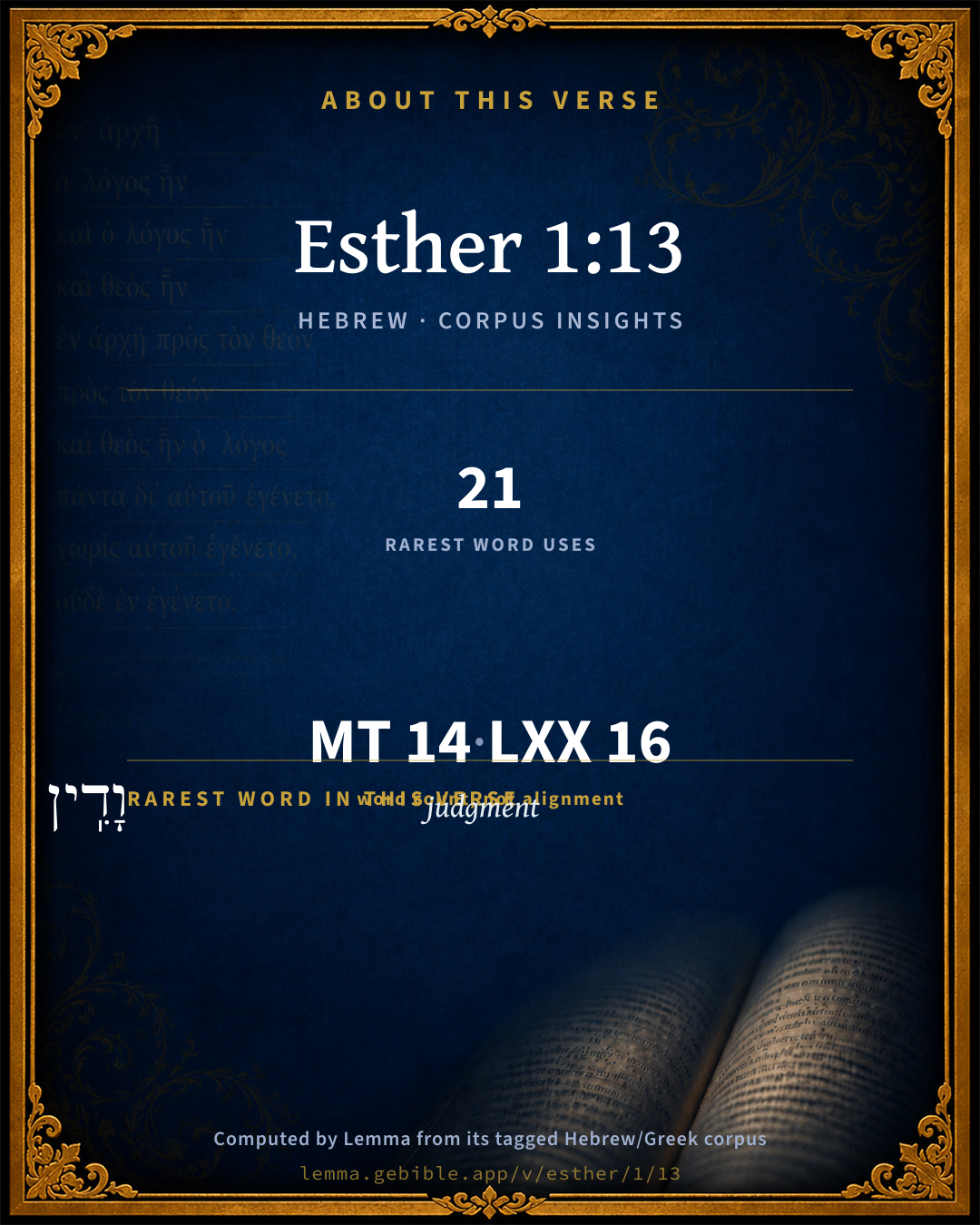
These counts appear in no published source. They are computed here, from the morphology-tagged text and Lemma’s own curated glosses. What Lemma adds →

14
words
12
distinct lemmas
Historical
section

Notable vocabulary

The rarest word here is וָדִֽין judgment H1779 — appearing just 21 times in the whole Hebrew Bible.

Shared distinctive vocabulary

וָדִֽין judgment H1779 occurs in 17 verses of the Hebrew Bible. Also found in:

Grammatical profile

  • 3 verbs
  • 8 nouns
  • 1 adjective
  • 1 conjunction
  • 1 adverb

Verb forms

  • וַיֹּ֣אמֶר Qal · Sequential Imperfect
  • יֹדְעֵ֣י Qal · Participle Active
  • יֹדְעֵ֖י Qal · Participle Active

Repetition

Words recur within this verse — often emphatic in Hebrew:

  • הַמֶּ֔לֶךְ king H4428 ×2
  • יֹדְעֵ֣י to know H3045 ×2

Hebrew & Septuagint length

In English translation the verse runs 25 words from the Hebrew and 18 from the Septuagint (LXX English) — closely comparable.

A rough comparison of the two English renderings, which tokenize alike — not a word-level alignment.

Word counts can differ between the Hebrew and the Greek without any difference in meaning — e.g. the Hebrew direct-object marker אֵת has no separate Greek word, and Greek often adds the article ὁ.

In the original languages it is 14 Hebrew tokens and 16 Greek tokens — but the two are counted differently (Hebrew bundles its prefixes and suffixes into one token; the Greek is in lemma form), so that isn’t a like-for-like length.

Cross-references

9

Topical passages linked to Esther 1:13 in the Treasury of Scripture Knowledge — connected by theme and wording, ordered by reader-vote popularity; previews shown in the World English Bible.

  • 1 Chronicles 12:32 Of the children of Issachar, men who had understanding of the times, to know what Israel ought to do, the heads of them were two hundred; and all their brothers were at their commandment.
  • Jeremiah 10:7 Who should not fear you, King of the nations? for to you does it appertain; because among all the wise men of the nations, and in all their royal estate, there is none like you.
  • Daniel 2:2 Then the king commanded to call the magicians, and the enchanters, and the sorcerers, and the Chaldeans, to tell the king his dreams. So they came in and stood before the king.
  • Daniel 2:12 For this cause the king was angry and very furious, and commanded to destroy all the wise men of Babylon.
  • Daniel 5:7 The king cried aloud to bring in the enchanters, the Chaldeans, and the soothsayers. The king spoke and said to the wise men of Babylon, Whoever shall read this writing, and show me the interpretation of it, shall be clothed with purple, and have a chain of gold about his neck, and shall be the third ruler in the kingdom.
  • Matthew 16:3 In the morning, 'It will be foul weather today, for the sky is red and threatening.' Hypocrites! You know how to discern the appearance of the sky, but you can't discern the signs of the times!
  • Matthew 2:1 Now when Jesus was born in Bethlehem of Judea in the days of Herod the king, behold, wise men from the east came to Jerusalem, saying,
  • Daniel 2:27 Daniel answered before the king, and said, The secret which the king has demanded can neither wise men, enchanters, magicians, nor soothsayers, show to the king;
  • Daniel 4:6–7 Therefore made I a decree to bring in all the wise men of Babylon before me, that they might make known to me the interpretation of the dream.

Cross-references courtesy of OpenBible.info (CC BY 4.0).

Hebrew and Greek witnesses Masoretic Hebrew ↔ Greek Septuagint

The same verse in the two great witnesses to the Old Testament, shown verse-for-verse.

These are two independent witnesses, not word-aligned to each other, and the Septuagint is shown in lemma (dictionary) form.

Hebrew Esther 1:13 Masoretic · Westminster Leningrad Codex

וַיֹּ֣אמֶר הַמֶּ֔לֶךְ לַחֲכָמִ֖ים יֹדְעֵ֣י הָֽעִתִּ֑ים כִּי כֵן֙ דְּבַ֣ר הַמֶּ֔לֶךְ לִפְנֵ֕י כָּל יֹדְעֵ֖י דָּ֥ת וָדִֽין

Then the king said to the wise men, who knew the times, (for so was the king's manner toward all who knew law and judgment;

World English Bible · Public Domain

Greek LXX Esther 1:13 Septuagint · lemma form

καί εἶπον ὁ φίλος αὐτός κατά οὗτος λαλέω αστιν ποιέω οὖν περί οὗτος νόμος καί κρίσις

And he said to his friends, Thus have Astin spoken: pronounce therefore upon this case law and judgment.

LXX2012 (modern English Septuagint) · Public Domain

On this verse, Haydock's Catholic Bible Commentary discusses the Septuagint’s reading. Read the note in Commentary ↓

Hebrew: Westminster Leningrad Codex (CC BY 4.0). Greek: Septuagint (public domain); English from LXX2012 (modern English Septuagint) (Public Domain). How the Septuagint differs from the Hebrew →

Commentary

Notes on Esther 1:13 from classic Christian and Jewish commentators (each source and its license shown beneath its notes). The classic Christian expositions comment on the surrounding passage and are grouped to its opening verse, so a note may address several verses; the Jewish commentaries on the Tanakh (Rashi and others) are per-verse, so they appear only where the commentator wrote on this verse.

Lemma curates 59 commentaries, every one of them public domain or Creative Commons licensed, each selected and text-cleaned for this edition rather than reprinted as found. About our sources →

Trapp's Complete Commentary

John Trapp

Est 1:13 Then the king said to the wise men, which knew the times, (for so [was] the king’s manner toward all that knew law and judgment:

Ver. 13. Then the king said to the wise men] What a sudden change is here! Ex conviviis fiunt comitia, imo et convitia, saith an interpreter. The enraged king forgets all his old love to Vashti, and breathes nothing else but reparation of his own lost honour, and revenge upon his peerless paragon. Howbeit herein he is to be commended, that he sent not for her forthwith by force, that he might dispatch her with his own hands; as Alexander did his friend Clitus and others in his cups and choler; neither ran he raging into her chamber, and kicked her out of the world, as Nero did his wife Octavia, for a less matter (Sueton. Ner.). He knew that anger is an evil counsellor.

- qui non moderabitur irae,

Infectum velit esse dolor quod suaserit et mens (Horat.).

He that reineth not in his anger, shall do that in his haste whereof it shall repent him by leisure, and could eat his nails to have it undone again. Ahasuerus therefore calleth for his judges and counsellors, skilful in state matters.

Which knew the times] And what was best to be done in them. This skill they had gotten by much reading of politics and histories, and long observation. The men of Issachar were such, 1Ch 12:32. Such a one was Croesus to Cyrus, Polybius to Scipio, Agrippa to Augustus, Anaxagoras to Themistocles, &c. Xerxes here had seven such to advise with as his privy councillors; Iudices Regios, the king’s judges, Herodotus calleth them, and further saith, that they held their places for their lives, unless they very much misbehaved themselves.

For so was the king’s manner] sc. To advise with them in matters of moment, but not always to take their advice. The manner was, and the fundamental laws of the land took order, for prevention of tyranny, that the kings of Persia should be ruled by this grave senate of the kingdom, and not bring in an arbitrary government. But Xerxes (who is this Ahasuerus) once at least (if not oftener), viz. in his expedition against Greece, which was not long after this great feast, called his seven princes together, and spake to them after this manner; lest, said he, I should seem to follow mine own counsel, I have assembled you, and now do you remember, that it becomes you rather to obey than advise (Val. Max. lib. 9, cap. 5).

Toward all that knew law and judgment] Of these Persian privy councillors it is said, 1. That they were wise men. Now those only are wise quibus res sapiunt prout sunt. 2. They were skilful in the times, that is, well versed in histories, and well furnished with experiences. 3. That they knew the laws, which they had ready, and at their fingers’ ends, as we say. They knew also judgment, that is, equity and moderation, without which utmost right might be utmost wrong: as indeed it proved in the case in hand. Memucan not only accuseth the queen, but aggravateth her offence, and instead of healing the wound, maketh it far wider. This might become a mercenary orator, but not a grave counsellor. The business was this; the king was angry, and he meant to set him going: the queen was an eyesore, and she must be removed. Such slaves are ambitious statists to their own and their princes’ lusts, but especially when their own plough is driven forward with.

John Trapp, A Commentary or Exposition upon All the Books of the Old and New Testament (1647–1656) — public domain. Text from a community e-Sword module.

Joseph Benson's Commentary

Est 1:13. Which knew the times — The histories of former times, what princes had done in such cases as this was, and were well skilled in the laws and customs of their country, and were therefore able to give the king counsel in all extraordinary and perplexed cases. Inasmuch, however, as the Persian kings did nothing without their magi, or wise men, who were great pretenders to astrology, some have supposed that men of this sort were now called in, to know whether it was a proper time to do what the king had in his mind.

Joseph Benson's Commentary on the Old and New Testaments (1811–1818) — public domain. Text from a community e-Sword module.

Keil & Delitzsch

C. F. Keil & F. Delitzsch

The king, greatly incensed at this disobedience to his behest, inquired of his wise men what was to be done to Queen Vashti according to law. These wise men are Est 1:13 designated as those "who knew the times," i.e., astrologers and magi, who give counsel according to celestial phenomena; comp. the wise men of Babylon, Dan 2:27; Dan 5:15; Isa 44:25; Isa 47:13; Jer 50:35. Of these he inquires, "for thus was the business of the king conducted before all that knew law and judgment." דּבר here does not signify word or speech, but matter, business; and the meaning of this parenthetical sentence is, that in every matter, the king, before deciding, applied to those who were skilled in law and judgment to hear their opinions concerning it. With this is joined a second explanatory parenthetical sentence, Est 1:14 : "And those next him were Carshena, etc., the seven princes of the Persians and Medes, who behold the king's countenance, who hold the first seat in his kingdom." אליו הקּרב is indefinite, and may be understood as expressing the plural. It is perhaps questionable how this clause should be combined with what precedes, whether with ודין דּת כּל־ידעי, before all that knew law and judgment and those next him, or with לחכמים, Est 1:13 : he spoke to the wise men ... and those next him. In any case the sense is, that the seven princes of the Persians and Medes were also numbered either among the wise men who knew the times, or those who were skilled in the law. These seven princes are the seven king's counsellors of Ezr 7:14, and by their number of seven form a counterpart to the seven Amshaspands. They who see the face of the king, i.e., are allowed direct intercourse with him. Herod. iii. 84 relates of the seven princes who conspired the overthrow of the pretended Smerdis, that they resolved, that it should be permitted them to present themselves unannounced before the future king. Hence many expositors identify these seven princes with the authorities called the seven counsellors, but without sufficient grounds. The number seven frequently recurs, - comp. the seven eunuchs, Est 1:5, the seven maidens who waited on Est 2:9, - and refers in the present case to the seven Amshaspands, in others to the days of the week, or the seven planets. ראשׁנה היּשׁבים, who sit first, i.e., in the highest place, i.e., constitute the highest authority in the realm. What the king said (Est 1:13) does not follow till Est 1:15 : "According to law, what is to be done to Queen Vashti, because she has not done the word of the king," i.e., not obeyed his command by the eunuchs? כּדת, according to law, legally, is placed first because it is intended emphatically to assert that the proceeding is to be in conformity with the law. עשׂה with בּ, to inflict something on any one.

Keil & Delitzsch — Biblical Commentary on the Old Testament (1861–1891) — public domain (CC PDM 1.0). Text via the HelloAO Bible API. (Old Testament only.)

Tyndale Open Study Notes

Tyndale Open Resources

1:13 The king did not react immediately but consulted with his wise advisers, following his normal custom of checking with Persian legal advisers to see what could be done about his disobedient wife (1:15).

Tyndale Open Study Notes — © Tyndale Open Resources, licensed CC BY-SA 4.0. Text via the HelloAO Bible API.

Geneva Bible (1599)

Geneva Bible translators

That had experience of things as they had learned by diligent marking in continuance of time.

Geneva Bible (1599) marginal notes — public domain. Text via Bolls.life.

Jamieson, Fausset & Brown

Robert Jamieson, A. R. Fausset & David Brown

Then the king said to the wise men--These were probably the magi, without whose advice as to the proper time of doing a thing the Persian kings never did take any step whatever; and the persons named in Est 1:14 were the "seven counsellors" (compare Ezr 7:14) who formed the state ministry. The combined wisdom of all, it seems, was enlisted to consult with the king what course should be taken after so unprecedented an occurrence as Vashti's disobedience of the royal summons. It is scarcely possible for us to imagine the astonishment produced by such a refusal in a country and a court where the will of the sovereign was absolute. The assembled grandees were petrified with horror at the daring affront. Alarm for the consequences that might ensue to each of them in his own household next seized on their minds; and the sounds of bacchanalian revelry were hushed into deep and anxious consultation what punishment to inflict on the refractory queen. But a purpose was to be served by the flattery of the king and the enslavement of all women. The counsellors were too intoxicated or obsequious to oppose the courtly advice of Memucan was unanimously resolved, with a wise regard to the public interests of the nation, that the punishment of Vashti could be nothing short of degradation from her royal dignity. The doom was accordingly pronounced and made known in all parts of the empire.

Next: Esther Chapter 2

Jamieson, Fausset & Brown — Commentary Critical and Explanatory on the Whole Bible (1871) — public domain (CC PDM 1.0). Text via the HelloAO Bible API.

Adam Clarke's Commentary

Verse 13. To the wise men] Probably the lawyers.

Adam Clarke's Commentary on the Bible (1810–1826) — public domain. Text from a community e-Sword/MySword module.

Ellicott's Commentary for English Readers

(13) Which knew the times.—That is, who were skilled in precedents, and could advise accordingly.

For so. . . .—Translate, for so was the king’s business laid, before . . .

A Bible Commentary for English Readers, edited by Charles John Ellicott (1878–1897) — public domain. Text from a community e-Sword module.

The Cambridge Bible for Schools and Colleges

gen. ed. J. J. S. Perowne

13. the wise men, which knew the times] The expression includes two classes of functionaries, (a) the astronomers and astrologers, who based their advice upon observation of the heavens, and (b) students of the laws and customs which had come into existence in the past, and so formed a guide for the direction of present conduct.

for so was the king’s manner etc.] This does not indicate a custom of Ahasuerus in particular, but is a general remark to the effect that the kings of Persia were in the habit of taking counsel in this way before coming to any important resolution, and nothing that in any way concerned the king’s dignity could be considered insignificant. By conforming to this national use Ahasuerus shewed that even on such an occasion, and while moved by passionate indignation, he was able to put some restraint upon himself. Another example of this usage in the Persian monarchy is that given by Herodotus (iii. 31), where Cambyses asks the opinion of the learned men who were about him before taking his sister in marriage.

The Cambridge Bible for Schools and Colleges (gen. ed. J. J. S. Perowne; Cambridge University Press, 1878–1918) — public domain. Text from a community e-Sword module.

John Gill's Exposition

Then the king said to the wise men that knew the times,.... Astrologers, as Aben Ezra, that knew the fit time for doing anything; or that had knowledge of ancient times, historians, well read in history, and knew things that had happened similar to this:

for so was the king's manner towards all that knew law and judgment; it was customary with him in any case of difficulty to have the opinion and advice of those that were expert in the law, and well understood right and wrong. These are called by Herodotus (t) the king's judges.

(t) Thalia, sive, l. 3. c. 14, 31. so in Aelian. Var. Hist. l. 1. c. 34.

John Gill's Exposition of the Whole Bible (1746–1763) — public domain (CC PDM 1.0). Text via the HelloAO Bible API.

Albert Barnes' Notes on the Bible

Wise men ... - Not “astrologers,” who were unknown in Persia; but rather men of practical wisdom, who knew the facts and customs of former times.

For so was the king’s manner - Some render it: “for so was the king’s business laid before all that knew law ...”

Albert Barnes' Notes on the Bible (1834–1885) — public domain. Text from a community e-Sword/MySword module.

Haydock's Catholic Bible Commentary

According. Hebrew, "knew the times, (for so was the king’s custom with those who knew law and judgment.) And the next," &c. (Haydock) --- These were the magi, more particularly versed in the constitutions of the country. The Persians commonly held their consultations over wine. (Herodotus i. 133.) --- Septuagint, "and the king said to his friends, Thus has Astin spoken; do therefore, in this affair, law and judgment. Then came forth to him Arkesaios and Saresthaios, and Malesear, the princes of the Persians and Medes, men near the king, and who sat first after the king. (Haydock) --- The old Vulgate places Mardochæus first. These seven counsellors were perhaps styled the king’s relations," (Brisson i. p. 171.) and administered justice; as even the kings referred their causes to them. (Plut. Artax., &c.)

George Leo Haydock (1774–1849), Haydock's Catholic Family Bible and Commentary, 1859 edition — public domain. Excludes Psalms (Douay-Rheims chapter numbering differs from Protestant) and Deuterocanonical books (Catholic canon only).

Matthew Poole's English Annotations

Which knew the times; either,

1. The histories of former times, what princes have done in such cases as this was. Or,

2. Things done or to be done in time; what was just and fit to be done, or what was the law and judgment in these cases, as the following words explain it, and how and when things were to be done. See Poole "1Ch 12:32". Times are oft put in Scripture and other authors for the things done in them, by a common figure called a metonymy of the adjunct.

So was the king’s manner, to wit, to consult with them in all matters of moment.

Matthew Poole's English Annotations on the Holy Bible (1683–1685) — public domain. Text from a community e-Sword/MySword module.

Whedon's Commentary on the Bible

Daniel D. Whedon

13. The wise men, which knew the times — Men versed in the laws and customs of their age and of former times, and, therefore, capable of giving proper counsel on any matters of law or precedent.

So was the king’s manner — The regard of the Persians and Medes for their laws is proverbial, and the kings were always careful to consult the wise men, who knew law and judgment, before they proceeded to enact or execute any great or unusual measure.

Daniel D. Whedon (gen. ed.), Commentary on the Old and New Testaments (1874–1909) — public domain. Text from a community e-Sword module.

The Pulpit Commentary

Then the king said to the wise men. Angry as he was, Ahasuerus had still some power of self-restraint. He was in the presence of his whole court, and of a great assembly of the people. It would not be seemly that he should vent his passion in violent words, imprecations, or threats. His dignity required that he should at any rate seem calm, and, instead of issuing any hasty order, should proceed deliberately to consider what were the next steps to be taken. Xerxes appears to have been rather fond of asking advice (Herod., 7:8, 48, 234; 8:101); and he now, in a sufficiently dignified way, required the opinion of his "wise men" on the practical question, What was to be done to Vashti? (see ver. 15). Which knew the times. i.e. persons who were well acquainted with past times, and knew what it was customary to do on each occasion. For so was the king"s manner toward all that mew law and judgment. Rather, "For so was the business of the king brought before such as knew law and judgment." Each matter which concerned the king was submitted to learned persons for their opinion before any actual step was taken (compare Herod., 3:31, where Cambyses asks the opinion of the royal judges with respect to his proposed marriage with his sister). It is not a special practice of Ahasuerus, but a general usage of the Persian monarchy, which m noticed.

Wise men.

Wisdom is the skill which some men possess of devising means to secure any end that is aimed at. It is what Aristotle termed an intellectual virtue. There is no position in life where wisdom is not useful. And in the highest positions, in Church and in State, it is a quality which is justly held in very high esteem. Counsellors of kings and ministers of state need a large measure of practical wisdom. The same may be said of pastors of Christian Churches, and of officers of Christian societies and organisations of all kinds.

I THE FOUNDATION OF WISDOM IS NATURAL SAGACITY. It is sometimes said of men that they are "born fools," and it is certain that some are by nature more endowed than others with insight into character, and with fertility of devices and resources. A cunning man is seldom wise, for he usually overreaches himself, and awakens distrust in the minds of his acquaintances.

II WISDOM IS NURTURED BY THE HABIT OF DELIBERATION. It is proverbial that hasty men are unwise; they will not allow themselves time to see more than one side of a subject. To weigh with calmness and impartiality the possible plans of action is conducive to a wise decision.

III WISDOM IS STRENGTHENED BY KNOWLEDGE AND STUDY. Not every well-informed and learned man is wise; but few men are wise whose knowledge is scanty, and whose experience is contracted. Two kinds of knowledge are referred to in this passage.

1. Historical knowledge, or knowledge of the times. To study the historyof nations and of the affairs of state is a good preparation for the life of a politician, a statesman (vide some excellent remarks in Bossuet"s "Lectures on Universal History," addressed to the Dauphin of France).

2. Legal knowledge. The counsellors of the king of Persia are said to have known law and judgment, obviously very essential to men in their position.

IV THE POSSESSION OF WISDOM IS A MOST RESPONSIBLE TRUST. Like other good things, it may be used, and it may be abused. There is a great danger lest the counsellors of kings should give advice fitted to please rather than to profit. It is well, therefore, that all such should remember that they are themselves accountable to the Lord and Judge of all. If wisdom be employed to secure merely selfish ends, or to flatter the ambitious and the vain, it will prove in every way a curse.

Lessons:

1. Let the truly wise, who use their wisdom to good purpose, be regardedwith general honor and esteem.

2. Let those who are consulted by others because of their repute forwisdom seek grace to give good counsel, as in the sight of the Lord.

3. Let the young seek to acquire practical wisdom, and let them rememberthat "the fear of the Lord is the beginning of wisdom, and to depart from evil is understanding.

Vers. 13-20.

Counsel.

The king of Persia had two bad counsellors, wine and anger. It showed some degree of common-sense on his part that, instead of acting upon impulse, he waited to ask the advice of his ministers, those privileged and trusted men who were nearest to the throne. If they had advised him well he might have avoided making an exhibition of his own folly to his people. But their plan was to fall in with the inclinations of their sovereign. This, whilst we must blame it, we cannot wonder at; for few dared to oppose the vain and imperious monarchs of Persia.

I GOOD COUNSEL SHOULD BE SINCERE AND HONEST IN ITSELF. It sometimes happens that a person called upon for advice sees what it would be right to advise, but gives advice contrary to that which his judgment would approve. It is better to decline advising than to do this.

II GOOD COUNSEL SHOULD BE DISINTERESTED AS REGARDS THE GIVER. If one advises so as to secure his own interest at the expense of the friend who trusts and consults him, he acts with baseness, and deserves contempt.

III GOOD COUNSEL SHOULD BE FAITHFUL AS REGARDS THE RECEIVER. In advising the great, counsellors are too often guided by a desire to fall in with their inclinations, to flatter their pride and vanity, to minister to their lusts. Flatterers are bad counsellors, though by their flattery they may advance themselves. Their motto is, Mihi placer quicquid regi placer (that pleases me which pleases my lord, the king).

IV GOOD COUNSEL SHOULD BE APPROPRIATE AND TIMELY. Advice which is not to the point, or which is given when it is too late for it to be of use, is vain. How many a misguided youth has had reason to exclaim, Why was I not warned or directed while warning and direction might have been of use?

Motives of self-restraint.

If the anger which burned in the king had issued in a determination to put the disobedient Vashti to death, his will would have been obeyed, and his example would not have been singular. History affords many instances of the sacrifice of wives by despotic kings under the influence of violent passion. What withheld Ahasuerus from this last stretch of authority? Several causes are suggested.

I AFFECTION. Vashti had both beauty of face and form, and nobility of character. That the king was fully sensible of the attractiveness of her presence is shown by his request that she should appear before his guests at the banquet. In spite of her disobedience and the anger it excited in his mind, it is very probable that a lingering affection curbed any desire he may have had to inflict on her an immediate and summary punishment. There are few greater treasures than the power to win such an esteem and love from relatives and friends as will not only be a fruitful pleasure in times of peace, but exercise a restraining influence on tempers that have become turbulent and unruly. Many qualities are needed to give a man or woman possession of it. Yet all, by a godly self-discipline, may acquire it in measure.

II FEAR. It can hardly be doubted that Vashti"s nature was a more powerful one than that of the king. The closing incident of the feast implies that the king was proud of his wife, and that the queen had some consciousness of power over her husband. From the little that is written little, but telling we gather that Vashti had been accustomed to a strong personal ascendancy in her intercourse with the king. And now, when anger burned in his heart against Vashti, the weak and self-indulgent king hesitated, and wavered, and sought the advice of others. He was still under the influence of a nature superior to his own. It is well to consider that there are forces in the world higher and mightier than the material. The grace and strength of character possessed by a single woman may be stronger than the wrathful will of a monarch who commands legions, and whose nod millions are ready to obey.

III LAW. The unalterable character given to the laws of the Medes and Persians displayed, though in an unwise and awkward way, a more than usual respect for the claims of public law. King Ahasuerus inherited a sort of reverence for the fixed code of the empire, and it was "his manner," or habit, to consult legal experts in all matters of difficulty. This habitual regard for law asserted itself in his treatment of Vashti"s rebellion, and assisted in preventing his wrath from wreaking itself at once in violent action. The king"s recognition of the claims of law is commendable. Notice

1. That law is the authoritative teaching of experience. It is theaccumulated and embodied wisdom of a nation. As civilisation advances in communities, their laws become at the same time more just and more humane, and they acquire inherent force in proportion as they reflect the principles of truth and right. Bad laws imply a low moral and social condition, and can only secure obedience through the fear excited by cruel penalties. Good laws carry with them an authority of their own which has greater power for good than the heaviest penal sanctions.

2. That law is a guide and teacher of the ignorant. There are multitudes inevery country to whom it becomes the chief practical educator as to what is right between man and man. The more deeply grounded it is in truth, the higher it will be in influence. The restraints which it imposes, the awards which it metes out, lead men to reflect on the principles and ends which underlie it. If it be based on Christian ideas of justice, those ideas will emerge in the thoughts and mould the character of the people who are governed by it. Law is a great educator.

3. That law is a restraint on the evil-disposed. Even criminals who set lawat defiance have their power much crippled by its just punishments. But very many who in heart rebel against it are only kept orderly and reputable in their outward conduct by fear of its rightful authority. Thus society is guarded by it against an anarchy and confusion of wickedness which would make life unsafe and intolerable. On the ground of social order we should cherish and encourage respect for law.

4. That law is a protection to the innocent, the weak, and the right-minded.It throws a benign shield over the young and tender, and it affords an open and safe field for upright living, and for the efforts of holy Christian beneficence. Without law there could be no freedom for the righteous and law-loving. A lawless liberty is the direst of oppressions. As the voice of government, law, in the words of Peter (1Pe_2:14) is "for the praise of them that do well.

From these reflections on law we learn

1. The duty of all citizens.

(1) To obey honestly and heartily the law under which they live. A solemn responsibility rests on them to give all honour to constituted authority.

(2) To use through legitimate means what power they possess to bring the law of their country into harmony with perfect justice and freedom. Christians are not released by their religion from civil obligations. On the contrary, the faith and life of Christ only sanctifies, and makes more binding on the conscience, the claims of natural, social, and political ties. We learn

2. The immense value of the Christian revelation of righteous law. That lawaffects all the affairs and interests the least as well as the greatest of human life. Nothing lies beyond its sovereign reach. It affects

(1) Nations. The more fully and regally it is admitted into the governments, and laws, and customs of corporate societies, the higher is the level which such societies attain with respect to all the elements that constitute true prosperity and happiness.

(2) Persons. Whatever be the outward conditions under which men live, their personal submission to the Christian law of life is an inestimable blessing both to themselves and to others. The Divine law which they recognise in faith and conduct makes them superior to all that is false and injurious in existing human laws; and their example of purity, humility, integrity, charity, and godly fear tells on many hearts that may be watching it in silence. We should be unfeignedly and deeply thankful for Christ"s law; for his revelation of the mind of God in perfect holiness and perfect love; and we should strive earnestly to commend it to others, and to infuse it into the law and life of the nation to which we belong. "Oh, how love I thy law!" should be the life-note of individual men and women. "Great peace have they which love thy law," should express their inward comfort, and the incentive of their active labour for God and good. D.

Vers. 13, 14.

Counsellors.

I RESPECT FOR COUNSEL AND COUNSELLORS. This implies

1. A proper humility. Some men are too proud to seek advice from others; they resent it as an impertinence when it is offered. Others place so much confidence in their own judgment that they fail to see the need of extraneous help. But the facts of life, as well as the verdicts of conscience and religion, condemn both pride and self-confidence as foolish and hurtful. How often are they brought low in presence of their own acts i

2. A proper sense of responsibility. We cannot estimate what may be theeffect of any particular act. The well-being of others as well as ourselves may be deeply concerned in conduct which we treat lightly, and therefore heedlessly pursue. A thoughtful consideration of our responsibility to God and our neighbour for our actions and their results would make us welcome the light of a kindly counsel, by whomsoever given. Especially should those who occupy positions of great influence seek and value the aid of good counsellors.

II QUALIFICATIONS OF COUNSELLORS. Few possess the peculiar gifts and acquirements needed to give them the character of good and trustworthy advisers. Such a character demands a combination of high qualities. This is true in connection not only with matters of grave importance, but with the affairs of ordinary life. In our passage we have certain qualifications indicated

1. Wisdom, or knowledge. The men whom the king consulted on the caseof Vashti are called "wise men who knew the times." They were learned in the wisdom of their day, and had studied the laws of the empire and the principles on which they were grounded. A special knowledge is required to grapple with, and throw light on, matters that are involved, perplexing, and attended by heavy risks. In presence of such matters ignorance is helpless or presuming, while imperfect knowledge is sure to mislead. Only a wisdom which is familiar with facts and principles can be trusted in cases where the counsellor is required.

2. Experience. A theoretical knowledge may be good and necessary, but itis not sufficient to guide in practical matters. Men may learn much from books and abstract meditation, but unless they are accustomed to apply what they have learned, or to study its applications, in the events of every day life, their counsel in cases of difficulty will be of little value. The men whom it was "the king"s manner" to consult were skilled both in "law" and in "judgment." Their knowledge was not only ideal or speculative, but practical and experimental. They had trained themselves to apply law in giving judgment. They had learned to discriminate, to weigh evidence, and to pronounce verdicts in the light of existing laws. Experience is the greatest of teachers, and those who have benefited most by its lessons are most capable of discharging the duty of counsellors. As in law, so also in all other human interests. In commerce, the best adviser will be the man who has passed through, in an honourable and successful way, all the vicissitudes of a commercial life. The same is true with respect to religious needs and anxieties. The true counsellor to the distressed soul will be the Christian who has himself experienced the struggles with sin, the renewing grace of God, and the redeeming love of Jesus Christ.

3. Reputation and standing. It is said that the king"s advisers were "next"to himself; that they "saw the king"s face," and that they "sat the first in the kingdom." Their wisdom had made them eminent, and the effect of their counsel would be in proportion to their eminence. They had much to gain or lose by the answer they might give to the king"s proposition. Their reputation and standing were at stake. It is easy for men of small character and influence to offer flippant or heedless advice. But those whose acknowledged wisdom has raised them to a position which gives power to their judgments are usually careful as to the opinions they express. At any rate they stand out before others as possessing a special claim on the confidence of those who require the guidance of enlightened counsel. From this consideration let us learn

(1) The value of a good social reputation. It should be cherished as a treasure beyond price.

(2) The influence of a good social reputation. It is incalculable. It tells on many. It works unseen. It goes far beyond the visible sphere of its action.

(3) The burden of a good social reputation. It is weighty. A great responsibility attaches to it.

III A DIVINE COUNSELLOR IS MADE KNOWN. Christ never fails those who trust and follow him. Among his recorded names are "the Wisdom," "the Word," and "the Counsellor." He is interested in all that interests man for time and eternity. His voice may be heard in connection with all duties, all positions, all events a voice of truth, righteousness, and love. If we listen to him we shall neither live nor die in vain. D.

The Pulpit Commentary (1880–1919), ed. H.D.M. Spence-Jones & Joseph S. Exell — public domain. Text from a community e-Sword module.

John Wesley's Explanatory Notes

The times - The histories of former times, what princes have done in such cases as this was.

John Wesley, Explanatory Notes Upon the Whole Bible (1754–1765) — public domain. Text via the GEBible commentary corpus.

unfoldingWord translationNotes

Door43 World Missions Community

who understood the times

"who understood the things that happened in their lives"

for this was the king's procedure toward all who were expert in law and judgment

This background information explains why the king called these men. (See: Background Information)

Karshena, Shethar, Admatha, Tarshish, Meres, Marsena, and Memukan

These are the names of men. (See: How to Translate Names)

In compliance with the law ... by the officials?

It may be helpful to state who asked this question. AT: The king said to them, "In compliance with the law ... by the officials?" (See: Assumed Knowledge and Implicit Information)

In compliance with the law

"In observance of the law" or "In obedience to the law"

translationWords

wise

law, laws

judge

prince

Persia

Medes

Vashti

obey

unfoldingWord translationNotes — © Distant Shores Media and the Door43 World Missions Community, licensed CC BY-SA 4.0. Source: git.door43.org/Door43/en_tn.

Rashi

Rabbi Shlomo Yitzchaki (Rashi)

for so was the king’s custom For it was the king’s custom in every judgment to present the matter before all who knew law and judgment.

Rashi on the Tanakh — English translations: “The Judaica Press complete Tanach with Rashi, translated by A. J. Rosenberg” (CC BY 4.0); “Pentateuch with Rashi's commentary by M. Rosenbaum and A.M. Silbermann, 1929-1934” (public domain); “The Metsudah Tanach series, Lakewood, N.J” (CC BY 4.0); and “The Book of Joshua, Metsudah Publications, 1997” (CC BY 4.0). Text via Sefaria.

Lesson kit

Teaching starters — assembled from the data on this page, not authored interpretation. Every prompt links to the verse data it draws on. Edit before teaching.

Esther, in the Historical, opens this verse with 14 words (12 distinct Hebrew lemmas). Its most distinctive word is dîyn (“judgment”). A historical commentator’s framing appears above. Read the whole chapter for the surrounding context.

Discussion questions

  1. The word dîyn carries the sense “judgment.” How does it shape the verse?
  2. Deuteronomy 17:8 shares the word «judgment» with this verse. How do the two illuminate each other?
  3. “king” occurs 2× in this one verse. What is the effect of the repetition?
  4. These translations render this verse differently; the difference is in the English rendering, not the original. What questions does that raise?
  5. The verb «וַיֹּ֣אמֶר» is Qal Sequential Imperfect. How does its form color the action?
  6. Reading how Trapp's Complete Commentary and Joseph Benson's Commentary read this verse, where do the two commentators agree and where do they part?

Things to notice

Reading settings

Reading text

Shown beneath each verse's original-language words.

Old Testament
Old Testament edition

Read the OT as the Masoretic Hebrew (MT) or the Greek Septuagint (LXX).

English shown for the Greek Septuagint (in the Hebrew ↔ Greek comparison).

Comparing translations? Open the Compare panel on any verse page to stack up to four side by side.