

1 Samuel 20:12

Hebrew (Westminster Leningrad Codex) 1 Samuel 20:12 appears in the Hebrew Old Testament. The text above is from the Westminster Leningrad Codex. Each word links to its Strong’s number, a concise gloss, and parsing drawn from the Open Scriptures Hebrew Bible morphology. Click any word for its full Brown-Driver-Briggs (BDB) entry.
Download image
Cite this verse

1 Samuel 20:12 (World English Bible). Public Domain. Lemma interlinear Bible study tool, https://lemma.gebible.app/v/1-samuel/20/12.

Show BibTeX & RIS
BibTeX
RIS
English Translation
Jonathan said to David, Yahweh, the God of Israel, [be witness]: when I have sounded my father about this time tomorrow, [or] the third day, behold, if there be good toward David, shall I not then send to you, and disclose it to you?
World English Bible · Public Domain
Download a study sheet

One document with this verse’s original text, its word-by-word gloss line, the meaning frame, cross-references with their text, attributed commentary, and full source and license credits — printable, and it pastes into notes with its structure intact.

This verse Autodidact and up

Study sheet (.html) Plain text (.txt)

A passage Seminary Student

Up to 50 verses in one chapter. A passage sheet keeps up to 6 commentary sources and 12 cross-references per verse, in the order this page ranks them, and says so on the sheet whenever that leaves anything out. Ask for a single verse and you get the Autodidact verse sheet above.

Everything on this page stays free to read, with no account — the sheet is a download of what is already on screen, not access to it.

Want to remove ads? Support Godless Engineer
Compare translations 3

The same verse in 3 English versions, stacked beneath the original-language interlinear above. Click any original word for its lexicon entry.

Each is an independent rendering of the whole verse — the interlinear is not word-aligned to these translations.

Highlighted words mark where these versions differ — a whole-verse word diff, not a word-by-word alignment.

  • World English Bible Public Domain
    Jonathan said to David, Yahweh, the God of Israel, [be witness]: when I have sounded my father about this time tomorrow, [or] the third day, behold, if there be good toward David, shall I not then send to you, and disclose it to you?
  • King James Version Public Domain
    And Jonathan said unto David, O LORD God of Israel, when I have sounded my father about to morrow any time, or the third day, and, behold, if there be good toward David, and I then send not unto thee, and show it thee;
  • unfoldingWord Literal Text CC BY-SA 4.0
    And Jonathan said to David, “ Yahweh, the God of Israel, that I will examine my father around this time tomorrow, the third day. And behold, good to David, then will I not then send to you and uncover your ear?

unfoldingWord Literal Text — © unfoldingWord, licensed CC BY-SA 4.0. Word-aligned USFM3 via Door43 (git.door43.org/unfoldingWord/en_ult).

Versions to compare (up to 4)

3 of 4 selected

Show all 18 translations

Every available English version of this verse, each an independent rendering of the whole verse.

  • World English Bible Public Domain
    Jonathan said to David, Yahweh, the God of Israel, [be witness]: when I have sounded my father about this time tomorrow, [or] the third day, behold, if there be good toward David, shall I not then send to you, and disclose it to you?
  • Berean Standard Bible Public Domain
    and Jonathan said, “By the LORD, the God of Israel, I will sound out my father by this time tomorrow or the next day. If he is favorable toward you, will I not send for you and tell you?
  • Majority Standard Bible Public Domain
    and Jonathan said, “By the LORD, the God of Israel, I will sound out my father by this time tomorrow or the next day. If he is favorable toward you, will I not send for you and tell you?
  • King James Version Public Domain
    And Jonathan said unto David, O LORD God of Israel, when I have sounded my father about to morrow any time, or the third day, and, behold, if there be good toward David, and I then send not unto thee, and show it thee;
  • American Standard Version (1901) Public Domain
    And Jonathan said unto David, Jehovah, the God of Israel, `be witness': when I have sounded my father about this time to-morrow, `or' the third day, behold, if there be good toward David, shall I not then send unto thee, and disclose it unto thee?
  • Revised Version (1885) Public Domain
    And Jonathan said unto David, The LORD, the God of Israel, be witness; when I have sounded my father about this time tomorrow, or the third day, behold, if there be good toward David, shall I not then send unto thee, and disclose it unto thee?
  • Geneva Bible (1599) Public Domain
    Then Ionathan sayde to Dauid, O Lord God of Israel, when I haue groped my fathers minde to morow at this time, or within this three dayes, and if it be well with Dauid, and I then send not vnto thee, and shewe it thee,
  • Douay-Rheims (1899) Public Domain
    Jonathan said to David: O Lord God of Israel, if I shall discover my father's mind, to morrow or the day after, and there be any thing good for David, and I send not immediately to thee, and make it known to thee,
  • Young's Literal Translation Public Domain
    And Jonathan saith unto David, `Jehovah, God of Israel -- when I search my father, about `this' time to-morrow `or' the third `day', and lo, good `is' towards David, and I do not then send unto thee, and have uncovered thine ear --
  • Literal Standard Version CC BY-SA 4.0
    And Jonathan says to David, “YHWH, God of Israel, [is my witness]—when I search out my father about [this] time tomorrow [or] the third [day], and behold, [there is] good toward David, and I do not then send to you, and have uncovered your ear—
  • Unlocked Literal Bible CC BY-SA 4.0
    Jonathan said to David, “May Yahweh, the God of Israel, be witness. When I have questioned my father around this time tomorrow, or the third day, see, if there is good will toward David, will I not then send to you and make it known to you?
  • unfoldingWord Literal Text CC BY-SA 4.0
    And Jonathan said to David, “ Yahweh, the God of Israel, that I will examine my father around this time tomorrow, the third day. And behold, good to David, then will I not then send to you and uncover your ear?
  • Darby Bible Public Domain
    And Jonathan said to David, Jehovah, God of Israel, when I sound my father about this time to-morrow, [or] the next day, and behold, there be good toward David, and I then send not to thee, and apprise thee of it,
  • World Messianic Bible Public Domain
    Jonathan said to David, “By the LORD, the God of Israel, when I have sounded out my father about this time tomorrow, or the third day, behold, if there is good toward David, won’t I then send to you and disclose it to you?
  • Webster's Bible Public Domain
    And Jonathan said to David, O LORD God of Israel, when I have sounded my father about to-morrow any time, or the third day, and behold, if there be good towards David, and I then send not to thee, and show it thee;
  • Free Bible Version CC BY-SA 4.0
    Jonathan said to David, “I promise by the Lord, the God of Israel, that I will question my father by this time tomorrow or the day after. If things look good for you, I'll send a message to you and let you know.
  • Bible in Basic English Public Domain
    And Jonathan said to David, May the Lord, the God of Israel, be witness; when I have had a chance of talking to my father, about this time tomorrow, if his feelings to David are good, will I not send and give you the news?
  • JPS Tanakh (1917) Public Domain
    And Jonathan said unto David: 'The LORD, the God of Israel — when I have sounded my father about this time to-morrow, or the third day, behold, if there be good toward David, shall I not then send unto thee, and disclose it unto thee?

Literal Standard Version (2020), Covenant Press — licensed CC BY-SA 4.0. Text via the HelloAO Bible API (eBible.org). Unlocked Literal Bible (unfoldingWord) — licensed CC BY-SA 4.0. Text via the HelloAO Bible API (eBible.org). unfoldingWord Literal Text — © unfoldingWord, licensed CC BY-SA 4.0. Word-aligned USFM3 via Door43 (git.door43.org/unfoldingWord/en_ult). Free Bible Version, Dr. Jonathan Gallagher — licensed CC BY-SA 4.0. Text via the HelloAO Bible API (eBible.org).

Word by word

More ways to search: Search by grammar → Find every occurrence → Compare this word →

Practice this passage: Drill this verse → Learn its vocabulary →

אֶחְקֹ֣ר
châqar
H2713
“to search”
Verb, Qal, Imperfect, 1st Person, Common, Singular
Part of Speech
Verb
Stem
Qal
Form
Imperfect
Person
1st Person
Gender
Common
Number
Singular
Full BDB Definition

Origin: a primitive root

TWOT: 729

to search, search for, search out, examine, investigate - (Qal) - to search (for) - to search through, explore - to examine thoroughly - (Niphal) - to be searched out, be found out, be ascertained, be examined - (Piel) to search out, seek out
  1. וַיֹּ֨אמֶר ʼâmar H559 “and · to say” Conjunction + Verb, Qal, Sequential Imperfect, 3rd Person, Masculine, Singular
  2. יְהוֹנָתָ֜ן Yᵉhôwnâthân H3083 “Jonathan” Noun, Proper
  3. אֶל ʼêl H413 “to” Preposition
  4. דָּוִ֗ד Dâvid H1732 “David” Noun, Proper
  5. יְהוָ֞ה Yᵉhôvâh H3068 “LORD” Noun, Proper
  6. אֱלֹהֵ֤י ʼĕlôhîym H430 “God(s) of” Noun, Common, Masculine, Plural, Construct
  7. יִשְׂרָאֵל֙ Yisrâʼêl H3478 “Israel” Noun, Proper
  8. כִּֽי kîy H3588 “that” Conjunction
  9. אֶת ʼêth H853 “-” Particle, Direct Object
  10. אָבִ֗י ʼâb H1 “father · my” Noun, Common, Masculine, Singular, Construct + Suffix, Personal, 1st Person, Common, Singular
  11. כָּעֵ֤ת ʻêth H6256 “like/as the · time” Preposition, Determined + Noun, Common, Both, Singular, Absolute
  12. מָחָר֙ mâchâr H4279 “tomorrow” Noun, Common, Masculine, Singular, Absolute
  13. הַשְּׁלִשִׁ֔ית shᵉlîyshîy H7992 “the · third” Particle, Definite Article + Adjective, Ordinal number, Feminine, Singular, Absolute
  14. וְהִנֵּה hinnêh H2009 “and · behold” Conjunction + Particle, Demonstrative
  15. ט֖וֹב ṭôwb H2896 “good” Adjective, Adjective, Masculine, Singular, Absolute
  16. אֶל ʼêl H413 “to” Preposition
  17. דָּוִ֑ד Dâvid H1732 “David” Noun, Proper
  18. וְלֹֽא lôʼ H3808 “and · not” Conjunction + Particle, Negative
  19. אָז֙ ʼâz H227 “then” Adverb
  20. אֶשְׁלַ֣ח shâlach H7971 “to send” Verb, Qal, Imperfect, 1st Person, Common, Singular
  21. אֵלֶ֔יךָ ʼêl H413 “to · you” Preposition + Suffix, Personal, 2nd Person, Masculine, Singular
  22. וְגָלִ֖יתִי gâlâh H1540 “and · to uncover” Conjunction + Verb, Qal, Sequential Perfect, 1st Person, Common, Singular
  23. אֶת ʼêth H853 “-” Particle, Direct Object
  24. אָזְנֶֽךָ ʼôzen H241 “ear · your” Noun, Common, Feminine, Singular, Construct + Suffix, Personal, 2nd Person, Masculine, Singular

About this verse

These counts appear in no published source. They are computed here, from the morphology-tagged text and Lemma’s own curated glosses. What Lemma adds →

25
words
21
distinct lemmas
Historical
section

Shared distinctive vocabulary

אֶחְקֹ֣ר to search H2713 occurs in 26 verses of the Hebrew Bible. Also found in:

Grammatical profile

  • 4 verbs
  • 10 nouns
  • 2 adjectives
  • 3 prepositions
  • 1 conjunction
  • 1 adverb
  • 4 particles

Verb forms

  • וַיֹּ֨אמֶר Qal · Sequential Imperfect
  • אֶחְקֹ֣ר Qal · Imperfect
  • אֶשְׁלַ֣ח Qal · Imperfect
  • וְגָלִ֖יתִי Qal · Sequential Perfect

Repetition

Words recur within this verse — often emphatic in Hebrew:

  • דָּוִ֗ד David H1732 ×2
  • אֶל to H413 ×3

Hebrew & Septuagint length

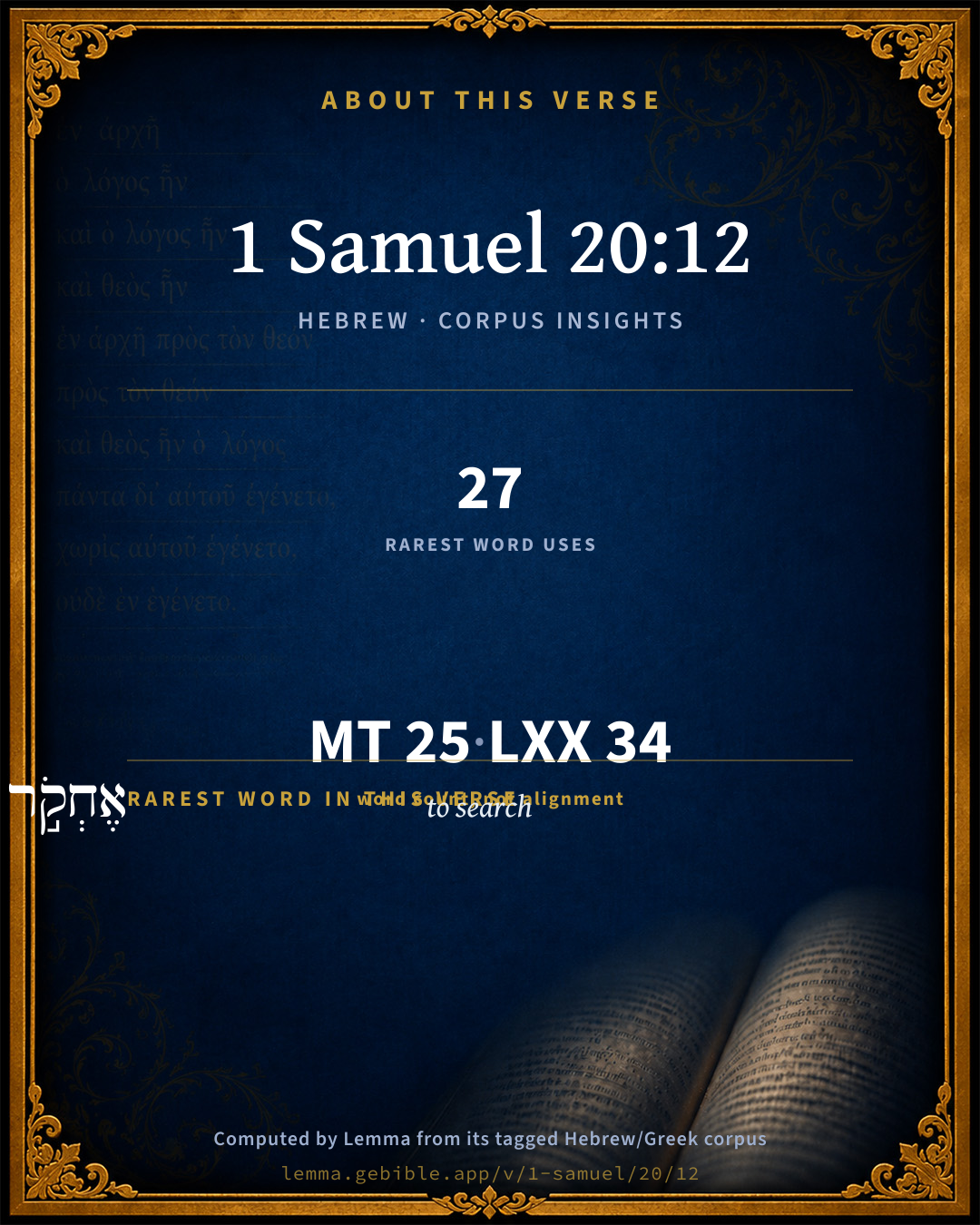
In English translation the verse runs 44 words from the Hebrew and 44 from the Septuagint (LXX English) — the same length.

A rough comparison of the two English renderings, which tokenize alike — not a word-level alignment.

Word counts can differ between the Hebrew and the Greek without any difference in meaning — e.g. the Hebrew direct-object marker אֵת has no separate Greek word, and Greek often adds the article ὁ.

In the original languages it is 25 Hebrew tokens and 34 Greek tokens — but the two are counted differently (Hebrew bundles its prefixes and suffixes into one token; the Greek is in lemma form), so that isn’t a like-for-like length.

Cross-references

6

Topical passages linked to 1 Samuel 20:12 in the Treasury of Scripture Knowledge — connected by theme and wording, ordered by reader-vote popularity; previews shown in the World English Bible.

  • Joshua 22:22 The Mighty One, God, Yahweh, the Mighty One, God, Yahweh, he knows; and Israel he shall know: if it be in rebellion, or if in trespass against Yahweh (don't save us this day),
  • Job 31:4 Doesn't he see my ways, And number all my steps?
  • Psalms 17:3 You have proved my heart; you have visited me in the night; You have tried me, and found nothing; I have resolved that my mouth shall not disobey.
  • Psalms 139:1–4 Yahweh, you have searched me, And you know me.
  • Proverbs 20:5 Counsel in the heart of man is like deep water; But a man of understanding will draw it out.
  • Proverbs 25:2–3 It is the glory of God to conceal a thing, But the glory of kings is to search out a matter.

Cross-references courtesy of OpenBible.info (CC BY 4.0).

Hebrew and Greek witnesses Masoretic Hebrew ↔ Greek Septuagint

The same verse in the two great witnesses to the Old Testament, shown verse-for-verse.

These are two independent witnesses, not word-aligned to each other, and the Septuagint is shown in lemma (dictionary) form.

Hebrew 1 Samuel 20:12 Masoretic · Westminster Leningrad Codex

וַיֹּ֨אמֶר יְהוֹנָתָ֜ן אֶל דָּוִ֗ד יְהוָ֞ה אֱלֹהֵ֤י יִשְׂרָאֵל֙ כִּֽי אֶחְקֹ֣ר אֶת אָבִ֗י כָּעֵ֤ת מָחָר֙ הַשְּׁלִשִׁ֔ית וְהִנֵּה ט֖וֹב אֶל דָּוִ֑ד וְלֹֽא אָז֙ אֶשְׁלַ֣ח אֵלֶ֔יךָ וְגָלִ֖יתִי אֶת אָזְנֶֽךָ

Jonathan said to David, Yahweh, the God of Israel, [be witness]: when I have sounded my father about this time tomorrow, [or] the third day, behold, if there be good toward David, shall I not then send to you, and disclose it to you?

World English Bible · Public Domain

Greek LXX 1 Samuel 20:12 Septuagint · lemma form

καί εἶπον ιωναθαν πρός δαυίδ κύριος ὁ θεός ἰσραήλ οἶδα ὅτι ἀνακρίνω ὁ πατήρ ἐγώ ὡς ἄν ὁ καιρός τρισσῶς καί ἰδού ἀγαθός εἰμί περί δαυίδ καί οὐ μή ἀποστέλλω πρός σύ εἰς ἀγρός

And Jonathan said to David, the Lord God of Israel knows that I will sound my father as I have an opportunity, three several times, and, behold, if good should be determined concerning David, and I do not send to you to the field,

LXX2012 (modern English Septuagint) · Public Domain

On this verse, Keil & Delitzsch discusses the Septuagint’s reading. Read the note in Commentary ↓

Hebrew: Westminster Leningrad Codex (CC BY 4.0). Greek: Septuagint (public domain); English from LXX2012 (modern English Septuagint) (Public Domain). How the Septuagint differs from the Hebrew →

Targum (Aramaic paraphrase)

1

The Targum is the ancient Jewish Aramaic paraphrase of the Hebrew Scriptures — an interpretive translation, not the Hebrew text itself. Onkelos (literal) and Pseudo-Jonathan (expansive) render the Torah, and Jonathan the Prophets. Coverage is partial: where no permissively-licensed English translation exists for a verse, only the Aramaic is shown. This is verse-level text, not a word-by-word alignment to the Hebrew.

  1. Targum Jonathan Prophets (Joshua–Malachi)
    וַאֲמַר יְהוֹנָתָן לְדָוִד יְיָ אֱלָהָא דְיִשְׂרָאֵל אֲרֵי אֶבְדוֹק יַת אַבָּא בְּעִדָנָא הָדֵין מְחַר אוֹ בְּיוֹמָא תְּלִיתָאָה וְהָא פִתְגָמַיָא תַקְנִין מִתְאַמְרִין עַל דָוִד וְלָא מִכְּעַן אֶשְׁלַח לְוָתָךְ וַאֲחַוֵי לָךְ:

    (no public-domain English translation for this verse)

    Targum Jonathan — Aramaic: “Mikraot Gedolot” (public domain). English: “Sefaria Community Translation” (CC0 1.0 (public-domain dedication)); “London "Chaldee Paraphrase," 1871” (public domain). Text via Sefaria.

Commentary

Notes on 1 Samuel 20:12 from classic Christian and Jewish commentators (each source and its license shown beneath its notes). The classic Christian expositions comment on the surrounding passage and are grouped to its opening verse, so a note may address several verses; the Jewish commentaries on the Tanakh (Rashi and others) are per-verse, so they appear only where the commentator wrote on this verse.

Lemma curates 59 commentaries, every one of them public domain or Creative Commons licensed, each selected and text-cleaned for this edition rather than reprinted as found. About our sources →

Trapp's Complete Commentary

John Trapp

1Sa 20:12 And Jonathan said unto David, O LORD God of Israel, when I have sounded my father about to morrow any time, [or] the third [day], and, behold, [if there be] good toward David, and I then send not unto thee, and shew it thee;

Ver. 12. O Lord God of Israel, when I have sounded, &c.] Broken language from a troubled spirit. Love will creep where it cannot go, and shine as a candle through the chinkers.

John Trapp, A Commentary or Exposition upon All the Books of the Old and New Testament (1647–1656) — public domain. Text from a community e-Sword module.

Keil & Delitzsch

C. F. Keil & F. Delitzsch

In the field, where they were both entirely free from observation, Jonathan first of all renewed his covenant with David, by vowing to him on oath that he would give him information of his father's feelings towards him (Sa1 20:12, Sa1 20:13); and then entreated him, with a certain presentiment that David would one day be king, even then to maintain his love towards him and his family for ever (Sa1 20:14-16); and lastly, he made David swear again concerning his love (Sa1 20:17), and then gave him the sign by which he would communicate the promised information (Sa1 20:18-23).

Sa1 20:12-15

Sa1 20:12 and Sa1 20:13 are connected. Jonathan commences with a solemn invocation of God: "Jehovah, God of Israel!" and thus introduces his oath. We have neither to supply "Jehovah is witness," nor "as truly as Jehovah liveth," as some have suggested. "When I inquire of my father about this time to-morrow, the day after to-morrow (a concise mode of saying 'to-morrow or the day after'), and behold it is (stands) well for David, and then I do not send to thee and make it known to thee, Jehovah shall do so to Jonathan," etc. ("The Lord do so," etc., the ordinary formula used in an oath: see Sa1 14:44). The other case is then added without an adversative particle: "If it should please my father evil against thee (lit. as regards evil), "I will make it known to thee, and let thee go, that thou mayest go in peace; and Jehovah be with thee, as He has been with my father." In this wish there is expressed the presentiment that David would one day occupy that place in Israel which Saul occupied then, i.e., the throne. - In Sa1 20:14 and Sa1 20:15 the Masoretic text gives no appropriate meaning. Luther's rendering, in which he follows the Rabbins and takes the first ולא (Sa1 20:14) by itself, and then completes the sentence from the context ("but if I do it not, show me no mercy, because I live, not even if I die"), contains indeed a certain permissible sense when considered in itself; but it is hardly reconcilable with what follows, "and do not tear away thy compassion for ever from my house." The request that he would show no compassion to him (Jonathan) even if he died, and yet would not withdraw his compassion from his house for ever, contains an antithesis which would have been expressed most clearly and unambiguously in the words themselves, if this had been really what Jonathan intended to say. De Wette's rendering gives a still more striking contradiction: "But let not (Jehovah be with thee) if I still live, and thou showest not the love of Jehovah to me, that I do not, and thou withdrawest not thy love from my house for ever." There is really no other course open than to follow the Syriac and Arabic, as Maurer, Thenius, and Ewald have done, and change the ולא in the first two clauses in Sa1 20:14 into ולוּ or ולא, according to the analogy of the form לוּא (Sa1 14:30), and to render the passage thus: "And mayest thou, if I still live, mayest thou show to me the favour of the Lord, and not if I do, not withdraw thy favour from my house for ever, not even (ולא) when Jehovah shall cut off the enemies of David, every one from the face of the earth!" "The favour of Jehovah" is favour such as Jehovah shall cut off," etc., shows very clearly Jonathan's conviction that Jehovah would give to David a victory over all his enemies.

Sa1 20:16

Thus Jonathan concluded a covenant with the house of David, namely, by bringing David to promise kindness to his family for ever. The word בּרית must be supplied in thought to יכרת, as in Sa1 22:8 and Ch2 7:18. "And Jehovah required it (what Jonathan had predicted) at the hand of David's enemies." Understood in this manner, the second clause contains a remark of the historian himself, namely, that Jonathan's words were really fulfilled in due time. The traditional rendering of וּבקּשׁ as a relative preterite, with אמר understood, "and said, Let Jehovah take vengeance," is not only precluded by the harshness of the introduction of the word "saying," but still more by the fact, that if אמר (saying) is introduced between the copula vav and the verb בּקּשׁ, the perfect cannot stand for the optative בּקּשׁ, as in Jos 22:23.

Sa1 20:17

"And Jonathan adjured David again by his love to him, because he loved him as his own soul" (cf. Sa1 18:1, Sa1 18:3); i.e., he once more implored David most earnestly with an oath to show favour to him and his house.

Sa1 20:18-19

He then discussed the sign with him for letting him know about his father's state of mind: "To-morrow is new moon, and thou wilt be missed, for thy seat will be empty," sc., at Saul's table (see at Sa1 20:5). "And on the third day come down quickly (from thy sojourning place), and go to the spot where thou didst hide thyself on the day of the deed, and place thyself by the side of the stone Ezel." The first words in this (19th) verse are not without difficulty. The meaning "on the third day" for the verb שׁלּשׁ cannot be sustained by parallel passages, but is fully established, partly by השּׁלשׁית, the third day, and partly by the Arabic usage (vid., Ges. Thes. s. v.). מאד after תּרד, lit., "go violently down," is more striking still. Nevertheless the correctness of the text is not to be called in question, since שׁלּשׁתּ is sustained by τρισσεύσει in the Septuagint, and מאד תּרד by descende ergo festinus in the Vulgate, and also by the rendering in the Chaldee, Arabic, and Syriac versions, "and on the third day thou wilt be missed still more," which is evidently merely a conjecture founded upon the context. The meaning of המּעשׂה בּיום is doubtful. Gesenius, De Wette, and Maurer render it "on the day of the deed," and understand it as referring to Saul's deed mentioned in Sa1 19:2, viz., his design of killing David; others render it "on the day of business," i.e., the working day (Luther, after the lxx and Vulgate), but this is not so good a rendering. The best is probably that of Thenius, "on the day of the business" (which is known to thee). Nothing further can be said concerning the stone Ezel than that Ezel is a proper name.

Sa1 20:20

"And I will shoot off three arrows to the side of it (the stone Ezek), to shoot for me at the mark," i.e., as if shooting at the mark. The article attached to החצּים is either to be explained as denoting that the historian assumed the thing as already well known, or on the supposition that Jonathan went to the field armed, and when giving the sign pointed to the arrows in his quiver. In the word צדּה the Raphe indicates that the suffix of ־ה is not a mere toneless ה, although it has no mappik, having given up its strong breathing on account of the harsh צ sound.

Sa1 20:21

"And, behold (הנּה, directing attention to what follows as the main point), I will send the boy (saying), Go, get the arrows. If I shall say to the boy, Behold, the arrows are from thee hitherwards, fetch them; then come, for peace is to thee, and it is nothing, as truly as Jehovah liveth."

Sa1 20:22

"But if I say to the youth, Behold, the arrows are from thee farther off; then go, for Jehovah sendeth thee away," i.e., bids thee flee. The appointment of this sign was just as simple as it was suitable to the purpose.

Sa1 20:23

This arrangement was to remain an eternal secret between them. "And (as for) the word that we have spoken, I and thou, behold, the Lord is between me and thee for ever," namely, a witness and judge in case one of us two should break the covenant (vid., Gen 31:48-49). This is implied in the words, without there being any necessity to assume that עד had dropped out of the text. "The word" refers not merely to the sign agreed upon, but to the whole matter, including the renewal of the bond of friendship.

Keil & Delitzsch — Biblical Commentary on the Old Testament (1861–1891) — public domain (CC PDM 1.0). Text via the HelloAO Bible API. (Old Testament only.)

Adam Clarke's Commentary

Verse 12. Jonathan said - O Lord God of Israel] There is, most evidently, something wanting in this verse. The Septuagint has, The Lord God of Israel doth KNOW. The Syriac and Arabic, The Lord God of Israel is WITNESS. Either of these makes a good sense. But two of Dr. Kennicott's MSS. supply the word chai, "liveth;" and the text reads thus, As the Lord God of Israel LIVETH, when I have sounded my father - if there be good, and I then send not unto thee, and show it thee, the Lord do so and much more to Jonathan. This makes a still better sense.

Adam Clarke's Commentary on the Bible (1810–1826) — public domain. Text from a community e-Sword/MySword module.

Ellicott's Commentary for English Readers

(12) O Lord God of Israel.—Now that the two friends have come to a remote solitary spot, Jonathan prefaces his reply to David’s piteous request by a very solemn invocation of that God they both loved so well. The vocative, however, “O Lord God,” &c., of the English Version has been generally looked upon as an impossible rendering—“there being no analogy for such a mode of address”—Lange.

The versions avoid it by supplying different words. So the Syriac and Arabic render “The Lord of Israel is my witness”; the LXX., “The Lord God of Israel knows.” Others have supplied a word which they find in two Hebrew MSS., “As the Lord God of Israel liveth.” The meaning, however, is perfectly clear.

Or the third day.—This statement of time on the part of Jonathan evidently assumes that the festival was continued the day after the “new moon” by a royal banquet. The time is thus reckoned: the present day; the morrow, which was the new moon festival; and the day after, which would reckon as the third day.

Behold, if there be good toward David.—In the event of the news being good—that is, if Saul, contrary to David’s expectation, spoke kindly of him—then Jonathan would send to him a special messenger; if, on the other hand, the king displayed enmity, in that case Jonathan would come himself and see David (for the last time). This sad message should be brought by no messenger.

A Bible Commentary for English Readers, edited by Charles John Ellicott (1878–1897) — public domain. Text from a community e-Sword module.

The Cambridge Bible for Schools and Colleges

gen. ed. J. J. S. Perowne

12. O Lord God] Jonathan begins by addressing Jehovah, but afterwards instead of putting the verb in the second person (so mayest Thou do) he repeats the divine Name.

about to-morrow any time, or the third day] About this time to-morrow or the day after.

The Cambridge Bible for Schools and Colleges (gen. ed. J. J. S. Perowne; Cambridge University Press, 1878–1918) — public domain. Text from a community e-Sword module.

John Gill's Exposition

And Jonathan said unto David, O Lord God of Israel,.... Or by the Lord God of Israel, I swear unto thee; for this is the form of the oath, as Jarchi and Kimchi observe:

when I have sounded my father about tomorrow any time, or the third day; searched, inquired, and found out how his disposition is:

and, behold, if there be good toward David; if he is well disposed to him, as may appear by speaking respectfully of him, or kindly inquiring after him, and by being satisfied with the account given him:

and I then send not unto thee, and show it thee; then let the vengeance of God fall upon me in some remarkable manner or another, as follows; or "shall I not then send unto thee, and show it thee" (t)? certainly I will; that is, I will send a messenger to thee to acquaint thee with it, who shall tell it, and cause thee to hear it, as from myself.

(t) "an non tune mitterem?" Junius & Tremellius; "nonne tunc mittam ad te?" so some in Vatablus.

John Gill's Exposition of the Whole Bible (1746–1763) — public domain (CC PDM 1.0). Text via the HelloAO Bible API.

Haydock's Catholic Bible Commentary

After. Septuagint, "The Lord....has known that I will sift my father, as opportunity shall serve, thrice," or repeatedly. (Haydock)

George Leo Haydock (1774–1849), Haydock's Catholic Family Bible and Commentary, 1859 edition — public domain. Excludes Psalms (Douay-Rheims chapter numbering differs from Protestant) and Deuterocanonical books (Catholic canon only).

Matthew Poole's English Annotations

O Lord God of Israel, do thou hear and judge between us. It is an abrupt speech, which is usual in great passions.

Matthew Poole's English Annotations on the Holy Bible (1683–1685) — public domain. Text from a community e-Sword/MySword module.

John Wesley's Explanatory Notes

O Lord God - Do thou hear and judge between us. It is an abrupt speech which is usual in great passions.

John Wesley, Explanatory Notes Upon the Whole Bible (1754–1765) — public domain. Text via the GEBible commentary corpus.

unfoldingWord translationNotes

Door43 World Missions Community

see

"look" or "listen" or "pay attention to what I am about to tell you"

if there is good will

"if my father wants to do good things for you"

will I not then send to you and make it known to you?

Jonathan uses this question to emphasize that he will tell David if Saul intends to harm him. This rhetorical question can be translated as a statement. AT: "then I will certainly send to you and make it known to you" (See: Rhetorical Question)

may Yahweh do to Jonathan and more also

This is an idiom. Jonathan uses this oath for emphasis and speaks of himself as if he were another person. AT: "may Yahweh do to me whatever harm my father intends to do to you, and even more than that" (See: Idiom and Pronouns)

translationWords

David

God

Israel

testimony

good

send

know

peace

unfoldingWord translationNotes — © Distant Shores Media and the Door43 World Missions Community, licensed CC BY-SA 4.0. Source: git.door43.org/Door43/en_tn.

Rashi

Rabbi Shlomo Yitzchaki (Rashi)

Adonoy the God of Yisroel. This is an expression of oath.

On the third day. Of the following day. That means the third day at this time, for tomorrow is the new moon, and tomorrow my father might not wonder; but he will wonder on the third day.

Rashi on the Tanakh — English translations: “The Judaica Press complete Tanach with Rashi, translated by A. J. Rosenberg” (CC BY 4.0); “Pentateuch with Rashi's commentary by M. Rosenbaum and A.M. Silbermann, 1929-1934” (public domain); “The Metsudah Tanach series, Lakewood, N.J” (CC BY 4.0); and “The Book of Joshua, Metsudah Publications, 1997” (CC BY 4.0). Text via Sefaria.

Lesson kit

Teaching starters — assembled from the data on this page, not authored interpretation. Every prompt links to the verse data it draws on. Edit before teaching.

1 Samuel, in the Historical, opens this verse with 25 words (21 distinct Hebrew lemmas). Its most distinctive word is châqar (“to search”). A historical commentator’s framing appears above. Read the whole chapter for the surrounding context.

Discussion questions

  1. The word châqar carries the sense “to search.” How does it shape the verse?
  2. How does Deuteronomy 13:14, which shares the word «to search», read alongside this verse?
  3. What does the repetition of “David” (2× in this one verse) do in this verse?
  4. The translations on this page render this verse differently — a whole-verse word diff, not a word-by-word alignment. What might account for the different wordings?
  5. «וַיֹּ֨אמֶר» is a Qal Sequential Imperfect verb. How does that grammatical form shape the action described?
  6. Compare how Trapp's Complete Commentary and Keil & Delitzsch read this verse. Where do they agree or differ?

Things to notice

Reading settings

Reading text

Shown beneath each verse's original-language words.

Old Testament
Old Testament edition

Read the OT as the Masoretic Hebrew (MT) or the Greek Septuagint (LXX).

English shown for the Greek Septuagint (in the Hebrew ↔ Greek comparison).

Comparing translations? Open the Compare panel on any verse page to stack up to four side by side.