
Jeremiah 2:28

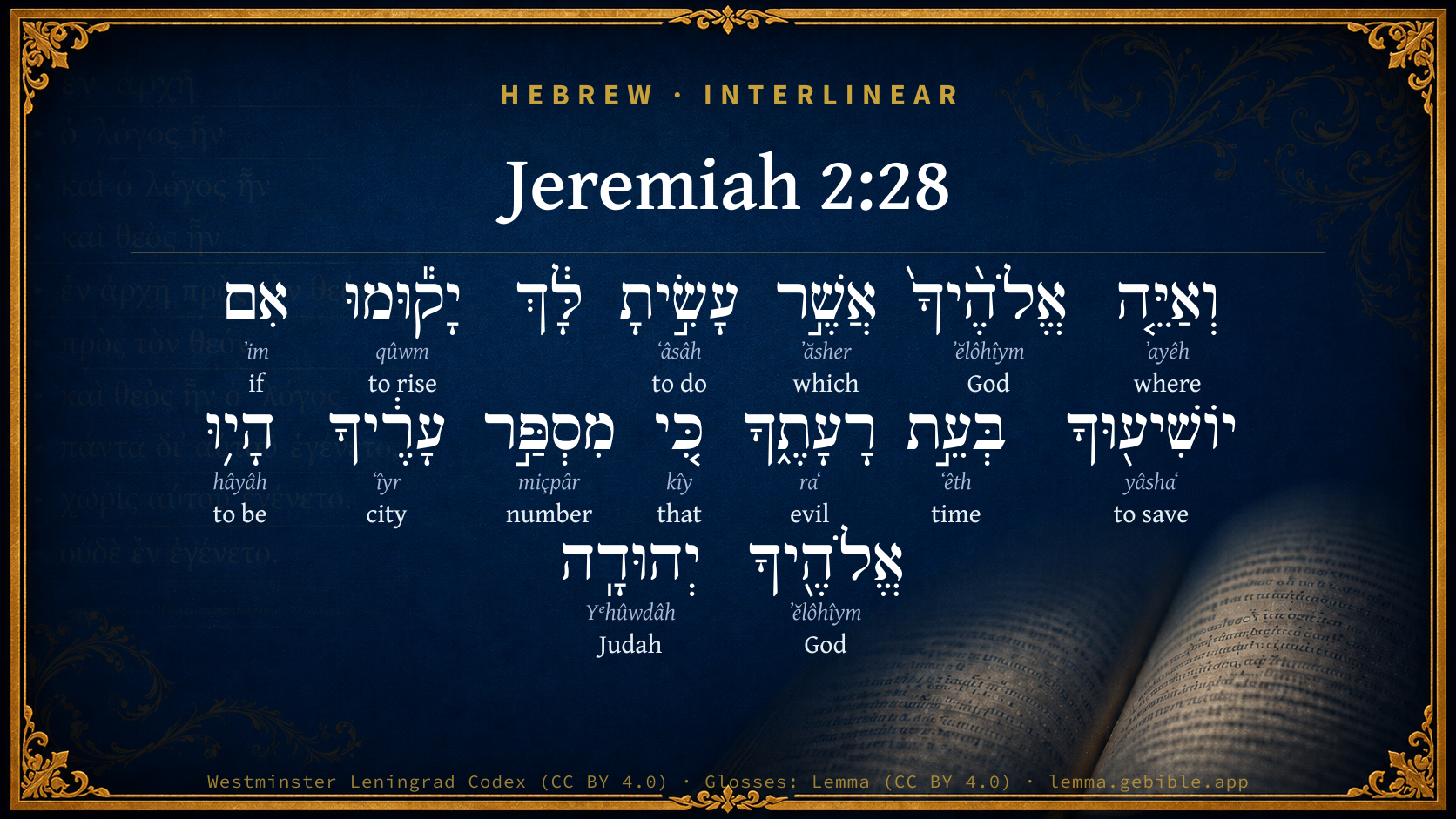
Hebrew (Westminster Leningrad Codex) Jeremiah 2:28 appears in the Hebrew Old Testament. The text above is from the Westminster Leningrad Codex. Each word links to its Strong’s number, a concise gloss, and parsing drawn from the Open Scriptures Hebrew Bible morphology. Click any word for its full Brown-Driver-Briggs (BDB) entry.
Download image
Cite this verse

Jeremiah 2:28 (World English Bible). Public Domain. Lemma interlinear Bible study tool, https://lemma.gebible.app/v/jeremiah/2/28.

Show BibTeX & RIS
BibTeX
RIS
English Translation
But where are your gods that you have made you? let them arise, if they can save you in the time of your trouble: for according to the number of your cities are your gods, Judah.
World English Bible · Public Domain
Download a study sheet

One document with this verse’s original text, its word-by-word gloss line, the meaning frame, cross-references with their text, attributed commentary, and full source and license credits — printable, and it pastes into notes with its structure intact.

This verse Autodidact and up

Study sheet (.html) Plain text (.txt)

A passage Seminary Student

Up to 50 verses in one chapter. A passage sheet keeps up to 6 commentary sources and 12 cross-references per verse, in the order this page ranks them, and says so on the sheet whenever that leaves anything out. Ask for a single verse and you get the Autodidact verse sheet above.

Everything on this page stays free to read, with no account — the sheet is a download of what is already on screen, not access to it.

Want to remove ads? Support Godless Engineer
Compare translations 3

The same verse in 3 English versions, stacked beneath the original-language interlinear above. Click any original word for its lexicon entry.

Each is an independent rendering of the whole verse — the interlinear is not word-aligned to these translations.

Highlighted words mark where these versions differ — a whole-verse word diff, not a word-by-word alignment.

  • World English Bible Public Domain
    But where are your gods that you have made you? let them arise, if they can save you in the time of your trouble: for according to the number of your cities are your gods, Judah.
  • King James Version Public Domain
    But where are thy gods that thou hast made thee? let them arise, if they can save thee in the time of thy trouble: for according to the number of thy cities are thy gods, O Judah.
  • unfoldingWord Literal Text CC BY-SA 4.0
    But where the gods that you made for yourself? Let them arise if they save you in the time of your trouble, for the number of your cities, they are your gods, Judah! ts\*

unfoldingWord Literal Text — © unfoldingWord, licensed CC BY-SA 4.0. Word-aligned USFM3 via Door43 (git.door43.org/unfoldingWord/en_ult).

Versions to compare (up to 4)

3 of 4 selected

Show all 18 translations

Every available English version of this verse, each an independent rendering of the whole verse.

  • World English Bible Public Domain
    But where are your gods that you have made you? let them arise, if they can save you in the time of your trouble: for according to the number of your cities are your gods, Judah.
  • Berean Standard Bible Public Domain
    But where are the gods you made for yourselves? Let them rise up in your time of trouble and save you if they can; for your gods are as numerous as your cities, O Judah.
  • Majority Standard Bible Public Domain
    But where are the gods you made for yourselves? Let them rise up in your time of trouble and save you if they can; for your gods are as numerous as your cities, O Judah.
  • King James Version Public Domain
    But where are thy gods that thou hast made thee? let them arise, if they can save thee in the time of thy trouble: for according to the number of thy cities are thy gods, O Judah.
  • American Standard Version (1901) Public Domain
    But where are thy gods that thou hast made thee? let them arise, if they can save thee in the time of thy trouble: for according to the number of thy cities are thy gods, O Judah.
  • Revised Version (1885) Public Domain
    But where are thy gods that thou hast made thee? let them arise, if they can save thee in the time of thy trouble: for according to the number of thy cities are thy gods, O Judah.
  • Geneva Bible (1599) Public Domain
    But where are thy gods, that thou hast made thee? let them arise, if they can helpe thee in the time of thy trouble: for according to the nomber of thy cities, are thy gods, O Iudah.
  • Douay-Rheims (1899) Public Domain
    Where are the gods, whom thou hast made thee? let them arise and deliver thee in the time of thy affliction: for according to the number of thy cities were thy gods, O Juda.
  • Young's Literal Translation Public Domain
    And where `are' thy gods, that thou hast made to thyself? Let them arise, if they may save thee, In the time of thy vexation, For -- the number of thy cities have been thy gods, O Judah,
  • Literal Standard Version CC BY-SA 4.0
    And where [are] your gods, that you have made to yourself? Let them arise, if they may save you, || In the time of your distress, || For—the number of your cities have been your gods, O Judah,
  • Unlocked Literal Bible CC BY-SA 4.0
    Yet where are the gods that you made for yourselves? Let them arise if they wish to save you in your time of troubles, for your idols equal your cities in number, Judah!
  • unfoldingWord Literal Text CC BY-SA 4.0
    But where the gods that you made for yourself? Let them arise if they save you in the time of your trouble, for the number of your cities, they are your gods, Judah! ts\*
  • Darby Bible Public Domain
    Where then are thy gods that thou hast made for thyself? let them arise, if they can save thee in the time of thy trouble: for as the number of thy cities, are thy gods, O Judah.
  • World Messianic Bible Public Domain
    “But where are your gods that you have made for yourselves? Let them arise, if they can save you in the time of your trouble, for you have as many gods as you have towns, O Judah.
  • Webster's Bible Public Domain
    But where are thy gods that thou hast made for thyself? let them arise, if they can save thee in the time of thy trouble: for according to the number of thy cities are thy gods, O Judah.
  • Free Bible Version CC BY-SA 4.0
    So where are these “gods” of yours that you made for yourselves? Let them come and help you when you're in trouble! Let them save you if they can, because you Israelites have as many gods as you have towns.
  • Bible in Basic English Public Domain
    But where are the gods you have made for yourselves? let them come, if they are able to give you salvation in the time of your trouble: for the number of your gods is as the number of your towns, O Judah.
  • JPS Tanakh (1917) Public Domain
    But where are thy gods that thou hast made thee? Let them arise, if they can save thee in the time of thy trouble; for according to the number of thy cities are thy gods, O Judah.

Literal Standard Version (2020), Covenant Press — licensed CC BY-SA 4.0. Text via the HelloAO Bible API (eBible.org). Unlocked Literal Bible (unfoldingWord) — licensed CC BY-SA 4.0. Text via the HelloAO Bible API (eBible.org). unfoldingWord Literal Text — © unfoldingWord, licensed CC BY-SA 4.0. Word-aligned USFM3 via Door43 (git.door43.org/unfoldingWord/en_ult). Free Bible Version, Dr. Jonathan Gallagher — licensed CC BY-SA 4.0. Text via the HelloAO Bible API (eBible.org).

Word by word

More ways to search: Search by grammar → Find every occurrence → Compare this word →

Practice this passage: Drill this verse → Learn its vocabulary →

וְאַיֵּ֤ה
ʼayêh
H346
“and · where”
Conjunction + Particle, Interrogative
Part of Speech
Conjunction + Particle
Type
Interrogative
Full BDB Definition

Origin: prolonged from H335

TWOT: 75a

where? - of persons, things - rhetorical
  1. אֱלֹהֶ֨יךָ֙ ʼĕlôhîym H430 “God(s) · your” Noun, Common, Masculine, Plural, Construct + Suffix, Personal, 2nd Person, Masculine, Singular
  2. אֲשֶׁ֣ר ʼăsher H834 “which” Particle, Relative
  3. עָשִׂ֣יתָ ʻâsâh H6213 “to do” Verb, Qal, Perfect, 2nd Person, Masculine, Singular
  4. יָק֕וּמוּ qûwm H6965 “to rise” Verb, Qal, Jussive, 3rd Person, Masculine, Plural
  5. אִם ʼim H518 “if” Conjunction
  6. יוֹשִׁיע֖וּךָ yâshaʻ H3467 “to save · you” Verb, Hiphil, Imperfect, 3rd Person, Masculine, Plural + Suffix, Personal, 2nd Person, Masculine, Singular
  7. בְּעֵ֣ת ʻêth H6256 “in/at · time of” Preposition + Noun, Common, Both, Singular, Construct
  8. רָעָתֶ֑ךָ raʻ H7451 “evil · your” Noun, Common, Feminine, Singular, Construct + Suffix, Personal, 2nd Person, Masculine, Singular
  9. כִּ֚י kîy H3588 “that” Conjunction
  10. מִסְפַּ֣ר miçpâr H4557 “number of” Noun, Common, Masculine, Singular, Construct
  11. עָרֶ֔יךָ ʻîyr H5892 “cities · your” Noun, Common, Feminine, Plural, Construct + Suffix, Personal, 2nd Person, Masculine, Singular
  12. הָי֥וּ hâyâh H1961 “to be” Verb, Qal, Perfect, 3rd Person, Common, Plural
  13. אֱלֹהֶ֖יךָ ʼĕlôhîym H430 “God(s) · your” Noun, Common, Masculine, Plural, Construct + Suffix, Personal, 2nd Person, Masculine, Singular
  14. יְהוּדָֽה Yᵉhûwdâh H3063 “Judah” Noun, Proper

About this verse

These counts appear in no published source. They are computed here, from the morphology-tagged text and Lemma’s own curated glosses. What Lemma adds →

16
words
14
distinct lemmas
Prophets
section

Shared distinctive vocabulary

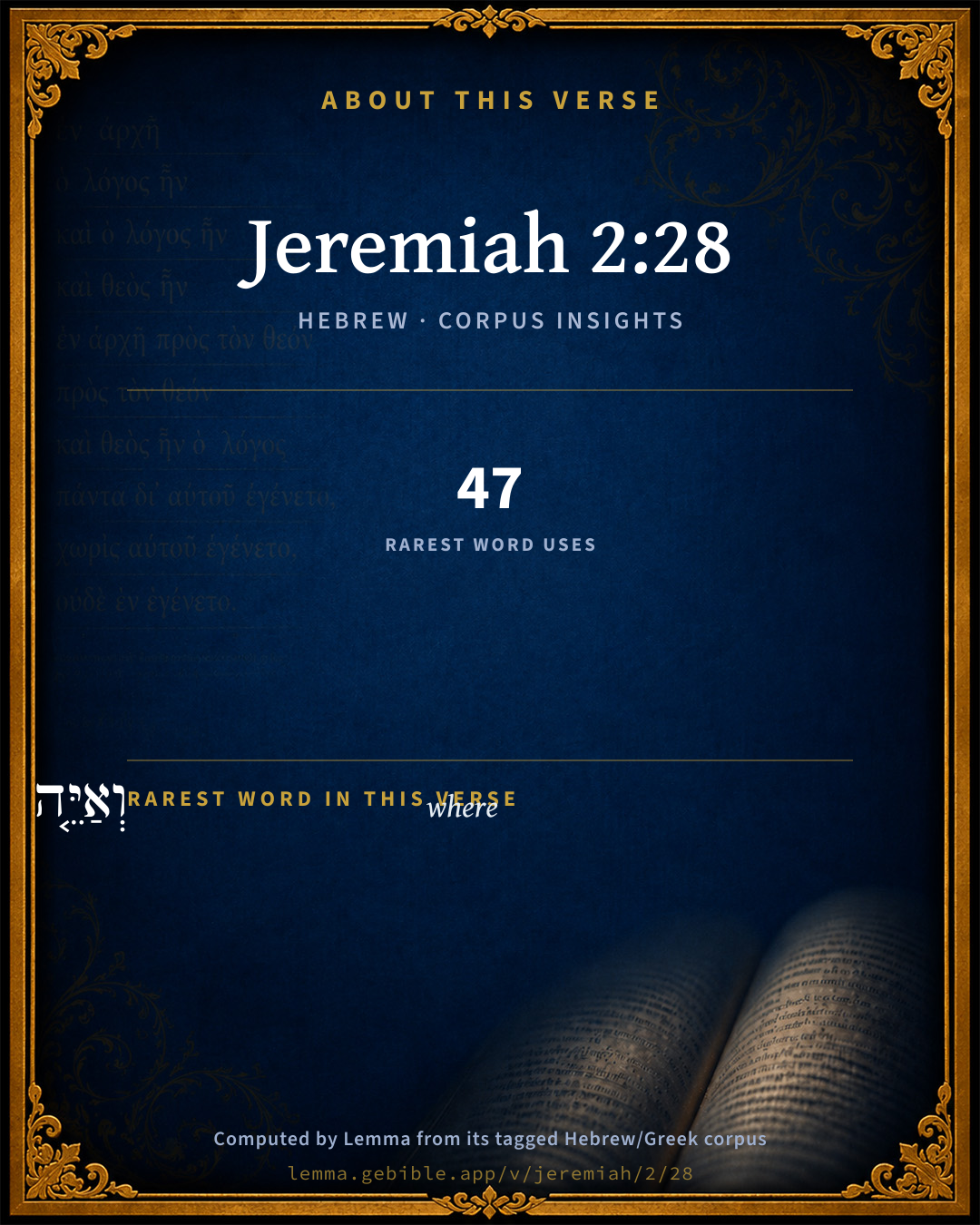
וְאַיֵּ֤ה where H346 occurs in 40 verses of the Hebrew Bible. Also found in:

Grammatical profile

  • 4 verbs
  • 7 nouns
  • 1 preposition
  • 2 conjunctions
  • 2 particles

Verb forms

  • עָשִׂ֣יתָ Qal · Perfect
  • יָק֕וּמוּ Qal · Jussive
  • יוֹשִׁיע֖וּךָ Hiphil · Imperfect
  • הָי֥וּ Qal · Perfect

Repetition

A word recurs within this verse — often emphatic in Hebrew:

  • אֱלֹהֶ֨יךָ֙ God H430 ×2

Cross-references

9

Topical passages linked to Jeremiah 2:28 in the Treasury of Scripture Knowledge — connected by theme and wording, ordered by reader-vote popularity; previews shown in the World English Bible.

  • Deuteronomy 32:37 He will say, Where are their gods, The rock in which they took refuge;
  • Jeremiah 11:13 For according to the number of your cities are your gods, Judah; and according to the number of the streets of Jerusalem have you set up altars to the shameful thing, even altars to burn incense to Baal.
  • Judges 10:14 Go and cry to the gods which you have chosen; let them save you in the time of your distress.
  • Isaiah 45:20 Assemble yourselves and come; draw near together, you who have escaped from the nations: they have no knowledge who carry the wood of their engraved image, and pray to a god that can't save.
  • 2 Kings 17:30–31 The men of Babylon made Succoth-benoth, and the men of Cuth made Nergal, and the men of Hamath made Ashima,
  • Isaiah 46:7 They bear it on the shoulder, they carry it, and set it in its place, and it stands, from its place it shall not move: yes, one may cry to it, yet it can not answer, nor save him out of his trouble.
  • 2 Kings 3:13 Elisha said to the king of Israel, What have I to do with you? get you to the prophets of your father, and to the prophets of your mother. The king of Israel said to him, No; for Yahweh has called these three kings together to deliver them into the hand of Moab.
  • Isaiah 46:2 They stoop, they bow down together; they could not deliver the burden, but themselves are gone into captivity.
  • Hosea 10:1 Israel is a luxuriant vine that puts forth his fruit. According to the abundance of his fruit he has multiplied his altars. As their land has prospered, they have adorned their sacred stones.

Cross-references courtesy of OpenBible.info (CC BY 4.0).

Hebrew and Greek witnesses Masoretic Hebrew ↔ Greek Septuagint

The same verse in the two great witnesses to the Old Testament, shown verse-for-verse.

These are two independent witnesses, not word-aligned to each other, and the Septuagint is shown in lemma (dictionary) form.

Hebrew Jeremiah 2:28 Masoretic · Westminster Leningrad Codex

וְאַיֵּ֤ה אֱלֹהֶ֨יךָ֙ אֲשֶׁ֣ר עָשִׂ֣יתָ לָּ֔ךְ יָק֕וּמוּ אִם יוֹשִׁיע֖וּךָ בְּעֵ֣ת רָעָתֶ֑ךָ כִּ֚י מִסְפַּ֣ר עָרֶ֔יךָ הָי֥וּ אֱלֹהֶ֖יךָ יְהוּדָֽה

But where are your gods that you have made you? let them arise, if they can save you in the time of your trouble: for according to the number of your cities are your gods, Judah.

World English Bible · Public Domain

Greek LXX Structure differs

In the Septuagint, Jeremiah is about an eighth shorter than the Hebrew and arranges its material differently — the Oracles Against the Nations (Hebrew chapters 46–51) appear in the middle of the Greek book, after 25:13. Because the chapter and verse boundaries do not line up, a verse-for-verse comparison with the Hebrew is not shown.

A verse-for-verse comparison isn’t shown here because the chapters and verses don’t line up. Switch to the LXX edition with the MT / LXX toggle above to read the Greek directly.

On this verse, Ellicott's Commentary for English Readers discusses the Septuagint’s reading. Read the note in Commentary ↓

Hebrew: Westminster Leningrad Codex (CC BY 4.0). Greek: Septuagint (public domain); English from a public-domain English Septuagint. How the Septuagint differs from the Hebrew →

Targum (Aramaic paraphrase)

1

The Targum is the ancient Jewish Aramaic paraphrase of the Hebrew Scriptures — an interpretive translation, not the Hebrew text itself. Onkelos (literal) and Pseudo-Jonathan (expansive) render the Torah, and Jonathan the Prophets. Coverage is partial: where no permissively-licensed English translation exists for a verse, only the Aramaic is shown. This is verse-level text, not a word-by-word alignment to the Hebrew.

  1. Targum Jonathan Prophets (Joshua–Malachi)
    וְאָן דְחַלְתְּכוֹן דַעֲבַדְתּוּן לְכוֹן יְקוּמוּן אִם יָכְלָן לְמִפְרַקְכוֹן בְּעִדַן בִּישַׁתְכוֹן אֲרֵי מִנְיַן קִרְוֵיכוֹן הֲוָאָה דַחֲלַתְכוֹן דְבֵית יְהוּדָה:

    (no public-domain English translation for this verse)

    Targum Jonathan — Aramaic: “Mikraot Gedolot” (public domain). English: “Sefaria Community Translation” (CC0 1.0 (public-domain dedication)); “London "Chaldee Paraphrase," 1871” (public domain). Text via Sefaria.

Commentary

Notes on Jeremiah 2:28 from classic Christian and Jewish commentators (each source and its license shown beneath its notes). The classic Christian expositions comment on the surrounding passage and are grouped to its opening verse, so a note may address several verses; the Jewish commentaries on the Tanakh (Rashi and others) are per-verse, so they appear only where the commentator wrote on this verse.

Lemma curates 59 commentaries, every one of them public domain or Creative Commons licensed, each selected and text-cleaned for this edition rather than reprinted as found. About our sources →

Trapp's Complete Commentary

John Trapp

Jer 2:28 But where [are] thy gods that thou hast made thee? let them arise, if they can save thee in the time of thy trouble: for [according to] the number of thy cities are thy gods, O Judah.

Ver. 28. But where are thy gods that thou hast made thee?] Thou hast sure no need of my help. Quasi tu huius indigeas patris. See the like, Jdg 10:14. {See Trapp on "Jdg 10:14"}

For according to the number of thy cities are thy gods.] Enough of them thou hast, and near enough. The Papists also have their tutelar saints, to whom they seek more than to God himself. And when the Ave Mary bell rings, which is at sunrise, noon, and sunset, all men, in whatever place, house, field, street, or market, do presently kneel down and send up their united devotions to heaven by an Ave Maria. {a}

{a} Spec. Europ.

John Trapp, A Commentary or Exposition upon All the Books of the Old and New Testament (1647–1656) — public domain. Text from a community e-Sword module.

Tyndale Open Study Notes

Tyndale Open Resources

2:28 The Israelites were foolishly devoted to many gods (11:13; Deut 32:37; Judg 10:14; 2 Kgs 17:30-31), who were all powerless to help them. • Jeremiah addressed the individual tribe of Judah, the people standing before him.

Tyndale Open Study Notes — © Tyndale Open Resources, licensed CC BY-SA 4.0. Text via the HelloAO Bible API.

Geneva Bible (1599)

Geneva Bible translators

Thou thoughtest that thy gods of blocks and stones could have helped thee, because they were many in number and present in every place: but now let us see whether either the multitude, or their presence can deliver thee from my plague, Jer. 11:13.

Geneva Bible (1599) marginal notes — public domain. Text via Bolls.life.

Jamieson, Fausset & Brown

Robert Jamieson, A. R. Fausset & David Brown

But--God sends them to the gods for whom they forsook Him, to see if they can help them (Deu 32:37-38; Jdg 10:14).

according to the number of thy cities--Besides national deities, each city had its tutelary god (Jer 11:13).

Jamieson, Fausset & Brown — Commentary Critical and Explanatory on the Whole Bible (1871) — public domain (CC PDM 1.0). Text via the HelloAO Bible API.

Adam Clarke's Commentary

Verse 28. According to the number of thy cities are thy gods] Among heathen nations every city had its tutelary deity. Judah, far sunk in idolatry, had adopted this custom. The Church of Rome has refined it a little: every city has its tutelary saint, and this saint has a procession and worship peculiar to himself. So here; not much of the old idolatry is lost.

Adam Clarke's Commentary on the Bible (1810–1826) — public domain. Text from a community e-Sword/MySword module.

John Calvin's Commentaries

And hence he adds, Where are your gods? Here God laughs to scorn the false confidence by which the Jews deceived themselves: Where are your gods, which you have made for yourselves? Let them arise, let us see whether they will help you in the time of your distress. We now understand what the Prophet means: for he shews that the people acted in a most strange manner; for they worshipped idols when they were in safety, and afterwards would have God to be bound to them; and yet they denied the true God when they fell away unto idols. He then shews that they could expect no aid from God; for they robbed him of his own power when they devised idols for themselves. But we must ever remember what he said, that false gods were counted as fathers and authors of salvation by the people.

The same thing is, no doubt, done at this day under the Papacy; for the Papists have their patrons; and when they find that their foolish superstitions can do nothing for them, they would have God to help them, and yet they leave nothing to him: after having taken away all his glory, and divided it as a spoil among dead saints, they would then have God to be their helper. But we see what God’s answer to them is, “Where are your gods?” etc.

Now this truth is of use to us; and we hence learn, that we are not to wait until we are really, and in the last state of despair, compelled to acknowledge that our labors have been useless, while we hoped and prayed for help from idols; but that we ought to come directly to God himself for aid in our distress.

God proceeds farther with the sarcasm or the derision which he has employed, Where are thy gods? Let them now arise that they may help thee; that is, — let them try their utmost whether they can aid thee. According to the number of thy cities have been thy gods, O Judah As the people were not satisfied with one God, every city chose a patron for itself. “Since, then, innumerable gods are invoked by you, how comes it that they do not help you?” We hence see that the unbelief of the people is here sharply reproved; for they did not acquiesce in God alone, but sought to procure for themselves gods without number: there were many cities in the tribe of Judah, and there were as many patrons. The one true God would have been fully sufficient for them, and would have brought them complete deliverance whenever needed; but the one true God they despised, and every city devised a god for itself. “Since ye trust,” he says, “in such a multitude, let them now arise, that they may succor you; for I, who am one, am despised by you.” We now understand what the Prophet means also in this part. It afterwards follows —

John Calvin's Commentaries (1540-1563) — public domain. Text from the Calvin Translation Society English edition (1840s-50s) via the Christian Classics Ethereal Library (ccel.org). Calvin's coverage is partial (roughly two-thirds of the Bible); uncommented books and verses are honest gaps, never fabricated. The 19th-century editor's footnotes and remarks are omitted so the notes are faithfully Calvin's own voice.

Ellicott's Commentary for English Readers

(28) Where are thy gods . . .?—The question is asked in indignant scorn. “Thou madest the gods, and yet they cannot profit thee.” Though every city had its tutelary deity, there was none found to deliver. The LXX. adds, as in Jer_11:13, the words “according to the number of the streets in Jerusalem they sacrificed to Baal.”

A Bible Commentary for English Readers, edited by Charles John Ellicott (1878–1897) — public domain. Text from a community e-Sword module.

The Cambridge Bible for Schools and Colleges

gen. ed. J. J. S. Perowne

28. Jehovah’s sarcastic answer to the people’s appeal. Do you cry to Me? Cry to the gods of your choice.

for according to the number of thy cities are thy gods] It cannot be through any scarcity in number that the gods whom thou hast chosen come not to thine aid. LXX add here, as they do in the parallel passage Jer_11:13 (where MT. gives them a general support), “and according to the number of the streets of Jerusalem they sacrifice to the Baal.”

The Cambridge Bible for Schools and Colleges (gen. ed. J. J. S. Perowne; Cambridge University Press, 1878–1918) — public domain. Text from a community e-Sword module.

John Gill's Exposition

Wherefore will ye plead with me?.... Strive and contend, chide, murmur, and complain, when evil came upon them, as if the Lord dealt hardly with them, and as if they had never sinned against him; when their case would not bear to be brought into judgment and examined openly; what would they get by that but shame and disgrace?

ye all have transgressed against me, saith the Lord; high and low, rich and poor, great and small; men of all ranks, degrees, and character; kings, priests and prophets; and therefore ought not to contend with God, and charge him with injustice or unkindness, but themselves with folly and wickedness.

John Gill's Exposition of the Whole Bible (1746–1763) — public domain (CC PDM 1.0). Text via the HelloAO Bible API.

Albert Barnes' Notes on the Bible

A question of bitter irony. Things are made for some use. Now is the time for thy deities to prove themselves real by being useful. When every city has its special deity, surely among so many there might be found one able to help his worshippers.

O Judah - Hereto the argument had been addressed to Israel: suddenly the prophet charges Judah with the habitual practice of idolatry, and points to the conclusion, that as Jerusalem has been guilty of Samaria’s sin, it must suffer Samaria’s punishment.

Albert Barnes' Notes on the Bible (1834–1885) — public domain. Text from a community e-Sword/MySword module.

Haydock's Catholic Bible Commentary

Cities. All were abandoned, Ezechiel xvi. 24., and Osee x. 1.

George Leo Haydock (1774–1849), Haydock's Catholic Family Bible and Commentary, 1859 edition — public domain. Excludes Psalms (Douay-Rheims chapter numbering differs from Protestant) and Deuterocanonical books (Catholic canon only).

Matthew Poole's English Annotations

Thy gods; thy idols, viz. gods of thy own making; what do they do for thee? Isa 31:3.

Let them arise: either by way of challenge, let them produce their idols now, to help them, if they can, whom they call their fathers and their makers; or by way of scoff, as Elijah to Baal’s priests: see Jdg 10:14. Besides, in this word arise there is an insinuation of their lifelessness and deadness, Isa 46:7; Jer 10:15. And further, there may be a secret reply couched in it: q.d. In your trouble you will say to me, Arise, save us; now say so to them, and see if they can arise, and save you.

According to the number of thy cities are thy gods: q.d. Thou hast them near to thee, and enough of them, imitating the heathens, who had according to Varro above thirty thousand deities; no marvel if I, who am but one, be slighted, when thou hast in every city at least one, 2Ki 17:29-31, and in Jerusalem one in every street, Jer 11:13. It is a hard case if none nor all these thy tutelar gods can help thee: see Deu 32:37-39. Make trial if any, or all of them together, can help thee.

Matthew Poole's English Annotations on the Holy Bible (1683–1685) — public domain. Text from a community e-Sword/MySword module.

Whedon's Commentary on the Bible

Daniel D. Whedon

28. Where are thy gods — “I also will laugh at your calamity: I will mock when your fear cometh.” This passage of bitter irony is double-barbed. It contains a taunt of their many gods and of their powerlessness.

Daniel D. Whedon (gen. ed.), Commentary on the Old and New Testaments (1874–1909) — public domain. Text from a community e-Sword module.

The Pulpit Commentary

According to the number of thy cities, etc. A remarkable statement, and one that well illustrates the superficial character of Hezekiah"s reformation. True, Manasseh"s reactionary reign had intervened, but his counter-movement would not have been so successful had it not been attended by the good wishes of the people; and besides, the last years of Manasseh, according to the tradition in 2Ch_33:12-16 were devoted to undoing the mischief of his former life. The force of the prophet"s words is strikingly brought out by M. Renan (he led an expedition to Phoenicia), who has shown that every district and every town had a cultus of its own, which often only differed from the neighboring cultus by words and titles ( nomina, numina); comp. Baal-Hamon, Baal-Hazor, eta Dr. Payne Smith well expresses the argument of Jeremiah: "When every city has its special deity, surely among so many there might be found one able to help his worshippers.

Lords many and gods many.

The multiplicity of idols contrasts with the unity of the true God. It involves inconsistency, spiritual confusion, etc. But here the argument is

I THAT IDOLATRY IS A LOCAL, EXCLUSIVE, AND SEPARATIVE PRINCIPLE.

II IT IS THUS THE CREATURE AND THE OCCASION OF IGNORANCE, PREJUDICE, AND DISCORD.

III IT IS THEREFORE BOUND TO DISAPPEAR BEFORE THE LIGHT AND PROGRESS OF HUMANITY. M.

The Pulpit Commentary (1880–1919), ed. H.D.M. Spence-Jones & Joseph S. Exell — public domain. Text from a community e-Sword module.

John Wesley's Explanatory Notes

For - Thou hast enough of them, imitating the Heathens, who had, according to Varro, above thirty thousand deities. Make trial if any, or all of them together, can help thee.

John Wesley, Explanatory Notes Upon the Whole Bible (1754–1765) — public domain. Text via the GEBible commentary corpus.

Rashi

Rabbi Shlomo Yitzchaki (Rashi)

as many as your cities were your gods In every city was another god.

Rashi on the Tanakh — English translations: “The Judaica Press complete Tanach with Rashi, translated by A. J. Rosenberg” (CC BY 4.0); “Pentateuch with Rashi's commentary by M. Rosenbaum and A.M. Silbermann, 1929-1934” (public domain); “The Metsudah Tanach series, Lakewood, N.J” (CC BY 4.0); and “The Book of Joshua, Metsudah Publications, 1997” (CC BY 4.0). Text via Sefaria.

Lesson kit

Teaching starters — assembled from the data on this page, not authored interpretation. Every prompt links to the verse data it draws on. Edit before teaching.

Jeremiah, in the Prophets, opens this verse with 16 words (14 distinct Hebrew lemmas). Its most distinctive word is ʼayêh (“where”). A historical commentator’s framing appears above. Read the whole chapter for the surrounding context.

Discussion questions

  1. How does “where” (ʼayêh) shape what this verse is saying?
  2. How does Genesis 18:9, which shares the word «where», read alongside this verse?
  3. What does the repetition of “God” (2× in this one verse) do in this verse?
  4. These translations render this verse differently. What is at stake in choosing one wording over another?
  5. «עָשִׂ֣יתָ» is a Qal Perfect verb. How does that grammatical form shape the action described?
  6. Compare how Trapp's Complete Commentary and Tyndale Open Study Notes read this verse. Where do they agree or differ?

Things to notice

Reading settings

Reading text

Shown beneath each verse's original-language words.

Old Testament
Old Testament edition

Read the OT as the Masoretic Hebrew (MT) or the Greek Septuagint (LXX).

English shown for the Greek Septuagint (in the Hebrew ↔ Greek comparison).

Comparing translations? Open the Compare panel on any verse page to stack up to four side by side.