Jeremiah 33:20

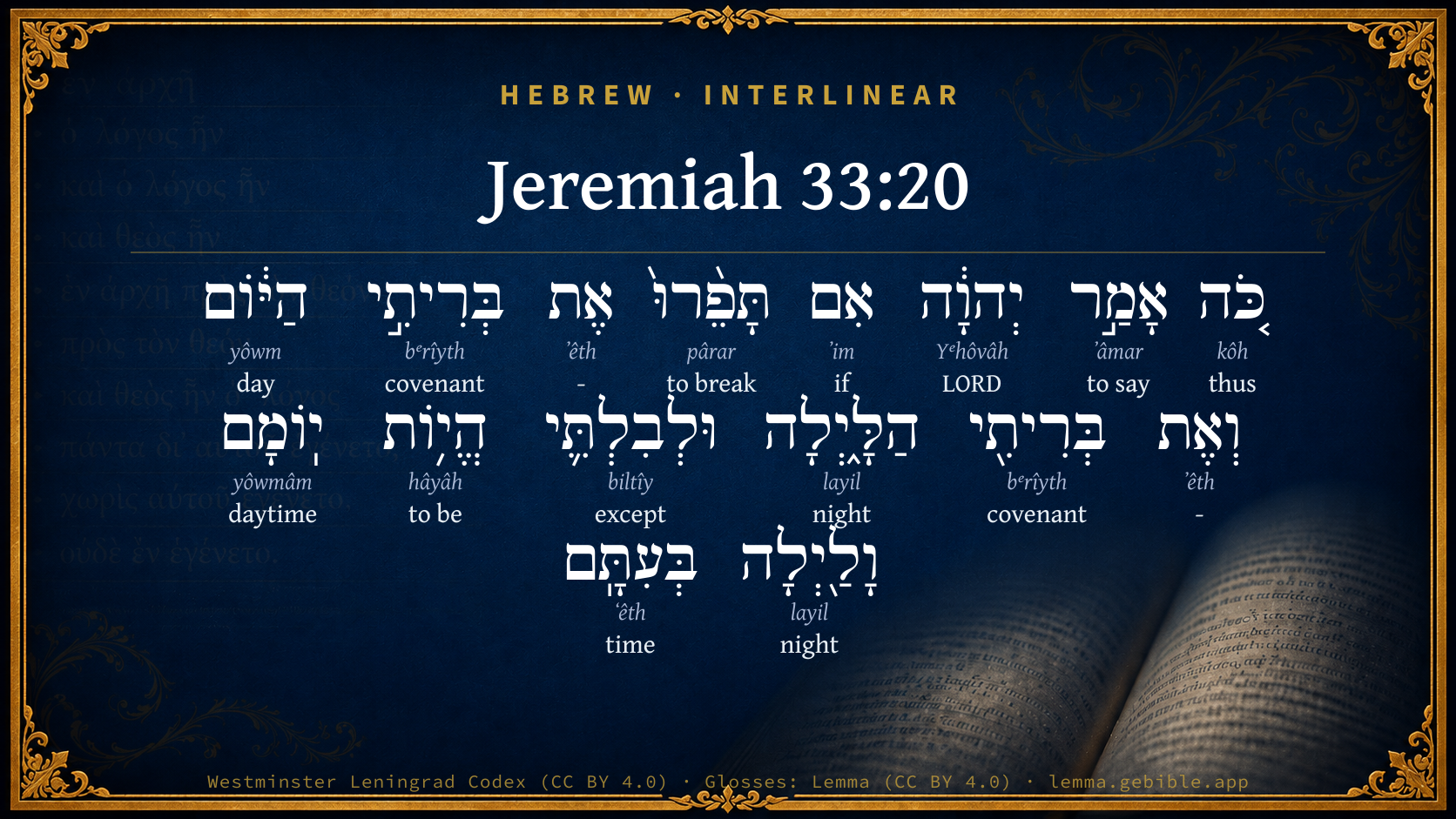
Hebrew (Westminster Leningrad Codex) Jeremiah 33:20 appears in the Hebrew Old Testament. The text above is from the Westminster Leningrad Codex. Each word links to its Strong’s number, a concise gloss, and parsing drawn from the Open Scriptures Hebrew Bible morphology. Click any word for its full Brown-Driver-Briggs (BDB) entry.
Download image
Cite this verse

Jeremiah 33:20 (World English Bible). Public Domain. Lemma interlinear Bible study tool, https://lemma.gebible.app/v/jeremiah/33/20.

Show BibTeX & RIS
BibTeX
RIS
English Translation
Thus says Yahweh: If you can break my covenant of the day, and my covenant of the night, so that there shall not be day and night in their season;
World English Bible · Public Domain
Download a study sheet

One document with this verse’s original text, its word-by-word gloss line, the meaning frame, cross-references with their text, attributed commentary, and full source and license credits — printable, and it pastes into notes with its structure intact.

This verse Autodidact and up

Study sheet (.html) Plain text (.txt)

A passage Seminary Student

Up to 50 verses in one chapter. A passage sheet keeps up to 6 commentary sources and 12 cross-references per verse, in the order this page ranks them, and says so on the sheet whenever that leaves anything out. Ask for a single verse and you get the Autodidact verse sheet above.

Everything on this page stays free to read, with no account — the sheet is a download of what is already on screen, not access to it.

Want to remove ads? Support Godless Engineer
Compare translations 3

The same verse in 3 English versions, stacked beneath the original-language interlinear above. Click any original word for its lexicon entry.

Each is an independent rendering of the whole verse — the interlinear is not word-aligned to these translations.

Highlighted words mark where these versions differ — a whole-verse word diff, not a word-by-word alignment.

  • World English Bible Public Domain
    Thus says Yahweh: If you can break my covenant of the day, and my covenant of the night, so that there shall not be day and night in their season;
  • King James Version Public Domain
    Thus saith the LORD; If ye can break my covenant of the day, and my covenant of the night, and that there should not be day and night in their season;
  • unfoldingWord Literal Text CC BY-SA 4.0
    “Yahweh says this: ‘If you can break my covenant with day and night so that there will no longer be day or night at their proper times,

unfoldingWord Literal Text — © unfoldingWord, licensed CC BY-SA 4.0. Word-aligned USFM3 via Door43 (git.door43.org/unfoldingWord/en_ult).

Versions to compare (up to 4)

3 of 4 selected

Show all 18 translations

Every available English version of this verse, each an independent rendering of the whole verse.

  • World English Bible Public Domain
    Thus says Yahweh: If you can break my covenant of the day, and my covenant of the night, so that there shall not be day and night in their season;
  • Berean Standard Bible Public Domain
    “This is what the LORD says: If you can break My covenant with the day and My covenant with the night, so that day and night cease to occupy their appointed time,
  • Majority Standard Bible Public Domain
    “This is what the LORD says: If you can break My covenant with the day and My covenant with the night, so that day and night cease to occupy their appointed time,
  • King James Version Public Domain
    Thus saith the LORD; If ye can break my covenant of the day, and my covenant of the night, and that there should not be day and night in their season;
  • American Standard Version (1901) Public Domain
    Thus saith Jehovah: If ye can break my covenant of the day, and my covenant of the night, so that there shall not be day and night in their season;
  • Revised Version (1885) Public Domain
    Thus saith the LORD: If ye can break my covenant of the day, and my covenant of the night, so that there should not be day and night in their season;
  • Geneva Bible (1599) Public Domain
    Thus sayth the Lord, If you can breake my couenant of the day, and my couenant of the night, that there should not be day, and night in their season,
  • Douay-Rheims (1899) Public Domain
    Thus saith the Lord: If my covenant with the day can be made void, and my covenant with the night, that there should not be day and night in their season:
  • Young's Literal Translation Public Domain
    `Thus said Jehovah: If ye do break My covenant of the day, And My covenant of the night, So that they are not daily and nightly in their season,
  • Literal Standard Version CC BY-SA 4.0
    “Thus said YHWH: If you can break My covenant with the day, || And My covenant with the night, || So that they are not daily and nightly in their season,
  • Unlocked Literal Bible CC BY-SA 4.0
    “Yahweh says this: 'If you can break my covenant with day and night so that there will no longer be day or night at their proper times,
  • unfoldingWord Literal Text CC BY-SA 4.0
    “Yahweh says this: ‘If you can break my covenant with day and night so that there will no longer be day or night at their proper times,
  • Darby Bible Public Domain
    Thus saith Jehovah: If ye can break my covenant [in respect] of the day, and my covenant [in respect] of the night, so that there should not be day and night in their season,
  • World Messianic Bible Public Domain
    “The LORD says: ‘If you can break my covenant of the day and my covenant of the night, so that there will not be day and night in their time,
  • Webster's Bible Public Domain
    Thus saith the LORD; If ye can break my covenant of the day, and my covenant of the night, so that there should not be day and night in their season;
  • Free Bible Version CC BY-SA 4.0
    This is what the Lord says: If you were able to break my agreement with the day and with the night, so that they wouldn't come at the right time,
  • Bible in Basic English Public Domain
    The Lord has said: If it is possible for my agreement of the day and the night to be broken, so that day and night no longer come at their fixed times,
  • JPS Tanakh (1917) Public Domain
    Thus saith the LORD: If ye can break My covenant with the day, and My covenant with the night, so that there should not be day and night in their season;

Literal Standard Version (2020), Covenant Press — licensed CC BY-SA 4.0. Text via the HelloAO Bible API (eBible.org). Unlocked Literal Bible (unfoldingWord) — licensed CC BY-SA 4.0. Text via the HelloAO Bible API (eBible.org). unfoldingWord Literal Text — © unfoldingWord, licensed CC BY-SA 4.0. Word-aligned USFM3 via Door43 (git.door43.org/unfoldingWord/en_ult). Free Bible Version, Dr. Jonathan Gallagher — licensed CC BY-SA 4.0. Text via the HelloAO Bible API (eBible.org).

Word by word

More ways to search: Search by grammar → Find every occurrence → Compare this word →

Practice this passage: Drill this verse → Learn its vocabulary →

תָּפֵ֨רוּ֙
pârar
H6565
“to break”
Verb, Hiphil, Imperfect, 2nd Person, Masculine, Plural
Part of Speech
Verb
Stem
Hiphil
Form
Imperfect
Person
2nd Person
Gender
Masculine
Number
Plural
Full BDB Definition

Origin: a primitive root

TWOT: 1829 , 1830 , 1831

to break, frustrate - (Hiphil) - to break, violate - to frustrate, make ineffectual - (Hophal) - to be frustrated - to be broken - to break - (Pilpel) to break to bits, shatter - to split, divide - (Qal) to split, crack through - (Poel) to break apart - (Hithpoel) to be split, be cracked through
  1. כֹּ֚ה kôh H3541 “thus” Adverb
  2. אָמַ֣ר ʼâmar H559 “to say” Verb, Qal, Perfect, 3rd Person, Masculine, Singular
  3. יְהוָ֔ה Yᵉhôvâh H3068 “LORD” Noun, Proper
  4. אִם ʼim H518 “if” Conjunction
  5. אֶת ʼêth H853 “-” Particle, Direct Object
  6. בְּרִיתִ֣י bᵉrîyth H1285 “covenant · my” Noun, Common, Feminine, Singular, Construct + Suffix, Personal, 1st Person, Common, Singular
  7. הַיּ֔וֹם yôwm H3117 “the · day” Particle, Definite Article + Noun, Common, Masculine, Singular, Absolute
  8. וְאֶת ʼêth H853 “and · -” Conjunction + Particle, Direct Object
  9. בְּרִיתִ֖י bᵉrîyth H1285 “covenant · my” Noun, Common, Feminine, Singular, Construct + Suffix, Personal, 1st Person, Common, Singular
  10. הַלָּ֑יְלָה layil H3915 “the · night” Particle, Definite Article + Noun, Common, Masculine, Singular, Absolute
  11. וּלְבִלְתִּ֛י biltîy H1115 “and · to/for · except” Conjunction + Preposition + Preposition
  12. הֱי֥וֹת hâyâh H1961 “to be” Verb, Qal, Infinitive Construct
  13. יֽוֹמָם yôwmâm H3119 “daytime” Adverb
  14. וָלַ֖יְלָה layil H3915 “and · night” Conjunction + Noun, Common, Masculine, Singular, Absolute
  15. בְּעִתָּֽם ʻêth H6256 “in/at · time · their” Preposition + Noun, Common, Both, Singular, Construct + Suffix, Personal, 3rd Person, Masculine, Plural

About this verse

These counts appear in no published source. They are computed here, from the morphology-tagged text and Lemma’s own curated glosses. What Lemma adds →

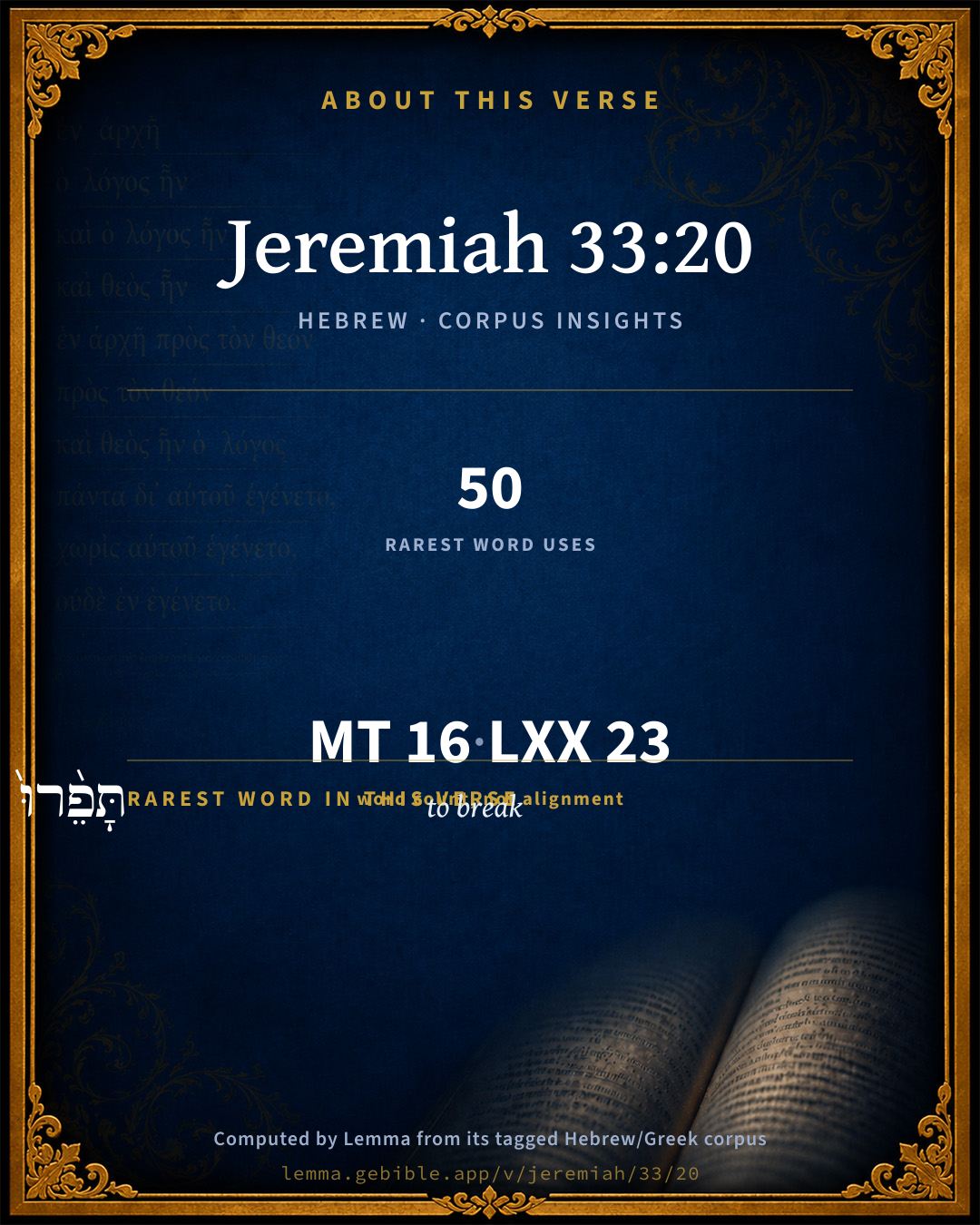
16
words
13
distinct lemmas
Prophets
section

Shared distinctive vocabulary

תָּפֵ֨רוּ֙ to break H6565 occurs in 46 verses of the Hebrew Bible. Also found in:

Grammatical profile

  • 3 verbs
  • 7 nouns
  • 1 preposition
  • 1 conjunction
  • 2 adverbs
  • 2 particles

Verb forms

  • אָמַ֣ר Qal · Perfect
  • תָּפֵ֨רוּ֙ Hiphil · Imperfect
  • הֱי֥וֹת Qal · Infinitive Construct

Repetition

Words recur within this verse — often emphatic in Hebrew:

  • בְּרִיתִ֣י covenant H1285 ×2
  • הַלָּ֑יְלָה night H3915 ×2

Hebrew & Septuagint length

In the original languages it is 16 Hebrew tokens and 23 Greek tokens — but the two are counted differently (Hebrew bundles its prefixes and suffixes into one token; the Greek is in lemma form), so that isn’t a like-for-like length.

Cross-references

6

Topical passages linked to Jeremiah 33:20 in the Treasury of Scripture Knowledge — connected by theme and wording, ordered by reader-vote popularity; previews shown in the World English Bible.

  • Genesis 8:22 While the earth remains, seed time and harvest, and cold and heat, and summer and winter, and day and night shall not cease."
  • Psalms 89:37 It will be established forever like the moon, The faithful witness in the sky." Selah.
  • Isaiah 54:9–10 For this is [as] the waters of Noah to me; for as I have sworn that the waters of Noah shall no more go over the earth, so have I sworn that I will not be angry with you, nor rebuke you.
  • Psalms 104:19–23 He appointed the moon for seasons. The sun knows when to set.
  • Jeremiah 31:35–37 Thus says Yahweh, who gives the sun for a light by day, and the ordinances of the moon and of the stars for a light by night, who stirs up the sea, so that the waves of it roar; Yahweh of hosts is his name:
  • Jeremiah 33:25–26 Thus says Yahweh: If my covenant of day and night fails, if I have not appointed the ordinances of heaven and earth;

Cross-references courtesy of OpenBible.info (CC BY 4.0).

Hebrew and Greek witnesses Masoretic Hebrew ↔ Greek Septuagint

The same verse in the two great witnesses to the Old Testament, shown verse-for-verse.

These are two independent witnesses, not word-aligned to each other, and the Septuagint is shown in lemma (dictionary) form.

Hebrew Jeremiah 33:20 Masoretic · Westminster Leningrad Codex

כֹּ֚ה אָמַ֣ר יְהוָ֔ה אִם תָּפֵ֨רוּ֙ אֶת בְּרִיתִ֣י הַיּ֔וֹם וְאֶת בְּרִיתִ֖י הַלָּ֑יְלָה וּלְבִלְתִּ֛י הֱי֥וֹת יֽוֹמָם וָלַ֖יְלָה בְּעִתָּֽם

Thus says Yahweh: If you can break my covenant of the day, and my covenant of the night, so that there shall not be day and night in their season;

World English Bible · Public Domain

Greek LXX Structure differs

In the Septuagint, Jeremiah is about an eighth shorter than the Hebrew and arranges its material differently — the Oracles Against the Nations (Hebrew chapters 46–51) appear in the middle of the Greek book, after 25:13. Because the chapter and verse boundaries do not line up, a verse-for-verse comparison with the Hebrew is not shown.

A verse-for-verse comparison isn’t shown here because the chapters and verses don’t line up. Switch to the LXX edition with the MT / LXX toggle above to read the Greek directly.

Hebrew: Westminster Leningrad Codex (CC BY 4.0). Greek: Septuagint (public domain); English from a public-domain English Septuagint. How the Septuagint differs from the Hebrew →

Targum (Aramaic paraphrase)

1

The Targum is the ancient Jewish Aramaic paraphrase of the Hebrew Scriptures — an interpretive translation, not the Hebrew text itself. Onkelos (literal) and Pseudo-Jonathan (expansive) render the Torah, and Jonathan the Prophets. Coverage is partial: where no permissively-licensed English translation exists for a verse, only the Aramaic is shown. This is verse-level text, not a word-by-word alignment to the Hebrew.

  1. Targum Jonathan Prophets (Joshua–Malachi)
    כִּדְנַן אֲמַר יְיָ כְּמָא דְלֵית אֶפְשַׁר דְיִבְטֵיל קְיָמִי דַאֲקִימֵית עִם יְמָמָא וְעִם לֵילְיָא וּבְדִיל דְלָא לְמֶהֱוֵי יֵימָם וְלֵילֵי בְּעִדָנְהוֹן:

    (no public-domain English translation for this verse)

    Targum Jonathan — Aramaic: “Mikraot Gedolot” (public domain). English: “Sefaria Community Translation” (CC0 1.0 (public-domain dedication)); “London "Chaldee Paraphrase," 1871” (public domain). Text via Sefaria.

Commentary

Notes on Jeremiah 33:20 from classic Christian and Jewish commentators (each source and its license shown beneath its notes). The classic Christian expositions comment on the surrounding passage and are grouped to its opening verse, so a note may address several verses; the Jewish commentaries on the Tanakh (Rashi and others) are per-verse, so they appear only where the commentator wrote on this verse.

Lemma curates 59 commentaries, every one of them public domain or Creative Commons licensed, each selected and text-cleaned for this edition rather than reprinted as found. About our sources →

Trapp's Complete Commentary

John Trapp

Jer 33:20 Thus saith the LORD; If ye can break my covenant of the day, and my covenant of the night, and that there should not be day and night in their season;

Ver. 20. If ye can break my covenant of the day.] God hath hitherto kept promise with nights and days, that one shall succeed the other; and will he not then keep in touch with his people?

John Trapp, A Commentary or Exposition upon All the Books of the Old and New Testament (1647–1656) — public domain. Text from a community e-Sword module.

The Biblical Illustrator

Joseph S. Exell

Jer_33:20-26

If ye can break My covenant of the day, and My covenant of the night . . . Then may also My covenant be broken with David My servant.

Gods great day-and-night engine, as a witness against skepticism

Day and night in their season are Gods perpetual challenge to unbelief, His sublime witnesses to the perpetuity of His Church. The doubters in Jeremiahs time saw, or thought they saw in the captivity of Israel already accomplished, and that of Judah foretold as nigh at hand, the complete breakdown of all Gods plans and promises as to His people and His Church. They said: The two families (Judah and Israel) which the Lord did choose, Tie hath even cast them off. Theres an end of all our fine expectations! Prophecy breaks down! God cant keep His contract! Religion is a failure! We told you so! But what does God say to them in reply? Thus saith the Lord If My covenant of day and night stand not, if I have not appointed the ordinances of heaven and earth; then will I also cast away the seed of Jacob, and of David My servant, &c. Thus God reminds the sceptic and the doubter that His covenant with His Church is as firm as that with day and night. We of to-day are in the midst of a sceptical age, and some good people are alarmed at the growth of doubt, and at coldness and troubles in the churches. They firmly believe in the truth of Christianity, but they seem to have lost something of their faith in its conquering power. What does God mean by His covenant of day and night? It was equal to saying: If you can stop the daily rotation I have given to this earth, then you may stay the onward rolling wheels of My Messiahs chariot from the conquest of the world! Thats what God meant, and He has thus far made good His word. Judah, like Israel, for her sins, went into captivity. But unlike Israel, Judah was brought back to do Gods work for ages longer; and perhaps for more work in the future than we now understand. The Church lives and grows. Tier ministers are thousands of thousands. As the host of heaven cannot be numbered, neither the sand of the sea measured, no more can her people. The earth rolls onward, bringing day and night in their season, and the sun hears the missionary Angelus chiming around the globe. Let us study this sublime illustration. Look at the daily rotation of this globe, and imagine the power necessary to produce and maintain this rotation. Suppose we see what Gods oath of day and night means when represented by steam mechanics. Let us build our engine and run this revolving globe a while by steam power. The earth is not a fiat fly-wheel set upon its edge, but a massive sphere, 8000 miles in diameter. So, by the ratio of size of shaft to size of paddle-wheel on a large steamboat, the earth must be slung on a steel shaft about 250 miles in diameter and 10,000 miles long. It must be driven by an engine whose cylinder should measure 1200 miles bore and 2000 miles stroke, having a piston-rod 100 miles thick and 2500 miles long, working by a connection-rod 3000 miles long on a crank of 1000 miles arm, with a wrist 200 miles long and 50 miles thick. The piston of this engine will make but one revolution daily; but to do that it will travel 4000 miles, at an average velocity of nearly three miles a minute. The working capacity of this engine will be about fourteen thousand million (14,000,000,000) horse-power. It must be controlled by an automatic governor of infallible accuracy, and supplied with inexhaustible fuel and oil; and so run on, day and night, never starting a bolt, nor heating a journal, nor wearing out a box, age after age. The iron bed-frame for this machine must be 10,000 miles square and 4000 miles high, and not tremble a hair under the stroke that drives the equatorial rim of this fly-wheel globe up to a steady velocity of seventeen and one-half miles a minute, twenty times the velocity of a lightning express train! Wholl take the contract to build and run this engine? The vast mass must fly through space in the earths orbit around the sun, with a velocity of more than 1100 miles a minute. The Armstrong 100-ton steel rifle sends its 2000-pound steel projectile at the rate of 1600 feet per second clean through a solid wrought-iron plate 22 inches thick. But God fires this globe, 8000 miles in diameter, through space with 60 1/2 times the velocity of the monster projectile, and 2000 times that of an express train at 34 miles per hour. And our engine that gives it its day-and-night rotation must fly with it at that speed, and never lose a stroke! And these are very slow among the velocities of the starry worlds. And yet these velocities only represent what God does every moment by the abiding force of that first impulse He gave to this silent spinning globe when He shot it from His creating hand like a top from a boys finger! Now, imagine the infidel trying to seize, in its mighty sweep, the flying crank that runs this globe, to stop its revolution! What then? Did you ever see a man caught and whirled and mangled on a little factory shaft, reduced to a shapeless pulp in a moment? Even so it has ever been with those who have tried to stop the engine of Christianity. (G. L. Taylor, D. D.)

Divine plans of action unalterable

I. The Almighty both in the material and spiritual departments of His universe acts from plan.

1. The text speaks of a covenant with material nature as well as with David.

2. The Infinite One acts evermore from plan.

(1) A priori reasoning would suggest this.

(2) The constitution of the creation shews this. The laws of nature about which philosophers talk are only parts of His plan which they have discovered.

(3) The Bible teaches this. It speaks of Him appointing everything in nature (Gen_1:1-31; Gen_8:21-22; Isa_4:10-11; Psa_104:1-35. &c.).

II. The plan on which God conducts the material universe is manifestly beyond the power of His creatures to alter.

1. This is a blessing to all. If men could alter the order of nature what would become of us!

2. This is an argument for the Divinity of miracles, if miracles are changes in the order of nature.

III. The unalterableness of His plan in material nature illustrates the unalterableness of His plan in the spiritual department of action. It is not impossible for God to reverse the order of nature, but it is impossible for God to act contrary to those principles of absolute truth and justice which He has revealed (Homilist.)

.

The Biblical Illustrator, edited by Joseph S. Exell (c. 1880s–1900s) — public domain. Text from a community e-Sword module.

Joseph Benson's Commentary

Jer 33:20-21. If you can break my covenant of the day and of the night — Called the ordinances of the day and night, Jer 31:35-36. Then may also my covenant be broken with David and with the Levites — A promise this, that the kingdom of Christ and a Christian ministry shall continue in the church to the end of time. And as his kingdom shall have no end, (Luk 1:32-33,) the words may also be construed as extending to the eternal state, in which, as Christ shall reign in glory for ever, so his saints shall be priests unto God, and reign for ever with him.

Joseph Benson's Commentary on the Old and New Testaments (1811–1818) — public domain. Text from a community e-Sword module.

Geneva Bible (1599)

Geneva Bible translators

Read Jer. 31:35.

Geneva Bible (1599) marginal notes — public domain. Text via Bolls.life.

Jamieson, Fausset & Brown

Robert Jamieson, A. R. Fausset & David Brown

covenant of the day--that is, covenant with the day: answering to "covenant with David" (Jer 33:21, also Jer 33:25, "with day"; compare Jer 31:35-36; Lev 26:42; Psa 89:34, Psa 89:37).

Jamieson, Fausset & Brown — Commentary Critical and Explanatory on the Whole Bible (1871) — public domain (CC PDM 1.0). Text via the HelloAO Bible API.

Adam Clarke's Commentary

Verse 20. If ye can break my covenant of the day] See Clarke on Jer 31:36.

Adam Clarke's Commentary on the Bible (1810–1826) — public domain. Text from a community e-Sword/MySword module.

John Calvin's Commentaries

We now perceive the purpose of the Prophet in saying, If void ye can make my covenant respecting the day and the night, then abolished shall be my covenant with David and the Levites Now he indirectly touches on the wickedness of the people; for the Jews did, as far as they could, overthrow, by their murmurs and complaints, the covenant of God; for in their adversities they instantly entertained the thought and also expressed it, that God had forgotten his covenant. This want of faith then is intimated by the Prophet, as though he had said, “Why are these complaints? It is the same thing as though ye sought to pull down the sun and the moon from the heavens, and to subvert the difference between day and night, and to upset the whole order of nature; for I am the same God, who has settled the succession of day and night, and has promised that the Church shall continue for ever: ye can, therefore, no more abolish my covenant with David than the general law of nature.” We now then understand the Prophet’s object: for this was not said without conveying reproof; because they were very wicked and ungrateful to God, when they doubted his truth and constancy, respecting the promise as to the perpetual condition of the Church. He in short intimates that they were carried away, as it were, by a blind madness, when they thus hesitated to believe God’s covenant, as though they attempted to subvert the whole world, so that there should be no longer any difference between light and darkness.

John Calvin's Commentaries (1540-1563) — public domain. Text from the Calvin Translation Society English edition (1840s-50s) via the Christian Classics Ethereal Library (ccel.org). Calvin's coverage is partial (roughly two-thirds of the Bible); uncommented books and verses are honest gaps, never fabricated. The 19th-century editor's footnotes and remarks are omitted so the notes are faithfully Calvin's own voice.

John Gill's Exposition

Thus saith the Lord, if you can break my covenant of the day,

and my covenant of the night,.... The same with the ordinances of the sun, moon, and stars, Jer 31:35; the original constitution and law of nature, settled from the beginning of the world, and observed ever since, in the constant revolution of day and night; and which was formed into a covenant and promise to Noah, after the deluge, that day and night should not cease, as long as the earth remained, Gen 8:22; and which has never been, nor can be, broken and made void: so

that there should not be day and night in their season; or turn; continually succeeding each other: this, as it would not be attempted, so could never be effected by any mortals, if it were.

John Gill's Exposition of the Whole Bible (1746–1763) — public domain (CC PDM 1.0). Text via the HelloAO Bible API.

Matthew Poole's English Annotations

By the

covenant of day and night here is meant the same with the ordinances mentioned Jer 31:35. God’s law established in the course. of natural causes, by virtue of which the day and night orderly succeed one another. These verses are but a further confirmation of what was said before, and the sense of them no more than this, that the succession of the gospel ministry in the church of God, to abide for ever, should be as certain as the succession of darkness and light; God had established the latter in a necessary course of natural causes, and he would by his providence take care for the other, that the effect should be every whit as certain. Though the second causes are widely different, yet God, who is the First Cause of both, is the same, and would as certainly bring the one to pass as the other.

Matthew Poole's English Annotations on the Holy Bible (1683–1685) — public domain. Text from a community e-Sword/MySword module.

Whedon's Commentary on the Bible

Daniel D. Whedon

GOD’S PERPETUAL COVENANT, Jer_33:19-26.

20. My covenant of the day, etc. — An appeal to the changeless and irresistible ongoing of nature, the innumerable host of stars, and the immeasurable quantity of the sand, as symbols of the stability and exhaustlessness of the divine resources. The stability of the physical universe leads to the stability of God’s higher kingdom; and its wonderful extent and variety suggest the infinite and all-comprehending character of the divine plans.

Daniel D. Whedon (gen. ed.), Commentary on the Old and New Testaments (1874–1909) — public domain. Text from a community e-Sword module.

The Pulpit Commentary

Vers. 20-22. The constant, regular succession of day and night is an emblem of the equally regular supply of royal descendants of David and of Levitical priests, and the countless grains of sand are symbolic of the wonderful increase of their numbers. At first sight the latter part of the promise seems a little unlike a blessing. But we have seen already (on Jer_19:3) that the members of the various branches of the royal family probably occupied the principal offices of the state, and the prophet imagines the future in forms borrowed from the present. A numerous sacerdotal class seemed equally necessary for the due magnificence of the ritual; and we must remember that preternatural fertility of the soil was a standing element of Messianic descriptions. The expressions used are, no doubt, hyperbolical, but the meaning seems clear enough. (Hengstenberg"s notion, that the prophet rather indicates the abolition of the royal and sacerdotal distinctions, (comp. Exo_19:6) is surely very far fetched.)

The Pulpit Commentary (1880–1919), ed. H.D.M. Spence-Jones & Joseph S. Exell — public domain. Text from a community e-Sword module.

John Wesley's Explanatory Notes

My covenant - The same with the ordinances mentioned, chap. xxxi, 35. God's law established in the course of natural causes, by virtue of which the day and night, orderly succeed one another. The succession of the gospel ministry in the church of God to abide for ever, shall be as certain as the succession of darkness and light.

John Wesley, Explanatory Notes Upon the Whole Bible (1754–1765) — public domain. Text via the GEBible commentary corpus.

Rashi

Rabbi Shlomo Yitzchaki (Rashi)

If you break My covenant with the day If you can break My covenant that I formed with the day and with the night to be in their time, which I formed with Noah and his sons, “And day and night shall not cease” (Gen. 8:22).

Rashi on the Tanakh — English translations: “The Judaica Press complete Tanach with Rashi, translated by A. J. Rosenberg” (CC BY 4.0); “Pentateuch with Rashi's commentary by M. Rosenbaum and A.M. Silbermann, 1929-1934” (public domain); “The Metsudah Tanach series, Lakewood, N.J” (CC BY 4.0); and “The Book of Joshua, Metsudah Publications, 1997” (CC BY 4.0). Text via Sefaria.

Lesson kit

Teaching starters — assembled from the data on this page, not authored interpretation. Every prompt links to the verse data it draws on. Edit before teaching.

Jeremiah, in the Prophets, opens this verse with 16 words (13 distinct Hebrew lemmas). Its most distinctive word is pârar (“to break”). A historical commentator’s framing appears above. Read the whole chapter for the surrounding context.

Discussion questions

  1. What does “to break” (pârar) contribute to the verse as a whole?
  2. How does Genesis 17:14, which shares the word «to break», read alongside this verse?
  3. What does the repetition of “covenant” (2× in this one verse) do in this verse?
  4. These translations render this verse differently. What is at stake in choosing one wording over another?
  5. «אָמַ֣ר» is a Qal Perfect verb. How does that grammatical form shape the action described?
  6. Compare how Trapp's Complete Commentary and The Biblical Illustrator read this verse. Where do they agree or differ?

Things to notice

Reading settings

Reading text

Shown beneath each verse's original-language words.

Old Testament
Old Testament edition

Read the OT as the Masoretic Hebrew (MT) or the Greek Septuagint (LXX).

English shown for the Greek Septuagint (in the Hebrew ↔ Greek comparison).

Comparing translations? Open the Compare panel on any verse page to stack up to four side by side.