

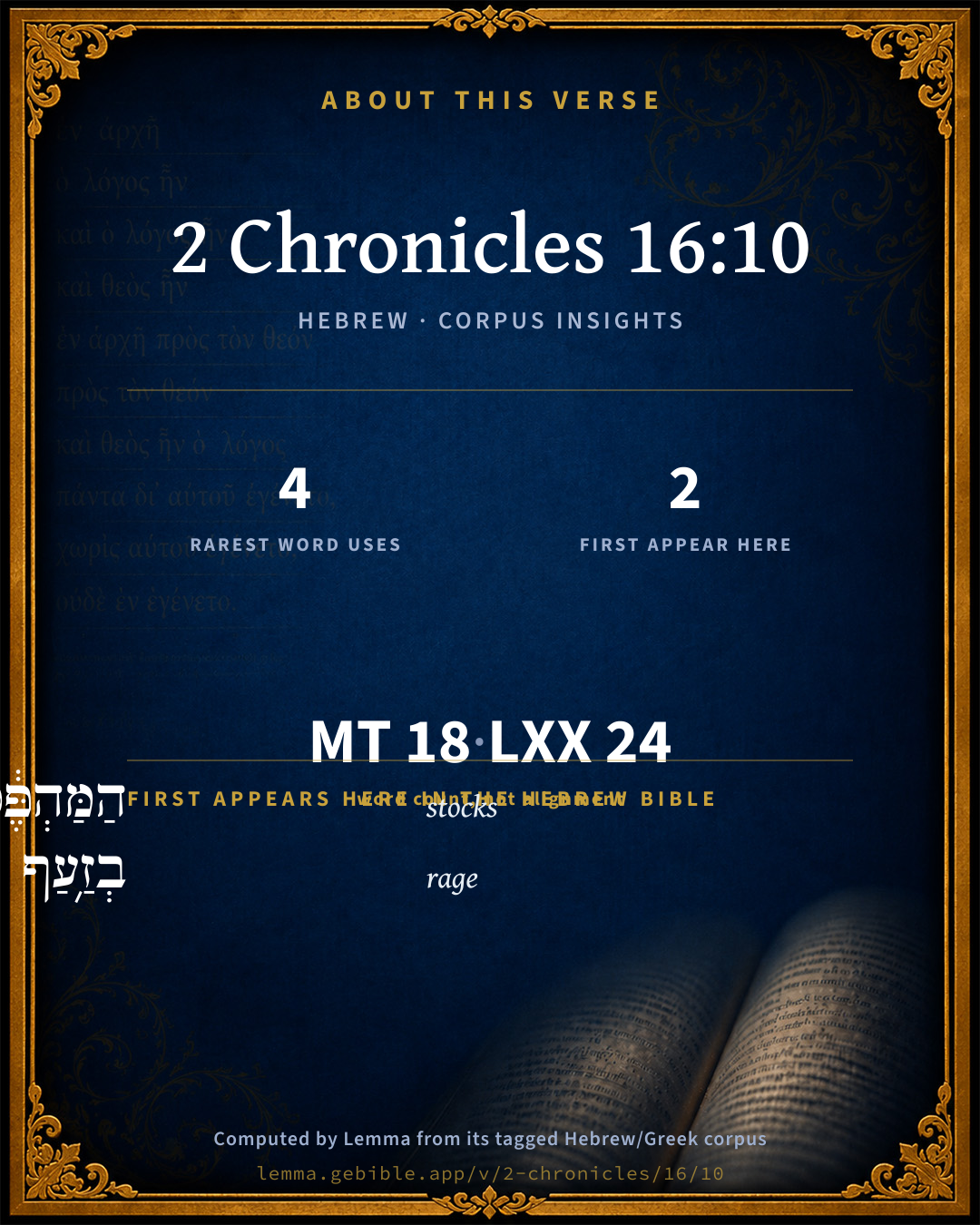
2 Chronicles 16:10

Hebrew (Westminster Leningrad Codex) 2 Chronicles 16:10 appears in the Hebrew Old Testament. The text above is from the Westminster Leningrad Codex. Each word links to its Strong’s number, a concise gloss, and parsing drawn from the Open Scriptures Hebrew Bible morphology. Click any word for its full Brown-Driver-Briggs (BDB) entry.
Download image
Cite this verse

2 Chronicles 16:10 (World English Bible). Public Domain. Lemma interlinear Bible study tool, https://lemma.gebible.app/v/2-chronicles/16/10.

Show BibTeX & RIS
BibTeX
RIS
English Translation
Then Asa was angry with the seer, and put him in the prison-house; for he was in a rage with him because of this thing. Asa oppressed some of the people at the same time.
World English Bible · Public Domain
Highlights
  • 2 first appearances in the Hebrew Bible
Full analysis ↓
Download a study sheet

One document with this verse’s original text, its word-by-word gloss line, the meaning frame, cross-references with their text, attributed commentary, and full source and license credits — printable, and it pastes into notes with its structure intact.

This verse Autodidact and up

Study sheet (.html) Plain text (.txt)

A passage Seminary Student

Up to 50 verses in one chapter. A passage sheet keeps up to 6 commentary sources and 12 cross-references per verse, in the order this page ranks them, and says so on the sheet whenever that leaves anything out. Ask for a single verse and you get the Autodidact verse sheet above.

Everything on this page stays free to read, with no account — the sheet is a download of what is already on screen, not access to it.

Want to remove ads? Support Godless Engineer
Compare translations 3

The same verse in 3 English versions, stacked beneath the original-language interlinear above. Click any original word for its lexicon entry.

Each is an independent rendering of the whole verse — the interlinear is not word-aligned to these translations.

Highlighted words mark where these versions differ — a whole-verse word diff, not a word-by-word alignment.

  • World English Bible Public Domain
    Then Asa was angry with the seer, and put him in the prison-house; for he was in a rage with him because of this thing. Asa oppressed some of the people at the same time.
  • King James Version Public Domain
    Then Asa was wroth with the seer, and put him in a prison house; for he was in a rage with him because of this thing. And Asa oppressed some of the people the same time.
  • unfoldingWord Literal Text CC BY-SA 4.0
    And Asa was angry at the seer; and he put him in the house of the stocks, for in rage with him regarding this. And Asa oppressed some of the people at that time.

unfoldingWord Literal Text — © unfoldingWord, licensed CC BY-SA 4.0. Word-aligned USFM3 via Door43 (git.door43.org/unfoldingWord/en_ult).

Versions to compare (up to 4)

3 of 4 selected

Show all 18 translations

Every available English version of this verse, each an independent rendering of the whole verse.

  • World English Bible Public Domain
    Then Asa was angry with the seer, and put him in the prison-house; for he was in a rage with him because of this thing. Asa oppressed some of the people at the same time.
  • Berean Standard Bible Public Domain
    Asa was angry with the seer and became so enraged over this matter that he put the man in prison. And at the same time Asa oppressed some of the people.
  • Majority Standard Bible Public Domain
    Asa was angry with the seer and became so enraged over this matter that he put the man in prison. And at the same time Asa oppressed some of the people.
  • King James Version Public Domain
    Then Asa was wroth with the seer, and put him in a prison house; for he was in a rage with him because of this thing. And Asa oppressed some of the people the same time.
  • American Standard Version (1901) Public Domain
    Then Asa was wroth with the seer, and put him in the prison-house; for he was in a rage with him because of this thing. And Asa oppressed some of the people at the same time.
  • Revised Version (1885) Public Domain
    Then Asa was wroth with the seer, and put him in the prison house; for he was in a rage with him because of this thing. And Asa oppressed some of the people the same time.
  • Geneva Bible (1599) Public Domain
    Then Asa was wroth with the Seer, and put him into a prison: for he was displeased with him, because of this thing. And Asa oppressed certaine of the people at the same time.
  • Douay-Rheims (1899) Public Domain
    And Asa was angry with the seer, and commanded him to be put in prison: for he was greatly enraged because of this thing: and he put to death many of the people at that time.
  • Young's Literal Translation Public Domain
    And Asa is angry at the seer, and giveth him to the house of torture, for `he is' in a rage with him for this; and Asa oppresseth `some' of the people at that time.
  • Literal Standard Version CC BY-SA 4.0
    And Asa is angry at the seer, and puts him [in] the house of stocks, for [he is] in a rage with him for this; and Asa oppresses [some] of the people at that time.
  • Unlocked Literal Bible CC BY-SA 4.0
    Then Asa was angry with the seer; he put him into prison, for he was angry with him over this matter. At the same time, Asa oppressed some of the people.
  • unfoldingWord Literal Text CC BY-SA 4.0
    And Asa was angry at the seer; and he put him in the house of the stocks, for in rage with him regarding this. And Asa oppressed some of the people at that time.
  • Darby Bible Public Domain
    And Asa was wroth with the seer, and put him in the prison; for he was enraged with him because of this. And Asa oppressed some of the people at the same time.
  • World Messianic Bible Public Domain
    Then Asa was angry with the seer, and put him in the prison; for he was in a rage with him because of this thing. Asa oppressed some of the people at the same time.
  • Webster's Bible Public Domain
    Then Asa was wroth with the seer, and put him in a prison house; for he was in a rage with him because of this thing. And Asa oppressed some of the people the same time.
  • Free Bible Version CC BY-SA 4.0
    Asa was angry with the seer. He was so angry with him over this that he put him in prison. At this same time Asa started to mistreat some of the people.
  • Bible in Basic English Public Domain
    Then Asa was angry with the seer, and put him in prison, burning with wrath against him because of this thing. And at the same time Asa was cruel to some of the people.
  • JPS Tanakh (1917) Public Domain
    Then Asa was wroth with the seer, and put him in the prison-house; for he was in a rage with him because of this thing. And Asa oppressed some of the people the same time.

Literal Standard Version (2020), Covenant Press — licensed CC BY-SA 4.0. Text via the HelloAO Bible API (eBible.org). Unlocked Literal Bible (unfoldingWord) — licensed CC BY-SA 4.0. Text via the HelloAO Bible API (eBible.org). unfoldingWord Literal Text — © unfoldingWord, licensed CC BY-SA 4.0. Word-aligned USFM3 via Door43 (git.door43.org/unfoldingWord/en_ult). Free Bible Version, Dr. Jonathan Gallagher — licensed CC BY-SA 4.0. Text via the HelloAO Bible API (eBible.org).

Word by word

More ways to search: Search by grammar → Find every occurrence → Compare this word →

Practice this passage: Drill this verse → Learn its vocabulary →

הַמַּהְפֶּ֔כֶת
mahpeketh
H4115
“the · stocks”
Particle, Definite Article + Noun, Common, Feminine, Singular, Absolute
Part of Speech
Particle + Noun
Type
Common
Gender
Feminine
Number
Singular
State
Absolute
Full BDB Definition

Origin: from H2015

TWOT: 512e

stocks - similar instrument of punishment (compelling crooked posture or distorting) - house of stocks, prison-house
  1. וַיִּכְעַ֨ס kaʻaç H3707 “and · to be angry” Conjunction + Verb, Qal, Sequential Imperfect, 3rd Person, Masculine, Singular
  2. אָסָ֜א ʼÂçâʼ H609 “Asa” Noun, Proper
  3. אֶל ʼêl H413 “to” Preposition
  4. הָרֹאֶ֗ה râʼâh H7200 “the · seer” Particle, Definite Article + Noun, Common, Masculine, Singular, Absolute
  5. וַֽיִּתְּנֵ֨הוּ֙ nâthan H5414 “and · to give · him” Conjunction + Verb, Qal, Sequential Imperfect, 3rd Person, Masculine, Singular + Suffix, Personal, 3rd Person, Masculine, Singular
  6. בֵּ֣ית bayith H1004 “house of” Noun, Common, Masculine, Singular, Construct
  7. כִּֽי kîy H3588 “that” Conjunction
  8. בְזַ֥עַף zaʻaph H2197 “in/at · rage” Preposition + Noun, Common, Masculine, Singular, Absolute
  9. עִמּ֖וֹ ʻim H5973 “with · him” Preposition + Suffix, Personal, 3rd Person, Masculine, Singular
  10. עַל ʻal H5921 “upon” Preposition
  11. זֹ֑את zôʼth H2063 “this” Pronoun, Demonstrative, Feminine, Singular
  12. וַיְרַצֵּ֥ץ râtsats H7533 “and · to crush” Conjunction + Verb, Piel, Sequential Imperfect, 3rd Person, Masculine, Singular
  13. אָסָ֛א ʼÂçâʼ H609 “Asa” Noun, Proper
  14. מִן min H4480 “from” Preposition
  15. הָעָ֖ם ʻam H5971 “the · people” Particle, Definite Article + Noun, Common, Masculine, Singular, Absolute
  16. בָּעֵ֥ת ʻêth H6256 “in/at the · time” Preposition, Determined + Noun, Common, Both, Singular, Absolute
  17. הַהִֽיא hûwʼ H1931 “the · he” Particle, Definite Article + Pronoun, Personal, 3rd Person, Feminine, Singular

About this verse

These counts appear in no published source. They are computed here, from the morphology-tagged text and Lemma’s own curated glosses. What Lemma adds →

18
words
17
distinct lemmas
Historical
section

Notable vocabulary

The rarest word here is הַמַּהְפֶּ֔כֶת stocks H4115 — appearing just 4 times in the whole Hebrew Bible.

First appearance in Scripture

These words make their first canonical appearance in the Hebrew Bible here:

  • הַמַּהְפֶּ֔כֶת stocks H4115
  • בְזַ֥עַף rage H2197

Shared distinctive vocabulary

הַמַּהְפֶּ֔כֶת stocks H4115 occurs in 4 verses of the Hebrew Bible. Also found in:

Grammatical profile

  • 3 verbs
  • 8 nouns
  • 2 pronouns
  • 4 prepositions
  • 1 conjunction

Verb forms

  • וַיִּכְעַ֨ס Qal · Sequential Imperfect
  • וַֽיִּתְּנֵ֨הוּ֙ Qal · Sequential Imperfect
  • וַיְרַצֵּ֥ץ Piel · Sequential Imperfect

Repetition

A word recurs within this verse — often emphatic in Hebrew:

  • אָסָ֜א Asa H609 ×2

Hebrew & Septuagint length

In English translation the verse runs 35 words from the Hebrew and 28 from the Septuagint (LXX English) — closely comparable.

A rough comparison of the two English renderings, which tokenize alike — not a word-level alignment.

Word counts can differ between the Hebrew and the Greek without any difference in meaning — e.g. the Hebrew direct-object marker אֵת has no separate Greek word, and Greek often adds the article ὁ.

In the original languages it is 18 Hebrew tokens and 24 Greek tokens — but the two are counted differently (Hebrew bundles its prefixes and suffixes into one token; the Greek is in lemma form), so that isn’t a like-for-like length.

Cross-references

18

Topical passages linked to 2 Chronicles 16:10 in the Treasury of Scripture Knowledge — connected by theme and wording, ordered by reader-vote popularity; previews shown in the World English Bible.

  • 2 Chronicles 18:26 and say, Thus says the king, Put this fellow in the prison, and feed him with bread of affliction and with water of affliction, until I return in peace.
  • 2 Samuel 11:4 David sent messengers, and took her; and she came in to him, and he lay with her (for she was purified from her uncleanness); and she returned to her house.
  • 2 Samuel 12:13 David said to Nathan, "I have sinned against Yahweh." Nathan said to David, "Yahweh also has put away your sin. You will not die.
  • 2 Samuel 12:31 He brought forth the people who were therein, and put them under saws, and under harrows of iron, and under axes of iron, and made them pass through the brick kiln: and thus did he to all the cities of the children of Ammon. David and all the people returned to Jerusalem.
  • 2 Samuel 24:10–14 David's heart struck him after that he had numbered the people. David said to Yahweh, I have sinned greatly in that which I have done: but now, Yahweh, put away, I beg you, the iniquity of your servant; for I have done very foolishly.
  • 2 Chronicles 25:16 It happened, as he talked with him, that [the king] said to him, Have we made you of the king's counsel? Stop! Why should you be struck down? Then the prophet stopped, and said, I know that God has determined to destroy you, because you have done this, and have not listened to my counsel.
  • 2 Chronicles 26:19 Then Uzziah was angry; and he had a censer in his hand to burn incense; and while he was angry with the priests, the leprosy broke forth in his forehead before the priests in the house of Yahweh, beside the altar of incense.
  • Job 20:19 For he has oppressed and forsaken the poor. He has violently taken away a house, and he shall not build it up.
  • Psalms 141:5 Let the righteous strike me, it is kindness; Let him reprove me, it is like oil on the head; Don't let my head refuse it; Yet my prayer is always against evil deeds.
  • Proverbs 9:7–9 He who corrects a mocker invites insult. He who reproves a wicked man invites abuse.
  • Isaiah 51:23 and I will put it into the hand of those who afflict you, who have said to your soul, Bow down, that we may go over; and you have laid your back as the ground, and as the street, to those who go over.
  • Jeremiah 20:2 Then Pashhur struck Jeremiah the prophet, and put him in the stocks that were in the upper gate of Benjamin, which was in the house of Yahweh.
  • Jeremiah 29:26 Yahweh has made you priest in the place of Jehoiada the priest, that there may be officers in the house of Yahweh, for every man who is mad, and makes himself a prophet, that you should put him in the stocks and in shackles.
  • Jeremiah 51:34 Nebuchadrezzar the king of Babylon has devoured me, he has crushed me, he has made me an empty vessel, he has, like a monster, swallowed me up, he has filled his maw with my delicacies; he has cast me out.
  • Lamentations 3:34 To crush under foot all the prisoners of the earth,
  • Matthew 14:3–4 For Herod had laid hold of John, and bound him, and put him in prison for the sake of Herodias, his brother Philip's wife.
  • Luke 3:20 added this also to them all, that he shut up John in prison.
  • Acts 16:23–24 When they had laid many stripes on them, they threw them into prison, charging the jailer to keep them safely,

Cross-references courtesy of OpenBible.info (CC BY 4.0).

Hebrew and Greek witnesses Masoretic Hebrew ↔ Greek Septuagint

The same verse in the two great witnesses to the Old Testament, shown verse-for-verse.

These are two independent witnesses, not word-aligned to each other, and the Septuagint is shown in lemma (dictionary) form.

Hebrew 2 Chronicles 16:10 Masoretic · Westminster Leningrad Codex

וַיִּכְעַ֨ס אָסָ֜א אֶל הָרֹאֶ֗ה וַֽיִּתְּנֵ֨הוּ֙ בֵּ֣ית הַמַּהְפֶּ֔כֶת כִּֽי בְזַ֥עַף עִמּ֖וֹ עַל זֹ֑את וַיְרַצֵּ֥ץ אָסָ֛א מִן הָעָ֖ם בָּעֵ֥ת הַהִֽיא

Then Asa was angry with the seer, and put him in the prison-house; for he was in a rage with him because of this thing. Asa oppressed some of the people at the same time.

World English Bible · Public Domain

Greek LXX 2 Chronicles 16:10 Septuagint · lemma form

καί θυμόω ασα ὁ προφήτης καί παρατίθημι αὐτός εἰς φυλακή ὅτι ὀργίζω ἐπί οὗτος καί λυμαίνω ασα ἐν ὁ λαός ἐν ὁ καιρός ἐκεῖνος

And Asa was angry with the prophet, and put him in prison, for he was angry at this: and Asa vexed some of the people at that time.

LXX2012 (modern English Septuagint) · Public Domain

On this verse, Ellicott's Commentary for English Readers discusses the Septuagint’s reading. Read the note in Commentary ↓

Hebrew: Westminster Leningrad Codex (CC BY 4.0). Greek: Septuagint (public domain); English from LXX2012 (modern English Septuagint) (Public Domain). How the Septuagint differs from the Hebrew →

Commentary

Notes on 2 Chronicles 16:10 from classic Christian and Jewish commentators (each source and its license shown beneath its notes). The classic Christian expositions comment on the surrounding passage and are grouped to its opening verse, so a note may address several verses; the Jewish commentaries on the Tanakh (Rashi and others) are per-verse, so they appear only where the commentator wrote on this verse.

Lemma curates 59 commentaries, every one of them public domain or Creative Commons licensed, each selected and text-cleaned for this edition rather than reprinted as found. About our sources →

Trapp's Complete Commentary

John Trapp

2Ch 16:10 Then Asa was wroth with the seer, and put him in a prison house; for [he was] in a rage with him because of this [thing]. And Asa oppressed [some] of the people the same time.

Ver. 10. Then Asa was wroth with the seer.] This might better have become an Ahab, a Joash, a Herod, a Cambyses, or Tiberius: but for Asa to be angry with the seer; Queen Elizabeth with the bishop that put her in mind of her great age and death; Tertullian to turn Montanist in his old age, and write bitterly against the orthodox party, for whom he had been so zealous; - this was very sad, and lets us see what are the best when left to themselves: how they may bristle and bustle against a just reproof, till they have better considered.

And put him in a prison house.] Heb., Into a house of subversion, in carcerem cippi, into the traitor’s prison, whither the Lady Elizabeth was so loath to go, when landed prisoner at the Tower.

For he was in a rage with him.] Indignatione percitus erat. The Vulgate hath it, For the Lord was very angry for this matter, and slew very many of the people. Pellican also goeth the same way, being deceived by the Vulgate, and for want of looking into the Hebrew text.

And Asa oppressed some of the people.] Conquassavit, he crushed or trampled on such as spake against his tyranny toward the prophet: he took an order with them to teach them better manners. Thus he added sin to sin, as the best shall do if God restrain them not.

John Trapp, A Commentary or Exposition upon All the Books of the Old and New Testament (1647–1656) — public domain. Text from a community e-Sword module.

The Biblical Illustrator

Joseph S. Exell

2Ch_16:10

Then Asa was wroth with the seer.

A reluctant conscience

It is said that straw which had been used for the bedding of the lions at Wombwells menagerie was sold, and placed in a stable as bedding for some horses. No, sooner did the horses enter than they began to show signs of alarm, snorting, snuffing the air, and trembling as though conscious of a threatening presence. Horses in this country have had no experience of the hostility or strength of carnivora; but there is a persistency in hereditary powers which certain objects can stimulate into activity. The conscience of man exhibits a similar persistency of sense, if not by self-reproach or remorse, at least by a reluctance to enter on the consideration of sin. It is not too much to infer that all is not right, when pain, alarm, aversion are felt when inquiry is suggested. (Bp. Boyd Carpenter.)

The Biblical Illustrator, edited by Joseph S. Exell (c. 1880s–1900s) — public domain. Text from a community e-Sword module.

Joseph Benson's Commentary

2Ch 16:10. Asa was wroth with the seer — Though the reproof came from God by one that was known to be his messenger; though it was just, and the reasoning fair, and all intended for his good, yet he was wroth with the prophet; nay, he was in a rage with him, for telling him of his folly. Is this Asa? Is this he whose heart is said to have been perfect with the Lord? How needful that advice, Let him that standeth take heed lest he fall! A wise man! and yet in a rage! An Israelite! and yet in a rage with a prophet!

A good man! and yet impatient of reproof, and cannot bear to be told of his faults! Lord, what is man when left to himself! They that idolize their own conduct, cannot bear contradiction; and they that indulge a peevish, passionate temper, may be transported by it into impieties as well as indecencies, and will some time or other, probably, fly in the face of God himself. See what gall and wormwood this root of bitterness bore! Asa put him in the prison-house — Him whom he knew to be a prophet of the Lord, and God’s messenger to him! Or, in the house of the stocks, (as some read it,) in which the feet, or, as some of the Hebrews say, the necks of the prisoners were locked up. God’s prophets meet with many that cannot bear reproof; still, however, they must proceed on doing their duty. And Asa oppressed some of the people the same time — Probably such as owned the prophet in his sufferings, or were known to be his particular friends. He that abused his power for the persecuting of God’s prophet, was left to himself further to abuse it for the crushing of his own subjects, whereby he weakened himself, and lost his interest. Most persecutors have been tyrants.

Joseph Benson's Commentary on the Old and New Testaments (1811–1818) — public domain. Text from a community e-Sword module.

Tyndale Open Study Notes

Tyndale Open Resources

16:10 Asa’s infidelity to the Lord in relying on power resulted in other sins, including oppression of the prophet and the people.

Tyndale Open Study Notes — © Tyndale Open Resources, licensed CC BY-SA 4.0. Text via the HelloAO Bible API.

Geneva Bible (1599)

Geneva Bible translators

Hebrew, prison house.

Thus instead of turning to God by repentance, he disdained the admonition of the Prophet, and punished him, as the wicked do when they be told of their faults.

Geneva Bible (1599) marginal notes — public domain. Text via Bolls.life.

Jamieson, Fausset & Brown

Robert Jamieson, A. R. Fausset & David Brown

Asa oppressed some of the people the same time--The form or degree of this oppression is not recorded. The cause of his oppressing them was probably due to the same offense as that of Hanani--a strong expression of their dissatisfaction with his conduct in leaguing with Ben-hadad, or it may have been his maltreatment of the Lord's servant.

Jamieson, Fausset & Brown — Commentary Critical and Explanatory on the Whole Bible (1871) — public domain (CC PDM 1.0). Text via the HelloAO Bible API.

Adam Clarke's Commentary

Verse 10. Asa was wroth with the seer] Instead of humbling himself, and deprecating the displeasure of the Lord, he persecuted his messenger: and having thus laid his impious hands upon the prophet, he appears to have got his heart hardened through the deceitfulness of sin; and then he began to oppress the people, either by unjust imprisonments, or excessive taxations.

Adam Clarke's Commentary on the Bible (1810–1826) — public domain. Text from a community e-Sword/MySword module.

Ellicott's Commentary for English Readers

(10) Then.—And. In a prison house: in the stocks. Literally, House of the stocks (Jer_20:2; Jer_29:26). The word mahpèkheth literally means “turning,” “distortion,” and so an instrument of torture, by which the body was bent double, hands and feet being passed through holes in a wooden frame. (See Act_16:24.) The Syriac and LXX. have simply “prison;” Vulgate, “nervus,” i.e., stocks. (Comp. the similar behaviour of Ahab to the prophet Michaiah, 1Ki_22:26-27.)

Because of this thing=“Herein” of 2Ch_16:9.

And Asa oppressed.—Riççaç (Job_20:19; comp. 1Sa_12:3).

The same time.—At that time.

Some of the people.—Those who sympathised with Hanani. Asa suppressed their murmurs with violence.

A Bible Commentary for English Readers, edited by Charles John Ellicott (1878–1897) — public domain. Text from a community e-Sword module.

The Cambridge Bible for Schools and Colleges

gen. ed. J. J. S. Perowne

10. in a prison house] Render, in the stocks (lit. in the house of the stocks). Jer_20:2; Jer_29:26 (R.V.).

oppressed] Lit. brake in pieces, an expression which when applied to things would mean, made spoil of, when applied to persons treated outrageously, tortured, ἐλυμήνατο LXX.

The Cambridge Bible for Schools and Colleges (gen. ed. J. J. S. Perowne; Cambridge University Press, 1878–1918) — public domain. Text from a community e-Sword module.

John Gill's Exposition

And, behold, the acts of Asa, first and last,.... See Gill on Kg1 15:23.

.

2 Chronicles 16:12

ch2 16:12

ch2 16:12

ch2 16:12And Asa in the thirty ninth year of his reign was diseased in his feet,.... This was about two years before his death, and his disease is generally thought to be the gout in his feet, and a just retaliation for putting the prophet's feet into the stocks:

until his disease was exceeding great; it increased upon him, and became very severe and intolerable, and the fits were frequent, as well as the pain sharper; though the sense of the Hebrew (m) phrase may be, that his disease got upwards, into a superior part of his body, head, or stomach, which, when the gout does, it is dangerous. A very learned physician (n) is of opinion, that not the gout, but what he calls an "aedematous" swelling of the feet, is meant, which insensibly gets up into the bowels, and is successively attended with greater inconveniences; a tension of the abdomen, difficulty of breathing, very troublesome to the patient, and issues in a dropsy, and death itself:

yet in his disease he sought not to the Lord; his seeking to physicians for help in his disease, perhaps, would not have been observed to his reproach, had he also sought unto the Lord, whom he ought to have sought in the first place; and when he applied to the physicians, he should have implored the blessing of God on their prescriptions; but he so much forgot himself as to forget the Lord: this is the first time we read of physicians among the Jews, and some think these were Heathens, and a sort of enchanters: the Jews entertained a very ill opinion of physicians; the best of them, they say (o), deserve hell, and they advise (p) men not to live in a city where the chief man is a physician; but the author of the book of Ecclesiasticus gives a great encomium of them, and exhorts to honour and esteem them,"1 Honour a physician with the honour due unto him for the uses which ye may have of him: for the Lord hath created him. 2 For of the most High cometh healing, and he shall receive honour of the king. 3 The skill of the physician shall lift up his head: and in the sight of great men he shall be in admiration. 4 The Lord hath created medicines out of the earth; and he that is wise will not abhor them. 5 Was not the water made sweet with wood, that the virtue thereof might be known? 6 And he hath given men skill, that he might be honoured in his marvellous works. 7 With such doth he heal men, and taketh away their pains. 8 Of such doth the apothecary make a confection; and of his works there is no end; and from him is peace over all the earth,'' (Sirach 38)Julian (q) the emperor greatly honoured them, and observes, that it is justly said by the philosophers, that the art of medicine fell from heaven.

(m) "usque ad supra", Montanus; "usque ad summum", Vatablus; "usque ad sursum", Piscator. (n) Scheuchzer. Physic. Sacr. vol. 4. p. 645. (o) T. Bab. Kiddashin, fol. 32. 1. Gloss. in ib. (p) T. Bab. Pesachim, fol. 113. 1. (q) Opera, par. 2. p. 154.

John Gill's Exposition of the Whole Bible (1746–1763) — public domain (CC PDM 1.0). Text via the HelloAO Bible API.

Haydock's Catholic Bible Commentary

Prison. Literally, "in bonds," (nervum) made of leather thongs or nerves, (H.) or of iron, to confine either the neck or the feet. Isidor. orig. 5. ultra --- Heb. "the house of disturbance." Sept., &c. "prison." Some explain it (C.) of the stocks to enclose the neck. Vatable --- Time, either because they expressed the same sentiments as the prophet, (C.) or because they disapproved of his imprisonment. T. --- Sept. "Asa made havoc among the people," &c. H.

George Leo Haydock (1774–1849), Haydock's Catholic Family Bible and Commentary, 1859 edition — public domain. Excludes Psalms (Douay-Rheims chapter numbering differs from Protestant) and Deuterocanonical books (Catholic canon only).

Matthew Poole's English Annotations

In a prison-house, or, in the house of the stocks; in which the feet, or, as some of the Hebrews say, the necks of the prisoners were locked up. See Jer 20:2; 29:26.

Matthew Poole's English Annotations on the Holy Bible (1683–1685) — public domain. Text from a community e-Sword/MySword module.

Whedon's Commentary on the Bible

Daniel D. Whedon

10. Asa was wroth with the seer — Alas, that he whose heart had been encouraged by the words of Azariah (2Ch_15:8,) could not endure the words of Hanani!

A prison house — Hebrews, a house of the stocks. Gesenius defines the word rendered stocks “a wooden frame, in which the feet, hands, and neck of a person were so fastened that his body was held bent.” Very different was Rehoboam’s action when the prophet Shemaiah rebuked him and threatened judgment. 2Ch_12:5-6.

Asa oppressed some of the people the same time — For doubtless some of the people sympathized with Hanani, and were greatly dissatisfied with the king’s measures; for many would clearly see that his league with Syria against Israel would in turn give Ben-hadad an advantage over the kingdom of Judah which might in time become disastrous. Asa attempted to suppress the discontent of the people by oppression.

Daniel D. Whedon (gen. ed.), Commentary on the Old and New Testaments (1874–1909) — public domain. Text from a community e-Sword module.

The Pulpit Commentary

A prison-house; literally, Hebrew, the house of the tkphm i.e. "of the twisting or distortion;" i.e. "the stocks." The word occurs three other times only, all of them in Jeremiah viz. Jer_20:2, 3 29:26. (For a forcible parallel, see (1Ki_22:27) And Asa oppressed some of the people the same time. This may throw some explanatory, though no exculpatory, light on Asa"s wrath and violence towards Hanani; for it probably marks that either some goodly portion of the wiser of the people had anticipated of their own common sense the matter of the message of Hanani the seer, or that they had not failed to follow it with some keenly sympathetic remarks For our Authorized Version, "oppressed," read a stronger verb, as "crushed.

Vers. 10-14.

Lessons from last years.

We could well wish the account of the last days of Asa to have been different from what it is. Sombre clouds, casting a chill shadow, gathered in the evening sky. Not that there was actual defection, but there was an amount of infirmity that detracts from the honour which his earlier years had laid up for him. We cannot help feeling

I THAT AGE IS NOT ALWAYS AS VENERABLE AS IT SHOULD BE; not even a "good old age;" not even Christian old age. Having enjoyed so much of privilege, and having passed through so much discipline, it ought to exemplify the lessons it has had opportunity to learn it ought to be calm, pure, steadfast, reverent, godly, pervaded with a Christian spirit. But it is not always thus. Men may be always learning, but never wise; men may pass through a very forest of privileges and of opportunities, and never pluck any fruit from its trees. And if we do not gather the good which is to be gained as we go on our way through life, we shall sink into an old age in which we have attained nothing and lost much. We must see to it that we do grow as we live; that we are laying up a store of wisdom and of worth that will make old age honourable and beloved. It is sometimes bare and unbeautiful enough; but it may "still bring forth fruit," and be fair to see as it stands in the garden of the Lord.

II THAT ONE FALSE STEP IS VERY LIKELY TO LEAD TO ANOTHER. Asa, having made the serious mistake of resorting to the Syrian king instead of trusting in the Lord, now violently resents the rebuke of the prophet of Jehovah; and he even proceeds to an act of positive persecution; and, having gone thus far, he goes yet further by some acts of severity, probably directed against those who sympathized with the imprisoned prophet. Thus wrong leads to wrong, sin to sin. It is the constant course of things. Equivocation leads to falsehood; impurity of thought to indelicacy of speech and licentiousness of action; sternness of spirit to cruelty of conduct; irregularity in worship to ungodliness, etc. And not only does faultiness commonly lead to sin in the same direction, but, as in this case, it often leads to wrong-doing in another direction. When the heart is led astray from God, and his will is disregarded in one thing, it is only too likely that that holy will will be defied in another thing. We may well shun the first wrong step, for we have no conception of the consequences it may entail. A wrong act, and still more a wrong courser leaves the heart exposed to the designs of the enemy; it is often found to be the first of a series.

III THAT RECTITUDE IS PARTLY, EVEN LARGELY, A MATTER OF PROPORTION. (Ver. 12.) Asa rightly enough consulted his physicians and leaned on their professional skill; he was wrong in placing too implicit and too great a reliance upon them; he did not remember, as he should have done, that all human means avail nothing without the blessing of God. He had not enough of the spirit of the psalmist in him. (Psa_33:17-21) To trust in God and to neglect the various sources of health and strength he offers us this is a foolish fanaticism which will bear its penalty in suffering and weakness. To resort to human science and to trust it, forgetful of the truth that we can do nothing at all independently of the Divine power this is impiety. True godliness is found in a wise admixture, a true proportion, of diligence and devotion, of self-reliance and self-surrender, of accepting the help of man and looking for the blessing of God.

IV THAT WE SHOULD JUDGE OUR CONTEMPORARIES, NOT BY THE LAST THING THEY DID, BUT BY ALL THAT THEY WERE. His subjects, when he died, did not remember against him the infirmities of his last days; they considered what had been his character and his course all through his long reign, and "they made a very great burning for him" (ver. 14). Here they were right. Whether they be of the living or the departed, we should not judge our fellow men by one or two exceptional acts, which may be unlike them and unworthy of them; but by the spirit of their life, by the principles by which they were guided throughout, by the character they built up. C.

The Pulpit Commentary (1880–1919), ed. H.D.M. Spence-Jones & Joseph S. Exell — public domain. Text from a community e-Sword module.

Keil & Delitzsch

C. F. Keil & F. Delitzsch

This sharp speech so angered the king, that he caused the seer to be set in the stock-house. המּהשפכת בּית, properly, house of stocks. מהפּכת, twisting, is an instrument of torture, a stock, by which the body was forced into an unnatural twisted position, the victim perhaps being bent double, with the hands and feet fastened together: cf. Jer 20:2; Jer 29:26; and Act 16:24, ἔβαλεν εἰς τὴν φυλακὴ̀ν καὶ τοὺς πόδας ἠσφαλίσατο αὐτῶν εἰς τὸ ξύλον. "For in wrath against him (scil. he did it) because of this thing, and Asa crushed some of the people at this time." Clearly Hanani's speech, and still more Asa's harsh treatment of the seer, caused great discontent among the people, at least in the upper classes, so that the king felt himself compelled to use force against them. רצץ, to break or crush, is frequently used along with עשׁק (Deu 28:33; Sa1 12:3, etc.), and signifies to suppress with violence. Asa had indeed well deserved the censure, Thou hast dealt foolishly. His folly consisted in this, that in order to get help against Baasha's attack, he had had recourse to a means which must become dangerous to him and to his kingdom; for it was not difficult to foresee that the Syrian king Benhadad would turn the superiority to Israel which he had gained against Judah itself. But in order to estimate rightly Asa's conduct, we must consider that it was perhaps an easier thing, in human estimation, to conquer the innumerable multitudes of the Ethiopian hordes than the united forces of the kings of Israel and Syria; and that, notwithstanding the victory over the Ethiopians, yet Asa's army may have been very considerably weakened by that war. But these circumstances are not sufficient to justify Asa. Since he had so manifestly had the help of the Lord in the war against the Cushites, it was at bottom mainly weakness of faith, or want of full trust in the omnipotence of the Lord, which caused him to seek the help of the enemy of God's people, the king of Syria, instead of that of the Almighty God, and to make flesh his arm; and for this he was justly censured by the prophet.

Keil & Delitzsch — Biblical Commentary on the Old Testament (1861–1891) — public domain (CC PDM 1.0). Text via the HelloAO Bible API. (Old Testament only.)

Rashi

Rabbi Shlomo Yitzchaki (Rashi)

into the prison house - Heb. בֵּית הַמַּהְפֶּכֶת. A prison made of vaultwork, gewelb(e)t in Middle High German, vaulted (prison).

Rashi on the Tanakh — English translations: “The Judaica Press complete Tanach with Rashi, translated by A. J. Rosenberg” (CC BY 4.0); “Pentateuch with Rashi's commentary by M. Rosenbaum and A.M. Silbermann, 1929-1934” (public domain); “The Metsudah Tanach series, Lakewood, N.J” (CC BY 4.0); and “The Book of Joshua, Metsudah Publications, 1997” (CC BY 4.0). Text via Sefaria.

Lesson kit

Teaching starters — assembled from the data on this page, not authored interpretation. Every prompt links to the verse data it draws on. Edit before teaching.

2 Chronicles, in the Historical, opens this verse with 18 words (17 distinct Hebrew lemmas). Its most distinctive word is mahpeketh (“stocks”). A historical commentator’s framing appears above. Read the whole chapter for the surrounding context.

Discussion questions

  1. The word mahpeketh carries the sense “stocks.” How does it shape the verse?
  2. 2 words here appear for the first time in Scripture. What is being introduced at this debut?
  3. Jeremiah 20:2 shares the word «stocks» with this verse. How do the two illuminate each other?
  4. “Asa” occurs 2× in this one verse. What is the effect of the repetition?
  5. These translations render this verse differently; the difference is in the English rendering, not the original. What questions does that raise?
  6. The verb «וַיִּכְעַ֨ס» is Qal Sequential Imperfect. How does its form color the action?
  7. Reading how Trapp's Complete Commentary and The Biblical Illustrator read this verse, where do the two commentators agree and where do they part?

Things to notice

Reading settings

Reading text

Shown beneath each verse's original-language words.

Old Testament
Old Testament edition

Read the OT as the Masoretic Hebrew (MT) or the Greek Septuagint (LXX).

English shown for the Greek Septuagint (in the Hebrew ↔ Greek comparison).

Comparing translations? Open the Compare panel on any verse page to stack up to four side by side.