Song of Solomon 2:12

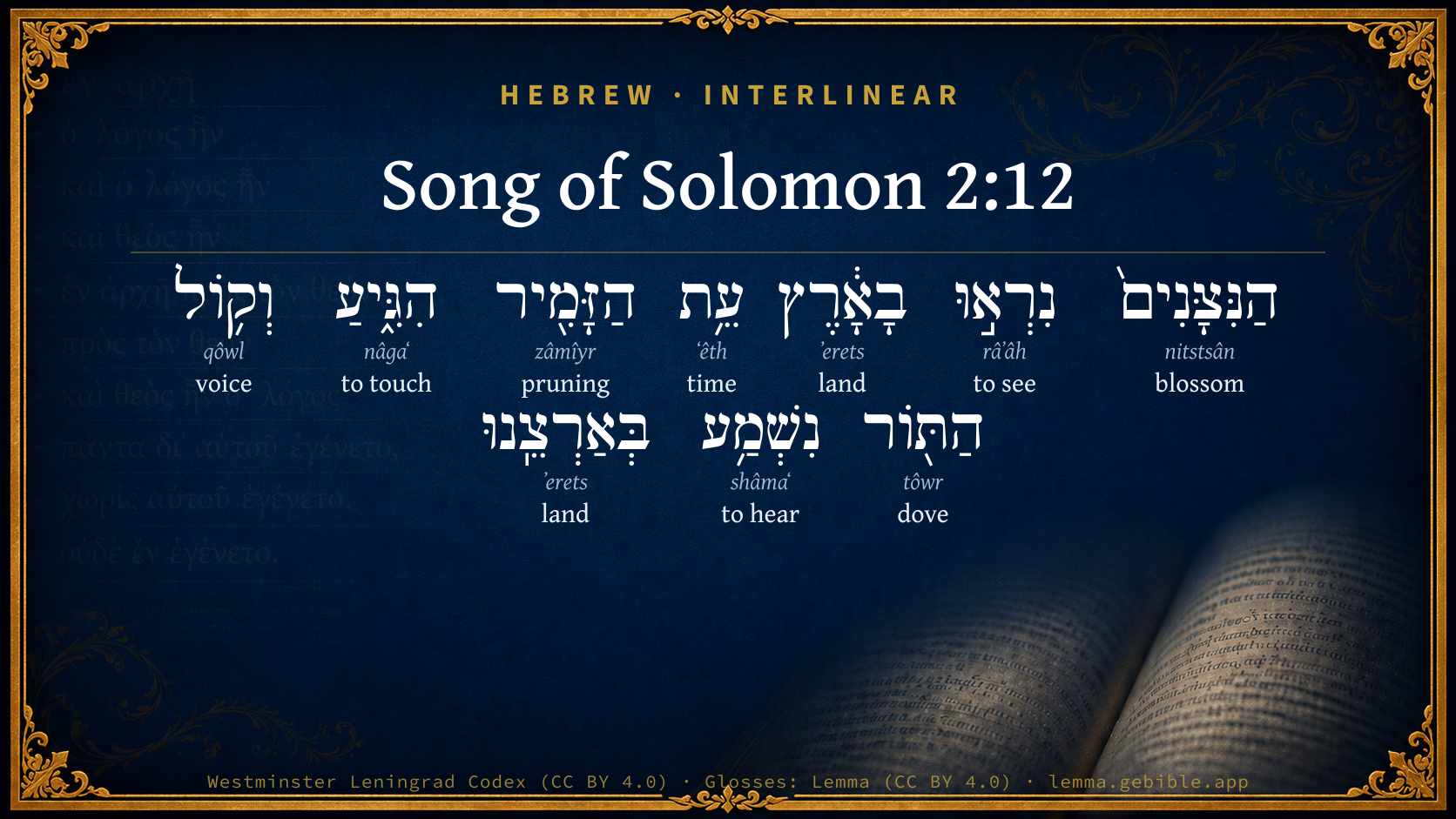
Hebrew (Westminster Leningrad Codex) Song of Solomon 2:12 appears in the Hebrew Old Testament. The text above is from the Westminster Leningrad Codex. Each word links to its Strong’s number, a concise gloss, and parsing drawn from the Open Scriptures Hebrew Bible morphology. Click any word for its full Brown-Driver-Briggs (BDB) entry.
Download image
Cite this verse

Song of Solomon 2:12 (World English Bible). Public Domain. Lemma interlinear Bible study tool, https://lemma.gebible.app/v/song-of-solomon/2/12.

Show BibTeX & RIS
BibTeX
RIS
English Translation
The flowers appear on the earth; The time of the singing has come, And the voice of the turtle-dove is heard in our land.
World English Bible · Public Domain
Highlights
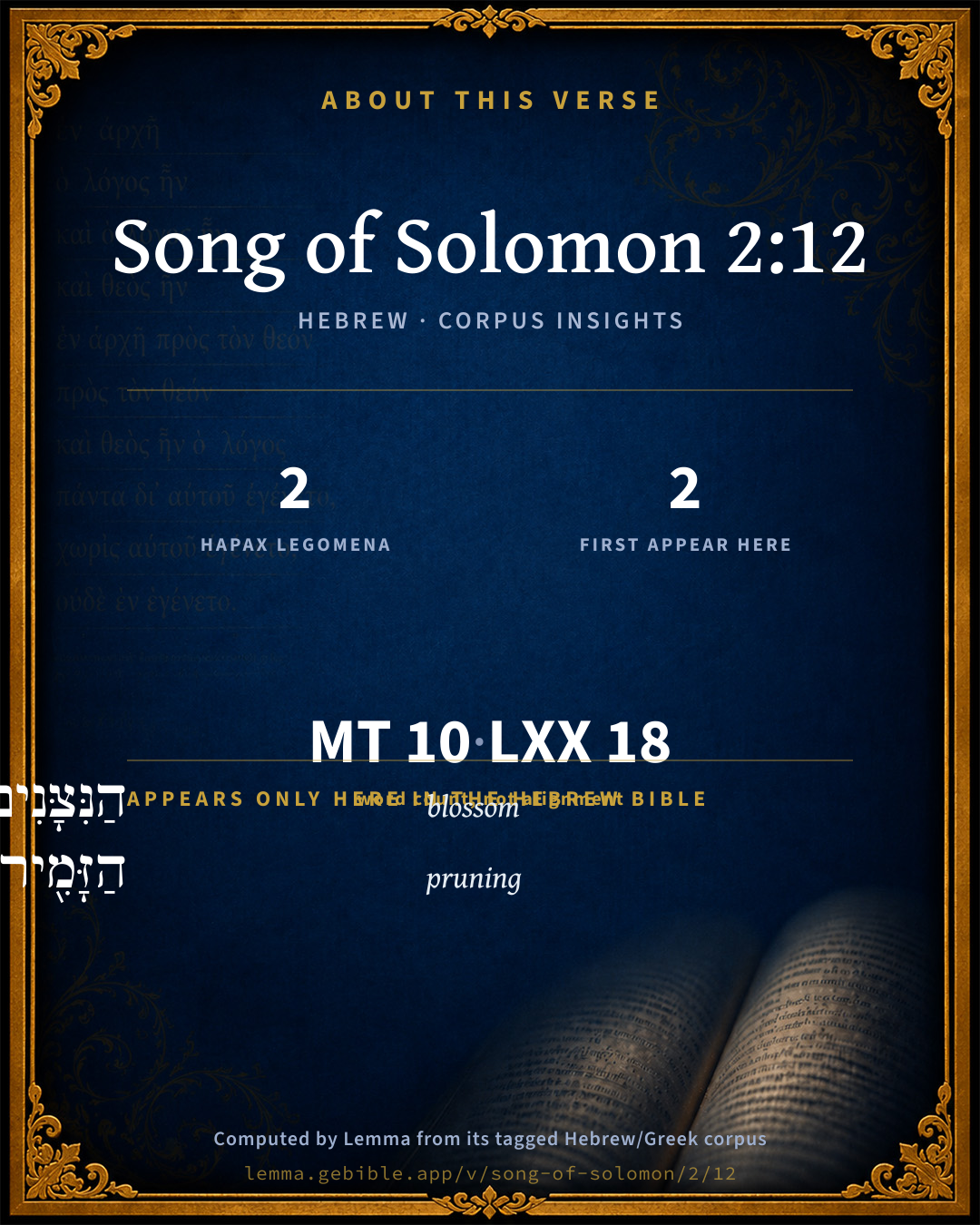
  • 2 hapax legomena — only here in the Hebrew Bible
  • 2 first appearances in the Hebrew Bible
Full analysis ↓
Download a study sheet

One document with this verse’s original text, its word-by-word gloss line, the meaning frame, cross-references with their text, attributed commentary, and full source and license credits — printable, and it pastes into notes with its structure intact.

This verse Autodidact and up

Study sheet (.html) Plain text (.txt)

A passage Seminary Student

Up to 50 verses in one chapter. A passage sheet keeps up to 6 commentary sources and 12 cross-references per verse, in the order this page ranks them, and says so on the sheet whenever that leaves anything out. Ask for a single verse and you get the Autodidact verse sheet above.

Everything on this page stays free to read, with no account — the sheet is a download of what is already on screen, not access to it.

Want to remove ads? Support Godless Engineer
Compare translations 3

The same verse in 3 English versions, stacked beneath the original-language interlinear above. Click any original word for its lexicon entry.

Each is an independent rendering of the whole verse — the interlinear is not word-aligned to these translations.

Highlighted words mark where these versions differ — a whole-verse word diff, not a word-by-word alignment.

  • World English Bible Public Domain
    The flowers appear on the earth; The time of the singing has come, And the voice of the turtle-dove is heard in our land.
  • King James Version Public Domain
    The flowers appear on the earth; the time of the singing of birds is come, and the voice of the turtle is heard in our land;
  • unfoldingWord Literal Text CC BY-SA 4.0
    The blossoms have appeared in the land; the time of the song has arrived, and the voice of the turtledove is heard in our land.

unfoldingWord Literal Text — © unfoldingWord, licensed CC BY-SA 4.0. Word-aligned USFM3 via Door43 (git.door43.org/unfoldingWord/en_ult).

Versions to compare (up to 4)

3 of 4 selected

Show all 18 translations

Every available English version of this verse, each an independent rendering of the whole verse.

  • World English Bible Public Domain
    The flowers appear on the earth; The time of the singing has come, And the voice of the turtle-dove is heard in our land.
  • Berean Standard Bible Public Domain
    The flowers have appeared in the countryside; the season of singing has come, and the cooing of turtledoves is heard in our land.
  • Majority Standard Bible Public Domain
    The flowers have appeared in the countryside; the season of singing has come, and the cooing of turtledoves is heard in our land.
  • King James Version Public Domain
    The flowers appear on the earth; the time of the singing of birds is come, and the voice of the turtle is heard in our land;
  • American Standard Version (1901) Public Domain
    The flowers appear on the earth; The time of the singing `of birds' is come, And the voice of the turtle-dove is heard in our land;
  • Revised Version (1885) Public Domain
    The flowers appear on the earth; the time of the singing of birds is come, and the voice of the turtle is heard in our land;
  • Geneva Bible (1599) Public Domain
    The flowers appeare in the earth: the time of the singing of birdes is come, and the voyce of the turtle is heard in our land.
  • Douay-Rheims (1899) Public Domain
    The flowers have appeared in our land, the time of pruning is come: the voice of the turtle is heard in our land:
  • Young's Literal Translation Public Domain
    The flowers have appeared in the earth, The time of the singing hath come, And the voice of the turtle was heard in our land,
  • Literal Standard Version CC BY-SA 4.0
    The flowers have appeared in the earth, || The time of the singing has come, || And the voice of the turtle was heard in our land,
  • Unlocked Literal Bible CC BY-SA 4.0
    The flowers have appeared in the land; the time for pruning and the singing of birds has come, and the sound of the doves is heard in our land.
  • unfoldingWord Literal Text CC BY-SA 4.0
    The blossoms have appeared in the land; the time of the song has arrived, and the voice of the turtledove is heard in our land.
  • Darby Bible Public Domain
    The flowers appear on the earth; The time of singing is come, And the voice of the turtle-dove is heard in our land;
  • World Messianic Bible Public Domain
    The flowers appear on the earth. The time of the singing has come, and the voice of the turtledove is heard in our land.
  • Webster's Bible Public Domain
    The flowers appear on the earth; the time of the singing of birds is come, and the voice of the turtle is heard in our land;
  • Free Bible Version CC BY-SA 4.0
    Flowers are blooming everywhere; the time when birds sing has come; the call of the turtledove is heard in the countryside.
  • Bible in Basic English Public Domain
    The flowers are come on the earth; the time of cutting the vines is come, and the voice of the dove is sounding in our land;
  • JPS Tanakh (1917) Public Domain
    The flowers appear on the earth; the time of singing is come, and the voice of the turtle is heard in our land;

Literal Standard Version (2020), Covenant Press — licensed CC BY-SA 4.0. Text via the HelloAO Bible API (eBible.org). Unlocked Literal Bible (unfoldingWord) — licensed CC BY-SA 4.0. Text via the HelloAO Bible API (eBible.org). unfoldingWord Literal Text — © unfoldingWord, licensed CC BY-SA 4.0. Word-aligned USFM3 via Door43 (git.door43.org/unfoldingWord/en_ult). Free Bible Version, Dr. Jonathan Gallagher — licensed CC BY-SA 4.0. Text via the HelloAO Bible API (eBible.org).

Word by word

More ways to search: Search by grammar → Find every occurrence → Compare this word →

Practice this passage: Drill this verse → Learn its vocabulary →

הַנִּצָּנִים֙
nitstsân
H5339
“the · blossoms”
Particle, Definite Article + Noun, Common, Masculine, Plural, Absolute
Part of Speech
Particle + Noun
Type
Common
Gender
Masculine
Number
Plural
State
Absolute
Full BDB Definition

Origin: from H5322

TWOT: 1405d

blossom
  1. נִרְא֣וּ râʼâh H7200 “to see” Verb, Niphal, Perfect, 3rd Person, Common, Plural
  2. בָאָ֔רֶץ ʼerets H776 “in/at the · land” Preposition, Determined + Noun, Common, Both, Singular, Absolute
  3. עֵ֥ת ʻêth H6256 “time of” Noun, Common, Both, Singular, Construct
  4. הַזָּמִ֖יר zâmîyr H2159 “the · pruning” Particle, Definite Article + Noun, Common, Masculine, Singular, Absolute
  5. הִגִּ֑יעַ nâgaʻ H5060 “to touch” Verb, Hiphil, Perfect, 3rd Person, Masculine, Singular
  6. וְק֥וֹל qôwl H6963 “and · voice of” Conjunction + Noun, Common, Masculine, Singular, Construct
  7. הַתּ֖וֹר tôwr H8449 “the · dove” Particle, Definite Article + Noun, Common, Both, Singular, Absolute
  8. נִשְׁמַ֥ע shâmaʻ H8085 “to hear” Verb, Niphal, Perfect, 3rd Person, Masculine, Singular
  9. בְּאַרְצֵֽנוּ ʼerets H776 “in/at · land · our” Preposition + Noun, Common, Both, Singular, Construct + Suffix, Personal, 1st Person, Common, Plural

About this verse

These counts appear in no published source. They are computed here, from the morphology-tagged text and Lemma’s own curated glosses. What Lemma adds →

10
words
9
distinct lemmas
Wisdom
section

Notable vocabulary

2 hapax legomena — words that appear only here in the entire Hebrew Bible:

  • הַנִּצָּנִים֙ blossom H5339
  • הַזָּמִ֖יר pruning H2159

First appearance in Scripture

These words make their first canonical appearance in the Hebrew Bible here:

  • הַנִּצָּנִים֙ blossom H5339
  • הַזָּמִ֖יר pruning H2159

Shared distinctive vocabulary

הַתּ֖וֹר dove H8449 occurs in 14 verses of the Hebrew Bible. Also found in:

Grammatical profile

  • 3 verbs
  • 7 nouns

Verb forms

  • נִרְא֣וּ Niphal · Perfect
  • הִגִּ֑יעַ Hiphil · Perfect
  • נִשְׁמַ֥ע Niphal · Perfect

Repetition

A word recurs within this verse — often emphatic in Hebrew:

  • בָאָ֔רֶץ land H776 ×2

Hebrew & Septuagint length

In English translation the verse runs 24 words from the Hebrew and 24 from the Septuagint (LXX English) — the same length.

A rough comparison of the two English renderings, which tokenize alike — not a word-level alignment.

Word counts can differ between the Hebrew and the Greek without any difference in meaning — e.g. the Hebrew direct-object marker אֵת has no separate Greek word, and Greek often adds the article ὁ.

In the original languages it is 10 Hebrew tokens and 18 Greek tokens — but the two are counted differently (Hebrew bundles its prefixes and suffixes into one token; the Greek is in lemma form), so that isn’t a like-for-like length.

Cross-references

14

Topical passages linked to Song of Solomon 2:12 in the Treasury of Scripture Knowledge — connected by theme and wording, ordered by reader-vote popularity; previews shown in the World English Bible.

  • Isaiah 55:12 For you shall go out with joy, and be led forth with peace: the mountains and the hills shall break forth before you into singing; and all the trees of the fields shall clap their hands.
  • Psalms 89:15 Blessed are the people who learn to acclaim you. They walk in the light of your presence, Yahweh.
  • Psalms 148:7–13 Praise Yahweh from the earth, You great sea creatures, and all depths!
  • Jeremiah 8:7 Yes, the stork in the sky knows her appointed times; and the turtle-dove and the swallow and the crane observe the time of their coming; but my people don't know Yahweh's law.
  • Colossians 3:16 Let the word of Christ dwell in you richly; in all wisdom teaching and admonishing one another with psalms, hymns, and spiritual songs, singing with grace in your heart to the Lord.
  • Psalms 40:1–3 I waited patiently for Yahweh. He turned to me, and heard my cry.
  • Song of Solomon 6:11 I went down into the nut tree grove, To see the green plants of the valley, To see whether the vine budded, And the pomegranates were in flower.
  • Isaiah 35:1–2 The wilderness and the dry land shall be glad; and the desert shall rejoice, and blossom as the rose.
  • Isaiah 42:10–12 Sing to Yahweh a new song, and his praise from the end of the earth; you who go down to the sea, and all that is therein, the isles, and the inhabitants of it.
  • Hosea 14:5–7 I will be like the dew to Israel. He will blossom like the lily, And send down his roots like Lebanon.
  • Romans 15:9–13 and that the Gentiles might glorify God for his mercy. As it is written, "Therefore will I give praise to you among the Gentiles, And sing to your name."
  • Ephesians 1:13–14 in whom you also, having heard the word of the truth, the Gospel of your salvation,--in whom, having also believed, you were sealed with the Holy Spirit of promise,
  • Ephesians 5:18–20 Don't be drunken with wine, in which is dissipation, but be filled with the Spirit,
  • Song of Solomon 6:2 My beloved has gone down to his garden, To the beds of spices, To feed in the gardens, and to gather lilies.

Cross-references courtesy of OpenBible.info (CC BY 4.0).

Hebrew and Greek witnesses Masoretic Hebrew ↔ Greek Septuagint

The same verse in the two great witnesses to the Old Testament, shown verse-for-verse.

These are two independent witnesses, not word-aligned to each other, and the Septuagint is shown in lemma (dictionary) form.

Hebrew Song of Solomon 2:12 Masoretic · Westminster Leningrad Codex

הַנִּצָּנִים֙ נִרְא֣וּ בָאָ֔רֶץ עֵ֥ת הַזָּמִ֖יר הִגִּ֑יעַ וְק֥וֹל הַתּ֖וֹר נִשְׁמַ֥ע בְּאַרְצֵֽנוּ

The flowers appear on the earth; The time of the singing has come, And the voice of the turtle-dove is heard in our land.

World English Bible · Public Domain

Greek LXX Song of Solomon 2:12 Septuagint · lemma form

ὁ ἄνθος ὁράω ἐν ὁ γῆ καιρός ὁ τομή φθάνω φωνή ὁ τρυγών ἀκούω ἐν ὁ γῆ ἐγώ

The flowers are seen in the land; the time of pruning has arrived; the voice of the turtle-dove has been heard in our land.

LXX2012 (modern English Septuagint) · Public Domain

On this verse, Ellicott's Commentary for English Readers discusses the Septuagint’s reading. Read the note in Commentary ↓

Hebrew: Westminster Leningrad Codex (CC BY 4.0). Greek: Septuagint (public domain); English from LXX2012 (modern English Septuagint) (Public Domain). How the Septuagint differs from the Hebrew →

Commentary

Notes on Song of Solomon 2:12 from classic Christian and Jewish commentators (each source and its license shown beneath its notes). The classic Christian expositions comment on the surrounding passage and are grouped to its opening verse, so a note may address several verses; the Jewish commentaries on the Tanakh (Rashi and others) are per-verse, so they appear only where the commentator wrote on this verse.

Lemma curates 59 commentaries, every one of them public domain or Creative Commons licensed, each selected and text-cleaned for this edition rather than reprinted as found. About our sources →

Trapp's Complete Commentary

John Trapp

Son 2:12 The flowers appear on the earth; the time of the singing [of birds] is come, and the voice of the turtle is heard in our land;

Ver. 12. The flowers appear on the earth.] Here we have a most dainty description of the spring or prime time - prin-temps, as the French call it - far surpassing that of Horace and the rest of the poets, who yet have shown themselves very witty that way. For the sense; by "flowers" (made rather to smell than to feed upon) are understood, saith an interpreter, the firstfruits of the Spirit, whereby the elect give a pleasant smell; and therein lieth sweetness of speech, and words going before works, even as flowers before fruits. For the which cause, as the apostle exhorteth that our speech be gracious always, "ministering edification to the hearer," {Col 4:6} so the prophet calls it a "pure language," which the Lord will give to as many as love him, as are called according to his purpose. {Zep 3:9}

The time of the singing of birds is come.] Hic autem garritus avium plurimum facit ad veris commendationem, this chirping of birds makes much to the spring’s commendation, saith Genebrard. How melodiously sing the ministers of the gospel, while they are unto God’s people as "a very lovely song of one that hath a pleasant voice." {Eze 33:32} It is mel in ore, moles in aure, to the elect, as it was to Augustine, who, coming to hear Ambrose, had his ears tickled, his heart touched; so had that unlearned Corinthian, {1Co 14:25} and the whole city of Samaria, wherein there was "great joy" at the receiving of the gospel. {Act 8:8} "Behold we bring you good tidings of great joy to all people," {Luk 2:10} said those angels to the shepherds that sang Christ into the world, and from whom the preaching of the gospel was afterwards taken and given to the ministers, whose proper office it is "to publish peace, to bring good tidings of good." "Thy watchmen shall lift up the voice; with the voice together shall they sing." {Isa 52:7-8} If they do otherwise to any, if they sing doleful accents to guilty persons, if the voice of these gospel birds be to such, like that of Abijah to Jeroboam’s wife, "I am sent to thee with heavy tidings," {1Ki 14:6} they may thank themselves. To fall out with the minister is as great folly, as if some fond people should accuse the herald or the trumpet as the cause of their war; or as if some ignorant peasant, when he sees his fowls bathing in his pond, should cry out of them as the causes of foul weather. What do faithful ministers do more - what can they do less, if they will be true to their souls? - than tax men’s sins, foretell their judgments? This when they do, it is diversely taken. Ravenous and unclean birds, like the ravens of Arabia, screech horribly, scratch terribly. Turtles and doves {a} (whose voice is here said to be heard in the land when other birds are sweetly singing) come in with a mournful tone, mixed with a groaning sadness (whence also the turtle hath its name, scil., a sono quem edit, per onomatopaeiam), and may well serve to set forth the unutterable groans of gracious spirits grieving for their sins, mourning bitterly {Zec 12:10} over Christ crucified before their eyes, {Gal 3:1} and evidently set forth by their faithful ministers (so that they need no other crucifix to draw tears from them) "tabering upon their breasts with the voice of doves," {Nah 2:7} yea, smiting upon their breasts, with the penitent publican, and saying, or rather sighing, out each for himself, "Lord be merciful to me a sinner." And here affert solatium lugentibus suspiriorum societas. {b} It is a heavenly hearing when a church full of good people, wrought upon by their godly preachers, send up a volley of sighs to God; and as "hinds by calving," so they by weeping "cast out their sorrows," {Job 39:3} such as show their hearts to be as so many Hadadrimmons. Augustine {c} persuades a preacher so long to insist upon some needful point, until by the groans and looks of his hearers he perceive that they understand it, and are affected with it. Such hearers Paul had at Athens, that wept as he did; {Act 20:37} but this is but few men’s happiness. Turtle doves are rare birds in our land.

{a} See Eze 7:16. Isidor.

{b} Basil.

{c} Aug. in Psa. x.

John Trapp, A Commentary or Exposition upon All the Books of the Old and New Testament (1647–1656) — public domain. Text from a community e-Sword module.

Ellicott's Commentary for English Readers

(12) The time of the singing—Heb., zamîr —may mean pruning (so LXX. and Vulg.), but parallelism requires singing-time (a meaning which analogy will certainly allow us to give to the Hebrew word zamîr). Nor can the correctness of our version in inserting of birds be questioned, since from the context it is plainly “the untaught harmony of spring,” and not the voices of men intended. It is true there is no authority for this beyond the context, and the allusions to the singing of birds are besides very few in Scripture; but travellers say that different species of warbless (Turdidœ), especially the bulbul and the nightingale. abound in the wooded valleys, filling the air in early spring with the rich cadence of their notes (Tristram’s Nat. Hist. of the Bible, p. 160).

Turtle.—Heb., tôr (turtur), from its plaintive note. Three species are found in Palestine, but the one intended is doubtless our own turtle-dove (Turtur auritus). It is migratory, and its advent marks the return of spring (Jer_8:7). “Search the glades and valleys even by sultry Jordan at the end of March, and not a turtle-dove is to be seen. Return in the second week of April, and clouds of doves are feeding on the clovers of the plain.” “The turtle, immediately on its arrival, pours forth from every garden grove and wooded hill its melancholy yet soothing ditty from early dawn till sunset” (Tristram’s Nat. Hist. of the Bible, p. 219).

A Bible Commentary for English Readers, edited by Charles John Ellicott (1878–1897) — public domain. Text from a community e-Sword module.

The Cambridge Bible for Schools and Colleges

gen. ed. J. J. S. Perowne

12. the flowers appear on the earth] The outburst of spring flowers in Palestine is wonderful. Stanley, Sinai and Palestine, p. 139, says: “The hills and valleys … glow with what is peculiar to Palestine, a profusion of wild flowers, daisies, the white flower called the Star of Bethlehem, but especially with a blaze of scarlet flowers of all kinds, chiefly anemones, wild tulips and poppies. Of all the ordinary aspects of the country, this blaze of scarlet colour is perhaps the most peculiar.” Cp. also Dr Post, in Hastings’ Dict. of the Bible, vol. 11. p. 24.

the time of the singing of birds is come] The words of birds, as is indicated by the italics in the A.V., are not in the Hebrew. All it says is that ‘çth hazzâmîr has come. Now zâmîr may mean either ‘pruning’ or ‘singing,’ and most of the ancient versions, e.g. LXX, Vulg., Targ., have translated it pruning, though the word does not occur elsewhere in the O.T. with this meaning. But in favour of this translation we have the fact that the various agricultural operations of the year are in Heb. named by words of an exactly similar form, e.g. qâtsîr, the harvest of grain, &c. Further, in Jer_51:33, we have the entirely analogous expression ‘çth haqqâtsîr = ‘the time of harvest.’ It cannot, therefore, be doubted that the translation ‘the time of pruning’ is thoroughly justified. Against it there is the fact that in Son_2:13 the vines are in bloom, and they cannot be pruned when they are at that stage. But there is what is called summer pruning, one purpose of which is to help in the formation of the fruit or blossom-buds of fruit trees. This is done while the shoots are yet young and succulent so that they may in most cases be nipped off with the thumb-nail. The time for this would be just before the blooming, and both pruning and blooming would be processes appropriate to spring. For the meaning singing, there is the fact that zâmîr occurs a number of times with the meaning song (e.g. Isa_25:5; 2Sa_23:1, &c.), but always of human singing. There is no instance of its being used of the singing of birds.

the voice of the turtle is heard in our land] The turtle-dove is named here, not as a singing bird, but as a bird of passage which “observes the time of its coming” (Jer_8:7); that is, it unfailingly appears in the spring, and by its voice announces its presence in the now leafy woods where it cannot readily be seen. Tristram says (Nat. Hist. p. 219), “Search the glades and valleys in March, and not a turtle-dove is to be seen. Return at the beginning of April, and clouds of doves are feeding on the clovers of the plain. They stock every tree and thicket. At every step they flutter up from the herbage in front, they perch on every tree and bush, they overspread the whole face of the land, and from every garden, grove, and wooded hill, pour forth their melancholy but soothing ditty unceasingly from early dawn to sunset.”

The Cambridge Bible for Schools and Colleges (gen. ed. J. J. S. Perowne; Cambridge University Press, 1878–1918) — public domain. Text from a community e-Sword module.

Haydock's Catholic Bible Commentary

Pruning. Protestants, "singing of birds." (Haydock) --- But the former version is better. (Septuagint, Symmachus, &c.) --- Turtle. Which returns in spring, Isaias viii. 9. (Calmet) --- It denotes the preaching of the gospel, (St. Cyril, ador. 15.) or rather the sighs of a holy soul in exile.

George Leo Haydock (1774–1849), Haydock's Catholic Family Bible and Commentary, 1859 edition — public domain. Excludes Psalms (Douay-Rheims chapter numbering differs from Protestant) and Deuterocanonical books (Catholic canon only).

Matthew Poole's English Annotations

The flowers appear on the earth: this and the following clauses are here alleged as evidences of the spring time, which in the mystical and principal sense seems to signify the day of grace, or the glad tidings of salvation proposed to sinners in the time of the law, by types, and shadows, and promises, but much more clearly and fully in the gospel, and all the discoveries and communications of God’s grace to mankind in holy ordinances, in the gifts, and graces, and comforts of the Holy Spirit, vouchsafed unto and appearing in believers, as buds and blossoms do in the spring time.

The time of the singing of birds; when birds sing most freely and sweetly, as they do in the spring. Or, as the ancient translator’s render it, of cutting or cropping, not trees, which agrees not with that season, but the flowers, last mentioned, for nosegays, or other uses.

The turtle; which changeth its place according to the season, as is observed. Jer 8:7, and by all other writers, who affirm that it disappears in winter, and appears in the spring, as some other birds also do; but this seems particularly to be mentioned, because it doth not only give notice of the spring, but also doth aptly represent the Spirit of God, which even the Chaldee paraphrast understands by this turtle, which appeared in the shape of a dove, and which worketh a dove-like meekness, and chastity, and faithfulness in believers.

In our land; in Immanuel’s land, as Canaan is called, Isa 8:8, in the church.

Matthew Poole's English Annotations on the Holy Bible (1683–1685) — public domain. Text from a community e-Sword/MySword module.

Whedon's Commentary on the Bible

Daniel D. Whedon

12. The flowers appear on the earth — The drift of allusion shows the parties foremost in the drama, the Enamoured and the Beloved, to be in lowly condition and dwellers in the country. To such this spring season is the most laborious of all, especially to get in all seeds while the soil is moist with the early rain and the latter rain is yet to come. This gives a holiday zest to this proposed excursion. They are to go, not for labour, but to the banquet which nature spreads.

The time of the singing — The word really means, the song of men — of labourers — but to refer it to birds does no harm, though the next clause would be sufficient for that.

The voice of the turtle — The “turtle” dove (named tur-tur, from its cooing) spends the winter farther south, and its return to Palestine is like that of the swallow to ours, or like that of the cuckoo, whose note resembles the turtle dove’s, which is often called the mourning dove.

Daniel D. Whedon (gen. ed.), Commentary on the Old and New Testaments (1874–1909) — public domain. Text from a community e-Sword module.

John Wesley's Explanatory Notes

The flowers - The communications of God's grace, the gifts, and graces, and comforts of the Holy Spirit, are vouchsafed unto, and appear in believers, as buds and blossoms do in the spring. The turtle - This seems particularly to be mentioned because it not only gives notice of the spring, but aptly represents the Spirit of God, which even the Chaldee paraphrast understands by this turtle, which appeared in the shape of a dove, and which worketh a dove-like meekness, and chastity, and faithfulness, in believers.

John Wesley, Explanatory Notes Upon the Whole Bible (1754–1765) — public domain. Text via the GEBible commentary corpus.

unfoldingWord translationNotes

Door43 World Missions Community

The flowers have appeared

"People can see flowers"

in the land

"all over this land"

for pruning

for cutting off branches from a plant so that it will produce more fruit or look better

the singing of birds

"for birds to sing"

the sound of the doves is heard

This can be translated in active form. AT: "people can hear the sound of doves" or "the doves are cooing" (See: Active or Passive)

The fig tree ripens her green figs

The tree is spoken of as if it were actively causing its fruit to ripen. This is a collective singular and can be translated as a plural. AT: "The figs on the trees are becoming ripe" (See: Personification)

vines are in blossom

"vines are flowering" or "vines have flowers"

they give off

The word "they" refers to the blossoms on the vines.

their fragrance

"their sweet smell"

my love

"you whom I love." See how you translated this in Song of Songs 1:9

translationWords

time

dove

fig

vine

unfoldingWord translationNotes — © Distant Shores Media and the Door43 World Missions Community, licensed CC BY-SA 4.0. Source: git.door43.org/Door43/en_tn.

Rashi

Rabbi Shlomo Yitzchaki (Rashi)

The blossoms have appeared in the land The days of summer are near, when the trees blossom and the travelers enjoy seeing them.

the time of singing has arrived when the birds give forth their song, and the sound is pleasant for travelers.

and the voice of the turtledove Heb. הַתּוֹר. According to its apparent meaning, this is a term referring to turtledoves and young pigeons. It is customary for the birds to sing and chirp in the days of Nissan.

Rashi on the Tanakh — English translations: “The Judaica Press complete Tanach with Rashi, translated by A. J. Rosenberg” (CC BY 4.0); “Pentateuch with Rashi's commentary by M. Rosenbaum and A.M. Silbermann, 1929-1934” (public domain); “The Metsudah Tanach series, Lakewood, N.J” (CC BY 4.0); and “The Book of Joshua, Metsudah Publications, 1997” (CC BY 4.0). Text via Sefaria.

Lesson kit

Teaching starters — assembled from the data on this page, not authored interpretation. Every prompt links to the verse data it draws on. Edit before teaching.

Song of Solomon, in the Wisdom, opens this verse with 10 words (9 distinct Hebrew lemmas). Its most distinctive word is nitstsân (“blossom”). A historical commentator’s framing appears above. Read the whole chapter for the surrounding context.

Discussion questions

  1. What does “blossom” (nitstsân) contribute to the verse as a whole?
  2. This verse holds 2 words here found nowhere else in the Hebrew Bible. What might the rare words draw attention to?
  3. 2 words here appear for the first time in Scripture. What is being introduced at this debut?
  4. Genesis 15:9 shares the word «dove» with this verse. How do the two illuminate each other?
  5. “land” occurs 2× in this one verse. What is the effect of the repetition?
  6. The translations on this page render this verse differently — a whole-verse word diff, not a word-by-word alignment. What might account for the different wordings?
  7. The verb «נִרְא֣וּ» is Niphal Perfect. How does its form color the action?
  8. Reading how Trapp's Complete Commentary and Ellicott's Commentary for English Readers read this verse, where do the two commentators agree and where do they part?

Things to notice

  • 2 words in this verse appear nowhere else in the Hebrew Bible.
  • 2 words make their first canonical appearance in Scripture here.
  • This verse counts 10 Hebrew ↔ 18 Greek words.
  • These translations choose different wording for 15 words in this verse.
  • “land” occurs 2× in this single verse.

Reading settings

Reading text

Shown beneath each verse's original-language words.

Old Testament
Old Testament edition

Read the OT as the Masoretic Hebrew (MT) or the Greek Septuagint (LXX).

English shown for the Greek Septuagint (in the Hebrew ↔ Greek comparison).

Comparing translations? Open the Compare panel on any verse page to stack up to four side by side.