
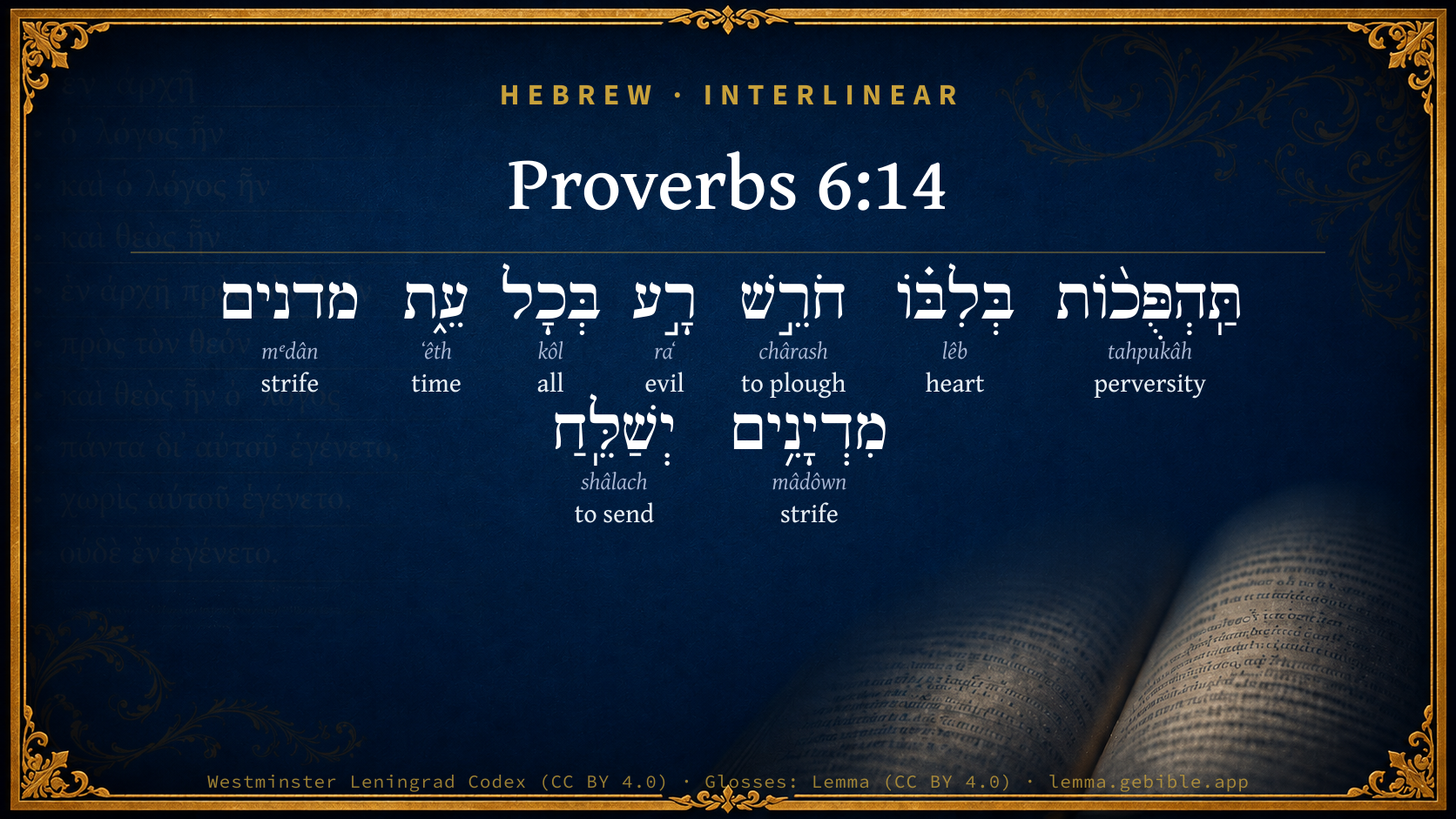
Proverbs 6:14

Hebrew (Westminster Leningrad Codex) Proverbs 6:14 appears in the Hebrew Old Testament. The text above is from the Westminster Leningrad Codex. Each word links to its Strong’s number, a concise gloss, and parsing drawn from the Open Scriptures Hebrew Bible morphology. Click any word for its full Brown-Driver-Briggs (BDB) entry.
Download image
Cite this verse

Proverbs 6:14 (World English Bible). Public Domain. Lemma interlinear Bible study tool, https://lemma.gebible.app/v/proverbs/6/14.

Show BibTeX & RIS
BibTeX
RIS
English Translation
In whose heart is perverseness, Who devises evil continually, Who always sows discord.
World English Bible · Public Domain
Highlights
  • 1 first appearance in the Hebrew Bible
Full analysis ↓
Download a study sheet

One document with this verse’s original text, its word-by-word gloss line, the meaning frame, cross-references with their text, attributed commentary, and full source and license credits — printable, and it pastes into notes with its structure intact.

This verse Autodidact and up

Study sheet (.html) Plain text (.txt)

A passage Seminary Student

Up to 50 verses in one chapter. A passage sheet keeps up to 6 commentary sources and 12 cross-references per verse, in the order this page ranks them, and says so on the sheet whenever that leaves anything out. Ask for a single verse and you get the Autodidact verse sheet above.

Everything on this page stays free to read, with no account — the sheet is a download of what is already on screen, not access to it.

Want to remove ads? Support Godless Engineer
Compare translations 3

The same verse in 3 English versions, stacked beneath the original-language interlinear above. Click any original word for its lexicon entry.

Each is an independent rendering of the whole verse — the interlinear is not word-aligned to these translations.

Highlighted words mark where these versions differ — a whole-verse word diff, not a word-by-word alignment.

  • World English Bible Public Domain
    In whose heart is perverseness, Who devises evil continually, Who always sows discord.
  • King James Version Public Domain
    Frowardness is in his heart, he deviseth mischief continually; he soweth discord.
  • unfoldingWord Literal Text CC BY-SA 4.0
    Perverse things in his heart, plotting evil on every occasion; he sends forth quarrels.

unfoldingWord Literal Text — © unfoldingWord, licensed CC BY-SA 4.0. Word-aligned USFM3 via Door43 (git.door43.org/unfoldingWord/en_ult).

Versions to compare (up to 4)

3 of 4 selected

Show all 18 translations

Every available English version of this verse, each an independent rendering of the whole verse.

  • World English Bible Public Domain
    In whose heart is perverseness, Who devises evil continually, Who always sows discord.
  • Berean Standard Bible Public Domain
    With deceit in his heart he devises evil; he continually sows discord.
  • Majority Standard Bible Public Domain
    With deceit in his heart he devises evil; he continually sows discord.
  • King James Version Public Domain
    Frowardness is in his heart, he deviseth mischief continually; he soweth discord.
  • American Standard Version (1901) Public Domain
    In whose heart is perverseness, Who deviseth evil continually, Who soweth discord.
  • Revised Version (1885) Public Domain
    Frowardness is in his heart, he deviseth evil continually; he soweth discord.
  • Geneva Bible (1599) Public Domain
    Lewde things are in his heart: he imagineth euill at all times, and raiseth vp contentions.
  • Douay-Rheims (1899) Public Domain
    With a wicked heart he deviseth evil, and at all times he soweth discord.
  • Young's Literal Translation Public Domain
    Frowardness `is' in his heart, devising evil at all times, Contentions he sendeth forth.
  • Literal Standard Version CC BY-SA 4.0
    Contrariness [is] in his heart, devising evil at all times, || He sends forth contentions.
  • Unlocked Literal Bible CC BY-SA 4.0
    He plots evil with deceit in his heart; he always stirs up discord.
  • unfoldingWord Literal Text CC BY-SA 4.0
    Perverse things in his heart, plotting evil on every occasion; he sends forth quarrels.
  • Darby Bible Public Domain
    deceits are in his heart; he deviseth mischief at all times, he soweth discords.
  • World Messianic Bible Public Domain
    in whose heart is perverseness, who devises evil continually, who always sows discord.
  • Webster's Bible Public Domain
    Frowardness is in his heart, he deviseth mischief continually; he soweth discord.
  • Free Bible Version CC BY-SA 4.0
    Their warped minds plot evil schemes; they're always causing trouble.
  • Bible in Basic English Public Domain
    His mind is ever designing evil: he lets loose violent acts.
  • JPS Tanakh (1917) Public Domain
    Frowardness is in his heart, he deviseth evil continually; he soweth discord.

Literal Standard Version (2020), Covenant Press — licensed CC BY-SA 4.0. Text via the HelloAO Bible API (eBible.org). Unlocked Literal Bible (unfoldingWord) — licensed CC BY-SA 4.0. Text via the HelloAO Bible API (eBible.org). unfoldingWord Literal Text — © unfoldingWord, licensed CC BY-SA 4.0. Word-aligned USFM3 via Door43 (git.door43.org/unfoldingWord/en_ult). Free Bible Version, Dr. Jonathan Gallagher — licensed CC BY-SA 4.0. Text via the HelloAO Bible API (eBible.org).

Word by word

More ways to search: Search by grammar → Find every occurrence → Compare this word →

Practice this passage: Drill this verse → Learn its vocabulary →

About this verse

These counts appear in no published source. They are computed here, from the morphology-tagged text and Lemma’s own curated glosses. What Lemma adds →

9
words
9
distinct lemmas
Wisdom
section

Notable vocabulary

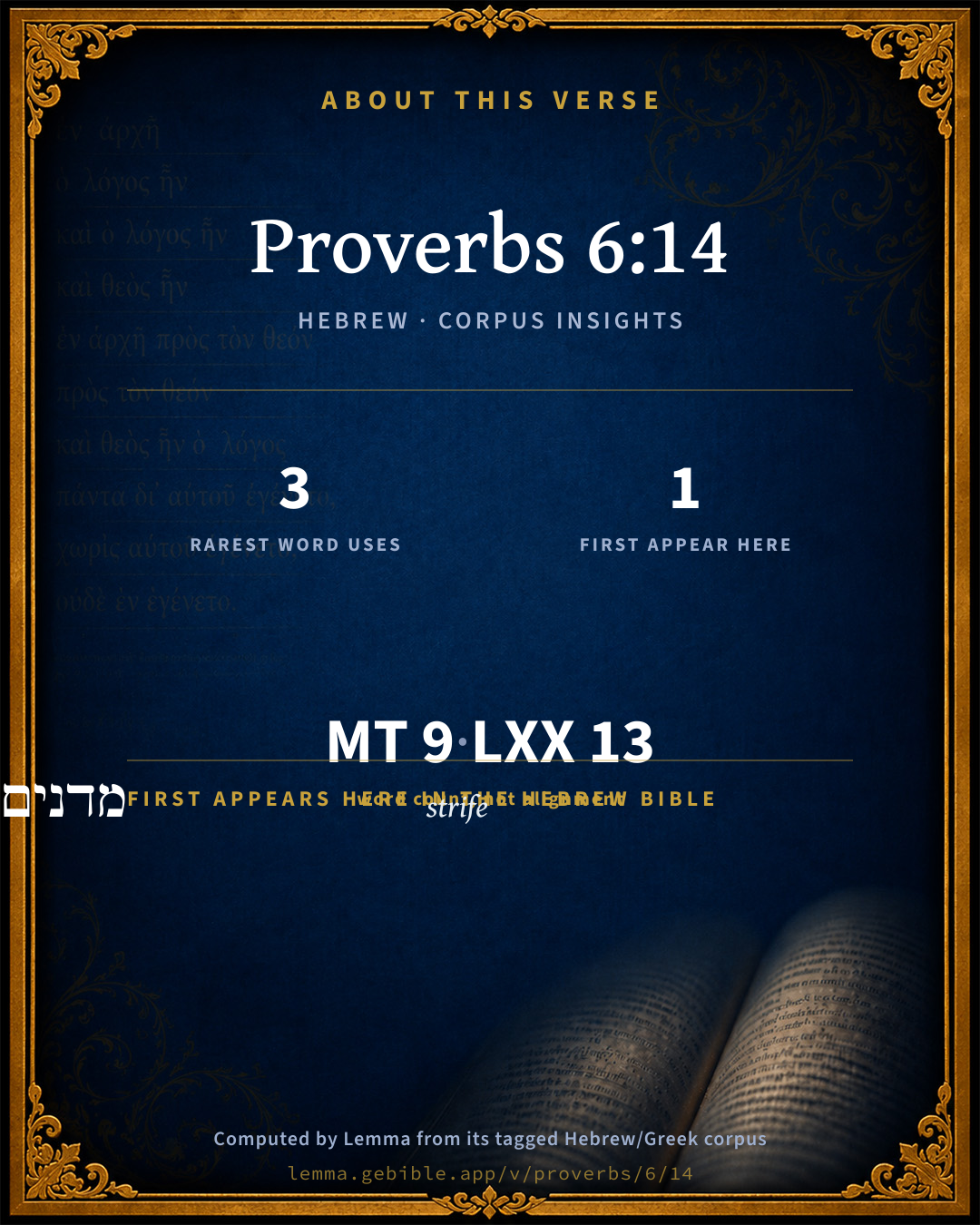
The rarest word here is מדנים strife H4090 — appearing just 3 times in the whole Hebrew Bible.

First appearance in Scripture

This word makes its first canonical appearance in the Hebrew Bible here:

  • מדנים strife H4090

Shared distinctive vocabulary

מדנים strife H4090 occurs in 3 verses of the Hebrew Bible. Also found in:

Grammatical profile

  • 2 verbs
  • 6 nouns
  • 1 adjective

Verb forms

  • חֹרֵ֣שׁ Qal · Participle Active
  • יְשַׁלֵּֽחַ Piel · Imperfect

Hebrew & Septuagint length

In English translation the verse runs 13 words from the Hebrew and 16 from the Septuagint (LXX English) — closely comparable.

A rough comparison of the two English renderings, which tokenize alike — not a word-level alignment.

Word counts can differ between the Hebrew and the Greek without any difference in meaning — e.g. the Hebrew direct-object marker אֵת has no separate Greek word, and Greek often adds the article ὁ.

In the original languages it is 9 Hebrew tokens and 13 Greek tokens — but the two are counted differently (Hebrew bundles its prefixes and suffixes into one token; the Greek is in lemma form), so that isn’t a like-for-like length.

Cross-references

15

Topical passages linked to Proverbs 6:14 in the Treasury of Scripture Knowledge — connected by theme and wording, ordered by reader-vote popularity; previews shown in the World English Bible.

  • Micah 2:1 Woe to those who devise iniquity And work evil on their beds! When the morning is light, they practice it, Because it is in the power of their hand.
  • Romans 16:17 Now I beg you, brothers, look out for those who are causing the divisions and occasions of stumbling, contrary to the doctrine which you learned, and turn away from them.
  • Proverbs 6:18–19 A heart that devises wicked schemes, Feet that are swift in running to mischief,
  • Hosea 8:7 For they sow the wind, And they will reap the whirlwind. He has no standing grain. The stalk will yield no head. If it does yield, strangers will swallow it up.
  • Psalms 36:4 He plots iniquity on his bed. He sets himself in a way that is not good; He doesn't abhor evil.
  • Proverbs 2:14 Who rejoice to do evil, And delight in the perverseness of evil;
  • Proverbs 26:17–22 Like one who grabs a dog's ears Is one who passes by and meddles in a quarrel not his own.
  • Proverbs 3:29 Don't devise evil against your neighbor, Seeing he dwells securely by you.
  • Proverbs 16:28–30 A perverse man stirs up strife. A whisperer separates close friends.
  • Proverbs 21:8 The way of the guilty is devious, But the conduct of the innocent is upright.
  • Proverbs 22:8 He who sows wickedness reaps trouble, And the rod of his fury will be destroyed.
  • Isaiah 32:7 The instruments of the churl are evil: he devises wicked devices to destroy the humble with lying words, even when the needy speaks right.
  • Isaiah 57:20 But the wicked are like the troubled sea; for it can't rest, and its waters cast up mire and dirt.
  • Ezekiel 11:2 He said to me, Son of man, these are the men who devise iniquity, and who give wicked counsel in this city;
  • Galatians 6:7–8 Don't be deceived. God is not mocked, for whatever a man sows, that will he also reap.

Cross-references courtesy of OpenBible.info (CC BY 4.0).

Hebrew and Greek witnesses Masoretic Hebrew ↔ Greek Septuagint

The same verse in the two great witnesses to the Old Testament, shown verse-for-verse.

These are two independent witnesses, not word-aligned to each other, and the Septuagint is shown in lemma (dictionary) form.

Hebrew Proverbs 6:14 Masoretic · Westminster Leningrad Codex

תַּֽהְפֻּכ֨וֹת בְּלִבּ֗וֹ חֹרֵ֣שׁ רָ֣ע בְּכָל עֵ֑ת מדנים מִדְיָנִ֥ים יְשַׁלֵּֽחַ

In whose heart is perverseness, Who devises evil continually, Who always sows discord.

World English Bible · Public Domain

Greek LXX Proverbs 6:14 Septuagint · lemma form

διαστρέφω δέ καρδία τεκταίνω κακός ἐν πᾶς καιρός ὁ τοιοῦτος ταραχή συνἵστημι πόλις

His perverse heart devises evils: at all times such a one causes troubles to a city.

LXX2012 (modern English Septuagint) · Public Domain

On this verse, The Pulpit Commentary discusses the Septuagint’s reading. Read the note in Commentary ↓

Hebrew: Westminster Leningrad Codex (CC BY 4.0). Greek: Septuagint (public domain); English from LXX2012 (modern English Septuagint) (Public Domain). How the Septuagint differs from the Hebrew →

Commentary

Notes on Proverbs 6:14 from classic Christian and Jewish commentators (each source and its license shown beneath its notes). The classic Christian expositions comment on the surrounding passage and are grouped to its opening verse, so a note may address several verses; the Jewish commentaries on the Tanakh (Rashi and others) are per-verse, so they appear only where the commentator wrote on this verse.

Lemma curates 59 commentaries, every one of them public domain or Creative Commons licensed, each selected and text-cleaned for this edition rather than reprinted as found. About our sources →

Trapp's Complete Commentary

John Trapp

Pro 6:14 Frowardness [is] in his heart, he deviseth mischief continually; he soweth discord.

Ver. 14. Frowardness is in his heart.] What marvel then though he solecise with his hand, {a} though he twinkle with his eye, and tinkle with his feet, &c.? "When he speaketh fair, believe him not, for there are seven abominations in his heart." {Pro 26:25} Even those seven next mentioned here, {Pro 6:16-19} as Aben Ezra conceiveth upon that text.

He deviseth mischief continually.] Heb., At all times. Pliny speaks of the scorpion, that there is not one minute wherein it doth not put forth the sting. The soul of a wicked man is "in a sling," {1Sa 25:29} restless, and violently tossed about by Satan, who acts and agitates him. {Eph 2:2 Mic 2:1 Hos 7:6}

He soweth discord.] And so shows himself a true breathing devil, a disciple of Machiavel, whose maxim was, divide et impera, make division and get dominion. In the year 1579, Allen at Rhemes instructed his emissary seducers, sent over into England, to make way for their great project of perdition in 1588, by dividing the people under the terms of Protestant and Puritan, and provoking them thereby to real and mutual both hate and contempt. {b} And what labouring there is now by the Jesuit party to heighten our unhappy differences, that they may make themselves masters of all, who seeth not? Herein they deal, - saith Gregory, of the like factors for the devil in his time, - as the master of the pit, who oft sets two cocks to fight together to the death of both, that after mutual conquest, he may sup with both their carcases. The Jews, before they were banished out of this kingdom, threw bags of poison into the wells and fountains that the people were to drink of, and thereby endeavoured to poison them all: so do our seedsmen of sedition.

{a} Oυτος τη χειρι σολοικιζει.

{b} Archbishop Abbot’s answer to Dr HilI’s Three Reasons.

John Trapp, A Commentary or Exposition upon All the Books of the Old and New Testament (1647–1656) — public domain. Text from a community e-Sword module.

Jamieson, Fausset & Brown

Robert Jamieson, A. R. Fausset & David Brown

Frowardness--as in Pro 2:14.

deviseth--literally, "constructs, as an artisan."

mischief--evil to others.

discord--especially litigation. Cunning is the talent of the weak and lazy.

Jamieson, Fausset & Brown — Commentary Critical and Explanatory on the Whole Bible (1871) — public domain (CC PDM 1.0). Text via the HelloAO Bible API.

Adam Clarke's Commentary

Verse 14. He deviseth mischief] He plots schemes and plans to bring it to pass.

He soweth discord.] Between men and their wives, by seducing the latter from their fidelity. See the preceding quotation.

Adam Clarke's Commentary on the Bible (1810–1826) — public domain. Text from a community e-Sword/MySword module.

The Cambridge Bible for Schools and Colleges

gen. ed. J. J. S. Perowne

14. soweth) Vulg. seminat. So R.V. with “Heb. letteth loose”, in marg. Lit. sendeth or casteth forth, as was done in the hand sowing of those days and countries. Comp. ὡς ἄνθρωπος βάλῃ τὸν σπόρον ἐπὶ τῆς γῆς, Mar_4:26. The idea of sowing is not contained, however, in the Heb. word, and the phrase “sowing strife” may merely be chosen as the best Eng. equivalent for the Heb. phrase. Comp. Pro_6:19 below, and Pro_16:28.

The Cambridge Bible for Schools and Colleges (gen. ed. J. J. S. Perowne; Cambridge University Press, 1878–1918) — public domain. Text from a community e-Sword module.

John Gill's Exposition

Therefore shall his calamity come suddenly,.... Unthought of and unexpected: he that deviseth mischief to others secretly shall have no warning of his own ruin, nor time and means of preventing it; the destruction of antichrist will be sudden, and of all wicked men at the coming of Christ, Th1 5:3;

suddenly shall he be broken without remedy; or, "and there shall be no healing" (b): his bones will be broken to pieces, and there will be no cure for him; or he shall be like an earthen vessel, which, when broke, cannot be put together again. The ruin of wicked men is sudden, inevitable, and irreparable; so antichrist will "come to his end, and none shall help him", Dan 11:45.

(b) "et non sanitas", Pagninus, Montanus; "curatio", Junius & Tremellius; "medicina", Piscator, Cocceius.

John Gill's Exposition of the Whole Bible (1746–1763) — public domain (CC PDM 1.0). Text via the HelloAO Bible API.

Matthew Poole's English Annotations

Frowardness; perverse or wicked thoughts and desires.

He soweth discord; either out of malice against others, or out of a base design of improving it to his own advantage.

Matthew Poole's English Annotations on the Holy Bible (1683–1685) — public domain. Text from a community e-Sword/MySword module.

Whedon's Commentary on the Bible

Daniel D. Whedon

14. Frowardness — Perversions.

Soweth — Casteth forth, or excites. Such men are perpetually at work contriving mischief, exciting suspicious, stirring up hatred, strife, brawls, lawsuits, discords in families, and revolutions in governments.

Daniel D. Whedon (gen. ed.), Commentary on the Old and New Testaments (1874–1909) — public domain. Text from a community e-Sword module.

The Pulpit Commentary

From these external features the teacher passes to the heart the seat of all this mischief and deceit. In this respect we observe a striking correspondence with the method adopted by our Saviour in his leaching, who referred everything to the heart, as the true seat of all that was good or bad in man. Frowardness is in his heart (Hebrew, tah"pukoth b"libbo); i.e. his heart is full of perverse imaginations, it is there he nourishes his jealousy, his hatred, his malice, his ill will. It is there, too, he deviseth mischief continually. "Devising mischief" carries us one step further back in the history of evil. It is this feature, this deliberate premeditation to plot mischief and to devise means to carry it into execution, which makes the character of the man simply diabolical. He makes his heart as it were the workshop wherein he fabricates and prepares his villainy. The Hebrew kharash (to which the participle khoresh belongs) is equivalent to the Vulgate machinari, and the LXX tekainomai , "to fabricate, devise, plot." (See Pro_3:29 and ver. 18; and cf. Psa_36:4, "He deviseth mischief upon his bed. The LXX combines the two statements in one proposition: "A perverse heart deviseth evil at all times." Similarly the Vulgate, which, however, joins "continually" (Hebrew, b"koleth; Vulgate, omni tempore) to the second hemistich, thus: "And at all times he sows discord (et omni tempore jurgia seminat)." He soweth discord (Hebrew, mid"-yanim (Keri) y"shalleakh); literally, he sends forth (i.e. excites) strife; or, as the margin, he casteth forth strife. The Keri reading mid"yanim, for the Khetib m"danim, is probably, as Hitzig suggests, derived from Gen_37:36. The phrase occurs again as shallakh m"danim in ver. 19, and as shillakh madon Pro_16:28. (cf. Pro_10:12) This is the culminating point in the character of the wicked man. He takes delight in breaking up friendship and in destroying concord among brethren (see ver. 19), and thus destroys one of the most essential elements for promoting individual happiness and the welfare of the community at large. This idea of the community is introduced into the LXX, which reads, "Such a one brings disturbance to the city (o tosoutov taracasthsi polei )." The motive cause may be either malice or self-interest.

Sowing discord.

I THE SOWER. He may be of various characters.

1. A malignant person. Such a one delights in the mischief he makes. He flings the firebrand with fiendish glee because he loves to witness the conflagration. He is a true child of Satan, one to break the peace of Eden, one to set Cain to murder his brother.

2. A person greedy of power. It is easier to make trouble than to mend it. Nothing is more simple than to scatter seeds of quarrels. A single pebble flung into the middle of a mountain tam will shatter the fair mirror of crag and sky, and spread disturbing wavelets to every shore. There is a sense of power, of producing a great effect, in mischief making.

3. A selfish person. If we always claim our does and exact our pound of flesh, we must be perpetually embroiled in quarrels. Disregard to the rights of others, which is only too common with the selfish, will lead one individual to plunge a whole society into confusion.

4. A heedless person. It is so easy to sow discord that we may do the mischievous thing before we are aware of our folly. It needs care and watchfulness to avoid this disastrous conduct.

II THE SEED.

1. A misrepresentation. Thomas Carlyle pointed out how often rational quarrels and wars spring from "misunderstandings." If we knew each other better we should be more friendly. Our acquaintances tend to become our friends. But a misrepresentation is the parent of a misunderstanding, and as such the seed of discord.

2. A hot word. If we approached a troublesome question calmly and patiently we might see a way of avoiding all quarrelling over it. But when the anger is roused everything appears in its worst light; there is no inclination to smooth ever a difficulty; on the contrary, opposition is magnified.

3. An unkind word, This may be spoken deliberately. The more cool the speaker, the more cutting his speech.

III THE SOIL. The discord is sown "among brethren.

1. A possible soil. One would say that here no quarrels can grow. But, alas! they who should love most can hate with bitterest hatred, or, if no deep dislike be engendered, they may still quarrel most fiercely. The first quarrel was between brethren Cain and Abel. Esau and Jacob, the two Hebrews whom Moses rebuked in Egypt, the nations of Israel and Judah, were all brethren in discord.

2. A fruitful soil. Surely it would be thought discord among brethren cannot last and spread. But experience proves the contrary. Family feuds are deep, bitter, enduring. Church quarrels are most rancorous. Civil war is sanguinary.

IV THE HARVEST. This discord is no slight thing like the breeze that disturbs the lake for one moment and speedily leaves it to resume its normal placidity.

1. It is painful. Pride may conceal the wound, but the sore is not slight. No misery is greater than that of fancily quarrels.

2. It is injurious. It raises evil passions, hinders harmonious action, wastes resources in internecine strife. All men are of one blood, therefore all war is discord, among brethren; and who shall measure its frightful harvest of woe?

3. It is unchristian. The gospel proclaims and enforces brotherhood. It helps us to realize the dream of the psalmist, "Behold how good and how pleasant it is for brethren to dwell together in unity!". (Psa_133:1) Christ blessed the peacemaker. (Mat_5:9)

The Pulpit Commentary (1880–1919), ed. H.D.M. Spence-Jones & Joseph S. Exell — public domain. Text from a community e-Sword module.

unfoldingWord translationNotes

Door43 World Missions Community

He plots evil

"He plans evil" or "He prepares to do evil deeds"

he always stirs up discord

"he always causes discord" or "he is constantly looking for conflict and escalating it"

Therefore

"For that reason"

his disaster will overtake him

This implies that the disaster is chasing him like a person or an animal, and that it will catch him soon. AT: "his disaster will catch him" (See: Personification)

his disaster

This refers to the disaster that will happen to him, but also the disaster that he himself caused.

in an instant; in a moment

Both mean the same thing, and one or both of them can be replaced by "suddenly" or "very quickly."

translationWords

evil

deceive

heart

unfoldingWord translationNotes — © Distant Shores Media and the Door43 World Missions Community, licensed CC BY-SA 4.0. Source: git.door43.org/Door43/en_tn.

Rashi

Rabbi Shlomo Yitzchaki (Rashi)

he incites quarrels between man and his Creator.

Rashi on the Tanakh — English translations: “The Judaica Press complete Tanach with Rashi, translated by A. J. Rosenberg” (CC BY 4.0); “Pentateuch with Rashi's commentary by M. Rosenbaum and A.M. Silbermann, 1929-1934” (public domain); “The Metsudah Tanach series, Lakewood, N.J” (CC BY 4.0); and “The Book of Joshua, Metsudah Publications, 1997” (CC BY 4.0). Text via Sefaria.

Lesson kit

Teaching starters — assembled from the data on this page, not authored interpretation. Every prompt links to the verse data it draws on. Edit before teaching.

Proverbs, in the Wisdom, opens this verse with 9 words (9 distinct Hebrew lemmas). Its most distinctive word is mᵉdân (“strife”). A historical commentator’s framing appears above. Read the whole chapter for the surrounding context.

Discussion questions

  1. The word mᵉdân carries the sense “strife.” How does it shape the verse?
  2. The word “strife” first appears here in Scripture. What is being introduced at this debut?
  3. Proverbs 6:19 shares the word «strife» with this verse. How do the two illuminate each other?
  4. The translations on this page render this verse differently — a whole-verse word diff, not a word-by-word alignment. What might account for the different wordings?
  5. The verb «חֹרֵ֣שׁ» is Qal Participle Active. How does its form color the action?
  6. Reading how Trapp's Complete Commentary and Jamieson, Fausset & Brown read this verse, where do the two commentators agree and where do they part?

Things to notice

Reading settings

Reading text

Shown beneath each verse's original-language words.

Old Testament
Old Testament edition

Read the OT as the Masoretic Hebrew (MT) or the Greek Septuagint (LXX).

English shown for the Greek Septuagint (in the Hebrew ↔ Greek comparison).

Comparing translations? Open the Compare panel on any verse page to stack up to four side by side.