Ezekiel 4:10

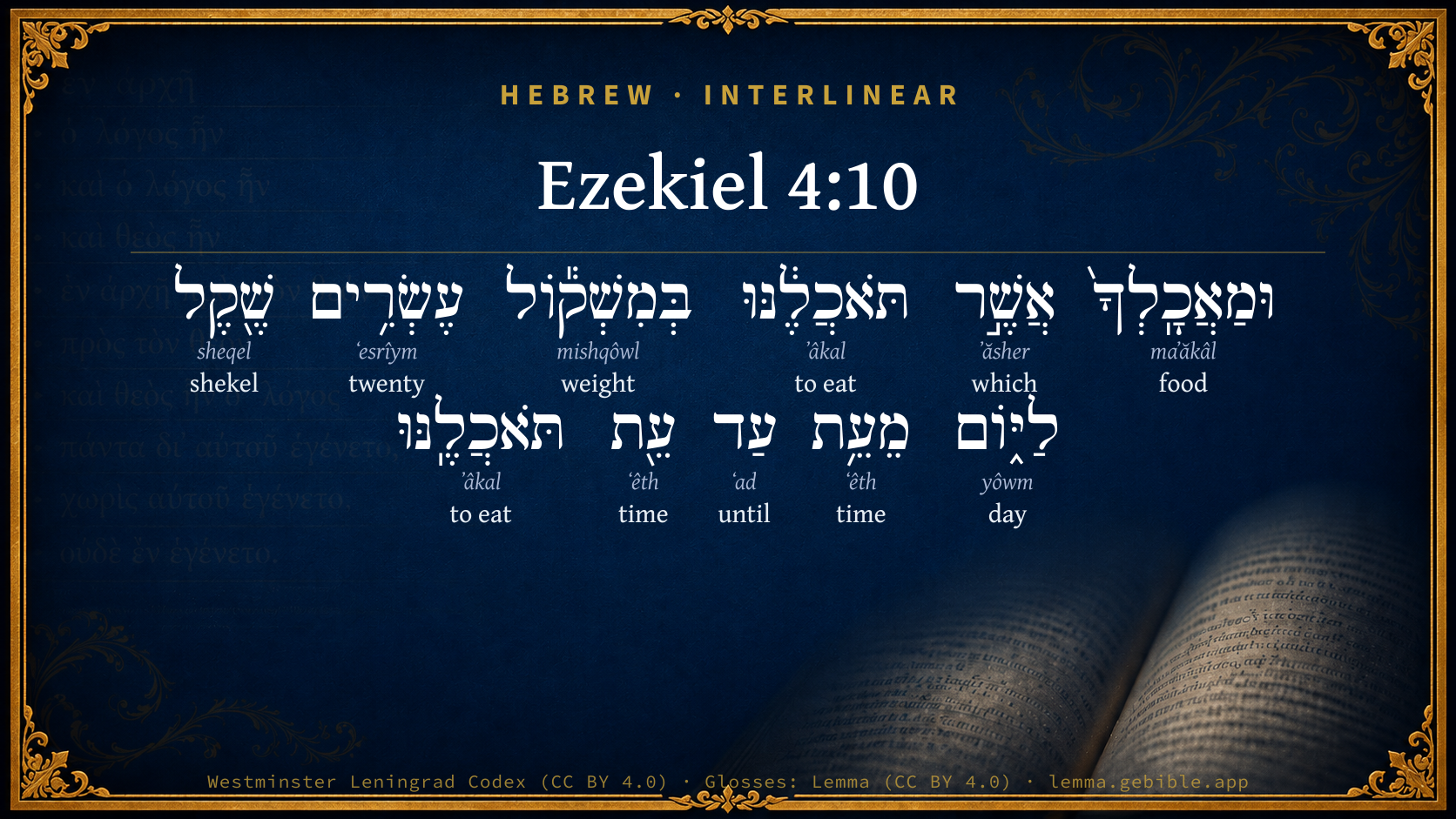
Hebrew (Westminster Leningrad Codex) Ezekiel 4:10 appears in the Hebrew Old Testament. The text above is from the Westminster Leningrad Codex. Each word links to its Strong’s number, a concise gloss, and parsing drawn from the Open Scriptures Hebrew Bible morphology. Click any word for its full Brown-Driver-Briggs (BDB) entry.
Download image
Cite this verse

Ezekiel 4:10 (World English Bible). Public Domain. Lemma interlinear Bible study tool, https://lemma.gebible.app/v/ezekiel/4/10.

Show BibTeX & RIS
BibTeX
RIS
English Translation
Your food which you shall eat shall be by weight, twenty shekels a day: from time to time shall you eat it.
World English Bible · Public Domain
Highlights
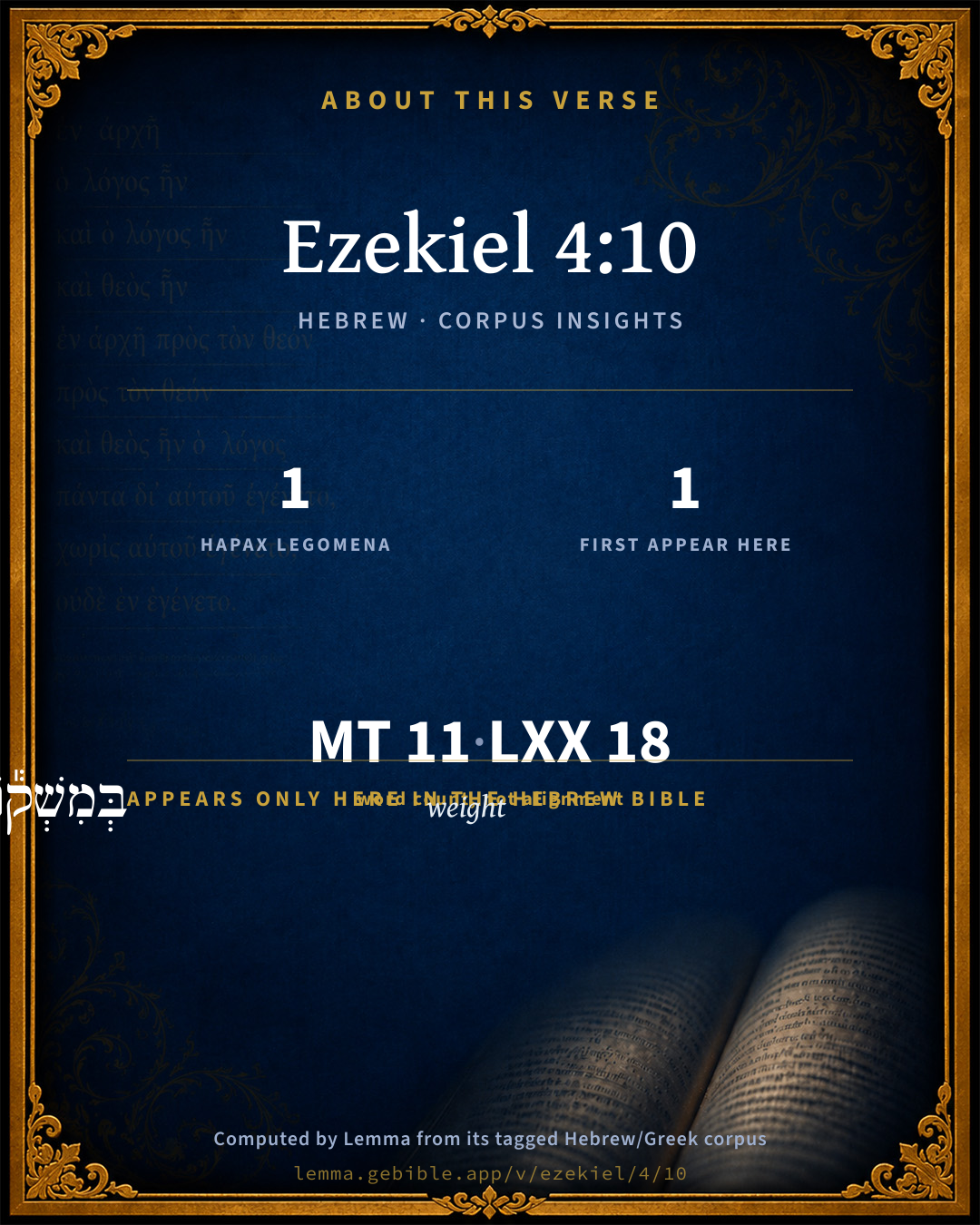
  • 1 hapax legomenon — only here in the Hebrew Bible
  • 1 first appearance in the Hebrew Bible
Full analysis ↓
Download a study sheet

One document with this verse’s original text, its word-by-word gloss line, the meaning frame, cross-references with their text, attributed commentary, and full source and license credits — printable, and it pastes into notes with its structure intact.

This verse Autodidact and up

Study sheet (.html) Plain text (.txt)

A passage Seminary Student

Up to 50 verses in one chapter. A passage sheet keeps up to 6 commentary sources and 12 cross-references per verse, in the order this page ranks them, and says so on the sheet whenever that leaves anything out. Ask for a single verse and you get the Autodidact verse sheet above.

Everything on this page stays free to read, with no account — the sheet is a download of what is already on screen, not access to it.

Want to remove ads? Support Godless Engineer
Compare translations 3

The same verse in 3 English versions, stacked beneath the original-language interlinear above. Click any original word for its lexicon entry.

Each is an independent rendering of the whole verse — the interlinear is not word-aligned to these translations.

Highlighted words mark where these versions differ — a whole-verse word diff, not a word-by-word alignment.

  • World English Bible Public Domain
    Your food which you shall eat shall be by weight, twenty shekels a day: from time to time shall you eat it.
  • King James Version Public Domain
    And thy meat which thou shalt eat shall be by weight, twenty shekels a day: from time to time shalt thou eat it.
  • unfoldingWord Literal Text CC BY-SA 4.0
    The food you will eat will be by weight, twenty shekels per day, and you will eat it at set times each day.

unfoldingWord Literal Text — © unfoldingWord, licensed CC BY-SA 4.0. Word-aligned USFM3 via Door43 (git.door43.org/unfoldingWord/en_ult).

Versions to compare (up to 4)

3 of 4 selected

Show all 18 translations

Every available English version of this verse, each an independent rendering of the whole verse.

  • World English Bible Public Domain
    Your food which you shall eat shall be by weight, twenty shekels a day: from time to time shall you eat it.
  • Berean Standard Bible Public Domain
    You are to weigh out twenty shekels of food to eat each day, and you are to eat it at set times.
  • Majority Standard Bible Public Domain
    You are to weigh out twenty shekels of food to eat each day, and you are to eat it at set times.
  • King James Version Public Domain
    And thy meat which thou shalt eat shall be by weight, twenty shekels a day: from time to time shalt thou eat it.
  • American Standard Version (1901) Public Domain
    And thy food which thou shalt eat shall be by weight, twenty shekels a day: from time to time shalt thou eat it.
  • Revised Version (1885) Public Domain
    And thy meat which thou shalt eat shall be by weight, twenty shekels a day: from time to time shalt thou eat it.
  • Geneva Bible (1599) Public Domain
    And the meate, whereof thou shalt eate, shalbe by weight, euen twenty shekels a day: and from time to time shalt thou eate thereof.
  • Douay-Rheims (1899) Public Domain
    And thy meat that thou shalt eat, shall be in weight twenty staters a day: from time to time thou shalt eat it.
  • Young's Literal Translation Public Domain
    And thy food that thou dost eat `is' by weight, twenty shekels daily; from time to time thou dost eat it.
  • Literal Standard Version CC BY-SA 4.0
    And your food that you eat [is] by weight, twenty shekels daily; from time to time you eat it.
  • Unlocked Literal Bible CC BY-SA 4.0
    The food you will eat will be by weight, twenty shekels per day, and you will eat it at set times each day.
  • unfoldingWord Literal Text CC BY-SA 4.0
    The food you will eat will be by weight, twenty shekels per day, and you will eat it at set times each day.
  • Darby Bible Public Domain
    And thy meat which thou shalt eat shall be by weight, twenty shekels a day: from time to time shalt thou eat it.
  • World Messianic Bible Public Domain
    Your food which you shall eat shall be by weight, twenty shekels a day. From time to time you shall eat it.
  • Webster's Bible Public Domain
    And thy food which thou shalt eat shall be by weight, twenty shekels a day: from time to time shalt thou eat it.
  • Free Bible Version CC BY-SA 4.0
    You are allowed to eat twenty shekels weight of food each day, and you are to eat it at regular times.
  • Bible in Basic English Public Domain
    And you are to take your food by weight, twenty shekels a day: you are to take it at regular times.
  • JPS Tanakh (1917) Public Domain
    And thy food which thou shalt eat shall be by weight, twenty shekels a day; from time to time shalt thou eat it.

Literal Standard Version (2020), Covenant Press — licensed CC BY-SA 4.0. Text via the HelloAO Bible API (eBible.org). Unlocked Literal Bible (unfoldingWord) — licensed CC BY-SA 4.0. Text via the HelloAO Bible API (eBible.org). unfoldingWord Literal Text — © unfoldingWord, licensed CC BY-SA 4.0. Word-aligned USFM3 via Door43 (git.door43.org/unfoldingWord/en_ult). Free Bible Version, Dr. Jonathan Gallagher — licensed CC BY-SA 4.0. Text via the HelloAO Bible API (eBible.org).

Word by word

More ways to search: Search by grammar → Find every occurrence → Compare this word →

Practice this passage: Drill this verse → Learn its vocabulary →

בְּמִשְׁק֕וֹל
mishqôwl
H4946
“in/at · weight”
Preposition + Noun, Common, Masculine, Singular, Absolute
Part of Speech
Preposition + Noun
Type
Common
Gender
Masculine
Number
Singular
State
Absolute
Full BDB Definition

Origin: from H8254

TWOT: 2454b

heaviness, weight
  1. וּמַאֲכָֽלְךָ֙ maʼăkâl H3978 “and · food · your” Conjunction + Noun, Common, Masculine, Singular, Construct + Suffix, Personal, 2nd Person, Masculine, Singular
  2. אֲשֶׁ֣ר ʼăsher H834 “which” Particle, Relative
  3. תֹּאכֲלֶ֔נּוּ ʼâkal H398 “to eat · him” Verb, Qal, Imperfect, 2nd Person, Masculine, Singular + Suffix, Personal, 3rd Person, Masculine, Singular
  4. עֶשְׂרִ֥ים ʻesrîym H6242 “twenty” Adjective, Cardinal number, Both, Plural, Absolute
  5. שֶׁ֖קֶל sheqel H8255 “shekel” Noun, Common, Masculine, Singular, Absolute
  6. לַיּ֑וֹם yôwm H3117 “to/for the · day” Preposition, Determined + Noun, Common, Masculine, Singular, Absolute
  7. מֵעֵ֥ת ʻêth H6256 “from · time” Preposition + Noun, Common, Both, Singular, Absolute
  8. עַד ʻad H5704 “until” Preposition
  9. עֵ֖ת ʻêth H6256 “time” Noun, Common, Both, Singular, Absolute
  10. תֹּאכֲלֶֽנּוּ ʼâkal H398 “to eat · him” Verb, Qal, Imperfect, 2nd Person, Masculine, Singular + Suffix, Personal, 3rd Person, Masculine, Singular

About this verse

These counts appear in no published source. They are computed here, from the morphology-tagged text and Lemma’s own curated glosses. What Lemma adds →

11
words
9
distinct lemmas
Prophets
section

Notable vocabulary

1 hapax legomenon — a word that appears only here in the entire Hebrew Bible:

  • בְּמִשְׁק֕וֹל weight H4946

First appearance in Scripture

This word makes its first canonical appearance in the Hebrew Bible here:

  • בְּמִשְׁק֕וֹל weight H4946

Shared distinctive vocabulary

וּמַאֲכָֽלְךָ֙ food H3978 occurs in 29 verses of the Hebrew Bible. Also found in:

Grammatical profile

  • 2 verbs
  • 6 nouns
  • 1 adjective
  • 1 preposition
  • 1 particle

Verb forms

  • תֹּאכֲלֶ֔נּוּ Qal · Imperfect
  • תֹּאכֲלֶֽנּוּ Qal · Imperfect

Repetition

Words recur within this verse — often emphatic in Hebrew:

  • תֹּאכֲלֶ֔נּוּ to eat H398 ×2
  • מֵעֵ֥ת time H6256 ×2

Hebrew & Septuagint length

In English translation the verse runs 22 words from the Hebrew and 20 from the Septuagint (LXX English) — closely comparable.

A rough comparison of the two English renderings, which tokenize alike — not a word-level alignment.

Word counts can differ between the Hebrew and the Greek without any difference in meaning — e.g. the Hebrew direct-object marker אֵת has no separate Greek word, and Greek often adds the article ὁ.

In the original languages it is 11 Hebrew tokens and 18 Greek tokens — but the two are counted differently (Hebrew bundles its prefixes and suffixes into one token; the Greek is in lemma form), so that isn’t a like-for-like length.

Cross-references

6

Topical passages linked to Ezekiel 4:10 in the Treasury of Scripture Knowledge — connected by theme and wording, ordered by reader-vote popularity; previews shown in the World English Bible.

  • Leviticus 26:26 When I break your staff of bread, ten women shall bake your bread in one oven, and they shall deliver your bread again by weight: and you shall eat, and not be satisfied.
  • Deuteronomy 28:51–68 and shall eat the fruit of your cattle, and the fruit of your ground, until you are destroyed; that also shall not leave you grain, new wine, or oil, the increase of your cattle, or the young of your flock, until they have caused you to perish.
  • Isaiah 3:1 For, behold, the Lord, Yahweh of Hosts, takes away from Jerusalem and from Judah supply and support, The whole supply of bread, And the whole supply of water;
  • Ezekiel 4:16 Moreover he said to me, Son of man, behold, I will break the staff of bread in Jerusalem: and they shall eat bread by weight, and with fearfulness; and they shall drink water by measure, and in dismay:
  • Ezekiel 14:13 Son of man, when a land sins against me by committing a trespass, and I stretch out my hand on it, and break the staff of the bread of it, and send famine on it, and cut off from it man and animal;
  • Ezekiel 45:12 The shekel shall be twenty gerahs. Twenty shekels plus twenty-five shekels plus fifteen shekels shall be your mina.

Cross-references courtesy of OpenBible.info (CC BY 4.0).

Hebrew and Greek witnesses Masoretic Hebrew ↔ Greek Septuagint

The same verse in the two great witnesses to the Old Testament, shown verse-for-verse.

These are two independent witnesses, not word-aligned to each other, and the Septuagint is shown in lemma (dictionary) form.

Hebrew Ezekiel 4:10 Masoretic · Westminster Leningrad Codex

וּמַאֲכָֽלְךָ֙ אֲשֶׁ֣ר תֹּאכֲלֶ֔נּוּ בְּמִשְׁק֕וֹל עֶשְׂרִ֥ים שֶׁ֖קֶל לַיּ֑וֹם מֵעֵ֥ת עַד עֵ֖ת תֹּאכֲלֶֽנּוּ

Your food which you shall eat shall be by weight, twenty shekels a day: from time to time shall you eat it.

World English Bible · Public Domain

Greek LXX Ezekiel 4:10 Septuagint · lemma form

καί ὁ βρῶμα σύ ὅς ἐσθίω ἐν σταθμός εἴκοσι σίκλος ὁ ἡμέρα ἀπό καιρός ἕως καιρός ἐσθίω αὐτός

And you shall eat your food by weight, twenty shekels a day: from time to time shall you eat them.

LXX2012 (modern English Septuagint) · Public Domain

Hebrew: Westminster Leningrad Codex (CC BY 4.0). Greek: Septuagint (public domain); English from LXX2012 (modern English Septuagint) (Public Domain). How the Septuagint differs from the Hebrew →

Targum (Aramaic paraphrase)

1

The Targum is the ancient Jewish Aramaic paraphrase of the Hebrew Scriptures — an interpretive translation, not the Hebrew text itself. Onkelos (literal) and Pseudo-Jonathan (expansive) render the Torah, and Jonathan the Prophets. Coverage is partial: where no permissively-licensed English translation exists for a verse, only the Aramaic is shown. This is verse-level text, not a word-by-word alignment to the Hebrew.

  1. Targum Jonathan Prophets (Joshua–Malachi)
    וּמֵיכְלָךְ דְתֵיכְלִינֵיהּ בְמַתְקַל עַסְרִין פִּילֵס לְיוֹם מֵעִדַן עַד עִדָן תֵּיכְלִינֵיהּ:

    (no public-domain English translation for this verse)

    Targum Jonathan — Aramaic: “Mikraot Gedolot” (public domain). English: “Sefaria Community Translation” (CC0 1.0 (public-domain dedication)); “London "Chaldee Paraphrase," 1871” (public domain). Text via Sefaria.

Commentary

Notes on Ezekiel 4:10 from classic Christian and Jewish commentators (each source and its license shown beneath its notes). The classic Christian expositions comment on the surrounding passage and are grouped to its opening verse, so a note may address several verses; the Jewish commentaries on the Tanakh (Rashi and others) are per-verse, so they appear only where the commentator wrote on this verse.

Lemma curates 59 commentaries, every one of them public domain or Creative Commons licensed, each selected and text-cleaned for this edition rather than reprinted as found. About our sources →

Trapp's Complete Commentary

John Trapp

Eze 4:10 And thy meat which thou shalt eat [shall be] by weight, twenty shekels a day: from time to time shalt thou eat it.

Ver. 10. Twenty shekels a day.] Five ounces, or ten at most; not prisoners’ pittance, qua proinde per diem trahitur magis anima quam sustentatur. See this complained of, Lam 1:11; Lam 1:19; Lam 2:11-12; Lam 2:19-20; Lam 4:4; Lam 4:9-10; Lam 5:6; Lam 5:9-10. They had sinned in excess, and now they are punished with cleanness of teeth. The famine of the word is far worse.

John Trapp, A Commentary or Exposition upon All the Books of the Old and New Testament (1647–1656) — public domain. Text from a community e-Sword module.

Joseph Benson's Commentary

Eze 4:10-12. And thy meat shall be by weight twenty shekels, &c. — In sieges it is common to stint every one to a certain allowance, by which means they can guess how long their provisions will last: twenty shekels is but ten ounces; a short allowance for a day’s sustenance. From time to time shalt thou eat of it — This shall be thy daily allowance during the whole three hundred and ninety days. Thou shalt drink also water by measure — In sieges it is usual for the enemy to cut off the water from coming into the cities which they besiege, as much as they can, which produces a scarcity of it; the sixth part of a hin — Which is about a pint and a half of our measure. Thou shalt eat it as barley cakes — Such as people make in haste, when they have not time for preparing a set meal: see Exo 12:39. This represents the hurry and disorder which would be occasioned by the siege. And thou shalt bake it with dung — To signify the scarcity of all kinds of fuel. Sir J. Chardin, in his MS. quoted by Harmer, tells us, “the eastern people always used cow-dung for baking, boiling a pot, and dressing all kinds of victuals that are easily cooked; especially in countries that had but little wood.” And D’Arvieux,

“complaining that one sort of Arab bread smells of smoke, and tastes of the cow-dung used in baking it, informs us, that the peasants often make use of the same fuel, and that all who live in villages where there is not plenty of wood, are very careful to stock themselves with it; the children,” he says, “gather up the dung, and clap it against a wall to dry, from whence the quantity that is necessary for baking, or warming themselves, is taken from time to time.” — Harmer, chap. 4. observ. 20, vol. 1. According to Dathius, quoted by Bishop Newcome, the dung of camels, as well as that of cows or oxen, was also “often used by the easterns as fuel for preparing their food.” But the command here given to the prophet, to use human dung, expressed the greatest necessity, and was terribly significant of the extremities which the inhabitants of Jerusalem should undergo during the siege, no nation making use of that offensive kind of fuel.

Joseph Benson's Commentary on the Old and New Testaments (1811–1818) — public domain. Text from a community e-Sword module.

Geneva Bible (1599)

Geneva Bible translators

Which make a pound.

Geneva Bible (1599) marginal notes — public domain. Text via Bolls.life.

Jamieson, Fausset & Brown

Robert Jamieson, A. R. Fausset & David Brown

twenty shekels--that is, little more than ten ounces; a scant measure to sustain life (Jer 52:6). But it applies not only to the siege, but to their whole subsequent state.

Jamieson, Fausset & Brown — Commentary Critical and Explanatory on the Whole Bible (1871) — public domain (CC PDM 1.0). Text via the HelloAO Bible API.

Adam Clarke's Commentary

Verse 10. Twenty shekels a day] The whole of the above grain, being ground, was to be formed into one mass, out of which he was to make three hundred and ninety loaves; one loaf for each day; and this loaf was to be of twenty shekels in weight. Now a shekel, being in weight about half an ounce, this would be ten ounces of bread for each day; and with this water to the amount of one sixth part of a hin, which is about a pint and a half of our measure. All this shows that so reduced should provisions be during the siege, that they should be obliged to eat the meanest sort of aliment, and that by weight, and their water by measure; each man's allowance being scarcely a pint and a half, and ten ounces, a little more than half a pound of bread, for each day's support.

Adam Clarke's Commentary on the Bible (1810–1826) — public domain. Text from a community e-Sword/MySword module.

John Calvin's Commentaries

This confirms what I have said, namely, that the want should be such, that the Prophet dared not eat even that bread to satiety: you shall eat, says he, bread by weight, viz, twenty shekels. These are not complete rounds, so that the sense is, that God commanded his Prophet to live sparingly. When the city was besieged, bread was distributed in pieces to each person. God then here says, that the Jews should be almost famished during the siege, so that they should not have bread except by fixed weight, and that a small one. What follows is more miserable, namely, the want of water; for this is the last stage of calamity when thirst oppresses us. it seems hard, indeed, to want wine, but when water is deficient, this, as I have said, is the last stage of famine, and this the Prophet denounces against the Jews when he says, water was not given to him during the time of the siege unless by measure. I shall leave the rest till to-morrow.

John Calvin's Commentaries (1540-1563) — public domain. Text from the Calvin Translation Society English edition (1840s-50s) via the Christian Classics Ethereal Library (ccel.org). Calvin's coverage is partial (roughly two-thirds of the Bible); uncommented books and verses are honest gaps, never fabricated. The 19th-century editor's footnotes and remarks are omitted so the notes are faithfully Calvin's own voice.

Ellicott's Commentary for English Readers

(10) By weight, twenty shekels a day.—The weight of the shekel is somewhat differently estimated by different authorities. The best computations fix it at about 220 grains, and this would make the allowance of twenty shekels equal to something less than eleven ounces, scarcely enough to sustain life. “Meat” is here used, as often in Scripture, of any kind of food. The extreme scarcity of food is also denoted by its being weighed rather than measured. “From time to time” means at set intervals of time (see 1Ch_9:25), here doubtless once a day. Only the longer period of 390 days is here mentioned, but the same command doubtless applied to both periods.

A Bible Commentary for English Readers, edited by Charles John Ellicott (1878–1897) — public domain. Text from a community e-Sword module.

The Cambridge Bible for Schools and Colleges

gen. ed. J. J. S. Perowne

10. twenty shekels a day] Twenty shekels might be eight or nine ounces. In this country two pounds of bread is held an ordinary allowance.

The Cambridge Bible for Schools and Colleges (gen. ed. J. J. S. Perowne; Cambridge University Press, 1878–1918) — public domain. Text from a community e-Sword module.

John Gill's Exposition

And thy meat which thou shall eat shall be by weight, twenty shekels a day,.... To eat bread by weight was a sign of a grievous famine; see Lev 26:26; a shekel, according to Josephus (i), weighed four Attic drachms, or half an ounce, wherefore twenty shekels weighed ten ounces; so that the bread the prophet had to eat was but ten ounces a day:

from time to time shall thou eat it; at the certain time of eating, or but once a day; from a set time in one day to the same in another; as from morning to morning, or from noon to noon, or from evening to evening; see Jer 37:21.

(i) Antiqu. l. 3. c. 8. sect. 2.

John Gill's Exposition of the Whole Bible (1746–1763) — public domain (CC PDM 1.0). Text via the HelloAO Bible API.

Albert Barnes' Notes on the Bible

meat - A general term for food, which in this case consists of grain. Instead of measuring, it was necessary in extreme scarcity to weigh it Lev 26:26; Rev 6:6.

Twenty shekels a day - The shekel contained about 220 grains, so that 20 shekels would be about 56 of a pound.

From time to time - Thou shalt receive and eat it at the appointed interval of a day.

Albert Barnes' Notes on the Bible (1834–1885) — public domain. Text from a community e-Sword/MySword module.

Haydock's Catholic Bible Commentary

Staters, sicles, each being equal to 9 dwt. 2.57 gr. Eng. The hin contained 1 gal. 2 pints. (Arbuthnot.) (Haydock) --- He had an allowance of ten ounces a-day. (Calmet) (Tirinus)

George Leo Haydock (1774–1849), Haydock's Catholic Family Bible and Commentary, 1859 edition — public domain. Excludes Psalms (Douay-Rheims chapter numbering differs from Protestant) and Deuterocanonical books (Catholic canon only).

Matthew Poole's English Annotations

Thy meat; the mean and coarse bread which thou must eat and be content with.

By weight; not full, as once; not as much as you will, but a small pittance delivered by weight to all; which bespeaks the extreme penury the city should be brought to.

Twenty shekels; some say five ounces, others say ten ounces, the greater of the two scarce enough to maintain life, and yet, it is probable enough, it was but five ounces of bread which was his allowance. A hard case, when the law of the twelve tables allowed a pound of bread to prisoners daily for their diet. But here the prophet hath but half that allowance, if the twenty shekels were shekels of the sanctuary; and he hath but a quarter of that allowance, if they were common shekels by which his allowance was weighed.

From time to time; at set hours this was weighed out, and no more could be had at any other time, whether morning or evening; once in four and twenty hours, or once in twelve hours, still at the appointed hour; and possibly there might be different hours appointed to different persons, and every one must observe his own time.

Matthew Poole's English Annotations on the Holy Bible (1683–1685) — public domain. Text from a community e-Sword/MySword module.

Whedon's Commentary on the Bible

Daniel D. Whedon

10. Thy meat… thou shalt eat… by weight, twenty shekels a day — This is about half the ordinary prison fare in England and America. It was to be weighed out carefully — not measured — because of the extreme scarcity of provisions.

Daniel D. Whedon (gen. ed.), Commentary on the Old and New Testaments (1874–1909) — public domain. Text from a community e-Sword module.

The Pulpit Commentary

Thy meat, etc.; better, food, here and elsewhere. Coarse as the food was, the people would have but scanty rations of it. Men were not, as usual, to measure the corn, but to weigh the bread. (Lev_26:26) Taking the shekel at about 220 grains, the twenty shekels would be about 10 or 12 ounces. The common allowance in England for prison or pauper dietaries gives, I believe from 24 to 32 ounces, Besides other food. And this was to be taken, not as hunger prompted, but at the appointed hour. once a day. The whole scene of the people of the besieged city coming for their daily rations is brought vividly before us.

The Pulpit Commentary (1880–1919), ed. H.D.M. Spence-Jones & Joseph S. Exell — public domain. Text from a community e-Sword module.

John Wesley's Explanatory Notes

By weight - Not as much as you will, but a small pittance delivered by weight to all. Twenty shekels - Ten ounces: scarce enough to maintain life. From time to time - At set hours this was weighed out.

John Wesley, Explanatory Notes Upon the Whole Bible (1754–1765) — public domain. Text via the GEBible commentary corpus.

Rashi

Rabbi Shlomo Yitzchaki (Rashi)

with a weight [This is] symbolic of the besieged people, who are fearful of the famine and [so] eat with a measure and drink with a measure.

Rashi on the Tanakh — English translations: “The Judaica Press complete Tanach with Rashi, translated by A. J. Rosenberg” (CC BY 4.0); “Pentateuch with Rashi's commentary by M. Rosenbaum and A.M. Silbermann, 1929-1934” (public domain); “The Metsudah Tanach series, Lakewood, N.J” (CC BY 4.0); and “The Book of Joshua, Metsudah Publications, 1997” (CC BY 4.0). Text via Sefaria.

Lesson kit

Teaching starters — assembled from the data on this page, not authored interpretation. Every prompt links to the verse data it draws on. Edit before teaching.

Ezekiel, in the Prophets, opens this verse with 11 words (9 distinct Hebrew lemmas). Its most distinctive word is mishqôwl (“weight”). A historical commentator’s framing appears above. Read the whole chapter for the surrounding context.

Discussion questions

  1. How does “weight” (mishqôwl) shape what this verse is saying?
  2. This verse holds 1 word here found nowhere else in the Hebrew Bible. What might the rare word draw attention to?
  3. The word “weight” first appears here in Scripture. What is being introduced at this debut?
  4. Genesis 2:9 shares the word «food» with this verse. How do the two illuminate each other?
  5. “to eat” occurs 2× in this one verse. What is the effect of the repetition?
  6. These translations render this verse differently. What is at stake in choosing one wording over another?
  7. The verb «תֹּאכֲלֶ֔נּוּ» is Qal Imperfect. How does its form color the action?
  8. Reading how Trapp's Complete Commentary and Joseph Benson's Commentary read this verse, where do the two commentators agree and where do they part?

Things to notice

  • 1 word in this verse appears nowhere else in the Hebrew Bible.
  • 1 word makes its first canonical appearance in Scripture here.
  • This verse counts 11 Hebrew ↔ 18 Greek words.
  • These translations choose different wording for 11 words in this verse.
  • “to eat” occurs 2× in this single verse.

Reading settings

Reading text

Shown beneath each verse's original-language words.

Old Testament
Old Testament edition

Read the OT as the Masoretic Hebrew (MT) or the Greek Septuagint (LXX).

English shown for the Greek Septuagint (in the Hebrew ↔ Greek comparison).

Comparing translations? Open the Compare panel on any verse page to stack up to four side by side.