
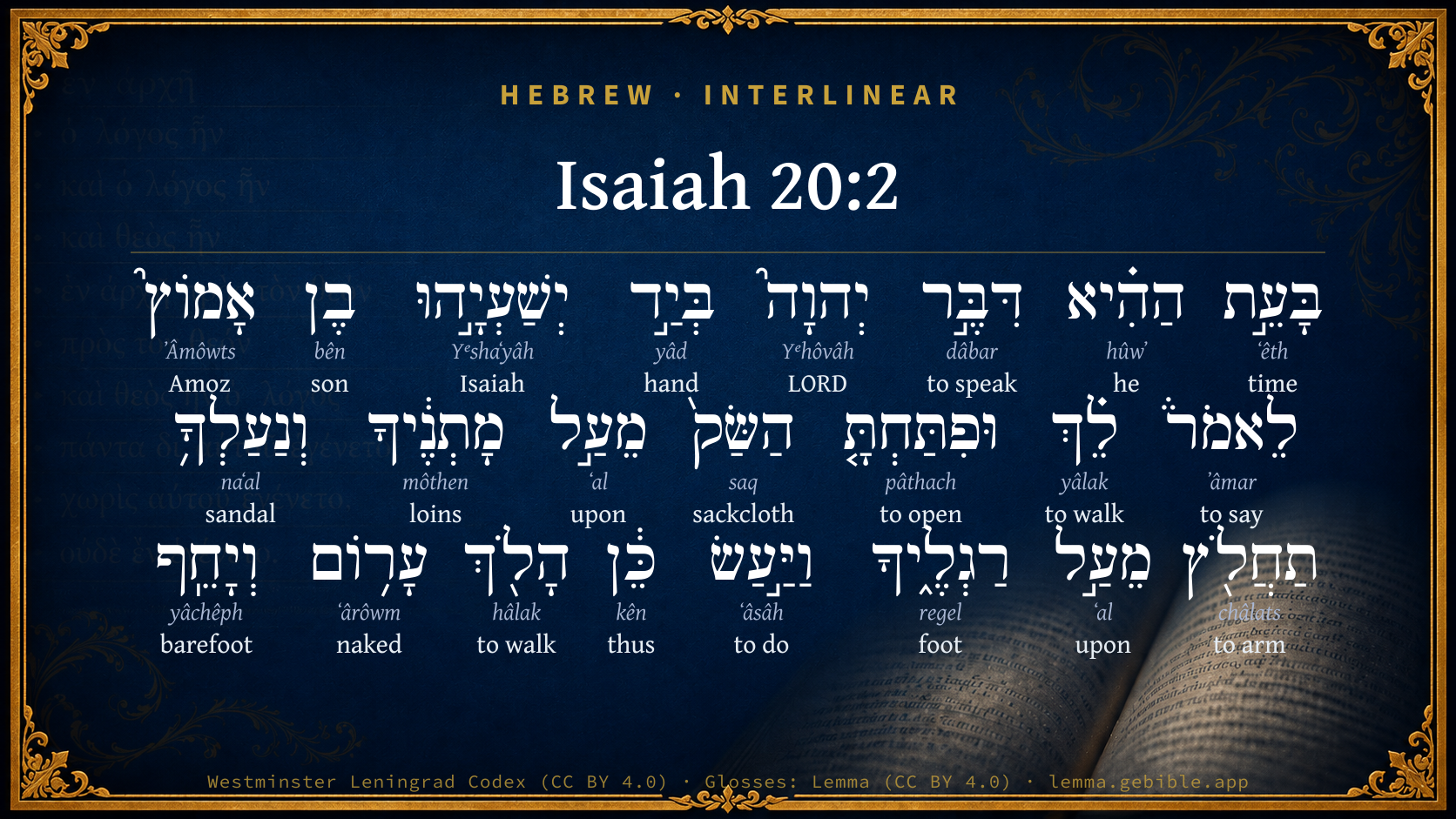
Isaiah 20:2

Hebrew (Westminster Leningrad Codex) Isaiah 20:2 appears in the Hebrew Old Testament. The text above is from the Westminster Leningrad Codex. Each word links to its Strong’s number, a concise gloss, and parsing drawn from the Open Scriptures Hebrew Bible morphology. Click any word for its full Brown-Driver-Briggs (BDB) entry.
Download image
Cite this verse

Isaiah 20:2 (World English Bible). Public Domain. Lemma interlinear Bible study tool, https://lemma.gebible.app/v/isaiah/20/2.

Show BibTeX & RIS
BibTeX
RIS
English Translation
at that time Yahweh spoke by Isaiah the son of Amoz, saying, Go, and loose the sackcloth from off your loins, and put your shoe from off your foot. He did so, walking naked and barefoot.
World English Bible · Public Domain
Download a study sheet

One document with this verse’s original text, its word-by-word gloss line, the meaning frame, cross-references with their text, attributed commentary, and full source and license credits — printable, and it pastes into notes with its structure intact.

This verse Autodidact and up

Study sheet (.html) Plain text (.txt)

A passage Seminary Student

Up to 50 verses in one chapter. A passage sheet keeps up to 6 commentary sources and 12 cross-references per verse, in the order this page ranks them, and says so on the sheet whenever that leaves anything out. Ask for a single verse and you get the Autodidact verse sheet above.

Everything on this page stays free to read, with no account — the sheet is a download of what is already on screen, not access to it.

Want to remove ads? Support Godless Engineer
Compare translations 3

The same verse in 3 English versions, stacked beneath the original-language interlinear above. Click any original word for its lexicon entry.

Each is an independent rendering of the whole verse — the interlinear is not word-aligned to these translations.

Highlighted words mark where these versions differ — a whole-verse word diff, not a word-by-word alignment.

  • World English Bible Public Domain
    at that time Yahweh spoke by Isaiah the son of Amoz, saying, Go, and loose the sackcloth from off your loins, and put your shoe from off your foot. He did so, walking naked and barefoot.
  • King James Version Public Domain
    At the same time spake the LORD by Isaiah the son of Amoz, saying, Go and loose the sackcloth from off thy loins, and put off thy shoe from thy foot. And he did so, walking naked and barefoot.
  • unfoldingWord Literal Text CC BY-SA 4.0
    at that time Yahweh spoke by the hand of Isaiah, the son of Amoz, saying, “Go, and you shall loosen the sackcloth from upon your waist, and you shall remove your sandal from upon your feet.” And he did thus, going naked and barefoot.

unfoldingWord Literal Text — © unfoldingWord, licensed CC BY-SA 4.0. Word-aligned USFM3 via Door43 (git.door43.org/unfoldingWord/en_ult).

Versions to compare (up to 4)

3 of 4 selected

Show all 18 translations

Every available English version of this verse, each an independent rendering of the whole verse.

  • World English Bible Public Domain
    at that time Yahweh spoke by Isaiah the son of Amoz, saying, Go, and loose the sackcloth from off your loins, and put your shoe from off your foot. He did so, walking naked and barefoot.
  • Berean Standard Bible Public Domain
    the LORD had already spoken through Isaiah son of Amoz, saying, “Go, remove the sackcloth from your waist and the sandals from your feet.” And Isaiah did so, walking around naked and barefoot.
  • Majority Standard Bible Public Domain
    the LORD had already spoken through Isaiah son of Amoz, saying, “Go, remove the sackcloth from your waist and the sandals from your feet.” And Isaiah did so, walking around naked and barefoot.
  • King James Version Public Domain
    At the same time spake the LORD by Isaiah the son of Amoz, saying, Go and loose the sackcloth from off thy loins, and put off thy shoe from thy foot. And he did so, walking naked and barefoot.
  • American Standard Version (1901) Public Domain
    at that time Jehovah spake by Isaiah the son of Amoz, saying, Go, and loose the sackcloth from off thy loins, and put thy shoe from off thy foot. And he did so, walking naked and barefoot.
  • Revised Version (1885) Public Domain
    at that time the LORD spake by Isaiah the son of Amoz, saying, Go, and loose sackcloth from off thy loins, and put thy shoe from off thy foot. And he did so, walking naked and barefoot.
  • Geneva Bible (1599) Public Domain
    At the same time spake the Lord by ye hand of Isaiah the sonne of Amoz, saying, Goe, and loose the sackecloth from thy loynes, and put off thy shooe from thy foote. And he did so, walking naked and barefoote.
  • Douay-Rheims (1899) Public Domain
    At that same time the Lord spoke by the hand of Isaias the son of Amos, saying: Go, and loose the sackcloth from off thy loins, and take off thy shoes from thy feet. And he did so, and went naked, and barefoot.
  • Young's Literal Translation Public Domain
    at that time spake Jehovah by the hand of Isaiah son of Amoz, saying, `Go, and thou hast loosed the sackcloth from off thy loins, and thy sandal thou dost draw from off thy foot,' and he doth so, going naked and barefoot.
  • Literal Standard Version CC BY-SA 4.0
    at that time YHWH spoke by the hand of Isaiah son of Amoz, saying, “Go, and you have loosed the sackcloth from off your loins, and you draw your sandal from off your foot,” and he does so, going naked and barefoot.
  • Unlocked Literal Bible CC BY-SA 4.0
    At that time Yahweh spoke by Isaiah son of Amoz and said, “Go and remove the sackcloth from your waist, and take your sandals off your feet.” He did so, walking naked and barefoot.
  • unfoldingWord Literal Text CC BY-SA 4.0
    at that time Yahweh spoke by the hand of Isaiah, the son of Amoz, saying, “Go, and you shall loosen the sackcloth from upon your waist, and you shall remove your sandal from upon your feet.” And he did thus, going naked and barefoot.
  • Darby Bible Public Domain
    at that time spoke Jehovah by Isaiah the son of Amoz, saying, Go and loose the sackcloth from off thy loins, and put off thy sandal from thy foot. And he did so, walking naked and barefoot.
  • World Messianic Bible Public Domain
    at that time the LORD spoke by Isaiah the son of Amoz, saying, “Go, and loosen the sackcloth from off your waist, and take your sandals from off your feet.” He did so, walking naked and barefoot.
  • Webster's Bible Public Domain
    At the same time spoke the LORD by Isaiah the son of Amoz, saying, Go, and loose the sackcloth from off thy loins, and put off thy shoe from thy foot. And he did so, walking naked and barefoot.
  • Free Bible Version CC BY-SA 4.0
    at that time the Lord spoke through Isaiah, son of Amoz. He told him, “Take off the sackcloth clothes from your body and remove your sandals.” Isaiah did so and went around naked and barefoot.
  • Bible in Basic English Public Domain
    At that time the word of the Lord came to Isaiah, the son of Amoz, saying, Go, and take off your robe, and your shoes from your feet; and he did so, walking unclothed and without shoes on his feet.
  • JPS Tanakh (1917) Public Domain
    at that time the LORD spoke by Isaiah the son of Amoz, saying: 'Go, and loose the sackcloth from off thy loins, and put thy shoe from off thy foot.' And he did so, walking naked and barefoot.

Literal Standard Version (2020), Covenant Press — licensed CC BY-SA 4.0. Text via the HelloAO Bible API (eBible.org). Unlocked Literal Bible (unfoldingWord) — licensed CC BY-SA 4.0. Text via the HelloAO Bible API (eBible.org). unfoldingWord Literal Text — © unfoldingWord, licensed CC BY-SA 4.0. Word-aligned USFM3 via Door43 (git.door43.org/unfoldingWord/en_ult). Free Bible Version, Dr. Jonathan Gallagher — licensed CC BY-SA 4.0. Text via the HelloAO Bible API (eBible.org).

Word by word

More ways to search: Search by grammar → Find every occurrence → Compare this word →

Practice this passage: Drill this verse → Learn its vocabulary →

וְיָחֵֽף
yâchêph
H3182
“and · barefoot”
Conjunction + Adjective, Adjective, Masculine, Singular, Absolute
Part of Speech
Conjunction + Adjective
Type
Adjective
Gender
Masculine
Number
Singular
State
Absolute
Full BDB Definition

Origin: from an unused root meaning to take off the shoes

TWOT: 861a

barefoot - bareness, being unshod (substantive)
  1. בָּעֵ֣ת ʻêth H6256 “in/at the · time” Preposition, Determined + Noun, Common, Both, Singular, Absolute
  2. הַהִ֗יא hûwʼ H1931 “the · he” Particle, Definite Article + Pronoun, Personal, 3rd Person, Feminine, Singular
  3. דִּבֶּ֣ר dâbar H1696 “to speak” Verb, Piel, Perfect, 3rd Person, Masculine, Singular
  4. יְהוָה֮ Yᵉhôvâh H3068 “LORD” Noun, Proper
  5. בְּיַ֣ד yâd H3027 “in/at · hand of” Preposition + Noun, Common, Both, Singular, Construct
  6. יְשַׁעְיָ֣הוּ Yᵉshaʻyâh H3470 “Isaiah” Noun, Proper
  7. בֶן bên H1121 “son of” Noun, Common, Masculine, Singular, Construct
  8. אָמוֹץ֮ ʼÂmôwts H531 “Amoz” Noun, Proper
  9. לֵאמֹר֒ ʼâmar H559 “to say” Preposition + Verb, Qal, Infinitive Construct
  10. לֵ֗ךְ yâlak H3212 “walk” Verb, Qal, Imperative, 2nd Person, Masculine, Singular
  11. וּפִתַּחְתָּ֤ pâthach H6605 “and · to open” Conjunction + Verb, Piel, Sequential Perfect, 2nd Person, Masculine, Singular
  12. הַשַּׂק֙ saq H8242 “the · sackcloth” Particle, Definite Article + Noun, Common, Masculine, Singular, Absolute
  13. מֵעַ֣ל ʻal H5921 “from · upon” Preposition + Preposition
  14. מָתְנֶ֔יךָ môthen H4975 “loins · your” Noun, Common, Masculine, Dual, Construct + Suffix, Personal, 2nd Person, Masculine, Singular
  15. וְנַעַלְךָ֥ naʻal H5275 “and · sandal · your” Conjunction + Noun, Common, Feminine, Singular, Construct + Suffix, Personal, 2nd Person, Masculine, Singular
  16. תַחֲלֹ֖ץ châlats H2502 “to arm” Verb, Qal, Imperfect, 2nd Person, Masculine, Singular
  17. מֵעַ֣ל ʻal H5921 “from · upon” Preposition + Preposition
  18. רַגְלֶ֑יךָ regel H7272 “feet · your” Noun, Common, Feminine, Dual, Construct + Suffix, Personal, 2nd Person, Masculine, Singular
  19. וַיַּ֣עַשׂ ʻâsâh H6213 “and · to do” Conjunction + Verb, Qal, Sequential Imperfect, 3rd Person, Masculine, Singular
  20. כֵּ֔ן kên H3651 “thus” Particle, Demonstrative
  21. הָלֹ֖ךְ hâlak H1980 “to walk” Verb, Qal, Infinitive Absolute
  22. עָר֥וֹם ʻârôwm H6174 “naked” Adjective, Adjective, Masculine, Singular, Absolute

About this verse

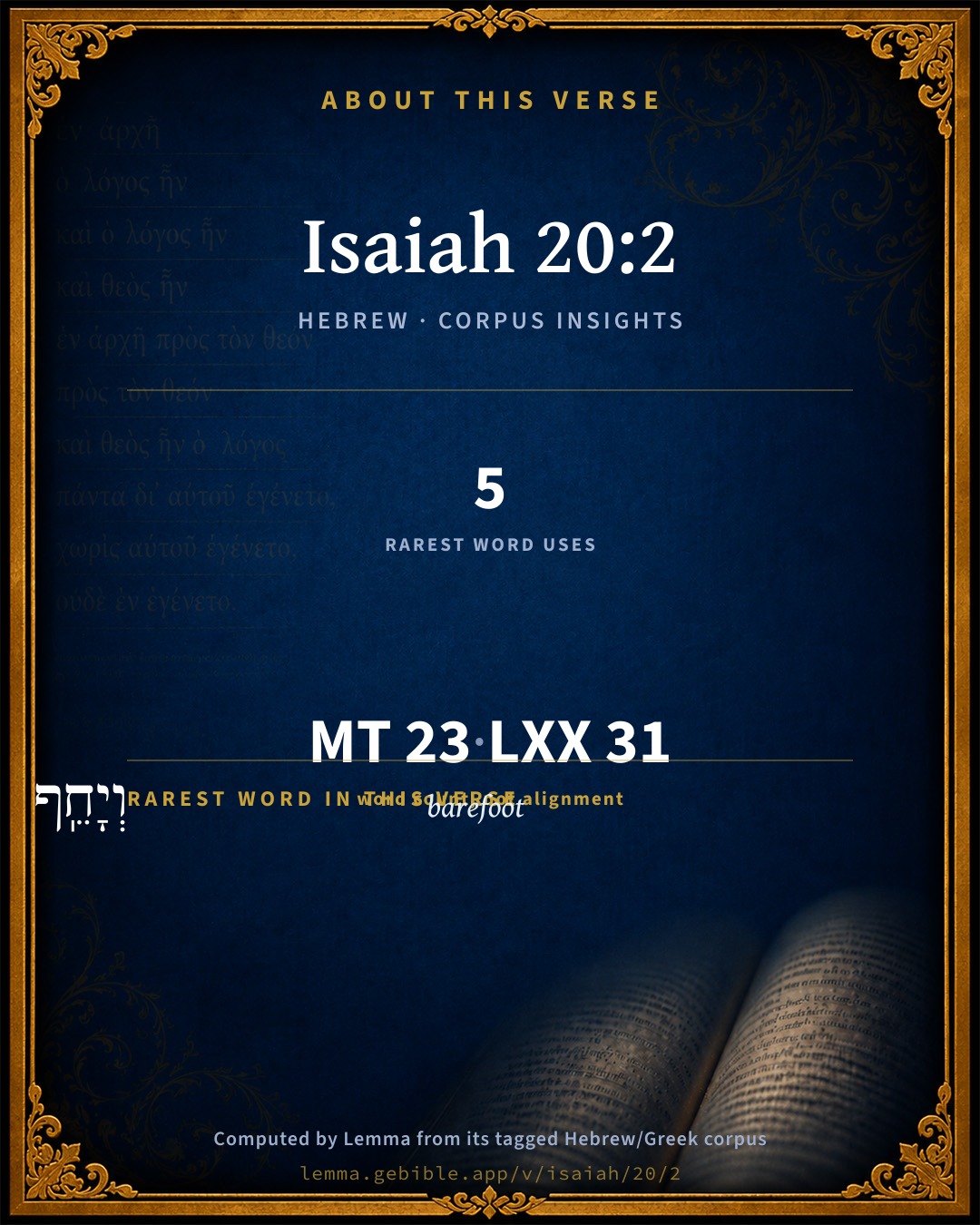
These counts appear in no published source. They are computed here, from the morphology-tagged text and Lemma’s own curated glosses. What Lemma adds →

23
words
22
distinct lemmas
Prophets
section

Notable vocabulary

The rarest word here is וְיָחֵֽף barefoot H3182 — appearing just 5 times in the whole Hebrew Bible.

Shared distinctive vocabulary

וְיָחֵֽף barefoot H3182 occurs in 5 verses of the Hebrew Bible. Also found in:

Grammatical profile

  • 7 verbs
  • 10 nouns
  • 2 adjectives
  • 1 pronoun
  • 2 prepositions
  • 1 particle

Verb forms

  • דִּבֶּ֣ר Piel · Perfect
  • לֵאמֹר֒ Qal · Infinitive Construct
  • לֵ֗ךְ Qal · Imperative
  • וּפִתַּחְתָּ֤ Piel · Sequential Perfect
  • תַחֲלֹ֖ץ Qal · Imperfect
  • וַיַּ֣עַשׂ Qal · Sequential Imperfect
  • הָלֹ֖ךְ Qal · Infinitive Absolute

Repetition

A word recurs within this verse — often emphatic in Hebrew:

  • מֵעַ֣ל upon H5921 ×2

Hebrew & Septuagint length

In English translation the verse runs 36 words from the Hebrew and 34 from the Septuagint (LXX English) — closely comparable.

A rough comparison of the two English renderings, which tokenize alike — not a word-level alignment.

Word counts can differ between the Hebrew and the Greek without any difference in meaning — e.g. the Hebrew direct-object marker אֵת has no separate Greek word, and Greek often adds the article ὁ.

In the original languages it is 23 Hebrew tokens and 31 Greek tokens — but the two are counted differently (Hebrew bundles its prefixes and suffixes into one token; the Greek is in lemma form), so that isn’t a like-for-like length.

Cross-references

20

Topical passages linked to Isaiah 20:2 in the Treasury of Scripture Knowledge — connected by theme and wording, ordered by reader-vote popularity; previews shown in the World English Bible.

  • 1 Samuel 19:24 He also stripped off his clothes, and he also prophesied before Samuel, and lay down naked all that day and all that night. Therefore they say, "Is Saul also among the prophets?"
  • Micah 1:8 For this I will lament and wail; I will go stripped and naked; I will howl like the jackals, And moan like the daughters of owls.
  • Matthew 3:4 Now John himself wore clothing made of camel's hair, with a leather belt around his waist. His food was locusts and wild honey.
  • Ezekiel 24:17 Sigh, but not aloud, make no mourning for the dead; bind your headdress on you, and put your shoes on your feet, and don't cover your lips, and don't eat men's bread.
  • Ezekiel 24:23 Your tires shall be on your heads, and your shoes on your feet: you shall not mourn nor weep; but you shall pine away in your iniquities, and moan one toward another.
  • Zechariah 13:4 It will happen in that day, that the prophets will each be ashamed of his vision, when he prophesies; neither will they wear a hairy mantle to deceive:
  • Isaiah 13:1 The burden of Babylon, which Isaiah the son of Amoz did see.
  • Micah 1:11 Pass on, inhabitant of Shaphir, in nakedness and shame. The inhabitant of Zaanan won't come out. The wailing of Beth Ezel will take from you his protection.
  • Exodus 3:5 He said, "Don't come close. Take off your sandals from off your feet, for the place you are standing on is holy ground."
  • Joshua 5:15 The prince of Yahweh's host said to Joshua, Put off your shoe from off your foot; for the place whereon you stand is holy. Joshua did so.
  • 2 Samuel 6:20 Then David returned to bless his household. Michal the daughter of Saul came out to meet David, and said, How glorious was the king of Israel today, who uncovered himself today in the eyes of the handmaids of his servants, as one of the vain fellows shamelessly uncovers himself!
  • 2 Kings 1:8 They answered him, He was a hairy man, and girt with a belt of leather about his loins. He said, It is Elijah the Tishbite.
  • Job 1:20–21 Then Job arose, and tore his robe, and shaved his head, and fell down on the ground, and worshiped.
  • Jeremiah 13:1–11 Thus says Yahweh to me, Go, and buy you a linen belt, and put it on your loins, and don't put it in water.
  • Jeremiah 19:1–15 Thus said Yahweh, Go, and buy a potter's earthen bottle, and [take] of the elders of the people, and of the elders of the priests;
  • Ezekiel 4:5 For I have appointed the years of their iniquity to be to you a number of days, even three hundred ninety days: so shall you bear the iniquity of the house of Israel.
  • Matthew 16:24 Then Jesus said to his disciples, "If anyone desires to come after me, let him deny himself, and take up his cross, and follow me.
  • John 21:7 That disciple therefore whom Jesus loved said to Peter, "It's the Lord!" So when Simon Peter heard that it was the Lord, he wrapped his coat around him (for he was naked), and threw himself into the sea.
  • Acts 19:16 The man in whom the evil spirit was leaped on them, and overpowered them, and prevailed against them, so that they fled out of that house naked and wounded.
  • Revelation 11:3 I will give power to my two witnesses, and they will prophesy one thousand two hundred sixty days, clothed in sackcloth."

Cross-references courtesy of OpenBible.info (CC BY 4.0).

Hebrew and Greek witnesses Masoretic Hebrew ↔ Greek Septuagint

The same verse in the two great witnesses to the Old Testament, shown verse-for-verse.

These are two independent witnesses, not word-aligned to each other, and the Septuagint is shown in lemma (dictionary) form.

Hebrew Isaiah 20:2 Masoretic · Westminster Leningrad Codex

בָּעֵ֣ת הַהִ֗יא דִּבֶּ֣ר יְהוָה֮ בְּיַ֣ד יְשַׁעְיָ֣הוּ בֶן אָמוֹץ֮ לֵאמֹר֒ לֵ֗ךְ וּפִתַּחְתָּ֤ הַשַּׂק֙ מֵעַ֣ל מָתְנֶ֔יךָ וְנַעַלְךָ֥ תַחֲלֹ֖ץ מֵעַ֣ל רַגְלֶ֑יךָ וַיַּ֣עַשׂ כֵּ֔ן הָלֹ֖ךְ עָר֥וֹם וְיָחֵֽף

at that time Yahweh spoke by Isaiah the son of Amoz, saying, Go, and loose the sackcloth from off your loins, and put your shoe from off your foot. He did so, walking naked and barefoot.

World English Bible · Public Domain

Greek LXX Isaiah 20:2 Septuagint · lemma form

τότε λαλέω κύριος πρός ησαιαν λέγω πορεύομαι καί ἀποαἱρέω ὁ σάκκος ἀπό ὁ ὀσφύς σύ καί ὁ σανδάλιον σύ ὑπολύω ἀπό ὁ πούς σύ καί ποιέω οὕτως πορεύομαι γυμνός καί ἀνυπόδετος

then the Lord spoke to Esaias the son of Amos, saying, Go and take the sackcloth off your loins, and loose your sandals from off your feet, and do thus, going naked and barefoot.

LXX2012 (modern English Septuagint) · Public Domain

On this verse, Adam Clarke's Commentary discusses the Septuagint’s reading. Read the note in Commentary ↓

Hebrew: Westminster Leningrad Codex (CC BY 4.0). Greek: Septuagint (public domain); English from LXX2012 (modern English Septuagint) (Public Domain). How the Septuagint differs from the Hebrew →

Targum (Aramaic paraphrase)

1

The Targum is the ancient Jewish Aramaic paraphrase of the Hebrew Scriptures — an interpretive translation, not the Hebrew text itself. Onkelos (literal) and Pseudo-Jonathan (expansive) render the Torah, and Jonathan the Prophets. Coverage is partial: where no permissively-licensed English translation exists for a verse, only the Aramaic is shown. This is verse-level text, not a word-by-word alignment to the Hebrew.

  1. Targum Jonathan Prophets (Joshua–Malachi)
    בְּעִדָנָא הַהִיא גְזַר יְיָ בְּיַד יְשַׁעְיָה בַּר אָמוֹץ לְמֵימָר אֱזֵיל וְתֵיסַר סַקָא בְחַרְצָךְ וּמְסָנָךְ תִּשְׁלוֹף מֵעַל רִגְלָךְ וַעֲבַד כֵּן אָזַל פָחֵיחַ וְיָחֵף:

    At that time the Lord decreed by Isaiah, the son of Amoz, saying, Go and remove the sackcloth which is on thy loins, and put off thy sandals from off thy feet: and he did so, walking naked and barefoot.

    Targum Jonathan — Aramaic: “Mikraot Gedolot” (public domain). English: “Sefaria Community Translation” (CC0 1.0 (public-domain dedication)); “London "Chaldee Paraphrase," 1871” (public domain). Text via Sefaria.

Commentary

Notes on Isaiah 20:2 from classic Christian and Jewish commentators (each source and its license shown beneath its notes). The classic Christian expositions comment on the surrounding passage and are grouped to its opening verse, so a note may address several verses; the Jewish commentaries on the Tanakh (Rashi and others) are per-verse, so they appear only where the commentator wrote on this verse.

Lemma curates 59 commentaries, every one of them public domain or Creative Commons licensed, each selected and text-cleaned for this edition rather than reprinted as found. About our sources →

Trapp's Complete Commentary

John Trapp

Isa 20:2 At the same time spake the LORD by Isaiah the son of Amoz, saying, Go and loose the sackcloth from off thy loins, and put off thy shoe from thy foot. And he did so, walking naked and barefoot.

Ver. 2. At the same time spake the Lord.] Against Egypt and Ethiopia, whom he had comforted, Isa 19:18-19, and yet now again threateneth; showing by an ocular demonstration {a} what miseries should befall them. This was done in Jewry; but the report thereof might easily come to these confederate countries, and the Jews, howsoever, were given hereby to see how vain a thing it was to trust to such confederates.

By Isaiah the son of Amoz.] Heb., By the hand of Isaiah, whom God used as a dispenser of this precious treasure.

Go, loose the sackcloth from off thy loins,] i.e., Thy thick rough garment, {b} such as prophets usually wore. {2Ki 1:8 Zec 13:4 Mat 3:4} Or else thy sackcloth put on as a mourning weed, either for ten tribes lately carried captive, or else for the miseries ready to fall shortly upon thine own people.

And put off thy shoe from thy foot.] The Nudipedales in Moravia might as well avouch Isaiah for their founder as the Carmelites do Elias.

And he did so.] God is to be obeyed without hesitation: his commands, how unreasonable soever they may seem, are not to be disputed, but despatched.

Walking naked.] Not stark naked, but stripped as a prisoner, his mantle or upper garment cast off. See 1Sa 19:24 Act 19:16 Mic 1:8.

{a} οφθαλμοειδως, i.e., Per Isaiam tanquam organum et dispensatorem suorum myster. - Oecolamp.

{b} Vestimentum vilosum.

John Trapp, A Commentary or Exposition upon All the Books of the Old and New Testament (1647–1656) — public domain. Text from a community e-Sword module.

The Biblical Illustrator

Joseph S. Exell

Isa_20:2

Go and loose the sackcloth from off thy loins

Isaiah stripped and barefooted

Owing to the great importance which is attributed to clothing from the standpoint of Oriental culture and manners, anyone who appears without the upper garment is already regarded as naked and bare.

Isaiah has to lay off the garment of the preacher of repentance and of the mourner, so that only his tunic remains; and in this dress, and moreover barefooted, he has to appear in public. It is the costume of a man who had been robbed and disgraced, of a beggar, it may be, or a prisoner of war. (F. Delitzsch.)

Gods appointment magnifies mean things

The appointment of God renders those things and actions which in themselves seem mean and contemptible, momentous and useful: it stamps them with real dignity and importance, and makes them truly instructive. View the ceremonial institutions of the Old Testament, such as circumcision, abstinence from particular kinds of food and of raiment, uncleanness contracted by touching certain objects, and sprinkling the tabernacle with blood, and they appear trifling and ridiculous. Contemplate them again as the ordinances of God, infinitely wise and gracious, and you may discern their excellence and extensive utility. Look at our prophet as he is here described, and you see an odd appearance; but consider him acting by Divine commission, that he might represent to his countrymen the future naked and destitute condition to which those nations were to be reduced in whom they foolishly placed their confidence, and every circumstance acquires new consequence. (R. Macculloch.)

Isaiahs obedience

When we are in the way of our duty we must trust God both with our credit and with our safety. (M. Henry.)

Gods purpose dignifies what might otherwise be scandalous

If the dress was scandalous, yet the design was glorious. (M. Henry.)

The Biblical Illustrator, edited by Joseph S. Exell (c. 1880s–1900s) — public domain. Text from a community e-Sword module.

Joseph Benson's Commentary

Isa 20:2. Go loose the sackcloth from off thy loins — By the sackcloth is meant either the hairy garment usually worn by the prophets, or a mournful habit, such as was commonly made of sackcloth which he wore in token of his grief for the great calamities that were already come upon Israel, and were coming on Judah. And he did so, walking naked and barefoot — Not wholly naked, but without his upper garment; as slaves and prisoners used to do, whose condition he was to represent. This action was both agreeable to the mode of instruction made use of in those times, and, as it was intended to excite the attention of the Israelites, was likewise very well adapted to promote that intention. — Vitringa.

Joseph Benson's Commentary on the Old and New Testaments (1811–1818) — public domain. Text from a community e-Sword module.

Tyndale Open Study Notes

Tyndale Open Resources

20:2 Prophets characteristically wore burlap or other rough clothing as a sign of mourning over the sins of the people (see 2 Kgs 1:8; Mark 1:6). • naked: That is, exposed in some way, possibly even completely nude.

Tyndale Open Study Notes — © Tyndale Open Resources, licensed CC BY-SA 4.0. Text via the HelloAO Bible API.

Geneva Bible (1599)

Geneva Bible translators

Which signifieth that the Prophet did lament the misery that he saw prepared, before the three years that he went naked and barefooted.

Geneva Bible (1599) marginal notes — public domain. Text via Bolls.life.

Jamieson, Fausset & Brown

Robert Jamieson, A. R. Fausset & David Brown

by--literally, "by the hand of" (compare Eze 3:14).

sackcloth--the loose outer garment of coarse dark hair-cloth worn by mourners (Sa2 3:31) and by prophets, fastened at the waist by a girdle (Mat 3:4; Kg2 1:8; Zac 13:4).

naked--rather, "uncovered"; he merely put off the outer sackcloth, retaining still the tunic or inner vest (Sa1 19:24; Amo 2:16; Joh 21:7); an emblem to show that Egypt should be stripped of its possessions; the very dress of Isaiah was a silent exhortation to repentance.

Jamieson, Fausset & Brown — Commentary Critical and Explanatory on the Whole Bible (1871) — public domain (CC PDM 1.0). Text via the HelloAO Bible API.

Adam Clarke's Commentary

Verse 2. Walking naked and barefoot.] It is not probable that the prophet walked uncovered and barefoot for three years; his appearing in that manner was a sign that within three years the Egyptians and Cushites should be in the same condition, being conquered and made captives by the king of Assyria. The time was denoted as well as the event; but his appearing in that manner for three whole years could give no premonition of the time at all. It is probable, therefore, that the prophet was ordered to walk so for three days to denote the accomplishment of the event in three years; a day for a year, according to the prophetical rule, Nu 14:34; Eze 4:6. The words שלש ימים shalosh yamim, three days, may possibly have been lost out of the text, at the end of the second verse, after יחף yacheph, barefoot; or after the same word in the third verse, where, in the Alexandrine and Vatican copies of the Septuagint, and in MSS. Pachom. and I. D. II. the words τρια ετη, three years, are twice expressed. Perhaps, instead of שלש ימים shalosh yamim, three days, the Greek translator might read שלש שנים shalosh shanim, three years, by his own mistake, or by that of his copy, after יחף yacheph in the third verse, for which stands the first τρια ετη, three years, in the Alexandrine and Vatican Septuagint, and in the two MSS. above mentioned. It is most likely that Isaiah's walking naked and barefoot was done in a vision; as was probably that of the Prophet Hosea taking a wife of whoredoms. None of these things can well be taken literally.

From thy foot] רגליך ragleycha, thy feet, is the reading of thirty-four of Kennicott's and De Rossi's MSS., four ancient editions, with the Septuagint, Syriac, Vulgate, and Arabic.

Adam Clarke's Commentary on the Bible (1810–1826) — public domain. Text from a community e-Sword/MySword module.

Ellicott's Commentary for English Readers

(2) Go and loose the sackcloth from off thy loins.—Against these schemes Isaiah was prompted to prophesy in act as well as words. Month by month, for three whole years, he was seen in the streets of Jerusalem as one who was already as a prisoner of war, ready to be led into an ignominious exile. The “sackcloth” was the “rough garment” which, like Elijah (2Ki_1:8) and John the Baptist, the prophets habitually wore (Zec_13:4), and the “nakedness” was confined to the laying aside this outer robe, and appearing in the short tunic worn near the body (1Sa_19:24; 2Sa_6:14-20; Joh_21:7). Like instances of prophetic symbolism are the horns of Zedekiah in 1Ki_22:11, the yokes worn by Jeremiah (Jer_27:2), Ezekiel’s lying on his side (Eze_4:4), and the girdle with which Agabus bound himself (Act_21:11).

A Bible Commentary for English Readers, edited by Charles John Ellicott (1878–1897) — public domain. Text from a community e-Sword module.

The Cambridge Bible for Schools and Colleges

gen. ed. J. J. S. Perowne

2. This verse is an explanatory parenthesis. The command here mentioned must have been given three years before the oracle of Isa_20:3 ff.; hence the expression “at that time” must be understood in a loose sense and for spake we must render “had spoken.”

sackcloth] the rough garment of hair or coarse linen worn by mourners in lieu of the customary upper garment; also by prophets (2Ki_1:8; Zec_13:4). It is rather surprising to find that Isaiah wore this distinctive badge of his profession. He is directed to “ungird” (and lay aside) this and walk “naked,” i.e. in his under-garment (the kuttôneth), cf. 1Sa_19:24; Joh_21:7. The action was expressive of the deepest degradation, and involved no small sacrifice for a man of Isaiah’s position. But that he actually performed it cannot reasonably be questioned. Cf. Mic_1:8.

3, resuming Isa_20:1, gives the interpretation of the symbol.

my servant Isaiah] Isaiah is Jehovah’s “servant” as a prophet. Cf. Amo_3:7; Num_12:7.

sign and wonder] see ch. Isa_8:18. By the accents the words “three years” are attached to this clause in order to convey the sense “a three-years’ sign,” meaning “a sign of an event which is to happen after three years.” But this is very unnatural, and was evidently suggested by a desire to avoid the notion that the action was kept up for so long a time.

upon Egypt and upon Ethiopia] Ethiopia was at this time the paramount influence in the Nile-valley, Upper Egypt being completely under its sway, while Lower Egypt was divided amongst a number of petty princes. The Sab’é, or Sib‘i (? Sevé), whom Sargon defeated in 720 is usually identified with the Ethiopian Sabako. Winckler, however, doubts this, and takes Sab’é to have been one of the small kings of the Delta. (See also Cheyne’s Note in 2nd Ed. of Robertson Smith’s Prophets of Israel, p. 428.) “Upon” may be either against or concerning.

The Cambridge Bible for Schools and Colleges (gen. ed. J. J. S. Perowne; Cambridge University Press, 1878–1918) — public domain. Text from a community e-Sword module.

John Gill's Exposition

At the same time spake the Lord by Isaiah the son of Amoz,.... Or, "by the hand of Isaiah", by his means; and it was to him likewise, as the following words show; and so the Septuagint version renders it; he spoke by him, by the sign he used, according to his order, and he spoke to him to use the sign:

saying; so the Arabic version, "with him"; and with these versions Noldius agrees:

go, and loose the sackcloth from off thy loins; a token of mourning, and which the prophet wore, as Kimchi thinks, because of the captivity of the ten tribes; and it may be also on account of the miseries that were coming upon the people of the Jews; though some think this was his common garb, and the same with the royal garment the prophets used to wear, Zac 13:4 but that he had put off, and had put on sackcloth in its room, which he is now bid to take off:

and put off thy shoe from thy foot; as a sign of distress and mourning also, Sa2 15:30,

and he did so, walking naked and barefoot; Kimchi thinks this was only visionally, or in the vision of prophecy, as he calls it, and not in reality; but the latter seems most probable, and best to agree with what follows; for he was obedient to the divine command, not regarding the disgrace which might attend it, nor the danger of catching cold, to which he was exposed; and hence he has the character of a servant of the Lord, in the next words, and a faithful obedient one he was.

John Gill's Exposition of the Whole Bible (1746–1763) — public domain (CC PDM 1.0). Text via the HelloAO Bible API.

Albert Barnes' Notes on the Bible

By Isaiah - Margin, ‘By the hand of Isaiah.’ So the Hebrew. That is, by the instrumentality of Isaiah. He sent him to make known the fate of the Egyptians, and the folly of trusting in them on this occasion.

Go, and loose the sackcloth - For the meaning of the word “sackcloth,” see the note at Isa 3:24. It was commonly worn as an emblem of mourning. But there is reason to believe that it was worn also by the prophets, and was regarded, in some degree, as their appropriate dress. It was made usually of the coarse hair of the goat, and was worn as a zone or girdle around the loins. That this was the dress of Elijah is apparent from 2Ki 1:8 : ‘He was an hairy man, and girt with a girdle of leather;’ that is, he was clothed in a garment made of hair. The same was true of John the Baptist Mat 3:4. That the prophets wore ‘a rough garment’ is apparent also from Zec 13:4 : ‘Neither shall they (the false prophets) wear a rough garment (Hebrew, A garment of hair) to deceive;’ that is, the false prophets shall not assume the dress of the true prophets for the purpose of deluding the people, or to make them think that they are true prophets. It is evident, therefore, that this hairy garment was regarded as a dress that pertained particularly to the prophets. It is well known, also, that the ancient Greek philosophers had a special dress to distinguish them from the common people. Probably the custom of wearing “hair cloth” among the monks of later ages took its rise from this example of the prophets. His removing this garment was designed to be a sign or an emblem to show that the Egyptians should be stripped of all their possessions, and carried captive to Assyria.

Walking naked - That is, walking “without this special prophetic garment. It does not mean that he was in a state of entire nudity, for all that he was directed to do was to lay this garment - this emblem of his office - aside. The word “naked,” moreover, is used in the Scriptures, not to denote an absolute destitution of clothing, but that the “outer” garment was laid aside (see the note at Joh 21:7). Thus it is said of Saul 1Sa 19:24 that he ‘stripped off his clothes also, and prophesied before Samuel, and lay down naked all that day;’ that is, he stripped off his royal robes, and was “naked or unclothed” in that respect. He removed his “special” dress as a king, or military chieftain, and appeared in the ordinary dress. It cannot be supposed that the king of Israel would be seen literally without raiment. So David is said to have danced “naked” before the ark, that is, with his royal robes laid aside. How “long” Isaiah walked in this manner has been a matter of doubt (see the note at Isa 20:3). The prophets were accustomed to use symbolic actions to denote the events which they foretold (see the note at Isa 8:18). Thus the children of Isaiah, and the names given to them, were significant of important events (Isa 8:1-3; compare Jer 18:1-6; Jer 43:8-9); in both of which places he used emblematic actions to exhibit the events concerning which he prophesied in a striking manner. Thus also the prophets are expressly called ‘signs and wonders’ Zec 3:8; Eze 12:6.

Albert Barnes' Notes on the Bible (1834–1885) — public domain. Text from a community e-Sword/MySword module.

Haydock's Catholic Bible Commentary

Sackcloth. The prophets lived in poverty, Zacharias xiii. 4. Their persons were prophetic. It is not agreed whether Isaias went quite naked, or only without his upper garment. The former supposition would represent better the condition of slaves, (ver. 4.) and is adopted by St. Jerome, &c. (Calmet) --- People are said to be naked when they are almost so, 2 Kings vi., and John xxi. (Haydock) --- Yet "nothing is more honest than to obey God." (St. Jerome) (Worthington)

George Leo Haydock (1774–1849), Haydock's Catholic Family Bible and Commentary, 1859 edition — public domain. Excludes Psalms (Douay-Rheims chapter numbering differs from Protestant) and Deuterocanonical books (Catholic canon only).

Matthew Poole's English Annotations

Loose the sackcloth; ungird it and put it off; the antecedent put for the consequent, which is very usual, as hath been often noted. God would sometimes have his prophets to add to their word a visible sign, to awaken people’s minds to a more serious consideration of the matters proposed to them.

The sackcloth; either,

1. His coarse and hairy garment, which the prophets used to wear, 2Ki 1:8; Zec 13:4, as many understand it. But that is expressed by another word in the places quoted, and never, to my knowledge, by this word. Or,

2. His mournful habit, which was commonly made of sackcloth, and which he wore in token of his hearty grief for the great calamities which were already come upon Israel, and were either come or coming upon Judah.

From off thy loins; upon which the upper garments were commonly girt, 1Ki 20:32; 2Ki 9.

1.

Walking naked; not wholly naked, which had been indecent and scandalous, and withal very dangerous, at least to do so for three years, as he did, Isa 20:3; but without his upper garment, as slaves and prisoners used to do, whose posture he was to represent, Isa 20:4. And so the word naked is used 1Sa 19:24; 2Sa 6:20; Joh 21:7. Thus also men are said to be naked when they are ill clothed, as Job 22:6; Mat 25:36; 1Co 4:11; Jam 2:15.

Barefoot; after the manner of mourners, 2Sa 15:30, and captives, Jer 2:25.

Matthew Poole's English Annotations on the Holy Bible (1683–1685) — public domain. Text from a community e-Sword/MySword module.

Whedon's Commentary on the Bible

Daniel D. Whedon

2. Loose the sackcloth — An outward garment, and not unfrequently worn as a badge of humiliation, and symbol of unwelcome tidings. It was the habitual covering of the prophet, especially in the dark days of those sieges in the vicinity of Jerusalem on the Philistine plains below. Isaiah, divesting himself of this and of his sandals — thus stripped of all clothing save his undergarment or tunic — was a symbolic prediction, or picture of some unusual suffering. The “sackcloth” was probably of goats’ hair; it was the covering of Elijah, and usually of other — even of false — prophets. Zec_13:4.

Daniel D. Whedon (gen. ed.), Commentary on the Old and New Testaments (1874–1909) — public domain. Text from a community e-Sword module.

The Pulpit Commentary

Loose the sackcloth from off thy loins. Dr. Kay supposes that Isaiah was wearing sackcloth exceptionally, as during a time of mourning. But it is more probable that the Hebrew sak represents the haircloth, ("rough garment," Zec_13:4) which, as ascetics, the Hebrew prophets wore habitually. (2Ki_1:8 Mat_3:4) Walking naked. Probably not actually "naked," for captives were not stripped bare by the Assyrians, but with nothing on besides his short tunic, as the male captives are commonly represented in the Assyrian sculptures.

HOMILIES BY R. TUCK Vers. 2, 3. Divine revelation in actions as well as words.

The language is somewhat uncertain, but it seems better to understand that, for three years, Isaiah was seen going to and fro through the streets of Jerusalem, having the dress and appearance of one who was already a prisoner of war, ready to be led into an ignominious exile. Isaiah wore no upper or outer garment, and no sandals, so that, when his dress was compared with that of others, he might be said to go naked; but "naked" in Scripture usually means "with only under-garments on." The three years were, perhaps, designed to represent three incursions of the Assyrians. The general topic suggested is the variety of forms which Divine revelations may take; the diversity of agencies which Divine revelation may employ. All modes by which man may he reached and influenced God may take up and use for conveying his mind and will.

I REVELATION IN NATURE. We often speak of a voice in nature. That voice God may employ. The beautiful, the sublime, the gentle, affect us, and bring to us thoughts of God"s goodness, wisdom, and power. This kind of revelation St. Paul recognizes, pleading thus at Lystra, (Act_14:17) Nevertheless he left not himself without witness, in that he did good, and gave us rain from heaven, and fruitful seasons, filling our hearts with food and gladness;" and writing thus to the Romans, (Rom_1:20) "For the invisible things of him from the creation of the world are clearly seen, being understood by the things that are made, even his eternal power and Godhead." What is called natural religion is that common knowledge of God, and of our duty to God, which comes through nature alone; and God has so made us kin with nature, has so set us in relation with an external world, that we can receive moral impressions through it.

II REVELATION IN INCIDENTS. Events of personal life and of public history convey God"s mind to us. And therefore so much of our Bible is but a treasured record of facts and incidents. Our Lord"s life on the earth was full of incidents, and we find in these the truths which God purposed, by Christ, to teach us. We are constantly receiving fresh revelations, new to us individually, though not new to the world, through the circumstances of public or of private life. We often think of this as God"s voice in providence.

III REVELATION IN MINDS. Or in those parts of man that are distinct from the senses. What we think of as the spiritual nature of man, including his conscience. God"s witness in this part of our being is argued by St. Paul, when, writing of the heathen, to whom a book revelation has not been given, he says, (Rom_2:15) "Which show the work of the Law written in their hearts, their conscience also bearing witness, and their thoughts the mean while accusing or else excusing one another." We must guard against the notion that God has put all his will into a book, and has now no direct access to our souls. What is true is that we can test all direct revelations by their harmony with the revelation that is written.

IV REVELATION IN SYMBOLS. Since symbols do convey ideas to men, God may use them. Illustrate by vision of divided pieces to Abraham; pillar of cloud to Israel; angel with drawn sword to David; fire-flash to Israel on Carmel, etc. And, to take symbols of another character, the prophets acted things before the people, making impressions without employing words as Isaiah here; as Zedekiah"s horns; (1Ki_22:11) Jeremiah"s yokes; (Jer_27:2) Ezekiel"s lying on his side; (Eze_4:4) and Agabus"binding himself with his girdle. (Act_21:11)

V REVELATION IN WORDS. The more ordinary method of communication between man and man. This opens up the opportunity of showing

(1) the reasonableness and

(2) the practical efficiency of a book revelation, and of commending that Collection of revelations which we call Holy Scripture.

Howsoever God may be pleased to speak to us, our duty is to heed, listening with the cherished purpose that we will carry out the Divine will in all holy and loving obedience. R.T.

The Pulpit Commentary (1880–1919), ed. H.D.M. Spence-Jones & Joseph S. Exell — public domain. Text from a community e-Sword module.

John Wesley's Explanatory Notes

Sackcloth - Which he wore in token of his grief for the calamities that were already come upon Israel, and were coming upon Judah. Naked - Not wholly naked, but without his upper garment, as slaves and prisoners used to do, whose posture he was to represent. Bare-foot - After the manner of mourners and captives.

John Wesley, Explanatory Notes Upon the Whole Bible (1754–1765) — public domain. Text via the GEBible commentary corpus.

J. A. Alexander on Isaiah

Joseph Addison Alexander

“At that time spake Jehovah by the hand of Isaiah the son of Amoz, saying, Go, and thou shalt open (i.e., loose) the sackcloth from upon thy loins, and thy shoe thou shalt pull off from upon thy foot. And he did so, going naked and barefoot.” The word naked is used to express partial denudation in all languages. As biblical examples, may be cited 1Sa 19:24; 2Sa 6:20; Amo 2:16; Joh 21:7. In the case before us, we may either suppose that the sackcloth was an upper garment which he threw entirely off, or an inner garment which he opened by ungirding it, or a girdle itself which he loosened and perhaps removed. Sackcloth was a common mourning dress, and some suppose that Isaiah was now wearing it in token of his grief for the exile of the ten tribes. Others understand it as an official or ascetic dress worn by the Prophets (Zec 13:4) as for instance by Elijah (2Ki 1:8) and by John the Baptist (Mat 3:4). Others again suppose that it is mentioned as a cheap coarse dress worn by the Prophet in common with the humbler class of people. By the hand denotes ministerial agency or intervention, and is often used in reference to communications made to the people through the prophets (Exo 4:13; 1Sa 16:20; Jer 37:2). So in this case, the divine communication was really addressed to the people, though the words immediately ensuing are addressed to the Prophet him self. It is not necessary to suppose that the phrase has exclusive reference to the symbolical action.

Joseph Addison Alexander, The Prophecies of Isaiah (1846–1847; New York: Scribner, 1870–1878) — public domain. Text from a community e-Sword module.

Rashi

Rabbi Shlomo Yitzchaki (Rashi)

and you shall gird sackcloth over your loins (וּפִתַּחְתָּ) Jonathan renders: “And you shall gird the sackcloth over your loins.” And his interpretation is evidenced by the fact that until now, He had not commanded him to gird himself with sackcloth, that He should tell him to remove it. Moreover, when He tells him, “And you shall remove your shoes from upon your feet,” this is a sign of mourning. (It is, therefore, likely that He commanded him to gird himself with sackcloth, also a sign of mourning.) And the meaning of וּפִתַּחְתָּ is like: (Exodus 39:6) “Engraved like the engravings of a seal (מְפֻתָּחוֹת פִּתּוּחֵי חוֹתָם),” to gird himself with sackcloth tightly on his flesh, so that it appears to be engraved in his flesh.

over your loins above your loins.

naked (עָרוֹם). Jonathan renders: פְּחֵיחַ, with torn and worn out clothing, but not actually naked.

Rashi on the Tanakh — English translations: “The Judaica Press complete Tanach with Rashi, translated by A. J. Rosenberg” (CC BY 4.0); “Pentateuch with Rashi's commentary by M. Rosenbaum and A.M. Silbermann, 1929-1934” (public domain); “The Metsudah Tanach series, Lakewood, N.J” (CC BY 4.0); and “The Book of Joshua, Metsudah Publications, 1997” (CC BY 4.0). Text via Sefaria.

Ibn Ezra

Rabbi Abraham ibn Ezra

And loose the sackcloth, etc. This shows that the prophet wore sackcloth. It would be a strange thing that the prophet should have gone naked, as a sign for Egypt. I shall explain this circumstance, with the help of the Lord, at the beginning of the minor prophets (Hos. 1:1).

Ibn Ezra on the Tanakh — English translations: “Sefaria Community Translation” (CC0 1.0 (public-domain dedication)); “Yalkut, Sifsei Chachomim Chumash, Metsudah Publications, 2009” (CC BY 4.0); and “Commentary of Ibn Ezra on Isaiah - trans. by M. Friedlander, 1873” (public domain). Text via Sefaria.

Lesson kit

Teaching starters — assembled from the data on this page, not authored interpretation. Every prompt links to the verse data it draws on. Edit before teaching.

Isaiah, in the Prophets, opens this verse with 23 words (22 distinct Hebrew lemmas). Its most distinctive word is yâchêph (“barefoot”). A historical commentator’s framing appears above. Read the whole chapter for the surrounding context.

Discussion questions

  1. How does “barefoot” (yâchêph) shape what this verse is saying?
  2. How does 2 Samuel 15:30, which shares the word «barefoot», read alongside this verse?
  3. What does the repetition of “upon” (2× in this one verse) do in this verse?
  4. These translations render this verse differently. What is at stake in choosing one wording over another?
  5. «דִּבֶּ֣ר» is a Piel Perfect verb. How does that grammatical form shape the action described?
  6. Compare how Trapp's Complete Commentary and The Biblical Illustrator read this verse. Where do they agree or differ?

Things to notice

Reading settings

Reading text

Shown beneath each verse's original-language words.

Old Testament
Old Testament edition

Read the OT as the Masoretic Hebrew (MT) or the Greek Septuagint (LXX).

English shown for the Greek Septuagint (in the Hebrew ↔ Greek comparison).

Comparing translations? Open the Compare panel on any verse page to stack up to four side by side.