
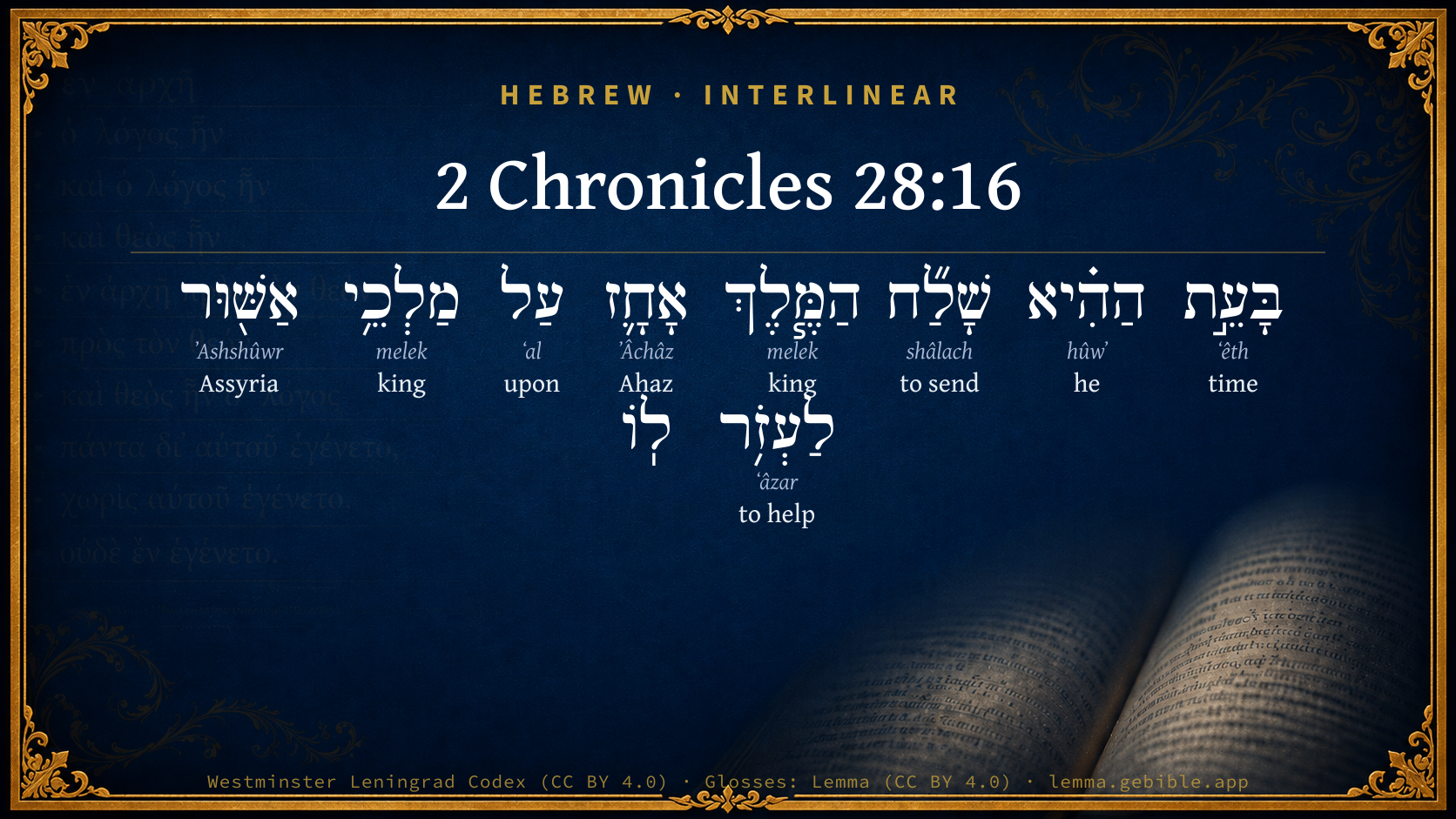
2 Chronicles 28:16

Hebrew (Westminster Leningrad Codex) 2 Chronicles 28:16 appears in the Hebrew Old Testament. The text above is from the Westminster Leningrad Codex. Each word links to its Strong’s number, a concise gloss, and parsing drawn from the Open Scriptures Hebrew Bible morphology. Click any word for its full Brown-Driver-Briggs (BDB) entry.
Download image
Cite this verse

2 Chronicles 28:16 (World English Bible). Public Domain. Lemma interlinear Bible study tool, https://lemma.gebible.app/v/2-chronicles/28/16.

Show BibTeX & RIS
BibTeX
RIS
English Translation
At that time did king Ahaz send to the kings of Assyria to help him.
World English Bible · Public Domain
Download a study sheet

One document with this verse’s original text, its word-by-word gloss line, the meaning frame, cross-references with their text, attributed commentary, and full source and license credits — printable, and it pastes into notes with its structure intact.

This verse Autodidact and up

Study sheet (.html) Plain text (.txt)

A passage Seminary Student

Up to 50 verses in one chapter. A passage sheet keeps up to 6 commentary sources and 12 cross-references per verse, in the order this page ranks them, and says so on the sheet whenever that leaves anything out. Ask for a single verse and you get the Autodidact verse sheet above.

Everything on this page stays free to read, with no account — the sheet is a download of what is already on screen, not access to it.

Want to remove ads? Support Godless Engineer
Compare translations 3

The same verse in 3 English versions, stacked beneath the original-language interlinear above. Click any original word for its lexicon entry.

Each is an independent rendering of the whole verse — the interlinear is not word-aligned to these translations.

Highlighted words mark where these versions differ — a whole-verse word diff, not a word-by-word alignment.

  • World English Bible Public Domain
    At that time did king Ahaz send to the kings of Assyria to help him.
  • King James Version Public Domain
    At that time did king Ahaz send unto the kings of Assyria to help him.
  • unfoldingWord Literal Text CC BY-SA 4.0
    At that time, King Ahaz sent to the kings of Assyria to help him.

unfoldingWord Literal Text — © unfoldingWord, licensed CC BY-SA 4.0. Word-aligned USFM3 via Door43 (git.door43.org/unfoldingWord/en_ult).

Versions to compare (up to 4)

3 of 4 selected

Show all 18 translations

Every available English version of this verse, each an independent rendering of the whole verse.

  • World English Bible Public Domain
    At that time did king Ahaz send to the kings of Assyria to help him.
  • Berean Standard Bible Public Domain
    At that time King Ahaz sent for help from the king of Assyria.
  • Majority Standard Bible Public Domain
    At that time King Ahaz sent for help from the king of Assyria.
  • King James Version Public Domain
    At that time did king Ahaz send unto the kings of Assyria to help him.
  • American Standard Version (1901) Public Domain
    At that time did king Ahaz send unto the kings of Assyria to help him.
  • Revised Version (1885) Public Domain
    At that time did king Ahaz send unto the kings of Assyria to help him.
  • Geneva Bible (1599) Public Domain
    At that time did King Ahaz sende vnto the Kings of Asshur, to helpe him.
  • Douay-Rheims (1899) Public Domain
    At that time king Achaz sent to the king of the Assyrians asking help.
  • Young's Literal Translation Public Domain
    At that time hath king Ahaz sent unto the king of Asshur to give help to him;
  • Literal Standard Version CC BY-SA 4.0
    At that time King Ahaz has sent to the king of Asshur to give help to him;
  • Unlocked Literal Bible CC BY-SA 4.0
    At that time King Ahaz sent messengers to the kings of Assyria to ask them to help him.
  • unfoldingWord Literal Text CC BY-SA 4.0
    At that time, King Ahaz sent to the kings of Assyria to help him.
  • Darby Bible Public Domain
    At that time king Ahaz sent to the kings of Assyria to help him.
  • World Messianic Bible Public Domain
    At that time King Ahaz sent to the kings of Assyria to help him.
  • Webster's Bible Public Domain
    At that time king Ahaz sent to the kings of Assyria to help him.
  • Free Bible Version CC BY-SA 4.0
    It was then that King Ahaz asked the king of Assyria for help.
  • Bible in Basic English Public Domain
    At that time King Ahaz sent for help to the king of Assyria.
  • JPS Tanakh (1917) Public Domain
    At that time did king Ahaz send unto the kings of Assyria to help him.

Literal Standard Version (2020), Covenant Press — licensed CC BY-SA 4.0. Text via the HelloAO Bible API (eBible.org). Unlocked Literal Bible (unfoldingWord) — licensed CC BY-SA 4.0. Text via the HelloAO Bible API (eBible.org). unfoldingWord Literal Text — © unfoldingWord, licensed CC BY-SA 4.0. Word-aligned USFM3 via Door43 (git.door43.org/unfoldingWord/en_ult). Free Bible Version, Dr. Jonathan Gallagher — licensed CC BY-SA 4.0. Text via the HelloAO Bible API (eBible.org).

Word by word

More ways to search: Search by grammar → Find every occurrence → Compare this word →

Practice this passage: Drill this verse → Learn its vocabulary →

About this verse

These counts appear in no published source. They are computed here, from the morphology-tagged text and Lemma’s own curated glosses. What Lemma adds →

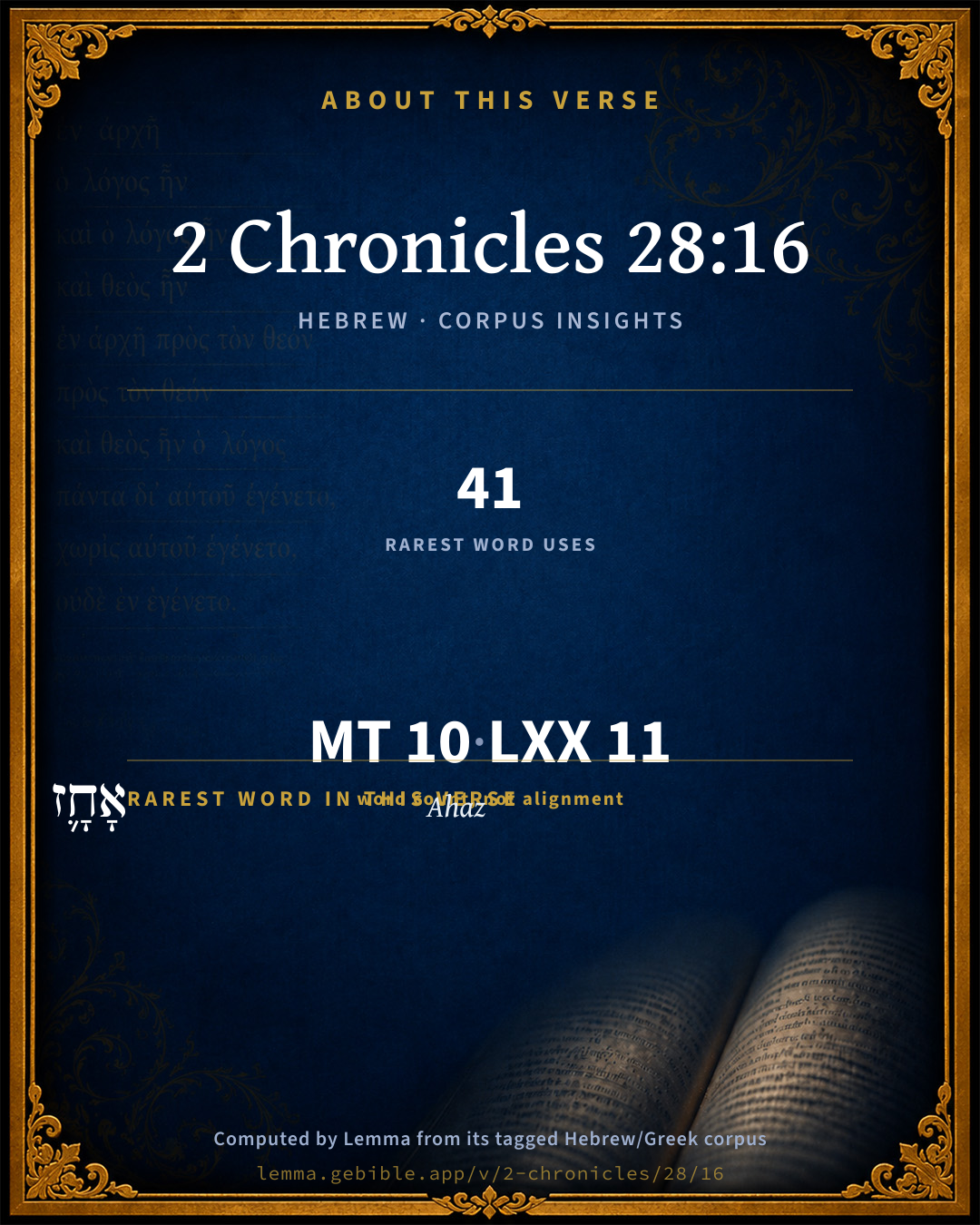
10
words
8
distinct lemmas
Historical
section

Shared distinctive vocabulary

אָחָ֛ז Ahaz H271 occurs in 39 verses of the Hebrew Bible. Also found in:

Grammatical profile

  • 2 verbs
  • 5 nouns
  • 1 pronoun
  • 2 prepositions

Verb forms

  • שָׁלַ֞ח Qal · Perfect
  • לַעְזֹ֥ר Qal · Infinitive Construct

Repetition

A word recurs within this verse — often emphatic in Hebrew:

  • הַמֶּ֧לֶךְ king H4428 ×2

Hebrew & Septuagint length

In English translation the verse runs 15 words from the Hebrew and 18 from the Septuagint (LXX English) — closely comparable.

A rough comparison of the two English renderings, which tokenize alike — not a word-level alignment.

Word counts can differ between the Hebrew and the Greek without any difference in meaning — e.g. the Hebrew direct-object marker אֵת has no separate Greek word, and Greek often adds the article ὁ.

In the original languages it is 10 Hebrew tokens and 11 Greek tokens — but the two are counted differently (Hebrew bundles its prefixes and suffixes into one token; the Greek is in lemma form), so that isn’t a like-for-like length.

Cross-references

3

Topical passages linked to 2 Chronicles 28:16 in the Treasury of Scripture Knowledge — connected by theme and wording, ordered by reader-vote popularity; previews shown in the World English Bible.

  • 2 Kings 16:5–7 Then Rezin king of Syria and Pekah son of Remaliah king of Israel came up to Jerusalem to war: and they besieged Ahaz, but could not overcome him.
  • Isaiah 7:17 Yahweh will bring on you, on your people, and on your father's house, days that have not come, from the day that Ephraim departed from Judah; even the king of Assyria.
  • Isaiah 7:1–9 It happened in the days of Ahaz the son of Jotham, the son of Uzziah, king of Judah, that Rezin the king of Syria, and Pekah the son of Remaliah, king of Israel, went up to Jerusalem to war against it, but could not prevail against it.

Cross-references courtesy of OpenBible.info (CC BY 4.0).

Hebrew and Greek witnesses Masoretic Hebrew ↔ Greek Septuagint

The same verse in the two great witnesses to the Old Testament, shown verse-for-verse.

These are two independent witnesses, not word-aligned to each other, and the Septuagint is shown in lemma (dictionary) form.

Hebrew 2 Chronicles 28:16 Masoretic · Westminster Leningrad Codex

בָּעֵ֣ת הַהִ֗יא שָׁלַ֞ח הַמֶּ֧לֶךְ אָחָ֛ז עַל מַלְכֵ֥י אַשּׁ֖וּר לַעְזֹ֥ר לֽוֹ

At that time did king Ahaz send to the kings of Assyria to help him.

World English Bible · Public Domain

Greek LXX 2 Chronicles 28:16 Septuagint · lemma form

ἐν ὁ καιρός ἐκεῖνος ἀποστέλλω αχαζ πρός βασιλεύς ασσουρ βοηθέω αὐτός

At that time king Achaz sent to the king of Assyria to help him, and on this occasion,

LXX2012 (modern English Septuagint) · Public Domain

On this verse, The Cambridge Bible for Schools and Colleges discusses the Septuagint’s reading. Read the note in Commentary ↓

Hebrew: Westminster Leningrad Codex (CC BY 4.0). Greek: Septuagint (public domain); English from LXX2012 (modern English Septuagint) (Public Domain). How the Septuagint differs from the Hebrew →

Commentary

Notes on 2 Chronicles 28:16 from classic Christian and Jewish commentators (each source and its license shown beneath its notes). The classic Christian expositions comment on the surrounding passage and are grouped to its opening verse, so a note may address several verses; the Jewish commentaries on the Tanakh (Rashi and others) are per-verse, so they appear only where the commentator wrote on this verse.

Lemma curates 59 commentaries, every one of them public domain or Creative Commons licensed, each selected and text-cleaned for this edition rather than reprinted as found. About our sources →

Matthew Henry's Commentary

Here is, I. The great distress which the kingdom of Ahaz was reduced to for his sin. In general, 1. The Lord brought Judah low, Ch2 28:19. They had lately been very high in wealth and power; but God found means to bring them down, and make them as despicable as they had been formidable. Those that will not humble themselves under the word of God will justly be humbled by his judgments. Iniquity brings men low, Psa 106:43. 2. Ahaz made Judah naked. As his sin debased them, so it exposed them. It made them naked to their shame; for it exposed them to contempt, as a man unclothed. It made them naked to their danger; for it exposed them to assaults, as a man unarmed, Exo 32:25. Sin strips men. In particular, the Edomites, to be revenged for Amaziah's cruel treatment of them (Ch2 25:12), smote Judah, and carried off many captives, Ch2 28:17. The Philistines also insulted them, took and kept possession of several cities and villages that lay near them (Ch2 28:18), and so they were revenged for the incursions which Uzziah had made upon them, Ch2 26:6. And, to show that it was purely the sin of Ahaz that brought the Philistines upon his country, in the very year that he died the prophet Isaiah foretold the destruction of the Philistines by his son, Isa 14:28, Isa 14:29.

II. The addition which Ahaz made both to the national distress and the national guilt.

1. He added to the distress, by making court to strange kings, in hopes they would relieve him. When the Edomites and Philistines were vexatious to him, he sent to the kings of Assyria to help him (Ch2 28:16); for he found his own kingdom weakened and made naked, and he could not put any confidence in God, and therefore was at a vast expense to get an interest in the king of Assyria. He pillaged the house of God, and the king's house, and squeezed the princes for money to hire these foreign forces into his service, Ch2 28:21. Though he had conformed to the idolatry of the heathen nations, his neighbours, they did not value him for that, nor love him the better, nor did his compliance, by which he lost God, gain them, nor could he make any interest in them, but with his money. It is often found that wicked men themselves have no real affection for those that revolt to them, nor do they care to do them a kindness. A degenerate branch is looked upon, on all sides, as an abominable branch, Isa 14:19. But what did Ahaz get by the king of Assyria? Why, he came to him, but he distressed him, and strengthened him not (Ch2 28:20), helped him not, Ch2 28:21. The forces of the Assyrian quartered upon his country, and so impoverished and weakened it; they grew insolent and imperious, and created him a great deal of vexation, like a broken reed, which not only fails, but pierces the hand.

2. He added to the guilt, by making court to strange gods, in hopes they would relieve him. In his distress, instead of repenting of his idolatry, which he had reason enough to see the folly of, he trespassed yet more (Ch2 28:22), was more mad than ever upon his idols. A brand of infamy is here set upon him for it: This is that king Ahaz, that wretched man, who was the scandal of the house of David and the curse and plague of his generation. Note, Those are wicked and vile indeed that are made worse by their afflictions, instead of being made better by them, who in their distress trespass yet more, have their corruptions exasperated by that which should mollify them, and their hearts more fully set in them to do evil. Let us see what his trespass was. (1.) He abused the house of God; for he cut in pieces the vessels of it, that the priests might not perform the service of the temple, or not as it should be performed, for want of vessels; and, at length, he shut up the doors, that the people might not attend it, Ch2 28:24. This was worse than the worst of the kings before him had done. (2.) He confronted the altar of God, for he made himself altars in every corner of Jerusalem; so that, as the prophet speaks, they were like heaps in the furrows of the fields, Hos 12:11. And in the cities of Judah, either by his power or by his purse, perhaps by both, he erected high places for the people to burn incense to what idols they pleased, as if on purpose to provoke the God of his fathers, Ch2 28:25. (3.) He cast off God himself; for he sacrificed to the gods of Damascus (Ch2 28:23), not because he loved them, for he thought they smote him; but because he feared them, thinking that they helped his enemies, and that, if he could bring them into his interest, they would help him. Foolish man! It was his own God that smote him and strengthened the Syrians against him, not the gods of Damascus; had he sacrificed to him, and to him only, he would have helped him. But no marvel that men's affections and devotions are misplaced when they mistake the author of their trouble and their help. And what comes of it? The gods of Syria befriend Ahaz no more than the kings of Assyria did; they were the ruin of him and of all Israel. This sin provoked God to bring judgments upon them, to cut him off in the midst of his days, when he was but thirty-six years old; and it debauched the people so that the reformation of the next reign could not prevail to cure them of their inclination to idolatry, but they retained that root of bitterness till the captivity in Babylon plucked it up.

The chapter concludes with the conclusion of the reign of Ahaz, Ch2 28:26, Ch2 28:27. For aught that appears, he died impenitent, and therefore died inglorious; for he was not buried in the sepulchres of the kings. Justly was he thought unworthy to be laid among them who was so unlike them - to be buried with kings who had used his kingly power for the destruction of the church and not for its protection or edification.

Matthew Henry's Commentary on the Whole Bible (1708–1710) — public domain (CC PDM 1.0). Text via the HelloAO Bible API.

Trapp's Complete Commentary

John Trapp

2Ch 28:16 At that time did king Ahaz send unto the kings of Assyria to help him.

Ver. 16. Did Ahaz send unto the king of Assyria.] Heb., Kings; so he is called, because king of kings, a mighty monarch. To him, therefore, Ahaz sendeth for help, at that time when the prophet Isaiah bade him trust only in God, and offered him a most satisfying sign for his confirmation. {Isa 7:14-16} {See Trapp on "2Ki 16:7"}

John Trapp, A Commentary or Exposition upon All the Books of the Old and New Testament (1647–1656) — public domain. Text from a community e-Sword module.

Joseph Benson's Commentary

2Ch 28:16-19. Did Ahaz send unto the kings of Assyria to help him — That is, the king, namely, Tiglath-pileser, (2Ki 16:7,) the plural number being put for the singular, either because he was a great king, a king of kings, or because Ahaz sent to divers of his princes also, who may be called kings in a more general signification of the word. Ahaz found his own kingdom weakened and made naked, and he could not put any confidence in God, and therefore was at a vast expense to procure an interest in the king of Assyria, 2Ch 28:18-19. The cities of the low country — That part of Judah which was toward the sea, and toward the Philistines’ land. For the Lord brought Judah low — As high as they were before in wealth and power. They that will not humble themselves under the word of God will be humbled by his judgments. For he made Judah naked — Taking away their ornament, and their defence and strength, namely, their treasures, which Ahaz sent to the Assyrian to no purpose; their frontier towns, and other strong holds, which by his folly and wickedness were lost; their religion, and the divine protection, which was their great and only security, which by his sins he forfeited. And transgressed sore against the Lord — The Targum renders it, The house of Judah ceased from the worship of God, which Ahaz in a manner wholly abolished, and thereby transgressed more grievously than any or all of his predecessors.

Joseph Benson's Commentary on the Old and New Testaments (1811–1818) — public domain. Text from a community e-Sword module.

Tyndale Open Study Notes

Tyndale Open Resources

28:16 Ahaz . . . asked the king of Assyria for help: See 2 Kgs 16:7-9 for more details.

Tyndale Open Study Notes — © Tyndale Open Resources, licensed CC BY-SA 4.0. Text via the HelloAO Bible API.

Geneva Bible (1599)

Geneva Bible translators

To Tiglath-Pileser and those kings that were under his dominion, 2 Kings 16:7.

Geneva Bible (1599) marginal notes — public domain. Text via Bolls.life.

Jamieson, Fausset & Brown

Robert Jamieson, A. R. Fausset & David Brown

At that time did king Ahaz send unto the kings of Assyria--"kings," the plural for the singular, which is found in many ancient versions. "At that time," refers to the period of Ahaz' great distress, when, after a succession of defeats, he retreated within the walls of Jerusalem. Either in the same or a subsequent campaign, the Syrian and Israelitish allies marched there to besiege him (see on Kg2 16:7). Though delivered from this danger, other enemies infested his dominions both on the south and the west.

Jamieson, Fausset & Brown — Commentary Critical and Explanatory on the Whole Bible (1871) — public domain (CC PDM 1.0). Text via the HelloAO Bible API.

Adam Clarke's Commentary

Verse 16. The kings of Assyria to help him.] Instead of מלכי malchey; KINGS; the Vulgate, Syriac, Arabic, and Chaldee, one MS., and the parallel place, 2Kg 16:7, have מלך melek, KING, in the singular number. This king was Tiglath-pileser, as we learn from the second book of Kings.

Adam Clarke's Commentary on the Bible (1810–1826) — public domain. Text from a community e-Sword/MySword module.

Ellicott's Commentary for English Readers

UNDER THE PRESSURE OF NEW ENEMIES, AHAZ ASKS HELP FROM ASSYRIA, BUT RECEIVES HURT (2Ch_28:17-21). (Comp. 2Ki_16:7-18.)

(16) At that time.—Apparently after the events above narrated; how soon after we can hardly decide.

The kings of Assyria.—A generalised expression, as in 2Ch_28:3 (comp. 2Ch_28:20-21), where the actual king is named. All the old versions have “king.”

A Bible Commentary for English Readers, edited by Charles John Ellicott (1878–1897) — public domain. Text from a community e-Sword module.

The Cambridge Bible for Schools and Colleges

gen. ed. J. J. S. Perowne

16. the kings] LXX. “king” (sing.). This monarch was Tiglath-pileser III.; cp. 2Ki_16:7.

16–21 (= 2Ki_16:7-9). Ahaz invokes Assyrian aid

There is a variation here between Chron. and Kings. According to the former (2Ch_28:21) Ahaz gained nothing by his tribute to the king of Assyria; according to Kings the Assyrian accepted the offering and marched against Syria, capturing Damascus and slaying Rezin.

The Cambridge Bible for Schools and Colleges (gen. ed. J. J. S. Perowne; Cambridge University Press, 1878–1918) — public domain. Text from a community e-Sword module.

John Gill's Exposition

The Philistines also had invaded the cities of the low country,.... Which lay nearest to them, as Sharon, Lydda, Joppa, &c. in revenge of what Uzziah had done to them, Ch2 26:6, and of the south of Judah; they penetrated as far as that, from the west to the south of the land:

and had taken Bethshemesh, and Ajalon, and Gederoth, and Shocho, with the villages thereof and Timnah with the villages thereof; of which see Jos 15:10.

and Gimzo also, and the villages thereof; which though nowhere else mentioned in Scripture, yet we frequently read in Jewish writings (l) of Nahum, a man of Ganizu, which perhaps is the same place with this:

and they dwelt there; kept them in their hands, and inhabited them.

(l) T. Bab. Taanith, fol. 21. 1. Sanhedrin, fol. 108. 2, &c.

John Gill's Exposition of the Whole Bible (1746–1763) — public domain (CC PDM 1.0). Text via the HelloAO Bible API.

Haydock's Catholic Bible Commentary

Kings. Heb. "kings." But Sept. have the singular, 4 K. xvi. 7.

George Leo Haydock (1774–1849), Haydock's Catholic Family Bible and Commentary, 1859 edition — public domain. Excludes Psalms (Douay-Rheims chapter numbering differs from Protestant) and Deuterocanonical books (Catholic canon only).

Matthew Poole's English Annotations

The kings of Assyria, i.e. the king; the plural number for the singular; either,

1. Because he was a great king and a king of kings; as the elephant, or, as others think, the crocodile, is called behemoth, which signifies beasts, Job 40, because of his vast bulk and eminency above other beasts. Or,

2. Because he wrote to divers of the kings or great princes, who may be called kings in a more general signification of the word, and indeed are so called, Isa 10:8, Are not my princes altogether kings?

Matthew Poole's English Annotations on the Holy Bible (1683–1685) — public domain. Text from a community e-Sword/MySword module.

The Pulpit Commentary

At that time did King Ahaz kings of Assyria. The vagueness of this common formula, "at that time," would doubtless not have been apparent in the original sources. In the present instance we may fall back on our vers. 5, 6 to give it distinctness; but see vers. 5, 6, 7 of the parallel, which involve their own formula and the present in some little uncertainty. The kings of Assyria. The Septuagint and other versions show the singular number. Our plural may perhaps find an explanation in 2Ch_30:6 2Ch_32:4.

Vers. 16, 20, 21.

An unfortunate embassy.

I THE PERSON APPROACHED. Tiglath-Pilneser (ver. 20), Tiglath-Pileser; (2Ki_16:7) in Assyrian, Takul-u- (Tukeal) - habal-i-sar-ra, meaning "He who puts his trust in Adar," or, "Adar is my confidence;" in the LXX Qalgaq-felassar; the same person as Pal King of Assyria (Schrader, "Die Keilinschriften," pp. 223-240), to whom Menahem of Israel gave a thousand talents of silver as a bribe for aid to keep the throne he had usurped. (2Ki_15:17) Originally a gardener (according to Greek tradition), Pal rose to eminence as a soldier, and eventually seized the crown of Assyria in B.C. 745, as Tiglath-Pileser II.

II THE INVITATION GIVEN. To assist Ahaz against Rezin of Damascus and Pekah of Israel. Already the power of Tiglath-Pileser II had been felt in numerous expeditions towards the West. Syria, Palestine, and Phoenicia had each resounded at the tread of his conquering legions. In particular, Rezin ("Records," etc., 5:48), and Menahem, one of Pekah"s predecessors on the throne of Israel, had acknowledged his supremacy by paying him tribute 2Ki_15:29; "Records," etc., 5:48). Accordingly, Ahaz had no doubt that the mighty Assyrian could by a word call off the two royal bandits that, like terriers, had sprung at his throat. Despatching ambassadors to Tiglath-Pileser, he requested aid against his foes from the north and east. To render his application successful, he sent with his plenipotentiaries a heavy largess, in the shape of presents of gold and silver taken from the temple, the palace, and the princes" mansions. (2Ki_16:7, 2Ki_16:8) An inscription, composed in the last or year before last year of Tiglath-Pileser"s reign, speaks of the Assyrian monarch as having received tribute from Mitinti of Askalon, Joachaz of Juda, and Kosmalak of Edom (Schrader, "Die Keilinschriften," p. 263). Though this tribute was probably that which Ahaz paid on visiting Tiglath-Pileser at Damascus, (2Ki_16:10) it will serve to illustrate and confirm the fact here mentioned, that Ahaz sent a present with his plenipotentiaries when they went to solicit Tiglath-Pileser"s assistance.

III THE ANSWER RETURNED. Tiglath-Pileser came unto him.

1. He marched against Rezin. (2Ki_16:9) The King of Syria was defeated in a pitched battle, and retreated to his capital. "He, to save his life, fled away alone and like a deer, and into the great gate of his city he entered. His generals alive in hand I captured, and on crosses I raised them. His country I subdued" (Inscription of Tiglath-Pileser, No. 10). "Damascus was closely invested; the trees in its neighbourhood were cut down; the districts dependent on it were ravaged, and forces were despatched to punish the Israelites, Ammonites, Moabites, and Philistines, who had been the allies of Resort. At last, in B.C. 732, after a siege of two years, Damascus was forced by famine to surrender. Reson was slain, Damascus given over to plunder and ruin, and its inhabitants transported to Kip" (Sayce, "Assyria, its Princes," etc., pp. 36, 37; cf. Smith, " Assyrian Discoveries," p. 282; Schrader, " Die Keilinschriften," pp. 258, 259).

2. He turned upon Israel. (2Ki_15:29) As above stated, this occurred while the siege of Damascus was being pressed forward. The towns of Ijon, Abel-beth-maachah, Janoah, Kedesh, Hazer, with the districts of Gilead, Galilee, and all the land of Naphtali, were captured, and their populations carried away to Syria, while Pekah, their sovereign, perished at the hands of a conspirator, Hoshea, who forthwith seized upon the throne. These details likewise receive confirmation from the monuments. Frame, sent No. 2 of Tiglath-Pileser"s inscription, narrating his war in Palestine, mentions "the city Gaul probably Gilead and Abil Abel-beth-maachah with the land of Humri throughout its whole extent as having been joined to the borders of Assyria; the entire population of the district as having been sent to Assyria, and their king, Pakaha, as having been slain" (Smith, "Assyrian Discoveries," pp. 284, 285; "Records," etc., 5:51, 52; Schrader, "Die Keilinschriften," pp, 255, 256).

3. He subjected Judah. This the obvious meaning of the Chronicler"s statement, that Tiglath-Pileser "distressed Ahaz, but strengthened him not." Instead of helping him to become an independent sovereign, Tiglath-Pileser made him a tributary to the Assyrian crown; and exactly in harmony with this, Joachaz of Juda appears, along with Mitinti of Askalon, Kosmalak of Edom, and Hanno of Gasa, among the tributary princes who, in the seventeenth or eighteenth year of his reign, did homage to the great king (see above). W.

The Pulpit Commentary (1880–1919), ed. H.D.M. Spence-Jones & Joseph S. Exell — public domain. Text from a community e-Sword module.

John Wesley's Explanatory Notes

Kings - Princes, who may be called kings in a more general signification of the word.

John Wesley, Explanatory Notes Upon the Whole Bible (1754–1765) — public domain. Text via the GEBible commentary corpus.

Keil & Delitzsch

C. F. Keil & F. Delitzsch

The liberation of the prisoners. - In Samaria there was a prophet of the Lord (i.e., not of the Jahve there worshipped in the calf images, but of the true God, like Hosea, who also at that time laboured in the kingdom of the ten tribes), Oded by name. He went forth to meet the army returning with the prisoners and the booty, as Azariha-ben-Oded (Ch2 15:2) once went to meet Asa; pointed out to the warriors the cruelty of their treatment of their brethren, and the guilt, calling to Heaven for vengeance, which they thereby incurred; and exhorted them to turn away the anger of God which was upon them, by sending back the prisoners. To soften the hearts of the rude warriors, and to gain them for his purpose, he tells them (Ch2 28:9), "Because the Lord God of your fathers was wroth, He gave them (the men of Judah) into your hand:" your victory over them is consequently not the fruit of your power and valour, but the work of the God of your fathers, whose wrath Judah has drawn upon itself by its defection from Him. This you should have considered, and so have had pity upon those smitten by the wrath of God; "but he have slaughtered among them with a rage which reacheth up to heaven," i.e., not merely with a rage beyond all measure, but a rage which calls to God for vengeance; cf. Ezr 9:6.

Ch2 28:10

"And now the sons of Judah and Jerusalem ye purpose to subject to yourselves for bondmen and bondwomen!" יהוּדה בּני is accus., and precedes as being emphatic; i.e., your brethren, whom the wrath of God has smitten, you purpose to keep in subjection. אתּם also is emphatically placed, and then is again emphasized at the end of the sentence by the suffix in לכם: "Are there not, only concerning you, with you, sins with Jahve your God?" i.e., Have you, to regard only you, not also burdened yourselves with many sins against the Lord? The question הלא, is a lively way of expressing assurance as to a matter which is not at all doubtful.

Ch2 28:11

After thus quickening the conscience, he calls upon them to send back the prisoners which they had carried away from among their brethren, because the anger of Jahve was upon them. Already in their pitiless butchery of their brethren they had committed a sin which cried to heaven, which challenged God's anger and His punishments; but by the carrying away of the women and children from their brethren they had filled up the measure of their sin, so that God's anger and rage must fall upon them.

Ch2 28:12-13

This speech made a deep impression. Four of the heads of the Ephraimites, here mentioned by name, - according to Ch2 28:12, four princes at the head of the assembled people, - came before those coming from the army (על קוּם, to come forward before one, to meet one), and said, Ch2 28:13, "Bring not the captives hither; for in order that a sin of Jahve come upon us, do you purpose (do you intend) to add to our sins and to our guilt?" i.e., to increase our sins and our guilt by making these prisoners slaves; "for great is our guilt, and fierce wrath upon Israel."

Ch2 28:14

Then the armed men (החלוּץ, cf. Ch1 12:23) who had escorted the prisoners to Samaria left the prisoners and the booty before the princes and the whole assembly.

Ch2 28:15

Keil & Delitzsch — Biblical Commentary on the Old Testament (1861–1891) — public domain (CC PDM 1.0). Text via the HelloAO Bible API. (Old Testament only.)

Kretzmann's Popular Commentary

Paul E. Kretzmann

Ahaz, Distressed by Assyria, Continues in his Wickedness

v. 16. At that time, when Judah had just suffered this severe defeat, besides losing the harbor of Eloth, on the Red Sea, to the Syrians, did King Ahaz send unto the kings of Assyria to help him, since Assyria was a mighty empire and was gaining in strength.

v. 17. For again the Edomites, freed from the sovereignty of Judah by the campaign of Rezin of Syria, had come and smitten Judah, and carried away captives. These raids were made along the southern and southeastern border.

v. 18. The Philistines also had invaded the cities of the low country, the lowlands toward the Mediterranean, and of the south of Judah, and had taken Beth-shemesh, and Ajalon, and Gederoth, and Shocho with the villages thereof, and Timnah with the villages thereof, Gimzo also and the villages thereof, all cities along the Philistine border in the west and southwest; and they dwelt there.

v. 19. For the Lord brought Judah low because of Ahaz, king of Israel, given this title because he was guilty of all the idolatry of the kings of Israel; for he, Ahaz, made Judah naked, he had behaved in a dissolute manner in the nation and with its people, and transgressed sore against the Lord.

v. 20. And Tilgathpilneser, king of Assyria, welcoming the opportunity to interfere in the affairs of the nations to the south, came unto him and distressed him, added to his burdens by oppressing him all the more, but strengthened him not.

v. 21. For Ahaz took away a portion out of the house of the Lord and out of the house of the king and of the princes, plundering the treasures of the kingdom in his vain attempts to find relief, and gave it unto the king of Assyria; but he helped him not.

v. 22. And in the time of his distress, when he should have repented and turned to the Lord for help, did he trespass yet more against the Lord. This is that King Ahaz, an example of foolish perverseness for all times.

v. 23. For he sacrificed unto the gods of Damascus which smote him; and he said, arguing foolishly in his blindness and attempting to excuse his further progress in wickedness, Because the gods of the kings of Syria help them, therefore will l sacrifice to them that they may help me, the very argument used in our days by such as sell their souls for the sake of outward success. But they were the ruin of him and of all Israel.

v. 24. And Ahaz gathered together the vessels of the house of God, and cut in pieces the vessels of the house of God, probably also to be used for tribute-money, and shut up the doors of the house of the Lord, thus suspending the worship both in the Holy Place and in the Most Holy Place; and he made him altars, devoted to idolatry, in every corner of Jerusalem, including the brazen altar erected by the priest Uriah after the pattern furnished him by the king, 2Ki 16:10-16.

v. 25. And in every several city of Judah he made high places to burn incense unto other gods, thus making idolatry of the grossest kind the official religion of the kingdom, and provoked to anger the Lord God of his fathers.

v. 26. Now, the rest of his acts and of all his ways, first and last, behold, they are written in the Book of the Kings of Judah and Israel.

v. 27. And Ahaz slept with his fathers, and they buried him in the city, even in Jerusalem, for the sake of his office, not of his person; but they brought him not into the sepulchers of the kings of Israel, they did not disgrace the tombs of the good kings of the line of David by placing his corpse by their side; and Hezekiah, his son, reigned in his stead. A terrible fate awaits him who refuses to be halted in his career of enmity toward God and dies in the hardness of his heart.

Paul E. Kretzmann, Popular Commentary of the Bible (1921–1924) — public domain. Text from a community e-Sword module.

unfoldingWord translationNotes

Door43 World Missions Community

They took Beth Shemesh

Taking a city is an idiom that means to conquer or to capture the city. AT: "The Philistines captured Beth Shemesh" (See: Idiom)

Beth Shemesh, Aijalon, Gederoth, Soko ... Timnah ... Gimzo

These are the names of places. (See: How to Translate Names)

translationWords

Ahaz

messenger

Assyria

Edom

Philistines

Negev

Beth Shemesh

unfoldingWord translationNotes — © Distant Shores Media and the Door43 World Missions Community, licensed CC BY-SA 4.0. Source: git.door43.org/Door43/en_tn.

Lesson kit

Teaching starters — assembled from the data on this page, not authored interpretation. Every prompt links to the verse data it draws on. Edit before teaching.

2 Chronicles, in the Historical, opens this verse with 10 words (8 distinct Hebrew lemmas). Its most distinctive word is ʼÂchâz (“Ahaz”). A historical commentator’s framing appears above. Read the whole chapter for the surrounding context.

Discussion questions

  1. The word ʼÂchâz carries the sense “Ahaz.” How does it shape the verse?
  2. How does 2 Kings 15:38, which shares the word «Ahaz», read alongside this verse?
  3. What does the repetition of “king” (2× in this one verse) do in this verse?
  4. These translations render this verse differently. What is at stake in choosing one wording over another?
  5. «שָׁלַ֞ח» is a Qal Perfect verb. How does that grammatical form shape the action described?
  6. Compare how Matthew Henry's Commentary and Trapp's Complete Commentary read this verse. Where do they agree or differ?

Things to notice

Reading settings

Reading text

Shown beneath each verse's original-language words.

Old Testament
Old Testament edition

Read the OT as the Masoretic Hebrew (MT) or the Greek Septuagint (LXX).

English shown for the Greek Septuagint (in the Hebrew ↔ Greek comparison).

Comparing translations? Open the Compare panel on any verse page to stack up to four side by side.