
Psalms 106:3

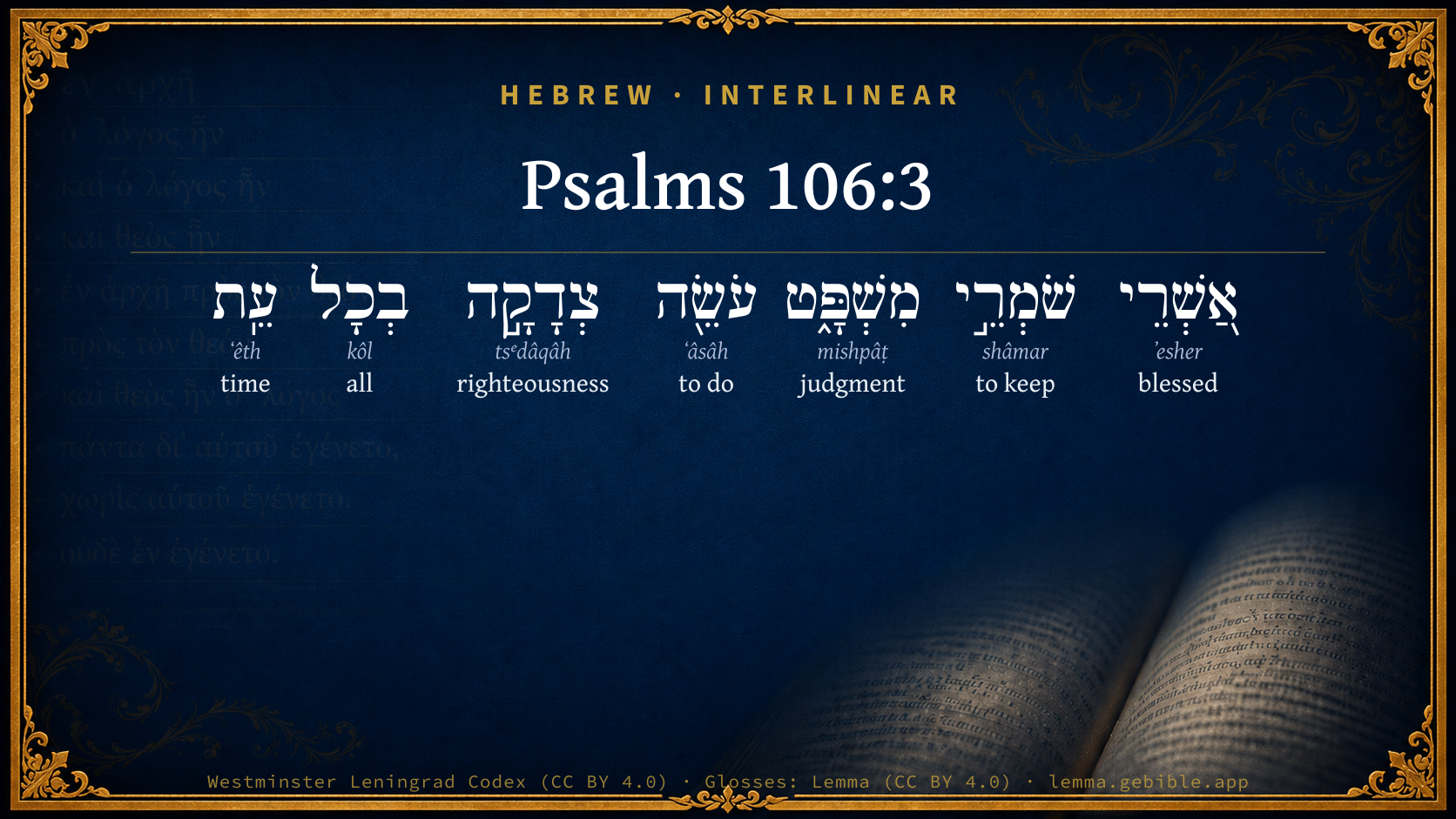
Hebrew (Westminster Leningrad Codex) Psalms 106:3 appears in the Hebrew Old Testament. The text above is from the Westminster Leningrad Codex. Each word links to its Strong’s number, a concise gloss, and parsing drawn from the Open Scriptures Hebrew Bible morphology. Click any word for its full Brown-Driver-Briggs (BDB) entry.
Download image
Cite this verse

Psalms 106:3 (World English Bible). Public Domain. Lemma interlinear Bible study tool, https://lemma.gebible.app/v/psalms/106/3.

Show BibTeX & RIS
BibTeX
RIS
English Translation
Blessed are those who keep justice. Blessed is one who does what is right at all times.
World English Bible · Public Domain
Download a study sheet

One document with this verse’s original text, its word-by-word gloss line, the meaning frame, cross-references with their text, attributed commentary, and full source and license credits — printable, and it pastes into notes with its structure intact.

This verse Autodidact and up

Study sheet (.html) Plain text (.txt)

A passage Seminary Student

Up to 50 verses in one chapter. A passage sheet keeps up to 6 commentary sources and 12 cross-references per verse, in the order this page ranks them, and says so on the sheet whenever that leaves anything out. Ask for a single verse and you get the Autodidact verse sheet above.

Everything on this page stays free to read, with no account — the sheet is a download of what is already on screen, not access to it.

Want to remove ads? Support Godless Engineer
Compare translations 3

The same verse in 3 English versions, stacked beneath the original-language interlinear above. Click any original word for its lexicon entry.

Each is an independent rendering of the whole verse — the interlinear is not word-aligned to these translations.

Highlighted words mark where these versions differ — a whole-verse word diff, not a word-by-word alignment.

  • World English Bible Public Domain
    Blessed are those who keep justice. Blessed is one who does what is right at all times.
  • King James Version Public Domain
    Blessed are they that keep judgment, and he that doeth righteousness at all times.
  • unfoldingWord Literal Text CC BY-SA 4.0
    The happinesses of the guardians of justice, the doers of righteousness at all times!

unfoldingWord Literal Text — © unfoldingWord, licensed CC BY-SA 4.0. Word-aligned USFM3 via Door43 (git.door43.org/unfoldingWord/en_ult).

Versions to compare (up to 4)

3 of 4 selected

Show all 18 translations

Every available English version of this verse, each an independent rendering of the whole verse.

  • World English Bible Public Domain
    Blessed are those who keep justice. Blessed is one who does what is right at all times.
  • Berean Standard Bible Public Domain
    Blessed are those who uphold justice, who practice righteousness at all times.
  • Majority Standard Bible Public Domain
    Blessed are those who uphold justice, who practice righteousness at all times.
  • King James Version Public Domain
    Blessed are they that keep judgment, and he that doeth righteousness at all times.
  • American Standard Version (1901) Public Domain
    Blessed are they that keep justice, And he that doeth righteousness at all times.
  • Revised Version (1885) Public Domain
    Blessed are they that keep judgment, and he that doeth righteousness at all times.
  • Geneva Bible (1599) Public Domain
    Blessed are they that keepe iudgement, and doe righteousnesse at all times.
  • Douay-Rheims (1899) Public Domain
    Blessed are they that keep judgment, and do justice at all times.
  • Young's Literal Translation Public Domain
    O the happiness of those keeping judgment, Doing righteousness at all times.
  • Literal Standard Version CC BY-SA 4.0
    O the blessedness of those keeping judgment, || Doing righteousness at all times.
  • Unlocked Literal Bible CC BY-SA 4.0
    Blessed are those who do what is right, and whose deeds are always just.
  • unfoldingWord Literal Text CC BY-SA 4.0
    The happinesses of the guardians of justice, the doers of righteousness at all times!
  • Darby Bible Public Domain
    Blessed are they that keep justice, [and] he that doeth righteousness at all times.
  • World Messianic Bible Public Domain
    Blessed are those who keep justice. Blessed is one who does what is right at all times.
  • Webster's Bible Public Domain
    Blessed are they that keep judgment, and he that doeth righteousness at all times.
  • Free Bible Version CC BY-SA 4.0
    Happy are those who treat people fairly, who always do what is right.
  • Bible in Basic English Public Domain
    Happy are they whose decisions are upright, and he who does righteousness at all times.
  • JPS Tanakh (1917) Public Domain
    Happy are they that keep justice, that do righteousness at all times.

Literal Standard Version (2020), Covenant Press — licensed CC BY-SA 4.0. Text via the HelloAO Bible API (eBible.org). Unlocked Literal Bible (unfoldingWord) — licensed CC BY-SA 4.0. Text via the HelloAO Bible API (eBible.org). unfoldingWord Literal Text — © unfoldingWord, licensed CC BY-SA 4.0. Word-aligned USFM3 via Door43 (git.door43.org/unfoldingWord/en_ult). Free Bible Version, Dr. Jonathan Gallagher — licensed CC BY-SA 4.0. Text via the HelloAO Bible API (eBible.org).

Word by word

More ways to search: Search by grammar → Find every occurrence → Compare this word →

Practice this passage: Drill this verse → Learn its vocabulary →

About this verse

These counts appear in no published source. They are computed here, from the morphology-tagged text and Lemma’s own curated glosses. What Lemma adds →

7
words
7
distinct lemmas
Wisdom
section

Shared distinctive vocabulary

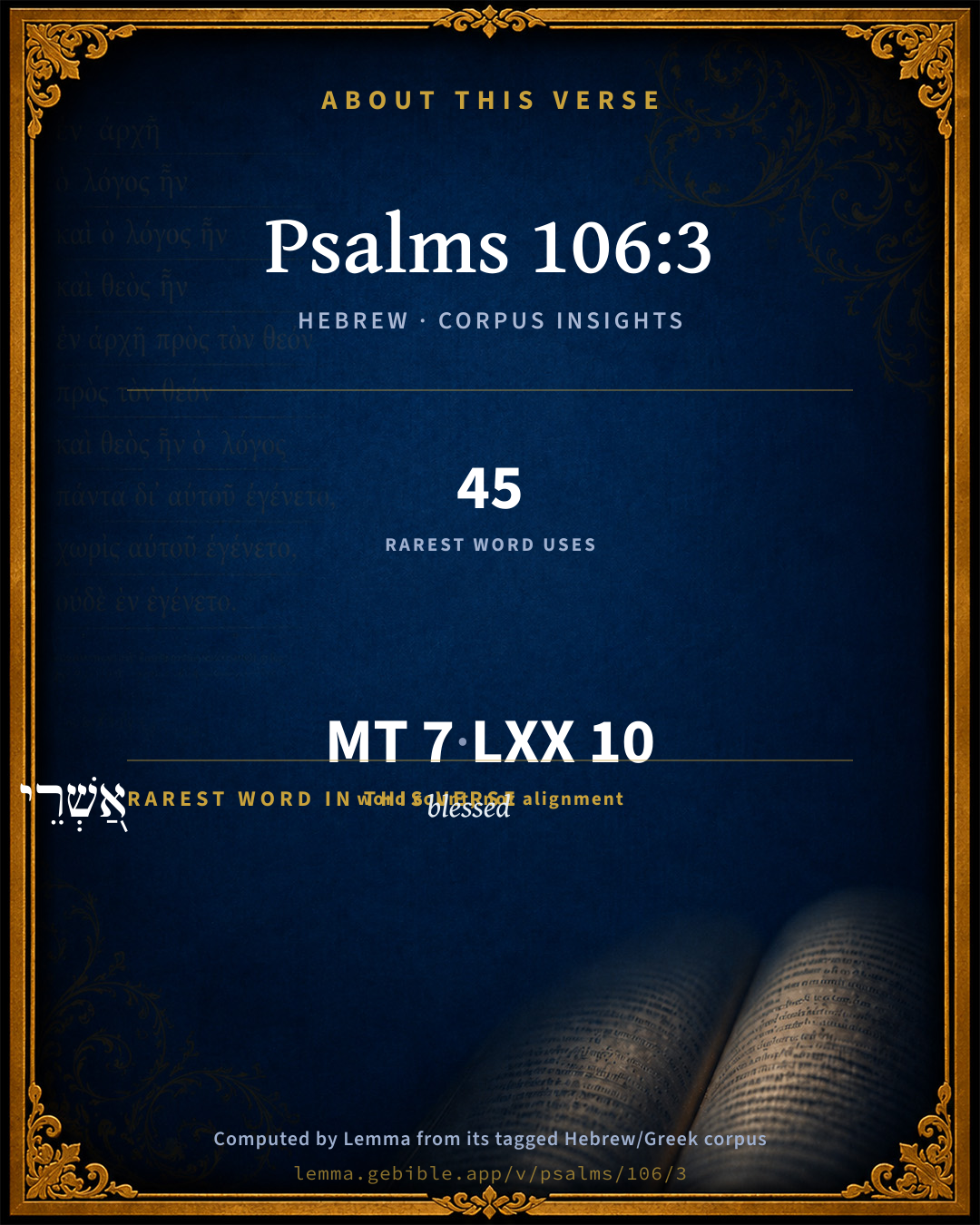
אַ֭שְׁרֵי blessed H835 occurs in 42 verses of the Hebrew Bible. Also found in:

Grammatical profile

  • 2 verbs
  • 5 nouns

Verb forms

  • שֹׁמְרֵ֣י Qal · Participle Active
  • עֹשֵׂ֖ה Qal · Participle Active

Hebrew & Septuagint length

In English translation the verse runs 17 words from the Hebrew and 12 from the Septuagint (LXX English) — closely comparable.

A rough comparison of the two English renderings, which tokenize alike — not a word-level alignment.

Word counts can differ between the Hebrew and the Greek without any difference in meaning — e.g. the Hebrew direct-object marker אֵת has no separate Greek word, and Greek often adds the article ὁ.

In the original languages it is 7 Hebrew tokens and 10 Greek tokens — but the two are counted differently (Hebrew bundles its prefixes and suffixes into one token; the Greek is in lemma form), so that isn’t a like-for-like length.

Cross-references

28

Topical passages linked to Psalms 106:3 in the Treasury of Scripture Knowledge — connected by theme and wording, ordered by reader-vote popularity; previews shown in the World English Bible.

  • Psalms 15:2 He who walks blamelessly does what is right, And speaks truth in his heart;
  • James 1:25 But he who looks into the perfect law, the law of freedom, and continues, not being a hearer who forgets but a doer of the work, this man will be blessed in what he does.
  • John 13:17 If you know these things, blessed are you if you do them.
  • John 15:14 You are my friends, if you do whatever I command you.
  • Galatians 6:9 Let us not be weary in doing good, for we will reap in due season, if we don't give up.
  • Deuteronomy 11:1 Therefore you shall love Yahweh your God, and keep his charge, and his statutes, and his ordinances, and his commandments, always.
  • Psalms 119:1–3 Blessed are those whose ways are blameless, Who walk according to Yahweh's law.
  • Psalms 119:20 My soul is consumed with longing for your ordinances at all times.
  • Psalms 119:44 So I will obey your law continually, Forever and ever.
  • Psalms 119:106 I have sworn, and have confirmed it, That I will obey your righteous ordinances.
  • Psalms 119:112 I have set my heart to perform your statutes forever, Even to the end.
  • Mark 3:35 For whoever does the will of God, the same is my brother, and my sister, and mother."
  • Romans 2:7 to those who by patience in well-doing seek for glory and honor and incorruptibility, eternal life;
  • Revelation 22:14 Blessed are those who do his commandments, that they may have the right to the tree of life, and may enter in by the gates into the city.
  • Deuteronomy 5:19 "Neither shall you steal.
  • Psalms 1:1–3 Blessed is the man who doesn't walk in the counsel of the wicked, Nor stand in the way of sinners, Nor sit in the seat of scoffers;
  • Psalms 84:11–12 For Yahweh God is a sun and a shield. Yahweh will give grace and glory. He withholds no good thing from those who walk blamelessly.
  • Isaiah 56:1–2 Thus says Yahweh, Keep you justice, and do righteousness; for my salvation is near to come, and my righteousness to be revealed.
  • Isaiah 64:5 You meet him who rejoices and works righteousness, those who remember you in your ways: behold, you were angry, and we sinned: in them [have we been] of long time; and shall we be saved?
  • Jeremiah 22:15–16 Shall you reign, because you strive to excel in cedar? Didn't your father eat and drink, and do justice and righteousness? then it was well with him.
  • Ezekiel 18:21–22 But if the wicked turn from all his sins that he has committed, and keep all my statutes, and do that which is lawful and right, he shall surely live, he shall not die.
  • Luke 1:74–75 To grant to us that we, being delivered out of the hand of our enemies, should serve him without fear,
  • Luke 6:47–49 Everyone who comes to me, and hears my words, and does them, I will show you who he is like.
  • Luke 11:28 But he said, "On the contrary, blessed are those who hear the word of God, and keep it."
  • John 14:21–23 One who has my commandments, and keeps them, that person is one who loves me. One who loves me will be loved by my Father, and I will love him, and will reveal myself to him."
  • Acts 24:16 Herein I also practice always having a conscience void of offense toward God and men.
  • Revelation 7:15 Therefore they are before the throne of God, they serve him day and night in his temple. He who sits on the throne will spread his tent over them.
  • Luke 11:42 But woe to you Pharisees! For you tithe mint and rue and every herb, but you bypass justice and the love of God. You ought to have done these, and not to have left the other undone.

Cross-references courtesy of OpenBible.info (CC BY 4.0).

Hebrew and Greek witnesses Masoretic Hebrew ↔ Greek Septuagint

The same verse in the two great witnesses to the Old Testament, shown verse-for-verse.

You’re reading Greek Psalm 105 (Hebrew Psalm 106). The Septuagint counts the superscription, so verse numbers can differ from the Hebrew — chapter-level alignment, not verse-by-verse. Numbering follows Rahlfs.

These are two independent witnesses, not word-aligned to each other, and the Septuagint is shown in lemma (dictionary) form.

Hebrew Psalms 106:3 Masoretic · Westminster Leningrad Codex

אַ֭שְׁרֵי שֹׁמְרֵ֣י מִשְׁפָּ֑ט עֹשֵׂ֖ה צְדָקָ֣ה בְכָל עֵֽת

Blessed are those who keep justice. Blessed is one who does what is right at all times.

World English Bible · Public Domain

Greek LXX Greek Psalm 105:3 Septuagint · lemma form

μακάριος ὁ φυλάσσω κρίσις καί ποιέω δικαιοσύνη ἐν πᾶς καιρός

Blessed are they that keep judgment, and do righteousness at all times.

LXX2012 (modern English Septuagint) · Public Domain

On this verse, The Cambridge Bible for Schools and Colleges discusses the Septuagint’s reading. Read the note in Commentary ↓

Hebrew: Westminster Leningrad Codex (CC BY 4.0). Greek: Septuagint (public domain); English from LXX2012 (modern English Septuagint) (Public Domain). How the Septuagint differs from the Hebrew →

Commentary

Notes on Psalms 106:3 from classic Christian and Jewish commentators (each source and its license shown beneath its notes). The classic Christian expositions comment on the surrounding passage and are grouped to its opening verse, so a note may address several verses; the Jewish commentaries on the Tanakh (Rashi and others) are per-verse, so they appear only where the commentator wrote on this verse.

Lemma curates 59 commentaries, every one of them public domain or Creative Commons licensed, each selected and text-cleaned for this edition rather than reprinted as found. About our sources →

Trapp's Complete Commentary

John Trapp

Psa 106:3 Blessed [are] they that keep judgment, [and] he that doeth righteousness at all times.

Ver. 3. Blessed are they that keep judgment, &c.] That are of right principles and upright practices; this is real and substantial praising of God. Thanks doing is the proof of thanksgiving; and the good life of the thankful is the life of thankfulness. Those that say God a-thank only, and no more, are not only contumelious, but injurious.

And he that doth righteousness] So preaching forth the virtues (or praises) of God who hath called him into his marvellous light, 1Pe 2:9, and composing his whole course, velar spectatum aliquod simulaehrum et documentum laudis eius constans atque perpetuum (Jun.).

John Trapp, A Commentary or Exposition upon All the Books of the Old and New Testament (1647–1656) — public domain. Text from a community e-Sword module.

J. A. Alexander on Psalms

Joseph Addison Alexander

3. (Psa 106:3) Happy the keepers of judgment, the doer of righteousness at every time. The form of expression at the beginning is the same as in Psa 1:1. The keepers of judgment are those who observe justice as the rule of their conduct, the same idea that is afterwards expressed in other words, the doer (or practicer) of righteousness, not occasionally merely but at all times. The change from the plural to the singular is common, where the latter denotes an ideal individual, the representative of a whole class. The condition here propounded is identical with that in Psa 105:45; Psa 103:18, Dan 9:4.

Joseph Addison Alexander, The Psalms Translated and Explained (1850) — public domain. Text from a community e-Sword module.

Geneva Bible (1599)

Geneva Bible translators

He showeth that it is not enough to praise God with the mouth, except the whole heart agree thereunto, and all our life be thereunto framed.

Geneva Bible (1599) marginal notes — public domain. Text via Bolls.life.

Adam Clarke's Commentary

Verse 3. Blessed are they that keep judgment, and he that doeth righteousness at all times.] How near do the Anglo-Saxon, the ancient Scottish Version, and the present translation, approach to each other!

Anglo-Saxon. [A.S.]. "Blessed they that holdeth doom, and doth righteousness in ilkere tide."

Anglo-Scottish. Blisful tha that kepes dome, and duse rightwisnes in ilk tyme.

Those are truly blessed, or happy, whose hearts are devoted to God, and who live in the habit of obedience. Those, the general tenor of whose life is not conformed to the will of God, have no true happiness.

Adam Clarke's Commentary on the Bible (1810–1826) — public domain. Text from a community e-Sword/MySword module.

John Calvin's Commentaries

3 Blessed are they that keep judgment I make a distinction between this and the preceding verse, and yet so as to preserve the connection between them. For the prophet, having declared the magnitude of God’s power to be such that no tongue could utter all its praises, now says, that the praises of the lip merely are not acceptable to God, but that the concurrence of the heart is indispensable, nay, that even the whole of our deportment must be in unison with this exercise. Now, when he first commands to keep judgment, and then to work righteousness, he gives us a short description of genuine godliness. I have no doubt, that in the former clause he describes the sincere affection of the heart, and that, in the latter, he refers to external works. For we know, there is nothing but the mere shadow of righteousness, unless a man cordially devote himself to the practice of honesty. He requires perseverance, too, that no one may imagine that he has discharged this duty properly, excepting he whose constant and continued aim it is to live righteously and justly. We behold not a few who have only an empty profession; others show some signs of virtue, but do not maintain a consistent course of conduct.

John Calvin's Commentaries (1540-1563) — public domain. Text from the Calvin Translation Society English edition (1840s-50s) via the Christian Classics Ethereal Library (ccel.org). Calvin's coverage is partial (roughly two-thirds of the Bible); uncommented books and verses are honest gaps, never fabricated. The 19th-century editor's footnotes and remarks are omitted so the notes are faithfully Calvin's own voice.

The Cambridge Bible for Schools and Colleges

gen. ed. J. J. S. Perowne

3. From the thought of the mercy and the might of Jehovah which are the ground of Israel’s hope, the Psalmist passes to the conditions of participation in the blessing for which he looks. Happy those who obey the Divine command, given in view of the near approach of Jehovah’s Advent to redeem, “Keep judgement, and do righteousness” (Isa_56:1): who repent, and bring forth fruits worthy of their repentance, conforming their conduct to the demands and will of God. Cp. Psa_105:45.

he that doeth] Probably we should read they that do (עשֵׂי for עשֵׂה, with LXX and other Versions).

The Cambridge Bible for Schools and Colleges (gen. ed. J. J. S. Perowne; Cambridge University Press, 1878–1918) — public domain. Text from a community e-Sword module.

John Gill's Exposition

Blessed are they that keep judgment,.... Or "observe" (k) it; the righteous judgment of God on wicked men; by which he is known in his justice, holiness, truth, and faithfulness; and by which the inhabitants of the earth observing it, learn to do righteousness, as follows: or else it may intend the word of God, his laws, statutes, and ordinances, after called his judgments, Psa 19:9, which should be observed and kept, as the rule of our actions, walk, and conversation.

And he that doeth righteousness at all times; continually believes in Christ for righteousness, and puts on that as his justifying righteousness; whereby he becomes righteous as he is, Jo1 3:7, and performs acts of righteousness from a principle of grace, as a fruit of regeneration, and an evidence of it, Jo1 2:29, that does it with right views, aims, and ends; not to be justified and saved by it, but because God requires it; and it is for his glory, and to testify subjection to him, and thankfulness for favours received from him. And this is to be done at all times; we should never be weary of well doing, but be always abounding in good works; and happy are those that will be found so doing, such are "blessed" persons: not that their blessedness lies in or arises from righteousness done by them; but this is descriptive of such that are blessed in Christ with the remission of sins, and his justifying righteousness. And these are the proper persons to show forth the mighty acts and praise of the Lord; they are most capable of it, and more likely to perform it with acceptance than any other; see Psa 50:14.

(k) "observarent", Junius & Tremellius; "observantium", Gejerus.

John Gill's Exposition of the Whole Bible (1746–1763) — public domain (CC PDM 1.0). Text via the HelloAO Bible API.

Albert Barnes' Notes on the Bible

Blessed are they that keep judgment - They are blessed, for their conduet is right, and it leads to happiness. The Hebrew is, “the keepers of judgment;” that is, they who observe the rules of justice in their conduct, or who are governed by the principles of integrity.

And he that doeth righteousness at all times - All who yield obedience to just law - whether a nation or an individual. The psalm is designed to illustrate this “by contrast;” that is, by showing, in the conduct of the Hebrew people, the consequences of “disobedience,” and thus impliedly what would have been, and what always must be, the consequences of the opposite course. Compare Psa 15:1-5.

Albert Barnes' Notes on the Bible (1834–1885) — public domain. Text from a community e-Sword/MySword module.

Matthew Poole's English Annotations

That keep judgment; that observe and practise what is just and right towards God and men; which in the next clause he calls

doing righteousness. At all times; in adversity as well as in prosperity. And this clause may belong either,

1. To the last foregoing words, that doeth righteousness at all times, constantly and perpetually; or rather,

2. To the first words, they are blessed at all times, even in the day of their calamity, which therefore ought not to hinder us from this great and just duty of praising God. And so this verse coheres with the former.

Matthew Poole's English Annotations on the Holy Bible (1683–1685) — public domain. Text from a community e-Sword/MySword module.

The Treasury of David

Charles H. Spurgeon

Ver. 3. Since the Lord is so good and so worthy to be praised, it must be for our happiness to obey him.

Blessed are they that keep judgment, and he that doeth righteousness at all times. Multiplied are the blessings which must descend upon the whole company of the keepers of the way of justice, and especially upon that one rare man who at all times follows that which is right. Holiness is happiness. The way of right is the way of peace. Yet men leave this road, and prefer the paths of the destroyer. Hence the story which follows is in sad contrast with the happiness here depicted, because the way of Israel was not that of judgment and righteousness, but that of folly and iniquity. The Psalmist, while contemplating the perfections of God, was impressed with the feeling that the servants of such a being must be happy, and when he looked around and saw how the tribes of old prospered when they obeyed, and suffered when they sinned, he was still more fully assured of the truth of his conclusion. O could we but be free of sin we should be rid of sorrow! We would not only be just, but "keep judgment"; we would not be content with occasionally acting rightly, but would "do justice at all times."

Ver. 3. Blessed are they that keep judgment, etc. That are of right principles and upright practices; this is real and substantial praising of God. Thanks doing is the proof of thanksgiving; and the good life of the thankful is the life of thankfulness. Those that thank God only, and no more, are not only contumelious, but injurious. John Trapp.

Ver. 3. Keep judgment; doeth righteousness. I doubt not that there is some difference; viz. that he is said to keep judgment who judgeth rightly, but he to do righteousness who acts righteously. Augustine.

Ver. 3. I have read of Louis, king of France, that when he had through inadvertency granted an unjust suit, as soon as ever he had read those words of the Psalmist, "Blessed is he that doeth righteousness at all times, "he presently recollected himself, and upon better thoughts gave his judgment quite contrary. Thomas Brooks.

Ver. 3. The blessedness of a godly life.

Psalms 106:4*

Charles H. Spurgeon's The Treasury of David (1869–1885) — public domain. Psalms only. Text from a community e-Sword/MySword module.

Whedon's Commentary on the Bible

Daniel D. Whedon

3. Blessed—The psalmist describes the character of the man upon whom will abide true happiness, namely, he who keeps judgment and righteousness—the act and the principle of rectitude—at all times.

Daniel D. Whedon (gen. ed.), Commentary on the Old and New Testaments (1874–1909) — public domain. Text from a community e-Sword module.

The Pulpit Commentary

Blessed are they that keep judgment, and he that doeth righteousness at all times. No distinction of meaning is intended between "keeping judgment" and "doing righteousness." The second clause merely repeats the first.

The blessedness of the holy life.

I SUCH LIFE IS POSSIBLE. It would not be spoken of here and throughout the Scriptures as it is, if it were only an ideal but not a possible life. Surely, if sin be the abominable thing which God hates, he must have contemplated, in his redemptive work, our deliverance from it. What is the first and great commandment, but a command to cherish that spirit towards God which is the spring of the holy life?

II IT IS ENTERED INTO BY A DEFINITE WAY.

1. By self-surrender, which consists in the abandoning of whatever we know to be contrary to the will of God; giving it up, though it be dear as the right hand or eye; and in the surrender of all our powers and possessions to the absolute control and direction of God.

2. Then, when we have thus given ourselves up to God, we are to believe that he accepts us, and we are to keep trusting him, day by day and hour by hour, to cleanse us by the blood of Christ from all sin. If we will persevere in this surrender and trust, nothing can hinder our entering into this holy life. Then

III IT IS MOST BLESSED.

1. For what it escapes: the misery of a condemning conscience; of paralyzed power for none can effectually work for God if they are abiding in sin; of knowing that your influence has been evil rather than good; of God"s face hidden from you.

2. For what it wins: the blessedness of inward peace; of confidence towards God; of power with God for man, and with man for God; of the possession of God"s loving kindness, which is better than life, (Ps 63) and of assured hope. When the people of God live this life, then there will be a turning to God on the part of the world, as now there is not, and for long ages has not been. For men will see that God"s people possess a secret spring of joy, and peace, and purity, and strength, and they will come to covet it with a great desire (vers. 4, 5). S.C.

The Pulpit Commentary (1880–1919), ed. H.D.M. Spence-Jones & Joseph S. Exell — public domain. Text from a community e-Sword module.

unfoldingWord translationNotes

Door43 World Missions Community

Call me to mind

The phrase "call to mind" means to remember something. AT: "remember me" (See: Idiom)

of your chosen

The word "chosen" refers to Yahweh's chosen people. AT: "of your chosen people" (See: Nominal Adjectives)

rejoice in the gladness ... and glory

These are things that David says he will do, along with "seeing the prosperity of your chosen." The words "I will" may be repeated here. AT: "I will rejoice in the gladness ... and I will glory" (See: Ellipsis)

gladness

joy, delight

glory with your inheritance

Here the phrase "your inheritance" refers to the Isrealites, who are Yahweh's chosen people. Here "glory" means "to boast about" something; in this case they are boasting about Yahweh. AT: "boast of your greatness with your people" or "boast with your people about you" (See: Metonymy)

translationWords

bless

works

just

mind

favor

people of God

save

prosper

chosen one

joy

nation

glory

inherit

unfoldingWord translationNotes — © Distant Shores Media and the Door43 World Missions Community, licensed CC BY-SA 4.0. Source: git.door43.org/Door43/en_tn.

Lesson kit

Teaching starters — assembled from the data on this page, not authored interpretation. Every prompt links to the verse data it draws on. Edit before teaching.

Psalms, in the Wisdom, opens this verse with 7 words (7 distinct Hebrew lemmas). Its most distinctive word is ʼesher (“blessed”). A historical commentator’s framing appears above. Read the whole chapter for the surrounding context.

Discussion questions

  1. How does “blessed” (ʼesher) shape what this verse is saying?
  2. Deuteronomy 33:29 shares the word «blessed» with this verse. How do the two illuminate each other?
  3. The translations on this page render this verse differently — a whole-verse word diff, not a word-by-word alignment. What might account for the different wordings?
  4. The verb «שֹׁמְרֵ֣י» is Qal Participle Active. How does its form color the action?
  5. Reading how Trapp's Complete Commentary and J. A. Alexander on Psalms read this verse, where do the two commentators agree and where do they part?

Things to notice

Reading settings

Reading text

Shown beneath each verse's original-language words.

Old Testament
Old Testament edition

Read the OT as the Masoretic Hebrew (MT) or the Greek Septuagint (LXX).

English shown for the Greek Septuagint (in the Hebrew ↔ Greek comparison).

Comparing translations? Open the Compare panel on any verse page to stack up to four side by side.