
Job 38:23

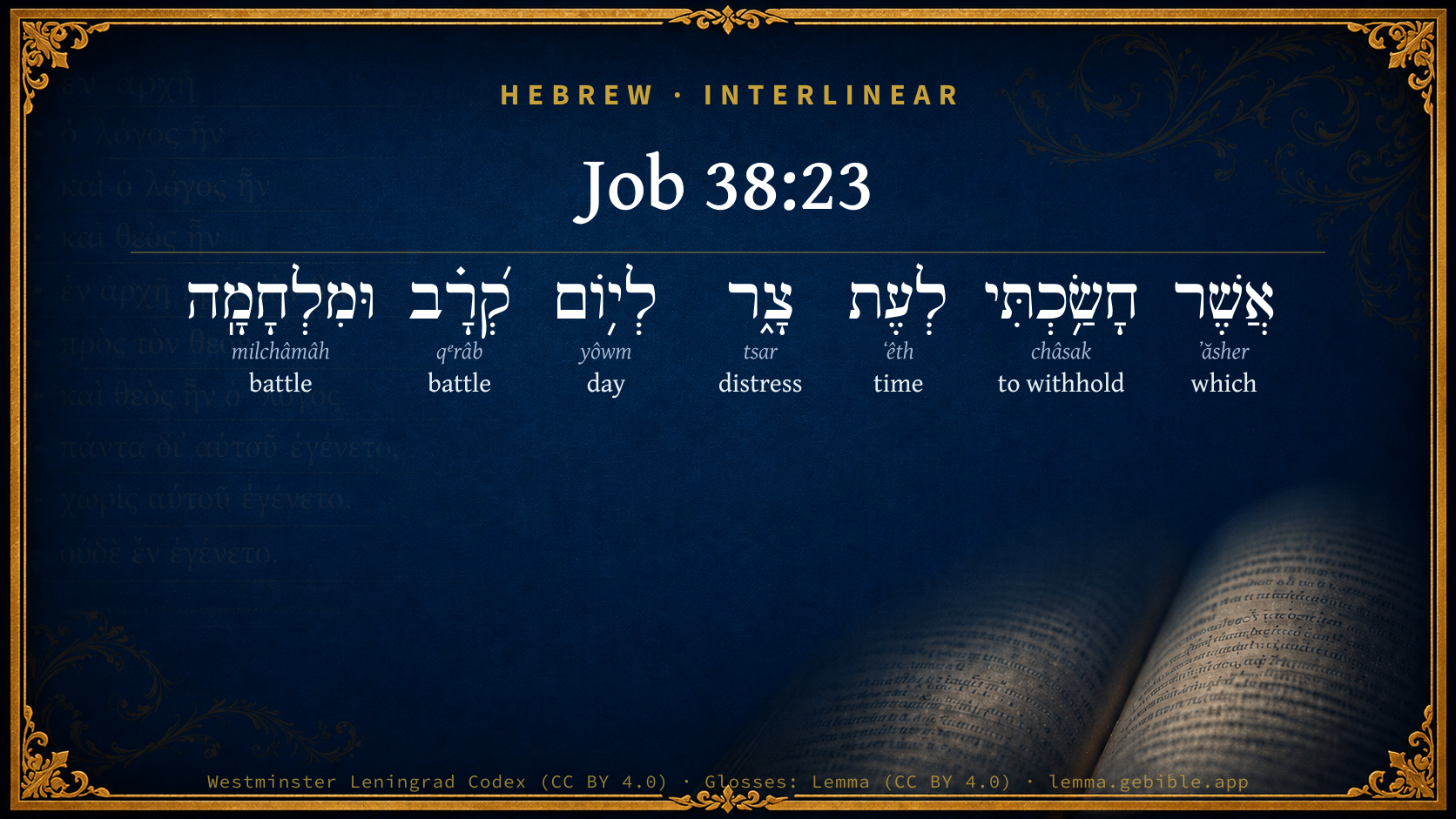
Hebrew (Westminster Leningrad Codex) Job 38:23 appears in the Hebrew Old Testament. The text above is from the Westminster Leningrad Codex. Each word links to its Strong’s number, a concise gloss, and parsing drawn from the Open Scriptures Hebrew Bible morphology. Click any word for its full Brown-Driver-Briggs (BDB) entry.
Download image
Cite this verse

Job 38:23 (World English Bible). Public Domain. Lemma interlinear Bible study tool, https://lemma.gebible.app/v/job/38/23.

Show BibTeX & RIS
BibTeX
RIS
English Translation
Which I have reserved against the time of trouble, Against the day of battle and war?
World English Bible · Public Domain
Download a study sheet

One document with this verse’s original text, its word-by-word gloss line, the meaning frame, cross-references with their text, attributed commentary, and full source and license credits — printable, and it pastes into notes with its structure intact.

This verse Autodidact and up

Study sheet (.html) Plain text (.txt)

A passage Seminary Student

Up to 50 verses in one chapter. A passage sheet keeps up to 6 commentary sources and 12 cross-references per verse, in the order this page ranks them, and says so on the sheet whenever that leaves anything out. Ask for a single verse and you get the Autodidact verse sheet above.

Everything on this page stays free to read, with no account — the sheet is a download of what is already on screen, not access to it.

Want to remove ads? Support Godless Engineer
Compare translations 3

The same verse in 3 English versions, stacked beneath the original-language interlinear above. Click any original word for its lexicon entry.

Each is an independent rendering of the whole verse — the interlinear is not word-aligned to these translations.

Highlighted words mark where these versions differ — a whole-verse word diff, not a word-by-word alignment.

  • World English Bible Public Domain
    Which I have reserved against the time of trouble, Against the day of battle and war?
  • King James Version Public Domain
    Which I have reserved against the time of trouble, against the day of battle and war?
  • unfoldingWord Literal Text CC BY-SA 4.0
    which I keep for a time of trouble, for a day of battle and war?

unfoldingWord Literal Text — © unfoldingWord, licensed CC BY-SA 4.0. Word-aligned USFM3 via Door43 (git.door43.org/unfoldingWord/en_ult).

Versions to compare (up to 4)

3 of 4 selected

Show all 18 translations

Every available English version of this verse, each an independent rendering of the whole verse.

  • World English Bible Public Domain
    Which I have reserved against the time of trouble, Against the day of battle and war?
  • Berean Standard Bible Public Domain
    which I hold in reserve for times of trouble, for the day of war and battle?
  • Majority Standard Bible Public Domain
    which I hold in reserve for times of trouble, for the day of war and battle?
  • King James Version Public Domain
    Which I have reserved against the time of trouble, against the day of battle and war?
  • American Standard Version (1901) Public Domain
    Which I have reserved against the time of trouble, Against the day of battle and war?
  • Revised Version (1885) Public Domain
    Which I have reserved against the time of trouble, against the day of battle and war?
  • Geneva Bible (1599) Public Domain
    Which I haue hid against the time of trouble, against the day of warre and battell?
  • Douay-Rheims (1899) Public Domain
    Which I have prepared for the time of the enemy, against the day of battle and war?
  • Young's Literal Translation Public Domain
    That I have kept back for a time of distress, For a day of conflict and battle.
  • Literal Standard Version CC BY-SA 4.0
    That I have kept back for a time of distress, || For a day of conflict and battle?
  • Unlocked Literal Bible CC BY-SA 4.0
    these things that I have kept for times of trouble, for days of battle and war?
  • unfoldingWord Literal Text CC BY-SA 4.0
    which I keep for a time of trouble, for a day of battle and war?
  • Darby Bible Public Domain
    Which I have reserved for the time of distress, for the day of battle and war?
  • World Messianic Bible Public Domain
    which I have reserved against the time of trouble, against the day of battle and war?
  • Webster's Bible Public Domain
    Which I have reserved against the time of trouble, against the day of battle and war?
  • Free Bible Version CC BY-SA 4.0
    I have stored them up for the time of trouble, for the day of war and battle.
  • Bible in Basic English Public Domain
    Which I have kept for the time of trouble, for the day of war and fighting?
  • JPS Tanakh (1917) Public Domain
    Which I have reserved against the time of trouble, against the day of battle and war?

Literal Standard Version (2020), Covenant Press — licensed CC BY-SA 4.0. Text via the HelloAO Bible API (eBible.org). Unlocked Literal Bible (unfoldingWord) — licensed CC BY-SA 4.0. Text via the HelloAO Bible API (eBible.org). unfoldingWord Literal Text — © unfoldingWord, licensed CC BY-SA 4.0. Word-aligned USFM3 via Door43 (git.door43.org/unfoldingWord/en_ult). Free Bible Version, Dr. Jonathan Gallagher — licensed CC BY-SA 4.0. Text via the HelloAO Bible API (eBible.org).

Word by word

More ways to search: Search by grammar → Find every occurrence → Compare this word →

Practice this passage: Drill this verse → Learn its vocabulary →

About this verse

These counts appear in no published source. They are computed here, from the morphology-tagged text and Lemma’s own curated glosses. What Lemma adds →

7
words
7
distinct lemmas
Wisdom
section

Notable vocabulary

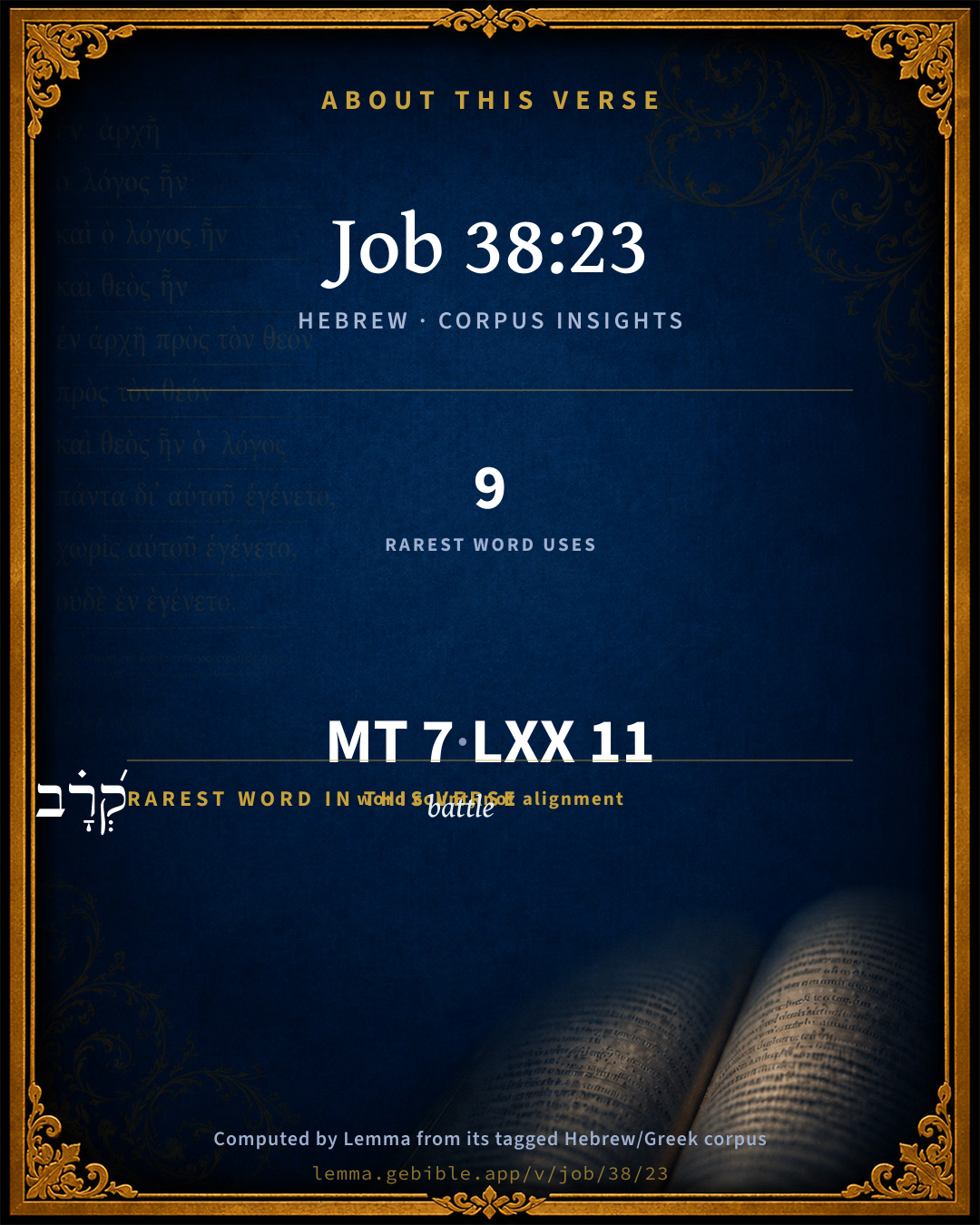
The rarest word here is קְ֝רָ֗ב battle H7128 — appearing just 9 times in the whole Hebrew Bible.

Shared distinctive vocabulary

קְ֝רָ֗ב battle H7128 occurs in 9 verses of the Hebrew Bible. Also found in:

Grammatical profile

  • 1 verb
  • 4 nouns
  • 1 adjective
  • 1 particle

Verb forms

  • חָשַׂ֥כְתִּי Qal · Perfect

Hebrew & Septuagint length

In English translation the verse runs 16 words from the Hebrew and 22 from the Septuagint (LXX English) — closely comparable.

A rough comparison of the two English renderings, which tokenize alike — not a word-level alignment.

Word counts can differ between the Hebrew and the Greek without any difference in meaning — e.g. the Hebrew direct-object marker אֵת has no separate Greek word, and Greek often adds the article ὁ.

In the original languages it is 7 Hebrew tokens and 11 Greek tokens — but the two are counted differently (Hebrew bundles its prefixes and suffixes into one token; the Greek is in lemma form), so that isn’t a like-for-like length.

Cross-references

9

Topical passages linked to Job 38:23 in the Treasury of Scripture Knowledge — connected by theme and wording, ordered by reader-vote popularity; previews shown in the World English Bible.

  • Joshua 10:11 It happened, as they fled from before Israel, while they were at the descent of Beth Horon, that Yahweh cast down great stones from the sky on them to Azekah, and they died: they were more who died with the hailstones than they whom the children of Israel killed with the sword.
  • Isaiah 30:30 Yahweh will cause his glorious voice to be heard, and will show the lighting down of his arm, with the indignation of [his] anger, and the flame of a devouring fire, with a blast, and tempest, and hailstones.
  • Exodus 9:18 Behold, tomorrow about this time I will cause it to rain a very grievous hail, such as has not been in Egypt since the day it was founded even until now.
  • Job 36:13 "But those who are godless in heart lay up anger. They don't cry for help when he binds them.
  • Ezekiel 13:11–13 tell those who daub it with whitewash, that it shall fall: there shall be an overflowing shower; and you, great hailstones, shall fall; and a stormy wind shall tear it.
  • Revelation 16:21 Great hailstones, about the weight of a talent, came down out of the sky on people. People blasphemed God because of the plague of the hail, for this plague is exceedingly severe.
  • Exodus 9:24 So there was very severe hail, and lightning mixed with the hail, such as had not been in all the land of Egypt since it became a nation.
  • Job 36:31 For by these he judges the people. He gives food in abundance.
  • Matthew 7:27 The rain came down, the floods came, and the winds blew, and beat on that house; and it fell--and great was its fall."

Cross-references courtesy of OpenBible.info (CC BY 4.0).

Hebrew and Greek witnesses Masoretic Hebrew ↔ Greek Septuagint

The same verse in the two great witnesses to the Old Testament, shown verse-for-verse.

These are two independent witnesses, not word-aligned to each other, and the Septuagint is shown in lemma (dictionary) form.

Hebrew Job 38:23 Masoretic · Westminster Leningrad Codex

אֲשֶׁר חָשַׂ֥כְתִּי לְעֶת צָ֑ר לְי֥וֹם קְ֝רָ֗ב וּמִלְחָמָֽה

Which I have reserved against the time of trouble, Against the day of battle and war?

World English Bible · Public Domain

Greek LXX Job 38:23 Septuagint · lemma form

ἀποκεῖμαι δέ σύ εἰς ὥρα ἐχθρός εἰς ἡμέρα πόλεμος καί μάχη

And is there a store of them, for you against the time of your enemies, for the day of wars and battle?

LXX2012 (modern English Septuagint) · Public Domain

Hebrew: Westminster Leningrad Codex (CC BY 4.0). Greek: Septuagint (public domain); English from LXX2012 (modern English Septuagint) (Public Domain). How the Septuagint differs from the Hebrew →

Commentary

Notes on Job 38:23 from classic Christian and Jewish commentators (each source and its license shown beneath its notes). The classic Christian expositions comment on the surrounding passage and are grouped to its opening verse, so a note may address several verses; the Jewish commentaries on the Tanakh (Rashi and others) are per-verse, so they appear only where the commentator wrote on this verse.

Lemma curates 59 commentaries, every one of them public domain or Creative Commons licensed, each selected and text-cleaned for this edition rather than reprinted as found. About our sources →

Trapp's Complete Commentary

John Trapp

Job 38:23 Which I have reserved against the time of trouble, against the day of battle and war?

Ver. 23. Which I have reserved against the time of trouble] Or, against the time of the enemy to punish him, as Exo 9:24 Jos 10:11 Isa 30:30. By deep snows men are sometimes withered and destroyed; by violent hail stones and coals of fire. {as Psa 18:13-15} What an overthrow was procured against the Quades by the prayers of the thundering legion, as they were afterwards called in the days of Aurelius the emperor! Ingens grando compluraque fulmina in hostes ceciderunt, Huge hail stones and many lightning bolts fell upon the enemy, saith the heathen historian (Dio in Vit. Ant. Phil.).

Against the day of battle and war?] When God is pleased to bring forth his upper and lower troops ready pressed, as the Rabbis phrase it.

John Trapp, A Commentary or Exposition upon All the Books of the Old and New Testament (1647–1656) — public domain. Text from a community e-Sword module.

The Biblical Illustrator

Joseph S. Exell

Job_38:23

Against the day of battle and war.

War from heaven

In some parts of Scripture Jehovah is represented descending in clouds and tempests, and fixing for Himself in the air a tent or pavilion, where the elementary forces attend and receive commissions and arms for the service in which each meteor, or element, is to be employed (Psa_18:1-50).

I. The treasures in the armoury of Jehovah.

1. Treasures of snow and hail. That vapour, ascending from the earth, and floating over our heads in the air, descends in small white flakes, is a sensible truth; but how the particles of vapour condense and adhere, how they assume the shape, and colour, and quality of snow, are questions too high for us, and must be resolved into the will and power of God. Hail, as a body of condensed vapour, is well known. Dreadful is the execution which it has done among the enemies of the Lord (Exo_9:25; Jos_10:11).

2. The air is the storehouse where snow and hail are collected and laid up. This magnificent fabric, the dimensions of which are unknown, is a glorious effect of the wisdom and power of the great Builder. Storey is founded upon storey, and sphere raised over sphere. At Gods command every exhalation appears, and without resisting His will, assumes the shape and fills the place which He hath appointed.

3. The treasures of snow and hail are under the care and direction of the Lord of heaven and earth. Over these His power is unlimited, and in and by these He doth whatsoever pleaseth Him.

4. These treasures are inaccessible to man. Are there secrets in the air which we cannot discover, and operations in that storehouse of vapour which we are not able to explain; then why do men of penetration stumble at mysteries in religion, or reject truths which God has revealed, because these are not comprehensible by reason? Canst thou find out the Almighty to perfection?

II. The time of trouble and the day of battle and war. There may indeed be trouble when there is not war, but a day of war is always a time of trouble.

1. Rebellion is the cause of these operations. The existence of rebellion against the Lord, the God of the whole earth, cannot be denied. Enemies and rebels are the real characters of multitudes in this generation.

2. These operations are penal operations, or punishments of rebellion against the laws of His kingdom.

3. These operations of Divine wrath and power are just and holy proceedings against the rebellious.

III. The reservation of the snow and the hail in the treasures of the Lord. In the expression there is a greatness becoming the majesty of the Speaker, and the state and grandeur of the Sovereign. The following particulars will help us to understand the sublime expression which the Lord of all uses concerning His operations.

1. The vapour, which fills the treasures of the snow and the hail, is raised, collected, condensed, and stored by the power of God.

2. The treasures, which are filled and stored by the power of God, are poised and balanced by His wisdom. These wondrous works are executed according to a determined and preconceived plan.

3. The snow and the hail are detained in the treasures until the time of trouble, and the day of battle and war. Inferences--

(1) In war from heaven the inhabitants of the earth are the aggressors.

(2) Provoking the Lord of hosts to battle is the folly of wickedness.

(3) Rebellion is as the sin of witchcraft.

(4) Humbling ourselves under the mighty hand of the Lord, and taking hold of the covenant of peace, is present duty and true wisdom. (A. Shanks.)

The Biblical Illustrator, edited by Joseph S. Exell (c. 1880s–1900s) — public domain. Text from a community e-Sword module.

Geneva Bible (1599)

Geneva Bible translators

To punish mine enemies with them, Exod. 9:18; Josh. 10:11.

Geneva Bible (1599) marginal notes — public domain. Text via Bolls.life.

Jamieson, Fausset & Brown

Robert Jamieson, A. R. Fausset & David Brown

against the time of trouble--the time when I design to chastise men (Exo 9:18; Jos 10:11; Rev 16:21; Isa 28:17; Psa 18:12-13; Hag 2:17).

Jamieson, Fausset & Brown — Commentary Critical and Explanatory on the Whole Bible (1871) — public domain (CC PDM 1.0). Text via the HelloAO Bible API.

Adam Clarke's Commentary

Verse 23. Reserved against the time of trouble] לעת צר leeth tsar, "to the season of strictness," i.e., the season when the earth is constringed or bound by the frost.

Against the day of battle and war?] Hailstones being often employed as instruments of God's displeasure against his enemies, and the enemies of his people. There is probably an allusion here to the plague of hail sent on the Egyptians. See Ex 9:23, and the notes there, for more particulars concerning hailstones, remarkable showers of them, c. There may be also a reference to Jos 10:10-11, where a destructive shower of what are called hailstones fell upon the Canaanitish kings who fought against Israel. See the note there also.

Adam Clarke's Commentary on the Bible (1810–1826) — public domain. Text from a community e-Sword/MySword module.

Ellicott's Commentary for English Readers

(23) The time of trouble.—As was the case with the Canaanites, in Jos_10:11. (Comp. Psa_18:13.)

A Bible Commentary for English Readers, edited by Charles John Ellicott (1878–1897) — public domain. Text from a community e-Sword module.

The Cambridge Bible for Schools and Colleges

gen. ed. J. J. S. Perowne

23. Compare such passages as Jos_10:11; Psa_68:14; Isa_30:30; Eze_13:13.

The Cambridge Bible for Schools and Colleges (gen. ed. J. J. S. Perowne; Cambridge University Press, 1878–1918) — public domain. Text from a community e-Sword module.

John Gill's Exposition

By what way is the light parted,.... That is, dost thou know by what way it is parted or divided? as at the first creation, when God divided the light from darkness, Gen 1:4; or at sun rising and sun setting; and so in the two hemispheres, when there is darkness on the one, and light on the other; or under the two poles, when there are interchangeably six months light and six months darkness. Or how it is parted in an unequal distribution of day and night, at different seasons and in different climates; or how on one and the same day, and at the same time, the sun shall shine in one part of the earth, and not another; and more especially if this had been now a fact, and known, that there should be darkness all over the land of Egypt, and light in Goshen. Some understand this of lightning, but that is later mentioned;

which scattereth the east wind upon the earth? that rising sometimes with the sun, or first spring of light; see Jon 4:8; or which light spreads and diffuses itself "from the east", as it may be rendered. The sun rises in the east, and in a very quick and surprising manner spreads and diffuses its light throughout the hemisphere. Or this may respect the east wind itself, which scatters the clouds; and either spreads them in the heavens over the earth, or disperses them and drives away rain (x), as the north wind does: or as Mr. Broughton renders the words, "and the east wind scattereth itself over the earth"; it blowing invisibly and without our knowledge, goes and returns as other winds do, Joh 3:8.

(x) "Agente nimbos ocyor euro". Horat. Carmin. l. 2. Ode 16.

John Gill's Exposition of the Whole Bible (1746–1763) — public domain (CC PDM 1.0). Text via the HelloAO Bible API.

Albert Barnes' Notes on the Bible

Which I have reserved - As if they were carefully treasured up to be brought forth as they shall be needed. The idea is, that they were entirely under the direction of God.

The time of trouble - Herder “the time of need.” The meaning probably is, that he had kept them in reserve for the time when he wished to bring calamity on his enemies, or that he made use of them to punish his foes; compare the notes at Job 36:31-33.

Against the day of battle and war - Hailstones were employed by God sometimes to overwhelm his foes, and were sent against them in time of battle; see Jos 10:11; Exo 9:22-26; Psa 18:12-13; compare the notes at Isa 29:6.

Albert Barnes' Notes on the Bible (1834–1885) — public domain. Text from a community e-Sword/MySword module.

Haydock's Catholic Bible Commentary

War. Hail, &c., are like the arrows of God, Jeremias x. 13., and l. 25. (Calmet)

George Leo Haydock (1774–1849), Haydock's Catholic Family Bible and Commentary, 1859 edition — public domain. Excludes Psalms (Douay-Rheims chapter numbering differs from Protestant) and Deuterocanonical books (Catholic canon only).

Matthew Poole's English Annotations

Which, i.e. which snow, and especially hail.

Against the time of trouble, i.e. when I intend to bring trouble or calamity upon any country or people for their sins, or for their trial. Or, against the time of the enemy, i.e. when I intend to punish mine or my people’s enemies, and to fight against them with these weapons; of which see instances Exo 9:14; Jos 10:11. Compare 1Sa 7:10; Job 36:31; Isa 30:30.

Matthew Poole's English Annotations on the Holy Bible (1683–1685) — public domain. Text from a community e-Sword/MySword module.

Whedon's Commentary on the Bible

Daniel D. Whedon

23. The day of battle and war — Man’s ordnance for war is the wide-mouthed and wide-resounding cannon; God’s, the silent snowflake, the blight, the unseen fungi floating in the air, or marshalled hosts of insects. “Providence,” said Napoleon, “is on the side of the heaviest battalions;” heaven’s answer consisted simply of snow and hail and cold; and one of the mightiest armies of modern times was laid low. Horace has a similar thought: —

Too long, alas! with storms of hail and snow,

Jove has chastised the world below.

Demosthenes compares the destructive course of King Philip to a storm of hail. For Scripture illustrations see Exo_9:18; Jos_10:11; 1Sa_7:10; 2Sa_23:20; Psa_68:14; Isa_28:17, etc.

Daniel D. Whedon (gen. ed.), Commentary on the Old and New Testaments (1874–1909) — public domain. Text from a community e-Sword module.

The Pulpit Commentary

Which I have reserved against the time of trouble. Hail is reckoned throughout Scripture as one of the ministers of the Divine vengeance. (see Exo_9:18-29 Exo_10:5-15 Jos_10:11 Psa_18:12, 13 78:47, 48 105:32 Isa_30:30 Isa_32:19 Eze_13:11, 13 36:22 Hag_2:17 Rev_8:7 Rev_11:19 Rev_16:21) Its destructive effect upon crops, even in temperate latitudes, is indicated by the insurances against damage from hail, which, even in our own country, so many farmers think it worth their while to pay. In tropical and semitropical regions the injury caused by hailstorms is far greater. Against the day of battle and war. Compare especially Jos_10:11, which, however, we need not suppose to have been in the mind of the writer. In ancient times, when the bow held the place in war which is now occupied by the rifle or the musket, a heavy hailstorm, striking full in the face of the combatants on one side, while it only fell on the backs of their adversaries, must of tea have decided a battle.

The Pulpit Commentary (1880–1919), ed. H.D.M. Spence-Jones & Joseph S. Exell — public domain. Text from a community e-Sword module.

John Wesley's Explanatory Notes

Trouble - When I intend to bring trouble upon any people for their sins.

John Wesley, Explanatory Notes Upon the Whole Bible (1754–1765) — public domain. Text via the GEBible commentary corpus.

Rashi

Rabbi Shlomo Yitzchaki (Rashi)

That I saved I withheld.

for a time of trouble For the five kings in Gibeon.

for a day of battle The war of Gog and Magog.

Rashi on the Tanakh — English translations: “The Judaica Press complete Tanach with Rashi, translated by A. J. Rosenberg” (CC BY 4.0); “Pentateuch with Rashi's commentary by M. Rosenbaum and A.M. Silbermann, 1929-1934” (public domain); “The Metsudah Tanach series, Lakewood, N.J” (CC BY 4.0); and “The Book of Joshua, Metsudah Publications, 1997” (CC BY 4.0). Text via Sefaria.

Lesson kit

Teaching starters — assembled from the data on this page, not authored interpretation. Every prompt links to the verse data it draws on. Edit before teaching.

Job, in the Wisdom, opens this verse with 7 words (7 distinct Hebrew lemmas). Its most distinctive word is qᵉrâb (“battle”). A historical commentator’s framing appears above. Read the whole chapter for the surrounding context.

Discussion questions

  1. The word qᵉrâb carries the sense “battle.” How does it shape the verse?
  2. How does 2 Samuel 17:11, which shares the word «battle», read alongside this verse?
  3. These translations render this verse differently. What is at stake in choosing one wording over another?
  4. «חָשַׂ֥כְתִּי» is a Qal Perfect verb. How does that grammatical form shape the action described?
  5. Compare how Trapp's Complete Commentary and The Biblical Illustrator read this verse. Where do they agree or differ?

Things to notice

Reading settings

Reading text

Shown beneath each verse's original-language words.

Old Testament
Old Testament edition

Read the OT as the Masoretic Hebrew (MT) or the Greek Septuagint (LXX).

English shown for the Greek Septuagint (in the Hebrew ↔ Greek comparison).

Comparing translations? Open the Compare panel on any verse page to stack up to four side by side.