
Jeremiah 11:12

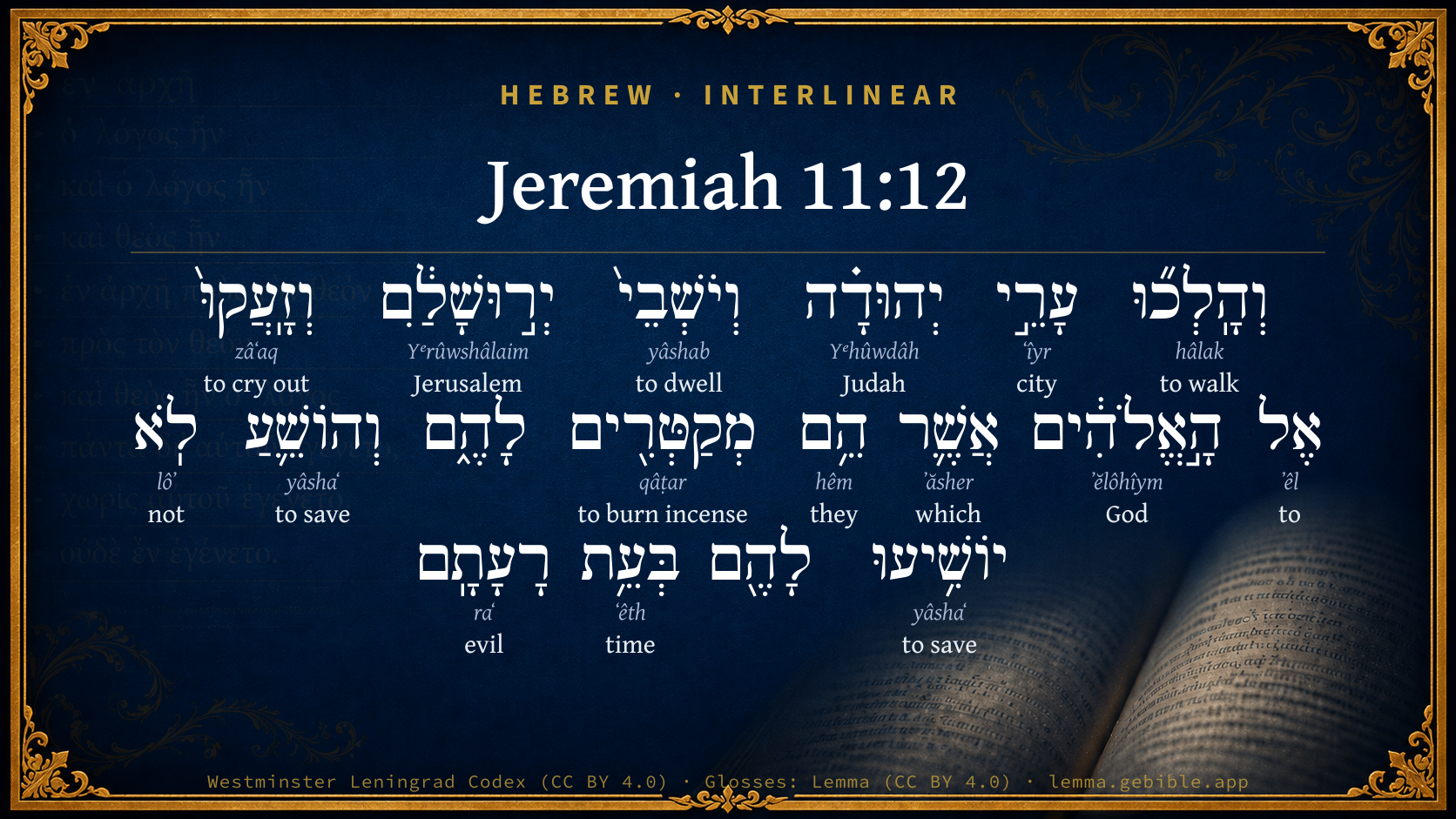
Hebrew (Westminster Leningrad Codex) Jeremiah 11:12 appears in the Hebrew Old Testament. The text above is from the Westminster Leningrad Codex. Each word links to its Strong’s number, a concise gloss, and parsing drawn from the Open Scriptures Hebrew Bible morphology. Click any word for its full Brown-Driver-Briggs (BDB) entry.
Download image
Cite this verse

Jeremiah 11:12 (World English Bible). Public Domain. Lemma interlinear Bible study tool, https://lemma.gebible.app/v/jeremiah/11/12.

Show BibTeX & RIS
BibTeX
RIS
English Translation
Then shall the cities of Judah and the inhabitants of Jerusalem go and cry to the gods to which they offer incense: but they will not save them at all in the time of their trouble.
World English Bible · Public Domain
Download a study sheet

One document with this verse’s original text, its word-by-word gloss line, the meaning frame, cross-references with their text, attributed commentary, and full source and license credits — printable, and it pastes into notes with its structure intact.

This verse Autodidact and up

Study sheet (.html) Plain text (.txt)

A passage Seminary Student

Up to 50 verses in one chapter. A passage sheet keeps up to 6 commentary sources and 12 cross-references per verse, in the order this page ranks them, and says so on the sheet whenever that leaves anything out. Ask for a single verse and you get the Autodidact verse sheet above.

Everything on this page stays free to read, with no account — the sheet is a download of what is already on screen, not access to it.

Want to remove ads? Support Godless Engineer
Compare translations 3

The same verse in 3 English versions, stacked beneath the original-language interlinear above. Click any original word for its lexicon entry.

Each is an independent rendering of the whole verse — the interlinear is not word-aligned to these translations.

Highlighted words mark where these versions differ — a whole-verse word diff, not a word-by-word alignment.

  • World English Bible Public Domain
    Then shall the cities of Judah and the inhabitants of Jerusalem go and cry to the gods to which they offer incense: but they will not save them at all in the time of their trouble.
  • King James Version Public Domain
    Then shall the cities of Judah and inhabitants of Jerusalem go, and cry unto the gods unto whom they offer incense: but they shall not save them at all in the time of their trouble.
  • unfoldingWord Literal Text CC BY-SA 4.0
    Then the cities of Judah and the inhabitants of Jerusalem will go and cry out to the gods whom they offering to them, and saving they will not save them in the time of their calamity.

unfoldingWord Literal Text — © unfoldingWord, licensed CC BY-SA 4.0. Word-aligned USFM3 via Door43 (git.door43.org/unfoldingWord/en_ult).

Versions to compare (up to 4)

3 of 4 selected

Show all 18 translations

Every available English version of this verse, each an independent rendering of the whole verse.

  • World English Bible Public Domain
    Then shall the cities of Judah and the inhabitants of Jerusalem go and cry to the gods to which they offer incense: but they will not save them at all in the time of their trouble.
  • Berean Standard Bible Public Domain
    Then the cities of Judah and the residents of Jerusalem will go and cry out to the gods to which they have been burning incense, but these gods certainly will not save them in their time of disaster.
  • Majority Standard Bible Public Domain
    Then the cities of Judah and the residents of Jerusalem will go and cry out to the gods to which they have been burning incense, but these gods certainly will not save them in their time of disaster.
  • King James Version Public Domain
    Then shall the cities of Judah and inhabitants of Jerusalem go, and cry unto the gods unto whom they offer incense: but they shall not save them at all in the time of their trouble.
  • American Standard Version (1901) Public Domain
    Then shall the cities of Judah and the inhabitants of Jerusalem go and cry unto the gods unto which they offer incense: but they will not save them at all in the time of their trouble.
  • Revised Version (1885) Public Domain
    Then shall the cities of Judah and the inhabitants of Jerusalem go and cry unto the gods unto whom they offer incense: but they shall not save them at all in the time of their trouble.
  • Geneva Bible (1599) Public Domain
    Then shall the cities of Iudah, and the inhabitants of Ierusalem goe, and crie vnto the gods vnto whome they offer incense, but they shall not bee able to helpe them in time of their trouble.
  • Douay-Rheims (1899) Public Domain
    And the cities of Juda, and the inhabitants of Jerusalem shall go, and cry to the gods to whom they offer sacrifice, and they shall not save them in the time of their affliction.
  • Young's Literal Translation Public Domain
    And the cities of Judah, and inhabitants of Jerusalem have gone, And they have cried unto the gods, To whom they are making perfume, And they give no deliverance at all to them, In the time of their vexation.
  • Literal Standard Version CC BY-SA 4.0
    And the cities of Judah, and inhabitants of Jerusalem have gone, || And they have cried to the gods, || To whom they are making incense, || And they give no deliverance at all to them, || In the time of their distress.
  • Unlocked Literal Bible CC BY-SA 4.0
    The cities of Judah and the inhabitants of Jerusalem will go and call out to the gods to which they had given offerings, but they will certainly not be saved by them at the time of their disaster.
  • unfoldingWord Literal Text CC BY-SA 4.0
    Then the cities of Judah and the inhabitants of Jerusalem will go and cry out to the gods whom they offering to them, and saving they will not save them in the time of their calamity.
  • Darby Bible Public Domain
    Then shall the cities of Judah and inhabitants of Jerusalem go and cry unto the gods unto whom they have burned incense; but they shall not save them at all in the time of their trouble.
  • World Messianic Bible Public Domain
    Then the cities of Judah and the inhabitants of Jerusalem will go and cry to the gods to which they offer incense, but they will not save them at all in the time of their trouble.
  • Webster's Bible Public Domain
    Then shall the cities of Judah and inhabitants of Jerusalem go, and cry to the gods to which they offer incense: but they shall not save them at all in the time of their trouble.
  • Free Bible Version CC BY-SA 4.0
    Then the people in the towns of Judah and Jerusalem will go and call out for help to the gods they've been burning incense to, but these gods won't be able to do anything to save them in their time of trouble.
  • Bible in Basic English Public Domain
    Then the towns of Judah and the people of Jerusalem will go crying for help to the gods to whom they have been burning perfumes: but they will give them no salvation in the time of their trouble.
  • JPS Tanakh (1917) Public Domain
    Then shall the cities of Judah and the inhabitants of Jerusalem go and cry unto the gods unto whom they offer; but they shall not save them at all in the time of their trouble.

Literal Standard Version (2020), Covenant Press — licensed CC BY-SA 4.0. Text via the HelloAO Bible API (eBible.org). Unlocked Literal Bible (unfoldingWord) — licensed CC BY-SA 4.0. Text via the HelloAO Bible API (eBible.org). unfoldingWord Literal Text — © unfoldingWord, licensed CC BY-SA 4.0. Word-aligned USFM3 via Door43 (git.door43.org/unfoldingWord/en_ult). Free Bible Version, Dr. Jonathan Gallagher — licensed CC BY-SA 4.0. Text via the HelloAO Bible API (eBible.org).

Word by word

More ways to search: Search by grammar → Find every occurrence → Compare this word →

Practice this passage: Drill this verse → Learn its vocabulary →

וְזָֽעֲקוּ֙
zâʻaq
H2199
“and · to cry out”
Conjunction + Verb, Qal, Sequential Perfect, 3rd Person, Common, Plural
Part of Speech
Conjunction + Verb
Stem
Qal
Form
Sequential Perfect
Person
3rd Person
Gender
Common
Number
Plural
Full BDB Definition

Origin: a primitive root

TWOT: 570

to cry, cry out, call, call for help - (Qal) - to call (to one's aid) - to cry, cry out (in need) - (Niphal) to be assembled, be called together, be joined together - (Hiphil) - to call, call out, call together, summon - to make a crying, proclaim - to have a proclamation made - to call out to, call out at
  1. וְהָֽלְכ֞וּ hâlak H1980 “and · to walk” Conjunction + Verb, Qal, Sequential Perfect, 3rd Person, Common, Plural
  2. עָרֵ֣י ʻîyr H5892 “cities of” Noun, Common, Feminine, Plural, Construct
  3. יְהוּדָ֗ה Yᵉhûwdâh H3063 “Judah” Noun, Proper
  4. וְיֹשְׁבֵי֙ yâshab H3427 “and · dwelling” Conjunction + Verb, Qal, Participle Active, Masculine, Plural, Construct
  5. יְר֣וּשָׁלִַ֔ם Yᵉrûwshâlaim H3389 “Jerusalem” Noun, Proper
  6. אֶל ʼêl H413 “to” Preposition
  7. הָ֣אֱלֹהִ֔ים ʼĕlôhîym H430 “the · God(s)” Particle, Definite Article + Noun, Common, Masculine, Plural, Absolute
  8. אֲשֶׁ֛ר ʼăsher H834 “which” Particle, Relative
  9. הֵ֥ם hêm H1992 “they” Pronoun, Personal, 3rd Person, Masculine, Plural
  10. מְקַטְּרִ֖ים qâṭar H6999 “burning incense” Verb, Piel, Participle Active, Masculine, Plural, Absolute
  11. וְהוֹשֵׁ֛עַ yâshaʻ H3467 “and · to save” Conjunction + Verb, Hiphil, Infinitive Absolute
  12. לֹֽא lôʼ H3808 “not” Particle, Negative
  13. יוֹשִׁ֥יעוּ yâshaʻ H3467 “to save” Verb, Hiphil, Imperfect, 3rd Person, Masculine, Plural
  14. בְּעֵ֥ת ʻêth H6256 “in/at · time of” Preposition + Noun, Common, Both, Singular, Construct
  15. רָעָתָֽם raʻ H7451 “evil · their” Noun, Common, Feminine, Singular, Construct + Suffix, Personal, 3rd Person, Masculine, Plural

About this verse

These counts appear in no published source. They are computed here, from the morphology-tagged text and Lemma’s own curated glosses. What Lemma adds →

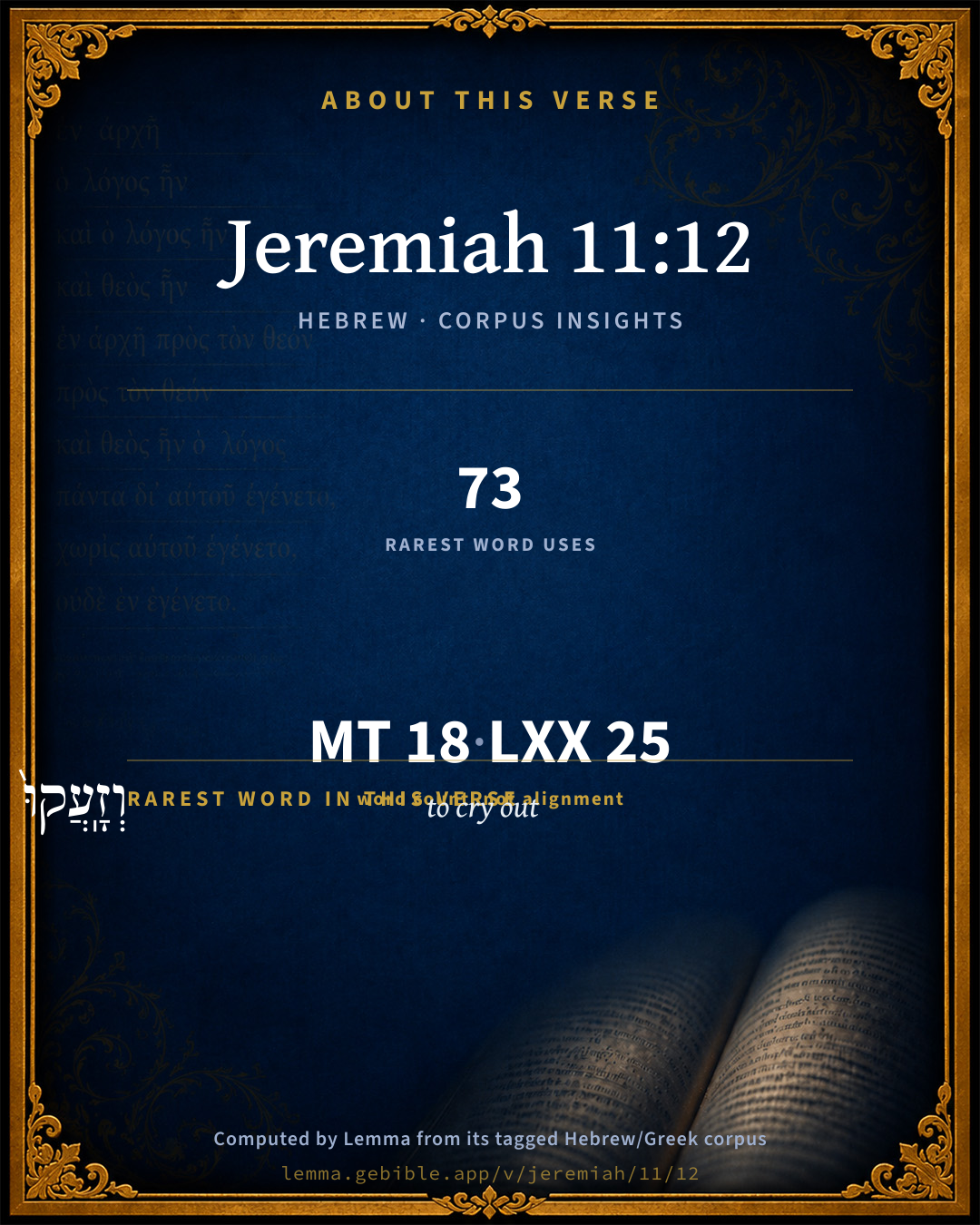
18
words
15
distinct lemmas
Prophets
section

Grammatical profile

  • 6 verbs
  • 6 nouns
  • 1 pronoun
  • 3 prepositions
  • 2 particles

Verb forms

  • וְהָֽלְכ֞וּ Qal · Sequential Perfect
  • וְיֹשְׁבֵי֙ Qal · Participle Active
  • וְזָֽעֲקוּ֙ Qal · Sequential Perfect
  • מְקַטְּרִ֖ים Piel · Participle Active
  • וְהוֹשֵׁ֛עַ Hiphil · Infinitive Absolute
  • יוֹשִׁ֥יעוּ Hiphil · Imperfect

Repetition

A word recurs within this verse — often emphatic in Hebrew:

  • וְהוֹשֵׁ֛עַ to save H3467 ×2

Hebrew & Septuagint length

In the original languages it is 18 Hebrew tokens and 25 Greek tokens — but the two are counted differently (Hebrew bundles its prefixes and suffixes into one token; the Greek is in lemma form), so that isn’t a like-for-like length.

Cross-references

6

Topical passages linked to Jeremiah 11:12 in the Treasury of Scripture Knowledge — connected by theme and wording, ordered by reader-vote popularity; previews shown in the World English Bible.

  • Deuteronomy 32:37 He will say, Where are their gods, The rock in which they took refuge;
  • Jeremiah 2:28 But where are your gods that you have made you? let them arise, if they can save you in the time of your trouble: for according to the number of your cities are your gods, Judah.
  • Judges 10:14 Go and cry to the gods which you have chosen; let them save you in the time of your distress.
  • 2 Chronicles 28:22 In the time of his distress did he trespass yet more against Yahweh, this same king Ahaz.
  • Isaiah 45:20 Assemble yourselves and come; draw near together, you who have escaped from the nations: they have no knowledge who carry the wood of their engraved image, and pray to a god that can't save.
  • Jeremiah 44:17–27 But we will certainly perform every word that is gone forth out of our mouth, to burn incense to the queen of the sky, and to pour out drink-offerings to her, as we have done, we and our fathers, our kings and our princes, in the cities of Judah, and in the streets of Jerusalem; for then had we plenty of food, and were well, and saw no evil.

Cross-references courtesy of OpenBible.info (CC BY 4.0).

Hebrew and Greek witnesses Masoretic Hebrew ↔ Greek Septuagint

The same verse in the two great witnesses to the Old Testament, shown verse-for-verse.

These are two independent witnesses, not word-aligned to each other, and the Septuagint is shown in lemma (dictionary) form.

Hebrew Jeremiah 11:12 Masoretic · Westminster Leningrad Codex

וְהָֽלְכ֞וּ עָרֵ֣י יְהוּדָ֗ה וְיֹשְׁבֵי֙ יְר֣וּשָׁלִַ֔ם וְזָֽעֲקוּ֙ אֶל הָ֣אֱלֹהִ֔ים אֲשֶׁ֛ר הֵ֥ם מְקַטְּרִ֖ים לָהֶ֑ם וְהוֹשֵׁ֛עַ לֹֽא יוֹשִׁ֥יעוּ לָהֶ֖ם בְּעֵ֥ת רָעָתָֽם

Then shall the cities of Judah and the inhabitants of Jerusalem go and cry to the gods to which they offer incense: but they will not save them at all in the time of their trouble.

World English Bible · Public Domain

Greek LXX Structure differs

In the Septuagint, Jeremiah is about an eighth shorter than the Hebrew and arranges its material differently — the Oracles Against the Nations (Hebrew chapters 46–51) appear in the middle of the Greek book, after 25:13. Because the chapter and verse boundaries do not line up, a verse-for-verse comparison with the Hebrew is not shown.

A verse-for-verse comparison isn’t shown here because the chapters and verses don’t line up. Switch to the LXX edition with the MT / LXX toggle above to read the Greek directly.

Hebrew: Westminster Leningrad Codex (CC BY 4.0). Greek: Septuagint (public domain); English from a public-domain English Septuagint. How the Septuagint differs from the Hebrew →

Targum (Aramaic paraphrase)

1

The Targum is the ancient Jewish Aramaic paraphrase of the Hebrew Scriptures — an interpretive translation, not the Hebrew text itself. Onkelos (literal) and Pseudo-Jonathan (expansive) render the Torah, and Jonathan the Prophets. Coverage is partial: where no permissively-licensed English translation exists for a verse, only the Aramaic is shown. This is verse-level text, not a word-by-word alignment to the Hebrew.

  1. Targum Jonathan Prophets (Joshua–Malachi)
    וִיהָכוֹן אֱנַשׁ קִרְוַיָא דְבֵית יְהוּדָה וְיַתְבֵי יְרוּשְׁלֵם וְיִבְעוּן מִן טַעֲוָתָא דְאִינוּן מַסְקִין בּוּסְמִין לְהֶן הַאִם יָכְלָן לְמִפְרַקְהוֹן בְּעִידַן בִּישַׁתְהוֹן:

    (no public-domain English translation for this verse)

    Targum Jonathan — Aramaic: “Mikraot Gedolot” (public domain). English: “Sefaria Community Translation” (CC0 1.0 (public-domain dedication)); “London "Chaldee Paraphrase," 1871” (public domain). Text via Sefaria.

Commentary

Notes on Jeremiah 11:12 from classic Christian and Jewish commentators (each source and its license shown beneath its notes). The classic Christian expositions comment on the surrounding passage and are grouped to its opening verse, so a note may address several verses; the Jewish commentaries on the Tanakh (Rashi and others) are per-verse, so they appear only where the commentator wrote on this verse.

Lemma curates 59 commentaries, every one of them public domain or Creative Commons licensed, each selected and text-cleaned for this edition rather than reprinted as found. About our sources →

Trapp's Complete Commentary

John Trapp

Jer 11:12 Then shall the cities of Judah and inhabitants of Jerusalem go, and cry unto the gods unto whom they offer incense: but they shall not save them at all in the time of their trouble.

Ver. 12. Then shall the cities of Judah … go and cry unto the gods.] Or, Let them go and cry unto them - q.d., let them for me. This is one of those bitter answers that God giveth to wicked suitors. {Eze 14:3-5 Jdg 10:14} Or, if he give them better at any time, it is in wrath, and for a mischief to them.

John Trapp, A Commentary or Exposition upon All the Books of the Old and New Testament (1647–1656) — public domain. Text from a community e-Sword module.

Joseph Benson's Commentary

Jer 11:12-14. Then shall the cities of Judah cry unto the gods, &c. — “When great calamities threaten men, their fears suggest all possible ways of seeking for succour. Thus, when the Jews found themselves forsaken of God, they betook themselves to idols, but found all such applications vain, and to no purpose: see 2Ch 28:23. For according to the number of thy cities were thy gods, &c. — See note on Jer 2:28. Ye have set up altars to that shameful thing — Hebrew, בשׁת, bosheth, shame, so called, because it was what they had cause to be ashamed of, and what would certainly bring them to shame and confusion. See note on Jer 3:24. Therefore pray not thou for this people — See note on Jer 7:16.

Joseph Benson's Commentary on the Old and New Testaments (1811–1818) — public domain. Text from a community e-Sword module.

Tyndale Open Study Notes

Tyndale Open Resources

11:12 The people of Judah and Jerusalem prayed and worshiped in their time of trouble, but not to the Lord; instead, they prayed to their idols. They were bonded to unreal and powerless images of wood and stone instead of to the one true God.

Tyndale Open Study Notes — © Tyndale Open Resources, licensed CC BY-SA 4.0. Text via the HelloAO Bible API.

Jamieson, Fausset & Brown

Robert Jamieson, A. R. Fausset & David Brown

cry unto the gods . . . not save-- (Deu 32:37-38). Compare this verse and beginning of Jer 11:13; Jer 2:28.

in the time of their trouble--that is, calamity (Jer 2:27).

Jamieson, Fausset & Brown — Commentary Critical and Explanatory on the Whole Bible (1871) — public domain (CC PDM 1.0). Text via the HelloAO Bible API.

Adam Clarke's Commentary

Verse 12. Go, and cry unto the gods] See Jer 2:28.

Adam Clarke's Commentary on the Bible (1810–1826) — public domain. Text from a community e-Sword/MySword module.

John Calvin's Commentaries

The Prophet then shews in these words that they were not touched by a true and sincere feeling of repentance who cried thus indiscriminately to God and to idols.

But another question may be here raised, How could they flee to God and to foreign gods too? The ready answer is this, that the unbelieving, in a turbulent state of mind, turn here and there, so that they lay hold of nothing certain, or sure and fixed. This we see in the Papists — they cry to God and at the same time to a great number of gods. Let us therefore know, that there is in all the unbelieving a spirit, as it were, of giddiness, which turns them into different expedients, so that now they call on God, then they flee to their idols. Men naturally are led to God when any distress holds them bound; hence they call on God: but afterwards, being not satisfied with him alone, they betake themselves to their own devices, and heap together, as I have said, a vast multitude of gods. Since then we see this to be done under the Papacy in our day, we need not wonder that it was done formerly, and that the Jews were on this account condemned.

The Prophet now addresses the Jews only; he had before spoken of the Israelites, but he now speaks especially to his own people, Go shall the cities of Judah and the citizens of Jerusalem, etc. What shall they do? They shall cry to their gods We hence see that their prayers were rambling, as though they poured them unto the air: therefore God could not have heard them. For whenever God promises to be propitious and appeasable he requires faith and repentance: but there was in this people an impious wantonness, and no faith, for they were entangled in their own superstitions.

The meaning is, that the Jews, when oppressed by calamities, would make their prayers to the true God, but without understanding, without any discrimination, but on the contrary, in a confused state of mind: and that this would be sufficiently evident, for they would at the same time seek the aid of various idols, but that they would gain no help, either from God or from their idols; and why? because they would be unworthy to be heard by God, as they would not call on him in a right spirit, not with faith and repentance; and their idols would not be able to bring them any help. It hence follows that they would be altogether in a hopeless state.

John Calvin's Commentaries (1540-1563) — public domain. Text from the Calvin Translation Society English edition (1840s-50s) via the Christian Classics Ethereal Library (ccel.org). Calvin's coverage is partial (roughly two-thirds of the Bible); uncommented books and verses are honest gaps, never fabricated. The 19th-century editor's footnotes and remarks are omitted so the notes are faithfully Calvin's own voice.

John Gill's Exposition

For according to the number of thy cities were thy gods, O Judah,.... See Gill on Jer 2:28,

and according to the number of the streets of Jerusalem; of which there were many, and some of note (i):

have ye set up altars to that shameful thing, even altars to burn incense unto Baal; one of whose names is Bosheth, "shame"; see Hos 9:10, hence Jerubbaal is called, in Sa2 11:21, Jerubbesheth; very properly is this name given to Baal, not only because the worship of him was to the reproach of the true God, but brought shame and confusion in the issue to its worshipper; as well as because shameful things were done in the worship of it, especially of Baalpeor; who seems to be the same with the Priapus of other nations.

(i) Vid. Lightfoot, Chorograph. Cent. ad Matt. p. 34.

John Gill's Exposition of the Whole Bible (1746–1763) — public domain (CC PDM 1.0). Text via the HelloAO Bible API.

Matthew Poole's English Annotations

Shall here signifieth will, and might as well have been so translated, denoting the hardness of the hearts of this people, whom affliction would not reduce to God; or rather the indicative mood is here put for the imperative, and the sense, Let

the cities of Judah, & c., and the phrase taken ironically. So it agreeth with God’s answer to the people crying to him, Jdg 10:14, and what this prophet had before said, Jer 2:28. But, saith the prophet, they shall do them no good, then they shall understand their vanity in their superstition and idolatry, that they have bestowed a divine homage upon lies and vanities, and things able to do them no good, nor at all to profit them.

Matthew Poole's English Annotations on the Holy Bible (1683–1685) — public domain. Text from a community e-Sword/MySword module.

Rashi

Rabbi Shlomo Yitzchaki (Rashi)

And they shall go the cities of Judah From the cities of Judah.

Rashi on the Tanakh — English translations: “The Judaica Press complete Tanach with Rashi, translated by A. J. Rosenberg” (CC BY 4.0); “Pentateuch with Rashi's commentary by M. Rosenbaum and A.M. Silbermann, 1929-1934” (public domain); “The Metsudah Tanach series, Lakewood, N.J” (CC BY 4.0); and “The Book of Joshua, Metsudah Publications, 1997” (CC BY 4.0). Text via Sefaria.

Lesson kit

Teaching starters — assembled from the data on this page, not authored interpretation. Every prompt links to the verse data it draws on. Edit before teaching.

Jeremiah, in the Prophets, opens this verse with 18 words (15 distinct Hebrew lemmas). Its most distinctive word is zâʻaq (“to cry out”). A historical commentator’s framing appears above. Read the whole chapter for the surrounding context.

Discussion questions

  1. The word zâʻaq carries the sense “to cry out.” How does it shape the verse?
  2. Deuteronomy 32:37 shares this passage’s theme. How do the two illuminate each other?
  3. “to save” occurs 2× in this one verse. What is the effect of the repetition?
  4. The translations on this page render this verse differently — a whole-verse word diff, not a word-by-word alignment. What might account for the different wordings?
  5. The verb «וְהָֽלְכ֞וּ» is Qal Sequential Perfect. How does its form color the action?
  6. Reading how Trapp's Complete Commentary and Joseph Benson's Commentary read this verse, where do the two commentators agree and where do they part?

Things to notice

Reading settings

Reading text

Shown beneath each verse's original-language words.

Old Testament
Old Testament edition

Read the OT as the Masoretic Hebrew (MT) or the Greek Septuagint (LXX).

English shown for the Greek Septuagint (in the Hebrew ↔ Greek comparison).

Comparing translations? Open the Compare panel on any verse page to stack up to four side by side.