
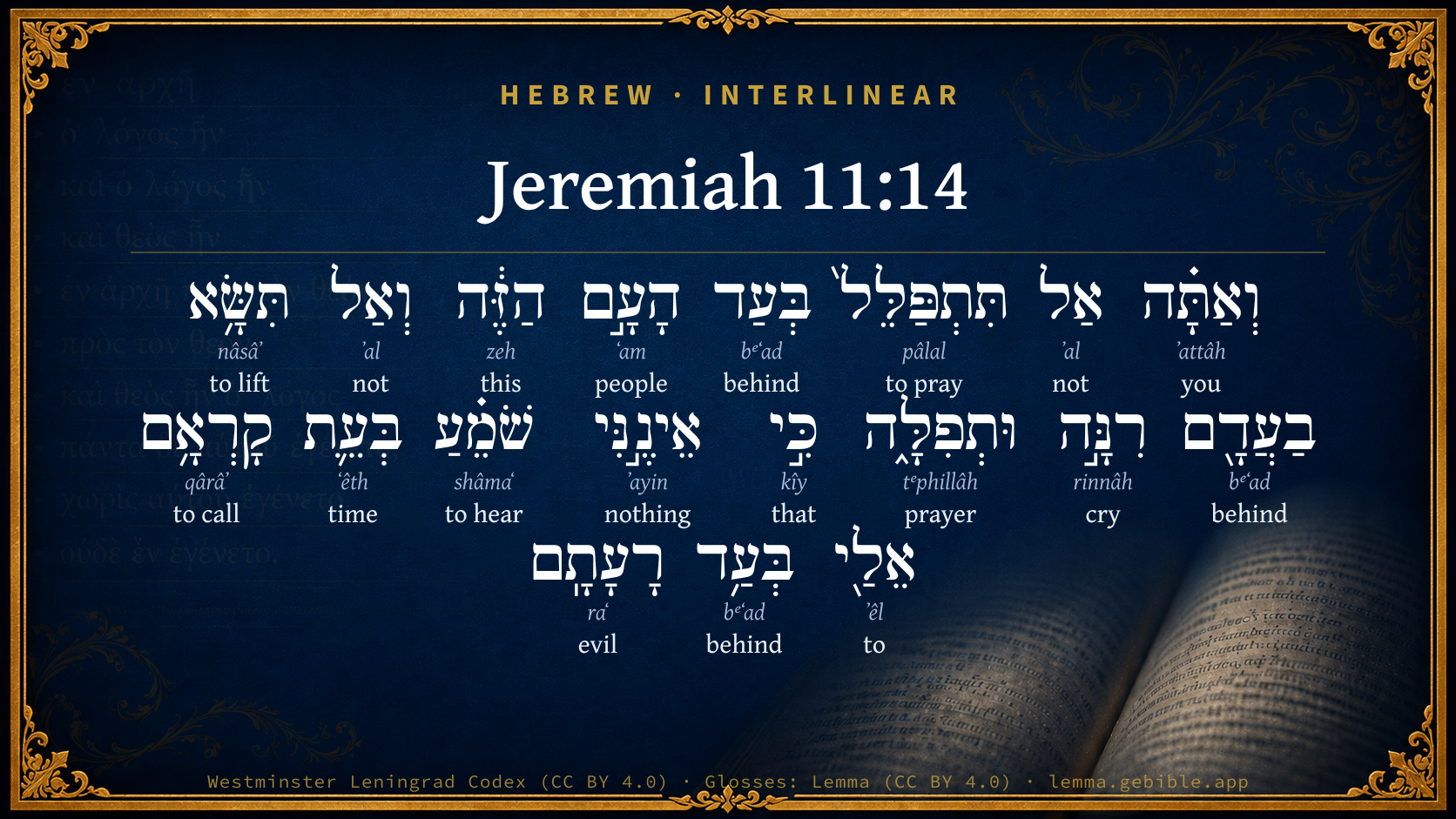
Jeremiah 11:14

Hebrew (Westminster Leningrad Codex) Jeremiah 11:14 appears in the Hebrew Old Testament. The text above is from the Westminster Leningrad Codex. Each word links to its Strong’s number, a concise gloss, and parsing drawn from the Open Scriptures Hebrew Bible morphology. Click any word for its full Brown-Driver-Briggs (BDB) entry.
Download image
Cite this verse

Jeremiah 11:14 (World English Bible). Public Domain. Lemma interlinear Bible study tool, https://lemma.gebible.app/v/jeremiah/11/14.

Show BibTeX & RIS
BibTeX
RIS
English Translation
Therefore don't you pray for this people, neither lift up cry nor prayer for them; for I will not hear them in the time that they cry to me because of their trouble.
World English Bible · Public Domain
Download a study sheet

One document with this verse’s original text, its word-by-word gloss line, the meaning frame, cross-references with their text, attributed commentary, and full source and license credits — printable, and it pastes into notes with its structure intact.

This verse Autodidact and up

Study sheet (.html) Plain text (.txt)

A passage Seminary Student

Up to 50 verses in one chapter. A passage sheet keeps up to 6 commentary sources and 12 cross-references per verse, in the order this page ranks them, and says so on the sheet whenever that leaves anything out. Ask for a single verse and you get the Autodidact verse sheet above.

Everything on this page stays free to read, with no account — the sheet is a download of what is already on screen, not access to it.

Want to remove ads? Support Godless Engineer
Compare translations 3

The same verse in 3 English versions, stacked beneath the original-language interlinear above. Click any original word for its lexicon entry.

Each is an independent rendering of the whole verse — the interlinear is not word-aligned to these translations.

Highlighted words mark where these versions differ — a whole-verse word diff, not a word-by-word alignment.

  • World English Bible Public Domain
    Therefore don't you pray for this people, neither lift up cry nor prayer for them; for I will not hear them in the time that they cry to me because of their trouble.
  • King James Version Public Domain
    Therefore pray not thou for this people, neither lift up a cry or prayer for them: for I will not hear them in the time that they cry unto me for their trouble.
  • unfoldingWord Literal Text CC BY-SA 4.0
    Therefore you, do not intercede for this people and do not lift up a cry or a prayer on their behalf, for there is not me listening in the time of their calling to me because of their calamity.

unfoldingWord Literal Text — © unfoldingWord, licensed CC BY-SA 4.0. Word-aligned USFM3 via Door43 (git.door43.org/unfoldingWord/en_ult).

Versions to compare (up to 4)

3 of 4 selected

Show all 18 translations

Every available English version of this verse, each an independent rendering of the whole verse.

  • World English Bible Public Domain
    Therefore don't you pray for this people, neither lift up cry nor prayer for them; for I will not hear them in the time that they cry to me because of their trouble.
  • Berean Standard Bible Public Domain
    As for you, do not pray for these people. Do not raise up a cry or a prayer on their behalf, for I will not be listening when they call out to Me in their time of disaster.
  • Majority Standard Bible Public Domain
    As for you, do not pray for these people. Do not raise up a cry or a prayer on their behalf, for I will not be listening when they call out to Me in their time of disaster.
  • King James Version Public Domain
    Therefore pray not thou for this people, neither lift up a cry or prayer for them: for I will not hear them in the time that they cry unto me for their trouble.
  • American Standard Version (1901) Public Domain
    Therefore pray not thou for this people, neither lift up cry nor prayer for them; for I will not hear them in the time that they cry unto me because of their trouble.
  • Revised Version (1885) Public Domain
    Therefore pray not thou for this people, neither lift up cry nor prayer for them: for I will not hear them in the time that they cry unto me for their trouble.
  • Geneva Bible (1599) Public Domain
    Therfore thou shalt not pray for this people, neither lift vp a crie, or prayer for them: for when they cry vnto mee in their trouble, I will not heare them.
  • Douay-Rheims (1899) Public Domain
    Therefore, do not thou pray for this people, and do not take up praise and prayer for them: for I will not hear them in the time of their cry to me, in the time of their affliction.
  • Young's Literal Translation Public Domain
    And thou, thou dost not pray for this people, Nor dost thou lift up for them cry and prayer, For I do not hearken in the time of their calling unto Me for their vexation.
  • Literal Standard Version CC BY-SA 4.0
    And you, you do not pray for this people, || Nor do you lift up cry and prayer for them, || For I do not listen in the time of their calling to Me for their distress.
  • Unlocked Literal Bible CC BY-SA 4.0
    So you yourself, Jeremiah, must not pray for this people. You must not wail or pray on their behalf. For I will not be listening when they call on me in their disaster.
  • unfoldingWord Literal Text CC BY-SA 4.0
    Therefore you, do not intercede for this people and do not lift up a cry or a prayer on their behalf, for there is not me listening in the time of their calling to me because of their calamity.
  • Darby Bible Public Domain
    And thou, pray not for this people, neither lift up cry nor prayer for them; for I will not hear in the time that they cry unto me for their trouble.
  • World Messianic Bible Public Domain
    “Therefore don’t pray for this people. Don’t lift up cry or prayer for them; for I will not hear them in the time that they cry to me because of their trouble.
  • Webster's Bible Public Domain
    Therefore pray not thou for this people, neither lift up a cry or prayer for them: for I will not hear them in the time when they cry to me for their trouble.
  • Free Bible Version CC BY-SA 4.0
    Jeremiah, don't pray for these people. Don't cry for help or offer a prayer on their behalf, because I won't be listening when they cry out to me in the time of their trouble.
  • Bible in Basic English Public Domain
    And as for you, make no prayers for this people, send up no cry or prayer for them: for I will not give ear to their cry in the time of their trouble.
  • JPS Tanakh (1917) Public Domain
    Therefore pray not thou for this people, neither lift up cry nor prayer for them; for I will not hear them in the time that they cry unto Me for their trouble.'

Literal Standard Version (2020), Covenant Press — licensed CC BY-SA 4.0. Text via the HelloAO Bible API (eBible.org). Unlocked Literal Bible (unfoldingWord) — licensed CC BY-SA 4.0. Text via the HelloAO Bible API (eBible.org). unfoldingWord Literal Text — © unfoldingWord, licensed CC BY-SA 4.0. Word-aligned USFM3 via Door43 (git.door43.org/unfoldingWord/en_ult). Free Bible Version, Dr. Jonathan Gallagher — licensed CC BY-SA 4.0. Text via the HelloAO Bible API (eBible.org).

Word by word

More ways to search: Search by grammar → Find every occurrence → Compare this word →

Practice this passage: Drill this verse → Learn its vocabulary →

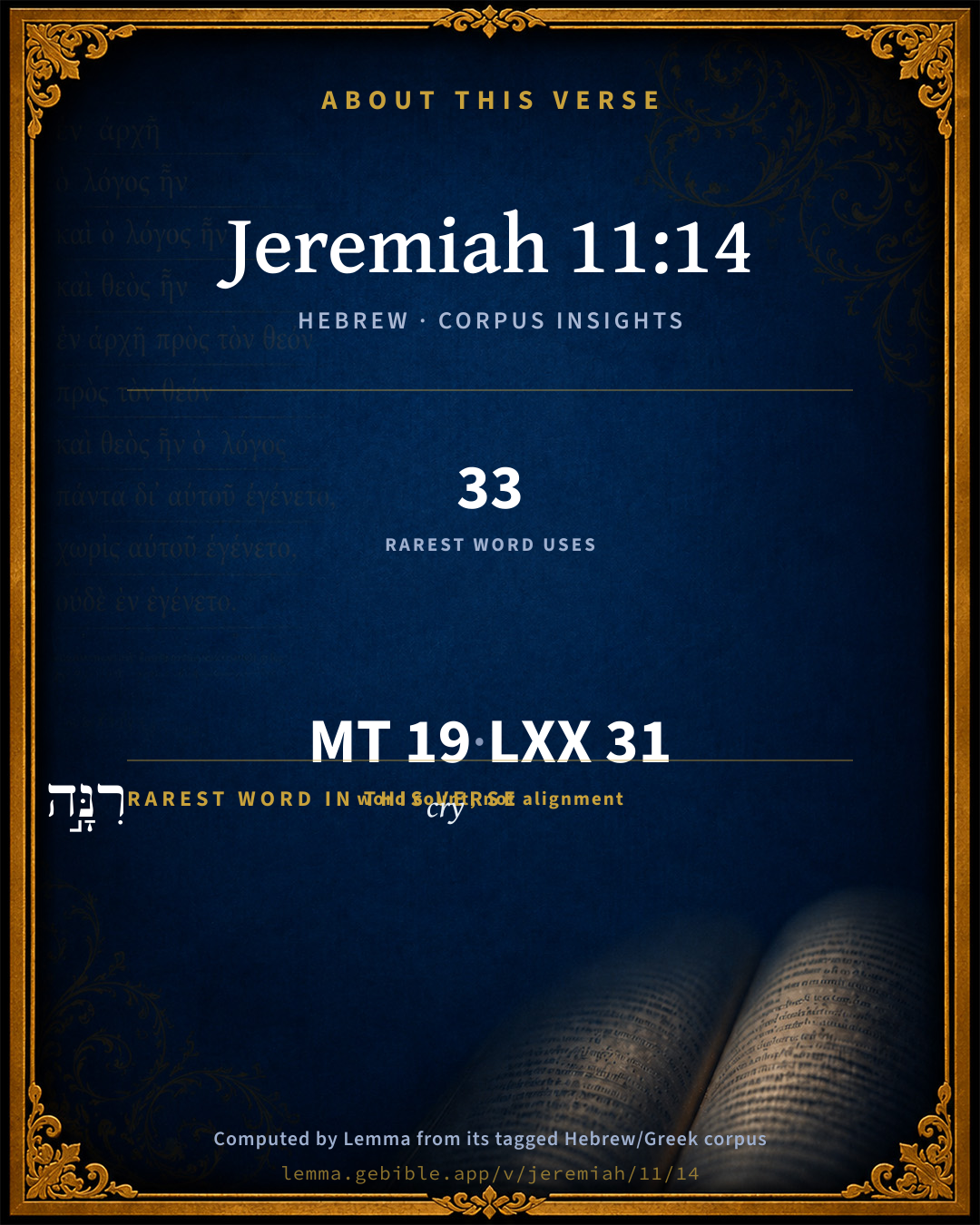
רִנָּ֣ה
rinnâh
H7440
“cry”
Noun, Common, Feminine, Singular, Absolute
Part of Speech
Noun
Type
Common
Gender
Feminine
Number
Singular
State
Absolute
Full BDB Definition

Origin: from H7442

TWOT: 2179c

ringing cry - of entreaty, supplication - in proclamation, joy, praise
  1. וְאַתָּ֗ה ʼattâh H859 “and · you” Conjunction + Pronoun, Personal, 2nd Person, Masculine, Singular
  2. אַל ʼal H408 “not” Particle, Negative
  3. תִּתְפַּלֵּל֙ pâlal H6419 “to pray” Verb, Hithpael, Jussive, 2nd Person, Masculine, Singular
  4. בְּעַד bᵉʻad H1157 “behind” Preposition
  5. הָעָ֣ם ʻam H5971 “the · people” Particle, Definite Article + Noun, Common, Masculine, Singular, Absolute
  6. הַזֶּ֔ה zeh H2088 “the · this” Particle, Definite Article + Pronoun, Demonstrative, Masculine, Singular
  7. וְאַל ʼal H408 “and · not” Conjunction + Particle, Negative
  8. תִּשָּׂ֥א nâsâʼ H5375 “to lift” Verb, Qal, Jussive, 2nd Person, Masculine, Singular
  9. בַעֲדָ֖ם bᵉʻad H1157 “behind · them” Preposition + Suffix, Personal, 3rd Person, Masculine, Plural
  10. וּתְפִלָּ֑ה tᵉphillâh H8605 “and · prayer” Conjunction + Noun, Common, Feminine, Singular, Absolute
  11. כִּ֣י kîy H3588 “that” Conjunction
  12. אֵינֶ֣נִּי ʼayin H369 “nothing · me” Particle, Interrogative + Suffix, Personal, 1st Person, Common, Singular
  13. שֹׁמֵ֗עַ shâmaʻ H8085 “hearing” Verb, Qal, Participle Active, Masculine, Singular, Absolute
  14. בְּעֵ֛ת ʻêth H6256 “in/at · time of” Preposition + Noun, Common, Both, Singular, Construct
  15. קָרְאָ֥ם qârâʼ H7121 “to call · them” Verb, Qal, Infinitive Construct + Suffix, Personal, 3rd Person, Masculine, Plural
  16. אֵלַ֖י ʼêl H413 “to · me” Preposition + Suffix, Personal, 1st Person, Common, Singular
  17. בְּעַ֥ד bᵉʻad H1157 “behind” Preposition
  18. רָעָתָֽם raʻ H7451 “evil · their” Noun, Common, Feminine, Singular, Construct + Suffix, Personal, 3rd Person, Masculine, Plural

About this verse

These counts appear in no published source. They are computed here, from the morphology-tagged text and Lemma’s own curated glosses. What Lemma adds →

19
words
16
distinct lemmas
Prophets
section

Shared distinctive vocabulary

רִנָּ֣ה cry H7440 occurs in 33 verses of the Hebrew Bible. Also found in:

Grammatical profile

  • 4 verbs
  • 5 nouns
  • 2 pronouns
  • 4 prepositions
  • 1 conjunction
  • 3 particles

Verb forms

  • תִּתְפַּלֵּל֙ Hithpael · Jussive
  • תִּשָּׂ֥א Qal · Jussive
  • שֹׁמֵ֗עַ Qal · Participle Active
  • קָרְאָ֥ם Qal · Infinitive Construct

Repetition

Words recur within this verse — often emphatic in Hebrew:

  • בְּעַד behind H1157 ×3
  • אַל not H408 ×2

Hebrew & Septuagint length

In the original languages it is 19 Hebrew tokens and 31 Greek tokens — but the two are counted differently (Hebrew bundles its prefixes and suffixes into one token; the Greek is in lemma form), so that isn’t a like-for-like length.

Cross-references

9

Topical passages linked to Jeremiah 11:14 in the Treasury of Scripture Knowledge — connected by theme and wording, ordered by reader-vote popularity; previews shown in the World English Bible.

  • Jeremiah 7:16 Therefore don't you pray for this people, neither lift up a cry nor prayer for them, neither make intercession to me; for I will not hear you.
  • Jeremiah 11:11 Therefore thus says Yahweh, Behold, I will bring evil on them, which they shall not be able to escape; and they shall cry to me, but I will not listen to them.
  • Jeremiah 14:11 Yahweh said to me, Don't pray for this people for [their] good.
  • 1 John 5:16 If anyone sees his brother sinning a sin not leading to death, he shall ask, and God will give him life for those who sin not leading to death. There is a sin leading to death. I don't say that he should make a request concerning this.
  • Exodus 32:10 Now therefore leave me alone, that my wrath may burn hot against them, and that I may consume them; and I will make of you a great nation."
  • Psalms 66:18 If I cherished sin in my heart, The Lord wouldn't have listened.
  • Proverbs 26:24–25 A malicious man disguises himself with his lips, But he harbors evil in his heart.
  • Jeremiah 15:1 Then said Yahweh to me, Though Moses and Samuel stood before me, yet my mind would not be toward this people: cast them out of my sight, and let them go forth.
  • Hosea 5:6 They will go with their flocks and with their herds to seek Yahweh; But they won't find him. He has withdrawn himself from them.

Cross-references courtesy of OpenBible.info (CC BY 4.0).

Hebrew and Greek witnesses Masoretic Hebrew ↔ Greek Septuagint

The same verse in the two great witnesses to the Old Testament, shown verse-for-verse.

These are two independent witnesses, not word-aligned to each other, and the Septuagint is shown in lemma (dictionary) form.

Hebrew Jeremiah 11:14 Masoretic · Westminster Leningrad Codex

וְאַתָּ֗ה אַל תִּתְפַּלֵּל֙ בְּעַד הָעָ֣ם הַזֶּ֔ה וְאַל תִּשָּׂ֥א בַעֲדָ֖ם רִנָּ֣ה וּתְפִלָּ֑ה כִּ֣י אֵינֶ֣נִּי שֹׁמֵ֗עַ בְּעֵ֛ת קָרְאָ֥ם אֵלַ֖י בְּעַ֥ד רָעָתָֽם

Therefore don't you pray for this people, neither lift up cry nor prayer for them; for I will not hear them in the time that they cry to me because of their trouble.

World English Bible · Public Domain

Greek LXX Structure differs

In the Septuagint, Jeremiah is about an eighth shorter than the Hebrew and arranges its material differently — the Oracles Against the Nations (Hebrew chapters 46–51) appear in the middle of the Greek book, after 25:13. Because the chapter and verse boundaries do not line up, a verse-for-verse comparison with the Hebrew is not shown.

A verse-for-verse comparison isn’t shown here because the chapters and verses don’t line up. Switch to the LXX edition with the MT / LXX toggle above to read the Greek directly.

Hebrew: Westminster Leningrad Codex (CC BY 4.0). Greek: Septuagint (public domain); English from a public-domain English Septuagint. How the Septuagint differs from the Hebrew →

Targum (Aramaic paraphrase)

1

The Targum is the ancient Jewish Aramaic paraphrase of the Hebrew Scriptures — an interpretive translation, not the Hebrew text itself. Onkelos (literal) and Pseudo-Jonathan (expansive) render the Torah, and Jonathan the Prophets. Coverage is partial: where no permissively-licensed English translation exists for a verse, only the Aramaic is shown. This is verse-level text, not a word-by-word alignment to the Hebrew.

  1. Targum Jonathan Prophets (Joshua–Malachi)
    וְאַתְּ לָא תְצַלֵי עַל עַמָא הָדֵין וְלָא תִתְחַנֵן עֲלֵיהוֹן בְּבָעוּ וּבִצְלוֹ אֲרֵי לָא רַעֲוָא קֳדָמַי בְּעִידַן דְאַתְּ מְצַלֵי עֲלֵיהוֹן קֳדָמַי בְּעִידַן בִּישַׁתְהוֹן:

    (no public-domain English translation for this verse)

    Targum Jonathan — Aramaic: “Mikraot Gedolot” (public domain). English: “Sefaria Community Translation” (CC0 1.0 (public-domain dedication)); “London "Chaldee Paraphrase," 1871” (public domain). Text via Sefaria.

Commentary

Notes on Jeremiah 11:14 from classic Christian and Jewish commentators (each source and its license shown beneath its notes). The classic Christian expositions comment on the surrounding passage and are grouped to its opening verse, so a note may address several verses; the Jewish commentaries on the Tanakh (Rashi and others) are per-verse, so they appear only where the commentator wrote on this verse.

Lemma curates 59 commentaries, every one of them public domain or Creative Commons licensed, each selected and text-cleaned for this edition rather than reprinted as found. About our sources →

Trapp's Complete Commentary

John Trapp

Jer 11:14 Therefore pray not thou for this people, neither lift up a cry or prayer for them: for I will not hear [them] in the time that they cry unto me for their trouble.

Ver. 14. Therefore pray not thou for this people.] See on Jer 7:16.

When they cry unto me for their trouble.] It is not the cry of the spirit for grace, but of the flesh only for ease; it is but the fruit of sinful self-love. In thee indeed it proceedeth from a better principle, but I am at a point.

John Trapp, A Commentary or Exposition upon All the Books of the Old and New Testament (1647–1656) — public domain. Text from a community e-Sword module.

The Biblical Illustrator

Joseph S. Exell

Jer_11:14

Therefore pray not thou for this people.

Futile prayers

It is futile to pray for those who have deliberately cast off the covenant of Jehovah and made a covenant with His adversary. Prayer cannot save, nothing can save, the impenitent; and there is a state of mind, in which ones own prayer is turned into sin; the state of mind in which a man prays, merely to appease God, and escape the fire, but without a thought of forsaking sin, without the faintest aspiration after holiness. There is a degree of guilt upon which sentence is already passed, which is unto death, and for which prayer is interdicted alike by the prophet of the new and of the old covenant. (C. J. Ball, M. A.)

The Biblical Illustrator, edited by Joseph S. Exell (c. 1880s–1900s) — public domain. Text from a community e-Sword module.

Whedon's Commentary on the Bible

Daniel D. Whedon

CALAMITY CONSEQUENT ON BREAKING THE COVENANT, Jer_11:14-17.

14. Pray not… for this people — Because they had reached that climax of guilt in which intercessory prayer may no longer avail.

Daniel D. Whedon (gen. ed.), Commentary on the Old and New Testaments (1874–1909) — public domain. Text from a community e-Sword module.

Tyndale Open Study Notes

Tyndale Open Resources

11:14 The Lord told Jeremiah not to weep or pray for the people of Jerusalem (see 7:16); the Lord had shut his ears to any prayers they might direct to him. Because the people were committed to worshiping Baal, any prayer they offered would be a charade.

Tyndale Open Study Notes — © Tyndale Open Resources, licensed CC BY-SA 4.0. Text via the HelloAO Bible API.

Geneva Bible (1599)

Geneva Bible translators

Read Jer. 7:16 and 14:11.

Geneva Bible (1599) marginal notes — public domain. Text via Bolls.life.

Jamieson, Fausset & Brown

Robert Jamieson, A. R. Fausset & David Brown

There is a climax of guilt which admits of no further intercessory prayer (Exo 32:10, in the Chaldee version, "leave off praying"; Jer 7:16; Sa1 16:1; Sa1 15:35; Jo1 5:16). Our mind should be at one with God in all that He is doing, even in the rejection of the reprobate.

for their trouble--on account of their trouble. Other manuscripts read, "in the time of their trouble" a gloss from Jer 11:12.

Jamieson, Fausset & Brown — Commentary Critical and Explanatory on the Whole Bible (1871) — public domain (CC PDM 1.0). Text via the HelloAO Bible API.

Adam Clarke's Commentary

Verse 14. Therefore pray not thou for this people] I am determined to give them up into the hands of their enemies; I will neither hear thy intercession, nor regard their prayers. Their measure is full.

Adam Clarke's Commentary on the Bible (1810–1826) — public domain. Text from a community e-Sword/MySword module.

John Calvin's Commentaries

That the Jews might understand that a sore calamity was nigh, and that God would not be appeasable, the Prophet himself is forbidden to intercede for them. There is no doubt but that even when he reproved the people in the severest strain, he made supplications to God for them; for he sustained a twofold character: when he went forth as the herald of celestial vengeance, he thundered against the ungodly and the despisers of God; but at the same time he humbly supplicated pardon in behalf of lost and miserable men; for had he not been solicitous for the salvation of the people, had he not diligently prayed, it would not have been necessary to prohibit him to pray. It hence appears that the Prophet was diligent in these two things, that he severely reproved the people according to God’s command, and that he also was a suppliant in seeking God’s favor to the unworthy. This is one thing.

Now then that God prohibits Jeremiah to pray, this was not done for his sake only, but he had a regard also to the whole people, that they might know that a sentence was pronounced on them, and that there was no hope left. We hence see that God positively declares that it was his purpose to destroy the people, and that therefore there was no room for prayer.

But it may be asked, Whether the Prophet, by going on in praying, offended God? for we shall see that he was still so anxious for the welfare of the people that he ceased not to pray: and what is said of Jeremiah is true also of all the other prophets; and the faithful have ever prayed for pardon, though the state of things had been brought to an extremity. But we must observe, that God, when he thus issues a simple prohibition, often stimulates the prayers of his people, according to what we read of Samuel; for though he knew from God’s own mouth that Saul was rejected, he yet from love ceased not to seek his good and to intercede God for him. (1 Samuel 15:35; 1 Samuel 16:1) But the prophets doubtless paid regard to God’s counsel in this case: yet as God did not speak for the sake of Jeremiah, but of the people, the Prophet is not to be charged with rashness or presumption, or foolish obstinacy or inconsiderate zeal, for having afterwards prayed; for he knew that this was not so much for his sake as on account of the people.

But there is another thing to be observed, — that Jeremiah was not forbidden to pray for the remnant, that is, for the elect, and for the seed from which the Church was afterwards to arise; but he was forbidden to pray for the whole body of the people: and no doubt he felt assured from that time that no remedy could be applied, and that the people would be driven into exile. This then is to be understood of the whole mass of the people; Jeremiah might still pray for the elect, and also for the new Church, that is, for the renewal of the Church: he was not indeed to pray that the Lord would not execute the vengeance which had been already decreed, for that could not be turned aside by any prayers.

We now then understand the meaning of this passage, — that Jeremiah prayed daily for all men, and also for the renewal of the Church; but that he was to look for the calamity of exile as a certain thing, for this had been fixed by God.

As to the words, Raise not for them a cry or a prayer, we have said elsewhere that there are two ways of speaking, which though different in some respects, are yet the same in meaning — to raise up and to cast a prayer. Hence the saints are said sometimes to cast their prayers: “Let my prayer be cast in thy presence.”’For no one is rightly prepared to call on God, except he is cast down in himself and laid prostrate. Hence the prayers of the saints are said to be cast on account of their humility; they are also said to be raised up on account of the fervor of their zeal, and also on account of their confidence. And that he repeats the same thing in different words is not without a meaning; for it is the same as though he had.said, “Thou wilt do nothing by beseeching, praying, interceding and supplicating.” God then confirms by these several words that he would not hereafter be reconciled to the people.

It follows, For I will not hear them at the time when they shall cry to me There seems not to be a suitable reason given here, for God might have conceded to the Prophet what had not been denied to the ungodly and the rebellious: but he simply means that he would be a severe Judge in executing punishment, so that there would be no room for mercy: I will not then hear them; that is, “If even they cry, I will not hear them, (it is an argument from the greater to the less) much less then will I hear thee for them.” But why was not God propitious to his servant? To this I answer, that God is more ready to shew mercy when any one himself calls on him, than when he is supplicated by others. The meaning is, that whether they themselves prayed or employed others to pray for them, God would not be reconciled to them.

What might be objected here has been elsewhere answered; for if they had from the heart and sincerely prayed, God would have no doubt heard them; for that promise never disappoints any,

“Nigh is God to all who call upon him;” (Psalm 145:18)

but it is added, “in truth.” As then hypocrites are here spoken of who poured forth rambling and false prayers, and blended the worship of the true God with that of their own idols, it is no wonder that. God rejected their prayers, for our prayers are sanctified by faith and repentance. When, therefore, unbelief prevails, and when the heart cleaves perversely to wickedness, our prayers are polluted and presumptuous; for then the name of God is profaned. It is therefore not strange that God rejects those who call on him hypocritically. It follows —

John Calvin's Commentaries (1540-1563) — public domain. Text from the Calvin Translation Society English edition (1840s-50s) via the Christian Classics Ethereal Library (ccel.org). Calvin's coverage is partial (roughly two-thirds of the Bible); uncommented books and verses are honest gaps, never fabricated. The 19th-century editor's footnotes and remarks are omitted so the notes are faithfully Calvin's own voice.

Ellicott's Commentary for English Readers

(14) Therefore pray not.—The words imply, as in Jer_7:16, that the prophet’s human feelings had led him to pour his soul in passionate intercession that the penalty might be averted. He is told that it is at once too early and too late for that prayer. The people have not yet been moved to repentance, and their cry is simply the wail of suffering. The discipline must do its work, and the judgment they have brought down on themselves can be stayed no longer.

A Bible Commentary for English Readers, edited by Charles John Ellicott (1878–1897) — public domain. Text from a community e-Sword module.

The Cambridge Bible for Schools and Colleges

gen. ed. J. J. S. Perowne

14. Therefore pray not thou] Cp. ch. Jer_7:16.

The Cambridge Bible for Schools and Colleges (gen. ed. J. J. S. Perowne; Cambridge University Press, 1878–1918) — public domain. Text from a community e-Sword module.

John Gill's Exposition

What hath my beloved to do in mine house,.... These are either the words of the prophet, as Kimchi and Ben Melech think, speaking after this manner; what has God, who is my beloved, he whom my soul loves, and who loves me, to do in the sanctuary, which is my house, and not this people's, that have defiled it, to cause his Shechinah to dwell there, after so much wickedness has been committed in it? and so Cocceius interprets it of Christ the beloved Son of God, and the beloved of his church and people, withdrawing from the temple, because of the wickedness of the Jews; or they are the words of God concerning the people of the Jews, who were beloved for the Father's sake; signifying that now, because of their abominations, it was not fitting they should continue in the house of God, or have any shelter and protection there. The Jews interpret (k) this of Abraham:

seeing she hath wrought lewdness with many; that is, the congregation of Israel, or the church of the Jews, had committed idolatry with many idols; or it was not only a few of them that were guilty of this sin, but a multitude, even their great men, the princes and nobles:

and the holy flesh is passed from thee? which Kimchi and Ben Melech understand of holy and good men, who ceased from among them, were perished and gone; and Jarchi, of the circumcision of the flesh, which was neglected: but it seems best to interpret it of the flesh of sacrifices; which were either laid aside by them, or, if offered and eaten of, were of no service to them, being offered up with a wicked mind; or rather the meaning is, the time was come that these were at an end, the temple being destroyed:

when thou doest evil; the evil of sin; or "when thine evil is" (l); the evil of punishment is coming upon thee:

then thou rejoicest; instead of repenting of sin, and mourning for it, or being humbled at approaching judgments, gave themselves up to sensual lusts and pleasures; neither concerned at the one nor at the other; neither grieved for sin, nor trembled at punishment; but amidst all were brisk and jovial; though some say (m) the word has the signification of trembling; and render it, "then thou shalt tremble". The Targum of the whole is,

"What (have I to do) with this people, that was beloved before me? they have left the worship of the house of my sanctuary; they have took counsel to sin much; they mingle the flesh of abominations with the holy flesh; they shall go into captivity from thee; because of thy wickedness thou art strong.''

(k) T. Bab. Menachot, fol. 53. 2. (l) "quum adest malum tuum", Junius & Tremellius; "praesto est", Piscator; extabit, Cocceius. (m) R. Sol. Urbin. Ohel Moed, fol. 32. 1.

John Gill's Exposition of the Whole Bible (1746–1763) — public domain (CC PDM 1.0). Text via the HelloAO Bible API.

Albert Barnes' Notes on the Bible

A parenthesis. As in Jer 7:16, all intercession is forbidden, and for this reason. Prayer for others for the forgiveness of their sins avails only when they also pray. The cry of the people now was that of the guilty smarting under punishment, not of the penitent mourning over sin.

Jer 11:15

This passage, like Isa 1:12, rebukes the inconsistency of Judah’s public worship of Yahweh with their private immorality and preference for idolatry. Translate it: “What hath My beloved in My house to practice guile there? The great men and the holy flesh (i. e., the sacrifices) shall pass away from thee.”

Jer 11:16

The “goodly” or “shapely fruit,” signifies the righteousness and faith which ought to have been the result of Israel’s possession of extraordinary privileges. The tree did not bear this fruit, and God now destroys it by a thunderstorm.

Albert Barnes' Notes on the Bible (1834–1885) — public domain. Text from a community e-Sword/MySword module.

Matthew Poole's English Annotations

Once before, and we shall find once after this, Jer 14:11, God forbiddeth the prophet to pray for this people; hence ariseth a question how the prophet is excused from sin, in praying for them after this prohibition, especially when God had assured him that he would not hear.

Solut.

1. God (say some) sometimes forbiddeth prayers for persons and people to stir them up to more fervent prayer.

2. We find the like done by Moses, Exo 32:10, and 1Sa 15:35; 16:1. Others say,

3. That we must not understand these words as an absolute prohibition to Jeremiah, but for the terrifying of the people.

4. God speaks only of a temporal evil, and willeth Jeremiah not to be too positive in his prayers for them, that they might be delivered from that; but he might pray for the pardon of their sins, and their deliverance from the eternal vengeance of God.

5. He might not pray for the obstinate part of this people, but for the elect of God amongst them.

Matthew Poole's English Annotations on the Holy Bible (1683–1685) — public domain. Text from a community e-Sword/MySword module.

The Pulpit Commentary

Therefore pray not thou, etc. First Jehovah declares that even the intercession of the prophet will be of no avail, (see on Jer_7:16) and then that the belated supplications of the people themselves will be ineffectual to avert the calamity. For their trouble. The four most ancient versions, and some of the extant Hebrew manuscripts, read "in the time of their trouble" (as in Ver. 12). The confusion between the two readings is easy, and the reading of the versions is to be preferred.

The staying of intercession.

The desperate condition of Israel is shown in this prohibition. How great must have been the sin of God"s people, ere prayer on their behalf could have been forbidden! What could have been the reason of this?

I. WHILST SIN IS PERSISTED IS THERE CAN BE NO REMOVAL OF DIVINE JUDGMENTS. The righteousness of God has, after long-suffering mercy, brought these upon his people. The wisdom of their imposition is infallible; and they spring from the depths of an inscrutable, infinite love. Whilst, therefore, the condition which involved their imposition is unchanged, it would be presumption to suggest their removal. It is rather for the righteous conscience of saints sorrowfully to approve the action of the Supreme Magistrate, as he draws his cordon round the transgressor and compels him to capitulate. The real calamity in connection with these judgments is the spiritual wrongness which necessitates them, and not the physical conditions through which they are executed. Most men suppose that if the pain or inconvenience is removed the evil is at an end, and the question between them and God settled. They still go on to sin. Impunity confirms and hardens them in their transgression. We have not learned the real lesson of calamity until we have detected its moral sources or occasions, and sought to rectify them before God.

II DIVINE JUDGMENTS MAY IN CERTAIN INSTANCES BE GREATER MERCIES THAN THE REMOVAL OF THEM WOULD BE. When judgment continues to rest upon the transgressor, it is not mere vengeance which is represented, but mercy working on the lines of severity. It is God"s emphasis upon his commandment which must be heeded. The blessing that is latent in it waits the appearance of a repentance not to be repented of. Like pent-up waters, it will flow in an overwhelming stream when once the barriers of law have been removed by the sinner"s return to God. M.

Intercession unavailing.

God here forbids Jeremiah to intercede for the people in their sore trouble. Similar expressions are found in Jer_7:16 Jer_14:11 Jer_15:1. It was evidently meant that the prophet should feel how unavailing all intercession was.

I WE HAVE HERE A VERY PAINFUL EXCEPTION TO A VERY IMPORTANT RULE. The rule is to pray, to pray continually, and to pray with not the least fervency and devotion when our prayers are intercessions. God delights in the dependent and confiding approaches of his people; and intercession must be specially a joy to him because it looks away from individual good, and exemplifies most effectively the loving of one"s neighbor as one"s self. Moses, Job, Samuel, Daniel, are all found interceding for transgressors. Hence the very forbidding here makes continual remembrance of the needs of others all the more a duty. We have to pray for those who lack the faith or the disposition to pray for themselves. And especially we have to bear in mind him "who ever liveth to make intercession" for the spiritually needy. It is worth noting that, while God here forbids Jeremiah to intercede for the people, he is represented in Rom_11:2-4 as reproving and enlightening Elijah when he interceded against the people. We must give special pains to say for sinners all that we can. And in order to do this, we must be observant and pitiful; for as a general rule we have a quick eye for faults, and become censorious by a kind of second nature. It wonderfully suits the inclinations of fallen man in be an accuser of his brethren.

II WHY THE EXCEPTION IS HERE MADE. There are two considerations here.

1. The petition, as to its literal aim, could not be granted. It was evidently a petition for the delivery of Judah and Jerusalem from the special calamity now so near. That calamity had become necessary. There was no choice for the people but to drink the waters of the full cup now wrung out for them. God, in refusing to hear Jeremiah, had really the same end in view as the prophet himself; but the prophet, in his keen sensitiveness, wished the end to come by some less painful way than through desolated Jerusalem. But God knew that this was the right way just because it was the way of humiliation and loss, and thus, in refusing the special supplication of the prophet, God was really taking the best way of answering it paradox though it may seem to say so.

2. Jeremiah"s own position had to be considered. We may conclude that it was reckoned one of the distinctions of a prophet that he could act as intercessor. Jeremiah, we know, was asked to pray to God for the people; (Jer_37:3 Jer_42:2) and just at the times when the refusal was most emphatic, the appeal for intercession may have been most urgent. Welt, then, was it that Jehovah should, as it were, stop the mouth of his servant in his supplication, so that no one could take up a reproach and say, "If thou weft indeed a prophet, thy petition for us would immediately avail." The honor of Jeremiah as a faithful servant was dear to his Divine Master. This is brought out very clearly by the reference to Moses and Samuel in Jer_15:1. It was no shame to him to fail where Moses and Samuel could not have succeeded.

III OBSERVE WHAT LAY BEYOND THE PRESENT REFUSAL. Though all is so stern and forbidding here, we look further on in the book, and there is brightness again. Jer_29:1-14 is a beautiful contrast to the word we have been considering. Desolation and exile were a cheap price to pay for such a restoration into favor as God there provides. He has shut the gates of mercy for a while; but only for a little while seventy years, two generations of men! The permanent command, only to be set aside by a special interference, is that which says, "Pray for the peace of Jerusalem: they shall prosper that love thee". Y. (Psa_122:6)

The Pulpit Commentary (1880–1919), ed. H.D.M. Spence-Jones & Joseph S. Exell — public domain. Text from a community e-Sword module.

unfoldingWord translationNotes

Door43 World Missions Community

You must not wail

"You must not make a loud cry of sadness"

Why is my beloved one, the one who has had so many wicked intentions, in my house?

Yahweh uses this rhetorical question to emphasize that the people Judah no longer have a right to be in his temple. This question can be written as a statement. AT: "My beloved one, the one who has had so many wicked intentions, should not be in my house." (See: Rhetorical Question)

is my beloved one, the one who has had

The people of Judah are spoken of as if they were a single woman greatly beloved. AT: "are the people whom I love, those who have had" or "are the people of Judah whom I love, who have had" (See: Metaphor)

In the past Yahweh called you a leafy olive tree

In the Old Testament people were often compared to trees or plants. Those who were prosperous and healthy were spoken of as leafy, fruitful tree. AT: "In the past Yahweh said that you were like a leafy olive tree" (See: Metaphor)

will light a fire on it

This expression continues the metaphor of the tree. The fire stands for the destruction of the people. (See: Metaphor)

that will sound like the roar of a storm

This compares the sound of the raging fire to the sound of a severe storm. (See: Simile)

its branches will be broken

This can be stated in active form. AT: "it will break off your branches" (See: Active or Passive)

translationWords

pray

beloved

call

olive

fruit

fire

unfoldingWord translationNotes — © Distant Shores Media and the Door43 World Missions Community, licensed CC BY-SA 4.0. Source: git.door43.org/Door43/en_tn.

Rashi

Rabbi Shlomo Yitzchaki (Rashi)

cry nor prayer This follows the Targum.

Rashi on the Tanakh — English translations: “The Judaica Press complete Tanach with Rashi, translated by A. J. Rosenberg” (CC BY 4.0); “Pentateuch with Rashi's commentary by M. Rosenbaum and A.M. Silbermann, 1929-1934” (public domain); “The Metsudah Tanach series, Lakewood, N.J” (CC BY 4.0); and “The Book of Joshua, Metsudah Publications, 1997” (CC BY 4.0). Text via Sefaria.

Lesson kit

Teaching starters — assembled from the data on this page, not authored interpretation. Every prompt links to the verse data it draws on. Edit before teaching.

Jeremiah, in the Prophets, opens this verse with 19 words (16 distinct Hebrew lemmas). Its most distinctive word is rinnâh (“cry”). A historical commentator’s framing appears above. Read the whole chapter for the surrounding context.

Discussion questions

  1. The word rinnâh carries the sense “cry.” How does it shape the verse?
  2. 1 Kings 8:28 shares the word «cry» with this verse. How do the two illuminate each other?
  3. “behind” occurs 3× in this one verse. What is the effect of the repetition?
  4. The translations on this page render this verse differently — a whole-verse word diff, not a word-by-word alignment. What might account for the different wordings?
  5. The verb «תִּתְפַּלֵּל֙» is Hithpael Jussive. How does its form color the action?
  6. Reading how Trapp's Complete Commentary and The Biblical Illustrator read this verse, where do the two commentators agree and where do they part?

Things to notice

Reading settings

Reading text

Shown beneath each verse's original-language words.

Old Testament
Old Testament edition

Read the OT as the Masoretic Hebrew (MT) or the Greek Septuagint (LXX).

English shown for the Greek Septuagint (in the Hebrew ↔ Greek comparison).

Comparing translations? Open the Compare panel on any verse page to stack up to four side by side.