Proverbs 8:30

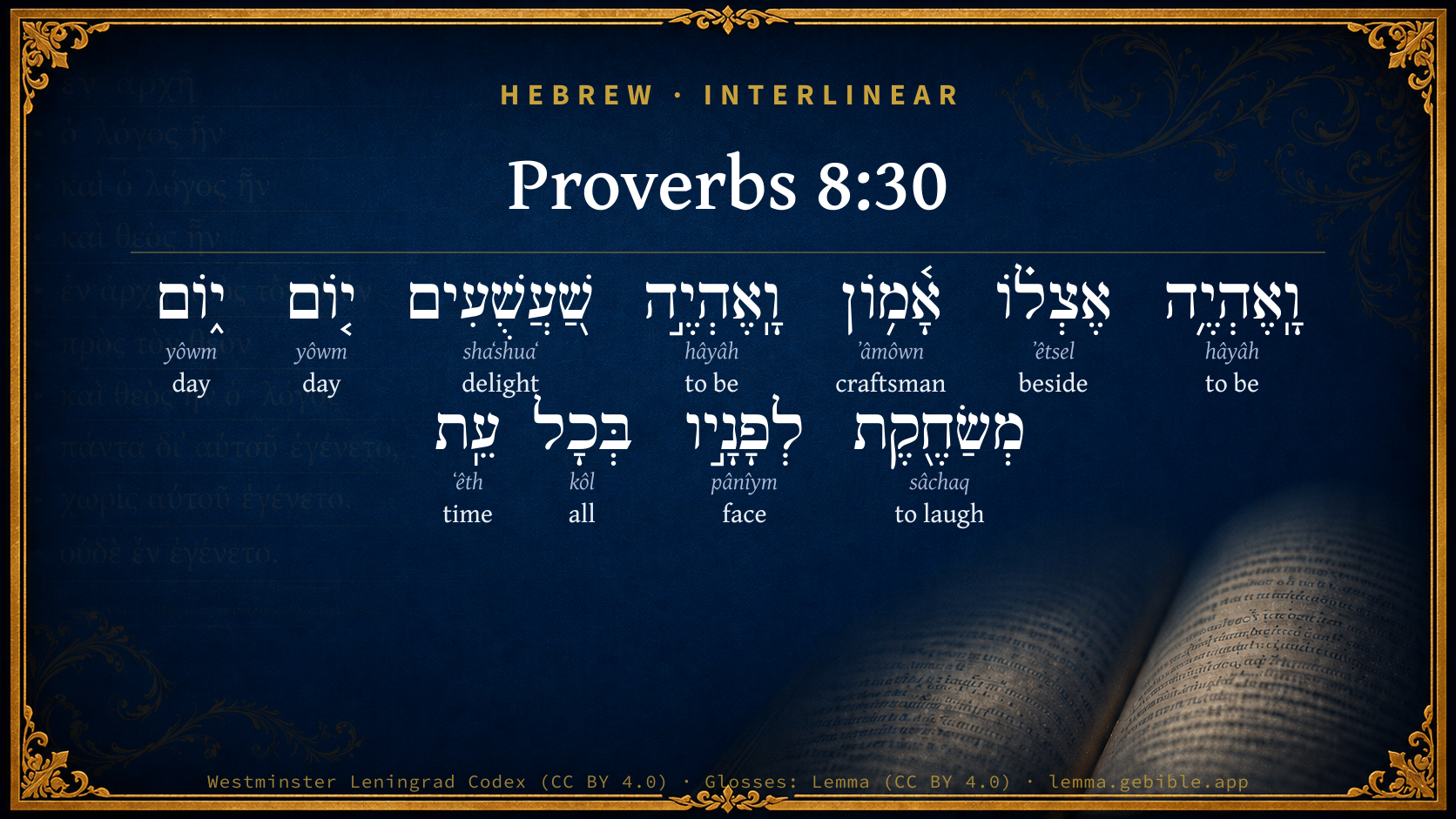
Hebrew (Westminster Leningrad Codex) Proverbs 8:30 appears in the Hebrew Old Testament. The text above is from the Westminster Leningrad Codex. Each word links to its Strong’s number, a concise gloss, and parsing drawn from the Open Scriptures Hebrew Bible morphology. Click any word for its full Brown-Driver-Briggs (BDB) entry.
Download image
Cite this verse

Proverbs 8:30 (World English Bible). Public Domain. Lemma interlinear Bible study tool, https://lemma.gebible.app/v/proverbs/8/30.

Show BibTeX & RIS
BibTeX
RIS
English Translation
Then I was the craftsman by his side. I was a delight day by day, Always rejoicing before him,
World English Bible · Public Domain
Highlights
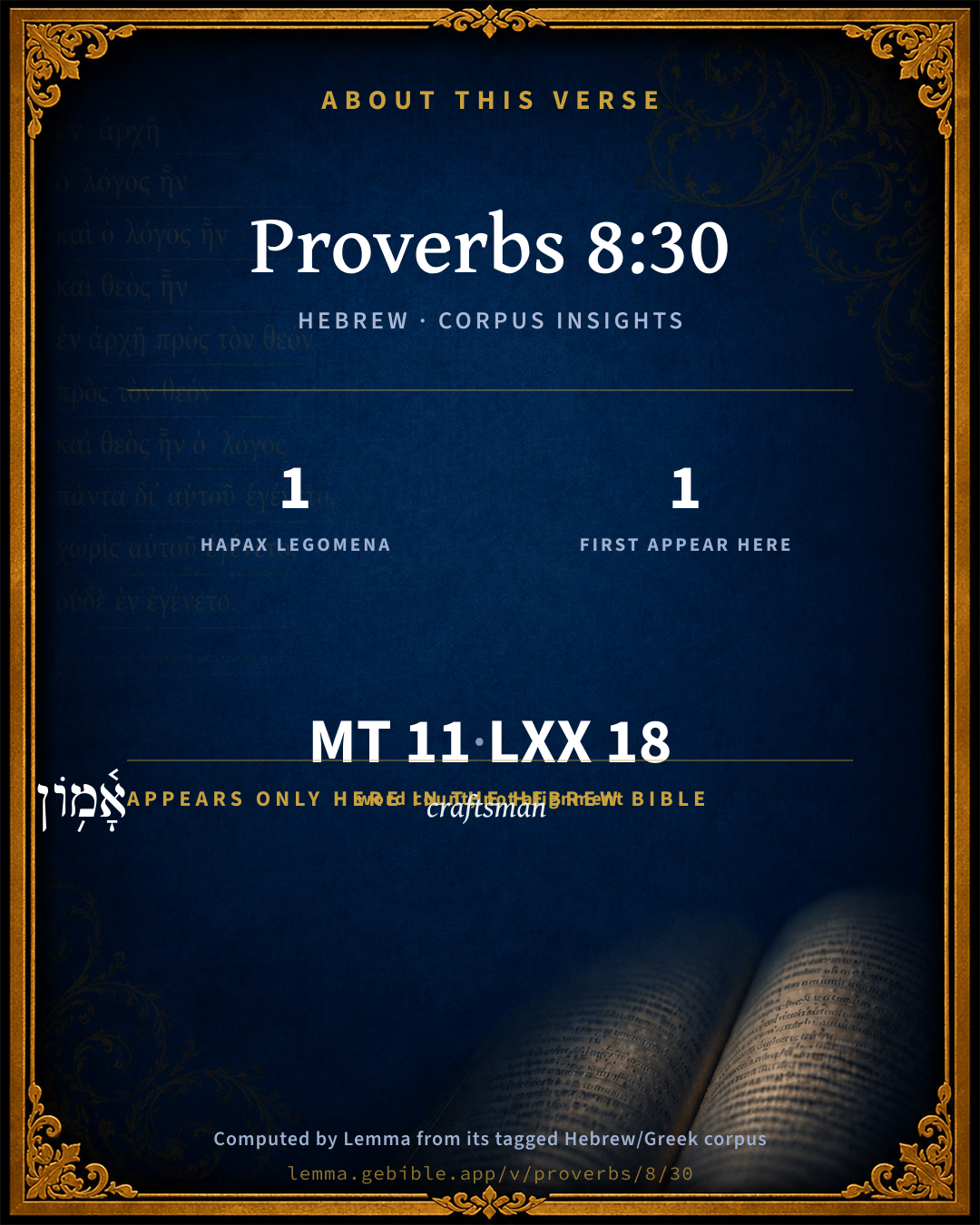
  • 1 hapax legomenon — only here in the Hebrew Bible
  • 1 first appearance in the Hebrew Bible
Full analysis ↓
Download a study sheet

One document with this verse’s original text, its word-by-word gloss line, the meaning frame, cross-references with their text, attributed commentary, and full source and license credits — printable, and it pastes into notes with its structure intact.

This verse Autodidact and up

Study sheet (.html) Plain text (.txt)

A passage Seminary Student

Up to 50 verses in one chapter. A passage sheet keeps up to 6 commentary sources and 12 cross-references per verse, in the order this page ranks them, and says so on the sheet whenever that leaves anything out. Ask for a single verse and you get the Autodidact verse sheet above.

Everything on this page stays free to read, with no account — the sheet is a download of what is already on screen, not access to it.

Want to remove ads? Support Godless Engineer
Compare translations 3

The same verse in 3 English versions, stacked beneath the original-language interlinear above. Click any original word for its lexicon entry.

Each is an independent rendering of the whole verse — the interlinear is not word-aligned to these translations.

Highlighted words mark where these versions differ — a whole-verse word diff, not a word-by-word alignment.

  • World English Bible Public Domain
    Then I was the craftsman by his side. I was a delight day by day, Always rejoicing before him,
  • King James Version Public Domain
    Then I was by him, as one brought up with him: and I was daily his delight, rejoicing always before him;
  • unfoldingWord Literal Text CC BY-SA 4.0
    Then I was beside him a skilled worker, and I was a delight day day, frolicking before his face at every time.

unfoldingWord Literal Text — © unfoldingWord, licensed CC BY-SA 4.0. Word-aligned USFM3 via Door43 (git.door43.org/unfoldingWord/en_ult).

Versions to compare (up to 4)

3 of 4 selected

Show all 18 translations

Every available English version of this verse, each an independent rendering of the whole verse.

  • World English Bible Public Domain
    Then I was the craftsman by his side. I was a delight day by day, Always rejoicing before him,
  • Berean Standard Bible Public Domain
    Then I was a skilled craftsman at His side, and His delight day by day, rejoicing always in His presence.
  • Majority Standard Bible Public Domain
    Then I was a skilled craftsman at His side, and His delight day by day, rejoicing always in His presence.
  • King James Version Public Domain
    Then I was by him, as one brought up with him: and I was daily his delight, rejoicing always before him;
  • American Standard Version (1901) Public Domain
    Then I was by him, `as' a master workman; And I was daily `his' delight, Rejoicing always before him,
  • Revised Version (1885) Public Domain
    Then I was by him, as a master workman: and I was daily his delight, rejoicing always before him;
  • Geneva Bible (1599) Public Domain
    Then was I with him as a nourisher, and I was dayly his delight reioycing alway before him,
  • Douay-Rheims (1899) Public Domain
    I was with him forming all things: and was delighted every day, playing before him at all times;
  • Young's Literal Translation Public Domain
    Then I am near Him, a workman, And I am a delight -- day by day. Rejoicing before Him at all times,
  • Literal Standard Version CC BY-SA 4.0
    Then I am near Him, a workman, || And I am a delight—day by day. Rejoicing before Him at all times,
  • Unlocked Literal Bible CC BY-SA 4.0
    I was beside him, as a skilled craftsman; I was his delight day after day, always rejoicing before him.
  • unfoldingWord Literal Text CC BY-SA 4.0
    Then I was beside him a skilled worker, and I was a delight day day, frolicking before his face at every time.
  • Darby Bible Public Domain
    then I was by him [his] nursling, and I was daily his delight, rejoicing always before him;
  • World Messianic Bible Public Domain
    then I was the craftsman by his side. I was a delight day by day, always rejoicing before him,
  • Webster's Bible Public Domain
    Then I was by him, as one brought up with him: and I was daily his delight, rejoicing always before him;
  • Free Bible Version CC BY-SA 4.0
    Then I was beside him as a master craftsman. I made him happy every day, and I was always full of joy in his presence.
  • Bible in Basic English Public Domain
    Then I was by his side, as a master workman: and I was his delight from day to day, playing before him at all times;
  • JPS Tanakh (1917) Public Domain
    Then I was by Him, as a nursling; and I was daily all delight, playing always before Him,

Literal Standard Version (2020), Covenant Press — licensed CC BY-SA 4.0. Text via the HelloAO Bible API (eBible.org). Unlocked Literal Bible (unfoldingWord) — licensed CC BY-SA 4.0. Text via the HelloAO Bible API (eBible.org). unfoldingWord Literal Text — © unfoldingWord, licensed CC BY-SA 4.0. Word-aligned USFM3 via Door43 (git.door43.org/unfoldingWord/en_ult). Free Bible Version, Dr. Jonathan Gallagher — licensed CC BY-SA 4.0. Text via the HelloAO Bible API (eBible.org).

Word by word

More ways to search: Search by grammar → Find every occurrence → Compare this word →

Practice this passage: Drill this verse → Learn its vocabulary →

אָ֫מ֥וֹן
ʼâmôwn
H525
“craftsman”
Noun, Common, Masculine, Singular, Absolute
Part of Speech
Noun
Type
Common
Gender
Masculine
Number
Singular
State
Absolute
Full BDB Definition

Origin: from H539 , probably in the sense of training

TWOT: 116 L

artificer, architect, master workman, skilled workman
  1. וָֽאֶהְיֶ֥ה hâyâh H1961 “and · to be” Conjunction + Verb, Qal, Sequential Imperfect, 1st Person, Common, Singular
  2. אֶצְל֗וֹ ʼêtsel H681 “beside · him” Preposition + Suffix, Personal, 3rd Person, Masculine, Singular
  3. וָֽאֶהְיֶ֣ה hâyâh H1961 “and · to be” Conjunction + Verb, Qal, Sequential Imperfect, 1st Person, Common, Singular
  4. שַׁ֭עֲשֻׁעִים shaʻshuaʻ H8191 “delights” Noun, Common, Masculine, Plural, Absolute
  5. י֤וֹם yôwm H3117 “day” Noun, Common, Masculine, Singular, Absolute
  6. י֑וֹם yôwm H3117 “day” Noun, Common, Masculine, Singular, Absolute
  7. מְשַׂחֶ֖קֶת sâchaq H7832 “laughing” Verb, Piel, Participle Active, Feminine, Singular, Absolute
  8. לְפָנָ֣יו pânîym H6440 “to/for · face(s) · his” Preposition + Noun, Common, Both, Plural, Construct + Suffix, Personal, 3rd Person, Masculine, Singular
  9. בְּכָל kôl H3605 “in/at · all of” Preposition + Noun, Common, Masculine, Singular, Construct
  10. עֵֽת ʻêth H6256 “time” Noun, Common, Both, Singular, Absolute

About this verse

These counts appear in no published source. They are computed here, from the morphology-tagged text and Lemma’s own curated glosses. What Lemma adds →

11
words
9
distinct lemmas
Wisdom
section

Notable vocabulary

1 hapax legomenon — a word that appears only here in the entire Hebrew Bible:

  • אָ֫מ֥וֹן craftsman H525

First appearance in Scripture

This word makes its first canonical appearance in the Hebrew Bible here:

  • אָ֫מ֥וֹן craftsman H525

Shared distinctive vocabulary

שַׁ֭עֲשֻׁעִים delight H8191 occurs in 9 verses of the Hebrew Bible. Also found in:

Grammatical profile

  • 3 verbs
  • 7 nouns
  • 1 preposition

Verb forms

  • וָֽאֶהְיֶ֥ה Qal · Sequential Imperfect
  • וָֽאֶהְיֶ֣ה Qal · Sequential Imperfect
  • מְשַׂחֶ֖קֶת Piel · Participle Active

Repetition

Words recur within this verse — often emphatic in Hebrew:

  • וָֽאֶהְיֶ֥ה to be H1961 ×2
  • י֤וֹם day H3117 ×2

Hebrew & Septuagint length

In English translation the verse runs 19 words from the Hebrew and 23 from the Septuagint (LXX English) — closely comparable.

A rough comparison of the two English renderings, which tokenize alike — not a word-level alignment.

Word counts can differ between the Hebrew and the Greek without any difference in meaning — e.g. the Hebrew direct-object marker אֵת has no separate Greek word, and Greek often adds the article ὁ.

In the original languages it is 11 Hebrew tokens and 18 Greek tokens — but the two are counted differently (Hebrew bundles its prefixes and suffixes into one token; the Greek is in lemma form), so that isn’t a like-for-like length.

Cross-references

8

Topical passages linked to Proverbs 8:30 in the Treasury of Scripture Knowledge — connected by theme and wording, ordered by reader-vote popularity; previews shown in the World English Bible.

  • John 1:1–3 In the beginning was the Word, and the Word was with God, and the Word was God.
  • John 1:18 No one has seen God at any time. The one and only Son, who is in the bosom of the Father, he has declared him.
  • Isaiah 42:1 Behold, my servant, whom I uphold; my chosen, in whom my soul delights: I have put my Spirit on him; he will bring forth justice to the Gentiles.
  • Matthew 3:17 Behold, a voice out of the heavens said, "This is my beloved Son, with whom I am well pleased."
  • John 12:28 Father, glorify your name!" Then there came a voice out of the sky, saying, "I have both glorified it, and will glorify it again."
  • John 16:28 I came out from the Father, and have come into the world. Again, I leave the world, and go to the Father."
  • Matthew 17:5 While he was still speaking, behold, a bright cloud overshadowed them. Behold, a voice came out of the cloud, saying, "This is my beloved Son, in whom I am well pleased. Listen to him."
  • Colossians 1:13 who delivered us out of the power of darkness, and translated us into the Kingdom of the Son of his love;

Cross-references courtesy of OpenBible.info (CC BY 4.0).

Hebrew and Greek witnesses Masoretic Hebrew ↔ Greek Septuagint

The same verse in the two great witnesses to the Old Testament, shown verse-for-verse.

These are two independent witnesses, not word-aligned to each other, and the Septuagint is shown in lemma (dictionary) form.

Hebrew Proverbs 8:30 Masoretic · Westminster Leningrad Codex

וָֽאֶהְיֶ֥ה אֶצְל֗וֹ אָ֫מ֥וֹן וָֽאֶהְיֶ֣ה שַׁ֭עֲשֻׁעִים י֤וֹם י֑וֹם מְשַׂחֶ֖קֶת לְפָנָ֣יו בְּכָל עֵֽת

Then I was the craftsman by his side. I was a delight day by day, Always rejoicing before him,

World English Bible · Public Domain

Greek LXX Proverbs 8:30 Septuagint · lemma form

ἐμός παρά αὐτός ἁρμόζω ἐγώ ἐμός ὅς προςχαίρω κατά ἡμέρα δέ εὐφραίνω ἐν πρόσωπον αὐτός ἐν πᾶς καιρός

I was by him, suiting myself to him, I was that wherein he took delight; and daily I rejoiced in his presence continually.

LXX2012 (modern English Septuagint) · Public Domain

On this verse, Trapp's Complete Commentary discusses the Septuagint’s reading. Read the note in Commentary ↓

Hebrew: Westminster Leningrad Codex (CC BY 4.0). Greek: Septuagint (public domain); English from LXX2012 (modern English Septuagint) (Public Domain). How the Septuagint differs from the Hebrew →

Commentary

Notes on Proverbs 8:30 from classic Christian and Jewish commentators (each source and its license shown beneath its notes). The classic Christian expositions comment on the surrounding passage and are grouped to its opening verse, so a note may address several verses; the Jewish commentaries on the Tanakh (Rashi and others) are per-verse, so they appear only where the commentator wrote on this verse.

Lemma curates 59 commentaries, every one of them public domain or Creative Commons licensed, each selected and text-cleaned for this edition rather than reprinted as found. About our sources →

Trapp's Complete Commentary

John Trapp

Pro 8:30 Then I was by him, [as] one brought up [with him]: and I was daily [his] delight, rejoicing always before him;

Ver. 30. Then I was by him.] Accursed then for ever be that blasphemous assertion of the Arians, ην οταν ουκ ην, There was a time when he was not. This scripture, so much abused by them, makes utterly against them. But heretics pervert the Scriptures, saith St Peter. {2Pe 3:15} A metaphor from those who put a man upon the rack, and make him speak that which he never thought. Tertullian calls Marcion the heretic, Mus Ponticus, because of his arroding {a} and gnawing the Scripture, to make it serviceable to his errors.

As one brought up with him.] Or, As a nourisher; that is, as a maintainer and upholder of that his excellent workmanship of creation. {Heb 1:3} The Septuagint render it, I was with him making all fine and trim, Eram apud eum aptans; { b} so Irenaeus.

Rejoicing always.] Or, Laughing {c} with him. This, as the very Jews are forced to confess, doth notably set forth that unspeakable sweetness and joy that the blessed God findeth in the apprehension of his own wisdom, which, say they, is one and the same with God himself.

{a} To gnaw or nibble at.

{b} ημην παρα αυτου αρμοζουσα - Sept.

{c} More pueri qui alatur, et risum captans ac concilians. - Mercer.

John Trapp, A Commentary or Exposition upon All the Books of the Old and New Testament (1647–1656) — public domain. Text from a community e-Sword module.

The Biblical Illustrator

Joseph S. Exell

Pro_8:30

And I was daily His delight.

The happiness of Christ antecedent to His incarnation

The delights between the Father and the Son, before His assumption of our nature, were twofold.

1. They delighted in one another without communicating their joys to any other; for no creature did then exist save in the mind of God.

2. They delighted in the salvation of men; in the prospect of that work, though not yet extant. The condition and state of Jesus Christ before His incarnation was a state of the most unspeakable delight in the enjoyment of His Father. Consider this--

I. Negatively.

1. He was not abased to the low estate of a creature.

2. He was not under the law in this estate.

3. He was not liable to any of those sorrowful consequents and attendants of that frail state of humanity which afterwards He assumed with that nature. Unacquainted with griefs. Never pinched with poverty and want. Never underwent reproach and shame. Was never offended with any impure suggestions. Never sensible of tortures and pains. There were no hidings or withdrawings of His Father. No experience of death.

II. Positively.

1. A state of matchless happiness.

2. A state of intimacy, dearness, and oneness with His Father.

3. A state of pure, unmixed, and ravishing delight.

III. Comparitively.

1. Compare it with the delight that some creatures take in each other, and you will soon find that they fall infinitely short of this.

2. Compare it with the delight that God takes in some of His creatures; you will find it to come short of the delight that God takes in Christ.

3. Compare it with the delight that the best of creatures take in God and Christ; how infinitely short it comes of the delight that God takes in Christ!

Conclusion:

1. What an astonishing love was this for the Father to give the darling of His soul for poor sinners!

2. Adore the love of Jesus to sinners, that ever He should consent to leave such a bosom.

3. An interest in Jesus Christ is the true way to all spiritual preferment in heaven.

4. Jesus Christ is worthy of all love and delight.

5. It is a grievous thing to see Gods dear Son despised, slighted, and rejected by sinners.

6. Let us be ready to forsake and leave all for Christ. (John Flavel.)

Christs eternal felicity

I. Christ was with the Father at the beginning. This censures the Arians.

II. God the Father, as He delighted in Christ at the beginning, so He doth always.

1. Because He is His Son.

2. Because He never offended Him.

3. Because He is always ready to please His Father.

III. Christ rejoiced in God the Father from the beginning, and does so always. Some read, I rejoice, or sport, always before Him. (Francis Taylor, B. D.)

Rejoicing always before Him.

Eternal Wisdom rejoicing in the events to be revealed

If we contemplate the character of Divine Wisdom as directed to earth, dwelling amongst men, anticipating the concerns and circumstances and history of this human world, we shall--

1. Be led to perceive an importance attaching to all the ramifications of that history, to all its epochs and all its events.

2. In addition to this we shall be led to depend, with a degree of delight and joy, on all the arrangements and developments of this Wisdom in relation to our circumstances.

3. And we shall perceive the impropriety of our murmuring; and that there is the greatest measure of folly, as well as of danger, in allowing ourselves to dispute any part of the Divine proceedings.

4. Such a view will induce us to look with intelligent and instructed minds upon all the things around us, and to observe in the various circumstances which transpire before our view the actual working out of a plan arranged before eternity.

5. We shall regard the great Supreme with deep solicitude, in order that we ourselves may be brought to see the truth and results of all that is around us.

6. We shall anticipate the glory of that scene in its fulness which we now perceive in fragments. Christ looked forward to the production of the world for the sake of the men who would dwell on it. What is more wonderful than the intellectual, physical, moral, and spiritual being, man? Consider the proofs of this anticipation and delight, and the reason whence arises all this delight. (R. S. McAll, LL. D.)

The Biblical Illustrator, edited by Joseph S. Exell (c. 1880s–1900s) — public domain. Text from a community e-Sword module.

Joseph Benson's Commentary

Pro 8:30-31. Then I was by him — Conversant with him, and united to him, as was said before; as one brought up with him — As one tenderly and dearly beloved by him. I was daily his delight — His elect; in whom his soul delighted, Isa 42:1. Rejoicing always before him — In constant and most intimate communion with him. Rejoicing in the habitable part of his earth — In the vast variety of creatures wherewith the earth was beautified and enriched; and my delights were with the sons of men — Made after the likeness of God, and capable of converse with him. Then I delighted to uphold them by my power and providence, to reveal myself, and my Father’s mind and will to them, from age to age, to assume their nature, and to redeem and save them. “The wisdom of God,” says Calmet, “communicated itself to men preferably to all other sensible creatures; having given to them alone intelligence, and souls capable of the illumination of prudence, and of the practice of virtue. The Son of God, the eternal wisdom, abundantly proved his delight to be with the sons of men, when for their instruction and salvation he took upon him a human form.”

Joseph Benson's Commentary on the Old and New Testaments (1811–1818) — public domain. Text from a community e-Sword module.

MacLaren's Expositions of Holy Scripture

Alexander MacLaren

Proverbs

WISDOM AND CHRIST

Pro 8:30 - Pro 8:31.

There is a singular difference between the two portions of this Book of Proverbs. The bulk of it, beginning with Pro 10:1 - Pro 10:32, contains a collection of isolated maxims which may be described as the product of sanctified common sense. They are shrewd and homely, but not remarkably spiritual or elevated. To these is prefixed this introductory portion, continuous, lofty in style, and in its personification of divine wisdom, rising to great sublimity both of thought and of expression. It seems as if the main body of the book had been fitted with an introduction by another hand than that of the compilers of the various sets of proverbial sayings. It is apparently due to an intellectual movement, perhaps not uninfluenced by Greek thought, and chronologically the latest of the elements composing the Old Testament scriptures. In place of the lyric fervour of prophets, and the devout intuition of psalmists, we have the praise of Wisdom. But that noble portrait is no copy of the Greek conception, but contains features peculiar to itself. She stands opposed to blatant, meretricious Folly, and seeks to draw men to herself by lofty motives and offering pure delights. She is not a person, but she is a personification of an aspect of the divine nature, and seeing that she is held forth as willing to bestow herself on men, that queenly figure shadows the great truth of God’s self-communication as being the end and climax of all His revelation.

We are on the wrong tack when we look for more or less complete resemblances between the ‘Wisdom’ of Proverbs and the ‘Sophia’ of Greek thinkers. It is much rather an anticipation, imperfect but real, of Jesus than a pale reflection of Greek thought. The way for the perfect revelation of God in the incarnation was prepared by prophet and psalmist. Was it not also prepared by this vision of a Wisdom which was always with God, and yet had its delights with the sons of men, and whilst ‘rejoicing always before Him,’ yet rejoiced in the habitable parts of the earth?

Let us then look, however imperfect our gaze may be, at the self-revelation in Proverbs of the personified divine Wisdom, and compare it with the revelation of the incarnate divine Word.

I. The Self-revelation of Wisdom.

The words translated in Authorised Version, ‘As one brought up with him,’ are rendered in Revised Version, ‘as a master workman,’ and seem intended to represent Wisdom-that is, of course, the divine Wisdom-as having been God’s agent in the creative act. In the preceding context, she triumphantly proclaims her existence before His ‘works of old,’ and that she was with God, ‘or ever the earth was.’ Before the everlasting mountains she was, before fountains flashed in the light and refreshed the earth, her waters flowed. But that presence is not all, Wisdom was the divine agent in creation. That thought goes beyond the ancient one: ‘He spake and it was done.’ Genesis regards the divine command as the cause of creatural being. God said, ‘Let there be-and there was’: the forthputting of His will was the impulse to which creatures sprang into existence at response. That is a great thought, but the meditative thinker in our text has pondered over the facts of creation, and notwithstanding all their apparent incompletenesses and errors, has risen to the conclusion that they can all be vindicated as ‘very good.’ To him, this wonderful universe is not only the product of a sovereign will, but of one guided in its operations by all-seeing Wisdom.

Then the relation of this divine Wisdom to God is represented as being a continual delight and a childlike rejoicing in Him, or as the word literally means, a ‘sporting’ in Him. Whatever energy of creative action is suggested by the preceding figure of a ‘master workman,’ that energy had no effort. To the divine Wisdom creation was an easy task. She was not so occupied with it as to interrupt her delight in contemplating God, and her task gave her infinite satisfaction, for she ‘rejoiced always’ before Him, and she rejoiced in His habitable earth. The writer does not shrink from ascribing to the agent of creation something like the glow of satisfaction that we feel over a piece of well-done work, the poet’s or the painter’s rapture as he sees his thoughts bodied forth in melody or glowing on canvas.

But there is a greater thought than these here, for the writer adds, ‘and my delight was with the sons of men.’ It is noteworthy that the same word is used in the preceding verse. The ‘delight of the heavenly Wisdom in God’ is not unlike that directed to man. ‘The sons of men’ are the last, noblest work of Creation, and on them, as the shining apex, her delight settles. The words describe not only what was true when man came into being, as the utmost possible climax of creatural excellence, but are the revelation of what still remains true.

One cannot but feel how in all this most striking disclosure of the depths of God, a deeper mystery is on the verge of revelation. There is here, as we have said, a personification, but there seems to be a Person shining through, or dimly discerned moving behind, the curtain. Wisdom is the agent of creation. She creates with ease, and in creating delights in God as well as in her work, which calls for no effort in doing, and done, is all very good. She delights most of all in the sons of men, and that delight is permanent. Does not this unknown Jewish thinker, too, belong, as well as prophet and psalmist, to those who went before crying, Hosanna to Him that cometh in the name of the Lord? Let us turn to the New Testament and find an answer to the question.

II. The higher revelation of the divine Word.

There can be no doubt that the New Testament is committed to the teaching that the Eternal Word of God, who was incarnate in Jesus, was the agent of creation. John, in his profound prologue to the Gospel, utters the deepest truths in brief sentences of monosyllables, and utters them without a trace of feeling that they needed proof. To him they are axiomatic and self evident. ‘All things were made by Him.’ The words are the words of a child; the thought takes a flight beyond the furthest reach of the mind of men. Paul, too, adds his Amen when he proclaims that ‘All things have been created through Him and unto Him, and He is before all things, and in Him all things hold together.’ The writer of Hebrews declares a Son ‘through whom also He made the worlds, and who upholds all things by the word of His power’ and does not scruple at transferring to Jesus the grand poetry of the Psalmist who hymned ‘Thou, Lord, in the beginning, hast laid the foundation of the earth, and the heavens are the work of Thy hands.’ We speak of things too deep for us when we speak of persons in the Godhead, but yet we know that the Eternal Word, which was from the beginning, was made flesh and dwelt among us. The personified Wisdom of Proverbs is the personal Word of John’s prologue. John almost quotes the former when he says ‘the same was in the beginning with God.’ for his word recalls the grand declaration, ‘The Lord possessed me in the beginning of His way . . . I was set up in the beginning or ever the earth was.’ Then there are two beginnings, one lost in the depths of timeless being, one, the commencement of creative activity, and that Word was with God in the remotest, as in the nearer, beginning.

But the ancient vision of the Jewish thinker anticipated the perfect revelation of the New Testament still further, in its thought of an unbroken communion between the personified Wisdom and God. That dim thought of perfect communion and interchange of delights flashes into wondrous clearness when we think of Him who spake of ‘the glory which I had with Thee before the foundation of the world,’ and calmly declared: ‘Thou lovedst me before the foundation of the world.’ Into that depth of mutual love we cannot look, and our eyes are too dim-sighted to bear the blaze of that flashing interchange of glory, but we shall rob the earthly life of Jesus of its pathos and saving power, if we do not recognise that in Him the personification of Proverbs has become a person, and that when He became flesh, He not only took on Him the garment of mortality, but laid aside ‘the visible robes of His imperial majesty,’ and that His being found in fashion as a man was humbling Himself beyond all humiliation that afterwards was His.

But still further, the Gospel reality fills out and completes the personification of Proverbs in that it shows us a divine person who so turned to ‘the sons of men’ that He took on Him their nature and Himself bore their sicknesses. The Jewish writer had great thoughts of the divine condescension, and was sure that God’s love still rested on men, sinful as they were, but not even he could foresee the miracle of long-suffering love in the Incarnate Jesus, and he had no power of insight into the depths of the heart of God, that enabled him to foresee the sufferings and death of Jesus. Till that supreme self-sacrifice was a fact, it was inconceivable. Alas, now that it is a fact, to how many hearts that need it most is it still incredible. But passing all anticipation as it is, it is the root of all joy, the ground of all hope, and to millions of sinful souls it is their only refuge, and their sovereign example and pattern of life.

The Jewish thinker had a glimpse of a divine wisdom which delighted in man, but he did not dream of the divine stooping to share in man’s sorrows, or of its so loving humanity as to take on itself its limitations, not only to pity these as God’s images, but to take part of the same and to die. That man should minister to the divine delight is wonderful, but that God should participate in man’s grief passes wonder. Thereby a new tenderness is given to the ancient personification, and the august form of the divine Wisdom softens and melts into the yet more august and tender likeness of the divine Love. Nor is there only an adumbration of the redeeming love of Jesus as He dwells among us here, but we have to remember that Jesus delights in the sons of men when they love Him back again. All the sweet mysteries of our loving communion with Him, and of His joy in our faith, love, and obedience, all the secret treasures of His self-impartation to, and abiding in, souls that open themselves to His entrance, are suggested in that thought. We can minister to the joy of Jesus, and when He is welcomed into any heart, and any man’s love answers His, He sees of the travail of His soul and is satisfied.

III. The call of the personal Word to each of us.

The Wisdom of Proverbs is portrayed in her queenly dignity, as calling men to herself, and promising them the satisfaction of all their needs. She describes herself that the description may draw men to her. The self-revelation of God is His mightiest means of attracting men to Him. We but need to know Him as He really is, in order to love Him and cling to Him. A fairer form than hers has drawn near to us, and calls us with tenderer invitations and better promises. The divine Wisdom has become Man with ‘sweet human hands and lips and eyes.’ Such was His delight in the sons of men that He emptied Himself of His glory, and finished a greater work than that over which he presided when the mountains were settled and the hills brought forth. Now He calls us, and His summons is tenderer, and gives promise of loftier blessings than the call of Wisdom was and did. She called to the simple, ‘Come eat ye of my bread, and drink of the wine which I have mingled.’ He invites us: ‘If any man thirst, let him come unto Me and drink,’ and He furnishes a table for us, and calls us to eat of the bread which is His body broken for us, and to drink of the wine which is His blood shed for many for the remission of sins. She promises ‘riches and honour, yea, durable riches and righteousness.’ His voice vibrates with sympathy, and calls the weary and heavy laden, of whom she scarcely thinks, and offers to them a gift, which may seem humble enough beside her more dazzling offers of fruit, better than gold and revenues, better than choice silver, but which come closer to universal wants, the gift of rest, which is really what all men long for, and none but they who take His yoke upon them possess. ‘See that ye refuse not Him that speaketh,’ for if they escaped not when they refused her that spake through the Jewish thinker’s lips of old, ‘much more shall not we escape, if we turn away from Him that beseecheth us from heaven.’ Jesus is the power of God and the wisdom of God, and it is in Him crucified that our weakness and our folly are made strong and wise, and Wisdom’s ancient promise is fulfilled: ‘Whoso findeth me findeth life, and shall obtain favour of the Lord.’

Alexander MacLaren, Expositions of Holy Scripture (1904–1910) — public domain. Text from a community e-Sword module.

Tyndale Open Study Notes

Tyndale Open Resources

8:30 architect: God’s wisdom guided the shaping of creation, bringing order out of chaos.

Tyndale Open Study Notes — © Tyndale Open Resources, licensed CC BY-SA 4.0. Text via the HelloAO Bible API.

Geneva Bible (1599)

Geneva Bible translators

Some read, a chief worker: signifying that this wisdom, even Christ Jesus, was equal with God his father, and created, preserveth and still worketh with him, as John 5:17.

Geneva Bible (1599) marginal notes — public domain. Text via Bolls.life.

Jamieson, Fausset & Brown

Robert Jamieson, A. R. Fausset & David Brown

one brought up--an object of special and pleasing regard. The bestowal of wisdom on men is represented by its finding a delightful residence and pleasing God.

Jamieson, Fausset & Brown — Commentary Critical and Explanatory on the Whole Bible (1871) — public domain (CC PDM 1.0). Text via the HelloAO Bible API.

Adam Clarke's Commentary

Verse 30. Then I was with him, as one brought up] אמון amon, a nursling, a darling child. Wisdom continues its parable, says Calmet; and represents itself as a new-born child which is ever near its parent, and takes pleasure to see him act, and to sport in his presence. This is poetical and highly figurative; and they who think they find the deity of Jesus Christ in these metaphors should be very cautious how they apply such terms as these; so that while they are endeavouring to defend the truth, they may do nothing against the truth, in which most of them unhappily fail.

Rejoicing always before him] All the images in this verse are borrowed from the state and circumstances of a darling, affectionate, playful child; as any one will be convinced who examines the Hebrew text.

Adam Clarke's Commentary on the Bible (1810–1826) — public domain. Text from a community e-Sword/MySword module.

Ellicott's Commentary for English Readers

(30) As one brought up with him—i.e., his foster child; as Mordecai “brought up” Esther (Est_2:7). But the word may also bear the sense of “artificer.” It probably occurs in this meaning in Jer_52:15 (though translated “multitude,” in accordance with 2Ki_25:11), and in a slightly different form, Son_7:1. This meaning is much more suitable, and harmonises with Psa_104:24; Psa_136:5, and Heb_1:2.

I was daily his delight.—The pronoun “his” does not occur in the Hebrew, which is, literally, I was delights, i.e., all joy, delight, as Psa_109:4 : “I am prayer,” i.e., give myself wholly to it. The words express the joy with which Wisdom carried out the work of God.

Rejoicing always before him.—The same expression is used in 2Sa_6:21 by David (there translated “play”), to describe his “leaping and dancing before the Lord.”

A Bible Commentary for English Readers, edited by Charles John Ellicott (1878–1897) — public domain. Text from a community e-Sword module.

The Cambridge Bible for Schools and Colleges

gen. ed. J. J. S. Perowne

30. one brought up with him] The Heb. root is used of bringing up a child, acting as nurse or foster-parent to it, Rth_4:16; Est_2:7. Hence the translation of A. V. But it may also be applied to one who rears a building, or carries out a work, an architect, or artificer; a master workman, R.V. So it is rendered in Jer_52:15, R.V. marg. artificers, where see note in this Series. The LXX. have here ἁρμόζουδα, and the Vulg. cuncta componens. And this sense agrees best with the general tenor of the passage. Comp. “For she which is the artificer of all things taught me, even wisdom,” Wis_7:22, R.V.

was daily his delight] So R.V. text; but, had delight continually, R.V. marg.; καθʼ ἡμέραν εὐφραινόμην, LXX.; delectabar per singulos dies, Vulg.

rejoicing] “Or, sporting,” R.V. marg.; ludens, Vulg. (and so Pro_8:31). Perhaps exulting would be a better rendering.

The Cambridge Bible for Schools and Colleges (gen. ed. J. J. S. Perowne; Cambridge University Press, 1878–1918) — public domain. Text from a community e-Sword module.

John Gill's Exposition

Then I was by him, as one brought up with him,.... He was then, and from all eternity, "by him", or "with him" (q); which denotes his co-existence with God, and his relation to him as his Father; his nearness to him, his equality with him, and his distinction from him: he was by him when the names of God's elect were put down in the book of life; he was by him and with him in the council and covenant of grace and peace; and so in the creation of all things, and has been ever since; not as a onlooker, but as a party concerned; and not as subordinate and inferior to his Father, but equal with him. The word translated "brought up", is differently rendered; Symmachus and Theodotion render it "strengthened"; as Christ was set up in his mediatorial office, he was strengthened in it by his Father; and was in his view, council, and covenant, the man of his right hand, made strong for himself: the Targum renders it "faithful", so the Tigurine version; as Christ was to him that appointed him, faithful to all he promised and was intrusted with. Many translate it an "artificer" or "workman" (r), as in Sol 7:1; and so Christ was a co-worker, a worker with God in the making of all things, the heavens, earth, and sea, and all in there; not as an instrument, but as a co-efficient cause of them; which is a proof of his proper deity, and equality with God. But others think the word has the sense of nursing, or being nursed, educated, or brought up. Some (s) take it actively, as in Rut 4:16, Est 2:7; and interpret it of Christ's nursing the creation, or cherishing, supporting, and preserving all creatures in their being when made; particularly of his nourishing and cherishing the church and people of God committed to his care. Others (t) passively, of his being "brought up", as our version; and so the Latin interpreter of the Targum renders it "nursed up at his side"; which expresses the tender regard of his Father to him, as his begotten Son; in whose bosom he lay and was bore, as a nursing father bears his son in his bosom, Num 11:12; and by whom, as Mediator, he was trained up in the performance of his office;

and I was daily his delight; or "delights" (u); exceeding delightful to him. The Father loved the Son from all eternity, with a love of complacency and delight, Joh 17:24; this delight was founded in relation to him, in sonship; and in likeness, he being the express image of his person; in sameness of nature, he being of the same nature and perfections with his Father: and he delighted in him as a workman, in the works which he did, being the same he saw him do; and in him as Mediator, in his constitution as such, and in engaging as a surety, to obey and suffer in the stead of his people, Isa 42:1; he not only delighted in him day by day, throughout the six days of the creation, when he was by him as a workman, but before, and even from the days of eternity; from the date of his commencement as Mediator; in the foreviews of his human nature, obeying and suffering in it; and of the salvation of the elect by him, and of his own glory in it;

rejoicing always before him; being always in his presence, and acceptable to him; rejoicing in having the same nature and perfections with him, and in the relation he stood in to him; and also in the view of the works of creation and redemption he would be jointly concerned in with him; which joy always did and ever will continue. There is a mutual pleasure and delight which the Father and Son have in each other, and in all that they are concerned; and especially in what respects the salvation of the chosen people. The allusion in the word used in this clause is to children's playing in the presence of their parents; which is a diversion to the one, and a pleasure to the other.

(q) "cum eo", V. L. "apud eum", Pagninus, Montanus, Junius & Tremellius, Piscator, &c. (r) Sept. "cuneta componens", V. L. "artifex vel opifex", Gejerus; so Schindler, col. 90. (s) "Nutritius", Montanus, Pagninus, Baynus; "educans", Junius & Tremellius. (t) "Alumnus", Vatablus, Piscator, Mercerus; "alumna", Schultens; "in sinu gestatus filius", Cocceius; so Gussetius, p. 77. and Noldius, p. 379. No. 1884. and Stockins, p. 71. (u) "deliciae", Montanus, Junius & Tremellius, Piscator, Cocceius, Gejerus, Michaelis; "obleclationes", Schultens.

John Gill's Exposition of the Whole Bible (1746–1763) — public domain (CC PDM 1.0). Text via the HelloAO Bible API.

Albert Barnes' Notes on the Bible

As one brought up with him - i. e., As his foster child. Others take the word in the original in another sense, “I was as his artificer,” a rendering which falls in best with the special point of the whole passage, the creative energy of Wisdom. Compare Wisdom Pro 7:21, Pro 7:22.

Daily - Heb. “day by day.” As the Creator rejoiced in His workmanship Gen 1:4, Gen 1:10, Gen 1:12-13, so Wisdom rejoiced in the exuberance of her might and strength.

Albert Barnes' Notes on the Bible (1834–1885) — public domain. Text from a community e-Sword/MySword module.

Haydock's Catholic Bible Commentary

Forming. Hebrew, "one nursed," (Calmet) or nursing, nutritius. (Pagnin) --- He was not an idle spectator. --- Playing. With ease and surprising variety. (Calmet)

George Leo Haydock (1774–1849), Haydock's Catholic Family Bible and Commentary, 1859 edition — public domain. Excludes Psalms (Douay-Rheims chapter numbering differs from Protestant) and Deuterocanonical books (Catholic canon only).

Matthew Poole's English Annotations

By him; conversant with him, and united to him, as was said before.

As one brought up with him; as one tenderly and dearly beloved by him.

Rejoicing always before him; he and I had constant, and intimate, and sweet converse together.

Matthew Poole's English Annotations on the Holy Bible (1683–1685) — public domain. Text from a community e-Sword/MySword module.

Whedon's Commentary on the Bible

Daniel D. Whedon

30. Then I… by him — Translation: “There was I, his chosen darling; there was I, his delight, day by day, sporting before him (as a beloved child) all the time.” The particle אצלו, (etslo,) rendered by him in the Authorized Version, may mean that; but the root, among other significations, has “to reserve,” “keep near one,” and hence “to select,” “choose.” Taken in this sense, with the אמון, (amon,) a nursling, (one nurtured by another, and hence beloved,) a darling, we make out the above, which agrees with the imagery following: “All the images in this [and the next verse] are borrowed from the state and circumstances of a darling, affectionate, playful child.” — A. Clarke.

Although the rendering above given of this verse is well supported, yet there is some uncertainty about the word אמון, amon. The root-meaning of the word branches out in many directions. One is that of establishing, bringing up, rearing. Hence our Authorized Version renders it, “one brought up with him,” — a nursling, foster-child, darling, etc. Others take it in the more active sense, of artificer, master-worker, or builder, fabricator, artist, etc. The Septuagint, Vulgate, Luther, and many Germans favour this idea. So, also, some English and Americans, as Holden, Boothroyd, Noyes, Muenscher, Miller, the Bible Com., etc. But Goode, Stuart, Conant, Fausset, Adam Clarke, Benson, etc, prefer the other view. For a defence of this view see Conant. It is a matter of choice and taste.

Fausset, indeed, who identifies the Hhokmah and the Logos, combines both thus: “I was nursed at his side,” amon, answering to Joh_1:18, the only begotten Son, who is in the bosom of the Father; “never separated from the Father; who seeth the Father always; who seeth what the Father doeth, so that he doeth the same himself, (with the same will and power;) in whom the Father is well pleased,” etc. Comp. Joh_5:20.

Daniel D. Whedon (gen. ed.), Commentary on the Old and New Testaments (1874–1909) — public domain. Text from a community e-Sword module.

unfoldingWord translationNotes

Door43 World Missions Community

I was beside him

This is still wisdom speaking. Wisdom now says she was right next to Yahweh, implying that she was his assistant in creating the world. (See: Personification)

skilled craftsman

This is a person who has trained for years to make useful things very well, like furniture or houses.

I was his delight

"I was what made him happy." The word "delight" is an abstract noun that can be stated as a verb. AT: "he was happy because of me" (See: Abstract Nouns)

day after day

This is a way to express the idea of a habitual action or of a continuous condition. AT: "continually" or "the whole time" (See: Idiom)

his whole world

"the whole world he created" or "everything he created"

the sons of mankind

This refers to human beings in general. AT: "the people he brought into existence" (See: Idiom)

translationWords

delight

joy

unfoldingWord translationNotes — © Distant Shores Media and the Door43 World Missions Community, licensed CC BY-SA 4.0. Source: git.door43.org/Door43/en_tn.

Rashi

Rabbi Shlomo Yitzchaki (Rashi)

a nursling Heb. אמון, one that was reared beside Him, an expression of (Lam. 4:5): “They that were reared (האמנים) amid crimson.

every day יום יום, lit. a day a day, two thousand years.

Rashi on the Tanakh — English translations: “The Judaica Press complete Tanach with Rashi, translated by A. J. Rosenberg” (CC BY 4.0); “Pentateuch with Rashi's commentary by M. Rosenbaum and A.M. Silbermann, 1929-1934” (public domain); “The Metsudah Tanach series, Lakewood, N.J” (CC BY 4.0); and “The Book of Joshua, Metsudah Publications, 1997” (CC BY 4.0). Text via Sefaria.

Lesson kit

Teaching starters — assembled from the data on this page, not authored interpretation. Every prompt links to the verse data it draws on. Edit before teaching.

Proverbs, in the Wisdom, opens this verse with 11 words (9 distinct Hebrew lemmas). Its most distinctive word is ʼâmôwn (“craftsman”). A historical commentator’s framing appears above. Read the whole chapter for the surrounding context.

Discussion questions

  1. The word ʼâmôwn carries the sense “craftsman.” How does it shape the verse?
  2. This verse holds 1 word here found nowhere else in the Hebrew Bible. What might the rare word draw attention to?
  3. The word “craftsman” first appears here in Scripture. What is being introduced at this debut?
  4. Psalms 119:24 shares the word «delight» with this verse. How do the two illuminate each other?
  5. “to be” occurs 2× in this one verse. What is the effect of the repetition?
  6. These translations render this verse differently; the difference is in the English rendering, not the original. What questions does that raise?
  7. The verb «וָֽאֶהְיֶ֥ה» is Qal Sequential Imperfect. How does its form color the action?
  8. Reading how Trapp's Complete Commentary and The Biblical Illustrator read this verse, where do the two commentators agree and where do they part?

Things to notice

  • 1 word in this verse appears nowhere else in the Hebrew Bible.
  • 1 word makes its first canonical appearance in Scripture here.
  • This verse counts 11 Hebrew ↔ 18 Greek words.
  • These translations choose different wording for 16 words in this verse.
  • “to be” occurs 2× in this single verse.

Reading settings

Reading text

Shown beneath each verse's original-language words.

Old Testament
Old Testament edition

Read the OT as the Masoretic Hebrew (MT) or the Greek Septuagint (LXX).

English shown for the Greek Septuagint (in the Hebrew ↔ Greek comparison).

Comparing translations? Open the Compare panel on any verse page to stack up to four side by side.