
Ezekiel 35:5

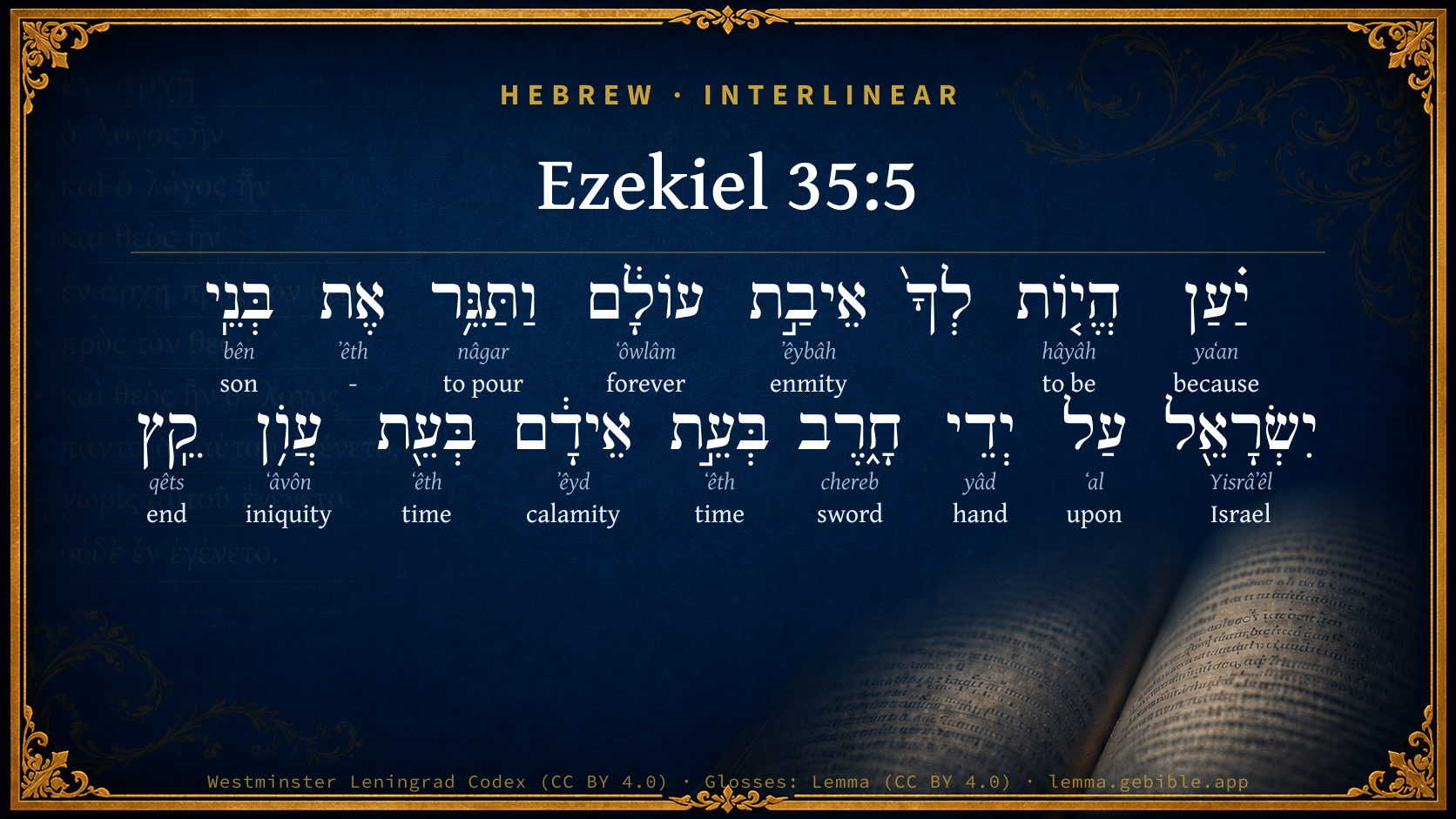
Hebrew (Westminster Leningrad Codex) Ezekiel 35:5 appears in the Hebrew Old Testament. The text above is from the Westminster Leningrad Codex. Each word links to its Strong’s number, a concise gloss, and parsing drawn from the Open Scriptures Hebrew Bible morphology. Click any word for its full Brown-Driver-Briggs (BDB) entry.
Download image
Cite this verse

Ezekiel 35:5 (World English Bible). Public Domain. Lemma interlinear Bible study tool, https://lemma.gebible.app/v/ezekiel/35/5.

Show BibTeX & RIS
BibTeX
RIS
English Translation
Because you have had a perpetual enmity, and have given over the children of Israel to the power of the sword in the time of their calamity, in the time of the iniquity of the end;
World English Bible · Public Domain
Download a study sheet

One document with this verse’s original text, its word-by-word gloss line, the meaning frame, cross-references with their text, attributed commentary, and full source and license credits — printable, and it pastes into notes with its structure intact.

This verse Autodidact and up

Study sheet (.html) Plain text (.txt)

A passage Seminary Student

Up to 50 verses in one chapter. A passage sheet keeps up to 6 commentary sources and 12 cross-references per verse, in the order this page ranks them, and says so on the sheet whenever that leaves anything out. Ask for a single verse and you get the Autodidact verse sheet above.

Everything on this page stays free to read, with no account — the sheet is a download of what is already on screen, not access to it.

Want to remove ads? Support Godless Engineer
Compare translations 3

The same verse in 3 English versions, stacked beneath the original-language interlinear above. Click any original word for its lexicon entry.

Each is an independent rendering of the whole verse — the interlinear is not word-aligned to these translations.

Highlighted words mark where these versions differ — a whole-verse word diff, not a word-by-word alignment.

  • World English Bible Public Domain
    Because you have had a perpetual enmity, and have given over the children of Israel to the power of the sword in the time of their calamity, in the time of the iniquity of the end;
  • King James Version Public Domain
    Because thou hast had a perpetual hatred, and hast shed the blood of the children of Israel by the force of the sword in the time of their calamity, in the time that their iniquity had an end:
  • unfoldingWord Literal Text CC BY-SA 4.0
    Because you have always been hostile to the people of Israel, and because you poured them out into the hands of the sword at the time of their distress, at the time their punishment was at its greatest.

unfoldingWord Literal Text — © unfoldingWord, licensed CC BY-SA 4.0. Word-aligned USFM3 via Door43 (git.door43.org/unfoldingWord/en_ult).

Versions to compare (up to 4)

3 of 4 selected

Show all 18 translations

Every available English version of this verse, each an independent rendering of the whole verse.

  • World English Bible Public Domain
    Because you have had a perpetual enmity, and have given over the children of Israel to the power of the sword in the time of their calamity, in the time of the iniquity of the end;
  • Berean Standard Bible Public Domain
    Because you harbored an ancient hatred and delivered the Israelites over to the sword in the time of their disaster at the final stage of their punishment,
  • Majority Standard Bible Public Domain
    Because you harbored an ancient hatred and delivered the Israelites over to the sword in the time of their disaster at the final stage of their punishment,
  • King James Version Public Domain
    Because thou hast had a perpetual hatred, and hast shed the blood of the children of Israel by the force of the sword in the time of their calamity, in the time that their iniquity had an end:
  • American Standard Version (1901) Public Domain
    Because thou hast had a perpetual enmity, and hast given over the children of Israel to the power of the sword in the time of their calamity, in the time of the iniquity of the end;
  • Revised Version (1885) Public Domain
    Because thou hast had a perpetual enmity, and hast given over the children of Israel to the power of the sword in the time of their calamity, in the time of the iniquity of the end:
  • Geneva Bible (1599) Public Domain
    Because thou hast had a perpetuall hatred and hast put the children of Israel to flight by the force of the sword in the time of their calamitie, when their iniquitie had an ende,
  • Douay-Rheims (1899) Public Domain
    Because thou hast been an everlasting enemy, and hast shut up the children of Israel in the hands of the sword in the time of their affliction, in the time of their last iniquity.
  • Young's Literal Translation Public Domain
    Because of thy having an enmity age-during, And thou dost saw the sons of Israel, By the hands of the sword, In the time of their calamity, In the time of the iniquity of the end:
  • Literal Standard Version CC BY-SA 4.0
    Because of your having continuous enmity, || And you saw the sons of Israel, || By the hands of the sword, || In the time of their calamity, || In the time of the iniquity of the end:
  • Unlocked Literal Bible CC BY-SA 4.0
    Because you have always been hostile to the people of Israel, and because you poured them out into the hands of the sword at the time of their distress, at the time their punishment was at its greatest.
  • unfoldingWord Literal Text CC BY-SA 4.0
    Because you have always been hostile to the people of Israel, and because you poured them out into the hands of the sword at the time of their distress, at the time their punishment was at its greatest.
  • Darby Bible Public Domain
    Because thou hast had a perpetual hatred, and hast given over the children of Israel to the power of the sword, in the time of their calamity, in the time of the iniquity of the end;
  • World Messianic Bible Public Domain
    “‘“Because you have had a perpetual hostility, and have given over the children of Israel to the power of the sword in the time of their calamity, in the time of the iniquity of the end,
  • Webster's Bible Public Domain
    Because thou hast had a perpetual hatred, and hast shed the blood of the children of Israel by the force of the sword in the time of their calamity, in the time that their iniquity had an end:
  • Free Bible Version CC BY-SA 4.0
    Because of your lasting hatred for the Israelites you let them be attacked with swords as they went through terrible disasters when the time of their punishment was coming to an end.
  • Bible in Basic English Public Domain
    Because yours has been a hate without end, and you have given up the children of Israel to the power of the sword in the time of their trouble, in the time of the punishment of the end:
  • JPS Tanakh (1917) Public Domain
    Because thou hast had a hatred of old, and hast hurled the children of Israel unto the power of the sword in the time of their calamity, in the time of the iniquity of the end;

Literal Standard Version (2020), Covenant Press — licensed CC BY-SA 4.0. Text via the HelloAO Bible API (eBible.org). Unlocked Literal Bible (unfoldingWord) — licensed CC BY-SA 4.0. Text via the HelloAO Bible API (eBible.org). unfoldingWord Literal Text — © unfoldingWord, licensed CC BY-SA 4.0. Word-aligned USFM3 via Door43 (git.door43.org/unfoldingWord/en_ult). Free Bible Version, Dr. Jonathan Gallagher — licensed CC BY-SA 4.0. Text via the HelloAO Bible API (eBible.org).

Word by word

More ways to search: Search by grammar → Find every occurrence → Compare this word →

Practice this passage: Drill this verse → Learn its vocabulary →

אֵיבַ֣ת
ʼêybâh
H342
“enmity of”
Noun, Common, Feminine, Singular, Construct
Part of Speech
Noun
Type
Common
Gender
Feminine
Number
Singular
State
Construct
Full BDB Definition

Origin: from H340

TWOT: 78a

enmity, hatred
  1. יַ֗עַן yaʻan H3282 “because” Conjunction
  2. הֱי֤וֹת hâyâh H1961 “to be” Verb, Qal, Infinitive Construct
  3. עוֹלָ֔ם ʻôwlâm H5769 “forever” Noun, Common, Masculine, Singular, Absolute
  4. וַתַּגֵּ֥ר nâgar H5064 “and · to pour” Conjunction + Verb, Hiphil, Sequential Imperfect, 2nd Person, Masculine, Singular
  5. אֶת ʼêth H853 “-” Particle, Direct Object
  6. בְּנֵֽי bên H1121 “sons of” Noun, Common, Masculine, Plural, Construct
  7. יִשְׂרָאֵ֖ל Yisrâʼêl H3478 “Israel” Noun, Proper
  8. עַל ʻal H5921 “upon” Preposition
  9. יְדֵי yâd H3027 “hands of” Noun, Common, Both, Dual, Construct
  10. חָ֑רֶב chereb H2719 “sword” Noun, Common, Feminine, Singular, Absolute
  11. בְּעֵ֣ת ʻêth H6256 “in/at · time of” Preposition + Noun, Common, Both, Singular, Construct
  12. אֵידָ֔ם ʼêyd H343 “calamity · their” Noun, Common, Masculine, Singular, Construct + Suffix, Personal, 3rd Person, Masculine, Plural
  13. בְּעֵ֖ת ʻêth H6256 “in/at · time of” Preposition + Noun, Common, Both, Singular, Construct
  14. עֲוֺ֥ן ʻâvôn H5771 “iniquity of” Noun, Common, Both, Singular, Construct
  15. קֵֽץ qêts H7093 “end” Noun, Common, Masculine, Singular, Absolute

About this verse

These counts appear in no published source. They are computed here, from the morphology-tagged text and Lemma’s own curated glosses. What Lemma adds →

17
words
15
distinct lemmas
Prophets
section

Notable vocabulary

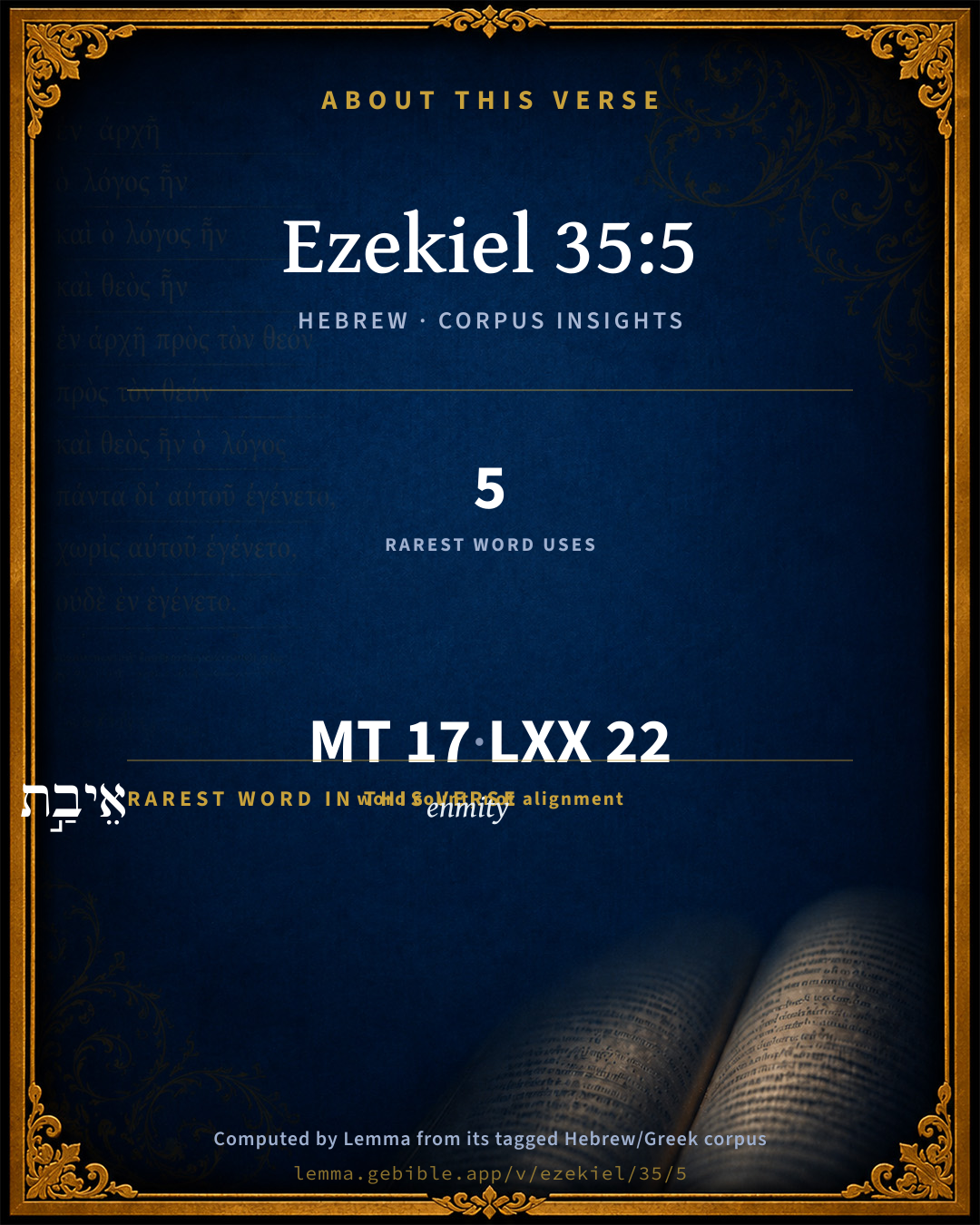
The rarest word here is אֵיבַ֣ת enmity H342 — appearing just 5 times in the whole Hebrew Bible.

Shared distinctive vocabulary

אֵיבַ֣ת enmity H342 occurs in 5 verses of the Hebrew Bible. Also found in:

Grammatical profile

  • 2 verbs
  • 11 nouns
  • 2 prepositions
  • 1 conjunction
  • 1 particle

Verb forms

  • הֱי֤וֹת Qal · Infinitive Construct
  • וַתַּגֵּ֥ר Hiphil · Sequential Imperfect

Repetition

A word recurs within this verse — often emphatic in Hebrew:

  • בְּעֵ֣ת time H6256 ×2

Hebrew & Septuagint length

In English translation the verse runs 36 words from the Hebrew and 33 from the Septuagint (LXX English) — closely comparable.

A rough comparison of the two English renderings, which tokenize alike — not a word-level alignment.

Word counts can differ between the Hebrew and the Greek without any difference in meaning — e.g. the Hebrew direct-object marker אֵת has no separate Greek word, and Greek often adds the article ὁ.

In the original languages it is 17 Hebrew tokens and 22 Greek tokens — but the two are counted differently (Hebrew bundles its prefixes and suffixes into one token; the Greek is in lemma form), so that isn’t a like-for-like length.

Cross-references

11

Topical passages linked to Ezekiel 35:5 in the Treasury of Scripture Knowledge — connected by theme and wording, ordered by reader-vote popularity; previews shown in the World English Bible.

  • Psalms 137:7 Remember, Yahweh, against the children of Edom, The day of Jerusalem; Who said, "Raze it! Raze it even to its foundation!"
  • Obadiah 1:10–16 For the violence done to your brother Jacob, shame will cover you, and you will be cut off forever.
  • Amos 1:11 Thus says Yahweh: "For three transgressions of Edom, yes, for four, I will not turn away its punishment; Because he pursued his brother with the sword, And cast off all pity, And his anger raged continually, And he kept his wrath forever;
  • Ezekiel 21:25 You, deadly wounded wicked one, the prince of Israel, whose day is come, in the time of the iniquity of the end,
  • Ezekiel 21:29 while they see for you false visions, while they divine lies to you, to lay you on the necks of the wicked who are deadly wounded, whose day is come in the time of the iniquity of the end.
  • Ezekiel 25:12 Thus says the Lord Yahweh: Because Edom has dealt against the house of Judah by taking vengeance, and has greatly offended, and revenged himself on them;
  • Genesis 27:41–42 Esau hated Jacob because of the blessing with which his father blessed him. Esau said in his heart, "The days of mourning for my father are at hand. Then I will kill my brother Jacob."
  • Ezekiel 25:15 Thus says the Lord Yahweh: Because the Philistines have dealt by revenge, and have taken vengeance with despite of soul to destroy with perpetual enmity;
  • Jeremiah 18:21 Therefore deliver up their children to the famine, and give them over to the power of the sword; and let their wives become childless, and widows; and let their men be slain of death, [and] their young men struck of the sword in battle.
  • Ezekiel 35:12 You shall know that I, Yahweh, have heard all your insults which you have spoken against the mountains of Israel, saying, They are laid desolate, they are given us to devour.
  • Daniel 9:24 Seventy weeks are decreed on your people and on your holy city, to finish disobedience, and to make an end of sins, and to make reconciliation for iniquity, and to bring in everlasting righteousness, and to seal up vision and prophecy, and to anoint the most holy.

Cross-references courtesy of OpenBible.info (CC BY 4.0).

Hebrew and Greek witnesses Masoretic Hebrew ↔ Greek Septuagint

The same verse in the two great witnesses to the Old Testament, shown verse-for-verse.

These are two independent witnesses, not word-aligned to each other, and the Septuagint is shown in lemma (dictionary) form.

Hebrew Ezekiel 35:5 Masoretic · Westminster Leningrad Codex

יַ֗עַן הֱי֤וֹת לְךָ֙ אֵיבַ֣ת עוֹלָ֔ם וַתַּגֵּ֥ר אֶת בְּנֵֽי יִשְׂרָאֵ֖ל עַל יְדֵי חָ֑רֶב בְּעֵ֣ת אֵידָ֔ם בְּעֵ֖ת עֲוֺ֥ן קֵֽץ

Because you have had a perpetual enmity, and have given over the children of Israel to the power of the sword in the time of their calamity, in the time of the iniquity of the end;

World English Bible · Public Domain

Greek LXX Ezekiel 35:5 Septuagint · lemma form

ἀντί ὁ γίγνομαι σύ ἔχθρα αἰώνιος καί ἐν καταἵζω ὁ οἶκος ἰσραήλ δόλος ἐν χείρ ἐχθρός μάχαιρα ἐν καιρός ἀδικία ἐπί ἔσχατος

Because you have been a perpetual enemy, and have laid wait craftily for the house of Israel, with the hand of enemies with a sword, in the time of injustice, at the last:

LXX2012 (modern English Septuagint) · Public Domain

Hebrew: Westminster Leningrad Codex (CC BY 4.0). Greek: Septuagint (public domain); English from LXX2012 (modern English Septuagint) (Public Domain). How the Septuagint differs from the Hebrew →

Targum (Aramaic paraphrase)

1

The Targum is the ancient Jewish Aramaic paraphrase of the Hebrew Scriptures — an interpretive translation, not the Hebrew text itself. Onkelos (literal) and Pseudo-Jonathan (expansive) render the Torah, and Jonathan the Prophets. Coverage is partial: where no permissively-licensed English translation exists for a verse, only the Aramaic is shown. This is verse-level text, not a word-by-word alignment to the Hebrew.

  1. Targum Jonathan Prophets (Joshua–Malachi)
    חֲלַף דַהֲוַת לָךְ דְבָבוּת עֲלָם וְתַבֵּיבְתָּא יַת בְּנֵי יִשְׂרָאֵל עַל יְדֵי קָטוֹלֵי חַרְבָּא בְּעִדַן תְּבִירְהוֹן בְּעִדַן תּוּשְׁלְמַת חוֹבֵיהוֹן:

    (no public-domain English translation for this verse)

    Targum Jonathan — Aramaic: “Mikraot Gedolot” (public domain). English: “Sefaria Community Translation” (CC0 1.0 (public-domain dedication)); “London "Chaldee Paraphrase," 1871” (public domain). Text via Sefaria.

Commentary

Notes on Ezekiel 35:5 from classic Christian and Jewish commentators (each source and its license shown beneath its notes). The classic Christian expositions comment on the surrounding passage and are grouped to its opening verse, so a note may address several verses; the Jewish commentaries on the Tanakh (Rashi and others) are per-verse, so they appear only where the commentator wrote on this verse.

Lemma curates 59 commentaries, every one of them public domain or Creative Commons licensed, each selected and text-cleaned for this edition rather than reprinted as found. About our sources →

Trapp's Complete Commentary

John Trapp

Eze 35:5 Because thou hast had a perpetual hatred, and hast shed [the blood of] the children of Israel by the force of the sword in the time of their calamity, in the time [that their] iniquity [had] an end:

Ver. 5. Because thou hast had a perpetual hatred.] A hereditary deadly feud against Israel. Heb., An enemy of ages, yea, of many ages continuance; such as is, as we use to say of Runner, the older the stronger.

And hast shed the blood of the children of Israel.] Ut diffluant; hast let out their life blood: all malice is bloody.

In time of their calamity.] Watching the worst time to do them the most mischief.

In the time that their iniquity had an end.] When I had in a manner done with them, yet thou hadst not done with them; but didst stir up Nebuzaradan to burn the city and temple with fire. This was to help forward the affliction. {Zec 1:15} {See Trapp on "Zec 1:15"}

John Trapp, A Commentary or Exposition upon All the Books of the Old and New Testament (1647–1656) — public domain. Text from a community e-Sword module.

Tyndale Open Study Notes

Tyndale Open Resources

35:5-10 The eternal [or ancient] hatred of Edom for Israel went all the way back to their respective ancestors, Esau and Jacob (see Gen 25:19-34; 27:1-46; Num 20:14-21; 24:18; 2 Sam 8:13-14; 1 Kgs 11:14). Because of that enmity, the Edomites took advantage of the Babylonian destruction to butcher the Israelites when they were helpless. They wanted to wipe out the descendants of Jacob and seize the lands of Israel and Judah. The bloodbath they delighted to inflict on Israel would return on their own heads, as their people would be slaughtered by the sword. Their everlasting hatred would be punished: Their land would become desolate forever. This prophecy was fulfilled when the Edomites were displaced by a coalition of Arab tribes sometime during the 400s BC.

Tyndale Open Study Notes — © Tyndale Open Resources, licensed CC BY-SA 4.0. Text via the HelloAO Bible API.

Geneva Bible (1599)

Geneva Bible translators

When by their punishment I called them from their iniquity.

Geneva Bible (1599) marginal notes — public domain. Text via Bolls.life.

Jamieson, Fausset & Brown

Robert Jamieson, A. R. Fausset & David Brown

perpetual hatred-- (Psa 137:7; Amo 1:11; Oba 1:10-16). Edom perpetuated the hereditary hatred derived from Esau against Jacob.

shed the blood of, &c.--The literal translation is better. "Thou hast poured out the children of Israel"; namely, like water. So Psa 22:14; Psa 63:10, Margin; Jer 18:21. Compare Sa2 14:14.

by the force of the sword--literally, "by" or "upon the hands of the sword"; the sword being personified as a devourer whose "hands" were the instruments of destruction.

in the time that their iniquity had an end--that is, had its consummation (Eze 21:25, Eze 21:29). Edom consummated his guilt when he exulted over Jerusalem's downfall, and helped the foe to destroy it (Psa 137:7; Oba 1:11).

Jamieson, Fausset & Brown — Commentary Critical and Explanatory on the Whole Bible (1871) — public domain (CC PDM 1.0). Text via the HelloAO Bible API.

Adam Clarke's Commentary

Verse 5. A perpetual hatred] The Edomites were the descendants of Esau; the Israelites, the descendants of Jacob. Both these were brothers; and between them there was contention even in the womb, and they lived generally in a state of enmity. Their descendants kept up the ancient feud: but the Edomites were implacable; they had not only a rooted but perpetual enmity to the Israelites, harassing and distressing them by all possible means; and they seized the opportunity, when the Israelites were most harassed by other enemies, to make inroads upon them, and cut them off wherever they found them.

To afflict the afflicted is cruel. This is scarcely of man, bad as he is. He must be possessed by the malignant spirit of the devil, when he wounds the wounded, insults over the miseries of the afflicted, and seeks opportunities to add affliction to those who are already under the rod of God.

Adam Clarke's Commentary on the Bible (1810–1826) — public domain. Text from a community e-Sword/MySword module.

Ellicott's Commentary for English Readers

(5) Perpetual hatred.—Enmity towards Israel is also imputed to the Ammonites, Moabites, and Philistines in Ezekiel 25; but that of Edom was deeper and coeval with its first ancestor (see Gen_25:22, &c., Gen_27:41); its peculiar malignity is noticed by Amo_1:11. (Comp. also Oba_1:10-15.)

Shed the blood.—“Blood” is not in the original, and should be omitted. The verb means literally to pour out, and the clause should be rendered hast scattered the children of Israel. The same expression occurs in Psa_63:10; Jer_18:21. The time specifically referred to is that of the overthrow of Jerusalem, as both that of their great “calamity” and that when “their iniquity had an end.” (On the last phrase, see Note on Eze_21:29.) So the world-power generally, while it may fawn upon and corrupt the Church in the day of its prosperity, shows its undisguised hostility in every time of adversity.

A Bible Commentary for English Readers, edited by Charles John Ellicott (1878–1897) — public domain. Text from a community e-Sword module.

The Cambridge Bible for Schools and Colleges

gen. ed. J. J. S. Perowne

5. The causes of the judgment on Mount Seir. These causes are three: first, its perpetual hatred of Israel, Eze_25:15; Amo_1:11; second. its malicious joy over the downfall of Israel and the part it took in the destruction of the people in the day of their calamity, when the consequences of their guilt fell upon them, Obad. Eze_35:10-14; and third, Edom’s invasion of the land and seizure of it as their own, though the Lord dwelt in it (Eze_35:10).

hast shed … of the sword] and didst deliver the children of Israel over into the hands of the sword. Jer_18:21; Psa_63:10.

time iniquity had an end] Lit. time of the iniquity of the end. The “iniquity of the end” is either, the final punishment of iniquity, or, the iniquity whose punishment was seen in the end (of the state). Cf. ch. 7. The phrase again Eze_21:30. The ref. is to the destruction of Jerusalem; so the “calamity” referred to is the downfall of the city and state, as Ob. Eze_35:13; cf. Psa_137:7, “the day of Jerusalem.”

The Cambridge Bible for Schools and Colleges (gen. ed. J. J. S. Perowne; Cambridge University Press, 1878–1918) — public domain. Text from a community e-Sword module.

John Gill's Exposition

Because thou hast had a perpetual hatred,.... There was an old grudge and enmity subsisting in the posterity of Esau against the posterity of Jacob, because the latter supplanted the former, and got the birthright and blessing from him; and which was discovered in all ages, and at all opportunities, and on all occasions which offered; and such has been the hatred of the church of Rome against the true professors and followers of Christ, as their bloody persecution of them in all ages have shown:

and hast shed the blood of the children of Israel by the force of the sword in the time of their calamity: when Jerusalem was taken by the Chaldeans, the Edomites not only rejoiced at it, and took part of the spoil, but stood in the crossways, and slew those that made their escape; or drove them back upon the sword of the enemy; or delivered them into their hands; which was barbarous and inhuman usage of their neighbours and brethren; see Oba 1:10. The Targum is,

"and thou didst deliver the children of Israel into the hands of those that slay with the sword, in the time of their destruction:''

in the time that their iniquity had an end; when either the measure of that was full; or when they received for it full correction and chastisement; at the consummation of that.

John Gill's Exposition of the Whole Bible (1746–1763) — public domain (CC PDM 1.0). Text via the HelloAO Bible API.

Albert Barnes' Notes on the Bible

Shed blood - Omit “blood:” better as in the margin, i. e., and hast given up the children of Israel to the sword; thou hast scattered the children of Israel in confusion like stones poured down a mountain-side Mic 1:6.

That their iniquity had an end - Or, “of the iniquity of the end,” i. e., the time when by the capture of the city the iniquity of Israel came to an end Eze 21:29.

Albert Barnes' Notes on the Bible (1834–1885) — public domain. Text from a community e-Sword/MySword module.

Haydock's Catholic Bible Commentary

Enemy. God revenges the injuries done to his Church, as if they were done to himself, Acts ix. 4. (Worthington) --- The enmity of Jacob and of Esau seemed to commence in the womb, and was increased by the purchase of the birth-right, till Jacob’s prudence disarmed his brother. Their descendants sought every opportunity to injure one another. The Idumeans shewed their ill-will particularly, when the Jews were most distressed. This was a piece of the greatest cruelty.

George Leo Haydock (1774–1849), Haydock's Catholic Family Bible and Commentary, 1859 edition — public domain. Excludes Psalms (Douay-Rheims chapter numbering differs from Protestant) and Deuterocanonical books (Catholic canon only).

Matthew Poole's English Annotations

A perpetual hatred: Edom was of the same stock, brother to Jacob, and it was sin to disgust or envy, but greater to hate, and greatest to retain a perpetual hatred, an hereditary enmity from Esau’s time, the father of the Edomites, till now: near one thousand two hundred years had the seed of Esau hated Jacob’s seed for inheriting the blessing, which yet I have some cause to think they as little valued as their father did before them.

Hast shed the blood, by sudden incursions sometimes, by a formed war at other times, and by taking side with those who warred upon him at all times; thus the sword of Edom was ever drawn or ready against Jacob’s seed.

By the force of the sword; with fierceness, cruelty, and burning hatred, as appears, Oba 1:11-14, which see.

Their calamity; deepest calamity; when all was lost, and their city taken, and none to pity or help, then did Edom cruelly execute his hatred, Psa 137:7.

In the time that their iniquity had an end; when their iniquity was charged and punished on them, which brought them to final ruin. See Eze 21:25.

Matthew Poole's English Annotations on the Holy Bible (1683–1685) — public domain. Text from a community e-Sword/MySword module.

The Pulpit Commentary

Because thou hast had a perpetual hatred; literally, hatred of old, or eternal enmity (cf. Eze_25:15) This was the first of the two specific grounds upon which Eden should feel the stroke of Divine vengeance. Edom had been Israel"s hereditary foe from the days of Esau and Jacob (Gen_25:22, sqq.; and Gen_27:37) downwards. Inspired with unappeasable wrath, (Amo_1:11) during the period of the wandering he had refused Israel, "his brother," a passage through his territory (Num_20:14-21; Jud_1:11:17) and in the days of Jehoshaphat had combined with Ammon and Moab to invade Judah. (2Ch_20:10, 2Ch_20:11; cf. Psa_83:1-8) His relentless antipathy to Israel culminated, according to Ezekiel, (cf. Oba_1:13) in the last days of Jerusalem, in the time of her calamity, when Nebuchadnezzar"s armies encompassed her walls, in the time that her iniquity had an end; or, in the time of the iniquity of the end (Revised Version); meaning, according to Keil, "the time of Judah"s final transgression;" or, according to Dr. Currey, in the "Speaker"s Commentary," the time when the capture of the city put an end to her iniquity; but, with more probability, according to Hengstenberg, Plumptre, and others, the time of that iniquity which brought on her end. (comp. Eze_21:29) Ewald translates, "at the time of her extremest punishment," taking avon in the sense of punishment a rendering the Revisers have placed in the margin. Then, according toObadiah (vers. 11-14), the Edomites had not only stood coolly by, but malevolently exulted when they beheld Jerusalem besieged by the Babylonian warriors; and not only joined with the foreign invaders in the sacking of the city, but occupied its gates and guarded the roads leading into the country, so as to prevent the escape of any of the wretched inhabitants, and even hewed down with the sword such fugitives as they were not able to save alive and deliver up to captivity. To this Ezekiel refers when he accuses Edom of having shed the blood of the children of Israel by the fores of the sword; literally, of having poured the children of Israel upon the hands of the sword; i.e. of having delivered them up to the sword. (cf. Psa_63:11; Jer_18:21)

The end of iniquity.

I INIQUITY MUST HAVE AN END. God will not permit it to run on forever unchecked and unpunished. The sinner has a long leash, but it is not interminable. God steps in at length and puts a stop to the awful succession of wicked deeds. Wicked cities and nations have had their end. So must it be with sinful lives.

II THE NATURAL END OF INIQUITY IS DEATH. Sin is the great destroyer. It is a raging fire which will ultimately fade away into dull ashes by consuming all the fuel on which it feeds. The sinner is a suicide. His evil is a slow but sure poison, that eats out the very fiber of his soul. This awful fate does not come on with a sudden shock so that men can be roused by its approach. It is like a creeping paralysis, and its insidious advent is least readily recognized by the very persons in whose experience it is taking place.

III INIQUITY MAY HAVE AN END IN REPENTANCE. There is an alternative. We are not bound to let the sin run through all its fatal course to the final silence and desolation. We must end the sin or it will end us; but the former may be done. The warnings of the fatal consequences of sin are set before us for the express purpose of urging us to cast off the deadly thing before it has completed its awful work.

IV CHRIST HAS COME TO PUT AN END TO INIQUITY. He works in common with the fundamental moral law in regard to the ending of sin. No lawgiver could be more stern in the denunciation of sin than the gracious Savior. He gave it no quarter. From the first he declared himself its deadly enemy. He came "to destroy the works of the devil". (1Jn_3:8) There is no shadow of excuse for the notion that we can find in Christ a shelter from the rigorous requirements of morality, so that we need not be so strictly righteous if we are Christians, as we should need to be it we were not. Christ expects a higher righteousness than that of the Law. (Mat_5:20) But when we perceive that our sin is our utter undoing, we are prepared to welcome Christ as cur Savior from this chiefly.

V IT IS WELL TO CONSIDER THE END OF INIQUITY. It has not yet arrived. All is now calm and apparently prosperous. We may say that there is time enough to consider the evil day. But the end may come before we expect it. Its slow and gradual approach leads to our failing to perceive how near it may be. Then the nearer it is the more difficult is it for us to draw back. The descent becomes more steep as it approaches the precipice; the rapids grow swifter as they near the falls; the poison more effectually pervades the system as death comes on. The longer we postpone repentance, the harder it is to repent. But apart from such thoughts of warning, sin that leads to so awful an issue should be accounted hateful in itself. Its present vile character is revealed by its end. With such fruit the plant must be odious.

HOMILIES BY J.R. THOMSON Vers. 5, 6. Lex talionis.

Ezekiel returns to his prophecy regarding the inhabitants of Mount Seir. These neighbors of the Israelites were animated by hostility to God"s people which was of a peculiarly bitter character. The prophet"s mind was deeply affected and sorely pained by the language and the actions of these enemies of Israel. This probably accounts for his reverting to his inspired threats of adversity and even destruction about to overtake these bitter and blasphemous foes of Israel and of Israel"s God.

I THE CHARGE BROUGHT AGAINST THE PEOPLE OF MOUNT SEIR.

1. The offense. They were guilty of violence against Israel and inexcusable bloodshed. A predatory and warlike race, they had turned their arms against their neighbors, instead of allowing them to dwell in security.

2. The motive. This was malice, malignity. A perpetual, unappeasable enmity actuated those of Mount Seir in their repeated incursions into the territory of the Israelites, and the desolation of the land and the destruction of life laid to their charge. Other more excusable motives accounted for the hostilities waged by other peoples; against Mount Seir the charge is brought of acting upon the meanest and basest of motives.

3. The opportunity. This was the time of Israel"s calamity and weakness. They took advantage of the circumstances of their neighbors, and attacked them at a conjuncture when they were powerless to defend themselves.

II THE RETRIBUTION WITH WHICH THE PEOPLE OF MOUNT SEIR WERE THREATENED.

1. The Author of this retribution was none other than the Lord God himself. He ruleth among the nations; "let not the rebellious exalt themselves." His justice is unquestionable and his power is irresistible. "He is terrible in his doings towards the children of men.

2. The nature of it. It is foretold that the cities shall be laid waste, and that the land shall be desolate, that the blood of the inhabitants of Mount Seir shall be shed. "I will prepare thee unto blood, and blood shall pursue thee

3. The law of it. Observe that the judgment and penalty here foretold is not simply retributive; it is of the nature of retaliation. The lea talionis prescribed "an eye for an eye, a tooth for a tooth," etc. The punishment matched the offense. Such a correspondence is noticeable between Seir"s treatment of Israel and Jehovah"s treatment of Seir. They had shed blood, and in recompense their blood should be shed. This is not to be regarded as private, personal revenge, which is forbidden to man, and could never be practiced by a holy God. It is a public measure, a judicial act, a proceeding warranted by justice, and intended to produce a deep and wholesome impression upon all who should witness it. It certainly marks the heinousness of sin in the view of the righteous Ruler, and it exemplifies the inevitable and universal action of the retributive government of the God of nations. T.

The Pulpit Commentary (1880–1919), ed. H.D.M. Spence-Jones & Joseph S. Exell — public domain. Text from a community e-Sword module.

John Wesley's Explanatory Notes

Their iniquity - When their iniquity was punished on them, which brought them to final ruin.

John Wesley, Explanatory Notes Upon the Whole Bible (1754–1765) — public domain. Text via the GEBible commentary corpus.

Rashi

Rabbi Shlomo Yitzchaki (Rashi)

and you hurled [Heb. וַתַּגֵר,] you cast down, as (Micah 1:6): “and I will cast (וְהִגַרְתִּי) its stones down into the valley,” for they would deliver them to their enemies as they fled through their land, and this is what Obadiah (1:14) says: “And you should not have stood by the gap [to cut off their fugitives, nor should you have delivered their survivors on the day of distress].”

on the day of their misfortune when I delivered them into the hands of the enemy.

at the time of the end of their iniquity when the end of their iniquity culminated, and their measure was full.

Rashi on the Tanakh — English translations: “The Judaica Press complete Tanach with Rashi, translated by A. J. Rosenberg” (CC BY 4.0); “Pentateuch with Rashi's commentary by M. Rosenbaum and A.M. Silbermann, 1929-1934” (public domain); “The Metsudah Tanach series, Lakewood, N.J” (CC BY 4.0); and “The Book of Joshua, Metsudah Publications, 1997” (CC BY 4.0). Text via Sefaria.

Lesson kit

Teaching starters — assembled from the data on this page, not authored interpretation. Every prompt links to the verse data it draws on. Edit before teaching.

Ezekiel, in the Prophets, opens this verse with 17 words (15 distinct Hebrew lemmas). Its most distinctive word is ʼêybâh (“enmity”). A historical commentator’s framing appears above. Read the whole chapter for the surrounding context.

Discussion questions

  1. What does “enmity” (ʼêybâh) contribute to the verse as a whole?
  2. Genesis 3:15 shares the word «enmity» with this verse. How do the two illuminate each other?
  3. “time” occurs 2× in this one verse. What is the effect of the repetition?
  4. The translations on this page render this verse differently — a whole-verse word diff, not a word-by-word alignment. What might account for the different wordings?
  5. The verb «הֱי֤וֹת» is Qal Infinitive Construct. How does its form color the action?
  6. Reading how Trapp's Complete Commentary and Tyndale Open Study Notes read this verse, where do the two commentators agree and where do they part?

Things to notice

Reading settings

Reading text

Shown beneath each verse's original-language words.

Old Testament
Old Testament edition

Read the OT as the Masoretic Hebrew (MT) or the Greek Septuagint (LXX).

English shown for the Greek Septuagint (in the Hebrew ↔ Greek comparison).

Comparing translations? Open the Compare panel on any verse page to stack up to four side by side.