
Psalms 37:19

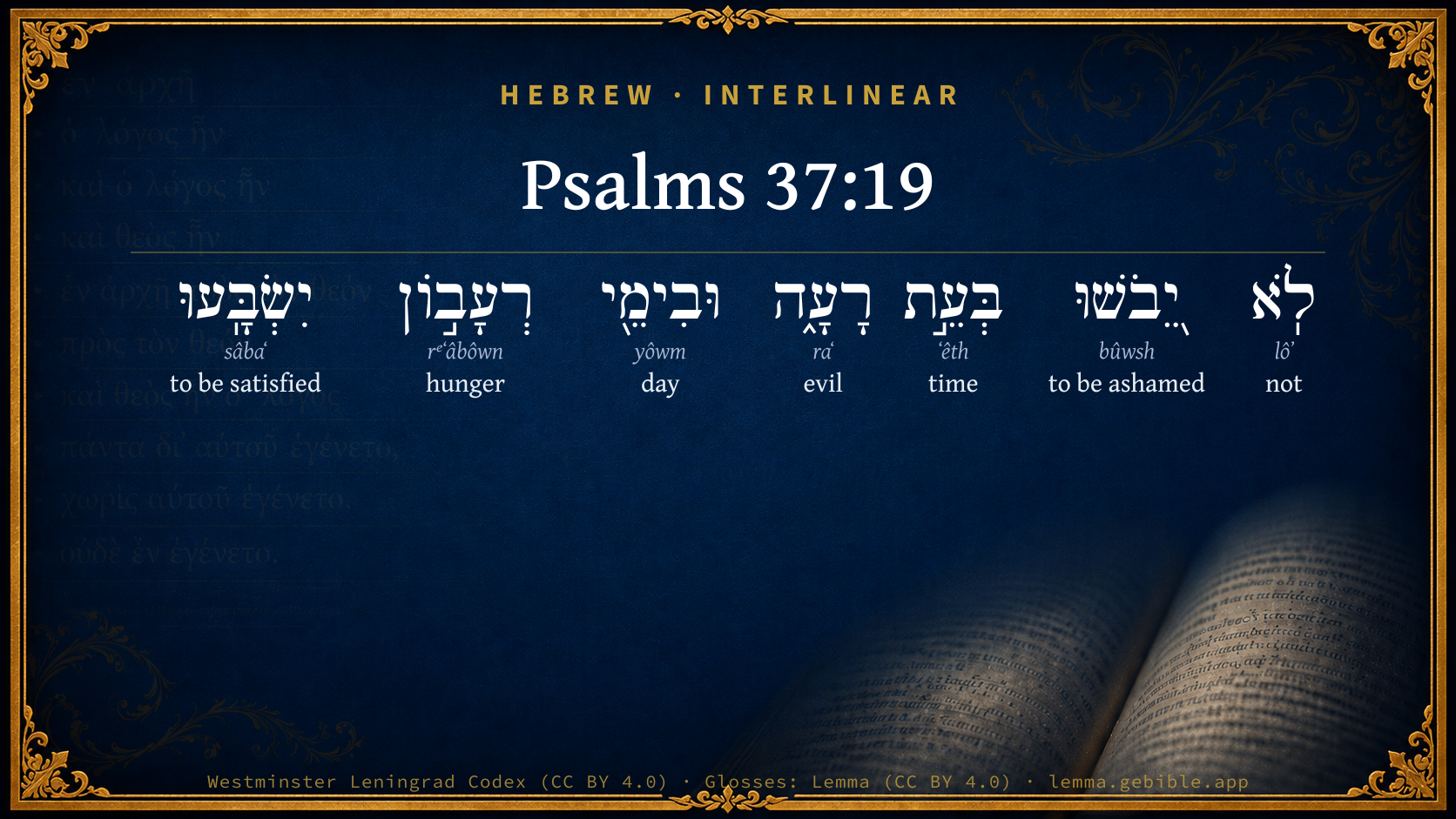
Hebrew (Westminster Leningrad Codex) Psalms 37:19 appears in the Hebrew Old Testament. The text above is from the Westminster Leningrad Codex. Each word links to its Strong’s number, a concise gloss, and parsing drawn from the Open Scriptures Hebrew Bible morphology. Click any word for its full Brown-Driver-Briggs (BDB) entry.
Download image
Cite this verse

Psalms 37:19 (World English Bible). Public Domain. Lemma interlinear Bible study tool, https://lemma.gebible.app/v/psalms/37/19.

Show BibTeX & RIS
BibTeX
RIS
English Translation
They shall not be disappointed in the time of evil. In the days of famine they shall be satisfied.
World English Bible · Public Domain
Download a study sheet

One document with this verse’s original text, its word-by-word gloss line, the meaning frame, cross-references with their text, attributed commentary, and full source and license credits — printable, and it pastes into notes with its structure intact.

This verse Autodidact and up

Study sheet (.html) Plain text (.txt)

A passage Seminary Student

Up to 50 verses in one chapter. A passage sheet keeps up to 6 commentary sources and 12 cross-references per verse, in the order this page ranks them, and says so on the sheet whenever that leaves anything out. Ask for a single verse and you get the Autodidact verse sheet above.

Everything on this page stays free to read, with no account — the sheet is a download of what is already on screen, not access to it.

Want to remove ads? Support Godless Engineer
Compare translations 3

The same verse in 3 English versions, stacked beneath the original-language interlinear above. Click any original word for its lexicon entry.

Each is an independent rendering of the whole verse — the interlinear is not word-aligned to these translations.

Highlighted words mark where these versions differ — a whole-verse word diff, not a word-by-word alignment.

  • World English Bible Public Domain
    They shall not be disappointed in the time of evil. In the days of famine they shall be satisfied.
  • King James Version Public Domain
    They shall not be ashamed in the evil time: and in the days of famine they shall be satisfied.
  • unfoldingWord Literal Text CC BY-SA 4.0
    They will not have shame in a time of evil, and in the days of famine they will have enough.

unfoldingWord Literal Text — © unfoldingWord, licensed CC BY-SA 4.0. Word-aligned USFM3 via Door43 (git.door43.org/unfoldingWord/en_ult).

Versions to compare (up to 4)

3 of 4 selected

Show all 18 translations

Every available English version of this verse, each an independent rendering of the whole verse.

  • World English Bible Public Domain
    They shall not be disappointed in the time of evil. In the days of famine they shall be satisfied.
  • Berean Standard Bible Public Domain
    In the time of evil they will not be ashamed, and in the days of famine they will be satisfied.
  • Majority Standard Bible Public Domain
    In the time of evil they will not be ashamed, and in the days of famine they will be satisfied.
  • King James Version Public Domain
    They shall not be ashamed in the evil time: and in the days of famine they shall be satisfied.
  • American Standard Version (1901) Public Domain
    They shall not be put to shame in the time of evil; And in the days of famine they shall be satisfied.
  • Revised Version (1885) Public Domain
    They shall not be ashamed in the time of evil: and in the days of famine they shall be satisfied.
  • Geneva Bible (1599) Public Domain
    They shall not be confounded in the perilous time, and in the daies of famine they shall haue ynough.
  • Douay-Rheims (1899) Public Domain
    They shall not be confounded in the evil time; and in the days of famine they shall be filled:
  • Young's Literal Translation Public Domain
    They are not ashamed in a time of evil, And in days of famine they are satisfied.
  • Literal Standard Version CC BY-SA 4.0
    They are not ashamed in a time of evil, || And they are satisfied in days of famine.
  • Unlocked Literal Bible CC BY-SA 4.0
    They will not be ashamed when times are bad. When famine comes, they will have enough to eat.
  • unfoldingWord Literal Text CC BY-SA 4.0
    They will not have shame in a time of evil, and in the days of famine they will have enough.
  • Darby Bible Public Domain
    they shall not be ashamed in the time of evil, and in the days of famine they shall be satisfied.
  • World Messianic Bible Public Domain
    They shall not be disappointed in the time of evil. In the days of famine they shall be satisfied.
  • Webster's Bible Public Domain
    They shall not be ashamed in the evil time: and in the days of famine they shall be satisfied.
  • Free Bible Version CC BY-SA 4.0
    They will not be humiliated in bad times; even in days of famine they will have plenty to eat.
  • Bible in Basic English Public Domain
    They will not be shamed in the evil time, and in the days when all are in need of food they will have enough.
  • JPS Tanakh (1917) Public Domain
    They shall not be ashamed in the time of evil; and in the days of famine they shall be satisfied.

Literal Standard Version (2020), Covenant Press — licensed CC BY-SA 4.0. Text via the HelloAO Bible API (eBible.org). Unlocked Literal Bible (unfoldingWord) — licensed CC BY-SA 4.0. Text via the HelloAO Bible API (eBible.org). unfoldingWord Literal Text — © unfoldingWord, licensed CC BY-SA 4.0. Word-aligned USFM3 via Door43 (git.door43.org/unfoldingWord/en_ult). Free Bible Version, Dr. Jonathan Gallagher — licensed CC BY-SA 4.0. Text via the HelloAO Bible API (eBible.org).

Word by word

More ways to search: Search by grammar → Find every occurrence → Compare this word →

Practice this passage: Drill this verse → Learn its vocabulary →

About this verse

These counts appear in no published source. They are computed here, from the morphology-tagged text and Lemma’s own curated glosses. What Lemma adds →

7
words
7
distinct lemmas
Wisdom
section

Notable vocabulary

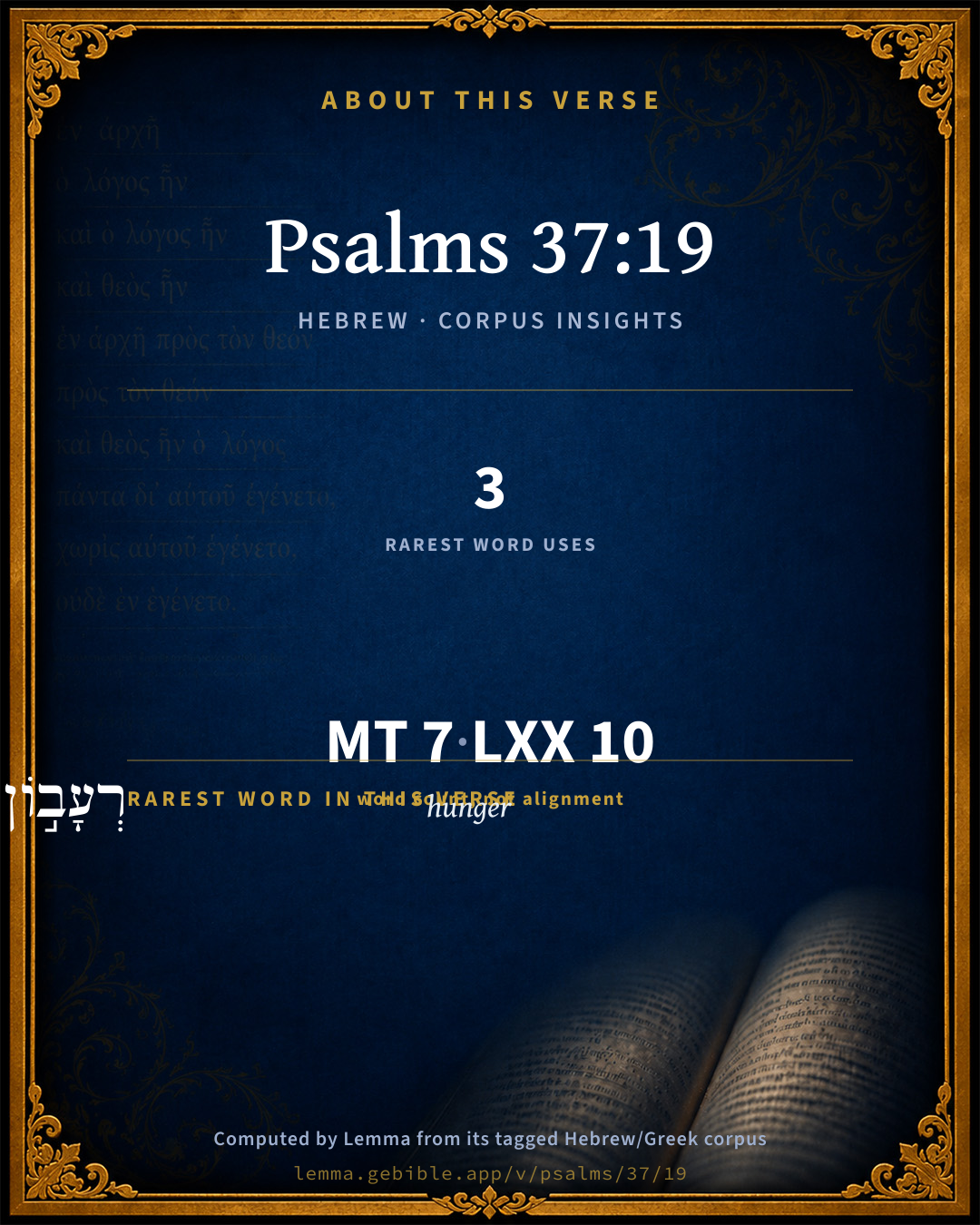
The rarest word here is רְעָב֣וֹן hunger H7459 — appearing just 3 times in the whole Hebrew Bible.

Shared distinctive vocabulary

רְעָב֣וֹן hunger H7459 occurs in 3 verses of the Hebrew Bible. Also found in:

Grammatical profile

  • 2 verbs
  • 4 nouns
  • 1 particle

Verb forms

  • יֵ֭בֹשׁוּ Qal · Imperfect
  • יִשְׂבָּֽעוּ Qal · Imperfect

Hebrew & Septuagint length

In English translation the verse runs 19 words from the Hebrew and 18 from the Septuagint (LXX English) — closely comparable.

A rough comparison of the two English renderings, which tokenize alike — not a word-level alignment.

Word counts can differ between the Hebrew and the Greek without any difference in meaning — e.g. the Hebrew direct-object marker אֵת has no separate Greek word, and Greek often adds the article ὁ.

In the original languages it is 7 Hebrew tokens and 10 Greek tokens — but the two are counted differently (Hebrew bundles its prefixes and suffixes into one token; the Greek is in lemma form), so that isn’t a like-for-like length.

Cross-references

8

Topical passages linked to Psalms 37:19 in the Treasury of Scripture Knowledge — connected by theme and wording, ordered by reader-vote popularity; previews shown in the World English Bible.

  • Psalms 33:19 To deliver their soul from death, To keep them alive in famine.
  • Proverbs 10:3 Yahweh will not allow the soul of the righteous to go hungry, But he thrusts away the desire of the wicked.
  • Job 5:20–22 In famine he will redeem you from death; In war, from the power of the sword.
  • Isaiah 33:16 He shall dwell on high; his place of defense shall be the munitions of rocks; his bread shall be given [him]; his waters shall be sure.
  • Amos 5:13 Therefore he who is prudent shall keep silence in such a time; For it is an evil time.
  • Ephesians 5:16 redeeming the time, because the days are evil.
  • Ecclesiastes 9:12 For man also doesn't know his time. As the fish that are taken in an evil net, and as the birds that are caught in the snare, even so are the sons of men snared in an evil time, when it falls suddenly on them.
  • Micah 2:3 Therefore thus says Yahweh: "Behold, I am planning against these people a disaster, From which you will not remove your necks, Neither will you walk haughtily; For it is an evil time.

Cross-references courtesy of OpenBible.info (CC BY 4.0).

Hebrew and Greek witnesses Masoretic Hebrew ↔ Greek Septuagint

The same verse in the two great witnesses to the Old Testament, shown verse-for-verse.

You’re reading Greek Psalm 36 (Hebrew Psalm 37). The Septuagint counts the superscription, so verse numbers can differ from the Hebrew — chapter-level alignment, not verse-by-verse. Numbering follows Rahlfs.

These are two independent witnesses, not word-aligned to each other, and the Septuagint is shown in lemma (dictionary) form.

Hebrew Psalms 37:19 Masoretic · Westminster Leningrad Codex

לֹֽא יֵ֭בֹשׁוּ בְּעֵ֣ת רָעָ֑ה וּבִימֵ֖י רְעָב֣וֹן יִשְׂבָּֽעוּ

They shall not be disappointed in the time of evil. In the days of famine they shall be satisfied.

World English Bible · Public Domain

Greek LXX Greek Psalm 36:19 Septuagint · lemma form

οὐ κατααἰσχύνω ἐν καιρός πονηρός καί ἐν ἡμέρα λιμός χορτάζω

They shall not be ashamed in an evil time; and in days of famine they shall be satisfied.

LXX2012 (modern English Septuagint) · Public Domain

Hebrew: Westminster Leningrad Codex (CC BY 4.0). Greek: Septuagint (public domain); English from LXX2012 (modern English Septuagint) (Public Domain). How the Septuagint differs from the Hebrew →

Commentary

Notes on Psalms 37:19 from classic Christian and Jewish commentators (each source and its license shown beneath its notes). The classic Christian expositions comment on the surrounding passage and are grouped to its opening verse, so a note may address several verses; the Jewish commentaries on the Tanakh (Rashi and others) are per-verse, so they appear only where the commentator wrote on this verse.

Lemma curates 59 commentaries, every one of them public domain or Creative Commons licensed, each selected and text-cleaned for this edition rather than reprinted as found. About our sources →

Trapp's Complete Commentary

John Trapp

Psa 37:19 They shall not be ashamed in the evil time: and in the days of famine they shall be satisfied.

Ver. 19. They shall not be ashamed] They shall hold up their heads when others droop; neither shall they be without comfort in times of common calamity, as Noah was - media tranquillus in unda.

And in the days of famine they shall be satisfied] God will work wonders rather than they shall want anything that is good for them; as he fed the Israelites in the wilderness, Elijah by the ravens, Jeremiah by a special providence in the siege. As Rochelle was relieved by an extraordinary shoal of fish cast in upon them by Divine providence. And as Leyden, besieged by the Duke of Alva and forced for their sustenance to search and scrape dunghills, to boil old leather, &c., was rescued by the turning of the winds and swelling of the tide, which forced the duke to raise the siege and be gone.

John Trapp, A Commentary or Exposition upon All the Books of the Old and New Testament (1647–1656) — public domain. Text from a community e-Sword module.

J. A. Alexander on Psalms

Joseph Addison Alexander

19. (Psa 37:19) They shall not be ashamed, disappointed, or deceived in their expectations. See above, on Ps. 6:11 (10), Psa 22:6 (5).—In an evil time, or, in a time of evil, i.e. of calamity or danger. See above, on Psa 9:10 (9), Psa 10:1. At such a time, their expectation of deliverance and safety shall not be frustrated.—And in days of famine, a specification of the general description, evil time, time of evil, not unlike that of the general term, suffering or afflicted, by the specific one, poor or needy, in ver 14 above.—They shall be satisfied, or filled, but only in a good sense, without any implication of satiety or surfeit. Compare Mat 5:6, Luk 6:21. The promise of this clause is not only specific but positive, whereas that of the first is both generic and negative. Compare Psa 33:19.

Joseph Addison Alexander, The Psalms Translated and Explained (1850) — public domain. Text from a community e-Sword module.

Geneva Bible (1599)

Geneva Bible translators

For God will give them contented minds: and that which shall be necessary.

Geneva Bible (1599) marginal notes — public domain. Text via Bolls.life.

Adam Clarke's Commentary

Verse 19. They shall not be ashamed] They have expressed strong confidence in the Lord; and he shall so work in their behalf that their enemies shall never be able to say, "Ye have trusted in your God, and yet your enemies have prevailed over you." No; for even in the days of famine they shall be satisfied.

Adam Clarke's Commentary on the Bible (1810–1826) — public domain. Text from a community e-Sword/MySword module.

John Calvin's Commentaries

19 They shall not be ashamed in the season of adversity This verse also shows us, that the faithful have no right to expect such exemption as the flesh would desire from affliction and trial, but they are assured of deliverance in the end; which, though it be indeed obtained, yet it is of such a nature as can be realised only by faith. We must regard these two things as inseparably connected, namely, that as the faithful are mingled among the wicked in this world, so hunger and adversity are common to both. The only difference betwixt them is, that God stretches forth his hand towards his own people in the time of their need, while he abandons the ungodly, and takes no care of them. If it should be objected, that the wicked often fare sumptuously in the time of famine, and gratify all their desires, whilst the faithful are oppressed with poverty and want, I answer, that the fullness of which mention is here made consists chiefly in this, that the faithful, though they live sparingly, and often labor hard to acquire the means of subsistence, are nevertheless fed by God as truly as if they had a greater abundance of this world’s goods than the ungodly, who greedily devour the good things of this life in all their variety and abundance, and yet are never satisfied. Besides, as I have elsewhere said, these temporal blessings are not always seen flowing in one uniform course. The hand of God is indeed always open, but we are straitened and limited in our desires, so that our own unbelief is no small hinderance to his liberality. Moreover, as our corrupt nature would soon break forth into excess, God deals with us more sparingly; and lest he might corrupt us by too great indulgence, he trains us to frugality by bestowing with a sparing hand what he was ready otherwise to lavish upon us in full abundance. And, indeed, whoever shall consider how much addicted we are to sensuality and pleasure, will not be surprised that God should exercise his own people with poverty and want. But although God may not bestow upon us what is necessary for our gratification, yet, unless our own ingratitude prevent us, we shall experience, even in famine and want, that be nourishes us graciously and liberally.

John Calvin's Commentaries (1540-1563) — public domain. Text from the Calvin Translation Society English edition (1840s-50s) via the Christian Classics Ethereal Library (ccel.org). Calvin's coverage is partial (roughly two-thirds of the Bible); uncommented books and verses are honest gaps, never fabricated. The 19th-century editor's footnotes and remarks are omitted so the notes are faithfully Calvin's own voice.

The Cambridge Bible for Schools and Colleges

gen. ed. J. J. S. Perowne

19. Cp. Job_5:19-20.

in the evil time] R.V. in the time of evil, i.e. calamity.

The Cambridge Bible for Schools and Colleges (gen. ed. J. J. S. Perowne; Cambridge University Press, 1878–1918) — public domain. Text from a community e-Sword module.

John Gill's Exposition

But the wicked shall perish,.... In a time of famine, in an evil day, and particularly at the day of judgment: for this is to be understood, not merely of being in bodily distress and want; nor of perishing by death, common to the righteous and the wicked; nor of being in a lost perishing condition, as all men by nature are, but of eternal perdition in hell;

and the enemies of the Lord shall be as the fat of lambs, they shall consume; that is, either they shall consume away as the fat of lambs burnt upon the altar, which evaporates, or as lambs fattened on purpose to be killed, and so prepared for the day of slaughter; in like manner the wicked, who have waxed fat and kicked, will be destroyed; they being the enemies of God, yea, enmity to him, to Father, Son, and Spirit, to the Gospel and ordinances of Christ, and to his people, and will be treated as such. Some render the word, "like the excellency of pastures" (s); the grass of the field, which is cut down and withers presently; see Psa 37:2;

into smoke shall they consume away, or "with" (t) it; that is, as it; see Psa 68:1; or "in smoke" (u); in the smoke of eternal torments, or hell, as the Targum.

(s) "sicut pretiosum pratorum", Muis; so some in Piscator; "vel gloria", Michaelis. (t) "cum fumo", Gejerus, Tigurine version; so Ainsworth. (u) "In fumo", Montanus, Musculus, Michaelis.

John Gill's Exposition of the Whole Bible (1746–1763) — public domain (CC PDM 1.0). Text via the HelloAO Bible API.

Albert Barnes' Notes on the Bible

They shall not be ashamed in the evil thee - In times of calamity and trouble. The word “ashamed” here refers to disappointment; as when one goes to a fountain or stream for water and finds it dried up. See Job 6:20, note; and Psa 25:2-3. The idea here is, that when thees of trouble and calamity come, in seasons of famine or want, they will find their expectations, arising from confidence in God, fully met. Their wants will be supplied, and they will find him to be their friend.

And in the days of famine they shall be satisfied - Their needs shall be supplied. God will provide for them. See Psa 37:25. This is in accordance with the general promises which are made in the Scriptures, that God will provide for the needs of those who trust in Him. See the notes at Psa 37:3.

Albert Barnes' Notes on the Bible (1834–1885) — public domain. Text from a community e-Sword/MySword module.

Matthew Poole's English Annotations

They shall not be ashamed, for the disappointment of their hopes, but their hopes and desires shall be satisfied, as it follows.

Matthew Poole's English Annotations on the Holy Bible (1683–1685) — public domain. Text from a community e-Sword/MySword module.

The Treasury of David

Charles H. Spurgeon

Ver. 19. They shall not be ashamed in the evil time. Calamities will come, but deliverances will come also. As the righteous never reckoned upon immunity from trouble, they will not be disappointed when they are called to take their share of it, but the rather they will cast themselves anew upon their God, and prove again his faithfulness and love. God is not a friend in the sunshine only, he is a friend indeed and a friend in need. And in the days of famine they shall be satisfied. Their barrel of meal and cruse of oil shall last out the day of distress, and if ravens do not bring them bread and meat, the supply of their needs shall come in some other way, for their bread shall be given them. Our Lord stayed himself upon this when he hungered in the wilderness, and by faith he repelled the tempter; we too may be enabled not to fret ourselves in any wise to do evil by the same consideration. If God's providence is our inheritance, we need not worry about the price of wheat. Mildew, and smut, and bent, are all in the Lord's hands. Unbelief cannot save a single ear from being blasted, but faith, if it do not preserve the crop, can do what is better, namely, preserve our joy in the Lord.

None.

Ver. 19. Good words for hard times.

Psalms 37:20*

Charles H. Spurgeon's The Treasury of David (1869–1885) — public domain. Psalms only. Text from a community e-Sword/MySword module.

The Pulpit Commentary

They shall not be ashamed in the evil times. If they fall into adversity, it will not cause them to feel shame. They will know that they are not being punished for evil-doing, but that God is trying them and purifying them. (Job_36:8-11) And in the days of famine they shall he satisfied. (comp. Psa_33:19)

The Pulpit Commentary (1880–1919), ed. H.D.M. Spence-Jones & Joseph S. Exell — public domain. Text from a community e-Sword module.

Lesson kit

Teaching starters — assembled from the data on this page, not authored interpretation. Every prompt links to the verse data it draws on. Edit before teaching.

Psalms, in the Wisdom, opens this verse with 7 words (7 distinct Hebrew lemmas). Its most distinctive word is rᵉʻâbôwn (“hunger”). A historical commentator’s framing appears above. Read the whole chapter for the surrounding context.

Discussion questions

  1. How does “hunger” (rᵉʻâbôwn) shape what this verse is saying?
  2. Genesis 42:19 shares the word «hunger» with this verse. How do the two illuminate each other?
  3. The translations on this page render this verse differently — a whole-verse word diff, not a word-by-word alignment. What might account for the different wordings?
  4. The verb «יֵ֭בֹשׁוּ» is Qal Imperfect. How does its form color the action?
  5. Reading how Trapp's Complete Commentary and J. A. Alexander on Psalms read this verse, where do the two commentators agree and where do they part?

Things to notice

Reading settings

Reading text

Shown beneath each verse's original-language words.

Old Testament
Old Testament edition

Read the OT as the Masoretic Hebrew (MT) or the Greek Septuagint (LXX).

English shown for the Greek Septuagint (in the Hebrew ↔ Greek comparison).

Comparing translations? Open the Compare panel on any verse page to stack up to four side by side.