Ecclesiastes 3:5

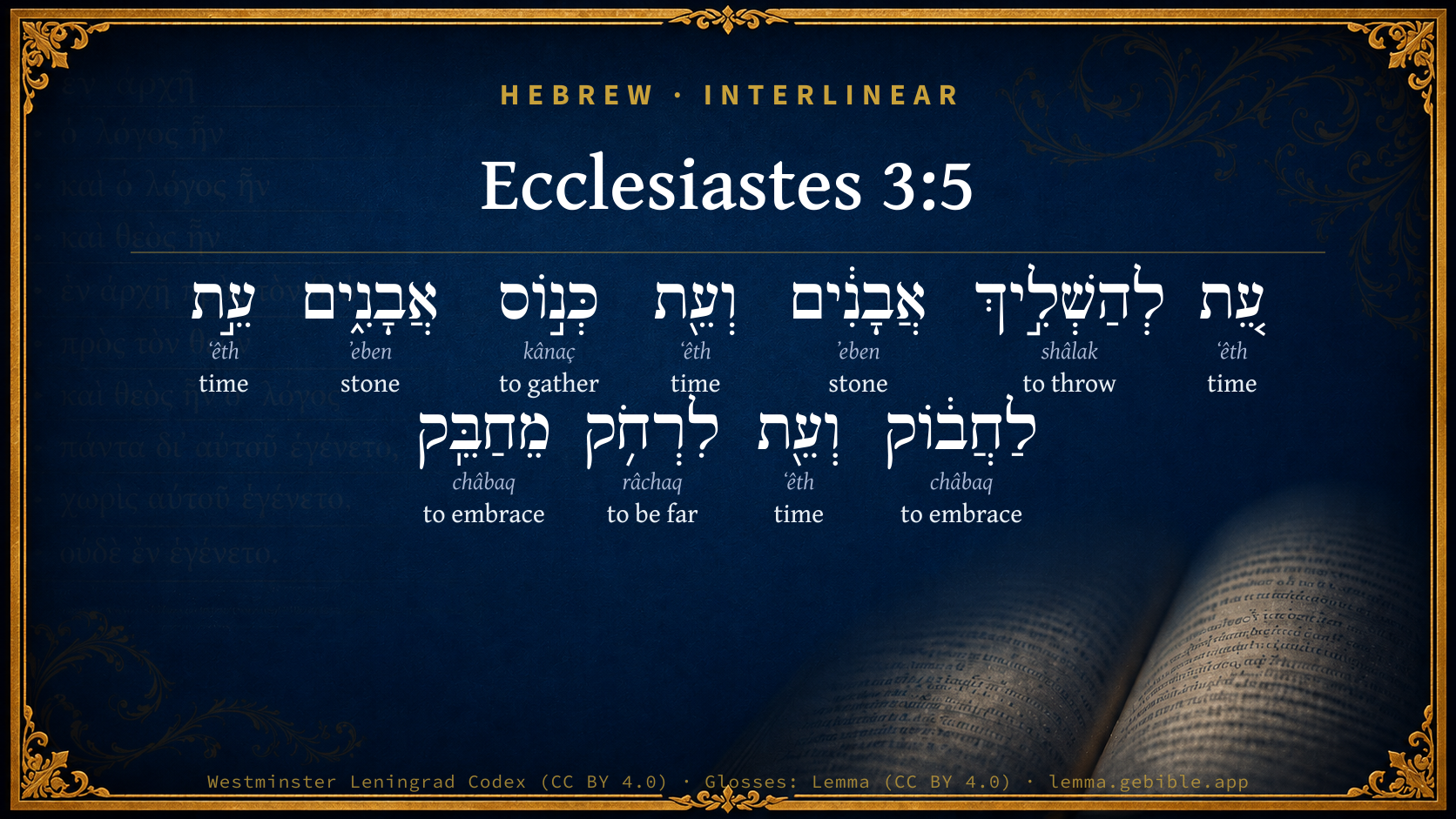
Hebrew (Westminster Leningrad Codex) Ecclesiastes 3:5 appears in the Hebrew Old Testament. The text above is from the Westminster Leningrad Codex. Each word links to its Strong’s number, a concise gloss, and parsing drawn from the Open Scriptures Hebrew Bible morphology. Click any word for its full Brown-Driver-Briggs (BDB) entry.
Download image
Cite this verse

Ecclesiastes 3:5 (World English Bible). Public Domain. Lemma interlinear Bible study tool, https://lemma.gebible.app/v/ecclesiastes/3/5.

Show BibTeX & RIS
BibTeX
RIS
English Translation
A time to cast away stones, And a time to gather stones together; A time to embrace, And a time to refrain from embracing;
World English Bible · Public Domain
Download a study sheet

One document with this verse’s original text, its word-by-word gloss line, the meaning frame, cross-references with their text, attributed commentary, and full source and license credits — printable, and it pastes into notes with its structure intact.

This verse Autodidact and up

Study sheet (.html) Plain text (.txt)

A passage Seminary Student

Up to 50 verses in one chapter. A passage sheet keeps up to 6 commentary sources and 12 cross-references per verse, in the order this page ranks them, and says so on the sheet whenever that leaves anything out. Ask for a single verse and you get the Autodidact verse sheet above.

Everything on this page stays free to read, with no account — the sheet is a download of what is already on screen, not access to it.

Want to remove ads? Support Godless Engineer
Compare translations 3

The same verse in 3 English versions, stacked beneath the original-language interlinear above. Click any original word for its lexicon entry.

Each is an independent rendering of the whole verse — the interlinear is not word-aligned to these translations.

Highlighted words mark where these versions differ — a whole-verse word diff, not a word-by-word alignment.

  • World English Bible Public Domain
    A time to cast away stones, And a time to gather stones together; A time to embrace, And a time to refrain from embracing;
  • King James Version Public Domain
    A time to cast away stones, and a time to gather stones together; a time to embrace, and a time to refrain from embracing;
  • unfoldingWord Literal Text CC BY-SA 4.0
    a time to throw stones and a time to gather stones, a time to embrace and a time to refrain from embracing,

unfoldingWord Literal Text — © unfoldingWord, licensed CC BY-SA 4.0. Word-aligned USFM3 via Door43 (git.door43.org/unfoldingWord/en_ult).

Versions to compare (up to 4)

3 of 4 selected

Show all 18 translations

Every available English version of this verse, each an independent rendering of the whole verse.

  • World English Bible Public Domain
    A time to cast away stones, And a time to gather stones together; A time to embrace, And a time to refrain from embracing;
  • Berean Standard Bible Public Domain
    a time to cast away stones and a time to gather stones together, a time to embrace and a time to refrain from embracing,
  • Majority Standard Bible Public Domain
    a time to cast away stones and a time to gather stones together, a time to embrace and a time to refrain from embracing,
  • King James Version Public Domain
    A time to cast away stones, and a time to gather stones together; a time to embrace, and a time to refrain from embracing;
  • American Standard Version (1901) Public Domain
    a time to cast away stones, and a time to gather stones together; a time to embrace, and a time to refrain from embracing;
  • Revised Version (1885) Public Domain
    a time to cast away stones, and a time to gather stones together; a time to embrace, and a time to refrain from embracing;
  • Geneva Bible (1599) Public Domain
    A time to cast away stones, and a time to gather stones: a time to embrace, and a time to be farre from embracing.
  • Douay-Rheims (1899) Public Domain
    A time to scatter stones, and a time to gather. A time to embrace, and a time to be far from embraces.
  • Young's Literal Translation Public Domain
    A time to cast away stones, And a time to heap up stones. A time to embrace, And a time to be far from embracing.
  • Literal Standard Version CC BY-SA 4.0
    A time to cast away stones, || And a time to heap up stones. A time to embrace, || And a time to be far from embracing.
  • Unlocked Literal Bible CC BY-SA 4.0
    a time to throw away stones and a time to gather stones, a time to embrace other people, and a time to refrain from embracing.
  • unfoldingWord Literal Text CC BY-SA 4.0
    a time to throw stones and a time to gather stones, a time to embrace and a time to refrain from embracing,
  • Darby Bible Public Domain
    A time to cast away stones, and a time to gather stones together; A time to embrace, and a time to refrain from embracing;
  • World Messianic Bible Public Domain
    a time to cast away stones, and a time to gather stones together; a time to embrace, and a time to refrain from embracing;
  • Webster's Bible Public Domain
    A time to cast away stones, and a time to gather stones; a time to embrace, and a time to refrain from embracing;
  • Free Bible Version CC BY-SA 4.0
    A time of throwing away stones, and a time of gathering up stones. A time of embracing, and a time of avoiding embracing.
  • Bible in Basic English Public Domain
    A time to take stones away and a time to get stones together; a time for kissing and a time to keep from kissing;
  • JPS Tanakh (1917) Public Domain
    A time to cast away stones, and a time to gather stones together; a time to embrace, and a time to refrain from embracing;

Literal Standard Version (2020), Covenant Press — licensed CC BY-SA 4.0. Text via the HelloAO Bible API (eBible.org). Unlocked Literal Bible (unfoldingWord) — licensed CC BY-SA 4.0. Text via the HelloAO Bible API (eBible.org). unfoldingWord Literal Text — © unfoldingWord, licensed CC BY-SA 4.0. Word-aligned USFM3 via Door43 (git.door43.org/unfoldingWord/en_ult). Free Bible Version, Dr. Jonathan Gallagher — licensed CC BY-SA 4.0. Text via the HelloAO Bible API (eBible.org).

Word by word

More ways to search: Search by grammar → Find every occurrence → Compare this word →

Practice this passage: Drill this verse → Learn its vocabulary →

כְּנ֣וֹס
kânaç
H3664
“to gather”
Verb, Qal, Infinitive Construct
Part of Speech
Verb
Stem
Qal
Form
Infinitive Construct
Full BDB Definition

Origin: a primitive root

TWOT: 1000

to gather, collect, wrap - (Qal) to gather - (Piel) to gather - (Hithpael) to gather together, wrap oneself up
  1. עֵ֚ת ʻêth H6256 “time” Noun, Common, Both, Singular, Absolute
  2. לְהַשְׁלִ֣יךְ shâlak H7993 “to throw” Preposition + Verb, Hiphil, Infinitive Construct
  3. אֲבָנִ֔ים ʼeben H68 “stones” Noun, Common, Feminine, Plural, Absolute
  4. וְעֵ֖ת ʻêth H6256 “and · time of” Conjunction + Noun, Common, Both, Singular, Construct
  5. אֲבָנִ֑ים ʼeben H68 “stones” Noun, Common, Feminine, Plural, Absolute
  6. עֵ֣ת ʻêth H6256 “time” Noun, Common, Both, Singular, Absolute
  7. לַחֲב֔וֹק châbaq H2263 “to embrace” Preposition + Verb, Qal, Infinitive Construct
  8. וְעֵ֖ת ʻêth H6256 “and · time” Conjunction + Noun, Common, Both, Singular, Absolute
  9. לִרְחֹ֥ק râchaq H7368 “to be far” Preposition + Verb, Qal, Infinitive Construct
  10. מֵחַבֵּֽק châbaq H2263 “from · to embrace” Preposition + Verb, Piel, Infinitive Construct

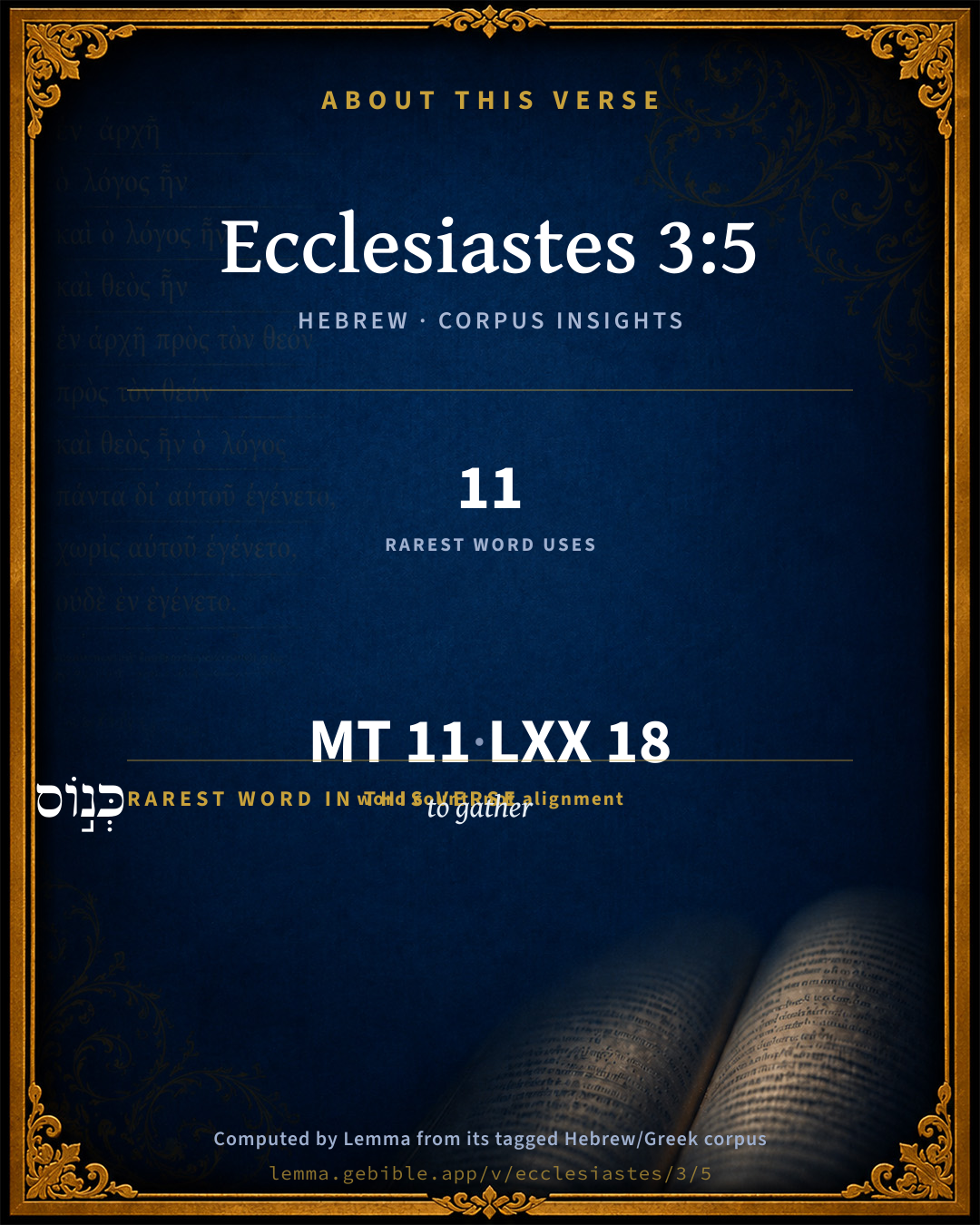
About this verse

These counts appear in no published source. They are computed here, from the morphology-tagged text and Lemma’s own curated glosses. What Lemma adds →

11
words
6
distinct lemmas
Wisdom
section

Notable vocabulary

The rarest word here is כְּנ֣וֹס to gather H3664 — appearing just 11 times in the whole Hebrew Bible.

Shared distinctive vocabulary

כְּנ֣וֹס to gather H3664 occurs in 11 verses of the Hebrew Bible. Also found in:

Grammatical profile

  • 5 verbs
  • 6 nouns

Verb forms

  • לְהַשְׁלִ֣יךְ Hiphil · Infinitive Construct
  • כְּנ֣וֹס Qal · Infinitive Construct
  • לַחֲב֔וֹק Qal · Infinitive Construct
  • לִרְחֹ֥ק Qal · Infinitive Construct
  • מֵחַבֵּֽק Piel · Infinitive Construct

Repetition

Words recur within this verse — often emphatic in Hebrew:

  • עֵ֚ת time H6256 ×4
  • אֲבָנִ֔ים stone H68 ×2
  • לַחֲב֔וֹק to embrace H2263 ×2

Hebrew & Septuagint length

In English translation the verse runs 24 words from the Hebrew and 23 from the Septuagint (LXX English) — closely comparable.

A rough comparison of the two English renderings, which tokenize alike — not a word-level alignment.

Word counts can differ between the Hebrew and the Greek without any difference in meaning — e.g. the Hebrew direct-object marker אֵת has no separate Greek word, and Greek often adds the article ὁ.

In the original languages it is 11 Hebrew tokens and 18 Greek tokens — but the two are counted differently (Hebrew bundles its prefixes and suffixes into one token; the Greek is in lemma form), so that isn’t a like-for-like length.

Cross-references

6

Topical passages linked to Ecclesiastes 3:5 in the Treasury of Scripture Knowledge — connected by theme and wording, ordered by reader-vote popularity; previews shown in the World English Bible.

  • 2 Kings 3:25 They beat down the cities; and on every good piece of land they cast every man his stone, and filled it; and they stopped all the springs of water, and felled all the good trees, until in Kir Hareseth [only] they left the stones of it; however the men armed with slings went about it, and struck it.
  • Joshua 10:27 It happened at the time of the going down of the sun, that Joshua commanded, and they took them down off the trees, and cast them into the cave in which they had hidden themselves, and laid great stones on the mouth of the cave, to this very day.
  • Joshua 4:3–9 and command you them, saying, Take hence out of the midst of the Jordan, out of the place where the priests' feet stood firm, twelve stones, and carry them over with you, and lay them down in the lodging-place, where you shall lodge this night.
  • Joel 2:16 Gather the people. Sanctify the assembly. Assemble the elders. Gather the children, and those who suck the breasts. Let the bridegroom go forth from his room, And the bride out of her chamber.
  • 1 Samuel 21:4–5 The priest answered David, and said, There is no common bread under my hand, but there is holy bread; if only the young men have kept themselves from women.
  • 2 Samuel 18:17–18 They took Absalom, and cast him into the great pit in the forest, and raised over him a very great heap of stones: and all Israel fled everyone to his tent.

Cross-references courtesy of OpenBible.info (CC BY 4.0).

Hebrew and Greek witnesses Masoretic Hebrew ↔ Greek Septuagint

The same verse in the two great witnesses to the Old Testament, shown verse-for-verse.

These are two independent witnesses, not word-aligned to each other, and the Septuagint is shown in lemma (dictionary) form.

Hebrew Ecclesiastes 3:5 Masoretic · Westminster Leningrad Codex

עֵ֚ת לְהַשְׁלִ֣יךְ אֲבָנִ֔ים וְעֵ֖ת כְּנ֣וֹס אֲבָנִ֑ים עֵ֣ת לַחֲב֔וֹק וְעֵ֖ת לִרְחֹ֥ק מֵחַבֵּֽק

A time to cast away stones, And a time to gather stones together; A time to embrace, And a time to refrain from embracing;

World English Bible · Public Domain

Greek LXX Ecclesiastes 3:5 Septuagint · lemma form

καιρός ὁ βάλλω λίθος καί καιρός ὁ συνἄγω λίθος καιρός ὁ περιλαμβάνω καί καιρός ὁ μακρύνω ἀπό περίλημψις

a time to throw stones, and a time to gather stones together; a time to embrace, and a time to abstain from embracing;

LXX2012 (modern English Septuagint) · Public Domain

Hebrew: Westminster Leningrad Codex (CC BY 4.0). Greek: Septuagint (public domain); English from LXX2012 (modern English Septuagint) (Public Domain). How the Septuagint differs from the Hebrew →

Commentary

Notes on Ecclesiastes 3:5 from classic Christian and Jewish commentators (each source and its license shown beneath its notes). The classic Christian expositions comment on the surrounding passage and are grouped to its opening verse, so a note may address several verses; the Jewish commentaries on the Tanakh (Rashi and others) are per-verse, so they appear only where the commentator wrote on this verse.

Lemma curates 59 commentaries, every one of them public domain or Creative Commons licensed, each selected and text-cleaned for this edition rather than reprinted as found. About our sources →

Trapp's Complete Commentary

John Trapp

Ecc 3:5 A time to cast away stones, and a time to gather stones together; a time to embrace, and a time to refrain from embracing;

Ver. 5. A time to cast away stones.] As when King Henry VIII pulled down the abbeys and other religious houses (as they called them), saying, Corvorum nidos esse penitus disturbandos, ne iterum ab cohabitandum convolent, that the crows’ nests were to be pulled in pieces, that they might never nestle there any more. {a} And herein he did but as Cardinal Wolsey did before him for he, by the Pope’s own license, had a little before pulled down forty monasteries, and taken their stones and revenues to build and endow his two colleges at Oxford and Ipswich. {b} Elapidation is a piece of the Church’s happiness. {Isa 5:2}

And a time to gather stones together.] As in building forts, castles, colleges, bridges, causeys, such as was that in 1Ch 26:16; 1Ch 26:18 1Ki 10:5 2Ch 9:11; 2Ch 16:6.

A time to embrace.] With honest conjugal embracements (as the Chaldee paraphrast interprets it), not with those libidinous embracings of the bosom of a stranger {c} {Pro 5:20} No time for such. {1Pe 4:3} Diabolus capite blanditur, ventre oblectat, cauda ligat.

And a time to refrain.] As in times of common calamity; for should we then make mirth? {Eze 21:10} Should not the bridegroom come forth of his chamber, and the bride out of her closet? {Joe 2:16} Some of the ancients {d} do very much note the manner of Noah’s going into the ark, and how the father and the sons went together, the mother and her daughters-in-law went together, God himself dividing at that time those whom himself had joined together. Others tell us that et bruta ipsa intra arcam quamdiu diluvium duravit, continuerint, the very brute creatures bred not in the ark during the deluge. There is both an intemperate and intempestive abuse of the marriage bed, which ought to be kept undefiled, {Heb 13:3} and not stained and dishonoured with either unseasonable or sensual excesses and uncleannesses, which God will certainly plague (though they lie without the walk of human censure) without true and timely repentance. Lutheri nuptias amici etiam improbabant, {e} &c. Luther’s marrying a wife, then, when all Germany was in a hurly burly, and all Saxony in heaviness for the death of their good Elector Frederick, Luther’s greatest friend, was no small grief to his best friends; and afterward also to himself, as Melanchthon testifieth in an epistle to Camerarius. {f}

{a} Sander. Schism. Ang., lib. i.

{b} Acts and Mon.

{c} Rupertus.

{d} Ambros., De Noe et Arca, cap. 21.

{e} Scultet. Annal.

{f} Quoniam vero ipsum Lutherum quodammodo tristierem esse cerno et perturbatum ob vitae mutationem, omni studio et benevolentia consolari eum cupio.

John Trapp, A Commentary or Exposition upon All the Books of the Old and New Testament (1647–1656) — public domain. Text from a community e-Sword module.

The Biblical Illustrator

Joseph S. Exell

Ecc_3:5

A time to cast away stones, and a time to gather stones together.

Decision and perseverance needed by the Christian

Perhaps the primary meaning may refer to the method in which an Eastern husbandman prepares to till his vineyard. These vineyards were often cultivated on the steep sides of the vales, and the traveller wonders to see under what difficult circumstances he toils, gathering up the stones which lie thickly on the ground, and carrying up soil and building up terraces in which to plant the vines. Hero the husbandman finds a season wherein he must cast away stones and pebbles, and clear the soil, and another time when it is needful to use these stones in raising up the walls and terraces of his vineyard.

1. If we regard our souls as possible vineyards and gardens, wherein may be grown the fruits of a good life, to the glory of God, how must we begin? We must cast away every obstacle, we must clear away anything which stands in the way and hinders us from truly serving God. One great obstacle which lies in the way of many is indolence in religious matters. The old fable described the vampire bat, in tropical countries, as hovering above its victims, and drinking their life-blood, whilst it soothes them to sleep on, by fanning them with its wings all the while. So the devil soothes souls into a fatal sleep. Again, another terrible obstacle is when there exists some favourite sin, some evil habit. We would give up much, but this one thing we cannot bear to part with. Our soul is like a captive bird, fastened by a string--it flies a little way, and then it is pulled back. But the Christian must summon up his courage, and with a strong effort break the chain float binds him down. Paint to yourself a prisoner seeking to escape from a gloomy dungeon. He has climbed up to the window of his cell. If only one bar was removed from the grated aperture, he could escape. Oh, with what determination he would grasp that rusty bar, how he would exert his utmost strength. Freedom, liberty, hopes, all before him, and but one bar between. And so with many a soul--one strong effort, and we might cut away that which holds us back.

2. A different picture now rises before our minds eye; as we before painted to ourselves the busy peasants casting away the stones to form the good ground for their vineyard, now we think of them gathering stones--how they pile them up in terraces, build them up with busy hands. Perhaps it is the surrounding walls, or the foundations of the wine-vat, or the tower of those that watch the vineyard, that is being raised. But whatever be the object of those that gather stones together, to build a wall, or erect a pier, or form a road, there is implied toil and patience. He who gathers stones must stoop, and stoop often. He who would grow in the Christian life must be humble, and as he who gathers stones. Habits of piety, humility, and patient well-doing take much watchfulness and constant prayer ere they can be formed. How slow is the process of gathering together stones! Yet it is only by constant daily efforts that we can build up the fabric of the Christian life, stone by stone, effort by effort. (J. W. Hardman, LL. D.)

The Biblical Illustrator, edited by Joseph S. Exell (c. 1880s–1900s) — public domain. Text from a community e-Sword module.

Jamieson, Fausset & Brown

Robert Jamieson, A. R. Fausset & David Brown

cast away stones--as out of a garden or vineyard (Isa 5:2).

gather--for building; figuratively, the Gentiles, once castaway stones, were in due time made parts of the spiritual building (Eph 2:19-20), and children of Abraham (Mat 3:9); so the restored Jews hereafter (Psa 102:13-14; Zac 9:16).

refrain . . . embracing-- (Joe 2:16; Co1 7:5-6).

Jamieson, Fausset & Brown — Commentary Critical and Explanatory on the Whole Bible (1871) — public domain (CC PDM 1.0). Text via the HelloAO Bible API.

Adam Clarke's Commentary

Verse 5. A time to cast away stones, - to gather stones, - to embrace, - to refrain]

"One while domestic cares abortive prove,

And then successful. Nature now invites

Connubial pleasures: but, when languid grown,

No less rejects."

Adam Clarke's Commentary on the Bible (1810–1826) — public domain. Text from a community e-Sword/MySword module.

Ellicott's Commentary for English Readers

(5) Gather stones.—As the collecting of stones for building purposes is included in Ecc_3:4, it is thought that what is here referred to is the clearing or marring of land (Isa_5:2; Isa_62:10; 2Ki_3:19; 2Ki_3:25).

A Bible Commentary for English Readers, edited by Charles John Ellicott (1878–1897) — public domain. Text from a community e-Sword module.

The Cambridge Bible for Schools and Colleges

gen. ed. J. J. S. Perowne

5. A time to cast away stones] The vagueness of the phrase has naturally given rise to conjectural interpretations. It seems obvious that the words cannot be a mere reproduction of Ecc_3:4 and therefore that the “casting away” and the “gathering” of stones must refer to something else than pulling down and building. Possibly we may think, with some interpreters, of the practice of covering fertile lands with stones as practised by an invading army (2Ki_3:19) and clearing out the stones of a field or vineyard before planting it (Isa_5:2). In this case however we fail to see any link uniting the two clauses in the couplet. A possible explanation may be found (as Delitzsch half suggests) in the old Jewish practice, which has passed into the Christian Church, of flinging stones or earth into the grave at a burial, but this leaves the “gathering” unexplained, except so far as it represents the building of a house, and thus contrasts the close of a man’s home life with its beginning. In this case the ceremonial of death would be contrasted with the “embracing” of friends or lovers in the second clause.

The Cambridge Bible for Schools and Colleges (gen. ed. J. J. S. Perowne; Cambridge University Press, 1878–1918) — public domain. Text from a community e-Sword module.

John Gill's Exposition

A time to cast away stones, and a time to gather stones together,.... To cast stones out of a field or vineyard where they are hurtful, and to gather them together to make walls and fences of, or build houses with; and may be understood both of throwing down buildings, as the temple of Jerusalem, so that not one stone was left upon another; of pouring out the stones of the sanctuary, and of gathering them again and laying them on one another; which was done when the servants of the Lord took pleasure in the stones of Zion, and favoured the dust thereof. Some understand this of precious stones, and of casting them away through luxury, wantonness, or contempt, and gathering them again: and it may be applied, as to the neglect of the Gentiles for a long time, and the gathering of those stones of which children were raised to Abraham; so of the casting away of the Jews for their rejection of the Messiah, and of the gathering of them again by conversion, when they shall be as the stones of a crown, lifted up as an ensign on his land, Zac 9:16;

a time to embrace, and a time to refrain from embracing: or "to be far from" (g) it; it may not only design conjugal embraces (h), but parents embracing their children, as Jacob did his; and one brother embracing another, as Esau Jacob, and one friend embracing another; all which is very proper and agreeable at times: but there are some seasons so very calamitous and distressing, in which persons are obliged to drop such fondnesses: it is true, in a spiritual sense, of the embraces of Christ and believers, which sometimes are, and sometimes are not, enjoyed, Pro 4:8.

(g) "tempus elongandi se", Pagninus, Montanus; "tempus longe fieri", V. L. (h) "Optatos dedit amplexus", Virgil. Aeneid. 8. v. 405.

John Gill's Exposition of the Whole Bible (1746–1763) — public domain (CC PDM 1.0). Text via the HelloAO Bible API.

Albert Barnes' Notes on the Bible

Stones may be regarded either as materials for building, or as impediments to the fertility of land (see 2Ki 3:19, 2Ki 3:25; Isa 5:2).

Albert Barnes' Notes on the Bible (1834–1885) — public domain. Text from a community e-Sword/MySword module.

Haydock's Catholic Bible Commentary

Stones, with a sling, or to render a field useless, 4 Kings iii. 25., and Isaias v. 2. --- Embraces. Countenance was sometimes prescribed for married people, Leviticus xx. 18., and 1 Corinthians vii. (St. Jerome) (St. Augustine, Enchiridion 78.) (Calmet) --- Hatred often succeeds love, ver. 8., and 2 Kings xiii. 14. (Haydock)

George Leo Haydock (1774–1849), Haydock's Catholic Family Bible and Commentary, 1859 edition — public domain. Excludes Psalms (Douay-Rheims chapter numbering differs from Protestant) and Deuterocanonical books (Catholic canon only).

Matthew Poole's English Annotations

A time to cast away stones; which were brought together in order to the building of a wall or house, but are now cast away, either because the man who gathered them hath changed his mind, and desists from his project, or by other causes or accidents.

A time to embrace; when persons shall enter into friendship, and perform all friendly offices one to another.

A time to refrain from embracing; either through alienation of affections, or grievous calamities. See Joe 2:16; 1Co 7:5

Matthew Poole's English Annotations on the Holy Bible (1683–1685) — public domain. Text from a community e-Sword/MySword module.

Whedon's Commentary on the Bible

Daniel D. Whedon

5. To cast away… gather — As when one is led to change his purpose of building, or of rendering land worthless to an enemy by covering it with stones. To embrace can refer only to the conjugal act. Even when guarded by the solemnity of a lifelong covenant, it may at times be unkind, imprudent, and immoral.

Daniel D. Whedon (gen. ed.), Commentary on the Old and New Testaments (1874–1909) — public domain. Text from a community e-Sword module.

The Pulpit Commentary

A time to cast away stones, and a time to gather stones together. There is no question about building or demolishing houses, as that has been already mentioned in ver. 3. Most commentators see an allusion to the practice of marring an enemy"s fields by casting stones upon them, as the Israelites did when they invaded Moab. (2Ki_3:19, 2Ki_3:25) But this must have been a very abnormal proceeding, and could scarcely be cited as a usual occurrence. Nor is the notion more happy that there is an allusion to the custom of flinging stones or earth into the grave at a burial a Christian, but not an ancient Jewish practice; this, too, leaves thecontrasted "gathering" unexplained. Equally inappropriate is the opinion that the punishment of stoning is meant, or some game played with pebbles. It seems most simple to see herein intimated the operation of clearing a vineyard of stones, as mentioned in Isa_5:2; and of collecting materials for making fences, wine-press, tower, etc., and repairing roads. A time to embrace. Those who explain the preceding clause of the marring and clearing of fields connect the following one with the other by conceiving that "the loving action of embracing stands beside the hostile, purposely injurious, throwing of stones into a field" (Delitzsch) It is plain that there are times when one may give himself up to the delights of love and friendship, and times when such distractions would be incongruous and unseasonable, as on solemn, penitential occasions (Joe_2:16; Exo_19:15; 1Co_7:5) but the congruity of the two clauses of the couplet is not obvious, unless the objectionable position of stones and their advantageous employment are compared with the character of illicit (Pro_5:20) and legitimate love.

The Pulpit Commentary (1880–1919), ed. H.D.M. Spence-Jones & Joseph S. Exell — public domain. Text from a community e-Sword module.

John Wesley's Explanatory Notes

Stones - Which were brought together in order to the building of a wall or house. To embrace - When persons perform all friendly offices one to another.

John Wesley, Explanatory Notes Upon the Whole Bible (1754–1765) — public domain. Text via the GEBible commentary corpus.

Keil & Delitzsch

C. F. Keil & F. Delitzsch

"To throw stones has its time, and to gather together stones has its time; to embrace has its time, and to refrain from embracing has its time." Did the old Jewish custom exist at the time of the author, of throwing three shovelfuls of earth into the grave, and did this lead him to use the phrase השׁ אבּ? But we do not need so incidental a connection of the thought, for the first pair accords with the specific idea of life and death; by the throwing of stones a field is destroyed, Kg2 3:25, or as expressed at Kg2 3:19 is marred; and by gathering the stones together and removing them (which is called סקּל), it is brought under cultivation. Does לה, to embrace, now follow because it is done with the arms and hands? Scarcely; but the loving action of embracing stands beside the hostile, purposely injurious throwing of stones into a field, not exclusively (Kg2 4:16), but yet chiefly (as e.g., at Pro 5:20) as referring to love for women; the intensive in the second member is introduced perhaps only for the purpose of avoiding the paronomasia lirhhoq mahhavoq.

The following pair of contrasts is connected with the avoiding or refraining from the embrace of love: -

Keil & Delitzsch — Biblical Commentary on the Old Testament (1861–1891) — public domain (CC PDM 1.0). Text via the HelloAO Bible API. (Old Testament only.)

Rashi

Rabbi Shlomo Yitzchaki (Rashi)

A time to cast stones The youths of Israel scattered during the destruction of the Temple: (Lam. 4: 1): “The holy stones are scattered.”

and a time to gather them from the exile, as it is written (Zech. 9: 16): “And the Lord God (sic) shall save them on that day like the flocks of his people, for crown stones are exalted on His land.”

a time to embrace (Jer. 13:11): “For, just as a girdle clings etc.”

and a time to refrain from embracing (Isa. 6:12): “And the Lord removes the people far away.”

Rashi on the Tanakh — English translations: “The Judaica Press complete Tanach with Rashi, translated by A. J. Rosenberg” (CC BY 4.0); “Pentateuch with Rashi's commentary by M. Rosenbaum and A.M. Silbermann, 1929-1934” (public domain); “The Metsudah Tanach series, Lakewood, N.J” (CC BY 4.0); and “The Book of Joshua, Metsudah Publications, 1997” (CC BY 4.0). Text via Sefaria.

Lesson kit

Teaching starters — assembled from the data on this page, not authored interpretation. Every prompt links to the verse data it draws on. Edit before teaching.

Ecclesiastes, in the Wisdom, opens this verse with 11 words (6 distinct Hebrew lemmas). Its most distinctive word is kânaç (“to gather”). A historical commentator’s framing appears above. Read the whole chapter for the surrounding context.

Discussion questions

  1. What does “to gather” (kânaç) contribute to the verse as a whole?
  2. 1 Chronicles 22:2 shares the word «to gather» with this verse. How do the two illuminate each other?
  3. “time” occurs 4× in this one verse. What is the effect of the repetition?
  4. The translations on this page render this verse differently — a whole-verse word diff, not a word-by-word alignment. What might account for the different wordings?
  5. The verb «לְהַשְׁלִ֣יךְ» is Hiphil Infinitive Construct. How does its form color the action?
  6. Reading how Trapp's Complete Commentary and The Biblical Illustrator read this verse, where do the two commentators agree and where do they part?

Things to notice

Reading settings

Reading text

Shown beneath each verse's original-language words.

Old Testament
Old Testament edition

Read the OT as the Masoretic Hebrew (MT) or the Greek Septuagint (LXX).

English shown for the Greek Septuagint (in the Hebrew ↔ Greek comparison).

Comparing translations? Open the Compare panel on any verse page to stack up to four side by side.