
2 Chronicles 7:8

Hebrew (Westminster Leningrad Codex) 2 Chronicles 7:8 appears in the Hebrew Old Testament. The text above is from the Westminster Leningrad Codex. Each word links to its Strong’s number, a concise gloss, and parsing drawn from the Open Scriptures Hebrew Bible morphology. Click any word for its full Brown-Driver-Briggs (BDB) entry.
Download image
Cite this verse

2 Chronicles 7:8 (World English Bible). Public Domain. Lemma interlinear Bible study tool, https://lemma.gebible.app/v/2-chronicles/7/8.

Show BibTeX & RIS
BibTeX
RIS
English Translation
So Solomon held the feast at that time seven days, and all Israel with him, a very great assembly, from the entrance of Hamath to the brook of Egypt.
World English Bible · Public Domain
Download a study sheet

One document with this verse’s original text, its word-by-word gloss line, the meaning frame, cross-references with their text, attributed commentary, and full source and license credits — printable, and it pastes into notes with its structure intact.

This verse Autodidact and up

Study sheet (.html) Plain text (.txt)

A passage Seminary Student

Up to 50 verses in one chapter. A passage sheet keeps up to 6 commentary sources and 12 cross-references per verse, in the order this page ranks them, and says so on the sheet whenever that leaves anything out. Ask for a single verse and you get the Autodidact verse sheet above.

Everything on this page stays free to read, with no account — the sheet is a download of what is already on screen, not access to it.

Want to remove ads? Support Godless Engineer
Compare translations 3

The same verse in 3 English versions, stacked beneath the original-language interlinear above. Click any original word for its lexicon entry.

Each is an independent rendering of the whole verse — the interlinear is not word-aligned to these translations.

Highlighted words mark where these versions differ — a whole-verse word diff, not a word-by-word alignment.

  • World English Bible Public Domain
    So Solomon held the feast at that time seven days, and all Israel with him, a very great assembly, from the entrance of Hamath to the brook of Egypt.
  • King James Version Public Domain
    Also at the same time Solomon kept the feast seven days, and all Israel with him, a very great congregation, from the entering in of Hamath unto the river of Egypt.
  • unfoldingWord Literal Text CC BY-SA 4.0
    And Solomon did the feast at that time, seven days, and all Israel with him, a very great assembly, from Lebo Hamath to the brook of Egypt.

unfoldingWord Literal Text — © unfoldingWord, licensed CC BY-SA 4.0. Word-aligned USFM3 via Door43 (git.door43.org/unfoldingWord/en_ult).

Versions to compare (up to 4)

3 of 4 selected

Show all 18 translations

Every available English version of this verse, each an independent rendering of the whole verse.

  • World English Bible Public Domain
    So Solomon held the feast at that time seven days, and all Israel with him, a very great assembly, from the entrance of Hamath to the brook of Egypt.
  • Berean Standard Bible Public Domain
    So at that time Solomon and all Israel with him—a very great assembly of people from Lebo-hamath to the Brook of Egypt—kept the feast for seven days.
  • Majority Standard Bible Public Domain
    So at that time Solomon and all Israel with him—a very great assembly of people from Lebo-hamath to the Brook of Egypt—kept the feast for seven days.
  • King James Version Public Domain
    Also at the same time Solomon kept the feast seven days, and all Israel with him, a very great congregation, from the entering in of Hamath unto the river of Egypt.
  • American Standard Version (1901) Public Domain
    So Solomon held the feast at that time seven days, and all Israel with him, a very great assembly, from the entrance of Hamath unto the brook of Egypt.
  • Revised Version (1885) Public Domain
    So Solomon held the feast at that time seven days, and all Israel with him, a very great congregation, from the entering in of Hamath unto the brook of Egypt.
  • Geneva Bible (1599) Public Domain
    And Salomon made a feast at that time of seuen dayes, and all Israel with him, a very great Congregation, from the entring in of Hamath, vnto the riuer of Egypt.
  • Douay-Rheims (1899) Public Domain
    And Solomon kept the solemnity at that time seven days, and all Israel with him, a very great congregation, from the entrance of Emath to the torrent of Egypt.
  • Young's Literal Translation Public Domain
    And solomon maketh the feast at that time seven days, and all Israel with him -- a very great assembly -- from the entering in of Hamath unto the brook of Egypt.
  • Literal Standard Version CC BY-SA 4.0
    And Solomon makes the celebration at that time [for] seven days, and all Israel with him—a very great assembly—from the entering in of Hamath to the Brook of Egypt.
  • Unlocked Literal Bible CC BY-SA 4.0
    So Solomon held the festival at that time for seven days, and all Israel with him, a very great assembly, from Lebo Hamath to the brook of Egypt.
  • unfoldingWord Literal Text CC BY-SA 4.0
    And Solomon did the feast at that time, seven days, and all Israel with him, a very great assembly, from Lebo Hamath to the brook of Egypt.
  • Darby Bible Public Domain
    And at that time Solomon held the feast seven days, and all Israel with him, a very great congregation, from the entrance of Hamath unto the torrent of Egypt.
  • World Messianic Bible Public Domain
    So Solomon held the feast at that time for seven days, and all Israel with him, a very great assembly, from the entrance of Hamath to the brook of Egypt.
  • Webster's Bible Public Domain
    Also at the same time Solomon kept the feast seven days, and all Israel with him, a very great congregation, from the entrance of Hamath to the river of Egypt.
  • Free Bible Version CC BY-SA 4.0
    Then over the next seven days Solomon observed the feast with all of Israel, a huge gathering that came from Lebo-hamath to the Wadi of Egypt.
  • Bible in Basic English Public Domain
    So Solomon kept the feast at that time for seven days, and all Israel with him, a very great meeting, for the people had come together from the way into Hamath and from as far as the river of Egypt.
  • JPS Tanakh (1917) Public Domain
    So Solomon held the feast at that time seven days, and all Israel with him, a very great congregation, from the entrance of Hamath unto the Brook of Egypt.

Literal Standard Version (2020), Covenant Press — licensed CC BY-SA 4.0. Text via the HelloAO Bible API (eBible.org). Unlocked Literal Bible (unfoldingWord) — licensed CC BY-SA 4.0. Text via the HelloAO Bible API (eBible.org). unfoldingWord Literal Text — © unfoldingWord, licensed CC BY-SA 4.0. Word-aligned USFM3 via Door43 (git.door43.org/unfoldingWord/en_ult). Free Bible Version, Dr. Jonathan Gallagher — licensed CC BY-SA 4.0. Text via the HelloAO Bible API (eBible.org).

Word by word

More ways to search: Search by grammar → Find every occurrence → Compare this word →

Practice this passage: Drill this verse → Learn its vocabulary →

חֲמָ֖ת
Chămâth
H2574
“Hamath”
Noun, Proper
Part of Speech
Noun
Type
Proper
Full BDB Definition

Origin: from the same as H2346

TWOT: None

Hamath = "fortress" - the principle city of upper Syria in the valley of the Orontes (noun proper locative) - father of the house of Rechab (noun proper masculine)
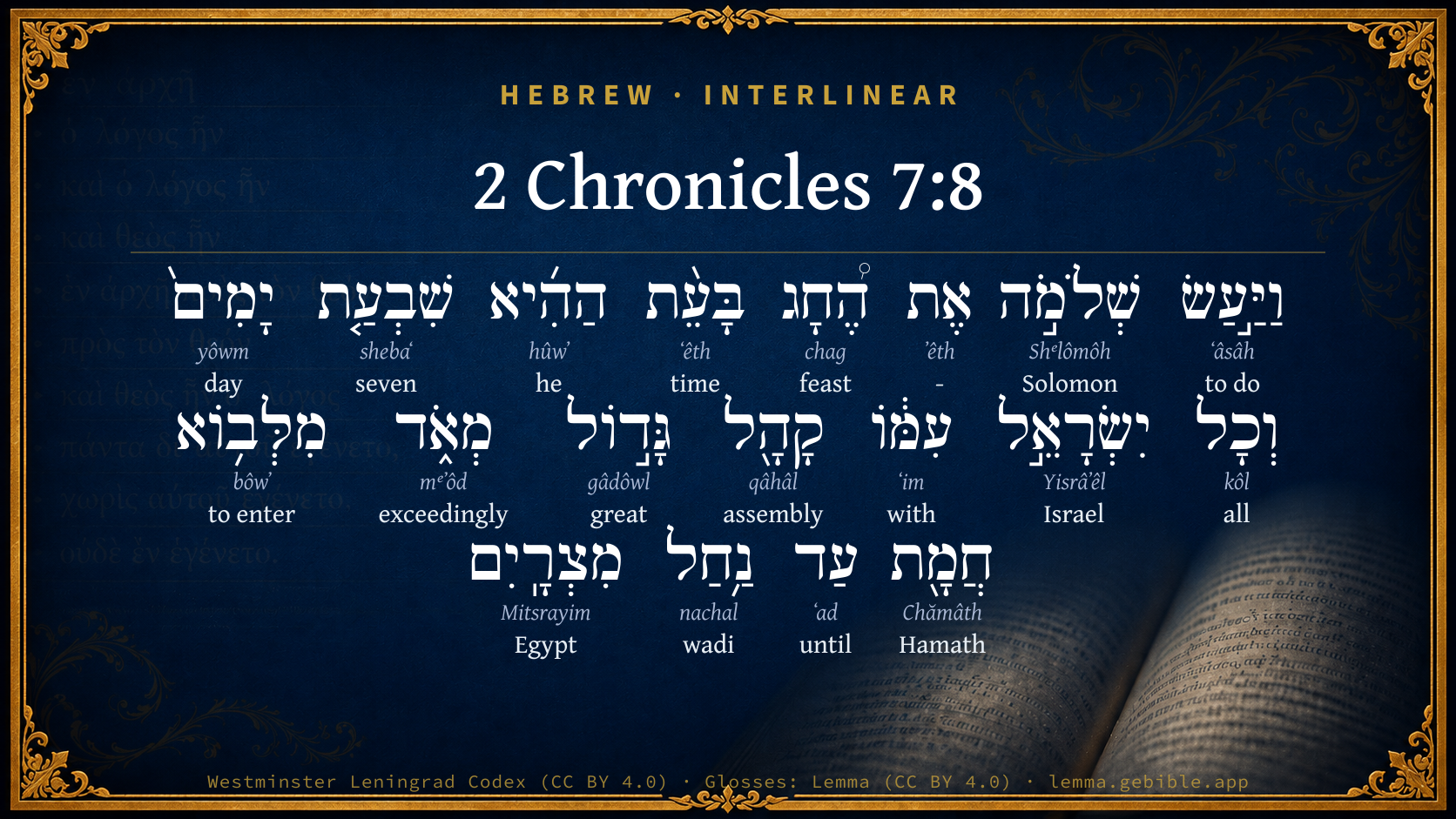
  1. וַיַּ֣עַשׂ ʻâsâh H6213 “and · to do” Conjunction + Verb, Qal, Sequential Imperfect, 3rd Person, Masculine, Singular
  2. שְׁלֹמֹ֣ה Shᵉlômôh H8010 “Solomon” Noun, Proper
  3. אֶת ʼêth H853 “-” Particle, Direct Object
  4. הֶ֠חָג chag H2282 “the · feast” Particle, Definite Article + Noun, Common, Masculine, Singular, Absolute
  5. בָּעֵ֨ת ʻêth H6256 “in/at the · time” Preposition, Determined + Noun, Common, Both, Singular, Absolute
  6. הַהִ֜יא hûwʼ H1931 “the · he” Particle, Definite Article + Pronoun, Personal, 3rd Person, Feminine, Singular
  7. שִׁבְעַ֤ת shebaʻ H7651 “seven” Adjective, Cardinal number, Masculine, Singular, Construct
  8. יָמִים֙ yôwm H3117 “days” Noun, Common, Masculine, Plural, Absolute
  9. וְכָל kôl H3605 “and · all of” Conjunction + Noun, Common, Masculine, Singular, Construct
  10. יִשְׂרָאֵ֣ל Yisrâʼêl H3478 “Israel” Noun, Proper
  11. עִמּ֔וֹ ʻim H5973 “with · him” Preposition + Suffix, Personal, 3rd Person, Masculine, Singular
  12. קָהָ֖ל qâhâl H6951 “assembly” Noun, Common, Masculine, Singular, Absolute
  13. גָּד֣וֹל gâdôwl H1419 “great” Adjective, Adjective, Masculine, Singular, Absolute
  14. מְאֹ֑ד mᵉʼôd H3966 “exceedingly” Adverb
  15. מִלְּב֥וֹא bôwʼ H935 “from · entrance” Preposition + Noun, Proper
  16. עַד ʻad H5704 “until” Preposition
  17. נַ֥חַל nachal H5158 “wadi of” Noun, Common, Masculine, Singular, Construct
  18. מִצְרָֽיִם Mitsrayim H4714 “Egypt” Noun, Proper

About this verse

These counts appear in no published source. They are computed here, from the morphology-tagged text and Lemma’s own curated glosses. What Lemma adds →

19
words
19
distinct lemmas
Historical
section

Shared distinctive vocabulary

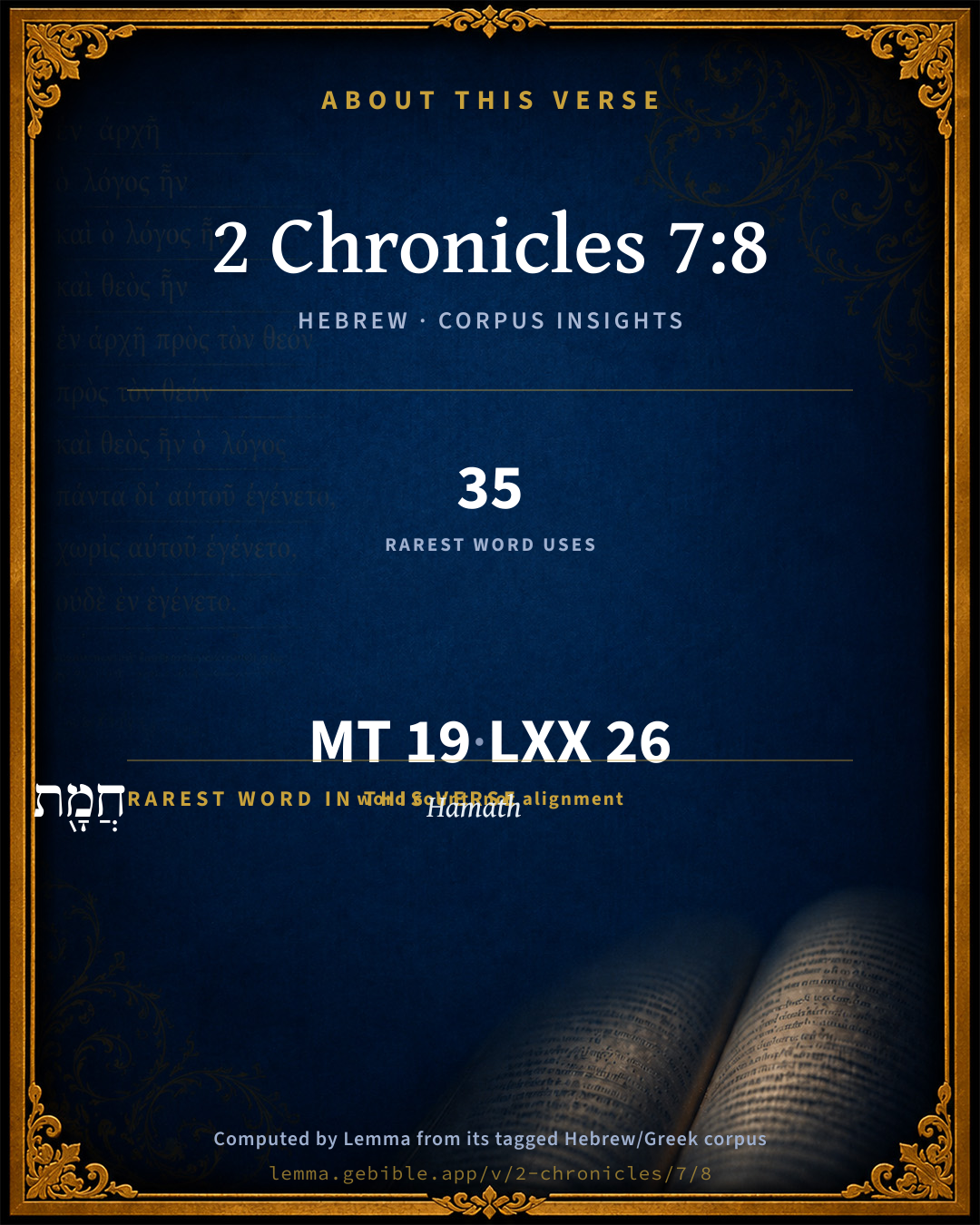
חֲמָ֖ת Hamath H2574 occurs in 33 verses of the Hebrew Bible. Also found in:

Grammatical profile

  • 1 verb
  • 11 nouns
  • 2 adjectives
  • 1 pronoun
  • 2 prepositions
  • 1 adverb
  • 1 particle

Verb forms

  • וַיַּ֣עַשׂ Qal · Sequential Imperfect

Hebrew & Septuagint length

In English translation the verse runs 29 words from the Hebrew and 33 from the Septuagint (LXX English) — closely comparable.

A rough comparison of the two English renderings, which tokenize alike — not a word-level alignment.

Word counts can differ between the Hebrew and the Greek without any difference in meaning — e.g. the Hebrew direct-object marker אֵת has no separate Greek word, and Greek often adds the article ὁ.

In the original languages it is 19 Hebrew tokens and 26 Greek tokens — but the two are counted differently (Hebrew bundles its prefixes and suffixes into one token; the Greek is in lemma form), so that isn’t a like-for-like length.

Cross-references

14

Topical passages linked to 2 Chronicles 7:8 in the Treasury of Scripture Knowledge — connected by theme and wording, ordered by reader-vote popularity; previews shown in the World English Bible.

  • Genesis 15:18 In that day Yahweh made a covenant with Abram, saying, "To your seed have I given this land, from the river of Egypt to the great river, the river Euphrates:
  • 1 Kings 8:65 So Solomon held the feast at that time, and all Israel with him, a great assembly, from the entrance of Hamath to the brook of Egypt, before Yahweh our God, seven days and seven days, even fourteen days.
  • Leviticus 23:34–43 "Speak to the children of Israel, and say, 'On the fifteenth day of this seventh month is the feast of tents for seven days to Yahweh.
  • Numbers 29:12–38 On the fifteenth day of the seventh month you shall have a holy convocation; you shall do no servile work, and you shall keep a feast to Yahweh seven days:
  • Numbers 34:5–8 and the border shall turn about from Azmon to the brook of Egypt, and the goings out of it shall be at the sea.
  • Deuteronomy 16:13–15 You shall keep the feast of tents seven days, after that you have gathered in from your threshing floor and from your winepress:
  • Joshua 13:3–5 from the Shihor, which is before Egypt, even to the border of Ekron northward, [which] is reckoned to the Canaanites; the five lords of the Philistines; the Gazites, and the Ashdodites, the Ashkelonites, the Gittites, and the Ekronites; also the Avvim,
  • 1 Kings 4:21–25 Solomon ruled over all the kingdoms from the River to the land of the Philistines, and to the border of Egypt: they brought tribute, and served Solomon all the days of his life.
  • 2 Chronicles 30:13 There assembled at Jerusalem much people to keep the feast of unleavened bread in the second month, a very great assembly.
  • Nehemiah 8:13–18 On the second day were gathered together the heads of fathers' [houses] of all the people, the priests, and the Levites, to Ezra the scribe, even to give attention to the words of the law.
  • Amos 6:14 For, behold, I will raise up against you a nation, house of Israel," Says Yahweh, the God of hosts; "And they will afflict you from the entrance of Hamath to the brook of the Arabah."
  • Zechariah 14:16–19 It will happen that everyone who is left of all the nations that came against Jerusalem will go up from year to year to worship the King, Yahweh of Hosts, and to keep the feast of tents.
  • John 7:2 Now the feast of the Jews, the Feast of Booths, was at hand.
  • John 7:27–39 However we know where this man comes from, but when the Christ comes, no one will know where he comes from."

Cross-references courtesy of OpenBible.info (CC BY 4.0).

Hebrew and Greek witnesses Masoretic Hebrew ↔ Greek Septuagint

The same verse in the two great witnesses to the Old Testament, shown verse-for-verse.

These are two independent witnesses, not word-aligned to each other, and the Septuagint is shown in lemma (dictionary) form.

Hebrew 2 Chronicles 7:8 Masoretic · Westminster Leningrad Codex

וַיַּ֣עַשׂ שְׁלֹמֹ֣ה אֶת הֶ֠חָג בָּעֵ֨ת הַהִ֜יא שִׁבְעַ֤ת יָמִים֙ וְכָל יִשְׂרָאֵ֣ל עִמּ֔וֹ קָהָ֖ל גָּד֣וֹל מְאֹ֑ד מִלְּב֥וֹא חֲמָ֖ת עַד נַ֥חַל מִצְרָֽיִם

So Solomon held the feast at that time seven days, and all Israel with him, a very great assembly, from the entrance of Hamath to the brook of Egypt.

World English Bible · Public Domain

Greek LXX 2 Chronicles 7:8 Septuagint · lemma form

καί ποιέω σαλωμών ὁ ἑορτή ἐν ὁ καιρός ἐκεῖνος ἑπτά ἡμέρα καί πᾶς ἰσραήλ μετά αὐτός ἐκκλησία μέγας σφόδρα ἀπό εἴσοδος αιμαθ καί ἕως χειμάροος αἴγυπτος

And Solomon kept the feast at that time seven days, and all Israel with him, a very great assembly, from the entering in of Aemath, and as far as the river of Egypt.

LXX2012 (modern English Septuagint) · Public Domain

On this verse, Ellicott's Commentary for English Readers discusses the Septuagint’s reading. Read the note in Commentary ↓

Hebrew: Westminster Leningrad Codex (CC BY 4.0). Greek: Septuagint (public domain); English from LXX2012 (modern English Septuagint) (Public Domain). How the Septuagint differs from the Hebrew →

Commentary

Notes on 2 Chronicles 7:8 from classic Christian and Jewish commentators (each source and its license shown beneath its notes). The classic Christian expositions comment on the surrounding passage and are grouped to its opening verse, so a note may address several verses; the Jewish commentaries on the Tanakh (Rashi and others) are per-verse, so they appear only where the commentator wrote on this verse.

Lemma curates 59 commentaries, every one of them public domain or Creative Commons licensed, each selected and text-cleaned for this edition rather than reprinted as found. About our sources →

Trapp's Complete Commentary

John Trapp

2Ch 7:8 Also at the same time Solomon kept the feast seven days, and all Israel with him, a very great congregation, from the entering in of Hamath unto the river of Egypt.

Ver. 8. Solomon kept the feast.] See 1Ki 8:65.

John Trapp, A Commentary or Exposition upon All the Books of the Old and New Testament (1647–1656) — public domain. Text from a community e-Sword module.

Tyndale Open Study Notes

Tyndale Open Resources

7:8-10 Lebo-hamath in the north and the Brook of Egypt in the south marked the boundaries of Israel as promised to the patriarchs (Gen 15:18; Num 34:5, 8; Josh 15:4). The Temple dedication festival preceded the annual Festival of Shelters, which ended on the twenty-second day of the month.

Tyndale Open Study Notes — © Tyndale Open Resources, licensed CC BY-SA 4.0. Text via the HelloAO Bible API.

Geneva Bible (1599)

Geneva Bible translators

The feast of the Tabernacles which was kept in the seventh month.

Geneva Bible (1599) marginal notes — public domain. Text via Bolls.life.

Jamieson, Fausset & Brown

Robert Jamieson, A. R. Fausset & David Brown

Solomon kept the feast seven days--The time chosen for the dedication of the temple was immediately previous to the feast of tabernacles (see on Kg1 8:1-12). That season, which came after the harvest, corresponding to our September and October, lasted seven days, and during so prolonged a festival there was time afforded for the offering of the immense sacrifices enumerated. A large proportion of these were peace offerings, which afforded to the people the means of festive enjoyment.

all Israel . . . from the entering in of Hamath--that is, the defile at Lebanon.

unto the river of Egypt--that is, Rhinocorura, now El-Arish, the south boundary of Palestine.

Jamieson, Fausset & Brown — Commentary Critical and Explanatory on the Whole Bible (1871) — public domain (CC PDM 1.0). Text via the HelloAO Bible API.

Adam Clarke's Commentary

Verse 8. The entering in of Hamath] "From the entrance of Antioch to the Nile of Egypt." - Targum.

Adam Clarke's Commentary on the Bible (1810–1826) — public domain. Text from a community e-Sword/MySword module.

Ellicott's Commentary for English Readers

(8) Also at the same time.—Literally, And Solomon made the feast at that time seven days. “The feast” was the Feast of Tabernacles. (See Lev_23:34-36.)

Seven days.—The legal time. (See Lev. 50100) The days were counted from the 15th of the seventh month. (Comp. 1Ki_8:65.)

The river.—Torrent or wady. LXX., χειμάρρους. Kings adds, “before the Lord our God.” So Syriac.

A Bible Commentary for English Readers, edited by Charles John Ellicott (1878–1897) — public domain. Text from a community e-Sword module.

The Cambridge Bible for Schools and Colleges

gen. ed. J. J. S. Perowne

8. Also at the same time Solomon kept the feast] R.V. So Solomon held the feast at that time.

from the entering in of Hamath] See note on 1Ch_13:5.

the river of Egypt] R.V. the book of Egypt, i.e. not the Nile, but the stream called Shihor of Egypt in 1Ch_13:5 (see note).

The Cambridge Bible for Schools and Colleges (gen. ed. J. J. S. Perowne; Cambridge University Press, 1878–1918) — public domain. Text from a community e-Sword module.

Albert Barnes' Notes on the Bible

Solomon kept the feast - i. e., Solomon kept at this same time, not the Feast of the Dedication only, but also the Feast of tabernacles. The former lasted seven days, from the 8th of Tisri to the 15th, the latter also seven days, from the 15th to the 22nd. On the day following the people were dismissed 2Ch 7:10.

Albert Barnes' Notes on the Bible (1834–1885) — public domain. Text from a community e-Sword/MySword module.

The Pulpit Commentary

Also at the same time the feast; i.e. the Feast of Tabernacles, which occupied the seven days from the fifteenth to the twenty-second of the month Tisri. (Lev_23:33) Thus fourteen dayswere (1Ki_8:65) occupied by the two feasts, that of the temple consecration and that of Tabernacles, while on the fifteenth day of feasting, viz. the twenty-third of the month Tisri, or Ethanim (the seventh month), the people went home. The entering in of Hamath unto the river of Egypt; i.e. from the extreme north to the extreme south of the land. The town Hamath was on the Orontes, through the valley of the Lebanon (Jos_13:3, Jos_13:5; also Num_13:21 Num_34:8; Jud_1:3:3; 2Ki_14:25; 1Ch_13:5; Amo_6:2, Amo_6:14) The river of Egypt; or, the river before Egypt, (Jos_13:3) was the Shihor, or Sihor, separating Egypt and Judaea.

Vers. 8-11.

Sunshine.

A very happy time it was when the temple was opened at Jerusalem. It may be said that the city of God and the people of God dwelt in the sunshine of his presence and his favour. It was a protracted period of sacred joy and gladdening prosperity.

I SOLEMNITIES AND FESTIVITIES ARE FITTINGLY ASSOCIATED. "At the same time" i.e. in close conjunction with the solemn rites that were observed within the temple, "Solomon kept the feast seven days, and all Israel with him." The slaying of the devoted animal on the altar and the spreading of the table for a common feast, sacrificial worship and festive delights, went hand in hand. This was quite in keeping with the provision of the Law. And it is in perfect accord with the spirit, the institutions, and the precepts of the gospel.

1. The spirit of the gospel enjoins humility before God, and then trust and joy in God.

2. The principal institution of the gospel is a common participation at a table a table at which the living, loving Host meets his friends, welcomes them with joy, and invites them to rejoice in him.

3. The precept of the gospel is, "Humble yourselves before God," and "Rejoice in the Lord alway." At our most solemn engagements and in our most sacred hours the note of holy joy should never be absent long; indeed, it should be the prevailing note in Christian service.

II SACRED JOY SHOULD BE UNSELFISH IN ITS CHARACTER. These men were glad at heart "for the goodness that the Lord had showed unto David, and to Solomon, and to Israel his people." They were filled with joy because their departed sovereign"s deepest desire was fulfilled, and because (they thought) if he were present his heart would be enlarged; they were gladdened because their present king was elated with an honourable pride and a profound satisfaction, and they made his joy their own. Moreover, their patriotism was stirred within them, and they rejoiced because they felt that their nation was now in the sunshine of the Divine favour. It is well to be able to say, "Surely goodness and mercy shall follow me ;" it is better to be able to sing, "Surely God is good to Israel. " Our piety rises to a higher altitude when concern for ourselves passes into solicitude for the welfare of our fellow-men, when gratitude for personal favours is lest in thankfulness to God for his mercy to our race.

III PIETY IS SURE TO FIND ITS WAY HOME. The people went back to "their tents" with this abounding exultation. They carried it home; they shared it with those with whom they dwelt; they communicated it to those who could not derive it from the temple-scenes themselves. This is a simple Christian obligation. All that we have from God we should carry home with us; and particularly those inspirations and exaltations which we gain in his house and from his worship we should impart to our kindred and our friends. We are closely related to one another for the express purpose that we may communicate to one another the best and highest that is within us our purest thoughts, our worthiest feelings, our highest aspirations, our most sacred joys.

IV PIETY AND PROSPERITY ARE VERY CLOSELY ALLIED. It was very right that the building of the king"s house (ver. 11) should follow the erection of the house of the Lord; it was quite natural that the one should lead to the other. We are not surprised to read that in all Solomon"s undertakings he "prospered effectively." He was living and labouring in the fear and the love of God; he was walking in the light Of God"s countenance. While the reward of piety is inward and spiritual rather than outward and material is in peace, hope, rectitude, Christ-likeness of spirit and character rather than in "riches and honour," yet is it true that "godliness has the promise of the life that now is;" it tends constantly to virtue, to prudence, to thrift, to comfort, to prosperity. C.

Vers. 8-11.

A great festival.

I THE OCCASION.

1. The dedication of the altar. Probably a part is here put for the whole. The writer means by the dedication of the altar the dedication of the whole temple. That this should have been followed by a feast was appropriate, since

(1) all labour carried to a successful termination, as the temple had been, is fitted to occasion joy; and

(2) the fact that sinful man is permitted to consecrate anything to Jehovah ought ever to excite within the heart glad emotions.

2. The Feast of Tabernacles. It would seem that the solemnities connected with the dedication were commenced seven days at least before the fifteenth of Tisri, the date of the Feast of Tabernacles, and that on the fifteenth this latter feast began, and was celebrated with unusual magnificence.

II THE GUESTS.

1. Solomon the king. So is Christ himself ever present at the banquets he provides for his people, whether on earth within the Church militant, or in heaven in the Church triumphant. With reference to the former Christ says, "I will sup with him"; (Rev_3:16) as regards the latter it is written, "The Lamb who is in the midst of the throne shall be their Shepherd"; (Rev_7:17) "I will drink it," the fruit of the vine, "new with you in my Father"s kingdom". (Mat_26:29)

2. All Israel with him, from the entering in of Hamath, the northen boundary of Palestine, to the river of Egypt, its southern limit. So will all the followers of God, the spiritual children and subjects of the heavenly King, be admitted to the banquet of salvation, both here and there with me". (Rev_3:16)

III THE DURATION. Seven days.

1. Preceded by a seven daysdedication service, during which the multitudes of victims were slain by the king and the people not by the priests, who were merely employed in sprinkling the blood upon the altar.

2. Followed by a solemn assembly on the eighth day, the last and the great day of the feast. (Joh_7:37) On the twenty-third day of the seventh month the assembly broke up, and the people returned to their homes.

IV THE GLADNESS.

1. Its character. The people"s joy was sincere, deep, and exhilarating. Not only at the termination of the festal season, but throughout its continuance, the celebrants were merry in their hearts.

2. Its cause. Different from the mirth which stirred the heart of Nabal, (1Sa_25:36) theirs proceeded from a contemplation of Jehovah"s goodness to David, who had been the originator of the temple-building scheme, to Solomon, who had carried it out, and to them who were to profit by it.

Learn:

1. That national feastings are as proper to religion as national lastings.

2. That sovereigns and their subjects should at times unite in publicexpressions of religious feeling.

3. That good rulers are often long remembered by their people.

4. That God"s goodness can be displayed to his saints long after they aredead.

5. That the greatest good a king or his people can receive from Heaven isreligion, and the means of sustaining and advancing it. W.

The Pulpit Commentary (1880–1919), ed. H.D.M. Spence-Jones & Joseph S. Exell — public domain. Text from a community e-Sword module.

unfoldingWord translationNotes

Door43 World Missions Community

all Israel with him

This generalization refers to those who were at the feast in Jerusalem, not necessarily to every person who lived in Israel. (See: Hyperbole and Generalization)

from Lebo Hamath to the brook of Egypt

Lebo Hamath was north of Israel, and the brook of Egypt was south of Israel. These are used together to emphasize that people from every part of Israel were at the festival. AT: "from Lebo Hamath in the north to the brook of Egypt in the south" (See: Assumed Knowledge and Implicit Information and Merism and How to Translate Names)

the eighth day

The word "eighth" is the ordinal form of "8." (See: Ordinal Numbers)

a solemn assembly

This was a special religious gathering.

they kept the dedication of the altar

Here "kept the dedication" is an idiom meaning "celebrated the dedication." (See: Idiom)

the twenty-third day of the seventh month

This is the seventh month of the Hebrew calendar. The twenty-third day is near the middle of October on Western calendars. (See: Hebrew Months and Ordinal Numbers)

with glad and joyful hearts

The words "glad" and "joyful" mean basically the same thing. Together they emphasize the intensity of joy. AT: "with very glad hearts" or "and they were very joyful" (See: Doublet)

because of the goodness that Yahweh had shown

"because Yahweh had shown wonderful goodness" or "because Yahweh had been so good"

Israel, his people

"Israel, God's people." The phrase "his people" emphasizes God's faithfulness to Israel. (See: Distinguishing versus Informing or Reminding)

translationWords

festival

Israel

assembly

Hamath

Egypt

altar

feast

good

David

Solomon

unfoldingWord translationNotes — © Distant Shores Media and the Door43 World Missions Community, licensed CC BY-SA 4.0. Source: git.door43.org/Door43/en_tn.

Rashi

Rabbi Shlomo Yitzchaki (Rashi)

from the entrance of Hamath which is in the north of the land of Israel.

to the brook of Egypt which is opposite it, as is delineated in אֵלֶּה מַסְעֵי (ibid. verse 5).

Rashi on the Tanakh — English translations: “The Judaica Press complete Tanach with Rashi, translated by A. J. Rosenberg” (CC BY 4.0); “Pentateuch with Rashi's commentary by M. Rosenbaum and A.M. Silbermann, 1929-1934” (public domain); “The Metsudah Tanach series, Lakewood, N.J” (CC BY 4.0); and “The Book of Joshua, Metsudah Publications, 1997” (CC BY 4.0). Text via Sefaria.

Lesson kit

Teaching starters — assembled from the data on this page, not authored interpretation. Every prompt links to the verse data it draws on. Edit before teaching.

2 Chronicles, in the Historical, opens this verse with 19 words (19 distinct Hebrew lemmas). Its most distinctive word is Chămâth (“Hamath”). A historical commentator’s framing appears above. Read the whole chapter for the surrounding context.

Discussion questions

  1. The word Chămâth carries the sense “Hamath.” How does it shape the verse?
  2. How does Numbers 13:21, which shares the word «Hamath», read alongside this verse?
  3. These translations render this verse differently; the difference is in the English rendering, not the original. What questions does that raise?
  4. «וַיַּ֣עַשׂ» is a Qal Sequential Imperfect verb. How does that grammatical form shape the action described?
  5. Compare how Trapp's Complete Commentary and Tyndale Open Study Notes read this verse. Where do they agree or differ?

Things to notice

Reading settings

Reading text

Shown beneath each verse's original-language words.

Old Testament
Old Testament edition

Read the OT as the Masoretic Hebrew (MT) or the Greek Septuagint (LXX).

English shown for the Greek Septuagint (in the Hebrew ↔ Greek comparison).

Comparing translations? Open the Compare panel on any verse page to stack up to four side by side.