
1 Kings 20:6

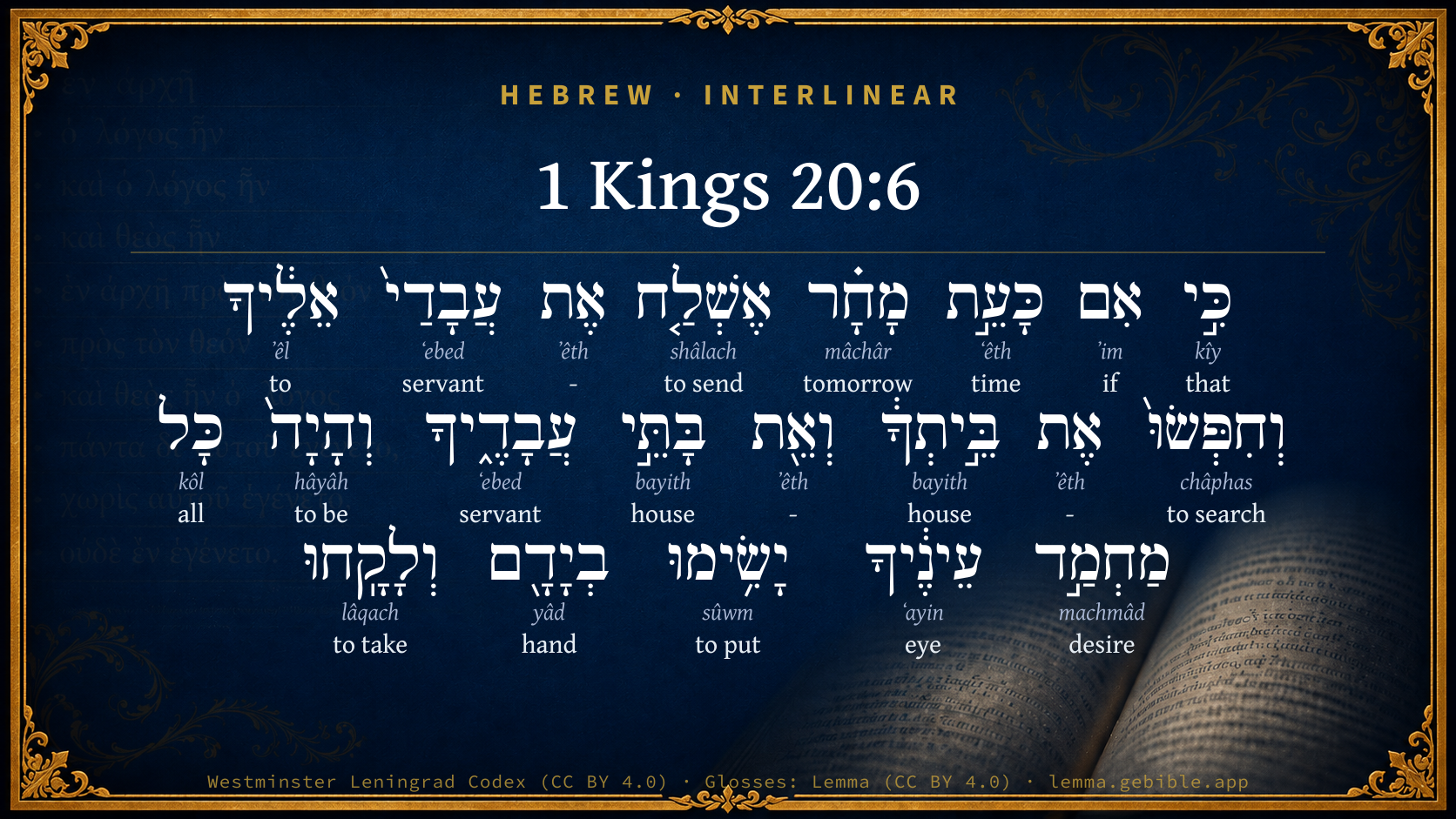
Hebrew (Westminster Leningrad Codex) 1 Kings 20:6 appears in the Hebrew Old Testament. The text above is from the Westminster Leningrad Codex. Each word links to its Strong’s number, a concise gloss, and parsing drawn from the Open Scriptures Hebrew Bible morphology. Click any word for its full Brown-Driver-Briggs (BDB) entry.
Download image
Cite this verse

1 Kings 20:6 (World English Bible). Public Domain. Lemma interlinear Bible study tool, https://lemma.gebible.app/v/1-kings/20/6.

Show BibTeX & RIS
BibTeX
RIS
English Translation
but I will send my servants to you tomorrow about this time, and they shall search your house, and the houses of your servants; and it shall be, that whatever is pleasant in your eyes, they shall put it in their hand, and take it away.
World English Bible · Public Domain
Highlights
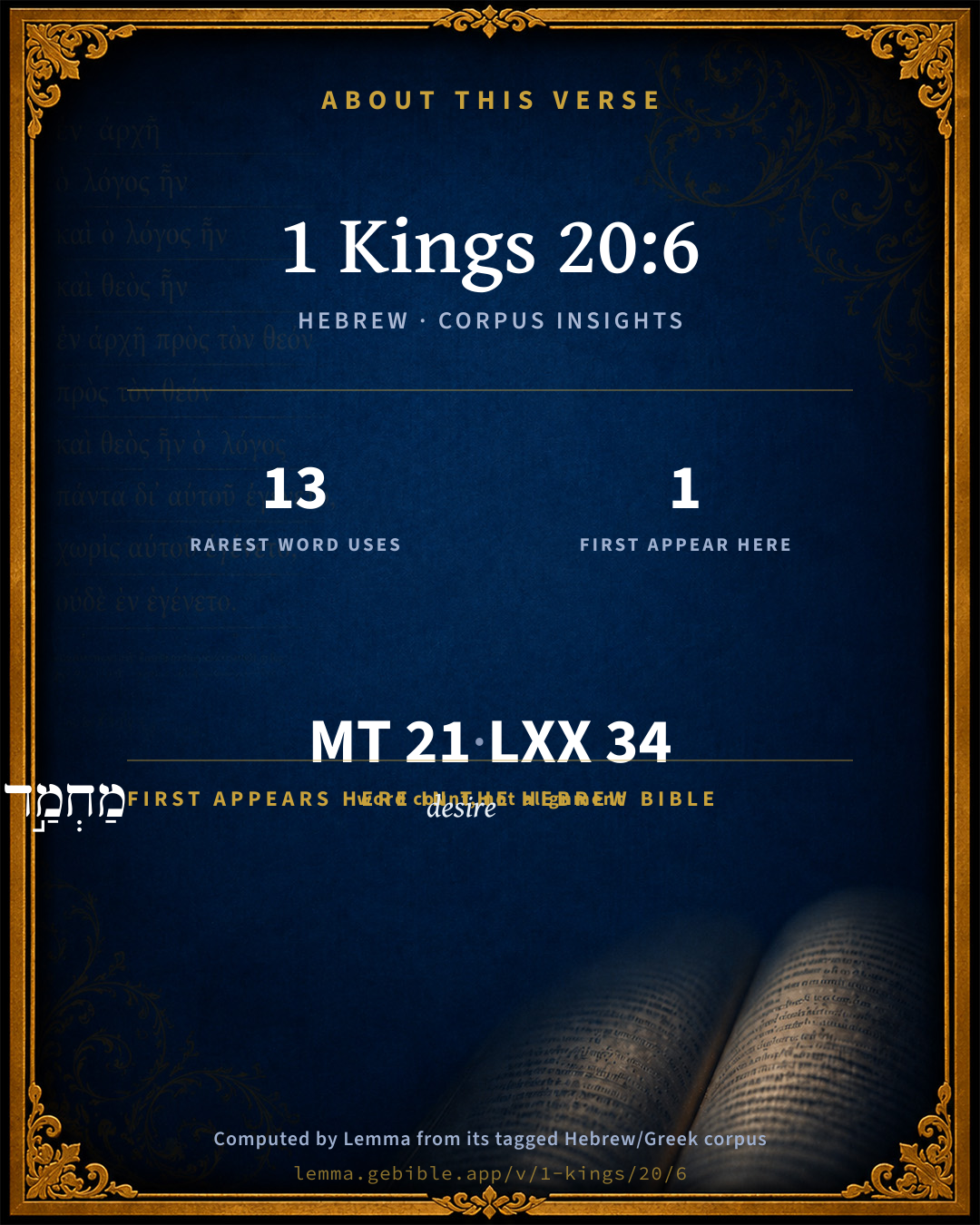
  • 1 first appearance in the Hebrew Bible
Full analysis ↓
Download a study sheet

One document with this verse’s original text, its word-by-word gloss line, the meaning frame, cross-references with their text, attributed commentary, and full source and license credits — printable, and it pastes into notes with its structure intact.

This verse Autodidact and up

Study sheet (.html) Plain text (.txt)

A passage Seminary Student

Up to 50 verses in one chapter. A passage sheet keeps up to 6 commentary sources and 12 cross-references per verse, in the order this page ranks them, and says so on the sheet whenever that leaves anything out. Ask for a single verse and you get the Autodidact verse sheet above.

Everything on this page stays free to read, with no account — the sheet is a download of what is already on screen, not access to it.

Want to remove ads? Support Godless Engineer
Compare translations 3

The same verse in 3 English versions, stacked beneath the original-language interlinear above. Click any original word for its lexicon entry.

Each is an independent rendering of the whole verse — the interlinear is not word-aligned to these translations.

Highlighted words mark where these versions differ — a whole-verse word diff, not a word-by-word alignment.

  • World English Bible Public Domain
    but I will send my servants to you tomorrow about this time, and they shall search your house, and the houses of your servants; and it shall be, that whatever is pleasant in your eyes, they shall put it in their hand, and take it away.
  • King James Version Public Domain
    Yet I will send my servants unto thee to morrow about this time, and they shall search thine house, and the houses of thy servants; and it shall be, that whatsoever is pleasant in thine eyes, they shall put it in their hand, and take it away.
  • unfoldingWord Literal Text CC BY-SA 4.0
    but rather, around time tomorrow I will send my servants to you, and they will search your house and the houses of your servants. And it will happen, every desire of your eyes, they will put in their hand and take away.’”

unfoldingWord Literal Text — © unfoldingWord, licensed CC BY-SA 4.0. Word-aligned USFM3 via Door43 (git.door43.org/unfoldingWord/en_ult).

Versions to compare (up to 4)

3 of 4 selected

Show all 18 translations

Every available English version of this verse, each an independent rendering of the whole verse.

  • World English Bible Public Domain
    but I will send my servants to you tomorrow about this time, and they shall search your house, and the houses of your servants; and it shall be, that whatever is pleasant in your eyes, they shall put it in their hand, and take it away.
  • Berean Standard Bible Public Domain
    But about this time tomorrow I will send my servants to search your palace and the houses of your servants. They will seize and carry away all that is precious to you.’”
  • Majority Standard Bible Public Domain
    But about this time tomorrow I will send my servants to search your palace and the houses of your servants. They will seize and carry away all that is precious to you.’”
  • King James Version Public Domain
    Yet I will send my servants unto thee to morrow about this time, and they shall search thine house, and the houses of thy servants; and it shall be, that whatsoever is pleasant in thine eyes, they shall put it in their hand, and take it away.
  • American Standard Version (1901) Public Domain
    but I will send my servants unto thee to-morrow about this time, and they shall search thy house, and the houses of thy servants; and it shall be, that whatsoever is pleasant in thine eyes, they shall put it in their hand, and take it away.
  • Revised Version (1885) Public Domain
    but I will send my servants unto thee tomorrow about this time, and they shall search thine house, and the houses of thy servants; and it shall be, that whatsoever is pleasant in thine eyes, they shall put it in their hand, and take it away.
  • Geneva Bible (1599) Public Domain
    Or els I will sende my seruants vnto thee by to morow this time: and they shall search thine house, and the houses of thy seruants: and whatsoeuer is pleasant in thine eyes, they shall take it in their handes, and bring it away.
  • Douay-Rheims (1899) Public Domain
    To morrow therefore at this same hour I will send my servants to thee, and they shall search thy house, and the houses of thy servants: and all that pleaseth them, they shall put in their hands, and take away.
  • Young's Literal Translation Public Domain
    for if, at this time to-morrow, I send my servants unto thee then they have searched thy house, and the houses of thy servants, and it hath been, every desirable thing of thine eyes they place in their hand, and have taken away.'
  • Literal Standard Version CC BY-SA 4.0
    for if, at this time tomorrow, I send my servants to you, then they have searched your house, and the houses of your servants, and it has been [that] every desirable thing of your eyes they place in their hand, and have taken [them] away.”
  • Unlocked Literal Bible CC BY-SA 4.0
    But I will send my servants to you tomorrow about this time, and they will search your house and your servants' houses. They will seize with their own hands and take away whatever pleases their eyes.'”
  • unfoldingWord Literal Text CC BY-SA 4.0
    but rather, around time tomorrow I will send my servants to you, and they will search your house and the houses of your servants. And it will happen, every desire of your eyes, they will put in their hand and take away.’”
  • Darby Bible Public Domain
    but to-morrow about this time I will send my servants to thee, and they shall search thy house, and the houses of thy servants; and it shall be, that whatsoever is pleasant in thy sight, they shall put in their hand and take away.
  • World Messianic Bible Public Domain
    but I will send my servants to you tomorrow about this time, and they will search your house and the houses of your servants. Whatever is pleasant in your eyes, they will put it in their hand, and take it away.”’”
  • Webster's Bible Public Domain
    Yet I will send my servants to thee to-morrow about this time, and they shall search thy house, and the houses of thy servants; and it shall be, that whatever is pleasant in thy eyes, they shall take it in their hand, and carry it away.
  • Free Bible Version CC BY-SA 4.0
    But around this time tomorrow I'm going to send my men to search your palace and the homes of your officials. They will take and carry away everything you see as valuable.”
  • Bible in Basic English Public Domain
    But I will send my servants to you tomorrow about this time, to make a search through your house and the houses of your people, and everything which is pleasing in your eyes they will take away in their hands.
  • JPS Tanakh (1917) Public Domain
    but I will send my servants unto thee tomorrow about this time, and they shall search thy house, and the houses of thy servants; and it shall be, that whatsoever is pleasant in thine eyes, they shall put it in their hand, and take it away.'

Literal Standard Version (2020), Covenant Press — licensed CC BY-SA 4.0. Text via the HelloAO Bible API (eBible.org). Unlocked Literal Bible (unfoldingWord) — licensed CC BY-SA 4.0. Text via the HelloAO Bible API (eBible.org). unfoldingWord Literal Text — © unfoldingWord, licensed CC BY-SA 4.0. Word-aligned USFM3 via Door43 (git.door43.org/unfoldingWord/en_ult). Free Bible Version, Dr. Jonathan Gallagher — licensed CC BY-SA 4.0. Text via the HelloAO Bible API (eBible.org).

Word by word

More ways to search: Search by grammar → Find every occurrence → Compare this word →

Practice this passage: Drill this verse → Learn its vocabulary →

מַחְמַ֣ד
machmâd
H4261
“desire of”
Noun, Common, Masculine, Singular, Construct
Part of Speech
Noun
Type
Common
Gender
Masculine
Number
Singular
State
Construct
Full BDB Definition

Origin: from H2530

TWOT: 673d , 673e

desire, desirable thing, pleasant thing
  1. כִּ֣י kîy H3588 “that” Conjunction
  2. אִם ʼim H518 “if” Conjunction
  3. כָּעֵ֣ת ʻêth H6256 “like/as the · time” Preposition, Determined + Noun, Common, Both, Singular, Absolute
  4. מָחָ֗ר mâchâr H4279 “tomorrow” Noun, Common, Masculine, Singular, Absolute
  5. אֶשְׁלַ֤ח shâlach H7971 “to send” Verb, Qal, Imperfect, 1st Person, Common, Singular
  6. אֶת ʼêth H853 “-” Particle, Direct Object
  7. עֲבָדַי֙ ʻebed H5650 “servants · my” Noun, Common, Masculine, Plural, Construct + Suffix, Personal, 1st Person, Common, Singular
  8. אֵלֶ֔יךָ ʼêl H413 “to · you” Preposition + Suffix, Personal, 2nd Person, Masculine, Singular
  9. וְחִפְּשׂוּ֙ châphas H2664 “and · to search” Conjunction + Verb, Piel, Perfect, 3rd Person, Common, Plural
  10. אֶת ʼêth H853 “-” Particle, Direct Object
  11. בֵּ֣יתְךָ֔ bayith H1004 “house · your” Noun, Common, Masculine, Singular, Construct + Suffix, Personal, 2nd Person, Masculine, Singular
  12. וְאֵ֖ת ʼêth H853 “and · -” Conjunction + Particle, Direct Object
  13. בָּתֵּ֣י bayith H1004 “houses of” Noun, Common, Masculine, Plural, Construct
  14. עֲבָדֶ֑יךָ ʻebed H5650 “servants · your” Noun, Common, Masculine, Plural, Construct + Suffix, Personal, 2nd Person, Masculine, Singular
  15. וְהָיָה֙ hâyâh H1961 “and · to be” Conjunction + Verb, Qal, Perfect, 3rd Person, Masculine, Singular
  16. כָּל kôl H3605 “all of” Noun, Common, Masculine, Singular, Construct
  17. עֵינֶ֔יךָ ʻayin H5869 “eyes · your” Noun, Common, Both, Dual, Construct + Suffix, Personal, 2nd Person, Masculine, Singular
  18. יָשִׂ֥ימוּ sûwm H7760 “to put” Verb, Qal, Imperfect, 3rd Person, Masculine, Plural
  19. בְיָדָ֖ם yâd H3027 “in/at · hand · their” Preposition + Noun, Common, Both, Singular, Construct + Suffix, Personal, 3rd Person, Masculine, Plural
  20. וְלָקָֽחוּ lâqach H3947 “and · to take” Conjunction + Verb, Qal, Perfect, 3rd Person, Common, Plural

About this verse

These counts appear in no published source. They are computed here, from the morphology-tagged text and Lemma’s own curated glosses. What Lemma adds →

21
words
17
distinct lemmas
Historical
section

Notable vocabulary

The rarest word here is מַחְמַ֣ד desire H4261 — appearing just 13 times in the whole Hebrew Bible.

First appearance in Scripture

This word makes its first canonical appearance in the Hebrew Bible here:

  • מַחְמַ֣ד desire H4261

Shared distinctive vocabulary

מַחְמַ֣ד desire H4261 occurs in 13 verses of the Hebrew Bible. Also found in:

Grammatical profile

  • 5 verbs
  • 10 nouns
  • 1 preposition
  • 2 conjunctions
  • 3 particles

Verb forms

  • אֶשְׁלַ֤ח Qal · Imperfect
  • וְחִפְּשׂוּ֙ Piel · Perfect
  • וְהָיָה֙ Qal · Perfect
  • יָשִׂ֥ימוּ Qal · Imperfect
  • וְלָקָֽחוּ Qal · Perfect

Repetition

Words recur within this verse — often emphatic in Hebrew:

  • עֲבָדַי֙ servant H5650 ×2
  • בֵּ֣יתְךָ֔ house H1004 ×2

Hebrew & Septuagint length

In English translation the verse runs 46 words from the Hebrew and 44 from the Septuagint (LXX English) — closely comparable.

A rough comparison of the two English renderings, which tokenize alike — not a word-level alignment.

Word counts can differ between the Hebrew and the Greek without any difference in meaning — e.g. the Hebrew direct-object marker אֵת has no separate Greek word, and Greek often adds the article ὁ.

In the original languages it is 21 Hebrew tokens and 34 Greek tokens — but the two are counted differently (Hebrew bundles its prefixes and suffixes into one token; the Greek is in lemma form), so that isn’t a like-for-like length.

Cross-references

11

Topical passages linked to 1 Kings 20:6 in the Treasury of Scripture Knowledge — connected by theme and wording, ordered by reader-vote popularity; previews shown in the World English Bible.

  • Genesis 27:15 Rebekah took the good clothes of Esau, her elder son, which were with her in the house, and put them on Jacob, her younger son.
  • 1 Samuel 13:19–21 Now there was no smith found throughout all the land of Israel; for the Philistines said, Lest the Hebrews make them swords or spears:
  • 2 Samuel 24:14 David said to Gad, I am in a great strait: let us fall now into the hand of Yahweh; for his mercies are great; and let me not fall into the hand of man.
  • 2 Kings 18:31–32 Don't listen to Hezekiah: for thus says the king of Assyria, Make your peace with me, and come out to me; and eat you everyone of his vine, and everyone of his fig tree, and everyone drink the waters of his own cistern;
  • Ezra 8:27 and twenty bowls of gold, of one thousand darics; and two vessels of fine bright brass, precious as gold.
  • Isaiah 44:9 Those who fashion an engraved image are all of them vanity; and the things that they delight in shall not profit; and their own witnesses don't see, nor know: that they may be disappointed.
  • Jeremiah 25:34 Wail, you shepherds, and cry; and wallow [in ashes], you principal of the flock; for the days of your slaughter and of your dispersions are fully come, and you shall fall like a goodly vessel.
  • Lamentations 1:7 Jerusalem remembers in the days of her affliction and of her miseries all her pleasant things that were from the days of old: When her people fell into the hand of the adversary, and none did help her, The adversaries saw her, they did mock at her desolations.
  • Lamentations 1:10 The adversary has spread out his hand on all her pleasant things: For she has seen that the nations are entered into her sanctuary, Concerning whom you did command that they should not enter into your assembly.
  • Hosea 13:15 Though he is fruitful among his brothers, an east wind will come, The breath of Yahweh coming up from the wilderness; And his spring will become dry, And his fountain will be dried up. He will plunder the storehouse of treasure.
  • Joel 3:5 Because you have taken my silver and my gold, And have carried my finest treasures into your temples,

Cross-references courtesy of OpenBible.info (CC BY 4.0).

Hebrew and Greek witnesses Masoretic Hebrew ↔ Greek Septuagint

The same verse in the two great witnesses to the Old Testament, shown verse-for-verse.

These are two independent witnesses, not word-aligned to each other, and the Septuagint is shown in lemma (dictionary) form.

Hebrew 1 Kings 20:6 Masoretic · Westminster Leningrad Codex

כִּ֣י אִם כָּעֵ֣ת מָחָ֗ר אֶשְׁלַ֤ח אֶת עֲבָדַי֙ אֵלֶ֔יךָ וְחִפְּשׂוּ֙ אֶת בֵּ֣יתְךָ֔ וְאֵ֖ת בָּתֵּ֣י עֲבָדֶ֑יךָ וְהָיָה֙ כָּל מַחְמַ֣ד עֵינֶ֔יךָ יָשִׂ֥ימוּ בְיָדָ֖ם וְלָקָֽחוּ

but I will send my servants to you tomorrow about this time, and they shall search your house, and the houses of your servants; and it shall be, that whatever is pleasant in your eyes, they shall put it in their hand, and take it away.

World English Bible · Public Domain

Greek LXX 1 Kings 20:6 Septuagint · lemma form

καί εἶπον πρός αὐτός ὅτι λαλέω πρός ναβουθαι ὁ ιεζραηλίτης λέγω δίδωμι ἐγώ ὁ ἀμπελών σύ ἀργύριον εἰ δέ βούλομαι δίδωμι σύ ἀμπελών ἄλλος ἀντί αὐτός καί εἶπον οὐ δίδωμι σύ κληρονομία πατήρ ἐγώ

And he said to her, Because I spoke to Nabuthai the Jezraelite, saying, Give me your vineyard for money; or if you will, I will give you another vineyard for it: and he said, I will not give you the inheritance of my fathers.

LXX2012 (modern English Septuagint) · Public Domain

On this verse, The Pulpit Commentary discusses the Septuagint’s reading. Read the note in Commentary ↓

Hebrew: Westminster Leningrad Codex (CC BY 4.0). Greek: Septuagint (public domain); English from LXX2012 (modern English Septuagint) (Public Domain). How the Septuagint differs from the Hebrew →

Targum (Aramaic paraphrase)

1

The Targum is the ancient Jewish Aramaic paraphrase of the Hebrew Scriptures — an interpretive translation, not the Hebrew text itself. Onkelos (literal) and Pseudo-Jonathan (expansive) render the Torah, and Jonathan the Prophets. Coverage is partial: where no permissively-licensed English translation exists for a verse, only the Aramaic is shown. This is verse-level text, not a word-by-word alignment to the Hebrew.

  1. Targum Jonathan Prophets (Joshua–Malachi)
    אֱלָהִין כְּעִדָנָא הָדֵין מְחַר אֶשְׁלַח יַת עַבְדַי לְוָתָךְ וְיִבְלְשׁוּן יַת בֵּיתָךְ וְיַת בָּתֵּי עַבְדָךְ וִיהֵי כָּל רִגְגָא בְּעֵינָךְ יְשַׁווּן בִּידֵיהוֹן וְיִסְבוּן:

    (no public-domain English translation for this verse)

    Targum Jonathan — Aramaic: “Mikraot Gedolot” (public domain). English: “Sefaria Community Translation” (CC0 1.0 (public-domain dedication)); “London "Chaldee Paraphrase," 1871” (public domain). Text via Sefaria.

Commentary

Notes on 1 Kings 20:6 from classic Christian and Jewish commentators (each source and its license shown beneath its notes). The classic Christian expositions comment on the surrounding passage and are grouped to its opening verse, so a note may address several verses; the Jewish commentaries on the Tanakh (Rashi and others) are per-verse, so they appear only where the commentator wrote on this verse.

Lemma curates 59 commentaries, every one of them public domain or Creative Commons licensed, each selected and text-cleaned for this edition rather than reprinted as found. About our sources →

Trapp's Complete Commentary

John Trapp

1Ki 20:6 Yet I will send my servants unto thee to morrow about this time, and they shall search thine house, and the houses of thy servants; and it shall be, [that] whatsoever is pleasant in thine eyes, they shall put [it] in their hand, and take [it] away.

Ver. 6. Whatsoever is pleasant in thine eyes.] Ahab, as bad as he was, had a name among these Syrians for a merciful man; {1Ki 20:31} this is now not respected, because he is at such an under. How much better Mithridates, king of Pontus, of whom it is said that he hated such as trampled upon virtue forsaken of fortune.

John Trapp, A Commentary or Exposition upon All the Books of the Old and New Testament (1647–1656) — public domain. Text from a community e-Sword module.

Geneva Bible (1599)

Geneva Bible translators

He would not accept his answer except he did out of hand deliver whatsoever he should ask, for he sought an occasion how to make war against him.

Geneva Bible (1599) marginal notes — public domain. Text via Bolls.life.

Adam Clarke's Commentary

Verse 6. Whatsoever is pleasant in thine eyes] It is not easy to discern in what this second requisition differed from the first; for surely his silver, gold, wives, and children, were among his most pleasant or desirable things. Jarchi supposes that it was the book of the law of the Lord which Ben-hadad meant, and of which he intended to deprive Israel. It is however evident that Ben-hadad meant to sack the whole city, and after having taken the royal treasures and the wives and children of the king, to deliver up the whole to be pillaged by his soldiers.

Adam Clarke's Commentary on the Bible (1810–1826) — public domain. Text from a community e-Sword/MySword module.

Ellicott's Commentary for English Readers

(6) Whatsoever is pleasant.—The demand, which is virtually for the plunder of Samaria, probably neither expects nor desires acceptance, and is therefore a refusal of all but unconditional surrender. It is notable that in the last extremity Ahab falls back on an exceptional appeal to the patriotism of the people.

The “elders of the land” (evidently present in Samaria at this time) were the representatives in the northern kingdom of the ancient assembly of the “elders of Israel,” existing from the time of Moses downwards as a senate, having power not only of advice, but of concurrence, in relation to the Judge or King. (See Exo_3:16; Exo_12:21; Exo_24:1; Deu_27:1; Deu_31:9; Jos_7:6; 2Sa_5:3; 1Ki_8:3). The solemn appointment of the seventy in Num_11:24-25 seems to be simply the re-constitution and consecration of the original body. Each tribe and each town had also its lesser body of elders. (See 1Sa_30:26, “the elders of Judah;” Deu_19:12; Deu_21:3, &c., “the elders of the city.”) The authority of all these assemblies must have been at all times largely overborne by the royal power (see 1Ki_21:11), and must have varied according to time and circumstance.

A Bible Commentary for English Readers, edited by Charles John Ellicott (1878–1897) — public domain. Text from a community e-Sword module.

The Cambridge Bible for Schools and Colleges

gen. ed. J. J. S. Perowne

6. to-morrow about this time] The imperious victor (as he thought himself) would suffer no delay. His orders were to be carried out at once.

The Cambridge Bible for Schools and Colleges (gen. ed. J. J. S. Perowne; Cambridge University Press, 1878–1918) — public domain. Text from a community e-Sword module.

John Gill's Exposition

Yet I will send my servants unto thee tomorrow about this time,.... He gave him twenty four hours to consider of it:

and they shall search thine house, and the houses of thy servants; the royal palace, and the houses of the noblemen, and even of every of his subjects in Samaria:

and it shall be, that whatsoever is pleasant (or desirable) in thine eyes, they shall put it in, their hand, and take it away; not be content with what should be given, but search for more; and if any in particular was more desirable to the possessor than anything else, that should be sure to be taken away; which was vastly insolent and aggravating.

John Gill's Exposition of the Whole Bible (1746–1763) — public domain (CC PDM 1.0). Text via the HelloAO Bible API.

Albert Barnes' Notes on the Bible

Ben-hadad, disappointed by Ahab’s consent to an indignity which he had thought no monarch could submit to, proceeds to put a fresh construction on his former demands.

Albert Barnes' Notes on the Bible (1834–1885) — public domain. Text from a community e-Sword/MySword module.

Haydock's Catholic Bible Commentary

Servants, or subjects. The king of Israel has thus a plea to interest all his people, as the danger was common. (Salien) --- He assumes the character of disinterestedness, as if he had been willing to abandon all his private property; knowing that Banadad would not accede even to that hard proposal. (Haydock) --- Thus "Nero consulted the first men of the city, whether they would prefer a doubtful war or a disgraceful peace." (Tacitus, An. xv.)

George Leo Haydock (1774–1849), Haydock's Catholic Family Bible and Commentary, 1859 edition — public domain. Excludes Psalms (Douay-Rheims chapter numbering differs from Protestant) and Deuterocanonical books (Catholic canon only).

Matthew Poole's English Annotations

Yet now I will not accept of those terms, but, together with thy royal treasures, I expect all the treasures of thy servants or subjects; nor will I wait till thou deliver them to me, but I will send my servants into the city, and they shall have free liberty and power to search out and take away all which they desire, and this to prevent fraud and delay; and then I will grant thee a peace.

Matthew Poole's English Annotations on the Holy Bible (1683–1685) — public domain. Text from a community e-Sword/MySword module.

Whedon's Commentary on the Bible

Daniel D. Whedon

6. I will send my servants — To this humiliation Ahab will not submit. He will allow no searching of his palace and his city by foreign emissaries, and no violent seizure of any of his goods, for this would be the same as to let the enemy come in and freely plunder all Samaria.

Daniel D. Whedon (gen. ed.), Commentary on the Old and New Testaments (1874–1909) — public domain. Text from a community e-Sword module.

The Pulpit Commentary

Yet I will send my servants unto thee tomorrow about this time This proposal was definite and immediate, the first demand was vague and general. "In the first Ahab was to send what he thought fit to give; in the second, Ben-hadad"s servants were to take into their own hands whatsoever they thought fit to sieze" (Wordsworth), and they shall search thine house, and the houses of thy servants; and it shall be, that whatsoever is pleasant in Heb. the desire of thine eyes The LXX and some other versions have a plural suffix their eyes. But the Hebrew text is to be preferred. The object of Ben-hadad was to couch his message in the most oftensive and humiliating terms, and "the desire of thine eyes" would be likely to cut deeper and wound more than "the desire of their eyes", they shall put it in their hand, and take it away. If Ahab ever hoped by his abject submission to conciliate the Syrian king, he now finds that his words have had just the opposite effect. For all that the latter concluded from it was that Ahab was one upon whom he might trample at pleasure, and this servility encouraged Ben-hadad to renew his demands in a still more galling and vexatious form. This second message discloses to us still more plainly the royal bully and braggart, and shows us what the "comity of nations" in the old world was often like.

The Pulpit Commentary (1880–1919), ed. H.D.M. Spence-Jones & Joseph S. Exell — public domain. Text from a community e-Sword module.

John Wesley's Explanatory Notes

Yet, &c. - Yet now I will not accept of those terms, but together with thy royal treasures, I expect all the treasures of thy servants or subjects; nor will I wait 'till thou deliver them to me, but I will send my servants into the city, and they shall search out and take away all thou art fond of, and this to prevent fraud and delay; and then I will grant thee a peace.

John Wesley, Explanatory Notes Upon the Whole Bible (1754–1765) — public domain. Text via the GEBible commentary corpus.

Rashi

Rabbi Shlomo Yitzchaki (Rashi)

Everything you cherish they will put in their hands and take. Were not the first [things] cherished things? What, then, is the meaning of “[everything] you cherish”? [This means] a treasure within a treasure, referring to the Torah Scroll, about which it is stated, “more desirable than gold, even more than quantities of fine gold.” Achov said to himself, “He demands a great thing, but this is not mine alone; it belongs to the elders of Yisroel.” Therefore, he “called all the elders of the land,” for even though they worshiped idols, they honored the Torah. with which the Torah is written.

Rashi on the Tanakh — English translations: “The Judaica Press complete Tanach with Rashi, translated by A. J. Rosenberg” (CC BY 4.0); “Pentateuch with Rashi's commentary by M. Rosenbaum and A.M. Silbermann, 1929-1934” (public domain); “The Metsudah Tanach series, Lakewood, N.J” (CC BY 4.0); and “The Book of Joshua, Metsudah Publications, 1997” (CC BY 4.0). Text via Sefaria.

Lesson kit

Teaching starters — assembled from the data on this page, not authored interpretation. Every prompt links to the verse data it draws on. Edit before teaching.

1 Kings, in the Historical, opens this verse with 21 words (17 distinct Hebrew lemmas). Its most distinctive word is machmâd (“desire”). A historical commentator’s framing appears above. Read the whole chapter for the surrounding context.

Discussion questions

  1. How does “desire” (machmâd) shape what this verse is saying?
  2. This is the first place “desire” appears in Scripture (first appears here). What does its debut here establish?
  3. How does 2 Chronicles 36:19, which shares the word «desire», read alongside this verse?
  4. What does the repetition of “servant” (2× in this one verse) do in this verse?
  5. These translations render this verse differently; the difference is in the English rendering, not the original. What questions does that raise?
  6. «אֶשְׁלַ֤ח» is a Qal Imperfect verb. How does that grammatical form shape the action described?
  7. Compare how Trapp's Complete Commentary and Geneva Bible (1599) read this verse. Where do they agree or differ?

Things to notice

Reading settings

Reading text

Shown beneath each verse's original-language words.

Old Testament
Old Testament edition

Read the OT as the Masoretic Hebrew (MT) or the Greek Septuagint (LXX).

English shown for the Greek Septuagint (in the Hebrew ↔ Greek comparison).

Comparing translations? Open the Compare panel on any verse page to stack up to four side by side.