Jeremiah 2:17

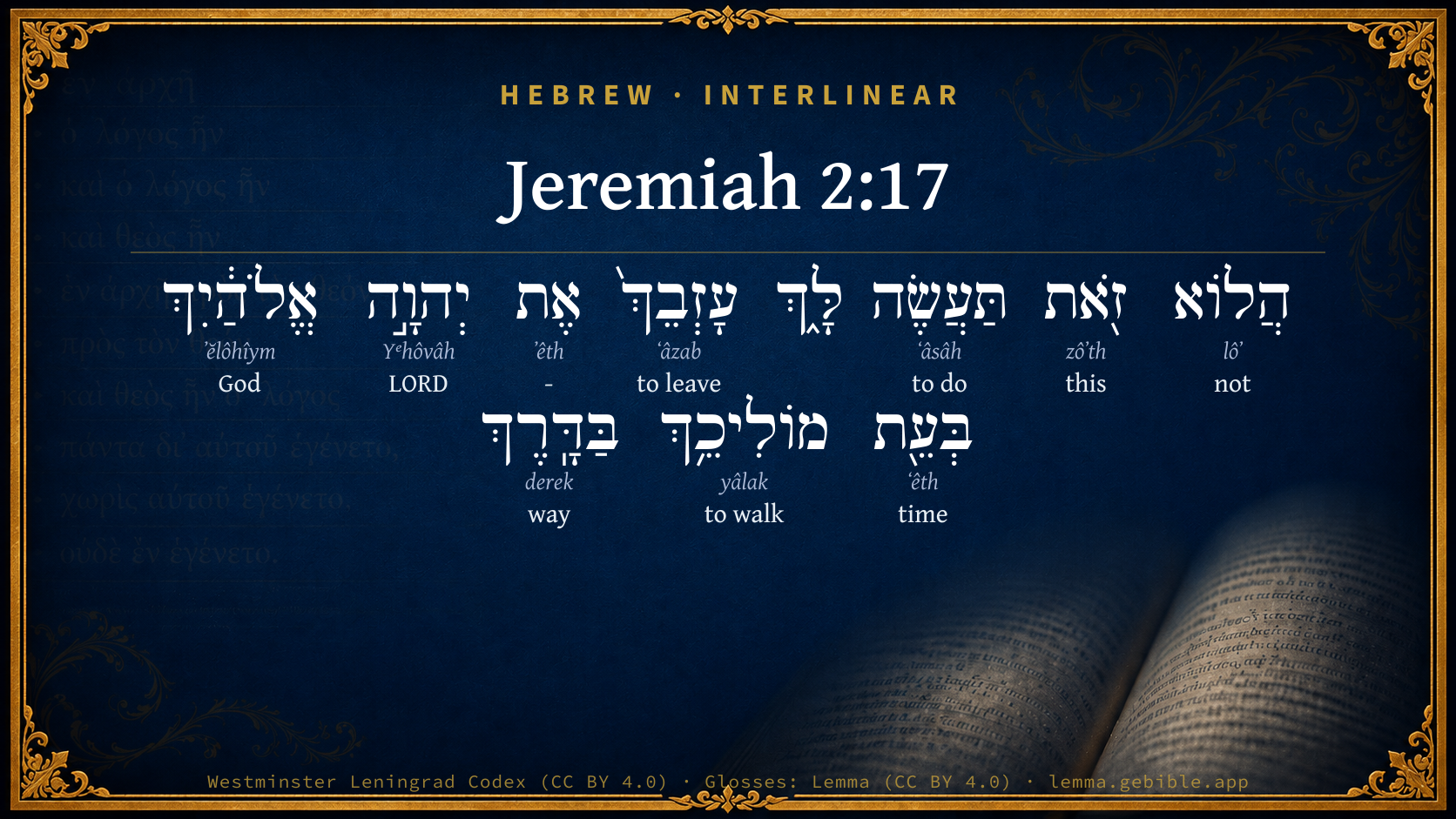
Hebrew (Westminster Leningrad Codex) Jeremiah 2:17 appears in the Hebrew Old Testament. The text above is from the Westminster Leningrad Codex. Each word links to its Strong’s number, a concise gloss, and parsing drawn from the Open Scriptures Hebrew Bible morphology. Click any word for its full Brown-Driver-Briggs (BDB) entry.
Download image
Cite this verse

Jeremiah 2:17 (World English Bible). Public Domain. Lemma interlinear Bible study tool, https://lemma.gebible.app/v/jeremiah/2/17.

Show BibTeX & RIS
BibTeX
RIS
English Translation
Haven't you procured this to yourself, in that you have forsaken Yahweh your God, when he led you by the way?
World English Bible · Public Domain
Download a study sheet

One document with this verse’s original text, its word-by-word gloss line, the meaning frame, cross-references with their text, attributed commentary, and full source and license credits — printable, and it pastes into notes with its structure intact.

This verse Autodidact and up

Study sheet (.html) Plain text (.txt)

A passage Seminary Student

Up to 50 verses in one chapter. A passage sheet keeps up to 6 commentary sources and 12 cross-references per verse, in the order this page ranks them, and says so on the sheet whenever that leaves anything out. Ask for a single verse and you get the Autodidact verse sheet above.

Everything on this page stays free to read, with no account — the sheet is a download of what is already on screen, not access to it.

Want to remove ads? Support Godless Engineer
Compare translations 3

The same verse in 3 English versions, stacked beneath the original-language interlinear above. Click any original word for its lexicon entry.

Each is an independent rendering of the whole verse — the interlinear is not word-aligned to these translations.

Highlighted words mark where these versions differ — a whole-verse word diff, not a word-by-word alignment.

  • World English Bible Public Domain
    Haven't you procured this to yourself, in that you have forsaken Yahweh your God, when he led you by the way?
  • King James Version Public Domain
    Hast thou not procured this unto thyself, in that thou hast forsaken the LORD thy God, when he led thee by the way?
  • unfoldingWord Literal Text CC BY-SA 4.0
    Have you not brought this to yourself you abandoned Yahweh your God, when he led you in the way?

unfoldingWord Literal Text — © unfoldingWord, licensed CC BY-SA 4.0. Word-aligned USFM3 via Door43 (git.door43.org/unfoldingWord/en_ult).

Versions to compare (up to 4)

3 of 4 selected

Show all 18 translations

Every available English version of this verse, each an independent rendering of the whole verse.

  • World English Bible Public Domain
    Haven't you procured this to yourself, in that you have forsaken Yahweh your God, when he led you by the way?
  • Berean Standard Bible Public Domain
    Have you not brought this on yourself by forsaking the LORD your God when He led you in the way?
  • Majority Standard Bible Public Domain
    Have you not brought this on yourself by forsaking the LORD your God when He led you in the way?
  • King James Version Public Domain
    Hast thou not procured this unto thyself, in that thou hast forsaken the LORD thy God, when he led thee by the way?
  • American Standard Version (1901) Public Domain
    Hast thou not procured this unto thyself, in that thou hast forsaken Jehovah thy God, when he led thee by the way?
  • Revised Version (1885) Public Domain
    Hast thou not procured this unto thyself, in that thou hast forsaken the LORD thy God, when he led thee by the way?
  • Geneva Bible (1599) Public Domain
    Hast not thou procured this vnto thy selfe, because thou hast forsaken the Lord thy God, when he led thee by the way?
  • Douay-Rheims (1899) Public Domain
    Hath not this been done to thee, because thou hast forsaken the Lord thy God at that time, when he led thee by the way?
  • Young's Literal Translation Public Domain
    Dost thou not do this to thyself? `By' thy forsaking Jehovah thy God, At the time He is leading thee in the way?
  • Literal Standard Version CC BY-SA 4.0
    Do you not do this to yourself? [By] your forsaking your God YHWH, || At the time He is leading you in the way?
  • Unlocked Literal Bible CC BY-SA 4.0
    Did you not do this to yourselves when you abandoned Yahweh your God, while he was leading you along the way?
  • unfoldingWord Literal Text CC BY-SA 4.0
    Have you not brought this to yourself you abandoned Yahweh your God, when he led you in the way?
  • Darby Bible Public Domain
    Hast thou not procured this unto thyself, in that thou hast forsaken Jehovah thy God, at the time he was leading thee in the way?
  • World Messianic Bible Public Domain
    “Haven’t you brought this on yourself, in that you have forsaken the LORD your God, when he led you by the way?
  • Webster's Bible Public Domain
    Hast thou not procured this to thyself in that thou hast forsaken the LORD thy God, when he led thee by the way?
  • Free Bible Version CC BY-SA 4.0
    Didn't you bring this on yourself by abandoning the Lord your God when he was leading you in the right way?
  • Bible in Basic English Public Domain
    Has not this come on you because you have given up the Lord your God, who was your guide by the way?
  • JPS Tanakh (1917) Public Domain
    Is it not this that doth cause it unto thee, that thou hast forsaken the LORD thy God, when He led thee by the way?

Literal Standard Version (2020), Covenant Press — licensed CC BY-SA 4.0. Text via the HelloAO Bible API (eBible.org). Unlocked Literal Bible (unfoldingWord) — licensed CC BY-SA 4.0. Text via the HelloAO Bible API (eBible.org). unfoldingWord Literal Text — © unfoldingWord, licensed CC BY-SA 4.0. Word-aligned USFM3 via Door43 (git.door43.org/unfoldingWord/en_ult). Free Bible Version, Dr. Jonathan Gallagher — licensed CC BY-SA 4.0. Text via the HelloAO Bible API (eBible.org).

Word by word

More ways to search: Search by grammar → Find every occurrence → Compare this word →

Practice this passage: Drill this verse → Learn its vocabulary →

עָזְבֵךְ֙
ʻâzab
H5800
“to leave · you”
Verb, Qal, Infinitive Construct + Suffix, Personal, 2nd Person, Feminine, Singular
Part of Speech
Verb
Stem
Qal
Form
Infinitive Construct
Full BDB Definition

Origin: a primitive root

TWOT: 1594 , 1595

to leave, loose, forsake - (Qal) to leave - to depart from, leave behind, leave, let alone - to leave, abandon, forsake, neglect, apostatise - to let loose, set free, let go, free - (Niphal) - to be left to - to be forsaken - (Pual) to be deserted - to restore, repair - (Qal) to repair
  1. הֲלוֹא lôʼ H3808 “not” Particle, Interrogative + Particle, Negative
  2. זֹ֖את zôʼth H2063 “this” Pronoun, Demonstrative, Feminine, Singular
  3. תַּעֲשֶׂה ʻâsâh H6213 “to do” Verb, Qal, Imperfect, 2nd Person, Masculine, Singular
  4. אֶת ʼêth H853 “-” Particle, Direct Object
  5. יְהוָ֣ה Yᵉhôvâh H3068 “LORD” Noun, Proper
  6. אֱלֹהַ֔יִךְ ʼĕlôhîym H430 “God(s) · your” Noun, Common, Masculine, Plural, Construct + Suffix, Personal, 2nd Person, Feminine, Singular
  7. בְּעֵ֖ת ʻêth H6256 “in/at · time of” Preposition + Noun, Common, Both, Singular, Construct
  8. מוֹלִיכֵ֥ךְ yâlak H3212 “walking · you” Verb, Hiphil, Participle Active, Masculine, Singular, Construct + Suffix, Personal, 2nd Person, Feminine, Singular
  9. בַּדָּֽרֶךְ derek H1870 “in/at the · way” Preposition, Determined + Noun, Common, Both, Singular, Absolute

About this verse

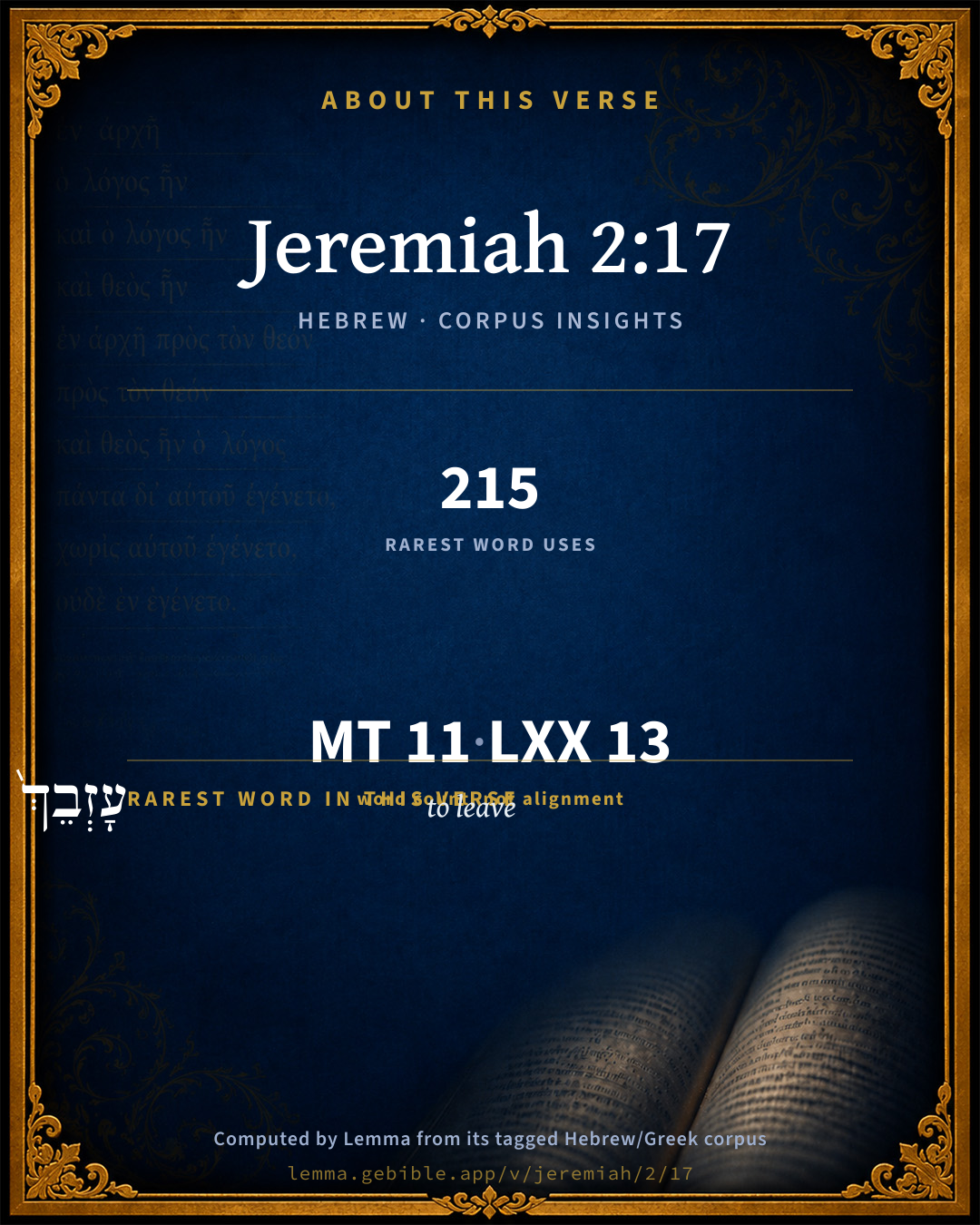
These counts appear in no published source. They are computed here, from the morphology-tagged text and Lemma’s own curated glosses. What Lemma adds →

11
words
10
distinct lemmas
Prophets
section

Grammatical profile

  • 3 verbs
  • 4 nouns
  • 1 pronoun
  • 1 preposition
  • 2 particles

Verb forms

  • תַּעֲשֶׂה Qal · Imperfect
  • עָזְבֵךְ֙ Qal · Infinitive Construct
  • מוֹלִיכֵ֥ךְ Hiphil · Participle Active

Hebrew & Septuagint length

In the original languages it is 11 Hebrew tokens and 13 Greek tokens — but the two are counted differently (Hebrew bundles its prefixes and suffixes into one token; the Greek is in lemma form), so that isn’t a like-for-like length.

Cross-references

18

Topical passages linked to Jeremiah 2:17 in the Treasury of Scripture Knowledge — connected by theme and wording, ordered by reader-vote popularity; previews shown in the World English Bible.

  • Jeremiah 4:18 Your way and your doings have procured these things to you; this is your wickedness; for it is bitter, for it reaches to your heart.
  • Jeremiah 2:19 Your own wickedness shall correct you, and your backsliding shall reprove you: know therefore and see that it is an evil thing and a bitter, that you have forsaken Yahweh your God, and that my fear is not in you, says the Lord, Yahweh of Hosts.
  • Jeremiah 2:13 For my people have committed two evils: they have forsaken me, the spring of living waters, and hewed them out cisterns, broken cisterns, that can hold no water.
  • Deuteronomy 28:15–68 But it shall come to pass, if you will not listen to the voice of Yahweh your God, to observe to do all his commandments and his statutes which I command you this day, that all these curses shall come on you, and overtake you.
  • Leviticus 26:15–46 and if you shall reject my statutes, and if your soul abhors my ordinances, so that you will not do all my commandments, but break my covenant;
  • Psalms 77:20 You led your people like a flock, By the hand of Moses and Aaron.
  • Psalms 107:7 He led them also by a straight way, That they might go to a city to live in.
  • Hosea 13:9 You are destroyed, Israel, because you are against me, Against your help.
  • Numbers 32:23 But if you will not do so, behold, you have sinned against Yahweh; and be sure your sin will find you out.
  • Deuteronomy 32:10 He found him in a desert land, In the waste howling wilderness; He compassed him about, he cared for him, He kept him as the apple of his eye.
  • Deuteronomy 32:19 Yahweh saw [it], and abhorred [them], Because of the provocation of his sons and his daughters.
  • 1 Chronicles 28:9 You, Solomon my son, know the God of your father, and serve him with a perfect heart and with a willing mind; for Yahweh searches all hearts, and understands all the imaginations of the thoughts: if you seek him, he will be found of you; but if you forsake him, he will cast you off forever.
  • 2 Chronicles 7:19–20 But if you turn away, and forsake my statutes and my commandments which I have set before you, and shall go and serve other gods, and worship them;
  • Job 4:8 According to what I have seen, those who plow iniquity, And sow trouble, Reap the same.
  • Psalms 78:53–54 He led them safely, so that they weren't afraid, But the sea overwhelmed their enemies.
  • Psalms 136:16 To him who led his people through the wilderness; For his loving kindness endures forever:
  • Isaiah 1:4 Ah sinful nation, A people loaded with iniquity, A seed of evil-doers, Children who deal corruptly! They have forsaken Yahweh. They have despised the Holy One of Israel. They are estranged and backward.
  • Isaiah 63:11–14 Then he remembered the days of old, Moses [and] his people, [saying], Where is he who brought them up out of the sea with the shepherds of his flock? where is he who put his holy Spirit in the midst of them?

Cross-references courtesy of OpenBible.info (CC BY 4.0).

Hebrew and Greek witnesses Masoretic Hebrew ↔ Greek Septuagint

The same verse in the two great witnesses to the Old Testament, shown verse-for-verse.

These are two independent witnesses, not word-aligned to each other, and the Septuagint is shown in lemma (dictionary) form.

Hebrew Jeremiah 2:17 Masoretic · Westminster Leningrad Codex

הֲלוֹא זֹ֖את תַּעֲשֶׂה לָּ֑ךְ עָזְבֵךְ֙ אֶת יְהוָ֣ה אֱלֹהַ֔יִךְ בְּעֵ֖ת מוֹלִיכֵ֥ךְ בַּדָּֽרֶךְ

Haven't you procured this to yourself, in that you have forsaken Yahweh your God, when he led you by the way?

World English Bible · Public Domain

Greek LXX Structure differs

In the Septuagint, Jeremiah is about an eighth shorter than the Hebrew and arranges its material differently — the Oracles Against the Nations (Hebrew chapters 46–51) appear in the middle of the Greek book, after 25:13. Because the chapter and verse boundaries do not line up, a verse-for-verse comparison with the Hebrew is not shown.

A verse-for-verse comparison isn’t shown here because the chapters and verses don’t line up. Switch to the LXX edition with the MT / LXX toggle above to read the Greek directly.

On this verse, Jamieson, Fausset & Brown discusses the Septuagint’s reading. Read the note in Commentary ↓

Hebrew: Westminster Leningrad Codex (CC BY 4.0). Greek: Septuagint (public domain); English from a public-domain English Septuagint. How the Septuagint differs from the Hebrew →

Targum (Aramaic paraphrase)

1

The Targum is the ancient Jewish Aramaic paraphrase of the Hebrew Scriptures — an interpretive translation, not the Hebrew text itself. Onkelos (literal) and Pseudo-Jonathan (expansive) render the Torah, and Jonathan the Prophets. Coverage is partial: where no permissively-licensed English translation exists for a verse, only the Aramaic is shown. This is verse-level text, not a word-by-word alignment to the Hebrew.

  1. Targum Jonathan Prophets (Joshua–Malachi)
    הֲלָא דָא פּוּרְעֲנוּתָא תִתְעַבֵּיד מִנִיךְ עַל דִשְׁבַקְתָּ יַת פּוּלְחָנָא דַייָ אֱלָהָךְ דְאַחֲזְיָךְ אוֹרְחָא תַקְנָא וְלָא הֲלֵיכְתָּא בָהּ:

    (no public-domain English translation for this verse)

    Targum Jonathan — Aramaic: “Mikraot Gedolot” (public domain). English: “Sefaria Community Translation” (CC0 1.0 (public-domain dedication)); “London "Chaldee Paraphrase," 1871” (public domain). Text via Sefaria.

Commentary

Notes on Jeremiah 2:17 from classic Christian and Jewish commentators (each source and its license shown beneath its notes). The classic Christian expositions comment on the surrounding passage and are grouped to its opening verse, so a note may address several verses; the Jewish commentaries on the Tanakh (Rashi and others) are per-verse, so they appear only where the commentator wrote on this verse.

Lemma curates 59 commentaries, every one of them public domain or Creative Commons licensed, each selected and text-cleaned for this edition rather than reprinted as found. About our sources →

Trapp's Complete Commentary

John Trapp

Jer 2:17 Hast thou not procured this unto thyself, in that thou hast forsaken the LORD thy God, when he led thee by the way?

Ver. 17. Hast thou not procured this to thyself?] The same may the Lord say to every sufferer: and further add, "Did not I warn you, saying, Sin not against the child?" {Gen 42:22} Oh, do not this abominable thing! your iniquities will undoubtedly be your ruin, &c.

When he led thee by the way.] The way that is called holy, the highway to heaven; fitly here opposed to those byways of carnal wisdom, mentioned in the following verses.

John Trapp, A Commentary or Exposition upon All the Books of the Old and New Testament (1647–1656) — public domain. Text from a community e-Sword module.

Joseph Benson's Commentary

Jer 2:17. Hast thou not procured this unto thyself? — Are not all these calamities owing to thy sins, thy known and wilful sins? By their sinful confederacies with the nations, and especially their conformity to them in their idolatrous customs and usages, they had made themselves very mean and contemptible, as all those do that have made a profession of religion, and afterward throw it off. Nothing now appeared of that which, by their constitution, made them both honourable and formidable, and therefore the neighbouring nations neither respected nor feared them. But this was not all: they had provoked God to give them up into the hands of their enemies, who, after becoming a dreadful scourge to them, at last subdued them, and overturned their government. And thus they brought their miseries upon themselves, in forsaking the Lord their God, in revolting from their allegiance to him, and so throwing themselves out of his protection; for protection and allegiance go together. When he led thee, &c. — Hebrew, מולכךְ בעת בדרךְ, at the time, the very time, he was leading thee by the way. Then, when he was leading thee on to a happy peace and settlement, and thou wast arrived at the very borders of it, thou didst draw back, and forsake thy guide. We may observe here, that although Josiah was a very pious prince, and exerted himself to the utmost to restore the worship of God, breaking down the altars and groves, and beating the graven images into powder, &c., 2 Chronicles 34., 35., nevertheless, from the complaints of Jeremiah, and his reproofs of their idolatry, it sufficiently appears that the people were far from being reformed.

Joseph Benson's Commentary on the Old and New Testaments (1811–1818) — public domain. Text from a community e-Sword module.

Geneva Bible (1599)

Geneva Bible translators

Showing that God would have still led them aright, if they would have followed him.

Geneva Bible (1599) marginal notes — public domain. Text via Bolls.life.

Jamieson, Fausset & Brown

Robert Jamieson, A. R. Fausset & David Brown

Literally, "Has not thy forsaking the Lord . . . procured this (calamity) to thee?" So the Septuagint: the Masoretic accents make "this" the subject of the verb, leaving the object to be understood. "Has not this procured (it, that is, the impending calamity) unto thee, that hast forsaken?" &c. (Jer 4:18).

led-- (Deu 32:10).

the way--The article expresses the right way, the way of the Lord: namely, the moral training which they enjoyed in the Mosaic covenant.

Jamieson, Fausset & Brown — Commentary Critical and Explanatory on the Whole Bible (1871) — public domain (CC PDM 1.0). Text via the HelloAO Bible API.

John Calvin's Commentaries

Now follows the cause; the Prophet, after having shewn that Israel were forsaken by God, now mentions the reason why it so happened, Has not this done it for thee? Some read in the second person, “Hast thou not done this for thee?” but the meaning is still nearly the same. More probable, however, is the rendering which others have given, “Has not this happened to thee, because thou hast forsaken Jehovah thy God?” Jeremiah, in short, teaches us that the cause of all the evils was the defection of the people, as though he had said, “Thou hast concocted for thyself all this evil; then must thou swallow it, and know that the blame cannot be cast on God; for he would have been faithful to thee, except thine impiety had prevented him. God has not, indeed, chosen thee in vain, nor has he in vain preferred thee to other nations; but thou hast rejected his kindness. Thy condition then would have never been as it is, hadst thou not procured thine own ruin.” How so? “Because thou hast departed from thy God.”

And he further exaggerates this sin by saying, At the time when he led thee in the way To lead in the way, is rightly to govern, so as to make people happy. The Prophet then shews, that the people’s perfidy and defection were without excuse in rejecting the worship of their God, for they were happy during the time they served him. Had they been in various ways tempted, or tried, they might have reigned some pretense. “We thought ourselves deceived in hoping in the true God, for he concealed his favor from us; we were therefore compelled by necessity. There ought at least some indulgence to be shewn to our levity; for we could have formed no other conjecture but that God had removed far from us.” The Prophet meets this objection, as he does in the fifth verse, “What iniquity have your fathers found in me?” and, as it is done in another place,

“My people, what have I done to thee, or in what have I been troublesome to thee?” (Micah 6:4)

for God in that passage shews that he was prepared to defend his own cause, and to clear himself from whatever the people might object to him. So also he does in this place, “I have led thee,” he says, “in the way;” that is, “Thou didst live happily under my government, and yet I could not retain thee by my goodness while I kindly treated thee; and thou knewest that nothing could be better for thee than to continue under my protection; but thou hast determined to go over into the service of idols. Now what excuse hast thou, or what pretense is left thee?” We hence see, that the sin of the people is greatly enhanced, for they were induced by no temptation or trial to forsake God, but through mere perfidy gave themselves up to idols: and a confirmation of this verse follows —

John Calvin's Commentaries (1540-1563) — public domain. Text from the Calvin Translation Society English edition (1840s-50s) via the Christian Classics Ethereal Library (ccel.org). Calvin's coverage is partial (roughly two-thirds of the Bible); uncommented books and verses are honest gaps, never fabricated. The 19th-century editor's footnotes and remarks are omitted so the notes are faithfully Calvin's own voice.

Ellicott's Commentary for English Readers

(17) Hast thou not procured this . . .?—The secret cause of the calamities is brought to light. Jehovah was leading Israel, but Israel has chosen another path, and so has procured sorrow upon sorrow to himself. The “way” here is scarcely the literal path through the wilderness, but much rather the true way of life.

A Bible Commentary for English Readers, edited by Charles John Ellicott (1878–1897) — public domain. Text from a community e-Sword module.

The Cambridge Bible for Schools and Colleges

gen. ed. J. J. S. Perowne

17. when he led thee by the way] If the text be right, the reference is to wilderness journeyings. But there can be little doubt that the words (omitted by LXX) have arisen from a scribe’s error in writing twice over the first four Hebrew words of Jer_2:18.

The Cambridge Bible for Schools and Colleges (gen. ed. J. J. S. Perowne; Cambridge University Press, 1878–1918) — public domain. Text from a community e-Sword module.

John Gill's Exposition

And now what hast thou to do in the way of Egypt,.... By worshipping of idols, in imitation of them; or by sending ambassadors thither for help, when they had their Lord, their God, so nigh, had they not forsaken him; nor had Josiah any business to go out against Pharaohnecho, Ch2 35:21 and, contrary to the express word of God by the Prophet Jeremy, did the Jews which remained in Judea go into Egypt, Jer 42:19.

To drink the waters of Sihor? which is the river Nile, as Jarchi interprets it. The Septuagint and Arabic versions render it "the waters of Geon", or "Gihon": and this also is the same with the Nile, as Josephus (k) affirms, who says,

"Geon, which runs through Egypt, is the same which the Greeks call Nile.''

So Jerom (l) from Eusebius,

"Geon is a river, which with the Egyptians is called Nile.''

The Vulgate Latin version renders it, "troubled water"; and such were the waters of the Nile, which had its name of Sihor from the blackness of it; and hence, by the Greeks (m), was called Melas; and by the Latines (n), Melo. Hence, as Braunius (o) observes, it was represented by a black stone, as other rivers by a white one; for which reason the black colour was very grateful to the Egyptians; and for the same reason Osiris, which is the very Nile itself, was reckoned black; and the ox Apis they worshipped was a black one, at least part of it, and was covered with black linen cloth; and its priests were also clothed in black, hence called Chemarim, Hos 10:5.

Or what hast thou to do in the way of Assyria; to go after their idolatrous practices, or to send to them for help; for this was the usual method of the Jews; when the Assyrians oppressed them, then they sent to Egypt for help; and when the Egyptians were upon them, then they applied to the Assyrians; and in both cases acted wrong, for they ought to have sought the Lord their God only:

to drink the waters of the river? of the river Euphrates. The sense is, that they preferred the waters of the Nile and of Euphrates, or the gods of the Egyptians and Assyrians, or the help of these people, before the Lord, the fountain of living waters, and his worship and powerful help. The Targum paraphrases this last clause thus,

"why do ye make covenant with the Assyrian, to carry you captive beyond the river Euphrates?''

(k) Antiqu. l. 1. c. 1. sect. 3. (l) De locis Hebraicis, fol. 91. H. (m) Eustathius in Dionys. (n) Servius in Virgil. Georg. l. 4. p. 343. & in Aeneid. l. 1. p. 541. (o) Selecta Sacr. l. 4. c. 9. p. 492, & l. 5. Exercit. 4. sect. 8. p. 700, 701.

John Gill's Exposition of the Whole Bible (1746–1763) — public domain (CC PDM 1.0). Text via the HelloAO Bible API.

Albert Barnes' Notes on the Bible

The way - Either, the journey through the wilderness, or the way of holiness.

Albert Barnes' Notes on the Bible (1834–1885) — public domain. Text from a community e-Sword/MySword module.

Matthew Poole's English Annotations

Hast thou not procured this unto thyself? here God by his prophet shows that they may thank themselves for all that is hastening upon them. See Num 32:23.

In that thou hast forsaken the Lord: here he shows wherein, viz. in forsaking God: not that he left them, but they him, and that without any temptation or provocation; and therefore were the more inexcusable.

When he led thee by the way, viz. by the conduct of his providence in the wilderness, keeping thee in safety from all dangers, Exo 13:21,22; Isa 63:12,13; or in the way of his counsels, which the ways of their own carnal wisdom were so opposite unto.

Matthew Poole's English Annotations on the Holy Bible (1683–1685) — public domain. Text from a community e-Sword/MySword module.

Whedon's Commentary on the Bible

Daniel D. Whedon

17. Hast thou not procured this — This has come from forsaking the Lord thy God, when he led thee by the way — No lions are in that way. It is not a way of servitude and sorrow. It may lead into a region of drought and death-shade, but it shall also be through it. To the eye of sense it may be devious and difficult, but to the eye of faith it leads directly to the promised land.

Daniel D. Whedon (gen. ed.), Commentary on the Old and New Testaments (1874–1909) — public domain. Text from a community e-Sword module.

The Pulpit Commentary

Hast not thou procured this? rather, Is it not this that doth procure it unto thee (namely) that thou hast forsaken, etc.? or, Is it not thy forsaking Jehovah that pro. cureth thee this? When he led thee by the way. The prophet thinks, perhaps, of the rebellion of the forefathers of Israel, who too soon ceased to "go after" Jehovah (comp. ver. 2), and whose fickleness was imitated but too well by their descendants. This view is favored by the phraseology of Deu_1:33 Deu_8:2, Deu_8:15. But we may, if we prefer it, explain "by (or, rather, in) the way," on the analogy of the promise in Jer_31:9, "I will lead them... in a straight way," i.e. I will grant them an uninterrupted course of prosperity. The omission of the adjective in the present passage may be paralleled by Psa_25:8, "Therefore will he instruct sinners in the (right) way."

The Pulpit Commentary (1880–1919), ed. H.D.M. Spence-Jones & Joseph S. Exell — public domain. Text from a community e-Sword module.

John Wesley's Explanatory Notes

When - By the conduct of providence in the wilderness, keeping thee from all dangers.

John Wesley, Explanatory Notes Upon the Whole Bible (1754–1765) — public domain. Text via the GEBible commentary corpus.

Rashi

Rabbi Shlomo Yitzchaki (Rashi)

Is not this caused to you Is not this misfortune and this retribution caused to you by the guilt and the iniquity that you have forsaken the Lord your God?

at the time He leads you by the way For He would teach you the good and the straight way.

Rashi on the Tanakh — English translations: “The Judaica Press complete Tanach with Rashi, translated by A. J. Rosenberg” (CC BY 4.0); “Pentateuch with Rashi's commentary by M. Rosenbaum and A.M. Silbermann, 1929-1934” (public domain); “The Metsudah Tanach series, Lakewood, N.J” (CC BY 4.0); and “The Book of Joshua, Metsudah Publications, 1997” (CC BY 4.0). Text via Sefaria.

Lesson kit

Teaching starters — assembled from the data on this page, not authored interpretation. Every prompt links to the verse data it draws on. Edit before teaching.

Jeremiah, in the Prophets, opens this verse with 11 words (10 distinct Hebrew lemmas). Its most distinctive word is ʻâzab (“to leave”). A historical commentator’s framing appears above. Read the whole chapter for the surrounding context.

Discussion questions

  1. The word ʻâzab carries the sense “to leave.” How does it shape the verse?
  2. How does Jeremiah 4:18, which shares this passage’s theme, read alongside this verse?
  3. These translations render this verse differently. What is at stake in choosing one wording over another?
  4. «תַּעֲשֶׂה» is a Qal Imperfect verb. How does that grammatical form shape the action described?
  5. Compare how Trapp's Complete Commentary and Joseph Benson's Commentary read this verse. Where do they agree or differ?

Things to notice

Reading settings

Reading text

Shown beneath each verse's original-language words.

Old Testament
Old Testament edition

Read the OT as the Masoretic Hebrew (MT) or the Greek Septuagint (LXX).

English shown for the Greek Septuagint (in the Hebrew ↔ Greek comparison).

Comparing translations? Open the Compare panel on any verse page to stack up to four side by side.