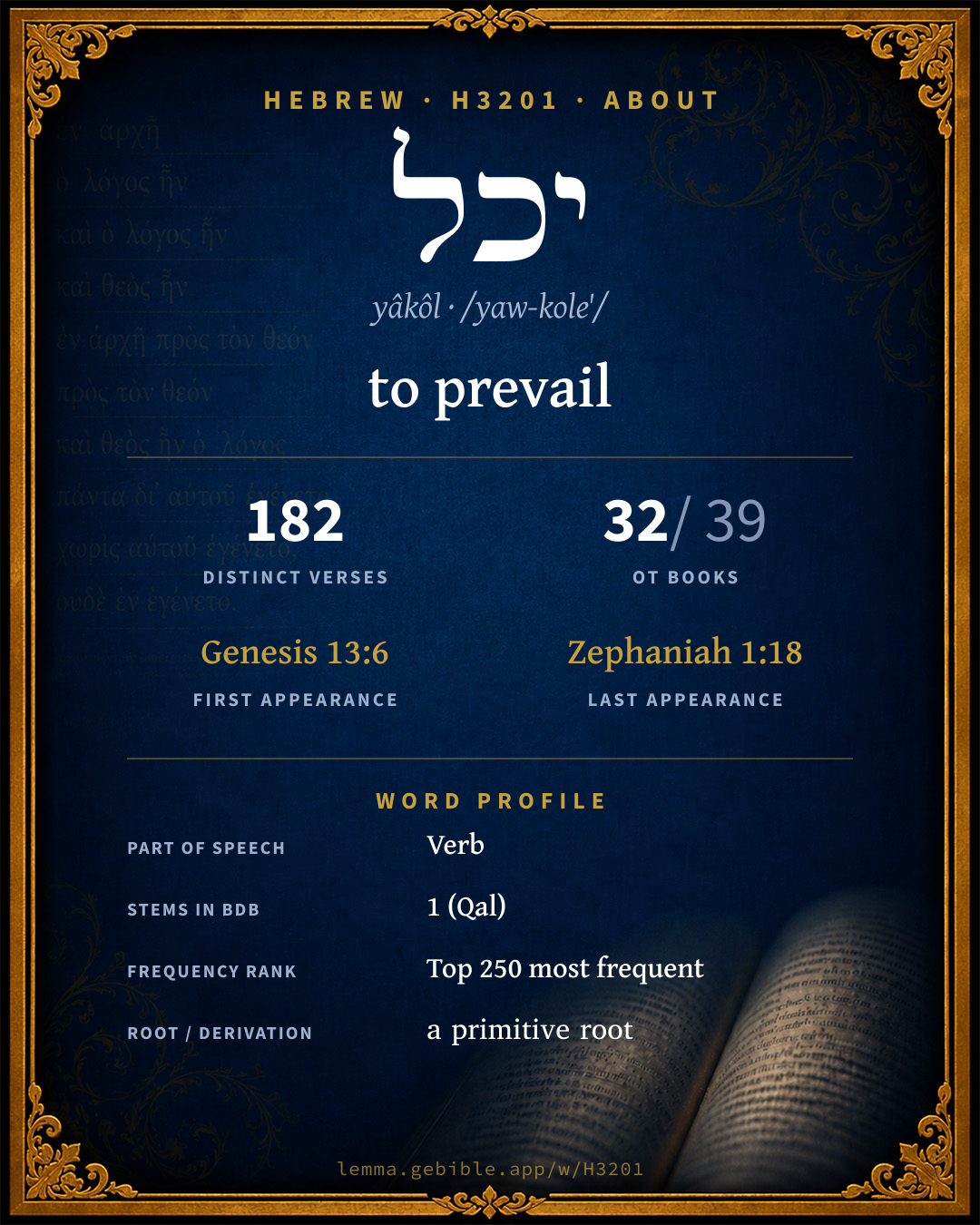
יָכֹל
to prevail
also: overcome, endure, have power, be able fuller range ↓
Full lexicon entry — Brown-Driver-Briggs (BDB)
From Brown-Driver-Briggs (BDB)
Where this word appears
Grammar key — what these labels mean
Part of speech
- Verb
- An action or state-of-being word.
Stem
- Qal
- The basic, simple active stem — the plain form of the verb (“he wrote”). Here: ‘be able’
Form
- Imperfect
- An incomplete, ongoing, or future action (“he will / would write”).
- Perfect
- A completed action or state — Hebrew marks aspect (completeness) more than strict tense (“he wrote”).
- Sequential Imperfect
- An imperfect with prefixed waw — the standard past-narrative form (waw-consecutive imperfect).
- Infinitive Absolute
- An unbound verbal noun, often intensifying or standing in for a finite verb.
- Infinitive Construct
- A bound verbal noun, frequently with prepositions (“to write / in writing”).
- Cohortative
- A first-person volitional form expressing wish or resolve (“let me / let us write”).
- Sequential Perfect
- A perfect with prefixed waw continuing a preceding imperfect or command (waw-consecutive perfect).
Person
- 3rd Person
- The one spoken about (“he / she / it / they”).
- 1st Person
- The speaker (“I / we”).
- 2nd Person
- The one addressed (“you”).
Gender
- Masculine
- Grammatically masculine.
- Common
- Either gender — not distinguished for this form.
- Feminine
- Grammatically feminine.
Number
- Singular
- One.
- Plural
- More than one (in Hebrew, generally three or more).
Grammatical forms 18 distinct
- Verb, Qal, Imperfect, 3rd Person, Masculine, Singular 40 times (21%)
- Verb, Qal, Imperfect, 1st Person, Common, Singular 34 times (18%)
- Verb, Qal, Perfect, 3rd Person, Common, Plural 32 times (16%)
- Verb, Qal, Imperfect, 2nd Person, Masculine, Singular 22 times (11%)
- Verb, Qal, Imperfect, 3rd Person, Masculine, Plural 17 times (9%)
- Verb, Qal, Perfect, 3rd Person, Masculine, Singular 12 times (6%)
- Verb, Qal, Imperfect, 1st Person, Common, Plural 11 times (6%)
- Verb, Qal, Perfect, 1st Person, Common, Singular 4 times (2%)
+10 more forms (22 occurrences)
Parsed forms decoded from the imported morphology (morphhb / Westminster Leningrad Codex — WLC text public domain, morphhb tagging CC BY 4.0), counted across 194 parsed occurrences — not distinct verses.
Every verse where H3201 appears — 182 distinct verses across 32 books. Click any verse to open its interlinear word-by-word view. Verse text shown in the World English Bible for context — . Each verse’s Hebrew form is shown with its reference; the English is not keyword-highlighted, since the data carries no word-level English alignment. Use “Compare translations” on any verse to read it across multiple English versions. This concordance covers the Hebrew Bible; Septuagint (Greek Old Testament) occurrences are not indexed here.
Genesis 21 verses
- Genesis 13:6 יָֽכְל֖וּ Qal pf 3cp The land was not able to bear them, that they might live together: for their substance was great, so that they could not live together.
- Genesis 13:16 יוּכַ֣ל Qal impf 3ms I will make your offspring as the dust of the earth, so that if a man can number the dust of the earth, then your seed may also be numbered.
- Genesis 15:5 תּוּכַ֖ל Qal impf 2ms Yahweh brought him outside, and said, "Look now toward the sky, and count the stars, if you are able to count them." He said to Abram, "So shall your seed be."
- Genesis 19:19 אוּכַל֙ Qal impf 1cs See now, your servant has found favor in your sight, and you have magnified your loving kindness, which you have shown to me in saving my life. I can't escape to the mountain, lest evil overtake me, and I die.
- Genesis 19:22 אוּכַל֙ Qal impf 1cs Hurry, escape there, for I can't do anything until you get there." Therefore the name of the city was called Zoar.
- Genesis 24:50 נוּכַ֛ל Qal impf 1cp Then Laban and Bethuel answered, "The thing proceeds from Yahweh. We can't speak to you bad or good.
- Genesis 29:8 נוּכַל֒ Qal impf 1cp They said, "We can't, until all the flocks are gathered together, and they roll the stone from the well's mouth. Then we water the sheep."
- Genesis 30:8 יָכֹ֑לְתִּי Qal pf 1cs Rachel said, "With mighty wrestlings have I wrestled with my sister, and have prevailed." She named him Naphtali.
- Genesis 31:35 אוּכַל֙ Qal impf 1cs She said to her father, "Don't let my lord be angry that I can't rise up before you; for the manner of women is on me." He searched, but didn't find the teraphim.
- Genesis 32:25 יָכֹל֙ Qal pf 3ms When he saw that he didn't prevail against him, he touched the hollow of his thigh, and the hollow of Jacob's thigh was strained, as he wrestled.
- Genesis 32:28 וַ/תּוּכָֽל conj + Qal wimpf 2ms He said, "Your name will no longer be called 'Jacob,' but, 'Israel,' for you have fought with God and with men, and have prevailed."
- Genesis 34:14 נוּכַל֙ Qal impf 1cp and said to them, "We can't do this thing, to give our sister to one who is uncircumcised; for that is a reproach to us.
- Genesis 36:7 יָֽכְלָ֜ה Qal pf 3fs For their substance was too great for them to dwell together, and the land of their travels couldn't bear them because of their cattle.
- Genesis 37:4 יָכְל֖וּ Qal pf 3cp His brothers saw that their father loved him more than all his brothers, and they hated him, and couldn't speak peaceably to him.
- Genesis 43:32 יוּכְל֜וּ/ן Qal impf 3mp + sfx n They served him by himself, and them by themselves, and the Egyptians, that ate with him, by themselves, because the Egyptians don't eat bread with the Hebrews, for that is an abomination to the Egyptians.
- Genesis 44:1 יוּכְל֖וּ/ן Qal impf 3mp + sfx n He commanded the steward of his house, saying, "Fill the men's sacks with food, as much as they can carry, and put every man's money in his sack's mouth.
- Genesis 44:22 יוּכַ֥ל Qal impf 3ms We said to my lord, 'The boy can't leave his father: for if he should leave his father, his father would die.'
- Genesis 44:26 נוּכַ֖ל נוּכַ֗ל Qal impf 1cp Qal impf 1cp We said, 'We can't go down. If our youngest brother is with us, then will we go down: for we may not see the man's face, unless our youngest brother is with us.'
- Genesis 45:1 יָכֹ֨ל Qal pf 3ms Then Joseph couldn't control himself before all those who stood before him, and he cried, "Cause every man to go out from me!" There stood no man with him, while Joseph made himself known to his brothers.
- Genesis 45:3 יָכְל֤וּ Qal pf 3cp Joseph said to his brothers, "I am Joseph! Does my father still live?" His brothers couldn't answer him; for they were terrified at his presence.
- Genesis 48:10 יוּכַ֖ל Qal impf 3ms Now the eyes of Israel were dim for age, so that he couldn't see. He brought them near to him; and he kissed them, and embraced them.
Exodus 13 verses
- Exodus 2:3 יָכְלָ֣ה Qal pf 3fs When she could no longer hide him, she took a papyrus basket for him, and coated it with tar and with pitch. She put the child in it, and laid it in the reeds by the river's bank.
- Exodus 7:21 יָכְל֣וּ Qal pf 3cp The fish that were in the river died; and the river became foul, and the Egyptians couldn't drink water from the river; and the blood was throughout all the land of Egypt.
- Exodus 7:24 יָֽכְלוּ֙ Qal pf 3cp All the Egyptians dug round about the river for water to drink; for they couldn't drink of the water of the river.
- Exodus 8:18 יָכֹ֑לוּ Qal pf 3cp The magicians tried with their enchantments to bring forth lice, but they couldn't. There were lice on man, and on animal.
- Exodus 9:11 יָכְל֣וּ Qal pf 3cp The magicians couldn't stand before Moses because of the boils; for the boils were on the magicians, and on all the Egyptians.
- Exodus 10:5 יוּכַ֖ל Qal impf 3ms and they shall cover the surface of the earth, so that one won't be able to see the earth. They shall eat the residue of that which has escaped, which remains to you from the hail, and shall eat every tree which grows for you out of the field.
- Exodus 12:39 יָֽכְלוּ֙ Qal pf 3cp They baked unleavened cakes of the dough which they brought forth out of Egypt; for it wasn't leavened, because they were thrust out of Egypt, and couldn't wait, neither had they prepared for themselves any food.
- Exodus 15:23 יָֽכְל֗וּ Qal pf 3cp When they came to Marah, they couldn't drink from the waters of Marah, for they were bitter. Therefore the name of it was called Marah.
- Exodus 18:18 תוּכַ֥ל Qal impf 2ms You will surely wear away, both you, and this people that is with you; for the thing is too heavy for you. You are not able to perform it yourself alone.
- Exodus 18:23 וְ/יָֽכָלְתָּ֖ conj + Qal wpf 2ms If you will do this thing, and God commands you so, then you will be able to endure, and all of these people also will go to their place in peace."
- Exodus 19:23 יוּכַ֣ל Qal impf 3ms Moses said to Yahweh, "The people can't come up to Mount Sinai, for you charged us, saying, 'Set bounds around the mountain, and sanctify it.'"
- Exodus 33:20 תוּכַ֖ל Qal impf 2ms He said, "You cannot see my face, for man may not see me and live."
- Exodus 40:35 יָכֹ֣ל Qal pf 3ms Moses wasn't able to enter into the tent of meeting, because the cloud stayed on it, and Yahweh's glory filled the tent.
Numbers 11 verses
- Numbers 9:6 יָכְל֥וּ Qal pf 3cp There were certain men, who were unclean because of the dead body of a man, so that they could not keep the Passover on that day, and they came before Moses and before Aaron on that day.
- Numbers 11:14 אוּכַ֤ל Qal impf 1cs I am not able to bear all this people alone, because it is too heavy for me.
- Numbers 13:30 יָכ֥וֹל נוּכַ֖ל Qal inf.abs Qal impf 1cp Caleb stilled the people before Moses, and said, Let us go up at once, and possess it; for we are well able to overcome it.
- Numbers 13:31 נוּכַ֖ל Qal impf 1cp But the men who went up with him said, We aren't able to go up against the people; for they are stronger than we.
- Numbers 14:16 יְכֹ֣לֶת Qal inf.cs Because Yahweh was not able to bring this people into the land which he swore to them, therefore he has slain them in the wilderness.
- Numbers 22:6 אוּכַל֙ Qal impf 1cs Please come now therefore curse me this people; for they are too mighty for me: peradventure I shall prevail, that we may strike them, and that I may drive them out of the land; for I know that he whom you bless is blessed, and he whom you curse is cursed.
- Numbers 22:11 אוּכַ֛ל Qal impf 1cs Behold, the people that is come out of Egypt, it covers the surface of the earth: now, come curse me them; peradventure I shall be able to fight against them, and shall drive them out.
- Numbers 22:18 אוּכַ֗ל Qal impf 1cs Balaam answered the servants of Balak, If Balak would give me his house full of silver and gold, I can't go beyond the word of Yahweh my God, to do less or more.
- Numbers 22:37 אוּכַ֖ל Qal impf 1cs Balak said to Balaam, Didn't I earnestly send to you to call you? why didn't you come to me? am I not able indeed to promote you to honor?
- Numbers 22:38 הֲ/יָכ֥וֹל אוּכַ֖ל ptcl inter + Qal inf.abs Qal impf 1cs Balaam said to Balak, Behold, I have come to you: have I now any power at all to speak anything? the word that God puts in my mouth, that shall I speak.
- Numbers 24:13 אוּכַ֗ל Qal impf 1cs If Balak would give me his house full of silver and gold, I can't go beyond the word of Yahweh, to do either good or bad of my own mind; what Yahweh speaks, that will I speak?
Deuteronomy 16 verses
- Deuteronomy 1:9 אוּכַ֥ל Qal impf 1cs I spoke to you at that time, saying, I am not able to bear you myself alone:
- Deuteronomy 7:17 אוּכַ֖ל Qal impf 1cs If you shall say in your heart, These nations are more than I; how can I dispossess them?
- Deuteronomy 7:22 תוּכַל֙ Qal impf 2ms Yahweh your God will cast out those nations before you by little and little: you may not consume them at once, lest the animals of the field increase on you.
- Deuteronomy 9:28 יְכֹ֣לֶת Qal inf.cs lest the land whence you brought us out say, Because Yahweh was not able to bring them into the land which he promised to them, and because he hated them, he has brought them out to kill them in the wilderness.
- Deuteronomy 12:17 תוּכַ֞ל Qal impf 2ms You may not eat within your gates the tithe of your grain, or of your new wine, or of your oil, or the firstborn of your herd or of your flock, nor any of your vows which you vow, nor your freewill-offerings, nor the heave-offering of your hand;
- Deuteronomy 14:24 תוּכַ֘ל Qal impf 2ms If the way be too long for you, so that you are not able to carry it, because the place is too far from you, which Yahweh your God shall choose, to set his name there, when Yahweh your God shall bless you;
- Deuteronomy 16:5 תוּכַ֖ל Qal impf 2ms You may not sacrifice the Passover within any of your gates, which Yahweh your God gives you;
- Deuteronomy 17:15 תוּכַ֗ל Qal impf 2ms you shall surely set him king over you, whom Yahweh your God shall choose: one from among your brothers shall you set king over you; you may not put a foreigner over you, who is not your brother.
- Deuteronomy 21:16 יוּכַ֗ל Qal impf 3ms then it shall be, in the day that he causes his sons to inherit that which he has, that he may not make the son of the beloved the firstborn before the son of the hated, who is the firstborn:
- Deuteronomy 22:3 תוּכַ֖ל Qal impf 2ms So shall you do with his donkey; and so shall you do with his garment; and so shall you do with every lost thing of your brother's, which he has lost, and you have found: you may not hide yourself.
- Deuteronomy 22:19 יוּכַ֥ל Qal impf 3ms and they shall fine him one hundred [shekels] of silver, and give them to the father of the young lady, because he has brought up an evil name on a virgin of Israel: and she shall be his wife; he may not put her away all his days.
- Deuteronomy 22:29 יוּכַ֥ל Qal impf 3ms then the man who lay with her shall give to the lady's father fifty [shekels] of silver, and she shall be his wife, because he has humbled her; he may not put her away all his days.
- Deuteronomy 24:4 יוּכַ֣ל Qal impf 3ms her former husband, who sent her away, may not take her again to be his wife, after that she is defiled; for that is abomination before Yahweh: and you shall not cause the land to sin, which Yahweh your God gives you for an inheritance.
- Deuteronomy 28:27 תוּכַ֖ל Qal impf 2ms Yahweh will strike you with the boil of Egypt, and with the tumors, and with the scurvy, and with the itch, of which you can not be healed.
- Deuteronomy 28:35 תוּכַ֖ל Qal impf 2ms Yahweh will strike you in the knees, and in the legs, with a sore boil, of which you can not be healed, from the sole of your foot to the crown of your head.
- Deuteronomy 31:2 אוּכַ֥ל Qal impf 1cs He said to them, I am one hundred twenty years old this day; I can no more go out and come in: and Yahweh has said to me, You shall not go over this Jordan.
Joshua 6 verses
- Joshua 7:12 יֻכְל֜וּ Qal impf 3mp Therefore the children of Israel can't stand before their enemies; they turn their backs before their enemies, because they are become accursed: I will not be with you any more, except you destroy the devoted thing from among you.
- Joshua 7:13 תוּכַ֗ל Qal impf 2ms Up, sanctify the people, and say, Sanctify yourselves against tomorrow: for thus says Yahweh, the God of Israel, There is a devoted thing in the midst of you, Israel; you can not stand before your enemies, until you take away the devoted thing from among you.
- Joshua 9:19 נוּכַ֖ל Qal impf 1cp But all the princes said to all the congregation, We have sworn to them by Yahweh, the God of Israel: now therefore we may not touch them.
- Joshua 15:63 יוכלו יָכְל֥וּ Qal impf 3mp Qal pf 3cp As for the Jebusites, the inhabitants of Jerusalem, the children of Judah couldn't drive them out: but the Jebusites dwell with the children of Judah at Jerusalem to this day.
- Joshua 17:12 יָכְלוּ֙ Qal pf 3cp Yet the children of Manasseh couldn't drive out [the inhabitants of] those cities; but the Canaanites would dwell in that land.
- Joshua 24:19 תֽוּכְלוּ֙ Qal impf 2mp Joshua said to the people, You can't serve Yahweh; for he is a holy God; he is a jealous God; he will not forgive your disobedience nor your sins.
Judges 7 verses
- Judges 2:14 יָכְל֣וּ Qal pf 3cp The anger of Yahweh was kindled against Israel, and he delivered them into the hands of spoilers who despoiled them; and he sold them into the hands of their enemies round about, so that they could not any longer stand before their enemies.
- Judges 8:3 יָּכֹ֖לְתִּי Qal pf 1cs God has delivered into your hand the princes of Midian, Oreb and Zeeb: and what was I able to do in comparison with you? Then their anger was abated toward him, when he had said that.
- Judges 11:35 אוּכַ֖ל Qal impf 1cs It happened, when he saw her, that he tore his clothes, and said, Alas, my daughter! you have brought me very low, and you are one of those who trouble me; for I have opened my mouth to Yahweh, and I can't go back.
- Judges 14:13 תוּכְלוּ֮ Qal impf 2mp but if you can't declare it to me, then shall you give me thirty linen garments and thirty changes of clothing. They said to him, Put forth your riddle, that we may hear it.
- Judges 14:14 יָכְל֛וּ Qal pf 3cp He said to them, Out of the eater came forth food, Out of the strong came forth sweetness. They couldn't in three days declare the riddle.
- Judges 16:5 נ֣וּכַל Qal impf 1cp The lords of the Philistines came up to her, and said to her, Entice him, and see in which his great strength lies, and by what means we may prevail against him, that we may bind him to afflict him: and we will each give you of us eleven hundred [pieces] of silver.
- Judges 21:18 נוּכַ֛ל Qal impf 1cp However we may not give them wives of our daughters, for the children of Israel had sworn, saying, Cursed be he who gives a wife to Benjamin.
Ruth 1 verse
1 Samuel 7 verses
- 1 Samuel 3:2 יוּכַ֖ל Qal impf 3ms It happened at that time, when Eli was laid down in his place (now his eyes had begun to grow dim, so that he could not see),
- 1 Samuel 4:15 יָכ֖וֹל Qal pf 3ms Now Eli was ninety-eight years old; and his eyes were set, so that he could not see.
- 1 Samuel 6:20 יוּכַ֣ל Qal impf 3ms The men of Beth-shemesh said, Who is able to stand before Yahweh, this holy God? and to whom shall he go up from us?
- 1 Samuel 17:9 יוּכַ֞ל אֽוּכַל Qal impf 3ms Qal impf 1cs If he be able to fight with me, and kill me, then will we be your servants; but if I prevail against him, and kill him, then shall you be our servants, and serve us.
- 1 Samuel 17:33 תוּכַל֙ Qal impf 2ms Saul said to David, You are not able to go against this Philistine to fight with him; for you are but a youth, and he a man of war from his youth.
- 1 Samuel 17:39 אוּכַ֛ל Qal impf 1cs David girded his sword on his clothing, and he tried to go; for he had not proved it. David said to Saul, I can't go with these; for I have not proved them. David put them off him.
- 1 Samuel 26:25 יָכֹ֣ל תּוּכָ֑ל Qal inf.abs Qal impf 2ms Then Saul said to David, Blessed be you, my son David: you shall both do mightily, and shall surely prevail. So David went his way, and Saul returned to his place.
2 Samuel 3 verses
- 2 Samuel 3:11 יָכֹ֣ל Qal pf 3ms He could not answer Abner another word, because he feared him.
- 2 Samuel 12:23 הַ/אוּכַ֥ל ptcl inter + Qal impf 1cs But now he is dead, why should I fast? can I bring him back again? I shall go to him, but he will not return to me.
- 2 Samuel 17:17 יוּכְל֛וּ Qal impf 3mp Now Jonathan and Ahimaaz were staying by En Rogel; and a maid-servant used to go and tell them; and they went and told king David: for they might not be seen to come into the city.
1 Kings 9 verses
- 1 Kings 3:9 יוּכַל֙ Qal impf 3ms Give your servant therefore an understanding heart to judge your people, that I may discern between good and evil; for who is able to judge this your great people?
- 1 Kings 5:3 יָכֹל֙ Qal pf 3ms You know how that David my father could not build a house for the name of Yahweh his God for the wars which were about him on every side, until Yahweh put them under the soles of his feet.
- 1 Kings 8:11 יָכְל֧וּ Qal pf 3cp so that the priests could not stand to minister by reason of the cloud; for the glory of Yahweh filled the house of Yahweh.
- 1 Kings 9:21 יָכְל֛וּ Qal pf 3cp their children who were left after them in the land, whom the children of Israel were not able utterly to destroy, of them did Solomon raise a levy of bondservants to this day.
- 1 Kings 13:4 יָכֹ֖ל Qal pf 3ms It happened, when the king heard the saying of the man of God, which he cried against the altar in Bethel, that Jeroboam put forth his hand from the altar, saying, Lay hold on him. His hand, which he put forth against him, dried up, so that he could not draw it back again to him.
- 1 Kings 13:16 אוּכַ֛ל Qal impf 1cs He said, I may not return with you, nor go in with you; neither will I eat bread nor drink water with you in this place:
- 1 Kings 14:4 יָכֹ֣ל Qal pf 3ms Jeroboam's wife did so, and arose, and went to Shiloh, and came to the house of Ahijah. Now Ahijah could not see; for his eyes were set by reason of his age.
- 1 Kings 20:9 אוּכַ֖ל Qal impf 1cs Therefore he said to the messengers of Ben Hadad, Tell my lord the king, All that you did send for to your servant at the first I will do; but this thing I may not do. The messengers departed, and brought him word again.
- 1 Kings 22:22 תּוּכָ֔ל Qal impf 2ms Yahweh said to him, 'How?' He said, 'I will go forth, and will be a lying spirit in the mouth of all his prophets.' He said, 'You shall entice him, and shall prevail also: go forth, and do so.'
2 Kings 5 verses
- 2 Kings 3:26 יָכֹֽלוּ Qal pf 3cp When the king of Moab saw that the battle was too severe for him, he took with him seven hundred men who drew sword, to break through to the king of Edom; but they could not.
- 2 Kings 4:40 יָכְל֖וּ Qal pf 3cp So they poured out for the men to eat. It happened, as they were eating of the stew, that they cried out, and said, man of God, there is death in the pot. They could not eat of it.
- 2 Kings 16:5 יָכְל֖וּ Qal pf 3cp Then Rezin king of Syria and Pekah son of Remaliah king of Israel came up to Jerusalem to war: and they besieged Ahaz, but could not overcome him.
- 2 Kings 18:23 תּוּכַ֕ל Qal impf 2ms Now therefore, Please give pledges to my master the king of Assyria, and I will give you two thousand horses, if you are able on your part to set riders on them.
- 2 Kings 18:29 יוּכַ֔ל Qal impf 3ms Thus says the king, Don't let Hezekiah deceive you; for he will not be able to deliver you out of his hand:
1 Chronicles 1 verse
2 Chronicles 9 verses
- 2 Chronicles 5:14 יָֽכְל֧וּ Qal pf 3cp so that the priests could not stand to minister by reason of the cloud: for the glory of Yahweh filled the house of God.
- 2 Chronicles 7:2 יָֽכְלוּ֙ Qal pf 3cp The priests could not enter into the house of Yahweh, because the glory of Yahweh filled Yahweh's house.
- 2 Chronicles 7:7 יָכ֗וֹל Qal pf 3ms Moreover Solomon made the middle of the court holy that was before the house of Yahweh; for there he offered the burnt offerings, and the fat of the peace-offerings, because the brazen altar which Solomon had made was not able to receive the burnt offering, and the meal-offering, and the fat.
- 2 Chronicles 18:21 תּוּכָ֔ל Qal impf 2ms He said, 'I will go forth, and will be a lying spirit in the mouth of all his prophets.' He said, 'You shall entice him, and shall prevail also: go forth, and do so.'
- 2 Chronicles 29:34 יָֽכְל֔וּ Qal pf 3cp But the priests were too few, so that they could not flay all the burnt offerings: therefore their brothers the Levites helped them, until the work was ended, and until the priests had sanctified themselves; for the Levites were more upright in heart to sanctify themselves than the priests.
- 2 Chronicles 30:3 יָכְל֛וּ Qal pf 3cp For they could not keep it at that time, because the priests had not sanctified themselves in sufficient number, neither had the people gathered themselves together to Jerusalem.
- 2 Chronicles 32:13 הֲ/יָכ֣וֹל יָֽכְל֗וּ ptcl inter + Qal inf.abs Qal pf 3cp Don't you know what I and my fathers have done to all the peoples of the lands? Were the gods of the nations of the lands in any wise able to deliver their land out of my hand?
- 2 Chronicles 32:14 יָכ֔וֹל יוּכַל֙ Qal pf 3ms Qal impf 3ms Who was there among all the gods of those nations which my fathers utterly destroyed, that could deliver his people out of my hand, that your God should be able to deliver you out of my hand?
- 2 Chronicles 32:15 יוּכַ֗ל Qal impf 3ms Now therefore don't let Hezekiah deceive you, nor persuade you after this manner, neither believe you him; for no god of any nation or kingdom was able to deliver his people out of my hand, and out of the hand of my fathers: how much less shall your God deliver you out of my hand?
Ezra 1 verse
Nehemiah 3 verses
- Nehemiah 4:10 נוּכַ֔ל Qal impf 1cp Judah said, The strength of the bearers of burdens is decayed, and there is much rubbish; so that we are not able to build the wall.
- Nehemiah 6:3 אוּכַ֖ל Qal impf 1cs I sent messengers to them, saying, I am doing a great work, so that I can't come down: why should the work cease, while I leave it, and come down to you?
- Nehemiah 7:61 יָכְל֗וּ Qal pf 3cp These were those who went up from Tel-melah, Tel Harsha, Cherub, Addon, and Immer; but they could not show their fathers' houses, nor their seed, whether they were of Israel:
Esther 2 verses
- Esther 6:13 תוּכַ֣ל Qal impf 2ms Haman recounted to Zeresh his wife and all his friends everything that had happened to him. Then his wise men and Zeresh his wife said to him, If Mordecai, before whom you have begun to fall, be of the seed of the Jews, you shall not prevail against him, but shall surely fall before him.
- Esther 8:6 אוּכַל֙ אוּכַל֙ Qal impf 1cs Qal impf 1cs for how can I endure to see the evil that shall come to my people? or how can I endure to see the destruction of my relatives?
Job 4 verses
- Job 4:2 יוּכָֽל Qal impf 3ms "If someone ventures to talk with you, will you be grieved? But who can withhold himself from speaking?
- Job 31:23 אוּכָֽל Qal impf 1cs For calamity from God is a terror to me, By reason of his majesty I can do nothing.
- Job 33:5 תּוּכַ֥ל Qal impf 2ms If you can, answer me; Set your words in order before me, and stand forth.
- Job 42:2 תּוּכָ֑ל Qal impf 2ms "I know that you can do all things, And that no purpose of yours can be restrained.
Psalms 10 verses
- Psalms 13:4 יְכָלְתִּ֑י/ו Qal pf 1cs + sfx pers 3ms Lest my enemy say, "I have prevailed against him;" Lest my adversaries rejoice when I fall.
- Psalms 18:38 יֻ֣כְלוּ Qal impf 3mp I will strike them through, so that they will not be able to rise. They shall fall under my feet.
- Psalms 21:11 יוּכָֽלוּ Qal impf 3mp For they intended evil against you. They plotted evil against you which cannot succeed.
- Psalms 36:12 יָ֥כְלוּ Qal pf 3cp There the workers of iniquity are fallen. They are thrust down, and shall not be able to rise.
- Psalms 40:12 יָכֹ֣לְתִּי Qal pf 1cs For innumerable evils have surrounded me. My iniquities have overtaken me, so that I am not able to look up. They are more than the hairs of my head. My heart has failed me.
- Psalms 78:19 הֲ/י֣וּכַל ptcl inter + Qal impf 3ms Yes, they spoke against God. They said, "Can God prepare a table in the wilderness?
- Psalms 78:20 י֣וּכַל Qal impf 3ms Behold, he struck the rock, so that waters gushed out, Streams overflowed. Can he give bread also? Will he provide flesh for his people?"
- Psalms 101:5 אוּכָֽל Qal impf 1cs I will silence whoever secretly slanders his neighbor. I won't tolerate one who is haughty and conceited.
- Psalms 129:2 יָ֥כְלוּ Qal pf 3cp Many times they have afflicted me from my youth up, Yet they have not prevailed against me.
- Psalms 139:6 א֥וּכַֽל Qal impf 1cs This knowledge is beyond me. It's lofty. I can't attain it.
Proverbs 1 verse
Ecclesiastes 5 verses
- Ecclesiastes 1:8 יוּכַ֥ל Qal impf 3ms All things are full of weariness beyond uttering. The eye is not satisfied with seeing, nor the ear filled with hearing.
- Ecclesiastes 1:15 יוּכַ֣ל יוּכַ֥ל Qal impf 3ms Qal impf 3ms That which is crooked can't be made straight; and that which is lacking can't be counted.
- Ecclesiastes 6:10 יוּכַ֣ל Qal impf 3ms Whatever has been, its name was given long ago; and it is known what man is; neither can he contend with him who is mightier than he.
- Ecclesiastes 7:13 יוּכַל֙ Qal impf 3ms Consider the work of God, for who can make that straight, which he has made crooked?
- Ecclesiastes 8:17 יוּכַ֜ל יוּכַ֖ל Qal impf 3ms Qal impf 3ms then I saw all the work of God, that man can't find out the work that is done under the sun, because however much a man labors to seek it out, yet he won't find it. Yes even though a wise man thinks he can comprehend it, he won't be able to find it.
Song of Solomon 1 verse
Isaiah 12 verses
- Isaiah 1:13 אוּכַ֥ל Qal impf 1cs Bring no more vain offerings. Incense is an abomination to me; New moons, Sabbaths, and convocations: I can't bear with evil assemblies.
- Isaiah 7:1 יָכֹ֖ל Qal pf 3ms It happened in the days of Ahaz the son of Jotham, the son of Uzziah, king of Judah, that Rezin the king of Syria, and Pekah the son of Remaliah, king of Israel, went up to Jerusalem to war against it, but could not prevail against it.
- Isaiah 16:12 יוּכָֽל Qal impf 3ms It shall happen, when Moab presents himself, when he wearies himself on the high place, and shall come to his sanctuary to pray, that he shall not prevail.
- Isaiah 29:11 אוּכַ֔ל Qal impf 1cs All vision is become to you as the words of a book that is sealed, which men deliver to one who is learned, saying, Read this, I pray you; and he says, I can't, for it is sealed:
- Isaiah 36:8 תּוּכַ֕ל Qal impf 2ms Now therefore, please give pledges to my master the king of Assyria, and I will give you two thousand horses, if you are able on your part to set riders on them.
- Isaiah 36:14 יוּכַ֖ל Qal impf 3ms Thus says the king, Don't let Hezekiah deceive you; for he will not be able to deliver you:
- Isaiah 46:2 יָכְל֖וּ Qal pf 3cp They stoop, they bow down together; they could not deliver the burden, but themselves are gone into captivity.
- Isaiah 47:11 תוּכְלִ֖י Qal impf 2fs Therefore shall evil come on you; you shall not know the dawning of it: and mischief shall fall on you; you shall not be able to put it away: and desolation shall come on you suddenly, which you don't know.
- Isaiah 47:12 תּוּכְלִ֥י Qal impf 2fs Stand now with your enchantments, and with the multitude of your sorceries, in which you have labored from your youth; if so be you shall be able to profit, if so be you may prevail.
- Isaiah 56:10 יוּכְל֖וּ Qal impf 3mp His watchmen are blind, they are all without knowledge; they are all mute dogs, they can't bark; dreaming, lying down, loving to slumber.
- Isaiah 57:20 יוּכָ֔ל Qal impf 3ms But the wicked are like the troubled sea; for it can't rest, and its waters cast up mire and dirt.
- Isaiah 59:14 תוּכַ֥ל Qal impf 3fs Justice is turned away backward, and righteousness stands afar off; for truth is fallen in the street, and uprightness can't enter.
Jeremiah 20 verses
- Jeremiah 1:19 י֣וּכְלוּ Qal impf 3mp They shall fight against you; but they shall not prevail against you: for I am with you, says Yahweh, to deliver you.
- Jeremiah 3:5 וַ/תּוּכָֽל conj + Qal wimpf 2ms Will he retain [his anger] forever? will he keep it to the end? Behold, you have spoken and have done evil things, and have had your way.
- Jeremiah 5:22 יוּכָ֔לוּ Qal impf 3mp Don't you fear me? says Yahweh: won't you tremble at my presence, who have placed the sand for the bound of the sea, by a perpetual decree, that it can't pass it? and though the waves of it toss themselves, yet they can't prevail; though they roar, yet they can't pass over it.
- Jeremiah 6:10 יוּכְל֖וּ Qal impf 3mp To whom shall I speak and testify, that they may hear? behold, their ear is uncircumcised, and they can't listen: behold, the word of Yahweh is become to them a reproach; they have no delight in it.
- Jeremiah 11:11 יוּכְל֖וּ Qal impf 3mp Therefore thus says Yahweh, Behold, I will bring evil on them, which they shall not be able to escape; and they shall cry to me, but I will not listen to them.
- Jeremiah 13:23 תּוּכְל֣וּ Qal impf 2mp Can the Ethiopian change his skin, or the leopard his spots? then may you also do good, who are accustomed to do evil.
- Jeremiah 14:9 יוּכַ֣ל Qal impf 3ms Why should you be like a scared man, as a mighty man who can't save? yet you, Yahweh, are in the midst of us, and we are called by your name; don't leave us.
- Jeremiah 15:20 י֣וּכְלוּ Qal impf 3mp I will make you to this people a fortified brazen wall; and they shall fight against you, but they shall not prevail against you; for I am with you to save you and to deliver you, says Yahweh.
- Jeremiah 18:6 אוּכַ֨ל Qal impf 1cs House of Israel, can't I do with you as this potter? says Yahweh. Behold, as the clay in the potter's hand, so are you in my hand, house of Israel.
- Jeremiah 19:11 יוּכַ֥ל Qal impf 3ms and shall tell them, Thus says Yahweh of Hosts: Even so will I break this people and this city, as one breaks a potter's vessel, that can't be made whole again; and they shall bury in Topheth, until there be no place to bury.
- Jeremiah 20:7 וַ/תּוּכָ֑ל conj + Qal wimpf 2ms Yahweh, you have persuaded me, and I was persuaded; you are stronger than I, and have prevailed: I am become a laughing-stock all the day, every one mocks me.
- Jeremiah 20:9 אוּכָֽל Qal impf 1cs If I say, I will not make mention of him, nor speak any more in his name, then there is in my heart as it were a burning fire shut up in my bones, and I am weary with forbearing, and I can't [contain].
- Jeremiah 20:10 וְ/נ֣וּכְלָה conj + Qal coh 1cp For I have heard the defaming of many, terror on every side. Denounce, and we will denounce him, [say] all my familiar friends, those who watch for my fall; peradventure he will be persuaded, and we shall prevail against him, and we shall take our revenge on him.
- Jeremiah 20:11 יֻכָ֑לוּ Qal impf 3mp But Yahweh is with me as an awesome mighty one: therefore my persecutors shall stumble, and they shall not prevail; they shall be utterly disappointed, because they have not dealt wisely, even with an everlasting dishonor which shall never be forgotten.
- Jeremiah 36:5 אוּכַ֔ל Qal impf 1cs Jeremiah commanded Baruch, saying, I am shut up; I can't go into the house of Yahweh:
- Jeremiah 38:5 יוּכַ֥ל Qal impf 3ms Zedekiah the king said, Behold, he is in your hand; for the king is not he who can do anything against you.
- Jeremiah 38:22 וְ/יָכְל֤וּ conj + Qal pf 3cp behold, all the women who are left in the king of Judah's house shall be brought forth to the king of Babylon's princes, and those women shall say, Your familiar friends have set you on, and have prevailed over you: [now that] your feet are sunk in the mire, they are turned away back.
- Jeremiah 44:22 יוּכַל֩ Qal impf 3ms so that Yahweh could no longer bear, because of the evil of your doings, and because of the abominations which you have committed; therefore is your land become a desolation, and an astonishment, and a curse, without inhabitant, as it is this day.
- Jeremiah 49:10 יוּכָ֑ל Qal impf 3ms But I have made Esau bare, I have uncovered his secret places, and he shall not be able to hide himself: his seed is destroyed, and his brothers, and his neighbors; and he is no more.
- Jeremiah 49:23 יוּכָֽל Qal impf 3ms Of Damascus. Hamath is confounded, and Arpad; for they have heard evil news, they are melted away: there is sorrow on the sea; it can't be quiet.
Lamentations 2 verses
- Lamentations 1:14 אוּכַ֥ל Qal impf 1cs The yoke of my transgressions is bound by his hand; They are knit together, they are come up on my neck; he has made my strength to fail: The Lord has delivered me into their hands, against whom I am not able to stand.
- Lamentations 4:14 יֽוּכְל֔וּ Qal impf 3mp They wander as blind men in the streets, they are polluted with blood, So that men can't touch their garments.
Ezekiel 3 verses
- Ezekiel 7:19 יוּכַ֣ל Qal impf 3ms They shall cast their silver in the streets, and their gold shall be as an unclean thing; their silver and their gold shall not be able to deliver them in the day of the wrath of Yahweh: they shall not satisfy their souls, neither fill their bowels; because it has been the stumbling block of their iniquity.
- Ezekiel 33:12 יוּכַ֛ל Qal impf 3ms You, son of man, tell the children of your people, The righteousness of the righteous shall not deliver him in the day of his disobedience; and as for the wickedness of the wicked, he shall not fall thereby in the day that he turns from his wickedness; neither shall he who is righteous be able to live thereby in the day that he sins.
- Ezekiel 47:5 אוּכַ֖ל Qal impf 1cs Afterward he measured one thousand; [and it was] a river that I could not pass through; for the waters were risen, waters to swim in, a river that could not be passed through.
Daniel 1 verse
Hosea 3 verses
- Hosea 5:13 יוּכַל֙ Qal impf 3ms When Ephraim saw his sickness, And Judah his wound, Then Ephraim went to Assyria, And sent to king Jareb: But he is not able to heal you, Neither will he cure you of your wound.
- Hosea 8:5 יוּכְל֖וּ Qal impf 3mp Let Samaria throw out his calf-idol! My anger burns against them! How long will it be before the are capable of purity?
- Hosea 12:4 וַ/יֻּכָ֔ל conj + Qal wimpf 3ms Indeed, he had power over the angel, and prevailed; He wept, and made supplication to him. He found him at Bethel, and there he spoke with us,
Amos 1 verse
Obadiah 1 verse
Jonah 1 verse
Habakkuk 1 verse
Zephaniah 1 verse
About this entry
At a glance — auto-summarized from this page’s data, not written by a person. Every figure links to its source below. This summary describes the numbers; it doesn’t interpret them.
At its core, יכל (yâkôl) means “to prevail.” Its English rendering has broadened — “could” classically, “able” (unfoldingWord Literal Text) in modern versions; see the renderings breakdown. Spanning 182 verses in 32 books, it ranks among the common words of the Hebrew Bible. It first appears in Genesis 13:6. Beyond its headline sense, its full sense range takes in “overcome”, “endure”, and “have power”. Dig into 182-verse concordance and the renderings breakdown below.
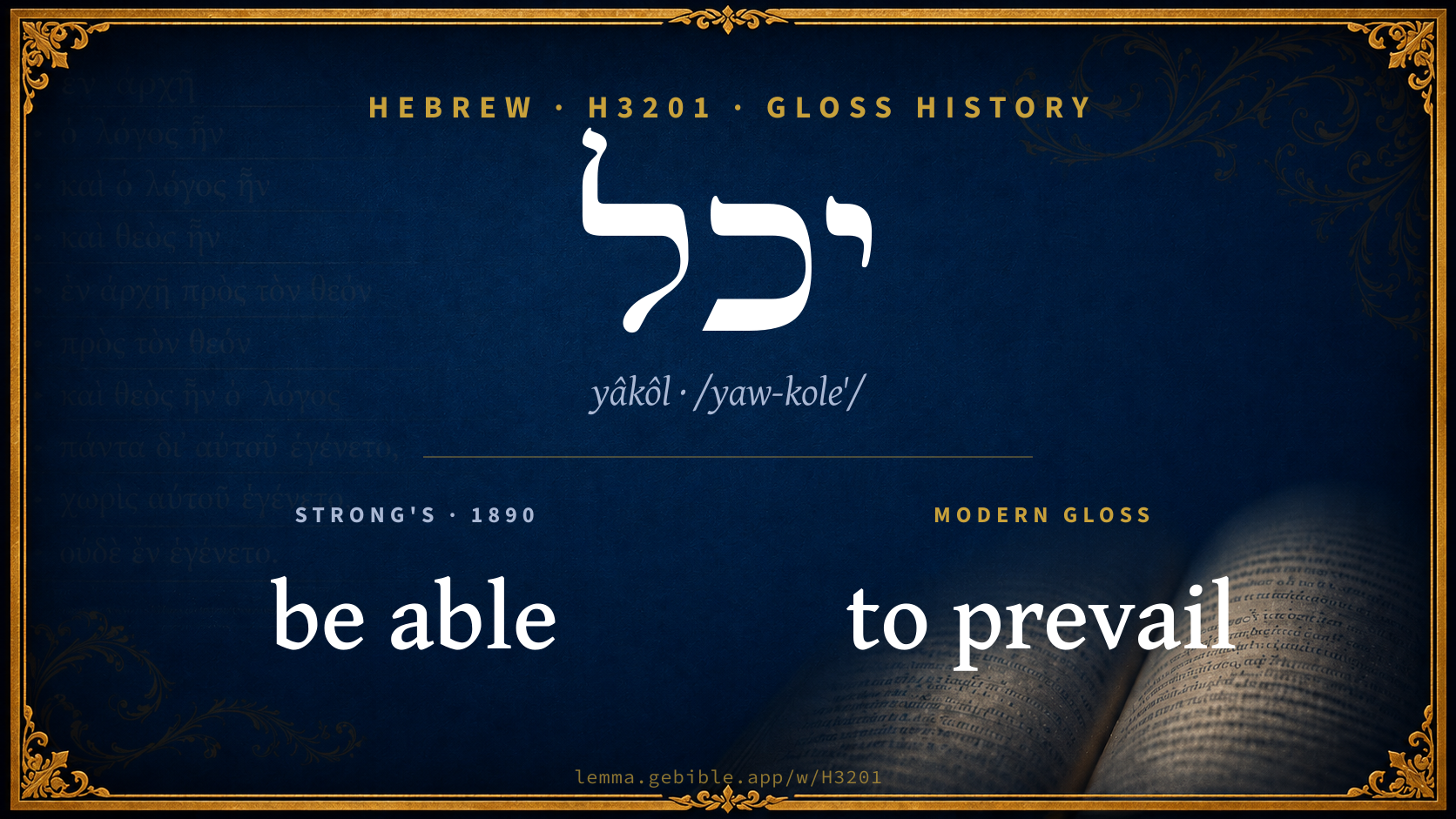
Gloss history
Strong's 1890 vs modern scholarship
About this word
Strong's H3201 catalogs a Hebrew word from the Hebrew Old Testament.
These counts are not copied from any lexicon or concordance. They are computed here, from the morphology-tagged Hebrew Old Testament. What Lemma adds →
- 182
- distinct verses
- The word appears in 182 distinct verses.
- 32 / 39
- OT books
- The word appears in 32 of 39 Old Testament books.
- #242
- by frequency
- Top 250 most frequent Hebrew words (rank 242 of 8,640 Hebrew words by occurrence).
View all 182 occurrences in the concordance →
Most concentrated in
- Genesis 21 verses 12%
- Jeremiah 20 verses 11%
- Deuteronomy 16 verses 9%
By section of the Old Testament
By traditional corpus
Conventional, traditional groupings — biblical authorship is debated, so this is a traditional corpus grouping, not an authorship claim. Each share is this word’s portion of its verses in that division of the Hebrew canon. Each figure is a share of the word’s 182 distinct verses.
- Prophets (Nevi'im) 80 verses · 44%
- Torah (Pentateuch) 61 verses · 34%
- Writings (Ketuvim) 41 verses · 23%
How translations render this word
Counts come from each version’s own published word-to-Strong’s tagging or interlinear alignment — an approximate guide to how each version renders this word, not a word-level alignment the data otherwise carries. Because each total is that version’s own tagged count, the per-version totals vary from one another and need not match the appearance or distinct-verse counts above. These counts may also differ from a printed concordance because Lemma counts each distinctly tagged rendering and does not collapse phrase taggings into a single head-word total. This is a fixed set of word-tagged versions (KJV, ASV, BSB, ULT) and does not change with the reading translation you choose elsewhere. Each version’s license is shown beside its name below (and on Sources).
- King James Version: Could 20×, Cannot 15×, They could 15×
- American Standard Version: Could 17×, Cannot 15×, They could 14×
- Berean Standard Bible: Could 13×, Can 11×, Prevail 7×
- unfoldingWord Literal Text: Able 96×, They were 17×, I am 16×
King James Version Public Domain
Renders H3201 across 193 tagged occurrences — most commonly:
Plus other, less common renderings. Plus 67 renderings that appear only once — usually multi-word phrases or single function words the recovered tagging swept in, not distinct renderings. Not rendered by a distinct English word in 2 further occurrences.
American Standard Version Public Domain
Renders H3201 across 192 tagged occurrences — most commonly:
Plus other, less common renderings. Plus 72 renderings that appear only once — usually multi-word phrases or single function words the recovered tagging swept in, not distinct renderings.
Berean Standard Bible Public Domain
Renders H3201 across 116 tagged occurrences — most commonly:
Plus other, less common renderings. Plus 42 renderings that appear only once — usually multi-word phrases or single function words the recovered tagging swept in, not distinct renderings. Not rendered by a distinct English word in 78 further occurrences.
unfoldingWord Literal Text CC BY-SA 4.0
Renders H3201 across 308 tagged occurrences — most commonly:
Plus other, less common renderings. Plus 47 renderings that appear only once — usually multi-word phrases or single function words the recovered tagging swept in, not distinct renderings.
16 senses and sub-senses in the full BDB
What do BDB’s symbols mean?
BDB uses these scholarly abbreviations:
| Symbol | Meaning |
|---|---|
| 𝔊 | the Septuagint (the ancient Greek translation, LXX) |
| 𝔙 | the Vulgate (the Latin translation) |
| 𝔖 | the Syriac version (the Peshitta) |
| 𝔗 | the Targum (the Aramaic translation) |
| ψ | the Psalms |
| √ | root (the underlying root or stem) |
| ‖ | parallel passage (a synonymous or contrasted parallel) |
| † | the dagger: every passage where the word occurs is cited |
The 16 senses and sub-senses the full Brown-Driver-Briggs lexicon distinguishes for this word, in lexicon order (not ranked by frequency), with BDB’s own verbatim wording and sub-sense lettering. Shown in Hebrew script with BDB’s own scholarly abbreviations. The condensed entry is in the Lexicon Entry tab. See also the Forms in the corpus table below.
Qal
- Pf. יָכֹל Gn 32:26 + 8 times; יָכוֹל 1 S 4:15 + 2 times; 3 fs. יָֽכְלָה Gn 36:7 Ex 2:3; 2 ms. וְיָכָלְתָּ֫ Ex 18:23; 1 s. יָכֹלְתִּי Gn 30:8 + 2 times; sf. יְכָלְתִּיו ψ 13:5; 3 pl. יָֽכְלוּ Gn 13:6 + 27 times + Jos 15:63 Qr; יָכֹ֑לוּ Ex 8:14 + 2 times; Impf. 3 ms. יוּכַל Gn 13:16 + 34 times; יוּכָ֑ל Jb 4:2 + 4 times; וַיֻּכָ֑ל Ho 12:5; 3 fs. תּוּכַל Am 7:10 + 2 times; 2 ms. תּוּכַל Gn 15:5 + 16 times; 1 s. אוּכַל Gn 19:19 + 30 times, etc. (on these Impf. forms as irreg. Qal, v. Ges§ 69, 2, R. 3 Köi. 407 WSG 237; others Hoph.); Inf. cstr. יְכֹ֫לֶת Nu 14:16 Dt 9:28; Inf. abs. יָכוֹל Nu 13:20 2 Ch 32:13; יָכֹל Nu 22:38 1 S 26:25; P 8 times (not Lv), Ez 3 times; often JED Je Is 2, not seld. SK Ch;— e.g. Genesis 32:26
- 1. be able, to do a thing, whether ability be physical, moral, constitutional, or dependent on external authority; usually of man Gn 13:16 (J) +, but also of gods 2 Ch 32:13, 15, and of י׳ Nu 14:16 (JE), Dt 9:28 Je 44:22; occasionally of inanimate things Am 7:10 Gn 36:7 (P), Ct 8:7 Ec 1:15(×2), etc.: e.g. Genesis 13:16
- a. usually sq. inf. c. לְ (122 times), Gn 31:35 I am not able to rise up; 45:1 Joseph was not able to restrain himself, v 3 48:10; Ex 7:21, 24 were not able to drink, 12:39 Jos 24:19 (all E); Gn 13:16 if a man can number the dust, 19:19, 22; 43:32; 44:22, 26(×2) Ex 10:5; 19:23 (all J), Gn 15:5 Ex 15:23 Nu 11:14 (all JE) + 10 times JE; Dt 7:17 + 10 times D; Gn 13:6 they could not dwell together, 34:14; 36:7 Ex 9:11; 40:35 Nu 9:6 Jos 9:19 (all P); 1 S 3:2; 6:20 1 K 9:21 (on ‖ 2 Ch 8:8 and text of Ju 1:19 v. BuRS 8), Am 7:10 Ho 5:13 Zp 1:18 Je 6:10; 11:11; 13:23; 18:6; 19:11 +. e.g. Genesis 31:35
- b. sq. inf. without לְ (27 times; not P): Gn 37:4 Ex 2:3; 18:18, 23 (all E), Gn 24:50; 44:1 (J), Nu 22:37, 38 (JE), Dt 1:9; 7:22; 14:24; 22:29 Ju 8:3 Je 49:10, 23 Hb 1:13 Is 46:2; 47:11, 12; 57:20 La 1:14 ψ 18:39; 36:13; 78:20 Pr 30:21 Jb 4:2; 33:5. e.g. Genesis 37:4
- c. c. inf. implic., always neg., Gn 29:8 go and feed them; and they said, We are not able, cannot (J), Ex 8:14 (P), Is 29;11 Je 20:9 ψ 21:12 Jon 1:13. e.g. Genesis 29:8
- d. c. neg. = may not (of moral inability): Gn 43:32 (J) the Egyptians might not eat bread with the Hebrews; Ju 21:18 we may not give them wives; especially D, Dt 7:22; 12:17; 14:24; 16:5; 17:15; 22:3; 28:27, 35. e.g. Genesis 43:32
- e. be able, sq. impf.: אוּלַי אוּכַל נַכֶּה Nu 22:6 (JE) perchance I am able (so that) we smite (v. Di; read perhaps נוּכַל for אוּכַל Ges§ 120, 1 b); לֹא יוּכְלוּ יִגְּעוּ La 4:14 they are unable, they touch = are unable to touch (Dr§ 163, Obs.) e.g. Numbers 22:6
- f. be able, sq. pf. consec., only very late, אוּכַל וְרָאִיתִי Est 8:6(×2), lit. how shall I be able and see?—Also in various combinations where English idiom would make it an auxiliary to another verb: e.g. Esther 8:6
- g. able to gain, accomplish: sq. acc. לֹא יוּכְלוּ נִקָּיוֹן Ho 8:5 how long will they be unable (to gain) innocence? יָדַעְתִּ֯ כִּי־כֹל תּוּכָ֑ל Jb 42:2 I know that thou art able (to do) all things; אֵין הַמֶּלֶךְ יוּכַל אֶתְכֶם דָּבָר Je 38:5 the king is not (one who is) able (to do) anything with (אֶתְכם for אִתְּכֶם v. Gf, i.e. against) you. e.g. Hosea 8:5
- h. able to endure: לֹא אוּכַל אָוֶן וַעֲצָרָה Is 1:13 I cannot endure iniquity and (with) a solemn assembly, ψ 101:5. e.g. Isaiah 1:13
- i. able to reach, sq. לְ, ψ 139:6 it is high, לֹא אוּכַל לָהּ I cannot (reach) to it. e.g. Psalms 139:6
- 2. prevail:
- a. abs. prevail, overcome, be victor Gn 30:8 (E), 32:29 (J), Ho 12:5 1 S 26:25 1 K 22:22 = 2 Ch 18:21 Je 20:7, 11; of waves 5:22; succeed Is 16:12, Je 3:5 (VB hast had thy way). e.g. Genesis 30:8
- b. sq. לְ pers., prevail against, over Gn 32:26 (J), Nu 13:30 (JE), Ju 16:5 1 S 17:19 Je 1:19; 15:20; 20:10; 38:22 Ob 7 ψ 129:2 Est 6:13. e.g. Genesis 32:26
- c. once c. sf., יְכָלְתִּיו ψ 13:5 I have prevailed over him, + Zc 9:15 (where read וְיָֽכְלוּם for וְאָֽכְלוּ with 𝔊 𝔗 KloThLZ 1879. 564 StaZAW 1881, 18). e.g. Psalms 13:5
- 3. abs. have ability, strength, only neg. מִשְּׂאֵתוֹ לֹא אוּכָ֑ל Jb 31:23 because of his loftiness I have no ability, am inadequate (to anything). e.g. Job 31:23
Senses from the full Brown-Driver-Briggs lexicon (Brown, Driver, Briggs; Oxford 1906 — public domain), digitized via Sefaria, supplemented by the OpenScriptures HebrewLexicon (CC BY 4.0). Full attribution on Sources.
Word origin
vb. be able, have power, prevail, endure (NH id.; Aramaic יְכִיל; Assyrian akâlu, Hpt in KAT2Gloss i,)—
— Brown-Driver-Briggs (Oxford 1906, public domain), digitized via Sefaria, supplemented by the OpenScriptures HebrewLexicon (CC BY 4.0). See Sources.
Origin: a primitive root
Jastrow Dictionary
A second Hebrew/Aramaic lexicon for comparison, covering Aramaic and post-biblical (Talmudic, Targumic, Midrashic) usage that the biblical-Hebrew BDB does not. Matched by lemma rather than by Strong’s number, so a lemma may carry more than one Jastrow headword (shown separately below), and the entries cover usage well beyond the Bible.
יָכוֹל
- 1. (adj.) m., יְכוֹלָה f. capable, able to sustain, enduring;
- 2. (verb), impf. יוּכַל, to be capable, able; one can, may; it is possible. Cant. R. to III, 6 לארי יָכֹלְתִּי … איני י׳ I overpowered the lion, and I should not overpower the dog? Ib. שר שלכם לא י׳ … ואתם יְכוֹלִים להם your guardian angel could not stand against their father (Jacob), and (you think) you could master them?—יְכוֹלְנִי = י׳ אני I can. Ḥag. 15ᵃ top Ms. M. (ed. יכול אני); Nidd. 64ᵇ.—Keth. 95ᵃ מפני שי׳ לומר וכ׳ because he may plead &c. Ib. יְכוֹלָה היא שתאמר she may plead. Ib. 43ᵃ, a. e. י׳ הרב לומר וכ׳ the master may (has a right to) say to his slave &c. Ber. 6ᵃ אין כל בריה י׳ לעמוד וכ׳ no creature could stand up (exist) before the demons. Taan. 30ᵇ ביָכוֹל of an able-bodied person.—Yalk. Esth. 1048 שמא תוּכַל להשיאה וכ׳ canst thou give her in marriage to both of them?—Midr. Till. to Ps. XLV לא יָכְלוּ להתודות וכ׳ they could not confess their sins with their mouth; a. v. fr.—Esp. יָכוֹל (= יכול אני לומר or י׳ אתה לומר) I (you) might think, argue, conclude. Sabb. 64ᵃ י׳ שאני מרבה וכ׳ from the Bible text (Lev. XI, 32) I might infer that ropes and cords are included; Sifra Sh’mini Par. 6, ch. VIII; a. v. fr.—כִּבְיָכוֹל as though it were possible, as it were (ref. to an allegorical or anthropomorphous expression with reference to the Lord). Mekh. Bo, Pisḥa, s. 14 כל זמן … כ׳ שכינה עמהם whenever Israel is enslaved, the Divine Majesty, as it were, is with them in slavery. Ib. כ׳ אמרו ישראל וכ׳ the Israelites said, thou, as it were, hast redeemed thyself. Ib. B’shall., Shirah, s. 6 כ׳ כלפי מעלה as if referring to the Lord’s eye. B. Kam. 79ᵇ, v. מַטָּה; a. fr.—Ch. יְכִיל. e.g. Leviticus 11:32
יָכֹל
- , v. יָכוֹל, יְכוֹלֶת.
A Dictionary of the Targumim, the Talmud Babli and Yerushalmi, and the Midrashic Literature (Marcus Jastrow; London, Luzac, 1903) — Public Domain. Digitized via Sefaria. Digitized via Sefaria. Full attribution on Sources.
Forms in the corpus
The 105 distinct written forms H3201 takes in the Hebrew Bible, most frequent first — each parse links to that stem’s occurrences in the concordance. Hebrew forms include their vowel points and cantillation, so a single lemma takes many written forms.
| Form | Parsing | Example | Uses |
|---|---|---|---|
| יוּכַ֣ל | Verb, Qal, Imperfect, 3rd Person, Masculine, Singular | Deuteronomy 24:4 | 9 |
| אוּכַ֖ל | Verb, Qal, Imperfect, 1st Person, Common, Singular | Deuteronomy 7:17 | 8 |
| אוּכַל֙ | Verb, Qal, Imperfect, 1st Person, Common, Singular | Esther 8:6 | 7 |
| יוּכַ֥ל | Verb, Qal, Imperfect, 3rd Person, Masculine, Singular | Deuteronomy 22:19 | 7 |
| יוּכַ֖ל | Verb, Qal, Imperfect, 3rd Person, Masculine, Singular | Ecclesiastes 8:17 | 5 |
| תוּכַ֖ל | Verb, Qal, Imperfect, 2nd Person, Masculine, Singular | Deuteronomy 16:5 | 5 |
| יָכֹ֣ל | Verb, Qal, Perfect, 3rd Person, Masculine, Singular | Exodus 40:35 | 4 |
| אוּכַ֥ל | Verb, Qal, Imperfect, 1st Person, Common, Singular | Deuteronomy 1:9 | 4 |
| יָכְל֖וּ | Verb, Qal, Perfect, 3rd Person, Common, Plural | Genesis 37:4 | 4 |
| יוּכְל֖וּ | Verb, Qal, Imperfect, 3rd Person, Masculine, Plural | Hosea 8:5 | 4 |
| יוּכַל֙ | Verb, Qal, Imperfect, 3rd Person, Masculine, Singular | Ecclesiastes 7:13 | 4 |
| נוּכַ֖ל | Verb, Qal, Imperfect, 1st Person, Common, Plural | Genesis 44:26 | 4 |
| תוּכַ֥ל | Verb, Qal, Imperfect, 3rd Person, Feminine, Singular | Isaiah 59:14 | 3 |
| אוּכַ֛ל | Verb, Qal, Imperfect, 1st Person, Common, Singular | 1 Kings 13:16 | 3 |
| אוּכָֽל | Verb, Qal, Imperfect, 1st Person, Common, Singular | Jeremiah 20:9 | 3 |
| יָֽכְל֗וּ | Verb, Qal, Perfect, 3rd Person, Common, Plural | Exodus 15:23 | 3 |
| יָֽכְלוּ֙ | Verb, Qal, Perfect, 3rd Person, Common, Plural | Exodus 7:24 | 3 |
| יָכְל֛וּ | Verb, Qal, Perfect, 3rd Person, Common, Plural | 1 Kings 9:21 | 3 |
| יָכְל֣וּ | Verb, Qal, Perfect, 3rd Person, Common, Plural | Exodus 7:21 | 3 |
| יָכְל֥וּ | Verb, Qal, Perfect, 3rd Person, Common, Plural | Joshua 15:63 | 3 |
| יוּכַ֗ל | Verb, Qal, Imperfect, 3rd Person, Masculine, Singular | Daniel 10:17 | 3 |
| יוּכָֽל | Verb, Qal, Imperfect, 3rd Person, Masculine, Singular | Isaiah 16:12 | 3 |
| תוּכַ֣ל | Verb, Qal, Imperfect, 2nd Person, Masculine, Singular | Esther 6:13 | 2 |
| אוּכַ֔ל | Verb, Qal, Imperfect, 1st Person, Common, Singular | Isaiah 29:11 | 2 |
| אוּכַ֗ל | Verb, Qal, Imperfect, 1st Person, Common, Singular | Numbers 22:18 | 2 |
| וַ/תּוּכָֽל | Verb, Qal, Sequential Imperfect, 2nd Person, Masculine, Singular | Genesis 32:28 | 2 |
| י֣וּכְלוּ | Verb, Qal, Imperfect, 3rd Person, Masculine, Plural | Jeremiah 1:19 | 2 |
| יְכֹ֣לֶת | Verb, Qal, Infinitive Construct | Deuteronomy 9:28 | 2 |
| יָ֥כְלוּ | Verb, Qal, Perfect, 3rd Person, Common, Plural | Psalms 36:12 | 2 |
| יָכֹ֑לוּ | Verb, Qal, Perfect, 3rd Person, Common, Plural | Exodus 8:18 | 2 |
| יָכֹ֖ל | Verb, Qal, Perfect, 3rd Person, Masculine, Singular | 1 Kings 13:4 | 2 |
| יָכֹל֙ | Verb, Qal, Perfect, 3rd Person, Masculine, Singular | Genesis 32:25 | 2 |
| נוּכַ֛ל | Verb, Qal, Imperfect, 1st Person, Common, Plural | Genesis 24:50 | 2 |
| תּוּכַ֕ל | Verb, Qal, Imperfect, 2nd Person, Masculine, Singular | 2 Kings 18:23 | 2 |
| תּוּכָ֑ל | Verb, Qal, Imperfect, 2nd Person, Masculine, Singular | 1 Samuel 26:25 | 2 |
| תּוּכָ֔ל | Verb, Qal, Imperfect, 2nd Person, Masculine, Singular | 1 Kings 22:22 | 2 |
| תוּכַ֗ל | Verb, Qal, Imperfect, 2nd Person, Masculine, Singular | Deuteronomy 17:15 | 2 |
| תוּכַל֙ | Verb, Qal, Imperfect, 2nd Person, Masculine, Singular | Deuteronomy 7:22 | 2 |
| א֥וּכַֽל | Verb, Qal, Imperfect, 1st Person, Common, Singular | Psalms 139:6 | 1 |
| אֽוּכַל | Verb, Qal, Imperfect, 1st Person, Common, Singular | 1 Samuel 17:9 | 1 |
| אוּכַ֤ל | Verb, Qal, Imperfect, 1st Person, Common, Singular | Numbers 11:14 | 1 |
| אוּכַ֨ל | Verb, Qal, Imperfect, 1st Person, Common, Singular | Jeremiah 18:6 | 1 |
| הֲ/י֣וּכַל | Verb, Qal, Imperfect, 3rd Person, Masculine, Singular | Psalms 78:19 | 1 |
| הֲ/יָכ֣וֹל | Verb, Qal, Infinitive Absolute | 2 Chronicles 32:13 | 1 |
| הֲ/יָכ֥וֹל | Verb, Qal, Infinitive Absolute | Numbers 22:38 | 1 |
| הַ/אוּכַ֥ל | Verb, Qal, Imperfect, 1st Person, Common, Singular | 2 Samuel 12:23 | 1 |
| וְ/יָֽכָלְתָּ֖ | Verb, Qal, Sequential Perfect, 2nd Person, Masculine, Singular | Exodus 18:23 | 1 |
| וְ/יָכְל֤וּ | Verb, Qal, Perfect, 3rd Person, Common, Plural | Jeremiah 38:22 | 1 |
| וְ/נ֣וּכְלָה | Verb, Qal, Cohortative, 1st Person, Common, Plural | Jeremiah 20:10 | 1 |
| וַ/יֻּכָ֔ל | Verb, Qal, Sequential Imperfect, 3rd Person, Masculine, Singular | Hosea 12:4 | 1 |
| וַ/תּוּכָ֑ל | Verb, Qal, Sequential Imperfect, 2nd Person, Masculine, Singular | Jeremiah 20:7 | 1 |
| י֣וּכַל | Verb, Qal, Imperfect, 3rd Person, Masculine, Singular | Psalms 78:20 | 1 |
| יְכָלְתִּ֑י/ו | Verb, Qal, Perfect, 1st Person, Common, Singular | Psalms 13:4 | 1 |
| יָֽכְל֔וּ | Verb, Qal, Perfect, 3rd Person, Common, Plural | 2 Chronicles 29:34 | 1 |
| יָֽכְל֖וּ | Verb, Qal, Perfect, 3rd Person, Common, Plural | Genesis 13:6 | 1 |
| יָכ֔וֹל | Verb, Qal, Perfect, 3rd Person, Masculine, Singular | 2 Chronicles 32:14 | 1 |
| יָכ֖וֹל | Verb, Qal, Perfect, 3rd Person, Masculine, Singular | 1 Samuel 4:15 | 1 |
| יָכ֗וֹל | Verb, Qal, Perfect, 3rd Person, Masculine, Singular | 2 Chronicles 7:7 | 1 |
| יָכ֥וֹל | Verb, Qal, Infinitive Absolute | Numbers 13:30 | 1 |
| יָכְל֗וּ | Verb, Qal, Perfect, 3rd Person, Common, Plural | Nehemiah 7:61 | 1 |
The 60 most common forms are shown; 45 rarer forms follow in the full concordance.
Same root — word family
Other BDB entries built from the same root as H3201, grouped by Strong’s listed origin. These share a root / origin per the lexicon — not necessarily a shared meaning. Each links to that word’s own entry.
Derived from this word
- היכל hêykâl H1964 temple
- יכל yᵉkêl H3202 to prevail
- כהל kᵉhal H3546 to be able
- מיכל mîykâl H4323 brook
Proper names from this root
People and places named from this root — a name, not an additional meaning of the word.
Compare all same-root words → Showing 4 of 7 — not the complete family. 2 of the same-root words are proper names (people or places). They share a root, not necessarily a meaning.
Septuagint verse parallels
This word appears in 172 verses that also exist in the Greek Old Testament (Septuagint), out of the 182 Hebrew verses it occurs in. You can read those verses in Greek by switching the Old Testament edition to the Septuagint.
Read these verses in the Septuagint
- Genesis 13:6
- Exodus 2:3
- Numbers 9:6
- Deuteronomy 1:9
- Joshua 7:12
- Judges 2:14
- Ruth 4:6
- 1 Samuel 3:2
- 2 Samuel 3:11
- 1 Kings 3:9
- 2 Kings 3:26
- 1 Chronicles 21:30
This is a verse-level parallel only — the same verses exist in both the Hebrew and Greek Old Testaments. No word-level Hebrew↔Greek correspondence is claimed: the data carries no such alignment, so no Greek word is shown as this Hebrew word’s translation. Coverage is not total — the Septuagint omits the deuterocanon and renumbers the Psalms, so some Hebrew verses have no direct Greek parallel.