Numbers 22:37

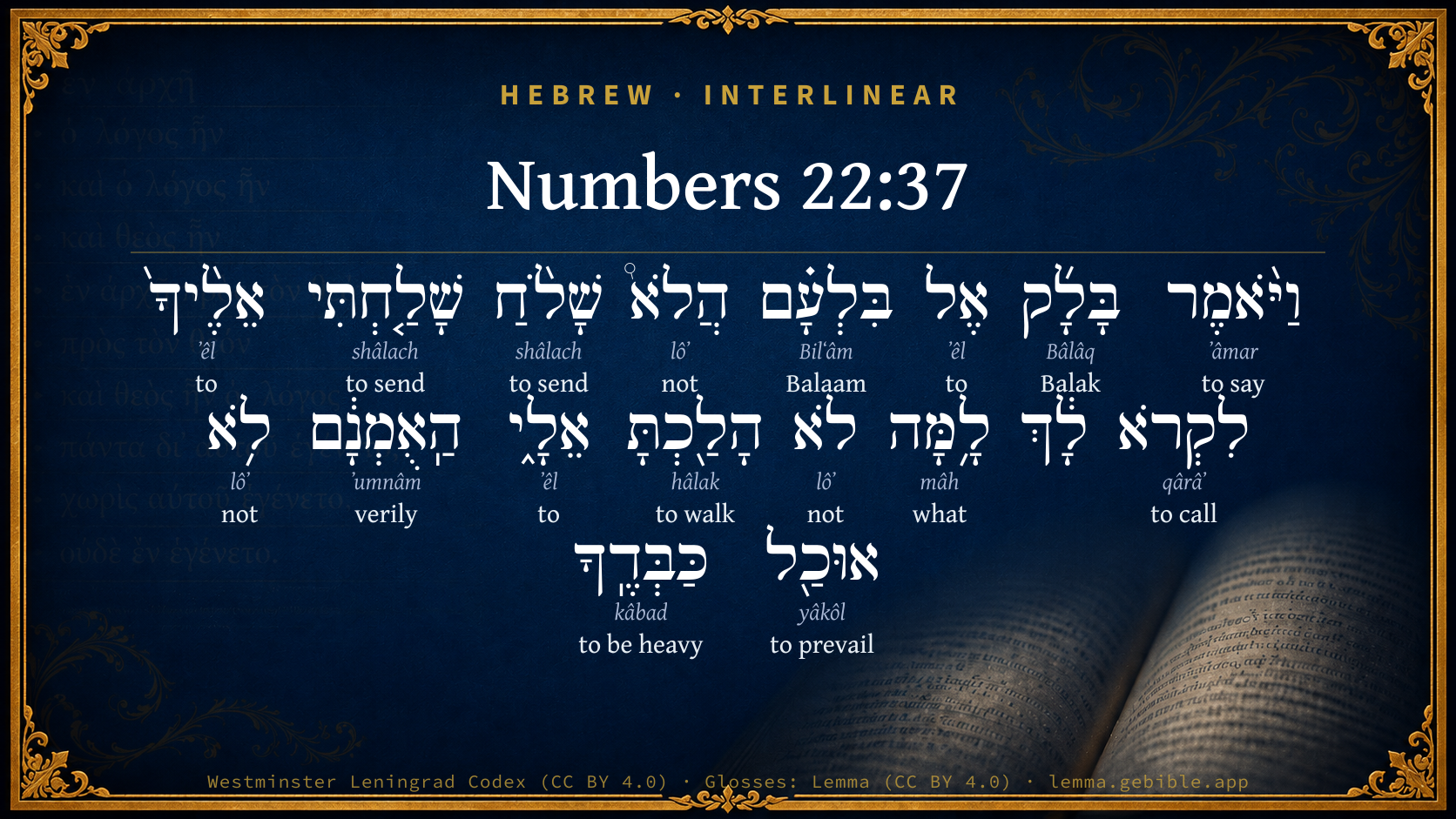
Hebrew (Westminster Leningrad Codex) Numbers 22:37 appears in the Hebrew Old Testament. The text above is from the Westminster Leningrad Codex. Each word links to its Strong’s number, a concise gloss, and parsing drawn from the Open Scriptures Hebrew Bible morphology. Click any word for its full Brown-Driver-Briggs (BDB) entry.
Download image
Cite this verse

Numbers 22:37 (World English Bible). Public Domain. Lemma interlinear Bible study tool, https://lemma.gebible.app/v/numbers/22/37.

Show BibTeX & RIS
BibTeX
RIS
English Translation
Balak said to Balaam, Didn't I earnestly send to you to call you? why didn't you come to me? am I not able indeed to promote you to honor?
World English Bible · Public Domain
Download a study sheet

One document with this verse’s original text, its word-by-word gloss line, the meaning frame, cross-references with their text, attributed commentary, and full source and license credits — printable, and it pastes into notes with its structure intact.

This verse Autodidact and up

Study sheet (.html) Plain text (.txt)

A passage Seminary Student

Up to 50 verses in one chapter. A passage sheet keeps up to 6 commentary sources and 12 cross-references per verse, in the order this page ranks them, and says so on the sheet whenever that leaves anything out. Ask for a single verse and you get the Autodidact verse sheet above.

Everything on this page stays free to read, with no account — the sheet is a download of what is already on screen, not access to it.

Want to remove ads? Support Godless Engineer
Compare translations 3

The same verse in 3 English versions, stacked beneath the original-language interlinear above. Click any original word for its lexicon entry.

Each is an independent rendering of the whole verse — the interlinear is not word-aligned to these translations.

Highlighted words mark where these versions differ — a whole-verse word diff, not a word-by-word alignment.

  • World English Bible Public Domain
    Balak said to Balaam, Didn't I earnestly send to you to call you? why didn't you come to me? am I not able indeed to promote you to honor?
  • King James Version Public Domain
    And Balak said unto Balaam, Did I not earnestly send unto thee to call thee? wherefore camest thou not unto me? am I not able indeed to promote thee to honor?
  • unfoldingWord Literal Text CC BY-SA 4.0
    And Balak said to Balaam, “Did I not sending send to you to summon you? Why did you not come to me? Am I truly not able to honor you?”

unfoldingWord Literal Text — © unfoldingWord, licensed CC BY-SA 4.0. Word-aligned USFM3 via Door43 (git.door43.org/unfoldingWord/en_ult).

Versions to compare (up to 4)

3 of 4 selected

Show all 18 translations

Every available English version of this verse, each an independent rendering of the whole verse.

  • World English Bible Public Domain
    Balak said to Balaam, Didn't I earnestly send to you to call you? why didn't you come to me? am I not able indeed to promote you to honor?
  • Berean Standard Bible Public Domain
    And he said to Balaam, “Did I not send you an urgent summons? Why did you not come to me? Am I really not able to richly reward you?”
  • Majority Standard Bible Public Domain
    And he said to Balaam, “Did I not send you an urgent summons? Why did you not come to me? Am I really not able to reward you richly?”
  • King James Version Public Domain
    And Balak said unto Balaam, Did I not earnestly send unto thee to call thee? wherefore camest thou not unto me? am I not able indeed to promote thee to honor?
  • American Standard Version (1901) Public Domain
    And Balak said unto Balaam, Did I not earnestly send unto thee to call thee? wherefore camest thou not unto me? am I not able indeed to promote thee to honor?
  • Revised Version (1885) Public Domain
    And Balak said unto Balaam, Did I not earnestly send unto thee to call thee? wherefore camest thou not unto me? am I not able indeed to promote thee to honour?
  • Geneva Bible (1599) Public Domain
    Then Balak saide vnto Balaam, Did I not sende for thee to call thee? Wherefore camest thou not vnto me? am I not able in deede to promote thee vnto honour?
  • Douay-Rheims (1899) Public Domain
    And he said to Balaam: I sent messengers to call thee, why didst thou not come immediately to me? was it because I am not able to reward thy coming?
  • Young's Literal Translation Public Domain
    and Balak saith unto Balaam, `Did I not diligently sent unto thee to call for thee? why didst thou not come unto me? am I not truly able to honour thee?'
  • Literal Standard Version CC BY-SA 4.0
    and Balak says to Balaam, “Did I not diligently send to you to call for you? Why did you not come to me? Am I not truly able to honor you?”
  • Unlocked Literal Bible CC BY-SA 4.0
    Balak said to Balaam, “Did I not send men to you to summon you? Why did you not come to me? Am I not able to honor you?”
  • unfoldingWord Literal Text CC BY-SA 4.0
    And Balak said to Balaam, “Did I not sending send to you to summon you? Why did you not come to me? Am I truly not able to honor you?”
  • Darby Bible Public Domain
    And Balak said to Balaam, Did I not earnestly send to thee to call thee? why didst thou not come to me? am I not surely able to honour thee?
  • World Messianic Bible Public Domain
    Balak said to Balaam, “Didn’t I earnestly send for you to summon you? Why didn’t you come to me? Am I not able indeed to promote you to honor?”
  • Webster's Bible Public Domain
    And Balak said to Balaam, Did I not earnestly send to thee to call thee? why camest thou not to me? am I not able indeed to promote thee to honor?
  • Free Bible Version CC BY-SA 4.0
    He said to Balaam, “Didn't you think my call for you to come was urgent? Why didn't you come to me straight away? Did you think I couldn't pay you enough?”
  • Bible in Basic English Public Domain
    And Balak said to Balaam, Did I not send to you, requesting you with all my heart to come to me? why did you not come? am I not able to give you a place of honour?
  • JPS Tanakh (1917) Public Domain
    And Balak said unto Balaam: 'Did I not earnestly send unto thee to call thee? wherefore camest thou not unto me? am I not able indeed to promote thee to honour?'

Literal Standard Version (2020), Covenant Press — licensed CC BY-SA 4.0. Text via the HelloAO Bible API (eBible.org). Unlocked Literal Bible (unfoldingWord) — licensed CC BY-SA 4.0. Text via the HelloAO Bible API (eBible.org). unfoldingWord Literal Text — © unfoldingWord, licensed CC BY-SA 4.0. Word-aligned USFM3 via Door43 (git.door43.org/unfoldingWord/en_ult). Free Bible Version, Dr. Jonathan Gallagher — licensed CC BY-SA 4.0. Text via the HelloAO Bible API (eBible.org).

Word by word

More ways to search: Search by grammar → Find every occurrence → Compare this word →

Practice this passage: Drill this verse → Learn its vocabulary →

הַֽאֻמְנָ֔ם
ʼumnâm
H552
“verily”
Particle, Interrogative + Adverb
Part of Speech
Particle + Adverb
Full BDB Definition

Origin: an orthographical variation of H551

TWOT: 116i

verily, truly, indeed
  1. וַיֹּ֨אמֶר ʼâmar H559 “and · to say” Conjunction + Verb, Qal, Sequential Imperfect, 3rd Person, Masculine, Singular
  2. בָּלָ֜ק Bâlâq H1111 “Balak” Noun, Proper
  3. אֶל ʼêl H413 “to” Preposition
  4. בִּלְעָ֗ם Bilʻâm H1109 “Balaam” Noun, Proper
  5. הֲלֹא֩ lôʼ H3808 “not” Particle, Interrogative + Particle, Negative
  6. שָׁלֹ֨חַ shâlach H7971 “to send” Verb, Qal, Infinitive Absolute
  7. שָׁלַ֤חְתִּי shâlach H7971 “to send” Verb, Qal, Perfect, 1st Person, Common, Singular
  8. אֵלֶ֨יךָ֙ ʼêl H413 “to · you” Preposition + Suffix, Personal, 2nd Person, Masculine, Singular
  9. לִקְרֹא qârâʼ H7121 “to call” Preposition + Verb, Qal, Infinitive Construct
  10. לָ֥מָּה mâh H4100 “to/for · what” Preposition + Particle, Interrogative
  11. לֹא lôʼ H3808 “not” Particle, Negative
  12. הָלַ֖כְתָּ hâlak H1980 “to walk” Verb, Qal, Perfect, 2nd Person, Masculine, Singular
  13. אֵלָ֑י ʼêl H413 “to · me” Preposition + Suffix, Personal, 1st Person, Common, Singular
  14. לֹ֥א lôʼ H3808 “not” Particle, Negative
  15. אוּכַ֖ל yâkôl H3201 “to prevail” Verb, Qal, Imperfect, 1st Person, Common, Singular
  16. כַּבְּדֶֽךָ kâbad H3513 “to be heavy · you” Verb, Piel, Infinitive Construct + Suffix, Personal, 2nd Person, Masculine, Singular

About this verse

These counts appear in no published source. They are computed here, from the morphology-tagged text and Lemma’s own curated glosses. What Lemma adds →

18
words
12
distinct lemmas
Pentateuch
section

Notable vocabulary

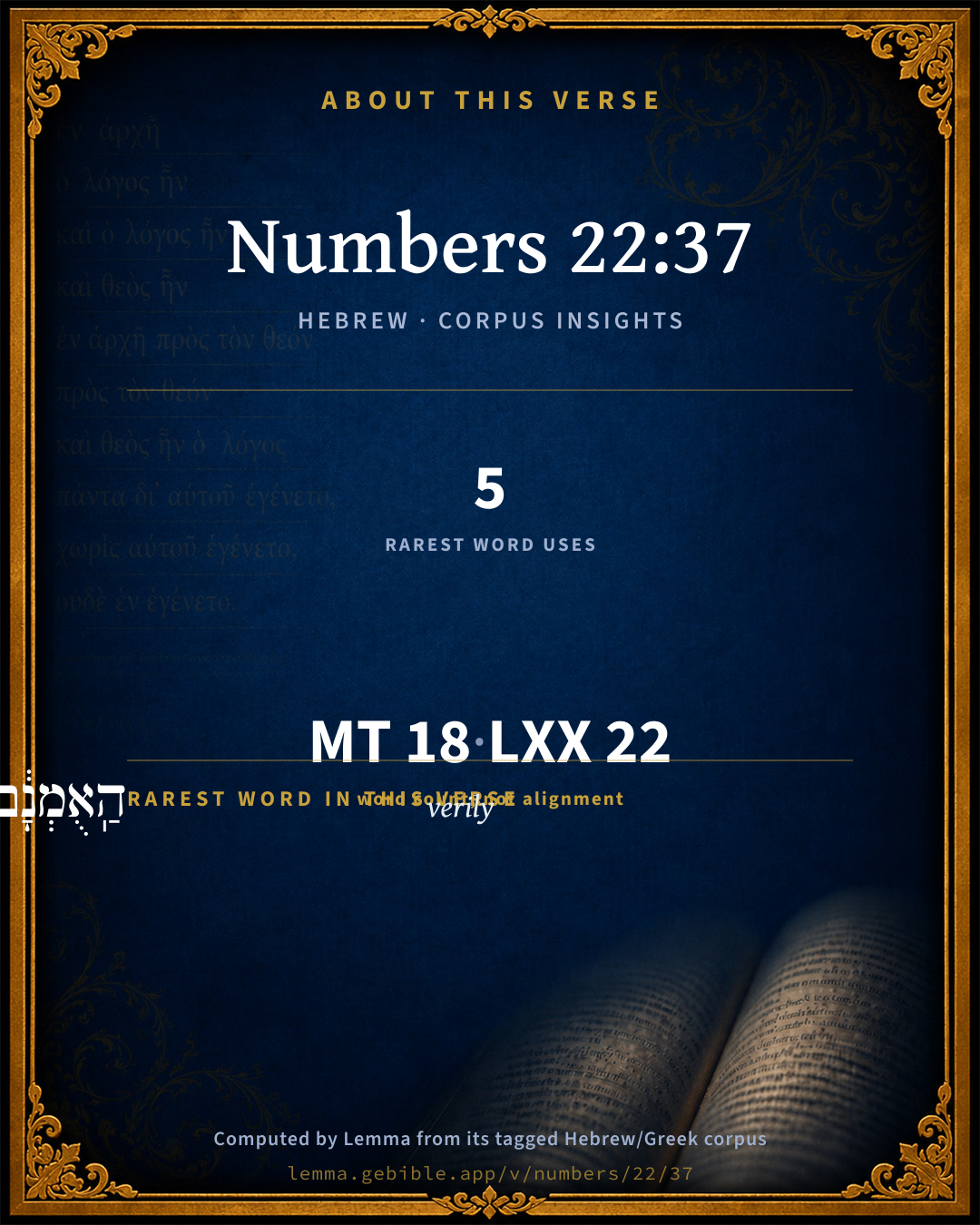
The rarest word here is הַֽאֻמְנָ֔ם verily H552 — appearing just 5 times in the whole Hebrew Bible.

Shared distinctive vocabulary

הַֽאֻמְנָ֔ם verily H552 occurs in 5 verses of the Hebrew Bible. Also found in:

Grammatical profile

  • 7 verbs
  • 2 nouns
  • 4 prepositions
  • 1 adverb
  • 4 particles

Verb forms

  • וַיֹּ֨אמֶר Qal · Sequential Imperfect
  • שָׁלֹ֨חַ Qal · Infinitive Absolute
  • שָׁלַ֤חְתִּי Qal · Perfect
  • לִקְרֹא Qal · Infinitive Construct
  • הָלַ֖כְתָּ Qal · Perfect
  • אוּכַ֖ל Qal · Imperfect
  • כַּבְּדֶֽךָ Piel · Infinitive Construct

Repetition

Words recur within this verse — often emphatic in Hebrew:

  • שָׁלֹ֨חַ to send H7971 ×2
  • אֶל to H413 ×3
  • הֲלֹא֩ not H3808 ×3

Hebrew & Septuagint length

In English translation the verse runs 29 words from the Hebrew and 30 from the Septuagint (LXX English) — closely comparable.

A rough comparison of the two English renderings, which tokenize alike — not a word-level alignment.

Word counts can differ between the Hebrew and the Greek without any difference in meaning — e.g. the Hebrew direct-object marker אֵת has no separate Greek word, and Greek often adds the article ὁ.

In the original languages it is 18 Hebrew tokens and 22 Greek tokens — but the two are counted differently (Hebrew bundles its prefixes and suffixes into one token; the Greek is in lemma form), so that isn’t a like-for-like length.

Cross-references

6

Topical passages linked to Numbers 22:37 in the Treasury of Scripture Knowledge — connected by theme and wording, ordered by reader-vote popularity; previews shown in the World English Bible.

  • Numbers 24:11 Therefore now flee you to your place: I thought to promote you to great honor; but, behold, Yahweh has kept you back from honor.
  • John 5:44 How can you believe, who receive glory from one another, and you don't seek the glory that comes from the only God?
  • Numbers 22:16–17 They came to Balaam, and said to him, Thus says Balak the son of Zippor, Please let nothing hinder you from coming to me:
  • Psalms 75:6 For neither from the east, nor from the west, Nor yet from the south, comes exaltation.
  • Matthew 4:8–9 Again, the devil took him to an exceedingly high mountain, and showed him all the kingdoms of the world, and their glory.
  • Luke 4:6 The devil said to him, "I will give you all this authority, and their glory, for it has been delivered to me; and I give it to whomever I want.

Cross-references courtesy of OpenBible.info (CC BY 4.0).

Hebrew and Greek witnesses Masoretic Hebrew ↔ Greek Septuagint

The same verse in the two great witnesses to the Old Testament, shown verse-for-verse.

These are two independent witnesses, not word-aligned to each other, and the Septuagint is shown in lemma (dictionary) form.

Hebrew Numbers 22:37 Masoretic · Westminster Leningrad Codex

וַיֹּ֨אמֶר בָּלָ֜ק אֶל בִּלְעָ֗ם הֲלֹא֩ שָׁלֹ֨חַ שָׁלַ֤חְתִּי אֵלֶ֨יךָ֙ לִקְרֹא לָ֔ךְ לָ֥מָּה לֹא הָלַ֖כְתָּ אֵלָ֑י הַֽאֻמְנָ֔ם לֹ֥א אוּכַ֖ל כַּבְּדֶֽךָ

Balak said to Balaam, Didn't I earnestly send to you to call you? why didn't you come to me? am I not able indeed to promote you to honor?

World English Bible · Public Domain

Greek LXX Numbers 22:37 Septuagint · lemma form

καί εἶπον βαλακ πρός βαλααμ οὐ ἀποστέλλω πρός σύ καλέω σύ διά τίς οὐ ἄρχω πρός ἐγώ ὄντως οὐ δύναμαι τιμάω σύ

And Balac said to Balaam, Did I not send to you to call you? why have you not come to me? shall I not indeed be able to honor you?

LXX2012 (modern English Septuagint) · Public Domain

Hebrew: Westminster Leningrad Codex (CC BY 4.0). Greek: Septuagint (public domain); English from LXX2012 (modern English Septuagint) (Public Domain). How the Septuagint differs from the Hebrew →

Targum (Aramaic paraphrase)

2

The Targum is the ancient Jewish Aramaic paraphrase of the Hebrew Scriptures — an interpretive translation, not the Hebrew text itself. Onkelos (literal) and Pseudo-Jonathan (expansive) render the Torah, and Jonathan the Prophets. Coverage is partial: where no permissively-licensed English translation exists for a verse, only the Aramaic is shown. This is verse-level text, not a word-by-word alignment to the Hebrew.

  1. Targum Onkelos Torah (Genesis–Deuteronomy)
    וַאֲמַר בָּלָק לְבִלְעָם הֲלָא מִשְׁלַח שַׁלְחִית לְוָתָךְ לְמִקְרֵי לָךְ לְמָא לָא אֲתֵיתָא לְוָתִי הַבְקוּשְׁטָא הֲוֵיתָא אָמַר לֵית אֲנָא יָכִיל לְיַקְרוּתָךְ

    (no public-domain English translation for this verse)

    Targum Onkelos — Aramaic: “Onkelos Genesis” (public domain); “Onkelos Exodus” (public domain); “Onkelos Leviticus” (public domain); “Onkelos Numbers” (public domain); “Onkelos Deuteronomy” (public domain). English: “Sefaria Community Translation” (CC0 1.0 (public-domain dedication)); “J.W. Etheridge. The Targums of Onkelos and Jonathan Ben Uzziel on the Pentateuch. London: Longmans, Green, 1862” (public domain). Text via Sefaria.

  2. Targum Pseudo-Jonathan Torah (Genesis–Deuteronomy)
    וַאֲמַר בָּלָק לְבִלְעָם הֲלָא שַׁדְרָא שְׁדָרִית לְוָתָךְ לְמִקְרֵי לָךְ לְמָא לָא אָתֵיתָא לְוָתִי הַבְּרַם מִן קוּשְׁטִין הֲוֵוית אָמַר לֵית אֲנָא יָכִיל לִמְיַיקְרָא יָתָךְ

    And Balak said to Bileam, Did I not send to call thee? Why camest thou not to me? Didst thou not indeed say that I could not do thee honour?

    Targum Pseudo-Jonathan — Aramaic: “Targum Jonathan on Genesis” (public domain); “Targum Jonathan on Exodus” (public domain); “Targum Jonathan on Leviticus” (public domain); “Targum Jonathan on Numbers” (public domain); “Targum Jonathan on Deuteronomy” (public domain). English: “The Targum of Jonathan ben Uzziel, trans. J. W. Etheridge, London, 1862” (public domain). Text via Sefaria.

Commentary

Notes on Numbers 22:37 from classic Christian and Jewish commentators (each source and its license shown beneath its notes). The classic Christian expositions comment on the surrounding passage and are grouped to its opening verse, so a note may address several verses; the Jewish commentaries on the Tanakh (Rashi and others) are per-verse, so they appear only where the commentator wrote on this verse.

Lemma curates 59 commentaries, every one of them public domain or Creative Commons licensed, each selected and text-cleaned for this edition rather than reprinted as found. About our sources →

Trapp's Complete Commentary

John Trapp

Num 22:37 And Balak said unto Balaam, Did I not earnestly send unto thee to call thee? wherefore camest thou not unto me? am I not able indeed to promote thee to honour?

Ver. 37. To promote thee to honour.] But what is such honour more than a magnum nihil, nay a great mischief? Like the wings of a butterfly curiously painted; but they foul the fingers of those that catch it.

John Trapp, A Commentary or Exposition upon All the Books of the Old and New Testament (1647–1656) — public domain. Text from a community e-Sword module.

Tyndale Open Study Notes

Tyndale Open Resources

22:37 Balak thought Balaam did not understand how urgent the situation was nor how great the offered payment.

Tyndale Open Study Notes — © Tyndale Open Resources, licensed CC BY-SA 4.0. Text via the HelloAO Bible API.

The Cambridge Bible for Schools and Colleges

gen. ed. J. J. S. Perowne

37. to promote thee to honour] to honour thee; see on Num_22:17.

The Cambridge Bible for Schools and Colleges (gen. ed. J. J. S. Perowne; Cambridge University Press, 1878–1918) — public domain. Text from a community e-Sword module.

John Gill's Exposition

And Balak offered oxen and sheep,.... Or "slew" (w) them, either for sacrifice; and if so Balak was the sacrificer, as it was common for kings to be priests; and then Balaam, who was sent for, was the prophet, that was to observe and explain any omen at the time of sacrificing, as Calchas did, when the chiefs of Greece sacrificed (x): or rather for a feast, as the following words seem to show; though it might be for both, it being usual, when sacrifices were offered to idols, to eat part of them in a festival way, in imitation of the peace offerings of the Jews, see Num 25:2,

and sent to Balaam, and to the princes that were with him; either part of it to them, or he sent for them to come, and partake of the feast, he and the princes of Moab and Midian, that had been to fetch him, and still attended him; and this the king did in a way of rejoicing, being glad that Balaam was come, and as expressing his well pleasedness with the conduct of the princes, and their success, as well as to keep Balaam in high spirits, hoping to have his end answered by him.

(w) "cuinque occidisset", V. L. (x) Homer. Iliad. 1.

John Gill's Exposition of the Whole Bible (1746–1763) — public domain (CC PDM 1.0). Text via the HelloAO Bible API.

Whedon's Commentary on the Bible

Daniel D. Whedon

37. Promote thee to honour — After a gentle reproof for refusing his first invitation, Balak excites Balaam’s imagination by promises of honour. But instead of bestowing honours, Balak dismissed him in disgrace. Num_24:10-11; Mat_4:8-9.

Daniel D. Whedon (gen. ed.), Commentary on the Old and New Testaments (1874–1909) — public domain. Text from a community e-Sword module.

Rashi

Rabbi Shlomo Yitzchaki (Rashi)

האמנם לא אוכל כבדך AM I NOT ABLE INDEED TO HONOUR YOU — He prophesied unwittingly that he (Balaam) would eventually leave him in disgrace (Midrash Tanchuma, Balak 10).

Rashi on the Tanakh — English translations: “The Judaica Press complete Tanach with Rashi, translated by A. J. Rosenberg” (CC BY 4.0); “Pentateuch with Rashi's commentary by M. Rosenbaum and A.M. Silbermann, 1929-1934” (public domain); “The Metsudah Tanach series, Lakewood, N.J” (CC BY 4.0); and “The Book of Joshua, Metsudah Publications, 1997” (CC BY 4.0). Text via Sefaria.

Lesson kit

Teaching starters — assembled from the data on this page, not authored interpretation. Every prompt links to the verse data it draws on. Edit before teaching.

Numbers, in the Pentateuch, opens this verse with 18 words (12 distinct Hebrew lemmas). Its most distinctive word is ʼumnâm (“verily”). A historical commentator’s framing appears above. Read the whole chapter for the surrounding context.

Discussion questions

  1. What does “verily” (ʼumnâm) contribute to the verse as a whole?
  2. Genesis 18:13 shares the word «verily» with this verse. How do the two illuminate each other?
  3. “to send” occurs 2× in this one verse. What is the effect of the repetition?
  4. These translations render this verse differently. What is at stake in choosing one wording over another?
  5. The verb «וַיֹּ֨אמֶר» is Qal Sequential Imperfect. How does its form color the action?
  6. Reading how Trapp's Complete Commentary and Tyndale Open Study Notes read this verse, where do the two commentators agree and where do they part?

Things to notice

Reading settings

Reading text

Shown beneath each verse's original-language words.

Old Testament
Old Testament edition

Read the OT as the Masoretic Hebrew (MT) or the Greek Septuagint (LXX).

English shown for the Greek Septuagint (in the Hebrew ↔ Greek comparison).

Comparing translations? Open the Compare panel on any verse page to stack up to four side by side.