Ecclesiastes 1:8

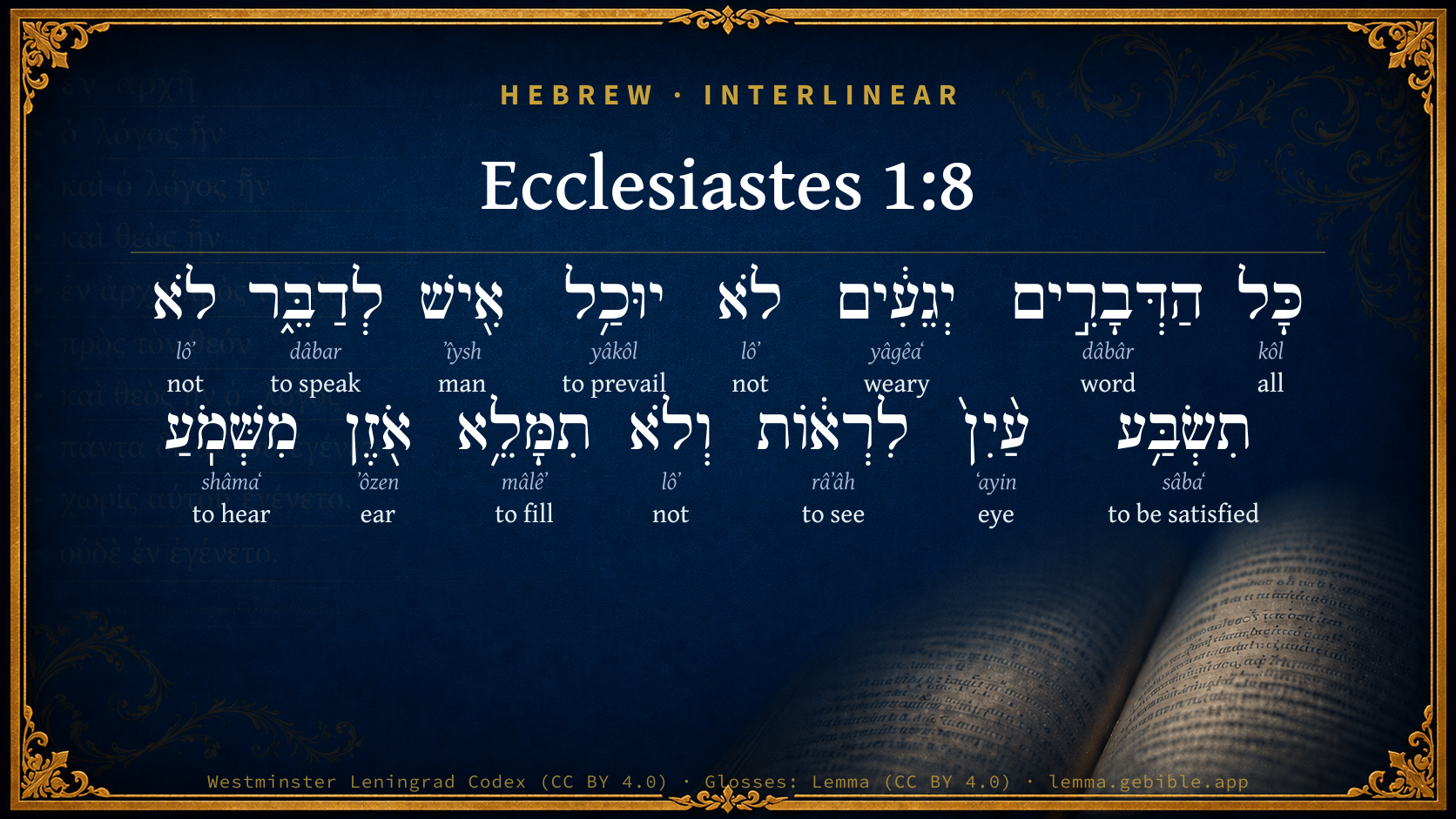
Hebrew (Westminster Leningrad Codex) Ecclesiastes 1:8 appears in the Hebrew Old Testament. The text above is from the Westminster Leningrad Codex. Each word links to its Strong’s number, a concise gloss, and parsing drawn from the Open Scriptures Hebrew Bible morphology. Click any word for its full Brown-Driver-Briggs (BDB) entry.
Download image
Cite this verse

Ecclesiastes 1:8 (World English Bible). Public Domain. Lemma interlinear Bible study tool, https://lemma.gebible.app/v/ecclesiastes/1/8.

Show BibTeX & RIS
BibTeX
RIS
English Translation
All things are full of weariness beyond uttering. The eye is not satisfied with seeing, nor the ear filled with hearing.
World English Bible · Public Domain
Download a study sheet

One document with this verse’s original text, its word-by-word gloss line, the meaning frame, cross-references with their text, attributed commentary, and full source and license credits — printable, and it pastes into notes with its structure intact.

This verse Autodidact and up

Study sheet (.html) Plain text (.txt)

A passage Seminary Student

Up to 50 verses in one chapter. A passage sheet keeps up to 6 commentary sources and 12 cross-references per verse, in the order this page ranks them, and says so on the sheet whenever that leaves anything out. Ask for a single verse and you get the Autodidact verse sheet above.

Everything on this page stays free to read, with no account — the sheet is a download of what is already on screen, not access to it.

Want to remove ads? Support Godless Engineer
Compare translations 3

The same verse in 3 English versions, stacked beneath the original-language interlinear above. Click any original word for its lexicon entry.

Each is an independent rendering of the whole verse — the interlinear is not word-aligned to these translations.

Highlighted words mark where these versions differ — a whole-verse word diff, not a word-by-word alignment.

  • World English Bible Public Domain
    All things are full of weariness beyond uttering. The eye is not satisfied with seeing, nor the ear filled with hearing.
  • King James Version Public Domain
    All things are full of labour; man cannot utter it: the eye is not satisfied with seeing, nor the ear filled with hearing.
  • unfoldingWord Literal Text CC BY-SA 4.0
    All the things wearisome; a person is not able to speak. An eye is not satisfied of seeing, and an ear is not filled from hearing.

unfoldingWord Literal Text — © unfoldingWord, licensed CC BY-SA 4.0. Word-aligned USFM3 via Door43 (git.door43.org/unfoldingWord/en_ult).

Versions to compare (up to 4)

3 of 4 selected

Show all 18 translations

Every available English version of this verse, each an independent rendering of the whole verse.

  • World English Bible Public Domain
    All things are full of weariness beyond uttering. The eye is not satisfied with seeing, nor the ear filled with hearing.
  • Berean Standard Bible Public Domain
    All things are wearisome, more than one can describe; the eye is not satisfied with seeing, nor the ear content with hearing.
  • Majority Standard Bible Public Domain
    All things are wearisome, more than one can describe; the eye is not satisfied with seeing, nor the ear content with hearing.
  • King James Version Public Domain
    All things are full of labour; man cannot utter it: the eye is not satisfied with seeing, nor the ear filled with hearing.
  • American Standard Version (1901) Public Domain
    All things are full of weariness; man cannot utter `it': the eye is not satisfied with seeing, nor the ear filled with hearing.
  • Revised Version (1885) Public Domain
    All things are full of weariness; man cannot utter it: the eye is not satisfied with seeing, nor the ear filled with hearing.
  • Geneva Bible (1599) Public Domain
    All things are full of labour: man cannot vtter it: the eye is not satisfied with seeing, nor the eare filled with hearing.
  • Douay-Rheims (1899) Public Domain
    All things are hard: man cannot explain them by word. The eye is not filled with seeing, neither is the ear filled with hearing.
  • Young's Literal Translation Public Domain
    All these things are wearying; a man is not able to speak, the eye is not satisfied by seeing, nor filled is the ear from hearing.
  • Literal Standard Version CC BY-SA 4.0
    All these things are wearying; a man is not able to speak, the eye is not satisfied by seeing, nor is the ear filled from hearing.
  • Unlocked Literal Bible CC BY-SA 4.0
    Everything becomes wearisome, and no one can explain it. The eye is not satisfied by what it sees, nor is the ear fulfilled by what it hears.
  • unfoldingWord Literal Text CC BY-SA 4.0
    All the things wearisome; a person is not able to speak. An eye is not satisfied of seeing, and an ear is not filled from hearing.
  • Darby Bible Public Domain
    All things are full of toil; none can express it. The eye is not satisfied with seeing, nor the ear filled with hearing.
  • World Messianic Bible Public Domain
    All things are full of weariness beyond uttering. The eye is not satisfied with seeing, nor the ear filled with hearing.
  • Webster's Bible Public Domain
    All things are full of labor; man cannot utter it: the eye is not satisfied with seeing, nor the ear filled with hearing.
  • Free Bible Version CC BY-SA 4.0
    Everything just keeps on going. You can't say all there is to say. You can't see all there is to see. You can't hear all there is to hear.
  • Bible in Basic English Public Domain
    All things are full of weariness; man may not give their story: the eye has never enough of its seeing, or the ear of its hearing.
  • JPS Tanakh (1917) Public Domain
    All things toil to weariness; man cannot utter it, the eye is not satisfied with seeing, nor the ear filled with hearing.

Literal Standard Version (2020), Covenant Press — licensed CC BY-SA 4.0. Text via the HelloAO Bible API (eBible.org). Unlocked Literal Bible (unfoldingWord) — licensed CC BY-SA 4.0. Text via the HelloAO Bible API (eBible.org). unfoldingWord Literal Text — © unfoldingWord, licensed CC BY-SA 4.0. Word-aligned USFM3 via Door43 (git.door43.org/unfoldingWord/en_ult). Free Bible Version, Dr. Jonathan Gallagher — licensed CC BY-SA 4.0. Text via the HelloAO Bible API (eBible.org).

Word by word

More ways to search: Search by grammar → Find every occurrence → Compare this word →

Practice this passage: Drill this verse → Learn its vocabulary →

יְגֵעִ֔ים
yâgêaʻ
H3023
“weary”
Adjective, Adjective, Masculine, Plural, Absolute
Part of Speech
Adjective
Type
Adjective
Gender
Masculine
Number
Plural
State
Absolute
Full BDB Definition

Origin: from H3021

TWOT: 842b

weary, wearisome
  1. כָּל kôl H3605 “all of” Noun, Common, Masculine, Singular, Construct
  2. הַדְּבָרִ֣ים dâbâr H1697 “the · words” Particle, Definite Article + Noun, Common, Masculine, Plural, Absolute
  3. לֹא lôʼ H3808 “not” Particle, Negative
  4. יוּכַ֥ל yâkôl H3201 “to prevail” Verb, Qal, Imperfect, 3rd Person, Masculine, Singular
  5. אִ֖ישׁ ʼîysh H376 “man” Noun, Common, Masculine, Singular, Absolute
  6. לְדַבֵּ֑ר dâbar H1696 “to speak” Preposition + Verb, Piel, Infinitive Construct
  7. לֹא lôʼ H3808 “not” Particle, Negative
  8. תִשְׂבַּ֥ע sâbaʻ H7646 “to be satisfied” Verb, Qal, Imperfect, 3rd Person, Feminine, Singular
  9. עַ֨יִן֙ ʻayin H5869 “eye” Noun, Common, Both, Singular, Absolute
  10. לִרְא֔וֹת râʼâh H7200 “to see” Preposition + Verb, Qal, Infinitive Construct
  11. וְלֹא lôʼ H3808 “and · not” Conjunction + Particle, Negative
  12. תִמָּלֵ֥א mâlêʼ H4390 “to fill” Verb, Niphal, Imperfect, 3rd Person, Feminine, Singular
  13. אֹ֖זֶן ʼôzen H241 “ear” Noun, Common, Feminine, Singular, Absolute
  14. מִשְּׁמֹֽעַ shâmaʻ H8085 “from · to hear” Preposition + Verb, Qal, Infinitive Construct

About this verse

These counts appear in no published source. They are computed here, from the morphology-tagged text and Lemma’s own curated glosses. What Lemma adds →

15
words
13
distinct lemmas
Wisdom
section

Notable vocabulary

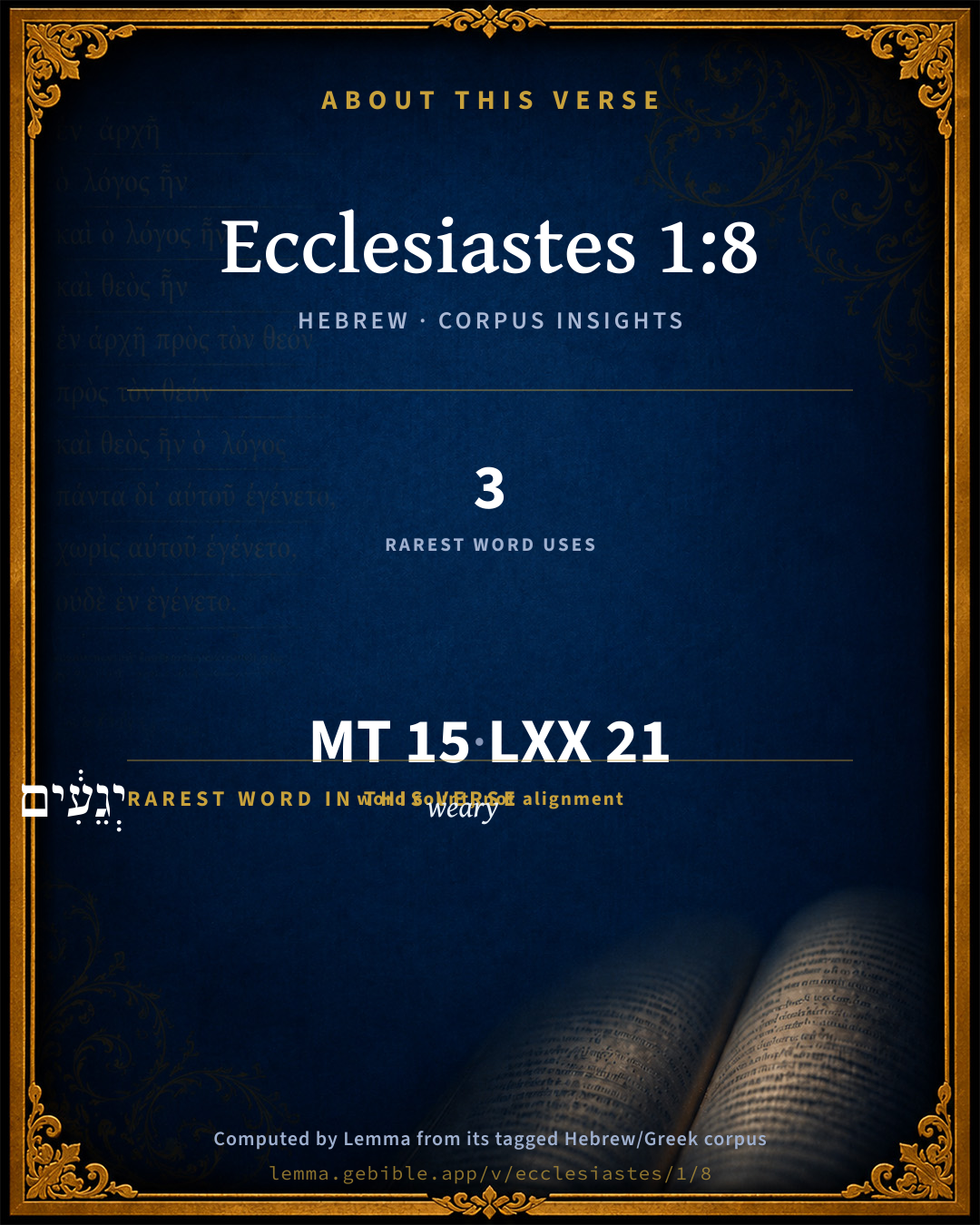
The rarest word here is יְגֵעִ֔ים weary H3023 — appearing just 3 times in the whole Hebrew Bible.

Shared distinctive vocabulary

יְגֵעִ֔ים weary H3023 occurs in 3 verses of the Hebrew Bible. Also found in:

Grammatical profile

  • 6 verbs
  • 5 nouns
  • 1 adjective
  • 3 particles

Verb forms

  • יוּכַ֥ל Qal · Imperfect
  • לְדַבֵּ֑ר Piel · Infinitive Construct
  • תִשְׂבַּ֥ע Qal · Imperfect
  • לִרְא֔וֹת Qal · Infinitive Construct
  • תִמָּלֵ֥א Niphal · Imperfect
  • מִשְּׁמֹֽעַ Qal · Infinitive Construct

Repetition

A word recurs within this verse — often emphatic in Hebrew:

Hebrew & Septuagint length

In English translation the verse runs 21 words from the Hebrew and 32 from the Septuagint (LXX English) — the Septuagint runs noticeably longer here. See the side-by-side →

A rough comparison of the two English renderings, which tokenize alike — not a word-level alignment.

Word counts can differ between the Hebrew and the Greek without any difference in meaning — e.g. the Hebrew direct-object marker אֵת has no separate Greek word, and Greek often adds the article ὁ.

In the original languages it is 15 Hebrew tokens and 21 Greek tokens — but the two are counted differently (Hebrew bundles its prefixes and suffixes into one token; the Greek is in lemma form), so that isn’t a like-for-like length.

Cross-references

13

Topical passages linked to Ecclesiastes 1:8 in the Treasury of Scripture Knowledge — connected by theme and wording, ordered by reader-vote popularity; previews shown in the World English Bible.

  • Proverbs 27:20 Sheol and Abaddon are never satisfied; And a man's eyes are never satisfied.
  • Matthew 11:28 "Come to me, all you who labor and are heavily burdened, and I will give you rest.
  • Ecclesiastes 4:8 There is one who is alone, and he has neither son nor brother. There is no end to all of his labor, neither are his eyes satisfied with wealth. For whom then, do I labor, and deprive my soul of enjoyment? This also is vanity, yes, it is a miserable business.
  • Psalms 63:5 My soul shall be satisfied as with the richest food. My mouth shall praise you with joyful lips,
  • Proverbs 30:15–16 "The leach has two daughters: 'Give, give.' "There are three things that are never satisfied; Four that don't say, 'Enough:'
  • Ecclesiastes 2:11 Then I looked at all the works that my hands had worked, and at the labor that I had labored to do; and, behold, all was vanity and a chasing after wind, and there was no profit under the sun.
  • Ecclesiastes 2:26 For to the man who pleases him, God gives wisdom, knowledge, and joy; but to the sinner he gives travail, to gather and to heap up, that he may give to him who pleases God. This also is vanity and a chasing after wind.
  • Ecclesiastes 4:1–4 Then I returned and saw all the oppressions that are done under the sun: and, behold, the tears of those who were oppressed, and they had no comforter; and on the side of their oppressors there was power; but they had no comforter.
  • Ecclesiastes 5:10–11 He who loves silver shall not be satisfied with silver; nor he who loves abundance, with increase: this also is vanity.
  • Ecclesiastes 7:24–26 That which is, is far off and exceedingly deep. Who can find it out?
  • Matthew 5:6 Blessed are those who hunger and thirst after righteousness, For they shall be filled.
  • Romans 8:22–23 For we know that the whole creation groans and travails in pain together until now.
  • Revelation 7:16–17 They will never be hungry, neither thirsty any more; neither will the sun beat on them, nor any heat;

Cross-references courtesy of OpenBible.info (CC BY 4.0).

Hebrew and Greek witnesses Masoretic Hebrew ↔ Greek Septuagint

The same verse in the two great witnesses to the Old Testament, shown verse-for-verse.

Here the Septuagint runs noticeably longer than the Hebrew — LXX2012 (modern English Septuagint) 32 words vs World English Bible 21. A rough length comparison of the two English translations, not a word-level alignment — read both below.

These are two independent witnesses, not word-aligned to each other, and the Septuagint is shown in lemma (dictionary) form.

Hebrew Ecclesiastes 1:8 Masoretic · Westminster Leningrad Codex

כָּל הַדְּבָרִ֣ים יְגֵעִ֔ים לֹא יוּכַ֥ל אִ֖ישׁ לְדַבֵּ֑ר לֹא תִשְׂבַּ֥ע עַ֨יִן֙ לִרְא֔וֹת וְלֹא תִמָּלֵ֥א אֹ֖זֶן מִשְּׁמֹֽעַ

All things are full of weariness beyond uttering. The eye is not satisfied with seeing, nor the ear filled with hearing.

World English Bible · Public Domain

Greek LXX Ecclesiastes 1:8 Septuagint · lemma form

πᾶς ὁ λόγος ἔγκοπος οὐ δύναμαι ἀνήρ ὁ λαλέω καί οὐ ἐνπίμπλημι ὀφθαλμός ὁ ὁράω καί οὐ πληρόω οὖς ἀπό ἀκρόασις

All things are full of labor; a man will not be able to speak of them: neither shall the eye be satisfied with seeing, neither shall the ear be filled with hearing.

LXX2012 (modern English Septuagint) · Public Domain

On this verse, The Cambridge Bible for Schools and Colleges discusses the Septuagint’s reading. Read the note in Commentary ↓

Hebrew: Westminster Leningrad Codex (CC BY 4.0). Greek: Septuagint (public domain); English from LXX2012 (modern English Septuagint) (Public Domain). How the Septuagint differs from the Hebrew →

Commentary

Notes on Ecclesiastes 1:8 from classic Christian and Jewish commentators (each source and its license shown beneath its notes). The classic Christian expositions comment on the surrounding passage and are grouped to its opening verse, so a note may address several verses; the Jewish commentaries on the Tanakh (Rashi and others) are per-verse, so they appear only where the commentator wrote on this verse.

Lemma curates 59 commentaries, every one of them public domain or Creative Commons licensed, each selected and text-cleaned for this edition rather than reprinted as found. About our sources →

Trapp's Complete Commentary

John Trapp

Ecc 1:8 All things [are] full of labour; man cannot utter [it]: the eye is not satisfied with seeing, nor the ear filled with hearing.

Ver. 8. All things are full of labour.] Labor est etiam ipsa voluptas. Molestation and misery meet us at every turn. The whole world is a "sea of glass" (for its vanity), "mingled with fire" (for its vexation), -.{Rev 4:6} Vota etiam post usum, fastidio sunt: All things are sweeter in the ambition than in the fruition. There is a singular vanity in this splendid misery. One well compares it to a beautiful picture, drawn with white and red colours in sackcloth, which afar off is very lovely, but near by it is like the filthy matter of a sore or wound, purulent rottenness, or the back of a galled horse. No man ever yet found any constant contentation in any state; {a} yet may his outward appearance deceive others, and another’s him.

Man cannot utter it.] If Solomon cannot, no man can; for "what can the man do that cometh after the king?" {Ecc 2:12}

The eye is not satisfied with seeing.] Though these be the two ‘learned senses,’ as Aristotle calls them, whereby learning is let into the soul, yet no man knows so much but he would know more. Herillus, therefore, and those other philosophers that placed the happiness of a man in the knowledge of natural causes and events, were not in the right. There is a curse of dissatisfaction which lies upon the creature. The soul, that acts in and by the outward senses, flickers up and down, as Noah’s dove did, but finds no firm footing; sharks and shifts from one thing to another for contentment, as the bee doth from flower to flower for honey, and desires still more things in number, and new things for manner. Hence the particles in the Hebrew that signify and and or, come of a word that signifieth to desire, {b} because the desires of man would have this and that, and that and another; and doth also tire itself, not knowing whether to have this or that or that or the other, so restless it is, after utmost endeavours of plenary satisfaction, which this life affords not.

{a} Chiron, cum ob iustitiam Dii permitterent ut perpetuo viveret, maluit mori, quod offenderetur taedio rerum semper eodem tenore recurrentium.

{b} å and, à of אוה.

John Trapp, A Commentary or Exposition upon All the Books of the Old and New Testament (1647–1656) — public domain. Text from a community e-Sword module.

The Biblical Illustrator

Joseph S. Exell

Ecc_1:8

The eye is not satisfied with seeing.

The unsatisfied eye

This fact is selected as an instance of mans profitless curiosity, as a symbol of the insatiable-ness of the human mind. My remarks will, I think, prove applicable to two cases,--to the dreary doctrine that man is virtually nothing, and all his efforts are unavailing; and also to the Christians affirmation, that there is something better and more lasting than the objects of our sensuous vision.

I. I direct your attention to the thing itself which in the text is said not to be satisfied with seeing. Consider what instances of skill we gaze at with admiration, and cross oceans to behold, and yet how imperfect and clumsy they are compared with this little compact organ set in its bony cup, with its lenses and regulators and pulleys and screws, its curtaining iris and its crystal deep, its inner chamber of imagery on which are flung the pictures of the universe,--the aspects of nature, the shapes of art, the symbols of knowledge, the faces of love; this magic glass, both telescope and microscope, filled with the splendours of an insects wing, yet taking in the scenery of heaven; this sentinel of the passions; this signal of the conscious soul, kindled by a light within more glorious than the light without, and never satisfied with seeing. Such is the human eye. And from the lowest creatures, whose visual apparatus is a mere nervous speck, up to the most complex organisms, there is nothing that has the range of this organ. In certain specialties of vision man may not be equal to some animals or insects. The shark and the spider, the hawk and the cat, may see better on some particular plane of sight; but in that general power which far transcends any special capacity, in scope, in possibility, in educated faculty, in expressiveness, the human eye excels all others. If, then, superior qualifications are to be taken as proof of superior purpose, this fact of itself is significant as to the dignity and the destiny of man. But in this line of argument nothing seems more suggestive than the very statement of the text: The eye is not satisfied with seeing. Now, so far as we can judge, the merely animal eye is satisfied with seeing. The brute does not shift about to get better views of nature. He does not search the landscape for objects of beauty and sublimity. It is man only who finds in the opportunities of vision the inspiration of action, and in all that lies under the sun secures employment for a restless curiosity. He ponders unfathomable problems in the pebble and the weed, and eagerly searches the secrets of the universe. How much of human enterprise is simply the result of a longing for vision,--the desire to see strange lands, and look upon memorable faces, to watch the evolution of facts, and detect hidden causes! No man is satisfied with that which he sees right around him. The child longs to know what lies beyond the hills that bound his familiar valley, into what strange country the sun goes down, and upon what marvellous region the rainbow rests. The eye, however, is not satisfied with its own natural limits, but seeks the aid of instruments. As, in its aspects, it is the most striking of all the organs of sense, so does it transcend them all in its scope, both of space and time. This little orb of observation, turning on its minute axis, sweeps the splendid theatre of suns and systems, comprehending millions of miles in a glance, and visited by rays of light that have been travelling downwards for thousands of years.

II. What is it that is not satisfied with seeing? In no scale of created being,--not even the lowest,--is it the eye itself that sees. It is the instinct, or consciousness, back of the eye. Examine the dead organ in man or animal, and all its wondrous mechanism is there. Lift the fallen lid, and the light of the outward world flickers upon its surface. But the faculty of sight is not there. Whatever that faculty may be in the brute, we have seen that in man it is a peculiar and distinctive faculty. We have seen that to him belongs this desire for vision ,--this pushing inquisitiveness that is never satisfied. Such, then, must be the inner and conscious nature of man. Such must be the mysterious power behind the eye,--the thing that really sees. Therefore the eye that is not satisfied with seeing is the spirit within us. The mind of man is the eye of man. And here opens an argument that rebukes materialistic disparagement and confirms Christian hope. It is because of the limitless nature of the human soul, that the eye of man never rests, but perpetually wanders over all the visible world, over all the regions of possible truth and beauty. Surely, if this were merely a mortal and limited nature, this would not be. Man would be satisfied with seeing.

1. In the first place, consider what it is that the physical eye itself implies. An examination of this mechanism alone,--these cups, these tissues, these muscles, these elastic veils,--shows at least that the eye is adjusted to the conditions of the external world, and that there are external things for it to behold. But, this being so, I ask, What is implied by that consciousness which acts behind the physical organ,--that faculty which really sees, and is never satisfied? What does that restless mind itself, with its capacities and instincts, imply? Surely it implies the existence of objects fitted to those capacities and instincts,--the existence of unlimited truth and beauty and goodness, and a field of deathless activity for that faculty which is never satisfied. Back of iris and retina there are other lenses. There is a lens of instinct, a lens of reason, a lens of faith, through which come reflections far beyond the visible veil of earth and heaven, images of ideal majesty and loveliness, and a light that never was on land or sea. Are these mere fantasies engendered from within? If so, I ask, What do these interior lenses imply? And why do they exist at all? What can we infer, but that in the wide realm of actual being there are spiritual objects which answer to its function? For the mind, and not the body, being the real eye, the faculty of looking out upon material forms is only one of its functions. This faith-vision, this perception of reason, is just as truly an original faculty, although now its objects may be seen only as through a glass darkly. You never really saw the most familiar object. Yet we do not distrust these transmitted images. We live in their light, and rejoice in their communion. Why, then, distrust these other conceptions, though they are but images also, and we may behold them only in that transparent world where the material lens shall be shattered, and we shall see as we never do here,--face to face? Why suppose these to be fantasies, any more than the mountains, the stars? This apprehension of God as an inscrutable Essence, yet also a veritable Presence; this impression on the retina of the soul of those who have vanished from our material sight,--are these but mists of fancy, or dreams of mortal sleep? I answer that they are as legitimate as any transcript of the outward world, only more indefinite, as all facts involved with the infinite and the immortal necessarily must be. There are diseased eyes, and there are defective eyes, by which the optic nerve brings false reports, upon which the outward world looks grim and obscure, to which all external things are a blank. So, too, there may be diseased and defective souls, whose images of spiritual things are fantastic and exaggerated, or whose vision is sealed altogether by sad, interior blindness. But these do not impeach the legitimate function of the eye, nor refute the general convictions of men. Moreover, as this faculty of vision that permits no limit to its material discoveries, and looks beyond these sensuous veils, is never satisfied with seeing, I ask, What does this fact itself imply? Surely it suggests boundless opportunities of action. The desire to see is never quenched: nevertheless the mere physical organ of sight grows weary, and gladly retreats under its drowsy lids. The dew of sleep is required for its refreshment, and the periods of darkness indicate a necessary suspension of its work. Age draws over it a filmy curtain. And so comes Death, shutting up the worn-out easements, and bringing on the final night when all this curious mechanism is resolved into its elements. But the actual eye is not yet satisfied with seeing, and the forces that shatter its material instruments do not quench its capacity or its yearning. But no capacity is without its sphere, no instinct is for ever baulked. The unsatisfied eye demonstrates the deathless and ever-unfolding mind.

III. Therefore in perfect consistency with what has been said, I also urge this truth,--that the eye sees more and more, and more and more shows its capacity for seeing, in proportion as it becomes accustomed to worthy objects. There may be diversities of spiritual, as there are diversities of physical faculty. Consider what some men will train their natural eyes to behold,--the sailor at the masthead, the Indian in the woods, the Esquimaux among the snows. And so there are diversities of spiritual sight, some of them perhaps resulting from original differences in power. But the spiritual vision of any man may be educated to still better results. One reason why men have not this spiritual discernment is because they will not see, because they neglect the faculty of seeing. It has been truly said that the eye sees only that which it brings the power to see. It does not create the thing to be seen, any more than the microscope creates the pomp of an insects wing, or Rosses tube the splendours of Orion. But we see just what we exercise the power to see; and no external revelations, however urged upon us, will make up for the lack of spiritual refinement. Educate the physical eye if you would see more of the natural world. But, even then, the mind must be educated, if we would discern the glory and the beauty everywhere, and live in a world of perpetual delight, detecting a rarer loveliness in the daisy, and pictures of wondrous grandeur in the shadows that drift along the mountain. It is not merely far travelling that enlarges and enriches the vision. The observant philosopher discovers a world of wonders in a tour around his garden. Let the eye of the soul be educated if you would see the world in new relations, if you would detect the true significance of life, if you would discern the real blessedness of every joy and the right look of every affliction, if you would stand consciously in the presence of God, and gaze upon spiritual things. What we really need is not more things but better eyesight. And is it not this eye of the soul that we must mainly rely upon? How far will physical sight guide us? How long will it last us? How much will it enable us to see? At best it gives us only appearances, and itself fades and grows dim ere long. Think, then, of the desolation of those who have no interior vision. How light, comparatively, has been the affliction of physical blindness to men like Niebuhr, who, when the veil had fallen upon present things, could cheer the darkness of his closing years by retracing in the luminous track of memory the scenes of early travel; or to Milton, who, with that inner eye which no calamity could darken, saw those ethereal virtues flinging down on the jasper pavement their crowns of amaranth and gold. (E. H. Chapin.)

The Biblical Illustrator, edited by Joseph S. Exell (c. 1880s–1900s) — public domain. Text from a community e-Sword module.

Joseph Benson's Commentary

Ecc 1:8-9. All things — Not only the sun, and winds, and rivers, but all other creatures; are full of labour — They are in continual restlessness and change, never abiding in the same state. The eye is not satisfied — As there are many things in the world vexatious to men, so even those things which are comfortable are not satisfactory, but men are constantly desiring some longer continuance or fuller enjoyment of them, or variety in them. The eye and ear are here put for all the senses, because these are most spiritual and refined, most curious and inquisitive, most capable of receiving satisfaction, and exercised with more ease and pleasure than the other senses. The thing that hath been, &c. — There is nothing in the world but a continued and tiresome repetition of the same things. The nature and course of the beings and affairs of the world, and the tempers of men, are the same that they ever were, and shall ever be; and therefore, because no man ever yet received satisfaction from worldly things, it is vain for any person hereafter to expect it. And there is no new thing — In the nature of things, which might give us hopes of attaining that satisfaction which hitherto things have not afforded.

Joseph Benson's Commentary on the Old and New Testaments (1811–1818) — public domain. Text from a community e-Sword module.

Jamieson, Fausset & Brown

Robert Jamieson, A. R. Fausset & David Brown

MAURER translates, "All words are wearied out," that is, are inadequate, as also, "man cannot express" all the things in the world which undergo this ceaseless, changeless cycle of vicissitudes: "The eye is not satisfied with seeing them," &c. But it is plainly a return to the idea (Ecc 1:3) as to man's "labor," which is only wearisome and profitless; "no new" good can accrue from it (Ecc 1:9); for as the sun, &c., so man's laborious works move in a changeless cycle. The eye and ear are two of the taskmasters for which man toils. But these are never "satisfied" (Ecc 6:7; Pro 27:20). Nor can they be so hereafter, for there will be nothing "new." Not so the chief good, Jesus Christ (Joh 4:13-14; Rev 21:5).

Jamieson, Fausset & Brown — Commentary Critical and Explanatory on the Whole Bible (1871) — public domain (CC PDM 1.0). Text via the HelloAO Bible API.

Adam Clarke's Commentary

Verse 8. All things are full of labour] It is; impossible to calculate how much anxiety, pain, labour, and fatigue are necessary in order to carry on the common operations of life. But an endless desire of gain, and an endless curiosity to witness a variety of results, cause men to, labour on. The eye sees much, but wishes to see more. The ear hears of many things; but is curious to have the actual knowledge of them. So desire and curiosity carry men, under the Divine providence, through all the labours and pains of life.

Adam Clarke's Commentary on the Bible (1810–1826) — public domain. Text from a community e-Sword/MySword module.

Ellicott's Commentary for English Readers

(8) This verse is capable of another translation which would give the sense “other instances of the same kind might be mentioned, but they are so numerous that it would be wearisome to recount them,” We abide by the rendering of our version.

A Bible Commentary for English Readers, edited by Charles John Ellicott (1878–1897) — public domain. Text from a community e-Sword module.

The Cambridge Bible for Schools and Colleges

gen. ed. J. J. S. Perowne

8. All things are full of labour] The Hebrew dabar may mean either “word” or “thing,” and so the sentence admits equally of this or the nearly equivalent rendering, All things are weary with toil and All words are feeble, and each gives, it is obvious, a fairly tenable meaning. The first generalizes as by an induction from the previous instances, that all things (especially, i. e. all human affairs) are alike “stale, flat and unprofitable.” The latter stops in the induction to say that all speech is feeble, that time and strength would fail to go through the catalogue. On the whole, looking to the fact that the verb “utter” is cognate in form with the word translated “things,” the latter seems more closely in harmony with the context. We might fairly express the force of the Hebrew by saying All speech fails; man cannot speak it. The seeming tautology gives the sentence the emphasis of iteration. So the LXX. and the Targum.

the eye is not satisfied with seeing] The thought is limited by the context. It is not that the Debater speaks of the cravings of sight and hearing for ever-new objects, true as that might be; but that wherever the eye or the ear turn, the same sad tale meets them, the same paradox of an unvarying record of endless yet monotonous version. The state which Lucretius (ii. 1037) describes, probably as echoing Epicurus, that of one “fessus satiate videndi,” presents a parallelism too striking to be passed over.

The Cambridge Bible for Schools and Colleges (gen. ed. J. J. S. Perowne; Cambridge University Press, 1878–1918) — public domain. Text from a community e-Sword module.

John Gill's Exposition

All things are full of labour,.... Or "are laborious" (g); gotten by labour, and attended with fatigue and weariness; riches are got by labour, and those who load themselves with thick clay, as gold and silver be, weary themselves with it; honour and glory, crowns and kingdoms, are weighty cares, and very fatiguing to those that have them; much study to acquire knowledge is a weariness to the flesh; and as men even weary themselves to commit iniquity, it is no wonder that religious exercises should be a weariness to a natural man, and a carnal professor;

man cannot utter it; or declare all the things that are laborious and fatiguing, nor all the labour they are full of; time would fail, and words be wanting to express the whole; all the vanity, unprofitableness, and unsatisfying nature of all things below the sun; particularly

the eye is not satisfied with seeing, nor the ear filled with hearing; both one and the other require new objects continually; the pleasure of these senses is blunted by the same objects constantly presented; men are always seeking new ones, and when they have got them they want others; whatever curious thing is to be seen the eye craves it; and, after it has dwelt on it a while, it grows tired of it, and wants something else to divert it; and so the ear is delighted with musical sounds, but in time loses the taste of them, and seeks for others; and in discourse and conversation never easy, unless, like the Athenians, it hears some new things, and which quickly grow stale, and then wants fresh ones still: and indeed the spiritual eye and ear will never be satisfied in this life, until the soul comes into the perfect state of blessedness, and beholds the face of God, and sees him as he is; and sees and hears what eye hath not seen, nor ear heard below. The Targum is,

"all the words that shall be in the world, the ancient prophets were weary in them, and they could not find out the ends of them; yea, a man has no power to say what shall be after him; and the eye cannot see all that shall be in the world, and the ear cannot be filled with hearing all the words of all the inhabitants of the world.''

(g) "laboriosae", Pagninus, Vatablus, Mercerus, Gejerus, Schmidt.

John Gill's Exposition of the Whole Bible (1746–1763) — public domain (CC PDM 1.0). Text via the HelloAO Bible API.

Albert Barnes' Notes on the Bible

All things ... utter it - This clause, as here translated, refers to the immensity of labor. Others translate it, “all words are full of labor; they make weary the hearers,” or “are feeble or insufficient” to tell the whole; and are referred to the impossibility of adequately describing labor.

Albert Barnes' Notes on the Bible (1834–1885) — public domain. Text from a community e-Sword/MySword module.

Haydock's Catholic Bible Commentary

Hearing. In all sciences there are many difficulties. If a man had arrived at perfect knowledge, his researches would cease.

George Leo Haydock (1774–1849), Haydock's Catholic Family Bible and Commentary, 1859 edition — public domain. Excludes Psalms (Douay-Rheims chapter numbering differs from Protestant) and Deuterocanonical books (Catholic canon only).

Matthew Poole's English Annotations

All things, not only the sun, and winds, and rivers, which I have mentioned, but all other creatures, are full of labour; both subjectively, as they are in continual restlessness and change, never abiding in the same state or place; and efficiently, as they cause great and sore labour to men, in getting, and keeping, and enjoying of them, yea, even in the study of them, as is noted hereafter.

Man cannot utter it; the labour is inexpressibly and unconceivably great.

The eye is not satisfied with seeing, nor the ear filled with hearing; as there are many things in the world troublesome and vexatious to men’s senses and minds, so even those things which are comfortable and acceptable to them are not satisfactory, but men are constantly desiring some longer continuance or fuller enjoyment of them, or variety in them, and they never say, It is enough, I desire no more. The eye and ear are here synecdochically put for all the senses, because these are most spiritual and refined, most curious and inquisitive, most capable of receiving satisfaction, because they are exercised with more ease and pleasure than the other senses, whose satisfactions are oft attended with greater weariness and manifold dangers and inconveniences.

Matthew Poole's English Annotations on the Holy Bible (1683–1685) — public domain. Text from a community e-Sword/MySword module.

Whedon's Commentary on the Bible

Daniel D. Whedon

8. This verse refers to these phenomena of nature.

Things — Hebrew, words. In several ancient languages “word” has a secondary meaning — thing, affair. But here the primary meaning is better — “All words are ineffectual” to tell the contrast between ever renewing nature and frail, transient man. Countless things addressed to the eye or ear illustrate it. The generations of man “haste stormfully” across the scene and return no more. But in every department of inanimate nature there is renewal. The sun returns to the East, and rejoices as a strong man to run its race; the wind comes freshly to its course; the water is renewed in the river channels.

Daniel D. Whedon (gen. ed.), Commentary on the Old and New Testaments (1874–1909) — public domain. Text from a community e-Sword module.

The Pulpit Commentary

All things are full of labor. Taking the word dabar in the sense of "ward" (compare the Greek rJhma), the LXX translates, "All words are wearisome;" i.e. to go through the whole catalogue of such things as those mentioned in the preceding verses would be a laborious and unprofitable task. The Targum and many modern expositors approve this rendering. But besides that, the word yaged implies suffering, not causing, weariness (Deu_25:18; Job_3:17) the run of the sentence is unnecessarily interrupted by such an assertion, when one is expecting a conclusion from the instances given above. The Vulgate has, cunetse res difficiles. The idea, as Motais has seen, is this Man"s life is constrained by the same law as his surroundings; he goes on his course subject to influences which he cannot control; in spite of his efforts, he can never be independent. This conclusion is developed in succeeding verses. In the present verse the proposition with which it starts is explained by what follows. All things have been the object of much labor; men have elaborately examined everything; yet the result is most unsatisfactory, the end is not reached; words cannot express it, neither eye nor ear can apprehend it. This is the view of St. Jerome, who writes, "Non solum do physicis, sed de ethicis quoque scirc difficile est. Nec sermo valet explicare causas natu-rasque rerum, nec oculus, ut rei poscit dignitas, intueri, nec auris, instituente doctore, ad summam scientiam pervenirc. Si enim nunc "per speculum videmus in aenigmate; et ex parte cognoscimus, et ex parte prophetamus," consequenter nec sermo potest explicate quod nescit; nec oculus in quo caecutit, aspiecre; nec auris, de quo dubitat, impleri." Delitzsch, Nowack, Wright, and others render, "All things are in restless activity;" i.e. constant movement pervades the whole world, and yet no visible conclusion is attained. This, however true, does not seem to be the point insisted on by the author, whose intention is, as we have said, to show that man, like nature, is confined to a circle from which he cannot free himself; and though he uses all the powers with, which he is endowed to penetrate the enigma of life and to rise superior to his environments, he is wholly unable to effect anything in these matters. Man cannot utter it. He cannot explain all things. Koheleth does not affirm that man can know nothing, that he can attain to no certitude, that reason will not teach him to apprehend any truth; his contention is that the inner cause and meaning elude his faculties, that his knowledge is concerned only with accidents and externals, and that there is still some depth which his powers cannot fathom. The eye is not satisfied with seeing, nor the ear filled with hearing. Use his eight as he may, listen to the sounds around him, attend to the instructions of professed teachers, man makes no real advance in knowledge of the mysteries in which he is involved; the paradox is inexplicable. We have, in Pro_27:20, "Sheol and Abaddon are never satisfied; and the eyes of man are never satisfied." Plumptre quotes Lucretins"s expression (2. 1038)," Fessus satiate videndi." "Remember," says Thomas a Kempis ("De Imitat.," 1:1.5), "the proverb, that the eye is not satisfied with seeing, nor the ear with hearing. Eudeavour, therefore, to withdraw thy heart from the love of visible things, and to transfer thyself to the invisible. For they that follow their sensuality do stain their conscience and lose the grace of God.

The insatiability of sense.

Man is on one side akin to the brutes, whilst he is on the other side akin to God. Sense he shares with the inferior animals; but the intellect and conscience by which he may use his senses in the acquisition of knowledge, and his physical powers in the fulfillment of a moral ideal, these are peculiar to himself. On this account it is impossible for man to be satisfied with mere sensibility; if he makes the attempt, he fails. To say this is not to disparage sense a great and wonderful gift of God. It is simply to put the senses in their proper place, as the auxiliaries and ministers of reason. Through the exercise of sense man may, by Divine aid, rise to great spiritual possessions, achievements, and enjoyments.

I AN INFINITE VARIETY OF OBJECTS APPEAL TO THE SENSES OF SIGHT AND HEARING. These are chosen as the two noblest of the senses those by whose means we learn most of nature, and most of the thoughts and purposes of our fellow-men and of our God. Around, beneath, and above us are objects to be seen, sounds and voices to be heard. The variety is as marvelous as the multiplicity.

II WONDERFUL IS THE ADAPTATION OF THE SENSES TO RECEIVE THE VARIED IMPRESSIONS PRODUCED BY NATURE. The susceptibility of the nerves of the eye to the undulations of ether, of the ear to atmospheric vibrations, has only been fully explained in recent times. There is no more marvelous instance of design than the mutual adaptations of the voice, the atmosphere, and the auditory nerve; of the molecular structure of colored body, the ether, and the retinal structure of the optic nerve. And these are only some of the arrangements between nature and sense which meet us at every turn and at every moment of our conscious existence.

III IT IS IMPOSSIBLE THAT THE MERE EXERCISE OF SENSE SHOULD AFFORD A FULL SATISFACTION TO THE NATURE OF MAN. It is not to be supposed that any reasonable being should seek his gratification merely in the enjoyment of the impressions upon the senses. But even curiosity fails to find satisfaction, and those who crave such satisfaction make it manifest that their craving is in vain. The restlessness of the sight-seer is proverbial. When the impressions of sense are used as the material for high intellectual and spiritual ends, the case is otherwise. But it remains true as in the days of Koheleth, "The eye is not satisfied with seeing, nor the ear filled with hearing.

IV IT WOULD BE AN ERROR TO REGARD THIS FACT AS A PROOF OF THE INHERENT BADNESS OF THE SENSES. Such an inference has sometimes been drawn by enthusiastic minds; and mystics have inculcated abstinence from the exercise of the senses as essential in order to intellectual and spiritual illumination. The error here lies in overlooking the distinction between making ourselves the slaves of our senses, and using the senses as our helpers and servants.

V BUT IT IS JUST TO REGARD THIS FACT AS AN INDICATION THAT MEN SHOULD SEEK THEIR SATISFACTION IN WHAT IS HIGHER THAN SENSE. When the eyes are opened to the works of God, when we look upon the form of the Son of God, when we hear the Divine Word speaking in conscience and speaking in Christ, our senses then become, directly or indirectly, the instrumentality by means of which our higher nature is called into exercise and finds abundant scope. Our reason may thus find rest in truth; our sympathies may thus respond to the revealed love of the Eternal Father known by his blessed Son; our whole heart may rise into fellowship with him from whom all our faculties and capacities are derived, and in whom alone his spiritual children can find a perfect satisfaction and an unshaken repose. T.

The Pulpit Commentary (1880–1919), ed. H.D.M. Spence-Jones & Joseph S. Exell — public domain. Text from a community e-Sword module.

John Wesley's Explanatory Notes

All things - Not only the sun, and winds, and rivers, but all other creatures. labour - They are in continual restlessness and change, never abiding in the same state. Is not satisfied - As there are many things in the world vexatious to men, so even those things which are comfortable, are not satisfactory, but men are constantly desiring some longer continuance or fuller enjoyment of them, or variety in them. The eye and ear are here put for all the senses, because these are most spiritual and refined, most curious and inquisitive, most capable of receiving satisfaction, and exercised with more ease and pleasure than the other senses.

John Wesley, Explanatory Notes Upon the Whole Bible (1754–1765) — public domain. Text via the GEBible commentary corpus.

Keil & Delitzsch

C. F. Keil & F. Delitzsch

"All things are in activity; no man can utter it; the eye is not satisfied with seeing, and the ear is not full with hearing." All translators and interpreters who understand devarim here of words (lxx, Syr., and Targ.) go astray; for if the author meant to say that no words can describe this everlasting sameness with perpetual change, then he would have expressed himself otherwise than by "all words weary" (Ew., Elst., Hengst., and others); he ought at least to have said לריק יג. But also "all things are wearisome" (Knob., Hitz.), or "full of labour" (Zck.), i.e., it is wearisome to relate them all, cannot be the meaning of the sentence; for יגע does not denote that which causes weariness, but that which suffers weariness (Deu 25:18; Sa2 7:2); and to refer the affection, instead of to the narrator, to that which is to be narrated, would be even for a poet too affected a quid pro quo. Rosenmller essentially correctly: omnes res fatigantur h. e. in perpetua versantur vicissitudine, qua fatigantur quasi. But יגעים is not appropriately rendered by fatigantur; the word means, becoming wearied, or perfectly feeble, or also: wearying oneself (cf. Ecc 10:15; Ecc 12:12), working with a strain on one's strength, fatiguing oneself (cf.יגיע, that which is gained by labour, work). This is just what these four examples are meant to show, viz., that a restless activity reaching no visible conclusion and end, always beginning again anew, pervades the whole world-all things, he says, summarizing, are in labour, i.e., are restless, hastening on, giving the impression of fatigue.

Thus also in strict sequence of thought that which follows: this unrest in the outer world reflects itself in man, when he contemplates that which is done around him; human language cannot exhaust this coming and going, this growth and decay in constant circle, and the quodlibet is so great, that the eye cannot be satisfied with seeing, nor the ear with hearing; to the unrest of things without corresponds the unrest of the mind, which through this course, in these ever repeated variations, always bringing back the old again to view, is kept in ceaseless activity. The object to dǎbbēr is the totality of things. No words can comprehend this, no sensible perception exhaust it. That which is properly aimed at here is not the unsatisfiedness of the eyes (Pro 27:20), and generally of the mind, thus not the ever-new attractive power which appertains to the eye and the ear of him who observes, but the force with which the restless activity which surrounds us lays hold of and communicates itself to us, so that we also find no rest and contentment. With שׂבע, to be satisfied, of the eye, there is appropriately interchanged נמלא, used of the funnel-shaped ear, to be filled, i.e., to be satisfied (as at Ecc 6:7). The min connected with this latter word is explained by Zck. after Hitz., "away from hearing," i.e., so that it may hear no more. This is not necessary. As saava' with its min may signify to be satisfied with anything, e.g., Ecc 6:3, Job 19:22; Psa 104:13; cf. Kal, Isa 2:6, Pih. Jer 51:34; Psa 127:5. Thus mishshemoa' is understood by all the old translators (e.g., Targ. מלּמשׁמע), and thus also, perhaps, the author meant it: the eye is not satisfied with seeing, and the ear is not filled (satisfied) with hearing; or yet more in accordance with the Heb. expression: there is not an eye, i.e., no eye is satisfied, etc., restlessly hastening, giving him who looks no rest, the world goes on in its circling course without revealing anything that is in reality new.

Keil & Delitzsch — Biblical Commentary on the Old Testament (1861–1891) — public domain (CC PDM 1.0). Text via the HelloAO Bible API. (Old Testament only.)

Rashi

Rabbi Shlomo Yitzchaki (Rashi)

All things are wearisome...the eye shall not be sated from seeing, nor shall the ear be filled This refers back to, “What profit [has man]” if he exchanges the study of Torah to speak wasteful words? They are only wearisome, and he will not be able to acquire them all, and if he comes to engage in the vision of the eye, it will not be satisfied, and if in the hearing of the ear, it will not be filled.

Rashi on the Tanakh — English translations: “The Judaica Press complete Tanach with Rashi, translated by A. J. Rosenberg” (CC BY 4.0); “Pentateuch with Rashi's commentary by M. Rosenbaum and A.M. Silbermann, 1929-1934” (public domain); “The Metsudah Tanach series, Lakewood, N.J” (CC BY 4.0); and “The Book of Joshua, Metsudah Publications, 1997” (CC BY 4.0). Text via Sefaria.

Lesson kit

Teaching starters — assembled from the data on this page, not authored interpretation. Every prompt links to the verse data it draws on. Edit before teaching.

Ecclesiastes, in the Wisdom, opens this verse with 15 words (13 distinct Hebrew lemmas). Its most distinctive word is yâgêaʻ (“weary”). The Greek Septuagint runs longer here. A historical commentator’s framing appears above. Read the whole chapter for the surrounding context.

Discussion questions

  1. What does “weary” (yâgêaʻ) contribute to the verse as a whole?
  2. How does Deuteronomy 25:18, which shares the word «weary», read alongside this verse?
  3. What does the repetition of “not” (3× in this one verse) do in this verse?
  4. The Septuagint runs longer here than the Hebrew. What might account for the difference?
  5. These translations render this verse differently. What is at stake in choosing one wording over another?
  6. «יוּכַ֥ל» is a Qal Imperfect verb. How does that grammatical form shape the action described?
  7. Compare how Trapp's Complete Commentary and The Biblical Illustrator read this verse. Where do they agree or differ?

Things to notice

Reading settings

Reading text

Shown beneath each verse's original-language words.

Old Testament
Old Testament edition

Read the OT as the Masoretic Hebrew (MT) or the Greek Septuagint (LXX).

English shown for the Greek Septuagint (in the Hebrew ↔ Greek comparison).

Comparing translations? Open the Compare panel on any verse page to stack up to four side by side.