
Jeremiah 49:10

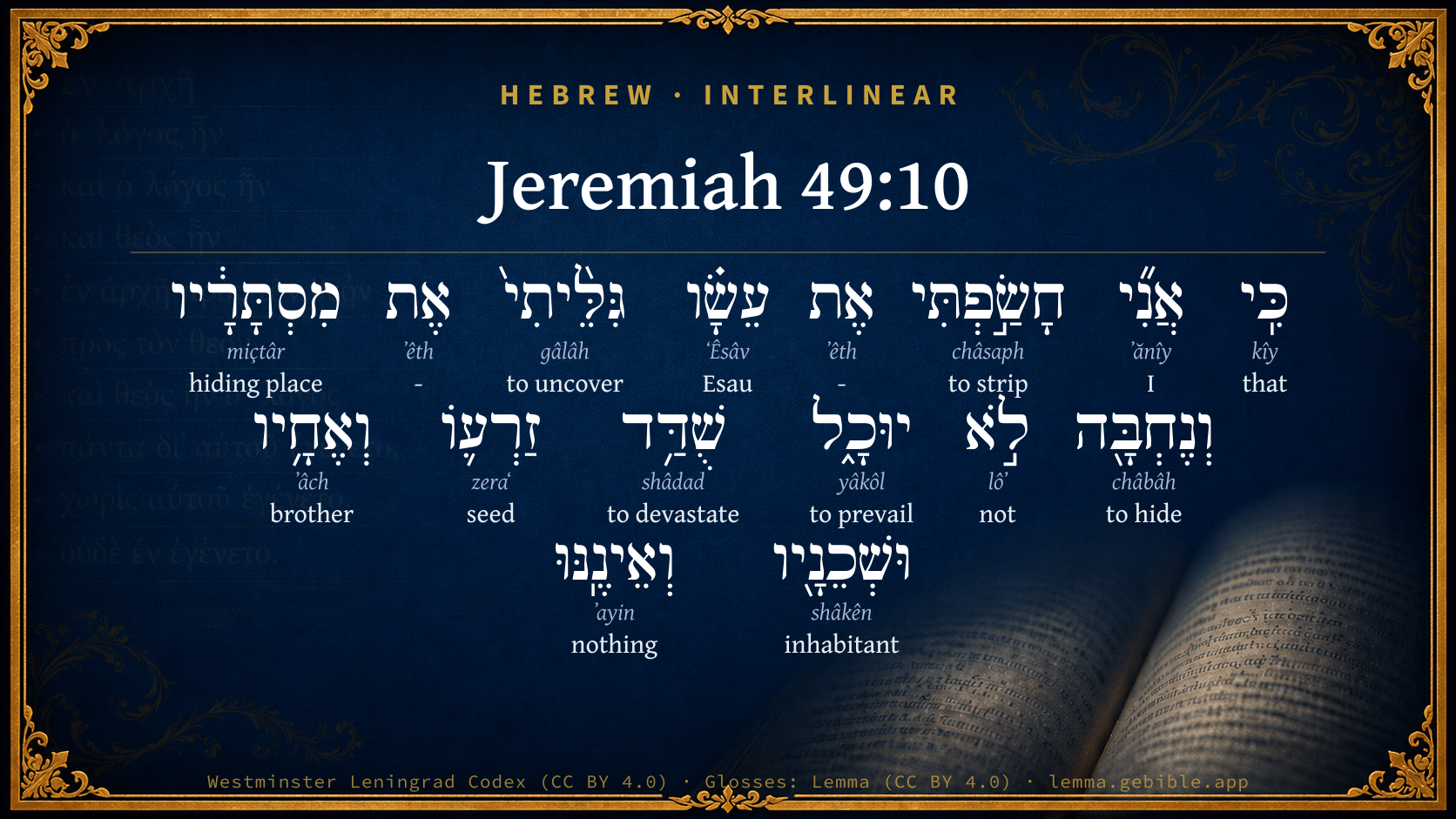
Hebrew (Westminster Leningrad Codex) Jeremiah 49:10 appears in the Hebrew Old Testament. The text above is from the Westminster Leningrad Codex. Each word links to its Strong’s number, a concise gloss, and parsing drawn from the Open Scriptures Hebrew Bible morphology. Click any word for its full Brown-Driver-Briggs (BDB) entry.
Download image
Cite this verse

Jeremiah 49:10 (World English Bible). Public Domain. Lemma interlinear Bible study tool, https://lemma.gebible.app/v/jeremiah/49/10.

Show BibTeX & RIS
BibTeX
RIS
English Translation
But I have made Esau bare, I have uncovered his secret places, and he shall not be able to hide himself: his seed is destroyed, and his brothers, and his neighbors; and he is no more.
World English Bible · Public Domain
Download a study sheet

One document with this verse’s original text, its word-by-word gloss line, the meaning frame, cross-references with their text, attributed commentary, and full source and license credits — printable, and it pastes into notes with its structure intact.

This verse Autodidact and up

Study sheet (.html) Plain text (.txt)

A passage Seminary Student

Up to 50 verses in one chapter. A passage sheet keeps up to 6 commentary sources and 12 cross-references per verse, in the order this page ranks them, and says so on the sheet whenever that leaves anything out. Ask for a single verse and you get the Autodidact verse sheet above.

Everything on this page stays free to read, with no account — the sheet is a download of what is already on screen, not access to it.

Want to remove ads? Support Godless Engineer
Compare translations 3

The same verse in 3 English versions, stacked beneath the original-language interlinear above. Click any original word for its lexicon entry.

Each is an independent rendering of the whole verse — the interlinear is not word-aligned to these translations.

Highlighted words mark where these versions differ — a whole-verse word diff, not a word-by-word alignment.

  • World English Bible Public Domain
    But I have made Esau bare, I have uncovered his secret places, and he shall not be able to hide himself: his seed is destroyed, and his brothers, and his neighbors; and he is no more.
  • King James Version Public Domain
    But I have made Esau bare, I have uncovered his secret places, and he shall not be able to hide himself: his seed is spoiled, and his brethren, and his neighbours, and he is not.
  • unfoldingWord Literal Text CC BY-SA 4.0
    But I have stripped Esau bare. I have revealed his hiding places. So he will not be able to hide himself. His children, his brothers, and his neighbors are destroyed, and he is gone.

unfoldingWord Literal Text — © unfoldingWord, licensed CC BY-SA 4.0. Word-aligned USFM3 via Door43 (git.door43.org/unfoldingWord/en_ult).

Versions to compare (up to 4)

3 of 4 selected

Show all 18 translations

Every available English version of this verse, each an independent rendering of the whole verse.

  • World English Bible Public Domain
    But I have made Esau bare, I have uncovered his secret places, and he shall not be able to hide himself: his seed is destroyed, and his brothers, and his neighbors; and he is no more.
  • Berean Standard Bible Public Domain
    But I will strip Esau bare; I will uncover his hiding places, and he will be unable to conceal himself. His descendants will be destroyed along with his relatives and neighbors, and he will be no more.
  • Majority Standard Bible Public Domain
    But I will strip Esau bare; I will uncover his hiding places, and he will be unable to conceal himself. His descendants will be destroyed along with his relatives and neighbors, and he will be no more.
  • King James Version Public Domain
    But I have made Esau bare, I have uncovered his secret places, and he shall not be able to hide himself: his seed is spoiled, and his brethren, and his neighbours, and he is not.
  • American Standard Version (1901) Public Domain
    But I have made Esau bare, I have uncovered his secret places, and he shall not be able to hide himself: his seed is destroyed, and his brethren, and his neighbors; and he is not.
  • Revised Version (1885) Public Domain
    But I have made Esau bare, I have uncovered his secret places, and he shall not be able to hide himself: his seed is spoiled, and his brethren, and his neighbours, and he is not.
  • Geneva Bible (1599) Public Domain
    For I haue discouered Esau: I haue vncouered his secrets, and he shall not be able to hide himselfe: his seede is wasted, and his brethren and his neighbours, and there shall be none to say,
  • Douay-Rheims (1899) Public Domain
    But I have made Esau bare, I have revealed his secrets, and he cannot be hid: his seed is laid waste, and his brethren, and his neighbours, and he shall not be.
  • Young's Literal Translation Public Domain
    For I -- I have made Esau bare, I have uncovered his secret places, And to be hidden he is not able, Spoiled `is' his seed, and his brethren, And his neighbours, and he is not.
  • Literal Standard Version CC BY-SA 4.0
    For I have made Esau bare, || I have uncovered his secret places, || And he is not able to be hidden, || Spoiled [is] his seed, and his brothers, || And his neighbors, and he is not.
  • Unlocked Literal Bible CC BY-SA 4.0
    But I have stripped Esau bare. I have revealed his hiding places. So he will not be able to hide himself. His children, his brothers, and his neighbors are destroyed, and he is gone.
  • unfoldingWord Literal Text CC BY-SA 4.0
    But I have stripped Esau bare. I have revealed his hiding places. So he will not be able to hide himself. His children, his brothers, and his neighbors are destroyed, and he is gone.
  • Darby Bible Public Domain
    But I have made Esau bare, I have uncovered his secret places, that he is unable to hide himself: his seed is wasted, and his brethren, and his neighbours, and he is not.
  • World Messianic Bible Public Domain
    But I have made Esau bare, I have uncovered his secret places, and he will not be able to hide himself. His offspring is destroyed, with his brothers and his neighbors; and he is no more.
  • Webster's Bible Public Domain
    But I have made Esau bare, I have uncovered his secret places, and he shall not be able to hide himself: his seed is laid waste, and his brethren, and his neighbors, and he is not.
  • Free Bible Version CC BY-SA 4.0
    But I'm going to strip the whole country bare, leaving its people with nowhere to hide. All of Esau's descendants will be destroyed, along with their relatives and friends—they will all be gone.
  • Bible in Basic English Public Domain
    I have had Esau searched out, uncovering his secret places, so that he may not keep himself covered: his seed is wasted and has come to an end, and there is no help from his neighbours.
  • JPS Tanakh (1917) Public Domain
    But I have made Esau bare, I have uncovered his secret places, and he shall not be able to hide himself; his seed is spoiled, and his brethren, and his neighbours, and he is not.

Literal Standard Version (2020), Covenant Press — licensed CC BY-SA 4.0. Text via the HelloAO Bible API (eBible.org). Unlocked Literal Bible (unfoldingWord) — licensed CC BY-SA 4.0. Text via the HelloAO Bible API (eBible.org). unfoldingWord Literal Text — © unfoldingWord, licensed CC BY-SA 4.0. Word-aligned USFM3 via Door43 (git.door43.org/unfoldingWord/en_ult). Free Bible Version, Dr. Jonathan Gallagher — licensed CC BY-SA 4.0. Text via the HelloAO Bible API (eBible.org).

Word by word

More ways to search: Search by grammar → Find every occurrence → Compare this word →

Practice this passage: Drill this verse → Learn its vocabulary →

וְנֶחְבָּ֖ה
châbâh
H2247
“and · to hide”
Conjunction + Verb, Niphal, Sequential Perfect, 3rd Person, Masculine, Singular
Part of Speech
Conjunction + Verb
Stem
Niphal
Form
Sequential Perfect
Person
3rd Person
Gender
Masculine
Number
Singular
Full BDB Definition

Origin: a primitive root [compare H2245 ]

TWOT: 590

to withdraw, hide, hide oneself - (Qal) to withdraw - (Niphal) to hide oneself, remain hidden, withdraw
  1. כִּֽי kîy H3588 “that” Conjunction
  2. אֲנִ֞י ʼănîy H589 “I” Pronoun, Personal, 1st Person, Common, Singular
  3. חָשַׂ֣פְתִּי châsaph H2834 “to strip” Verb, Qal, Perfect, 1st Person, Common, Singular
  4. אֶת ʼêth H853 “-” Particle, Direct Object
  5. עֵשָׂ֗ו ʻÊsâv H6215 “Esau” Noun, Proper
  6. גִּלֵּ֨יתִי֙ gâlâh H1540 “to uncover” Verb, Piel, Perfect, 1st Person, Common, Singular
  7. אֶת ʼêth H853 “-” Particle, Direct Object
  8. מִסְתָּרָ֔יו miçtâr H4565 “hiding places · his” Noun, Common, Masculine, Plural, Construct + Suffix, Personal, 3rd Person, Masculine, Singular
  9. לֹ֣א lôʼ H3808 “not” Particle, Negative
  10. יוּכָ֑ל yâkôl H3201 “to prevail” Verb, Qal, Imperfect, 3rd Person, Masculine, Singular
  11. שֻׁדַּ֥ד shâdad H7703 “to devastate” Verb, Pual, Perfect, 3rd Person, Masculine, Singular
  12. זַרְע֛וֹ zeraʻ H2233 “seed · his” Noun, Common, Masculine, Singular, Construct + Suffix, Personal, 3rd Person, Masculine, Singular
  13. וְאֶחָ֥יו ʼâch H251 “and · brothers · his” Conjunction + Noun, Common, Masculine, Plural, Construct + Suffix, Personal, 3rd Person, Masculine, Singular
  14. וּשְׁכֵנָ֖יו shâkên H7934 “and · inhabitant · his” Conjunction + Adjective, Adjective, Masculine, Plural, Construct + Suffix, Personal, 3rd Person, Masculine, Singular
  15. וְאֵינֶֽנּוּ ʼayin H369 “and · nothing · him” Conjunction + Particle, Negative + Suffix, Personal, 3rd Person, Masculine, Singular

About this verse

These counts appear in no published source. They are computed here, from the morphology-tagged text and Lemma’s own curated glosses. What Lemma adds →

16
words
15
distinct lemmas
Prophets
section

Notable vocabulary

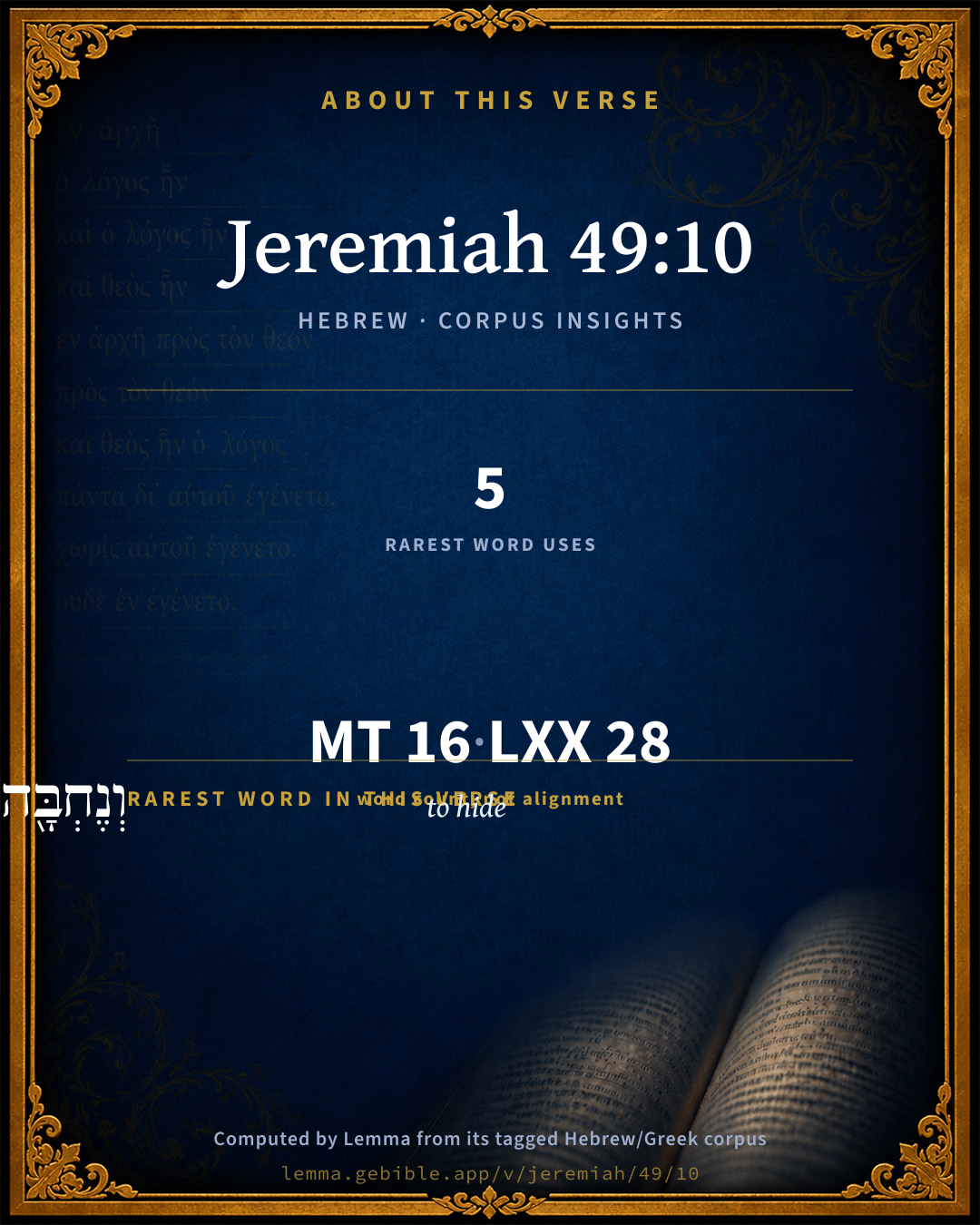
The rarest word here is וְנֶחְבָּ֖ה to hide H2247 — appearing just 5 times in the whole Hebrew Bible.

Shared distinctive vocabulary

וְנֶחְבָּ֖ה to hide H2247 occurs in 5 verses of the Hebrew Bible. Also found in:

Grammatical profile

  • 5 verbs
  • 4 nouns
  • 1 adjective
  • 1 pronoun
  • 1 conjunction
  • 4 particles

Verb forms

  • חָשַׂ֣פְתִּי Qal · Perfect
  • גִּלֵּ֨יתִי֙ Piel · Perfect
  • וְנֶחְבָּ֖ה Niphal · Sequential Perfect
  • יוּכָ֑ל Qal · Imperfect
  • שֻׁדַּ֥ד Pual · Perfect

Hebrew & Septuagint length

In the original languages it is 16 Hebrew tokens and 28 Greek tokens — but the two are counted differently (Hebrew bundles its prefixes and suffixes into one token; the Greek is in lemma form), so that isn’t a like-for-like length.

Cross-references

10

Topical passages linked to Jeremiah 49:10 in the Treasury of Scripture Knowledge — connected by theme and wording, ordered by reader-vote popularity; previews shown in the World English Bible.

  • Isaiah 17:14 At evening, behold, terror; [and] before the morning they are no more. This is the portion of those who despoil us, and the lot of those who rob us.
  • Malachi 1:3–4 but Esau I hated, and made his mountains a desolation, and gave his heritage to the jackals of the wilderness."
  • Psalms 37:28 For Yahweh loves justice, And doesn't forsake his saints. They are preserved forever, But the children of the wicked shall be cut off.
  • Psalms 37:35–36 I have seen the wicked in great power, Spreading himself like a green tree in its native soil.
  • Isaiah 14:20–22 You shall not be joined with them in burial, because you have destroyed your land, you have killed your people; the seed of evil-doers shall not be named forever.
  • Isaiah 45:3 and I will give you the treasures of darkness, and hidden riches of secret places, that you may know that it is I, Yahweh, who call you by your name, even the God of Israel.
  • Jeremiah 23:24 Can any hide himself in secret places so that I shall not see him? says Yahweh. Don't I fill heaven and earth? says Yahweh.
  • Amos 9:3 Though they hide themselves in the top of Carmel, I will search and take them out there; and though they be hid from my sight in the bottom of the sea, there I will command the serpent, and it will bite them.
  • Obadiah 1:9 Your mighty men, Teman, will be dismayed, to the end that everyone may be cut off from the mountain of Esau by slaughter.
  • Romans 9:13 Even as it is written, "Jacob I loved, but Esau I hated."

Cross-references courtesy of OpenBible.info (CC BY 4.0).

Hebrew and Greek witnesses Masoretic Hebrew ↔ Greek Septuagint

The same verse in the two great witnesses to the Old Testament, shown verse-for-verse.

These are two independent witnesses, not word-aligned to each other, and the Septuagint is shown in lemma (dictionary) form.

Hebrew Jeremiah 49:10 Masoretic · Westminster Leningrad Codex

כִּֽי אֲנִ֞י חָשַׂ֣פְתִּי אֶת עֵשָׂ֗ו גִּלֵּ֨יתִי֙ אֶת מִסְתָּרָ֔יו וְנֶחְבָּ֖ה לֹ֣א יוּכָ֑ל שֻׁדַּ֥ד זַרְע֛וֹ וְאֶחָ֥יו וּשְׁכֵנָ֖יו וְאֵינֶֽנּוּ

But I have made Esau bare, I have uncovered his secret places, and he shall not be able to hide himself: his seed is destroyed, and his brothers, and his neighbors; and he is no more.

World English Bible · Public Domain

Greek LXX Structure differs

In the Septuagint, Jeremiah is about an eighth shorter than the Hebrew and arranges its material differently — the Oracles Against the Nations (Hebrew chapters 46–51) appear in the middle of the Greek book, after 25:13. Because the chapter and verse boundaries do not line up, a verse-for-verse comparison with the Hebrew is not shown.

A verse-for-verse comparison isn’t shown here because the chapters and verses don’t line up. Switch to the LXX edition with the MT / LXX toggle above to read the Greek directly.

Hebrew: Westminster Leningrad Codex (CC BY 4.0). Greek: Septuagint (public domain); English from a public-domain English Septuagint. How the Septuagint differs from the Hebrew →

Targum (Aramaic paraphrase)

1

The Targum is the ancient Jewish Aramaic paraphrase of the Hebrew Scriptures — an interpretive translation, not the Hebrew text itself. Onkelos (literal) and Pseudo-Jonathan (expansive) render the Torah, and Jonathan the Prophets. Coverage is partial: where no permissively-licensed English translation exists for a verse, only the Aramaic is shown. This is verse-level text, not a word-by-word alignment to the Hebrew.

  1. Targum Jonathan Prophets (Joshua–Malachi)
    אֲרֵי אֲנָא אַיְתֵיתִי בְלוֹשִׁין עַל עֵשָׂו גִלִיתִי יַת מַטְמְרוֹהִי דְאִם יִבְעִי לְאִטַמְרָא לָא יִכּוּל אִתְבְּזִיזוּ בְּנוֹהִי וַאֲחוֹהִי וְקָרִיבוֹהִי וְלַיְתִינוּן:

    (no public-domain English translation for this verse)

    Targum Jonathan — Aramaic: “Mikraot Gedolot” (public domain). English: “Sefaria Community Translation” (CC0 1.0 (public-domain dedication)); “London "Chaldee Paraphrase," 1871” (public domain). Text via Sefaria.

Commentary

Notes on Jeremiah 49:10 from classic Christian and Jewish commentators (each source and its license shown beneath its notes). The classic Christian expositions comment on the surrounding passage and are grouped to its opening verse, so a note may address several verses; the Jewish commentaries on the Tanakh (Rashi and others) are per-verse, so they appear only where the commentator wrote on this verse.

Lemma curates 59 commentaries, every one of them public domain or Creative Commons licensed, each selected and text-cleaned for this edition rather than reprinted as found. About our sources →

Trapp's Complete Commentary

John Trapp

Jer 49:10 But I have made Esau bare, I have uncovered his secret places, and he shall not be able to hide himself: his seed is spoiled, and his brethren, and his neighbours, and he [is] not.

Ver. 10. I have uncovered his secret places.] Where he had hid himself, or his treasures, those sinews of war.

And he is not,] scil., Any more a state or a people. Time shall triumph over him, so that he shall but live by fame.

John Trapp, A Commentary or Exposition upon All the Books of the Old and New Testament (1647–1656) — public domain. Text from a community e-Sword module.

Jamieson, Fausset & Brown

Robert Jamieson, A. R. Fausset & David Brown

Edom became politically extinct after the time of the Romans.

uncovered his secret places--where he hid himself (Jer 49:8) and his treasures (Isa 45:3). I have caused that nothing should be so hidden as that the conqueror should not find it.

brethren--Ammon.

neighbours--the Philistines.

Jamieson, Fausset & Brown — Commentary Critical and Explanatory on the Whole Bible (1871) — public domain (CC PDM 1.0). Text via the HelloAO Bible API.

Adam Clarke's Commentary

Verse 10. I have made Esau bare] I have stripped him of all defence, and have discovered his hiding-places to his enemies.

Adam Clarke's Commentary on the Bible (1810–1826) — public domain. Text from a community e-Sword/MySword module.

John Calvin's Commentaries

As to the beginning of the verse, the meaning of the Prophet is not obscure; for he means that such would be the destruction of the people of Edom, that they would be spoiled by enemies, that they would become wholly naked. But he speaks in the name of God: Behold, I uncover Esau, and make open his hidden things By hidden things he means treasures, as it is evident from Obadiah. He then says that he would so expose the Idumeans to plunder, that there would be no hidden thing but that their enemies would seize and plunder it. This is the meaning.

He then confirms what I have said, that this plundering would not be like grape-gathering, or theft, or common robbery, because God would altogether empty the Idumeans of all that they had, even of all that they hid in the ground.

John Calvin's Commentaries (1540-1563) — public domain. Text from the Calvin Translation Society English edition (1840s-50s) via the Christian Classics Ethereal Library (ccel.org). Calvin's coverage is partial (roughly two-thirds of the Bible); uncommented books and verses are honest gaps, never fabricated. The 19th-century editor's footnotes and remarks are omitted so the notes are faithfully Calvin's own voice.

The Cambridge Bible for Schools and Colleges

gen. ed. J. J. S. Perowne

10. Parallel with Oba_1:6, which (as 8; see on Jer_49:7 above) is probably an insertion from this passage, where it fits the context much better; especially if, with mg. we introduce, as we should, the v. by For.

his secret places] the retreats and fastnesses of Edom.

his seed … he is not] For metrical reasons we should shorten this part of the v., reading, e.g. with Co. (who points out that “his seed is spoiled” is inconsistent with Jer_49:11), “he is spoiled and is not.”

The Cambridge Bible for Schools and Colleges (gen. ed. J. J. S. Perowne; Cambridge University Press, 1878–1918) — public domain. Text from a community e-Sword module.

John Gill's Exposition

But I have made Esau bare,.... By the hand of the Chaldeans; stripped him of everything that is valuable; of his cities, castles, villages, people, wealth, and treasure:

I have uncovered his secret places; where either his substance was hid, or his people; these were made known to their enemies, who seized on both:

and he shall not be able to hide himself; even in his deep places, in the caves and dens of the earth, but his enemy shall find him out:

his seed is spoiled, and his brethren, and his neighbours; his children, as the Targum; and his brethren, the Ammonites and Moabites; and his neighbours, the Philistines; or as many as were with him, and belonged unto him:

and he is not: his kingdom is not; he is no more a people and nation, but all destroyed by the sword, or carried captive; or there should be none left of his brethren, and neighbours, and friends, to say to him what follows: "leave thy fatherless children", &c. So Kimchi and Ben Melech say this phrase is in connection with the Jer 49:11.

John Gill's Exposition of the Whole Bible (1746–1763) — public domain (CC PDM 1.0). Text via the HelloAO Bible API.

Haydock's Catholic Bible Commentary

Secrets, or lurking holes, ver. 8. (Haydock) --- God permits the Chaldeans to plunder all. --- Brethren; Israelites. --- Neighbours; Moab, &c.

George Leo Haydock (1774–1849), Haydock's Catholic Family Bible and Commentary, 1859 edition — public domain. Excludes Psalms (Douay-Rheims chapter numbering differs from Protestant) and Deuterocanonical books (Catholic canon only).

Matthew Poole's English Annotations

But the Edomites should be left bare; and though they sought to hide themselves in secret places, yet God would there find them out, and there should be no places sufficient to hide them. All their children should be destroyed, and the Moabites their kinsmen, and the Philistines their neighbours, should be ruined as well as they.

Matthew Poole's English Annotations on the Holy Bible (1683–1685) — public domain. Text from a community e-Sword/MySword module.

The Pulpit Commentary

But, etc.; rather, for. The verse gives the reason why the destruction is so complete. "It is I, Jehovah, who made Esau bare," etc. "Esau," i.e. Edom. (Gen_25:30) His seed; i.e. the Edomites. His brethren, or kinsmen; i.e. the Amalekites. (Gen_36:12) His neighbours; i.e. the tribes of Dedan, Terns, and Buz. (Jer_25:23)

The Pulpit Commentary (1880–1919), ed. H.D.M. Spence-Jones & Joseph S. Exell — public domain. Text from a community e-Sword module.

Rashi

Rabbi Shlomo Yitzchaki (Rashi)

I exposed Heb. חשפתי, uncovered. Cf. “the exposure (מַחְשֹף) of the white” (Gen. 30:37). And you delivered the survivors of Israel in order that no one remain of them, as it is stated: “Neither should you have delivered his survivors” (Obadiah 1:14).

and he could not hide He will seek to hide but will be unable.

Rashi on the Tanakh — English translations: “The Judaica Press complete Tanach with Rashi, translated by A. J. Rosenberg” (CC BY 4.0); “Pentateuch with Rashi's commentary by M. Rosenbaum and A.M. Silbermann, 1929-1934” (public domain); “The Metsudah Tanach series, Lakewood, N.J” (CC BY 4.0); and “The Book of Joshua, Metsudah Publications, 1997” (CC BY 4.0). Text via Sefaria.

Lesson kit

Teaching starters — assembled from the data on this page, not authored interpretation. Every prompt links to the verse data it draws on. Edit before teaching.

Jeremiah, in the Prophets, opens this verse with 16 words (15 distinct Hebrew lemmas). Its most distinctive word is châbâh (“to hide”). A historical commentator’s framing appears above. Read the whole chapter for the surrounding context.

Discussion questions

  1. The word châbâh carries the sense “to hide.” How does it shape the verse?
  2. How does Joshua 2:16, which shares the word «to hide», read alongside this verse?
  3. These translations render this verse differently; the difference is in the English rendering, not the original. What questions does that raise?
  4. «חָשַׂ֣פְתִּי» is a Qal Perfect verb. How does that grammatical form shape the action described?
  5. Compare how Trapp's Complete Commentary and Jamieson, Fausset & Brown read this verse. Where do they agree or differ?

Things to notice

Reading settings

Reading text

Shown beneath each verse's original-language words.

Old Testament
Old Testament edition

Read the OT as the Masoretic Hebrew (MT) or the Greek Septuagint (LXX).

English shown for the Greek Septuagint (in the Hebrew ↔ Greek comparison).

Comparing translations? Open the Compare panel on any verse page to stack up to four side by side.