Esther 8:6

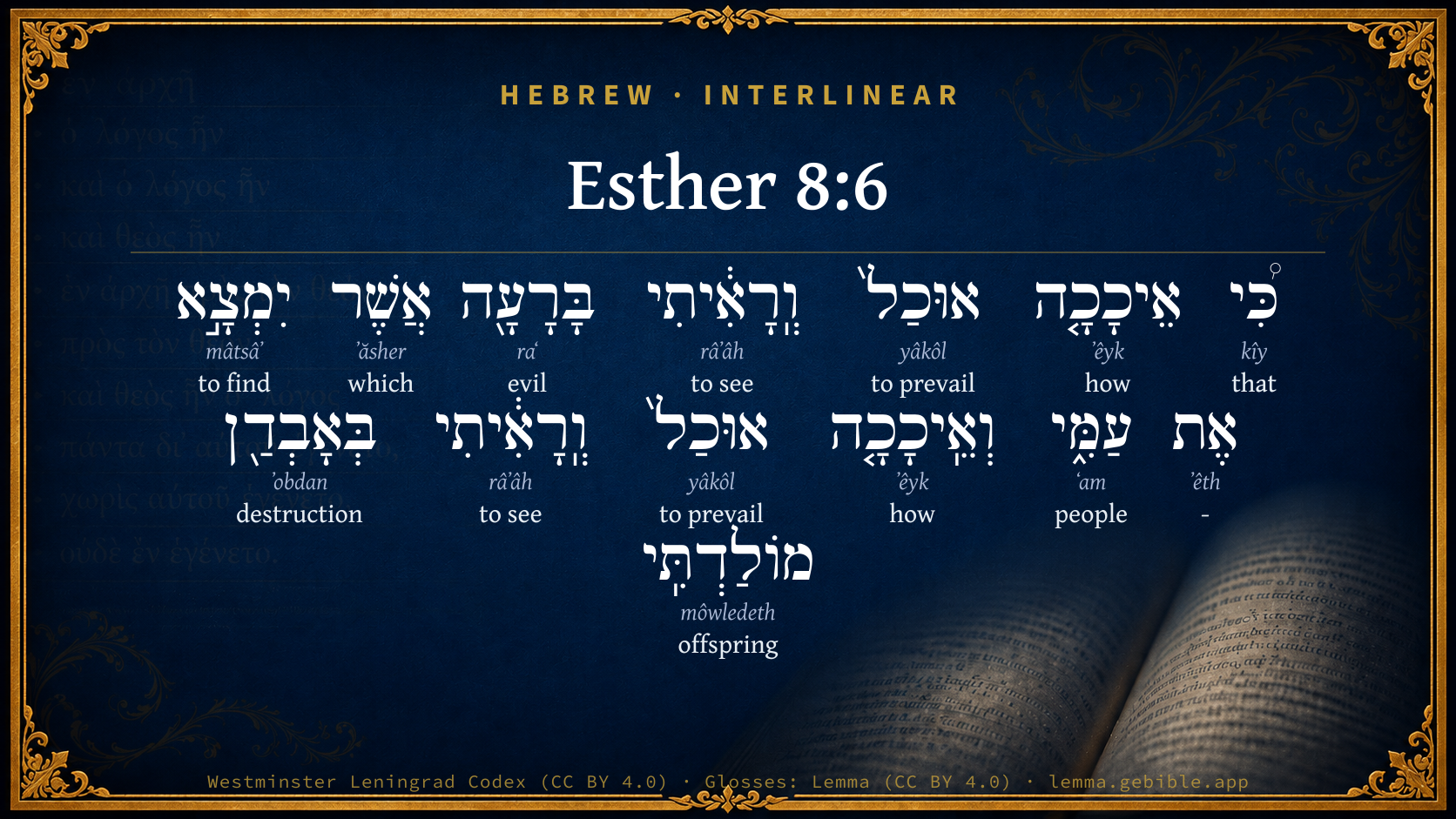
Hebrew (Westminster Leningrad Codex) Esther 8:6 appears in the Hebrew Old Testament. The text above is from the Westminster Leningrad Codex. Each word links to its Strong’s number, a concise gloss, and parsing drawn from the Open Scriptures Hebrew Bible morphology. Click any word for its full Brown-Driver-Briggs (BDB) entry.
Download image
Cite this verse

Esther 8:6 (World English Bible). Public Domain. Lemma interlinear Bible study tool, https://lemma.gebible.app/v/esther/8/6.

Show BibTeX & RIS
BibTeX
RIS
English Translation
for how can I endure to see the evil that shall come to my people? or how can I endure to see the destruction of my relatives?
World English Bible · Public Domain
Highlights
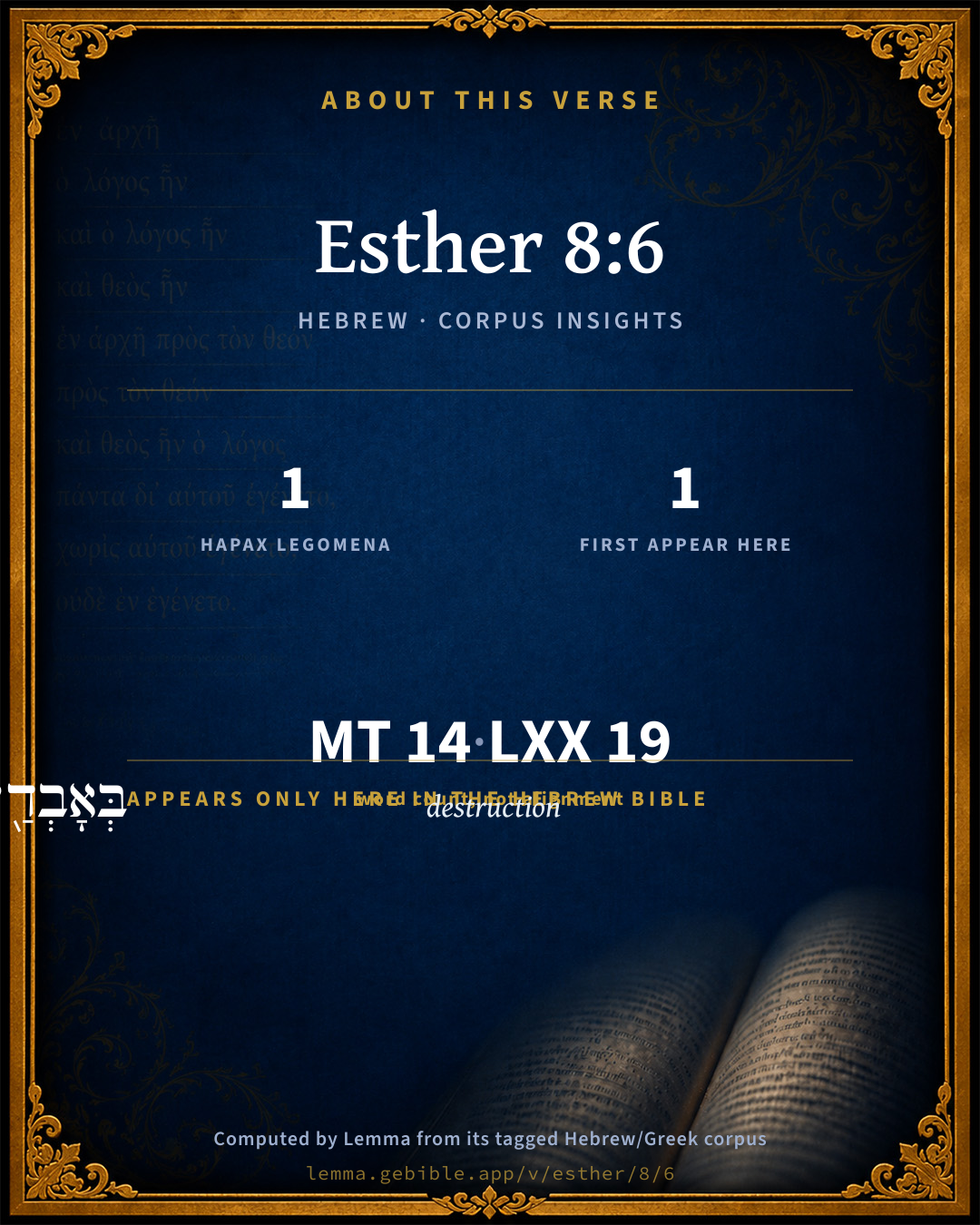
  • 1 hapax legomenon — only here in the Hebrew Bible
  • 1 first appearance in the Hebrew Bible
Full analysis ↓
Download a study sheet

One document with this verse’s original text, its word-by-word gloss line, the meaning frame, cross-references with their text, attributed commentary, and full source and license credits — printable, and it pastes into notes with its structure intact.

This verse Autodidact and up

Study sheet (.html) Plain text (.txt)

A passage Seminary Student

Up to 50 verses in one chapter. A passage sheet keeps up to 6 commentary sources and 12 cross-references per verse, in the order this page ranks them, and says so on the sheet whenever that leaves anything out. Ask for a single verse and you get the Autodidact verse sheet above.

Everything on this page stays free to read, with no account — the sheet is a download of what is already on screen, not access to it.

Want to remove ads? Support Godless Engineer
Compare translations 3

The same verse in 3 English versions, stacked beneath the original-language interlinear above. Click any original word for its lexicon entry.

Each is an independent rendering of the whole verse — the interlinear is not word-aligned to these translations.

Highlighted words mark where these versions differ — a whole-verse word diff, not a word-by-word alignment.

  • World English Bible Public Domain
    for how can I endure to see the evil that shall come to my people? or how can I endure to see the destruction of my relatives?
  • King James Version Public Domain
    For how can I endure to see the evil that shall come unto my people? or how can I endure to see the destruction of my kindred?
  • unfoldingWord Literal Text CC BY-SA 4.0
    For how could I bear to see the evil that my people would find? And how could I bear seeing the destruction of my kindred?”

unfoldingWord Literal Text — © unfoldingWord, licensed CC BY-SA 4.0. Word-aligned USFM3 via Door43 (git.door43.org/unfoldingWord/en_ult).

Versions to compare (up to 4)

3 of 4 selected

Show all 18 translations

Every available English version of this verse, each an independent rendering of the whole verse.

  • World English Bible Public Domain
    for how can I endure to see the evil that shall come to my people? or how can I endure to see the destruction of my relatives?
  • Berean Standard Bible Public Domain
    For how could I bear to see the disaster that would befall my people? How could I bear to see the destruction of my kindred?”
  • Majority Standard Bible Public Domain
    For how could I bear to see the disaster that would befall my people? How could I bear to see the destruction of my kindred?”
  • King James Version Public Domain
    For how can I endure to see the evil that shall come unto my people? or how can I endure to see the destruction of my kindred?
  • American Standard Version (1901) Public Domain
    for how can I endure to see the evil that shall come unto my people? or how can I endure to see the destruction of my kindred?
  • Revised Version (1885) Public Domain
    for how can I endure to see the evil that shall come unto my people? or how can I endure to see the destruction of my kindred?
  • Geneva Bible (1599) Public Domain
    For how can I suffer and see the euil, that shall come vnto my people? Or howe can I suffer and see the destruction of my kinred?
  • Douay-Rheims (1899) Public Domain
    For how call I endure the murdering and slaughter of my people?
  • Young's Literal Translation Public Domain
    for how do I endure when I have looked on the evil that doth find my people? and how do I endure when I have looked on the destruction of my kindred?'
  • Literal Standard Version CC BY-SA 4.0
    for how do I endure when I have looked on the evil that finds my people? And how do I endure when I have looked on the destruction of my family?”
  • Unlocked Literal Bible CC BY-SA 4.0
    For how could I bear to see disaster fall on my people? How could I endure watching the destruction of my relatives?”
  • unfoldingWord Literal Text CC BY-SA 4.0
    For how could I bear to see the evil that my people would find? And how could I bear seeing the destruction of my kindred?”
  • Darby Bible Public Domain
    For how shall I endure to see the evil that shall befall my people? and how shall I endure to see the destruction of my kindred?
  • World Messianic Bible Public Domain
    For how can I endure to see the evil that would come to my people? How can I endure to see the destruction of my relatives?”
  • Webster's Bible Public Domain
    For how can I endure to see the evil that will come to my people? or how can I endure to see the destruction of my kindred?
  • Free Bible Version CC BY-SA 4.0
    For how can I bear to see the disaster about to fall on my people? How can I bear to see the destruction of my family?”
  • Bible in Basic English Public Domain
    For how is it possible for me to see the evil which is to overtake my nation? how may I see the destruction of my people?
  • JPS Tanakh (1917) Public Domain
    for how can I endure to see the evil that shall come unto my people? or how can I endure to see the destruction of my kindred?'

Literal Standard Version (2020), Covenant Press — licensed CC BY-SA 4.0. Text via the HelloAO Bible API (eBible.org). Unlocked Literal Bible (unfoldingWord) — licensed CC BY-SA 4.0. Text via the HelloAO Bible API (eBible.org). unfoldingWord Literal Text — © unfoldingWord, licensed CC BY-SA 4.0. Word-aligned USFM3 via Door43 (git.door43.org/unfoldingWord/en_ult). Free Bible Version, Dr. Jonathan Gallagher — licensed CC BY-SA 4.0. Text via the HelloAO Bible API (eBible.org).

Word by word

More ways to search: Search by grammar → Find every occurrence → Compare this word →

Practice this passage: Drill this verse → Learn its vocabulary →

בְּאָבְדַ֖ן
ʼobdan
H13
“in/at · destruction of”
Preposition + Noun, Common, Masculine, Singular, Construct
Part of Speech
Preposition + Noun
Type
Common
Gender
Masculine
Number
Singular
State
Construct
Full BDB Definition

Origin: from H6

TWOT: 2c

destruction
  1. כִּ֠י kîy H3588 “that” Conjunction
  2. אֵיכָכָ֤ה ʼêyk H349 “how” Particle, Interrogative
  3. אוּכַל֙ yâkôl H3201 “to prevail” Verb, Qal, Imperfect, 1st Person, Common, Singular
  4. וְֽרָאִ֔יתִי râʼâh H7200 “and · to see” Conjunction + Verb, Qal, Sequential Perfect, 1st Person, Common, Singular
  5. בָּרָעָ֖ה raʻ H7451 “in/at the · evil” Preposition, Determined + Noun, Common, Feminine, Singular, Absolute
  6. אֲשֶׁר ʼăsher H834 “which” Particle, Relative
  7. יִמְצָ֣א mâtsâʼ H4672 “to find” Verb, Qal, Imperfect, 3rd Person, Masculine, Singular
  8. אֶת ʼêth H853 “-” Particle, Direct Object
  9. עַמִּ֑י ʻam H5971 “people · my” Noun, Common, Masculine, Singular, Construct + Suffix, Personal, 1st Person, Common, Singular
  10. וְאֵֽיכָכָ֤ה ʼêyk H349 “and · how” Conjunction + Particle, Interrogative
  11. אוּכַל֙ yâkôl H3201 “to prevail” Verb, Qal, Imperfect, 1st Person, Common, Singular
  12. וְֽרָאִ֔יתִי râʼâh H7200 “and · to see” Conjunction + Verb, Qal, Sequential Perfect, 1st Person, Common, Singular
  13. מוֹלַדְתִּֽי môwledeth H4138 “offspring · my” Noun, Common, Feminine, Singular, Construct + Suffix, Personal, 1st Person, Common, Singular

About this verse

These counts appear in no published source. They are computed here, from the morphology-tagged text and Lemma’s own curated glosses. What Lemma adds →

14
words
11
distinct lemmas
Historical
section

Notable vocabulary

1 hapax legomenon — a word that appears only here in the entire Hebrew Bible:

  • בְּאָבְדַ֖ן destruction H13

First appearance in Scripture

This word makes its first canonical appearance in the Hebrew Bible here:

  • בְּאָבְדַ֖ן destruction H13

Shared distinctive vocabulary

מוֹלַדְתִּֽי offspring H4138 occurs in 21 verses of the Hebrew Bible. Also found in:

Grammatical profile

  • 5 verbs
  • 4 nouns
  • 1 conjunction
  • 4 particles

Verb forms

  • אוּכַל֙ Qal · Imperfect
  • וְֽרָאִ֔יתִי Qal · Sequential Perfect
  • יִמְצָ֣א Qal · Imperfect
  • אוּכַל֙ Qal · Imperfect
  • וְֽרָאִ֔יתִי Qal · Sequential Perfect

Repetition

Words recur within this verse — often emphatic in Hebrew:

  • אֵיכָכָ֤ה how H349 ×2
  • אוּכַל֙ to prevail H3201 ×2
  • וְֽרָאִ֔יתִי to see H7200 ×2

Hebrew & Septuagint length

In English translation the verse runs 27 words from the Hebrew and 27 from the Septuagint (LXX English) — the same length.

A rough comparison of the two English renderings, which tokenize alike — not a word-level alignment.

Word counts can differ between the Hebrew and the Greek without any difference in meaning — e.g. the Hebrew direct-object marker אֵת has no separate Greek word, and Greek often adds the article ὁ.

In the original languages it is 14 Hebrew tokens and 19 Greek tokens — but the two are counted differently (Hebrew bundles its prefixes and suffixes into one token; the Greek is in lemma form), so that isn’t a like-for-like length.

Cross-references

9

Topical passages linked to Esther 8:6 in the Treasury of Scripture Knowledge — connected by theme and wording, ordered by reader-vote popularity; previews shown in the World English Bible.

  • Esther 7:4 for we are sold, I and my people, to be destroyed, to be slain, and to perish. But if we had been sold for bondservants and bondmaids, I had held my peace, although the adversary could not have compensated for the king's damage.
  • Romans 9:2–3 that I have great sorrow and unceasing pain in my heart.
  • Romans 10:1 Brothers, my heart's desire and my prayer to God is for Israel, that they may be saved.
  • Genesis 44:34 For how will I go up to my father, if the boy isn't with me? Lest I see the evil that will come on my father."
  • Nehemiah 2:3 I said to the king, Let the king live forever: why should not my face be sad, when the city, the place of my fathers' tombs, lies waste, and the gates of it are consumed with fire?
  • Esther 9:1 Now in the twelfth month, which is the month Adar, on the thirteenth day of the same, when the king's commandment and his decree drew near to be put in execution, on the day that the enemies of the Jews hoped to have rule over them, (whereas it was turned to the contrary, that the Jews had rule over those who hated them),
  • Jeremiah 4:19 My anguish, my anguish! I am pained at my very heart; my heart is disquieted in me; I can't hold my peace; because you have heard, O my soul, the sound of the trumpet, the alarm of war.
  • Jeremiah 9:1 Oh that my head were waters, and my eyes a spring of tears, that I might weep day and night for the slain of the daughter of my people!

Cross-references courtesy of OpenBible.info (CC BY 4.0).

Hebrew and Greek witnesses Masoretic Hebrew ↔ Greek Septuagint

The same verse in the two great witnesses to the Old Testament, shown verse-for-verse.

These are two independent witnesses, not word-aligned to each other, and the Septuagint is shown in lemma (dictionary) form.

Hebrew Esther 8:6 Masoretic · Westminster Leningrad Codex

כִּ֠י אֵיכָכָ֤ה אוּכַל֙ וְֽרָאִ֔יתִי בָּרָעָ֖ה אֲשֶׁר יִמְצָ֣א אֶת עַמִּ֑י וְאֵֽיכָכָ֤ה אוּכַל֙ וְֽרָאִ֔יתִי בְּאָבְדַ֖ן מוֹלַדְתִּֽי

for how can I endure to see the evil that shall come to my people? or how can I endure to see the destruction of my relatives?

World English Bible · Public Domain

Greek LXX Esther 8:6 Septuagint · lemma form

πῶς γάρ δύναμαι ὁράω ὁ κάκωσις ὁ λαός ἐγώ καί πῶς δύναμαι σώζω ἐν ὁ ἀπώλεια ὁ πατρίς ἐγώ

For how shall I be able to look upon the affliction of my people, and how shall I be able to survive the destruction of my kindred?

LXX2012 (modern English Septuagint) · Public Domain

Hebrew: Westminster Leningrad Codex (CC BY 4.0). Greek: Septuagint (public domain); English from LXX2012 (modern English Septuagint) (Public Domain). How the Septuagint differs from the Hebrew →

Commentary

Notes on Esther 8:6 from classic Christian and Jewish commentators (each source and its license shown beneath its notes). The classic Christian expositions comment on the surrounding passage and are grouped to its opening verse, so a note may address several verses; the Jewish commentaries on the Tanakh (Rashi and others) are per-verse, so they appear only where the commentator wrote on this verse.

Lemma curates 59 commentaries, every one of them public domain or Creative Commons licensed, each selected and text-cleaned for this edition rather than reprinted as found. About our sources →

Trapp's Complete Commentary

John Trapp

Est 8:6 For how can I endure to see the evil that shall come unto my people? or how can I endure to see the destruction of my kindred?

Ver. 6. For how can I endure to see the evil, &c.] She had her life already given her at her petition; but unless she might have her people at her request, who were sold as well as herself, to be destroyed, to be slain, and to perish, Est 7:3-4, her life would be unto her a joyless, that is, a lifeless life, Mortis enim habet vices quae trahitur vita gemitibus. It is rather a death than a life that is spent in heaviness and horror. And this would be Esther’s case if her people should be massacred, as was designed and decreed; such was her holy sympathy and endeared affection to her countrymen and fellow citizens of heaven, that she could not live to behold such a sad and bloody spectacle:

Absit ut excisa possim super vivere Troia,

said Anchises to his son Æneas, that would have saved his life in that common destruction of his country: Far be it from me to outlive Troy. Curtius telleth us, that Alexander the Great, when he was extremely thirsty, and had water offered to him, he would not receive it, but put it by with this brave speech, Nec solus bibere sustineo, nec tam exiguum dividere omnibus possum, There is not enough for all my soldiers to share with me, and to drink it alone I cannot find in my heart, I will never do it. Compare herewith this speech of Esther, and you will find it far the better, as being full of those precious graces (whereunto Alexander was a perfect stranger), humility, prudence, faith, zeal toward God, and ardent love toward his people. Oh how great is the number of those today (saith Lavater here), qui ne micam Spiritus Estherae habent, who have not the least parcel of Esther’s spirit, but are all for themselves, and for their own interests!

Or how can I endure to see] Heb. Quomodo potero et videbo? How can I? and shall I see? how should I do otherwise than sink at the sight (as she did in the Roman History, when her son was butchered; and as the Virgin Mary felt a sword at her heart when she beheld Christ crucified, Luk 2:35). Melancthon said, that good Oecolampadius died of grief for the Church’s calamities. Nehemiah was heart sick for the breaches of Joseph, Neh 2:3 Amo 6:6. Moses wished himself expunged, and Paul accursed, rather than it should go ill with God’s people.

John Trapp, A Commentary or Exposition upon All the Books of the Old and New Testament (1647–1656) — public domain. Text from a community e-Sword module.

Adam Clarke's Commentary

Verse 6. To see the destruction of my kindred?] She had now informed the king that she was cousin to Mordecai, and consequently a Jewess; and though her own life and that of Mordecai were no longer in danger, Haman being dead, yet the decree that had gone forth was in full force against the Jews; and if not repealed, their destruction would be inevitable.

Adam Clarke's Commentary on the Bible (1810–1826) — public domain. Text from a community e-Sword/MySword module.

John Gill's Exposition

For how can I endure to see the evil that shall come unto my people?.... I cannot bear it; it will break my heart; I shall die to see all my people massacred throughout the realm; the thought of it is shocking and shuddering; to see it, intolerable: or "how can I endure to see the destruction of my kindred?" the same thing in different words, and somewhat more express and explanative. She explains the evil coming upon her people of the utter destruction of them, not barely an oppression, but an extermination of them; and she makes use of a word expressive of their relation to her, as more endearing, being her kindred; she and they being, as it were, of the same family, and with whom she could not but sympathize in distress.

For how can I endure to see the evil that shall come unto my people?.... I cannot bear it; it will break my heart; I shall die to see all my people massacred throughout the realm; the thought of it is shocking and shuddering; to see it, intolerable: or "how can I endure to see the destruction of my kindred?" the same thing in different words, and somewhat more express and explanative. She explains the evil coming upon her people of the utter destruction of them, not barely an oppression, but an extermination of them; and she makes use of a word expressive of their relation to her, as more endearing, being her kindred; she and they being, as it were, of the same family, and with whom she could not but sympathize in distress.

Esther 8:7

est 8:7

est 8:7

est 8:7Then the King Ahasuerus said unto Esther the queen, and to Mordecai the Jew,.... Who was present at the same time, either at the desire of Esther, or by virtue of his office, being now one of those that saw the king's face, Est 8:1,

behold, I have given Esther the house of Haman; See Gill on Est 8:1,

and him they have hanged upon the gallows; which he had prepared for Mordecai, Est 7:10

because he laid his hand upon the Jews; intended to do so, and had prepared for it, and wrote letters, ordering their destruction on such a day. Now as the king had shown favour to Esther and Mordecai, and had punished Haman for contriving mischief against them and the Jews, which was publicly known, the people would be fearful of doing anything against them, lest they should incur the king's displeasure, and therefore might make themselves easy about this matter; but, however, to give them all the satisfaction he could, he directs them to do as follows.

John Gill's Exposition of the Whole Bible (1746–1763) — public domain (CC PDM 1.0). Text via the HelloAO Bible API.

Matthew Poole's English Annotations

My heart will sink under it, and I shall never be able to survive it.

Matthew Poole's English Annotations on the Holy Bible (1683–1685) — public domain. Text from a community e-Sword/MySword module.

The Pulpit Commentary

Patriotism.

Esther"s life was now safe, and probably her cousin"s too. But that was not enough. Her nation was still in danger. The royal decree had delivered the Jews throughout the empire into the hands of their enemies. In a few months, unless measures were meantime taken to check and hinder the malice of their foes, thousands of Israelites might be exposed to violence, pillage, and massacre. The thought was to Esther cruel beyond bearing. "How," said she, "can I endure to see the evil that shall come unto my people, the destruction of my kindred?" This was patriotism indeed.

I PATRIOTISM IMPLIES A SENTIMENT OF SYMPATHY. Esther felt for her people, her kindred. Every lover of his country will not only rejoice in its prosperity, cherish a glow of pride and satisfaction in any great deeds of his countrymen, but will grieve over national calamities and mourn over national sins; will "sigh and cry for the abominations that are done in the land.

II PATRIOTISM DETERS MEN FROM DOING ANYTHING THAT CAN INJURE THEIR COUNTRY. If personal advantage can be secured by any harm to his country, the patriot will spurn the thought of so profiting himself at the expense of the nation. As a citizen, whose life must have some influence, he will refrain from conduct by which his countrymen might suffer.

III TRUE PATRIOTISM WILL LEAD MEN TO SEEK NOT ONLY THE MATERIAL PROSPERITY, BUT THE REAL AND MORAL GREATNESS OF THEIR COMMON COUNTRY. They cannot contemplate uninterested, unmoved, a state of society

Where wealth accumulates, and men decay.

The progress of knowledge, of virtue, of true religion amongst their kindred will be sought with ardour and zeal.

IV PATRIOTISM WILL LEAD TO PRACTICAL EFFORT TO AVOID THREATENING DANGERS. The patriot is unwilling to contemplate, to anticipate evil. But mere sentiment is insufficient, and he will exert himself to avert the evil he dreads. Especially will he use any influence he possesses with those who have the means, the power, the opportunity of assisting to secure the safety and welfare of the country. The examples of Ezra and of Nehemiah, among the children of the captivity, show us what true patriotism will lead men to undertake and do and bear. But the supreme example, alike of patriotism and of philanthropy, is to be beheld in Jesus Christ, who wept over Jerusalem as well as over the world, and who would fain have averted ruin from the city he favoured with his teaching and ministry, and in which he shed his precious blood.

HOMILIES BY P.C. BARKER Ver. 6.

True patriotism.

Esther felt that her work was not yet done. An overconfident and sanguine disposition might have taken for granted, as we do in the mere retrospect, that all else which was requisite would follow as matter of course. She had met as yet no rebuff, had suffered no failure. Each move, well considered beforehand, had been crowned with success, surpassing the utmost that she or Mordecai had dared to imagine. In the flush of personal success, and of joy because of the safety and great promotion of Mordecai, she does not forget the larger family of her "people" and "kindred." The fearful decree is not reversed. It still overhangs the heads of thousands upon thousands. Esther feels that her mission will not be fulfilled until she has obtained the abrogation of the decree, and secured the lives of her people. In all the methods she had employed hitherto a remarkable calmness and circumspection are observable. But now a change is visible in favour of a demonstrativeness which it must have required very strong effort to keep up to this time in such restraint. Esther "fell down at the feet of the king, and besought him with tears to put away the mischief of Haman, and his device that he had devised against the Jews (ver. 3). This change is interesting to observe, as occurring at the time when thought and affection left self and home for the scattered kindred of a hundred and twenty-seven provinces. This verse is the irrepressible outcry of true patriotism. It is the expostulation of vivid and tender sympathy. It is the argument of a forcible principle of our nature, which oversteps the boundaries of the personal and the domestic in order to travel much farther, and to embrace the national. It mounts by the stepping-stones of self-love and sacred family love to the love of vast numbers of those never seen nor personally known, yet in some special sense related. The passage suggests, by a leading illustration, the general subject of patriotism; and we may notice

I WHAT TRUE PATRIOTISM IS.

1. It is evidently an original and ultimate principle. As soon as ever it waspossible it showed its existence The fact of its presence, and operative presence, has been visible in all ages, traceable in all kinds and degrees of civilisation among the barbarous, and among the most advanced and elevated nationalities.

2. It is a principle of a high moral kind. A form of love above the sympathywhich is between individual and individual, above that which lies between those born of the same parents, and, on the other hand, falling short of that universal love of man, as such, which is one of the very highest teachings of Christianity.

3. It is a somewhat quickened regard for those united to us by communityof race. A stronger interest in their welfare and advantage is marked by it, while divested as far as possible of any conscious reflex action or benefit to self. This affection was no doubt exceedingly strong in the Jewish race, was at Esther"s time greatly intensified by adversity and persecution and natural causes, but owed its most determined hold to distinctly Divine purpose.

II THE USE OF PATRIOTISM IN THE INDIVIDUAL CHARACTER.

1. It must be enlarging to the heart. It must expand the affections in theiroutlook, which then seek the various and the distant instead of ever keeping at home. It must give greater and freer exercise to the more important moral elements of our nature.

2. It must operate ever as a distinct corrective to some portion of thedangers of selfishness. There is much selfishness in our self-love; there is often not a little even in the family and domestic circle; sympathies may run round indeed, but in too narrow a circle. But the circle is immensely widened by this community of interest, while yet kept within a manageable area.

3. It is able to give enough natural motive to the awakening of moralenergies, which without it would have found no sufficient appeal. In point of fact, some of the grandest displays of human force, and among them that of the present history, have been due to it.

III ITS USEFULNESS TO PUBLIC SOCIETY. There will be a vast amount of this necessarily entailed indirectly and unconsciously, as arising from the previous considerations; but, in addition, manifest practical use on a large scale will also result.

1. It secures the prospect of bringing together to one point a greataggregate of force in emergency. It is like public opinion in action, seasoned by genuine affection.

2. It is equal also to the converse of this, spreading, as in Esther"s example, the willing benefit, the critical advantage of opportunity, of one loving, praying heart, over a vast area.

3. Pervading the whole mass of mankind, it so divides it up and so allots it,that in place of unwieldiness a well-knit-together organisation is found. Thus it offers a strong and very traceable analogy to the body with its members.

IV THAT IN PATRIOTISM WE HAVE ANOTHER EVIDENCE OF DIVINE DESIGN IN THE STRUCTURE OF HUMAN SOCIETY. For

1. It cannot possibly be attributed to mere human arrangement or compact.

2. It does not at all really contravene either the descent of all from onehead, or the fact that "God has made of one blood all nations of the earth.

3. Its operation is not malevolent, setting "nation against nation." It isbeneficent, and is ever growing to show itself more and more so, leading up to mutual service, mutual dependence, and mutual love, to the attainment of which it were very hard to see any other way so compact, so sure. B.

The Pulpit Commentary (1880–1919), ed. H.D.M. Spence-Jones & Joseph S. Exell — public domain. Text from a community e-Sword module.

Lesson kit

Teaching starters — assembled from the data on this page, not authored interpretation. Every prompt links to the verse data it draws on. Edit before teaching.

Esther, in the Historical, opens this verse with 14 words (11 distinct Hebrew lemmas). Its most distinctive word is ʼobdan (“destruction”). A historical commentator’s framing appears above. Read the whole chapter for the surrounding context.

Discussion questions

  1. What does “destruction” (ʼobdan) contribute to the verse as a whole?
  2. 1 word here appears nowhere else in the Hebrew Bible. Why might the author reach for such rare wording?
  3. This is the first place “destruction” appears in Scripture (first appears here). What does its debut here establish?
  4. How does Genesis 11:28, which shares the word «offspring», read alongside this verse?
  5. What does the repetition of “how” (2× in this one verse) do in this verse?
  6. These translations render this verse differently; the difference is in the English rendering, not the original. What questions does that raise?
  7. «אוּכַל֙» is a Qal Imperfect verb. How does that grammatical form shape the action described?
  8. Compare how Trapp's Complete Commentary and Adam Clarke's Commentary read this verse. Where do they agree or differ?

Things to notice

  • 1 word in this verse appears nowhere else in the Hebrew Bible.
  • 1 word makes its first canonical appearance in Scripture here.
  • This verse counts 14 Hebrew ↔ 19 Greek words.
  • These translations choose different wording for 11 words in this verse.
  • “how” occurs 2× in this single verse.

Reading settings

Reading text

Shown beneath each verse's original-language words.

Old Testament
Old Testament edition

Read the OT as the Masoretic Hebrew (MT) or the Greek Septuagint (LXX).

English shown for the Greek Septuagint (in the Hebrew ↔ Greek comparison).

Comparing translations? Open the Compare panel on any verse page to stack up to four side by side.