
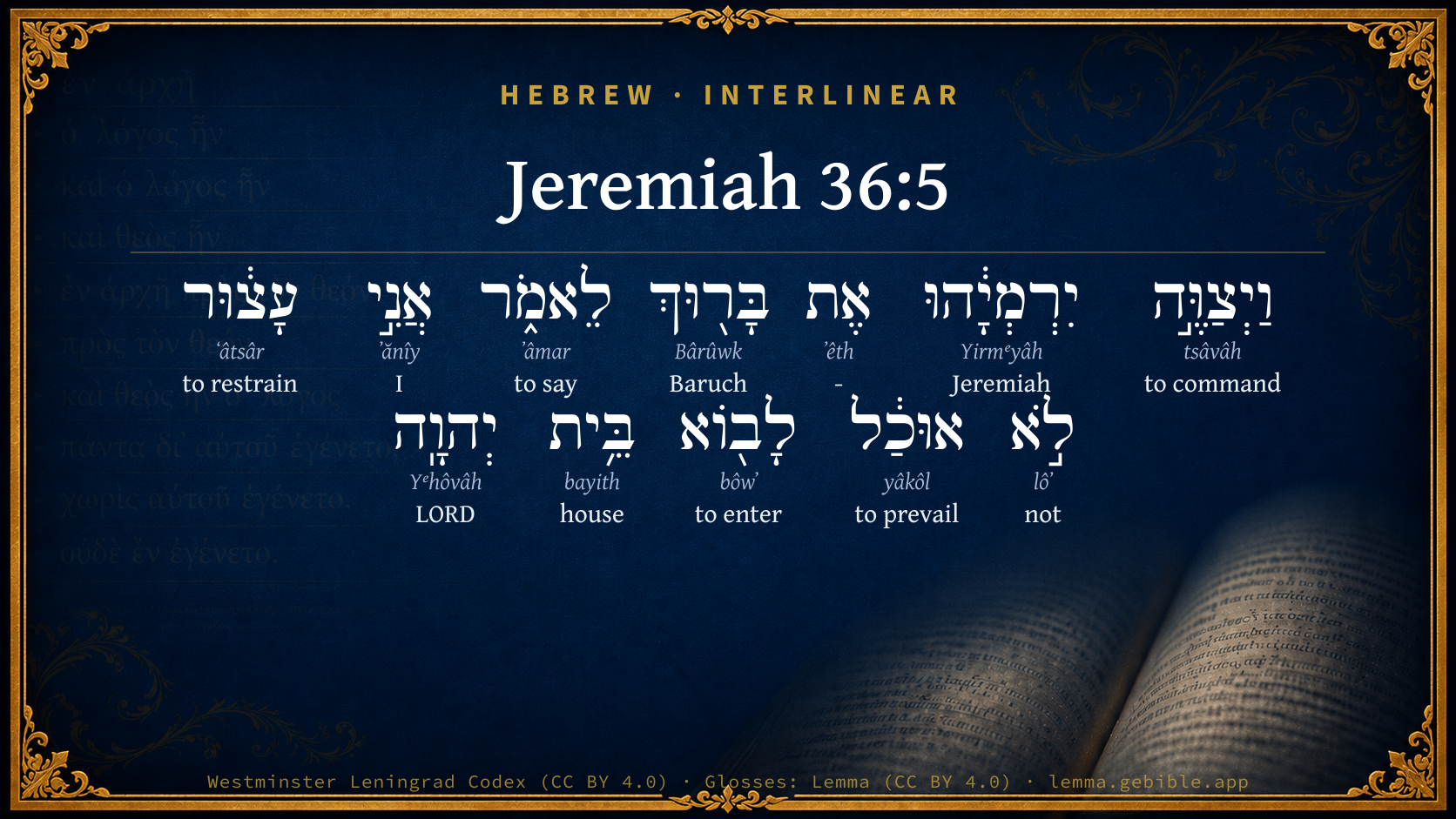
Jeremiah 36:5

Hebrew (Westminster Leningrad Codex) Jeremiah 36:5 appears in the Hebrew Old Testament. The text above is from the Westminster Leningrad Codex. Each word links to its Strong’s number, a concise gloss, and parsing drawn from the Open Scriptures Hebrew Bible morphology. Click any word for its full Brown-Driver-Briggs (BDB) entry.
Download image
Cite this verse

Jeremiah 36:5 (World English Bible). Public Domain. Lemma interlinear Bible study tool, https://lemma.gebible.app/v/jeremiah/36/5.

Show BibTeX & RIS
BibTeX
RIS
English Translation
Jeremiah commanded Baruch, saying, I am shut up; I can't go into the house of Yahweh:
World English Bible · Public Domain
Download a study sheet

One document with this verse’s original text, its word-by-word gloss line, the meaning frame, cross-references with their text, attributed commentary, and full source and license credits — printable, and it pastes into notes with its structure intact.

This verse Autodidact and up

Study sheet (.html) Plain text (.txt)

A passage Seminary Student

Up to 50 verses in one chapter. A passage sheet keeps up to 6 commentary sources and 12 cross-references per verse, in the order this page ranks them, and says so on the sheet whenever that leaves anything out. Ask for a single verse and you get the Autodidact verse sheet above.

Everything on this page stays free to read, with no account — the sheet is a download of what is already on screen, not access to it.

Want to remove ads? Support Godless Engineer
Compare translations 3

The same verse in 3 English versions, stacked beneath the original-language interlinear above. Click any original word for its lexicon entry.

Each is an independent rendering of the whole verse — the interlinear is not word-aligned to these translations.

Highlighted words mark where these versions differ — a whole-verse word diff, not a word-by-word alignment.

  • World English Bible Public Domain
    Jeremiah commanded Baruch, saying, I am shut up; I can't go into the house of Yahweh:
  • King James Version Public Domain
    And Jeremiah commanded Baruch, saying, I am shut up; I cannot go into the house of the LORD:
  • unfoldingWord Literal Text CC BY-SA 4.0
    Next Jeremiah gave a command to Baruch. He said, “I am in prison and cannot go to Yahweh’s house.

unfoldingWord Literal Text — © unfoldingWord, licensed CC BY-SA 4.0. Word-aligned USFM3 via Door43 (git.door43.org/unfoldingWord/en_ult).

Versions to compare (up to 4)

3 of 4 selected

Show all 18 translations

Every available English version of this verse, each an independent rendering of the whole verse.

  • World English Bible Public Domain
    Jeremiah commanded Baruch, saying, I am shut up; I can't go into the house of Yahweh:
  • Berean Standard Bible Public Domain
    Then Jeremiah commanded Baruch, “I am restricted; I cannot enter the house of the LORD;
  • Majority Standard Bible Public Domain
    Then Jeremiah commanded Baruch, “I am restricted; I cannot enter the house of the LORD;
  • King James Version Public Domain
    And Jeremiah commanded Baruch, saying, I am shut up; I cannot go into the house of the LORD:
  • American Standard Version (1901) Public Domain
    And Jeremiah commanded Baruch, saying, I am shut up; I cannot go into the house of Jehovah:
  • Revised Version (1885) Public Domain
    And Jeremiah commanded Baruch, saying, I am shut up; I cannot go into the house of the LORD:
  • Geneva Bible (1599) Public Domain
    And Ieremiah commanded Baruch, saying, I am shut vp, and can not go into the House of the Lord.
  • Douay-Rheims (1899) Public Domain
    And Jeremias commanded Baruch, saying: I am shut up, and cannot go into the house of the Lord.
  • Young's Literal Translation Public Domain
    And Jeremiah commandeth Baruch, saying, `I am restrained, I am not able to enter the house of Jehovah;
  • Literal Standard Version CC BY-SA 4.0
    And Jeremiah commands Baruch, saying, “I am restrained, I am not able to enter the house of YHWH;
  • Unlocked Literal Bible CC BY-SA 4.0
    Next Jeremiah gave a command to Baruch. He said, “I am in prison and cannot go to Yahweh's house.
  • unfoldingWord Literal Text CC BY-SA 4.0
    Next Jeremiah gave a command to Baruch. He said, “I am in prison and cannot go to Yahweh’s house.
  • Darby Bible Public Domain
    And Jeremiah commanded Baruch, saying, I am shut up, I cannot go into the house of Jehovah; but go thou in,
  • World Messianic Bible Public Domain
    Jeremiah commanded Baruch, saying, “I am restricted. I can’t go into the LORD’s house.
  • Webster's Bible Public Domain
    And Jeremiah commanded Baruch, saying, I am confined, I cannot go into the house of the LORD:
  • Free Bible Version CC BY-SA 4.0
    Then Jeremiah gave Baruch these instructions: “I'm a prisoner here so I can't go into the Lord's Temple.
  • Bible in Basic English Public Domain
    And Jeremiah gave orders to Baruch, saying, I am shut up, and am not able to go into the house of the Lord:
  • JPS Tanakh (1917) Public Domain
    And Jeremiah commanded Baruch, saying: 'I am detained, I cannot go into the house of the LORD;

Literal Standard Version (2020), Covenant Press — licensed CC BY-SA 4.0. Text via the HelloAO Bible API (eBible.org). Unlocked Literal Bible (unfoldingWord) — licensed CC BY-SA 4.0. Text via the HelloAO Bible API (eBible.org). unfoldingWord Literal Text — © unfoldingWord, licensed CC BY-SA 4.0. Word-aligned USFM3 via Door43 (git.door43.org/unfoldingWord/en_ult). Free Bible Version, Dr. Jonathan Gallagher — licensed CC BY-SA 4.0. Text via the HelloAO Bible API (eBible.org).

Word by word

More ways to search: Search by grammar → Find every occurrence → Compare this word →

Practice this passage: Drill this verse → Learn its vocabulary →

בָּר֖וּךְ
Bârûwk
H1263
“Baruch”
Noun, Proper
Part of Speech
Noun
Type
Proper
Full BDB Definition

Origin: pass. participle from H1288

TWOT: None

Baruch = "blessed" - friend, amanuensis, and faithful attendant of Jeremiah - a priest, the son of Zabbai who assisted Nehemiah in rebuilding the walls of Jerusalem - a priest, or family of priests, who signed the covenant with Nehemiah - son of Col-hozeh, a descendant of Perez or Pharez, the son of Judah
  1. וַיְצַוֶּ֣ה tsâvâh H6680 “and · to command” Conjunction + Verb, Piel, Sequential Imperfect, 3rd Person, Masculine, Singular
  2. יִרְמְיָ֔הוּ Yirmᵉyâh H3414 “Jeremiah” Noun, Proper
  3. אֶת ʼêth H853 “-” Particle, Direct Object
  4. לֵאמֹ֑ר ʼâmar H559 “to say” Preposition + Verb, Qal, Infinitive Construct
  5. אֲנִ֣י ʼănîy H589 “I” Pronoun, Personal, 1st Person, Common, Singular
  6. עָצ֔וּר ʻâtsâr H6113 “restrained” Verb, Qal, Participle Passive, Masculine, Singular, Absolute
  7. לֹ֣א lôʼ H3808 “not” Particle, Negative
  8. אוּכַ֔ל yâkôl H3201 “to prevail” Verb, Qal, Imperfect, 1st Person, Common, Singular
  9. לָב֖וֹא bôwʼ H935 “to enter” Preposition + Verb, Qal, Infinitive Construct
  10. בֵּ֥ית bayith H1004 “house of” Noun, Common, Masculine, Singular, Construct
  11. יְהוָֽה Yᵉhôvâh H3068 “LORD” Noun, Proper

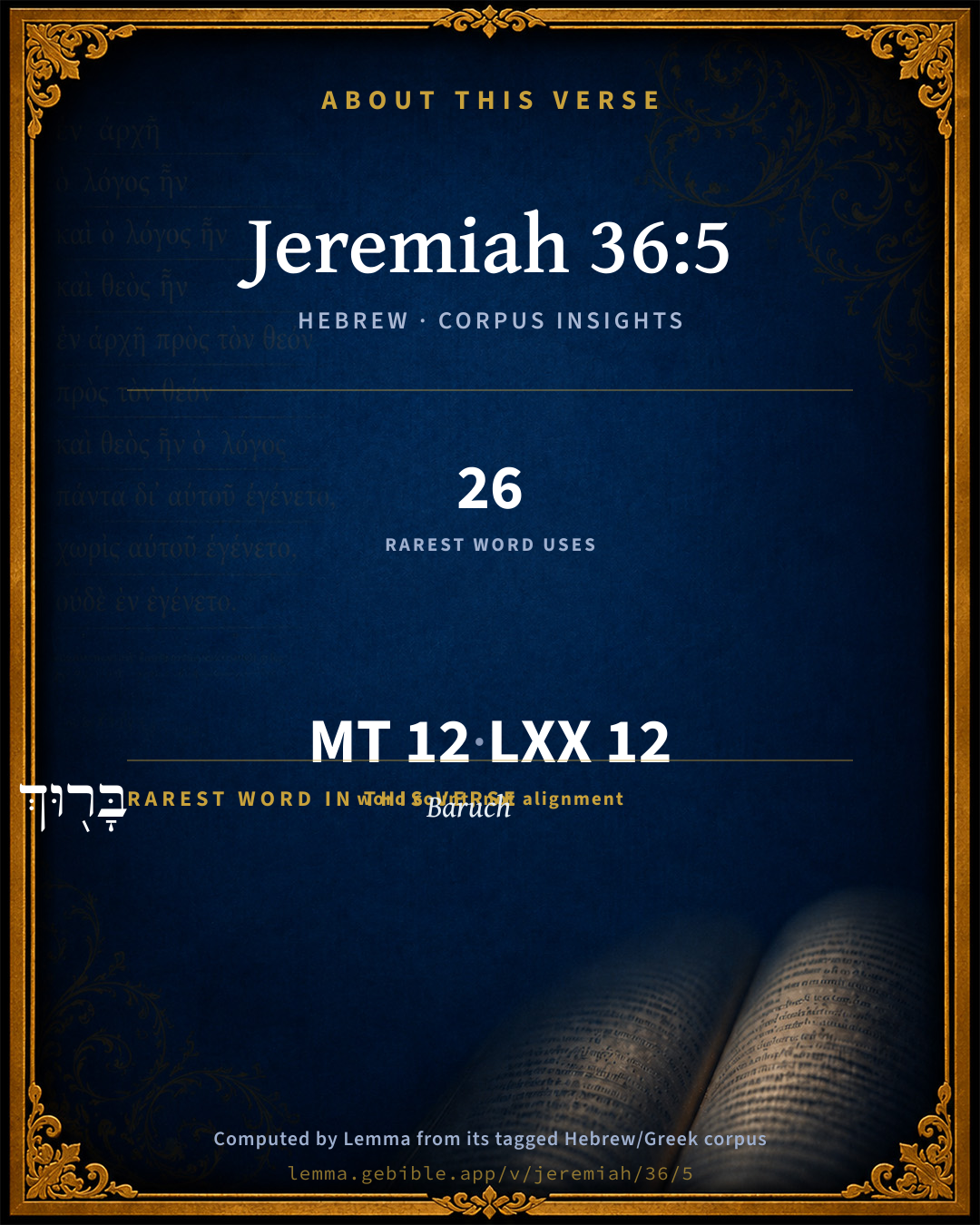
About this verse

These counts appear in no published source. They are computed here, from the morphology-tagged text and Lemma’s own curated glosses. What Lemma adds →

12
words
12
distinct lemmas
Prophets
section

Shared distinctive vocabulary

בָּר֖וּךְ Baruch H1263 occurs in 24 verses of the Hebrew Bible. Also found in:

Grammatical profile

  • 5 verbs
  • 4 nouns
  • 1 pronoun
  • 2 particles

Verb forms

  • וַיְצַוֶּ֣ה Piel · Sequential Imperfect
  • לֵאמֹ֑ר Qal · Infinitive Construct
  • עָצ֔וּר Qal · Participle Passive
  • אוּכַ֔ל Qal · Imperfect
  • לָב֖וֹא Qal · Infinitive Construct

Hebrew & Septuagint length

In the original languages it is 12 Hebrew tokens and 12 Greek tokens — but the two are counted differently (Hebrew bundles its prefixes and suffixes into one token; the Greek is in lemma form), so that isn’t a like-for-like length.

Cross-references

12

Topical passages linked to Jeremiah 36:5 in the Treasury of Scripture Knowledge — connected by theme and wording, ordered by reader-vote popularity; previews shown in the World English Bible.

  • Jeremiah 32:2 Now at that time the king of Babylon's army was besieging Jerusalem; and Jeremiah the prophet was shut up in the court of the guard, which was in the king of Judah's house.
  • Jeremiah 33:1 Moreover the word of Yahweh came to Jeremiah the second time, while he was yet shut up in the court of the guard, saying,
  • 2 Corinthians 11:23 Are they servants of Christ? (I speak as one beside himself) I am more so; in labors more abundantly, in prisons more abundantly, in stripes above measure, in deaths often.
  • Jeremiah 20:2 Then Pashhur struck Jeremiah the prophet, and put him in the stocks that were in the upper gate of Benjamin, which was in the house of Yahweh.
  • Jeremiah 37:15 The princes were angry with Jeremiah, and struck him, and put him in prison in the house of Jonathan the scribe; for they had made that the prison.
  • Jeremiah 38:6 Then took they Jeremiah, and cast him into the dungeon of Malchijah the king's son, that was in the court of the guard: and they let down Jeremiah with cords. In the dungeon there was no water, but mire; and Jeremiah sank in the mire.
  • Jeremiah 38:28 So Jeremiah abode in the court of the guard until the day that Jerusalem was taken.
  • Jeremiah 40:4 Now, behold, I loose you this day from the chains which are on your hand. If it seem good to you to come with me into Babylon, come, and I will look well to you; but if it seem ill to you to come with me into Babylon, forbear: behold, all the land is before you; where it seems good and right to you to go, there go.
  • Ephesians 3:1 For this cause I, Paul, am the prisoner of Christ Jesus on behalf of you Gentiles,
  • Ephesians 6:20 for which I am an ambassador in chains; that in it I may speak boldly, as I ought to speak.
  • 2 Timothy 2:9 in which I suffer hardship to the point of chains as a criminal. But God's word isn't chained.
  • Hebrews 11:36 Others were tried by mocking and scourging, yes, moreover by bonds and imprisonment.

Cross-references courtesy of OpenBible.info (CC BY 4.0).

Hebrew and Greek witnesses Masoretic Hebrew ↔ Greek Septuagint

The same verse in the two great witnesses to the Old Testament, shown verse-for-verse.

These are two independent witnesses, not word-aligned to each other, and the Septuagint is shown in lemma (dictionary) form.

Hebrew Jeremiah 36:5 Masoretic · Westminster Leningrad Codex

וַיְצַוֶּ֣ה יִרְמְיָ֔הוּ אֶת בָּר֖וּךְ לֵאמֹ֑ר אֲנִ֣י עָצ֔וּר לֹ֣א אוּכַ֔ל לָב֖וֹא בֵּ֥ית יְהוָֽה

Jeremiah commanded Baruch, saying, I am shut up; I can't go into the house of Yahweh:

World English Bible · Public Domain

Greek LXX Structure differs

In the Septuagint, Jeremiah is about an eighth shorter than the Hebrew and arranges its material differently — the Oracles Against the Nations (Hebrew chapters 46–51) appear in the middle of the Greek book, after 25:13. Because the chapter and verse boundaries do not line up, a verse-for-verse comparison with the Hebrew is not shown.

A verse-for-verse comparison isn’t shown here because the chapters and verses don’t line up. Switch to the LXX edition with the MT / LXX toggle above to read the Greek directly.

Hebrew: Westminster Leningrad Codex (CC BY 4.0). Greek: Septuagint (public domain); English from a public-domain English Septuagint. How the Septuagint differs from the Hebrew →

Targum (Aramaic paraphrase)

1

The Targum is the ancient Jewish Aramaic paraphrase of the Hebrew Scriptures — an interpretive translation, not the Hebrew text itself. Onkelos (literal) and Pseudo-Jonathan (expansive) render the Torah, and Jonathan the Prophets. Coverage is partial: where no permissively-licensed English translation exists for a verse, only the Aramaic is shown. This is verse-level text, not a word-by-word alignment to the Hebrew.

  1. Targum Jonathan Prophets (Joshua–Malachi)
    וּפַקֵיד יִרְמְיָה יַת בָּרוּךְ לְמֵימָר אֲנָא כְלֵי לֵית אֲנָא יָכִיל לְמֵיעַל לְבֵית מַקְדְשָׁא דַיָי:

    (no public-domain English translation for this verse)

    Targum Jonathan — Aramaic: “Mikraot Gedolot” (public domain). English: “Sefaria Community Translation” (CC0 1.0 (public-domain dedication)); “London "Chaldee Paraphrase," 1871” (public domain). Text via Sefaria.

Commentary

Notes on Jeremiah 36:5 from classic Christian and Jewish commentators (each source and its license shown beneath its notes). The classic Christian expositions comment on the surrounding passage and are grouped to its opening verse, so a note may address several verses; the Jewish commentaries on the Tanakh (Rashi and others) are per-verse, so they appear only where the commentator wrote on this verse.

Lemma curates 59 commentaries, every one of them public domain or Creative Commons licensed, each selected and text-cleaned for this edition rather than reprinted as found. About our sources →

Trapp's Complete Commentary

John Trapp

Jer 36:5 And Jeremiah commanded Baruch, saying, I [am] shut up; I cannot go into the house of the LORD:

Ver. 5. I am shut up.] Or, I am detained, or restrained; haply by some legal pollution that he had contracted, as by touching a dead carcase, &c.; or by some bodily infirmity, or by the lying in wait of his enemies, or by the Spirit of God, {as Act 16:6-7} for a punishment to the Jews by the prophet’s absence and silence, and for the safety of his servant in those perilous times.

John Trapp, A Commentary or Exposition upon All the Books of the Old and New Testament (1647–1656) — public domain. Text from a community e-Sword module.

Joseph Benson's Commentary

Jer 36:5-6. Jeremiah commanded Baruch, saying, I am shut up — It is not said, that “he was shut up in prison” at this time: but barely that he was shut up, or confined, as עצורsignifies, that is, under some such confinement, or restraint, as precluded his going to the house of the Lord. Therefore go thou and read in the roll, &c., upon the fasting day — Not the day of the yearly fast, mentioned Lev 23:27, but on a day appointed for a national fast, of which we read more, Jer 36:9, proclaimed by Jehoiakim, probably to avert the calamity hanging over them from the Chaldeans, or from the drought. And it was undoubtedly because of the concourse of people which the prophet knew would then be in the temple that he chose that day, when some would be present from all parts of Judah. It was the opinion, indeed, of Archbishop Usher and Dean Prideaux, that the roll was twice read by Baruch in the temple, and that the first reading was on the tenth day of the seventh month, being the great day of atonement, in the fourth year of King Jehoiakim. “But this,” says Blaney, “I am persuaded is a mistake; and that the reasons urged by the latter of those two learned men, in support of this hypothesis, are by no means conclusive. I see no good reason for concluding that the roll was read publicly in the temple more than once; nor does Josephus, who speaks of its being read in the ninth month of the fifth year, (Antiquities, lib. 10. cap. 6,) give the least hint of its having been read before; if it had been, I think we might naturally expect to be informed how it was received by those who heard it the first time, as well as by those who heard it the second. From the utter silence on this head, the contrary may be presumed, and we may fairly conjecture the case to have been pretty nearly as follows. Toward the latter end of Jehoiakim’s fourth year, after Nebuchadnezzar had replaced him on the throne, and had left the city, it is possible that both king and people, freed from former apprehensions, began again to indulge their wicked inclinations; and therefore Jeremiah was ordered to lay before them at once all the evils that still threatened them, and from which nothing but speedy repentance could protect them. In consequence of this charge, he caused Baruch to write a collection of all his prophecies, and to have them in readiness to read at a fit opportunity. Perhaps the collection was not fully completed before the fifth year was already begun; but the season pitched on, as most convenient for reading this tremendous publication, was the day on which the people should assemble to deplore, before God, the calamity with which he had visited them just twelve months before. Accordingly, at that time Baruch read openly in the temple what he had written, and the immediate consequences of such reading are here related at large.”

Joseph Benson's Commentary on the Old and New Testaments (1811–1818) — public domain. Text from a community e-Sword module.

Tyndale Open Study Notes

Tyndale Open Resources

36:5 Jeremiah was either a prisoner under house arrest, or he had been banished from the Temple grounds.

Tyndale Open Study Notes — © Tyndale Open Resources, licensed CC BY-SA 4.0. Text via the HelloAO Bible API.

Geneva Bible (1599)

Geneva Bible translators

Meaning, in prison, through the malice of the Priests.

Geneva Bible (1599) marginal notes — public domain. Text via Bolls.life.

Jamieson, Fausset & Brown

Robert Jamieson, A. R. Fausset & David Brown

I am shut up--not in prison, for there is no account of his imprisonment under Jehoiakim, and Jer 36:19, Jer 36:26 are inconsistent with it: but, "I am prevented," namely, by some hindrance; or, through fear of the king, to whose anger Baruch was less exposed, as not being the author of the prophecy.

Jamieson, Fausset & Brown — Commentary Critical and Explanatory on the Whole Bible (1871) — public domain (CC PDM 1.0). Text via the HelloAO Bible API.

The Cambridge Bible for Schools and Colleges

gen. ed. J. J. S. Perowne

5. I am shut up] The same verb occurs chs. Jer_33:1, Jer_39:15, in the sense of in confinement. Here, however, it cannot have that force (see Jer_36:19), but simply means that he was hindered from addressing the people by ceremonial uncleanness (cp. 1Sa_21:7, where the Hebrew verb “detained” is the same) or some other cause, perhaps danger to his life arising from the extreme unpopularity of his recent utterances.

The Cambridge Bible for Schools and Colleges (gen. ed. J. J. S. Perowne; Cambridge University Press, 1878–1918) — public domain. Text from a community e-Sword module.

John Gill's Exposition

And Jeremiah commanded Baruch, saying, I am shut up,.... In prison, according to Jarchi; but this is not likely, for then there would have been no occasion for an order to take him, Jer 36:26. Grotius thinks he was obliged by the king's order to stay at home; possibly he might be restrained by the Spirit of God, or had not freedom in his own mind to go abroad; there might be a restraint, an impulse upon his spirit, by the Spirit of God. Some think he was under some legal pollution, which made him unfit to go into the temple: for it follows:

I cannot go into the house of the Lord: labouring either under some bodily infirmity, or ceremonial defilement, or was forbidden by the king. What was the true cause is not certain; but so it was, that either he was discharged, or disabled, or disqualified, from going into the house of God.

John Gill's Exposition of the Whole Bible (1746–1763) — public domain (CC PDM 1.0). Text via the HelloAO Bible API.

Albert Barnes' Notes on the Bible

Shut up - Hindered from going; perhaps through fear of Jehoiakim.

Albert Barnes' Notes on the Bible (1834–1885) — public domain. Text from a community e-Sword/MySword module.

Haydock's Catholic Bible Commentary

Shut up. Not that the prophet was now in prison; for the contrary appears from ver. 19., but that he kept himself shut up, by reason of the persecutions he had lately met with. See chap. xxvi. (Challoner) --- If he had been confined, as Grotius asserts, the king would easily have found him. (Calmet) --- He and Baruch retired to some secret place, as most priests (Worthington) did formerly in England, (Haydock) that they might better exercise their functions than they could do in the hands of the persecutors. (Worthington)

George Leo Haydock (1774–1849), Haydock's Catholic Family Bible and Commentary, 1859 edition — public domain. Excludes Psalms (Douay-Rheims chapter numbering differs from Protestant) and Deuterocanonical books (Catholic canon only).

Whedon's Commentary on the Bible

Daniel D. Whedon

5. Shut up — Rather, hindered. There is no proof that Jeremiah was in custody at this time.

Daniel D. Whedon (gen. ed.), Commentary on the Old and New Testaments (1874–1909) — public domain. Text from a community e-Sword module.

The Pulpit Commentary

I am shut up. Not so; Jeremiah was not detained by material force. Some strong reason he had (perhaps of a ceremonial kind), but as it was irrelevant to the narrative, it is not given. Render, I am detained. (same verb as in 1Sa_21:7)

Vers. 5-21. The reading of the roll.

I THE READER. Baruch, the secretary of Jeremiah, is sent to read the roll. We do not know what cause detains the prophet. He has often made bold utterances in public before this. But if he cannot go the truth must not be hidden. "The Word of God is not bound". (2Ti_2:9) Truth is more important than the speaker. It matters little who is the messenger; all importance attaches to the message. Men forget this when they run after a Jeremiah and neglect a Baruch, though the scribe may be the bearer of the prophet"s teachings. We should recollect how much more important the gospel preached is than the man who preaches it. If a Chrysostom, a Paul, or an angel from heaven preach any other gospel but the true gospel of Christ, "let him be anathema." But if Christ is proclaimed, we must be thankful for that, though the preacher and his conduct may not quite approve themselves to us. (Php_1:18) Perhaps it was best that the prophet should not appear in person to repeat his message. His presence might reuse personal feelings to the neglect of bin message. He desired the truth to carry its own fair weight. Baruch did his work bravely and modestly. In repeating the prophet"s unpopular words, he would invite the odium that attached to them to pass on to himself. But his duty was to read the roll. God would see to the consequences. With this courage there was a remarkable modesty. The occasion was a tempting opportunity for Baruch to exercise his own powers by way of comment of addition. But he said nothing beyond what was written in the roll. He knew his place. The scribe is not a prophet. Why should not the great sermons of great preachers be sometimes read in our churches?

II THE CIRCUMSTANCES OF THE READING. The roll was read to three audiences.

1. The people (vers. 9, 10). The Bible is a book for the people, not for the priests or the learned only. The occasion of that reading was "a fasting day" (ver. 6). Then the people would be in the best mood for receiving the call to repentance. We should learn to speak "in season." The place of the reading was the temple (ver. 10). Instruction should be associated with worship.

2. The princes (vers. 11-19). Divine truth is of importance to all classes. They who are in responsible positions are especially called upon to study the signs of the times.

3. The king (vers. 20, 21). It was necessary that what concerned the fate of the kingdom should receive the most careful consideration of its monarch. Even kings must bow before the utterance of truth. A prophet can speak with authority to a king.

III THE EFFECT OF READING. The effect on the people is not here indicated. Probably little moral good came of it; but there was evidently some impression made if the feelings of one man, Michaiah, may be taken in illustration. This man was so much stirred by what he heard that he immediately reported it to the princes at the court (vers. 11-13). From this report other consequences flowed. If but one man out of a great congregation is seriously impressed by a sermon, that sermon has not failed; possibly through the one man it may be instrumental in effecting vast and lasting good. When the roll was read to the princes they were first dismayed (ver. 16). How graphic is that picture of the great men of the kingdom as "they turned shuddering one to another," terrified and confounded by the prophet"s words! Perhaps some of them had heard the same words before unmoved. The time may come when the most hardened will be roused. The terror of princes might be a wholesome beginning of a genuine repentance. But if no appropriate action followed, it would soon die away, leaving the conscience the more hardened and demoralized. We need to "bring forth fruits meet for repentance." The princes inquired as to the origin of the roll. Were its words true? On what authority were they written? Such inquiries are reasonable. We should have a reason for accepting what we believe to be a Divine message. Yet it is dangerous to divert attention from the moral weight of truth by too much intellectual criticism about literary curiosities. The princes reported the matter to the king with a warning to Baruch patriotic and generous conduct. The king"s reception of the book was very different. Unlike the princes, who neither accepted the message without question, nor rejected it for its unpleasant contents, but inquired calmly and carefully as to the authority of it, Jehoiakim flew into a rage and hastily destroyed it. What an act of supreme folly! The truth was not the less important because the record of it was burnt. "We can do nothing against the truth, but for the truth". (2Co_13:8)

Vers. 5-8. Vicarious ministry in holy things.

The "vicar," an ecclesiastical officer of mediaeval times, explain the origin and nature of his duties. Show how large this question of vicarious service, and how universal its necessity, in business, society, the state, the Church, etc. This incident illustrates

I ITS ESSENTIAL NATURE. Not merely that one should do, be, or suffer instead of another, but as representative of him. More or less consciously, sympathetically, adequately. That one man and not another should do a given duty, for instance, may be but the chance of fortune; but that he should do it for and in place of that other is for him to be that other"s "vicar." This essential character of the transaction is not altered by the fact of the superiority, equality, or inferiority of the substitute.

II ITS SUGGESTIVE INTEREST. An element of pathos and mystery. Perhaps the end better served in this than in the alternative way. Conceivable that the reading, the authoritative publication, and the supernatural interest, may have been enhanced rather than otherwise by the substitution.

1. The community of true service. How different in importance, etc., the function of the prophet in receiving the message and communicating it from that of the scribe! yet both are on this occasion indispensable. One man"s service the condition of another"s or its complement. All true service associated in relation to final ends and rewards. (Joh_4:37, 38 Heb_11:40)

2. An impression of urgency produced. This was the message it was absolutely important for Judah to hear at that time. God always speaks at the right time, even when that requires extraordinary efforts and unusual means. The latter on this occasion must have eloquently suggested that now was the "accepted time" and "the day of salvation.

3. The earnestness of the prophet and his Inspirer. Jeremiah was the true friend of the nation and the devoted servant of Jehovah, therefore he did not excuse himself from the task because of its difficulties.

4. How inevitable the message? It was not to be evaded or suppressed. From the prison or hiding place the prophet wilt still be heard.

III ITS ETHICS. Service of the kind here described was justifiable only on the supposition that the original or principal in responsibility is unable to do his own proper work, or that it can be better done by being delegated to another. Jeremiah is careful to explain why he does not do it himself. Would that the reasons for non-attendance in the sanctuary, or inoccupation in spiritual work, were as real and valid in the case of professing Christians!

1. On the part of the person instead of whom the service was rendered. He did not ask his substitute to do what he could do himself; and what he alone could do was done with the utmost care and diligence. It is calculated that the writing out of the roll from the prophet"s dictation occupied nine months, and many delays and difficulties must have been experienced. His solicitude, too, on behalf of the proper delivery of the message by Baruch, is very instructive and inspiring. He sought (God"s end in) the repentance of the people, and everything was to conspire to produce this. By example and moral influence he sought to fill Baruch with his own enthusiasm, and a sense of the importance of the task. The preacher is the vicar of the Church; so with the Sunday school teacher, etc. By prayer, sympathy, and loving cooperation Christians should encourage these.

2. On the part of the substitute. Baruch sought to do his part faithfully and with minute exactitude. His success in producing an impression proved how he exerted himself. A sense of responsibility should ever rest upon those who minister in the house of God. A certain measure of boldness was also required to do such a thug. The people or their princes might turn against him. Boldness is essential to the preaching of the gospel. But there cannot but occur to most readers the parallelism there is in all this to what Christ has undertaken for us. Another temple from whose service we are "shut up" by reason of personal unfitness, or that we remain in the flesh. Christ, our great Forerunner and Vicar, or Substitute, has entered into its holy of holies, with his own eternal sacrifice and intercession. Upon him all our hope must be placed; we must follow him in spirit; and we must imitate Jeremiah in the zeal and labour with which we execute our part of the great process of salvation. M.

The Pulpit Commentary (1880–1919), ed. H.D.M. Spence-Jones & Joseph S. Exell — public domain. Text from a community e-Sword module.

Rashi

Rabbi Shlomo Yitzchaki (Rashi)

imprisoned in the jail.

Rashi on the Tanakh — English translations: “The Judaica Press complete Tanach with Rashi, translated by A. J. Rosenberg” (CC BY 4.0); “Pentateuch with Rashi's commentary by M. Rosenbaum and A.M. Silbermann, 1929-1934” (public domain); “The Metsudah Tanach series, Lakewood, N.J” (CC BY 4.0); and “The Book of Joshua, Metsudah Publications, 1997” (CC BY 4.0). Text via Sefaria.

Lesson kit

Teaching starters — assembled from the data on this page, not authored interpretation. Every prompt links to the verse data it draws on. Edit before teaching.

Jeremiah, in the Prophets, opens this verse with 12 words (12 distinct Hebrew lemmas). Its most distinctive word is Bârûwk (“Baruch”). A historical commentator’s framing appears above. Read the whole chapter for the surrounding context.

Discussion questions

  1. The word Bârûwk carries the sense “Baruch.” How does it shape the verse?
  2. How does Nehemiah 3:20, which shares the word «Baruch», read alongside this verse?
  3. The translations on this page render this verse differently — a whole-verse word diff, not a word-by-word alignment. What might account for the different wordings?
  4. «וַיְצַוֶּ֣ה» is a Piel Sequential Imperfect verb. How does that grammatical form shape the action described?
  5. Compare how Trapp's Complete Commentary and Joseph Benson's Commentary read this verse. Where do they agree or differ?

Things to notice

Reading settings

Reading text

Shown beneath each verse's original-language words.

Old Testament
Old Testament edition

Read the OT as the Masoretic Hebrew (MT) or the Greek Septuagint (LXX).

English shown for the Greek Septuagint (in the Hebrew ↔ Greek comparison).

Comparing translations? Open the Compare panel on any verse page to stack up to four side by side.