
2 Kings 18:23

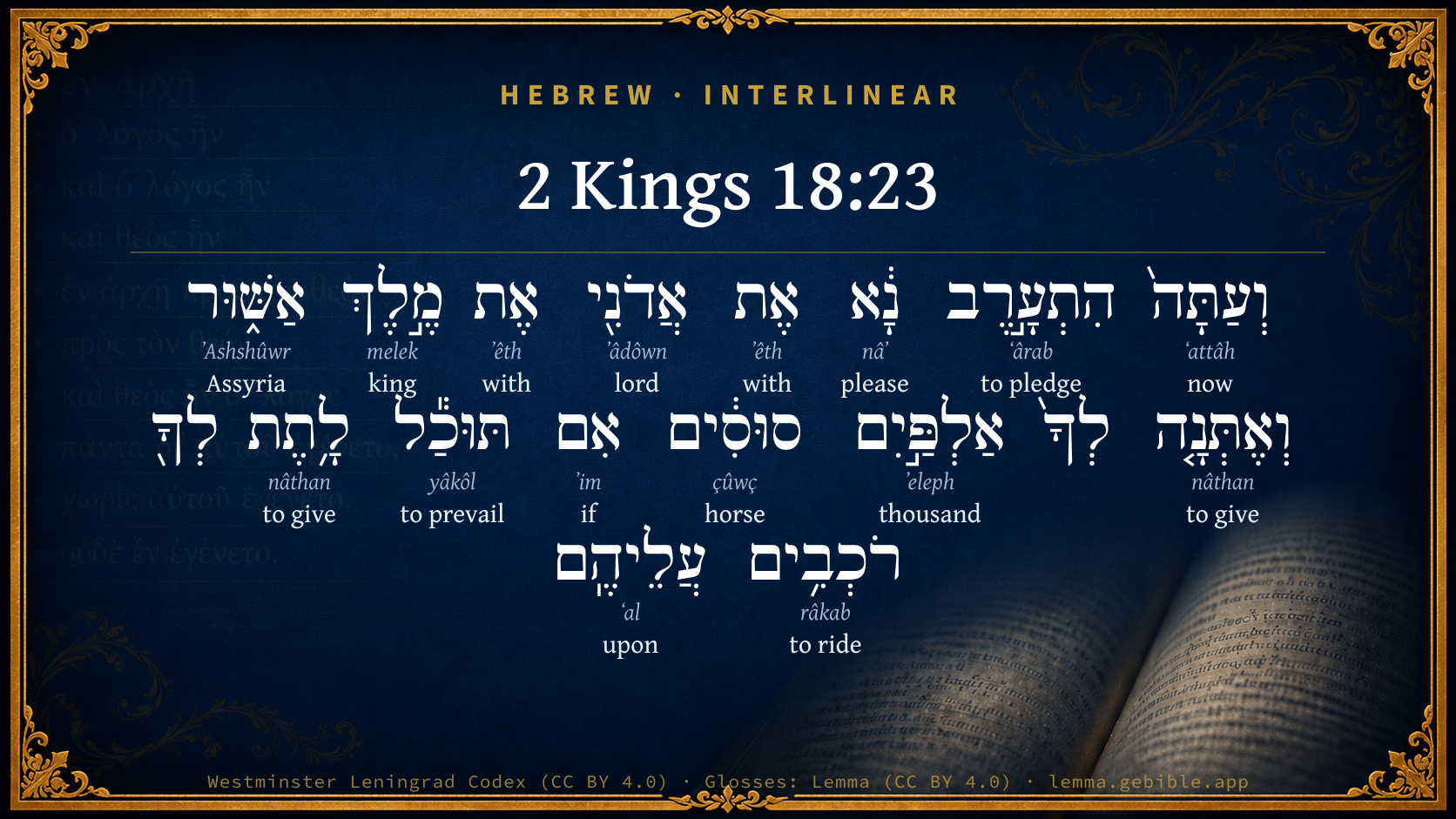
Hebrew (Westminster Leningrad Codex) 2 Kings 18:23 appears in the Hebrew Old Testament. The text above is from the Westminster Leningrad Codex. Each word links to its Strong’s number, a concise gloss, and parsing drawn from the Open Scriptures Hebrew Bible morphology. Click any word for its full Brown-Driver-Briggs (BDB) entry.
Download image
Cite this verse

2 Kings 18:23 (World English Bible). Public Domain. Lemma interlinear Bible study tool, https://lemma.gebible.app/v/2-kings/18/23.

Show BibTeX & RIS
BibTeX
RIS
English Translation
Now therefore, Please give pledges to my master the king of Assyria, and I will give you two thousand horses, if you are able on your part to set riders on them.
World English Bible · Public Domain
Download a study sheet

One document with this verse’s original text, its word-by-word gloss line, the meaning frame, cross-references with their text, attributed commentary, and full source and license credits — printable, and it pastes into notes with its structure intact.

This verse Autodidact and up

Study sheet (.html) Plain text (.txt)

A passage Seminary Student

Up to 50 verses in one chapter. A passage sheet keeps up to 6 commentary sources and 12 cross-references per verse, in the order this page ranks them, and says so on the sheet whenever that leaves anything out. Ask for a single verse and you get the Autodidact verse sheet above.

Everything on this page stays free to read, with no account — the sheet is a download of what is already on screen, not access to it.

Want to remove ads? Support Godless Engineer
Compare translations 3

The same verse in 3 English versions, stacked beneath the original-language interlinear above. Click any original word for its lexicon entry.

Each is an independent rendering of the whole verse — the interlinear is not word-aligned to these translations.

Highlighted words mark where these versions differ — a whole-verse word diff, not a word-by-word alignment.

  • World English Bible Public Domain
    Now therefore, Please give pledges to my master the king of Assyria, and I will give you two thousand horses, if you are able on your part to set riders on them.
  • King James Version Public Domain
    Now therefore, I pray thee, give pledges to my lord the king of Assyria, and I will deliver thee two thousand horses, if thou be able on thy part to set riders upon them.
  • unfoldingWord Literal Text CC BY-SA 4.0
    ‘And now, wager, please, with my master, with the king of Assyria. And I will give to you 2,000 horses if you are able to put riders on them for yourself.

unfoldingWord Literal Text — © unfoldingWord, licensed CC BY-SA 4.0. Word-aligned USFM3 via Door43 (git.door43.org/unfoldingWord/en_ult).

Versions to compare (up to 4)

3 of 4 selected

Show all 18 translations

Every available English version of this verse, each an independent rendering of the whole verse.

  • World English Bible Public Domain
    Now therefore, Please give pledges to my master the king of Assyria, and I will give you two thousand horses, if you are able on your part to set riders on them.
  • Berean Standard Bible Public Domain
    Now, therefore, make a bargain with my master, the king of Assyria. I will give you two thousand horses—if you can put riders on them!
  • Majority Standard Bible Public Domain
    Now, therefore, make a bargain with my master, the king of Assyria. I will give you two thousand horses—if you can put riders on them!
  • King James Version Public Domain
    Now therefore, I pray thee, give pledges to my lord the king of Assyria, and I will deliver thee two thousand horses, if thou be able on thy part to set riders upon them.
  • American Standard Version (1901) Public Domain
    Now therefore, I pray thee, give pledges to my master the king of Assyria, and I will give thee two thousand horses, if thou be able on thy part to set riders upon them.
  • Revised Version (1885) Public Domain
    Now therefore, I pray thee, give pledges to my master the king of Assyria, and I will give thee two thousand horses, if thou be able on thy part to set riders upon them.
  • Geneva Bible (1599) Public Domain
    Now therefore giue hostages to my lord the King of Asshur, and I will giue thee two thousand horses, if thou be able to set riders vpon them.
  • Douay-Rheims (1899) Public Domain
    Now therefore come over to my master the king of the Assyrians, and I will give you two thousand horses, and see whether you be able to have riders for them.
  • Young's Literal Translation Public Domain
    `And, now, give a pledge for thee, I pray thee, to my lord the king of Asshur, and I give to thee two thousand horses, if thou art able to give for thee riders on them.
  • Literal Standard Version CC BY-SA 4.0
    And now, please give a pledge for yourself to my lord the king of Asshur, and I give two thousand horses to you, if you are able to give riders for yourself on them.
  • Unlocked Literal Bible CC BY-SA 4.0
    Now therefore, I want to make you a good offer from my master the king of Assyria. I will give you two thousand horses, if you are able to find riders for them.
  • unfoldingWord Literal Text CC BY-SA 4.0
    ‘And now, wager, please, with my master, with the king of Assyria. And I will give to you 2,000 horses if you are able to put riders on them for yourself.
  • Darby Bible Public Domain
    And now, engage, I pray thee, with my master the king of Assyria, and I will give thee two thousand horses, if thou canst set the riders upon them.
  • World Messianic Bible Public Domain
    Now therefore, please give pledges to my master the king of Assyria, and I will give you two thousand horses if you are able on your part to set riders on them.
  • Webster's Bible Public Domain
    Now therefore, I pray thee, give pledges to my lord the king of Assyria, and I will deliver thee two thousand horses, if thou shalt be able on thy part to set riders upon them.
  • Free Bible Version CC BY-SA 4.0
    Why don't you accept a challenge from my master, the king of Assyria? He says, I'll give you two thousand horses, if you can find enough riders for them!
  • Bible in Basic English Public Domain
    And now, take a chance with my master, the king of Assyria, and I will give you two thousand horses, if you are able to put horsemen on them.
  • JPS Tanakh (1917) Public Domain
    Now therefore, I pray thee, make a wager with my master the king of Assyria, and I will give thee two thousand horses, if thou be able on thy part to set riders upon them.

Literal Standard Version (2020), Covenant Press — licensed CC BY-SA 4.0. Text via the HelloAO Bible API (eBible.org). Unlocked Literal Bible (unfoldingWord) — licensed CC BY-SA 4.0. Text via the HelloAO Bible API (eBible.org). unfoldingWord Literal Text — © unfoldingWord, licensed CC BY-SA 4.0. Word-aligned USFM3 via Door43 (git.door43.org/unfoldingWord/en_ult). Free Bible Version, Dr. Jonathan Gallagher — licensed CC BY-SA 4.0. Text via the HelloAO Bible API (eBible.org).

Word by word

More ways to search: Search by grammar → Find every occurrence → Compare this word →

Practice this passage: Drill this verse → Learn its vocabulary →

הִתְעָ֣רֶב
ʻârab
H6148
“pledge”
Verb, Hithpael, Imperative, 2nd Person, Masculine, Singular
Part of Speech
Verb
Stem
Hithpael
Form
Imperative
Person
2nd Person
Gender
Masculine
Number
Singular
Full BDB Definition

Origin: a primitive root

TWOT: 1686

to pledge, exchange, mortgage, engage, occupy, undertake for, give pledges, be or become surety, take on pledge, give in pledge - (Qal) - to take on pledge, go surety for - to give in pledge - to exchange - to pledge - (Hithpael) - to exchange pledges - to have fellowship with, share
  1. וְעַתָּה֙ ʻattâh H6258 “and · now” Conjunction + Adverb
  2. נָ֔א nâʼ H4994 “please” Particle, Exhortation
  3. אֶת ʼêth H854 “with” Preposition
  4. אֲדֹנִ֖י ʼâdôwn H113 “lord · my” Noun, Common, Masculine, Singular, Construct + Suffix, Personal, 1st Person, Common, Singular
  5. אֶת ʼêth H854 “with” Preposition
  6. מֶ֣לֶךְ melek H4428 “king of” Noun, Common, Masculine, Singular, Construct
  7. אַשּׁ֑וּר ʼAshshûwr H804 “Assyria” Noun, Gentilic, Masculine, Singular, Absolute
  8. וְאֶתְּנָ֤ה nâthan H5414 “and · to give” Conjunction + Verb, Qal, Cohortative, 1st Person, Common, Singular
  9. אַלְפַּ֣יִם ʼeleph H505 “thousand” Adjective, Cardinal number, Both, Plural, Absolute
  10. סוּסִ֔ים çûwç H5483 “horses” Noun, Common, Masculine, Plural, Absolute
  11. אִם ʼim H518 “if” Conjunction
  12. תּוּכַ֕ל yâkôl H3201 “to prevail” Verb, Qal, Imperfect, 2nd Person, Masculine, Singular
  13. לָ֥תֶת nâthan H5414 “to give” Preposition + Verb, Qal, Infinitive Construct
  14. רֹכְבִ֥ים râkab H7392 “riding” Verb, Qal, Participle Active, Masculine, Plural, Absolute
  15. עֲלֵיהֶֽם ʻal H5921 “upon · them” Preposition + Suffix, Personal, 3rd Person, Masculine, Plural

About this verse

These counts appear in no published source. They are computed here, from the morphology-tagged text and Lemma’s own curated glosses. What Lemma adds →

18
words
14
distinct lemmas
Historical
section

Notable vocabulary

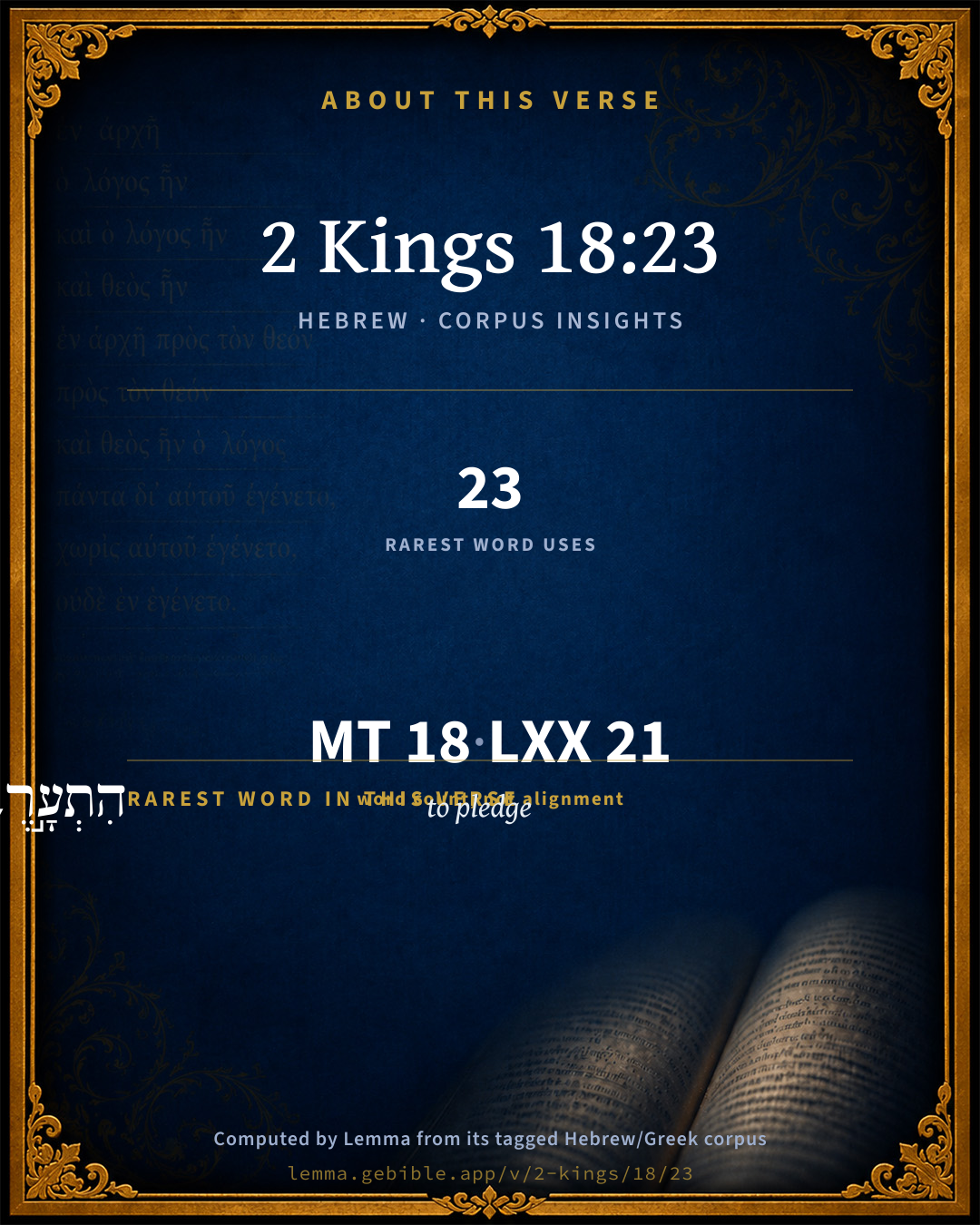
The rarest word here is הִתְעָ֣רֶב to pledge H6148 — appearing just 23 times in the whole Hebrew Bible.

Shared distinctive vocabulary

הִתְעָ֣רֶב to pledge H6148 occurs in 23 verses of the Hebrew Bible. Also found in:

Grammatical profile

  • 5 verbs
  • 4 nouns
  • 1 adjective
  • 5 prepositions
  • 1 conjunction
  • 1 adverb
  • 1 particle

Verb forms

  • הִתְעָ֣רֶב Hithpael · Imperative
  • וְאֶתְּנָ֤ה Qal · Cohortative
  • תּוּכַ֕ל Qal · Imperfect
  • לָ֥תֶת Qal · Infinitive Construct
  • רֹכְבִ֥ים Qal · Participle Active

Repetition

Words recur within this verse — often emphatic in Hebrew:

  • וְאֶתְּנָ֤ה to give H5414 ×2
  • אֶת with H854 ×2

Hebrew & Septuagint length

In English translation the verse runs 32 words from the Hebrew and 37 from the Septuagint (LXX English) — closely comparable.

A rough comparison of the two English renderings, which tokenize alike — not a word-level alignment.

Word counts can differ between the Hebrew and the Greek without any difference in meaning — e.g. the Hebrew direct-object marker אֵת has no separate Greek word, and Greek often adds the article ὁ.

In the original languages it is 18 Hebrew tokens and 21 Greek tokens — but the two are counted differently (Hebrew bundles its prefixes and suffixes into one token; the Greek is in lemma form), so that isn’t a like-for-like length.

Cross-references

8

Topical passages linked to 2 Kings 18:23 in the Treasury of Scripture Knowledge — connected by theme and wording, ordered by reader-vote popularity; previews shown in the World English Bible.

  • 1 Samuel 17:42 When the Philistine looked about, and saw David, he disdained him; for he was but a youth, and ruddy, and withal of a fair face.
  • 1 Samuel 17:44 The Philistine said to David, Come to me, and I will give your flesh to the birds of the sky, and to the animals of the field.
  • 1 Kings 20:10 Ben Hadad sent to him, and said, The gods do so to me, and more also, if the dust of Samaria shall suffice for handfuls for all the people who follow me.
  • 1 Kings 20:18 He said, Whether they are come out for peace, take them alive, or whether they are come out for war, taken them alive.
  • Nehemiah 4:2–5 He spoke before his brothers and the army of Samaria, and said, What are these feeble Jews doing? will they fortify themselves? will they sacrifice? will they make an end in a day? will they revive the stones out of the heaps of rubbish, seeing they are burned?
  • Psalms 123:3–4 Have mercy on us, Yahweh, have mercy on us, For we have endured much contempt.
  • Isaiah 10:13–14 For he has said, By the strength of my hand I have done it, and by my wisdom; for I have understanding: and I have removed the bounds of the peoples, and have robbed their treasures, and like a valiant man I have brought down those who sit [on thrones]:
  • Isaiah 36:8–9 Now therefore, please give pledges to my master the king of Assyria, and I will give you two thousand horses, if you are able on your part to set riders on them.

Cross-references courtesy of OpenBible.info (CC BY 4.0).

Hebrew and Greek witnesses Masoretic Hebrew ↔ Greek Septuagint

The same verse in the two great witnesses to the Old Testament, shown verse-for-verse.

These are two independent witnesses, not word-aligned to each other, and the Septuagint is shown in lemma (dictionary) form.

Hebrew 2 Kings 18:23 Masoretic · Westminster Leningrad Codex

וְעַתָּה֙ הִתְעָ֣רֶב נָ֔א אֶת אֲדֹנִ֖י אֶת מֶ֣לֶךְ אַשּׁ֑וּר וְאֶתְּנָ֤ה לְךָ֙ אַלְפַּ֣יִם סוּסִ֔ים אִם תּוּכַ֕ל לָ֥תֶת לְךָ֖ רֹכְבִ֥ים עֲלֵיהֶֽם

Now therefore, Please give pledges to my master the king of Assyria, and I will give you two thousand horses, if you are able on your part to set riders on them.

World English Bible · Public Domain

Greek LXX 2 Kings 18:23 Septuagint · lemma form

καί νῦν μίγνυμι δή ὁ κύριος ἐγώ βασιλεύς ἀσσύριος καί δίδωμι σύ δισχίλιοι ἵππος εἰ δύναμαι δίδωμι σεαυτοῦ ἐπιβάτης ἐπί αὐτός

And now, I pray you, make and agreement with my lord the king of the Assyrians, and I will give you two thousand horses, if you shall be able on your part to set riders upon them.

LXX2012 (modern English Septuagint) · Public Domain

On this verse, Ellicott's Commentary for English Readers discusses the Septuagint’s reading. Read the note in Commentary ↓

Hebrew: Westminster Leningrad Codex (CC BY 4.0). Greek: Septuagint (public domain); English from LXX2012 (modern English Septuagint) (Public Domain). How the Septuagint differs from the Hebrew →

Targum (Aramaic paraphrase)

1

The Targum is the ancient Jewish Aramaic paraphrase of the Hebrew Scriptures — an interpretive translation, not the Hebrew text itself. Onkelos (literal) and Pseudo-Jonathan (expansive) render the Torah, and Jonathan the Prophets. Coverage is partial: where no permissively-licensed English translation exists for a verse, only the Aramaic is shown. This is verse-level text, not a word-by-word alignment to the Hebrew.

  1. Targum Jonathan Prophets (Joshua–Malachi)
    וּכְעַן אִתְעָרֵב כְּעַן עִם רִבּוֹנִי עִם מַלְכָּא דְאַתּוּר וְאֶתֵּן לָךְ תְּרֵין אַלְפִין סוּסְוָן אִם תִּכּוּל לְמַנָאָה לָךְ רְכִיבִין עֲלֵיהוֹן:

    (no public-domain English translation for this verse)

    Targum Jonathan — Aramaic: “Mikraot Gedolot” (public domain). English: “Sefaria Community Translation” (CC0 1.0 (public-domain dedication)); “London "Chaldee Paraphrase," 1871” (public domain). Text via Sefaria.

Commentary

Notes on 2 Kings 18:23 from classic Christian and Jewish commentators (each source and its license shown beneath its notes). The classic Christian expositions comment on the surrounding passage and are grouped to its opening verse, so a note may address several verses; the Jewish commentaries on the Tanakh (Rashi and others) are per-verse, so they appear only where the commentator wrote on this verse.

Lemma curates 59 commentaries, every one of them public domain or Creative Commons licensed, each selected and text-cleaned for this edition rather than reprinted as found. About our sources →

Trapp's Complete Commentary

John Trapp

2Ki 18:23 Now therefore, I pray thee, give pledges to my lord the king of Assyria, and I will deliver thee two thousand horses, if thou be able on thy part to set riders upon them.

Ver. 23. Give pledges.] Pignora certa. Tremellius rendereth it, Misce bellum, fight with my master, the king of Assyria, if thou darest. Lacessentis atque insultantis, verba.

If thou be able on thy part.] A bitter scoff, whereby he mocketh at Hezekiah’s boldness, being no better able.

John Trapp, A Commentary or Exposition upon All the Books of the Old and New Testament (1647–1656) — public domain. Text from a community e-Sword module.

Joseph Benson's Commentary

2Ki 18:23-24. Now, therefore, give pledges to my lord the king — That is, give hostages to ensure thy future obedience and subjection. And I will deliver thee two thousand horses, &c. — There is so little likelihood of thy being able to withstand the power of my master, who has thousands of chariots and horses, that I challenge thee to produce two thousand skilful horsemen that know how to manage horses, and I will give thee two thousand horses for them. How then wilt thou turn away the face of one captain, &c. — How wilt thou force him to turn his back to thee, and flee away from thee?

Joseph Benson's Commentary on the Old and New Testaments (1811–1818) — public domain. Text from a community e-Sword module.

Tyndale Open Study Notes

Tyndale Open Resources

18:23-24 The officer next turned to taunting, suggesting that Jerusalem would be unable to field sufficient manpower and strength to withstand even the weakest contingent of Assyrian troops.

Tyndale Open Study Notes — © Tyndale Open Resources, licensed CC BY-SA 4.0. Text via the HelloAO Bible API.

Geneva Bible (1599)

Geneva Bible translators

Meaning, that it was best for him to yield to the king of Assyria, because his power was so small that he had not men to furnish two thousand horses.

Geneva Bible (1599) marginal notes — public domain. Text via Bolls.life.

Adam Clarke's Commentary

Verse 23. I will deliver thee two thousand horses] Another insult: Were I to give thee two thousand Assyrian horses, thou couldst not find riders for them. How then canst thou think that thou shalt be able to stand against even the smallest division of my troops?

Adam Clarke's Commentary on the Bible (1810–1826) — public domain. Text from a community e-Sword/MySword module.

Ellicott's Commentary for English Readers

(23) Give pledges to.—Rather, make a compact with . . . So the Syriac; literally, mingle with . . . have dealings with (Psa_106:35). Gesenius explains: join battle with; literally, mingle yourselves with: LXX., μίχθητε δὴ. Mr. Cheyne prefers, lay a wager with . . . The rab-sak sneers at Hezekiah’s want of cavalry, an arm in which the Assyrians were preeminently strong; and further hints that even if horses were supplied him in numbers sufficient to constitute an ordinary troop, he would not be able to muster an equivalent number of trained riders.

A Bible Commentary for English Readers, edited by Charles John Ellicott (1878–1897) — public domain. Text from a community e-Sword module.

The Cambridge Bible for Schools and Colleges

gen. ed. J. J. S. Perowne

23. Now therefore, I pray thee, give pledges to my lord] R.V. my master. The change conforms to verses 24 and 27 below. Having ridiculed any trust in Egypt, and expressed his opinion that Hezekiah could not expect help from Jehovah, after demolishing all the altars in the land, Rab-shakeh comes to his third argument. This is, ‘you have no forces to resist us’. He puts this into the form of a taunt. The verb rendered ‘give pledges’, has in its simpler voice, the sense of ‘mortgaging’ or ‘giving something in pledge’. In the present verse it appears to mean ‘pledge yourself’, ‘put yourself under some penalty’. And so the taunt is equivalent to saying: ‘You dare not undertake to find two thousand riders, if I offer you the horses for them. If you dare, then do it. The horses are ready; I challenge you to provide the men’.

I will deliver] R.V. give. The verb is the one usually rendered ‘give’, and the insult is made the greater by this proud way of expressing superiority.

The Cambridge Bible for Schools and Colleges (gen. ed. J. J. S. Perowne; Cambridge University Press, 1878–1918) — public domain. Text from a community e-Sword module.

Albert Barnes' Notes on the Bible

The phrase translated “give pledges,” or “hostages” (margin) may perhaps be best understood as meaning “make an agreement.” If you will “bind yourself to find the riders” (i. e., trained horsemen), we will “bind ourselves to furnish the horses.” The suggestion implied that in all Judaea there were not 2000 men accustomed to serve as cavalry.

Albert Barnes' Notes on the Bible (1834–1885) — public domain. Text from a community e-Sword/MySword module.

Haydock's Catholic Bible Commentary

Over. Josephus insinuates that it is a challenge to fight, and that Rabsaces was so confident of victory, that he made this contemptuous proposal, (Haydock) knowing that the subjects of Ezechias were not good horsemen, (Calmet) or that they were comparatively (Haydock) so few in number. (Menochius) --- Hebrew, "agree, or give pledges to my master."

George Leo Haydock (1774–1849), Haydock's Catholic Family Bible and Commentary, 1859 edition — public domain. Excludes Psalms (Douay-Rheims chapter numbering differs from Protestant) and Deuterocanonical books (Catholic canon only).

Matthew Poole's English Annotations

Give pledges to my lord, i.e. give him hostages to secure him from thy future rebellion, and he will depart from thee. Or rather, contend with my lord in battle; seeing thou hast counsel and strength for war, do not lie lurking in thy strong hold, but come out into the open field, and let us try for mastery; and whereas thou mayest pretend thou wantest horses to fight with me, if thou wilt accept of my challenge, I will furnish thee with two thousand horses, if thou hast riders for them; as it here follows.

Matthew Poole's English Annotations on the Holy Bible (1683–1685) — public domain. Text from a community e-Sword/MySword module.

Whedon's Commentary on the Bible

Daniel D. Whedon

23. Give pledges to — Rather, enter into intercourse with, or, make an agreement with.

If thou be able — The whole verse is a contemptuous assumption of the weakness of the Jewish military force. The sense is, Suppose you make a bargain with the king of Assyria, I venture to say he will deliver you two thousand horses on condition that you furnish men enough to use them as cavalry, and I have no fear that you will be able to meet the condition. “The meaning is not that Hezekiah could not raise two thousand soldiers in all, but that he could not produce so many men who were able to fight as horsemen.” — Keil.

Daniel D. Whedon (gen. ed.), Commentary on the Old and New Testaments (1874–1909) — public domain. Text from a community e-Sword module.

The Pulpit Commentary

Now therefore, I pray thee, give pledges to my lord the King of Assyria, and I will deliver thee two thousand horses, if thou be able on thy part to set riders upon them. "Pledge thyself," i.e. "to find the men, and I will pledge myself to find the horses." It is a strong expression of contempt for the military power of the Jews. They have not only no trained cavalry, but, were any one to furnish them with two thousand horses, they could not find the men to ride them. The Jewish army does, in fact, appear to have consisted of infantry and chariots only.

The Pulpit Commentary (1880–1919), ed. H.D.M. Spence-Jones & Joseph S. Exell — public domain. Text from a community e-Sword module.

Rashi

Rabbi Shlomo Yitzchaki (Rashi)

Provide a security. Glorify yourself over him; enter a wager on the condition that if you are able to supply riders for two thousand horses.

Wager. Gajer, in O.F.

Rashi on the Tanakh — English translations: “The Judaica Press complete Tanach with Rashi, translated by A. J. Rosenberg” (CC BY 4.0); “Pentateuch with Rashi's commentary by M. Rosenbaum and A.M. Silbermann, 1929-1934” (public domain); “The Metsudah Tanach series, Lakewood, N.J” (CC BY 4.0); and “The Book of Joshua, Metsudah Publications, 1997” (CC BY 4.0). Text via Sefaria.

Lesson kit

Teaching starters — assembled from the data on this page, not authored interpretation. Every prompt links to the verse data it draws on. Edit before teaching.

2 Kings, in the Historical, opens this verse with 18 words (14 distinct Hebrew lemmas). Its most distinctive word is ʻârab (“to pledge”). A historical commentator’s framing appears above. Read the whole chapter for the surrounding context.

Discussion questions

  1. What does “to pledge” (ʻârab) contribute to the verse as a whole?
  2. Genesis 43:9 shares the word «to pledge» with this verse. How do the two illuminate each other?
  3. “to give” occurs 2× in this one verse. What is the effect of the repetition?
  4. The translations on this page render this verse differently — a whole-verse word diff, not a word-by-word alignment. What might account for the different wordings?
  5. The verb «הִתְעָ֣רֶב» is Hithpael Imperative. How does its form color the action?
  6. Reading how Trapp's Complete Commentary and Joseph Benson's Commentary read this verse, where do the two commentators agree and where do they part?

Things to notice

Reading settings

Reading text

Shown beneath each verse's original-language words.

Old Testament
Old Testament edition

Read the OT as the Masoretic Hebrew (MT) or the Greek Septuagint (LXX).

English shown for the Greek Septuagint (in the Hebrew ↔ Greek comparison).

Comparing translations? Open the Compare panel on any verse page to stack up to four side by side.