Isaiah 1:13

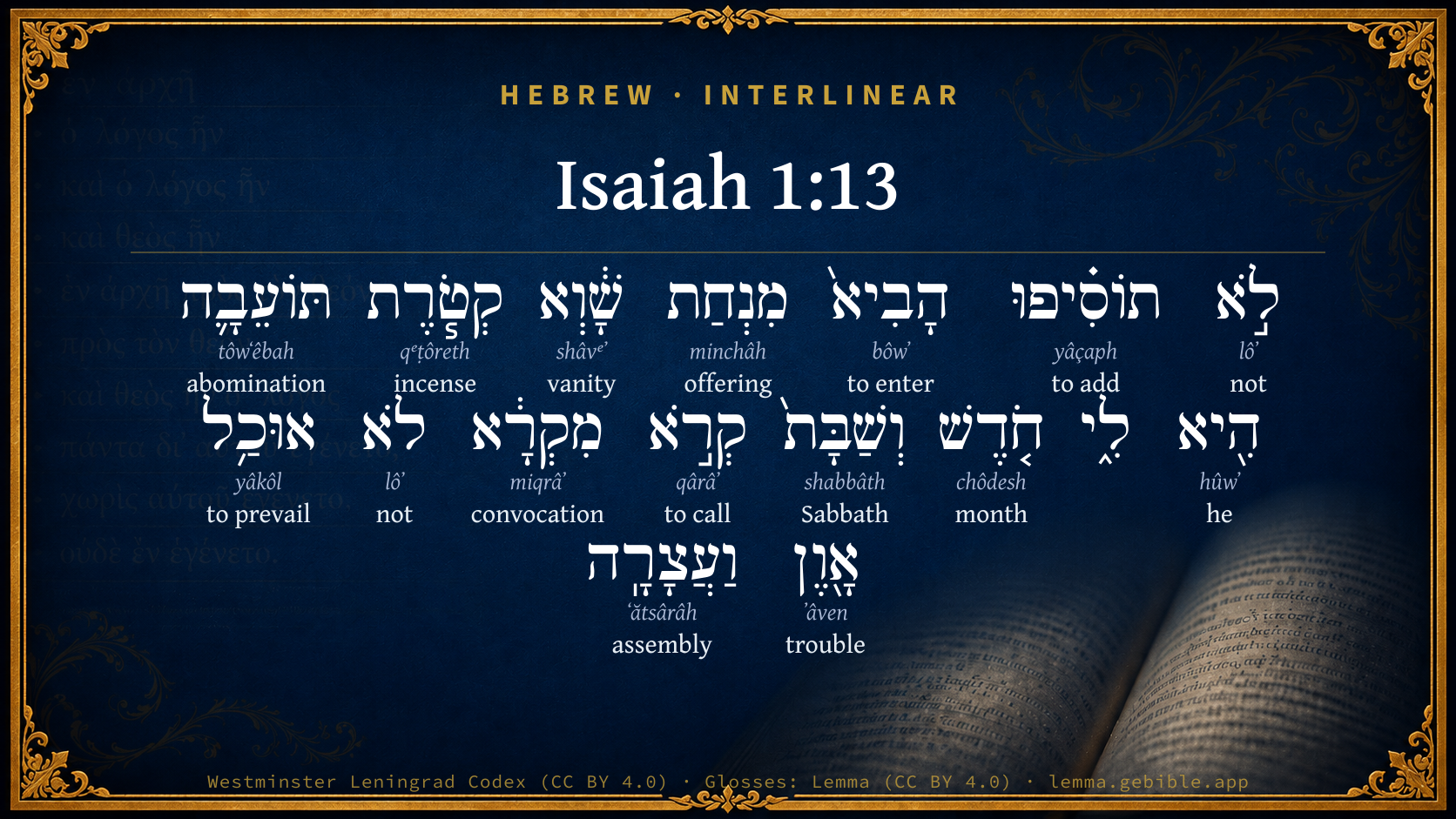
Hebrew (Westminster Leningrad Codex) Isaiah 1:13 appears in the Hebrew Old Testament. The text above is from the Westminster Leningrad Codex. Each word links to its Strong’s number, a concise gloss, and parsing drawn from the Open Scriptures Hebrew Bible morphology. Click any word for its full Brown-Driver-Briggs (BDB) entry.
Download image
Cite this verse

Isaiah 1:13 (World English Bible). Public Domain. Lemma interlinear Bible study tool, https://lemma.gebible.app/v/isaiah/1/13.

Show BibTeX & RIS
BibTeX
RIS
English Translation
Bring no more vain offerings. Incense is an abomination to me; New moons, Sabbaths, and convocations: I can't bear with evil assemblies.
World English Bible · Public Domain
Download a study sheet

One document with this verse’s original text, its word-by-word gloss line, the meaning frame, cross-references with their text, attributed commentary, and full source and license credits — printable, and it pastes into notes with its structure intact.

This verse Autodidact and up

Study sheet (.html) Plain text (.txt)

A passage Seminary Student

Up to 50 verses in one chapter. A passage sheet keeps up to 6 commentary sources and 12 cross-references per verse, in the order this page ranks them, and says so on the sheet whenever that leaves anything out. Ask for a single verse and you get the Autodidact verse sheet above.

Everything on this page stays free to read, with no account — the sheet is a download of what is already on screen, not access to it.

Want to remove ads? Support Godless Engineer
Compare translations 3

The same verse in 3 English versions, stacked beneath the original-language interlinear above. Click any original word for its lexicon entry.

Each is an independent rendering of the whole verse — the interlinear is not word-aligned to these translations.

Highlighted words mark where these versions differ — a whole-verse word diff, not a word-by-word alignment.

  • World English Bible Public Domain
    Bring no more vain offerings. Incense is an abomination to me; New moons, Sabbaths, and convocations: I can't bear with evil assemblies.
  • King James Version Public Domain
    Bring no more vain oblations; incense is an abomination unto me; the new moons and sabbaths, the calling of assemblies, I cannot away with; it is iniquity, even the solemn meeting.
  • unfoldingWord Literal Text CC BY-SA 4.0
    Do not continue to bring an offering of worthlessness! Incense, it an abomination to me. New moon and Sabbath, the calling of an assembly -- I am not able wickedness and a solemn gathering.

unfoldingWord Literal Text — © unfoldingWord, licensed CC BY-SA 4.0. Word-aligned USFM3 via Door43 (git.door43.org/unfoldingWord/en_ult).

Versions to compare (up to 4)

3 of 4 selected

Show all 18 translations

Every available English version of this verse, each an independent rendering of the whole verse.

  • World English Bible Public Domain
    Bring no more vain offerings. Incense is an abomination to me; New moons, Sabbaths, and convocations: I can't bear with evil assemblies.
  • Berean Standard Bible Public Domain
    Bring your worthless offerings no more; your incense is detestable to Me—your New Moons, Sabbaths, and convocations. I cannot endure iniquity in a solemn assembly.
  • Majority Standard Bible Public Domain
    Bring your worthless offerings no more; your incense is detestable to Me. New Moons, Sabbaths, and convocations—I cannot endure iniquity in a solemn assembly.
  • King James Version Public Domain
    Bring no more vain oblations; incense is an abomination unto me; the new moons and sabbaths, the calling of assemblies, I cannot away with; it is iniquity, even the solemn meeting.
  • American Standard Version (1901) Public Domain
    Bring no more vain oblations; incense is an abomination unto me; new moon and sabbath, the calling of assemblies,- I cannot away with iniquity and the solemn meeting.
  • Revised Version (1885) Public Domain
    Bring no more vain oblations; incense is an abomination unto me; new moon and sabbath, the calling of assemblies,—I cannot away with iniquity and the solemn meeting.
  • Geneva Bible (1599) Public Domain
    Bring no more oblations, in vaine: incense is an abomination vnto me: I can not suffer your newe moones, nor Sabbaths, nor solemne dayes (it is iniquitie) nor solemne assemblies.
  • Douay-Rheims (1899) Public Domain
    Offer sacrifice no more in vain: incense is an abomination tome. The new moons, and the sabbaths, and other festivals I will not abide, your assemblies are wicked.
  • Young's Literal Translation Public Domain
    Add not to bring in a vain present, Incense -- an abomination it `is' to Me, New moon, and sabbath, calling of convocation! Rendure not iniquity -- and a restraint!
  • Literal Standard Version CC BY-SA 4.0
    Do not add to bring in a vain present, || Incense—it [is] an abomination to Me, || New moon, and Sabbath, calling of convocation! Do not render iniquity—and a restraint!
  • Unlocked Literal Bible CC BY-SA 4.0
    Bring no more meaningless offerings; incense is an abomination to me; your new moon and Sabbath assemblies—I cannot tolerate these wicked assemblies.
  • unfoldingWord Literal Text CC BY-SA 4.0
    Do not continue to bring an offering of worthlessness! Incense, it an abomination to me. New moon and Sabbath, the calling of an assembly -- I am not able wickedness and a solemn gathering.
  • Darby Bible Public Domain
    Bring no more vain oblations! Incense is an abomination unto me, -- new moon and sabbath, the calling of convocations -- wickedness and the solemn meeting I cannot bear.
  • World Messianic Bible Public Domain
    Bring no more vain offerings. Incense is an abomination to me. New moons, Sabbaths, and convocations— I can’t stand evil assemblies.
  • Webster's Bible Public Domain
    Bring no more vain oblations; incense is an abomination to me; the new moons and sabbaths, the calling of assemblies, I cannot endure; it is iniquity, even the solemn meeting.
  • Free Bible Version CC BY-SA 4.0
    Don't bring me any more meaningless offerings; your incense is offensive to me. Your new moon festivals and Sabbath observations and your calling of special religious meetings—I can't stand them because they're evil, as are your solemn assemblies.
  • Bible in Basic English Public Domain
    Give me no more false offerings; the smoke of burning flesh is disgusting to me, so are your new moons and Sabbaths and your holy meetings.
  • JPS Tanakh (1917) Public Domain
    Bring no more vain oblations; it is an offering of abomination unto Me; new moon and sabbath, the holding of convocations — I cannot endure iniquity along with the solemn assembly.

Literal Standard Version (2020), Covenant Press — licensed CC BY-SA 4.0. Text via the HelloAO Bible API (eBible.org). Unlocked Literal Bible (unfoldingWord) — licensed CC BY-SA 4.0. Text via the HelloAO Bible API (eBible.org). unfoldingWord Literal Text — © unfoldingWord, licensed CC BY-SA 4.0. Word-aligned USFM3 via Door43 (git.door43.org/unfoldingWord/en_ult). Free Bible Version, Dr. Jonathan Gallagher — licensed CC BY-SA 4.0. Text via the HelloAO Bible API (eBible.org).

Word by word

More ways to search: Search by grammar → Find every occurrence → Compare this word →

Practice this passage: Drill this verse → Learn its vocabulary →

וַעֲצָרָֽה
ʻătsârâh
H6116
“and · assembly”
Conjunction + Noun, Common, Feminine, Singular, Absolute
Part of Speech
Conjunction + Noun
Type
Common
Gender
Feminine
Number
Singular
State
Absolute
Full BDB Definition

Origin: from H6113

TWOT: 1675c

assembly, solemn assembly - assembly (sacred or festive meeting) - assemblage, company, group
  1. לֹ֣א lôʼ H3808 “not” Particle, Negative
  2. תוֹסִ֗יפוּ yâçaph H3254 “to add” Verb, Hiphil, Imperfect, 2nd Person, Masculine, Plural
  3. הָבִיא֙ bôwʼ H935 “to enter” Verb, Hiphil, Infinitive Construct
  4. מִנְחַת minchâh H4503 “offering of” Noun, Common, Feminine, Singular, Construct
  5. שָׁ֔וְא shâvᵉʼ H7723 “vanity” Noun, Common, Masculine, Singular, Absolute
  6. קְטֹ֧רֶת qᵉṭôreth H7004 “incense” Noun, Common, Feminine, Singular, Absolute
  7. תּוֹעֵבָ֛ה tôwʻêbah H8441 “abomination” Noun, Common, Feminine, Singular, Absolute
  8. הִ֖יא hûwʼ H1931 “he” Pronoun, Personal, 3rd Person, Feminine, Singular
  9. חֹ֤דֶשׁ chôdesh H2320 “month” Noun, Common, Masculine, Singular, Absolute
  10. וְשַׁבָּת֙ shabbâth H7676 “and · Sabbath” Conjunction + Noun, Common, Both, Singular, Absolute
  11. קְרֹ֣א qârâʼ H7121 “to call” Verb, Qal, Infinitive Construct
  12. מִקְרָ֔א miqrâʼ H4744 “convocation” Noun, Common, Masculine, Singular, Absolute
  13. לֹא lôʼ H3808 “not” Particle, Negative
  14. אוּכַ֥ל yâkôl H3201 “to prevail” Verb, Qal, Imperfect, 1st Person, Common, Singular
  15. אָ֖וֶן ʼâven H205 “trouble” Noun, Common, Masculine, Singular, Absolute

About this verse

These counts appear in no published source. They are computed here, from the morphology-tagged text and Lemma’s own curated glosses. What Lemma adds →

17
words
15
distinct lemmas
Prophets
section

Notable vocabulary

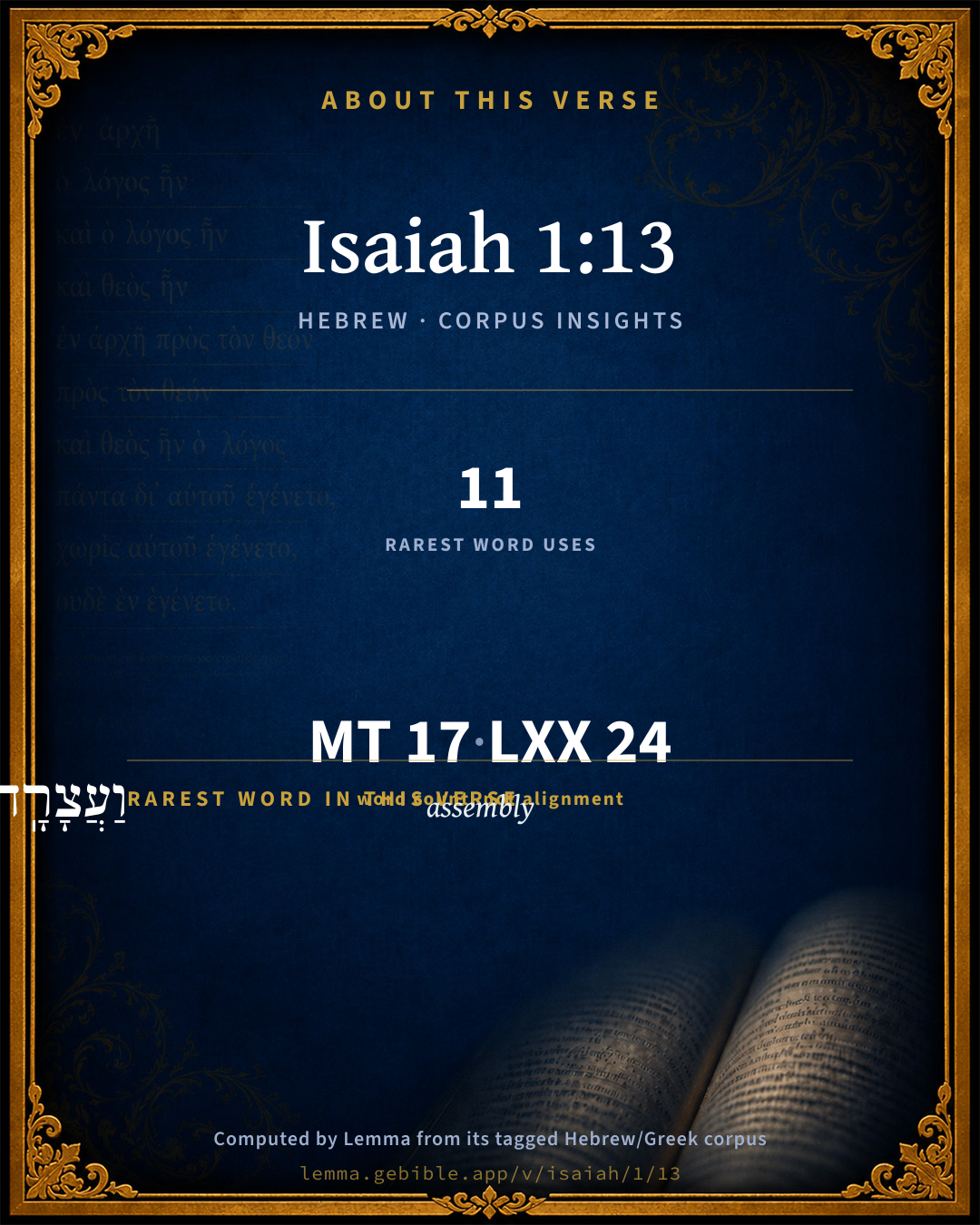
The rarest word here is וַעֲצָרָֽה assembly H6116 — appearing just 11 times in the whole Hebrew Bible.

Shared distinctive vocabulary

וַעֲצָרָֽה assembly H6116 occurs in 11 verses of the Hebrew Bible. Also found in:

Grammatical profile

  • 4 verbs
  • 9 nouns
  • 1 pronoun
  • 1 preposition
  • 2 particles

Verb forms

  • תוֹסִ֗יפוּ Hiphil · Imperfect
  • הָבִיא֙ Hiphil · Infinitive Construct
  • קְרֹ֣א Qal · Infinitive Construct
  • אוּכַ֥ל Qal · Imperfect

Repetition

A word recurs within this verse — often emphatic in Hebrew:

Hebrew & Septuagint length

In English translation the verse runs 22 words from the Hebrew and 27 from the Septuagint (LXX English) — closely comparable.

A rough comparison of the two English renderings, which tokenize alike — not a word-level alignment.

Word counts can differ between the Hebrew and the Greek without any difference in meaning — e.g. the Hebrew direct-object marker אֵת has no separate Greek word, and Greek often adds the article ὁ.

In the original languages it is 17 Hebrew tokens and 24 Greek tokens — but the two are counted differently (Hebrew bundles its prefixes and suffixes into one token; the Greek is in lemma form), so that isn’t a like-for-like length.

Cross-references

19

Topical passages linked to Isaiah 1:13 in the Treasury of Scripture Knowledge — connected by theme and wording, ordered by reader-vote popularity; previews shown in the World English Bible.

  • Isaiah 66:3 He who kills an ox is as he who kills a man; he who sacrifices a lamb, as he who breaks a dog's neck; he who offers an offering, [as he who offers] pig's blood; he who burns frankincense, as he who blesses an idol. Yes, they have chosen their own ways, and their soul delights in their abominations:
  • Malachi 1:10 "Oh that there were one among you who would shut the doors, that you might not kindle fire on my altar in vain! I have no pleasure in you," says Yahweh of hosts, "neither will I accept an offering at your hand.
  • Matthew 15:9 And in vain do they worship me, Teaching as doctrine rules made by men.'"
  • Ezekiel 20:39 As for you, house of Israel, thus says the Lord Yahweh: Go you, serve everyone his idols, and hereafter also, if you will not listen to me; but my holy name shall you no more profane with your gifts, and with your idols.
  • Lamentations 2:6 He has violently taken away his tent, as if it were of a garden; he has destroyed his place of assembly: Yahweh has caused solemn assembly and Sabbath to be forgotten in Zion, Has despised in the indignation of his anger the king and the priest.
  • Joel 2:15 Blow the trumpet in Zion! Sanctify a fast. Call a solemn assembly.
  • Exodus 12:16 In the first day there shall be to you a holy convocation, and in the seventh day a holy convocation; no manner of work shall be done in them, except that which every man must eat, that only may be done by you.
  • Leviticus 23:1–44 Yahweh spoke to Moses, saying,
  • Deuteronomy 16:1–22 Observe the month of Abib, and keep the Passover to Yahweh your God; for in the month of Abib Yahweh your God brought you forth out of Egypt by night.
  • 1 Chronicles 23:31 and to offer all burnt offerings to Yahweh, on the Sabbaths, on the new moons, and on the set feasts, in number according to the ordinance concerning them, continually before Yahweh;
  • Psalms 78:40 How often they rebelled against him in the wilderness, And grieved him in the desert!
  • Proverbs 21:27 The sacrifice of the wicked is an abomination: How much more, when he brings it with a wicked mind!
  • Jeremiah 7:9–10 Will you steal, murder, and commit adultery, and swear falsely, and burn incense to Baal, and walk after other gods that you have not known,
  • Joel 1:14 Sanctify a fast. Call a solemn assembly. Gather the elders, And all the inhabitants of the land, to the house of Yahweh, your God, And cry to Yahweh.
  • Luke 11:42 But woe to you Pharisees! For you tithe mint and rue and every herb, but you bypass justice and the love of God. You ought to have done these, and not to have left the other undone.
  • 1 Corinthians 11:17 But in giving you this command, I don't praise you, that you come together not for the better but for the worse.
  • Ephesians 4:30 Don't grieve the Holy Spirit of God, in whom you were sealed for the day of redemption.
  • Numbers 28:1–29 Yahweh spoke to Moses, saying,
  • Philippians 1:15 Some indeed preach Christ even out of envy and strife, and some also out of good will.

Cross-references courtesy of OpenBible.info (CC BY 4.0).

Hebrew and Greek witnesses Masoretic Hebrew ↔ Greek Septuagint

The same verse in the two great witnesses to the Old Testament, shown verse-for-verse.

These are two independent witnesses, not word-aligned to each other, and the Septuagint is shown in lemma (dictionary) form.

Hebrew Isaiah 1:13 Masoretic · Westminster Leningrad Codex

לֹ֣א תוֹסִ֗יפוּ הָבִיא֙ מִנְחַת שָׁ֔וְא קְטֹ֧רֶת תּוֹעֵבָ֛ה הִ֖יא לִ֑י חֹ֤דֶשׁ וְשַׁבָּת֙ קְרֹ֣א מִקְרָ֔א לֹא אוּכַ֥ל אָ֖וֶן וַעֲצָרָֽה

Bring no more vain offerings. Incense is an abomination to me; New moons, Sabbaths, and convocations: I can't bear with evil assemblies.

World English Bible · Public Domain

Greek LXX Isaiah 1:13 Septuagint · lemma form

οὐ προςτίθημι ἐάν φέρω σεμίδαλις μάταιος θυμίαμα βδέλυγμα ἐγώ εἰμί ὁ νουμηνία σύ καί ὁ σάββατον καί ἡμέρα μέγας οὐ ἀναἔχω νηστεία καί ἀργία

Though you⌃ bring fine flour, it is vain; incense is an abomination to me; I can’t bear your new moons, and your sabbaths, and the great day;

LXX2012 (modern English Septuagint) · Public Domain

On this verse, Adam Clarke's Commentary discusses the Septuagint’s reading. Read the note in Commentary ↓

Hebrew: Westminster Leningrad Codex (CC BY 4.0). Greek: Septuagint (public domain); English from LXX2012 (modern English Septuagint) (Public Domain). How the Septuagint differs from the Hebrew →

Targum (Aramaic paraphrase)

1

The Targum is the ancient Jewish Aramaic paraphrase of the Hebrew Scriptures — an interpretive translation, not the Hebrew text itself. Onkelos (literal) and Pseudo-Jonathan (expansive) render the Torah, and Jonathan the Prophets. Coverage is partial: where no permissively-licensed English translation exists for a verse, only the Aramaic is shown. This is verse-level text, not a word-by-word alignment to the Hebrew.

  1. Targum Jonathan Prophets (Joshua–Malachi)
    לָא תוֹסְפוּן לְאַיְתָאָה מִנְחַת אֲנִיסָא קוּרְבַּן מְרַחַק הוּא קֳדָמַי יַרְחִין וְשַׁבִּין כְּנִישָׁא אַתּוּן מִתְכַּנְשִׁין לָא שָׁבְקִין חוֹבֵיכוֹן לְקַבְּלָא צְלוֹתְכוֹן בְּעִדַן כְּנִישַׁתְכוֹן:

    Bring no more the oblation obtained by oppression; sacrifice is an abomination before me; the new moons and Sabbaths, the assembly ye are congregating, your sins shall not be forgiven, nor shall I hear your prayer at the time of your congregating yourselves together.

    Targum Jonathan — Aramaic: “Mikraot Gedolot” (public domain). English: “Sefaria Community Translation” (CC0 1.0 (public-domain dedication)); “London "Chaldee Paraphrase," 1871” (public domain). Text via Sefaria.

Commentary

Notes on Isaiah 1:13 from classic Christian and Jewish commentators (each source and its license shown beneath its notes). The classic Christian expositions comment on the surrounding passage and are grouped to its opening verse, so a note may address several verses; the Jewish commentaries on the Tanakh (Rashi and others) are per-verse, so they appear only where the commentator wrote on this verse.

Lemma curates 59 commentaries, every one of them public domain or Creative Commons licensed, each selected and text-cleaned for this edition rather than reprinted as found. About our sources →

Trapp's Complete Commentary

John Trapp

Isa 1:13 Bring no more vain oblations; incense is an abomination unto me; the new moons and sabbaths, the calling of assemblies, I cannot away with; [it is] iniquity, even the solemn meeting.

Ver. 13. Bring no more vain oblations.] Vain, because unacceptable, ineffectual, unsubstantial. Epitheton argumentosum, saith Piscator. Lip labour is lost labour, for God is not mocked with shadows of service; his sharp nose easily discerneth and is offended with the stinking breath of the hypocrite’s rotten lungs, though his words be never so scented and perfumed with shows of holiness. Hence it is added,

Incense is an abomination unto me,] sc., Because it stinketh of the hand that offereth it. Incense of itself was a sweet and precious perfume, compounded of the best odours and spices. In the incense of faithful prayer also, how many sweet spices are burnt together by the fire of faith, as humility, hope, love, &c., all which come up for a memorial before God, through the merits and mediation of Jesus Christ. {Heb 9:24} But it is otherwise with the wicked, whose carnal heart is like some fen or bog, and every prayer thence proceeding is as an evil vapour reeking and rising from that dunghill. Never did those five cities of the plain send up such poisonous smells to heaven, which God, being not able to abide, sent down upon them a counter poison of fire and brimstone.

I cannot away with.] Heb., "I cannot," by an angry aposiopesis; " I cannot" - that is, I cannot behold, bear with, or forbear to punish, as Oecolampadius maketh the supply to be.

It is iniquity.] Or, An affliction, a grievance. {as Joh 5:6} Yea, it is a "vexation," as some render the next word - viz., "your solemn meeting."

John Trapp, A Commentary or Exposition upon All the Books of the Old and New Testament (1647–1656) — public domain. Text from a community e-Sword module.

The Biblical Illustrator

Joseph S. Exell

Isa_1:13

The calling of assemblies, I cannot away with

Service not services

1.

Many think religion flourishes if services are well attended. But, unless we are willing and obedient our fat things will not make us fat. They will rather harm us. Paul says, Ye serve the Lord Christ. Your vocation is the main part of your service for Him, provided you are in the place where He would have you be. If you are not clear about that point, be sure and inquire of Him. In a well-ordered house there are many servants, and, if one tried to do anothers work, there would be confusion. Do your work and do it faithfully. If God has special and occasional service, beyond this, He will direct you to it.

2. Again, remember what the apostle says about service, Not slothful in business, fervent in spirit, serving the Lord--fervent, that is, quite not, boiling. You might as well run a locomotive without steam as try and serve the Lord without fervour. How shall you get it? You can get it in a measure from the influence of those who themselves are warm in Gods service. Catch fire from such as Samuel Rutherford, whose volume reminds me of a contrivance they had before matches were invented. It was a kind of bottle, containing some mixture, into which you dipped the match, and it immediately took fire. These letters of Rutherfords are just like that. When you feel dull, lukewarm, read one or two of those letters, and, provided your heart is sincere, see if it does not set you on fire. But we have better than that. We have Rutherfords Master. The central source of holy zeal, of burning love, is there.

3. Again, be willing to do what is humble, what seems useless, if He so direct. It is a great trial of patience. Moses tended sheep forty years. Gods chief difficulty with us is, not filling, but emptying us; not edifying or building up, as it is pulling us down. Look at the history of the Church, and you will see that most, if not all, of those whom God has employed in a signal manner for His glory, have been, in one way or another, among the most afflicted of men either in heart or in body, sometimes in both. Therefore, do not be afraid of suffering; it helps service. The work of God is mostly hidden work, fully known to Him, known partly to those who are the immediate objects of it, scarcely known to ourselves. I am afraid, nowadays, there is a great deal too much speaking about the work done or doing. I have sometimes thought how well the apostles got on without newspapers--and the work was done all the same!

4. if we are thus doing Gods work fervently, humbly, patiently, though obscurely, looking to Him alone, we, like our Master, will finish the work that He has given us to do. Only as we abide in Christ, can we be able to complete our work. Mere machinery and outward activity are of no account without this daily dwelling in, and drawing from, Him. (T. Monod.)

Acceptable worship

To adore God for His goodness, and to pray to Him to make us good, is the sum and substance of all wholesome worship. Then is a man fit to come to church, sins and all, if he carry his sins into church not to carry them out again safely and carefully, as we are all too apt to do, but to cast them down at the foot of Christs Cross, in the hope (and no man ever hoped that hope in vain) that he will be lightened of that burden, and leave some of them, at least, behind him. (C. Kingsley, M. A.)

The Biblical Illustrator, edited by Joseph S. Exell (c. 1880s–1900s) — public domain. Text from a community e-Sword module.

Joseph Benson's Commentary

Isa 1:13. Bring no more vain oblations — I neither desire, nor will accept of any on these terms. Incense is an abomination to me — So far is it from being a sweet savour to me, as you foolishly imagine. The new moons — Which were holy to God, and observed with great solemnity; the calling of assemblies — At all other solemn times, wherein the people were obliged to meet together. I cannot away with — Hebrew, לא אוכל, I cannot endure; it is grievous to me. It is iniquity — It is so far from pleasing me, that it is an offence to me: and, instead of reconciling me to you, which is your design, it provokes me more against you; even the solemn meeting — The most solemn day of each of the three feasts, which was the last day, which was called by this very name, עצרה, Lev 23:36; Num 29:35, and elsewhere; although the word be used sometimes more generally of any other solemn festival day. Perhaps the great day of atonement was especially intended. Bishop Lowth renders it, the day of restraint, certain holy days, ordained by the law, being distinguished by a particular charge, that “no servile work should be done therein.” This circumstance clearly explains the reason of the name, the restraint, given to those days.

Joseph Benson's Commentary on the Old and New Testaments (1811–1818) — public domain. Text from a community e-Sword module.

The Preacher's Complete Homiletical Commentary

Joseph S. Exell (gen. ed.)

THE POSSIBILITIES OF PUBLIC WORSHIP

Isa_1:13. It is iniquity, even the solemn meeting.

I. Public worship is a thing of Divine appointment. A considerable part of the earlier books of Scripture is occupied with injunctions to observe it, and with directions for its conduct. All the best men of ancient times made public worship part of the business of their lives. David, Josiah, Hezekiah, Ezra, and Nehemiah made great sacrifices that it might be duly honoured. Our Lord Himself, who set aside the traditions of men, was careful to observe this Divine ordinance; besides attending the great feasts, He attended the synagogue every Sabbath-day (Luk_4:16). The apostles and early Christians were in this respect His true followers (Act_2:46; Act_3:1). And we are expressly warned against neglect of it (Heb_10:24-25).

II. Public worship may be a means of communion with God. It was this possibility that induced men to build the Temple, that there might be a recognised place of meeting, not only with each other, but with God. There God did often meet with them (Psa_63:2; Psa_27:4, &c.) The Temple now is wherever devout men are assembled for worship, and God, in the person of His Son, has expressly promised to be in their midst (Mat_18:20).

III. Consequently public worship may be a thing of the highest profit to man. Upon those to whom communion with God is indeed vouchsafed, public worship exerts a transforming and ennobling influence [258] They are uplifted for a season above the cares, the sorrows, and the joys of life; they receive new strength for the performance of life’s duties and the bearing of life’s burdens; from the mount of supplication they come down bearing a more real and abiding likeness to God than that which in the old time gave to the countenance of Moses an overwhelming splendour.

[258] The mind is essentially the same in the peasant and the prince; the forces of it naturally equal in the untaught man and in the philosopher; only the one of these is busied in meaner affairs and within narrower bounds, the other exercises himself in things of weight and moment; and this it is that puts the wide distance between them. Noble objects are to the mind what the sunbeams are to a bud or flower: they open and unfold, as it were, the leaves of it, put it upon exerting and spreading itself every way, and call forth all those powers that lie hid and locked up in it. The praise and admiration of God, therefore, brings this advantage along with it, that it sets our faculties upon their full stretch, and improves them to all the degrees of perfection of which they are capable.—Atterbury, 1663–1732.

IV. It may also be a thing supremely acceptable to God. When His children assemble to unite in expressing their common thankfulness, trust, and love for Him, He listens with fatherly delight [261] Compared with angelic worship, human worship is a very poor and imperfect thing; it is but an earthen vessel compared with a chalice of silver or of gold; but the emotions of gratitude, trust, and love with which it is filled, make it precious in His sight. There is a reversal of our Lord’s saying (Mat_23:19): the rude altar is hallowed by the spiritual sacrifice.

[261] No doubt the prayers which the faithful put up to heaven from under their private roofs, were very acceptable unto Him; but if a saint’s single voice in prayer be so sweet to God’s ear, much more the Church choir, His saints’ prayers in consort together. A father is glad to see any one of his children, and makes him welcome when he visits him, but much more when they come together, the greatest feast is when they all meet at his house. The public praises of the Church are the emblem of heaven itself, where all the angels and saints make but one consort. There is a wonderful prevalency in the joint prayers of His people. When Peter was in prison, the Church meets and prays him out of his enemies’ hands. A prince will grant a petition subscribed by the hands of a whole city, which maybe he would not at the request of a private subject, and yet love him well too. There is an especial promise to public prayer: “Where two or three are gathered together in My Name, there am I in the midst of them.”—Gurnall, 1617–1679.

These are some of the possibilities of public worship; but they are not the only ones. The reverse of all this may be true. The worship may be observed and offered without any real regard to the Divine will and pleasure; it may separate God and men still more widely; it may be a curse to those who partake in it, and it may be a grievous offence to the Holy One of Israel.

Let us recall some of the things in connection with public worship which are apt to satisfy men. They are such as these: a crowded assembly; sweet singing; a noble liturgy; an eloquent sermon; a large collection. When these things are combined in any service, we are apt to felicitate ourselves exceedingly. But upon that very service God may look with unqualified condemnation. The crowd may have assembled for reasons very far removed from a desire to worship God; the singing may have been merely an artistic performance; the liturgy may have been made up of prayers such as that which a newspaper described as “the most eloquent ever addressed to a Boston audience;” the sermon may have had for its supreme object the glorification of the preacher; the contributors to the collection may have been moved merely by a desire to place the name of their congregation at the head of the subscription-list published in the newspapers on the following day. The whole thing may have been of the earth, earthy, and this may have been God’s verdict concerning it, “It is iniquity, even the solemn meeting.”

What, then, are the elements in worship essential to its acceptance with God?

1. That it be offered by His people. Not from rebels against His authority will He accept expressions of homage [264] in their lips such expressions are mockeries vile and horrible as those wherewith in Pilate’s judgment-hall the Roman soldiers jeered at the Son of God (Mat_27:27-29).

2. That it be offered with reverence, with that sweet and solemn awe which is born of a recognition of God’s nearness and of His exceeding glory (Psa_89:7) [267]

3. That it be the expression of love—love singing in the hymns, breathing in the prayers, awakening “godly sorrow” for the sins of the past, leading to sincere and resolute dedication of the whole being to God for the future. Where these principles animate the worshippers, they will be governed by them also in daily life; their whole life will be a service and sacrifice well-pleasing in the sight of God, and what are called their “acts of worship” will not be artificial flowers stuck on to dead and rotting branches for their adornment, but sweet, natural blossoms, upon which God will smile, and which He will pronounce “very good.”

[264] If a person was to attend the levee of an earthly prince every court-day, and pay his obeisance punctually and respectfully, but at other times speak and act in opposition to his sovereign, the king would justly deem such a one an hypocrite and an enemy. Nor will a solemn and stated attendance on the means of grace in the house of God prove us to be God’s children and friends,—if we confine our religion to the church walls, and do not devote our lips and lives to the glory of that Saviour we profess to love.—Salter.

[267] A remembrance of God’s omnipresence will quell distractions in worship. The actual thoughts of this would establish our thoughts, pull them back when they begin to rove, and blow off all the froth that lies on the top of our spirits. An eye taken up with the presence of one object is not at leisure to be filled with another; he that looks intently upon the sun shall have nothing for a while but the sun in his eye. Oppose to every intruding thought the idea of the Divine omnipresence, and put it to silence by the awe of His majesty. When the master is present, scholars mind their books, keep their places, and run not over the forms to play with one another; and the master’s eye keeps an idle servant to his work, that otherwise would be gazing at every straw, and prating to every passenger. How soon would the remembrance of this dash all extravagant fancies out of countenance, just as the news of the approach of a prince would make the courtiers bustle up themselves, huddle up their vain sports, and prepare themselves for a reverent behaviour in his sight. We should not dare to give God a piece of our heart, when we apprehend Him present with the whole; we should not dare to mock one that we knew were more inwards with us than we are with ourselves, and that beheld every motion of our mind as well as action of our body.—Charnock, 1628–1680.

I have sometimes had the misfortune to sit in concerts where persons would chatter and giggle and laugh during the performance of the profoundest passages of the symphonies of the great artists; and I never fail to think, at such times, “I ask to know neither you, nor your father and mother, nor your name: I know what you are, by the way you conduct yourself here—by the want of sympathy and appreciation which you evince respecting what is passing around you.” We could hardly help striking a man who should stand looking upon Niagara Falls without exhibiting emotions of awe and admiration. If we were to see a man walk through galleries of genius, totally unimpressed by what he saw, we should say to ourselves, “Let us be rid of such an unsusceptible creature as that.”

Now I ask you to pass upon yourselves the same judgment. What do you suppose angels, that have trembled and quivered with ecstatic joy in the presence of God, think when they see how indifferent you are to the Divine love and goodness in which you are perpetually bathed, and by which you are blessed and sustained every moment of your lives? How can they do otherwise than accuse you of monstrous ingratitude and moral insensibility, which betoken guilt as well as danger?—Beecher.

The Preacher's Complete Homiletical Commentary (gen. ed. Joseph S. Exell; Funk & Wagnalls, c. 1892) — public domain (pre-1929). A full-Bible homiletical/sermon-outline anthology covering 65 of 66 books (2 John is absent from the source module). Text from a community e-Sword module.

Keil & Delitzsch

C. F. Keil & F. Delitzsch

Because they had not performed what Jehovah commanded as He commanded it, He expressly forbids them to continue it. "Continue not to bring lying meat-offering; abomination incense is it to me." Minchah (the meat-offering) was the vegetable offering, as distinguished from zebach, the animal sacrifice. It is called a "lying meat-offering," as being a hypocritical dead work, behind which there was none of the feeling which it appeared to express. In the second clause the Sept., Vulg., Gesenius, and others adopt the rendering "incense - an abomination is it to me," ketoreth being taken as the name of the daily burning of incense upon the golden altar in the holy place (Exo 30:8). But neither in Psa 141:2, where prayer is offered by one who is not a priest, nor in the passage before us, where the reference is not to the priesthood, but to the people and to their deeds, is this continual incense to be thought of. Moreover, it is much more natural to regard the word ketoreth not as a bold absolute case, but, according to the conjunctive darga with which it is marked, as constructive rather; and this is perfectly allowable. The meat-offering is called "incense" (ketoreth) with reference to the so-called azcarah, i.e., that portion which the priest burned upon the altar, to bring the grateful offerer into remembrance before God (called "burning the memorial," hiktir azcârâh, in Lev 2:2). As a general rule, this was accompanied with incense (Isa 66:3), the whole of which was placed upon the altar, and not merely a small portion of it. The meat-offering, with its sweet-smelling savour, was merely the form, which served as an outward expression of the thanksgiving for God's blessing, or the longing for His blessing, which really ascended in prayer. But in their case the form had no such meaning. It was nothing but the form, with which they thought they had satisfied God; and therefore it was an abomination to Him. Isa 1:13. God was just as little pleased with their punctilious observance of the feasts: "New-moon and Sabbath, calling of festal meetings ... I cannot bear ungodliness and a festal crowd." The first objective notions, which are logically governed by "I cannot bear" (לא־אוּכל: literally, a future hophal - I am unable, incapable, viz., to bear, which may be supplied, according to Psa 101:5; Jer 44:22; Pro 30:21), become absolute cases here, on account of another grammatical object presenting itself in the last two nouns: "ungodliness and a festal crowd." As for new-moon and Sabbath (the latter always signifies the weekly Sabbath when construed with Chodesh) - and, in fact, the calling of meetings of the whole congregation on the weekly Sabbath and high festivals, which was a simple duty according to Lev 23 - Jehovah could not endure festivals associated with wickedness. עצרה (from עצר, to press, or crowd thickly together) is synonymous with מקרא), so far as its immediate signification is concerned, as Jer 9:1 clearly shows, just as πανήγυρις is synonymous with εκκλησία . און (from אוּן, to breathe) is moral worthlessness, regarded as an utter absence of all that has true essence and worth in the sight of God. The prophet intentionally joins these two nouns together. A densely crowded festal meeting, combined with inward emptiness and barrenness on the part of those who were assembled together, was a contradiction which God could not endure.

Keil & Delitzsch — Biblical Commentary on the Old Testament (1861–1891) — public domain (CC PDM 1.0). Text via the HelloAO Bible API. (Old Testament only.)

Tyndale Open Study Notes

Tyndale Open Resources

1:13 The incense that accompanied offerings was intended as a sweet fragrance to the Lord (see Exod 30:7-8), but when offered with hypocrisy it was a nauseating stench and an abomination to God. • While the Lord had ordered special days for fasting at the Temple (Lev 16:31; 23:32; Num 29:7), they were ruined by the guilt of Judah’s sin (see Isa 58:1-7; Matt 6:16-18). • pious meetings: These holy days were associated with the new moon and other festivals (see Lev 23).

Tyndale Open Study Notes — © Tyndale Open Resources, licensed CC BY-SA 4.0. Text via the HelloAO Bible API.

Geneva Bible (1599)

Geneva Bible translators

Without faith and repentance.

Geneva Bible (1599) marginal notes — public domain. Text via Bolls.life.

Jamieson, Fausset & Brown

Robert Jamieson, A. R. Fausset & David Brown

oblations--unbloody; "meat (old English sense, not flesh) offerings," that is, of flour, fruits, oil, &c. (Lev 2:1-13). Hebrew, mincha.

incense--put upon the sacrifices, and burnt on the altar of incense. Type of prayer (Psa 141:2; Rev 8:3).

new moons--observed as festivals (Num 10:10; Num 28:11, Num 28:14) with sacrifices and blowing of silver trumpets.

sabbaths--both the seventh day and the beginning and closing days of the great feasts (Lev. 23:24-39).

away with--bear, MAURER translates, "I cannot bear iniquity and the solemn meeting," that is, the meeting associated with iniquity--literally, the closing days of the feasts; so the great days (Lev 23:36; Joh 7:37).

Jamieson, Fausset & Brown — Commentary Critical and Explanatory on the Whole Bible (1871) — public domain (CC PDM 1.0). Text via the HelloAO Bible API.

Adam Clarke's Commentary

Verse 13. The new moons and Sabbaths - "The fast and the day of restraint"] און ועצרה aven vaatsarah. These words are rendered in many different manners by different interpreters, to a good and probable sense by all; but I think by none in such a sense as can arise from the phrase itself, agreeably to the idiom of the Hebrew language. Instead of און aven, the Septuagint manifestly read צום tsom, νηστειαν, "the fast." This Houbigant has adopted. The prophet could not well have omitted the fast in the enumeration of their solemnities, nor the abuse of it among the instances of their hyprocrisy, which he has treated at large with such force and elegance in his fifty-eighth chapter. Observe, also, that the prophet Joel, (Joe 1:14; Joe 2:15,) twice joins together the fast and the day of restraint: -

עצרה קראו צום קדשו atsarah kiru tsom kaddeshu

"Sanctify a fast; proclaim a day of restraint:"

which shows how properly they are here joined together. עצרה atsarah, "the restraint," is rendered, both here and in other places of our English translation, "the solemn assembly." Certain holy days ordained by the law were distinguished by a particular charge that "no servile work should be done therein;" Le 23:36; Nu 29:35; De 16:8. This circumstance clearly explains the reason of the name, the restraint, or the day of restraint, given to those days.

If I could approve of any translation of these two words which I have met with, it should be that of the Spanish version of the Old Testament, made for the use of the Spanish Jews: Tortura y detenimento, "it is a pain and a constraint unto me." But I still think that the reading of the Septuagint is more probably the truth.

Adam Clarke's Commentary on the Bible (1810–1826) — public domain. Text from a community e-Sword/MySword module.

Ellicott's Commentary for English Readers

(13) Bring no more vain oblations.—These were of the minchah class, the “meat-offerings,” or, more properly, meal-offerings of Lev_7:9-12. This, with its symbolic accompaniment of incense (Isa_66:3), was the characteristic feature of the thank-offerings and peace-offerings.

Incense is an abomination.—The Hebrew word is not that usually translated “incense,” and is found in Psa_66:15 (“incense,” or sweet smoke, “of rams”), in connection with animal sacrifice. There does not appear, however, any adequate reason why we should take the minchah in any but its usual sense of meal-offering. The prophet brings together all the chief ritual phrases without an elaborate attention to the details connected with them.

The new moons and sabbaths . . .—The classification agrees with that of 2Ch_8:13 : sabbaths, new moons, and solemn feasts.” (Comp. Hos_2:11). The term “convocation,” or “assembly,” was specially applied to the Passover, the Feast of Weeks, and the Feast of Tabernacles (Lev_23:7; Lev_23:21; Lev_23:27). The religious revival under Hezekiah brought all these into a fresh prominence (2Ch_31:3). In Col_2:16 they appear together as belonging to the Judaising Essene Christians of the apostolic age.

It is iniquity, even the solemn meeting.—The Hebrew construction has the abruptness of indignation: “The new moon and sabbaths, and calling of assemblies . . . iniquity with a solemn assembly I cannot bear. This was what made the crowded courts of the Temple hateful to the messenger of Jehovah. “Iniquity” was there. The character of a ruling caste is not changed in a day, and the lives of rulers and judges were under Hezekiah as they had been in the days of Ahaz, or at least in those of Uzziah.

A Bible Commentary for English Readers, edited by Charles John Ellicott (1878–1897) — public domain. Text from a community e-Sword module.

The Cambridge Bible for Schools and Colleges

gen. ed. J. J. S. Perowne

13. oblations] The word is technically used of the meal-offering, but may embrace sacrificial gifts of every description (Gen_4:4).

incense is an abomination] Or (according to the Hebrew accentuation), “it is abominable incense to me.” The word “incense” meant originally the sacrificial smoke.

new moon and sabbath (R.V.). Cf. 1Sa_20:5; 1Sa_20:24; 2Ki_4:23; Amo_8:5; Hos_2:11; Num_28:11, &c.; Exo_20:8; Gen_2:2-3, &c. assemblies (lit. “calling together”) is the word rendered “convocation” in the Pent. (see esp. Leviticus 23).

it is iniquity … meeting] Render as R.V. I cannot away with (endure) iniquity and the solemn meeting (festal gathering), i.e. the combination of the two. The construction is still harsh (but see a somewhat similar combination in 1Sa_15:23). LXX. has “fasting and idleness”; apparently çôm wì‘açlâh. The true reading may have been çôm wa‘ǎçârâh, “fasting and solemn assembly” (Joe_1:14; Joe_2:15).

solemn meeting] (=“throng,” Jer_9:2), cf. 2Ki_10:20; Amo_5:21; Joe_1:14. A slightly different form is used in the Law for the great gathering on the last day of the feasts of Passover and Tabernacles (Lev_23:36; Deu_16:8, &c.). The original meaning of the word is probably “tempus clausum.” (See Robertson Smith, Rel. of the Semites, Revd. Ed. p. 456.)

The Cambridge Bible for Schools and Colleges (gen. ed. J. J. S. Perowne; Cambridge University Press, 1878–1918) — public domain. Text from a community e-Sword module.

John Gill's Exposition

Bring no more vain oblations,.... As all such were, which were offered up without faith in Christ, in hypocrisy, and with dependence on them for pardon and atonement, and particularly when put an end to by the sacrifice of Christ; see Mat 15:9. The Targum renders it, "an oblation of robbery"; see Isa 60:8.

incense is an abomination to me; instead of being of a sweet smell. This was burnt on the altar of incense, and put upon the sacrifices, Exo 30:1 was typical of prayer, Psa 141:2 but now under the Gospel dispensation to be disused, and so disagreeable to God, that it is as if an idol was blessed, Isa 66:3.

the new moons; the feasts kept on the first day of the month, at the appearance of the moon:

and sabbaths; observed every seventh day, every seventh year, and every seven times seventh year:

the calling of assemblies; or "the new moon and sabbath, do not call a congregation". These assemblies called were the holy convocations on the seventh day sabbath, at the feasts of passover, pentecost, and tabernacles, at the blowing of the trumpets, and on the day of atonement, Lev 23:3 &c. Num 28:26. The words,

I cannot away with or "bear", may be joined with the following word, "iniquity"; and the meaning is, that the Lord could not bear the iniquity that was in their hearts when they had their solemn assemblies and holy convocations:

it is iniquity, even the solemn meeting: or cessation from work on any of the above festivals; particularly the feast of weeks, or pentecost, was called "Atzareth", by the Jews (g), the same word with this here (h).

(g) Misn. Chagiga, c. 2. sect. 4. (h) The whole verse, agreeably to the accents, is thus rendered by Reinbeck. de Accent. Heb. p. 377, 378.

"Do not go on to offer oblation of vanity; incense of abomination is it to me; do not go on, I say, on the new moon, and sabbath, to call a convocation: I cannot bear iniquity, together with the most solemn congregation.''

John Gill's Exposition of the Whole Bible (1746–1763) — public domain (CC PDM 1.0). Text via the HelloAO Bible API.

Albert Barnes' Notes on the Bible

Bring no more - God does not intend absolutely to forbid this kind of worship, but he expresses his strong abhorrence of the manner in which it was done. He desired a better state of mind; he preferred purity of heart to all this external homage.

Vain - Hebrew “offering of vanity” - שׁוא shâv' - offerings which were hollow, false, deceitful, and hypocritical.

Oblations - מנחת minchath. This word properly denotes a gift, or present, of any kind Gen 32:13, and then especially a present or offering to the Deity, Gen 4:3-5. It does not denote a bloody offering, but what is improperly rendered in the Old Testament, a meat-offering Lev 2:1; Lev 6:14; Lev 9:17 - an offering made of flour or fruits, with oil and frankincense. A small part of it was burned upon the altar, and the remainder was eaten by Aaron and his sons with salt, Lev 2:1, Lev 2:9, Lev 2:13. The proper translation would have been meat or flour-offering rather than meat-offering, since the word meat with us now denotes animal food only.

Incense - More properly frankincense. This is an aromatic or odoriferous gum, which is obtained from a tree called Thurifera. Its leaves were like those of a pear-tree. It grew around Mount Lebanon, and in Arabia. The gum was obtained by making incisions in the bark in dogdays. It was much used in worship, not only by the Jews, but by the pagan. When burned, it produced an agreeable odor; and hence, it is called a sacrifice of sweet smell, an odor acceptable to God; compare Phi 4:18. That which was burned among the Jews was prepared in a special manner, with a mixture of sweet spices. It was offered by the priest alone, and it was not lawful to prepare it in any other way than that prescribed by the law: see Exo 30:34, ...

Is an abomination - Is hateful, or an object of abhorrence; that is, as it was offered by them, with hollow service, and with hypocritical hearts.

The new moons - On the appearance of the new moon. in addition to the daily sacrifices, two bullocks, a ram, and seven sheep, with a meal-offering, were required to be offered to God, Num 10:10; Num 28:11-14. The new moon in the beginning of the month Tisri (October), was the beginning of their civil year, and was commanded to be observed as a festival, Lev 23:24-25. The appearance of the new moon was announced by the blowing of silver trumpets, Num 10:10. Hence, the annual festival was called sometimes, ‘the memorial of the blowing of trumpets.’ The time of the appearance of the new moon was not ascertained, as with us, by astronomical calculation; but persons were stationed, about the time it was to appear, on elevated places in the vicinity of Jerusalem, and when it was discovered, the trumpet was sounded. Moses did not command that this should be observed as a festival except at the beginning of the year, but it is not improbable that the Jews observed each return of the new moon as such.

And sabbaths - שׁבת shabbâth, from שׁבת shâbath, “to cease to do anything”; “to rest from labor.” The words used here are all in the singular number, and should have been rendered ‘the new moon, and the sabbath, and the calling of the assembly;’ though used in a collective sense. The sabbaths here refer not only to the weekly sabbaths, but to all their days of rest. The word sabbath means properly a day of rest Gen 2:2-3; and it was applied not only to the seventh day, but particularly to the beginning and the close of their great festivals, which were days of unusual solemnity and sacredness, Lev 16:31; 23:24-39.

The calling of assemblies - The solemn convocations or meetings at their festivals and fasts.

I cannot away with - Hebrew אוּכל לא lo' 'ûkal - I cannot bear, or endure.

It is iniquity - That is, in the way in which it is conducted. This is a strong emphatic expression. It is not merely evil, and tending to evil; but it is iniquity itself. There was no mixture of good.

Even the solemn meeting - The word which is used here - עצרה ‛ătsârâh - comes from the verb עצר ‛âtsar, which signifies to shut up, or to close; and is applied to the solemnities which concluded their great feasts, as being periods of unusual interest and sacredness. It was applied to such solemnities, because they shut up, or closed the sacred festivals. Hence, that day was called the great day of the feast, as being a day of special solemnity and impressiveness; see the note at Joh 7:37; compare Lev. 23:3-36. In the translation of this word, however, there is a great variety in the ancient versions. Vulgate, ‘Your assemblies are iniquitous.’ Septuagint, ‘Your new moons, and sabbaths, and great day, I cannot endure; fasting and idleness.’ Chald. Paraph., ‘Sacrifice is abominable before me; and your new moons, and sabbaths, “since you will not forsake your sins, so that your prayer may be heard in the time of your assembling.” Syriac, ‘In the beginning of your months, and on the sabbath, you convene an assembly, but I do not eat that (that is, sacrifices) which has been Obtained by fraud and violence.’ The English translation has, however, probably expressed the correct sense of the Hebrew.

Albert Barnes' Notes on the Bible (1834–1885) — public domain. Text from a community e-Sword/MySword module.

Matthew Poole's English Annotations

Bring no more; I neither desire nor will accept of any upon these terms.

Oblations, Heb. meat-offerings; of which see Lev 2:1; Num 15:4. Incense is an abomination, unto me; so far is it from being a sweet savour to me, as you foolishly imagine. The new moons; which were holy to God, and observed with great solemnity. See Num 28:11,14; Psa 81:3.

The calling of assemblies; all other solemn times wherein the people were obliged to meet together, as the three great yearly feasts, and other extraordinary seasons.

I cannot away with, Heb. I cannot bear; it is burdensome and grievous to me. It is also iniquity; so far is it from pleasing me, that it is an offence to me; and instead of reconciling me to you, which is your design, it provoketh me more against you.

The solemn meeting; the most solemn day of each of the three feasts, which was the last day, which is called by this very name, Lev 23:36; Num 29:35, and elsewhere; although the word be sometimes more generally used of any other solemn festival day.

Matthew Poole's English Annotations on the Holy Bible (1683–1685) — public domain. Text from a community e-Sword/MySword module.

Whedon's Commentary on the Bible

Daniel D. Whedon

13. Vain oblations — The Minchah — an offering of meal to go with the “burnt offering;” this is here termed “vain,” because an undevout, empty performance.

Incense — No longer a flagrant odour, a symbol of true devotion, but an abomination to God. Incense was made from burning in a censer frankincense procured from incisions in thuriferous trees, found in Arabia. Sweet spices were mixed with it, making “a sacrifice of a sweet-smelling savour.”

Solemn meeting — Heartless worldliness attending ordinary religious occasions “reaches even to the great day of atonement, the most solemn of all days in their sacred calendar.”

Daniel D. Whedon (gen. ed.), Commentary on the Old and New Testaments (1874–1909) — public domain. Text from a community e-Sword module.

The Pulpit Commentary

Bring no more vain oblations. The command is net "Bring no more oblations, "as though the daily oblation was to cease; but "bring no more oblations that are vain ones, i.e. empty and unreal mere forms, without the proper corresponding spirit. The "oblation" spoken of is the minchah, or "meat offering," cf. Lev_2:1-11 Num_28:12-31, which was a cake of fine flour mingled with oil, and generally had incense joined with it, which explains the nexus of this clause with the following one. Incense is an abomination unto me. God had commanded the use of incense in worship, as he had commanded burnt offerings and oblations. (Exo_30:1-8, 34-38 Lev_2:2 Lev_16:12, Lev_16:13) But incense symbolized prayer; (Psa_141:2) and if no heartfelt prayer accompanied its use, it was emptied of all its significance, and became hateful to God a mere form, and consequently an "abomination." The new moons and sabbaths, the calling of assemblies, I cannot away with. The weekly festival of the sabbath, the monthly one of the "new moon, "and the annual "assemblies" or "solemn feasts", (2Ch_8:13) were the main occasions of Jewish worship. As at this time conducted, God could endure none of them; all were tainted with the prevalent unreality. The construction of the passage is highly rhetorical, and indicates great excitement of feeling. Kay translates it literally, "New moon and sabbath, the calling of assemblies, I cannot it is ungodliness even the solemn meeting." The authors of the Revised Version also suppose an aposiopesis. The solemn meeting. The word thus translated is applied only to particular days in the great festival seasons, as to the eighth day of the Feast of Tabernacles, (Lev_23:36 Num_29:35 Neh_8:18) and the seventh day of the Passover, (Deu_16:8) or else to days specially appointed for religious services by civil authority. (2Ki_10:20 2Ch_7:9; Joe_1:14 Joe_2:15) The meaning thus is, that even the very highest "occasions of religious worship were abused by the Israelites of the time, and made an offence to God.

The Pulpit Commentary (1880–1919), ed. H.D.M. Spence-Jones & Joseph S. Exell — public domain. Text from a community e-Sword module.

John Wesley's Explanatory Notes

The solemn meeting - The most solemn day of each of the three feasts, which was the last day.

John Wesley, Explanatory Notes Upon the Whole Bible (1754–1765) — public domain. Text via the GEBible commentary corpus.

J. A. Alexander on Isaiah

Joseph Addison Alexander

What He said before of animal sacrifices and of attendance at the temple to present them, is now extended to bloodless offerings, such as incense and the meal-offering, as well as to the observance of sacred times, and followed by a brief intimation of the sense in which they were all unacceptable to God, viz. when combined with the practice of iniquity. The interrogative form is here exchanged for that of direct prohibition. “Ye shall not add (i.e., continue) to bring a vain offering” (that is, a useless one, because hypocritical and impious). “Incense is an abomination to me: (so are) new moon and sabbath, the calling of the convocation” (at those times, or at the annual feasts, which are then distinctly mentioned with the weekly and monthly ones): “I cannot bear iniquity and holy day” (abstinence from labor, religious observance), meaning of course, I cannot bear them together. This last clause is a key to the preceding verses. It was not religious observance in itself, but its combination with iniquity, that God abhorred.

Joseph Addison Alexander, The Prophecies of Isaiah (1846–1847; New York: Scribner, 1870–1878) — public domain. Text from a community e-Sword module.

Scofield Reference Notes

C. I. Scofield

Bring no more (See Scofield "2Co 8:1") Is 1:11-17.

The Scofield Reference Bible (1917 edition), notes by C. I. Scofield — public domain. Text from a community e-Sword module.

Rashi

Rabbi Shlomo Yitzchaki (Rashi)

You shall bring no more vain meal-offerings I warn you, you shall not bring Me your vain meal- offering, for the smoke that rises from it is smoke of abomination to Me, and not for My satisfaction.

New moons and Sabbaths, calling, convocations, I cannot... and [sic, does not appear in Parshandatha] to call convocations, i.e., New Moons and Sabbaths when you gather to call a convocation and an assembly on them, I cannot bear the iniquity in your hearts that is inclined to paganism, and the convocation with it, for these two things are incompatible: to call a convocation to gather before Me, and the iniquity that is in your hearts for paganism, and you do not take it out of your hearts.

Rashi on the Tanakh — English translations: “The Judaica Press complete Tanach with Rashi, translated by A. J. Rosenberg” (CC BY 4.0); “Pentateuch with Rashi's commentary by M. Rosenbaum and A.M. Silbermann, 1929-1934” (public domain); “The Metsudah Tanach series, Lakewood, N.J” (CC BY 4.0); and “The Book of Joshua, Metsudah Publications, 1997” (CC BY 4.0). Text via Sefaria.

Ibn Ezra

Rabbi Abraham ibn Ezra

לא תוסיפו Ye shall not continue. A prohibition (comp. Deut. 4:2); not a mere future.

להביא═הביא To bring. Vain oblations, etc. For your oblation is vain in mine eyes, and your incense an abomination.

ראש חדש═חדש Day of the new moon. In the Pentateuch it is clearly stated that the word bears this meaning, New-moon.

קרא מקרא That you proclaim them to be holy convocations. Isaiah mentions these festivals, together with the burnt offerings and oblations, because of the additional offering (מוסף) brought on such days.

לא אוכל I cannot bear. Supply the word נְשאׁ, ‘to bear.’ Comp. חמור לחם an ass laden with bread (1 Sam. 16:20).

עצרה Restraint. Comp. עׂצֶר ‘prison’ (53:8). Restraint from doing any work. עצרת (Lev. 23:36) has the same meaning. Iniquity and restraint. God cannot bear iniquity coupled with the observance of holy days; for of what use is it to keep holy days and to do evil at the same time.

Ibn Ezra on the Tanakh — English translations: “Sefaria Community Translation” (CC0 1.0 (public-domain dedication)); “Yalkut, Sifsei Chachomim Chumash, Metsudah Publications, 2009” (CC BY 4.0); and “Commentary of Ibn Ezra on Isaiah - trans. by M. Friedlander, 1873” (public domain). Text via Sefaria.

Lesson kit

Teaching starters — assembled from the data on this page, not authored interpretation. Every prompt links to the verse data it draws on. Edit before teaching.

Isaiah, in the Prophets, opens this verse with 17 words (15 distinct Hebrew lemmas). Its most distinctive word is ʻătsârâh (“assembly”). A historical commentator’s framing appears above. Read the whole chapter for the surrounding context.

Discussion questions

  1. The word ʻătsârâh carries the sense “assembly.” How does it shape the verse?
  2. Leviticus 23:36 shares the word «assembly» with this verse. How do the two illuminate each other?
  3. “not” occurs 2× in this one verse. What is the effect of the repetition?
  4. These translations render this verse differently. What is at stake in choosing one wording over another?
  5. The verb «תוֹסִ֗יפוּ» is Hiphil Imperfect. How does its form color the action?
  6. Reading how Trapp's Complete Commentary and The Biblical Illustrator read this verse, where do the two commentators agree and where do they part?

Things to notice

Reading settings

Reading text

Shown beneath each verse's original-language words.

Old Testament
Old Testament edition

Read the OT as the Masoretic Hebrew (MT) or the Greek Septuagint (LXX).

English shown for the Greek Septuagint (in the Hebrew ↔ Greek comparison).

Comparing translations? Open the Compare panel on any verse page to stack up to four side by side.