
Numbers 11:14

Hebrew (Westminster Leningrad Codex) Numbers 11:14 appears in the Hebrew Old Testament. The text above is from the Westminster Leningrad Codex. Each word links to its Strong’s number, a concise gloss, and parsing drawn from the Open Scriptures Hebrew Bible morphology. Click any word for its full Brown-Driver-Briggs (BDB) entry.
Download image
Cite this verse

Numbers 11:14 (World English Bible). Public Domain. Lemma interlinear Bible study tool, https://lemma.gebible.app/v/numbers/11/14.

Show BibTeX & RIS
BibTeX
RIS
English Translation
I am not able to bear all this people alone, because it is too heavy for me.
World English Bible · Public Domain
Download a study sheet

One document with this verse’s original text, its word-by-word gloss line, the meaning frame, cross-references with their text, attributed commentary, and full source and license credits — printable, and it pastes into notes with its structure intact.

This verse Autodidact and up

Study sheet (.html) Plain text (.txt)

A passage Seminary Student

Up to 50 verses in one chapter. A passage sheet keeps up to 6 commentary sources and 12 cross-references per verse, in the order this page ranks them, and says so on the sheet whenever that leaves anything out. Ask for a single verse and you get the Autodidact verse sheet above.

Everything on this page stays free to read, with no account — the sheet is a download of what is already on screen, not access to it.

Want to remove ads? Support Godless Engineer
Compare translations 3

The same verse in 3 English versions, stacked beneath the original-language interlinear above. Click any original word for its lexicon entry.

Each is an independent rendering of the whole verse — the interlinear is not word-aligned to these translations.

Highlighted words mark where these versions differ — a whole-verse word diff, not a word-by-word alignment.

  • World English Bible Public Domain
    I am not able to bear all this people alone, because it is too heavy for me.
  • King James Version Public Domain
    I am not able to bear all this people alone, because it is too heavy for me.
  • unfoldingWord Literal Text CC BY-SA 4.0
    I, I am not able by myself to carry all this people, for heavy from me.

unfoldingWord Literal Text — © unfoldingWord, licensed CC BY-SA 4.0. Word-aligned USFM3 via Door43 (git.door43.org/unfoldingWord/en_ult).

Versions to compare (up to 4)

3 of 4 selected

Show all 18 translations

Every available English version of this verse, each an independent rendering of the whole verse.

  • World English Bible Public Domain
    I am not able to bear all this people alone, because it is too heavy for me.
  • Berean Standard Bible Public Domain
    I cannot carry all these people by myself; it is too burdensome for me.
  • Majority Standard Bible Public Domain
    I cannot carry all these people by myself; it is too burdensome for me.
  • King James Version Public Domain
    I am not able to bear all this people alone, because it is too heavy for me.
  • American Standard Version (1901) Public Domain
    I am not able to bear all this people alone, because it is too heavy for me.
  • Revised Version (1885) Public Domain
    I am not able to bear all this people alone, because it is too heavy for me.
  • Geneva Bible (1599) Public Domain
    I am not able to beare al this people alone, for it is too heauie for me.
  • Douay-Rheims (1899) Public Domain
    I am not able alone to bear all this people, because it is too heavy for me.
  • Young's Literal Translation Public Domain
    I am not able -- I alone -- to bear all this people, for `it is' too heavy for me;
  • Literal Standard Version CC BY-SA 4.0
    I am not able—I alone—to bear all this people, for [it is] too heavy for me;
  • Unlocked Literal Bible CC BY-SA 4.0
    I cannot bear all these people alone. They are too much for me.
  • unfoldingWord Literal Text CC BY-SA 4.0
    I, I am not able by myself to carry all this people, for heavy from me.
  • Darby Bible Public Domain
    I am not able to bear all this people alone, for it is too heavy for me.
  • World Messianic Bible Public Domain
    I am not able to bear all this people alone, because it is too heavy for me.
  • Webster's Bible Public Domain
    I am not able to bear all this people alone, because it is too heavy for me.
  • Free Bible Version CC BY-SA 4.0
    I can't go on carrying all these people by myself—it's just too much.
  • Bible in Basic English Public Domain
    I am not able by myself to take the weight of all this people, for it is more than my strength.
  • JPS Tanakh (1917) Public Domain
    I am not able to bear all this people myself alone, because it is too heavy for me.

Literal Standard Version (2020), Covenant Press — licensed CC BY-SA 4.0. Text via the HelloAO Bible API (eBible.org). Unlocked Literal Bible (unfoldingWord) — licensed CC BY-SA 4.0. Text via the HelloAO Bible API (eBible.org). unfoldingWord Literal Text — © unfoldingWord, licensed CC BY-SA 4.0. Word-aligned USFM3 via Door43 (git.door43.org/unfoldingWord/en_ult). Free Bible Version, Dr. Jonathan Gallagher — licensed CC BY-SA 4.0. Text via the HelloAO Bible API (eBible.org).

Word by word

More ways to search: Search by grammar → Find every occurrence → Compare this word →

Practice this passage: Drill this verse → Learn its vocabulary →

כָבֵ֖ד
kâbêd
H3515
“heavy”
Adjective, Adjective, Masculine, Singular, Absolute
Part of Speech
Adjective
Type
Adjective
Gender
Masculine
Number
Singular
State
Absolute
Full BDB Definition

Origin: from H3513

TWOT: 943a

heavy, great - heavy - massive, abundant, numerous - heavy, dull - hard, difficult, burdensome - very oppressive, numerous, rich
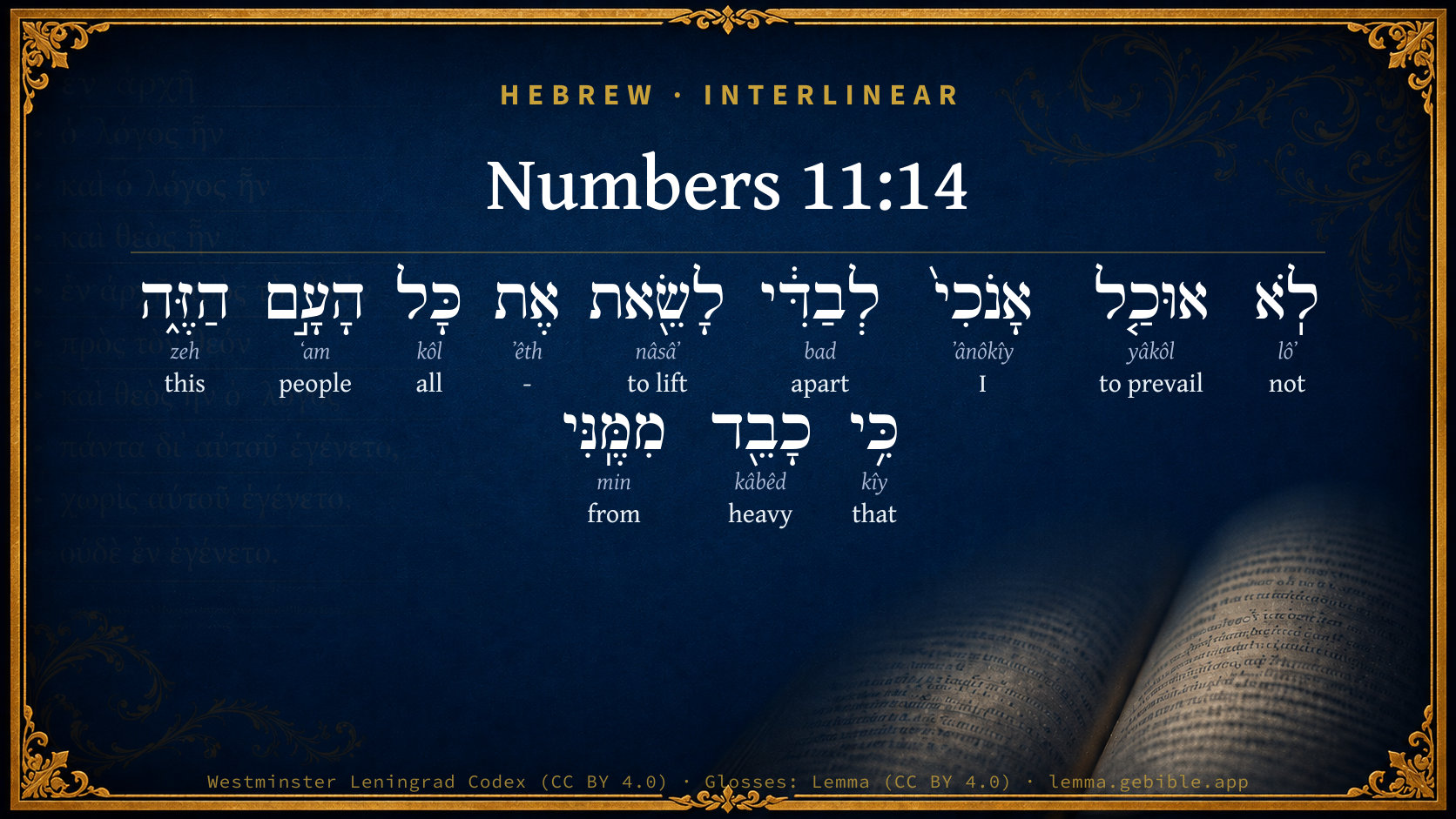
  1. לֹֽא lôʼ H3808 “not” Particle, Negative
  2. אוּכַ֤ל yâkôl H3201 “to prevail” Verb, Qal, Imperfect, 1st Person, Common, Singular
  3. אָנֹכִי֙ ʼânôkîy H595 “I” Pronoun, Personal, 1st Person, Common, Singular
  4. לְבַדִּ֔י bad H905 “to/for · apart · my” Preposition + Noun, Common, Masculine, Singular, Construct + Suffix, Personal, 1st Person, Common, Singular
  5. לָשֵׂ֖את nâsâʼ H5375 “to lift” Preposition + Verb, Qal, Infinitive Construct
  6. אֶת ʼêth H853 “-” Particle, Direct Object
  7. כָּל kôl H3605 “all of” Noun, Common, Masculine, Singular, Construct
  8. הָעָ֣ם ʻam H5971 “the · people” Particle, Definite Article + Noun, Common, Masculine, Singular, Absolute
  9. הַזֶּ֑ה zeh H2088 “the · this” Particle, Definite Article + Pronoun, Demonstrative, Masculine, Singular
  10. כִּ֥י kîy H3588 “that” Conjunction
  11. מִמֶּֽנִּי min H4480 “from · me” Preposition + Suffix, Personal, 1st Person, Common, Singular

About this verse

These counts appear in no published source. They are computed here, from the morphology-tagged text and Lemma’s own curated glosses. What Lemma adds →

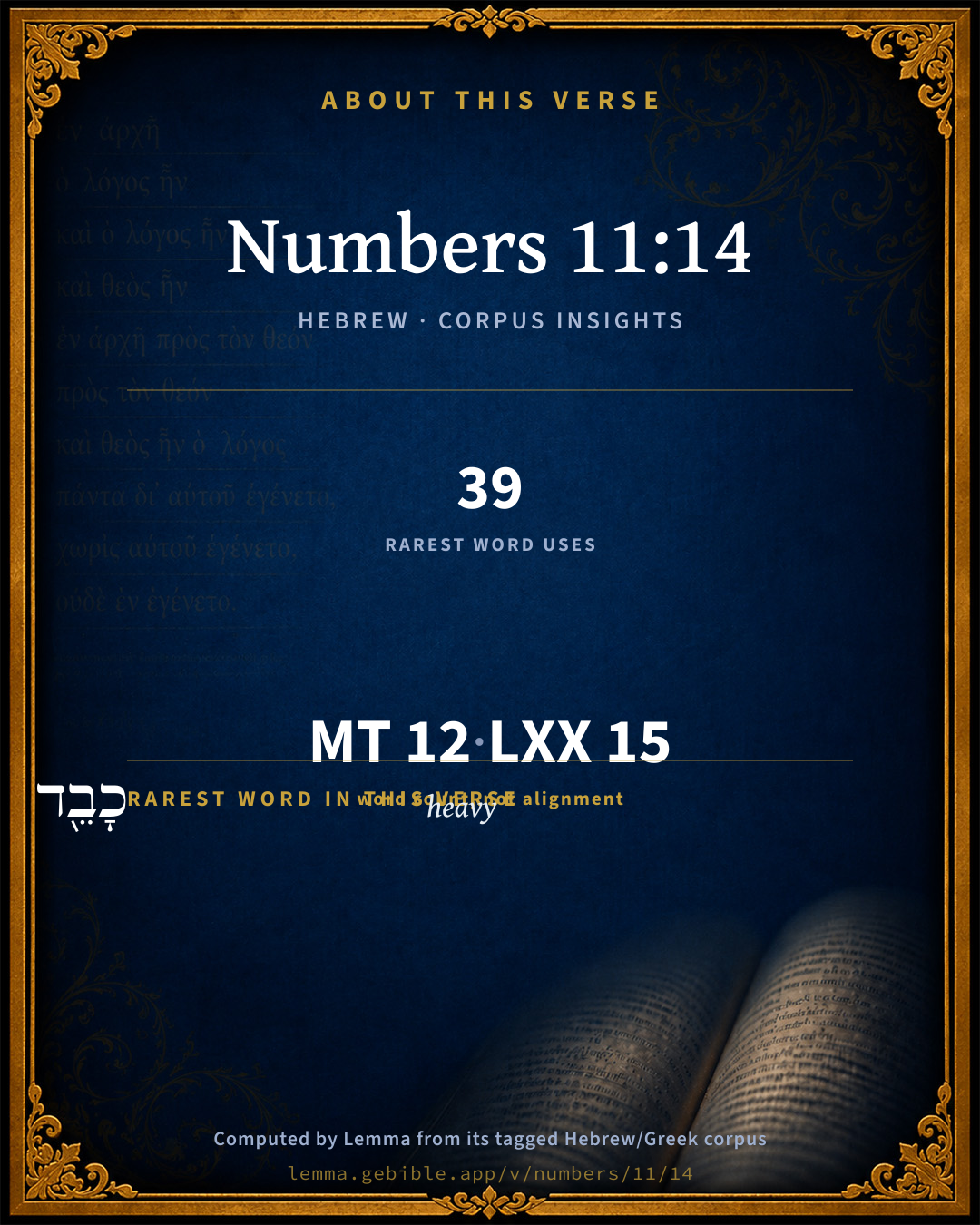
12
words
12
distinct lemmas
Pentateuch
section

Shared distinctive vocabulary

כָבֵ֖ד heavy H3515 occurs in 38 verses of the Hebrew Bible. Also found in:

Grammatical profile

  • 2 verbs
  • 3 nouns
  • 1 adjective
  • 2 pronouns
  • 1 preposition
  • 1 conjunction
  • 2 particles

Verb forms

  • אוּכַ֤ל Qal · Imperfect
  • לָשֵׂ֖את Qal · Infinitive Construct

Hebrew & Septuagint length

In English translation the verse runs 17 words from the Hebrew and 18 from the Septuagint (LXX English) — closely comparable.

A rough comparison of the two English renderings, which tokenize alike — not a word-level alignment.

Word counts can differ between the Hebrew and the Greek without any difference in meaning — e.g. the Hebrew direct-object marker אֵת has no separate Greek word, and Greek often adds the article ὁ.

In the original languages it is 12 Hebrew tokens and 15 Greek tokens — but the two are counted differently (Hebrew bundles its prefixes and suffixes into one token; the Greek is in lemma form), so that isn’t a like-for-like length.

Cross-references

6

Topical passages linked to Numbers 11:14 in the Treasury of Scripture Knowledge — connected by theme and wording, ordered by reader-vote popularity; previews shown in the World English Bible.

  • Exodus 18:18 You will surely wear away, both you, and this people that is with you; for the thing is too heavy for you. You are not able to perform it yourself alone.
  • Deuteronomy 1:9–12 I spoke to you at that time, saying, I am not able to bear you myself alone:
  • Zechariah 6:13 even he shall build the temple of Yahweh; and he shall bear the glory, and shall sit and rule on his throne; and he shall be a priest on his throne; and the counsel of peace shall be between them both.
  • 2 Corinthians 2:16 to the one a stench from death to death; to the other a sweet aroma from life to life. Who is sufficient for these things?
  • Psalms 89:19 Then you spoke in vision to your saints, And said, "I have bestowed strength on the warrior. I have exalted a young man from the people.
  • Isaiah 9:6 For to us a child is born, to us a son is given; and the government shall be on his shoulder: and his name shall be called Wonderful, Counselor, Mighty God, Everlasting Father, Prince of Peace.

Cross-references courtesy of OpenBible.info (CC BY 4.0).

Hebrew and Greek witnesses Masoretic Hebrew ↔ Greek Septuagint

The same verse in the two great witnesses to the Old Testament, shown verse-for-verse.

These are two independent witnesses, not word-aligned to each other, and the Septuagint is shown in lemma (dictionary) form.

Hebrew Numbers 11:14 Masoretic · Westminster Leningrad Codex

לֹֽא אוּכַ֤ל אָנֹכִי֙ לְבַדִּ֔י לָשֵׂ֖את אֶת כָּל הָעָ֣ם הַזֶּ֑ה כִּ֥י כָבֵ֖ד מִמֶּֽנִּי

I am not able to bear all this people alone, because it is too heavy for me.

World English Bible · Public Domain

Greek LXX Numbers 11:14 Septuagint · lemma form

οὐ δύναμαι ἐγώ μόνος φέρω ὁ λαός οὗτος ὅτι βαρύς ἐγώ εἰμί ὁ ῥῆμα οὗτος

I shall not be able to bear this people alone, for this thing is too heavy for me.

LXX2012 (modern English Septuagint) · Public Domain

Hebrew: Westminster Leningrad Codex (CC BY 4.0). Greek: Septuagint (public domain); English from LXX2012 (modern English Septuagint) (Public Domain). How the Septuagint differs from the Hebrew →

Targum (Aramaic paraphrase)

2

The Targum is the ancient Jewish Aramaic paraphrase of the Hebrew Scriptures — an interpretive translation, not the Hebrew text itself. Onkelos (literal) and Pseudo-Jonathan (expansive) render the Torah, and Jonathan the Prophets. Coverage is partial: where no permissively-licensed English translation exists for a verse, only the Aramaic is shown. This is verse-level text, not a word-by-word alignment to the Hebrew.

  1. Targum Onkelos Torah (Genesis–Deuteronomy)
    לֵית אֲנָא יָכִיל בִּלְחוֹדִי לְסוֹבָרָא יָת כָּל עַמָא הָדֵין אֲרֵי יַקִיר מִנִי

    (no public-domain English translation for this verse)

    Targum Onkelos — Aramaic: “Onkelos Genesis” (public domain); “Onkelos Exodus” (public domain); “Onkelos Leviticus” (public domain); “Onkelos Numbers” (public domain); “Onkelos Deuteronomy” (public domain). English: “Sefaria Community Translation” (CC0 1.0 (public-domain dedication)); “J.W. Etheridge. The Targums of Onkelos and Jonathan Ben Uzziel on the Pentateuch. London: Longmans, Green, 1862” (public domain). Text via Sefaria.

  2. Targum Pseudo-Jonathan Torah (Genesis–Deuteronomy)
    לֵית אֲנָא יָכִיל בִּלְחוֹדִי לְמִיטְעַן לְכָל עַמָא הָדֵין אֲרוּם יַקִיר הוּא מִינִי

    I am not able to bear all this people, for it is too weighty for me.

    Targum Pseudo-Jonathan — Aramaic: “Targum Jonathan on Genesis” (public domain); “Targum Jonathan on Exodus” (public domain); “Targum Jonathan on Leviticus” (public domain); “Targum Jonathan on Numbers” (public domain); “Targum Jonathan on Deuteronomy” (public domain). English: “The Targum of Jonathan ben Uzziel, trans. J. W. Etheridge, London, 1862” (public domain). Text via Sefaria.

Commentary

Notes on Numbers 11:14 from classic Christian and Jewish commentators (each source and its license shown beneath its notes). The classic Christian expositions comment on the surrounding passage and are grouped to its opening verse, so a note may address several verses; the Jewish commentaries on the Tanakh (Rashi and others) are per-verse, so they appear only where the commentator wrote on this verse.

Lemma curates 59 commentaries, every one of them public domain or Creative Commons licensed, each selected and text-cleaned for this edition rather than reprinted as found. About our sources →

Trapp's Complete Commentary

John Trapp

Num 11:14 I am not able to bear all this people alone, because [it is] too heavy for me.

Ver. 14. It is too heavy for me.] Crowns have their cares; high seats are uneasy, many a cumber attends honour. Beatus ille qui procul negotiis. {a}

{a} Horat.

John Trapp, A Commentary or Exposition upon All the Books of the Old and New Testament (1647–1656) — public domain. Text from a community e-Sword module.

MacLaren's Expositions of Holy Scripture

Alexander MacLaren

Numbers

MOSES DESPONDENT

Num 11:14.

Detail the circumstances.

The leader speaks the truth in his despondency. He is pressed with the feeling of his incapacity for his work. We may take his words here as teaching us what men need in him who is to be their guide, and how impossible it is to find what they need in mere men.

I. What men need in their guide.

These Israelites were wandering in the wilderness; they were without natural supplies for their daily necessities; they had a long hard journey before them, an unknown road, at the terminus of which was a land where they should rest. We have precisely the same necessities as those which Moses despairingly said that they had.

Like them, we wander hungry, and need a Leader who can satisfy our desires and evermore give us bread for our souls even more than for our bodies. We need One to whom we can ‘weep,’ as the Israelites did to Moses, and not weep in vain. We need One who can do for us what Moses felt that the Israelites needed, and that he could not give them, when he almost indignantly put to God the despairing question, ‘Can I carry them in my bosom as a nursing father beareth the sucking child?’ Our weakness, our ignorance, our heart-hunger, cry out for One who can ‘bear all this people alone.’ who in his single Self has resources of strength, wisdom, and sufficiency to meet not only the wants of one soul but those of the world. For He who can satisfy the poorest single soul must be able to satisfy all men.

II. The impossibility of finding this in men.

Moses’ experience here is that of all leaders and great men. He is overwhelmed with the work; feels his own utter impotence; has himself to be strengthened; loathes his work; longs for release from it. See how he confesses

His human dependence.

His incapacity to do and be what is needed.

His impatience with the people

His longing to be rid of it all.

That is a true picture of the experience of the best of men-a true picture of the limitations of the noblest leaders.

But it is not only the leaders who confess their inadequacy, but the followers feel it, for even the most enthusiastic of them come sooner or later to find that their Oracle had not learned all wisdom, nor was fit to be taken as sole guide, much less as sole defence or satisfaction. He who looks to find all that he needs in men must take many men to find it, and no multiplicity of men will bring him what he seeks. The Milky Way is no substitute for the sun. Our hearts cry out for One great light, for One spacious home. Endless strings of pearls do not reach the preciousness of One pearl of price.

III. The failures of human leaders prophesy the true Leader.

Moses was prophetic of Christ by his failures as by his successes. He could not do what the people clamoured to have done, and what he in the mood of despair in which the text shows him, sadly owned that he could not. In that very confession he becomes an unconscious prophet. For that he should have so vividly set forth the qualifications of a leader of men, as defined by the people’s cries, and should have so bitterly felt his incapacity to supply them, is a witness, if there is a God at all, that somewhere the needed Ideal will be realised in ‘a Leader and Commander of the people,’ God-sent and ‘worthy of more glory than Moses.’

The best service that all human leaders, helpers or lovers, can do us, is to confess their own insufficiency, and to point us to Jesus.

All that men need is found in Him and in Him alone. All that men have failed, and must always fail, to be, He is. Those eyes are blessed that ‘see no man any more save Jesus only.’ We need One who can satisfy our desires and fill our hungry souls, and Jesus speaks a promise, confirmed by the experience of all who have tested it when He declares: ‘He that cometh unto Me shall never hunger.’ We need One who will dry our tears, and Jesus, when He says ‘Weep not,’ wipes them away and stanches their sources, giving ‘the oil of joy for mourning.’ We need One who can hold us up in our journey, and minister strength to fainting hearts and vigour to weary feet, and Jesus ‘strengthens us with might in the inner man.’ We need One who will bring us to the promised land of rest, and Jesus brings many sons to glory, and wills that they be ‘with Him where He is.’ So let us turn away from the multiplicity of human insufficiencies to Him who is our one only help and hope, because He is all-sufficient and eternal.

Alexander MacLaren, Expositions of Holy Scripture (1904–1910) — public domain. Text from a community e-Sword module.

Ellicott's Commentary for English Readers

(14) To bear all this people alone.—In accordance with the advice of Jethro, able men had been chosen out of all Israel who heard and determined the small matters which arose among them (Exo_18:25-26), but they were of no avail on occasions such as the present.

My wretchedness.—Or, my evil. This is one of the eighteen places in which the scribes are said to have altered the text, and to have substituted my for Thy.

A Bible Commentary for English Readers, edited by Charles John Ellicott (1878–1897) — public domain. Text from a community e-Sword module.

John Gill's Exposition

I am not able to bear all this people alone,.... The burden of government of them, to take care of them and provide sustenance for them; but he was not alone, for, not to take notice of the rulers and officers in the several divisions of the people that assisted and eased him in lighter matters, advised to by Jethro, Exo 18:21, the Lord himself was with him in all matters of moment and difficulty; to whom he could apply at any time for advice, and who had promised to supply and did supply the people with suitable and proper provisions every day:

because it is too heavy for me; to answer the requests, redress the grievances, and supply the necessities of this people.

John Gill's Exposition of the Whole Bible (1746–1763) — public domain (CC PDM 1.0). Text via the HelloAO Bible API.

Haydock's Catholic Bible Commentary

For me. Had he not the judges, whom Jethro advised him to appoint? But all matters of consequence were still brought to Moses. He was made answerable for all things.

George Leo Haydock (1774–1849), Haydock's Catholic Family Bible and Commentary, 1859 edition — public domain. Excludes Psalms (Douay-Rheims chapter numbering differs from Protestant) and Deuterocanonical books (Catholic canon only).

Matthew Poole's English Annotations

All this people, i.e. the burden of providing for and satisfying of them.

Object. How was he alone, when there were others added to help him, Exo 18:21,24?

Answ. Those were only assistant to him in civil causes and smaller matters, but the harder and greater affairs, such as this unquestionably was, were brought to Moses and determined by him alone, Exo 18:22.

Matthew Poole's English Annotations on the Holy Bible (1683–1685) — public domain. Text from a community e-Sword/MySword module.

The Pulpit Commentary

I am not able to bear all this people alone. This complaint, while reasonable in itself, shows how unreasonable the rest of his words were. However many he might have had to share his responsibilities, be could not have provided flesh for the people, nor enabled them to live one day in the wilderness; this had never been laid upon him.

The Pulpit Commentary (1880–1919), ed. H.D.M. Spence-Jones & Joseph S. Exell — public domain. Text from a community e-Sword module.

John Wesley's Explanatory Notes

To bear - The burden of providing for and satisfying them. Alone - Others were only assistant to him in smaller matters; but the harder and greater affairs, such as this unquestionably was, were brought to Moses and determined by him alone.

John Wesley, Explanatory Notes Upon the Whole Bible (1754–1765) — public domain. Text via the GEBible commentary corpus.

Ramban (Nachmanides)

Rabbi Moshe ben Nachman (Ramban / Nachmanides)

I AM NOT ABLE TO BEAR ALL THIS PEOPLE MYSELF ALONE. The meaning thereof is not that the elders should help him to give the people flesh, for where should they get it from? Moreover, even if they would have many leaders they would still only complain against Moses our teacher who took them out of Egypt, as they used to say to him, And wherefore have ye made us to come up out of Egypt? [asking him] that he should give them through his prayers all that they asked for, and grant them their desires [and so they would still continue to complain to him rather than to the elders]! But Moses thought that if they would have many leaders they would appease their wrath by speaking to their hearts when they would start complaining. Or it is possible that when the elders prophesied, and the spirit [which was upon Moses] was put upon them, the people would know that these elders are established as prophets, and would not all gather against Moses but would ask for their desires from them as well [by means of their prayers].

Ramban (Nachmanides) on the Tanakh — English translation: “Commentary on the Torah by Ramban (Nachmanides). Translated and annotated by Charles B. Chavel. New York, Shilo Pub. House, 1971-1976” (CC BY 4.0). Text via Sefaria.

Lesson kit

Teaching starters — assembled from the data on this page, not authored interpretation. Every prompt links to the verse data it draws on. Edit before teaching.

Numbers, in the Pentateuch, opens this verse with 12 words (12 distinct Hebrew lemmas). Its most distinctive word is kâbêd (“heavy”). A historical commentator’s framing appears above. Read the whole chapter for the surrounding context.

Discussion questions

  1. What does “heavy” (kâbêd) contribute to the verse as a whole?
  2. How does Genesis 12:10, which shares the word «heavy», read alongside this verse?
  3. The translations on this page render this verse differently — a whole-verse word diff, not a word-by-word alignment. What might account for the different wordings?
  4. «אוּכַ֤ל» is a Qal Imperfect verb. How does that grammatical form shape the action described?
  5. Compare how Trapp's Complete Commentary and MacLaren's Expositions of Holy Scripture read this verse. Where do they agree or differ?

Things to notice

Reading settings

Reading text

Shown beneath each verse's original-language words.

Old Testament
Old Testament edition

Read the OT as the Masoretic Hebrew (MT) or the Greek Septuagint (LXX).

English shown for the Greek Septuagint (in the Hebrew ↔ Greek comparison).

Comparing translations? Open the Compare panel on any verse page to stack up to four side by side.