Jeremiah 49:23

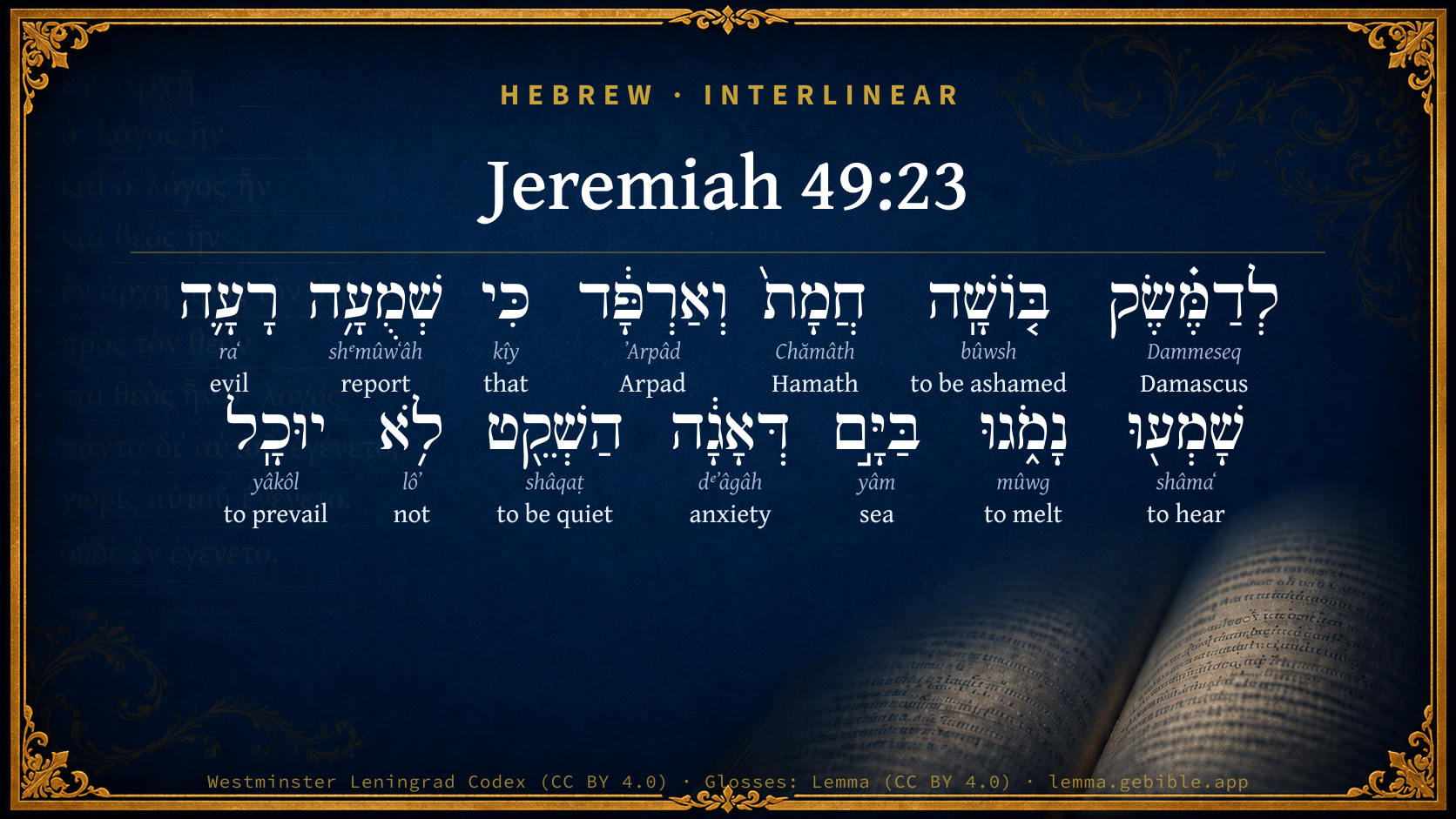
Hebrew (Westminster Leningrad Codex) Jeremiah 49:23 appears in the Hebrew Old Testament. The text above is from the Westminster Leningrad Codex. Each word links to its Strong’s number, a concise gloss, and parsing drawn from the Open Scriptures Hebrew Bible morphology. Click any word for its full Brown-Driver-Briggs (BDB) entry.
Download image
Cite this verse

Jeremiah 49:23 (World English Bible). Public Domain. Lemma interlinear Bible study tool, https://lemma.gebible.app/v/jeremiah/49/23.

Show BibTeX & RIS
BibTeX
RIS
English Translation
Of Damascus. Hamath is confounded, and Arpad; for they have heard evil news, they are melted away: there is sorrow on the sea; it can't be quiet.
World English Bible · Public Domain
Download a study sheet

One document with this verse’s original text, its word-by-word gloss line, the meaning frame, cross-references with their text, attributed commentary, and full source and license credits — printable, and it pastes into notes with its structure intact.

This verse Autodidact and up

Study sheet (.html) Plain text (.txt)

A passage Seminary Student

Up to 50 verses in one chapter. A passage sheet keeps up to 6 commentary sources and 12 cross-references per verse, in the order this page ranks them, and says so on the sheet whenever that leaves anything out. Ask for a single verse and you get the Autodidact verse sheet above.

Everything on this page stays free to read, with no account — the sheet is a download of what is already on screen, not access to it.

Want to remove ads? Support Godless Engineer
Compare translations 3

The same verse in 3 English versions, stacked beneath the original-language interlinear above. Click any original word for its lexicon entry.

Each is an independent rendering of the whole verse — the interlinear is not word-aligned to these translations.

Highlighted words mark where these versions differ — a whole-verse word diff, not a word-by-word alignment.

  • World English Bible Public Domain
    Of Damascus. Hamath is confounded, and Arpad; for they have heard evil news, they are melted away: there is sorrow on the sea; it can't be quiet.
  • King James Version Public Domain
    Concerning Damascus. Hamath is confounded, and Arpad: for they have heard evil tidings: they are fainthearted; there is sorrow on the sea; it cannot be quiet.
  • unfoldingWord Literal Text CC BY-SA 4.0
    About Damascus: “Hamath and Arpad will be ashamed, for they have heard news of disaster. They melt away! They become as troubled as the sea, which cannot stay calm.

unfoldingWord Literal Text — © unfoldingWord, licensed CC BY-SA 4.0. Word-aligned USFM3 via Door43 (git.door43.org/unfoldingWord/en_ult).

Versions to compare (up to 4)

3 of 4 selected

Show all 18 translations

Every available English version of this verse, each an independent rendering of the whole verse.

  • World English Bible Public Domain
    Of Damascus. Hamath is confounded, and Arpad; for they have heard evil news, they are melted away: there is sorrow on the sea; it can't be quiet.
  • Berean Standard Bible Public Domain
    Concerning Damascus: “Hamath and Arpad are put to shame, for they have heard a bad report; they are agitated like the sea; their anxiety cannot be calmed.
  • Majority Standard Bible Public Domain
    Concerning Damascus: “Hamath and Arpad are put to shame, for they have heard a bad report; they are agitated like the sea; their anxiety cannot be calmed.
  • King James Version Public Domain
    Concerning Damascus. Hamath is confounded, and Arpad: for they have heard evil tidings: they are fainthearted; there is sorrow on the sea; it cannot be quiet.
  • American Standard Version (1901) Public Domain
    Of Damascus. Hamath is confounded, and Arpad; for they have heard evil tidings, they are melted away: there is sorrow on the sea; it cannot be quiet.
  • Revised Version (1885) Public Domain
    Of Damascus. Hamath is ashamed, and Arpad; for they have heard evil tidings, they are melted away: there is sorrow on the sea; it cannot be quiet.
  • Geneva Bible (1599) Public Domain
    Vnto Damascus he sayeth, Hamath is confounded and Arpad, for they haue heard euill tidings, and they are faint hearted as one on the fearefull sea that can not rest.
  • Douay-Rheims (1899) Public Domain
    Against Damascus. Emath is confounded and Arphad: for they have heard very bad tidings, they are troubled as in the sea: through care they could not rest.
  • Young's Literal Translation Public Domain
    Concerning Damascus: Ashamed hath been Hamath and Arpad, For an evil report they have heard, They have been melted, in the sea `is' sorrow, To be quiet it is not able.
  • Literal Standard Version CC BY-SA 4.0
    Concerning Damascus: “Hamath and Arpad have been ashamed, || For they have heard an evil report, || They have been melted, sorrow [is] in the sea, || It is not able to be quiet.
  • Unlocked Literal Bible CC BY-SA 4.0
    About Damascus: “Hamath and Arpad will be ashamed, for they have heard news of disaster. They melt away! They become as troubled as the sea, which cannot stay calm.
  • unfoldingWord Literal Text CC BY-SA 4.0
    About Damascus: “Hamath and Arpad will be ashamed, for they have heard news of disaster. They melt away! They become as troubled as the sea, which cannot stay calm.
  • Darby Bible Public Domain
    Concerning Damascus. Hamath is put to shame, and Arpad; for they have heard evil tidings, they are melted away: there is distress on the sea; it cannot be quiet.
  • World Messianic Bible Public Domain
    Of Damascus: “Hamath and Arpad are confounded, for they have heard evil news. They have melted away. There is sorrow on the sea. It can’t be quiet.
  • Webster's Bible Public Domain
    Concerning Damascus. Hamath is confounded, and Arpad: for they have heard evil tidings: they are faint-hearted; there is sorrow on the sea; it cannot be quiet.
  • Free Bible Version CC BY-SA 4.0
    A prophecy about Damascus: The towns of Hamath and Arpad are disturbed, because they've received bad news. They are fearful, restless like the sea. Nothing can calm their worries.
  • Bible in Basic English Public Domain
    About Damascus. Hamath is put to shame, and Arpad; for the word of evil has come to their ears, their heart in its fear is turned to water, it will not be quiet.
  • JPS Tanakh (1917) Public Domain
    Of Damascus. Hamath is ashamed, and Arpad; for they have heard evil tidings, they are melted away; there is trouble in the sea; it cannot be quiet.

Literal Standard Version (2020), Covenant Press — licensed CC BY-SA 4.0. Text via the HelloAO Bible API (eBible.org). Unlocked Literal Bible (unfoldingWord) — licensed CC BY-SA 4.0. Text via the HelloAO Bible API (eBible.org). unfoldingWord Literal Text — © unfoldingWord, licensed CC BY-SA 4.0. Word-aligned USFM3 via Door43 (git.door43.org/unfoldingWord/en_ult). Free Bible Version, Dr. Jonathan Gallagher — licensed CC BY-SA 4.0. Text via the HelloAO Bible API (eBible.org).

Word by word

More ways to search: Search by grammar → Find every occurrence → Compare this word →

Practice this passage: Drill this verse → Learn its vocabulary →

וְאַרְפָּ֔ד
ʼArpâd
H774
“and · Arpad”
Conjunction + Noun, Proper
Part of Speech
Conjunction + Noun
Type
Proper
Full BDB Definition

Origin: from H7502

TWOT: None

Arpad or Arphad = "I shall be spread out (or supported)" - a city in northern Syria cited as an example of the Assyrian conquest
  1. לְדַמֶּ֗שֶׂק Dammeseq H1834 “to/for · Damascus” Preposition + Noun, Proper
  2. בּ֤וֹשָֽׁה bûwsh H954 “to be ashamed” Verb, Qal, Perfect, 3rd Person, Feminine, Singular
  3. חֲמָת֙ Chămâth H2574 “Hamath” Noun, Proper
  4. כִּי kîy H3588 “that” Conjunction
  5. שְׁמֻעָ֥ה shᵉmûwʻâh H8052 “report” Noun, Common, Feminine, Singular, Absolute
  6. רָעָ֛ה raʻ H7451 “evil” Adjective, Adjective, Feminine, Singular, Absolute
  7. שָׁמְע֖וּ shâmaʻ H8085 “to hear” Verb, Qal, Perfect, 3rd Person, Common, Plural
  8. נָמֹ֑גוּ mûwg H4127 “to melt” Verb, Niphal, Perfect, 3rd Person, Common, Plural
  9. בַּיָּ֣ם yâm H3220 “in/at the · sea” Preposition, Determined + Noun, Common, Masculine, Singular, Absolute
  10. דְּאָגָ֔ה dᵉʼâgâh H1674 “anxiety” Noun, Common, Feminine, Singular, Absolute
  11. הַשְׁקֵ֖ט shâqaṭ H8252 “to be quiet” Verb, Hiphil, Infinitive Absolute
  12. לֹ֥א lôʼ H3808 “not” Particle, Negative
  13. יוּכָֽל yâkôl H3201 “to prevail” Verb, Qal, Imperfect, 3rd Person, Masculine, Singular

About this verse

These counts appear in no published source. They are computed here, from the morphology-tagged text and Lemma’s own curated glosses. What Lemma adds →

14
words
14
distinct lemmas
Prophets
section

Notable vocabulary

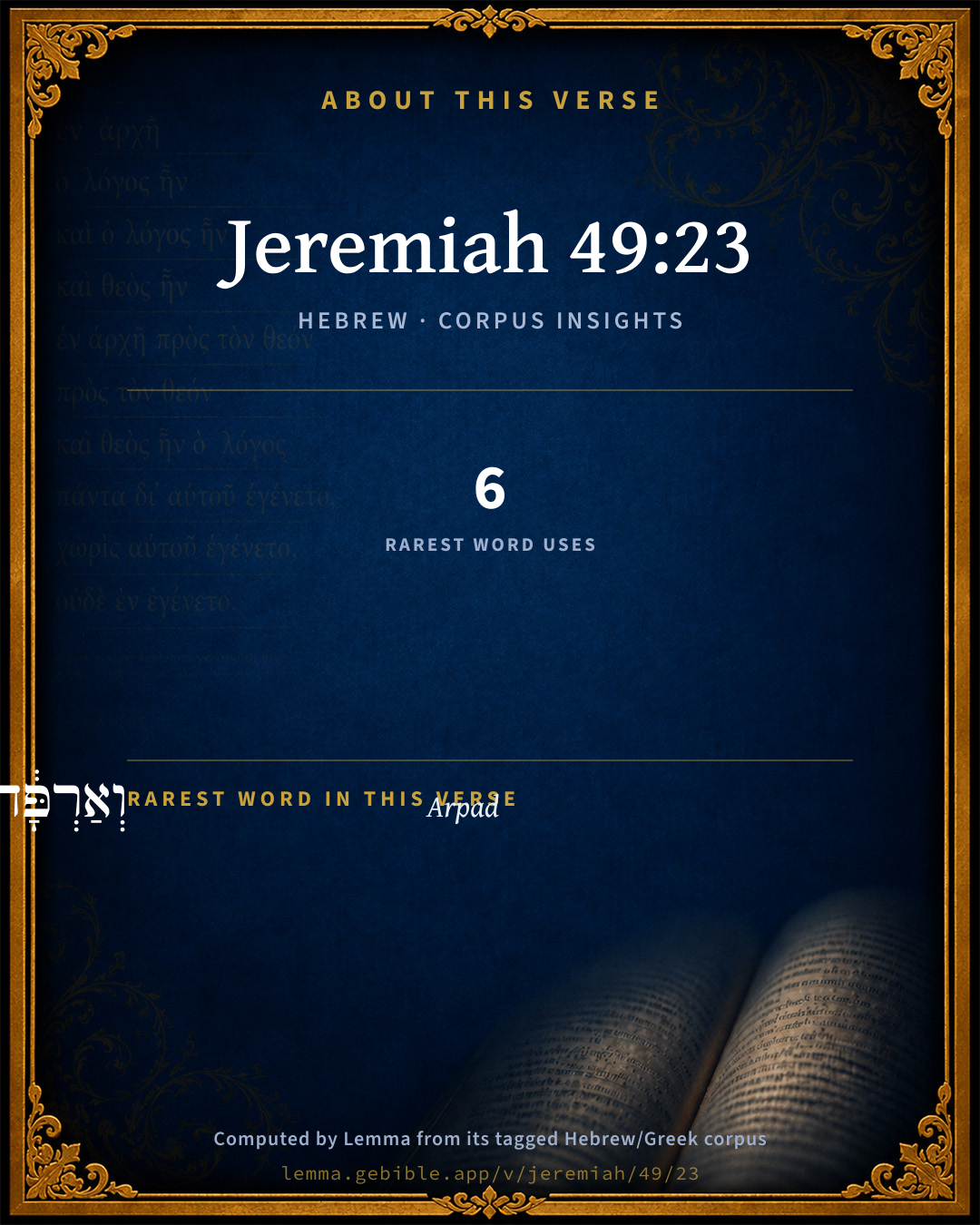
The rarest word here is וְאַרְפָּ֔ד Arpad H774 — appearing just 6 times in the whole Hebrew Bible.

Shared distinctive vocabulary

וְאַרְפָּ֔ד Arpad H774 occurs in 6 verses of the Hebrew Bible. Also found in:

Grammatical profile

  • 5 verbs
  • 6 nouns
  • 1 adjective
  • 1 conjunction
  • 1 particle

Verb forms

  • בּ֤וֹשָֽׁה Qal · Perfect
  • שָׁמְע֖וּ Qal · Perfect
  • נָמֹ֑גוּ Niphal · Perfect
  • הַשְׁקֵ֖ט Hiphil · Infinitive Absolute
  • יוּכָֽל Qal · Imperfect

Cross-references

29

Topical passages linked to Jeremiah 49:23 in the Treasury of Scripture Knowledge — connected by theme and wording, ordered by reader-vote popularity; previews shown in the World English Bible.

  • 2 Kings 18:34 Where are the gods of Hamath, and of Arpad? where are the gods of Sepharvaim, of Hena, and Ivvah? have they delivered Samaria out of my hand?
  • Isaiah 10:9 Isn't Calno as Carchemish? Isn't Hamath as Arpad? Isn't Samaria as Damascus?
  • Genesis 14:15 He divided himself against them by night, he and his servants, and struck them, and pursued them to Hobah, which is on the left hand of Damascus.
  • Genesis 15:2 Abram said, "Lord Yahweh, what will you give me, seeing I go childless, and he who will inherit my estate is Eliezer of Damascus?"
  • Isaiah 57:20 But the wicked are like the troubled sea; for it can't rest, and its waters cast up mire and dirt.
  • Numbers 13:21 So they went up, and spied out the land from the wilderness of Zin to Rehob, to the entrance of Hamath.
  • 2 Kings 19:13 Where is the king of Hamath, and the king of Arpad, and the king of the city of Sepharvaim, of Hena, and Ivvah?
  • Nahum 2:10 She is empty, void, and waste. The heart melts, the knees knock together, their bodies and faces have grown pale.
  • Deuteronomy 20:8 The officers shall speak further to the people, and they shall say, What man is there who is fearful and faint-hearted? let him go and return to his house, lest his brother's heart melt as his heart.
  • Joshua 2:11 As soon as we had heard it, our hearts did melt, neither did there remain any more spirit in any man, because of you: for Yahweh your God, he is God in heaven above, and on earth beneath.
  • Joshua 14:8 Nevertheless my brothers who went up with me made the heart of the people melt; but I wholly followed Yahweh my God.
  • 2 Samuel 8:9 When Toi king of Hamath heard that David had struck all the host of Hadadezer,
  • 2 Samuel 17:10 Even he who is valiant, whose heart is as the heart of a lion, will utterly melt; for all Israel knows that your father is a mighty man, and those who are with him are valiant men.
  • 1 Kings 11:24 He gathered men to him, and became captain over a troop, when David killed them [of Zobah]: and they went to Damascus, and lived therein, and reigned in Damascus.
  • 2 Kings 17:24 The king of Assyria brought men from Babylon, and from Cuthah, and from Avva, and from Hamath and Sepharvaim, and placed them in the cities of Samaria instead of the children of Israel; and they possessed Samaria, and lived in the cities of it.
  • 2 Chronicles 16:2 Then Asa brought out silver and gold out of the treasures of the house of Yahweh and of the king's house, and sent to Ben Hadad king of Syria, who lived at Damascus, saying,
  • Psalms 107:26–27 They mount up to the sky; they go down again to the depths. Their soul melts away because of trouble.
  • Isaiah 11:11 It shall happen in that day, that the Lord will set his hand again the second time to recover the remnant of his people, who shall remain, from Assyria, and from Egypt, and from Pathros, and from Cush, and from Elam, and from Shinar, and from Hamath, and from the islands of the sea.
  • Isaiah 13:7 Therefore shall all hands be feeble, and every heart of man shall melt:
  • Isaiah 17:1–3 The burden of Damascus. Behold, Damascus is taken away from being a city, and it shall be a ruinous heap.
  • Isaiah 37:13 Where is the king of Hamath, and the king of Arpad, and the king of the city of Sepharvaim, of Hena, and Ivvah?
  • Amos 1:3–5 Thus says Yahweh: "For three transgressions of Damascus, yes, for four, I will not turn away its punishment; Because they have threshed Gilead with threshing instruments of iron;
  • Amos 6:2 Go to Calneh, and see; And from there go to Hamath the great; Then go down to Gath of the Philistines. Are they better than these kingdoms? Or is their border greater than your border?
  • Zechariah 9:1–2 An oracle. The word of Yahweh is against the land of Hadrach, And will rest upon Damascus; For the eye of man And of all the tribes of Israel is toward Yahweh;
  • Luke 8:23–24 But as they sailed, he fell asleep. A wind storm came down on the lake, and they were taking on dangerous amounts of water.
  • Luke 21:25–26 There will be signs in the sun, moon, and stars; and on the earth anxiety of nations, in perplexity for the roaring of the sea and the waves;
  • Acts 9:2 and asked for letters from him to the synagogues of Damascus, that if he found any who were of the Way, whether men or women, he might bring them bound to Jerusalem.
  • Acts 27:20 When neither sun nor stars shone on us for many days, and no small tempest pressed on us, all hope that we would be saved was now taken away.
  • 2 Corinthians 11:32 In Damascus the governor under Aretas the king guarded the city of the Damascenes desiring to arrest me.

Cross-references courtesy of OpenBible.info (CC BY 4.0).

Hebrew and Greek witnesses Masoretic Hebrew ↔ Greek Septuagint

The same verse in the two great witnesses to the Old Testament, shown verse-for-verse.

These are two independent witnesses, not word-aligned to each other, and the Septuagint is shown in lemma (dictionary) form.

Hebrew Jeremiah 49:23 Masoretic · Westminster Leningrad Codex

לְדַמֶּ֗שֶׂק בּ֤וֹשָֽׁה חֲמָת֙ וְאַרְפָּ֔ד כִּי שְׁמֻעָ֥ה רָעָ֛ה שָׁמְע֖וּ נָמֹ֑גוּ בַּיָּ֣ם דְּאָגָ֔ה הַשְׁקֵ֖ט לֹ֥א יוּכָֽל

Of Damascus. Hamath is confounded, and Arpad; for they have heard evil news, they are melted away: there is sorrow on the sea; it can't be quiet.

World English Bible · Public Domain

Greek LXX Structure differs

In the Septuagint, Jeremiah is about an eighth shorter than the Hebrew and arranges its material differently — the Oracles Against the Nations (Hebrew chapters 46–51) appear in the middle of the Greek book, after 25:13. Because the chapter and verse boundaries do not line up, a verse-for-verse comparison with the Hebrew is not shown.

A verse-for-verse comparison isn’t shown here because the chapters and verses don’t line up. Switch to the LXX edition with the MT / LXX toggle above to read the Greek directly.

On this verse, The Cambridge Bible for Schools and Colleges discusses the Septuagint’s reading. Read the note in Commentary ↓

Hebrew: Westminster Leningrad Codex (CC BY 4.0). Greek: Septuagint (public domain); English from a public-domain English Septuagint. How the Septuagint differs from the Hebrew →

Targum (Aramaic paraphrase)

1

The Targum is the ancient Jewish Aramaic paraphrase of the Hebrew Scriptures — an interpretive translation, not the Hebrew text itself. Onkelos (literal) and Pseudo-Jonathan (expansive) render the Torah, and Jonathan the Prophets. Coverage is partial: where no permissively-licensed English translation exists for a verse, only the Aramaic is shown. This is verse-level text, not a word-by-word alignment to the Hebrew.

  1. Targum Jonathan Prophets (Joshua–Malachi)
    לְדַמֶשֶׂק בְּהִיתוּ יַתְבֵי חֲמָת וְאַרְפָּד אֲרֵי בְּסוּרָא בִישָׁא שְׁמָעוּ אִתְּבָרוּ דַחֲלָא בְיַמָא וְיִצְפָּא אֲחַדְתִּינוּן הָא כְנָחֲתֵי יַמָא דְשָׁקְטִין וְלָא יָכְלִין לִמְנָח:

    (no public-domain English translation for this verse)

    Targum Jonathan — Aramaic: “Mikraot Gedolot” (public domain). English: “Sefaria Community Translation” (CC0 1.0 (public-domain dedication)); “London "Chaldee Paraphrase," 1871” (public domain). Text via Sefaria.

Commentary

Notes on Jeremiah 49:23 from classic Christian and Jewish commentators (each source and its license shown beneath its notes). The classic Christian expositions comment on the surrounding passage and are grouped to its opening verse, so a note may address several verses; the Jewish commentaries on the Tanakh (Rashi and others) are per-verse, so they appear only where the commentator wrote on this verse.

Lemma curates 59 commentaries, every one of them public domain or Creative Commons licensed, each selected and text-cleaned for this edition rather than reprinted as found. About our sources →

Matthew Henry's Commentary

The kingdom of Syria lay north of Canaan, as that of Edom lay south, and thither we must now remove and take a view of the approaching fate of that kingdom, which had been often vexatious to the Israel of God. Damascus was the metropolis of that kingdom, and the ruin of the whole is supposed in the ruin of that: yet Hamath and Arpad, two other considerable cities, are names (Jer 49:23), and the palaces of Ben-hadad, which he built, are particularly marked for ruin, Jer 49:27; see also Amo 1:4. Some think Ben-hadad (the son of Hadad, either their idol, or one of their ancient kings, whence the rest descended) was a common name of the kings of Syria, as Pharaoh of the kings of Egypt. Now observe concerning the judgment of Damascus, 1. It begins with a terrible fright and faint-heartedness. They hear evil tidings, that the king of Babylon, with all his force, is coming against them, and they are confounded; they know not what measures to take for their own safety, their souls are melted, they are faint-hearted, they have no spirit left them, they are like the troubled sea, that cannot be quiet (Isa 57:20), or like men in a storm at sea (Psa 107:26); or the sorrow that begins in the city shall go to the sea-coast, Jer 49:23. See how easily God can dispirit those nations that have been most celebrated for valour. Damascus now waxes feeble (Jer 49:24), a city that thought she could look the most formidable enemy in the face now turns herself to flee, and owns it is to no more purpose to think of contending with her fate than for a woman in labour to contend with her pains, which she cannot escape, but must yield to. It was a city of praise (Jer 49:25), not praise to God, but to herself, a city much commended and admired by all strangers that visited it. It was a city of joy, where there was an affluence and confluence of all the delights of the sons of men, and abundance of mirth in the enjoyment of them. We read it (though there is no necessity for this) the city of my joy, which the prophet himself had sometimes visited with pleasure. Or it may be the speech of the king lamenting the ruin of the city of his joy. But now it is all overwhelmed with fear and grief. Note, Those deceive themselves who place their happiness in carnal joys; for God in his providence can soon cast a damp upon them and put an end to them. He can soon make a city of praise to be a reproach and a city of joy to be a terror to itself. 2. It ends with a terrible fall and fire. (1.) The inhabitants are slain (Jer 49:26): The young men, who should fight the enemy and defend the city, shall fall by the sword in her streets; and all the men of war, mighty men, expert in war, and engaged in the service of their country, shall be cut off. (2.) The city is laid in ashes (Jer 49:27): The fire is kindled by the besiegers in the wall, but it shall devour all before it, the palaces of Ben-hadad particularly, where so much mischief had formerly been hatched against God's Israel, for which it is now thus visited.

Matthew Henry's Commentary on the Whole Bible (1708–1710) — public domain (CC PDM 1.0). Text via the HelloAO Bible API.

The Cambridge Bible for Schools and Colleges

gen. ed. J. J. S. Perowne

23. Damascus] Damascus was for a long time held by a powerful dynasty of kings, who reduced the other cities under their own sway.

Hamath] Hama, on the Orontes, 110 miles N. of Damascus.

Arpad] Tell-Erfad, 95 miles N. of Hamath, and often mentioned (e.g. 2Ki_18:34; 2Ki_19:13; Isa_10:9) along with it. Both names occur frequently on Assyrian monuments.

sorrow (mg. care) on the sea] The mention of “sea” (perhaps arising from the influence of Isa_57:20) is quite unsuitable topographically to this context. Co. emends to “they are melted away there from care.” But Dr.’s emendation is better, viz. because of care, like the sea, they cannot rest.

23–27 (= LXX. Ch. Jer_30:12-16). Prophecy against Damascus

This section is rejected even by some commentators (e.g. Co.) who admit portions of chs. 46–51 as genuine. The main objection adduced is the emphasis laid on Hamath and Arpad (Jer_49:23), combined with the absence of these two cities from the vision in ch. Jer_25:18 ff. Still this hardly justifies us in dismissing the whole section as later than Jeremiah’s time, as Jer_49:26-27 may easily be an addition to the original form, the former as borrowed from Jer_50:30, where it fits better, the latter as closely connected with the refrain, Amo_1:4; Amo_1:10; Amo_1:12; Amo_1:14; Amo_2:5.

The section may be summarized thus. Hamath and Arpad are terror-stricken. Damascus turns in alarm to flee. She is empty of succour. Her warriors within her are fallen, and Benhadad’s palaces shall be burnt.

The Cambridge Bible for Schools and Colleges (gen. ed. J. J. S. Perowne; Cambridge University Press, 1878–1918) — public domain. Text from a community e-Sword module.

Trapp's Complete Commentary

John Trapp

Jer 49:23 Concerning Damascus. Hamath is confounded, and Arpad: for they have heard evil tidings: they are fainthearted; [there is] sorrow on the sea; it cannot be quiet.

Ver. 23. Concerning Damascus.] The chief city of Syria, so pleasantly situated, so rich and luxurious, that one compareth it to Corinth or Ephesus. Julian the emperor, in his Epistles, calleth it the city of Jupiter, and the eye of the whole East. Tamerlane would not come into it, lest he should be detained there by the delights and delicacies of it. He destroyed it in a displeasure, and built three towers with the skulls of those he had there slain (for a trophy) with singular skill. It was built again by the Soldan of Egypt, and is now possessed by the Turks.

There is sorrow on the sea: it cannot be quiet.] Or, There is sorrow as upon the sea, which cannot rest.

John Trapp, A Commentary or Exposition upon All the Books of the Old and New Testament (1647–1656) — public domain. Text from a community e-Sword module.

The Biblical Illustrator

Joseph S. Exell

Jer_49:23

There is sorrow (as) on the sea; it cannot be quiet.

Life on the ocean

That which was true of the cities spoken of in our text, is also true, though in a different sense, of every voyager on the sea of life. There is sorrow (as) on the sea.

I. Sorrow as on the sea is divinely predicted. Voyagers you all must be. Out on that wide mysterious ocean which is swept by storms untold, and which teems with dangers innumerable, you must sail. Many of you axe as yet but as landsmen lying in the docks. You are admiring your vessel, and putting on nautical airs, and wondering when you will be freed from the trammels of the shore. Some of you are just dropping down the stream, your breasts big with hope, and your imagination painting glowing pictures of the ocean life beyond. Mid the songs of the sailors, and the music of the passengers, bright visions are rising of sunny seas and blue skies, of mirth and boundless happiness. With all my heart I wish you God-speed. I would not unnecessarily becloud that fair prospect. May the sunbeams which begild the waves around you follow you abundantly. And yet, though at the risk of being charged with unkindness, I must warn you that there is sorrow on the sea. I would not, I could not, prevent your sailing; but I must remind you of that which should not be always forgotten, that in lifes voyage troubles will come.

II. Sorrow as on the sea is universally experienced.

1. From the mutability of life. I have no wish to play the misanthrope, to paint you a leaden landscape under a lowering sky, where no break of sunshine ever comes to chase the shadows from an ebon sea. There is sunshine! Though all life has its clouds, life is not all sorrow. But while lifes joys may be many and real, it will have its sorrows by reason of its changes. To-day the sea may he calm, and the sky may be without a cloud, but even while we speak the glass is falling, and the calm sea will soon be lashed into foaming fury, and the cloudless sky will soon be overcast with messengers of coming woe.

2. From the uncertainties of life. Which way to steer--what to do--whether to enter into this speculation or to avoid that transaction--how to meet this engagement, or how to be relieved of that responsibility--often drives men to their wits end. Business goes wrong, markets are unsteady, panics are abroad, and fogs and thick darkness so enshroud the mercantile world, that with dangers and uncertainty everywhere around, the perplexed tradesmen often just throws up the helm in despair, and allows the vessel to drift whithersoever the current will take her. And in his spiritual voyage the Christian is not always free from similar sorrow. With the Psalmist, we have sometimes to lament that we see not our signs.

3. The disappointments of life.

(1) Think of lifes friendships! Where we anticipated most consolation, there, in the day of our need, we were most bitterly deceived.

(2) Look at lifes prospects! You remember how hard you toiled to secure that position which you thought would consummate your joys, and be the very climax of your every earthly ambition. You remember how bright your prospects seemed to be. You know that towards the end everything was so apparently propitious that you never for a moment entertained a doubt of success. But you were disappointed l

III. Sorrow as on the sea may be greatly mitigated.

1. A good ship. Let a sailor be persuaded of the soundness of the ship in which he sails, and it may blow big guns--he is comparatively at ease. We want similar faith in the grand old Gospel ship. We want the unswerving confidence which will inspire us ever to say, I am not ashamed of the Gospel of Christ, for it is the power of God unto salvation. Classed A1 for ever in the heavenly register, this everlasting Gospel can never fail. In this good ship millions have reached the desired haven in peace; on her deck millions are sailing thither now; and there is room for millions yet unborn.

2. A reliable chart. Without this a man may well be anxious. By what chart are you steering? Is it the Bible, or is it the Age of Reason? Blessed be God, we know whom and we know what we believe.

3. Sufficient provision. Lacking provision, what can the sailor do? There is often such sorrow on the sea. Want often stares men in the face when they are far from port, and when they can by no possible means obtain supplies. This can never happen on board the ship of the Gospel. This vessel is stored abundantly with the choicest provisions of free eternal grace. (W. H. Burton.)

The sea, a parable of human life

The ocean is, and always will be, so long as man keeps the faculty of imagination, a mournfully suggestive parable of human life. The restlessness of the sea, its constant alternations of storm and calm, its treachery, for ever deceiving us by false appearances, the atmosphere of mystery that broods over it, all these contribute to make it the natural symbol of mans condition here in this world. Take only one of those characteristics--mysteriousness. David had been visited by this thought also. Thy judgments, he says, while pondering the strange confusion of good and evil in the world, are like the great deep. The sea does suggest, with wonderful power, the mysteriousness of Gods providence in the affairs of men. Thy way is in the sea, and Thy path in the great waters, and Thy footsteps are not known. The human mind is by nature prone to the misgiving that fate rather than providence orders the procession of our life. Events, so the temptation whispers, fall out according to an iron law of necessity. There is no loving Father who notes the sparrows fall, and gives His children their daily bread; neither is there any blessed consummation, any final victory of the good over the evil towards which history may be supposed to move. These hopes are delusive; they rest on no foundation. The only thing of which we are certain is that effect follows upon cause in uniform succession, any given human life being as powerless to quicken, or retard, or alter the movement of this endless chain, as if it were only a tiny bubble molten in the fibre of the iron of one single link. This is what we understand by such words as destiny, fate. necessity, and this is the idea which the sea, looked at as a parable, most easily suggests. You sit upon some rocky promontory and watch the incoming tide. You note how wave after wave dashes itself against the hard face of the cliff, and perishes in the act. You observe that every now and then a larger wave comes in, and seems to make a braver effort; but that also, like its predecessor, falls back and is gone. Meanwhile the general level of the water rises and rises, until a predetermined point is reached, and then, as gradually, the tide recedes, sure to return again as soon as a few hours have past, and to make its mark a little higher, or a little lower, according to rules which the astronomers wrote out long ago, which you might have found all calculated for you in their books before you started on the walk. Surely, if there be anywhere in nature a vivid emblem of the idea of destiny, it is here. And, if anything were needed to heighten the impression which the eye has already carried to the mind, the ear might find it in the monotonous, melancholy music of the breaking waves, a sound which possibly suggested to the mourner among the prophets his pathetic cry, There is sorrow on the sea. What is the relief for a mind oppressed, weighted down with thoughts like this? The sea is His, and He made it. Have faith in God, said our Lord Jesus Christ to His disciples, when they found themselves in perplexity. Have faith in God. He who made the sea is greater than the sea. He who ordained the strangely tangled scheme of providence, is greater than His scheme. He who is responsible for the mystery of human life, holds the key of that mystery in. His hands. Do you ask for proof of this? There is no proof. If there were proof, Christ need not have said, Have faith in God. Where knowledge leaves off, there faith begins. At the outer boundary of demonstration, belief lifts up her voice and sings. Do you say, Convince me that the idea of destiny is false, and that the idea of providence is true? No, I cannot convince, I can only, by Gods help, persuade you; and yet, when once persuaded, you will be as certain as if you had been convinced; for what a man believes with all his heart, he holds as firmly as he does that which he knows with all his mind. We know, says St. Paul, grandly asserting his faith in a doctrine the opposite of destiny, that all things work together for good to them that love God. How did he know this? Had it been proved to him by strict processes of reasoning in which his keen intellect had been able to detect no flaw? Was that the ground of the confidence with which he spoke? Far from it. The foundation of his certainty was what he elsewhere calls the assurance of faith. And who is the teacher of this glad faith? To whom shall we go that we may learn to believe that God is love? I know not, if not to Him who, standing once upon the deck of a tempest-tossed ship, rebuked the wind, and said unto this same sea, Peace, be still. Did not He, the Redeemer, come into this world, and take our nature upon Him, and suffer death upon the Cross, for the very purpose of freeing men from the bondage of their fears, for the very purpose of breaking up this evil dream of destiny and enfranchising us with the liberty of the sons of God? Has He not made for us, as for Israel of old, a pathway through the dreaded sea, and having overcome the sharpness of death, has He not opened the kingdom of heaven to all believers? Well may He ask, Where is your faith? One who has done so much for us has at least the right to expect that we shall trust Him; having at so great a cost purchased us this freedom, He has at least the right to expect that we shall be thankful for it, and use it as His gift. (W. R. Huntington, D. D.)

The Biblical Illustrator, edited by Joseph S. Exell (c. 1880s–1900s) — public domain. Text from a community e-Sword module.

Joseph Benson's Commentary

Jer 49:23. Concerning Damascus — “Damascus was the capital of the kingdom of Syria: and had seemingly at this time swallowed up all the other petty sovereignties of that country. Isaiah had before uttered a prophecy concerning it, of a calamitous import, (chap. 17,) which had been fulfilled by Tiglath-pileser’s taking it, and carrying the people captive to Kir, 2Ki 16:9. Amos also had foretold the same event, Amo 1:3-5. But it had recovered itself after the fall of the Assyrian empire, and is here doomed to suffer again the like calamities from the resentment of Nebuchadnezzar, probably about the same time with the other neighbouring nations: see note on chap. Jer 48:1. Hamath is confounded, and Arpad — Hamath and Arpad are elsewhere joined together: see 2Ki 18:34; 2Ki 19:13; Isa 10:9. Hamath was the capital of a part of Syria. bearing the same name, and which formed once an independent kingdom. It was situate on the northern frontier of the land of Israel, Whence we find frequent mention of the entrance of Hamath, Num 34:8, &c. The city of Hamath, Josephus tells us, was that which the Macedonians afterward called Epiphania: Ant., lib. 1. cap. 6. And Jerome, in his commentary on Isa 10:9, says the same. Hemath, quam Syri usque hodie Epiphanium vocant — Aphad, or Arvad, is with good reason held to be the island of Aradus, in the Mediterranean sea; as those who are called הארודי, Gen 10:18, are by the LXX. rendered Αραδιοι, in the Vulgate, Aradii. This island was not far from the shore, and nearly opposite to Hamath.” — Blaney. They heard evil tidings — Tidings of the approach of a hostile army; they are faint-hearted — Their courage fails them. Their sorrow is on the sea — Or, as on the sea, namely, when a storm arises and the sea is tempestuous. Houbigant reads, They fluctuate as the sea; they cannot be at rest: compare Isa 57:20-21. But Blaney renders נמגו נים דאגה, They are melted into a sea of solicitude: observing, “This is a literal translation of the text; and appears to me preferable in sense to any of the interpretations I have hitherto met with.”

Joseph Benson's Commentary on the Old and New Testaments (1811–1818) — public domain. Text from a community e-Sword module.

Keil & Delitzsch

C. F. Keil & F. Delitzsch

Concerning Damascus. - Aram, on this side of the Euphrates, or Syria, was divided, in the times of Saul and David, into the kingdoms of Damascus, Zobah, and Hamath, of which the second, extending between Damascus and Hamath (see on Sa2 8:3), or situated north-eastward from Damascus, between the Orontes and the Euphrates, was the most powerful; its kings were defeated by Saul (Sa1 14:47), and afterwards conquered and made tributary to the kingdom of Israel by David, who did the same to the Syrians of Damascus that had come to the assistance of Hadadezer king of Zobah (2 Sam 8 and 10). After the death of David and during the time of Solomon, a freebooter named Rezon, who had broken away from Hadadezer during the war, established himself in Damascus (see on Kg1 11:23-25), and became the founder of a dynasty which afterwards made vassals of all the smaller kings of Syria, whose number is given Kg1 20:1. This dynasty also, under the powerful rulers Benhadad I and II and Hazael, long pressed hard on the kingdom of Israel, and conquered a great part of the Israelite territory (Kg1 15:18., Jer 20:1., Jer 22:3.; Kg2 5:1., Jer 6:8., 8:28f., 10:32f., 12:18ff., Jer 13:3.). At last, King Joash, after the death of Hazael, succeeded in retaking the conquered cities from his son, Benhadad III (Kg2 13:19.); and Jeroboam II was able to restore the ancient frontiers of Israel as far as Hamath (Kg2 14:25). Some decades alter, Rezin king of Damascus, in alliance with Pekah of Israel, undertook a war of conquest against Judah during the time of Ahaz, who therefore called to his aid the Assyrian king Tiglath-pileser. This monarch conquered Damascus, and put an end to the Syrian kingdom, by carrying away the people to Kir (Kg2 15:37; Kg2 16:5-9). This kingdom of Syria is called "Damascus" in the prophets, after its capital. We find threats of destruction and ruin pronounced against it even by such early prophets as Amos (Amo 1:3-5), for its cruelty committed against Israel, and Isaiah (Isa 17:1.), because of its having combined with Israel to destroy Judah. According to the use of language just referred to, "Damascus," mentioned in the heading of this prophecy, is not the city, but the kingdom of Syria, which has been named after its capital, and to which, besides Damascus, belonged the powerful cities of Hamath and Arpad, wxich formerly had kings of their own (Isa 37:13). Jeremiah does not mention any special offence. In the judgment to come on all nations, Aram-Damascus cannot remain exempt.

Jer 49:23

"Hamath is ashamed, and Arpad, for they have heard evil tidings: they despair; there is trouble on the sea; no one can rest. Jer 49:24. Damascus has become discouraged, she has turned to flee: terror has seized her; distress and pains have laid hold on her, like a woman in childbirth. Jer 49:25. How is the city of praise not left, the city of my delight? Jer 49:26. Therefore shall her young men fall in her streets, and all the man of war shall be silent in that day, saith Jahveh of hosts. Jer 49:27. And I will kindle a fire in the wall of Damascus, and it shall devour the palaces of Benhadad."

The largest cities of Aram are seized with consternation and discouragement. Damascus would flee, but its men of war fall by the sword of the enemy, and the city is in flames. The description of the terror which overpowers the inhabitants of Aram begins with Hamath (Epiphaneia of the Greeks, now called Hamah), which lies north from Hums (Emesa), on the Orontes (el 'Asi); see on Gen 10:17 and Num 34:8. Arpad is always mentioned in connection with Hamath (Isa 10:9; Isa 36:19; Isa 37:13; Kg2 18:34 and Kg2 19:13): in the list of Assyrian synonyms published by Oppert and Schrader, it is sounded Arpadda; and judging by the name, it still remains in the large village of Arfd, mentioned by Maras., about fifteen miles north from Haleb (Aleppo); see on Kg2 18:34. The bad news which Hamath and Arpad have heard is about the approach of a hostile army. "She is ashamed," i.e., disappointed in her hope and trust (cf. Jer 17:13), with the accessory idea of being confounded. נמוג, to be fainthearted from fear and anxiety; cf. Jos 2:9, Jos 2:24; Exo 15:15, etc. There is a difficulty with the expression בּים, from the mention of the sea. Ewald has therefore invented a new word, בּי, which is stated to signify mind, heart; and he translates, "their heart is in trouble." Graf very rightly remarks, against this, that there was no occasion whatever for the employment of a word which occurs nowhere else. The simplest explanation is that of J. D. Michaelis, Rosenmller, and Maurer: "on the sea," i.e., onwards to the sea, "anxiety prevails." The objection of Graf, that on this view there is no nominative to יוּכל, cannot make this explanation doubtful, because the subject (Ger. man, Fr. on, Eng. people, they) is easily obtained from the context. The words השׁקט לא יוּכל form a reminiscence from Isa 57:20, where they are used of the sea when stirred up, to which the wicked are compared. But it does not follow from this that the words are to be understood in this passage also of the sea, and to be translated accordingly: "in the sea there is no rest," i.e., the sea itself is in ceaseless motion (Hitzig); or with a change of בּים into כּים, "there is a tumult like the sea, which cannot keep quiet" (Graf). As little warrant is there for concluding, from passages like Jer 17:12., where the surging of the Assyrian power is compared to the roaring of the waves of the sea, that the unrest of the inhabitants of Syria, who are in a state of anxious solicitude, is here compared to the restless surging and roaring of the sea (Umbreit). For such a purpose, דּאגה, "concern, solicitude," is much too weak, or rather inappropriate.

Jer 49:24-26

רפתה דמּשׁק, "Damascus has become slack," i.e., discouraged; she turns to flee, and cannot escape, being seized with trembling and anxiety. החזיקה is not the third pers. fem., prehendit terrorem, but stands for החזיקהּ, with Mappik omitted, because the tone is retracted in consequence of the Athnach; cf. Jer 6:24; Jer 8:21, etc. "Terror has seized Damascus." In the last clause וחבלים is subsumed along with צרה; hence the verb is put in the singular. - Jer 49:25. The question, "How is not," etc., has been differently explained. Eichhorn, Gesenius, Ewald, and Umbreit take the words according to the German usage, in the sense, "How is the city forsaken?" or laid waste. But this Germanism is foreign to the Hebrew; and it is not obviated by C. B. Michaelis taking "how" in the sense of quam inopinato et quam horribiliter non deserta est, so that the words would mean nullus est modus desertionis aut gradus quem Damascus non sit experta, because איך לא does not express the kind and manner, or the degree of an action. In the only other passage where איך לא occurs (Sa2 1:14) the negative has its full meaning. Others (Calvin, Schnurrer, J. D. Michaelis, Rosenmller, Maurer) take עזב in the sense of leaving free, untouched: "How has she not been left untouched?" i.e., been spared. But this meaning of the verb is nowhere found. There is no other course left than, with Ngelsbach, to take the verb as referring to the desertion of the city through the flight of the inhabitants, as in Jer 4:29, etc., and to take the words thus: "How is (i.e., how has it happened that) the famous city (is) not forsaken?" According to this view, it is not the desolation of the city that is bewailed, but the fact that the inhabitants have not saved their lives by flight. The way is prepared for this thought by Jer 49:24, where it is said that the inhabitants of Damascus wish to flee, but are seized with convulsive terror; in Jer 49:25 also there is a more specific reason given for it, where it is stated that the youths (the young warriors) and all the men of war shall fall in the streets of the city, and be slain by foes. The suffix in "my delight" refers to the prophet, and expresses his sympathy for the fall of the glorious city (see on Jer 48:31); because not only does its population perish, but the city itself also (Jer 49:27) is to be burned to ashes.

Jer 49:27

Jer 49:27 has been imitated from Amo 1:4 and Jer 49:14 conjointly. בּחמת, not "on," but "in," i.e., "within the wall." "The palaces of Benhadad" are the palaces of the Syrian kings generally, because three kings of Damascus bore this name.

The fulfilment of this threat cannot be proved historically, from want of information. Since Pharaoh-Necho had conquered Syria as far as the Euphrates, it is very possible that, after the defeat of the Egyptians at Carchemish, in the conquest of Syria by Nebuchadnezzar, Damascus was harshly treated. The prophecy is, however, so general in its statement, that we need not confine its fulfilment to the conquest by Nebuchadnezzar.

Keil & Delitzsch — Biblical Commentary on the Old Testament (1861–1891) — public domain (CC PDM 1.0). Text via the HelloAO Bible API. (Old Testament only.)

The Expositor's Bible

CHAPTER XXII

DAMASCUS

Jer_49:23-27

"I will kindle a fire in the wall of Damascus, and it shall devour the palaces of Benhadad."- Jer_49:27

WE are a little surprised to meet with a prophecy of Jeremiah concerning Damascus and the palaces of Benhadad. The names carry our minds back for more than a couple of centuries. During Elishas ministry Damascus and Samaria were engaged in their long, fierce duel for the supremacy over Syria and Palestine. In the reign of Ahaz these ancient rivals combined to attack Judah, so that Isaiah is keenly interested in Damascus and its fortunes. But about B.C. 745, about a hundred and fifty years before Jeremiahs time, the Assyrian king Tiglath-Pileser {2Ki_16:9} overthrew the Syrian kingdom and carried its people into captivity. We know from Ezekiel, {Eze_28:18} what we might have surmised from the position and later history of Damascus, that this ancient city continued a wealthy commercial centre; but Ezekiel has no oracle concerning Damascus, and the other documents of the period and of later times do not mention the capital of Benhadad. Its name does not even occur in Jeremiahs exhaustive list of the countries of his world in Jer_25:15-26. Religious interest in alien races depended on their political relations with Israel; when the latter ceased, the prophets had no word from Jehovah concerning foreign nations. Such considerations have suggested doubts as to the authenticity of this section, and it has been supposed that it may be a late echo of Isaiahs utterances concerning Damascus.

We know, however, too little of the history of the period to warrant such a conclusion. Damascus would continue to exist as a tributary state, and might furnish auxiliary forces to the enemies of Judah or join with her to conspire against Babylon, and would in either case attract Jeremiahs attention. Moreover, in ancient as in modern times, commerce played its part in international politics. Doubtless slaves were part of the merchandise of Damascus, just as they were among the wares of the Apocalyptic Babylon. Joel {Joe_3:4} denounces Tyre and Zidon for selling Jews to the Greeks, and the Damascenes may have served as slave agents to Nebuchadnezzar and his captains, and thus provoked the resentment of patriot Jews. So many picturesque and romantic associations cluster around Damascus, that this section of Jeremiah almost strikes a jarring note. We love to think of this fairest of Oriental cities, "half as old as time," as the "Eye of the East" which Mohammed refused to enter-because "Man," he said, "can have but one paradise, and my paradise is fixed above"-and as the capital of Noureddin and his still more famous successor Saladin. And so we regret that, when it emerges from the obscurity of centuries into the light of Biblical narrative, the brief reference should suggest a disaster such as it endured in later days at the hands of the treacherous and ruthless Tamerlane.

"Damascus hath grown feeble:

She turneth herself to flee:

Trembling hath seized on her.

How is the city of praise forsaken,

The city of joy!

Her young men shall fall in the streets

All the warriors shall be put to silence in that day."

We are moved to sympathy with the feelings of Hamath and Arpad, when they heard the evil tidings, and were filled with sorrow, "like the sea that cannot rest."

Yet even here this most uncompromising of prophets may teach us, after his fashion, wholesome though perhaps unwelcome truths. We are reminded how often the mystic glamour of romance has served to veil cruelty and corruption, and how little picturesque scenery and interesting associations can do of themselves to promote a noble life. Feudal castles, with their massive grandeur, were the strongholds of avarice and cruelty; and ancient abbeys which, even in decay, are like a dream of fairyland, were sometimes the home of abominable corruption.

William Robertson Nicoll, ed., The Expositor's Bible (London: Hodder & Stoughton, 1887–1910) — public domain. 65 of 66 books (1 Corinthians is not separately keyed, as that volume carries no machine-parseable verse references); section-level commentary keyed to the opening verse. Introductory and overview sections not keyed to a specific passage are excluded.

Tyndale Open Study Notes

Tyndale Open Resources

49:23-27 Damascus, the capital of Aram (ancient Syria), and the Aramean cities of Hamath and Arpad, indicate Aram as the next object of the Lord’s judgment.

Tyndale Open Study Notes — © Tyndale Open Resources, licensed CC BY-SA 4.0. Text via the HelloAO Bible API.

Geneva Bible (1599)

Geneva Bible translators

Which was the chief city of Syria, whereby he meaneth the whole country.

Geneva Bible (1599) marginal notes — public domain. Text via Bolls.life.

Jamieson, Fausset & Brown

Robert Jamieson, A. R. Fausset & David Brown

Prophecy as to Damascus, &c. (Isa 17:1; Isa 10:9). The kingdom of Damascus was destroyed by Assyria, but the city revived, and it is as to the latter Jeremiah now prophesies. The fulfilment was probably about five years after the destruction of Jerusalem by Nebuchadnezzar [JOSEPHUS, Antiquities, 10.9,7].

Hamath is confounded--at the tidings of the overthrow of the neighboring Damascus.

on the sea--that is, at the sea; the dwellers there are alarmed. Other manuscripts read, "like the sea." "There is anxiety (restless) as is the sea: they cannot quiet it," that is, it cannot be quieted (Isa 57:20).

it--Whatever dwellers are there "cannot be quiet."

Jamieson, Fausset & Brown — Commentary Critical and Explanatory on the Whole Bible (1871) — public domain (CC PDM 1.0). Text via the HelloAO Bible API.

Adam Clarke's Commentary

Verse 23. CONCERNING DAMASCUS.] This is the head or title of another prophecy. Damascus was one of the principal cities of Syria. It was taken by David, 2Sa 8:6, was retaken in the reign of Solomon, 1Kg 11:24, c., and regained its independence. Its kings were often at war with the ten tribes, and once it joined with them for the destruction of Judah. To defend himself against these powerful enemies Ahaz made a league with the king of Assyria, who besieged Damascus, took, and demolished it. From that time we hear nothing of Damascus till we meet with it in this prophecy. It appears to have been rebuilt and restored to some consequence. It made an obstinate resistance to Nebuchadnezzar but was at last taken and sacked by him. At present it is both a large and populous city, with considerable commerce.

Hamath is confounded] This is a city of Syria, on the Orontes. The Greeks called it Epiphania.

Arpad] Not far from Damascus.

Sorrow on the sea] They are like the troubled sea, that cannot rest.

Adam Clarke's Commentary on the Bible (1810–1826) — public domain. Text from a community e-Sword/MySword module.

John Calvin's Commentaries

Jeremiah speaks here of the kingdom of Syria, which he means by Damascus, where the kings, as it is well known, resided. The Syrians had been from the beginning very hostile to the Israelites; and histories, well known, record that they had continual wars for many years. At length the kings of Israel confederated with the Syrians for the purpose of attacking their brethren the Jews. Hence it was, that the Syrians caused great troubles to the Jews, and were friends to the Israelites until both kingdoms were subverted by the Chaldeans. It is hence probable that this prophecy was announced while the kingdom was yet standing, or at least before its final overthrow; for it was much weakened before it was wholly cut off, as it has been stated elsewhere.

It was necessary to make this preface, in order that we might know the design of God in proclaiming this prophecy against the Syrians, even because they had been from the beginning enemies to the Israelites, and also, because they had united their strength with them for the purpose of oppressing the Jews. They had therefore always been like the fans of the Devil in the work of consuming the church of God. God then shews here that the calamity which awaited them, was a just reward for the impious cruelty which they had exercised towards the chosen people. This we must bear in mind.

He now says, that Hamath is confounded; this is considered to have been Antioch in Syria. There were many celebrated cities of this name; but Hamath towards Cilicia was the most renowned. He then says that the city Hamath, that is, Antioch, was ashamed as well as Arpad, which was also an opulent city. He adds, because they heard a bad report, or an adverse rumor. By these words he intimates that the kingdom of Syria would be terrified by a report only. No one could have thought such a thing, for when they had united themselves with the Israelites, they thought that they had power enough to drive away their enemies. As then they supposed themselves to be thus strong, so as to be beyond danger, the Prophet derides their confidence, and says that they would be so terrified by mere report, that they would be ashamed as though conquered by enemies.

He then adds, that they would be melted; for מוג, mug, means to be dissolved or melted. But there is here a different reading; many copies have בים דאגה, beim dage, connected with this; and they who read thus are forced to wrest the words of the Prophet. This reading literally is, “They are ashamed in the sea, dread to rest,” or, make to rest, “it cannot,” or could not. We see how harsh is the expression; they, however, elicit this meaning, that these cities would be dissolved, as he who sails on the sea and cannot through dread make his heart tranquil. But, as I have already said, the words of the Prophet are thus perverted. Now, if we read for ב, beth, כ, caph, which denotes likeness, the meaning would be very suitable, as a sea of dread, or a turbulent sea (a noun in the genitive case instead of an adjective, a common thing in Scripture) which cannot rest or be still.

As to the general meaning of the passage, there is not much difference; for the Prophet intends to show that the Syrians would be like a turbulent sea, which is tossed here and there, so that the waves conflict together. If any one prefers to refer this to sailors, the meaning would be still materially the same. The sum of what is said then is, that as the Syrians had been terrible to all, so they would be frightened at the mere report of war, and so much so as to melt away and not be able to stand their ground, like the sea, which, when a tempest rages, has no rest, but is driven in all directions. He afterwards adds, —

John Calvin's Commentaries (1540-1563) — public domain. Text from the Calvin Translation Society English edition (1840s-50s) via the Christian Classics Ethereal Library (ccel.org). Calvin's coverage is partial (roughly two-thirds of the Bible); uncommented books and verses are honest gaps, never fabricated. The 19th-century editor's footnotes and remarks are omitted so the notes are faithfully Calvin's own voice.

Ellicott's Commentary for English Readers

(23) Concerning Damascus.—Damascus is named as the capital of Aram, or Syria. The kingdom first became powerful under Rezon after David’s death (1Ki_11:23-24). In the history of 1 and 2 Kings we find it engaged in constant wars against Israel and Judah (1Ki_22:1; 2Ki_6:8) or in alliance with Israel against Judah (1Ki_15:19; 2Ki_16:5-6). The last of these alliances was the memorable confederacy of Isa_7:2, between Rezin and Pekah. That ended, as Isaiah foretold, in the subjugation of Damascus by the Assyrians (2Ki_16:9). And so the Syrians continued subject till the downfall of the Assyrian Empire, when they naturally fell before the power of Nebuchadnezzar. The language of the prophet is vague, but probably points to his attack.

Hamath is confounded, and Arpad.—The former town was originally pointed out as the northern limit of the territory of Israel (Num_34:8), and this was attained under Solomon (2Ch_8:4). It lies in a strong position in the valley of the Orontes, and under the name of Hamah is still a flourishing city with 30,000 inhabitants, Arpad, always joined with Hamath (Isa_10:9; Isa_36:19; Isa_37:13), must at the time have been nearly as important. The name Arpaddu has been found in cuneiform inscriptions, and its site has been placed at about fourteen miles north of Aleppo. For further details see Notes on Isa_10:9.

There is sorrow on the sea; it cannot be quiet.—The mention of the sea in connexion with Damascus presents some difficulty. The most simple solution is probably the truest. The terror that prevails at Damascus is thought of as extending to the sea (i.e., to the Mediterranean), possibly with special reference to its commerce with Tyre (Eze_27:18). All is restless and unquiet as the sea itself. The last clause seems like a reminiscence of Isa_57:20. Many MSS. give the various reading “like the sea,” which would make the parallelism more complete.

A Bible Commentary for English Readers, edited by Charles John Ellicott (1878–1897) — public domain. Text from a community e-Sword module.

John Gill's Exposition

Concerning Damascus,.... Or, "unto Damascus" (d); or, "against Damascus" (e); that is, "thus saith the Lord"; which is to be repeated from the foregoing instances, Jer 49:1. This is to be understood, not only of the city of Damascus, but of the whole kingdom of Syria, of which Damascus was the metropolis; see Isa 7:8;

Hamath is confounded, and Arpad; two cities in Syria; the first is generally thought to be Antioch of Syria, sometimes called Epiphania; and the other the same with Arvad, inhabited by the Arvadim, or Aradians; see Kg2 18:34; these, that is, the inhabitants of them, as the Targum, were covered with shame, thrown into the utmost confusion and consternation:

for they have heard evil tidings; of the Chaldean army invading the land of Syria, and of their coming against them; and perhaps of their taking of Damascus their capital city; all which must be bad news unto them, and give them great uneasiness:

they are fainthearted; or "melted" (f); their hearts melted like wax, and flowed like water; they had no heart nor spirit left in them, through fear of the enemy;

there is sorrow in the sea, it cannot be quiet: the Targum is,

"fear in the sea, carefulness hath taken hold on them, behold, as those that go down to the sea to rest, and cannot rest;''

or, as other copies, cannot flee. So Jarchi, and Kimchi interpret it, as if the note of similitude was wanting, and the sense this, that the inhabitants of the above places were either like the troubled sea itself, which cannot rest; or like persons in a storm at sea, who are in the utmost uneasiness and distress: or else it designs such that belonged to the kingdom of Syria, that dwelt in the isles of the sea; who were in great fright when they heard of the invasion of their country by the Chaldeans, particularly the Antaradians.

(d) "ad Damascum", V. L. Pagninus, Montanus. (e) "Contra Damascum", Vatablus, Junius & Tremellius, Piscator, Schmidt. (f) "liquefacti sunt", Vatablus, Cocceius, Schmidt.

John Gill's Exposition of the Whole Bible (1746–1763) — public domain (CC PDM 1.0). Text via the HelloAO Bible API.

Albert Barnes' Notes on the Bible

Though the superscription is confined to Damascus, the prophecy relates to the whole of Aram, called by us Syria, which was divided into two parts, the northern, of which Hamath was the capital, and the southeastern, belonging to Damascus.

Hamath is confounded - Or, is ashamed. For Hamath see Isa 10:9 note. Arpad lay about fourteen miles north of Aleppo, at a place now called Tel Erfad.

Fainthearted - The sinews are relaxed unknit, through terror.

There is sorrow on the sea - In the sea. As the sea is used (marginal reference) of the agitation of the thoughts of evil men, its sense here also probably is, there is sorrow, or rather anxiety, in the agitated hearts of the Syrians.

Albert Barnes' Notes on the Bible (1834–1885) — public domain. Text from a community e-Sword/MySword module.

Haydock's Catholic Bible Commentary

Damascus, the capital of Syria, Isaias vii. 8. (Worthington) --- It was punished at the same time as the rest. (Josephus) --- Arphad; Arad, an island near Tyre, or Raphanæ. (Theodoret) --- Syriac, "Rephad....they are troubled from the sea." Nabuchodonosor left Tyre to invade them. (Calmet) --- As in. The islands of the Mediterranean tremble for themselves, and all Syria is afraid, hearing of the fall of so many cities and nations.

George Leo Haydock (1774–1849), Haydock's Catholic Family Bible and Commentary, 1859 edition — public domain. Excludes Psalms (Douay-Rheims chapter numbering differs from Protestant) and Deuterocanonical books (Catholic canon only).

Matthew Poole's English Annotations

The prophet comes to denounce the judgments of God against Syria, another nation of the Gentiles.

Damascus was the head city of Syria, Isa 7:8; 17:3, or Aram, (as in the Hebrew,) because it was a country inhabited by the posterity of Aram, one of the sons of Shem; part of it lay betwixt Babylon and Arabia, and was called Mesopotamia, lying betwixt the two rivers of Tigris and Euphrates. Laban and Naaman were of this country. David had war with them, 2Sa 8:5; 10:18. So had Ahab, 1Ki 20:20; and Joram, 2Ki 8:28; and Ahaz, Isa 7:2. After God’s long patience with them he threatens them with ruin, as by Jeremiah in this place, so by Amos, i. 5. Damascus being the head of this country, is sometimes put (as here) for the whole country. Hamath and Arpad were two cities also of Syria, 2Ki 18:34. The prophet foretells that they also should hear of ill news, an enemy that is coming against them, and that they should be melted through fear, and their courage should fail them, they should be as troubled as the sea, is in a storm, or their inhabitants that lived near to the sea should be troubled.

Matthew Poole's English Annotations on the Holy Bible (1683–1685) — public domain. Text from a community e-Sword/MySword module.

Whedon's Commentary on the Bible

Daniel D. Whedon

23. Concerning Damascus — The kingdom of Damascus was destroyed by Tiglath-pileser, but the city itself remained, and was probably at this time the most important center of influence in all Syria. This district of country could hardly fail to be involved in the troubles which are the burden of this book, and Damascus is given a place in this picture as the most conspicuous and representative city.

Hamath — This place was the capital of Northern Aram, and Arpad is usually associated with it.

Sorrow on the sea — Among the multitude of people. Some prefer sorrow to the sea, but this leaves the following sentence unintelligible.

Daniel D. Whedon (gen. ed.), Commentary on the Old and New Testaments (1874–1909) — public domain. Text from a community e-Sword module.

The Pulpit Commentary

Vers. 23-27. The heading Concerning Damascus is too limited (like that of the partly parallel prophecy in Isa_17:1-11); for the prophecy relates, not only to Damascus, the capital of the kingdom of southeastern Aram (or Syria), but to Hamath, the capital of the northern kingdom. (The third of the Aramaean kingdoms, that of Zobah, had ceased to exist.) Damascus had already been threatened by Amos, (Amo_1:3-5) and by Isaiah. (Isa_17:1-11) We may infer from the prophecy that Damascus had provoked the hostility of Nebuchadnezzar, but we have.as yet no monumental evidence as to the facts.

Hamath. Still an important city under the name of Hamah, situated to the north of Hums (Emesa), on the Orontes. It formed nominally the boundary of the kingdom of Israel, (Num_34:8 Jos_13:5) was actually a part of the empire of Solomon, (2Ch_8:4) and was conquered for a short time by Jeroboam II (2Ki_14:25) Under Sargon it was fully incorporated into the Assyrian empire; (comp. Isa_10:9) rebellious populations were repeatedly transplanted into the territory of Hamath. Arpad. Always mentioned together with Hamath, whose fate it appears to have shared. (Isa_10:9) A tell, or hill, with ruins, about three (German) miles from Aleppo, still bears the name Erfad (Zeitschrift of the German Oriental Society, 25:655). There is sorrow on the sea, etc.; i.e. even the sea participates in the agitation of that troublous time: somewhat as in Hab_3:10 the sea is represented as sympathizing in the terror produced by a Divine manifestation. But by the slightest possible emendation (viz. of caph into beth) we obtain a more natural sense an unrest as of the sea, which cannot be quiet." In Isa_57:20 we read, "For the ungodly are like the troubled sea, for it cannot be quiet;" and it can hardly be doubted that Jeremiah is alluding to this passage. If he altered it at all, it would be in the direction of greater smoothness rather than the reverse. Not a few manuscripts of Jeremiah actually have this corrected reading, which should probably be adopted.

The unrest of the wicked.

Isaiah (Isa_17:12, Isa_17:13; cf. Isa_57:20, Isa_57:21) uses the same figure of Damascus, and Jeremiah must, therefore, have either borrowed it from him or from some common source. It is possible that the figure was a common expression amongst the Jews of the time. The neighbourhood of Damascus and its associated cities was always a populous one, with a varied nationality and conflicting interests and affinities. From its character there was no religious unity, and its position exposed it to dangers on every hand, especially from Babylon and Egypt. It was a motley people, with vast commercial relations and strong tendency to pleasure, but no religious earnestness or capacity of moral influence or initiation. This is another of those phases of the world spirit which Jeremiah paints in his panorama of the nations" judgment.

I THE UNREST OF WORLD LIFE IS LIKENED TO THAT OF THE SEA.

1. Continual.

2. Vast and tumultuous.

3. Not to be stilled.

4. Sad and ruinous in its effects.

II BECAUSE THE WORLDLY THEMSELVES ARE LIKE THE SEA.

1. Unstable. How easily ruffled! Uncertain, irresolute, (Jam_1:6) subject to sudden panics. This is moral and spiritual.

2. With no central controlling power. The very constitution of the sea renders storms sudden and terrible. So it is with the sinner"s character. There is no central controlling influence; no moral principle or spiritual power. True calm comes from within. He of the Galilean sea can alone tranquillize the troubled nation or the alarmed sinner. M.

Lessons from the sea.

"There is sorrow on the sea; it cannot be quiet." We must remember that the sea to the Jew of old time was an object of almost unmixed terror. Nearly all the allusions in the Bible tell of its power and peril, never of its preciousness and value to man. The Jews were a non-seafaring people; they dreaded it. In Deu_28:68 the being taken back to Egypt in ships is held out as a great threatening. They had no seaport worth mentioning. For centuries their seaboard was held by the Philistines. All their conceptions of it relate to its hurtful and destructive power (cf. Ps 107, "They that go down to the sea in ships," etc.; cf. also histories of the Deluge, Exodus, Jonah). The epithets applied to it are never pleasing, but all more, or less terrible. It is "raging," "roaring," "troubled," "breaking ships of Tarshish." Hezekiah failed to construct a navy. And hence St. John, (Rev_21:1) when tolling of the beauty, the glory, and the joy of the new heavens and the new earth, is careful to add, "And there was no more sea." Now, this ver. 23 is an illustration of this common Jewish feeling. But this Jewish feeling was a false one, though not so to them. For the sea is one of God"s most blessed gifts to man. Life would be impossible without it. It has been justly called, "the life blood of the land, as the blood is the life of the body. It is the vital fluid that animates our earth, and, should it disappear altogether, our fair green planet would become a heap of brown volcanic rocks and deserts, lifeless and worthless as the slag cast out from a furnace." We remember, too, how God said of the sea that it was "very good," and no mistaken Jewish ideas must be allowed to reverse that verdict. Think of: Its vapours. Each recurring harvest is really the harvest of the sea as much as of the land. For from the sea ascend those vapours which form the clouds and which descend in the fertilizing indispensable rain. Its currents, bearing along the sun-heated waters of subtropical climes, far away northward and southward, and giving to regions like our own that mild and on the whole beautiful climate which we enjoy, whereas bat for these warm waters of the sea our shores would be bleak, inhospitable, barren, and all but uninhabitable, like the shores of Labrador. Its breezes, so health giving, imparting fresh life to the sick and feeble. Its beauty, ever presenting some fresh form of loveliness in colour, movements, outline, brilliancy. Its tides, sweeping up the mouths of our great rivers and estuaries, and all along our shores, washing clean what else would be foul, stagnant, poisonous. Its saltness , ministering to the life of its inhabitants, retaining the warmth of the sun, and so aiding in the transmission of those currents spoken of above, preserving from corruption, etc. But these thoughts were not those of the Jew. To him the sea was a type of manifold ills, and he rejoiced to believe that in his eternal home there should be "no more sea." For it told of unrest, instability, painful mystery, afflictions, separation, and hence impossibility of intercourse and death. For all these the sea serves in the Scriptures as a symbol, as reference to the passages which Speak of the sea will show. But it has its brighter teachings also, Note

I ITS WAVES. See them in their blithe merry heartedness, their buoyant spring and rush, coming in landwards from out the far distance, gleaming and sparkling as they roll along, "clapping their hands" as David would say, praising God as they leap and bound in their joy. How often we have seen them coming in such fashion, long lines of them! nearer and nearer they approach, the sea breeze filling them with vigour, and the sunshine gleaming on them and adorning them with the most exquisite colouring, until at length the shelving shore stops them, and they fall over, and in masses of snow white foam, with merry rush and roar, they dash up the beach, brightening everything they touch; and then, their strength all gone, they glide down the sands and hid away back to their ocean-home, to begin the same joyous career all over again. Now, surely this perpetual process suggests the joyful vigour of the sea. True, its waves lie broken on the beach, their spray scattered far and wide, and it would seem as if that were but a poor ending for such a career. But not heeding that at all, the waves just gather up their strength again, and, never knowing when they are beaten, return again and again to the charge. And does not this teach us how we should meet rebuff and disappointment? Not lie down and moan, but lie back again to the source of our strength once more, and then again to the work God has given us to do. They seem to say to us, "Never be discouraged; see us as we begin again after each rebuff, how we sparkle all the more that we are scattered and broken, and then go back to come on again. So do you. Hope continually, and praise God more and more.

II ITS MISTS AND VAPOURS its clouds and exhalations they also have their lessons. How common these mists are all who know the sea know well. But in and by them the sea renders up her strength, pays her tribute to the heavens. But how bountifully she is recompensed! How comes it that the sea abides wholesome, that it is not the source of malaria, a deadly mass of waters, in which no plant or fish can live? And part of the reply is in the fact that those mists and vapours which ascend from the sea descend to the earth in rain and showers, and fill the springs and fountains, which are the sources of the rivers, which are the carriers into the sea depths of those varied salts and other products which serve as ministers of health to the innumerable forms of life with which the sea abounds. Thus is the sea repaid for the tribute she renders to the heavens. And so these sea mists teach the blessedness of rendering up to God all he asks for. Thy God commandeth thy strength. The recompense of the sea assures us how abundantly God will recompense all who obey this command. And they suggest the sure way of deliverance from all inward evil. They ascend from the sea, but they leave all its saltness behind; from the pools and lakes and from stagnant marsh, but they leave all their unhealthful, corrupting properties behind; and when they come back again in form of rain, they are sweet and wholesome and precious, to quench the thirst of man and beast, and to gladden the whole face of the earth. And so with ourselves. In ascending to God, in spiritual drawing near to him, we leave all our evil behind. God says to the waters, "Come up hither," and they are cleansed in the coming. And so he says to us, "Come up hither," and we, too, are cleansed in the coming. And when we come back our hearts and lives, our whole influence, will be healthful and salutary, a blessing to all with whom we have to do.

III ITS TIDES. They teach the power of the unseen. Their mighty movements are all governed by a force imperceptible to our senses. And it is the unseen, the intangible, that. which the senses cannot perceive thought, which governs the world. They teach also the gradualness of the religious life. It is often hard to say, on looking at the sea, whether the tide ebbs or flows. You must compare it after a while with its present position, and then you shall know. And so it is with the religious life. There are no leaps and bounds, no great starts and strides, but gradual, slow, step by step such is the Divine ordering. Now, hence a lesson:

1. Of consolation. We are not to write bitter things against ourselves because our advance is slow.

2. Thankfulness. No man can leap into hell any more than he can into fitness for heaven. God holds us very fast, and only very slowly will he let us go.

3. Caution. Judge not that all is well because of no sudden great change in you. There may be the gradual ebbing away. Are there now large portions of your life which the fear of God does not govern, though once it controlled them all? If so the tide has ebbed.

IV THE DEPTHS of the sea tell of that complete putting away of our sin which God promises to us. (cf. Mic_7:19) God will utterly put them away, casting them, not near the shore, in the shallows, or in the tide way, but in the depths, where they will be sunk out of sight and out of reach forever.

V ITS SANDS. (Cf. Jer_5:22) They teach how God makes our weakness strong. What more feeble than the sand? And yet by it the mighty sea is held in. "To them who have no might God increaseth strength." But what are we and the surroundings of our lives but weak, shifting, unstable as the sand? But God can so fill them with strength that they shall beat back the fierce waves which would overwhelm us. Then let us fear not. He who makes the weak sand a sure bar against the ocean"s rage can and will make our weakness strong to triumph over all that would harm us. Such are some of the lessons of the sea. C.

The perils of the sea.

I THE FEELING PRODUCED BY MARITIME DANGER. Sorrow is far too vague a word for the feeling here referred to. Fear, anxiety, constant watchfulness against close and sudden and increasing danger, a sense that utter destruction may come at any moment, these are the feelings going to make up the complex state of mind with which Damascus is so profoundly disturbed. No discomposing effect produced by a land danger was enough to serve the prophet"s purpose. Not but what land perils taken in the sum of them are greater than sea ones; but they do not produce the same effect on the mind. Away out at sea one is so completely at the mercy of the waters. There is no chance to say, "Run for your life." There is nothing left for it but patience, submission, and hope trying to rise above opposed emotions. Those who have been in such circumstances will be best able to realize the force and peculiarity of the figure here employed. The Old Testament furnishes one illustration in Jonah"s disobedient voyage, and the New Testament another in the experiences connected with the shipwreck of Paul.

II THE WAY TO PREPARE FOR SUCH AN HOUR. The hour in which human strength and wisdom can do nothing may come on us unawares, may come fated with terrible appearances beyond all previous imaginations, but it by no means follows that such an hour is to come unprepared for. More preparation is needed than simply that of counting on the chances of escaping such an hour altogether. The hour may be escaped, but all who go down to the sea in ships cannot escape it; and therefore they do wisely to prepare for it, especially as the preparation arises from a state of mind which brings the greatest positive blessings The peace that passeth all understanding is a peace that comprehends and subdues every possible disturbing cause. The attainment of this peace and the benefits consequent upon it have been wonderfully proved in terrible cases of shipwreck. The true wisdom for us all in this world so full of perils, whether we have to face the dangers of sea or of land, is to have the real treasures of life in heaven. Then when we have done all that human resources can compass, we are sure that the most precious things remain safe beyond the reach of harm. Y.

The Pulpit Commentary (1880–1919), ed. H.D.M. Spence-Jones & Joseph S. Exell — public domain. Text from a community e-Sword module.

John Wesley's Explanatory Notes

Damascus - Being the head of this country, is put for the whole country. Hamath - Hamath and Arpad were two cities also of Syria. On the sea - Their inhabitants that live near the sea shall be troubled.

John Wesley, Explanatory Notes Upon the Whole Bible (1754–1765) — public domain. Text via the GEBible commentary corpus.

Kretzmann's Popular Commentary

Paul E. Kretzmann

Against Damascus, Hazok, and Elam

v. 23. Concerning Damascus. Hamath, a powerful city on the Orontes and formerly the capital of a country of the same name, is confounded, and Arpad, another mighty city, both of them now within the confines of Syria, for they have heard evil tidings; they are faint-hearted, full of concern on account of the reports which they have heard; there is sorrow on the sea, terror among the inhabitants along its shores; it cannot be quiet, there is no rest for worry over the outlook.

v. 24. Damascus is waxed feeble, utterly discouraged and enfeebled; and turneth herself to flee, and fear hath seized on her, anguish and sorrows have taken her, as a woman in travail, the terror of utter despair.

v. 25. How is the city of praise not left, the city of my joy? How was it that the place of delight, as Damascus was called of old, was not abandoned by its inhabitants, so that they might have saved their lives by a speedy flight?

v. 26. Therefore her young men shall fall in her streets, and all the men of war shall be cut off in that day, saith the Lord of hosts. So great had been their terror at the approach of the enemy that they had not even had recourse to flight and so were cut down in the very streets of their city.

v. 27. And I will kindle a fire in the wall of Damascus, inside the walls, and it shall consume the palaces of Benhadad, the royal dwellings, and therewith at least a part, if not all, of the city.

v. 28. Concerning Kedar, a tribe of Bedouins, descendants of Ishmael found in Northern Arabia, and concerning the kingdoms of Hazor, a district in Northeastern Arabia, which Nebuchadnezzar, king of Babylon, shall smite, thus saith the Lord, Arise ye, go up to Kedar, and spoil the men of the East, as the people of Canaan designated all the wilderness dwellers of Arabia.

v. 29. Their tents and their flocks, the chief possessions of nomads, shall they take away; they shall take to themselves their curtains, the costly woven goods and the hangings of their tents, and all their vessels, household utensils as well as such pieces of furniture and adornment as comprised their wealth, and their camels; and they, the invading forces, shall cry unto them, in a shout of war, Fear is on every side.

v. 30. Flee, get you far off, run apace, dwell deep, hiding themselves in remote places, O ye inhabitants of Hazor! saith the Lord; for Nebuchadnezzar, king of Babylon, hath taken counsel against you, devised a plan to subdue them, and hath conceived a purpose against you. This warning is addressed to the wilderness dwellers, since no conqueror would venture to follow them into the trackless wastes of the desert. In the next words the Lord once more turns to the enemies, bidding them continue their work of destruction.

v. 31. Arise, get you up unto the wealthy nation, a tranquil tribe, having no presentiment of evil, that dwelleth without care, in calm security, saith the Lord, which have neither gates nor bars, not dwelling in fenced and fortified cities, which dwell alone, with little or no intercourse with other nations or tribes, from which they might expect assistance in case of an attack.

v. 32. And their camels shall be a booty and the multitude of their cattle a spoil, a welcome bit of plunder for the enemies; and I will scatter into all winds them that are in the utmost corners, those who have the edges of their hair trimmed; for these tribes had the custom of clipping the hair of head and beard in a peculiar angle; and I will bring their calamity from all sides thereof, saith the Lord.

v. 33. And Hazor shall be a dwelling for dragons, the habitation of jackals, and a desolation forever; there shall no man abide there, nor any son of man dwell in it. This prophecy was fulfilled when the Chaldeans, on their way to the West and South, sent detachments of troops to bring these nomadic tribes into subjection.

v. 34. The word of the Lord that came to Jeremiah, the prophet, against Elam, a Semitic tribe in the Persian province of Susiana, especially that section nearest to Palestine, in the beginning of the reign of Zedekiah, king of Judah, at the beginning of the sixth century B. C. saying,

v. 35. Thus saith the Lord of hosts, Behold, I will break the bow of Elam, for the skilful use of which the Elamites were known, the chief of their might, thus rendering them helpless before their enemies.

v. 36. And upon Elam will I bring the four winds from the four quarters of heaven and will scatter them toward all those winds, so that their power would be definitely and finally broken; and there shall be no nation whither the outcasts of Elam shall not come.

v. 37. For I will cause Elam to be dismayed before their enemies and before them that seek their life, no specific enemy being named, but all of them included; and I will bring evil upon them, even My fierce anger, saith the Lord; and I will send the sword after them till I have consumed them, so that their identity as a separate nation, would be lost;

v. 38. and I will set My throne in Elam, Jehovah showing Himself as King by His judgments there, and will destroy from thence the king and the princes, saith the Lord.

v. 39. But it shall come to pass in the latter days, an expression used invariably of the Messianic era, that I will bring again the captivity of Elam, saith the Lord, so that from this country also there were some who accepted the Messiah as their Lord and Savior. It is interesting to note that among the strangers present on the great day of Pentecost to hear the sermon of Peter there were also people of Elam. Cf Act 2:9.

Paul E. Kretzmann, Popular Commentary of the Bible (1921–1924) — public domain. Text from a community e-Sword module.

unfoldingWord translationNotes

Door43 World Missions Community

General Information:

Yahweh tells what will happen to the people of Damascus.

Hamath and Arpad will be ashamed

Here "Hamath" and "Arpad" represent the people who live there. AT: "The people who live in Hamath and Arpad will be ashamed" (See: Metonymy)

Hamath and Arpad

These are cities in Syria. (See: How to Translate Names)

They melt away

A person being afraid is spoken of as if the person were melting. AT: "They are very afraid" (See: Metaphor)

They become as troubled as the sea, which cannot stay calm

The water of the sea is always moving and is never still. This is compared to the people who cannot rest because they are so anxious about the bad news they heard. (See: Simile)

Damascus has become very weak. It turns ... seizes it

Here "Damascus" represents the people who live there. AT: "The people of Damascus have become very weak. They turn ... seizes them" (See: Metonymy)

terror seizes it

The abstract noun "terror" can be stated as the verb "terrified." AT: "Damascus is terrified" or "The people of Damascus are terrified"

Distress and pain seize it, like the pain of a woman giving birth

This can be restated to remove the abstract nouns "distress" and "pain." The people are compared to a woman giving birth to emphasize their pain and fear. AT: "The people are afraid and suffering like a woman giving birth" (See: Abstract Nouns and Simile)

How has the city of praise not been forsaken, the town of my joy?

Yahweh uses a question to express that the people should have left the city. It can be translated as a statement. AT: "This famous city once caused me to rejoice, but now the people should leave it." (See: Rhetorical Question)

How has the city of praise not been forsaken, the town of my joy?

Some Bibles translate this with the people of Damascus speaking. AT: "The people of Damascus say, 'The famous city, which once made us rejoice, is now empty.'"

translationWords

Damascus

Hamath

shame

trouble

terror

joy

unfoldingWord translationNotes — © Distant Shores Media and the Door43 World Missions Community, licensed CC BY-SA 4.0. Source: git.door43.org/Door43/en_tn.

Rashi

Rabbi Shlomo Yitzchaki (Rashi)

Hamath and Arpad are shamed [Hamath and Arpad,] cities of Aram, [are shamed,] for they heard bad news concerning Damascus, which is the head of Aram, as it is stated. “For the head of Aram is Damascus” (Isa. 7:8). Therefore, they melted.

there is worry in the sea He compares her worry to the worry of the sea, which cannot be quiet. Every instance of דאגה, worry, is an expression of fear.

Rashi on the Tanakh — English translations: “The Judaica Press complete Tanach with Rashi, translated by A. J. Rosenberg” (CC BY 4.0); “Pentateuch with Rashi's commentary by M. Rosenbaum and A.M. Silbermann, 1929-1934” (public domain); “The Metsudah Tanach series, Lakewood, N.J” (CC BY 4.0); and “The Book of Joshua, Metsudah Publications, 1997” (CC BY 4.0). Text via Sefaria.

Lesson kit

Teaching starters — assembled from the data on this page, not authored interpretation. Every prompt links to the verse data it draws on. Edit before teaching.

Jeremiah, in the Prophets, opens this verse with 14 words (14 distinct Hebrew lemmas). Its most distinctive word is ʼArpâd (“Arpad”). A historical commentator’s framing appears above. Read the whole chapter for the surrounding context.

Discussion questions

  1. How does “Arpad” (ʼArpâd) shape what this verse is saying?
  2. How does 2 Kings 18:34, which shares the word «Arpad», read alongside this verse?
  3. The translations on this page render this verse differently — a whole-verse word diff, not a word-by-word alignment. What might account for the different wordings?
  4. «בּ֤וֹשָֽׁה» is a Qal Perfect verb. How does that grammatical form shape the action described?
  5. Compare how Matthew Henry's Commentary and The Cambridge Bible for Schools and Colleges read this verse. Where do they agree or differ?

Things to notice

Reading settings

Reading text

Shown beneath each verse's original-language words.

Old Testament
Old Testament edition

Read the OT as the Masoretic Hebrew (MT) or the Greek Septuagint (LXX).

English shown for the Greek Septuagint (in the Hebrew ↔ Greek comparison).

Comparing translations? Open the Compare panel on any verse page to stack up to four side by side.