Isaiah 59:14

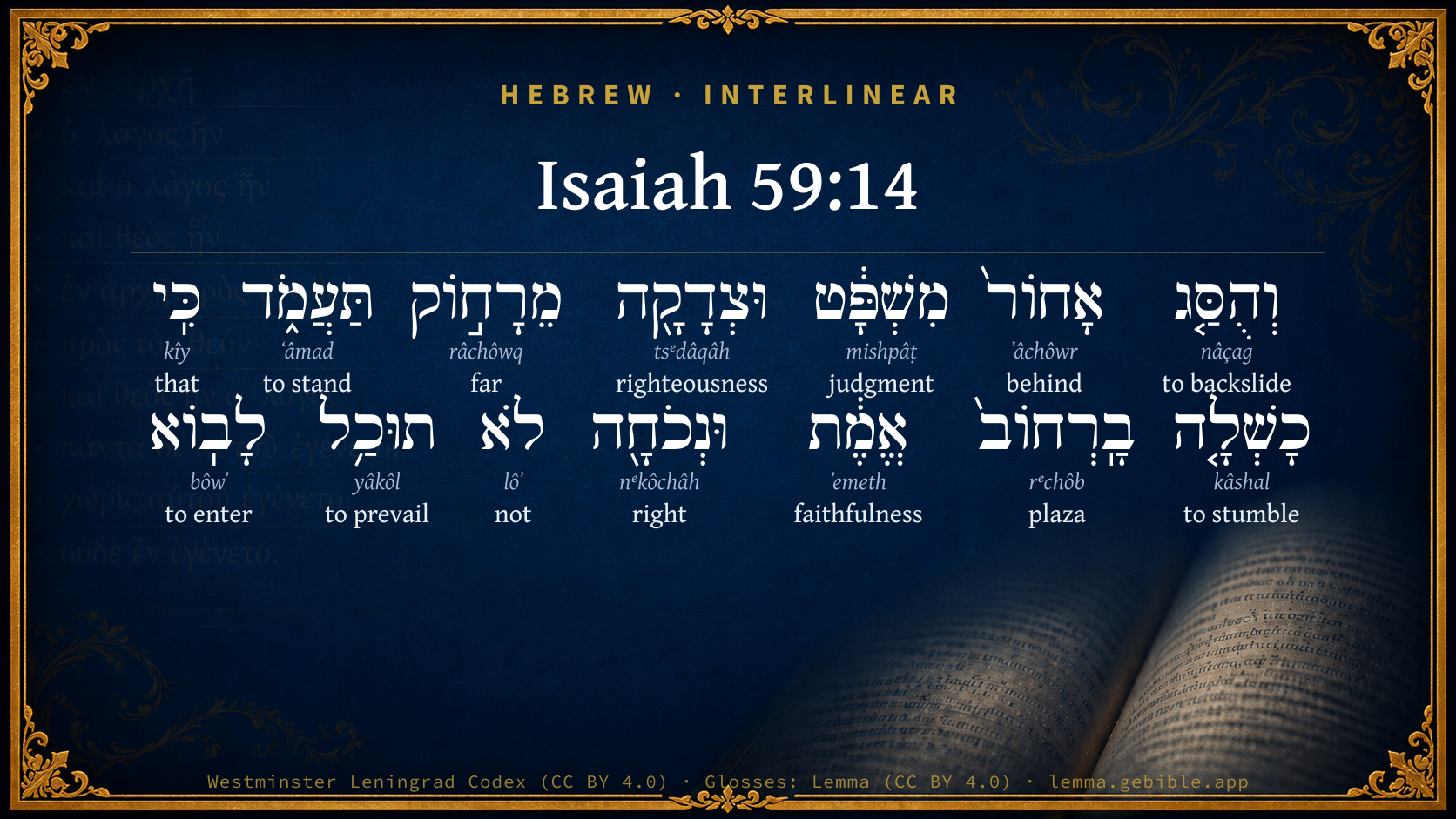
Hebrew (Westminster Leningrad Codex) Isaiah 59:14 appears in the Hebrew Old Testament. The text above is from the Westminster Leningrad Codex. Each word links to its Strong’s number, a concise gloss, and parsing drawn from the Open Scriptures Hebrew Bible morphology. Click any word for its full Brown-Driver-Briggs (BDB) entry.
Download image
Cite this verse

Isaiah 59:14 (World English Bible). Public Domain. Lemma interlinear Bible study tool, https://lemma.gebible.app/v/isaiah/59/14.

Show BibTeX & RIS
BibTeX
RIS
English Translation
Justice is turned away backward, and righteousness stands afar off; for truth is fallen in the street, and uprightness can't enter.
World English Bible · Public Domain
Download a study sheet

One document with this verse’s original text, its word-by-word gloss line, the meaning frame, cross-references with their text, attributed commentary, and full source and license credits — printable, and it pastes into notes with its structure intact.

This verse Autodidact and up

Study sheet (.html) Plain text (.txt)

A passage Seminary Student

Up to 50 verses in one chapter. A passage sheet keeps up to 6 commentary sources and 12 cross-references per verse, in the order this page ranks them, and says so on the sheet whenever that leaves anything out. Ask for a single verse and you get the Autodidact verse sheet above.

Everything on this page stays free to read, with no account — the sheet is a download of what is already on screen, not access to it.

Want to remove ads? Support Godless Engineer
Compare translations 3

The same verse in 3 English versions, stacked beneath the original-language interlinear above. Click any original word for its lexicon entry.

Each is an independent rendering of the whole verse — the interlinear is not word-aligned to these translations.

Highlighted words mark where these versions differ — a whole-verse word diff, not a word-by-word alignment.

  • World English Bible Public Domain
    Justice is turned away backward, and righteousness stands afar off; for truth is fallen in the street, and uprightness can't enter.
  • King James Version Public Domain
    And judgment is turned away backward, and justice standeth afar off: for truth is fallen in the street, and equity cannot enter.
  • unfoldingWord Literal Text CC BY-SA 4.0
    And justice is driven back, and righteousness stands from faraway. For truth stumbles in the open area, and uprightness is not able to enter.

unfoldingWord Literal Text — © unfoldingWord, licensed CC BY-SA 4.0. Word-aligned USFM3 via Door43 (git.door43.org/unfoldingWord/en_ult).

Versions to compare (up to 4)

3 of 4 selected

Show all 18 translations

Every available English version of this verse, each an independent rendering of the whole verse.

  • World English Bible Public Domain
    Justice is turned away backward, and righteousness stands afar off; for truth is fallen in the street, and uprightness can't enter.
  • Berean Standard Bible Public Domain
    So justice is turned away, and righteousness stands at a distance. For truth has stumbled in the public square, and honesty cannot enter.
  • Majority Standard Bible Public Domain
    So justice is turned away, and righteousness stands at a distance. For truth has stumbled in the public square, and honesty cannot enter.
  • King James Version Public Domain
    And judgment is turned away backward, and justice standeth afar off: for truth is fallen in the street, and equity cannot enter.
  • American Standard Version (1901) Public Domain
    And justice is turned away backward, and righteousness standeth afar off; for truth is fallen in the street, and uprightness cannot enter.
  • Revised Version (1885) Public Domain
    And judgment is turned away backward, and righteousness standeth afar off: for truth is fallen in the street, and uprightness cannot enter.
  • Geneva Bible (1599) Public Domain
    Therefore iudgement is turned backewarde, and iustice standeth farre off: for trueth is fallen in the streete, and equitie cannot enter.
  • Douay-Rheims (1899) Public Domain
    And judgment is turned away backward, and justice hath stood far off: because truth bath fallen down in the street, and equity could not come in.
  • Young's Literal Translation Public Domain
    And removed backward is judgment, And righteousness afar off standeth, For truth hath been feeble in the street, And straightforwardness is not able to enter,
  • Literal Standard Version CC BY-SA 4.0
    And judgment is removed backward, || And righteousness stands far off, || For truth has been feeble in the street, || And straightforwardness is not able to enter,
  • Unlocked Literal Bible CC BY-SA 4.0
    Justice is driven back, and righteousness stands far off; for truth stumbles in the public square, and right cannot come.
  • unfoldingWord Literal Text CC BY-SA 4.0
    And justice is driven back, and righteousness stands from faraway. For truth stumbles in the open area, and uprightness is not able to enter.
  • Darby Bible Public Domain
    And judgment is turned away backward, and righteousness standeth afar off; for truth stumbleth in the street, and uprightness cannot enter.
  • World Messianic Bible Public Domain
    Justice is turned away backward, and righteousness stands far away; for truth has fallen in the street, and uprightness can’t enter.
  • Webster's Bible Public Domain
    And judgment is turned away backward, and justice standeth afar off: for truth is fallen in the street, and equity cannot enter.
  • Free Bible Version CC BY-SA 4.0
    Justice is rejected, and doing right never happens. Truth falls down in the street, and honesty is banned.
  • Bible in Basic English Public Domain
    And the right is turned back, and righteousness is far away: for good faith is not to be seen in the public places, and upright behaviour may not come into the town.
  • JPS Tanakh (1917) Public Domain
    And justice is turned away backward, and righteousness standeth afar off; for truth hath stumbled in the broad place, and uprightness cannot enter.

Literal Standard Version (2020), Covenant Press — licensed CC BY-SA 4.0. Text via the HelloAO Bible API (eBible.org). Unlocked Literal Bible (unfoldingWord) — licensed CC BY-SA 4.0. Text via the HelloAO Bible API (eBible.org). unfoldingWord Literal Text — © unfoldingWord, licensed CC BY-SA 4.0. Word-aligned USFM3 via Door43 (git.door43.org/unfoldingWord/en_ult). Free Bible Version, Dr. Jonathan Gallagher — licensed CC BY-SA 4.0. Text via the HelloAO Bible API (eBible.org).

Word by word

More ways to search: Search by grammar → Find every occurrence → Compare this word →

Practice this passage: Drill this verse → Learn its vocabulary →

וּנְכֹחָ֖ה
nᵉkôchâh
H5229
“and · right”
Conjunction + Adjective, Adjective, Feminine, Singular, Absolute
Part of Speech
Conjunction + Adjective
Type
Adjective
Gender
Feminine
Number
Singular
State
Absolute
Full BDB Definition

Origin: from H5228

TWOT: 1365a

straight in front, be in front of, straight, right, straightness - true things (of prophecy) - rectitude (substantive)
  1. וְהֻסַּ֤ג nâçag H5253 “and · to backslide” Conjunction + Verb, Hophal, Sequential Perfect, 3rd Person, Masculine, Singular
  2. אָחוֹר֙ ʼâchôwr H268 “behind” Noun, Common, Masculine, Singular, Absolute
  3. מִשְׁפָּ֔ט mishpâṭ H4941 “judgment” Noun, Common, Masculine, Singular, Absolute
  4. וּצְדָקָ֖ה tsᵉdâqâh H6666 “and · righteousness” Conjunction + Noun, Common, Feminine, Singular, Absolute
  5. מֵרָח֣וֹק râchôwq H7350 “from · far” Preposition + Adjective, Adjective, Masculine, Singular, Absolute
  6. תַּעֲמֹ֑ד ʻâmad H5975 “to stand” Verb, Qal, Imperfect, 3rd Person, Feminine, Singular
  7. כִּֽי kîy H3588 “that” Conjunction
  8. כָשְׁלָ֤ה kâshal H3782 “to stumble” Verb, Qal, Perfect, 3rd Person, Feminine, Singular
  9. בָֽרְחוֹב֙ rᵉchôb H7339 “in/at the · plaza” Preposition, Determined + Noun, Common, Feminine, Singular, Absolute
  10. אֱמֶ֔ת ʼemeth H571 “faithfulness” Noun, Common, Feminine, Singular, Absolute
  11. לֹא lôʼ H3808 “not” Particle, Negative
  12. תוּכַ֥ל yâkôl H3201 “to prevail” Verb, Qal, Imperfect, 3rd Person, Feminine, Singular
  13. לָבֽוֹא bôwʼ H935 “to enter” Preposition + Verb, Qal, Infinitive Construct

About this verse

These counts appear in no published source. They are computed here, from the morphology-tagged text and Lemma’s own curated glosses. What Lemma adds →

14
words
14
distinct lemmas
Prophets
section

Notable vocabulary

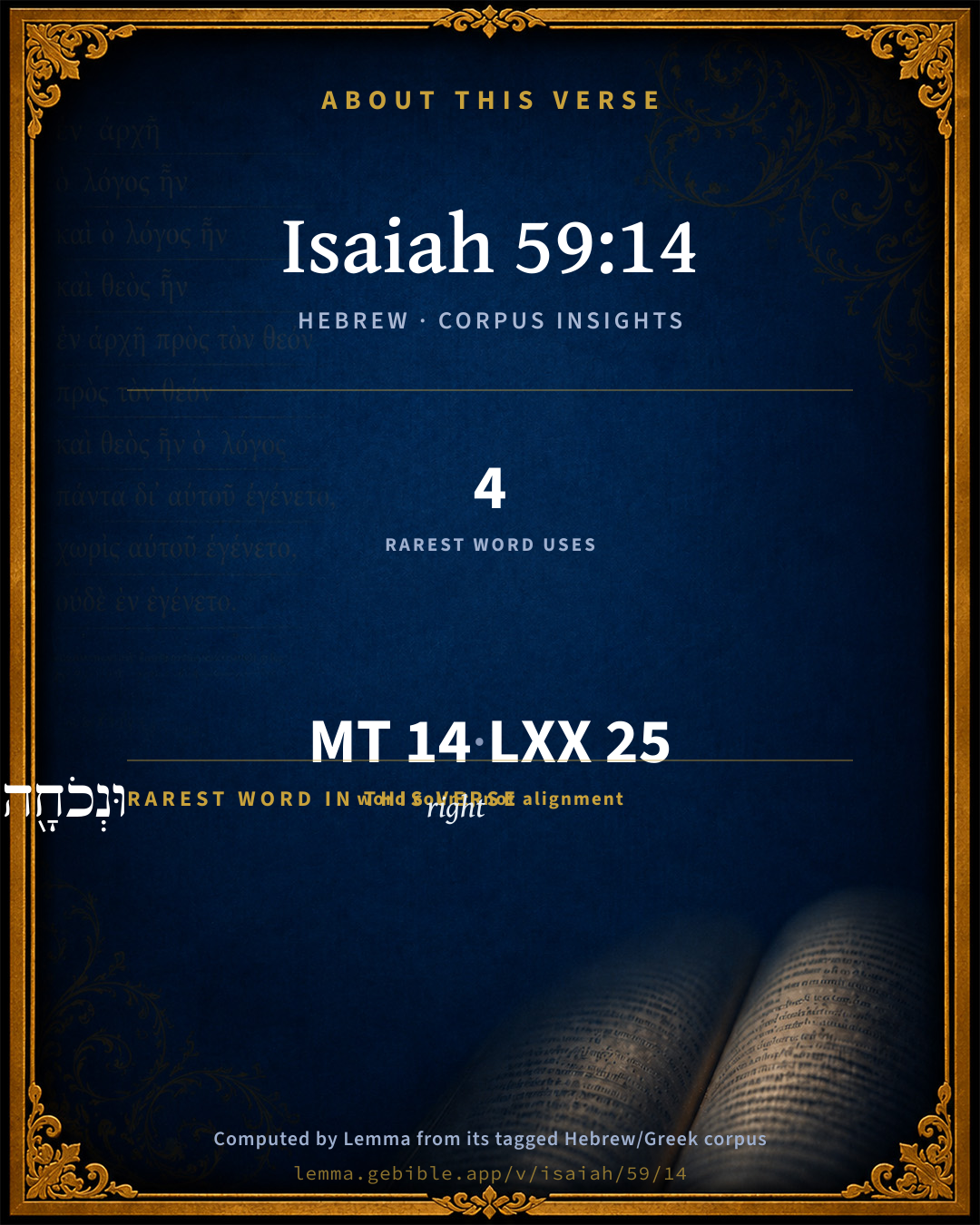
The rarest word here is וּנְכֹחָ֖ה right H5229 — appearing just 4 times in the whole Hebrew Bible.

Shared distinctive vocabulary

וּנְכֹחָ֖ה right H5229 occurs in 4 verses of the Hebrew Bible. Also found in:

Grammatical profile

  • 5 verbs
  • 5 nouns
  • 2 adjectives
  • 1 conjunction
  • 1 particle

Verb forms

  • וְהֻסַּ֤ג Hophal · Sequential Perfect
  • תַּעֲמֹ֑ד Qal · Imperfect
  • כָשְׁלָ֤ה Qal · Perfect
  • תוּכַ֥ל Qal · Imperfect
  • לָבֽוֹא Qal · Infinitive Construct

Hebrew & Septuagint length

In English translation the verse runs 21 words from the Hebrew and 28 from the Septuagint (LXX English) — closely comparable.

A rough comparison of the two English renderings, which tokenize alike — not a word-level alignment.

Word counts can differ between the Hebrew and the Greek without any difference in meaning — e.g. the Hebrew direct-object marker אֵת has no separate Greek word, and Greek often adds the article ὁ.

In the original languages it is 14 Hebrew tokens and 25 Greek tokens — but the two are counted differently (Hebrew bundles its prefixes and suffixes into one token; the Greek is in lemma form), so that isn’t a like-for-like length.

Cross-references

14

Topical passages linked to Isaiah 59:14 in the Treasury of Scripture Knowledge — connected by theme and wording, ordered by reader-vote popularity; previews shown in the World English Bible.

  • Ecclesiastes 3:16 Moreover I saw under the sun, in the place of justice, that wickedness was there; and in the place of righteousness, that wickedness was there.
  • Habakkuk 1:4 Therefore the law is paralyzed, and justice never goes forth; for the wicked surround the righteous; therefore justice goes forth perverted.
  • Isaiah 1:21 How the faithful city has become a prostitute! She was full of justice; righteousness lodged in her, But now murderers.
  • Isaiah 5:23 Who acquit the guilty for a bribe, But deny justice for the innocent!
  • Isaiah 10:1–2 Woe to those who decree unrighteous decrees, and to the writers who write perverseness;
  • Jeremiah 5:27–28 As a cage is full of birds, so are their houses full of deceit: therefore they are become great, and grew rich.
  • Jeremiah 5:31 the prophets prophesy falsely, and the priests bear rule by their means; and my people love to have it so: and what will you do in the end of it?
  • Amos 5:11 Forasmuch therefore as you trample on the poor, And take taxes from him of wheat: You have built houses of hewn stone, But you will not dwell in them. You have planted pleasant vineyards, But you shall not drink their wine.
  • Micah 3:9–11 Please listen to this, you heads of the house of Jacob, And rulers of the house of Israel, Who abhor justice, And pervert all equity.
  • Isaiah 59:4 None sues in righteousness, and none pleads in truth: they trust in vanity, and speak lies; they conceive mischief, and bring forth iniquity.
  • Amos 5:7 You who turn justice to wormwood, And cast down righteousness to the earth:
  • Zephaniah 3:1–3 Woe to her who is rebellious and polluted, the oppressing city!
  • Psalms 82:2–5 "How long will you judge unjustly, And show partiality to the wicked?" Selah.
  • Micah 7:3–5 Their hands are on that which is evil to do it diligently. The ruler and judge ask for a bribe; And the powerful man dictates the evil desire of his soul. Thus they conspire together.

Cross-references courtesy of OpenBible.info (CC BY 4.0).

Hebrew and Greek witnesses Masoretic Hebrew ↔ Greek Septuagint

The same verse in the two great witnesses to the Old Testament, shown verse-for-verse.

These are two independent witnesses, not word-aligned to each other, and the Septuagint is shown in lemma (dictionary) form.

Hebrew Isaiah 59:14 Masoretic · Westminster Leningrad Codex

וְהֻסַּ֤ג אָחוֹר֙ מִשְׁפָּ֔ט וּצְדָקָ֖ה מֵרָח֣וֹק תַּעֲמֹ֑ד כִּֽי כָשְׁלָ֤ה בָֽרְחוֹב֙ אֱמֶ֔ת וּנְכֹחָ֖ה לֹא תוּכַ֥ל לָבֽוֹא

Justice is turned away backward, and righteousness stands afar off; for truth is fallen in the street, and uprightness can't enter.

World English Bible · Public Domain

Greek LXX Isaiah 59:14 Septuagint · lemma form

καί ἀποἵστημι ὀπίσω ὁ κρίσις καί ὁ δικαιοσύνη μακράν ἀποἵστημι ὅτι κατα ἀναἁλίσκω ἐν ὁ ὁδός αὐτός ὁ ἀλήθεια καί διά εὐθύς οὐ δύναμαι διαἔρχομαι

And we have turned judgment back, and righteousness has departed afar off: for truth is consumed in their ways, and they could not pass by a straight path.

LXX2012 (modern English Septuagint) · Public Domain

On this verse, Keil & Delitzsch discusses the Septuagint’s reading. Read the note in Commentary ↓

Hebrew: Westminster Leningrad Codex (CC BY 4.0). Greek: Septuagint (public domain); English from LXX2012 (modern English Septuagint) (Public Domain). How the Septuagint differs from the Hebrew →

Targum (Aramaic paraphrase)

1

The Targum is the ancient Jewish Aramaic paraphrase of the Hebrew Scriptures — an interpretive translation, not the Hebrew text itself. Onkelos (literal) and Pseudo-Jonathan (expansive) render the Torah, and Jonathan the Prophets. Coverage is partial: where no permissively-licensed English translation exists for a verse, only the Aramaic is shown. This is verse-level text, not a word-by-word alignment to the Hebrew.

  1. Targum Jonathan Prophets (Joshua–Malachi)
    וְאִסְתְּחַר לַאֲחוֹרָא עָבְדֵי דִינָא וְעָבְדֵי זְכוּתָא מֵרָחִיק קָמִין אֲרֵי אִתְקִילוּ עַבְדֵי קוּשְׁטָא וְעָבְדֵי הֵימְנוּתָא לָא יָכְלִין לְאִתְגַלָאָה:

    And justice is turned away backward, and righteousness standeth afar off: for they that follow truth stumble in the street; and they that follow faithfulness cannot shew themselves.

    Targum Jonathan — Aramaic: “Mikraot Gedolot” (public domain). English: “Sefaria Community Translation” (CC0 1.0 (public-domain dedication)); “London "Chaldee Paraphrase," 1871” (public domain). Text via Sefaria.

Commentary

Notes on Isaiah 59:14 from classic Christian and Jewish commentators (each source and its license shown beneath its notes). The classic Christian expositions comment on the surrounding passage and are grouped to its opening verse, so a note may address several verses; the Jewish commentaries on the Tanakh (Rashi and others) are per-verse, so they appear only where the commentator wrote on this verse.

Lemma curates 59 commentaries, every one of them public domain or Creative Commons licensed, each selected and text-cleaned for this edition rather than reprinted as found. About our sources →

Trapp's Complete Commentary

John Trapp

Isa 59:14 And judgment is turned away backward, and justice standeth afar off: for truth is fallen in the street, and equity cannot enter.

Ver. 14. And judgment is turned away backward.] Nihil amplius ex aequo et bono agitur; all is out of order, causes are carried the contrary way.

Truth is fallen in the streets.] When the disputation at Oxford with Cranmer, Ridley, and Latimer, martyrs, was finished, Weston, the prolocutor, triumphed with Vicit veritas, whereas he should rather have said, Vicit potestas - not truth, but force, hath carried it. In the convocation at Paul’s about the same time, when Philpot and other good men argued for the truth against the Popish prelates, it was said that those distressed ministers had the Word for them, but the prelates had the sword on their side, and would therefore get the better. {a}

{a} Acts and Mon., 1300.

John Trapp, A Commentary or Exposition upon All the Books of the Old and New Testament (1647–1656) — public domain. Text from a community e-Sword module.

The Biblical Illustrator

Joseph S. Exell

Isa_59:14-15

And judgment is turned away backward

National sin

The sin of a nation becomes national, and brings public judgments, when it is not restrained by public justice.

(M. Henry.)

The Biblical Illustrator, edited by Joseph S. Exell (c. 1880s–1900s) — public domain. Text from a community e-Sword module.

Joseph Benson's Commentary

Isa 59:14-15. And judgment is turned away backward — He speaks here of the sentences in courts of judicature, which were contrary to right and justice; as if he had said, God denies you justice, as you have denied it to others. And justice standeth afar off — Justice and judges are at a great distance from each other; for truth is fallen — Truth is cast to the ground, and justice trampled under foot; in the street — Even in public. And equity cannot enter — No such thing will be admitted in the courts. Yea, truth faileth — Truth is more than fallen, which he had said in the last verse; it faileth. If it had been only fallen, it might have recovered itself again: but its failing denotes the loss of its very vitals; as being everywhere neglected, in the court, in the city, in the country; in inferior as well as superior ranks; in the streets, in the gates, in the markets, in the fairs; in all public places of commerce: as if he had said, All things are amiss; neither judgment, nor justice, nor truth is to be found among us; but fraud and deceit; yet none are troubled on account of it. And he that departeth from evil — That separateth himself from evil things and evil persons, that will not be as vile as others; maketh himself a prey — Or, as משׁתוללis rendered in the margin, is accounted mad; is laughed at. Josephus tells us, that immediately before the destruction of Jerusalem, it was a matter of scorn to be religious. The translators reach the meaning of the word by prey: the wicked, like wild beasts, endeavouring to devour such as are not as bad as themselves: where wickedness rules, innocence is oppressed. For they that are simple and innocent are outwitted by the crafty and fraudulent, as not being willing, or rather, not daring to oppose fraud with fraud, but doing all things in sincerity. And the Lord saw it — Took notice of it; it was not hid from him. It is spoken of God after the manner of men. And it displeased him, &c. — As if he had said, If you would know why God is so angry with you, it is for such things as these; the Lord observes them, and they are great evils in his eyes.

Joseph Benson's Commentary on the Old and New Testaments (1811–1818) — public domain. Text from a community e-Sword module.

Geneva Bible (1599)

Geneva Bible translators

There is neither justice nor uprightness among men.

Geneva Bible (1599) marginal notes — public domain. Text via Bolls.life.

Jamieson, Fausset & Brown

Robert Jamieson, A. R. Fausset & David Brown

Justice and righteousness are put away from our legal courts.

in the street--in the forum, the place of judicature, usually at the gate of the city (Zac 8:16).

cannot enter--is shut out from the forum, or courts of justice.

Jamieson, Fausset & Brown — Commentary Critical and Explanatory on the Whole Bible (1871) — public domain (CC PDM 1.0). Text via the HelloAO Bible API.

Adam Clarke's Commentary

Verse 14. Justice standeth afar off] צדקה tsedakah, righteousness, put here, says Kimchi, for alms to the poor. This casts some light on Mt 6:1: "Take heed that you do not your alms," ελεημοσυνην. But the best copies have δικαιοσυνην, righteousness; the former having been inserted in the text at first merely as the explanation of the genuine and original word.

Adam Clarke's Commentary on the Bible (1810–1826) — public domain. Text from a community e-Sword/MySword module.

Ellicott's Commentary for English Readers

(14) Truth is fallen in the street—i.e., the broad open place, or agora, of the city. The words point naturally to Jerusalem. If they refer to Babylon, we must assume, unless we deal with the language as altogether figurative, that the exiles had a quarter of their own, in which they had an agora for business and judicial proceedings.

A Bible Commentary for English Readers, edited by Charles John Ellicott (1878–1897) — public domain. Text from a community e-Sword module.

The Cambridge Bible for Schools and Colleges

gen. ed. J. J. S. Perowne

14. The confession, following the same order as the indictment in Isa_59:3-4, proceeds from personal sins to public injustice.

judgment and justice (righteousness) are not the divine vindication of Israel’s right (as in Isa_59:9), but the fundamental civic virtues. These, by a bold personification, are conceived as eager to take their rightful place in the administration of justice, but as kept at a distance by the prevailing social corruption. For truth (the essential basis of righteousness) stumbleth in the broad place, and uprightness (R.V.) cannot enter. The “broad place” is probably the open space at the city gate where cases were decided by the judges (Jer_5:1 &c.).

The Cambridge Bible for Schools and Colleges (gen. ed. J. J. S. Perowne; Cambridge University Press, 1878–1918) — public domain. Text from a community e-Sword module.

John Gill's Exposition

And judgment is turned away backward, and justice standeth afar off,.... Jarchi interprets this of the vengeance of God, and his righteousness in his judgments, not immediately executed; but it is to be understood of the want of judgment and justice being done among men; and therefore are represented as persons turned back, and standing afar off, rejected, neglected, and discouraged. The Targum renders it,

"they that do judgment are turned back, and they that do justice stand afar off;''

having none to take their parts, but everyone opposing them: this may respect both the want of judgment and justice in courts of judicature; no regard being had to right and wrong; no true judgment being given, or justice done, in any cause; but both banished from the bench: and also in the churches of Christ, or, however, under a profession of his name, where there is no judgment in doctrines, or discerning between truth and error; and no justice inflicted on delinquents according to the rules of Christ; no order nor discipline observed in his house; these are dismissed and discarded:

for truth is fallen in the street; where it used to be preached, exalted, established, and confirmed; but now thrown down and trampled upon, and few or none to help it up, and stand by it; and though it may have some secret well wishers, yet very few, if any, public advocates for it:

and equity cannot enter; either into civil courts, or Christian congregations; the doing of that which is just and right between man and man in things civil; and between Christian and Christian in things religious; or that which is right according to the word of God; can find no place, or cannot be admitted into assemblies that are called by his name. The Targum is,

"they that do truth stumble in the street; and they that exercise faith cannot be made manifest;''

such as are on the side of truth, in the service of it, cannot stand their ground through the violence of their opposers; and those that are faithful, and abide by the doctrine of faith, are forced to hide themselves, and cannot appear in the vindication of it.

John Gill's Exposition of the Whole Bible (1746–1763) — public domain (CC PDM 1.0). Text via the HelloAO Bible API.

Albert Barnes' Notes on the Bible

And judgment is turned away backward - The word ‘judgment’ is not used, as in Isa 59:9, to denote the divine interposition to avenge and deliver them, but it is used in the sense of justice, or lust decisions between man and man. The verse contains a further confession of the evil of their course of life; and, among other things, they acknowledged that they had been unjust in their legal decisions. They had been influenced by partiality and by bribes; they had condemned the innocent, they had acquitted the guilty. Judgment had thus been lumped back by their sins when it seemed to be approaching and entering the city.

And justice standeth afar off - This is a beautiful figure. justice is represented as standing at a distance from the city. Deterred by their sins, it would not enter. They prevented its approach, and it was unknown among them.

For truth is fallen in the street - Or rather, perhaps, in the gate - the place where justice was administered. The language here is all taken from courts of justice, and the idea is, that there was no justice in their decisions, but that their courts were unprincipled and corrupt.

And equity cannot enter - It stood at a distance, and the impenetrable mass of guilt effectually prevented its approach to the capital.

Albert Barnes' Notes on the Bible (1834–1885) — public domain. Text from a community e-Sword/MySword module.

Haydock's Catholic Bible Commentary

CHAPTER LIX.

In. Where truth is disregarded, there can be no justice.

George Leo Haydock (1774–1849), Haydock's Catholic Family Bible and Commentary, 1859 edition — public domain. Excludes Psalms (Douay-Rheims chapter numbering differs from Protestant) and Deuterocanonical books (Catholic canon only).

Matthew Poole's English Annotations

Judgment is turned away backward: he speaks here of the sentences and decrees in courts of judicature, which are carried quite contrary to right and justice. God denies you justice, as you have denied help to others.

Justice standeth afar off: it notes the same thing with the former, to show that justice and judges are far asunder.

Truth is fallen; a metaphor taken from a feeble person that wants support, without which he falls; thus truth hath none to support or patronize it: the same, only otherwise expressed, with Isa 59:16. Truth is cast upon the ground, and justice trampled under foot.

In the street, i.e. in public.

Equity cannot enter; no such thing will be admitted in their courts; all corrupt, so that all equity and justice is violently kept off by the authority of the great ones.

Matthew Poole's English Annotations on the Holy Bible (1683–1685) — public domain. Text from a community e-Sword/MySword module.

Whedon's Commentary on the Bible

Daniel D. Whedon

14, 15. The section from Isa_59:9-14, including first part of Isa_59:15, culminates in a confession of a state of things fearfully bad in Jewish society at several periods of its history, but especially in the days of John the Baptist, of our Saviour Christ, and onward to the final breaking up of the nation, A.D. 70.

Judgment — Equity set at naught. No magistrate could really avail.

Daniel D. Whedon (gen. ed.), Commentary on the Old and New Testaments (1874–1909) — public domain. Text from a community e-Sword module.

The Pulpit Commentary

Judgment is turned away backward. In conclusion, the crying sin of perversion of justice is admitted with much amplification.

(1) Right judgment is exactly inverted the innocent are condemned, the guilty acquitted.

(2) Justice standeth afar off too far off to be able to hear those who make appeal to it.

(3) Truth is fallen in the street; i.e. false witness prevails over true in the courts of justice.

(4) Equity cannot enter is not admitted inside the courts, but waits without.

Vers. 14, 15. Truth the foundation of morality.

Surprise is sometimes expressed at there being no distinct prohibition of all lying in the ten commandments. "False witness" alone is forbidden. But the reason may be that truth is assumed as too fundamentally necessary for any one to suppose that it could possibly be dispensed with. Similarly, piety is assumed as a duty in the commandments, where men are not bidden to worship God, but warned against worshipping more than one God, and against worshipping him in an improper way. Truth throughout Scripture appears as a quality assumed to be possessed by men, rather than as a virtue which they are to be exhorted to "put on." It lies, in fact, at the root of all real goodness.

I TRUTH LIES AT THE ROOT OF JUSTICE. The administration of justice consists primarily in a series of efforts to find out the truth. There is always a question before the court, and the first question is one of fact, "Has the thing charged been done or no?" What is the truth of the matter? When this has been decided, if decided on the affirmative side, then a second question arises, "What is the degree of the guilt?" It is essential for the judge to have the most earnest desire to discover the truth, and the highest power of eliciting the truth. Nor is this all. To every one concerned in a cause whether prosecutor, defendant, witness, counsel, or attorney the sole object ought to be the discovery of the truth. The importance of veracity in the witnesses is universally admitted; but veracity is really incumbent on all concerned. A prisoner who knows himself guilty would do best to confess his guilt. It is no real benefit to him to be acquitted unless he is innocent. Truth ought to govern all the utterances of counsel, who are not entitled to make any suggestions but such as they think may be true. Chicanery, quibbles, special pleading, are unworthy of those who take part in the administration of justice and exercise what is really a sacred function. The first requisite of all those who bear part in the solemn work of "doing justice" is that they should be "men of truth". (Exo_18:21)

II TRUTH LIES AT THE ROOT OF KINDNESS. The desire to be kind is independent of truth; but the moment that the desire has to pass into action, considerations of truth come in. Am I prompted to praise a person? But if I praise him when he is deserving of blame, I am doing him the greatest unkindness. If I even overpraise him when he deserves praise, I am doing him an unkindness to a certain extent an unkindness and a wrong. I am helping him to content himself with a low standard of goodness. Again, suppose that I am prompted to relieve a person who appears to me poor and distressed. To decide aright whether I ought to relieve him at all, and, if so, to what extent, I require a true knowledge of his circumstances. I do him an injury if I allow him to impose upon me. I do him an injury if I repress efforts that he would otherwise have made to help himself. In all the kindly acts that we seek to do to others there is always room for, and generally much need of, careful consideration of facts, discovery of the exactly true state of the case, before we allow ourselves to follow our impulses. Otherwise we may make great blunders, and, while striving to be kind, be guilty of many an unkindness.

III TRUTH LIES AT THE ROOT OF PIETY. Piety is a feeling of love and reverence towards some being, or beings, whom we feel to be superior to ourselves, and believe to afford us help and protection. It is impossible to say that many of the heathen, many even of the grossest idolaters, were not, in a certain sense, pious. But for piety to attain its full proportions, and to be the virtue that it was intended to be, it needs to rest upon a basis of truth. We need to have true conceptions of the nature of that which is the object of our love and reverence. Until we conceive of that "eternal something outside us that makes for righteousness" as One, as a Person, as the Creator of all things, as omnipotent, as omniscient, as beneficent, and as perfectly good, we cannot have the feelings towards him that we ought to have, or worship him acceptably. True piety is the worship of the true God. The votaries of false religions possess only a semblance of piety a dwarfed and cramped, sometimes a distorted, imitation of it.

The Pulpit Commentary (1880–1919), ed. H.D.M. Spence-Jones & Joseph S. Exell — public domain. Text from a community e-Sword module.

John Wesley's Explanatory Notes

Judgment - He speaks here of the sentences in courts of judicature. Truth - Truth is cast to the ground, and justice trampled under foot, even in publick. Equity - No such thing will be admitted in their courts.

John Wesley, Explanatory Notes Upon the Whole Bible (1754–1765) — public domain. Text via the GEBible commentary corpus.

Keil & Delitzsch

C. F. Keil & F. Delitzsch

The confession of personal sins is followed by that of the sinful state of society. "And right is forced back, and righteousness stands afar off; for truth has fallen in the market-place, and honesty finds no admission. And truth became missing, and he who avoids evil is outlawed." In connection with mishpât and tsedâqâh here, we have not to think of the manifestation of divine judgment and justice which is prevented from being realized; but the people are here continuing the confession of their own moral depravity. Right has been forced back from the place which it ought to occupy (hissı̄g is the word applied in the law to the removal of boundaries), and righteousness has to look from afar off at the unjust habits of the people, without being able to interpose. And why are right and righteousness - that united pair so pleasing to God and beneficial to man - thrust out of the nation, and why do they stand without? Because there is no truth or uprightness in the nation. Truth wanders about, and stands no longer in the midst of the nation; but upon the open street, the broad market-place, where justice is administered, and where she ought above all to stand upright and be preserved upright, she has stumbled and fallen down (cf., Isa 3:8); and honesty (nekhōchâh), which goes straight forward, would gladly enter the limits of the forum, but she cannot: people and judges alike form a barrier which keeps her back. The consequence of this is indicated in Isa 59:15: truth in its manifold practical forms has become a missing thing; and whoever avoids the existing voice is mishtōlēl (part. hithpoel, not hithpoal), one who is obliged to let himself be plundered and stripped (Psa 76:6), to be made a shōlâl (Mic 1:8), Arab. maslûb, with a passive turn given to the reflective meaning, as in התחפּשׂ, to cause one's self to be spied out = to disguise one's self, and as in the so-called niphal tolerativum (Ewald, 133, b, 2).

The third strophe of the prophecy commences at Isa 59:15 or Isa 59:16. It begins with threatening, and closes with promises; for the true nature of God is love, and every manifestation of wrath is merely one phase in its development. In consideration of the fact that this corrupt state of things furnishes no prospect of self-improvement, Jehovah has already equipped Himself for judicial interposition. "And Jehovah saw it, and it was displeasing in His eyes, that there was no right. And He saw that there was not a man anywhere, and was astonished that there was nowhere an intercessor: then His arm brought Him help, and His righteousness became His stay. And He put on righteousness as a coat of mail, and the helmet of salvation upon His head; and put on garments of vengeance as armour, and clothed Himself in zeal as in a cloak. According to the deeds, accordingly He will repay: burning wrath to His adversaries, punishment to His foes; the islands He will repay with chastisement." The prophet's language has now toilsomely worked its way through the underwood of keen reproach, of dark descriptions of character, and of mournful confession which has brought up the apostasy of the great mass in all the blacker colours before his mind, from the fact that the confession proceeds from those who are ready for salvation. And now, having come to the description of the approaching judgment, out of whose furnace the church of the future is to spring, it rises again like a palm-tree that has been violently hurled to the ground, and shakes its head as if restored to itself in the transforming ether of the future. Jehovah saw, and it excited His displeasure ("it was evil in His eyes," an antiquated phrase from the Pentateuch, e.g., Gen 38:10) to see that right (which He loves, Isa 61:8; Psa 37:28) had vanished form the life of His nation. He saw that there was no man there, no man possessing either the disposition or the power to stem this corruption (אישׁ as in Jer 5:1, cf., Sa1 4:9; Kg1 2:2, and the old Jewish saying, "Where there is no man, I strive to be a man"). He was astonished (the sight of such total depravity exciting in Him the highest degree of compassion and displeasure) that there was no מפגּיע, i.e., no one to step in between God and the people, and by his intercession to press this disastrous condition of the people upon the attention of God (see Isa 53:12); no one to form a wall against the coming ruin, and cover the rent with his body; no one to appease the wrath, like Aaron (Num 17:12-13) or Phinehas (Num 25:7).

What the fut. consec. affirms from ותּושׁע onwards, is not something to come, but something past, as distinguished form the coming events announced from Isa 59:18 onwards. Because the nation was so utterly and deeply corrupt, Jehovah had quipped Himself for judicial interposition. The equipment was already completed; only the taking of vengeance remained to be effected. Jehovah saw no man at His side who was either able or willing to help Him to His right in opposition to the prevailing abominations, or to support His cause. Then His own arm became His help, and His righteousness His support (cf., Isa 63:5); so that He did not desist from the judgment to which He felt Himself impelled, until He had procured the fullest satisfaction for the honour of His holiness (Isa 5:16). The armour which Jehovah puts on is now described. According to the scriptural view, Jehovah is never unclothed; but the free radiation of His own nature shapes itself into a garment of light. Light is the robe He wears (Psa 104:2). When the prophet describes this garment of light as changed into a suit of armour, this must be understood in the same sense as when the apostle in Eph speaks of a Christian's panoply. Just as there the separate pieces of armour represent the manifold self-manifestations of the inward spiritual life so here the pieces of Jehovah's armour stand for the manifold self-manifestations of His holy nature, which consists of a mixture of wrath and love. He does not arm Himself from any outward armoury; but the armoury is His infinite wrath and His infinite love, and the might in which He manifests Himself in such and such a way to His creatures is His infinite will. He puts on righteousness as a coat of mail (שׁרין in half pause, as in Kg1 22:34 in full pause, for שׁריון, ō passing into the broader a, as is generally the case in יחפּץ, יחבשׁ; also in Gen 43:14, שׁכלתי; Gen 49:3, עז; Gen 49:27, יטרף), so that His appearance on every side is righteousness; and on His head He sets the helmet of salvation: for the ultimate object for which He goes into the conflict is the redemption of the oppressed, salvation as the fruit of the victory gained by righteousness. And over the coat of mail He draws on clothes of vengeance as a tabard (lxx περιβόλαιον), and wraps Himself in zeal as in a war-cloak. The inexorable justice of God is compared to an impenetrable brazen coat of mail; His joyful salvation, to a helmet which glitters from afar; His vengeance, with its manifold inflictions of punishment, to the clothes worn above the coat of mail; and His wrathful zeal (קנאה from קנא), to be deep red) with the fiery-looking chlamys. No weapon is mentioned, neither the sword nor bow; for His own arm procures Him help, and this alone. But what will Jehovah do, when He has armed Himself thus with justice and salvation, vengeance and zeal? As Isa 59:18 affirms, He will carry out a severe and general retributive judgment. גּמוּל and גּמלה signify accomplishment of (on gâmal, see at Isa 3:9) a ῥῆμα μέσον; גּמלות, which may signify, according to the context, either manifestations of love or manifestations of wrath, and either retribution as looked at from the side of God, or forfeiture as regarded from the side of man, has the latter meaning here, viz., the works of men and the double-sided gemūl, i.e., repayment, and that in the infliction of punishment. כּעל, as if, as on account of, signifies, according to its Semitic use, in the measure (כּ) of that which is fitting (על); cf., Isa 63:7, uti par est propter. It is repeated with emphasis (like לכן in Isa 52:6); the second stands without rectum, as the correlate of the first. By the adversaries and enemies, we naturally understand, after what goes before, the rebellious Israelites. The prophet does not mention these, however, but "the islands," that is to say, the heathen world. He hides the special judgment upon Israel in the general judgment upon the nations. The very same fate falls upon Israel, the salt of the world which has lost its savour, as upon the whole of the ungodly world. The purified church will have its place in the midst of a world out of which the crying injustice has been swept away.

Keil & Delitzsch — Biblical Commentary on the Old Testament (1861–1891) — public domain (CC PDM 1.0). Text via the HelloAO Bible API. (Old Testament only.)

J. A. Alexander on Isaiah

Joseph Addison Alexander

“And judgment is thrust (or driven) back, and righteousness afar off stands; for truth has fallen in the street, and uprightness cannot enter.” The description is now continued in the ordinary form by the finite verb. The word translated ‘street’ properly means an open place or square, especially the space about the gate of an oriental town, where courts were held and other public business was transacted. (See Job 29:7; Neh 8:1). The present form which seems to be required by our idiom is much less expressive than the preterit and futures of the original. Those interpreters who commonly apply whatever is said of tyranny to the oppression of the Jews in exile are compelled in this case, where the sin is charged upon the Jews themselves, to resort to the imaginary fact of gross misgovernment among the exiles, for the purpose of avoiding the conclusion that the passage has respect to a condition of society like that described in the first chapter.

Joseph Addison Alexander, The Prophecies of Isaiah (1846–1847; New York: Scribner, 1870–1878) — public domain. Text from a community e-Sword module.

unfoldingWord translationNotes

Door43 World Missions Community

General Information:

Isaiah continues speaking.

Justice is driven back

This can be stated in active form. AT: "The people drive justice back" (See: Active or Passive)

Justice ... righteousness ... truth ... right ... Trustworthiness

These are ideas that Isaiah describes as acting like persons. (See: Personification and Abstract Nouns)

translationWords

just

righteous

true

stumble

trust

evil

Yahweh

unfoldingWord translationNotes — © Distant Shores Media and the Door43 World Missions Community, licensed CC BY-SA 4.0. Source: git.door43.org/Door43/en_tn.

Rashi

Rabbi Shlomo Yitzchaki (Rashi)

And justice has turned away backwards Our revenge from our enemies, which depends upon the Holy One, blessed be He, and His righteousness stands from afar. Why? For truth has stumbled in our streets, [and since truth has stumbled from the earth, even from heaven righteousness and justice do not come.]

Rashi on the Tanakh — English translations: “The Judaica Press complete Tanach with Rashi, translated by A. J. Rosenberg” (CC BY 4.0); “Pentateuch with Rashi's commentary by M. Rosenbaum and A.M. Silbermann, 1929-1934” (public domain); “The Metsudah Tanach series, Lakewood, N.J” (CC BY 4.0); and “The Book of Joshua, Metsudah Publications, 1997” (CC BY 4.0). Text via Sefaria.

Ibn Ezra

Rabbi Abraham ibn Ezra

והסג And is turned away. It is Hophal

And justice standeth afar off. It is figurative expression for "they evince no justice". אמת Truth. It is a feminine noun; the third radical (נ) is dropped and expressed implicitly by Dagesh in אמתך "thy truth" (38:18).

נכחה Equity. Things which one says straightforwardly to his neighbour; comp. נכוחים right (Sam II 15:3).

Ibn Ezra on the Tanakh — English translations: “Sefaria Community Translation” (CC0 1.0 (public-domain dedication)); “Yalkut, Sifsei Chachomim Chumash, Metsudah Publications, 2009” (CC BY 4.0); and “Commentary of Ibn Ezra on Isaiah - trans. by M. Friedlander, 1873” (public domain). Text via Sefaria.

Lesson kit

Teaching starters — assembled from the data on this page, not authored interpretation. Every prompt links to the verse data it draws on. Edit before teaching.

Isaiah, in the Prophets, opens this verse with 14 words (14 distinct Hebrew lemmas). Its most distinctive word is nᵉkôchâh (“right”). A historical commentator’s framing appears above. Read the whole chapter for the surrounding context.

Discussion questions

  1. What does “right” (nᵉkôchâh) contribute to the verse as a whole?
  2. Isaiah 26:10 shares the word «right» with this verse. How do the two illuminate each other?
  3. These translations render this verse differently; the difference is in the English rendering, not the original. What questions does that raise?
  4. The verb «וְהֻסַּ֤ג» is Hophal Sequential Perfect. How does its form color the action?
  5. Reading how Trapp's Complete Commentary and The Biblical Illustrator read this verse, where do the two commentators agree and where do they part?

Things to notice

Reading settings

Reading text

Shown beneath each verse's original-language words.

Old Testament
Old Testament edition

Read the OT as the Masoretic Hebrew (MT) or the Greek Septuagint (LXX).

English shown for the Greek Septuagint (in the Hebrew ↔ Greek comparison).

Comparing translations? Open the Compare panel on any verse page to stack up to four side by side.