
Nehemiah 7:61

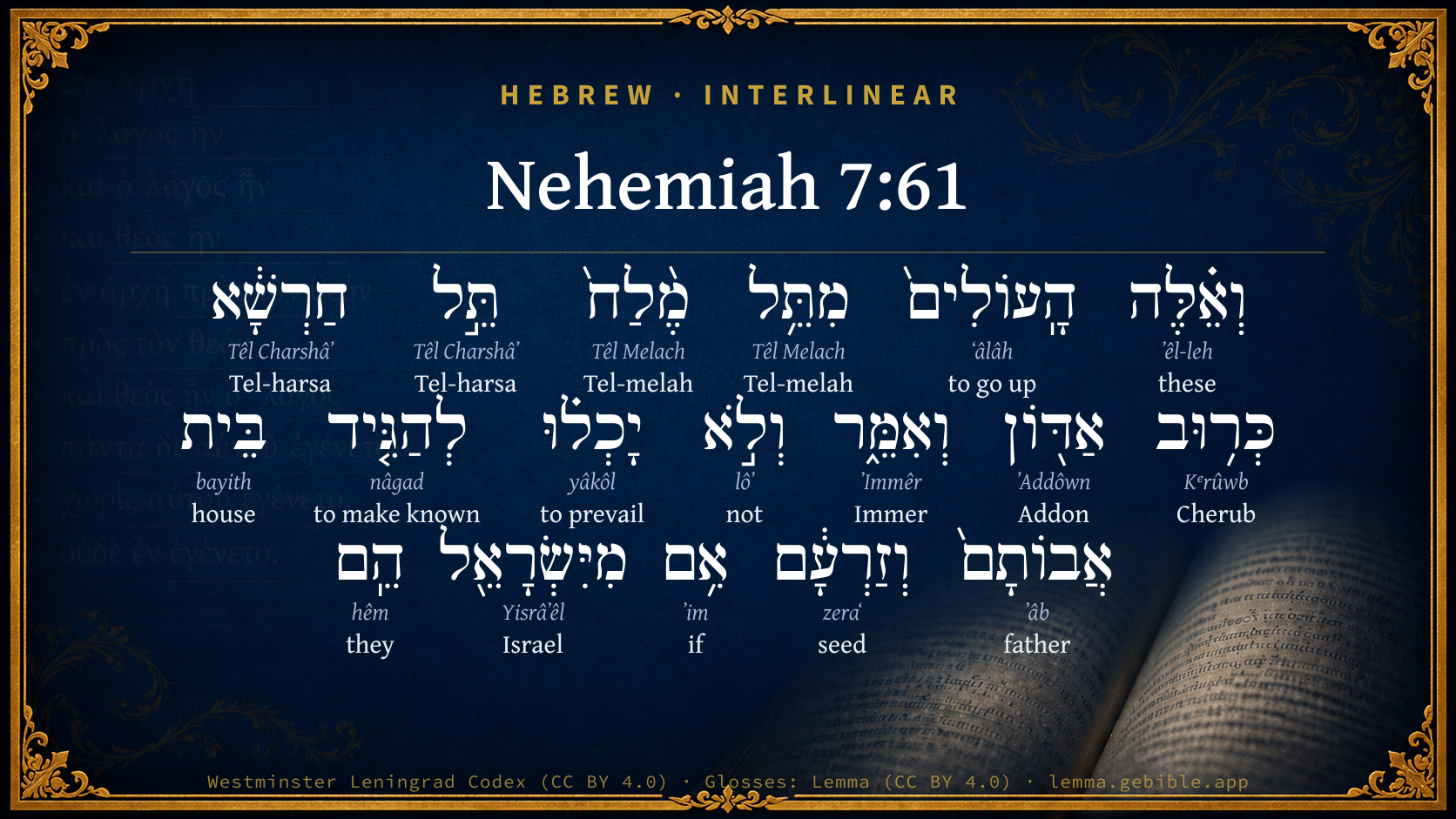
Hebrew (Westminster Leningrad Codex) Nehemiah 7:61 appears in the Hebrew Old Testament. The text above is from the Westminster Leningrad Codex. Each word links to its Strong’s number, a concise gloss, and parsing drawn from the Open Scriptures Hebrew Bible morphology. Click any word for its full Brown-Driver-Briggs (BDB) entry.
Download image
Cite this verse

Nehemiah 7:61 (World English Bible). Public Domain. Lemma interlinear Bible study tool, https://lemma.gebible.app/v/nehemiah/7/61.

Show BibTeX & RIS
BibTeX
RIS
English Translation
These were those who went up from Tel-melah, Tel Harsha, Cherub, Addon, and Immer; but they could not show their fathers' houses, nor their seed, whether they were of Israel:
World English Bible · Public Domain
Highlights
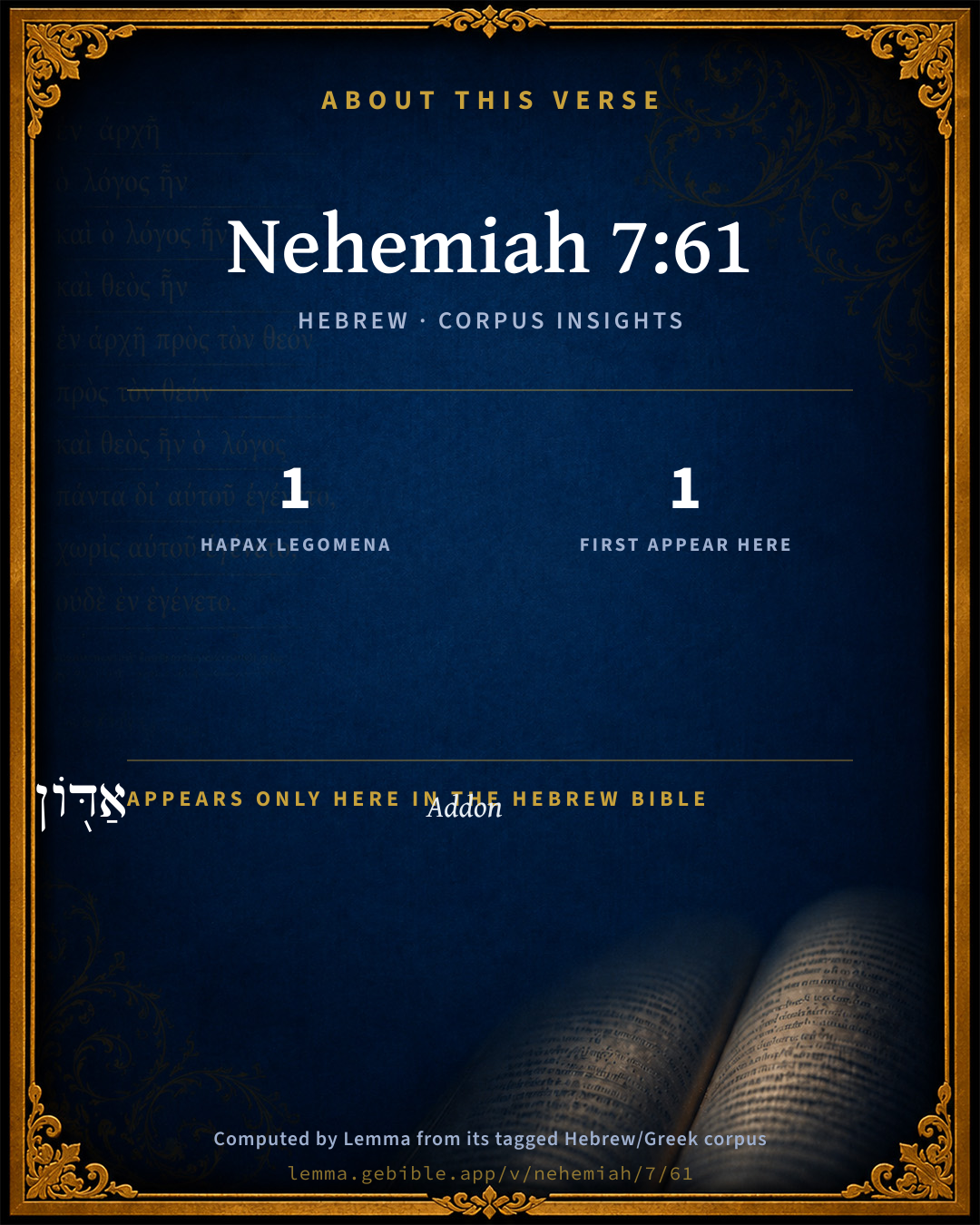
  • 1 hapax legomenon — only here in the Hebrew Bible
  • 1 first appearance in the Hebrew Bible
Full analysis ↓
Download a study sheet

One document with this verse’s original text, its word-by-word gloss line, the meaning frame, cross-references with their text, attributed commentary, and full source and license credits — printable, and it pastes into notes with its structure intact.

This verse Autodidact and up

Study sheet (.html) Plain text (.txt)

A passage Seminary Student

Up to 50 verses in one chapter. A passage sheet keeps up to 6 commentary sources and 12 cross-references per verse, in the order this page ranks them, and says so on the sheet whenever that leaves anything out. Ask for a single verse and you get the Autodidact verse sheet above.

Everything on this page stays free to read, with no account — the sheet is a download of what is already on screen, not access to it.

Want to remove ads? Support Godless Engineer
Compare translations 3

The same verse in 3 English versions, stacked beneath the original-language interlinear above. Click any original word for its lexicon entry.

Each is an independent rendering of the whole verse — the interlinear is not word-aligned to these translations.

Highlighted words mark where these versions differ — a whole-verse word diff, not a word-by-word alignment.

  • World English Bible Public Domain
    These were those who went up from Tel-melah, Tel Harsha, Cherub, Addon, and Immer; but they could not show their fathers' houses, nor their seed, whether they were of Israel:
  • King James Version Public Domain
    And these were they which went up also from Telmelah, Telharesha, Cherub, Addon, and Immer: but they could not shew their father's house, nor their seed, whether they were of Israel.
  • unfoldingWord Literal Text CC BY-SA 4.0
    And these are the ones who went up from Tel Melah, Tel Harsha, Kerub, Addon, and Immer, but they were not able to tell the house of their fathers and their seed, whether they were from Israel.

unfoldingWord Literal Text — © unfoldingWord, licensed CC BY-SA 4.0. Word-aligned USFM3 via Door43 (git.door43.org/unfoldingWord/en_ult).

Versions to compare (up to 4)

3 of 4 selected

Show all 18 translations

Every available English version of this verse, each an independent rendering of the whole verse.

  • World English Bible Public Domain
    These were those who went up from Tel-melah, Tel Harsha, Cherub, Addon, and Immer; but they could not show their fathers' houses, nor their seed, whether they were of Israel:
  • Berean Standard Bible Public Domain
    The following came up from Tel-melah, Tel-harsha, Cherub, Addon, and Immer, but could not prove that their families were descended from Israel:
  • Majority Standard Bible Public Domain
    The following came up from Tel-melah, Tel-harsha, Cherub, Addon, and Immer, but they could not prove that their families were descended from Israel:
  • King James Version Public Domain
    And these were they which went up also from Telmelah, Telharesha, Cherub, Addon, and Immer: but they could not shew their father's house, nor their seed, whether they were of Israel.
  • American Standard Version (1901) Public Domain
    And these were they that went up from Tel-melah, Tel-harsha, Cherub, Addon, and Immer; but they could not show their fathers' houses, nor their seed, whether they were of Israel:
  • Revised Version (1885) Public Domain
    And these were they which went up from Tel-melah, Tel-harsha, Cherub, Addon, and Immer: but they could not shew their fathers’ houses, nor their seed, whether they were of Israel:
  • Geneva Bible (1599) Public Domain
    And these came vp from Tel-melah, Tel-haresha, Cherub, Addon, and Immer: but they could not shewe their fathers house, nor their seede, or if they were of Israel.
  • Douay-Rheims (1899) Public Domain
    And these are they that came up from Telmela, Thelharsa, Cherub, Addon, and Emmer: and could not shew the house of their fathers, nor their seed, whether they were of Israel.
  • Young's Literal Translation Public Domain
    And these `are' those coming up from Tel-Melah, Tel-Harsha, Cherub, Addon, and Immer -- and they have not been able to declare the house of their fathers, and their seed, whether they `are' of Israel --
  • Literal Standard Version CC BY-SA 4.0
    And these [are] those coming up from Tel-Melah, Tel-Harsha, Cherub, Addon, and Immer—and they have not been able to declare the house of their fathers, and their seed, whether they [are] of Israel—
  • Unlocked Literal Bible CC BY-SA 4.0
    These were the people who went up from Tel Melah, Tel Harsha, Kerub, Addon, and Immer. But they could not prove that they or their ancestors' families were descendants from Israel:
  • unfoldingWord Literal Text CC BY-SA 4.0
    And these are the ones who went up from Tel Melah, Tel Harsha, Kerub, Addon, and Immer, but they were not able to tell the house of their fathers and their seed, whether they were from Israel.
  • Darby Bible Public Domain
    And these are they that went up from Tel-melah, Tel-harsha, Cherub-Addon and Immer; but they could not shew their father's house, nor their seed, whether they were of Israel.
  • World Messianic Bible Public Domain
    These were those who went up from Tel Melah, Tel Harsha, Cherub, Addon, and Immer; but they could not show their fathers’ houses, nor their offspring, whether they were of Israel:
  • Webster's Bible Public Domain
    And these were they who went up also from Tel-mela, Tel-haresha, Cherub, Addon, and Immer: but they could not show their fathers house, nor their seed, whether they were of Israel.
  • Free Bible Version CC BY-SA 4.0
    Those who came from the towns of Tel-melah, Tel-harsha, Kerub, Addan, and Immer could not prove their family genealogy, or even that they were descendants of Israel.
  • Bible in Basic English Public Domain
    All these were the people who went up from Tel-melah, Tel-harsha, Cherub, Addon, and Immer; but because they had no knowledge of their fathers' families or offspring, it was not certain if they were Israelites:
  • JPS Tanakh (1917) Public Domain
    And these were they that went up from Tel-melah, Tel-harsha, Cherub, Addon, and Immer; but they could not tell their fathers' houses, nor their seed, whether they were of Israel:

Literal Standard Version (2020), Covenant Press — licensed CC BY-SA 4.0. Text via the HelloAO Bible API (eBible.org). Unlocked Literal Bible (unfoldingWord) — licensed CC BY-SA 4.0. Text via the HelloAO Bible API (eBible.org). unfoldingWord Literal Text — © unfoldingWord, licensed CC BY-SA 4.0. Word-aligned USFM3 via Door43 (git.door43.org/unfoldingWord/en_ult). Free Bible Version, Dr. Jonathan Gallagher — licensed CC BY-SA 4.0. Text via the HelloAO Bible API (eBible.org).

Word by word

More ways to search: Search by grammar → Find every occurrence → Compare this word →

Practice this passage: Drill this verse → Learn its vocabulary →

אַדּ֖וֹן
ʼAddôwn
H114
“Addon”
Noun, Proper
Part of Speech
Noun
Type
Proper
Full BDB Definition

Origin: probably intensive for H113

TWOT: None

Addon = "powerful" - an Israelite?
  1. וְאֵ֗לֶּה ʼêl-leh H428 “and · these” Conjunction + Pronoun, Demonstrative, Common, Plural
  2. הָֽעוֹלִים֙ ʻâlâh H5927 “the · going up” Particle, Definite Article + Verb, Qal, Participle Active, Masculine, Plural, Absolute
  3. מִתֵּ֥ל Têl Melach H8528 “from · Tel-melah” Preposition + Noun, Proper
  4. מֶ֨לַח֙ Têl Melach H8528 “Tel-melah” Noun, Proper
  5. תֵּ֣ל Têl Charshâʼ H8521 “Tel-harsa” Noun, Proper
  6. חַרְשָׁ֔א Têl Charshâʼ H8521 “Tel-harsa” Noun, Proper
  7. כְּר֥וּב Kᵉrûwb H3743 “Cherub” Noun, Proper
  8. וְאִמֵּ֑ר ʼImmêr H564 “and · Immer” Conjunction + Noun, Proper
  9. וְלֹ֣א lôʼ H3808 “and · not” Conjunction + Particle, Negative
  10. יָכְל֗וּ yâkôl H3201 “to prevail” Verb, Qal, Perfect, 3rd Person, Common, Plural
  11. לְהַגִּ֤יד nâgad H5046 “to make known” Preposition + Verb, Hiphil, Infinitive Construct
  12. בֵּית bayith H1004 “house of” Noun, Common, Masculine, Singular, Construct
  13. אֲבוֹתָם֙ ʼâb H1 “fathers · their” Noun, Common, Masculine, Plural, Construct + Suffix, Personal, 3rd Person, Masculine, Plural
  14. וְזַרְעָ֔ם zeraʻ H2233 “and · seed · their” Conjunction + Noun, Common, Masculine, Singular, Construct + Suffix, Personal, 3rd Person, Masculine, Plural
  15. אִ֥ם ʼim H518 “if” Conjunction
  16. מִיִּשְׂרָאֵ֖ל Yisrâʼêl H3478 “from · Israel” Preposition + Noun, Proper
  17. הֵֽם hêm H1992 “they” Pronoun, Personal, 3rd Person, Masculine, Plural

About this verse

These counts appear in no published source. They are computed here, from the morphology-tagged text and Lemma’s own curated glosses. What Lemma adds →

18
words
16
distinct lemmas
Historical
section

Notable vocabulary

1 hapax legomenon — a word that appears only here in the entire Hebrew Bible:

  • אַדּ֖וֹן Addon H114

First appearance in Scripture

This word makes its first canonical appearance in the Hebrew Bible here:

  • אַדּ֖וֹן Addon H114

Shared distinctive vocabulary

כְּר֥וּב Cherub H3743 occurs in 2 verses of the Hebrew Bible. Also found in:

Grammatical profile

  • 3 verbs
  • 11 nouns
  • 2 pronouns
  • 1 conjunction
  • 1 particle

Verb forms

  • הָֽעוֹלִים֙ Qal · Participle Active
  • יָכְל֗וּ Qal · Perfect
  • לְהַגִּ֤יד Hiphil · Infinitive Construct

Repetition

Words recur within this verse — often emphatic in Hebrew:

  • מִתֵּ֥ל Tel-melah H8528 ×2
  • תֵּ֣ל Tel-harsa H8521 ×2

Cross-references

1

Topical passages linked to Nehemiah 7:61 in the Treasury of Scripture Knowledge — connected by theme and wording, ordered by reader-vote popularity; previews shown in the World English Bible.

  • Ezra 2:59 These were those who went up from Tel-melah, Tel Harsha, Cherub, Addan, [and] Immer; but they could not show their fathers' houses, and their seed, whether they were of Israel:

Cross-references courtesy of OpenBible.info (CC BY 4.0).

Hebrew and Greek witnesses Masoretic Hebrew ↔ Greek Septuagint

The same verse in the two great witnesses to the Old Testament, shown verse-for-verse.

These are two independent witnesses, not word-aligned to each other, and the Septuagint is shown in lemma (dictionary) form.

Hebrew Nehemiah 7:61 Masoretic · Westminster Leningrad Codex

וְאֵ֗לֶּה הָֽעוֹלִים֙ מִתֵּ֥ל מֶ֨לַח֙ תֵּ֣ל חַרְשָׁ֔א כְּר֥וּב אַדּ֖וֹן וְאִמֵּ֑ר וְלֹ֣א יָכְל֗וּ לְהַגִּ֤יד בֵּית אֲבוֹתָם֙ וְזַרְעָ֔ם אִ֥ם מִיִּשְׂרָאֵ֖ל הֵֽם

These were those who went up from Tel-melah, Tel Harsha, Cherub, Addon, and Immer; but they could not show their fathers' houses, nor their seed, whether they were of Israel:

World English Bible · Public Domain

Greek LXX Structure differs

The Septuagint has no separate book of Nehemiah. Its Greek text is the second half of Esdras B (2 Esdras), chapters 11–23; Ezra is the first half (1–10).

A verse-for-verse comparison isn’t shown here because the chapters and verses don’t line up. Switch to the LXX edition with the MT / LXX toggle above to read the Greek directly.

Hebrew: Westminster Leningrad Codex (CC BY 4.0). Greek: Septuagint (public domain); English from a public-domain English Septuagint. How the Septuagint differs from the Hebrew →

Commentary

Notes on Nehemiah 7:61 from classic Christian and Jewish commentators (each source and its license shown beneath its notes). The classic Christian expositions comment on the surrounding passage and are grouped to its opening verse, so a note may address several verses; the Jewish commentaries on the Tanakh (Rashi and others) are per-verse, so they appear only where the commentator wrote on this verse.

Lemma curates 59 commentaries, every one of them public domain or Creative Commons licensed, each selected and text-cleaned for this edition rather than reprinted as found. About our sources →

Tyndale Open Study Notes

Tyndale Open Resources

7:61-62 they could not prove that they . . . were descendants of Israel: They had no genealogical records.

Tyndale Open Study Notes — © Tyndale Open Resources, licensed CC BY-SA 4.0. Text via the HelloAO Bible API.

The Cambridge Bible for Schools and Colleges

gen. ed. J. J. S. Perowne

61. also] R.V. omits.

Tel-haresha] R.V. Tel-harsha.

fathers’ house] R.V. fathers’ houses.

The Cambridge Bible for Schools and Colleges (gen. ed. J. J. S. Perowne; Cambridge University Press, 1878–1918) — public domain. Text from a community e-Sword module.

unfoldingWord translationNotes

Door43 World Missions Community

Connecting Statement:

Nehemiah is continuing to recount the number of people who returned from exile. (See: Numbers)

went up

This is an idiom that refers to traveling toward Jerusalem, which was on higher ground than the surrounding area. AT: "returned" or "came back" (See: Idiom)

Tel Melah ... Tel Harsha ... Kerub ... Addon ... Immer

These are names of places. (See: How to Translate Names)

Delaiah ... Tobiah ... Nekoda ... Habaiah ... Hakkoz ... Barzillai

These are names of men. (See: How to Translate Names)

translationWords

family

descend

Israel

priest

Gilead

call

name

unfoldingWord translationNotes — © Distant Shores Media and the Door43 World Missions Community, licensed CC BY-SA 4.0. Source: git.door43.org/Door43/en_tn.

Lesson kit

Teaching starters — assembled from the data on this page, not authored interpretation. Every prompt links to the verse data it draws on. Edit before teaching.

Nehemiah, in the Historical, opens this verse with 18 words (16 distinct Hebrew lemmas). Its most distinctive word is ʼAddôwn (“Addon”). A historical commentator’s framing appears above. Read the whole chapter for the surrounding context.

Discussion questions

  1. How does “Addon” (ʼAddôwn) shape what this verse is saying?
  2. 1 word here appears nowhere else in the Hebrew Bible. Why might the author reach for such rare wording?
  3. This is the first place “Addon” appears in Scripture (first appears here). What does its debut here establish?
  4. How does Ezra 2:59, which shares the word «Cherub», read alongside this verse?
  5. What does the repetition of “Tel-melah” (2× in this one verse) do in this verse?
  6. These translations render this verse differently; the difference is in the English rendering, not the original. What questions does that raise?
  7. «הָֽעוֹלִים֙» is a Qal Participle Active verb. How does that grammatical form shape the action described?
  8. Compare how Tyndale Open Study Notes and The Cambridge Bible for Schools and Colleges read this verse. Where do they agree or differ?

Things to notice

  • 1 word in this verse appears nowhere else in the Hebrew Bible.
  • 1 word makes its first canonical appearance in Scripture here.
  • These translations choose different wording for 21 words in this verse.
  • “Tel-melah” occurs 2× in this single verse.
  • 16 distinct Hebrew lemmas span 18 words in this verse.

Reading settings

Reading text

Shown beneath each verse's original-language words.

Old Testament
Old Testament edition

Read the OT as the Masoretic Hebrew (MT) or the Greek Septuagint (LXX).

English shown for the Greek Septuagint (in the Hebrew ↔ Greek comparison).

Comparing translations? Open the Compare panel on any verse page to stack up to four side by side.