Hosea 12:4

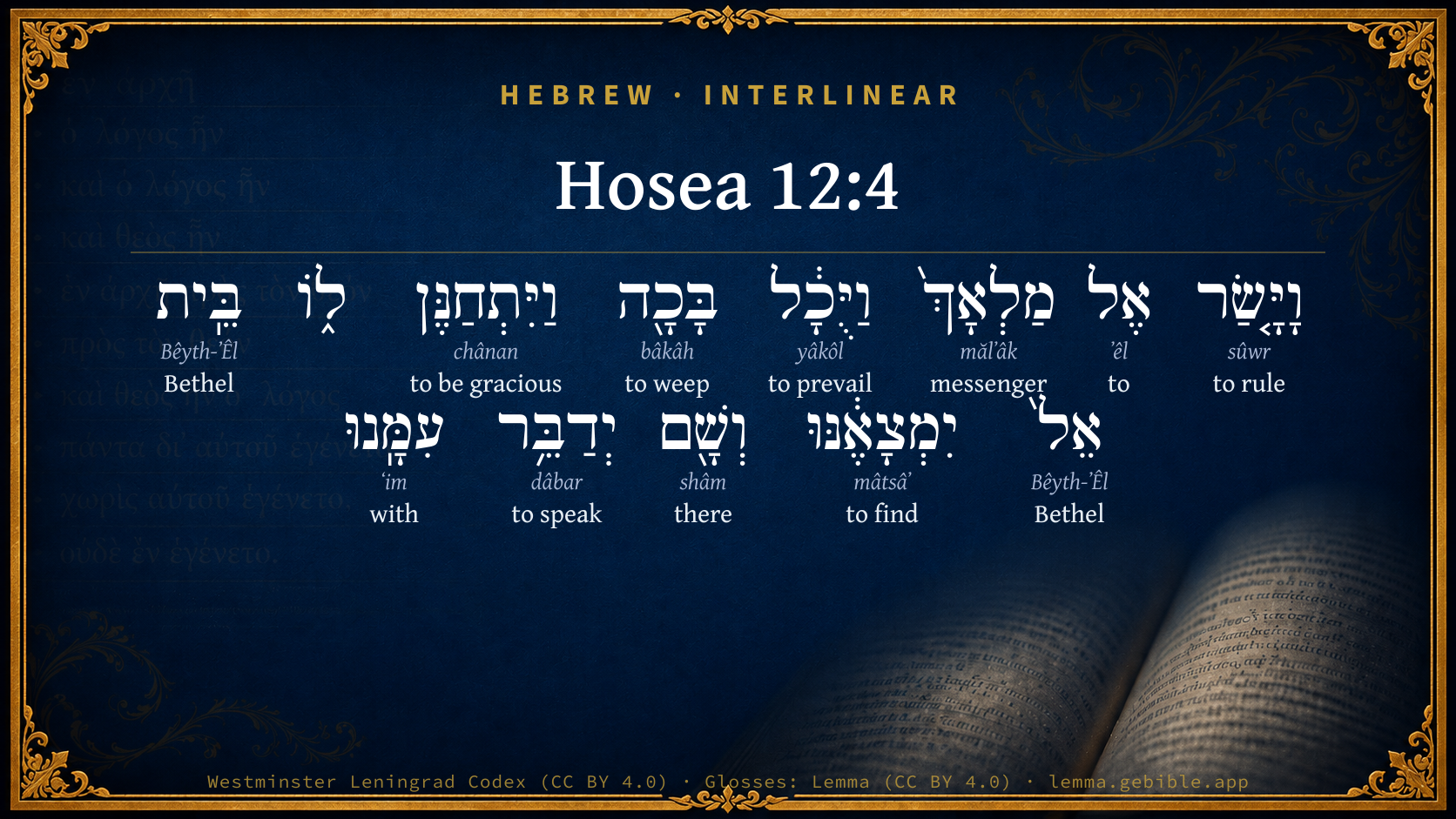
Hebrew (Westminster Leningrad Codex) Hosea 12:4 appears in the Hebrew Old Testament. The text above is from the Westminster Leningrad Codex. Each word links to its Strong’s number, a concise gloss, and parsing drawn from the Open Scriptures Hebrew Bible morphology. Click any word for its full Brown-Driver-Briggs (BDB) entry.
Download image
Cite this verse

Hosea 12:4 (World English Bible). Public Domain. Lemma interlinear Bible study tool, https://lemma.gebible.app/v/hosea/12/4.

Show BibTeX & RIS
BibTeX
RIS
English Translation
Indeed, he had power over the angel, and prevailed; He wept, and made supplication to him. He found him at Bethel, and there he spoke with us,
World English Bible · Public Domain
Download a study sheet

One document with this verse’s original text, its word-by-word gloss line, the meaning frame, cross-references with their text, attributed commentary, and full source and license credits — printable, and it pastes into notes with its structure intact.

This verse Autodidact and up

Study sheet (.html) Plain text (.txt)

A passage Seminary Student

Up to 50 verses in one chapter. A passage sheet keeps up to 6 commentary sources and 12 cross-references per verse, in the order this page ranks them, and says so on the sheet whenever that leaves anything out. Ask for a single verse and you get the Autodidact verse sheet above.

Everything on this page stays free to read, with no account — the sheet is a download of what is already on screen, not access to it.

Want to remove ads? Support Godless Engineer
Compare translations 3

The same verse in 3 English versions, stacked beneath the original-language interlinear above. Click any original word for its lexicon entry.

Each is an independent rendering of the whole verse — the interlinear is not word-aligned to these translations.

Highlighted words mark where these versions differ — a whole-verse word diff, not a word-by-word alignment.

  • World English Bible Public Domain
    Indeed, he had power over the angel, and prevailed; He wept, and made supplication to him. He found him at Bethel, and there he spoke with us,
  • King James Version Public Domain
    Yea, he had power over the angel, and prevailed: he wept, and made supplication unto him: he found him in Bethel, and there he spake with us;
  • unfoldingWord Literal Text CC BY-SA 4.0
    And he struggled with an angel and prevailed. He wept and begged favor of him. At Bethel he found him, and there he spoke with us.

unfoldingWord Literal Text — © unfoldingWord, licensed CC BY-SA 4.0. Word-aligned USFM3 via Door43 (git.door43.org/unfoldingWord/en_ult).

Versions to compare (up to 4)

3 of 4 selected

Show all 18 translations

Every available English version of this verse, each an independent rendering of the whole verse.

  • World English Bible Public Domain
    Indeed, he had power over the angel, and prevailed; He wept, and made supplication to him. He found him at Bethel, and there he spoke with us,
  • Berean Standard Bible Public Domain
    Yes, he struggled with the angel and prevailed; he wept and sought His favor; he found Him at Bethel and spoke with Him there—
  • Majority Standard Bible Public Domain
    Yes, he struggled with the angel and prevailed; he wept and sought His favor; he found Him at Bethel and spoke with Him there—
  • King James Version Public Domain
    Yea, he had power over the angel, and prevailed: he wept, and made supplication unto him: he found him in Bethel, and there he spake with us;
  • American Standard Version (1901) Public Domain
    yea, he had power over the angel, and prevailed; he wept, and made supplication unto him: he found him at Beth-el, and there he spake with us,
  • Revised Version (1885) Public Domain
    yea, he had power over the angel, and prevailed: he wept, and made supplication unto him: he found him at Beth-el, and there he spake with us;
  • Geneva Bible (1599) Public Domain
    And had power ouer the Angel, and preuailed: he wept and praied vnto him: he founde him in Beth-el, and there he spake with vs.
  • Douay-Rheims (1899) Public Domain
    And he prevailed over the angel, and was strengthened: he wept, and made supplication to him: he found him in Bethel, and there he spoke with us.
  • Young's Literal Translation Public Domain
    Yea, he is a prince unto the Messenger, And he overcometh `by' weeping, And he maketh supplication to Him, At Bethel He doth find him, And there He doth speak with us,
  • Literal Standard Version CC BY-SA 4.0
    Indeed, he is a prince to the Messenger, || And he overcomes [by] weeping, || And he makes supplication to Him, || At Bethel He finds him, || And there He speaks with us,
  • Unlocked Literal Bible CC BY-SA 4.0
    He struggled with the angel and won. He wept and begged for his favor. He met God at Bethel; there God spoke with him.
  • unfoldingWord Literal Text CC BY-SA 4.0
    And he struggled with an angel and prevailed. He wept and begged favor of him. At Bethel he found him, and there he spoke with us.
  • Darby Bible Public Domain
    Yea, he wrestled with the Angel, and prevailed; he wept, and made supplication unto him: he found him in Bethel, and there he spoke with us,
  • World Messianic Bible Public Domain
    Indeed, he struggled with the angel, and prevailed; he wept, and made supplication to him. He found him at Bethel, and there he spoke with us—
  • Webster's Bible Public Domain
    \\12:3\\He took his brother by the heel in the womb, and by his strength he had power with God:
  • Free Bible Version CC BY-SA 4.0
    He fought with the angel, and he won. He wept, and begged him for a blessing. Jacob found God at Bethel, and spoke with him there—
  • Bible in Basic English Public Domain
    In the body of his mother he took his brother by the foot, and in his strength he was fighting with God;
  • JPS Tanakh (1917) Public Domain
    (12-5) So he strove with an angel, and prevailed; he wept, and made supplication unto him; at Beth-el he would find him, and there he would speak with us;

Literal Standard Version (2020), Covenant Press — licensed CC BY-SA 4.0. Text via the HelloAO Bible API (eBible.org). Unlocked Literal Bible (unfoldingWord) — licensed CC BY-SA 4.0. Text via the HelloAO Bible API (eBible.org). unfoldingWord Literal Text — © unfoldingWord, licensed CC BY-SA 4.0. Word-aligned USFM3 via Door43 (git.door43.org/unfoldingWord/en_ult). Free Bible Version, Dr. Jonathan Gallagher — licensed CC BY-SA 4.0. Text via the HelloAO Bible API (eBible.org).

Word by word

More ways to search: Search by grammar → Find every occurrence → Compare this word →

Practice this passage: Drill this verse → Learn its vocabulary →

וָיָּ֤שַׂר
sûwr
H7786
“and · to rule”
Conjunction + Verb, Qal, Sequential Imperfect, 3rd Person, Masculine, Singular
Part of Speech
Conjunction + Verb
Stem
Qal
Form
Sequential Imperfect
Person
3rd Person
Gender
Masculine
Number
Singular
Full BDB Definition

Origin: a primitive root

TWOT: 2287

to be or act as prince, rule, contend, have power, prevail over - (Qal) to rule over, govern - (Hiphil) to make rulers, play the prince
  1. אֶל ʼêl H413 “to” Preposition
  2. מַלְאָךְ֙ mălʼâk H4397 “messenger” Noun, Common, Masculine, Singular, Absolute
  3. וַיֻּכָ֔ל yâkôl H3201 “and · to prevail” Conjunction + Verb, Qal, Sequential Imperfect, 3rd Person, Masculine, Singular
  4. בָּכָ֖ה bâkâh H1058 “to weep” Verb, Qal, Perfect, 3rd Person, Masculine, Singular
  5. וַיִּתְחַנֶּן chânan H2603 “and · to be gracious” Conjunction + Verb, Hithpael, Sequential Imperfect, 3rd Person, Masculine, Singular
  6. בֵּֽית Bêyth-ʼÊl H1008 “Bethel” Noun, Proper
  7. אֵל֙ Bêyth-ʼÊl H1008 “Bethel” Noun, Proper
  8. יִמְצָאֶ֔נּוּ mâtsâʼ H4672 “to find · him” Verb, Qal, Imperfect, 3rd Person, Masculine, Singular + Suffix, Personal, 3rd Person, Masculine, Singular
  9. וְשָׁ֖ם shâm H8033 “and · there” Conjunction + Adverb
  10. יְדַבֵּ֥ר dâbar H1696 “to speak” Verb, Piel, Imperfect, 3rd Person, Masculine, Singular
  11. עִמָּֽנוּ ʻim H5973 “with · us” Preposition + Suffix, Personal, 1st Person, Common, Plural

About this verse

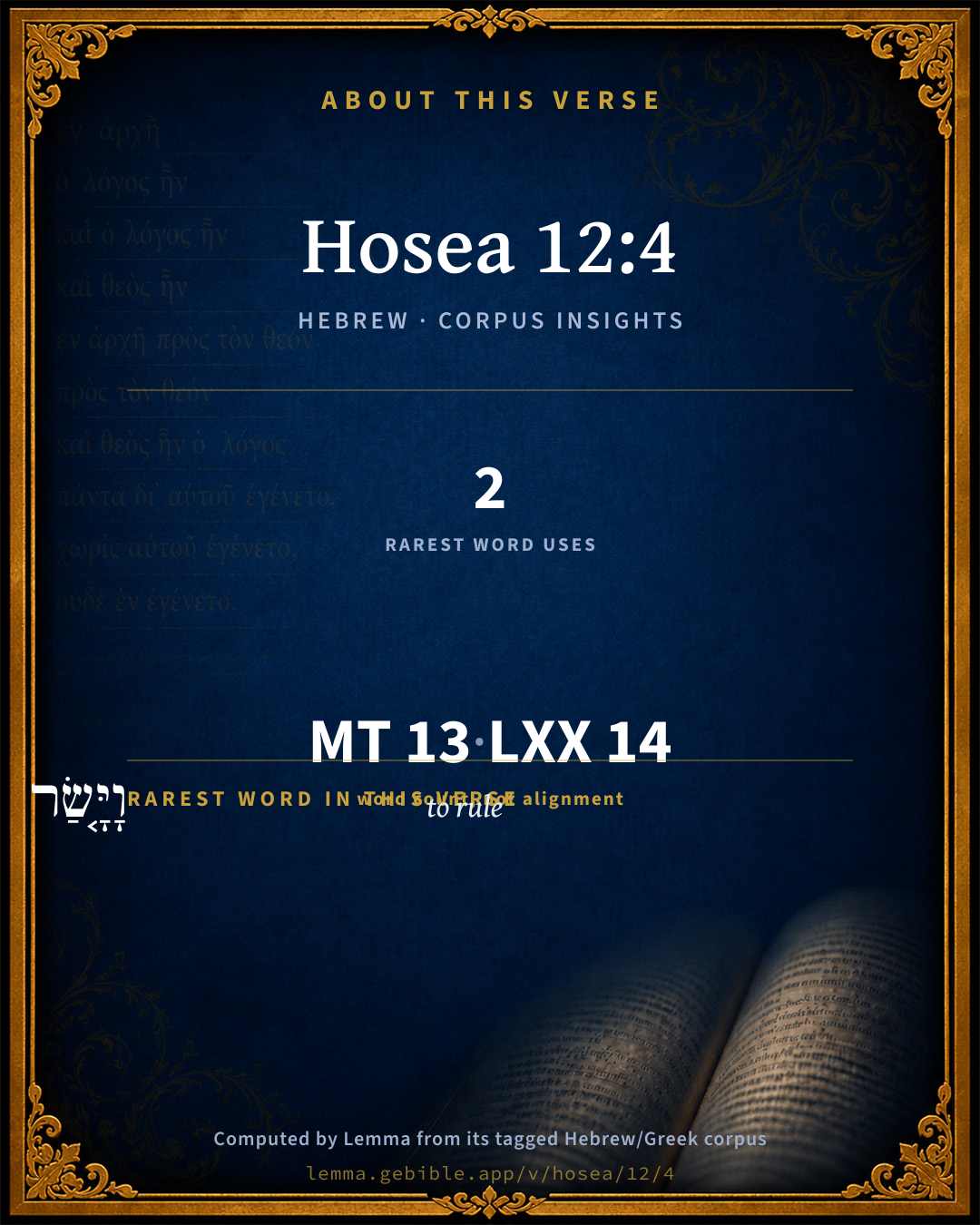
These counts appear in no published source. They are computed here, from the morphology-tagged text and Lemma’s own curated glosses. What Lemma adds →

13
words
11
distinct lemmas
Prophets
section

Notable vocabulary

The rarest word here is וָיָּ֤שַׂר to rule H7786 — appearing just 2 times in the whole Hebrew Bible.

Shared distinctive vocabulary

וָיָּ֤שַׂר to rule H7786 occurs in 2 verses of the Hebrew Bible. Also found in:

Grammatical profile

  • 6 verbs
  • 3 nouns
  • 3 prepositions
  • 1 adverb

Verb forms

  • וָיָּ֤שַׂר Qal · Sequential Imperfect
  • וַיֻּכָ֔ל Qal · Sequential Imperfect
  • בָּכָ֖ה Qal · Perfect
  • וַיִּתְחַנֶּן Hithpael · Sequential Imperfect
  • יִמְצָאֶ֔נּוּ Qal · Imperfect
  • יְדַבֵּ֥ר Piel · Imperfect

Repetition

A word recurs within this verse — often emphatic in Hebrew:

  • בֵּֽית Bethel H1008 ×2

Hebrew & Septuagint length

In English translation the verse runs 27 words from the Hebrew and 30 from the Septuagint (LXX English) — closely comparable.

A rough comparison of the two English renderings, which tokenize alike — not a word-level alignment.

Word counts can differ between the Hebrew and the Greek without any difference in meaning — e.g. the Hebrew direct-object marker אֵת has no separate Greek word, and Greek often adds the article ὁ.

In the original languages it is 13 Hebrew tokens and 14 Greek tokens — but the two are counted differently (Hebrew bundles its prefixes and suffixes into one token; the Greek is in lemma form), so that isn’t a like-for-like length.

Cross-references

14

Topical passages linked to Hosea 12:4 in the Treasury of Scripture Knowledge — connected by theme and wording, ordered by reader-vote popularity; previews shown in the World English Bible.

  • Genesis 35:15 Jacob called the name of the place where God spoke with him "Bethel."
  • Malachi 3:1 "Behold, I send my messenger, and he will prepare the way before me; and the Lord, whom you seek, will suddenly come to his temple; and the messenger of the covenant, whom you desire, behold, he comes!" says Yahweh of hosts.
  • 1 Thessalonians 4:17 then we who are alive, who are left, will be caught up together with them in the clouds, to meet the Lord in the air. So we will be with the Lord forever.
  • Genesis 32:29 Jacob asked him, "Please tell me your name." He said, "Why is it that you ask what my name is?" He blessed him there.
  • Genesis 35:9–10 God appeared to Jacob again, when he came from Paddan Aram, and blessed him.
  • Genesis 48:15 He blessed Joseph, and said, "The God before whom my fathers Abraham and Isaac did walk, the God who has fed me all my life long to this day,
  • Exodus 3:2–5 The angel of Yahweh appeared to him in a flame of fire out of the midst of a bush. He looked, and behold, the bush burned with fire, and the bush was not consumed.
  • Psalms 66:6 He turned the sea into dry land. They went through the river on foot. There, we rejoiced in him.
  • Isaiah 63:9 In all their affliction he was afflicted, and the angel of his presence saved them: in his love and in his pity he redeemed them; and he bore them, and carried them all the days of old.
  • Acts 7:30–35 "When forty years were fulfilled, an angel of the Lord appeared to him in the wilderness of Mount Sinai, in a flame of fire in a bush.
  • Hebrews 5:7 He, in the days of his flesh, having offered up prayers and petitions with strong crying and tears to him who was able to save him from death, and having been heard for his godly fear,
  • Hebrews 6:13–18 For when God made a promise to Abraham, since he could swear by none greater, he swore by himself,
  • Genesis 28:11–19 He came to a certain place, and stayed there all night, because the sun had set. He took one of the stones of the place, and put it under his head, and lay down in that place to sleep.
  • Genesis 32:9–12 Jacob said, "God of my father Abraham, and God of my father Isaac, Yahweh, who said to me, 'Return to your country, and to your relatives, and I will do you good.'

Cross-references courtesy of OpenBible.info (CC BY 4.0).

Hebrew and Greek witnesses Masoretic Hebrew ↔ Greek Septuagint

The same verse in the two great witnesses to the Old Testament, shown verse-for-verse.

These are two independent witnesses, not word-aligned to each other, and the Septuagint is shown in lemma (dictionary) form.

Hebrew Hosea 12:4 Masoretic · Westminster Leningrad Codex

וָיָּ֤שַׂר אֶל מַלְאָךְ֙ וַיֻּכָ֔ל בָּכָ֖ה וַיִּתְחַנֶּן ל֑וֹ בֵּֽית אֵל֙ יִמְצָאֶ֔נּוּ וְשָׁ֖ם יְדַבֵּ֥ר עִמָּֽנוּ

Indeed, he had power over the angel, and prevailed; He wept, and made supplication to him. He found him at Bethel, and there he spoke with us,

World English Bible · Public Domain

Greek LXX Hosea 12:4 Septuagint · lemma form

ἐν ὁ κοιλία πτερνίζω ὁ ἀδελφός αὐτός καί ἐν κόπος αὐτός ἐνἰσχύω πρός θεός

And he prevailed with the angel and was strong: they wept, and entreated me: they found me in the house of On, and there a word was spoken to them.

LXX2012 (modern English Septuagint) · Public Domain

On this verse, Joseph Benson's Commentary discusses the Septuagint’s reading. Read the note in Commentary ↓

Hebrew: Westminster Leningrad Codex (CC BY 4.0). Greek: Septuagint (public domain); English from LXX2012 (modern English Septuagint) (Public Domain). How the Septuagint differs from the Hebrew →

Targum (Aramaic paraphrase)

1

The Targum is the ancient Jewish Aramaic paraphrase of the Hebrew Scriptures — an interpretive translation, not the Hebrew text itself. Onkelos (literal) and Pseudo-Jonathan (expansive) render the Torah, and Jonathan the Prophets. Coverage is partial: where no permissively-licensed English translation exists for a verse, only the Aramaic is shown. This is verse-level text, not a word-by-word alignment to the Hebrew.

  1. Targum Jonathan Prophets (Joshua–Malachi)
    נְבִיָא אֱמַר לְהוֹן הֲלָא יַעֲקֹב עַד דְלָא אִתְיְלִיד אֲמִיר דְיִסְגֵי מִן אֲחוּהִי וּבְתוּקְפֵיהּ אִתְרַבְרַב עִם מַלְאָכָא:

    (no public-domain English translation for this verse)

    Targum Jonathan — Aramaic: “Mikraot Gedolot” (public domain). English: “Sefaria Community Translation” (CC0 1.0 (public-domain dedication)); “London "Chaldee Paraphrase," 1871” (public domain). Text via Sefaria.

Commentary

Notes on Hosea 12:4 from classic Christian and Jewish commentators (each source and its license shown beneath its notes). The classic Christian expositions comment on the surrounding passage and are grouped to its opening verse, so a note may address several verses; the Jewish commentaries on the Tanakh (Rashi and others) are per-verse, so they appear only where the commentator wrote on this verse.

Lemma curates 59 commentaries, every one of them public domain or Creative Commons licensed, each selected and text-cleaned for this edition rather than reprinted as found. About our sources →

Trapp's Complete Commentary

John Trapp

Hos 12:4 Yea, he had power over the angel, and prevailed: he wept, and made supplication unto him: he found him [in] Bethel, and there he spake with us;

Ver. 4. Yea, he had power over the angel] That Angel of the covenant, Mal 3:1, the Angel of the great council (μεγαλης βουλης αγγελος), as the Seventy render Isa 9:6, the Lord Christ, who redeemed Jacob from all evil, Gen 48:16, and is called Elohim in the former verse. Jacob is reproved for asking his name, an argument of his majesty. God, as he surmounteth all creatures, and hath no parallel, so he surpasseth all notion, and is above all name. The Africans call him Amon, that is, Heus, tu, cluis es? Our best eloquence of him is a humble silence: or if we say anything, to say as in the next verse following, Jehovah, God of hosts, Jehovah is his memorial.

And prevailed] Sept. εδυνασθη. He had power, or got the better, Christ yielding himself overcome by the prayers of the patriarch: "for the effectual fervent prayer of a righteous man availeth much," saith St James. There is a kind of omnipotence in it, saith Luther, of whom also that saying passed among his friends, Iste vir potuit apud Deum quod voluit, That man could do what he would with God. The reason whereof is given by St Jerome, in these words, Deus ipse qui nullis contra so viribus superari potest, precibus, vincitur; that is, God himself, who is otherwise insuperable, may be overcome by prayers ( Invictum vincunt vota precesque Deum); provided that men persevere in prayer as Jacob did, holding out till the morning light, and growing more resolute toward the latter end than he had been before.

He wept and made supplication] Jacob did (not the angel, as Mercer and Drusins would carry it). His wrestling was by weeping, and his prevailing by praying.

“ Verbum, preces, et lachrymae,

Miserae arma sunt Ecclesiae. ”

We read not till this text of his weeping for the blessing (no more we do of the earthquake in Hezekiah’s days, till Amo 1:1 Zec 14:4-5), but this we know, that ardent prayer is a pouring out of the soul to God, not without a shower of tears, or at least a storm of sighs. And as music upon the water sounds farther and more harmoniously than upon the land, so prayers with tears are more pleasing to God, and prevalent with him. Christ could not but look back to those weeping women that followed him to the cross, and comfort them. Tears of compassion and of compunction, when men love and weep, as Mary Magdalen did, are very acceptable to God, who puts them into his bottle as precious. There are tears of another sort, lachrimae nequitiae, tears of wickedness, expressed either by hypocrisy or a desire of revenge: such were Esau’s tears for the blessing too, Gen 27:38, but he went without it, because he was a profane hypocrite; he cried out of discontent, and threatened his brother Jacob; he complained of his father’s store, (Hast thou but one blessing?) of his brother’s subtilty, (was he not rightly called Jacob?) but not a word of his own wickedness. He roared for the disquietness of his heart, but he did not, as Jacob, weep and make supplication to his Judge, deploring his own wants, and imploring the supplies of his grace, quam unice expetiit, as the main thing he desired.

He found him in Bethel] That is, the Lord found Jacob there, Gen 28:18-19; but especially, Gen 35:14-15, confirming his promises to him and all his posterity.

There he spake with us] Who were then in Jacob’s loins, and promised that God should be our God; but we have falsified with him, and turned Bethel into Bethaven; abusing that place to idolatry and calf worship, where we, in our forefathers, had so many manifestations of Divine mercy. Oh better he had never spoken with us there than that we should have so slighted his promises, cast his words behind our backs, and wickedly departed from our God. Is this Jacob-like? &c. There he spake with us. What he spake with Jacob he spake with us; and we are to hold ourselves no less concerned therein than he was. See a like expression Psa 66:6. See likewise Rom 15:4 Heb 13:5. What God spake to Joshua, Jos 1:5, he spake to all believers. And that which he spake to his afflicted, Psa 102:17, "He will regard the prayer of the destitute, and not despise their prayer," that he spake to us: for, Psa 102:18, "This shall be written for the generations to come." The Hebrews have a proverb, Quae patribus acciderunt signum sunt filiis, What things befell the fathers, those were a sign to their children; and thence it is that the deeds of the fathers are often attributed to the children. Let us labour to see our own names written upon every promise; and secure our interest by searching for the conditions whereunto the promises are annexed; and then put them in suit by faithful prayer, saying with David, "Remember thy word unto thy servant, whereupon thou hast caused me to trust."

John Trapp, A Commentary or Exposition upon All the Books of the Old and New Testament (1647–1656) — public domain. Text from a community e-Sword module.

Joseph Benson's Commentary

Hos 12:4-5. He had power over the angel — Called God, Hos 12:3, and Jehovah, God of hosts, Hos 12:5, namely, God by nature and essence, and an angel by office and voluntary undertaking. He wept and made supplication unto him — He prayed with tears from a sense of his own unworthiness, and with earnestness for the mercy he desired. Jacob’s wrestling with the angel was, as has been just intimated, not only a corporal conflict, but likewise a spiritual one; from bodily wrestling he betook himself to spiritual weapons; he poured forth tears with earnest supplications and prayers, and strove, not so much for victory, as for a blessing: the only way for a feeble, impotent creature, to prevail over his Creator. The observations of Luther, upon this extraordinary conflict between Jacob and the person called the angel, are so excellent, that the intelligent reader will be glad to be presented here with a translation of them. “Different views are wont to be entertained concerning the nature of this wrestling. But the history shows that Jacob had come into imminent danger of his life, and was assaulted by an unknown antagonist with his whole power. He therefore himself also exerted his bodily strength to the utmost against this antagonist, that he might defend his life. Nevertheless, he did not contend only with the strength of his body; his faith also wrestled: and first, in such an immediate danger, he comforted himself that he had been ordered by God to return into the land of Canaan [to which country, in obedience to God, he was now journeying.] Then with his whole heart he laid hold on the promise made him by the Lord in Beth-el, where he was fully assured of the divine protection. When therefore he was in distress, and assaulted by an unknown enemy with all his might, although he used his own strength, yet he contended more strenuously by faith, beholding the promise, and concluding with certainty that God, according to his word, would be present with him in so great a danger, and would save him. And with this faith, [so to speak,] he prevailed over God; for although Christ tried Jacob in this conflict, nevertheless he could do nothing against, or contrary to, his word, on which Jacob relied.” Jacob’s supplication and tears, here mentioned, probably refer to those earnest prayers which he poured out to God, as is recorded Gen 32:9-11. The conflict here spoken of, in which Jacob had power with God, ended in an assurance that his prayers were answered. He found him in Beth-el — This refers to God’s appearing to Jacob after the former vision, as is related Gen 35:9; Gen 35:14, when God renewed his promise of giving the land of Canaan to his posterity. The prophet takes particular notice of the place where God appeared to him: as if he had said, He appeared in that very place where you worship a golden calf as your god! And there he spake with us — Who were then in Jacob’s loins. The Alexandrian copy, however, of the LXX. reads, There he spake with him; as if the expression alluded to the above-mentioned passage, where God is said to have talked with Jacob. But the present Hebrew reading contains a very important meaning, signifying, that God did not only speak to him there, but likewise did, by so doing, instruct his posterity to the latest generation. Certainly the things spoken concerned Jacob’s posterity, as much, or more, than himself. Even the Lord God of hosts — He that appeared and spake, who promised the blessing, and commanded the reformation at Beth-el, was Jehovah, the eternal and unchangeable God; who can perform his promise, and execute his threat; who is a most terrible enemy, and a most desirable friend. The Lord is his memorial — That is, the name Jehovah is God’s memorial; his appropriate, perpetual, incommunicable name, expressing his essence; the name by which he will be known and remembered to all generations; the name which especially distinguishes him from all false gods, and sets forth his glory more than any other name whatsoever: see note on Exo 3:14.

Joseph Benson's Commentary on the Old and New Testaments (1811–1818) — public domain. Text from a community e-Sword module.

Tyndale Open Study Notes

Tyndale Open Resources

12:4 at Bethel he met God: See Gen 28:11-22.

Tyndale Open Study Notes — © Tyndale Open Resources, licensed CC BY-SA 4.0. Text via the HelloAO Bible API.

Geneva Bible (1599)

Geneva Bible translators

God found Jacob as he lay sleeping in Bethel, Gen. 28:12, and so spake with him there, that the fruit of that speech appertained to the whole body of the people, whereof we are.

Read Gen. 32:24-32.

Geneva Bible (1599) marginal notes — public domain. Text via Bolls.life.

Jamieson, Fausset & Brown

Robert Jamieson, A. R. Fausset & David Brown

the angel--the uncreated Angel of the Covenant, as God the Son appears in the Old Testament (Mal 3:1).

made supplication-- Gen 32:26; I will not let thee go, except thou bless me."

he found him--The angel found Jacob, when he was fleeing from Esau into Syria: the Lord appearing to him "in Beth-el" (Gen 28:11-19; Gen 35:1). What a sad contrast, that in this same Beth-el now Israel worships the golden calves!

there he spake with us--"with us," as being in the loins of our progenitor Jacob (compare Psa 66:6, "They . . . we;" Heb 7:9-10). What God there spoke to Jacob appertains to us. God's promises to him belong to all his posterity who follow in the steps of his prayerful faith.

Jamieson, Fausset & Brown — Commentary Critical and Explanatory on the Whole Bible (1871) — public domain (CC PDM 1.0). Text via the HelloAO Bible API.

Adam Clarke's Commentary

Verse 4. He had power over the Angel] Who represented the invisible Jehovah.

He wept, and made supplication] He entreated with tears that God would bless him; and he prevailed. The circumstance of his weeping is not mentioned in Genesis.

He found him in Beth-el] It was there that God made those glorious promises to Jacob relative to his posterity. See Ge 28:13-15.

Adam Clarke's Commentary on the Bible (1810–1826) — public domain. Text from a community e-Sword/MySword module.

John Calvin's Commentaries

And since this was especially worthy of being remembered, he repeats, that he had power with the angel, and prevailed. But we have already said how Jacob prevailed not indeed of himself, but because God had so distributed his power, that the greater part was in Jacob himself. I am therefore wont, when I speak of the wrestling and of the daily contests with which God exercises the godly, to adduce this similitude, — That God fights with us with his left hand, and defends us with his right hand, that is, he assails us in a weak manner, (so to speak,) and at the same time stretches forth his right hand to defend us: he displays, in the latter instance, his greater power, that we may become victorious in the struggle. And this mode of speaking, though at the first view it seems harsh, does yet wonderfully set forth the grace and goodness of God, inasmuch as he deigns to humble himself for our sake, so as to choose to concede to us the praise of victory; not indeed that we may become proud of ourselves, but that he may be thus more glorified, when he prefers exercising his power in defending us rather than in overwhelming us, which he could do with one breath of his mouth. For he has no need of making any effort to reduce us to nothing: if he only chooses to blow on the whole human race, the whole world would in a moment be extinguished. But the Lord fights with us, and at the same time suffers us not to be crushed; nay, he raises us up on high, and, as I have already said, concedes to us the victory. Let us now go on.

The Prophet adds, that he wept and entreated: He wept, he says, and made supplication unto him Some explain this clause of the angel; but I know not whether weeping was suitable to him. The saying may be indeed defended that the angel was as it were a suppliant, when he yielded up the conquest to the holy man; for it was the same as though he who owns himself unequal in a contest were to throw himself on the ground. Then they explain weeping thus, “The angel entreated the patriarch when he said, ‘Let me go;’ and this was a confession of victory.” The sense would then be, that the patriarch Jacob did not gain any ordinary thing when he came forth a conqueror in the struggle; for God was in a manner the suppliant, for he conceded to him the name and praise of a conqueror. But I prefer explaining this of the patriarch, and to do so is, in my judgement, more suitable. It is not indeed said that Jacob wept; that is, it is not, I own, stated distinctly and expressly by Moses; but weeping may be taken for that humility which the faithful ever bring to the presence of God: and then weeping was meet for the patriarch; for he so gained the victory in the combat, that he did not depart without grief and loss, inasmuch as we know that his leg was put out of joint, and that his thigh was dislocated so that he was lame all his life. Jacob then obtained the victory, and there triumphed with God’s approbation: but yet he departed not whole, for God had left him lame. He felt then no small grief, since this weakness in his body continued through life. Hence weeping did not ill become the holy man, who was humbled in the struggle, though he carried away the palm of victory.

And this ought to be carefully noticed; for here the Prophet meets all calumnies, when he so moderates the sentence, that he takes away nothing from God and his glory, though he thus splendidly adorns the victory of the patriarch. He was then a prince with God; he prevailed also, he became a conqueror, — but how? He yet wept and entreated him; which means, that there was no cause for pride that he carried away the palm of victory from the contest, but that God led him to humility even by the dislocation of his thigh or leg: and so he entreated him. The praying of Jacob is related by Moses, which he made, when he asked to be blessed. But the less, as the Apostle says, is blessed by the greater, (Hebrews 7:7.) Then Jacob did not exalt himself, as blind men do, who claim merit to themselves; but he prayed to God, and asked to be blessed by Him, who owned himself to be overcome. And this ought to be carefully observed, especially the additional circumstance; for we hence learn that there is no cause why they who are proved by temptations should flee away from God, though our flesh indeed seeks ease, and desires to be spared.

But when a temptation is at hand, we withdraw ourselves, and there is no one who would not gladly make a truce, and also hide himself at a distance from the presence of God. Inasmuch then as we desire God to be far from us, when he comes forth as an antagonist to try our faith, this praying of Jacob ought to be remembered; for though he had his leg disjointed, though he was worn out with weariness, he did not yet withdraw himself, he did not wish the departure of the angel, but retained him as it were by force: “Thou shalt bless me; I would rather contend with thee, and be wholly consumed, than to let thee go before thou blesses me.” We hence see that we ought to seek the presence of God; though he may severely try us, though we may suffer much, though our strength fail, though we may be made lame through life, we ought not yet to shun the presence of God, but rather embrace him with both arms, and retain him as it were by force; for it is much better to groan under our burden, and to feel his power who is above us, than to continue free from toil, and to rot in our pleasures, as they do whom God forsakes. And we see how much such an indulgence ought to be dreaded by us; for unless we are daily sharpened by various temptations, we immediately gather rust and other evils. It is therefore necessary, in order that we may continue in a sound state, that our contests should be daily renewed: and hence I have said, that we ought to seek the presence of God, however severe the wresting may be.

It follows, He found him in Bethel To remove every ambiguity, I would render it, “In Bethel he had found him.” It is indeed a verb in the future tense; but it is certain that the Prophet speaks of the past. But when we take the past tense, ambiguity in the language still remains; for some thus understand the place, that God had afterwards found Jacob in Bethel, or, that Jacob had found God; that is, when the name of Israel was confirmed to him, after the destruction of the town of Sichem; for, to console his grief, God appeared to him there again. They then explain this of a second vision in that place. But it seems to me that the Prophet had another thing in view, even this, that God had already found Jacob in Bethel, that he had met him when he fled to Syria, and went away through the fear of his brother. It was then for the first time that God appeared to his servant, and exhorted him to faithfulness: he promised to him a safe return to his own country. The Prophet then means, that Jacob gained the victory, because God had long before began to embrace him in his love, and also testified his love when he had manifested himself to him in Bethel. Hence he found him in Bethel. This might indeed be referred to Jacob, “He found him in Bethel;” that is, he found God. But as it is immediately added, There he spake with us, and as this cannot be applied to any other than to God himself, I am inclined to add also, that God had found Jacob in Bethel. And the Prophet commends to us again the gratuitous goodness of God towards Jacob, because he deigned to meet him on his way, and to show that he was the leader of Jacob on his journey: for he did not think previously that God was nigh him, as he says himself,

‘This is the house of God, and the gate of heaven, and I knew it not,’ (Genesis 28:16,17.)

When therefore the holy man thought himself to be as it were cast away by God, and destitute of all aid, when he was alone and without any hope, God is said to have found him; for of his own good will he presented himself to him, when the holy man hoped no such thing, nor conceived such a thing in his mind. Hence God had already found his servant in Bethel; and there he spake, or (that the same strain may be continued) had spoken to him.

There he had spoken with us. Some take עמנו, omnu, for עמו, omu , he had spoken with him; and they do this, being forced by necessity; for they find no sense in the words that God spake with us in Bethel. But there is no need to change the words contrary to rules of grammar. Others who dare not to depart from the words of the Prophet, imagine a sense wholly different. Some say, “He spake with us there;” that is, “The Lord speaks by me, Hosea, and by Amos, who is my colleague and friend: for we denounce on you, by his authority, utter ruin and destruction; and God has made known to us at Bethel whatever we bring to you.” But how strained is this, all must see: this is to wrest Scripture, and not to explain it. Others also speak still more frigidly: “There he spake with us,” as though the angel had said, “Wait, the Lord will speak with us; I have called thee Israel, but the Lord will at length come, who will ratify what I now say to thee:” as if he was not indeed the eternal God; but this he immediately expresses when he says Jehovah is his memorial, Jehovah of hosts But thus the Jews trifle, who are like irrational beings whenever there is a reference made to Christ.

There does not seem, however, to be any great reason why we should toil much about the Prophet’s words: and some even of the Rabbis (not to deprive them of their just praise) have observed this to be the meaning, That the Lord had so spoken with Jacob, that what he said belonged to the whole people. For doubtless whatever God then promised to his servant appertained to the whole body of the people, and all his posterity. Why then do interpreters so greatly torment themselves, when it is evident that God spake through the person of one man with all the posterity of Abraham? And this agrees best with the context; for the Prophet now applies, so to speak, to the whole people what he had hitherto recorded of the patriarch Jacob. That they might not then think that the history of one man was related, he says that it belongs to all. How so? Because the Lord had so spoken with holy Jacob, that his voice ought to resound in the ears of all. For what was said to the holy man? Did God only reveal himself to him? Did he promise to be a Father only to him? Nay, he adopted his whole seed, and extended his favour to all his posterity. Since then he had so spoken to all the Israelites, they ought now to be more ashamed of their defection, inasmuch as they had so much degenerated from their father, with whom they were yet connected. For there was a sacred bond of unity between Jacob and his children, since God embraced them all in his love, and favoured them all with his adoption. We now perceive the mind of the Prophet. Let us proceed —

John Calvin's Commentaries (1540-1563) — public domain. Text from the Calvin Translation Society English edition (1840s-50s) via the Christian Classics Ethereal Library (ccel.org). Calvin's coverage is partial (roughly two-thirds of the Bible); uncommented books and verses are honest gaps, never fabricated. The 19th-century editor's footnotes and remarks are omitted so the notes are faithfully Calvin's own voice.

The Cambridge Bible for Schools and Colleges

gen. ed. J. J. S. Perowne

4. he had power over] Rather, he contended with.

he wept, &c.] (The subject is Jacob, not the angel.) This feature is not given in Genesis 32; it is however well adapted to the hortatory object of Hosea. The Septuagint has, ‘they wept’, &c.

he found him in Beth-el] (The subject is Jehovah.) Two visions of Jacob’s are recorded in explanation of the name Bethel (Gen_28:10-22; Gen_35:9-15). They proceed from different documents, and either of them may have been current in the circle to which Hosea belonged; the latter is of course pure conjecture. The Septuagint strangely has, ‘They found me in the house of On’ (i.e. Aven or Beth-aven instead of Bethel, comp. Hos_4:15).

there he spake with us] i.e. ‘in the loins of Jacob’ (Horsley, &c.); comp. the twofold use of ‘Israel’ in Hos_12:12-13. But this spoils the consistency of the historical picture. The Peshito, Aquila, Symmachus, Theodotion, and probably the Septuagint (πρὸς αὐτοὺς), read with him, i.e. with Jacob. (This is better than assimilating the pronoun in the preceding clause, with a few Hebrew MSS.)

The Cambridge Bible for Schools and Colleges (gen. ed. J. J. S. Perowne; Cambridge University Press, 1878–1918) — public domain. Text from a community e-Sword module.

John Gill's Exposition

Yea, he had power over the angel, and prevailed,.... This is repeated in different words, not only for the confirmation of it, it being a very extraordinary thing, and difficult of belief; but to direct to the history here referred to, where the person Jacob prevailed over is called a man, and here the angel; and so Josephus (u) calls him a divine Person; not a created angel, not Michael, as the Rabbins say, unless the Messiah is meant by him; nor Jacob's guardian angel, as Kimchi, every man being thought by some to have one; and much less Esau's evil angel, that was against Jacob, as Jarchi and Abarbinel; for of him he would never have sought nor expected a blessing; but an uncreated Angel, the Son of God, the same that went before the Israelites in the wilderness, and that redeemed Jacob from all evil, Gen 48:16; called an Angel, being so not by nature, for he is superior to angels in both his natures, divine and human; but by office, being sent to reveal the will of God, and to do the work of God in the redemption and salvation of men; the same that is called the Angel of the great council in the Greek version of Isa 9:6; and the Angel of God's presence, Isa 63:9; and the Angel or messenger of the covenant, Mal 3:1; the phrases used denote, as before, the power and prevalence Jacob had with this divine Person in prayer; whereby he obtained the blessing of him, even deliverance from his brother Esau, as well as others respecting him and his posterity;

he wept, and made supplication unto him; not the angel, entreating Jacob to let him go, as Jarchi and Kimchi, and so some Christian interpreters; who think that an angel in human form may be said to weep, as well as to eat and drink; and the rather, since this angel was not the conqueror, but the conquered; and since Christ, in the days of his flesh, both prayed and wept, and shed tears; but the case here is different; and though he was prevailed over, it was through his own condescension and goodness: but rather Jacob is meant, as Abarbinel and others; who wept not on account of the angel's touching his thigh, and the pain that might put him to; for he was of a more heroic spirit than to weep for that, who had endured so much hardship in Laban's service, in heat and cold; and besides, notwithstanding this, he kept wrestling with him, and afterwards walked, though haltingly: but he wept either because he could not get out the name of the person he wrestled with; or rather the tears he shed were for the blessing he sought of him; for it is joined with his making supplication, and is expressive of the humble, yet ardent, affectionate, fervent, and importunate request he made to obtain it; and here we have another proof of the deity of Christ, in that supplication was made to him, and he is here represented as the object of that part of religious worship, prayer, as he often is in the New Testament. This circumstance is not expressed in Gen 32:1, though it may be gathered from what is there said; however, the prophet had it by divine inspiration; and the truth of it is not to be doubted of, being not at all inconsistent with, but quite agreeable to, that history;

he found him at Bethel; either the angel found Jacob in Bethel, as he did more than once, both before and after this time, Gen 28:12; it is good to be in Bethel, in the house of God; happy are those that dwell there, and are found there living and dying, doing the will and work of God there: or rather Jacob found God or the angel in Bethel; God is to be found in his own house, there he comes and blesses with his gracious presence; here Christ the Angel of his presence is; here he meets with his people, and manifests himself unto them. There is in the words a tacit reflection on Israel, or the ten tribes, that bore the name of Jacob; the patriarch found God in Bethel, Christ the Angel of the Lord; but now, instead of him, there was a calf set up in this place, Israel worshipped; and therefore it was called Bethaven, the house of an idol, or iniquity, instead of Bethel, the house of God;

and there he spake with us; not with Esau and his angel, concerning Isaac's blessing of Jacob, as Jarchi; nor with Jacob and his angel, as the father of Kimchi; nor with the prophet, and with Amos, to reprove Israel there for the worship of the calves, as Kimchi himself; but with all the Israelites, of whom the prophet was one; who were then in the loins of Jacob, when he conversed with God, and God with him, at Bethel: or, as Saadiah interprets it, "for us" for our sakes, on our account; or "concerning us"; concerning the multiplication of Jacob's posterity, and the giving the land of Canaan to them, as the Lord did at both times he appeared to Jacob in Bethel; see Gen 28:14; and it is in the house of God, where Christ is as a son, that he speaks with and to his people, even in his word and ordinances there.

(u) Ut supra. (Antiqu. l. 1. c. 20. sect. 2.)

John Gill's Exposition of the Whole Bible (1746–1763) — public domain (CC PDM 1.0). Text via the HelloAO Bible API.

Albert Barnes' Notes on the Bible

He wept and made supplication unto Him - Jacob’s weeping is not mentioned by Moses. Hosea then knew more than Moses related. He could not have gathered it out of Moses, for Moses relates the words of earnest supplication; yet the tone is that of one, by force of earnest energy, wresting, as it were, the blessing from God, not of one weeping. Yet Hosea adds this, in harmony with Moses. For “vehement desires and earnest petitions frequently issue in tears.” “To implore means to ask with tears” . “Jacob, learning, that God Himself thus deigned to deal with him, might well out of amazement and wonder, out of awful respect to Him, and in earnest desire of a blessing, pour out his supplication with tears.” Herein he became an image of Him, “Who, in the days of His flesh, offered up prayers and supplications, with strong crying and tears unto Him that was able to save Him from death, and was heard in that He feared” Heb 5:7.

: “This which he saith, ‘he prevailed,’ subjoining, ‘he wept and made supplication,’ describes the strength of penitents, for in truth they are strong by weeping earnestly and praying perseveringly for the forgiveness of sins, according to that, “From the days of John the kingdom of heaven suffereth violence, and the violent take it by force.” Whosoever so imitates the patriarch Jacob, who wrestled with the Angel, and, as a conqueror, extorted a blessing from him, he, of whatever nation he be, is truly Jacob, and deserveth to be called Israel.” : “Yea, herein is the unconquerable might of the righteous, this his wondrous wrestling, herein his glorious victories, in glowing longings, assiduous prayers, joyous weeping. Girt with the might of holy orison, they strive with God, they wrestle with His judgment, and will not be overcome, until they obtain from His goodness all they desire, and extort it, as it were, by force, from His hands.”

He found him in Bethel - This may mean either that “God found Jacob,” or that “Jacob found God;” which are indeed one and the same thing, since we find God, when He has first found us. God “found,” i. e., made Himself known to Jacob twice in this place; first, when he was going toward Haran, when he saw the vision of the ladder and the angels of God ascending and descending, “and the Lord stood above it and said, I am the Lord God of Abraham and the God of Isaac;” and Jacob first called the place “Bethel;” secondly, on his return, when God spake with him, giving him the name of Israel. Both revelations of God to Jacob are probably included in the words, “He found him in Bethel,” since, on both occasions, God did “find him,” and come to him, and he “found” God. In Bethel, where God found Jacob, Israel deserted Him, setting up the worship of the calves; yea, he deserted God the more there, because of God’s mercy to his forefather, desecrating to false worship the place which had been consecrated by the revelation of the true God; and choosing it the rather, because it had been so consecrated.

And there He spake with us - For what He said to Jacob, He said not to Jacob only, nor for Jacob’s sake alone, but, in him, He spake to all his posterity, both the children of his body and the children of his faith. Thus it is said, “There did we rejoice in Him” Psa 66:6, i. e., we, their posterity, rejoiced in God there, where He so delivered our forefathers, and, “Levi also, who receiveth tithes, paid tithes in Abraham, for he was yet in the loins of his father, when Melchizedek met him” Heb 7:9-10. And Paul saith, that what was said to Abraham, “therefore it was imputed to him for righteousness, was not written for his sake alone, but for us also, to whom it shall be imputed, if we believe on Him that raised up Jesus our Lord from the dead” Rom 4:23, Rom 4:4. There He spake with us, how, in our needs, we should seek and find Him. In loneliness, apart from distractions, in faith, rising in proportion to our tears, in persevering prayer, in earnestness, which “clings so fast to God, that if God would cast us into Hell, He should, as one said Himself go with us, so should Hell not be Hell to us,” God is sought and found.

Albert Barnes' Notes on the Bible (1834–1885) — public domain. Text from a community e-Sword/MySword module.

Haydock's Catholic Bible Commentary

Wept. Septuagint, "they wept, and besought me." Other interpreters agree with the Vulgate. --- Us. By changing a vowel point, in Hebrew, it might be, "He spoke to him." (Cap.[Cappel?;] Grotius) --- The most magnificent promises were made, at Bethel, regarding the Israelites: this made the profanation of the place more horrible. (Calmet) --- Septuagint, "They found me in the house of On, and there the word was addressed to them." --- Bethaven was the name of Bethel, among the pious Jews, in the days of Osee. (Haydock)

George Leo Haydock (1774–1849), Haydock's Catholic Family Bible and Commentary, 1859 edition — public domain. Excludes Psalms (Douay-Rheims chapter numbering differs from Protestant) and Deuterocanonical books (Catholic canon only).

Matthew Poole's English Annotations

He; your famous progenitor of whom you boast.

Had power; behaved himself as a prince with God, Gen 32:28.

Over; with: the angel was willing to be conquered, or Jacob could not have gotten the victory.

The angel; called God, Hos 12:3, and, Hos 12:5, is Jehovah, Lord of hosts. He was no created angel, but the uncreated Angel Christ, the Messiah, eternal God by nature and essence, angel by office and voluntary undertaking.

And prevailed; got the victory, went out of the field a conqueror, but not by such arms and methods as you use. You are conquered by man because of your sins, he conquered with God by faith and prayer.

He, not the angel, as some through mistake, but your father Jacob,

wept: by this we know he prayed with tears, though the story say not so, with sense of his own unworthiness, with earnestness for the mercy he desired, and apprehensive of the majesty of him with whom he wrestled. But you, quite contrary, proud as if worthy, regardless of the best part of the blessing, and earnest only for the meaner part, seek it not of God, but idols.

And made supplication unto him: it is Christ who is here intended; it was no mere creature, Jacob might not have prayed to such, but it was the Creator of angels and the Redeemer of man, the blessed Jesus, to whom every knee ought to bow, Phi 2:10.

He, God,

found him, Jacob, full of weariness, fears, and solicitude on his journey to Laban, Gen 28:12,20, when prayers obtained a blessing; but with this, and more directly, when on his return after this wrestling bout, Gen 35:1, &c., God appeared to him, Gen 35:7-15, and blessed him. Beth-el; formerly called Luz, but by Jacob new named and called Beth-el, Gen 28:19.

There he, God,

spake, renewed his promise and confirmed the blessing, with us: by the current of the words in their grammatical order it should be,

he spake to him; but it is, not without good reason, changed to the plural first person, us, as posterity were in Jacob’s loins, and blessed with him. Yet more, where God appeared to Jacob he commanded him to build an altar there to God, to restore religion and reform his family from idolatry, which he did, Gen 35:4. But you, children of this Jacob by natural descent, are of another and far different humour; though you have been called and exhorted to leave your idols, yet these two hundred years you have kept them, and will, I see, keep them: this is your sin, and in it you are obstinate, and I will punish such a Jacob as you.

Matthew Poole's English Annotations on the Holy Bible (1683–1685) — public domain. Text from a community e-Sword/MySword module.

The Pulpit Commentary

Yea, he had power over the angel, and prevailed: he wept, and made supplication unto him. As Jacob"s position at birth symbolized the pre-eminence which God"s electing love had in store for him, and as in his manhood"s prime he put forth such earnestness and energy to obtain the blessing, so Israel, by the example of their forefather, are encouraged to like strenuous exertion with like certainty of success. The example is more fully described and dwelt on in this verse for the purpose of more powerfully stimulating the Israelites of the prophet"s day to imitate it. From this verse we learn the following facts:

(1) the nature of the conflict as of a spiritual kind;

(2) the visible embodiment of the invisible deity, so that the angel is not an entire identification with God in the preceding verse, bat the organ of Divine manifestation; and

(3) the weapons used, or the means employed, namely, weeping and supplication, in a word, the instrumentality of prayer; and

(4) the true way of prevailing with God, which is real humility and sin-core supplication, not stiff, necked and defiant resistance to the Divine will and word, like that of Israel at the period in question. This verse "is," according to Aben Ezra, an explanation how he put forth prowess with God." Kimchi regards it as "the repetition of the same thought for the put. pose of intensifying, for it was a great wonder for a man to wrestle with an angel." hbk

(1) commences a new clause; while

(2) the punctuation of it as a participle, jbbo, and the connection of it with "prevailed," leaves the following clause isolated without any improvement of the sense. The rendering in this latter case would be "prevailed weeping," a somewhat awkward expression. But

(3) there is an exposition adopted by the Hebrew expositors and advocated by Hitzig, which appears to us to do violence to the true signification of the passage. Thus Rashi: "And the angel besought him," Let me now go.

The end of the Holy and Blessed One is that he may reveal himself to thee in Bethel, and there shalt thou find him. Similarly Aben Ezra: "He (the angel) almost wept and supplicated him to let him go. And the signification of y, Gen_32:26, is: "before the light strengthened, that Jacob might not be alarmed. Also Kimchi: "This is not mentioned in the Thorah; and the explanation is as if the angel wept and supplicated Jacob to let him go, as he said, "Let me go, for" the day breaketh. Such exposition introduces into the text an intolerable anthropopathism. Jerome long before had given the correct explanation thus: He wept and asked him, when he said, "I will not let thee go, unless thou shalt have blessed me!" For the wrestling was that which he engaged in with the angel, holding him by prayers that he might bless him, not by the strength of work. If any one weeps and exercises penitence, and supplicates the Lord, he shall find him in the grief of his heart, and when he has invoked him, he shall hear him answering." He found him in Bethel, and there he spake with us. The prophet here records the result of Jacob"s faithful wrestling. Them in Bethel, the very place where years after idolatry and immorality found a home, God had manifested himself to the patriarch.

The fruit of Jacob"s victory was that

(1) he found God at Bethel; not that

(2) God found him, as some explain it.

The historical basis of the prophet"s statement is not Gen_28:11, which narrates the appearance of God to the patriarch as he fled into Mesopotamia, but Gen_35:9, when the new name of Israel, "prince with God," was confirmed to him, and the promise of all the families of the earth being blessed through his seed renewed. Of the two visions at Bethel the second is the one here referred to, as it comes after that at Penuel, the scene of the patriarch"s wrestling with the angel; while the accompanying circumstances keep us to the right understanding of the expression, "He found him in Bethel," which we are considering. Jacob on that memorable occasion prepared himself and household for seeking God by putting away the strange gods that were among them, by ceremonial purifications, and putting on change of garments. Thus, seeking with holy purpose and prepared heart, he found the Lord at Bethel, and enjoyed heavenly fellowship with him there. Aben Ezra favors (2) making Jehovah, not Jacob, the subject; thus: "As he was returning to his father, the angel found him there; and because the angel appeared to him twice in Bethel, behold the place is the gate of heaven; therefore I and Amos have prophesied about Jeroboam at Bethel, which is the place of his kingdom." Kimchi approves of the exposition of the angel finding Jacob, but mentions a modification of that of Jacob finding the angel; thus: "The angel found him in Bethel and also blessed him there; and the word ymy, equivalent to "found him," is the future instead of the past. But my lord my father, of blessed memory, explains it according to its literal import, that the angel said to him (when wrestling with him) that he would find him in Bethel The blessed God announced to him the good tidings that he would there manifest himself to him and call his name Israel." The last clause of this verse states the additional fact that God spoke

(1) through the patriarch to his posterity. "Let it be observed," says Lackemacher, as quoted by Keil, "that God is said to have talked at Bethel, not with Jacob only, but with all his posterity. That is to say, the things which are here said to have been done by Jacob, and to have happened to him, had not regard to himself only, but to all the race that sprang from him, and were signs of the good fortune which they either would or certainly might enjoy." Though the suffix of ymy, in the Massoretic text is well attested, yet, instead of

(a) the third person, Ewald reads it

(b) as the first plural, and consequently so renders the word that the clause implies, not a narrative of the past, but a prophecy of the future; thus:

(2) "He will find at Bethel, and there he will speak with us." The. Septuagint, again, with other Greek versions, as also the Syriac and Arabic, read in the last part of the clause wMi, equivalent "to him," instead of WnMi, equivalent to "us," which identifies the patriarch with his posterity. The translation by which a relative is understood before immanu, equiva lent to "Them he spoke to Jacob the things that are with us," or "happened us," or "pertained to us," is neither necessary nor in accordance with good taste. Kimchi understands the verb in the present tense that is, God speaks

(a) with us Hosea and the other prophets, to reprove the idolatry rampant in Bethel;

(b) rather with the prophet and the people descended from the patriarch. On the words, "there he spake with us," Kimchi comments as follows: "These are the words of the prophet. He says, "There in Bethel he (Jehovah) speaks with me and with Amos to reprove Israel for the worship of the calf in Bethel," as Amos (Amo_5:4) says, "Seek ye me, and ye shall live: but seek not Bethel." But my lord my father, of blessed memory, explained "And there he will speak with us" as the words of the angel. He (the angel) says to him (Jacob), "The blessed God will find us in Bethel, and there he will speak

(c) with us, with me and with thee, in order to confirm to thee my blessing, and to call thy name Israel, saying, For as a prince hast thou power with God and with men, and hast prevailed. But others, as Saadia Gaon, explain the word, not in the sense of "with us," but

(d) "on account of us," or "about us."

The Pulpit Commentary (1880–1919), ed. H.D.M. Spence-Jones & Joseph S. Exell — public domain. Text from a community e-Sword module.

John Wesley's Explanatory Notes

The angel - Called ver. 3, God; and ver. 5, Jehovah, Lord of hosts. He was no created angel, but the Messiah; eternal God by nature and essence, angel by office, and voluntary undertaking. He wept - He prayed with tears from a sense of his own unworthiness, and with earnestness for the mercy he desired. He - God. Him - Jacob full of weariness, fears, and solicitude on his journey to Laban. He - God. With us - Being then in Jacob's loins.

John Wesley, Explanatory Notes Upon the Whole Bible (1754–1765) — public domain. Text via the GEBible commentary corpus.

Scofield Reference Notes

C. I. Scofield

angel

(See Scofield "Heb 1:4").

The Scofield Reference Bible (1917 edition), notes by C. I. Scofield — public domain. Text from a community e-Sword module.

Rashi

Rabbi Shlomo Yitzchaki (Rashi)

In the womb, he seized his brother’s heel All this I did for him, he held him by the heel, as a sign that he would be a master over him.

Rashi on the Tanakh — English translations: “The Judaica Press complete Tanach with Rashi, translated by A. J. Rosenberg” (CC BY 4.0); “Pentateuch with Rashi's commentary by M. Rosenbaum and A.M. Silbermann, 1929-1934” (public domain); “The Metsudah Tanach series, Lakewood, N.J” (CC BY 4.0); and “The Book of Joshua, Metsudah Publications, 1997” (CC BY 4.0). Text via Sefaria.

Lesson kit

Teaching starters — assembled from the data on this page, not authored interpretation. Every prompt links to the verse data it draws on. Edit before teaching.

Hosea, in the Prophets, opens this verse with 13 words (11 distinct Hebrew lemmas). Its most distinctive word is sûwr (“to rule”). A historical commentator’s framing appears above. Read the whole chapter for the surrounding context.

Discussion questions

  1. How does “to rule” (sûwr) shape what this verse is saying?
  2. How does Judges 9:22, which shares the word «to rule», read alongside this verse?
  3. What does the repetition of “Bethel” (2× in this one verse) do in this verse?
  4. The translations on this page render this verse differently — a whole-verse word diff, not a word-by-word alignment. What might account for the different wordings?
  5. «וָיָּ֤שַׂר» is a Qal Sequential Imperfect verb. How does that grammatical form shape the action described?
  6. Compare how Trapp's Complete Commentary and Joseph Benson's Commentary read this verse. Where do they agree or differ?

Things to notice

Reading settings

Reading text

Shown beneath each verse's original-language words.

Old Testament
Old Testament edition

Read the OT as the Masoretic Hebrew (MT) or the Greek Septuagint (LXX).

English shown for the Greek Septuagint (in the Hebrew ↔ Greek comparison).

Comparing translations? Open the Compare panel on any verse page to stack up to four side by side.