
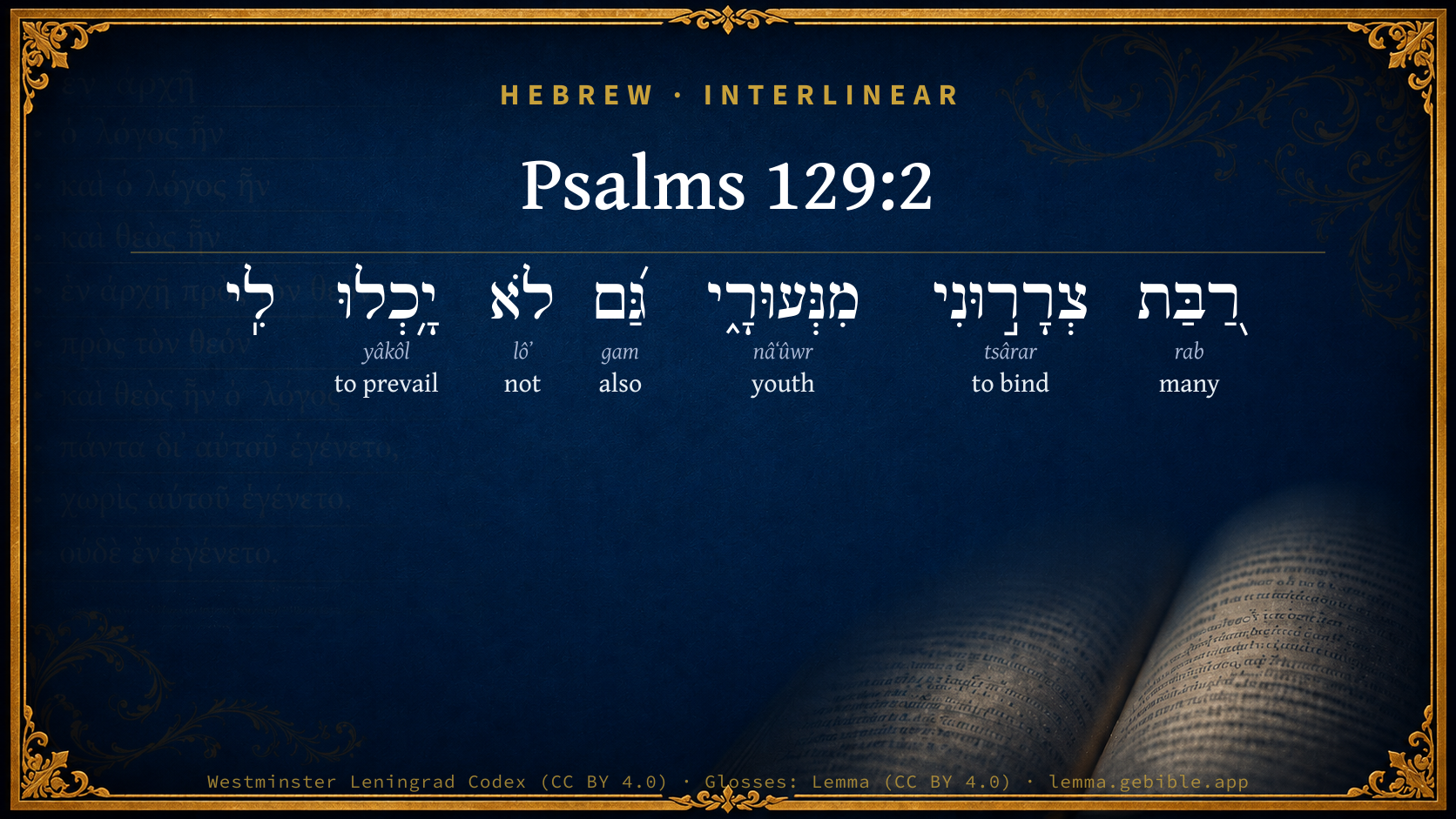
Psalms 129:2

Hebrew (Westminster Leningrad Codex) Psalms 129:2 appears in the Hebrew Old Testament. The text above is from the Westminster Leningrad Codex. Each word links to its Strong’s number, a concise gloss, and parsing drawn from the Open Scriptures Hebrew Bible morphology. Click any word for its full Brown-Driver-Briggs (BDB) entry.
Download image
Cite this verse

Psalms 129:2 (World English Bible). Public Domain. Lemma interlinear Bible study tool, https://lemma.gebible.app/v/psalms/129/2.

Show BibTeX & RIS
BibTeX
RIS
English Translation
Many times they have afflicted me from my youth up, Yet they have not prevailed against me.
World English Bible · Public Domain
Download a study sheet

One document with this verse’s original text, its word-by-word gloss line, the meaning frame, cross-references with their text, attributed commentary, and full source and license credits — printable, and it pastes into notes with its structure intact.

This verse Autodidact and up

Study sheet (.html) Plain text (.txt)

A passage Seminary Student

Up to 50 verses in one chapter. A passage sheet keeps up to 6 commentary sources and 12 cross-references per verse, in the order this page ranks them, and says so on the sheet whenever that leaves anything out. Ask for a single verse and you get the Autodidact verse sheet above.

Everything on this page stays free to read, with no account — the sheet is a download of what is already on screen, not access to it.

Want to remove ads? Support Godless Engineer
Compare translations 3

The same verse in 3 English versions, stacked beneath the original-language interlinear above. Click any original word for its lexicon entry.

Each is an independent rendering of the whole verse — the interlinear is not word-aligned to these translations.

Highlighted words mark where these versions differ — a whole-verse word diff, not a word-by-word alignment.

  • World English Bible Public Domain
    Many times they have afflicted me from my youth up, Yet they have not prevailed against me.
  • King James Version Public Domain
    Many a time have they afflicted me from my youth: yet they have not prevailed against me.
  • unfoldingWord Literal Text CC BY-SA 4.0
    Abundantly they have afflicted me from my youth; however, they did not prevail against me.

unfoldingWord Literal Text — © unfoldingWord, licensed CC BY-SA 4.0. Word-aligned USFM3 via Door43 (git.door43.org/unfoldingWord/en_ult).

Versions to compare (up to 4)

3 of 4 selected

Show all 18 translations

Every available English version of this verse, each an independent rendering of the whole verse.

  • World English Bible Public Domain
    Many times they have afflicted me from my youth up, Yet they have not prevailed against me.
  • Berean Standard Bible Public Domain
    many a time they have persecuted me from my youth, but they have not prevailed against me.
  • Majority Standard Bible Public Domain
    many a time they have persecuted me from my youth, but they have not prevailed against me.
  • King James Version Public Domain
    Many a time have they afflicted me from my youth: yet they have not prevailed against me.
  • American Standard Version (1901) Public Domain
    Many a time have they afflicted me from my youth up: Yet they have not prevailed against me.
  • Revised Version (1885) Public Domain
    Many a time have they afflicted me from my youth up: yet they have not prevailed against me.
  • Geneva Bible (1599) Public Domain
    They haue often times afflicted me from my youth: but they could not preuaile against me.
  • Douay-Rheims (1899) Public Domain
    For thou shalt eat the labours of thy hands: blessed art thou, and it shall be well with thee.
  • Young's Literal Translation Public Domain
    Often they distressed me from my youth, Yet they have not prevailed over me.
  • Literal Standard Version CC BY-SA 4.0
    Often they distressed me from my youth, || Yet they have not prevailed over me.
  • Unlocked Literal Bible CC BY-SA 4.0
    “Often since my youth they have attacked me, yet they have not defeated me.
  • unfoldingWord Literal Text CC BY-SA 4.0
    Abundantly they have afflicted me from my youth; however, they did not prevail against me.
  • Darby Bible Public Domain
    Many a time have they afflicted me from my youth; yet they have not prevailed against me.
  • World Messianic Bible Public Domain
    many times they have afflicted me from my youth up, yet they have not prevailed against me.
  • Webster's Bible Public Domain
    Many a time have they afflicted me from my youth: yet they have not prevailed against me.
  • Free Bible Version CC BY-SA 4.0
    Many enemies have attacked from the time I was young, but they never defeated me.
  • Bible in Basic English Public Domain
    Great have been my troubles from the time when I was young, but my troubles have not overcome me.
  • JPS Tanakh (1917) Public Domain
    'Much have they afflicted me from my youth up; but they have not prevailed against me.

Literal Standard Version (2020), Covenant Press — licensed CC BY-SA 4.0. Text via the HelloAO Bible API (eBible.org). Unlocked Literal Bible (unfoldingWord) — licensed CC BY-SA 4.0. Text via the HelloAO Bible API (eBible.org). unfoldingWord Literal Text — © unfoldingWord, licensed CC BY-SA 4.0. Word-aligned USFM3 via Door43 (git.door43.org/unfoldingWord/en_ult). Free Bible Version, Dr. Jonathan Gallagher — licensed CC BY-SA 4.0. Text via the HelloAO Bible API (eBible.org).

Word by word

More ways to search: Search by grammar → Find every occurrence → Compare this word →

Practice this passage: Drill this verse → Learn its vocabulary →

About this verse

These counts appear in no published source. They are computed here, from the morphology-tagged text and Lemma’s own curated glosses. What Lemma adds →

7
words
6
distinct lemmas
Wisdom
section

Shared distinctive vocabulary

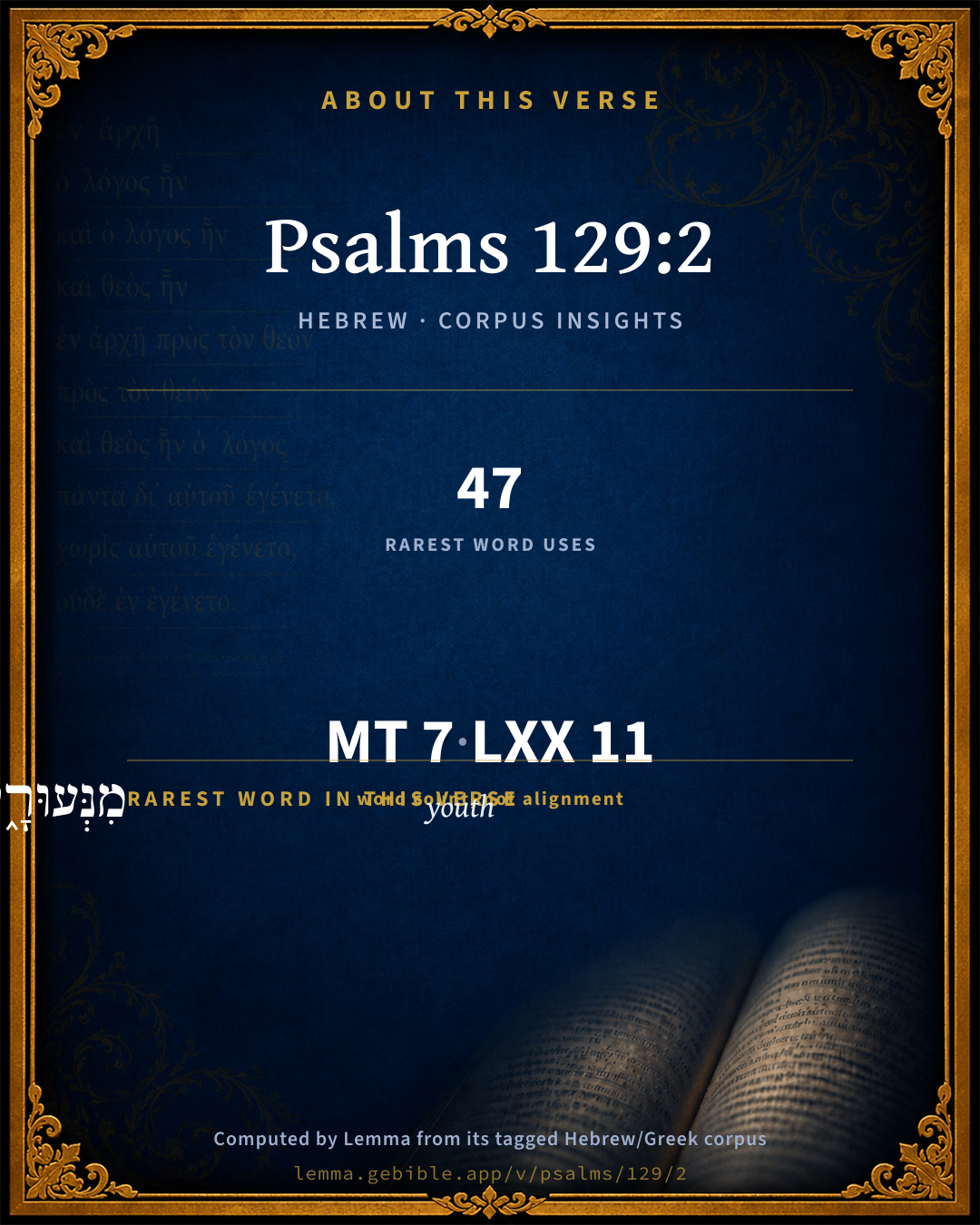
מִנְּעוּרָ֑י youth H5271 occurs in 46 verses of the Hebrew Bible. Also found in:

Grammatical profile

  • 2 verbs
  • 1 noun
  • 1 adjective
  • 1 preposition
  • 2 particles

Verb forms

  • צְרָר֣וּנִי Qal · Perfect
  • יָ֥כְלוּ Qal · Perfect

Hebrew & Septuagint length

In English translation the verse runs 17 words from the Hebrew and 18 from the Septuagint (LXX English) — closely comparable.

A rough comparison of the two English renderings, which tokenize alike — not a word-level alignment.

Word counts can differ between the Hebrew and the Greek without any difference in meaning — e.g. the Hebrew direct-object marker אֵת has no separate Greek word, and Greek often adds the article ὁ.

In the original languages it is 7 Hebrew tokens and 11 Greek tokens — but the two are counted differently (Hebrew bundles its prefixes and suffixes into one token; the Greek is in lemma form), so that isn’t a like-for-like length.

Cross-references

10

Topical passages linked to Psalms 129:2 in the Treasury of Scripture Knowledge — connected by theme and wording, ordered by reader-vote popularity; previews shown in the World English Bible.

  • Psalms 34:19 Many are the afflictions of the righteous, But Yahweh delivers him out of them all.
  • Matthew 16:18 I also tell you that you are Peter, and on this rock I will build my assembly, and the gates of Hades will not prevail against it.
  • 2 Corinthians 4:8–9 We are pressed on every side, yet not crushed; perplexed, yet not to despair;
  • Revelation 12:8–9 They didn't prevail, neither was a place found for him any more in heaven.
  • Psalms 42:1 As the deer pants for the water brooks, So my soul pants after you, God.
  • Psalms 118:13 You pushed me back hard, to make me fall, But Yahweh helped me.
  • Psalms 125:1 Those who trust in Yahweh are as Mount Zion, Which can't be moved, but remains forever.
  • John 16:33 I have told you these things, that in me you may have peace. In the world you have oppression; but cheer up! I have overcome the world."
  • Job 5:19 He will deliver you in six troubles; Yes, in seven there shall no evil touch you.
  • Romans 8:35–39 Who shall separate us from the love of Christ? Could oppression, or anguish, or persecution, or famine, or nakedness, or peril, or sword?

Cross-references courtesy of OpenBible.info (CC BY 4.0).

Hebrew and Greek witnesses Masoretic Hebrew ↔ Greek Septuagint

The same verse in the two great witnesses to the Old Testament, shown verse-for-verse.

You’re reading Greek Psalm 128 (Hebrew Psalm 129). The Septuagint counts the superscription, so verse numbers can differ from the Hebrew — chapter-level alignment, not verse-by-verse. Numbering follows Rahlfs.

These are two independent witnesses, not word-aligned to each other, and the Septuagint is shown in lemma (dictionary) form.

Hebrew Psalms 129:2 Masoretic · Westminster Leningrad Codex

רַ֭בַּת צְרָר֣וּנִי מִנְּעוּרָ֑י גַּ֝ם לֹא יָ֥כְלוּ לִֽי

Many times they have afflicted me from my youth up, Yet they have not prevailed against me.

World English Bible · Public Domain

Greek LXX Greek Psalm 128:2 Septuagint · lemma form

πλεονάκις πολεμέω ἐγώ ἐκ νεότης ἐγώ καί γάρ οὐ ἀδυνατέω ἐγώ

Many a time have they warred against me from my youth: and yet they prevailed not against me.

LXX2012 (modern English Septuagint) · Public Domain

Hebrew: Westminster Leningrad Codex (CC BY 4.0). Greek: Septuagint (public domain); English from LXX2012 (modern English Septuagint) (Public Domain). How the Septuagint differs from the Hebrew →

Commentary

Notes on Psalms 129:2 from classic Christian and Jewish commentators (each source and its license shown beneath its notes). The classic Christian expositions comment on the surrounding passage and are grouped to its opening verse, so a note may address several verses; the Jewish commentaries on the Tanakh (Rashi and others) are per-verse, so they appear only where the commentator wrote on this verse.

Lemma curates 59 commentaries, every one of them public domain or Creative Commons licensed, each selected and text-cleaned for this edition rather than reprinted as found. About our sources →

Trapp's Complete Commentary

John Trapp

Psa 129:2 Many a time have they afflicted me from my youth: yet they have not prevailed against me.

Ver. 2. Many a time, &c.] Anadiplosis ad exaggerationem, q.d. They have done it and done it again, but could never achieve their design, viz. to supplant and eradicate me; which might not be. Oppugnarunt (non expugnarunt, however the Vulgate so rendereth here). The Church is invincible. Athens took upon her of old to be so; and Venice alate boasteth the like; but time hath confuted the one, and may soon do the other; when the Church shall stand firm, because founded on a rock. More truly may it be said of it than it was once of Troy,

Victa tamen vinces, eversaque Troia resurges:

Obruet hostiles illa ruina domes

(Ovid. de Fast.).

John Trapp, A Commentary or Exposition upon All the Books of the Old and New Testament (1647–1656) — public domain. Text from a community e-Sword module.

J. A. Alexander on Psalms

Joseph Addison Alexander

2. (Psa 129:2) Many (a time) have they distressed me from my youth; yet have they not prevailed against me. The statement in the first verse is repeated, for the sake of being joined with one of a more cheering character. Yet, literally also. As if he had said; it is true that they have so done, but it is also true, etc. Prevailed against me, literally been able (as) to me, i.e. able to accomplish their designs respecting me. See Gen 32:25, and compare Psa 13:4.

8. (Psa 129:2) Nor do the passers by say, The blessing of Jehovah (come) unto you, we bless you in the name of Jehovah. The negative description is still carried out, with unusual distinctness and particularity. This verse affords an interesting glimpse of ancient harvest usages, confirmed by the historical statement in Rth 2:4, from the analogy of which place it is altogether probable, although denied by some, that there is here allusion to the alternate or responsive salutations in common use among the people. We may then supply in thought before the last clause, nor receive the customary answer. As the Hebrew preposition before you does not mean on but to or unto, it seems better to supply come than be. With this verse compare Psa 118:26.

Joseph Addison Alexander, The Psalms Translated and Explained (1850) — public domain. Text from a community e-Sword module.

Adam Clarke's Commentary

Verse 2. Yet they have not prevailed] They endeavoured to annihilate us as a people; but God still preserves us as his own nation.

Adam Clarke's Commentary on the Bible (1810–1826) — public domain. Text from a community e-Sword/MySword module.

The Cambridge Bible for Schools and Colleges

gen. ed. J. J. S. Perowne

2. yet they have not prevailed against me] Cp. 2Co_4:8-10.

The Cambridge Bible for Schools and Colleges (gen. ed. J. J. S. Perowne; Cambridge University Press, 1878–1918) — public domain. Text from a community e-Sword module.

John Gill's Exposition

Many a time have they afflicted me from my youth,.... This is repeated for the confirmation of it, to excite attention to it, and to express the vehement affection of the speaker;

yet they have not prevailed against me; the Egyptians could not prevail against literal Israel; the more they were afflicted, the more they grew and multiplied; in the times of the Judges, one after another were raised up as deliverers of them; neither the Assyrians, Chaldeans, nor Romans, nor any other, have been able to cut them off from being a nation; they continue to this day: the enemies of the church of Christ, even the gates of hell, have not been able to prevail against it, being built upon a rock, so as to extirpate and destroy it, neither by open and cruel persecutors, nor by secret and fraudulent heretics; nor could the enemies of the Messiah prevail against him, for though they brought him to the dust of death, they could not hold him in it; and they themselves, through his death, were conquered by him, as sin, Satan, the world, and death itself; nor can the enemies of the saints prevail against them, God being on their side, Christ making them more than conquerors, the Spirit in them being greater than he that is in the world.

John Gill's Exposition of the Whole Bible (1746–1763) — public domain (CC PDM 1.0). Text via the HelloAO Bible API.

Albert Barnes' Notes on the Bible

Many a time ... - This repetition is designed to fix the thoughts on the fact, and to impress it on the mind. The mind dwells on the fact as important in its bearing on the present occasion or emergency. The idea is, that it is no new thing to be thus afflicted. It has often occurred. It is a matter of long and almost constant experience. Our enemies have often attempted to destroy us, but in vain. What we experience now we have often experienced, and when thus tried we have been as often delivered, and have nothing now therefore to fear. We are not to regard it as a strange thing that we are now afflicted; and we are not to be discouraged or disheartened as if our enemies could overcome us, for they have often tried it in vain. He who has protected us heretofore can protect us still. He who defended us before can defend us now, and the past furnishes an assurance that be will defend us if it is best that we should be protected. It does much to support us in affliction if we can recall to mind the consolations which we had in former trials, and can avail ourselves of the result of past experience in supporting us now.

Yet they have not prevailed against me - They have never been able to overcome us. We were safe then in the divine hands; we shall be safe in the same hands now.

Albert Barnes' Notes on the Bible (1834–1885) — public domain. Text from a community e-Sword/MySword module.

The Treasury of David

Charles H. Spurgeon

Ver. 2. Many a time have they afflicted, me from my youth. Israel repeats her statement of her repeated afflictions. The fact was uppermost in her thoughts, and she could not help soliloquizing upon it again and again. These repetitions are after the manner of poetry: thus she makes a sonnet out of her sorrows, music out of her miseries. "Yet they have not prevailed against me." We seem to hear the beat of timbrels and the clash of cymbals here: the foe is derided; his malice has failed. That "yet" breaks in like the blast of trumpets, or the roll of kettledrums. "Cast down, but not destroyed", is the shout of a victor. Israel has wrestled, and has overcome in the struggle. Who wonders? If Israel overcame the angel of the covenant, what man or devil shall vanquish him? The fight was oft renewed and long protracted: the champion severely felt the conflict, and was at times fearful of the issue; but at length he takes breath, and cries, "Yet they have not prevailed against me." "Many a time; " yes, "many a time", the enemy has had his opportunity and his vantage, but not so much as once has he gained the victory.

Ver. 2. Many a time, etc. The Christian Church may adopt the language of the Hebrew Church: "Many a time have they afflicted me from my youth: yet they have not prevailed against me." What afflictions were endured by the Christian Church from her youth up! How feeble was that youth! How small the number of the apostles to whom our Lord gave his gospel in charge! How destitute were they of human learning, of worldly influence, of secular power! To effect their destruction, and to frustrate their objectthe glory of God and the salvation of menthe dungeon and the mine, the rack and the gibbet, were all successively employed. The ploughmen ploughed their back, and made long their furrows. Their property was confiscated; their persons were imprisoned; their civil rights were taken from them; their heads rolled on the scaffold; their bodies were consumed at the burning pile; they were thrown, amidst the ringing shouts of the multitude, to the wild beasts of the amphitheatre. Despite, however, of every opposition, our holy religion took root and grew upward. Not all the fury of ten persecutions could exterminate it from the earth. The teeth of wild beasts could not grind it to powder; the fire could not burn it; the waters could not drown it; the dungeon could not confine it. Truth is eternal, like the great God from whose bosom it springs, and therefore it cannot be destroyed. And because Christianity is the truth, and no lie, her enemies have never prevailed against her. M. M'Michael.

Ver. 2. Yet they have not prevailed against me. The words are the same as in Ge 32:28. The blessing won by Jacob, when he wrestled with the angel, remained on his descendants. During the long night of the Captivity the faithful had wrestled in faithful prayer; now the morning had appeared, and Israel was raised to a higher stage of privilege. W. Kay.

Ver. 2. Yet they have not prevailed against me. Israel prevailed with God in wrestling with him, and therefore it is that he prevails with men also. If so be that we will wrestle with God for a blessing, and prevail with him, then we need not to fear but we shall wrestle the enemies out of it also. If we be the people of God, and persist in wrestling against his enemies, we need not fear but that we shall be victorious. Alexander Henderson.

Psalms 129:3*

Charles H. Spurgeon's The Treasury of David (1869–1885) — public domain. Psalms only. Text from a community e-Sword/MySword module.

Whedon's Commentary on the Bible

Daniel D. Whedon

2. Not prevailed—Because God was on their side. See Psa_124:1, etc. The existence of a Church which is in antagonism with all “ungodliness and unrighteousness of men,” standing alone and without worldly support or sympathy, hated and persecuted as the reprover of sin, yet unconquered, is the standing miracle of the ages.

Daniel D. Whedon (gen. ed.), Commentary on the Old and New Testaments (1874–1909) — public domain. Text from a community e-Sword module.

The Pulpit Commentary

Many a time have they afflicted me from my youth. The repetition emphasizes the fact of Israel"s long and bitter suffering. Yet they have not prevailed against me. Israel has not been given as a prey to the heathen"s teeth. (Psa_124:6) She is still a nation, unsubdued; she holds her own; the struggle is not ended.

The Pulpit Commentary (1880–1919), ed. H.D.M. Spence-Jones & Joseph S. Exell — public domain. Text from a community e-Sword module.

Lesson kit

Teaching starters — assembled from the data on this page, not authored interpretation. Every prompt links to the verse data it draws on. Edit before teaching.

Psalms, in the Wisdom, opens this verse with 7 words (6 distinct Hebrew lemmas). Its most distinctive word is nâʻûwr (“youth”). A historical commentator’s framing appears above. Read the whole chapter for the surrounding context.

Discussion questions

  1. The word nâʻûwr carries the sense “youth.” How does it shape the verse?
  2. Genesis 8:21 shares the word «youth» with this verse. How do the two illuminate each other?
  3. These translations render this verse differently. What is at stake in choosing one wording over another?
  4. The verb «צְרָר֣וּנִי» is Qal Perfect. How does its form color the action?
  5. Reading how Trapp's Complete Commentary and J. A. Alexander on Psalms read this verse, where do the two commentators agree and where do they part?

Things to notice

Reading settings

Reading text

Shown beneath each verse's original-language words.

Old Testament
Old Testament edition

Read the OT as the Masoretic Hebrew (MT) or the Greek Septuagint (LXX).

English shown for the Greek Septuagint (in the Hebrew ↔ Greek comparison).

Comparing translations? Open the Compare panel on any verse page to stack up to four side by side.