
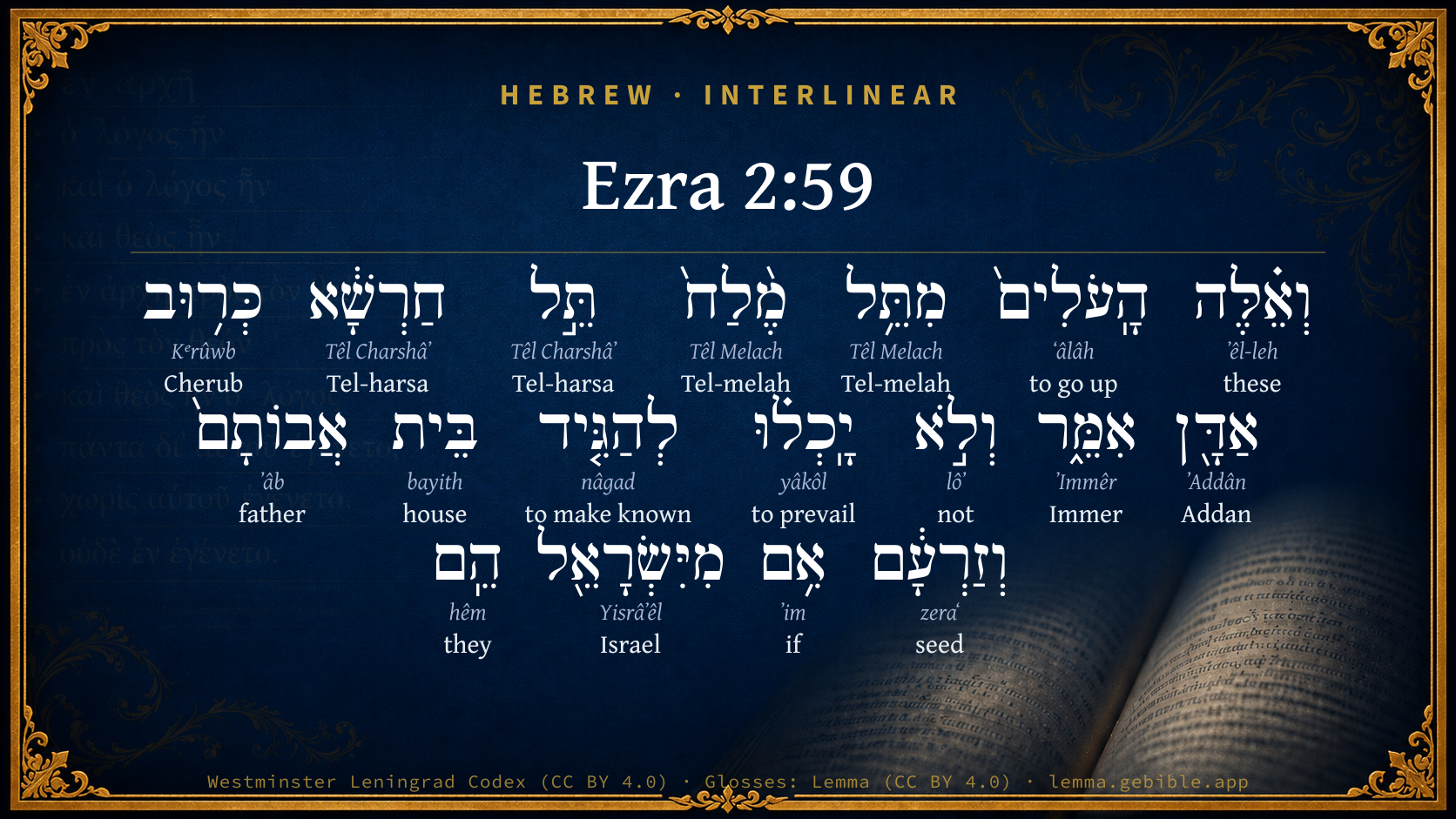
Ezra 2:59

Hebrew (Westminster Leningrad Codex) Ezra 2:59 appears in the Hebrew Old Testament. The text above is from the Westminster Leningrad Codex. Each word links to its Strong’s number, a concise gloss, and parsing drawn from the Open Scriptures Hebrew Bible morphology. Click any word for its full Brown-Driver-Briggs (BDB) entry.
Download image
Cite this verse

Ezra 2:59 (World English Bible). Public Domain. Lemma interlinear Bible study tool, https://lemma.gebible.app/v/ezra/2/59.

Show BibTeX & RIS
BibTeX
RIS
English Translation
These were those who went up from Tel-melah, Tel Harsha, Cherub, Addan, [and] Immer; but they could not show their fathers' houses, and their seed, whether they were of Israel:
World English Bible · Public Domain
Highlights
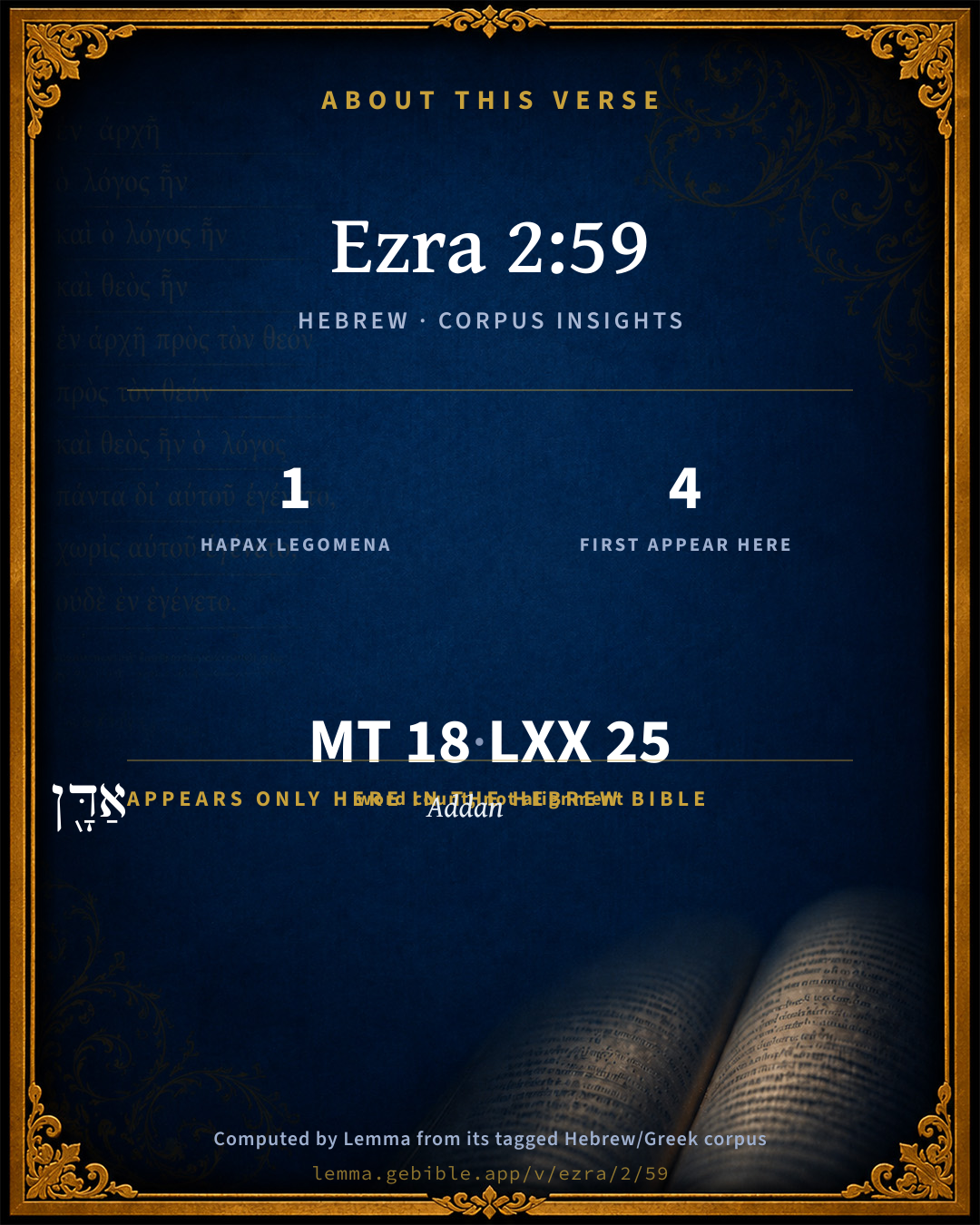
  • 1 hapax legomenon — only here in the Hebrew Bible
  • 4 first appearances in the Hebrew Bible
Full analysis ↓
Download a study sheet

One document with this verse’s original text, its word-by-word gloss line, the meaning frame, cross-references with their text, attributed commentary, and full source and license credits — printable, and it pastes into notes with its structure intact.

This verse Autodidact and up

Study sheet (.html) Plain text (.txt)

A passage Seminary Student

Up to 50 verses in one chapter. A passage sheet keeps up to 6 commentary sources and 12 cross-references per verse, in the order this page ranks them, and says so on the sheet whenever that leaves anything out. Ask for a single verse and you get the Autodidact verse sheet above.

Everything on this page stays free to read, with no account — the sheet is a download of what is already on screen, not access to it.

Want to remove ads? Support Godless Engineer
Compare translations 3

The same verse in 3 English versions, stacked beneath the original-language interlinear above. Click any original word for its lexicon entry.

Each is an independent rendering of the whole verse — the interlinear is not word-aligned to these translations.

Highlighted words mark where these versions differ — a whole-verse word diff, not a word-by-word alignment.

  • World English Bible Public Domain
    These were those who went up from Tel-melah, Tel Harsha, Cherub, Addan, [and] Immer; but they could not show their fathers' houses, and their seed, whether they were of Israel:
  • King James Version Public Domain
    And these were they which went up from Telmelah, Telharsa, Cherub, Addan, and Immer: but they could not shew their father's house, and their seed, whether they were of Israel:
  • unfoldingWord Literal Text CC BY-SA 4.0
    And these were the ones who went up from Tel Melah, Tel Harsha, Kerub, Addon, and Immer; but they were not able to tell the house of their fathers or their seed, whether they were from Israel.

unfoldingWord Literal Text — © unfoldingWord, licensed CC BY-SA 4.0. Word-aligned USFM3 via Door43 (git.door43.org/unfoldingWord/en_ult).

Versions to compare (up to 4)

3 of 4 selected

Show all 18 translations

Every available English version of this verse, each an independent rendering of the whole verse.

  • World English Bible Public Domain
    These were those who went up from Tel-melah, Tel Harsha, Cherub, Addan, [and] Immer; but they could not show their fathers' houses, and their seed, whether they were of Israel:
  • Berean Standard Bible Public Domain
    The following came up from Tel-melah, Tel-harsha, Cherub, Addan, and Immer, but could not prove that their families were descended from Israel:
  • Majority Standard Bible Public Domain
    The following came up from Tel-melah, Tel-harsha, Cherub, Addan, and Immer, but they could not prove that their families were descended from Israel:
  • King James Version Public Domain
    And these were they which went up from Telmelah, Telharsa, Cherub, Addan, and Immer: but they could not shew their father's house, and their seed, whether they were of Israel:
  • American Standard Version (1901) Public Domain
    And these were they that went up from Tel-melah, Tel-harsha, Cherub, Addan, `and' Immer; but they could not show their fathers' houses, and their seed, whether they were of Israel:
  • Revised Version (1885) Public Domain
    And these were they which went up from Tel-melah, Tel-harsha, Cherub, Addan, and Immer: but they could not shew their fathers’ houses, and their seed, whether they were of Israel:
  • Geneva Bible (1599) Public Domain
    And these went vp from Telmelah, and from Telharsha, Cherub, Addan, and Immer, but they could not discerne their fathers house and their seede, whether they were of Israel.
  • Douay-Rheims (1899) Public Domain
    And these are they that came up from Thelmela, Thelharsa, Cherub, and Adon, and Emer. And they could not shew the house of their fathers and their seed, whether they were of Israel.
  • Young's Literal Translation Public Domain
    And these `are' those going up from Tel-Melah, Tel-Harsa, Cherub, Addan, Immer, and they have not been able to declare the house of their fathers, and their seed, whether they `are' of Israel:
  • Literal Standard Version CC BY-SA 4.0
    And these [are] those going up from Tel-Melah, Tel-Harsa, Cherub, Addan, Immer, and they have not been able to declare the house of their fathers, and their seed, whether they [are] of Israel:
  • Unlocked Literal Bible CC BY-SA 4.0
    Those who left Tel Melah, Tel Harsha, Kerub, Addon, and Immer—but were not able to prove their ancestry from Israel
  • unfoldingWord Literal Text CC BY-SA 4.0
    And these were the ones who went up from Tel Melah, Tel Harsha, Kerub, Addon, and Immer; but they were not able to tell the house of their fathers or their seed, whether they were from Israel.
  • Darby Bible Public Domain
    And these are they that went up from Tel-melah, Tel-harsha, Cherub-Addan, Immer; but they could not shew their fathers' house, nor their seed, whether they were of Israel.
  • World Messianic Bible Public Domain
    These were those who went up from Tel Melah, Tel Harsha, Cherub, Addan, and Immer; but they could not show their fathers’ houses and their offspring, whether they were of Israel:
  • Webster's Bible Public Domain
    And these were they who went up from Tel-melah, Tel-harsa, Cherub, Addan, and Immer: but they could not show their fathers' house, and their seed, whether they were of Israel:
  • Free Bible Version CC BY-SA 4.0
    Those who came from the towns of Tel-melah, Tel-harsha, Kerub, Addan, and Immer could not prove their family genealogy, or even that they were descendants of Israel.
  • Bible in Basic English Public Domain
    And these were the people who went up from Tel-melah, Tel-harsha, Cherub, Addan, and Immer. But having no knowledge of their fathers' families or offspring, it was not certain that they were Israelites;
  • JPS Tanakh (1917) Public Domain
    And these were they that went up from Tel-melah, Tel-harsa, Cherub, Addan, and Immer; but they could not tell their fathers' houses, and their seed, whether they were of Israel:

Literal Standard Version (2020), Covenant Press — licensed CC BY-SA 4.0. Text via the HelloAO Bible API (eBible.org). Unlocked Literal Bible (unfoldingWord) — licensed CC BY-SA 4.0. Text via the HelloAO Bible API (eBible.org). unfoldingWord Literal Text — © unfoldingWord, licensed CC BY-SA 4.0. Word-aligned USFM3 via Door43 (git.door43.org/unfoldingWord/en_ult). Free Bible Version, Dr. Jonathan Gallagher — licensed CC BY-SA 4.0. Text via the HelloAO Bible API (eBible.org).

Word by word

More ways to search: Search by grammar → Find every occurrence → Compare this word →

Practice this passage: Drill this verse → Learn its vocabulary →

אַדָּ֖ן
ʼAddân
H135
“Addan”
Noun, Proper
Part of Speech
Noun
Type
Proper
Full BDB Definition

Origin: intensive from the same as H134

TWOT: None

Addan = "strong, firm" - place in Babylon, from which exiles returned
  1. וְאֵ֗לֶּה ʼêl-leh H428 “and · these” Conjunction + Pronoun, Demonstrative, Common, Plural
  2. הָֽעֹלִים֙ ʻâlâh H5927 “the · going up” Particle, Definite Article + Verb, Qal, Participle Active, Masculine, Plural, Absolute
  3. מִתֵּ֥ל Têl Melach H8528 “from · Tel-melah” Preposition + Noun, Proper
  4. מֶ֨לַח֙ Têl Melach H8528 “Tel-melah” Noun, Proper
  5. תֵּ֣ל Têl Charshâʼ H8521 “Tel-harsa” Noun, Proper
  6. חַרְשָׁ֔א Têl Charshâʼ H8521 “Tel-harsa” Noun, Proper
  7. כְּר֥וּב Kᵉrûwb H3743 “Cherub” Noun, Proper
  8. אִמֵּ֑ר ʼImmêr H564 “Immer” Noun, Proper
  9. וְלֹ֣א lôʼ H3808 “and · not” Conjunction + Particle, Negative
  10. יָֽכְל֗וּ yâkôl H3201 “to prevail” Verb, Qal, Perfect, 3rd Person, Common, Plural
  11. לְהַגִּ֤יד nâgad H5046 “to make known” Preposition + Verb, Hiphil, Infinitive Construct
  12. בֵּית bayith H1004 “house of” Noun, Common, Masculine, Singular, Construct
  13. אֲבוֹתָם֙ ʼâb H1 “fathers · their” Noun, Common, Masculine, Plural, Construct + Suffix, Personal, 3rd Person, Masculine, Plural
  14. וְזַרְעָ֔ם zeraʻ H2233 “and · seed · their” Conjunction + Noun, Common, Masculine, Singular, Construct + Suffix, Personal, 3rd Person, Masculine, Plural
  15. אִ֥ם ʼim H518 “if” Conjunction
  16. מִיִּשְׂרָאֵ֖ל Yisrâʼêl H3478 “from · Israel” Preposition + Noun, Proper
  17. הֵֽם hêm H1992 “they” Pronoun, Personal, 3rd Person, Masculine, Plural

About this verse

These counts appear in no published source. They are computed here, from the morphology-tagged text and Lemma’s own curated glosses. What Lemma adds →

18
words
16
distinct lemmas
Historical
section

Notable vocabulary

1 hapax legomenon — a word that appears only here in the entire Hebrew Bible:

  • אַדָּ֖ן Addan H135

First appearance in Scripture

These words make their first canonical appearance in the Hebrew Bible here:

  • מִתֵּ֥ל Tel-melah H8528
  • תֵּ֣ל Tel-harsa H8521
  • כְּר֥וּב Cherub H3743
  • אַדָּ֖ן Addan H135

Shared distinctive vocabulary

כְּר֥וּב Cherub H3743 occurs in 2 verses of the Hebrew Bible. Also found in:

Grammatical profile

  • 3 verbs
  • 11 nouns
  • 2 pronouns
  • 1 conjunction
  • 1 particle

Verb forms

  • הָֽעֹלִים֙ Qal · Participle Active
  • יָֽכְל֗וּ Qal · Perfect
  • לְהַגִּ֤יד Hiphil · Infinitive Construct

Repetition

Words recur within this verse — often emphatic in Hebrew:

  • מִתֵּ֥ל Tel-melah H8528 ×2
  • תֵּ֣ל Tel-harsa H8521 ×2

Hebrew & Septuagint length

In English translation the verse runs 30 words from the Hebrew and 33 from the Septuagint (LXX English) — closely comparable.

A rough comparison of the two English renderings, which tokenize alike — not a word-level alignment.

Word counts can differ between the Hebrew and the Greek without any difference in meaning — e.g. the Hebrew direct-object marker אֵת has no separate Greek word, and Greek often adds the article ὁ.

In the original languages it is 18 Hebrew tokens and 25 Greek tokens — but the two are counted differently (Hebrew bundles its prefixes and suffixes into one token; the Greek is in lemma form), so that isn’t a like-for-like length.

Cross-references

1

Topical passages linked to Ezra 2:59 in the Treasury of Scripture Knowledge — connected by theme and wording, ordered by reader-vote popularity; previews shown in the World English Bible.

  • Nehemiah 7:61 These were those who went up from Tel-melah, Tel Harsha, Cherub, Addon, and Immer; but they could not show their fathers' houses, nor their seed, whether they were of Israel:

Cross-references courtesy of OpenBible.info (CC BY 4.0).

Hebrew and Greek witnesses Masoretic Hebrew ↔ Greek Septuagint

The same verse in the two great witnesses to the Old Testament, shown verse-for-verse.

These are two independent witnesses, not word-aligned to each other, and the Septuagint is shown in lemma (dictionary) form.

Hebrew Ezra 2:59 Masoretic · Westminster Leningrad Codex

וְאֵ֗לֶּה הָֽעֹלִים֙ מִתֵּ֥ל מֶ֨לַח֙ תֵּ֣ל חַרְשָׁ֔א כְּר֥וּב אַדָּ֖ן אִמֵּ֑ר וְלֹ֣א יָֽכְל֗וּ לְהַגִּ֤יד בֵּית אֲבוֹתָם֙ וְזַרְעָ֔ם אִ֥ם מִיִּשְׂרָאֵ֖ל הֵֽם

These were those who went up from Tel-melah, Tel Harsha, Cherub, Addan, [and] Immer; but they could not show their fathers' houses, and their seed, whether they were of Israel:

World English Bible · Public Domain

Greek LXX Ezra 2:59 Septuagint · lemma form

καί οὗτος ὁ ἀναβαίνω ἀπό θελμελεθ θελαρησα χαρουβ ηδαν εμμηρ καί οὐ δύναμαι ὁ ἀναἀγγέλλω οἶκος πατριά αὐτός καί σπέρμα αὐτός εἰ ἐκ ἰσραήλ εἰμί

And these are they that went up from Thelmelech, Thelaresa, Cherub, Hedan, Emmer: and they were not able to tell the house of their fathers, and their seed, whether they were of Israel:

LXX2012 (modern English Septuagint) · Public Domain

In the Septuagint this is one book — Esdras B (2 Esdras): Ezra is chapters 1–10, Nehemiah 11–23.

Hebrew: Westminster Leningrad Codex (CC BY 4.0). Greek: Septuagint (public domain); English from LXX2012 (modern English Septuagint) (Public Domain). How the Septuagint differs from the Hebrew →

Commentary

Notes on Ezra 2:59 from classic Christian and Jewish commentators (each source and its license shown beneath its notes). The classic Christian expositions comment on the surrounding passage and are grouped to its opening verse, so a note may address several verses; the Jewish commentaries on the Tanakh (Rashi and others) are per-verse, so they appear only where the commentator wrote on this verse.

Lemma curates 59 commentaries, every one of them public domain or Creative Commons licensed, each selected and text-cleaned for this edition rather than reprinted as found. About our sources →

Trapp's Complete Commentary

John Trapp

Ezr 2:59 And these [were] they which went up from Telmelah, Telharsa, Cherub, Addan, [and] Immer: but they could not shew their father’s house, and their seed, whether they [were] of Israel:

Ver. 59. And these were they which went up from Telmelah, Telharsa, Cherub, &c.] Places in Chaldaea where these Jews were scattered; as at this day their posterity are up and down in Turkey, and some parts of Christendom, a dejected and despised people.

John Trapp, A Commentary or Exposition upon All the Books of the Old and New Testament (1647–1656) — public domain. Text from a community e-Sword module.

Joseph Benson's Commentary

Ezr 2:59. Which went up from Tel-melah, &c. — These were names of some cities in the Babylonish empire, from whence many went along with the Jews to Judea. They were of the Jewish religion, and probably were the children of those who had been carried captive before the general captivity; but they had lost their genealogies, and could not show from what families they were derived, and therefore could not obtain any certain possession in Judea, as those did who knew and could show to what family and city they belonged.

Joseph Benson's Commentary on the Old and New Testaments (1811–1818) — public domain. Text from a community e-Sword module.

Keil & Delitzsch

C. F. Keil & F. Delitzsch

Those who went up with, but could not prove that they pertained to, the nation of Israel. Comp. Neh 7:61 and Neh 7:62. - Three such families are named, consisting of 652, or according to Nehemiah of 642, persons. These went up, with those who returned, from Tel-melah (Salthill) and Tel-harsa (Thicket or Forest Hill), names of Babylonian districts or regions, the situations of which cannot be ascertained. The words also which follow, אמּר אדּן כּרוּב, are obscure, but are certainly not the names of individuals, the persons who went up not being specified till Ezr 2:60. The words are names of places, but it is uncertain whether the three are used to express one or three places. In favour of the notion that they designate but one locality, may be alleged that in Ezr 2:60 only three races are named, which would then correspond with the districts named in Ezr 2:59 : Tel-melah, Tel-harsa, and Cherub-Addan-Immer; a race from each district joining those who went up to Jerusalem. The three last words, however, may also designate three places in close proximity, in which one of the races of Ezr 2:60 might be dwelling. These could not show their father's house and their seed, i.e., genealogy, whether they were of Israel. הם, as well as the suffixes of זרעם and בּית־אבותם, refers to the persons named in Ezr 2:60. They could not show that the houses of Delaiah, Tobiah, and Nekoda, after which they were called, belonged to Israel, nor that they themselves were of Israelitish origin. Cler. well remarks: Judaicam religionem dudum sequebantur, quam ob rem se Judaeos censebant; quamvis non possent genealogicas ullas tabulas ostendere, ex quibus constaret, ex Hebraeis oriundos esse. One of these names, Nekoda, Ezr 2:48, occurring among those of the Nethinim, Bertheau conjectures that while the sons of Nekoda here spoken of claimed to belong to Israel, the objection was made that they might belong to the sons of Nekoda mentioned Ezr 2:48, and ought therefore to be reckoned among the Nethinim. Similar objections may have been made to the two other houses. Although they could not prove their Israelite origin, they were permitted to go up to Jerusalem with the rest, the rights of citizenship alone being for the present withheld. Hence we meet with none of these names either in the enumeration of the heads and houses of the people, Neh 10:15-28, or in the list Ezra 10:25-43.

Keil & Delitzsch — Biblical Commentary on the Old Testament (1861–1891) — public domain (CC PDM 1.0). Text via the HelloAO Bible API. (Old Testament only.)

Tyndale Open Study Notes

Tyndale Open Resources

2:59-60 Some returnees believed in Israel’s God but had no genealogical records to prove that they were Israelites. Without this information, the other Israelites did not know whether to treat them as brothers and intermarry with them or to treat them as outsiders. The genealogies in 1 Chr 1–9 illustrate how carefully many family histories were kept.

Tyndale Open Study Notes — © Tyndale Open Resources, licensed CC BY-SA 4.0. Text via the HelloAO Bible API.

Ellicott's Commentary for English Readers

(59-63) Finally, those who had lost the records of their lineage are mentioned. Of the people, the children of three families from Tel-melah, Hill of salt, Tel-harsa, Hill of the wood, and a few other places, are mentioned. Of the priests, there are also three families without their genealogy.

A Bible Commentary for English Readers, edited by Charles John Ellicott (1878–1897) — public domain. Text from a community e-Sword module.

The Cambridge Bible for Schools and Colleges

gen. ed. J. J. S. Perowne

59–63. Israelites and Priests of uncertain genealogy

59. Tel-melah, Tel-harsa] R.V., Tel-melah, Tel-harsha i.e. Salthill and Forest-hill, probably names of localities in Babylonia.

Cherub, Addan, and Immer] These are names not of people, but, in all probability, of three villages in one district of Babylonia. Rawlinson suggests that Cherub is the Cheripha of Ptolemy, and that Tel-melah is Telme.

There are then three districts, Tel-melah, Tel-harsa, and Cherub-Addan-Immer, from which came the three families Delaiah, Tobiah and Nekoda.

Addan] appears in Neh_7:59 ‘Addon’.

their fathers’ house] their fathers’ houses R.V. They were able to show their recent ancestry, but not their descent from the great clans or households into which the tribes were divided. They could not prove either of the two greatest essentials in a Jewish genealogy, their place in the household or their membership in a tribe.

This technical failure to produce their genealogy probably deprived them of the full rights of citizenship. They were not refused participation in the Return. But the names do not appear in later lists, Ezr_10:25-43; Neh_10:1-27.

The Cambridge Bible for Schools and Colleges (gen. ed. J. J. S. Perowne; Cambridge University Press, 1878–1918) — public domain. Text from a community e-Sword module.

John Gill's Exposition

These sought their register among those that were reckoned by genealogy,.... To find their names written and registered there; for the Jews kept public registers of their priests, their descent, marriages, and offspring, that it might be known who were fit, and who not, to officiate as such:

but they were not found; their names were not there, nor any account taken of them:

therefore were they, as polluted, put from the priesthood; were not suffered to attend at the altar, and offer sacrifice, and enjoy the privileges belonging to that office.

John Gill's Exposition of the Whole Bible (1746–1763) — public domain (CC PDM 1.0). Text via the HelloAO Bible API.

Albert Barnes' Notes on the Bible

Tel-melah, Tel-harsa, Cherub, Addan, and Immer, were probably cities, or villages, of Babylonia, at which the Jews here spoken of had been settled. The first and third have been reasonably identified with the Thelme and Chiripha of Ptolemy. Of the rest, nothing is known at present.

Albert Barnes' Notes on the Bible (1834–1885) — public domain. Text from a community e-Sword/MySword module.

Haydock's Catholic Bible Commentary

Thelmela, "the height of Mela, or of salt." The river Melas empties itself into the Euphrates. (Strabo xii.) --- The cities here mentioned were in Chaldea. Some of the ten tribes had probably been transported into Cappadocia, where Herodotus (ii. 35,) place some circumcised Syrians. --- Thelharsa, or Thelassar, 4 Kings xix. 12. --- Cherub, &c., were cities of Chaldea, (Tirinus) or chief men; but as they had been carried away by Theglathphalassar, they had lost their genealogies, and could only produce circumcision as a proof that they were Israelites.

George Leo Haydock (1774–1849), Haydock's Catholic Family Bible and Commentary, 1859 edition — public domain. Excludes Psalms (Douay-Rheims chapter numbering differs from Protestant) and Deuterocanonical books (Catholic canon only).

Matthew Poole's English Annotations

Tel-mela, Tel-harsa; the names of the places whence they came, and where they had lived in the time of their captivity.

Cherub, Addan, and Immer; the names either of the heads of the families living in the places last mentioned, or of other places where the persons here understood had dwelt.

Matthew Poole's English Annotations on the Holy Bible (1683–1685) — public domain. Text from a community e-Sword/MySword module.

Whedon's Commentary on the Bible

Daniel D. Whedon

59. Tel-melah, Tel-harsa, Cherub, Addan, Immer — These are the names of cities or districts in Chaldea, but they have not been identified with modern sites. Some take the last three to be names of persons.

Daniel D. Whedon (gen. ed.), Commentary on the Old and New Testaments (1874–1909) — public domain. Text from a community e-Sword module.

The Pulpit Commentary

Tel-melah is probably the Thelme of Ptolemy ("Geograph.," 5:20), a city of Lower Babylonia, situated in the salt tract near the Persian Gulf. Hence the name, which means "Hill of Salt." Cherub is no doubt Ptolemy"s Chiripha, which was in the same region. The other places here mentioned are unknown to us, but probably belonged to the same tract of country. Tel-Harsa means "Hill of the Wood." They could not show their father"s house. It is more surprising that so many of the returning exiles had preserved their genealogies than that a certain number had omitted to do so. Considering the duration of the exile, its hardships, and the apparent improbability of a restoration, there could have been no cause for wonder if the great majority had forgotten their descent.

The Pulpit Commentary (1880–1919), ed. H.D.M. Spence-Jones & Joseph S. Exell — public domain. Text from a community e-Sword module.

Kretzmann's Popular Commentary

Paul E. Kretzmann

The People and the Priests Without Genealogy

v. 59. And these were they which went up from Tel-melah, Tel-harsa, Cherub, Addan, and Immer, probably all cities in a province of Babylonia; but they could not show their father’s house, their genealogical tables had been lost, and they could not say to which father-house in Israel their forefathers had belonged, and their seed, their pedigree, their descent, whether they were of Israel:

v. 60. the children of Delaiah, the children of Toblah, the children of Nekoda, six hundred fifty and two. They were not mere adventurers, but had been urged to join the company of returning exiles by their loyalty to Jehovah, even though their family records were lost.

v. 61. And of the children of the priests: the children of Habaiah, the children of Koz, the children of Barzillai, which took a wife of the daughters of Barzillai the Gileadite and was called after their name, 2Sa 17:27. It is supposed that this man of priestly descent married the woman because she was an heiress and assumed her name. In this way his connection with the tribe of Levites was lost sight of. Worldly ambition forfeited the dignity of the priesthood.

v. 62. These sought their register among those that were reckoned by genealogy, but they were not found, they were unable to bring the documentary proof of their priestly descent; therefore were they, as polluted, put from the priesthood, they were excluded from the holy office because their descent was doubtful.

v. 63. And the Tirshatha, the governor of the province, said unto them that they should not eat of the most holy things till there stood up a priest with Urim and with Thummim, Exo 28:30; Num 27:21, that is, a high priest sanctioned by God to give decisions by consulting the Lord in the ancient manner, in infallible Revelation s. Because the matter was in doubt, this was a decision of discretion.

v. 64. The whole congregation together was forty and two thousand three hundred and threescore. This number is twelve thousand greater than the sum of the numbers, for to the returning exiles must be added the few remaining Jews and even such from Egypt as promptly gathered when they found that the ancient worship would be restored. It was a small flock that came together in Jerusalem and vicinity, but it represented the true worship of Jehovah in those days, the visible Church of God.

Paul E. Kretzmann, Popular Commentary of the Bible (1921–1924) — public domain. Text from a community e-Sword module.

unfoldingWord translationNotes

Door43 World Missions Community

General Information:

This is a list of people who had returned to Israel from various Babylonian cities but could not prove their heritage. (See: Numbers and How to Translate Names)

Tel Melah, Tel Harsha, Kerub, Addon, and Immer

These are the names of places in Babylon that no longer exist. (See: How to Translate Names)

652 descendants

"six hundred and fifty-two descendants." (See: Numbers)

Delaiah, Tobiah, and Nekoda

These are men's names. (See: How to Translate Names)

translationWords

descend

unfoldingWord translationNotes — © Distant Shores Media and the Door43 World Missions Community, licensed CC BY-SA 4.0. Source: git.door43.org/Door43/en_tn.

Rashi

Rabbi Shlomo Yitzchaki (Rashi)

And these were the ones who ascended from Tel-Mela, etc. And what incident happened to them? They could not tell....

and their children [i.e., the children] of their fathers, because they lost their genealogical records and did not know if they were Israelites.

Rashi on the Tanakh — English translations: “The Judaica Press complete Tanach with Rashi, translated by A. J. Rosenberg” (CC BY 4.0); “Pentateuch with Rashi's commentary by M. Rosenbaum and A.M. Silbermann, 1929-1934” (public domain); “The Metsudah Tanach series, Lakewood, N.J” (CC BY 4.0); and “The Book of Joshua, Metsudah Publications, 1997” (CC BY 4.0). Text via Sefaria.

Lesson kit

Teaching starters — assembled from the data on this page, not authored interpretation. Every prompt links to the verse data it draws on. Edit before teaching.

Ezra, in the Historical, opens this verse with 18 words (16 distinct Hebrew lemmas). Its most distinctive word is ʼAddân (“Addan”). A historical commentator’s framing appears above. Read the whole chapter for the surrounding context.

Discussion questions

  1. What does “Addan” (ʼAddân) contribute to the verse as a whole?
  2. This verse holds 1 word here found nowhere else in the Hebrew Bible. What might the rare word draw attention to?
  3. 4 words here appear for the first time in Scripture. What is being introduced at this debut?
  4. Nehemiah 7:61 shares the word «Cherub» with this verse. How do the two illuminate each other?
  5. “Tel-melah” occurs 2× in this one verse. What is the effect of the repetition?
  6. These translations render this verse differently. What is at stake in choosing one wording over another?
  7. The verb «הָֽעֹלִים֙» is Qal Participle Active. How does its form color the action?
  8. Reading how Trapp's Complete Commentary and Joseph Benson's Commentary read this verse, where do the two commentators agree and where do they part?

Things to notice

  • 1 word in this verse appears nowhere else in the Hebrew Bible.
  • 4 words make their first canonical appearance in Scripture here.
  • This verse counts 18 Hebrew ↔ 25 Greek words.
  • These translations choose different wording for 22 words in this verse.
  • “Tel-melah” occurs 2× in this single verse.

Reading settings

Reading text

Shown beneath each verse's original-language words.

Old Testament
Old Testament edition

Read the OT as the Masoretic Hebrew (MT) or the Greek Septuagint (LXX).

English shown for the Greek Septuagint (in the Hebrew ↔ Greek comparison).

Comparing translations? Open the Compare panel on any verse page to stack up to four side by side.