
Jeremiah 19:11

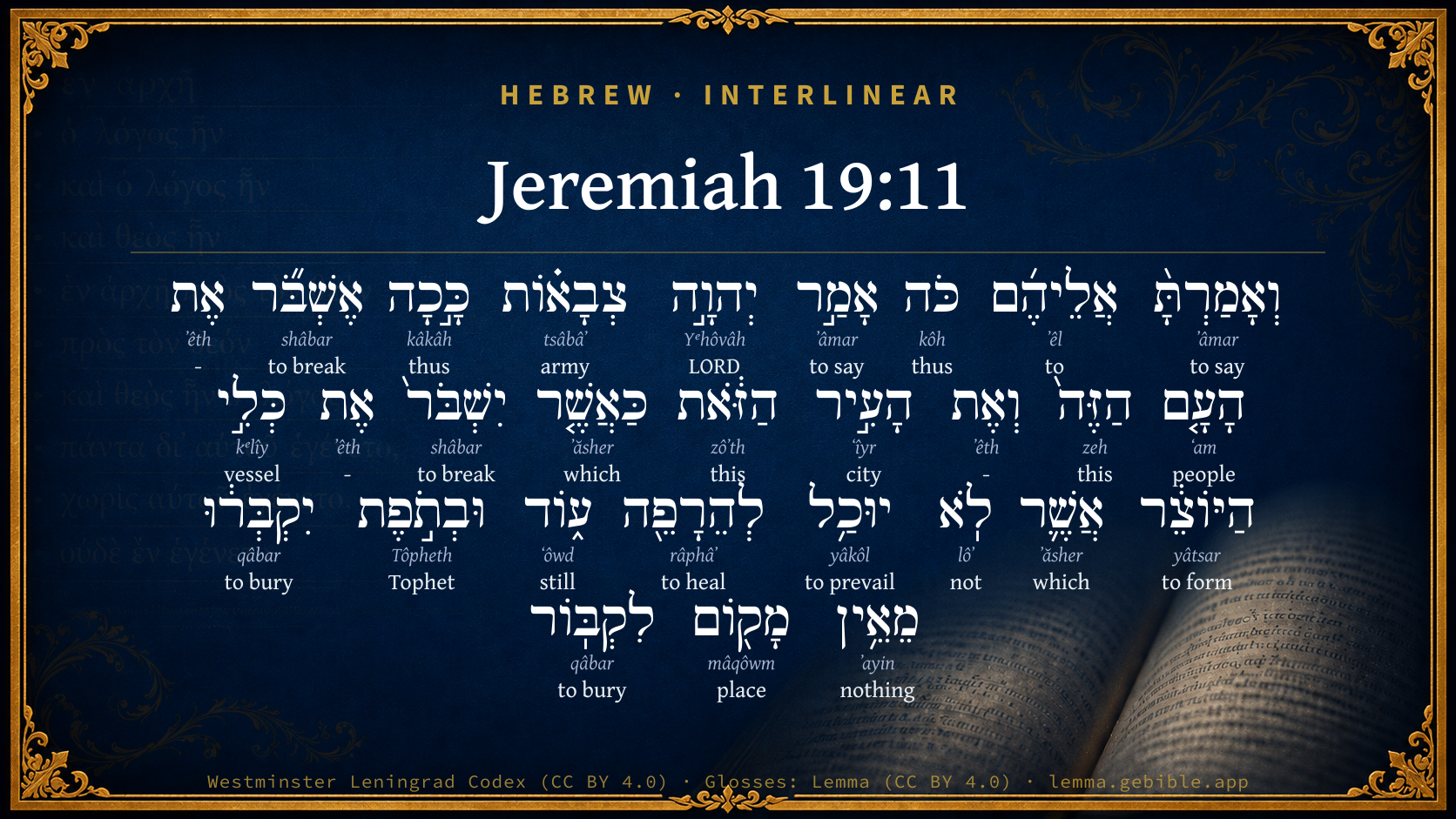
Hebrew (Westminster Leningrad Codex) Jeremiah 19:11 appears in the Hebrew Old Testament. The text above is from the Westminster Leningrad Codex. Each word links to its Strong’s number, a concise gloss, and parsing drawn from the Open Scriptures Hebrew Bible morphology. Click any word for its full Brown-Driver-Briggs (BDB) entry.
Download image
Cite this verse

Jeremiah 19:11 (World English Bible). Public Domain. Lemma interlinear Bible study tool, https://lemma.gebible.app/v/jeremiah/19/11.

Show BibTeX & RIS
BibTeX
RIS
English Translation
and shall tell them, Thus says Yahweh of Hosts: Even so will I break this people and this city, as one breaks a potter's vessel, that can't be made whole again; and they shall bury in Topheth, until there be no place to bury.
World English Bible · Public Domain
Download a study sheet

One document with this verse’s original text, its word-by-word gloss line, the meaning frame, cross-references with their text, attributed commentary, and full source and license credits — printable, and it pastes into notes with its structure intact.

This verse Autodidact and up

Study sheet (.html) Plain text (.txt)

A passage Seminary Student

Up to 50 verses in one chapter. A passage sheet keeps up to 6 commentary sources and 12 cross-references per verse, in the order this page ranks them, and says so on the sheet whenever that leaves anything out. Ask for a single verse and you get the Autodidact verse sheet above.

Everything on this page stays free to read, with no account — the sheet is a download of what is already on screen, not access to it.

Want to remove ads? Support Godless Engineer
Compare translations 3

The same verse in 3 English versions, stacked beneath the original-language interlinear above. Click any original word for its lexicon entry.

Each is an independent rendering of the whole verse — the interlinear is not word-aligned to these translations.

Highlighted words mark where these versions differ — a whole-verse word diff, not a word-by-word alignment.

  • World English Bible Public Domain
    and shall tell them, Thus says Yahweh of Hosts: Even so will I break this people and this city, as one breaks a potter's vessel, that can't be made whole again; and they shall bury in Topheth, until there be no place to bury.
  • King James Version Public Domain
    And shalt say unto them, Thus saith the LORD of hosts; Even so will I break this people and this city, as one breaketh a potter's vessel, that cannot be made whole again: and they shall bury them in Tophet, till there be no place to bury.
  • unfoldingWord Literal Text CC BY-SA 4.0
    And you shall say to them, ‘Thus says Yahweh of Armies: Thus I will break this people and this city, as one breaks a vessel of the potter that is not able to be made whole again. And in Topheth they will bury, until there is no place to bury.

unfoldingWord Literal Text — © unfoldingWord, licensed CC BY-SA 4.0. Word-aligned USFM3 via Door43 (git.door43.org/unfoldingWord/en_ult).

Versions to compare (up to 4)

3 of 4 selected

Show all 18 translations

Every available English version of this verse, each an independent rendering of the whole verse.

  • World English Bible Public Domain
    and shall tell them, Thus says Yahweh of Hosts: Even so will I break this people and this city, as one breaks a potter's vessel, that can't be made whole again; and they shall bury in Topheth, until there be no place to bury.
  • Berean Standard Bible Public Domain
    and you are to proclaim to them that this is what the LORD of Hosts says: I will shatter this nation and this city, like one shatters a potter’s jar that can never again be repaired. They will bury the dead in Topheth until there is no more room to bury them.
  • Majority Standard Bible Public Domain
    and you are to proclaim to them that this is what the LORD of Hosts says: I will shatter this nation and this city, like one shatters a potter’s jar that can never again be repaired. They will bury the dead in Topheth until there is no more room to bury them.
  • King James Version Public Domain
    And shalt say unto them, Thus saith the LORD of hosts; Even so will I break this people and this city, as one breaketh a potter's vessel, that cannot be made whole again: and they shall bury them in Tophet, till there be no place to bury.
  • American Standard Version (1901) Public Domain
    and shalt say unto them, Thus saith Jehovah of hosts: Even so will I break this people and this city, as one breaketh a potter's vessel, that cannot be made whole again; and they shall bury in Topheth, till there be no place to bury.
  • Revised Version (1885) Public Domain
    and shalt say unto them, Thus saith the LORD of hosts: Even so will I break this people and this city, as one breaketh a potter’s vessel, that cannot be made whole again: and they shall bury in Topheth, till there be no place to bury.
  • Geneva Bible (1599) Public Domain
    And shalt say vnto them, Thus saith ye Lord of hostes, Euen so will I breake this people and this citie, as one breaketh a potters vessell, that cannot be made whole againe, and they shall bury them in Topheth till there be no place to bury.
  • Douay-Rheims (1899) Public Domain
    And thou shalt say to them: Thus saith the Lord of hosts: even so will I break this people, and this city, as the potter's vessel is broken, which cannot be made whole again: and they shall be buried in Topheth, because there is no other place to bury in.
  • Young's Literal Translation Public Domain
    and hast said unto them: Thus said Jehovah of Hosts, Thus do I break this people and this city, as one breaketh the potter's vessel, that is not able to be repaired again, and in Tophet they bury -- without place to bury;
  • Literal Standard Version CC BY-SA 4.0
    and have said to them, Thus said YHWH of Hosts: Thus I break this people and this city, as one breaks the potter’s vessel, that is not able to be repaired again, and in Tophet they bury—without place to bury;
  • Unlocked Literal Bible CC BY-SA 4.0
    You will say to them, 'Yahweh of hosts says this: I will do this same thing to this people and this city—this is Yahweh's declaration—just as Jeremiah shattered the clay flask so that it could not be repaired again. People will bury the dead in Topheth until there is no place left for any more dead.
  • unfoldingWord Literal Text CC BY-SA 4.0
    And you shall say to them, ‘Thus says Yahweh of Armies: Thus I will break this people and this city, as one breaks a vessel of the potter that is not able to be made whole again. And in Topheth they will bury, until there is no place to bury.
  • Darby Bible Public Domain
    and shalt say unto them, Thus saith Jehovah of hosts: Even so will I break this people and this city, as one breaketh a potter's vessel, that cannot be made whole again. And they shall bury in Topheth, till there be no place to bury.
  • World Messianic Bible Public Domain
    and shall tell them, ‘The LORD of Hosts says: “Even so I will break this people and this city as one breaks a potter’s vessel, that can’t be made whole again. They will bury in Topheth until there is no place to bury.
  • Webster's Bible Public Domain
    And shalt say to them, Thus saith the LORD of hosts; Even so will I break this people and this city, as one breaketh a potter's vessel, that cannot be made whole again: and they shall bury them in Tophet, till there be no place to bury.
  • Free Bible Version CC BY-SA 4.0
    Tell them, This is what the Lord Almighty says: I'm going to smash this nation and this city, just like a clay jar is smashed so it can't ever be repaired. People will bury their dead in Topheth until it's full.
  • Bible in Basic English Public Domain
    And say to them, This is what the Lord of armies has said: Even so will this people and this town be broken by me, as a potter's bottle is broken and may not be put together again: and the bodies of the dead will be put in the earth in Topheth, till there is no more room.
  • JPS Tanakh (1917) Public Domain
    and shalt say unto them: Thus saith the LORD of hosts: Even so will I break this people and this city, as one breaketh a potter's vessel, that cannot be made whole again; and they shall bury in Topheth, for want of room to bury.

Literal Standard Version (2020), Covenant Press — licensed CC BY-SA 4.0. Text via the HelloAO Bible API (eBible.org). Unlocked Literal Bible (unfoldingWord) — licensed CC BY-SA 4.0. Text via the HelloAO Bible API (eBible.org). unfoldingWord Literal Text — © unfoldingWord, licensed CC BY-SA 4.0. Word-aligned USFM3 via Door43 (git.door43.org/unfoldingWord/en_ult). Free Bible Version, Dr. Jonathan Gallagher — licensed CC BY-SA 4.0. Text via the HelloAO Bible API (eBible.org).

Word by word

More ways to search: Search by grammar → Find every occurrence → Compare this word →

Practice this passage: Drill this verse → Learn its vocabulary →

וּבְתֹ֣פֶת
Tôpheth
H8612
“and · in/at · Tophet”
Conjunction + Preposition + Noun, Proper
Part of Speech
Conjunction + Preposition + Noun
Type
Proper
Full BDB Definition

Origin: the same as H8611

TWOT: 2539

Tophet or Topheth = "place of fire"
  1. וְאָמַרְתָּ֨ ʼâmar H559 “and · to say” Conjunction + Verb, Qal, Sequential Perfect, 2nd Person, Masculine, Singular
  2. אֲלֵיהֶ֜ם ʼêl H413 “to · them” Preposition + Suffix, Personal, 3rd Person, Masculine, Plural
  3. כֹּה kôh H3541 “thus” Adverb
  4. אָמַ֣ר ʼâmar H559 “to say” Verb, Qal, Perfect, 3rd Person, Masculine, Singular
  5. יְהוָ֣ה Yᵉhôvâh H3068 “LORD” Noun, Proper
  6. צְבָא֗וֹת tsâbâʼ H6635 “armies” Noun, Common, Both, Plural, Absolute
  7. כָּ֣כָה kâkâh H3602 “thus” Adverb
  8. אֶשְׁבֹּ֞ר shâbar H7665 “to break” Verb, Qal, Imperfect, 1st Person, Common, Singular
  9. אֶת ʼêth H853 “-” Particle, Direct Object
  10. הָעָ֤ם ʻam H5971 “the · people” Particle, Definite Article + Noun, Common, Masculine, Singular, Absolute
  11. הַזֶּה֙ zeh H2088 “the · this” Particle, Definite Article + Pronoun, Demonstrative, Masculine, Singular
  12. וְאֶת ʼêth H853 “and · -” Conjunction + Particle, Direct Object
  13. הָעִ֣יר ʻîyr H5892 “the · city” Particle, Definite Article + Noun, Common, Feminine, Singular, Absolute
  14. הַזֹּ֔את zôʼth H2063 “the · this” Particle, Definite Article + Pronoun, Demonstrative, Feminine, Singular
  15. כַּאֲשֶׁ֤ר ʼăsher H834 “like/as · which” Preposition + Particle, Relative
  16. יִשְׁבֹּר֙ shâbar H7665 “to break” Verb, Qal, Imperfect, 3rd Person, Masculine, Singular
  17. אֶת ʼêth H853 “-” Particle, Direct Object
  18. כְּלִ֣י kᵉlîy H3627 “vessel of” Noun, Common, Masculine, Singular, Construct
  19. הַיּוֹצֵ֔ר yâtsar H3335 “the · forming” Particle, Definite Article + Verb, Qal, Participle Active, Masculine, Singular, Absolute
  20. אֲשֶׁ֛ר ʼăsher H834 “which” Particle, Relative
  21. לֹֽא lôʼ H3808 “not” Particle, Negative
  22. יוּכַ֥ל yâkôl H3201 “to prevail” Verb, Qal, Imperfect, 3rd Person, Masculine, Singular
  23. לְהֵרָפֵ֖ה râphâʼ H7495 “to heal” Preposition + Verb, Niphal, Infinitive Construct
  24. ע֑וֹד ʻôwd H5750 “still” Adverb
  25. יִקְבְּר֔וּ qâbar H6912 “to bury” Verb, Qal, Imperfect, 3rd Person, Masculine, Plural
  26. מֵאֵ֥ין ʼayin H369 “from · nothing” Preposition + Particle, Negative
  27. מָק֖וֹם mâqôwm H4725 “place” Noun, Common, Masculine, Singular, Absolute
  28. לִקְבּֽוֹר qâbar H6912 “to bury” Preposition + Verb, Qal, Infinitive Construct

About this verse

These counts appear in no published source. They are computed here, from the morphology-tagged text and Lemma’s own curated glosses. What Lemma adds →

29
words
23
distinct lemmas
Prophets
section

Notable vocabulary

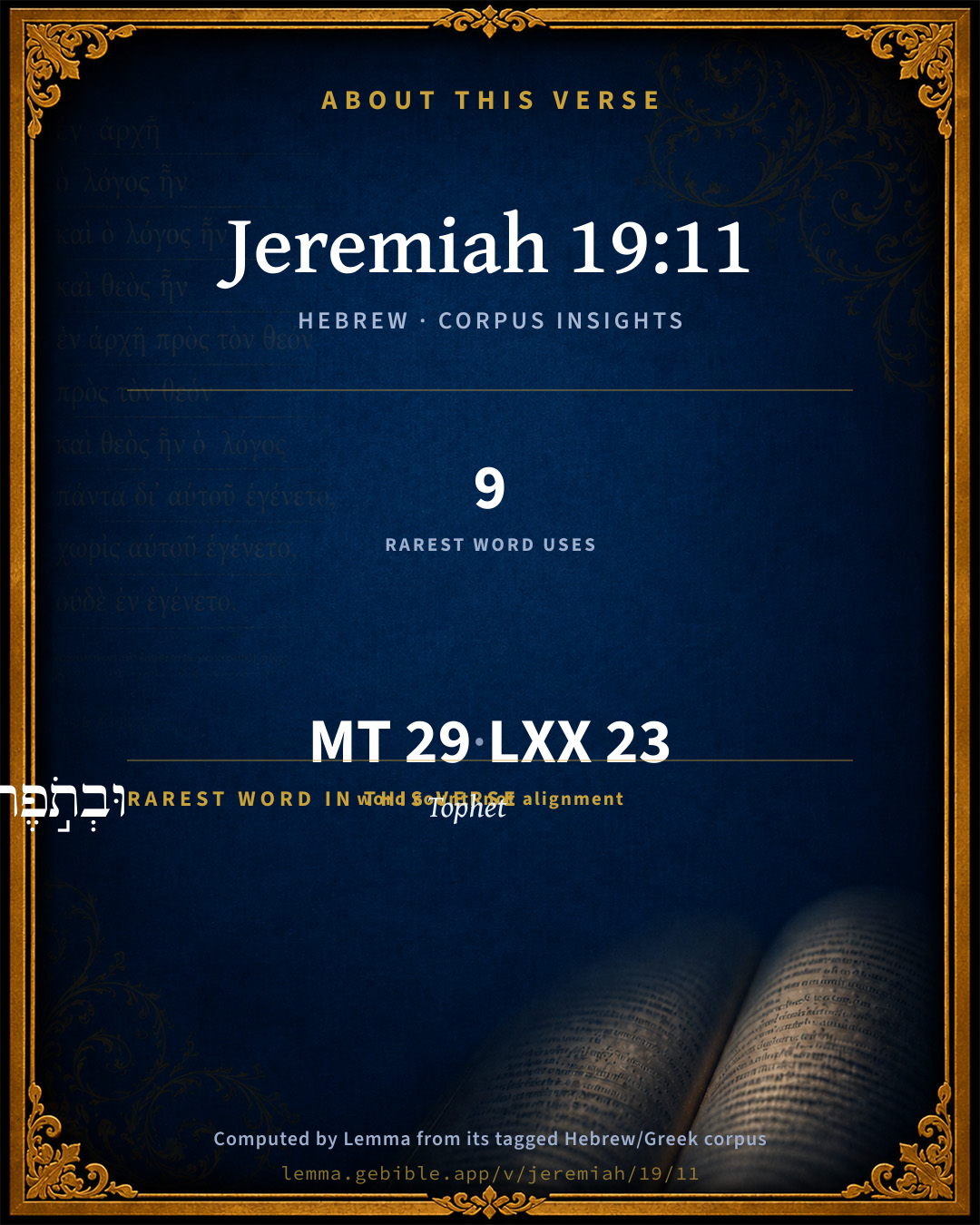
The rarest word here is וּבְתֹ֣פֶת Tophet H8612 — appearing just 9 times in the whole Hebrew Bible.

Shared distinctive vocabulary

וּבְתֹ֣פֶת Tophet H8612 occurs in 8 verses of the Hebrew Bible. Also found in:

Grammatical profile

  • 9 verbs
  • 7 nouns
  • 2 pronouns
  • 1 preposition
  • 3 adverbs
  • 7 particles

Verb forms

  • וְאָמַרְתָּ֨ Qal · Sequential Perfect
  • אָמַ֣ר Qal · Perfect
  • אֶשְׁבֹּ֞ר Qal · Imperfect
  • יִשְׁבֹּר֙ Qal · Imperfect
  • הַיּוֹצֵ֔ר Qal · Participle Active
  • יוּכַ֥ל Qal · Imperfect
  • לְהֵרָפֵ֖ה Niphal · Infinitive Construct
  • יִקְבְּר֔וּ Qal · Imperfect
  • לִקְבּֽוֹר Qal · Infinitive Construct

Repetition

Words recur within this verse — often emphatic in Hebrew:

  • וְאָמַרְתָּ֨ to say H559 ×2
  • אֶשְׁבֹּ֞ר to break H7665 ×2
  • יִקְבְּר֔וּ to bury H6912 ×2
  • כַּאֲשֶׁ֤ר which H834 ×2

Hebrew & Septuagint length

In the original languages it is 29 Hebrew tokens and 23 Greek tokens — but the two are counted differently (Hebrew bundles its prefixes and suffixes into one token; the Greek is in lemma form), so that isn’t a like-for-like length.

Cross-references

7

Topical passages linked to Jeremiah 19:11 in the Treasury of Scripture Knowledge — connected by theme and wording, ordered by reader-vote popularity; previews shown in the World English Bible.

  • Psalms 2:9 You shall break them with a rod of iron. You shall dash them in pieces like a potter's vessel."
  • Isaiah 30:14 He shall break it as a potter's vessel is broken, breaking it in pieces without sparing; so that there shall not be found among the pieces of it a broken piece with which to take fire from the hearth, or to dip up water out of the cistern."
  • Lamentations 4:2 The precious sons of Zion, comparable to fine gold, How are they esteemed as earthen pitchers, the work of the hands of the potter!
  • Jeremiah 13:14 I will dash them one against another, even the fathers and the sons together, says Yahweh: I will not pity, nor spare, nor have compassion, that I should not destroy them.
  • Revelation 2:27 He will rule them with a rod of iron, shattering them like clay pots; as I also have received of my Father:
  • Jeremiah 7:31–32 They have built the high places of Topheth, which is in the valley of the son of Hinnom, to burn their sons and their daughters in the fire; which I didn't command, neither came it into my mind.
  • Jeremiah 19:6 therefore, behold, the days come, says Yahweh, that this place shall no more be called Topheth, nor The valley of the son of Hinnom, but The valley of Slaughter.

Cross-references courtesy of OpenBible.info (CC BY 4.0).

Hebrew and Greek witnesses Masoretic Hebrew ↔ Greek Septuagint

The same verse in the two great witnesses to the Old Testament, shown verse-for-verse.

These are two independent witnesses, not word-aligned to each other, and the Septuagint is shown in lemma (dictionary) form.

Hebrew Jeremiah 19:11 Masoretic · Westminster Leningrad Codex

וְאָמַרְתָּ֨ אֲלֵיהֶ֜ם כֹּה אָמַ֣ר יְהוָ֣ה צְבָא֗וֹת כָּ֣כָה אֶשְׁבֹּ֞ר אֶת הָעָ֤ם הַזֶּה֙ וְאֶת הָעִ֣יר הַזֹּ֔את כַּאֲשֶׁ֤ר יִשְׁבֹּר֙ אֶת כְּלִ֣י הַיּוֹצֵ֔ר אֲשֶׁ֛ר לֹֽא יוּכַ֥ל לְהֵרָפֵ֖ה ע֑וֹד וּבְתֹ֣פֶת יִקְבְּר֔וּ מֵאֵ֥ין מָק֖וֹם לִקְבּֽוֹר

and shall tell them, Thus says Yahweh of Hosts: Even so will I break this people and this city, as one breaks a potter's vessel, that can't be made whole again; and they shall bury in Topheth, until there be no place to bury.

World English Bible · Public Domain

Greek LXX Structure differs

In the Septuagint, Jeremiah is about an eighth shorter than the Hebrew and arranges its material differently — the Oracles Against the Nations (Hebrew chapters 46–51) appear in the middle of the Greek book, after 25:13. Because the chapter and verse boundaries do not line up, a verse-for-verse comparison with the Hebrew is not shown.

A verse-for-verse comparison isn’t shown here because the chapters and verses don’t line up. Switch to the LXX edition with the MT / LXX toggle above to read the Greek directly.

On this verse, The Cambridge Bible for Schools and Colleges discusses the Septuagint’s reading. Read the note in Commentary ↓

Hebrew: Westminster Leningrad Codex (CC BY 4.0). Greek: Septuagint (public domain); English from a public-domain English Septuagint. How the Septuagint differs from the Hebrew →

Targum (Aramaic paraphrase)

1

The Targum is the ancient Jewish Aramaic paraphrase of the Hebrew Scriptures — an interpretive translation, not the Hebrew text itself. Onkelos (literal) and Pseudo-Jonathan (expansive) render the Torah, and Jonathan the Prophets. Coverage is partial: where no permissively-licensed English translation exists for a verse, only the Aramaic is shown. This is verse-level text, not a word-by-word alignment to the Hebrew.

  1. Targum Jonathan Prophets (Joshua–Malachi)
    וְתֵימַר לְהוֹן כִּדְנַן אֲמַר יְיָ צְבָאוֹת כְּדֵין אִתְּבַר יַת עַמָא הָדֵין וְיַת קַרְתָּא הָדָא כְּמָא דְמִתְּבַר יַת מָנָא דְפַחֲרָא דְלָא אֶפְשַׁר לְאִתַּסָאָה לֵיהּ עוֹד וּכְתוֹפֶת יִקְבְּרוּן מִבְּלִי אֲתַר לְמִקְבַּר:

    (no public-domain English translation for this verse)

    Targum Jonathan — Aramaic: “Mikraot Gedolot” (public domain). English: “Sefaria Community Translation” (CC0 1.0 (public-domain dedication)); “London "Chaldee Paraphrase," 1871” (public domain). Text via Sefaria.

Commentary

Notes on Jeremiah 19:11 from classic Christian and Jewish commentators (each source and its license shown beneath its notes). The classic Christian expositions comment on the surrounding passage and are grouped to its opening verse, so a note may address several verses; the Jewish commentaries on the Tanakh (Rashi and others) are per-verse, so they appear only where the commentator wrote on this verse.

Lemma curates 59 commentaries, every one of them public domain or Creative Commons licensed, each selected and text-cleaned for this edition rather than reprinted as found. About our sources →

Trapp's Complete Commentary

John Trapp

Jer 19:11 And shalt say unto them, Thus saith the LORD of hosts; Even so will I break this people and this city, as [one] breaketh a potter’s vessel, that cannot be made whole again: and they shall bury [them] in Tophet, till [there be] no place to bury.

Ver. 11. That cannot be made whole again.] Heb., Cured. No more was the Jewish state ever restored to its ancient dignity and lustre, after the captivity; neither was Tophet ever repaired at all, but served for a mortuary chapel, a place to lay dead men’s bones in.

John Trapp, A Commentary or Exposition upon All the Books of the Old and New Testament (1647–1656) — public domain. Text from a community e-Sword module.

Geneva Bible (1599)

Geneva Bible translators

This visible sign was to confirm them touching the assurance of this plague, which the Lord threatened by his prophet.

Geneva Bible (1599) marginal notes — public domain. Text via Bolls.life.

Jamieson, Fausset & Brown

Robert Jamieson, A. R. Fausset & David Brown

as one breaketh a potters vessel--expressing God's absolute sovereignty (Jer 18:6; Psa 2:9; Isa 30:14, Margin; Lam 4:2; Rom 9:20-21).

cannot be made whole again--A broken potter's vessel cannot be restored, but a new one may be made of the same material. So God raised a new Jewish seed, not identical with the destroyed rebels, but by substituting another generation in their stead [GROTIUS].

no place to bury-- (Jer 7:32).

Jamieson, Fausset & Brown — Commentary Critical and Explanatory on the Whole Bible (1871) — public domain (CC PDM 1.0). Text via the HelloAO Bible API.

Adam Clarke's Commentary

Verse 11. Even so will I break this people and this city] The breaking of the bottle was the symbolical representation of the destruction of the city and of the state.

That cannot be made whole again] This seems to refer rather to the final destruction of Jerusalem by the Romans, than to what was done by the Chaldeans. Jerusalem was healed after 70 years: but nearly 1800 years have elapsed since Jerusalem was taken and destroyed by the Romans; and it was then so broken, that it could not be made whole again.

Adam Clarke's Commentary on the Bible (1810–1826) — public domain. Text from a community e-Sword/MySword module.

John Calvin's Commentaries

The Prophet again confirms what he had shewn by the external symbol, and he does this by a new coremtrod from God. We know that signs are wholly useless when the word of God does not shine forth, as we see that superstitious men always practice many ceremonies, but they are only histrionic acts. But God never commanded his prophets to shew any sign without adding doctrine to it. This is what we see was done on this occasion; for Jeremiah spoke against impious superstitions, and as a celestial herald denounced punishment; he then sealed the prophecy by breaking the bottle, and a repetition of the doctrine follows again, Thus shalt thou say to them. This is not said of the Prophet’s companions, the pronoun is without an antecedent, but the whole reople are the persons referred to.

Thus saith Jehovah, I will so break this people and this city. He mentions the city, in which they thought they had an impregnable fortress, because the temple of God was there. But as they had profaned the temple and polluted the city with their crimes, Jeremiah reminded them that no confidence or hope was to be placed in the city. Then he says, As one breaks a vessel which cannot be repaired, etc. Here again he shows that they were wholly to perish, so as no more to rise again. We indeed know that sometimes those who are most grievously afflicted retain some remnants of strength, and are at length restored to their former vigor; but the Prophet shews that the approaching calamity would be wholly irremediable. It is no objection to say, that God a. fterwards restored the people, and that the city and the temple were rebuilt, for all this was nothing to the ungodly men of that age, as their memory wholly perished. A curse and God’s vengeance remained on the heads of those who thus continued obstinate in their wickedness; and hence those who returned from exile are said in Psalm 102:19, to have been a people created again, as though they rose up as new men,

“A people, who shall be created, shall praise the Lord.”

He then says, Buried shall they be, in Tophet, for there will be no place elsewhere They had chosen that place at a time when they thought that they had some evidence of God’s favor, and a cause for joy; but he declares that that place would be filled with dead bodies, for they would flee in great numbers into the city, which afterwards would become so full of dead bodies that no room for burial could be found except in Topher. It follows —

John Calvin's Commentaries (1540-1563) — public domain. Text from the Calvin Translation Society English edition (1840s-50s) via the Christian Classics Ethereal Library (ccel.org). Calvin's coverage is partial (roughly two-thirds of the Bible); uncommented books and verses are honest gaps, never fabricated. The 19th-century editor's footnotes and remarks are omitted so the notes are faithfully Calvin's own voice.

The Cambridge Bible for Schools and Colleges

gen. ed. J. J. S. Perowne

11. and they shall bury … to bury] The absence of connexion shews this (not found in LXX) to be an insertion from Jer_7:32. Gi. and Schmidt omit the clause and onwards to end of Jer_19:13.

The Cambridge Bible for Schools and Colleges (gen. ed. J. J. S. Perowne; Cambridge University Press, 1878–1918) — public domain. Text from a community e-Sword module.

John Gill's Exposition

Thus will I do unto this place, saith the Lord, and to the inhabitants thereof,.... To the city of Jerusalem and its inhabitants, as was done to the earthen bottle, and as before threatened:

and even, or also,

make this city as Tophet; as full of slaughtered men and women as that had been of the blood of innocent children; and as filthy, abominable, and execrable a place as that; and to lose its name, as that is foretold it should, Jer 19:6; and as Jerusalem did, after the desolation of it by Hadrian, as Jerom observes; for what was built upon the spot afterwards was by the emperor called Aelia, after his own name.

John Gill's Exposition of the Whole Bible (1746–1763) — public domain (CC PDM 1.0). Text via the HelloAO Bible API.

Albert Barnes' Notes on the Bible

Made whole again - literally, “healed.” In this lies the distinction between this symbol and that of Jer 18:4. The plastic clay can be shaped and re-shaped until the potter forms with it the vessel he had predetermined: the broken bottle is of no further use, but its fragments are cast away forever upon the heaps of rubbish deposited in Tophet.

Albert Barnes' Notes on the Bible (1834–1885) — public domain. Text from a community e-Sword/MySword module.

Haydock's Catholic Bible Commentary

Again. The captives indeed returned, so that this must not be urged too much. (Calmet) --- Yet the Romans strictly fulfilled this prophecy, (St. Jerome; Sanctius) and the city was built in another place, and styled Ælia. (Haydock) --- God can perform what is impossible to man, chap. xviii. 3., and Matthew xix. (Worthington)

George Leo Haydock (1774–1849), Haydock's Catholic Family Bible and Commentary, 1859 edition — public domain. Excludes Psalms (Douay-Rheims chapter numbering differs from Protestant) and Deuterocanonical books (Catholic canon only).

Matthew Poole's English Annotations

The Lord of hosts; a name ordinarily given to God, here very properly, to let them know that he said nothing with his lips but what he had power by his hand to accomplish, being the Captain-general of all the armies of his creatures. God, by ordering the prophet to carry no other vessel but one of earth, had a design, upon the breaking of it, not only to show them that he would bruise, wound, or endamage them greatly, but so destroy them, as there should be no present remedy. If a vessel of brass, silver, gold, &c. be broken, it may be mended, but an earthen vessel, if broken, cannot be made whole. See the like Isa 30:14. He tells them that this Tophet, which they had made a place of barbarous slaughter for the children, killed for idolatrous sacrifices, should continue for a slaughter-house, but of another nature, even for them that had committed such wickedness in it, who should be slain there in such plenty, that they should want ground to bury dead carcasses in.

Matthew Poole's English Annotations on the Holy Bible (1683–1685) — public domain. Text from a community e-Sword/MySword module.

Whedon's Commentary on the Bible

Daniel D. Whedon

11. Cannot be made whole again — In this it differed from the symbol of the preceding chapter. That set forth the one unfailing, invincible purpose of God in crushing the vessel for its more perfect moulding, and so bringing a fuller victory out of apparent defeat; here we have the judgment of God dashing into fragments a worthless vessel. The innumerable fragments fitly represent the countless slain.

Daniel D. Whedon (gen. ed.), Commentary on the Old and New Testaments (1874–1909) — public domain. Text from a community e-Sword module.

The Pulpit Commentary

As one breaketh a potter"s vessel. (comp. Isa_30:14) Them-son speaks of the utter indifference with which the common pottery of Palestine is handled. It is not only brittle, but so cheap that no one is distressed at breaking it. And they shall bury them in Tophet, etc. These words form the conclusion of Jer_7:32 (see note), thegreater part of which is repeated in ver. 6. They are certainly out of place here, and are wanting in the Septuagint.

The Pulpit Commentary (1880–1919), ed. H.D.M. Spence-Jones & Joseph S. Exell — public domain. Text from a community e-Sword module.

Rashi

Rabbi Shlomo Yitzchaki (Rashi)

(which can no longer be repaired This refers to the people, but the city I will make like the Topheth and purify it in the future.)

Rashi on the Tanakh — English translations: “The Judaica Press complete Tanach with Rashi, translated by A. J. Rosenberg” (CC BY 4.0); “Pentateuch with Rashi's commentary by M. Rosenbaum and A.M. Silbermann, 1929-1934” (public domain); “The Metsudah Tanach series, Lakewood, N.J” (CC BY 4.0); and “The Book of Joshua, Metsudah Publications, 1997” (CC BY 4.0). Text via Sefaria.

Lesson kit

Teaching starters — assembled from the data on this page, not authored interpretation. Every prompt links to the verse data it draws on. Edit before teaching.

Jeremiah, in the Prophets, opens this verse with 29 words (23 distinct Hebrew lemmas). Its most distinctive word is Tôpheth (“Tophet”). A historical commentator’s framing appears above. Read the whole chapter for the surrounding context.

Discussion questions

  1. The word Tôpheth carries the sense “Tophet.” How does it shape the verse?
  2. How does 2 Kings 23:10, which shares the word «Tophet», read alongside this verse?
  3. What does the repetition of “to say” (2× in this one verse) do in this verse?
  4. The translations on this page render this verse differently — a whole-verse word diff, not a word-by-word alignment. What might account for the different wordings?
  5. «וְאָמַרְתָּ֨» is a Qal Sequential Perfect verb. How does that grammatical form shape the action described?
  6. Compare how Trapp's Complete Commentary and Geneva Bible (1599) read this verse. Where do they agree or differ?

Things to notice

Reading settings

Reading text

Shown beneath each verse's original-language words.

Old Testament
Old Testament edition

Read the OT as the Masoretic Hebrew (MT) or the Greek Septuagint (LXX).

English shown for the Greek Septuagint (in the Hebrew ↔ Greek comparison).

Comparing translations? Open the Compare panel on any verse page to stack up to four side by side.