
Numbers 22:11

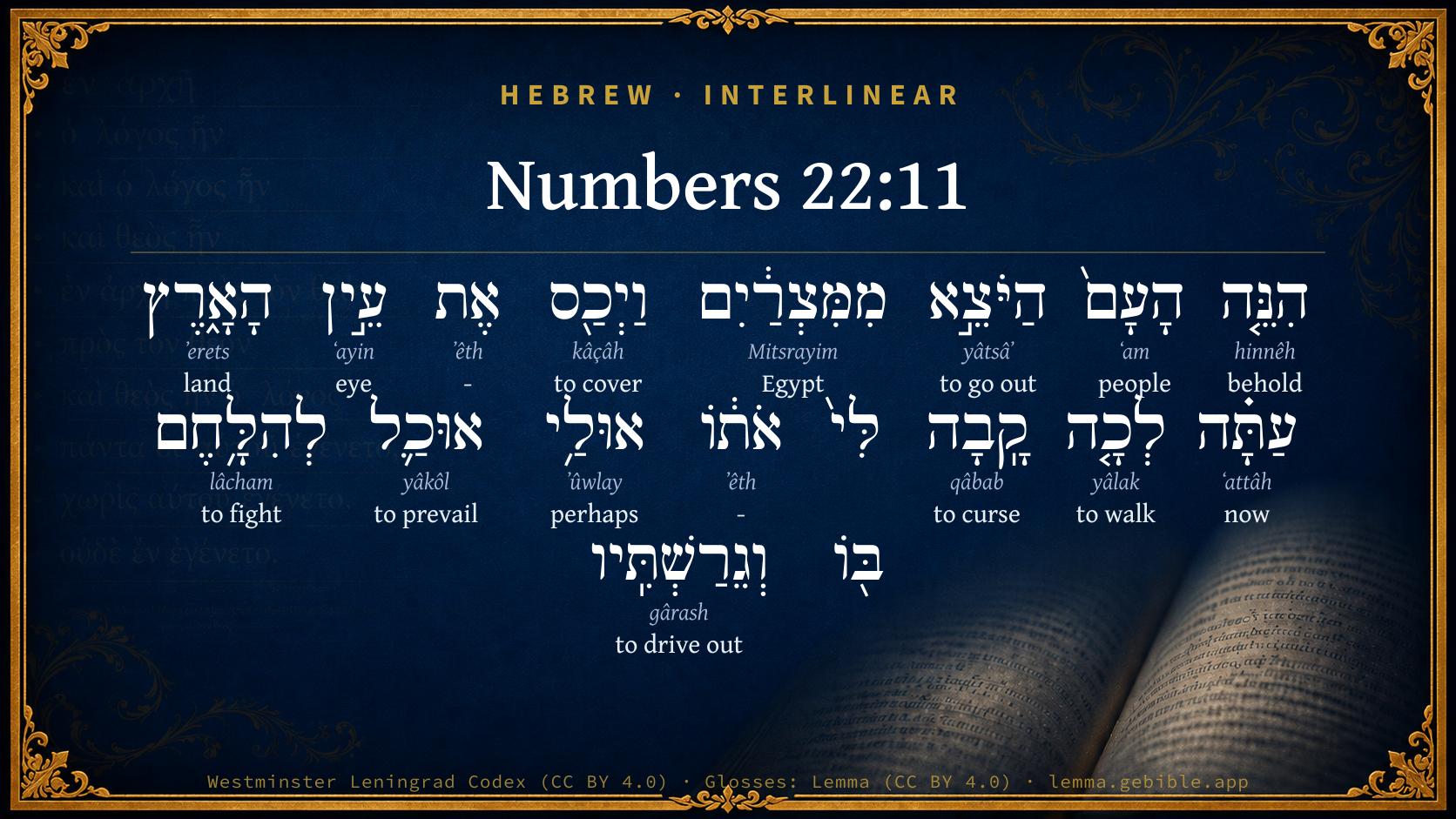
Hebrew (Westminster Leningrad Codex) Numbers 22:11 appears in the Hebrew Old Testament. The text above is from the Westminster Leningrad Codex. Each word links to its Strong’s number, a concise gloss, and parsing drawn from the Open Scriptures Hebrew Bible morphology. Click any word for its full Brown-Driver-Briggs (BDB) entry.
Download image
Cite this verse

Numbers 22:11 (World English Bible). Public Domain. Lemma interlinear Bible study tool, https://lemma.gebible.app/v/numbers/22/11.

Show BibTeX & RIS
BibTeX
RIS
English Translation
Behold, the people that is come out of Egypt, it covers the surface of the earth: now, come curse me them; peradventure I shall be able to fight against them, and shall drive them out.
World English Bible · Public Domain
Highlights
  • 1 first appearance in the Hebrew Bible
Full analysis ↓
Download a study sheet

One document with this verse’s original text, its word-by-word gloss line, the meaning frame, cross-references with their text, attributed commentary, and full source and license credits — printable, and it pastes into notes with its structure intact.

This verse Autodidact and up

Study sheet (.html) Plain text (.txt)

A passage Seminary Student

Up to 50 verses in one chapter. A passage sheet keeps up to 6 commentary sources and 12 cross-references per verse, in the order this page ranks them, and says so on the sheet whenever that leaves anything out. Ask for a single verse and you get the Autodidact verse sheet above.

Everything on this page stays free to read, with no account — the sheet is a download of what is already on screen, not access to it.

Want to remove ads? Support Godless Engineer
Compare translations 3

The same verse in 3 English versions, stacked beneath the original-language interlinear above. Click any original word for its lexicon entry.

Each is an independent rendering of the whole verse — the interlinear is not word-aligned to these translations.

Highlighted words mark where these versions differ — a whole-verse word diff, not a word-by-word alignment.

  • World English Bible Public Domain
    Behold, the people that is come out of Egypt, it covers the surface of the earth: now, come curse me them; peradventure I shall be able to fight against them, and shall drive them out.
  • King James Version Public Domain
    Behold, there is a people come out of Egypt, which covereth the face of the earth: come now, curse me them; peradventure I shall be able to overcome them, and drive them out.
  • unfoldingWord Literal Text CC BY-SA 4.0
    ‘Behold, the people coming out from Egypt, and it has covered the eye of the land. Now come, denounce it for me. Perhaps I will be able to fight against it and drive it out.’”

unfoldingWord Literal Text — © unfoldingWord, licensed CC BY-SA 4.0. Word-aligned USFM3 via Door43 (git.door43.org/unfoldingWord/en_ult).

Versions to compare (up to 4)

3 of 4 selected

Show all 18 translations

Every available English version of this verse, each an independent rendering of the whole verse.

  • World English Bible Public Domain
    Behold, the people that is come out of Egypt, it covers the surface of the earth: now, come curse me them; peradventure I shall be able to fight against them, and shall drive them out.
  • Berean Standard Bible Public Domain
    ‘Behold, a people has come out of Egypt, and they cover the face of the land. Now come and put a curse on them for me. Perhaps I may be able to fight against them and drive them away.’”
  • Majority Standard Bible Public Domain
    ‘Behold, a people has come out of Egypt, and they cover the face of the land. Now come and put a curse on them for me. Perhaps I may be able to fight against them and drive them away.’”
  • King James Version Public Domain
    Behold, there is a people come out of Egypt, which covereth the face of the earth: come now, curse me them; peradventure I shall be able to overcome them, and drive them out.
  • American Standard Version (1901) Public Domain
    Behold, the people that is come out of Egypt, it covereth the face of the earth: now, come curse me them; peradventure I shall be able to fight against them, and shall drive them out.
  • Revised Version (1885) Public Domain
    Behold, the people that is come out of Egypt, it covereth the face of the earth: now, come curse me them; peradventure I shall be able to fight against them, and shall drive them out.
  • Geneva Bible (1599) Public Domain
    Beholde, there is a people come out of Egypt and couereth the face of the earth: come nowe, curse them for my sake: so it may be that I shalbe able to ouercome them in battell, and to driue them out.
  • Douay-Rheims (1899) Public Domain
    Saying: Behold a people that is come out of Egypt, hath covered the face of the land: come and curse them, if by any means I may fight with them and drive them away.
  • Young's Literal Translation Public Domain
    Lo, the people that is coming out from Egypt and covereth the eye of the land, -- now come, pierce it for me; it may be I am able to fight against it, and have cast it out;'
  • Literal Standard Version CC BY-SA 4.0
    Behold, the people that is coming out from Egypt and covers the eye of the land—now come, pierce it for me; it may be I am able to fight against it and have cast it out”;
  • Unlocked Literal Bible CC BY-SA 4.0
    'Look, the people who have come from Egypt cover the surface of my land. Now come and curse them for me. Perhaps I will manage to fight them and drive them out.'”
  • unfoldingWord Literal Text CC BY-SA 4.0
    ‘Behold, the people coming out from Egypt, and it has covered the eye of the land. Now come, denounce it for me. Perhaps I will be able to fight against it and drive it out.’”
  • Darby Bible Public Domain
    Behold, a people is come out of Egypt, and it covers the face of the land. Now come, curse me them: perhaps I may be able to fight against them, and drive them out.
  • World Messianic Bible Public Domain
    ‘Behold, the people that has come out of Egypt covers the surface of the earth. Now, come curse them for me. Perhaps I shall be able to fight against them, and shall drive them out.’”
  • Webster's Bible Public Domain
    Behold, there has a people come out of Egypt, which covereth the face of the earth: come now, curse them for me: it may be I shall be able to overcome them, and drive them out.
  • Free Bible Version CC BY-SA 4.0
    ‘Listen, a group of people has arrived here who came from Egypt. There are hordes of them. Please come immediately and curse these people for me. Maybe then I'll be able to fight them and drive them out of my country.’”
  • Bible in Basic English Public Domain
    See, the people who have come out of Egypt are covering all the earth: now, put a curse on this people for me, so that I may be able to make war on them, driving them out of the land.
  • JPS Tanakh (1917) Public Domain
    Behold the people that is come out of Egypt, it covereth the face of the earth; now, come curse me them; peradventure I shall be able to fight against them, and shall drive them out.'

Literal Standard Version (2020), Covenant Press — licensed CC BY-SA 4.0. Text via the HelloAO Bible API (eBible.org). Unlocked Literal Bible (unfoldingWord) — licensed CC BY-SA 4.0. Text via the HelloAO Bible API (eBible.org). unfoldingWord Literal Text — © unfoldingWord, licensed CC BY-SA 4.0. Word-aligned USFM3 via Door43 (git.door43.org/unfoldingWord/en_ult). Free Bible Version, Dr. Jonathan Gallagher — licensed CC BY-SA 4.0. Text via the HelloAO Bible API (eBible.org).

Word by word

More ways to search: Search by grammar → Find every occurrence → Compare this word →

Practice this passage: Drill this verse → Learn its vocabulary →

קָֽבָה
qâbab
H6895
“curse”
Verb, Qal, Imperative, 2nd Person, Masculine, Singular + Suffix, h
Part of Speech
Verb
Stem
Qal
Form
Imperative
Person
2nd Person
Gender
Masculine
Number
Singular
Full BDB Definition

Origin: a primitive root

TWOT: 1978

to curse, utter a curse against - (Qal) to curse
  1. הִנֵּ֤ה hinnêh H2009 “behold” Particle, Demonstrative
  2. הָעָם֙ ʻam H5971 “the · people” Particle, Definite Article + Noun, Common, Masculine, Singular, Absolute
  3. הַיֹּצֵ֣א yâtsâʼ H3318 “the · going out” Particle, Definite Article + Verb, Qal, Participle Active, Masculine, Singular, Absolute
  4. מִמִּצְרַ֔יִם Mitsrayim H4714 “from · Egypt” Preposition + Noun, Proper
  5. וַיְכַ֖ס kâçâh H3680 “and · to cover” Conjunction + Verb, Piel, Sequential Imperfect, 3rd Person, Masculine, Singular
  6. אֶת ʼêth H853 “-” Particle, Direct Object
  7. עֵ֣ין ʻayin H5869 “eye of” Noun, Common, Both, Singular, Construct
  8. הָאָ֑רֶץ ʼerets H776 “the · land” Particle, Definite Article + Noun, Common, Both, Singular, Absolute
  9. עַתָּ֗ה ʻattâh H6258 “now” Adverb
  10. לְכָ֤ה yâlak H3212 “walk” Verb, Qal, Imperative, 2nd Person, Masculine, Singular + Suffix, h
  11. אֹת֔וֹ ʼêth H853 “- · him” Particle, Direct Object + Suffix, Personal, 3rd Person, Masculine, Singular
  12. אוּלַ֥י ʼûwlay H194 “perhaps” Adverb
  13. אוּכַ֛ל yâkôl H3201 “to prevail” Verb, Qal, Imperfect, 1st Person, Common, Singular
  14. לְהִלָּ֥חֶם lâcham H3898 “to fight” Preposition + Verb, Niphal, Infinitive Construct
  15. וְגֵרַשְׁתִּֽיו gârash H1644 “and · to drive out · him” Conjunction + Verb, Piel, Sequential Perfect, 1st Person, Common, Singular + Suffix, Personal, 3rd Person, Masculine, Singular

About this verse

These counts appear in no published source. They are computed here, from the morphology-tagged text and Lemma’s own curated glosses. What Lemma adds →

18
words
15
distinct lemmas
Pentateuch
section

Notable vocabulary

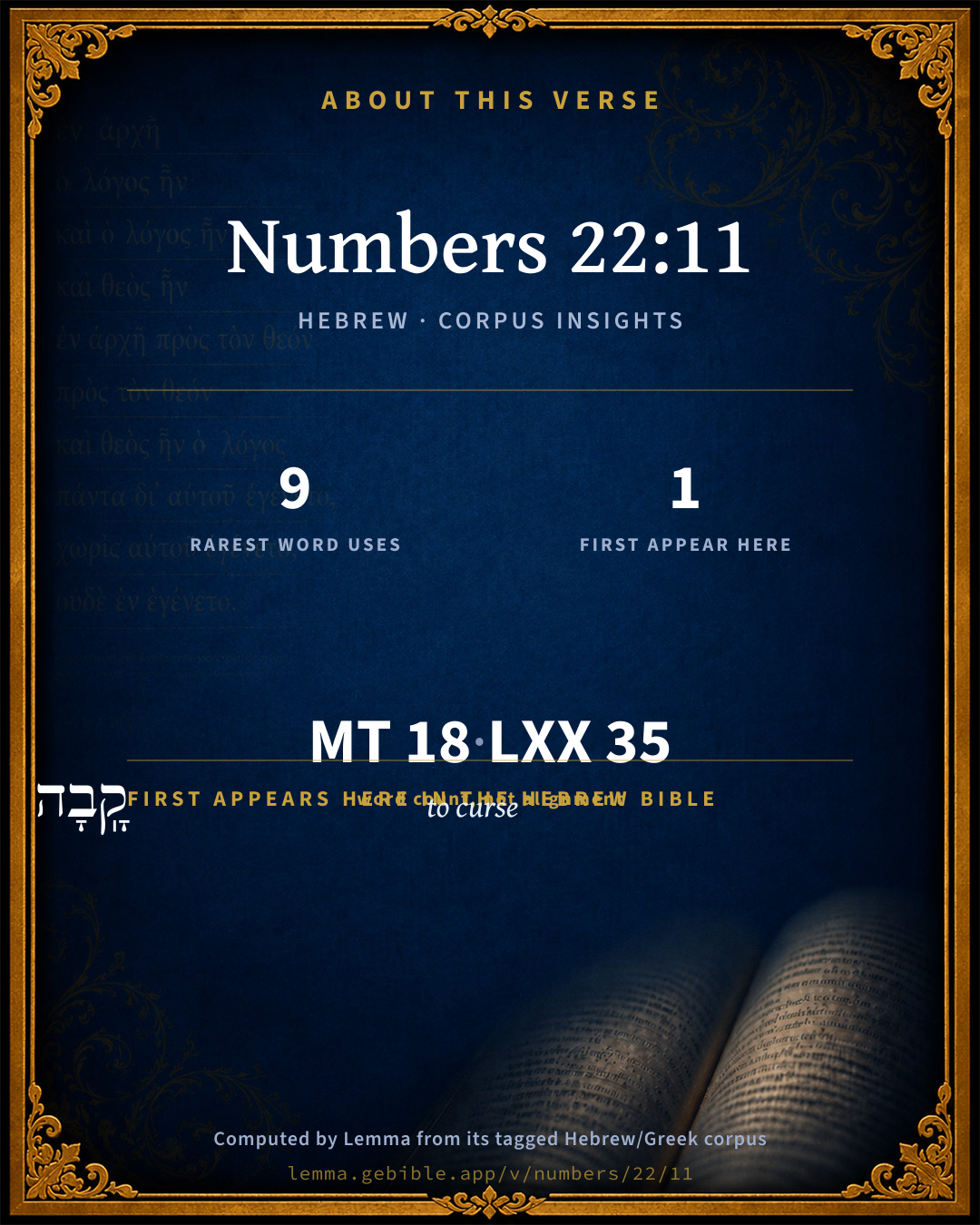
The rarest word here is קָֽבָה to curse H6895 — appearing just 9 times in the whole Hebrew Bible.

First appearance in Scripture

This word makes its first canonical appearance in the Hebrew Bible here:

  • קָֽבָה to curse H6895

Shared distinctive vocabulary

קָֽבָה to curse H6895 occurs in 9 verses of the Hebrew Bible. Also found in:

Grammatical profile

  • 7 verbs
  • 4 nouns
  • 2 prepositions
  • 2 adverbs
  • 3 particles

Verb forms

  • הַיֹּצֵ֣א Qal · Participle Active
  • וַיְכַ֖ס Piel · Sequential Imperfect
  • לְכָ֤ה Qal · Imperative
  • קָֽבָה Qal · Imperative
  • אוּכַ֛ל Qal · Imperfect
  • לְהִלָּ֥חֶם Niphal · Infinitive Construct
  • וְגֵרַשְׁתִּֽיו Piel · Sequential Perfect

Hebrew & Septuagint length

In English translation the verse runs 35 words from the Hebrew and 47 from the Septuagint (LXX English) — closely comparable.

A rough comparison of the two English renderings, which tokenize alike — not a word-level alignment.

Word counts can differ between the Hebrew and the Greek without any difference in meaning — e.g. the Hebrew direct-object marker אֵת has no separate Greek word, and Greek often adds the article ὁ.

In the original languages it is 18 Hebrew tokens and 35 Greek tokens — but the two are counted differently (Hebrew bundles its prefixes and suffixes into one token; the Greek is in lemma form), so that isn’t a like-for-like length.

Hebrew and Greek witnesses Masoretic Hebrew ↔ Greek Septuagint

The same verse in the two great witnesses to the Old Testament, shown verse-for-verse.

These are two independent witnesses, not word-aligned to each other, and the Septuagint is shown in lemma (dictionary) form.

Hebrew Numbers 22:11 Masoretic · Westminster Leningrad Codex

הִנֵּ֤ה הָעָם֙ הַיֹּצֵ֣א מִמִּצְרַ֔יִם וַיְכַ֖ס אֶת עֵ֣ין הָאָ֑רֶץ עַתָּ֗ה לְכָ֤ה קָֽבָה לִּי֙ אֹת֔וֹ אוּלַ֥י אוּכַ֛ל לְהִלָּ֥חֶם בּ֖וֹ וְגֵרַשְׁתִּֽיו

Behold, the people that is come out of Egypt, it covers the surface of the earth: now, come curse me them; peradventure I shall be able to fight against them, and shall drive them out.

World English Bible · Public Domain

Greek LXX Numbers 22:11 Septuagint · lemma form

ἰδού λαός ἐκἔρχομαι ἐκ αἴγυπτος καί ἰδού καλύπτω ὁ ὄψις ὁ γῆ καί οὗτος ἐν καταἧμαι ἔχω ἐγώ καί νῦν δεῦρο ἀράομαι ἐγώ αὐτός εἰ ἄρα δύναμαι πατάσσω αὐτός καί ἐκβάλλω αὐτός ἀπό ὁ γῆ

Behold, a people has come forth out of Egypt, and has covered the face of the land, and it has encamped near to me; and now come, curse it for me, if indeed I shall be able to strike it, and cast it out of the land.

LXX2012 (modern English Septuagint) · Public Domain

Hebrew: Westminster Leningrad Codex (CC BY 4.0). Greek: Septuagint (public domain); English from LXX2012 (modern English Septuagint) (Public Domain). How the Septuagint differs from the Hebrew →

Targum (Aramaic paraphrase)

2

The Targum is the ancient Jewish Aramaic paraphrase of the Hebrew Scriptures — an interpretive translation, not the Hebrew text itself. Onkelos (literal) and Pseudo-Jonathan (expansive) render the Torah, and Jonathan the Prophets. Coverage is partial: where no permissively-licensed English translation exists for a verse, only the Aramaic is shown. This is verse-level text, not a word-by-word alignment to the Hebrew.

  1. Targum Onkelos Torah (Genesis–Deuteronomy)
    הָא עַמָא דִי נְפַק מִמִצְרַיִם וַחֲפָא יָת עֵין שִׁמְשָׁא דְאַרְעָא כְּעַן אִיתָא לוֹט לִי יָתֵיהּ מָאִים אֵיכוּל לְאַגָחָא בֵּיהּ קְרָב וְאֲתָרֵיכִינֵיהּ

    (no public-domain English translation for this verse)

    Targum Onkelos — Aramaic: “Onkelos Genesis” (public domain); “Onkelos Exodus” (public domain); “Onkelos Leviticus” (public domain); “Onkelos Numbers” (public domain); “Onkelos Deuteronomy” (public domain). English: “Sefaria Community Translation” (CC0 1.0 (public-domain dedication)); “J.W. Etheridge. The Targums of Onkelos and Jonathan Ben Uzziel on the Pentateuch. London: Longmans, Green, 1862” (public domain). Text via Sefaria.

  2. Targum Pseudo-Jonathan Torah (Genesis–Deuteronomy)
    הָא עַמָא נְפַק מִמִצְרַיִם וַחֲפָא יַת חֵיזְוָא דְאַרְעָא וּכְדוּן אִיתָא לוֹט בְּגִינִי יָתֵיהּ לְוַאי אֵיכוֹל לִמְסַדְרָא סִדְרֵי קְרָבָא בֵּיהּ וְאִתְרְכִינֵיהּ

    Behold, a people hath come out of Mizraim, and cover the face of the land: now therefore, come, curse them for me, so that I may be able to fight and drive them away.

    Targum Pseudo-Jonathan — Aramaic: “Targum Jonathan on Genesis” (public domain); “Targum Jonathan on Exodus” (public domain); “Targum Jonathan on Leviticus” (public domain); “Targum Jonathan on Numbers” (public domain); “Targum Jonathan on Deuteronomy” (public domain). English: “The Targum of Jonathan ben Uzziel, trans. J. W. Etheridge, London, 1862” (public domain). Text via Sefaria.

Commentary

Notes on Numbers 22:11 from classic Christian and Jewish commentators (each source and its license shown beneath its notes). The classic Christian expositions comment on the surrounding passage and are grouped to its opening verse, so a note may address several verses; the Jewish commentaries on the Tanakh (Rashi and others) are per-verse, so they appear only where the commentator wrote on this verse.

Lemma curates 59 commentaries, every one of them public domain or Creative Commons licensed, each selected and text-cleaned for this edition rather than reprinted as found. About our sources →

Ellicott's Commentary for English Readers

(11) A people come out of Egypt . . . —Better, the people which came out from Egypt, it covereth . . .

A Bible Commentary for English Readers, edited by Charles John Ellicott (1878–1897) — public domain. Text from a community e-Sword module.

John Gill's Exposition

And Balaam rose up in the morning,.... With the impression of the dream upon his mind, and of what had passed between God and him in it:

and said unto the princes of Balak; which shows what the elders were that were sent, of what honour and dignity, and may include both those of Moab and of Midian:

get you into your land; as soon as you can; set forward on your journey, it is to no purpose to stay here:

for the Lord refuseth to give me leave to go with you; he only relates one part of the answer he had from the Lord, respecting his going with them, but says not a word of his being forbid to curse Israel, and of the reason given why he should not; had he reported this, in all probability it would have prevented any further application to him, and so any attempt to get this done, which Balaam seemed aware of; and therefore, by concealing this, hoped for fresh solicitations and entreaties, and that in time the Lord might be prevailed on to let him go and curse them; he having a covetous desire of riches, honour, and preferment, in Balak's court.

John Gill's Exposition of the Whole Bible (1746–1763) — public domain (CC PDM 1.0). Text via the HelloAO Bible API.

Rashi

Rabbi Shlomo Yitzchaki (Rashi)

קבה לי CURSE FOR ME — this is worse than ארה לי, (the expression which Balak had actually used, v. 6), for in the case of this verb it means that one mentions and pronounces in full [the name of God] when cursing (cf. Rashi on Leviticus 24:16) (Midrash Tanchuma, Balak 5).

וגרשתיו AND I WILL DRIVE THEM OUT, meaning from the world; but Balak had said only, (v. 6) “and I will drive them out from the land”: I seek only to make them move away from me. Balaam, however, hated them even more than did Balak (cf.Midrash Tanchuma, Balak 5).

Rashi on the Tanakh — English translations: “The Judaica Press complete Tanach with Rashi, translated by A. J. Rosenberg” (CC BY 4.0); “Pentateuch with Rashi's commentary by M. Rosenbaum and A.M. Silbermann, 1929-1934” (public domain); “The Metsudah Tanach series, Lakewood, N.J” (CC BY 4.0); and “The Book of Joshua, Metsudah Publications, 1997” (CC BY 4.0). Text via Sefaria.

Lesson kit

Teaching starters — assembled from the data on this page, not authored interpretation. Every prompt links to the verse data it draws on. Edit before teaching.

Numbers, in the Pentateuch, opens this verse with 18 words (15 distinct Hebrew lemmas). Its most distinctive word is qâbab (“to curse”). A historical commentator’s framing appears above. Read the whole chapter for the surrounding context.

Discussion questions

  1. What does “to curse” (qâbab) contribute to the verse as a whole?
  2. The word “to curse” first appears here in Scripture. What is being introduced at this debut?
  3. Numbers 22:17 shares the word «to curse» with this verse. How do the two illuminate each other?
  4. These translations render this verse differently. What is at stake in choosing one wording over another?
  5. The verb «הַיֹּצֵ֣א» is Qal Participle Active. How does its form color the action?
  6. Reading how Ellicott's Commentary for English Readers and John Gill's Exposition read this verse, where do the two commentators agree and where do they part?

Things to notice

Reading settings

Reading text

Shown beneath each verse's original-language words.

Old Testament
Old Testament edition

Read the OT as the Masoretic Hebrew (MT) or the Greek Septuagint (LXX).

English shown for the Greek Septuagint (in the Hebrew ↔ Greek comparison).

Comparing translations? Open the Compare panel on any verse page to stack up to four side by side.