
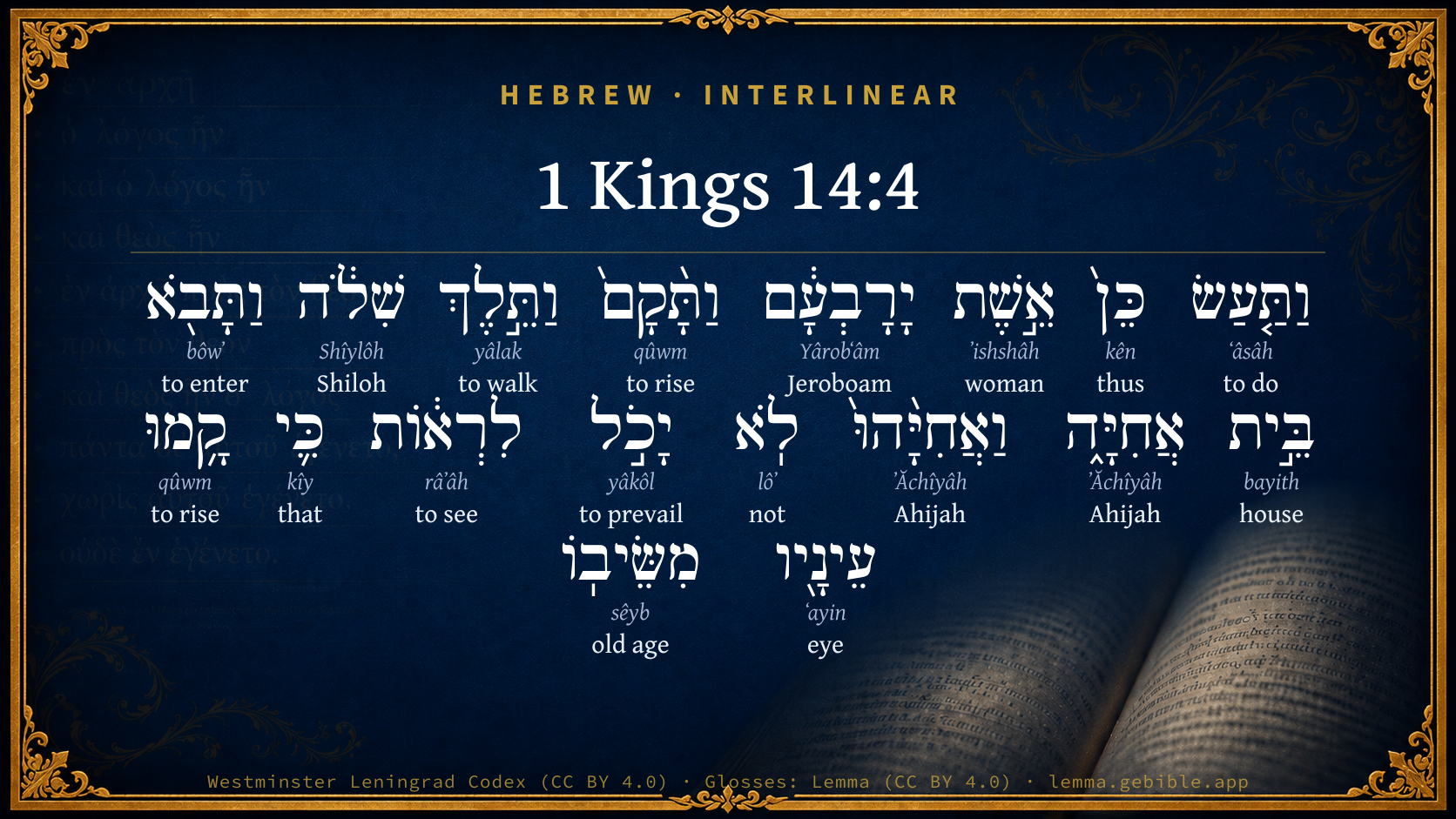
1 Kings 14:4

Hebrew (Westminster Leningrad Codex) 1 Kings 14:4 appears in the Hebrew Old Testament. The text above is from the Westminster Leningrad Codex. Each word links to its Strong’s number, a concise gloss, and parsing drawn from the Open Scriptures Hebrew Bible morphology. Click any word for its full Brown-Driver-Briggs (BDB) entry.
Download image
Cite this verse

1 Kings 14:4 (World English Bible). Public Domain. Lemma interlinear Bible study tool, https://lemma.gebible.app/v/1-kings/14/4.

Show BibTeX & RIS
BibTeX
RIS
English Translation
Jeroboam's wife did so, and arose, and went to Shiloh, and came to the house of Ahijah. Now Ahijah could not see; for his eyes were set by reason of his age.
World English Bible · Public Domain
Highlights
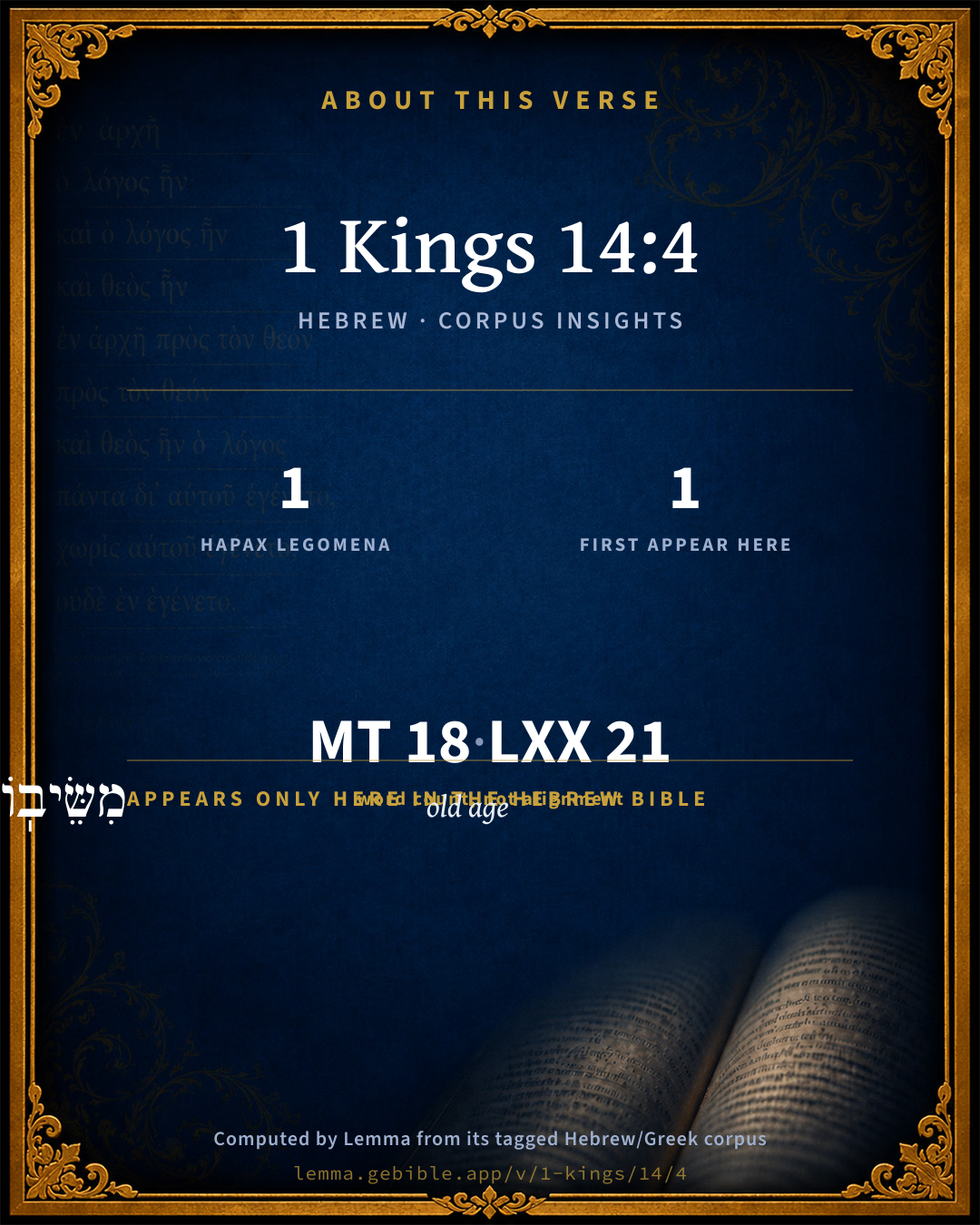
  • 1 hapax legomenon — only here in the Hebrew Bible
  • 1 first appearance in the Hebrew Bible
Full analysis ↓
Download a study sheet

One document with this verse’s original text, its word-by-word gloss line, the meaning frame, cross-references with their text, attributed commentary, and full source and license credits — printable, and it pastes into notes with its structure intact.

This verse Autodidact and up

Study sheet (.html) Plain text (.txt)

A passage Seminary Student

Up to 50 verses in one chapter. A passage sheet keeps up to 6 commentary sources and 12 cross-references per verse, in the order this page ranks them, and says so on the sheet whenever that leaves anything out. Ask for a single verse and you get the Autodidact verse sheet above.

Everything on this page stays free to read, with no account — the sheet is a download of what is already on screen, not access to it.

Want to remove ads? Support Godless Engineer
Compare translations 3

The same verse in 3 English versions, stacked beneath the original-language interlinear above. Click any original word for its lexicon entry.

Each is an independent rendering of the whole verse — the interlinear is not word-aligned to these translations.

Highlighted words mark where these versions differ — a whole-verse word diff, not a word-by-word alignment.

  • World English Bible Public Domain
    Jeroboam's wife did so, and arose, and went to Shiloh, and came to the house of Ahijah. Now Ahijah could not see; for his eyes were set by reason of his age.
  • King James Version Public Domain
    And Jeroboam's wife did so, and arose, and went to Shiloh, and came to the house of Ahijah. But Ahijah could not see; for his eyes were set by reason of his age.
  • unfoldingWord Literal Text CC BY-SA 4.0
    And the wife of Jeroboam did thus. And she arose and went Shiloh, and she entered the house of Ahijah. (Now Ahijah was not able to see, for his eyes had set because of his age.)

unfoldingWord Literal Text — © unfoldingWord, licensed CC BY-SA 4.0. Word-aligned USFM3 via Door43 (git.door43.org/unfoldingWord/en_ult).

Versions to compare (up to 4)

3 of 4 selected

Show all 18 translations

Every available English version of this verse, each an independent rendering of the whole verse.

  • World English Bible Public Domain
    Jeroboam's wife did so, and arose, and went to Shiloh, and came to the house of Ahijah. Now Ahijah could not see; for his eyes were set by reason of his age.
  • Berean Standard Bible Public Domain
    Jeroboam’s wife did as instructed; she arose and went to Shiloh and arrived at Ahijah’s house. Now Ahijah could not see, for his eyes were dim because of his age.
  • Majority Standard Bible Public Domain
    Jeroboam’s wife did as instructed; she arose and went to Shiloh and arrived at Ahijah’s house. Now Ahijah could not see, for his eyes were dim because of his age.
  • King James Version Public Domain
    And Jeroboam's wife did so, and arose, and went to Shiloh, and came to the house of Ahijah. But Ahijah could not see; for his eyes were set by reason of his age.
  • American Standard Version (1901) Public Domain
    And Jeroboam's wife did so, and arose, and went to Shiloh, and came to the house of Ahijah. Now Ahijah could not see; for his eyes were set by reason of his age.
  • Revised Version (1885) Public Domain
    And Jeroboam’s wife did so, and arose, and went to Shiloh, and came to the house of Ahijah. Now Ahijah could not see; for his eyes were set by reason of his age.
  • Geneva Bible (1599) Public Domain
    And Ieroboams wife did so, and arose, and went to Shiloh, and came to the house of Ahiiah: but Ahiiah could not see, for his sight was decayed for his age.
  • Douay-Rheims (1899) Public Domain
    Jeroboam's wife did as he told her: and rising up went to Silo, and came to the house of Ahias: but he could not see, for his eyes were dim by reason of his age.
  • Young's Literal Translation Public Domain
    And the wife of Jeroboam doth so, and riseth, and goeth to Shiloh, and entereth the house of Ahijah, and Ahijah is not able to see, for his eyes have stood because of his age.
  • Literal Standard Version CC BY-SA 4.0
    And the wife of Jeroboam does so, and rises, and goes to Shiloh, and enters the house of Ahijah, and Ahijah is not able to see, for his eyes have stood because of his age.
  • Unlocked Literal Bible CC BY-SA 4.0
    Jeroboam's wife did so; she left and went to Shiloh and came to the house of Ahijah. Now Ahijah could not see; he lost his sight because of old age.
  • unfoldingWord Literal Text CC BY-SA 4.0
    And the wife of Jeroboam did thus. And she arose and went Shiloh, and she entered the house of Ahijah. (Now Ahijah was not able to see, for his eyes had set because of his age.)
  • Darby Bible Public Domain
    And Jeroboam's wife did so, and arose and went to Shiloh, and came to the house of Ahijah. And Ahijah could not see; for his eyes were set by reason of his age.
  • World Messianic Bible Public Domain
    Jeroboam’s wife did so, and arose and went to Shiloh, and came to Ahijah’s house. Now Ahijah could not see, for his eyes were set by reason of his age.
  • Webster's Bible Public Domain
    And Jeroboam's wife did so, and arose, and went to Shiloh, and came to the house of Ahijah. But Ahijah could not see; for his eyes were set by reason of his age.
  • Free Bible Version CC BY-SA 4.0
    Jeroboam's wife did as she was told. She got up and went to Ahijah's house in Shiloh. Ahijah could not see—he had become blind because of his age.
  • Bible in Basic English Public Domain
    So Jeroboam's wife did so, and got up and went to Shiloh and came to the house of Ahijah. Now Ahijah was unable to see, because he was very old.
  • JPS Tanakh (1917) Public Domain
    And Jeroboam's wife did so, and arose, and went to Shiloh, and came to the house of Ahijah. Now Ahijah could not see; for his eyes were set by reason of his age.

Literal Standard Version (2020), Covenant Press — licensed CC BY-SA 4.0. Text via the HelloAO Bible API (eBible.org). Unlocked Literal Bible (unfoldingWord) — licensed CC BY-SA 4.0. Text via the HelloAO Bible API (eBible.org). unfoldingWord Literal Text — © unfoldingWord, licensed CC BY-SA 4.0. Word-aligned USFM3 via Door43 (git.door43.org/unfoldingWord/en_ult). Free Bible Version, Dr. Jonathan Gallagher — licensed CC BY-SA 4.0. Text via the HelloAO Bible API (eBible.org).

Word by word

More ways to search: Search by grammar → Find every occurrence → Compare this word →

Practice this passage: Drill this verse → Learn its vocabulary →

מִשֵּׂיבֽוֹ
sêyb
H7869
“from · old age · his”
Preposition + Noun, Common, Masculine, Singular, Construct + Suffix, Personal, 3rd Person, Masculine, Singular
Part of Speech
Preposition + Noun
Type
Common
Gender
Masculine
Number
Singular
State
Construct
Full BDB Definition

Origin: from H7867

TWOT: 2253a

hoary age, gray-headed age
  1. וַתַּ֤עַשׂ ʻâsâh H6213 “and · to do” Conjunction + Verb, Qal, Sequential Imperfect, 3rd Person, Feminine, Singular
  2. כֵּן֙ kên H3651 “thus” Particle, Demonstrative
  3. אֵ֣שֶׁת ʼishshâh H802 “woman of” Noun, Common, Feminine, Singular, Construct
  4. יָרָבְעָ֔ם Yârobʻâm H3379 “Jeroboam” Noun, Proper
  5. וַתָּ֨קָם֙ qûwm H6965 “and · to rise” Conjunction + Verb, Qal, Sequential Imperfect, 3rd Person, Feminine, Singular
  6. וַתֵּ֣לֶךְ yâlak H3212 “and · to walk” Conjunction + Verb, Qal, Sequential Imperfect, 3rd Person, Feminine, Singular
  7. שִׁלֹ֔ה Shîylôh H7887 “Shiloh” Noun, Proper
  8. וַתָּבֹ֖א bôwʼ H935 “and · to enter” Conjunction + Verb, Qal, Sequential Imperfect, 3rd Person, Feminine, Singular
  9. בֵּ֣ית bayith H1004 “house of” Noun, Common, Masculine, Singular, Construct
  10. אֲחִיָּ֑ה ʼĂchîyâh H281 “Ahijah” Noun, Proper
  11. וַאֲחִיָּ֨הוּ֙ ʼĂchîyâh H281 “and · Ahijah” Conjunction + Noun, Proper
  12. לֹֽא lôʼ H3808 “not” Particle, Negative
  13. יָכֹ֣ל yâkôl H3201 “to prevail” Verb, Qal, Perfect, 3rd Person, Masculine, Singular
  14. לִרְא֔וֹת râʼâh H7200 “to see” Preposition + Verb, Qal, Infinitive Construct
  15. כִּ֛י kîy H3588 “that” Conjunction
  16. קָ֥מוּ qûwm H6965 “to rise” Verb, Qal, Perfect, 3rd Person, Common, Plural
  17. עֵינָ֖יו ʻayin H5869 “eyes · his” Noun, Common, Both, Dual, Construct + Suffix, Personal, 3rd Person, Masculine, Singular

About this verse

These counts appear in no published source. They are computed here, from the morphology-tagged text and Lemma’s own curated glosses. What Lemma adds →

18
words
16
distinct lemmas
Historical
section

Notable vocabulary

1 hapax legomenon — a word that appears only here in the entire Hebrew Bible:

  • מִשֵּׂיבֽוֹ old age H7869

First appearance in Scripture

This word makes its first canonical appearance in the Hebrew Bible here:

  • מִשֵּׂיבֽוֹ old age H7869

Shared distinctive vocabulary

אֲחִיָּ֑ה Ahijah H281 occurs in 23 verses of the Hebrew Bible. Also found in:

Grammatical profile

  • 7 verbs
  • 8 nouns
  • 1 conjunction
  • 2 particles

Verb forms

  • וַתַּ֤עַשׂ Qal · Sequential Imperfect
  • וַתָּ֨קָם֙ Qal · Sequential Imperfect
  • וַתֵּ֣לֶךְ Qal · Sequential Imperfect
  • וַתָּבֹ֖א Qal · Sequential Imperfect
  • יָכֹ֣ל Qal · Perfect
  • לִרְא֔וֹת Qal · Infinitive Construct
  • קָ֥מוּ Qal · Perfect

Repetition

Words recur within this verse — often emphatic in Hebrew:

  • וַתָּ֨קָם֙ to rise H6965 ×2
  • אֲחִיָּ֑ה Ahijah H281 ×2

Hebrew & Septuagint length

In the original languages it is 18 Hebrew tokens and 21 Greek tokens — but the two are counted differently (Hebrew bundles its prefixes and suffixes into one token; the Greek is in lemma form), so that isn’t a like-for-like length.

Cross-references

12

Topical passages linked to 1 Kings 14:4 in the Treasury of Scripture Knowledge — connected by theme and wording, ordered by reader-vote popularity; previews shown in the World English Bible.

  • 1 Kings 11:29 It happened at that time, when Jeroboam went out of Jerusalem, that the prophet Ahijah the Shilonite found him in the way; now [Ahijah] had clad himself with a new garment; and they two were alone in the field.
  • 1 Samuel 3:2 It happened at that time, when Eli was laid down in his place (now his eyes had begun to grow dim, so that he could not see),
  • 1 Samuel 4:15 Now Eli was ninety-eight years old; and his eyes were set, so that he could not see.
  • Genesis 27:1 It happened, that when Isaac was old, and his eyes were dim, so that he could not see, he called Esau his elder son, and said to him, "My son?" He said to him, "Here I am."
  • Genesis 48:10 Now the eyes of Israel were dim for age, so that he couldn't see. He brought them near to him; and he kissed them, and embraced them.
  • Deuteronomy 34:7 Moses was one hundred twenty years old when he died: his eye was not dim, nor his natural force abated.
  • Joshua 18:1 The whole congregation of the children of Israel assembled themselves together at Shiloh, and set up the tent of meeting there: and the land was subdued before them.
  • 1 Samuel 4:3–4 When the people were come into the camp, the elders of Israel said, Why has Yahweh struck us today before the Philistines? Let us get the ark of the covenant of Yahweh out of Shiloh to us, that it may come among us, and save us out of the hand of our enemies.
  • 1 Kings 14:2 Jeroboam said to his wife, Please get up and disguise yourself, that you not be known to be the wife of Jeroboam; and get you to Shiloh: behold, there is Ahijah the prophet, who spoke concerning me that I should be king over this people.
  • Psalms 90:10 The days of our years are seventy, Or even by reason of strength eighty years; Yet their pride is but labor and sorrow, For it passes quickly, and we fly away.
  • Ecclesiastes 12:3 In the day when the keepers of the house shall tremble, And the strong men shall bow themselves, And the grinders cease because they are few, And those who look out of the windows are darkened,
  • Jeremiah 7:12–14 But go you now to my place which was in Shiloh, where I caused my name to dwell at the first, and see what I did to it for the wickedness of my people Israel.

Cross-references courtesy of OpenBible.info (CC BY 4.0).

Hebrew and Greek witnesses Masoretic Hebrew ↔ Greek Septuagint

The same verse in the two great witnesses to the Old Testament, shown verse-for-verse.

These are two independent witnesses, not word-aligned to each other, and the Septuagint is shown in lemma (dictionary) form.

Hebrew 1 Kings 14:4 Masoretic · Westminster Leningrad Codex

וַתַּ֤עַשׂ כֵּן֙ אֵ֣שֶׁת יָרָבְעָ֔ם וַתָּ֨קָם֙ וַתֵּ֣לֶךְ שִׁלֹ֔ה וַתָּבֹ֖א בֵּ֣ית אֲחִיָּ֑ה וַאֲחִיָּ֨הוּ֙ לֹֽא יָכֹ֣ל לִרְא֔וֹת כִּ֛י קָ֥מוּ עֵינָ֖יו מִשֵּׂיבֽוֹ

Jeroboam's wife did so, and arose, and went to Shiloh, and came to the house of Ahijah. Now Ahijah could not see; for his eyes were set by reason of his age.

World English Bible · Public Domain

Greek LXX 1 Kings 14:4 Septuagint · lemma form

καί σύνδεσμος γίγνομαι ἐν ὁ γῆ καί ποιέω ἀπό πᾶς ὁ βδέλυγμα ὁ ἔθνος ὅς ἐκαἴρω κύριος ἀπό πρόσωπον υἱός ἰσραήλ

No English rendering of this Greek verse — the small residue in the structurally divergent books.

On this verse, Haydock's Catholic Bible Commentary discusses the Septuagint’s reading. Read the note in Commentary ↓

Hebrew: Westminster Leningrad Codex (CC BY 4.0). Greek: Septuagint (public domain); English from a public-domain English Septuagint. How the Septuagint differs from the Hebrew →

Targum (Aramaic paraphrase)

1

The Targum is the ancient Jewish Aramaic paraphrase of the Hebrew Scriptures — an interpretive translation, not the Hebrew text itself. Onkelos (literal) and Pseudo-Jonathan (expansive) render the Torah, and Jonathan the Prophets. Coverage is partial: where no permissively-licensed English translation exists for a verse, only the Aramaic is shown. This is verse-level text, not a word-by-word alignment to the Hebrew.

  1. Targum Jonathan Prophets (Joshua–Malachi)
    וַעֲבַדַת כֵּן אִתַּת יָרָבְעָם וְקָמַת וַאֲזַלַת לְשִׁלֹה וַאֲתַת לְבֵית אֲחִיָה וַאֲחִיָה לָא יָכִיל לְמֶחֱזֵי אֲרֵי כְהָאָה עֵינוֹהִי מִסֵיבֵיהּ:

    (no public-domain English translation for this verse)

    Targum Jonathan — Aramaic: “Mikraot Gedolot” (public domain). English: “Sefaria Community Translation” (CC0 1.0 (public-domain dedication)); “London "Chaldee Paraphrase," 1871” (public domain). Text via Sefaria.

Commentary

Notes on 1 Kings 14:4 from classic Christian and Jewish commentators (each source and its license shown beneath its notes). The classic Christian expositions comment on the surrounding passage and are grouped to its opening verse, so a note may address several verses; the Jewish commentaries on the Tanakh (Rashi and others) are per-verse, so they appear only where the commentator wrote on this verse.

Lemma curates 59 commentaries, every one of them public domain or Creative Commons licensed, each selected and text-cleaned for this edition rather than reprinted as found. About our sources →

Trapp's Complete Commentary

John Trapp

1Ki 14:4 And Jeroboam’s wife did so, and arose, and went to Shiloh, and came to the house of Ahijah. But Ahijah could not see; for his eyes were set by reason of his age.

Ver. 4. And Jeroboam’s wife did so.] Putting off her royal attire, and putting on more demure apparel; like as many hypocrites do, conforming themselves to the company they come into, and walking in a disguise, till God detect them.

For his eyes were set by reason of his age.] These things, therefore, were done toward the end of Jeroboam’s reign.

John Trapp, A Commentary or Exposition upon All the Books of the Old and New Testament (1647–1656) — public domain. Text from a community e-Sword module.

Joseph Benson's Commentary

1Ki 14:4. But Ahijah could not see — He not only lived obscure and neglected in Shiloh, but was blind through age: yet he was still blessed with the visions of the Almighty; which require not bodily eyes; but are rather favoured by the want of them, the eyes of the mind being then most intent and least diverted. His eyes were set, &c. — Hebrew, קמו משׁיבו, kamu misheibo, stood for his hoariness — No longer performed their office, by reason of his great age. Perhaps the fibres and muscles by which the eyes and eye-lids are moved, were contracted and withered, the optic nerves become effete, or film or cataract was grown over his eyes.

Joseph Benson's Commentary on the Old and New Testaments (1811–1818) — public domain. Text from a community e-Sword module.

Geneva Bible (1599)

Geneva Bible translators

Hebrew, eyes stood.

Geneva Bible (1599) marginal notes — public domain. Text via Bolls.life.

Ellicott's Commentary for English Readers

(4) Were set.—The same word is rendered “were dim” in 1Sa_4:15. The metaphor is evidently drawn from the solid opaque look of the iris, when affected by cataract or some similar disease.

A Bible Commentary for English Readers, edited by Charles John Ellicott (1878–1897) — public domain. Text from a community e-Sword module.

The Cambridge Bible for Schools and Colleges

gen. ed. J. J. S. Perowne

4. for his eyes were set] The same expression is used of Eli, 1Sa_4:15. The idea is of one whose eye has lost its power so that the light no longer acts upon it to enlarge or contract the pupil.

The Cambridge Bible for Schools and Colleges (gen. ed. J. J. S. Perowne; Cambridge University Press, 1878–1918) — public domain. Text from a community e-Sword module.

John Gill's Exposition

And the Lord said unto Abijah,.... Either in a dream, or by an impulse upon his mind, before Jeroboam's wife came in:

behold, the wife of Jeroboam cometh to ask a thing of thee for her son, for he is sick; to know whether he will recover or not:

thus and thus shall thou say unto her; as after expressed in some following verses:

for it shall be, when she cometh in, that she shall feign herself another woman; to the people that let her in, and introduce her to the prophet, and to the prophet himself; pretend herself to be a countrywoman come to ask a question of the prophet concerning her son that was ill of a disease.

John Gill's Exposition of the Whole Bible (1746–1763) — public domain (CC PDM 1.0). Text via the HelloAO Bible API.

Haydock's Catholic Bible Commentary

Dim. Hebrew, "swelled," &c. (Calmet) --- Septuagint inform us that the prophet was 60 years old. (Haydock)

George Leo Haydock (1774–1849), Haydock's Catholic Family Bible and Commentary, 1859 edition — public domain. Excludes Psalms (Douay-Rheims chapter numbering differs from Protestant) and Deuterocanonical books (Catholic canon only).

Matthew Poole's English Annotations

Or, stood still, or were grown stiff; the nerves, by which the eyes and eye-lids are moved, being contracted and withered.

Matthew Poole's English Annotations on the Holy Bible (1683–1685) — public domain. Text from a community e-Sword/MySword module.

Whedon's Commentary on the Bible

Daniel D. Whedon

4. Ahijah could not see — “Upon the outer world, made foul by man’s abominations, he has closed his eyes, and sees and lives by the light that shines within.” — Kitto. And vainly will Jeroboam or his wife attempt, in the presence of such a divinely-illumined seer, to practice guile.

Daniel D. Whedon (gen. ed.), Commentary on the Old and New Testaments (1874–1909) — public domain. Text from a community e-Sword module.

The Pulpit Commentary

And Jeroboam"s wife did so, and arose, and went to Shiloh, and came probably on the second day to the house of Ahijah. But rather Now Ahijah could not see; for his eyes were set Heb. stood. Same word as in 1Sa_4:15. Cf. Gen_27:1. In amaurosis the pupil is set, and does not contract with the light. A partial paralysis of the optic nerve is common in extreme old age by reason of his age. Heb. for hoariness, i.e. old age.

Vers. 4-6.

Spiritual Vision.

When the season of retributions set in upon Jeroboam, and his son Abijah was smitten with sickness, he sent to the prophet Ahijah the Shilonite to inquire of the word of Jehovah, what should become of the child. He was unwilling it should be publicly known that, in such an emergency, he had recourse to the prophet of the Lord rather than to his calves. (compare 2Ki_1:2) He accordingly entrusted this delicate business to his wife, and enjoined that she should disguise herself. The text evinces how futile were these expedients. Note

I SIN SEEKS DISGUISES.

1. Truth needs none.

(1) It is naturally open. "He that doeth truth cometh to the light.

(2) It has nothing to be ashamed of. It is self-consistent, harmonious, lovely.

(3) It ought to be displayed; its influence is elevating. (Php_2:15, 16) The saint who hides his light wrongs his race.

(4) Churches are constituted that Christians should, to the best advantage, witness for Christ. They are the candlesticks (see Mat_5:14-16; Rev_1:20) Note: Christians should discourage the eccentricity that would lead them away from the Churches.

2. It is otherwise with sin.

(1) It is naturally close. The sinner has as instinctive an aversion to the light as the owl and the bat, his types.

(2) It has everything to be ashamed of. It is self-contradictory, discordant, frightfully and monstrously ugly.

(3) It ought, by the impenitent sinner, to be concealed. For he could only desire to disclose it in order to infect and demoralize others.

(4) But the true should drag it to the light, that its deformity might be seen, abhorred, and execrated.

II GOD SEES THROUGH ALL DISGUISES.

1. Nature itself teaches this.

(1) He that formed the eye, can He not see? (Exo_4:10-12; Psa_94:9)

(2) He that formed the mind, can He not perceive? (1Ch_28:9; Psa_7:9; Pro_15:11; Rev_2:23)

2. It is evinced in the visions of prophecy.

(1) How far-reaching are those visions! The end was seen from the beginning. The instalments fulfilled certify the remainder.

(2) How deep their insight into the secret workings of the heart! The secret ambition of Jeroboam, when he was yet the servant of Solomon, was read by Ahijah. (1Ki_11:37) Now he sees through the disguise of the queen and reads its motives.

3. This should be considered.

(1) How foolish are disguises where God is concerned! And where is God not concerned?

(2) Those who would deceive God only deceive themselves.

(3) What disclosures will the day of judgment make! (1Co_3:13 1Co_4:5) What a day of trembling to the hypocrite!

III GOD CAN OPEN THE EYES OF THE BLIND.

1. Literally.

(1) Miracles upon the sight were occasionally wrought in ancient times (Gen_19:11; 2Ki_6:18)

(2) Many such were wrought by Christ.

2. Spiritually.

(1) The prophets were gifted with spiritual vision. They were therefore called seers. Their prophecies were called visions.

(2) Such vision had Ahijah. His natural sight had now failed him (ver. 4), yet he saw Jeroboam"s queen before she came into his presence, saw through her disguises, and discerned the purpose of her visit.

(3) Spiritual vision is not exclusively the privilege of prophets.

(a) God gives this to the sinner when He discovers to him the exceeding sinfulness of sin. God strips him of the disguises by which he would deceive himself, and exhibits his own life likeness to his conscience.

(b) God gives it to believers, when He witnesses His pardon and their adoption, to their spirits. (See Act_26:17, Act_26:18; Eph_1:18) Have your eyes been opened? Pray God that Satan may never succeed in throwing his dust into them. J.A.M.

The Pulpit Commentary (1880–1919), ed. H.D.M. Spence-Jones & Joseph S. Exell — public domain. Text from a community e-Sword module.

unfoldingWord translationNotes

Door43 World Missions Community

Look, the wife of Jeroboam

Here the word "Look" means "pay attention."

coming to seek advice from you

The abstract noun "advice" can be translated as a verb. AT: "coming to ask you to advise her" (See: Abstract Nouns)

Say such and such to her

The words "such and such" mean that Yahweh told Ahijah what to say. AT: "Speak in this way to her" (See: Idiom)

translationWords

Yahweh

unfoldingWord translationNotes — © Distant Shores Media and the Door43 World Missions Community, licensed CC BY-SA 4.0. Source: git.door43.org/Door43/en_tn.

Lesson kit

Teaching starters — assembled from the data on this page, not authored interpretation. Every prompt links to the verse data it draws on. Edit before teaching.

1 Kings, in the Historical, opens this verse with 18 words (16 distinct Hebrew lemmas). Its most distinctive word is sêyb (“old age”). A historical commentator’s framing appears above. Read the whole chapter for the surrounding context.

Discussion questions

  1. What does “old age” (sêyb) contribute to the verse as a whole?
  2. This verse holds 1 word here found nowhere else in the Hebrew Bible. What might the rare word draw attention to?
  3. The word “old age” first appears here in Scripture. What is being introduced at this debut?
  4. 1 Samuel 14:3 shares the word «Ahijah» with this verse. How do the two illuminate each other?
  5. “to rise” occurs 2× in this one verse. What is the effect of the repetition?
  6. These translations render this verse differently; the difference is in the English rendering, not the original. What questions does that raise?
  7. The verb «וַתַּ֤עַשׂ» is Qal Sequential Imperfect. How does its form color the action?
  8. Reading how Trapp's Complete Commentary and Joseph Benson's Commentary read this verse, where do the two commentators agree and where do they part?

Things to notice

  • 1 word in this verse appears nowhere else in the Hebrew Bible.
  • 1 word makes its first canonical appearance in Scripture here.
  • This verse counts 18 Hebrew ↔ 21 Greek words.
  • These translations choose different wording for 11 words in this verse.
  • “to rise” occurs 2× in this single verse.

Reading settings

Reading text

Shown beneath each verse's original-language words.

Old Testament
Old Testament edition

Read the OT as the Masoretic Hebrew (MT) or the Greek Septuagint (LXX).

English shown for the Greek Septuagint (in the Hebrew ↔ Greek comparison).

Comparing translations? Open the Compare panel on any verse page to stack up to four side by side.