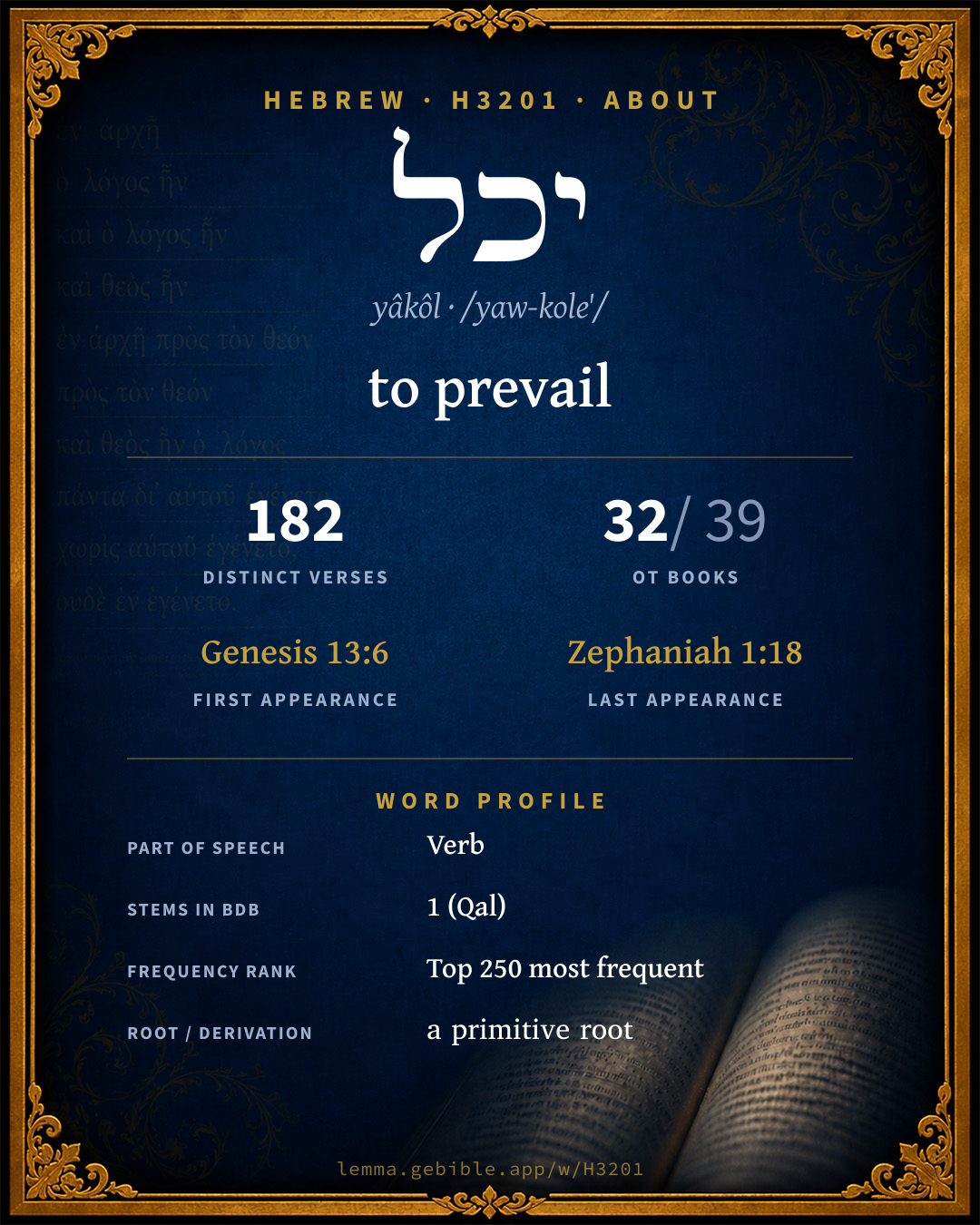
יָכֹל
to prevail
also: overcome, endure, have power, be able fuller range ↓
Full lexicon entry — Brown-Driver-Briggs (BDB)
From Brown-Driver-Briggs (BDB)
Where this word appears
Grammar key — what these labels mean
Part of speech
- Verb
- An action or state-of-being word.
Stem
- Qal
- The basic, simple active stem — the plain form of the verb (“he wrote”). Here: ‘be able’
Form
- Imperfect
- An incomplete, ongoing, or future action (“he will / would write”).
- Perfect
- A completed action or state — Hebrew marks aspect (completeness) more than strict tense (“he wrote”).
- Sequential Imperfect
- An imperfect with prefixed waw — the standard past-narrative form (waw-consecutive imperfect).
- Infinitive Absolute
- An unbound verbal noun, often intensifying or standing in for a finite verb.
- Infinitive Construct
- A bound verbal noun, frequently with prepositions (“to write / in writing”).
- Cohortative
- A first-person volitional form expressing wish or resolve (“let me / let us write”).
- Sequential Perfect
- A perfect with prefixed waw continuing a preceding imperfect or command (waw-consecutive perfect).
Person
- 3rd Person
- The one spoken about (“he / she / it / they”).
- 1st Person
- The speaker (“I / we”).
- 2nd Person
- The one addressed (“you”).
Gender
- Masculine
- Grammatically masculine.
- Common
- Either gender — not distinguished for this form.
- Feminine
- Grammatically feminine.
Number
- Singular
- One.
- Plural
- More than one (in Hebrew, generally three or more).
Every verse where H3201 appears in the Book of Deuteronomy — 16 distinct verses. Click any verse to open its interlinear word-by-word view. Verse text shown in the World English Bible for context — . Each verse’s Hebrew form is shown with its reference; the English is not keyword-highlighted, since the data carries no word-level English alignment. Use “Compare translations” on any verse to read it across multiple English versions. This concordance covers the Hebrew Bible; Septuagint (Greek Old Testament) occurrences are not indexed here.
Deuteronomy
- Deuteronomy 1:9 אוּכַ֥ל Qal impf 1cs I spoke to you at that time, saying, I am not able to bear you myself alone:
- Deuteronomy 7:17 אוּכַ֖ל Qal impf 1cs If you shall say in your heart, These nations are more than I; how can I dispossess them?
- Deuteronomy 7:22 תוּכַל֙ Qal impf 2ms Yahweh your God will cast out those nations before you by little and little: you may not consume them at once, lest the animals of the field increase on you.
- Deuteronomy 9:28 יְכֹ֣לֶת Qal inf.cs lest the land whence you brought us out say, Because Yahweh was not able to bring them into the land which he promised to them, and because he hated them, he has brought them out to kill them in the wilderness.
- Deuteronomy 12:17 תוּכַ֞ל Qal impf 2ms You may not eat within your gates the tithe of your grain, or of your new wine, or of your oil, or the firstborn of your herd or of your flock, nor any of your vows which you vow, nor your freewill-offerings, nor the heave-offering of your hand;
- Deuteronomy 14:24 תוּכַ֘ל Qal impf 2ms If the way be too long for you, so that you are not able to carry it, because the place is too far from you, which Yahweh your God shall choose, to set his name there, when Yahweh your God shall bless you;
- Deuteronomy 16:5 תוּכַ֖ל Qal impf 2ms You may not sacrifice the Passover within any of your gates, which Yahweh your God gives you;
- Deuteronomy 17:15 תוּכַ֗ל Qal impf 2ms you shall surely set him king over you, whom Yahweh your God shall choose: one from among your brothers shall you set king over you; you may not put a foreigner over you, who is not your brother.
- Deuteronomy 21:16 יוּכַ֗ל Qal impf 3ms then it shall be, in the day that he causes his sons to inherit that which he has, that he may not make the son of the beloved the firstborn before the son of the hated, who is the firstborn:
- Deuteronomy 22:3 תוּכַ֖ל Qal impf 2ms So shall you do with his donkey; and so shall you do with his garment; and so shall you do with every lost thing of your brother's, which he has lost, and you have found: you may not hide yourself.
- Deuteronomy 22:19 יוּכַ֥ל Qal impf 3ms and they shall fine him one hundred [shekels] of silver, and give them to the father of the young lady, because he has brought up an evil name on a virgin of Israel: and she shall be his wife; he may not put her away all his days.
- Deuteronomy 22:29 יוּכַ֥ל Qal impf 3ms then the man who lay with her shall give to the lady's father fifty [shekels] of silver, and she shall be his wife, because he has humbled her; he may not put her away all his days.
- Deuteronomy 24:4 יוּכַ֣ל Qal impf 3ms her former husband, who sent her away, may not take her again to be his wife, after that she is defiled; for that is abomination before Yahweh: and you shall not cause the land to sin, which Yahweh your God gives you for an inheritance.
- Deuteronomy 28:27 תוּכַ֖ל Qal impf 2ms Yahweh will strike you with the boil of Egypt, and with the tumors, and with the scurvy, and with the itch, of which you can not be healed.
- Deuteronomy 28:35 תוּכַ֖ל Qal impf 2ms Yahweh will strike you in the knees, and in the legs, with a sore boil, of which you can not be healed, from the sole of your foot to the crown of your head.
- Deuteronomy 31:2 אוּכַ֥ל Qal impf 1cs He said to them, I am one hundred twenty years old this day; I can no more go out and come in: and Yahweh has said to me, You shall not go over this Jordan.
About this entry
At a glance — auto-summarized from this page’s data, not written by a person. Every figure links to its source below. This summary describes the numbers; it doesn’t interpret them.
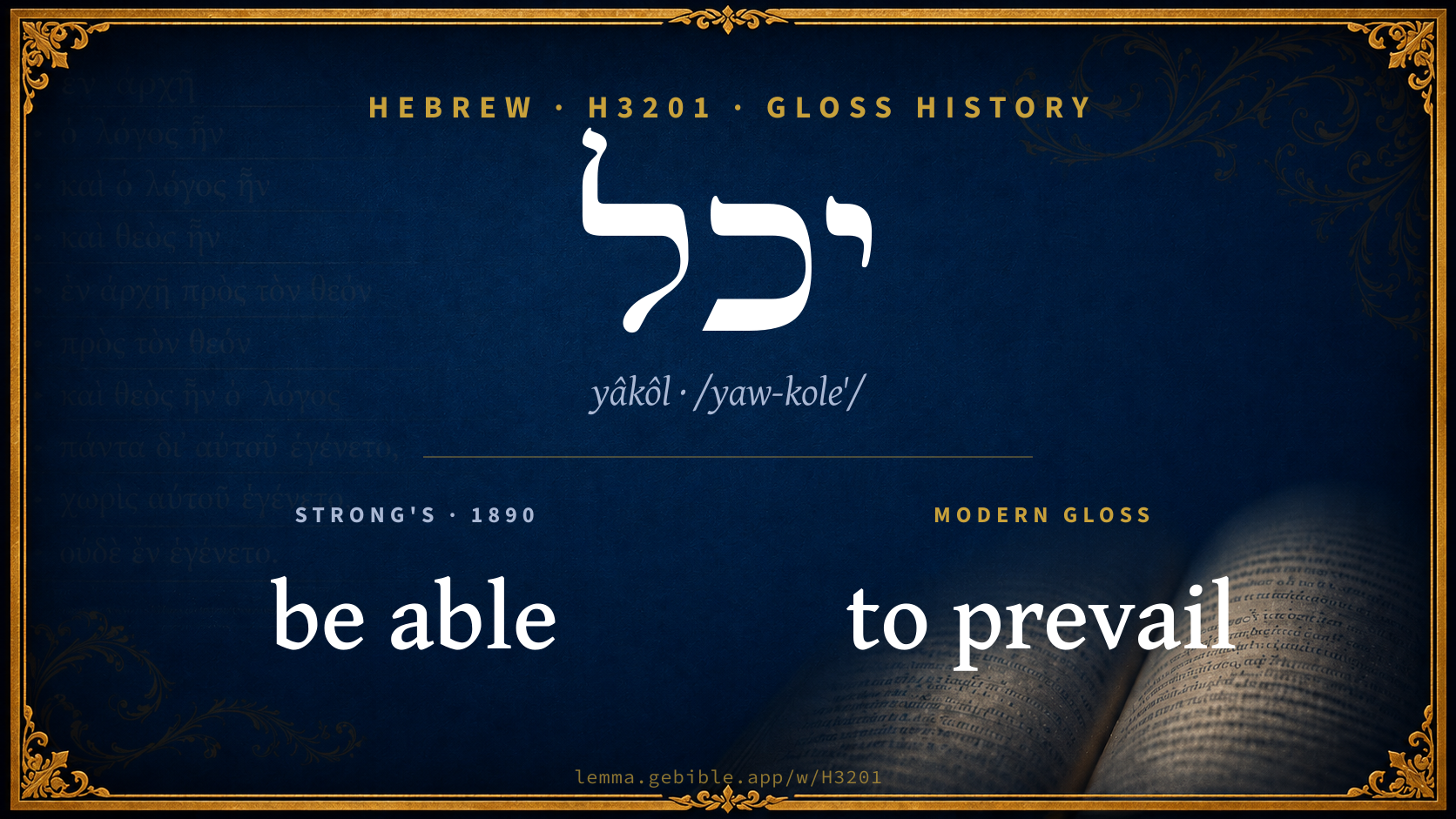
At its core, יכל (yâkôl) means “to prevail.” Its English rendering has broadened — “could” classically, “able” (unfoldingWord Literal Text) in modern versions; see the renderings breakdown. Spanning 182 verses in 32 books, it ranks among the common words of the Hebrew Bible. It first appears in Genesis 13:6. Beyond its headline sense, its full sense range takes in “overcome”, “endure”, and “have power”. Dig into 182-verse concordance and the renderings breakdown below.
Gloss history
Strong's 1890 vs modern scholarship
About this word
Strong's H3201 catalogs a Hebrew word from the Hebrew Old Testament.
These counts are not copied from any lexicon or concordance. They are computed here, from the morphology-tagged Hebrew Old Testament. What Lemma adds →
- 182
- distinct verses
- The word appears in 182 distinct verses.
- 32 / 39
- OT books
- The word appears in 32 of 39 Old Testament books.
- #242
- by frequency
- Top 250 most frequent Hebrew words (rank 242 of 8,640 Hebrew words by occurrence).
View all 182 occurrences in the concordance →
Most concentrated in
- Genesis 21 verses 12%
- Jeremiah 20 verses 11%
- Deuteronomy 16 verses 9%
By section of the Old Testament
By traditional corpus
Conventional, traditional groupings — biblical authorship is debated, so this is a traditional corpus grouping, not an authorship claim. Each share is this word’s portion of its verses in that division of the Hebrew canon. Each figure is a share of the word’s 182 distinct verses.
- Prophets (Nevi'im) 80 verses · 44%
- Torah (Pentateuch) 61 verses · 34%
- Writings (Ketuvim) 41 verses · 23%
How translations render this word
Counts come from each version’s own published word-to-Strong’s tagging or interlinear alignment — an approximate guide to how each version renders this word, not a word-level alignment the data otherwise carries. Because each total is that version’s own tagged count, the per-version totals vary from one another and need not match the appearance or distinct-verse counts above. These counts may also differ from a printed concordance because Lemma counts each distinctly tagged rendering and does not collapse phrase taggings into a single head-word total. This is a fixed set of word-tagged versions (KJV, ASV, BSB, ULT) and does not change with the reading translation you choose elsewhere. Each version’s license is shown beside its name below (and on Sources).
- King James Version: Could 20×, Cannot 15×, They could 15×
- American Standard Version: Could 17×, Cannot 15×, They could 14×
- Berean Standard Bible: Could 13×, Can 11×, Prevail 7×
- unfoldingWord Literal Text: Able 96×, They were 17×, I am 16×
King James Version Public Domain
Renders H3201 across 193 tagged occurrences — most commonly:
Plus other, less common renderings. Plus 67 renderings that appear only once — usually multi-word phrases or single function words the recovered tagging swept in, not distinct renderings. Not rendered by a distinct English word in 2 further occurrences.
American Standard Version Public Domain
Renders H3201 across 192 tagged occurrences — most commonly:
Plus other, less common renderings. Plus 72 renderings that appear only once — usually multi-word phrases or single function words the recovered tagging swept in, not distinct renderings.
Berean Standard Bible Public Domain
Renders H3201 across 116 tagged occurrences — most commonly:
Plus other, less common renderings. Plus 42 renderings that appear only once — usually multi-word phrases or single function words the recovered tagging swept in, not distinct renderings. Not rendered by a distinct English word in 78 further occurrences.
unfoldingWord Literal Text CC BY-SA 4.0
Renders H3201 across 308 tagged occurrences — most commonly:
Plus other, less common renderings. Plus 47 renderings that appear only once — usually multi-word phrases or single function words the recovered tagging swept in, not distinct renderings.
16 senses and sub-senses in the full BDB
What do BDB’s symbols mean?
BDB uses these scholarly abbreviations:
| Symbol | Meaning |
|---|---|
| 𝔊 | the Septuagint (the ancient Greek translation, LXX) |
| 𝔙 | the Vulgate (the Latin translation) |
| 𝔖 | the Syriac version (the Peshitta) |
| 𝔗 | the Targum (the Aramaic translation) |
| ψ | the Psalms |
| √ | root (the underlying root or stem) |
| ‖ | parallel passage (a synonymous or contrasted parallel) |
| † | the dagger: every passage where the word occurs is cited |
The 16 senses and sub-senses the full Brown-Driver-Briggs lexicon distinguishes for this word, in lexicon order (not ranked by frequency), with BDB’s own verbatim wording and sub-sense lettering. Shown in Hebrew script with BDB’s own scholarly abbreviations. The condensed entry is in the Lexicon Entry tab. See also the Forms in the corpus table below.
Qal
- Pf. יָכֹל Gn 32:26 + 8 times; יָכוֹל 1 S 4:15 + 2 times; 3 fs. יָֽכְלָה Gn 36:7 Ex 2:3; 2 ms. וְיָכָלְתָּ֫ Ex 18:23; 1 s. יָכֹלְתִּי Gn 30:8 + 2 times; sf. יְכָלְתִּיו ψ 13:5; 3 pl. יָֽכְלוּ Gn 13:6 + 27 times + Jos 15:63 Qr; יָכֹ֑לוּ Ex 8:14 + 2 times; Impf. 3 ms. יוּכַל Gn 13:16 + 34 times; יוּכָ֑ל Jb 4:2 + 4 times; וַיֻּכָ֑ל Ho 12:5; 3 fs. תּוּכַל Am 7:10 + 2 times; 2 ms. תּוּכַל Gn 15:5 + 16 times; 1 s. אוּכַל Gn 19:19 + 30 times, etc. (on these Impf. forms as irreg. Qal, v. Ges§ 69, 2, R. 3 Köi. 407 WSG 237; others Hoph.); Inf. cstr. יְכֹ֫לֶת Nu 14:16 Dt 9:28; Inf. abs. יָכוֹל Nu 13:20 2 Ch 32:13; יָכֹל Nu 22:38 1 S 26:25; P 8 times (not Lv), Ez 3 times; often JED Je Is 2, not seld. SK Ch;— e.g. Genesis 32:26
- 1. be able, to do a thing, whether ability be physical, moral, constitutional, or dependent on external authority; usually of man Gn 13:16 (J) +, but also of gods 2 Ch 32:13, 15, and of י׳ Nu 14:16 (JE), Dt 9:28 Je 44:22; occasionally of inanimate things Am 7:10 Gn 36:7 (P), Ct 8:7 Ec 1:15(×2), etc.: e.g. Genesis 13:16
- a. usually sq. inf. c. לְ (122 times), Gn 31:35 I am not able to rise up; 45:1 Joseph was not able to restrain himself, v 3 48:10; Ex 7:21, 24 were not able to drink, 12:39 Jos 24:19 (all E); Gn 13:16 if a man can number the dust, 19:19, 22; 43:32; 44:22, 26(×2) Ex 10:5; 19:23 (all J), Gn 15:5 Ex 15:23 Nu 11:14 (all JE) + 10 times JE; Dt 7:17 + 10 times D; Gn 13:6 they could not dwell together, 34:14; 36:7 Ex 9:11; 40:35 Nu 9:6 Jos 9:19 (all P); 1 S 3:2; 6:20 1 K 9:21 (on ‖ 2 Ch 8:8 and text of Ju 1:19 v. BuRS 8), Am 7:10 Ho 5:13 Zp 1:18 Je 6:10; 11:11; 13:23; 18:6; 19:11 +. e.g. Genesis 31:35
- b. sq. inf. without לְ (27 times; not P): Gn 37:4 Ex 2:3; 18:18, 23 (all E), Gn 24:50; 44:1 (J), Nu 22:37, 38 (JE), Dt 1:9; 7:22; 14:24; 22:29 Ju 8:3 Je 49:10, 23 Hb 1:13 Is 46:2; 47:11, 12; 57:20 La 1:14 ψ 18:39; 36:13; 78:20 Pr 30:21 Jb 4:2; 33:5. e.g. Genesis 37:4
- c. c. inf. implic., always neg., Gn 29:8 go and feed them; and they said, We are not able, cannot (J), Ex 8:14 (P), Is 29;11 Je 20:9 ψ 21:12 Jon 1:13. e.g. Genesis 29:8
- d. c. neg. = may not (of moral inability): Gn 43:32 (J) the Egyptians might not eat bread with the Hebrews; Ju 21:18 we may not give them wives; especially D, Dt 7:22; 12:17; 14:24; 16:5; 17:15; 22:3; 28:27, 35. e.g. Genesis 43:32
- e. be able, sq. impf.: אוּלַי אוּכַל נַכֶּה Nu 22:6 (JE) perchance I am able (so that) we smite (v. Di; read perhaps נוּכַל for אוּכַל Ges§ 120, 1 b); לֹא יוּכְלוּ יִגְּעוּ La 4:14 they are unable, they touch = are unable to touch (Dr§ 163, Obs.) e.g. Numbers 22:6
- f. be able, sq. pf. consec., only very late, אוּכַל וְרָאִיתִי Est 8:6(×2), lit. how shall I be able and see?—Also in various combinations where English idiom would make it an auxiliary to another verb: e.g. Esther 8:6
- g. able to gain, accomplish: sq. acc. לֹא יוּכְלוּ נִקָּיוֹן Ho 8:5 how long will they be unable (to gain) innocence? יָדַעְתִּ֯ כִּי־כֹל תּוּכָ֑ל Jb 42:2 I know that thou art able (to do) all things; אֵין הַמֶּלֶךְ יוּכַל אֶתְכֶם דָּבָר Je 38:5 the king is not (one who is) able (to do) anything with (אֶתְכם for אִתְּכֶם v. Gf, i.e. against) you. e.g. Hosea 8:5
- h. able to endure: לֹא אוּכַל אָוֶן וַעֲצָרָה Is 1:13 I cannot endure iniquity and (with) a solemn assembly, ψ 101:5. e.g. Isaiah 1:13
- i. able to reach, sq. לְ, ψ 139:6 it is high, לֹא אוּכַל לָהּ I cannot (reach) to it. e.g. Psalms 139:6
- 2. prevail:
- a. abs. prevail, overcome, be victor Gn 30:8 (E), 32:29 (J), Ho 12:5 1 S 26:25 1 K 22:22 = 2 Ch 18:21 Je 20:7, 11; of waves 5:22; succeed Is 16:12, Je 3:5 (VB hast had thy way). e.g. Genesis 30:8
- b. sq. לְ pers., prevail against, over Gn 32:26 (J), Nu 13:30 (JE), Ju 16:5 1 S 17:19 Je 1:19; 15:20; 20:10; 38:22 Ob 7 ψ 129:2 Est 6:13. e.g. Genesis 32:26
- c. once c. sf., יְכָלְתִּיו ψ 13:5 I have prevailed over him, + Zc 9:15 (where read וְיָֽכְלוּם for וְאָֽכְלוּ with 𝔊 𝔗 KloThLZ 1879. 564 StaZAW 1881, 18). e.g. Psalms 13:5
- 3. abs. have ability, strength, only neg. מִשְּׂאֵתוֹ לֹא אוּכָ֑ל Jb 31:23 because of his loftiness I have no ability, am inadequate (to anything). e.g. Job 31:23
Senses from the full Brown-Driver-Briggs lexicon (Brown, Driver, Briggs; Oxford 1906 — public domain), digitized via Sefaria, supplemented by the OpenScriptures HebrewLexicon (CC BY 4.0). Full attribution on Sources.
Word origin
vb. be able, have power, prevail, endure (NH id.; Aramaic יְכִיל; Assyrian akâlu, Hpt in KAT2Gloss i,)—
— Brown-Driver-Briggs (Oxford 1906, public domain), digitized via Sefaria, supplemented by the OpenScriptures HebrewLexicon (CC BY 4.0). See Sources.
Origin: a primitive root
Jastrow Dictionary
A second Hebrew/Aramaic lexicon for comparison, covering Aramaic and post-biblical (Talmudic, Targumic, Midrashic) usage that the biblical-Hebrew BDB does not. Matched by lemma rather than by Strong’s number, so a lemma may carry more than one Jastrow headword (shown separately below), and the entries cover usage well beyond the Bible.
יָכוֹל
- 1. (adj.) m., יְכוֹלָה f. capable, able to sustain, enduring;
- 2. (verb), impf. יוּכַל, to be capable, able; one can, may; it is possible. Cant. R. to III, 6 לארי יָכֹלְתִּי … איני י׳ I overpowered the lion, and I should not overpower the dog? Ib. שר שלכם לא י׳ … ואתם יְכוֹלִים להם your guardian angel could not stand against their father (Jacob), and (you think) you could master them?—יְכוֹלְנִי = י׳ אני I can. Ḥag. 15ᵃ top Ms. M. (ed. יכול אני); Nidd. 64ᵇ.—Keth. 95ᵃ מפני שי׳ לומר וכ׳ because he may plead &c. Ib. יְכוֹלָה היא שתאמר she may plead. Ib. 43ᵃ, a. e. י׳ הרב לומר וכ׳ the master may (has a right to) say to his slave &c. Ber. 6ᵃ אין כל בריה י׳ לעמוד וכ׳ no creature could stand up (exist) before the demons. Taan. 30ᵇ ביָכוֹל of an able-bodied person.—Yalk. Esth. 1048 שמא תוּכַל להשיאה וכ׳ canst thou give her in marriage to both of them?—Midr. Till. to Ps. XLV לא יָכְלוּ להתודות וכ׳ they could not confess their sins with their mouth; a. v. fr.—Esp. יָכוֹל (= יכול אני לומר or י׳ אתה לומר) I (you) might think, argue, conclude. Sabb. 64ᵃ י׳ שאני מרבה וכ׳ from the Bible text (Lev. XI, 32) I might infer that ropes and cords are included; Sifra Sh’mini Par. 6, ch. VIII; a. v. fr.—כִּבְיָכוֹל as though it were possible, as it were (ref. to an allegorical or anthropomorphous expression with reference to the Lord). Mekh. Bo, Pisḥa, s. 14 כל זמן … כ׳ שכינה עמהם whenever Israel is enslaved, the Divine Majesty, as it were, is with them in slavery. Ib. כ׳ אמרו ישראל וכ׳ the Israelites said, thou, as it were, hast redeemed thyself. Ib. B’shall., Shirah, s. 6 כ׳ כלפי מעלה as if referring to the Lord’s eye. B. Kam. 79ᵇ, v. מַטָּה; a. fr.—Ch. יְכִיל. e.g. Leviticus 11:32
יָכֹל
- , v. יָכוֹל, יְכוֹלֶת.
A Dictionary of the Targumim, the Talmud Babli and Yerushalmi, and the Midrashic Literature (Marcus Jastrow; London, Luzac, 1903) — Public Domain. Digitized via Sefaria. Digitized via Sefaria. Full attribution on Sources.
Forms in the corpus
The 105 distinct written forms H3201 takes in the Hebrew Bible, most frequent first — each parse links to that stem’s occurrences in the concordance. Hebrew forms include their vowel points and cantillation, so a single lemma takes many written forms.
| Form | Parsing | Example | Uses |
|---|---|---|---|
| יוּכַ֣ל | Verb, Qal, Imperfect, 3rd Person, Masculine, Singular | Deuteronomy 24:4 | 9 |
| אוּכַ֖ל | Verb, Qal, Imperfect, 1st Person, Common, Singular | Deuteronomy 7:17 | 8 |
| אוּכַל֙ | Verb, Qal, Imperfect, 1st Person, Common, Singular | Esther 8:6 | 7 |
| יוּכַ֥ל | Verb, Qal, Imperfect, 3rd Person, Masculine, Singular | Deuteronomy 22:19 | 7 |
| יוּכַ֖ל | Verb, Qal, Imperfect, 3rd Person, Masculine, Singular | Ecclesiastes 8:17 | 5 |
| תוּכַ֖ל | Verb, Qal, Imperfect, 2nd Person, Masculine, Singular | Deuteronomy 16:5 | 5 |
| יָכֹ֣ל | Verb, Qal, Perfect, 3rd Person, Masculine, Singular | Exodus 40:35 | 4 |
| אוּכַ֥ל | Verb, Qal, Imperfect, 1st Person, Common, Singular | Deuteronomy 1:9 | 4 |
| יָכְל֖וּ | Verb, Qal, Perfect, 3rd Person, Common, Plural | Genesis 37:4 | 4 |
| יוּכְל֖וּ | Verb, Qal, Imperfect, 3rd Person, Masculine, Plural | Hosea 8:5 | 4 |
| יוּכַל֙ | Verb, Qal, Imperfect, 3rd Person, Masculine, Singular | Ecclesiastes 7:13 | 4 |
| נוּכַ֖ל | Verb, Qal, Imperfect, 1st Person, Common, Plural | Genesis 44:26 | 4 |
| תוּכַ֥ל | Verb, Qal, Imperfect, 3rd Person, Feminine, Singular | Isaiah 59:14 | 3 |
| אוּכַ֛ל | Verb, Qal, Imperfect, 1st Person, Common, Singular | 1 Kings 13:16 | 3 |
| אוּכָֽל | Verb, Qal, Imperfect, 1st Person, Common, Singular | Jeremiah 20:9 | 3 |
| יָֽכְל֗וּ | Verb, Qal, Perfect, 3rd Person, Common, Plural | Exodus 15:23 | 3 |
| יָֽכְלוּ֙ | Verb, Qal, Perfect, 3rd Person, Common, Plural | Exodus 7:24 | 3 |
| יָכְל֛וּ | Verb, Qal, Perfect, 3rd Person, Common, Plural | 1 Kings 9:21 | 3 |
| יָכְל֣וּ | Verb, Qal, Perfect, 3rd Person, Common, Plural | Exodus 7:21 | 3 |
| יָכְל֥וּ | Verb, Qal, Perfect, 3rd Person, Common, Plural | Joshua 15:63 | 3 |
| יוּכַ֗ל | Verb, Qal, Imperfect, 3rd Person, Masculine, Singular | Daniel 10:17 | 3 |
| יוּכָֽל | Verb, Qal, Imperfect, 3rd Person, Masculine, Singular | Isaiah 16:12 | 3 |
| תוּכַ֣ל | Verb, Qal, Imperfect, 2nd Person, Masculine, Singular | Esther 6:13 | 2 |
| אוּכַ֔ל | Verb, Qal, Imperfect, 1st Person, Common, Singular | Isaiah 29:11 | 2 |
| אוּכַ֗ל | Verb, Qal, Imperfect, 1st Person, Common, Singular | Numbers 22:18 | 2 |
| וַ/תּוּכָֽל | Verb, Qal, Sequential Imperfect, 2nd Person, Masculine, Singular | Genesis 32:28 | 2 |
| י֣וּכְלוּ | Verb, Qal, Imperfect, 3rd Person, Masculine, Plural | Jeremiah 1:19 | 2 |
| יְכֹ֣לֶת | Verb, Qal, Infinitive Construct | Deuteronomy 9:28 | 2 |
| יָ֥כְלוּ | Verb, Qal, Perfect, 3rd Person, Common, Plural | Psalms 36:12 | 2 |
| יָכֹ֑לוּ | Verb, Qal, Perfect, 3rd Person, Common, Plural | Exodus 8:18 | 2 |
| יָכֹ֖ל | Verb, Qal, Perfect, 3rd Person, Masculine, Singular | 1 Kings 13:4 | 2 |
| יָכֹל֙ | Verb, Qal, Perfect, 3rd Person, Masculine, Singular | Genesis 32:25 | 2 |
| נוּכַ֛ל | Verb, Qal, Imperfect, 1st Person, Common, Plural | Genesis 24:50 | 2 |
| תּוּכַ֕ל | Verb, Qal, Imperfect, 2nd Person, Masculine, Singular | 2 Kings 18:23 | 2 |
| תּוּכָ֑ל | Verb, Qal, Imperfect, 2nd Person, Masculine, Singular | 1 Samuel 26:25 | 2 |
| תּוּכָ֔ל | Verb, Qal, Imperfect, 2nd Person, Masculine, Singular | 1 Kings 22:22 | 2 |
| תוּכַ֗ל | Verb, Qal, Imperfect, 2nd Person, Masculine, Singular | Deuteronomy 17:15 | 2 |
| תוּכַל֙ | Verb, Qal, Imperfect, 2nd Person, Masculine, Singular | Deuteronomy 7:22 | 2 |
| א֥וּכַֽל | Verb, Qal, Imperfect, 1st Person, Common, Singular | Psalms 139:6 | 1 |
| אֽוּכַל | Verb, Qal, Imperfect, 1st Person, Common, Singular | 1 Samuel 17:9 | 1 |
| אוּכַ֤ל | Verb, Qal, Imperfect, 1st Person, Common, Singular | Numbers 11:14 | 1 |
| אוּכַ֨ל | Verb, Qal, Imperfect, 1st Person, Common, Singular | Jeremiah 18:6 | 1 |
| הֲ/י֣וּכַל | Verb, Qal, Imperfect, 3rd Person, Masculine, Singular | Psalms 78:19 | 1 |
| הֲ/יָכ֣וֹל | Verb, Qal, Infinitive Absolute | 2 Chronicles 32:13 | 1 |
| הֲ/יָכ֥וֹל | Verb, Qal, Infinitive Absolute | Numbers 22:38 | 1 |
| הַ/אוּכַ֥ל | Verb, Qal, Imperfect, 1st Person, Common, Singular | 2 Samuel 12:23 | 1 |
| וְ/יָֽכָלְתָּ֖ | Verb, Qal, Sequential Perfect, 2nd Person, Masculine, Singular | Exodus 18:23 | 1 |
| וְ/יָכְל֤וּ | Verb, Qal, Perfect, 3rd Person, Common, Plural | Jeremiah 38:22 | 1 |
| וְ/נ֣וּכְלָה | Verb, Qal, Cohortative, 1st Person, Common, Plural | Jeremiah 20:10 | 1 |
| וַ/יֻּכָ֔ל | Verb, Qal, Sequential Imperfect, 3rd Person, Masculine, Singular | Hosea 12:4 | 1 |
| וַ/תּוּכָ֑ל | Verb, Qal, Sequential Imperfect, 2nd Person, Masculine, Singular | Jeremiah 20:7 | 1 |
| י֣וּכַל | Verb, Qal, Imperfect, 3rd Person, Masculine, Singular | Psalms 78:20 | 1 |
| יְכָלְתִּ֑י/ו | Verb, Qal, Perfect, 1st Person, Common, Singular | Psalms 13:4 | 1 |
| יָֽכְל֔וּ | Verb, Qal, Perfect, 3rd Person, Common, Plural | 2 Chronicles 29:34 | 1 |
| יָֽכְל֖וּ | Verb, Qal, Perfect, 3rd Person, Common, Plural | Genesis 13:6 | 1 |
| יָכ֔וֹל | Verb, Qal, Perfect, 3rd Person, Masculine, Singular | 2 Chronicles 32:14 | 1 |
| יָכ֖וֹל | Verb, Qal, Perfect, 3rd Person, Masculine, Singular | 1 Samuel 4:15 | 1 |
| יָכ֗וֹל | Verb, Qal, Perfect, 3rd Person, Masculine, Singular | 2 Chronicles 7:7 | 1 |
| יָכ֥וֹל | Verb, Qal, Infinitive Absolute | Numbers 13:30 | 1 |
| יָכְל֗וּ | Verb, Qal, Perfect, 3rd Person, Common, Plural | Nehemiah 7:61 | 1 |
The 60 most common forms are shown; 45 rarer forms follow in the full concordance.
Same root — word family
Other BDB entries built from the same root as H3201, grouped by Strong’s listed origin. These share a root / origin per the lexicon — not necessarily a shared meaning. Each links to that word’s own entry.
Derived from this word
- היכל hêykâl H1964 temple
- יכל yᵉkêl H3202 to prevail
- כהל kᵉhal H3546 to be able
- מיכל mîykâl H4323 brook
Proper names from this root
People and places named from this root — a name, not an additional meaning of the word.
Compare all same-root words → Showing 4 of 7 — not the complete family. 2 of the same-root words are proper names (people or places). They share a root, not necessarily a meaning.
Septuagint verse parallels
This word appears in 172 verses that also exist in the Greek Old Testament (Septuagint), out of the 182 Hebrew verses it occurs in. You can read those verses in Greek by switching the Old Testament edition to the Septuagint.
Read these verses in the Septuagint
- Genesis 13:6
- Exodus 2:3
- Numbers 9:6
- Deuteronomy 1:9
- Joshua 7:12
- Judges 2:14
- Ruth 4:6
- 1 Samuel 3:2
- 2 Samuel 3:11
- 1 Kings 3:9
- 2 Kings 3:26
- 1 Chronicles 21:30
This is a verse-level parallel only — the same verses exist in both the Hebrew and Greek Old Testaments. No word-level Hebrew↔Greek correspondence is claimed: the data carries no such alignment, so no Greek word is shown as this Hebrew word’s translation. Coverage is not total — the Septuagint omits the deuterocanon and renumbers the Psalms, so some Hebrew verses have no direct Greek parallel.