Ruth 4:6

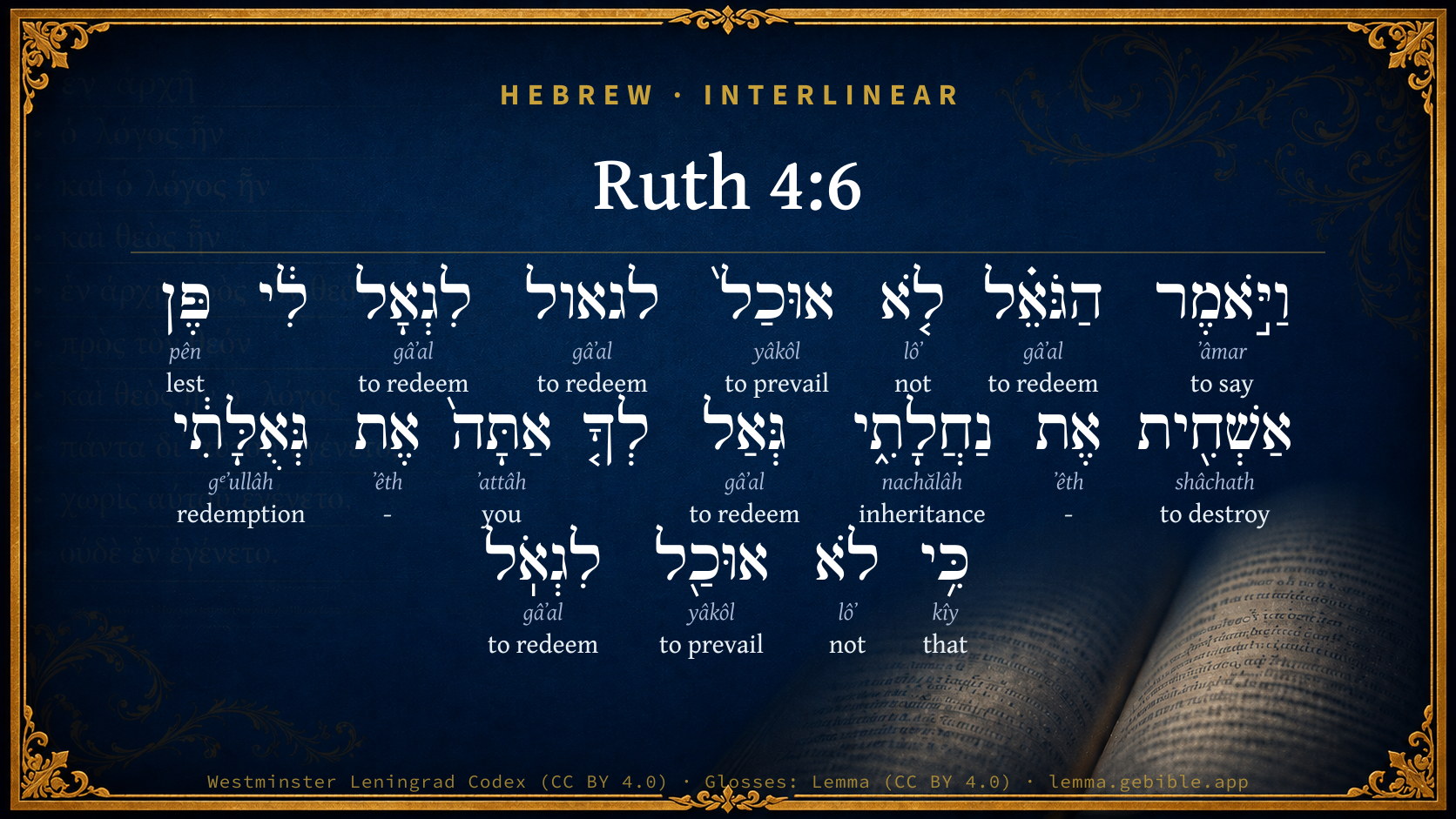
Hebrew (Westminster Leningrad Codex) Ruth 4:6 appears in the Hebrew Old Testament. The text above is from the Westminster Leningrad Codex. Each word links to its Strong’s number, a concise gloss, and parsing drawn from the Open Scriptures Hebrew Bible morphology. Click any word for its full Brown-Driver-Briggs (BDB) entry.
Download image
Cite this verse

Ruth 4:6 (World English Bible). Public Domain. Lemma interlinear Bible study tool, https://lemma.gebible.app/v/ruth/4/6.

Show BibTeX & RIS
BibTeX
RIS
English Translation
The near kinsman said, I can't redeem it for myself, lest I mar my own inheritance: take my right of redemption on you; for I can't redeem it.
World English Bible · Public Domain
Download a study sheet

One document with this verse’s original text, its word-by-word gloss line, the meaning frame, cross-references with their text, attributed commentary, and full source and license credits — printable, and it pastes into notes with its structure intact.

This verse Autodidact and up

Study sheet (.html) Plain text (.txt)

A passage Seminary Student

Up to 50 verses in one chapter. A passage sheet keeps up to 6 commentary sources and 12 cross-references per verse, in the order this page ranks them, and says so on the sheet whenever that leaves anything out. Ask for a single verse and you get the Autodidact verse sheet above.

Everything on this page stays free to read, with no account — the sheet is a download of what is already on screen, not access to it.

Want to remove ads? Support Godless Engineer
Compare translations 3

The same verse in 3 English versions, stacked beneath the original-language interlinear above. Click any original word for its lexicon entry.

Each is an independent rendering of the whole verse — the interlinear is not word-aligned to these translations.

Highlighted words mark where these versions differ — a whole-verse word diff, not a word-by-word alignment.

  • World English Bible Public Domain
    The near kinsman said, I can't redeem it for myself, lest I mar my own inheritance: take my right of redemption on you; for I can't redeem it.
  • King James Version Public Domain
    And the kinsman said, I cannot redeem it for myself, lest I mar mine own inheritance: redeem thou my right to thyself; for I cannot redeem it.
  • unfoldingWord Literal Text CC BY-SA 4.0
    Then the kinsman-redeemer said, “I am not able to redeem it for myself lest I damage my own inheritance. You redeem for yourself my right of redemption, for I am not able to redeem it.”

unfoldingWord Literal Text — © unfoldingWord, licensed CC BY-SA 4.0. Word-aligned USFM3 via Door43 (git.door43.org/unfoldingWord/en_ult).

Versions to compare (up to 4)

3 of 4 selected

Show all 18 translations

Every available English version of this verse, each an independent rendering of the whole verse.

  • World English Bible Public Domain
    The near kinsman said, I can't redeem it for myself, lest I mar my own inheritance: take my right of redemption on you; for I can't redeem it.
  • Berean Standard Bible Public Domain
    The kinsman-redeemer replied, “I cannot redeem it myself, or I would jeopardize my own inheritance. Take my right of redemption, because I cannot redeem it.”
  • Majority Standard Bible Public Domain
    The kinsman-redeemer replied, “I cannot redeem it myself, or I would jeopardize my own inheritance. Take my right of redemption, because I cannot redeem it.”
  • King James Version Public Domain
    And the kinsman said, I cannot redeem it for myself, lest I mar mine own inheritance: redeem thou my right to thyself; for I cannot redeem it.
  • American Standard Version (1901) Public Domain
    And the near kinsman said, I cannot redeem it for myself, lest I mar mine own inheritance: take thou my right of redemption on thee; for I cannot redeem it.
  • Revised Version (1885) Public Domain
    And the near kinsman said, I cannot redeem it for myself, lest I mar mine own inheritance: take thou my right of redemption on thee; for I cannot redeem it.
  • Geneva Bible (1599) Public Domain
    And the kinsman answered, I can not redeeme it, lest I destroy mine owne inheritance: redeeme my right to thee, for I can not redeeme it.
  • Douay-Rheims (1899) Public Domain
    He answered: I yield up my right of next akin: for I must not cut off the posterity of my own family. Do thou make use of my privilege, which I profess I do willingly forego.
  • Young's Literal Translation Public Domain
    And the redeemer saith, `I am not able to redeem `it' for myself, lest I destroy mine inheritance; redeem for thyself -- thou -- my right of redemption, for I am not able to redeem.'
  • Literal Standard Version CC BY-SA 4.0
    And the redeemer says, “I am not able to redeem [it] for myself, lest I destroy my inheritance; redeem for yourself—you—my right of redemption, for I am not able to redeem.”
  • Unlocked Literal Bible CC BY-SA 4.0
    Then the near kinsman said, “I cannot redeem it for myself without damaging my own inheritance. You take my right of redemption for yourself, for I cannot redeem it.”
  • unfoldingWord Literal Text CC BY-SA 4.0
    Then the kinsman-redeemer said, “I am not able to redeem it for myself lest I damage my own inheritance. You redeem for yourself my right of redemption, for I am not able to redeem it.”
  • Darby Bible Public Domain
    And he that had the right of redemption said, I cannot redeem [it] for myself, lest I mar mine own inheritance. Redeem thou for thyself what I should redeem, for I cannot redeem [it].
  • World Messianic Bible Public Domain
    The near kinsman said, “I can’t redeem it for myself, lest I endanger my own inheritance. Take my right of redemption for yourself; for I can’t redeem it.”
  • Webster's Bible Public Domain
    And the kinsman said, I cannot redeem it for myself, lest I mar my own inheritance: redeem thou my right to thyself; for I cannot redeem it.
  • Free Bible Version CC BY-SA 4.0
    “Well, I can't do it then,” the family redeemer replied. “If I were to redeem it, that could jeopardize what I already own. You redeem it for yourself, because I can't.”
  • Bible in Basic English Public Domain
    And the near relation said, I am not able to do the relation's part, for fear of damaging the heritage I have: you may do it in my place, for I am not able to do it myself.
  • JPS Tanakh (1917) Public Domain
    And the near kinsman said: 'I cannot redeem it for myself, lest I mar mine own inheritance; take thou my right of redemption on thee; for I cannot redeem it.' —

Literal Standard Version (2020), Covenant Press — licensed CC BY-SA 4.0. Text via the HelloAO Bible API (eBible.org). Unlocked Literal Bible (unfoldingWord) — licensed CC BY-SA 4.0. Text via the HelloAO Bible API (eBible.org). unfoldingWord Literal Text — © unfoldingWord, licensed CC BY-SA 4.0. Word-aligned USFM3 via Door43 (git.door43.org/unfoldingWord/en_ult). Free Bible Version, Dr. Jonathan Gallagher — licensed CC BY-SA 4.0. Text via the HelloAO Bible API (eBible.org).

Word by word

More ways to search: Search by grammar → Find every occurrence → Compare this word →

Practice this passage: Drill this verse → Learn its vocabulary →

גְּאֻלָּתִ֔י
gᵉʼullâh
H1353
“redemption · my”
Noun, Common, Feminine, Singular, Construct + Suffix, Personal, 1st Person, Common, Singular
Part of Speech
Noun
Type
Common
Gender
Feminine
Number
Singular
State
Construct
Full BDB Definition

Origin: pass. participle of H1350

TWOT: 300b

kindred, redemption, right of redemption, price of redemption - kin, kindred - redemption - right of redemption - price of redemption, redemption price
  1. וַיֹּ֣אמֶר ʼâmar H559 “and · to say” Conjunction + Verb, Qal, Sequential Imperfect, 3rd Person, Masculine, Singular
  2. הַגֹּאֵ֗ל gâʼal H1350 “the · redeeming” Particle, Definite Article + Verb, Qal, Participle Active, Masculine, Singular, Absolute
  3. לֹ֤א lôʼ H3808 “not” Particle, Negative
  4. אוּכַל֙ yâkôl H3201 “to prevail” Verb, Qal, Imperfect, 1st Person, Common, Singular
  5. לגאול gâʼal H1350 “to redeem” Preposition + Verb, Qal, Infinitive Construct
  6. לִגְאָל gâʼal H1350 “to redeem” Preposition + Verb, Qal, Infinitive Construct
  7. פֶּן pên H6435 “lest” Conjunction
  8. אַשְׁחִ֖ית shâchath H7843 “to destroy” Verb, Hiphil, Imperfect, 1st Person, Common, Singular
  9. אֶת ʼêth H853 “-” Particle, Direct Object
  10. נַחֲלָתִ֑י nachălâh H5159 “inheritance · my” Noun, Common, Feminine, Singular, Construct + Suffix, Personal, 1st Person, Common, Singular
  11. גְּאַל gâʼal H1350 “redeem” Verb, Qal, Imperative, 2nd Person, Masculine, Singular
  12. אַתָּה֙ ʼattâh H859 “you” Pronoun, Personal, 2nd Person, Masculine, Singular
  13. אֶת ʼêth H853 “-” Particle, Direct Object
  14. כִּ֥י kîy H3588 “that” Conjunction
  15. לֹא lôʼ H3808 “not” Particle, Negative
  16. אוּכַ֖ל yâkôl H3201 “to prevail” Verb, Qal, Imperfect, 1st Person, Common, Singular
  17. לִגְאֹֽל gâʼal H1350 “to redeem” Preposition + Verb, Qal, Infinitive Construct

About this verse

These counts appear in no published source. They are computed here, from the morphology-tagged text and Lemma’s own curated glosses. What Lemma adds →

20
words
11
distinct lemmas
Historical
section

Notable vocabulary

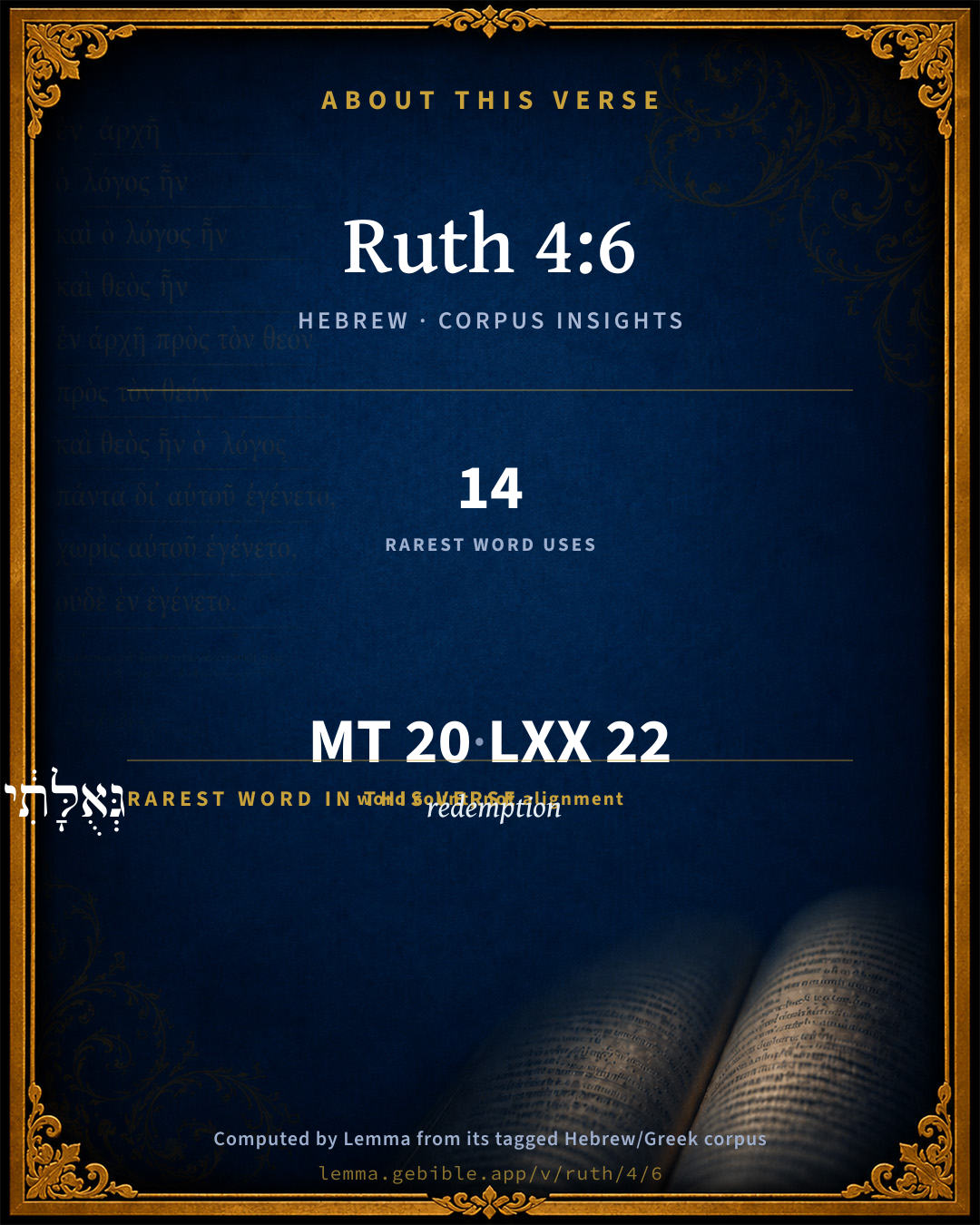
The rarest word here is גְּאֻלָּתִ֔י redemption H1353 — appearing just 14 times in the whole Hebrew Bible.

Shared distinctive vocabulary

גְּאֻלָּתִ֔י redemption H1353 occurs in 13 verses of the Hebrew Bible. Also found in:

Grammatical profile

  • 9 verbs
  • 2 nouns
  • 1 pronoun
  • 2 prepositions
  • 2 conjunctions
  • 4 particles

Verb forms

  • וַיֹּ֣אמֶר Qal · Sequential Imperfect
  • הַגֹּאֵ֗ל Qal · Participle Active
  • אוּכַל֙ Qal · Imperfect
  • לגאול Qal · Infinitive Construct
  • לִגְאָל Qal · Infinitive Construct
  • אַשְׁחִ֖ית Hiphil · Imperfect
  • גְּאַל Qal · Imperative
  • אוּכַ֖ל Qal · Imperfect
  • לִגְאֹֽל Qal · Infinitive Construct

Repetition

Words recur within this verse — often emphatic in Hebrew:

  • הַגֹּאֵ֗ל to redeem H1350 ×5
  • אוּכַל֙ to prevail H3201 ×2
  • לֹ֤א not H3808 ×2

Hebrew & Septuagint length

In English translation the verse runs 28 words from the Hebrew and 36 from the Septuagint (LXX English) — closely comparable.

A rough comparison of the two English renderings, which tokenize alike — not a word-level alignment.

Word counts can differ between the Hebrew and the Greek without any difference in meaning — e.g. the Hebrew direct-object marker אֵת has no separate Greek word, and Greek often adds the article ὁ.

In the original languages it is 20 Hebrew tokens and 22 Greek tokens — but the two are counted differently (Hebrew bundles its prefixes and suffixes into one token; the Greek is in lemma form), so that isn’t a like-for-like length.

Cross-references

2

Topical passages linked to Ruth 4:6 in the Treasury of Scripture Knowledge — connected by theme and wording, ordered by reader-vote popularity; previews shown in the World English Bible.

  • Leviticus 25:25 "'If your brother becomes poor, and sells some of his possessions, then his kinsman who is next to him shall come, and redeem that which his brother has sold.
  • Ruth 3:13 Stay this night, and it shall be in the morning, that if he will perform to you the part of a kinsman, well; let him do the kinsman's part: but if he will not do the part of a kinsman to you, then will I do the part of a kinsman to you, as Yahweh lives: lie down until the morning.

Cross-references courtesy of OpenBible.info (CC BY 4.0).

Hebrew and Greek witnesses Masoretic Hebrew ↔ Greek Septuagint

The same verse in the two great witnesses to the Old Testament, shown verse-for-verse.

These are two independent witnesses, not word-aligned to each other, and the Septuagint is shown in lemma (dictionary) form.

Hebrew Ruth 4:6 Masoretic · Westminster Leningrad Codex

וַיֹּ֣אמֶר הַגֹּאֵ֗ל לֹ֤א אוּכַל֙ לגאול לִגְאָל לִ֔י פֶּן אַשְׁחִ֖ית אֶת נַחֲלָתִ֑י גְּאַל לְךָ֤ אַתָּה֙ אֶת גְּאֻלָּתִ֔י כִּ֥י לֹא אוּכַ֖ל לִגְאֹֽל

The near kinsman said, I can't redeem it for myself, lest I mar my own inheritance: take my right of redemption on you; for I can't redeem it.

World English Bible · Public Domain

Greek LXX Ruth 4:6 Septuagint · lemma form

καί εἶπον ὁ ἀγχιστεύς οὐ δύναμαι ἀγχιστεύω ἐμαυτοῦ μήποτε διαφθείρω ὁ κληρονομία ἐγώ ἀγχιστεύω σεαυτοῦ ὁ ἀγχιστεία ἐγώ ὅτι οὐ δύναμαι ἀγχιστεύω

And the kinsman said, I shall not be able to redeem it for myself, lest I mar my own inheritance; do you redeem my right for yourself, for I shall not be able to redeem it.

LXX2012 (modern English Septuagint) · Public Domain

Hebrew: Westminster Leningrad Codex (CC BY 4.0). Greek: Septuagint (public domain); English from LXX2012 (modern English Septuagint) (Public Domain). How the Septuagint differs from the Hebrew →

Commentary

Notes on Ruth 4:6 from classic Christian and Jewish commentators (each source and its license shown beneath its notes). The classic Christian expositions comment on the surrounding passage and are grouped to its opening verse, so a note may address several verses; the Jewish commentaries on the Tanakh (Rashi and others) are per-verse, so they appear only where the commentator wrote on this verse.

Lemma curates 59 commentaries, every one of them public domain or Creative Commons licensed, each selected and text-cleaned for this edition rather than reprinted as found. About our sources →

Jamieson, Fausset & Brown

Robert Jamieson, A. R. Fausset & David Brown

HE REFUSES THE REDEMPTION. (Rut 4:6-8)

The kinsman said, I cannot redeem it . . ., lest I mar mine own inheritance--This consequence would follow, either, first, from his having a son by Ruth, who, though heir to the property, would not bear his name; his name would be extinguished in that of her former husband; or, secondly, from its having to be subdivided among his other children, which he had probably by a previous marriage. This right, therefore, was renounced and assigned in favor of Boaz, in the way of whose marriage with Ruth the only existing obstacle was now removed.

Jamieson, Fausset & Brown — Commentary Critical and Explanatory on the Whole Bible (1871) — public domain (CC PDM 1.0). Text via the HelloAO Bible API.

Trapp's Complete Commentary

John Trapp

Rth 4:6 And the kinsman said, I cannot redeem [it] for myself, lest I mar mine own inheritance: redeem thou my right to thyself; for I cannot redeem [it].

Ver. 6. I cannot redeem it.] And again, I cannot redeem it. Note here: (1.) His verbosity; see the like, Ecc 10:14; {See Trapp on "Ecc 1:14"} (2.) His levity and inconstancy, aliud stuns, aliud sedens, erewhile he could, but now he cannot. {a} And why so?

Lest I mar mine own inheritance.] Oh! take heed of that by any means: this is the worldling’s greatest care; he preferreth haram domesticam arae domicae, a swine sty before a sanctuary: and feareth more iacturam regionis quam religionis, the loss of his part in Paris, than of his part in paradise, with that carnal cardinal. But what meant this man by marring his inheritance, in marrying the widow? First, she was poor; and then the old woman must be kept too, which would be a double charge. More than this: she might fill him with children, and so weaken his inheritance, while it was divided among so many. Or if he had but one child only by her, he should lack an heir to bear his own name: for the child must bear the name of his kinsman deceased: he should but beget children on another man’s bed, &c. Quae vero illa fuit vel impudentia vel audacia? saith Lavater here. What strange impudency was it thus to reason, and thus to resolve! Would this man be wiser than God? Is it not he who preserveth families, and blesseth those that obey his commandments, &c. But this fellow hath many fellows in these our days, &c.

{a} Una eademque de re contraria loquitur. - Lav.

John Trapp, A Commentary or Exposition upon All the Books of the Old and New Testament (1647–1656) — public domain. Text from a community e-Sword module.

The Biblical Illustrator

Joseph S. Exell

Rth_4:6

I cannot redeem it for myself, lest I mar mine own inheritance.

The endangered inheritance

Many men mar noble inheritances.

I. The inheritance of physical health. The ancients were right who spoke of a sound mind in a sound body as one of the best gifts of the gods. God has written His will upon the body as truly as upon the pages of the Bible. Every natural motion of the body is a revelation of the will and purpose of the Divine Creator. Ever since Christ was cradled in the manger at Bethlehem the body has been honoured, exalted, glorified. Ever since the descent of the Holy Spirit on the Day of Pentecost the body has been the temple of the Third Person of the Trinity. The man who overworks his body sins against God. The man who by intemperance in eating or drinking unfits his body for discharging its normal functions degrades himself and dishonours the Almighty. It is true that many men with broken bodies have accomplished wonderful results in life. The names of John Calvin, Robert Hall, and a score more, suggest themselves as illustrations. Let no man be discouraged who has inherited a weak body. Great souls have often dwelt in frail tenements, until the tired body was laid to its rest and the great soul went up in triumph to God. But let those who have received the inheritance of physical health prize it as one of the great gifts of life, care for it as one of the sacred inheritances of life, and lay it as a willing offering at the feet of the Lord Christ.

II. The inheritance of intellectual capabilities. Of course there are great differences among men in these respects. But in our day ignorance is not simply a misfortune; it is a crime. Christian men must develop all their faculties to their highest possibilities. Every man is bound, by the most sacred obligations, to make the most of himself for time and for eternity. What a man is intellectually here will determine to some degree what he will be intellectually hereafter. The life to come is but the developed results of present conditions and attainments; that life is but the ripened fruit of the intellectual and moral seed sown in this life. Every Christian, because inspired by a sense of loyalty to Jesus Christ, will desire to develop his intellectual powers to their utmost degree. He cannot but wish to possess numerous and varied mental faculties for the salvation of men and for the greater glory of the Lord. Divine love in human hearts puts enlarged brains into human heads. Religion stimulates every noble faculty of the soul. It made John Bunyan the immortal dreamer; it made Samuel Bradburn one of the greatest workers and orators in his Church, a man of whom Dr. Abel Stevens said that during forty years Samuel Bradburn was esteemed the Demosthenes of Methodism; it made William Carey a profound scholar, a lofty thinker, a consecrated toiler, and an inspired genius. Christianity adorns culture with true symmetry and highest beauty; and culture, in turn, gives Christianity its fullest beauty and its grandest opportunity. They ought never to be separated. Each sweetly and divinely ministers to the other. Let no young man or woman neglect wide reading, careful study, earnest thought. Young Christians should be model students. They have Jesus Christ for their teacher and the noblest men and women in the world as their fellow-pupils.

III. The inheritance of a worthy family history. This is a gift above the worth of all mere financial values. A good name is more to be desired than gold, yea, than much fine gold. A good name is the ripe product of years of noble ancestral character. Is there a man who has wandered from his fathers and his mothers God? Is there one who has lowered the standard of a noble family life and history? Is there one who is besmirching his name and staining his character by unholy thoughts and impure acts? In the name of that worthy family history, in the name of an ideal family life, in the name of the great God and Father of us all, I beseech him to stop and to stop now. He is marring his own inheritance. It is a blessed thing to be able to give a noble family inheritance to ones children. Let us carefully guard it; let us sacredly preserve it; let us continually honour it; let us never so live that our children shall be ashamed of the name they bear. Let us send it down to them as an honoured inheritance to which they shall add honours from all the generations to come.

IV. The inheritance of religious possibilities. Intellectual attainments and religious experiences cannot be transmitted to our children. We can transmit our vices; but, strictly speaking, not our virtues. There is a sense, however, in which we can transmit tendencies toward good and God, or toward evil and the devil. There is a Divine truth in much that is said regarding heredity in our day. It is much for a man to be able to say, My fathers God; it is vastly easier for such a man to say, My Lord and my God, after having been taught to say, My fathers God. Children of Christian men and women stand upon a vastly higher plane of possibility than the children of ungodly men and women. The time may come when the natural will be much more like the supernatural than as we now see it. Indeed, there is a sense in which there is no distinction between the natural and supernatural. God is active in all spheres of nature. The possibility of being translated out of the kingdom of darkness into the kingdom of Gods dear Son ought to be realised in early childhood. No man, however far he may go into sin, can shake off entirely the influences of a godly parentage and of early religious training. I once talked with a man who had just recovered from a period of dissipation, and with broken voice and moist eyes, he said, How could I so far forget myself, so greatly dishonour my sainted parents, and so wickedly disobey my fathers God? Oh! children of Gods children, prize your privileges! (R. S. MacArthur, D. D.)

The Biblical Illustrator, edited by Joseph S. Exell (c. 1880s–1900s) — public domain. Text from a community e-Sword module.

Joseph Benson's Commentary

Rth 4:6. Lest I mar mine own inheritance — It seems he had a wife and children already, which made him afraid to marry a poor woman with a small parcel of land, which would not provide for the children he might have by her, lest he should thereby diminish the inheritance of which he was already possessed. The Chaldee paraphrase on the passage is, “I cannot redeem it on this condition,” namely, the condition of marrying Ruth; “because I have a wife already, and do not choose to bring another into my house, lest quarrels and divisions arise in it, and I hurt my own inheritance.”

Joseph Benson's Commentary on the Old and New Testaments (1811–1818) — public domain. Text from a community e-Sword module.

Keil & Delitzsch

C. F. Keil & F. Delitzsch

The redeemer admitted the justice of this demand, from which we may see that the thing passed as an existing right in the nation. But as he was not disposed to marry Ruth, he gave up the redemption of the field.

Rut 4:6-13

"I cannot redeem it for myself, lest I mar mine own inheritance." The redemption would cost money, since the yearly produce of the field would have to be paid for up to the year of jubilee. Now, if he acquired the field by redemption as his own permanent property, he would have increased by so much his own possessions in land. But if he should marry Ruth, the field so redeemed would belong to the son whom he would beget through her, and he would therefore have parted with the money that he had paid for the redemption merely for the son of Ruth, so that he would have withdrawn a certain amount of capital from his own possession, and to that extent have detracted from its worth. "Redeem thou for thyself my redemption," i.e., the field which I have the first right to redeem.

Rut 4:7-8

This declaration he confirmed by what was a usual custom at that time in renouncing a right. This early custom is described in Rut 4:7, and there its application to the case before us is mentioned afterwards. "Now this was (took place) formerly in Israel in redeeming and exchanging, to confirm every transaction: A man took off his shoe and gave it to another, and this was a testimony in Israel." From the expression "formerly," and also from the description given of the custom in question, it follows that it had gone out of use at the time when our book was composed. The custom itself, which existed among the Indians and the ancient Germans, arose from the fact that fixed property was taken possession of by treading upon the soil, and hence taking off the shoe and handing it to another was a symbol of the transfer of a possession or right of ownership (see the remarks on Deu 25:9 and my Bibl. Archol. ii. p. 66). The Piel קיּם is rarely met with in Hebrew; in the present instance it was probably taken from the old legal phraseology. The only other places in which it occurs are Eze 13:6; Psa 119:28, Psa 119:106, and the book of Esther, where it is used more frequently as a Chaldaism.

Rut 4:9-10

After the nearest redeemer had thus renounced the right of redemption with all legal formality, Boaz said to the elders and all the (rest of the) people, "Ye are witnesses this day, that I have acquired this day all that belonged to Elimelech, and to Mahlon and Chilion (i.e., the field of Elimelech, which was the rightful inheritance of his sons Mahlon and Chilion), at the hand of Naomi; and also Ruth the Moabitess, the wife of Mahlon, I have acquired as my wife, to raise up the name of the deceased upon his inheritance, that the name of the deceased may not be cut off among his brethren and from the gate of his people" (i.e., from his native town Bethlehem; cf. Rut 3:11). On the fact itself, see the introduction to Ruth 3; also the remarks on the Levirate marriages at Deu 25:5.

Rut 4:11

The people and the elders said, "We are witnesses," and desired for Boaz the blessing of the Lord upon this marriage. For Boaz had acted as unselfishly as he had acted honourably in upholding a laudable family custom in Israel. The blessing desired is the greatest blessing of marriage: "The Lord make the woman that shall come into thine house (the participle בּאה refers to what is immediately about to happen) like Rachel and like Leah, which two did build the house of Israel ("build" as in Gen 16:2; Gen 30:3); and do thou get power in Ephratah, and make to thyself a name in Bethlehem." חיל עשׂה does not mean "get property or wealth," as in Deu 8:17, but get power, as in Ps. 60:14 (cf. Pro 31:29), sc., by begetting and training worthy sons and daughters. "Make thee a name," literally "call out a name." The meaning of this phrase, which is only used here in this peculiar manner, must be the following: "Make to thyself a well-established name through thy marriage with Ruth, by a host of worthy sons who shall make thy name renowned."

Rut 4:12

"May thy house become like the house of Perez, whom Tamar bore to Judah" (Gen 38). It was from Perez that the ancestors of Boaz, enumerated in Rut 4:18. and Ch1 2:5., were descended. As from Perez, so also from the seed which Jehovah would give to Boaz through Ruth, there should grow up a numerous posterity.

Keil & Delitzsch — Biblical Commentary on the Old Testament (1861–1891) — public domain (CC PDM 1.0). Text via the HelloAO Bible API. (Old Testament only.)

Tyndale Open Study Notes

Tyndale Open Resources

4:6 Then I can’t redeem it: The addition of Ruth to the transaction completely changed the equation for the other kinsman. • this might endanger my own estate: If he bought the land, married Ruth, and raised an heir for Elimelech, he might invest many resources only to lose control of the new land, and he might not have enough to maintain his own land. If he then failed to have a second son with Ruth as his own heir, his land would be inherited by Elimelech’s heir, and his own name would die out. Even if this kinsman had acquired the land and not Ruth (see study notes on 3:11; 4:5), he still might lose his investment in the land to the heir born to Ruth. By acting to preserve his own name, this man became the no-name who refused to help his close relative.

Tyndale Open Study Notes — © Tyndale Open Resources, licensed CC BY-SA 4.0. Text via the HelloAO Bible API.

Adam Clarke's Commentary

Verse 6. I cannot redeem it for myself] The Targum gives the proper sense of this passage: "And the kinsman said, On this ground I cannot redeem it, because I have a wife already; and I have no desire to take another, lest there should be contention in my house, and I should become a corrupter of my inheritance. Do thou redeem it, for thou hast no wife; for I cannot redeem it." This needs no comment. But still the gloss of the Targum has no foundation in the law of Moses. See the law, De 25:5-9.

Adam Clarke's Commentary on the Bible (1810–1826) — public domain. Text from a community e-Sword/MySword module.

Ellicott's Commentary for English Readers

(6) Lest I mar . . .—The redemption of the land would involve the spending of money, drawn away from the Goel’s own estate; but the land thus acquired would not belong to the Goel himself, but to the son he should have by Ruth, who would yet be, in the eyes of the law, the son of Mahlon. It would, therefore, be like mortgaging one’s own estate, and that for the benefit of another. Josephus and the Targum explain it by saying that he already had a wife, and feared the discord that might arise.

A Bible Commentary for English Readers, edited by Charles John Ellicott (1878–1897) — public domain. Text from a community e-Sword module.

The Cambridge Bible for Schools and Colleges

gen. ed. J. J. S. Perowne

6. lest I mar mine own inheritance] When the Go’el learns that if he redeems the estate he is expected to marry the widow, he takes back his promise (Rth_4:4). He declares that he cannot afford to be so generous. If he were to have a son by Ruth, the child would take the name and estate of the dead, and the Go’el would have only a temporary usufruct in the property, and in the end lose it altogether (Robertson Smith l.c.).

take thou my right of redemption on thee] Since the Go’el declines, the right to redeem falls on Boaz as the next nearest kinsman.

The Cambridge Bible for Schools and Colleges (gen. ed. J. J. S. Perowne; Cambridge University Press, 1878–1918) — public domain. Text from a community e-Sword module.

John Gill's Exposition

And the kinsman said, I cannot redeem it for myself,.... On such a condition, because he had a wife, as the Targum suggests; and to take another would, as that intimates, tend to introduce contention into his family, and make him uncomfortable; so Josephus says (h), he had a wife and children, for that reason it was not convenient for him to take the purchase on such a condition:

lest I mar my own inheritance; he considered, that as he had a wife and children already and as he might have more by marrying Ruth, his family expenses would be increased, and his estate diminished; and what would remain must be divided among many, and this estate in particular go to Ruth's firstborn, whereby his own inheritance would be scattered and crumbled, and come to little or nothing; add to all which, he might suppose that her ancient mother Naomi would be upon his hands to maintain also:

redeem thou my right for thyself which I am ready to give up to thee, for thou hast no wife, as the Targum expresses it:

for I can not redeem it; in the circumstances I am, and upon the condition annexed to the purchase.

(h) Antiqu. l. 5. c. 9. sect. 4.

John Gill's Exposition of the Whole Bible (1746–1763) — public domain (CC PDM 1.0). Text via the HelloAO Bible API.

Albert Barnes' Notes on the Bible

I mar mine own inheritance - The meaning of these words is doubtful. Some explain them by saying that the גאל gā'al had a wife and children already, and would not introduce strife into his family. Others think that there was a risk (which he would not incur) of the go’el’s own name being blotted out from his inheritance Rth 4:10. Others take the word translated as “mar” in a sense of wasting or spending. If he had to find the purchase-money, and support Naomi and Ruth, his own fortune would be broken down, if, as is likely, he was a man of slender means. Boaz, being “a mighty man of wealth,” could afford this.

Redeem thou my right ... - Literally, redeem my redemption - perform that act of redemption which properly belongs to me, but which I cannot perform.

Albert Barnes' Notes on the Bible (1834–1885) — public domain. Text from a community e-Sword/MySword module.

Haydock's Catholic Bible Commentary

Family. Hebrew, "I cannot redeem it for myself, lest I spoil my own inheritance." He was afraid of having too many children, and sensible that the first son that should be born of the proposed marriage, would not be counted as his. (Haydock) --- The miserable Onan had the same pretext, Genesis xxxviii. 9. Chaldean, "Since I cannot make use of this privilege, having already a wife, and not being allowed to take another, as that might cause dissensions in my family, and spoil my inheritance, do thou redeem it,….as thou art unmarried."

George Leo Haydock (1774–1849), Haydock's Catholic Family Bible and Commentary, 1859 edition — public domain. Excludes Psalms (Douay-Rheims chapter numbering differs from Protestant) and Deuterocanonical books (Catholic canon only).

Matthew Poole's English Annotations

Lest I mar mine own inheritance; either, first, Because having no children of his own, he might have one, and but one, son by Ruth, who, though he should carry away his inheritance, yet should not bear his name, but the name of Ruth’s husband; and so by preserving another man’s name, he should lose his own. Or, secondly, Because as his inheritance would be but very little increased by this marriage, so it might be much diminished by being divided amongst his many children, which he possibly had already, and might probably have more by Ruth.

Redeem thou my right, which I freely renounce and resign to thee.

Matthew Poole's English Annotations on the Holy Bible (1683–1685) — public domain. Text from a community e-Sword/MySword module.

Whedon's Commentary on the Bible

Daniel D. Whedon

6. I cannot — This kinsman already had, according to the Targum and the general supposition of interpreters, a wife and children. Accordingly, had he married Ruth, his children by her would have succeeded to Elimelech’s estate, and so his own inheritance would not only have received no addition, but might have suffered much by having his time and attention largely drawn from it in care for the interests of another. Others suppose that it was Ruth’s Moabitish nationality that formed the ground of this kinsman’s refusal to marry her. The death of Elimelech’s sons may have been popularly attributed to their marriage with Moabitish women, and this kinsman feared that by attempting to redeem his relative’s estate he would involve himself in like misfortunes.

Daniel D. Whedon (gen. ed.), Commentary on the Old and New Testaments (1874–1909) — public domain. Text from a community e-Sword module.

The Pulpit Commentary

And the kinsman said, I am not able to perform, for myself, the kinsman"s part, lest I should destroy my inheritance. Perform thou, for thyself, the kinsman"s part devolving on me, for I am not able to perform it. The moment that Ruth was referred to, as the inseparable appurtenance of Elimelech"s estate, a total change came over the feelings of the anonymous relative and the spirit of his dream. He "could not," so he strongly put it, perform the kinsman"s part. The probability is that he already had a family, but was a widower. This being the state of the case, it followed that if he should acquire Ruth along with her father-in-law"s property, there might be an addition, perhaps a numerous addition, to his family; and if so, then there would be more to provide for during his lifetime, and at his death an increased subdivision of his patrimony. This, as he strongly put it, would be to destroy" his patrimony, inasmuch as it might be frittered into insignificant fractions. There can be no reference, as the Chaldee Targumist imagined, to his fear of domestic dissensions. Or, if he did indeed think of such a casualty, he certainly did not give the idea expression to Boaz and the assessors. Cassel takes another view. "It must be," he says, her Moabitish nationality that forms the ground, such as it is, of the kinsman"s refusal. Elimelech"s misfortunes had been popularly ascribed to his emigration to Moab; the death of Chillon and Machlon to their marriage with Moabitish women. This it was that had endangered their inheritance. The goal fears a similar fate. He thinks that he ought not to take into his house a woman, marriage with whom has already been visited with the extinguishment of a family in Israel." But if this had been what he referred to when he spoke of the destruc tion" of his inheritance, it was not much in harmony with the benevolence which he owed to Boaz, and to which he so far gives expression in the courtesy of his address, that he should have gratuitously urged upon his relative what he declined as dangerous for himself. The expressions for myself" and "for thyself" (yli and are significant. The anonymous relative does not conceal the idea that it would be only on the ground of doing what would be for his own interest that he could entertain for consideration the proposal of Naomi. He likewise assumed that if Boaz should be willing to act the kinsman"s part, it would be simply because it could be turned to account for his own interest. He did not know that there was in Boaz"s heart a love that truly seeketh not her own," but in honor prefers the things of another.

The Pulpit Commentary (1880–1919), ed. H.D.M. Spence-Jones & Joseph S. Exell — public domain. Text from a community e-Sword module.

John Wesley's Explanatory Notes

Mar - Either because having no children of his own, he might have one, and but one son by Ruth, who, though he should carry away his inheritance, yet would not bear his name, but the name of Ruth's husband; and so by preserving another man's name, he should lose his own. Or, because as his inheritance would be but very little increased by this marriage, so it might be much diminished by being divided amongst his many children, which he possibly had already, and might probably have more by Ruth. My right - Which I freely resign to thee.

John Wesley, Explanatory Notes Upon the Whole Bible (1754–1765) — public domain. Text via the GEBible commentary corpus.

Rashi

Rabbi Shlomo Yitzchaki (Rashi)

lest I mar my heritage my offspring, like (Ps. 127:3): “Behold the heritage of the Lord is sons,” to give my offspring a stigma, as it is said (Deut. 23:4): “An Ammonite or a Moabite shall not enter the congregation of the Lord,” but he erred by [not interpreting it as] “an Ammonite but not an Ammonitess.”

Rashi on the Tanakh — English translations: “The Judaica Press complete Tanach with Rashi, translated by A. J. Rosenberg” (CC BY 4.0); “Pentateuch with Rashi's commentary by M. Rosenbaum and A.M. Silbermann, 1929-1934” (public domain); “The Metsudah Tanach series, Lakewood, N.J” (CC BY 4.0); and “The Book of Joshua, Metsudah Publications, 1997” (CC BY 4.0). Text via Sefaria.

Ibn Ezra

Rabbi Abraham ibn Ezra

"Lest I ruin my own inheritance." He had a large estate. And some say it hints at his wife.

"Redeem it for yourself." Here, I have given you the authority, for I cannot do it.

Ibn Ezra on the Tanakh — English translations: “Sefaria Community Translation” (CC0 1.0 (public-domain dedication)); “Yalkut, Sifsei Chachomim Chumash, Metsudah Publications, 2009” (CC BY 4.0); and “Commentary of Ibn Ezra on Isaiah - trans. by M. Friedlander, 1873” (public domain). Text via Sefaria.

Lesson kit

Teaching starters — assembled from the data on this page, not authored interpretation. Every prompt links to the verse data it draws on. Edit before teaching.

Ruth, in the Historical, opens this verse with 20 words (11 distinct Hebrew lemmas). Its most distinctive word is gᵉʼullâh (“redemption”). A historical commentator’s framing appears above. Read the whole chapter for the surrounding context.

Discussion questions

  1. The word gᵉʼullâh carries the sense “redemption.” How does it shape the verse?
  2. How does Leviticus 25:24, which shares the word «redemption», read alongside this verse?
  3. What does the repetition of “to redeem” (5× in this one verse) do in this verse?
  4. The translations on this page render this verse differently — a whole-verse word diff, not a word-by-word alignment. What might account for the different wordings?
  5. «וַיֹּ֣אמֶר» is a Qal Sequential Imperfect verb. How does that grammatical form shape the action described?
  6. Compare how Jamieson, Fausset & Brown and Trapp's Complete Commentary read this verse. Where do they agree or differ?

Things to notice

Reading settings

Reading text

Shown beneath each verse's original-language words.

Old Testament
Old Testament edition

Read the OT as the Masoretic Hebrew (MT) or the Greek Septuagint (LXX).

English shown for the Greek Septuagint (in the Hebrew ↔ Greek comparison).

Comparing translations? Open the Compare panel on any verse page to stack up to four side by side.