
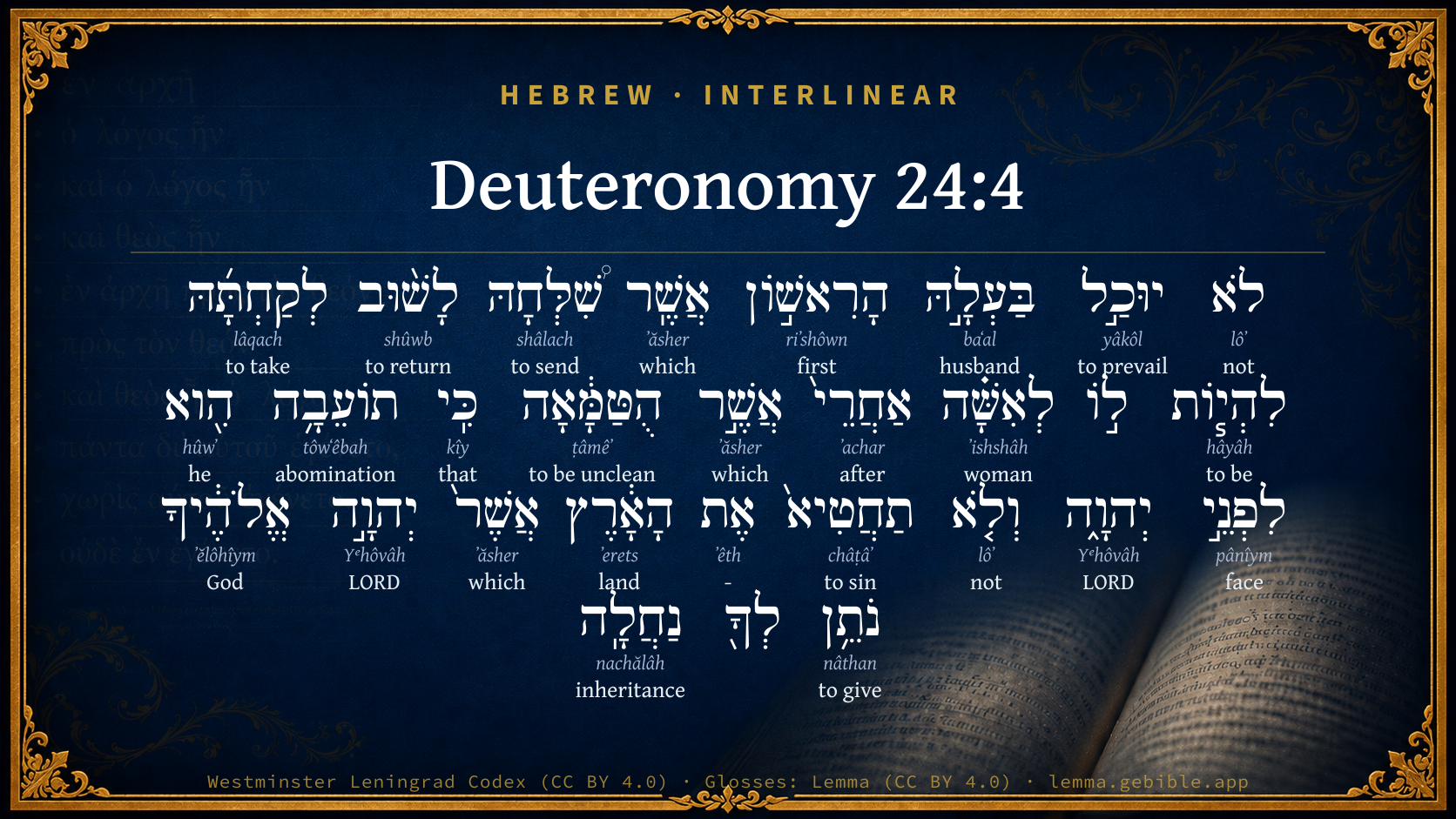
Deuteronomy 24:4

Hebrew (Westminster Leningrad Codex) Deuteronomy 24:4 appears in the Hebrew Old Testament. The text above is from the Westminster Leningrad Codex. Each word links to its Strong’s number, a concise gloss, and parsing drawn from the Open Scriptures Hebrew Bible morphology. Click any word for its full Brown-Driver-Briggs (BDB) entry.
Download image
Cite this verse

Deuteronomy 24:4 (World English Bible). Public Domain. Lemma interlinear Bible study tool, https://lemma.gebible.app/v/deuteronomy/24/4.

Show BibTeX & RIS
BibTeX
RIS
English Translation
her former husband, who sent her away, may not take her again to be his wife, after that she is defiled; for that is abomination before Yahweh: and you shall not cause the land to sin, which Yahweh your God gives you for an inheritance.
World English Bible · Public Domain
Download a study sheet

One document with this verse’s original text, its word-by-word gloss line, the meaning frame, cross-references with their text, attributed commentary, and full source and license credits — printable, and it pastes into notes with its structure intact.

This verse Autodidact and up

Study sheet (.html) Plain text (.txt)

A passage Seminary Student

Up to 50 verses in one chapter. A passage sheet keeps up to 6 commentary sources and 12 cross-references per verse, in the order this page ranks them, and says so on the sheet whenever that leaves anything out. Ask for a single verse and you get the Autodidact verse sheet above.

Everything on this page stays free to read, with no account — the sheet is a download of what is already on screen, not access to it.

Want to remove ads? Support Godless Engineer
Compare translations 3

The same verse in 3 English versions, stacked beneath the original-language interlinear above. Click any original word for its lexicon entry.

Each is an independent rendering of the whole verse — the interlinear is not word-aligned to these translations.

Highlighted words mark where these versions differ — a whole-verse word diff, not a word-by-word alignment.

  • World English Bible Public Domain
    her former husband, who sent her away, may not take her again to be his wife, after that she is defiled; for that is abomination before Yahweh: and you shall not cause the land to sin, which Yahweh your God gives you for an inheritance.
  • King James Version Public Domain
    Her former husband, which sent her away, may not take her again to be his wife, after that she is defiled; for that is abomination before the LORD: and thou shalt not cause the land to sin, which the LORD thy God giveth thee for an inheritance.
  • unfoldingWord Literal Text CC BY-SA 4.0
    her first husband, who had sent her away, shall not be able to take her again to be his wife after she has become impure; for it an abomination to the face of Yahweh, and you shall not cause the land to sin, which Yahweh your God is giving to you an inheritance.

unfoldingWord Literal Text — © unfoldingWord, licensed CC BY-SA 4.0. Word-aligned USFM3 via Door43 (git.door43.org/unfoldingWord/en_ult).

Versions to compare (up to 4)

3 of 4 selected

Show all 18 translations

Every available English version of this verse, each an independent rendering of the whole verse.

  • World English Bible Public Domain
    her former husband, who sent her away, may not take her again to be his wife, after that she is defiled; for that is abomination before Yahweh: and you shall not cause the land to sin, which Yahweh your God gives you for an inheritance.
  • Berean Standard Bible Public Domain
    then the husband who divorced her first may not remarry her after she has been defiled, for that is an abomination to the LORD. You must not bring sin upon the land that the LORD your God is giving you as an inheritance.
  • Majority Standard Bible Public Domain
    then the husband who divorced her first may not remarry her after she has been defiled, for that is an abomination to the LORD. You must not bring sin upon the land that the LORD your God is giving you as an inheritance.
  • King James Version Public Domain
    Her former husband, which sent her away, may not take her again to be his wife, after that she is defiled; for that is abomination before the LORD: and thou shalt not cause the land to sin, which the LORD thy God giveth thee for an inheritance.
  • American Standard Version (1901) Public Domain
    her former husband, who sent her away, may not take her again to be his wife, after that she is defiled; for that is abomination before Jehovah: and thou shalt not cause the land to sin, which Jehovah thy God giveth thee for an inheritance.
  • Revised Version (1885) Public Domain
    her former husband, which sent her away, may not take her again to be his wife, after that she is defiled; for that is abomination before the LORD: and thou shalt not cause the land to sin, which the LORD thy God giveth thee for an inheritance.
  • Geneva Bible (1599) Public Domain
    Then her first husband, which sent her away, may not take her againe to be his wife, after that she is defiled: for that is abomination in the sight of the Lord, and thou shalt not cause the land to sinne, which the Lord thy God doeth giue thee to inherite.
  • Douay-Rheims (1899) Public Domain
    The former husband cannot take her again to wife: because she is defiled, and is become abominable before the Lord: lest thou cause thy land to sin, which the Lord thy God shall give thee to possess.
  • Young's Literal Translation Public Domain
    `Her former husband who sent her away is not able to turn back to take her to be to him for a wife, after that she hath become defiled; for an abomination it `is' before Jehovah, and thou dost not cause the land to sin which Jehovah thy God is giving to thee -- an inheritance.
  • Literal Standard Version CC BY-SA 4.0
    her former husband who sent her away is not able to return to take her to be to him for a wife, after that she has become defiled; for it [is] an abomination before YHWH, and you do not cause the land to sin which your God YHWH is giving to you [for] an inheritance.
  • Unlocked Literal Bible CC BY-SA 4.0
    then her former husband, the one who had first sent her away, may not take her again to be his wife, after she has become impure; for that would be an abomination to Yahweh. You must not cause the land to become guilty, the land that Yahweh your God is giving you as an inheritance.
  • unfoldingWord Literal Text CC BY-SA 4.0
    her first husband, who had sent her away, shall not be able to take her again to be his wife after she has become impure; for it an abomination to the face of Yahweh, and you shall not cause the land to sin, which Yahweh your God is giving to you an inheritance.
  • Darby Bible Public Domain
    her first husband, who sent her away, may not take her again to be his wife, after that she is defiled; for it is an abomination before Jehovah; and thou shalt not cause the land to sin, which Jehovah thy God giveth thee for an inheritance.
  • World Messianic Bible Public Domain
    her former husband, who sent her away, may not take her again to be his wife after she is defiled; for that would be an abomination to the LORD. You shall not cause the land to sin, which the LORD your God gives you for an inheritance.
  • Webster's Bible Public Domain
    Her former husband who sent her away, may not take her again to be his wife, after that she is defiled; for that is abomination before the LORD: and thou shalt not cause the land to sin, which the LORD thy God giveth thee for an inheritance.
  • Free Bible Version CC BY-SA 4.0
    The first husband who divorced her is not permitted to marry her again after she was shamed, for that offends the Lord. You are not to bring guilt upon the land that the Lord your God is giving you to own.
  • Bible in Basic English Public Domain
    Her first husband, who had sent her away, may not take her back after she has been wife to another; for that is disgusting to the Lord: and you are not to be a cause of sin in the land which the Lord your God is giving you for your heritage.
  • JPS Tanakh (1917) Public Domain
    her former husband, who sent her away, may not take her again to be his wife, after that she is defiled; for that is abomination before the LORD; and thou shalt not cause the land to sin, which the LORD thy God giveth thee for an inheritance.

Literal Standard Version (2020), Covenant Press — licensed CC BY-SA 4.0. Text via the HelloAO Bible API (eBible.org). Unlocked Literal Bible (unfoldingWord) — licensed CC BY-SA 4.0. Text via the HelloAO Bible API (eBible.org). unfoldingWord Literal Text — © unfoldingWord, licensed CC BY-SA 4.0. Word-aligned USFM3 via Door43 (git.door43.org/unfoldingWord/en_ult). Free Bible Version, Dr. Jonathan Gallagher — licensed CC BY-SA 4.0. Text via the HelloAO Bible API (eBible.org).

Word by word

More ways to search: Search by grammar → Find every occurrence → Compare this word →

Practice this passage: Drill this verse → Learn its vocabulary →

בַּעְלָ֣הּ
baʻal
H1167
“husband · her”
Noun, Common, Masculine, Singular, Construct + Suffix, Personal, 3rd Person, Feminine, Singular
Part of Speech
Noun
Type
Common
Gender
Masculine
Number
Singular
State
Construct
Full BDB Definition

Origin: from H1166

TWOT: 262a

owner, husband, lord - owner - a husband - citizens, inhabitants - rulers, lords - (noun of relationship used to characterise - i.e., master of dreams) - lord (used of foreign gods)
  1. לֹא lôʼ H3808 “not” Particle, Negative
  2. יוּכַ֣ל yâkôl H3201 “to prevail” Verb, Qal, Imperfect, 3rd Person, Masculine, Singular
  3. הָרִאשׁ֣וֹן riʼshôwn H7223 “the · first” Particle, Definite Article + Adjective, Ordinal number, Masculine, Singular, Absolute
  4. אֲשֶֽׁר ʼăsher H834 “which” Particle, Relative
  5. שִׁ֠לְּחָהּ shâlach H7971 “to send · her” Verb, Piel, Perfect, 3rd Person, Masculine, Singular + Suffix, Personal, 3rd Person, Feminine, Singular
  6. לָשׁ֨וּב shûwb H7725 “to return” Preposition + Verb, Qal, Infinitive Construct
  7. לְקַחְתָּ֜הּ lâqach H3947 “to take · her” Preposition + Verb, Qal, Infinitive Construct + Suffix, Personal, 3rd Person, Feminine, Singular
  8. לִהְי֧וֹת hâyâh H1961 “to be” Preposition + Verb, Qal, Infinitive Construct
  9. לְאִשָּׁ֗ה ʼishshâh H802 “to/for · woman” Preposition + Noun, Common, Feminine, Singular, Absolute
  10. אַחֲרֵי֙ ʼachar H310 “after” Preposition
  11. אֲשֶׁ֣ר ʼăsher H834 “which” Particle, Relative
  12. הֻטַּמָּ֔אָה ṭâmêʼ H2930 “to be unclean” Verb, Hothpaal, Perfect, 3rd Person, Feminine, Singular
  13. כִּֽי kîy H3588 “that” Conjunction
  14. תוֹעֵבָ֥ה tôwʻêbah H8441 “abomination” Noun, Common, Feminine, Singular, Absolute
  15. הִ֖וא hûwʼ H1931 “he” Pronoun, Personal, 3rd Person, Feminine, Singular
  16. לִפְנֵ֣י pânîym H6440 “to/for · face(s) of” Preposition + Noun, Common, Both, Plural, Construct
  17. יְהוָ֑ה Yᵉhôvâh H3068 “LORD” Noun, Proper
  18. וְלֹ֤א lôʼ H3808 “and · not” Conjunction + Particle, Negative
  19. תַחֲטִיא֙ châṭâʼ H2398 “to sin” Verb, Hiphil, Imperfect, 2nd Person, Masculine, Singular
  20. אֶת ʼêth H853 “-” Particle, Direct Object
  21. הָאָ֔רֶץ ʼerets H776 “the · land” Particle, Definite Article + Noun, Common, Both, Singular, Absolute
  22. אֲשֶׁר֙ ʼăsher H834 “which” Particle, Relative
  23. יְהוָ֣ה Yᵉhôvâh H3068 “LORD” Noun, Proper
  24. אֱלֹהֶ֔יךָ ʼĕlôhîym H430 “God(s) · your” Noun, Common, Masculine, Plural, Construct + Suffix, Personal, 2nd Person, Masculine, Singular
  25. נֹתֵ֥ן nâthan H5414 “giving” Verb, Qal, Participle Active, Masculine, Singular, Absolute
  26. נַחֲלָֽה nachălâh H5159 “inheritance” Noun, Common, Feminine, Singular, Absolute

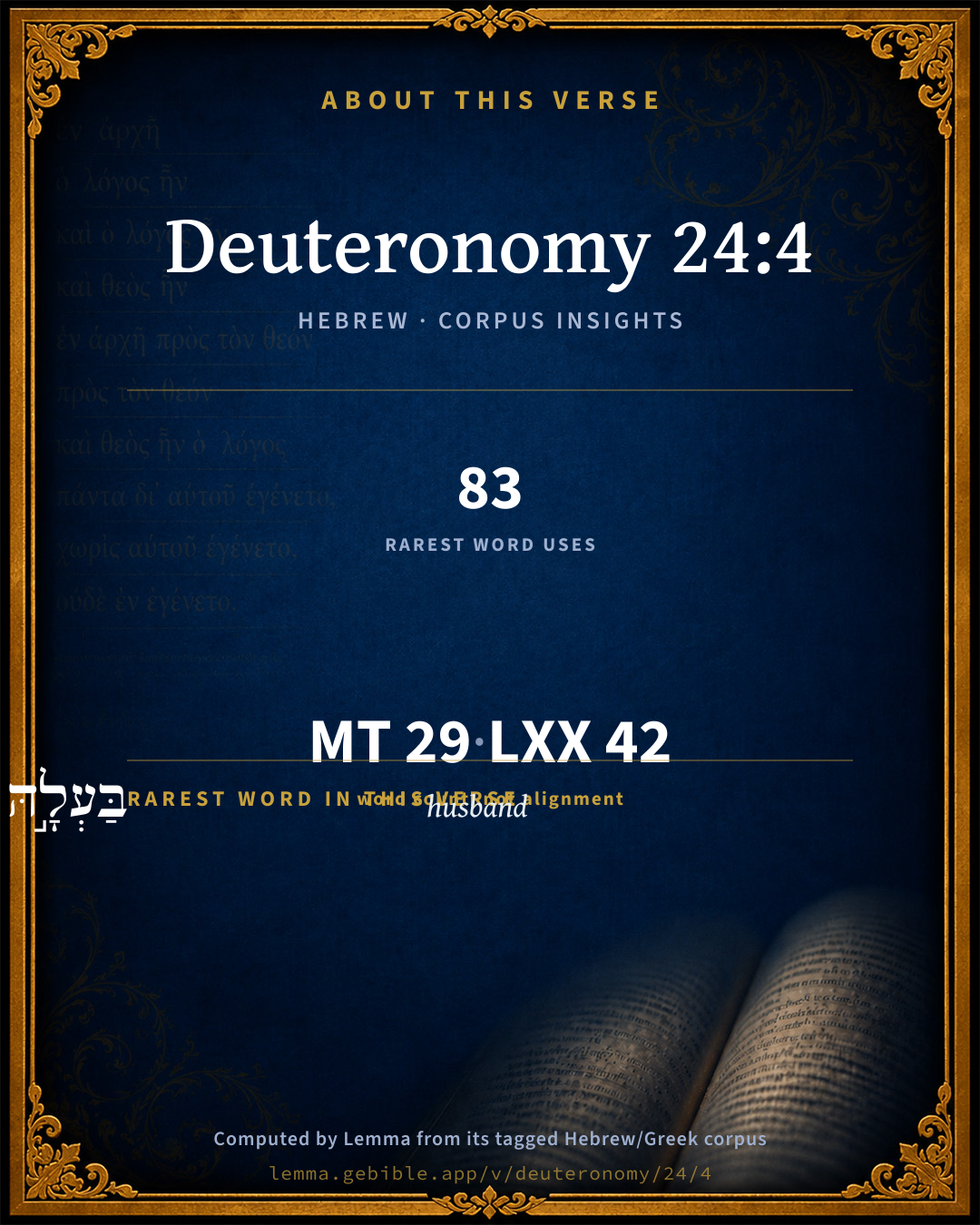
About this verse

These counts appear in no published source. They are computed here, from the morphology-tagged text and Lemma’s own curated glosses. What Lemma adds →

29
words
23
distinct lemmas
Pentateuch
section

Grammatical profile

  • 8 verbs
  • 9 nouns
  • 1 adjective
  • 1 pronoun
  • 3 prepositions
  • 1 conjunction
  • 6 particles

Verb forms

  • יוּכַ֣ל Qal · Imperfect
  • שִׁ֠לְּחָהּ Piel · Perfect
  • לָשׁ֨וּב Qal · Infinitive Construct
  • לְקַחְתָּ֜הּ Qal · Infinitive Construct
  • לִהְי֧וֹת Qal · Infinitive Construct
  • הֻטַּמָּ֔אָה Hothpaal · Perfect
  • תַחֲטִיא֙ Hiphil · Imperfect
  • נֹתֵ֥ן Qal · Participle Active

Repetition

Words recur within this verse — often emphatic in Hebrew:

  • יְהוָ֑ה LORD H3068 ×2
  • אֲשֶֽׁר which H834 ×3
  • לֹא not H3808 ×2

Hebrew & Septuagint length

In English translation the verse runs 45 words from the Hebrew and 12 from the Septuagint (LXX English) — the Septuagint runs noticeably shorter here. See the side-by-side →

A rough comparison of the two English renderings, which tokenize alike — not a word-level alignment.

Word counts can differ between the Hebrew and the Greek without any difference in meaning — e.g. the Hebrew direct-object marker אֵת has no separate Greek word, and Greek often adds the article ὁ.

In the original languages it is 29 Hebrew tokens and 42 Greek tokens — but the two are counted differently (Hebrew bundles its prefixes and suffixes into one token; the Greek is in lemma form), so that isn’t a like-for-like length.

Cross-references

1

Topical passages linked to Deuteronomy 24:4 in the Treasury of Scripture Knowledge — connected by theme and wording, ordered by reader-vote popularity; previews shown in the World English Bible.

  • Jeremiah 3:1 They say, If a man put away his wife, and she go from him, and become another man's, will he return to her again? Won't that land be greatly polluted? But you have played the prostitute with many lovers; yet return again to me, says Yahweh.

Cross-references courtesy of OpenBible.info (CC BY 4.0).

Hebrew and Greek witnesses Masoretic Hebrew ↔ Greek Septuagint

The same verse in the two great witnesses to the Old Testament, shown verse-for-verse.

Here the Septuagint runs noticeably shorter than the Hebrew — LXX2012 (modern English Septuagint) 12 words vs World English Bible 45. A rough length comparison of the two English translations, not a word-level alignment — read both below.

These are two independent witnesses, not word-aligned to each other, and the Septuagint is shown in lemma (dictionary) form.

Hebrew Deuteronomy 24:4 Masoretic · Westminster Leningrad Codex

לֹא יוּכַ֣ל בַּעְלָ֣הּ הָרִאשׁ֣וֹן אֲשֶֽׁר שִׁ֠לְּחָהּ לָשׁ֨וּב לְקַחְתָּ֜הּ לִהְי֧וֹת ל֣וֹ לְאִשָּׁ֗ה אַחֲרֵי֙ אֲשֶׁ֣ר הֻטַּמָּ֔אָה כִּֽי תוֹעֵבָ֥ה הִ֖וא לִפְנֵ֣י יְהוָ֑ה וְלֹ֤א תַחֲטִיא֙ אֶת הָאָ֔רֶץ אֲשֶׁר֙ יְהוָ֣ה אֱלֹהֶ֔יךָ נֹתֵ֥ן לְךָ֖ נַחֲלָֽה

her former husband, who sent her away, may not take her again to be his wife, after that she is defiled; for that is abomination before Yahweh: and you shall not cause the land to sin, which Yahweh your God gives you for an inheritance.

World English Bible · Public Domain

Greek LXX Deuteronomy 24:4 Septuagint · lemma form

οὐ δύναμαι ὁ ἀνήρ ὁ πρότερος ὁ ἐκ ἀποστέλλω αὐτός ἐπι ἀναστρέφω λαμβάνω αὐτός ἑαυτοῦ γυνή μετά ὁ μιαίνω αὐτός ὅτι βδέλυγμα εἰμί ἐναντίον κύριος ὁ θεός σύ καί οὐ μιαίνω ὁ γῆ ὅς κύριος ὁ θεός σύ δίδωμι σύ ἐν κλῆρος

And if she should go away and be married to another man;

LXX2012 (modern English Septuagint) · Public Domain

On this verse, The Cambridge Bible for Schools and Colleges discusses the Septuagint’s reading. Read the note in Commentary ↓

Hebrew: Westminster Leningrad Codex (CC BY 4.0). Greek: Septuagint (public domain); English from LXX2012 (modern English Septuagint) (Public Domain). How the Septuagint differs from the Hebrew →

Targum (Aramaic paraphrase)

2

The Targum is the ancient Jewish Aramaic paraphrase of the Hebrew Scriptures — an interpretive translation, not the Hebrew text itself. Onkelos (literal) and Pseudo-Jonathan (expansive) render the Torah, and Jonathan the Prophets. Coverage is partial: where no permissively-licensed English translation exists for a verse, only the Aramaic is shown. This is verse-level text, not a word-by-word alignment to the Hebrew.

  1. Targum Onkelos Torah (Genesis–Deuteronomy)
    לֵית לֵהּ רְשׁוּ לְבַעֲלַהּ קַדְמָאָה דִי פָטְרַהּ לְמִתֻּב לְמִסְבַהּ לְמֶהֱוֵי לֵהּ לְאִנְתּוּ בָּתַר דִי אִסְתָּאָבַת אֲרֵי מְרָחָקָא הִיא קֳדָם יְיָ וְלָא תְחַיַב יָת אַרְעָא דִי יְיָ אֱלָהָךְ יָהֵב לָךְ אַחֲסָנָא

    (no public-domain English translation for this verse)

    Targum Onkelos — Aramaic: “Onkelos Genesis” (public domain); “Onkelos Exodus” (public domain); “Onkelos Leviticus” (public domain); “Onkelos Numbers” (public domain); “Onkelos Deuteronomy” (public domain). English: “Sefaria Community Translation” (CC0 1.0 (public-domain dedication)); “J.W. Etheridge. The Targums of Onkelos and Jonathan Ben Uzziel on the Pentateuch. London: Longmans, Green, 1862” (public domain). Text via Sefaria.

  2. Targum Pseudo-Jonathan Torah (Genesis–Deuteronomy)
    לֵית לֵיהּ רְשׁוּת לְבַעֲלָהּ קַמָּאָה דְפַטְרָהּ מִן שֵׁירוּיָא לִמְתוֹב לְמִסְבָּהּ לְמֶהֱוֵי לֵיהּ לְאִנְתּוּ מִן בָּתַר דְּאִיסְתְּאָבַת אֲרוּם מְרַחֲקָא הִיא קֳדָם יְיָ וְלָא מְרַחֲקִין בְּנָהָא דְתֵלִיד מִנֵּיהּ וְלָא תְחַיֵּיב חוֹבַת מוֹתָנָא יַת אַרְעָא דַיְיָ אֱלָהָכוֹן יָהֵיב לְכוֹן אַחְסָנָא

    it shall not be in the power of the first husband who dismissed her at the beginning to return and take her to be with him as his wife, after that she hath been defiled; for that is an abomination before the Lord: for the children whom she might bear should not be made abominable, or the land which the Lord your God giveth you to inherit become obnoxious to the plague.

    Targum Pseudo-Jonathan — Aramaic: “Targum Jonathan on Genesis” (public domain); “Targum Jonathan on Exodus” (public domain); “Targum Jonathan on Leviticus” (public domain); “Targum Jonathan on Numbers” (public domain); “Targum Jonathan on Deuteronomy” (public domain). English: “The Targum of Jonathan ben Uzziel, trans. J. W. Etheridge, London, 1862” (public domain). Text via Sefaria.

Commentary

Notes on Deuteronomy 24:4 from classic Christian and Jewish commentators (each source and its license shown beneath its notes). The classic Christian expositions comment on the surrounding passage and are grouped to its opening verse, so a note may address several verses; the Jewish commentaries on the Tanakh (Rashi and others) are per-verse, so they appear only where the commentator wrote on this verse.

Lemma curates 59 commentaries, every one of them public domain or Creative Commons licensed, each selected and text-cleaned for this edition rather than reprinted as found. About our sources →

Trapp's Complete Commentary

John Trapp

Deu 24:4 Her former husband, which sent her away, may not take her again to be his wife, after that she is defiled; for that [is] abomination before the LORD: and thou shalt not cause the land to sin, which the LORD thy God giveth thee [for] an inheritance.

Ver. 4. After that she is defiled.] Or, Caused to he defiled, to wit, by her husband, who put her away first, he being her only lawful husband. {Mat 5:32}

John Trapp, A Commentary or Exposition upon All the Books of the Old and New Testament (1647–1656) — public domain. Text from a community e-Sword module.

Joseph Benson's Commentary

Deu 24:4. Her former husband may not take her again — This is the punishment of his levity and injustice in putting her away without sufficient cause, which, by this offer, he now acknowledgeth. Defiled — Not absolutely, as if her second marriage were a sin, but with respect to her first husband, to whom she is as a defiled or unclean woman; that is, forbidden; for things forbidden are accounted and called unclean, (Jdg 13:7,) because they may no more be touched or used than an unclean thing. Thou shalt not cause the land to sin — Thou shalt not suffer such lightness to be practised, lest the people be polluted, and the land defiled and accursed by that means.

Joseph Benson's Commentary on the Old and New Testaments (1811–1818) — public domain. Text from a community e-Sword module.

Tyndale Open Study Notes

Tyndale Open Resources

24:4 Perhaps the woman is described as defiled because she had two husbands; returning to the first husband would be considered adultery. • guilt upon the land: The concept of community was so strong in ancient Israel that the individual’s identity almost merged with that of the community. The sin of one individual had collective, corporate consequences.

Tyndale Open Study Notes — © Tyndale Open Resources, licensed CC BY-SA 4.0. Text via the HelloAO Bible API.

Geneva Bible (1599)

Geneva Bible translators

Seeing that by dimitting her, he judged her to be unclean and defiled.

Geneva Bible (1599) marginal notes — public domain. Text via Bolls.life.

Adam Clarke's Commentary

Verse 4. She is defiled] Does not this refer to her having been divorced, and married in consequence to another? Though God, for the hardness of their hearts, suffered them to put away their wives, yet he considered all after-marriages in that case to be pollution and defilement; and it is on this ground that our Lord argues in the places referred to above, that whoever marries the woman that is put away is an adulterer: now this could not have been the case if God had allowed the divorce to be a legal and proper separation of the man from his wife; but in the sight of God nothing can be a legal cause of separation but adultery on either side. In such a case, according to the law of God, a man may put away his wife, and a wife may put away her husband; (see Mt 19:9); for it appears that the wife had as much right to put away her husband as the husband had to put away his wife, see Mr 10:12.

Adam Clarke's Commentary on the Bible (1810–1826) — public domain. Text from a community e-Sword/MySword module.

The Cambridge Bible for Schools and Colleges

gen. ed. J. J. S. Perowne

4. after that she is defiled] Ambiguous indeed, as the most carefully chosen terms of some laws often are. But the natural meaning is that she is unclean to the former husband by her union with the latter. It cannot be a matter of indifference to him that she has been another’s, as (presumably) the popular humour took it. Such easy passage of a woman from one man to another did defile her: it is an abomination before Jehovah (notice the peculiar construction before and the absence of thy God after the divine name). She was, therefore, taboo, or unlawful to her first husband. Marti suggests that the uncleanness may have a demonistic origin (cp. Deu_22:9-11). This, of course, may have been the motive of the original law, but if so, it has disappeared from its present form.

thou shalt not cause the land to sin] Sam., LXX ye shall not, etc. Cp. Deu_22:9.

which the Lord thy God is to give thee, etc.] See on Deu_4:21.

The Cambridge Bible for Schools and Colleges (gen. ed. J. J. S. Perowne; Cambridge University Press, 1878–1918) — public domain. Text from a community e-Sword module.

John Gill's Exposition

Her former husband which sent her away may not take her again to be his wife,.... Though ever so desirous of it, and having heartily repented that he had put her away: this is the punishment of his fickleness and inconstancy, and was ordered to make men cautious how they put away their wives; since when they had so done, and they had been married to another, they could not enjoy them again even on the death of the second husband; yea, though she was only espoused to him, and he had never lain with her, as Ben Melech observes, it was forbidden the former husband to marry her; though if she had only played the whore, according to the same writer, and others (a), she might return to him:

after that she is defiled; not by whoredom, for in that case she was not forbidden, as it is interpreted, but by her being married to another man; when she was defiled, not by him, or with respect to him, nor with regard to any other man, whom she might lawfully marry after the decease of her latter husband; but with respect to her first husband, being by her divorce from him, and by her marriage to another, entirely alienated and separated from him, and so prohibited to him; and thus R. Joseph Kimchi interprets this defilement of prohibition, things prohibited being reckoned unclean, or not lawful to be used:

for that is abomination before the Lord; for a man to take his wife again, after she had been divorced by him, and married to another man; and yet, such is the grace and goodness of God to his backsliding people, that he receives them when they return unto him their first husband, and forsake other lovers, Jer 3:1,

and thou shalt not cause the land to sin which the Lord thy God giveth thee for an inheritance; since if this was allowed, that men might put away their wives, and take them again at pleasure, and change them as often as they thought fit, no order could be observed, and the utmost confusion in families introduced, and lewdness encouraged, and which would subject the land and the inhabitants of it to many evils and calamities, as the just punishment thereof.

(a) Maimon. & Bartenora in Misn. Sotah, c. 2. sect. 6.

John Gill's Exposition of the Whole Bible (1746–1763) — public domain (CC PDM 1.0). Text via the HelloAO Bible API.

Haydock's Catholic Bible Commentary

Defiled. This insinuates that the second marriage was a real adultery, (Calmet) and only tolerated by the law to prevent greater evils. (Haydock) --- It might be said indeed that the woman was defiled, with regard to her former husband, who could not take her back without condemning his former proceeding (Calmet); as he would seem to have only lent her for some mean consideration. (Menochius) --- Domitian took the privilege of a judge from a Roman knight, who had resumed his wife after he had divorced her for adultery. (Suetonius, viii.) But how then is the woman abominable before the Lord? Some say the thing itself is extremely dishonourable, as the Hebrew intimates, thought the woman have done nothing but what the law allows. Grotius believes that the man might take back his wife, at any time, before she was married to another. But the Rabbins limit this privilege to three months after the date of separation. God forbids his priests to marry with those who had been divorced, as it is to be presumed that they have not been rejected by their former husbands without good reason, Leviticus xxi. 7. The an who cohabits with an adulteress, is deemed a fool; (Proverbs xviii. 22,) and some have believed, that it was necessary to put such away. But St. Paul advises a reconciliation, 1 Corinthians vii. 11. --- To sin, or to incur the punishment due to it. (Calmet) --- If the state connived at the transgression of the law, the judgments of God would fall upon the people.

George Leo Haydock (1774–1849), Haydock's Catholic Family Bible and Commentary, 1859 edition — public domain. Excludes Psalms (Douay-Rheims chapter numbering differs from Protestant) and Deuterocanonical books (Catholic canon only).

Matthew Poole's English Annotations

This is the punishment of his levity and injustice in putting her away without sufficient cause, which by this offer he now acknowledgeth.

After that she is defiled; not simply and absolutely, as if her second marriage were a sin, but respectively, or as to her first husband, to whom she is as a defiled or unclean woman, that is, forbidden; for things forbidden are accounted and called unclean, Jdg 13:7, because they may no more be touched or used than an unclean thing.

Thou shalt not cause the land to sin, i.e. thou shalt not suffer such abominable lightness and lewdness to be practised, lest the people be polluted, and the land defiled and accursed by that means.

Matthew Poole's English Annotations on the Holy Bible (1683–1685) — public domain. Text from a community e-Sword/MySword module.

The Pulpit Commentary

The woman was held to be defiled by her second marriage, and thus by implication, the marrying of a woman who had been divorced was pronounced immoral, as is by our Lord explicitly asserted. (Mat_5:32) The prohibition of a return of the wife to her first husband, as well as the necessity of a formal bill of divorcement being given to the woman before she could be sent away, could not fail to be checks on the license of divorce, as doubtless they were intended to be.

The Pulpit Commentary (1880–1919), ed. H.D.M. Spence-Jones & Joseph S. Exell — public domain. Text from a community e-Sword module.

John Wesley's Explanatory Notes

May not - This is the punishment of his levity and injustice in putting her away without sufficient cause, which by this offer he now acknowledgeth. Defiled - Not absolutely, as if her second marriage were a sin, but with respect to her first husband, to whom she is as a defiled or unclean woman, that is, forbidden things; forbidden are accounted and called unclean, Judg. xiii, 7, because they may no more be touched or used than an unclean thing. Thou shalt not cause the land to sin - Thou shalt not suffer such lightness to be practiced, lest the people be polluted, and the land defiled and accursed by that means.

John Wesley, Explanatory Notes Upon the Whole Bible (1754–1765) — public domain. Text via the GEBible commentary corpus.

Rashi

Rabbi Shlomo Yitzchaki (Rashi)

אחרי אשר הטמאה [HER FIRST HUSBAND … MAY NOT TAKE HER AGAIN TO BE HIS WIFE] AFTER THAT SHE IS DEFILED — these words are intended to include in the prohibition a faithless wife (סוטה) who had been in seclusion with another man (Sifrei Devarim 270:10; Yevamot 11b).

Rashi on the Tanakh — English translations: “The Judaica Press complete Tanach with Rashi, translated by A. J. Rosenberg” (CC BY 4.0); “Pentateuch with Rashi's commentary by M. Rosenbaum and A.M. Silbermann, 1929-1934” (public domain); “The Metsudah Tanach series, Lakewood, N.J” (CC BY 4.0); and “The Book of Joshua, Metsudah Publications, 1997” (CC BY 4.0). Text via Sefaria.

Ramban (Nachmanides)

Rabbi Moshe ben Nachman (Ramban / Nachmanides)

[HER FORMER HUSBAND, WHO SENT HER AWAY, MAY NOT TAKE HER AGAIN TO BE HIS WIFE] AFTER THAT SHE IS DEFILED — “this includes a sotah (a suspected adulteress) who had been in seclusion [with a man against whom her husband had warned her not to seclude herself].” This is Rashi’s language. But the meaning thereof is that she had committed adultery while she was a married person, but in the case of a sotah who had merely been secluded and it is not known whether she was defiled — he [her husband] does not transgress this prohibition [if he continues to live with her]. It is so clearly explained in the first chapter of Tractate Yebamoth: “What is the meaning of v’nisterah?. She committed adultery. And why does Scripture refer to it as v’nisterah [which means, ‘but she was secluded’]? It is a more seemly expression.” On this answer the Gemara asked: “If she committed adultery — that [aspect] is clearly stated, and she hid and she be defiled,. [and therefore v’nisterah in the verse before us must have another meaning]! It is to declare that the husband [whose wife committed adultery and, as a result was divorced] transgresses a negative commandment [if he remarries her].” And if so, Scripture states here: “Her former husband, who sent her away, may not take her again to be his wife ‘and’ after that she is defiled [he may also not take her again].” Thus, these are two negative commandment: he warns against remarrying his own divorcee after she had married [someone else and was divorced or widowed], and he warns against remarrying his [former] wife who had been defiled by adultery [and divorced]. And in line with the plain meaning of Scripture the expression after that she is defiled refers to the first husband, the verse suggesting that because she “knew” [i.e., married] another man she is accounted to him [i.e., the first husband] as “defiled.”Now these are newly-declared commandments both with respect to divorce and remarriage. And the reason for this prohibition is so that people should not exchange their wives with one another: he would be able to write her a bill of divorce at night, and in the morning she will return to him. This is the sense of the expression, and thou shalt not cause the Land to sin, for this is a cause of great sins. And in the Sifre it is stated: 270. “And thou shalt not cause the Land to sin — this is intended to admonish the court concerning this.”

Ramban (Nachmanides) on the Tanakh — English translation: “Commentary on the Torah by Ramban (Nachmanides). Translated and annotated by Charles B. Chavel. New York, Shilo Pub. House, 1971-1976” (CC BY 4.0). Text via Sefaria.

Lesson kit

Teaching starters — assembled from the data on this page, not authored interpretation. Every prompt links to the verse data it draws on. Edit before teaching.

Deuteronomy, in the Pentateuch, opens this verse with 29 words (23 distinct Hebrew lemmas). Its most distinctive word is baʻal (“husband”). The Greek Septuagint runs shorter here. A historical commentator’s framing appears above. Read the whole chapter for the surrounding context.

Discussion questions

  1. How does “husband” (baʻal) shape what this verse is saying?
  2. How does Jeremiah 3:1, which shares this passage’s theme, read alongside this verse?
  3. What does the repetition of “LORD” (2× in this one verse) do in this verse?
  4. The Septuagint runs shorter here than the Hebrew. What might account for the difference?
  5. The translations on this page render this verse differently — a whole-verse word diff, not a word-by-word alignment. What might account for the different wordings?
  6. «יוּכַ֣ל» is a Qal Imperfect verb. How does that grammatical form shape the action described?
  7. Compare how Trapp's Complete Commentary and Joseph Benson's Commentary read this verse. Where do they agree or differ?

Things to notice

Reading settings

Reading text

Shown beneath each verse's original-language words.

Old Testament
Old Testament edition

Read the OT as the Masoretic Hebrew (MT) or the Greek Septuagint (LXX).

English shown for the Greek Septuagint (in the Hebrew ↔ Greek comparison).

Comparing translations? Open the Compare panel on any verse page to stack up to four side by side.