Exodus 8:18

Hebrew (Westminster Leningrad Codex) Exodus 8:18 appears in the Hebrew Old Testament. The text above is from the Westminster Leningrad Codex. Each word links to its Strong’s number, a concise gloss, and parsing drawn from the Open Scriptures Hebrew Bible morphology. Click any word for its full Brown-Driver-Briggs (BDB) entry.
Download image
Cite this verse

Exodus 8:18 (World English Bible). Public Domain. Lemma interlinear Bible study tool, https://lemma.gebible.app/v/exodus/8/18.

Show BibTeX & RIS
BibTeX
RIS
English Translation
The magicians tried with their enchantments to bring forth lice, but they couldn't. There were lice on man, and on animal.
World English Bible · Public Domain
Download a study sheet

One document with this verse’s original text, its word-by-word gloss line, the meaning frame, cross-references with their text, attributed commentary, and full source and license credits — printable, and it pastes into notes with its structure intact.

This verse Autodidact and up

Study sheet (.html) Plain text (.txt)

A passage Seminary Student

Up to 50 verses in one chapter. A passage sheet keeps up to 6 commentary sources and 12 cross-references per verse, in the order this page ranks them, and says so on the sheet whenever that leaves anything out. Ask for a single verse and you get the Autodidact verse sheet above.

Everything on this page stays free to read, with no account — the sheet is a download of what is already on screen, not access to it.

Want to remove ads? Support Godless Engineer
Compare translations 3

The same verse in 3 English versions, stacked beneath the original-language interlinear above. Click any original word for its lexicon entry.

Each is an independent rendering of the whole verse — the interlinear is not word-aligned to these translations.

Highlighted words mark where these versions differ — a whole-verse word diff, not a word-by-word alignment.

  • World English Bible Public Domain
    The magicians tried with their enchantments to bring forth lice, but they couldn't. There were lice on man, and on animal.
  • King James Version Public Domain
    And the magicians did so with their enchantments to bring forth lice, but they could not: so there were lice upon man, and upon beast.
  • unfoldingWord Literal Text CC BY-SA 4.0
    And the magicians did so with their magic to bring out lice, but they were not able. And there were lice on man and beast.

unfoldingWord Literal Text — © unfoldingWord, licensed CC BY-SA 4.0. Word-aligned USFM3 via Door43 (git.door43.org/unfoldingWord/en_ult).

Versions to compare (up to 4)

3 of 4 selected

Show all 18 translations

Every available English version of this verse, each an independent rendering of the whole verse.

  • World English Bible Public Domain
    The magicians tried with their enchantments to bring forth lice, but they couldn't. There were lice on man, and on animal.
  • Berean Standard Bible Public Domain
    The magicians tried to produce gnats using their magic arts, but they could not. And the gnats remained on man and beast.
  • Majority Standard Bible Public Domain
    The magicians tried to produce gnats using their magic arts, but they could not. And the gnats remained on man and beast.
  • King James Version Public Domain
    And the magicians did so with their enchantments to bring forth lice, but they could not: so there were lice upon man, and upon beast.
  • American Standard Version (1901) Public Domain
    And the magicians did so with their enchantments to bring forth lice, but they could not: and there were lice upon man, and upon beast.
  • Revised Version (1885) Public Domain
    And the magicians did so with their enchantments to bring forth lice, but they could not: and there were lice upon man, and upon beast.
  • Geneva Bible (1599) Public Domain
    Nowe the enchanters assaied likewise with their enchantments to bring forth lyce, but they could not. So the lyce were vpon man and vpon beast.
  • Douay-Rheims (1899) Public Domain
    And the magicians with their enchantments practiced in like manner, to bring forth sciniphs, and they could not and there were sciniphs as well on men as on beasts.
  • Young's Literal Translation Public Domain
    And the scribes do so with their flashings, to bring out the gnats, and they have not been able, and the gnats are on man and on beast;
  • Literal Standard Version CC BY-SA 4.0
    And the enchanters do so with their secrets, to bring out the gnats, and they have not been able, and the gnats are on man and on beast;
  • Unlocked Literal Bible CC BY-SA 4.0
    The magicians tried with their magic to produce gnats, but they could not. There were gnats on man and beast.
  • unfoldingWord Literal Text CC BY-SA 4.0
    And the magicians did so with their magic to bring out lice, but they were not able. And there were lice on man and beast.
  • Darby Bible Public Domain
    And the scribes did so with their sorceries, to bring forth gnats; but they could not. And the gnats were on man and on beast.
  • World Messianic Bible Public Domain
    The magicians tried with their enchantments to produce lice, but they couldn’t. There were lice on man, and on animal.
  • Webster's Bible Public Domain
    And the magicians did so with their inchantments to bring forth lice, but they could not: so there were lice upon man and upon beast.
  • Free Bible Version CC BY-SA 4.0
    The magicians also tried to make gnats using their magic arts, but they couldn't. The gnats stayed on both people and animals.
  • Bible in Basic English Public Domain
    And the wonder-workers with their secret arts, attempting to make insects, were unable to do so: and there were insects on man and on beast.
  • JPS Tanakh (1917) Public Domain
    (8-14) And the magicians did so with their secret arts to bring forth gnats, but they could not; and there were gnats upon man, and upon beast.

Literal Standard Version (2020), Covenant Press — licensed CC BY-SA 4.0. Text via the HelloAO Bible API (eBible.org). Unlocked Literal Bible (unfoldingWord) — licensed CC BY-SA 4.0. Text via the HelloAO Bible API (eBible.org). unfoldingWord Literal Text — © unfoldingWord, licensed CC BY-SA 4.0. Word-aligned USFM3 via Door43 (git.door43.org/unfoldingWord/en_ult). Free Bible Version, Dr. Jonathan Gallagher — licensed CC BY-SA 4.0. Text via the HelloAO Bible API (eBible.org).

Word by word

More ways to search: Search by grammar → Find every occurrence → Compare this word →

Practice this passage: Drill this verse → Learn its vocabulary →

בְּלָטֵיהֶ֛ם
lâṭ
H3909
“in/at · enchantments · their”
Preposition + Noun, Common, Masculine, Plural, Construct + Suffix, Personal, 3rd Person, Masculine, Plural
Part of Speech
Preposition + Noun
Type
Common
Gender
Masculine
Number
Plural
State
Construct
Full BDB Definition

Origin: a form of H3814 or else participle from H3874

TWOT: 1092a

secrecy, mystery, enchantment - secrecy, secretly - mystery, enchantment
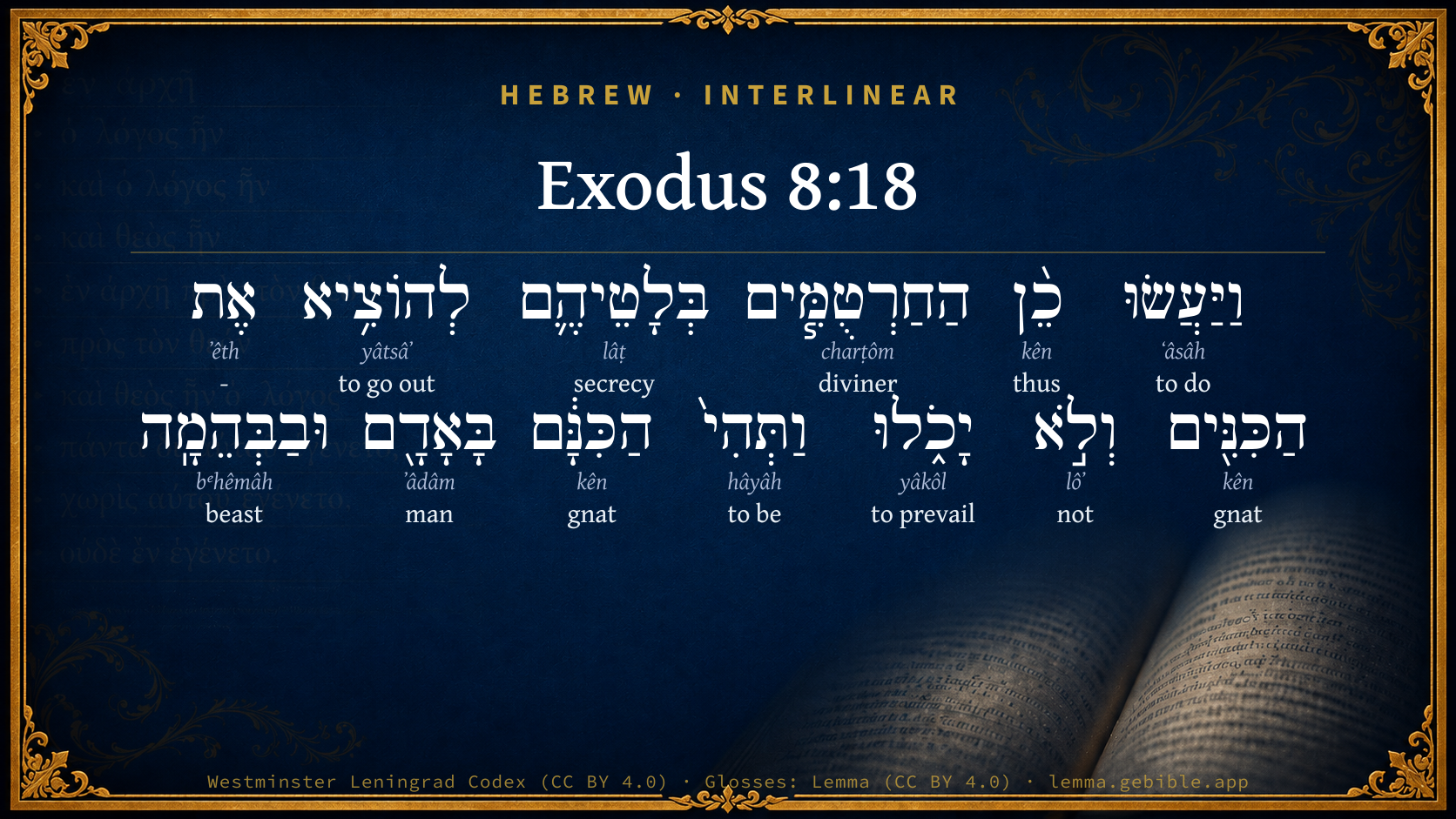
  1. וַיַּעֲשׂוּ ʻâsâh H6213 “and · to do” Conjunction + Verb, Qal, Sequential Imperfect, 3rd Person, Masculine, Plural
  2. כֵ֨ן kên H3651 “thus” Adverb
  3. הַחַרְטֻמִּ֧ים charṭôm H2748 “the · diviners” Particle, Definite Article + Noun, Common, Masculine, Plural, Absolute
  4. לְהוֹצִ֥יא yâtsâʼ H3318 “to go out” Preposition + Verb, Hiphil, Infinitive Construct
  5. אֶת ʼêth H853 “-” Particle, Direct Object
  6. הַכִּנִּ֖ים kên H3654 “the · gnats” Particle, Definite Article + Noun, Common, Masculine, Plural, Absolute
  7. וְלֹ֣א lôʼ H3808 “and · not” Conjunction + Particle, Negative
  8. יָכֹ֑לוּ yâkôl H3201 “to prevail” Verb, Qal, Perfect, 3rd Person, Common, Plural
  9. וַתְּהִי֙ hâyâh H1961 “and · to be” Conjunction + Verb, Qal, Sequential Imperfect, 3rd Person, Feminine, Singular
  10. הַכִּנָּ֔ם kên H3654 “the · gnat” Particle, Definite Article + Noun, Common, Masculine, Singular, Absolute
  11. בָּאָדָ֖ם ʼâdâm H120 “in/at the · man” Preposition, Determined + Noun, Common, Masculine, Singular, Absolute
  12. וּבַבְּהֵמָֽה bᵉhêmâh H929 “and · in/at the · beast” Conjunction + Preposition, Determined + Noun, Common, Feminine, Singular, Absolute

About this verse

These counts appear in no published source. They are computed here, from the morphology-tagged text and Lemma’s own curated glosses. What Lemma adds →

13
words
12
distinct lemmas
Pentateuch
section

Notable vocabulary

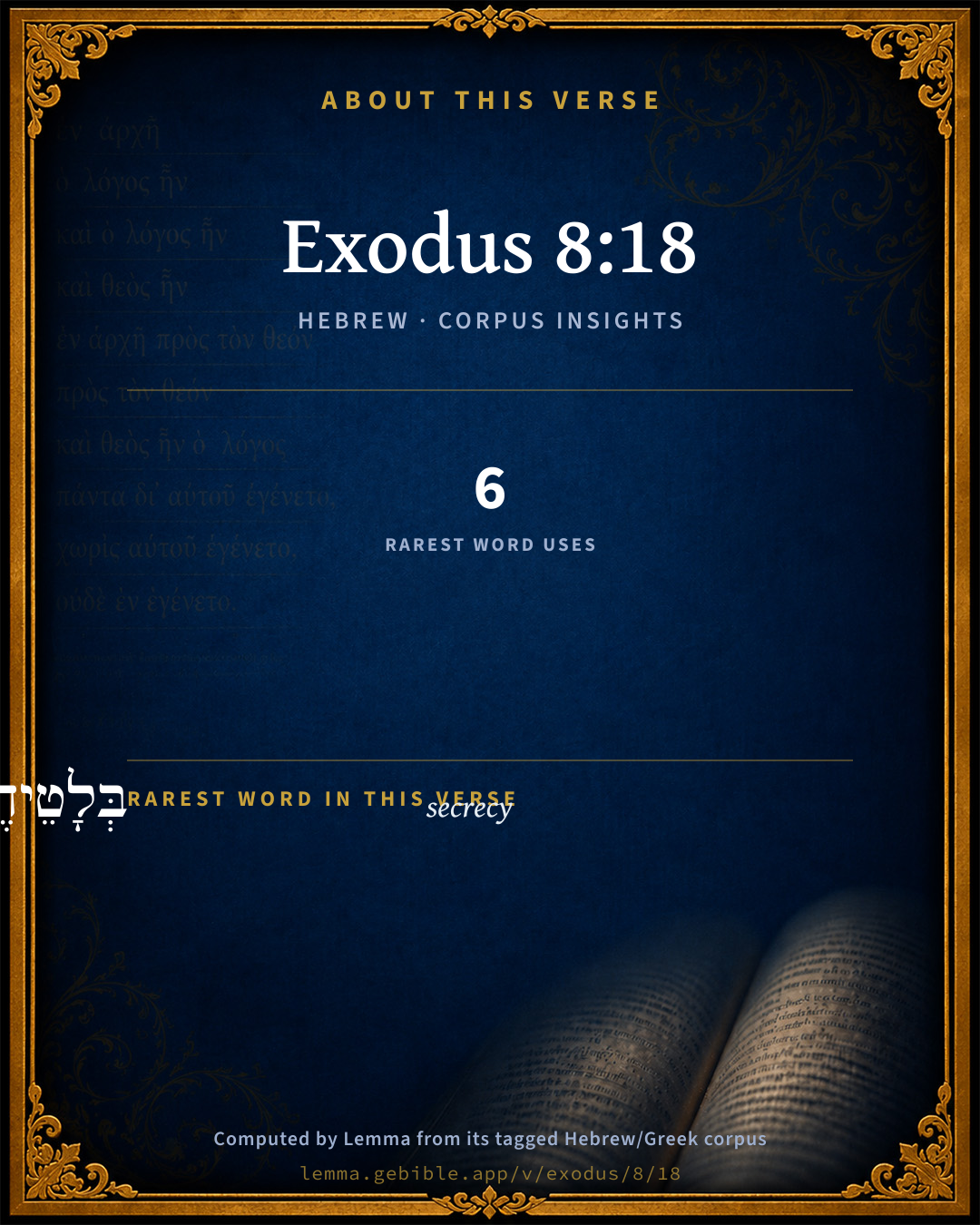
The rarest word here is בְּלָטֵיהֶ֛ם secrecy H3909 — appearing just 6 times in the whole Hebrew Bible.

Shared distinctive vocabulary

בְּלָטֵיהֶ֛ם secrecy H3909 occurs in 6 verses of the Hebrew Bible. Also found in:

Grammatical profile

  • 4 verbs
  • 6 nouns
  • 1 adverb
  • 2 particles

Verb forms

  • וַיַּעֲשׂוּ Qal · Sequential Imperfect
  • לְהוֹצִ֥יא Hiphil · Infinitive Construct
  • יָכֹ֑לוּ Qal · Perfect
  • וַתְּהִי֙ Qal · Sequential Imperfect

Repetition

A word recurs within this verse — often emphatic in Hebrew:

  • הַכִּנִּ֖ים gnat H3654 ×2

Hebrew & Septuagint length

In English translation the verse runs 21 words from the Hebrew and 30 from the Septuagint (LXX English) — the Septuagint runs noticeably longer here. See the side-by-side →

A rough comparison of the two English renderings, which tokenize alike — not a word-level alignment.

Word counts can differ between the Hebrew and the Greek without any difference in meaning — e.g. the Hebrew direct-object marker אֵת has no separate Greek word, and Greek often adds the article ὁ.

Cross-references

10

Topical passages linked to Exodus 8:18 in the Treasury of Scripture Knowledge — connected by theme and wording, ordered by reader-vote popularity; previews shown in the World English Bible.

  • Exodus 7:11 Then Pharaoh also called for the wise men and the sorcerers. They also, the magicians of Egypt, did in like manner with their enchantments.
  • Exodus 9:11 The magicians couldn't stand before Moses because of the boils; for the boils were on the magicians, and on all the Egyptians.
  • Daniel 5:8 Then came in all the king's wise men; but they could not read the writing, nor make known to the king the interpretation.
  • Genesis 41:8 It happened in the morning that his spirit was troubled, and he sent and called for all the magicians of Egypt, and all the wise men of it. Pharaoh told them his dream, but there was no one who could interpret them to Pharaoh.
  • Isaiah 19:12 Where then are your wise men? and let them tell you now; and let them know what Yahweh of Hosts has purposed concerning Egypt.
  • Isaiah 47:12–13 Stand now with your enchantments, and with the multitude of your sorceries, in which you have labored from your youth; if so be you shall be able to profit, if so be you may prevail.
  • Daniel 2:10–11 The Chaldeans answered before the king, and said, There is not a man on the earth who can show the king's matter, because no king, lord, or ruler, has asked such a thing of any magician, or enchanter, or Chaldean.
  • Daniel 4:7 Then came in the magicians, the enchanters, the Chaldeans, and the soothsayers; and I told the dream before them; but they did not make known to me the interpretation of it.
  • Luke 10:18 He said to them, "I saw Satan having fallen like lightning from heaven.
  • 2 Timothy 3:8–9 Even as Jannes and Jambres opposed Moses, so do these also oppose the truth; men corrupted in mind, reprobate concerning the faith.

Cross-references courtesy of OpenBible.info (CC BY 4.0).

Hebrew and Greek witnesses Masoretic Hebrew ↔ Greek Septuagint

The same verse in the two great witnesses to the Old Testament, shown verse-for-verse.

Here the Septuagint runs noticeably longer than the Hebrew — LXX2012 (modern English Septuagint) 30 words vs World English Bible 21. A rough length comparison of the two English translations, not a word-level alignment — read both below.

These are two independent witnesses, not word-aligned to each other, and the Septuagint is shown in lemma (dictionary) form.

Hebrew Exodus 8:18 Masoretic · Westminster Leningrad Codex

וַיַּעֲשׂוּ כֵ֨ן הַחַרְטֻמִּ֧ים בְּלָטֵיהֶ֛ם לְהוֹצִ֥יא אֶת הַכִּנִּ֖ים וְלֹ֣א יָכֹ֑לוּ וַתְּהִי֙ הַכִּנָּ֔ם בָּאָדָ֖ם וּבַבְּהֵמָֽה

The magicians tried with their enchantments to bring forth lice, but they couldn't. There were lice on man, and on animal.

World English Bible · Public Domain

Greek LXX Exodus 8:18 Septuagint · lemma form

καί παραδοξάζω ἐν ὁ ἡμέρα ἐκεῖνος ὁ γῆ γεσεμ ἐπί ὅς ὁ λαός ἐγώ ἐπιεἰμί ἐπί αὐτός ἐπί ὅς οὐ εἰμί ἐκεῖ ὁ κυνόμυια ἵνα οἶδα ὅτι ἐγώ εἰμί κύριος ὁ κύριος πᾶς ὁ γῆ

And the charmers also did so with their sorceries, to bring forth the louse, and they could not. And the lice were both on the men and on the quadrupeds.

LXX2012 (modern English Septuagint) · Public Domain

On this verse, Joseph Benson's Commentary discusses the Septuagint’s reading. Read the note in Commentary ↓

Hebrew: Westminster Leningrad Codex (CC BY 4.0). Greek: Septuagint (public domain); English from LXX2012 (modern English Septuagint) (Public Domain). How the Septuagint differs from the Hebrew →

Targum (Aramaic paraphrase)

2

The Targum is the ancient Jewish Aramaic paraphrase of the Hebrew Scriptures — an interpretive translation, not the Hebrew text itself. Onkelos (literal) and Pseudo-Jonathan (expansive) render the Torah, and Jonathan the Prophets. Coverage is partial: where no permissively-licensed English translation exists for a verse, only the Aramaic is shown. This is verse-level text, not a word-by-word alignment to the Hebrew.

  1. Targum Onkelos Torah (Genesis–Deuteronomy)
    וְאַפְרֵישׁ בְּיוֹמָא הַהוּא יָת אַרְעָא דְגשֶׁן דְעַמִי קָאִים עֲלַהּ בְּדִיל דְלָא לְמֶהֱוֵי תַמָן עָרוֹבָא בְּדִיל דְתִדַע אֲרֵי אֲנָא יְיָ שַׁלִיטּ בְּגוֹ אַרְעָא:

    (no public-domain English translation for this verse)

    Targum Onkelos — Aramaic: “Onkelos Genesis” (public domain); “Onkelos Exodus” (public domain); “Onkelos Leviticus” (public domain); “Onkelos Numbers” (public domain); “Onkelos Deuteronomy” (public domain). English: “Sefaria Community Translation” (CC0 1.0 (public-domain dedication)); “J.W. Etheridge. The Targums of Onkelos and Jonathan Ben Uzziel on the Pentateuch. London: Longmans, Green, 1862” (public domain). Text via Sefaria.

  2. Targum Pseudo-Jonathan Torah (Genesis–Deuteronomy)
    וְאֶעֱבֵיד פִּלְאִין בְּיוֹמָא הַהוּא עִם אַרְעָא דְגשֶׁן דְעַמִי שְׁרֵי עֲלָהּ בְּדִיל דְלָא לְמֶהֱוֵי תַמָן עִירְבּוּב חֵיוַת בָּרָא מִן בִּגְלַל דְתִנְדַע אַרוּם אֲנָא יְיָ שַׁלִיט בְּגוֹ אַרְעָא

    And I will do wonders that day in the land of Goshen where My people dwell, that there no swarms of wild beasts shall be; - that thou mayest know that I the Lord am the Ruler in the midst of the land.

    Targum Pseudo-Jonathan — Aramaic: “Targum Jonathan on Genesis” (public domain); “Targum Jonathan on Exodus” (public domain); “Targum Jonathan on Leviticus” (public domain); “Targum Jonathan on Numbers” (public domain); “Targum Jonathan on Deuteronomy” (public domain). English: “The Targum of Jonathan ben Uzziel, trans. J. W. Etheridge, London, 1862” (public domain). Text via Sefaria.

Commentary

Notes on Exodus 8:18 from classic Christian and Jewish commentators (each source and its license shown beneath its notes). The classic Christian expositions comment on the surrounding passage and are grouped to its opening verse, so a note may address several verses; the Jewish commentaries on the Tanakh (Rashi and others) are per-verse, so they appear only where the commentator wrote on this verse.

Lemma curates 59 commentaries, every one of them public domain or Creative Commons licensed, each selected and text-cleaned for this edition rather than reprinted as found. About our sources →

Trapp's Complete Commentary

John Trapp

Exo 8:18 And the magicians did so with their enchantments to bring forth lice, but they could not: so there were lice upon man, and upon beast.

Ver. 18. But they could not.] Though they endeavoured it, as did the magician of Antwerp, who, being required by the English merchants there to play his feats and show his cunning, after much sweating and toil, when he saw that nothing could go forward, but that all his enchantments were void, was compelled openly to confess that there was some man there at supper which disturbed and hindered all his doings. This was Mr Tyndale the martyr, who, hearing of this magician, had desired certain of the merchants that he might be present to see him play, {a} &c.

{a} Act. and Mon., fol. 985.

John Trapp, A Commentary or Exposition upon All the Books of the Old and New Testament (1647–1656) — public domain. Text from a community e-Sword module.

Joseph Benson's Commentary

Exo 8:18. The magicians did so — They also smote the dust of the earth to bring forth lice with their enchantments, but they could not — Some have said that this verse is not accurately translated, and that the true sense of it is, that the magicians endeavoured not to bring forth, but to draw off, or take away, the lice. But surely they have affirmed this without having examined the original. The words להוציא את הכנים, Lehoatsi eth hachinnim, signify to bring forth the lice, and not to take them away. Nor is the word εξαγαγειν, used by the LXX., at all inimical to this construction, signifying properly to bring out, or bring forth. So that the thing asserted, as commentators have generally understood, is, that the magicians could not produce lice, as they had frogs, much less could they take away those that God, by Moses, had produced. Now, as it surely was as easy to produce lice as frogs, from this it appeared by what power they had done the other two miracles; not by any virtue that was in their enchantments, but by a supernatural power which God had permitted Satan to give them, but the further operation of which he now thought proper to prevent, to show them that all their power, to whatever cause they might attribute it, was limited, and not to be compared with that of the God of Israel.

Joseph Benson's Commentary on the Old and New Testaments (1811–1818) — public domain. Text from a community e-Sword module.

Geneva Bible (1599)

Geneva Bible translators

God confounded their wisdom and authority in a thing most vile.

Geneva Bible (1599) marginal notes — public domain. Text via Bolls.life.

Adam Clarke's Commentary

Verse 18. The magicians did so] That is, They tried the utmost of their skill, either to produce these insects or to remove this plague; but they could not, no juggling could avail here, because insects must be produced which would stick to and infix themselves in man and beast, which no kind of trick could possibly imitate; and to remove them, as some would translate the passage, was to their power equally impossible. If the magicians even acted by spiritual agents, we find from this case that these agents had assigned limits, beyond which they could not go; for every agent in the universe is acting under the direction or control of the Almighty.

Adam Clarke's Commentary on the Bible (1810–1826) — public domain. Text from a community e-Sword/MySword module.

Ellicott's Commentary for English Readers

(18) The magicians did so—i.e., tried to do so—took moist earth, and dried it, and pulverised it, and tried the effect of their magic charms upon it, but. failed to produce mosquitoes, as Aaron had done. Mosquitoes were things too delicate to be caught, and manipulated, and produced at a given moment by sleight-of-hand. The magicians tried to produce a counterfeit of the miracle, but could not. Then they excused themselves to their master with the words, “This is the finger of a god.”

A Bible Commentary for English Readers, edited by Charles John Ellicott (1878–1897) — public domain. Text from a community e-Sword module.

The Cambridge Bible for Schools and Colleges

gen. ed. J. J. S. Perowne

18. This wonder the magicians (v. 7) were unable to imitate.

to bring forth] viz. from the earth.

19 This is the finger of God] i.e. the finger, or hand, of God is discernible here. The expression (though not in the same application), also, Exo_31:18, Deu_9:10, Luk_11:20, and in the plural, Psa_8:3.

The mosquito is so well known as a plague in Egypt, that it will not be necessary to add anything to what has been said about it on v. 16. The ‘gnats’ described here, however, differ from the mosquito in being produced, not from water, but from the dust; and also in their appearing miraculously, like the frogs, at a signal given by Aaron.

The Cambridge Bible for Schools and Colleges (gen. ed. J. J. S. Perowne; Cambridge University Press, 1878–1918) — public domain. Text from a community e-Sword module.

John Gill's Exposition

Then the magicians said unto Pharaoh, this is the finger of God,.... This is to be ascribed to a power superior to human, to a divine power; so long as they could do something similar, or impose upon the senses of men, and make them believe they did the like, they would not acknowledge divine omnipotence; but when they no longer could deceive the sight of Pharaoh and the Egyptian, then they own the effects of a superior power: and this they did partly to detract from the power of Moses and Aaron, because they would not have them pass for more skilful persons in the magic art than themselves; and therefore suggest, that this was done not by virtue of any human skill and art, but by the power of the Supreme Being; and partly to detract from the honour of the God of Israel; for they do not say this is the finger of Jehovah, whom they accounted, as Dr. Lightfoot (g) observes, as a petty trivial god, but this is the finger of Elohim, the Supreme Deity. It is conjectured by some (h), that in memory of this plague the Egyptian priests scrape their whole bodies, lest there should be a louse or any unclean thing on them when they worship their gods, as Herodotus (i) relates:

and Pharaoh's heart was hardened, and he hearkened not unto them; either not unto the magicians owning the hand of God, and his divine power in the plague inflicted; or to Moses and Aaron demanding the dismission of the people of Israel, which latter seems to be confirmed by the usual phrase, as follows:

as the Lord had said; see Exo 7:4.

(g) Ut supra. (Works, vol. 1. p. 705, 706.) (h) Vid. Scheuchzer. Physica Sacra, vol. 1. p. 132. (i) Euterpe, sive, l. 2. c. 37.

John Gill's Exposition of the Whole Bible (1746–1763) — public domain (CC PDM 1.0). Text via the HelloAO Bible API.

Haydock's Catholic Bible Commentary

Practiced, fecerunt; the same expression as ver. 7: whence some argue, that the former were delusions, not real changes. (Haydock) --- God was pleased to shew here the vanity of their attempts, and the imbecility of the devil, who could not even bring a single animalcule or insect, though he had before appeared to work great wonders. (Tirinus)

George Leo Haydock (1774–1849), Haydock's Catholic Family Bible and Commentary, 1859 edition — public domain. Excludes Psalms (Douay-Rheims chapter numbering differs from Protestant) and Deuterocanonical books (Catholic canon only).

Matthew Poole's English Annotations

Did so, i.e. endeavoured to do so. Thus to enter, Mat 7:13, is put for striving to enter, Luk 13:24. Thus men are said to deliver, Gen 37:21; to fight, Jos 24:9; to return, Jos 10:15; when they only attempted or endeavoured to do so. And therefore when it is said in any of the plagues that the magicians did so, it is not to be understood that they really did the same thing, but that they endeavoured to do so, and that they did something which looked like it.

It was as easy for them to produce lice as frogs, but God hindered them, partly to confound them and their devilish arts, and to show that what they did before was only by his permission; and partly to convince Pharaoh and the Egyptians of their vanity in trusting to such impotent magicians, and in opposing that God who could control and confound them when he pleased.

Matthew Poole's English Annotations on the Holy Bible (1683–1685) — public domain. Text from a community e-Sword/MySword module.

Whedon's Commentary on the Bible

Daniel D. Whedon

18. But they could not — Here the magicians are baffled, and they can imitate these signs no further. In this the gradual advance is to be noted, and also in the fact that the stroke is much more severe. The Egyptians could keep away from the bloody river; the frogs came upon their tables and beds; but the loathsome lice feasted on their bodies.

Daniel D. Whedon (gen. ed.), Commentary on the Old and New Testaments (1874–1909) — public domain. Text from a community e-Sword module.

The Pulpit Commentary

The magicians did so with their enchantments. The magicians stretched out their rods over certain collections of dust, but no gnats were produced; which would be the natural result, if they had made no secret arrangements. No reason can be assigned why they should not have seemed to produce gnats, as easily as frogs, if they had employed all the arts of which they were masters in so doing. But events had convinced them that they could not cope with Moses and Aaron; and it would seem that they therefore declined further contest,

The Pulpit Commentary (1880–1919), ed. H.D.M. Spence-Jones & Joseph S. Exell — public domain. Text from a community e-Sword module.

John Wesley's Explanatory Notes

And the magicians did so - That is, endeavoured to do so.

John Wesley, Explanatory Notes Upon the Whole Bible (1754–1765) — public domain. Text via the GEBible commentary corpus.

Keil & Delitzsch

C. F. Keil & F. Delitzsch

"The magicians did so with their enchantments (i.e., smote the dust with rods), to bring forth gnats, but could not." The cause of this inability is hardly to be sought for, as Knobel supposes, in the fact that "the thing to be done in this instance, was to call creatures into existence, and not merely to call forth and change creatures and things in existence already, as in the case of the staff, the water, and the frogs." For after this, they could neither call out the dog-flies, nor protect their own bodies from the boils; to say nothing of the fact, that as gnats proceed from the eggs laid in the dust or earth by the previous generation, their production is not to be regarded as a direct act of creation any more than that of the frogs. The miracle in both plagues was just the same, and consisted not in a direct creation, but simply in a sudden creative generation and supernatural multiplication, not of the gnats only, but also of the frogs, in accordance with a previous prediction. The reason why the arts of the Egyptians magicians were put to shame in this case, we have to seek in the omnipotence of God, restraining the demoniacal powers which the magicians had made subservient to their purposes before, in order that their inability to bring out these, the smallest of all creatures, which seemed to arise as it were from the dust itself, might display in the sight of every one the impotence of their secret arts by the side of the almighty creative power of the true God. This omnipotence the magicians were compelled to admit: they were compelled to acknowledge, "This is the finger of God." "But they did not make this acknowledgment for the purpose of giving glory to God Himself, but simply to protect their own honour, that Moses and Aaron might not be thought to be superior to them in virtue or knowledge. It was equivalent to saying, it is not by Moses and Aaron that we are restrained, but by a divine power, which is greater than either" (Bochart). The word Elohim is decisive in support of this view. If they had meant to refer to the God of Israel, they would have used the name Jehovah. The "finger of God" denotes creative omnipotence (Psa 8:3; Luk 11:20, cf. Exo 31:18). Consequently this miracle also made no impression upon Pharaoh.

Keil & Delitzsch — Biblical Commentary on the Old Testament (1861–1891) — public domain (CC PDM 1.0). Text via the HelloAO Bible API. (Old Testament only.)

unfoldingWord translationNotes

Door43 World Missions Community

This is the finger of God

The words "finger of God" represent the power of God. AT: "This is the powerful work of God" (See: Metonymy)

Pharaoh's heart was hardened

Here "heart" refers to Pharaoh. See how you translated this in Exodus 7:13. AT: "Pharaoh became more defiant" (See: Synecdoche and Metaphor)

translationWords

magic

unfoldingWord translationNotes — © Distant Shores Media and the Door43 World Missions Community, licensed CC BY-SA 4.0. Source: git.door43.org/Door43/en_tn.

Rashi

Rabbi Shlomo Yitzchaki (Rashi)

והפליתי means I WILL SEPARATE. Similar is, (Exodus 9:4) “And the Lord will make a separation (והפלה)”; so, also, (Deuteronomy 30:11) “It is not נפלאת from thee״ — that is, “it is not separated and set at a far distance from thee”.

למען תדע כי אני ה׳ בקרב הארץ IN ORDER THAT THOU MAYEST KNOW THAT I AM THE ETERNAL IN THE MIDST OF THE EARTH — although My Shechina is in the heavens My command is fulfilled amongst mankind (as we might say, “My writ runs on earth also”).

Rashi on the Tanakh — English translations: “The Judaica Press complete Tanach with Rashi, translated by A. J. Rosenberg” (CC BY 4.0); “Pentateuch with Rashi's commentary by M. Rosenbaum and A.M. Silbermann, 1929-1934” (public domain); “The Metsudah Tanach series, Lakewood, N.J” (CC BY 4.0); and “The Book of Joshua, Metsudah Publications, 1997” (CC BY 4.0). Text via Sefaria.

Ramban (Nachmanides)

Rabbi Moshe ben Nachman (Ramban / Nachmanides)

AND I WILL SET APART IN THAT DAY THE LAND OF GOSHEN. Due to the fact that the first plagues were not migratory in nature, it was no wonder that they were confined to the land of Egypt and were not to be in the land of Goshen, [Israel’s habitation]. But this [plague of swarms] was a migratory plague. Thus when the wild beasts came up from the lions’ dens, from the mountains of the leopards, and brought ruin upon the whole land of Egypt, it was natural that they also come into the land of Goshen, which contained some of the best of the land of Egypt. of Egypt. Therefore it was necessary for Him to say, And I will set apart in that day the land of Goshen, so that it would be completely saved [from the wild beasts] because My people dwell in it, as the majority of its inhabitants were Israelites.And I will put ‘p’duth’ (a division) between My people and thy people. The intent thereof is that even in the land of Egypt, if the beasts will find a certain Jew, they will not harm him. Instead they will devour the Egyptians, as it is written: He sent among them swarms of beasts, which devoured them. This is the sense of the word ‘p’duth’ between My people and thy people, which is similar to the verse, I have given Egypt as thy ransom, Ethiopia and Seba for thee.

I AM THE ETERNAL IN THE MIDST OF THE EARTH. Rabbi Abraham ibn Ezra explained it as being a figure of speech, emblematic of the nature of kings to establish their seat of government in the center of the kingdom in order to be near to the remote comers thereof. This explanation makes no sense. Rather, its intent is to state that He rules and supervises in the midst of the earth, and not, as some think, that thick clouds are a covering to Him, that He seeth not; and He walketh in the circuit of heaven. It is possible that the sense of the expression is similar to the verse, For My name is in him, and the secret thereof is sublime and recondite.

Ramban (Nachmanides) on the Tanakh — English translation: “Commentary on the Torah by Ramban (Nachmanides). Translated and annotated by Charles B. Chavel. New York, Shilo Pub. House, 1971-1976” (CC BY 4.0). Text via Sefaria.

Lesson kit

Teaching starters — assembled from the data on this page, not authored interpretation. Every prompt links to the verse data it draws on. Edit before teaching.

Exodus, in the Pentateuch, opens this verse with 13 words (12 distinct Hebrew lemmas). Its most distinctive word is lâṭ (“secrecy”). The Greek Septuagint runs longer here. A historical commentator’s framing appears above. Read the whole chapter for the surrounding context.

Discussion questions

  1. The word lâṭ carries the sense “secrecy.” How does it shape the verse?
  2. How does Exodus 7:22, which shares the word «secrecy», read alongside this verse?
  3. What does the repetition of “gnat” (2× in this one verse) do in this verse?
  4. The Septuagint runs longer here than the Hebrew. What might account for the difference?
  5. These translations render this verse differently; the difference is in the English rendering, not the original. What questions does that raise?
  6. «וַיַּעֲשׂוּ» is a Qal Sequential Imperfect verb. How does that grammatical form shape the action described?
  7. Compare how Trapp's Complete Commentary and Joseph Benson's Commentary read this verse. Where do they agree or differ?

Things to notice

Reading settings

Reading text

Shown beneath each verse's original-language words.

Old Testament
Old Testament edition

Read the OT as the Masoretic Hebrew (MT) or the Greek Septuagint (LXX).

English shown for the Greek Septuagint (in the Hebrew ↔ Greek comparison).

Comparing translations? Open the Compare panel on any verse page to stack up to four side by side.